Introduction
Svalbard in the European Arctic ceased to be an untouched wilderness over four centuries ago. In the absence of indigenous people, the arrival of Willem Barents in 1596 paved the way for the unchecked expansion of commercial whaling, sealing, fur hunting and fishing in and around the archipelago. Since the late nineteenth century, scientific expeditions, mass tourism and mining continue to leave their mark on the environment. Although previous research has attempted to quantify this anthropogenic pressure (for example, Appleby, Reference Appleby2008; Bruijn & Davids, Reference Bruijn and Davids1975; De Jong, Reference De Jong1979; Gjertz & Wiig, Reference Gjertz and Wiig1994; Holland, Reference Holland1994; Jackson, Reference Jackson1978; Kjær, Reference Kjær2011; Lønø, Reference Lønø1972, Reference Lønø2014; Schokkenbroek, Reference Schokkenbroek2008) and its lasting environmental impact (for example, Allen & Keay, Reference Allen and Keay2001, Reference Allen and Keay2004, Reference Allen and Keay2006; Hacquebord, Reference Hacquebord2001; Węsławski, Hacquebord, Stempniewicz, & Malinga, Reference Węsławski, Hacquebord, Stempniewicz and Malinga2000), the approaches have as of yet been too narrow. The following observation will find substantiation throughout this paper: that the research was commonly done from nationalistic and economic perspectives favouring one arbitrary historical period over another and using archival sources solely and selectively. While a stupendous amount of data was thus generated, this practice also introduced a serious research bias. If unaddressed, this research bias will continue to hamper the meaningful and timely investigation of the historical dimension of Svalbard's human-induced ecosystem change. To fill the research gaps, historical ecological data must now be sought systematically with the goal of adding time-depth to the topical ‘new understanding of the links between different kinds of environmental pressures and their impacts on nature’ (MOSJ, n.d.).
This paper is a follow-up of a study on historical human presence in Svalbard and its surrounding seas (Kruse, Reference Kruse2016). Its focus lies solely on historical catch data. Svalbard benefits from exceptionally well-preserved archaeological remains complemented by a wealth of historical documents spanning its entire human past. The catch data in this paper have been derived from readily accessible publications, official statistics and the Norwegian database for cultural heritage (Askeladden). Additional original research was outside the scope of this paper, and it has not been possible to take all available catch data into consideration. Hence, five key species of game animal have been selected on this occasion. These five species are the bowhead whale (Balaena mysticetus Linnaeus, 1758), the Atlantic walrus (Odobenus rosmarus rosmarus L., 1758), the polar bear (Ursus maritimus Phipps, 1774), the Arctic fox (Vulpes lagopus L., 1758) and the Svalbard reindeer (Rangifer tarandus platyrynchus Vrolik, 1829). The aims of this study are to (1) collate and quantify the readily accessible historical catch data for these key species across Svalbard's human past; (2) ascertain whether the catch data in its current state is a suitable indicator of long-term anthropogenic pressure on Svalbard's terrestrial and marine ecosystems; and (3) evaluate the potential and merit of renewed original research in Svalbard historical ecology.
Materials and methods
To adequately address the research bias, it is a necessary and instructive exercise to critically evaluate the written and archaeological sources underlying this study.
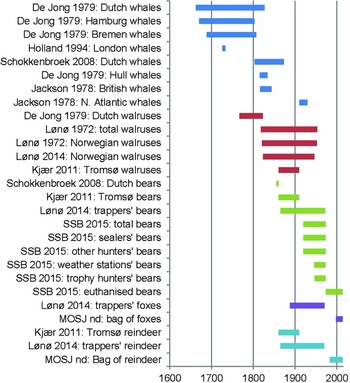
Fig. 1 indicates that a mere seven publications (De Jong, Reference De Jong1979; Holland, Reference Holland1994; Jackson, Reference Jackson1978; Kjær, Reference Kjær2011; Lønø, Reference Lønø1972, Reference Lønø2014; Schokkenbroek, Reference Schokkenbroek2008) coupled with the official statistics of Statistics Norway (SSB, 2015) and MOSJ (n.d.) have given rise to 27 different sets of catch data. The datasets can further be subdivided into those dealing with bowhead whales, Atlantic walruses, polar bears, Arctic foxes and Svalbard reindeer. It is immediately noticeable that no single publication deals with all five species at once and that no dataset spans the full four centuries of human industry. Although each bar of the chart gives a solid impression, they rarely denote continuous data but frequently conceal the fragmented nature of the record. Jackson's (Reference Jackson1978) figures of North Atlantic whaling between 1910 and 1929 make an appearance here to prompt the contemplation if North Atlantic practices at the time spilled over into the southern Arctic Ocean, thus influencing the bowhead whale.
Seven publications, Statistics Norway (SSB) and MOSJ (Miljøvaktning Svalbard og Jan Mayen [Environmental Monitoring of Svalbard and Jan Mayen]) give rise to 27 different sets of historical catch data from Svalbard.

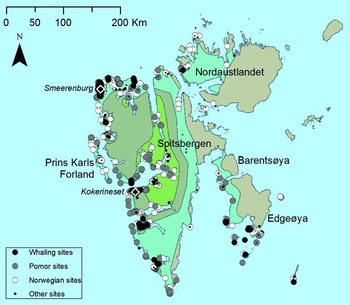
Regarding the archaeological record, Fig. 2 is an illustration of Svalbard's archaeological sites (with the exclusion of Bjørnøya) which are registered in Askeladden and which have been plotted on a base map of biogeographical zones (Norwegian Polar Institute, 2014). Broadly speaking, the biogeographical zones range from the inner fjord zone and middle arctic tundra in the centre and west of the island of Spitsbergen, respectively, via the northern arctic tundra to the Arctic polar desert in eastern Nordaustlandet, Barentsøya and Edgeøya. There is a correlation between the coasts of the inner fjord zone and the middle arctic tundra, and the archaeological sites, that is to say the human preference for occupancy. However, the sites were not in concurrent use. In Fig. 2 they have been plotted according to a simplified chronology with the earliest whaling sites (black) overlapping later Russian Pomor sites (grey), which in turn overlay the yet more recent Norwegian sites (white). The Pomor sites thereby hide many Norwegian sites, but the map nonetheless provides a realistic representation of a busy west coast. This layering only serves as an aid to visualise the spatial scale of past human activities, it by no means suggests that we also find stratified sites in the field. The archaeology of Svalbard is in fact characterised by horizontal stratigraphy – structures in the same place but of different ages commonly do not lie on top of but next to one another. Strictly speaking not all ‘Norwegian’ fur hunting was Norwegian (there were many other nationalities involved) but for the purpose of this paper the term is a permissible shorthand. Other sites (dots) include scientific and mining localities, as well as the remnants of World War II.
Map of Svalbard (excluding Bjørnøya) showing the archaeological sites registered in Askeladden plotted against a background of biogeographical zones. The zones range from the inner fjords and middle arctic tundra in central and west Spitsbergen, respectively, via the northern arctic tundra to the polar desert of the eastern islands. The former Dutch whaling station of Smeerenburg and the Russian Pomor remains at Kokerineset are indicated by diamonds (Askeladden; Norwegian Polar Institute, 2014.)

It is merely possible to plot Svalbard's archaeological sites thematically according to their former industries because Askeladden lacks absolute dates which would otherwise enable the representation of all sites that were contemporaneous, regardless of primary purpose. This is probably not so much a fault of the Norwegian database as of the original archaeological fieldwork. The archives of the Governor of Svalbard in Longyearbyen list 142 international archaeological expeditions between 1955 and 2012. Where reports have been submitted, they are in English, Norwegian or Russian. It remains a task for the future to assess their contents and scientific value thoroughly, but a brief scan revealed that the majority do not reach the high standards nowadays required by, for example, Britain's Chartered Institute for Archaeologists (CIfA, 2014). A quick consultation of 27 reports in the English language showed that these do not include any absolute dates, and hardly any animal bones have been surveyed, recovered and treated in such a way as to allow for comprehensive zooarchaeological analysis and interpretation. Many of the expeditions carried out extensive excavations but how much of the material culture was correctly archived at the Svalbard Museum in Longyearbyen or at similar depositories is not known. Regarding the Russian Pomors, the Svalbard Museum has recently made the commendable effort of processing 1,653 artefacts and ecofacts from seven sites (Wisniewska & Solnes, Reference Wisniewska and Solnes2014). That is an average of 236 items per site. A mammoth 37 Pomor sites are still awaiting digitisation. The record is already widely available online at Norway's Digital Museum (www.digitaltmuseum.no). Askeladden lists 124 Pomor localities, but there are inconsistencies in the record; the number of individual Pomor sites is more likely to be below 90. That means that 44 of 90 Pomor sites are represented in the collections of the Svalbard Museum – with one exception, their faunal remains appear not to have been investigated.
Using the search terms ‘Svalbard’, ‘Spitsbergen’, ‘archaeology’ and ‘faunal remains’, a quick online search on Google Scholar exposes a disappointing peer-reviewed publication effort, at least in the English language. Two localities that have received zooarchaeological attention are the former Dutch whaling station of Smeerenburg and the Pomor site at Kokerineset (Fig. 2). These find further mention in the results below.
Despite this elaborate but necessary source criticism, much valuable catch data could be collated. Historical catch data is essentially the recorded count – not the actual number – of game animals killed in and around Svalbard in the years prior to modern ecological monitoring. One would hope that recent statistics are reliable but poaching is always a possibility, which has not been explored here. The data has undergone very little additional treatment. Where clashes between datasets were noted, one was chosen over another. As such, de Jong's (Reference De Jong1979) whales killed by Hull whalers were removed in favour of Jackson's (Reference Jackson1978) whales killed by British whalers on the assumption that the Hull whalers were included in the latter. There were very minor conflicts in the data concerning walruses. Two events must be mentioned here: de Jong (Reference De Jong1979) records 4,075 walruses killed by Dutch whalers in 1767 and Lønø (Reference Lønø1972) states that 300 walruses perished in 1783. These occurrences are unfortunately invisible in figs 3b and 3f. The total catch of polar bears (SSB, 2015) made room for the datasets concerning the different hunters (SSB, 2015), and the total number of Arctic foxes (Lønø, Reference Lønø2014) could have been subdivided into blue foxes and white foxes (Lønø, Reference Lønø2014), but this was not thought relevant for now. There are only three datasets concerning reindeer and they do not clash.
This historical–archaeological research is rooted in the interdisciplinary concept of historical ecology, which is defined as ‘the study of past ecosystems by charting the change in landscapes over time’ (Crumley, Reference Crumley and Crumley1994, p. 6). To enhance its reach and applicability across different scientific fields, it adheres to the terminology of the millennium ecosystem assessment (Nelson et al., Reference Nelson, Bennett, Berhe, Cassman, DeFries, Dietz, Zurek, Carpenter, Pingali, Bennett and Zurek2005) and of the DPSIR-SES approach (Berkes & Folke, Reference Berkes and Folke1998; Maxim, Spangenberg, & O'Connor, Reference Maxim, Spangenberg and O'Connor2009). According to DPSIR, ‘social and economic developments (driving forces, D) exert pressures (P) on the environment, and as a consequence, the status (S) of the environment changes. This leads to impacts (I) on the ecosystems, human health, and society, which may elicit a societal response (R) that feeds back on driving forces, on state or on impacts via various mitigation, adaptation or curative actions’ (Maxim et al., Reference Maxim, Spangenberg and O'Connor2009, p. 12). To counteract DPSIR's artificial distinction between the human and the natural system, it has been coupled with the notion of socio-ecological systems (SES; Berkes & Folke, Reference Berkes and Folke1998).
For the purposes of this paper, the drivers are predominantly economic, that is to say human-induced. A consideration of natural driving forces is outside its scope. Simply put, since the Barents expedition in 1596, which provided a first record of hunting in Svalbard (De Veer, 1598), there has been continuous demand for different Arctic living resources by European visitors and in the European core region. Anthropogenic pressure subsequently took the form of whaling, sealing and fur hunting; fishing data has not been collected here. Generally speaking, these practices equate to harvest and resource consumption to the point of overexploitation and species removal. Although ‘the point at which harvest and resource consumption pass the critical threshold where they are no longer considered sustainable, and are then categorized as over-exploitation, is not clearly defined’ (Anastasopoulou, Chobotova, Dawson, Kluvankova-Oravska, & Rounsevell, Reference Anastasopoulou, Chobotova, Dawson, Kluvankova-Oravska and Rounsevell2007, p. 24). It is probably highly specific to subpopulation.
As the definition of historical ecology suggests, past ecosystem change in Svalbard is not only a matter of magnitude, that is to say the total number of animals killed, but also of scale and speed (Kruse, Reference Kruse2016). Regarding the spatial scale, archaeological data is likely to only reveal the terrestrial coverage until the archaeological cut-off date after 1945, while documentary evidence must be relied on to provide the historical range over which marine mammals were pursued. The temporal scale, which will give rise to the speed of depletion, can be sought across the sources. The changing status of islands’ terrestrial and marine ecosystems will be the subject of a follow-up publication. Other species, as well as the impact of and societal response to the dramatic Arctic hunt, will be treated in upcoming original research.
Results and Discussion
Published sources
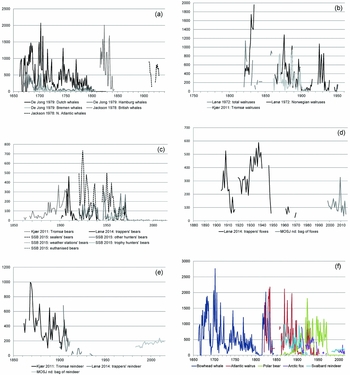
The historical catch data derived from published sources has been plotted as simple line charts (Figs 3a–f). Line charts are typically used to illustrate trends in data over selected time intervals. Isolated occurrences like the aforementioned large catches of walruses (4,075 in 1767 and 300 in 1783) are unfortunately lost in this type of illustration, but they are picked up again in the visualisation of running total catches (Fig. 4).
Line charts showing the catches per year of a. bowhead whales (B. mysticetus) (De Jong, Reference De Jong1979; Jackson, Reference Jackson1978), b. Atlantic walruses (O. rosmarus rosmarus) (Lønø, Reference Lønø1972; Kjær, Reference Kjær2011), c. polar bears (U. maritimus) (Kjær, Reference Kjær2011; Lønø, Reference Lønø2014; SSB, 2015), d. Arctic foxes (V. lagopus) (Lønø, Reference Lønø2014; MOSJ, n.d.), and e. Svalbard reindeer (R. tarandus platyrynchus) (Kjær, Reference Kjær2011; Lønø, Reference Lønø2014; MOSJ, nd). f. Line chart comparing the total catches of five different game animals in Svalbard per year (De Jong, Reference De Jong1979; Jackson, Reference Jackson1978; Kjær, Reference Kjær2011; Lønø, Reference Lønø1972, Reference Lønø2014; MOSJ, n.d.; SSB, 2015).

Composite image comparing the running totals of catches of five different game animals in Svalbard per year against a background of the main industrial periods in the archipelago over time. The total number of animals killed and the years of the species’ protection are emphasised. In addition to the periods of whaling and hunting, scientific exploration of the interior began in 1827, a first cruise ship visited Spitsbergen in 1881 and an initial commercial shipment of coal took place in 1899. As yet, the running totals do not reflect the impact of hunting from all industries (Sources: Arlov, Reference Arlov1989; De Jong, Reference De Jong1979; Jackson, Reference Jackson1978; Kjær, Reference Kjær2011; Kruse, Reference Kruse2016; Lønø, Reference Lønø1972, Reference Lønø2014; MOSJ, n.d.; Reilly, Reference Reilly2009; SSB, 2015; Thuesen, Reference Thuesen2005).

Bowhead whale
Fig. 3a primarily shows data on the bowhead whale, although with technological progress over time faster whale species were also hunted, and a clear distinction between the different species is not always made in the historical sources. Hacquebord (Reference Hacquebord1999) has reconstructed the former range of the Svalbard–Barents Sea (Spitsbergen) subpopulation; the International Union for Conservation of Nature and Natural Resources (IUCN) provides a current distribution map (Reilly et al., Reference Reilly, Bannister, Best, Brown, Brownell, Butterworth and Zerbini2012). The whaling of the Spitsbergen stock across its former range to the east of Greenland was known as the Greenland Fishery. Care has been taken to only include catch data from this Greenland Fishery as opposed to that of the Davis Strait Fishery to the west of Greenland, which concerns a different subpopulation. The distinction between the two fisheries in the historical sources is often problematic. At the scale of the line chart, the sporadic data of Holland (Reference Holland1994) and Schokkenbroek (Reference Schokkenbroek2008) on whales caught by London and Dutch whalers, respectively, is practically invisible, so it has not been plotted. It has, however, been included again in Figs 3f and 4.
Whaling history has long been a popular research topic, and the bowhead whale is consequently the best-studied of the game animals in this paper. Still, we must consider if the data comprises any research bias. Although English whalers killed a first bowhead whale off Spitsbergen in 1611, there is, for example, no consistent catch data until 1662. The record of the Dutch and German hunt from this date until the Napoleonic wars (1803–1815) is mostly reliable. Jackson's (Reference Jackson1978) choice to study British Arctic whaling from 1816 onwards gives the impression that the British industry appeared out of nowhere at this time to then dwindle in the early 1840s. Similarly, North Atlantic whaling in the first quarter of the twentieth century (Jackson, Reference Jackson1978) seems to just pop up. What of the Basques, the Norwegians, the Russians and other whaling nations? The study of primary resources may resolve this issue, but that is not yet the concern of this paper. It is, however, an absolute necessity to realise how such research gaps cause and influence apparent trends in the data.
Fig. 3a reveals peaks in Dutch and German catches at the beginning of the eighteenth century, which subsequently fall away over the next 100 years. It is not as easy to discern a similar pattern of early success followed by gradual recession in the British data. The yearly fluctuations are immense both in magnitude and speed. In some cases, the absence of whalers is directly related to the occurrence of European wars (Anglo-Dutch wars 1665–1667, 1672–1674, 1780–1784; French Revolutionary War 1795–1802; Napoleonic wars 1803–1815), but most fluctuations will probably have had primary economic causes combined with a multitude of secondary socio-political reasons as well as natural phenomena. None of these have been explored here. Although Dutch and British whaling prior to the 1840s are particularly well-studied, Jackson's (Reference Jackson1978) North Atlantic data has again been included to emphasise that whaling continued beyond these and other research biases. Norwegian Arctic whaling, for example, is an obvious omission (Gustafsson, Reference Gustafsson and Ringstad2010; Schokkenbroek, Reference Schokkenbroek and Ringstad2010). After 320 years of whaling in the Greenland Fishery, the bowhead whale was first protected under the 1931 League of Nations Convention (NOAA Fisheries, Reference Fisheries2013). Today, the Spitsbergen stock (and genetic analyses will have to show if there still is a Spitsbergen stock) is listed as endangered on the IUCN Red List of Threatened Species. The global population of bowhead whales, however, is of least concern (Reilly et al., Reference Reilly, Bannister, Best, Brown, Brownell, Butterworth and Zerbini2012).
Atlantic walrus
Fig. 3b concerns the Atlantic walrus. A former range of a possible Spitsbergen subpopulation at the time of early whalers and sealers has not yet been reconstructed. Gjertz and Wiig (Reference Gjertz and Wiig1994) presented the past and present distribution of walruses in Svalbard and its surrounding seas, but their former range will probably have been much larger. Lowry, Kovacs, and Burkanov (Reference Lowry, Kovacs and Burkanov2008) proposed the modern range of a Barents Sea–Kara Sea subpopulation to include most of Svalbard, Zemlya Frantsa-Iosifa (Franz Josef Land) and Novaya Zemlya – but to exclude Bjørnøya (Bear Island) and Jan Mayen. The authors suggested a separate stock along the east coast of Greenland. The published sources of catch data do not clearly define their spatial scales, but they usually place Svalbard at their centre. As with the bowhead whale above, due to the scale of the line chart, both de Jong (Reference De Jong1979) and Lønø (Reference Lønø2014) have been disregarded, to be added again to later figures. For the most part, Lønø (Reference Lønø1972) does not supply tabulated data, so the yearly catch has been estimated from his column graphs.
Unlike the bowhead whale, the Atlantic walrus is not a very well recorded and therefore a less well-studied species of game animal. One simple reason may be that whales were large enough to be counted individually; even a single whale provided a considerable amount of blubber and baleen. Walruses were of a size where the animals were sometimes counted individually, especially by wintering hunters for whom they were an exceptional kill. Most sealers, however, recorded their catch in terms of tons of blubber. A count of the walrus tusks would have been a useful indication of the number of animals killed, but tusks, too, were simply weighed. This paper is based only on the count of individuals where it could be traced.
Based on Poole (1604–1609), Gjertz and Wiig (Reference Gjertz and Wiig1994) stated that a first walrus was killed at Bjørnøya in 1604. It is therefore remarkable that Fig. 3b only indicates a first data point after 214 years in 1818. Gjertz and Wiig (Reference Gjertz and Wiig1994) conducted a search of all books, trappers’ diaries, sealing vessel logbooks, journals and scientific literature in the archives of the Norwegian Polar Institute for any reference to walruses. Although they were thorough, they realised their survey was not complete. Some international primary documents were consulted where copies were at hand, but the archives in Tromsø understandably have a Norwegian focus. The gross of historical documents in the Netherlands, Great Britain, Germany, Russia and other nations that participated in the Arctic hunt were not read. In this paper, we will not yet come to know how many walruses were harvested before 1818.
Fig. 3b does thus not reveal all commercial hunting of a possible Spitsbergen stock of Atlantic walrus that ever took place. It merely shows three apparent Norwegian phases: the first in the 1820s and 1830s, the second from the 1860s until World War I, and the last between the 1920s and 1940s. As with the bowhead whales, these phases appear to be characterised by a rapid expansion followed by a more gradual decline. Again, there are considerable absences and substantial fluctuations in magnitude and speed, the causes of which will invariably have been a combination of economic, socio-political and natural factors. It is noteworthy that in some years, the Tromsø sealing fleet completely dominated the industry, but from the chart it is not clear if this was a reality or if data from other Norwegians towns, such as Hammerfest and Vardø, is as yet missing. In 1952, the walruses in Svalbard were totally protected (Wiig, Born, & Stewart, Reference Wiig, Born and Stewart2014). In the Soviet Arctic, an initial ban on ship-based hunting in 1934 was superseded by a total ban in 1956. The Norwegian–Russian Sealing Agreement of 1958 confirmed these prohibitions. Today, Svalbard numbers are increasing slowly but the overall population trend is unknown (Lowry, Kovacs, & Burkanov, Reference Lowry, Kovacs and Burkanov2008). The walrus is listed as ‘data deficient’ in the IUCN Red List.
Polar bear
Fig. 3c presents data for the polar bear. It is probably unlikely that its former distribution differed greatly from today's. Wiig et al. (Reference Wiig, Amstrup, Atwood, Laidre, Lunn, Obbard and Thiemann2015) summarise that the modern polar bear can be found throughout the ice-covered waters of the Arctic, usually roaming in the annual ice of the continental shelves or inter-island archipelagos around the polar basin. Currently, 19 subpopulations are recognised, of which the Barents Sea subpopulation is one, but they are not completely distinct and gene flow occurs. Conservationists more adequately think in terms of management areas. While there is insufficient data to discern the population trend of the Barents Sea subpopulation, the global polar bear population is considered ‘vulnerable’ (Wiig et al., Reference Wiig, Amstrup, Atwood, Laidre, Lunn, Obbard and Thiemann2015).
Due to recurring visibility issues, Schokkenbroek's (Reference Schokkenbroek2008) nine polar bears reportedly killed by Dutch whalers have not been plotted. These were by no means the only polar bears killed by whalers, but Schokkenbroek's (Reference Schokkenbroek2008) example once again serves as a reminder that other nations and other industries were engaged in the hunt over time. The accessible sources deal for the most part with Norwegian hunters after 1855. Lacking other continuous data, the commercial hunt was at first seemingly dominated by the Tromsø sealing fleet of the late nineteenth century. For a brief period at the beginning of the twentieth century, wintering trappers in Svalbard took over and although they were not absent during World War I there is a marked reduction in catch data. The switch from one dataset (Lønø, Reference Lønø2014) to another (SSB, 2015) probably causes an artificial break prior to 1920. From 1920, catch data is available from Statistics Norway (SSB, 2015). A simple plot of the total number of polar bears killed until 2014 would have made for a tidier chart. However, the separation into the different Norwegian groups shows firstly the nature of those involved in the hunt and secondly some trends over time. As such, sealers and fur hunters had been around the longest. However, after World War II, which had seen the evacuation of all residents from Svalbard, the staff of weather stations had an increasing impact on the polar bear and, although trophy hunting was by no means new, a record was now being kept of this too. There is no knowing how many polar bears perished unrecorded. In 1973, Canada, Denmark (Greenland), Norway, the Soviet Union and the USA signed the International Agreement on the Conservation of Polar Bears. The species is now completely protected in Svalbard. Yet, there continue to be frequent confrontations between humans and polar bears, and in most years since 1973, polar bears have been ‘euthanised’ as a precautionary measure (Gjertz & Persen, Reference Gjertz and Persen1987; SSB, 2015).
Lønø’s (Reference Lønø2014) catch data for wintering trappers overlaps with Statistics Norway's (SSB, 2015) catch data for ‘other hunters’ between 1920 and 1973. It is thought that ‘other hunters’ were all commercial hunters with the exception of sealers. For the most part, this will have comprised wintering trappers; it is difficult to discern who else would have been in this group. It is therefore surprising that there is a substantial discrepancy between the datasets; without providing a clear reference to its source, Statistics Norway's (SSB, 2015) catch data is on average 7.3 bears per year higher than Lønø’s (Reference Lønø2014) record. It is difficult to establish where the discrepancy comes from and which dataset is more reliable.
Arctic fox
Fig. 3d shows data on the Arctic fox. Although its distribution at the time of Willem Barents has not been reconstructed, the animal is known to have lived along the ice edge during the last glaciation and has since had a circumpolar distribution in all arctic tundra habitats (Angerbjörn & Tannerfeldt, Reference Angerbjörn and Tannerfeldt2014). Angerbjörn and Tannerfeldt (Reference Angerbjörn and Tannerfeldt2014) list the Arctic fox as a native to both Svalbard and Jan Mayen, but hunting has led to the extinction of the species on Jan Mayen. In Svalbard, the animals enjoy relatively stable food availability and have therefore adopted a generalist strategy. Since they also feed on carrion left by other predators, such as the polar bear, whom they follow across the sea ice, vagrant foxes have been observed as far from land as the North Pole (Angerbjörn & Tannerfeldt, Reference Angerbjörn and Tannerfeldt2014). The Arctic fox is generally not protected but hunting bans have been introduced in Sweden in 1928, mainland Norway in 1930 and Finland in 1940. In Svalbard, trapping has never been prohibited but it is regulated by licensing. Since 1998, MOSJ (n.d.) records the yearly catch of Arctic foxes. With the exception of Fennoscandia, the global population is stable and the species is generally of least concern.
The line chart comprises a mere two datasets, a historical one and a modern one, both of which concern Norwegian trappers. It is remarkable in what it does not show about Arctic fox hunting: no other nations, no other industries and, even within the Norwegian sources, no consideration of different groups of hunters. Nonetheless, Lønø’s (Reference Lønø2014) catch data for wintering trappers between 1888 and 1970 provides food for thought. First, infrequent data is not visible prior to 1904, when the catch data becomes mostly continuous. Yet, the gaps in the record should most certainly not be filled with zeroes because this would suggest no catch that year as opposed to no record of a catch that year. The difference is not trivial; an ill-placed zero would falsify the record.
Second, there again seem to be exploitative phases. Large catches were made in the early twentieth century, which subsided, but did not stop completely during World War I. Since the hunting of the Arctic fox went hand in hand with the pursuit of the polar bear, prices sometimes favouring one over the other, a comparison with Fig. 3c is in order. The comparison in fact reveals that the pre-war pattern for both species is very similar. The inter-war years saw large catches with a decreasing trend for the polar bear, which culminates in the human absence during World War II. Interestingly, the catches of Arctic fox seem to increase over the same period but are also disrupted by the war. It is possible that both decreasing polar bear catches and a ban of Arctic fox hunting in Sweden and mainland Norway caused the sharp rise after 1928. While there is a fairly reliable post-war record for the polar bear, the intermittent data for the Arctic fox only suggests that some foxes were still being caught or, better, that some catches were still being recorded. With the total protection of the polar bear in 1973, the Arctic fox, too, may have entered a recovery period. With the advent of systematic monitoring in 1998 (MOSJ, n.d.), the record of catch data has become the most reliable yet.
Svalbard reindeer
Fig. 3e concerns the Svalbard reindeer. Generally, reindeer (Rangifer tarandus) can be found in the tundra and taiga zones of the Arctic. Henttonen and Tikhonov (Reference Henttonen and Tikhonov2008) explain that the Svalbard reindeer is a separate subspecies, which the authors’ distribution map indicates to only occur in certain parts of the islands of Spitsbergen, Nordaustlandet, Edgeøya and Kong Karls Land (Bjørnøya and Jan Mayen have not been included). A historical reconstruction of their range is not known, but it would be interesting to see if it had been equally patchy and if the patchiness changed over time.
Again, there are few sources that provide some continuous catch data and these suggest that the historical hunt for Svalbard reindeer by Tromsø sealers and wintering Norwegian trappers was quite dramatic compared to today's management practices (MOSJ, n.d.). The catches in the late nineteenth century are large, as are the yearly fluctuations. An overall downward trend into the beginning of the twentieth century is very noticeable. This could, of course, indicate a change in demand but it is more likely to reflect the demise of the Svalbard reindeer. With the ratification of the Spitsbergen Treaty in 1925, which granted sovereignty to Norway, the subspecies became the first of the archipelago's game animals to be protected, before the bowhead whale (1931), the Atlantic walrus (1952) and the polar bear (1973). Despite the protection, Lønø (Reference Lønø2014) reports some catches for the mid-1930s and it is thinkable that poaching continued. Yet, the Svalbard reindeer on the whole recovered very well. In 1983, its protection was lifted and licensed shooting ensued. MOSJ's (n.d.) gradually increasing catch of reindeer mirrors the steadily growing population. Careful monitoring and yearly hunting quotas keep large fluctuations in catch numbers under control. The current population trend is stable and both the species and the subspecies are of least concern.
Total annual catches
Due to the research bias and knowledge gaps, the charts above offer only limited new insights into the historical hunt in Svalbard by themselves. They can hardly be used to draw far-reaching conclusions. Yet, besides collating and quantifying the available catch data for the first time, another important contribution of this paper is its comparative aspect. Hence, Fig. 3f shows what happens when the total annual catches of each of the five key species are plotted side by side. Despite the many shortcomings, there are apparent trends which find brief mention here but which must be fully investigated at a future stage.
First, there appears to be a substitution of one species of game animal for another over time. This may seem logical – as one living resource is depleted, another takes its place, especially where the substitute provides a similar product such as blubber or fur. In this case, however, this trend is definitely the result of former nationalistic research agendas and cannot be taken at face value. Nonetheless, renewed comprehensive research may yet reveal that a substitution of species did indeed take place.
Second, Jackson's (Reference Jackson1978) count of whales flensed by British whalers in the early nineteenth century overlaps in magnitude, scale and speed with Lønø’s (Reference Lønø1972) data on walruses killed predominantly by Norwegians during the same period. While the catch of whales appears to be decreasing, the catch of walruses is rising. This may or may not be a coincidence; any causal connections across the two nations and the two different industries are not immediately obvious. It is unlikely that the whalers and the sealers supplied the same national markets. Perhaps the global demand for the products of Arctic marine mammals was unexpectedly great and uniform at the time. Although the paper cannot provide answers, it is important that a comparative line chart of catch data can give rise to insights of this kind which in turn warrant further investigation.
Third, the Tromsø sealing fleet not only put considerable pressure on walruses between 1867 and 1909 (Kjær, Reference Kjær2011) but also on Svalbard reindeer and increasingly on the polar bear. The causes and impacts of this multi-game hunt are valuable research topics to pursue.
Fourth, as already mentioned above, the decreasing catch data of the polar bear after 1920 (SSB, 2015) seemingly goes hand in hand with an increase in the number of Arctic foxes caught (Lønø, Reference Lønø2014).
Finally, if and how whaling in the North Atlantic (Jackson, Reference Jackson1978) and the closing years of the walrus hunt (Lønø, Reference Lønø1972) are related is as yet unknown.
Running totals
To allow for a second comparative dimension, the running totals of the catch data for each species are illustrated in Fig. 4. There is an emphasis on the total number of animals killed as per the data collated in this paper as well as the year in which the species were protected in Svalbard, which should bring a respective line to an end. However, the 1925 hunting ban on the Svalbard reindeer was lifted in 1983, and despite their protection since 1973, some polar bears continue to be shot preventatively in most years. The running totals are plotted against a background of grey bars that indicate the duration of some major historical industries in Svalbard, of which some persist today.
The period of European whaling and the pursuit of the bowhead whale after 1611 suffers from a lack of continuous catch data until 1662, after which the industry was dominated by Dutch and German whalers. The running total illustrates very well their exit during the Napoleonic wars, which may have been a brief respite for the bowhead whale. The next steep rise is caused by the British participation between 1816 and 1842. With the British withdrawal, this period characterised by whaling practically ends, although Schokkenbroek (Reference Schokkenbroek2008) has shown that a small Dutch endeavour with very little impact persisted until 1873. A study of twentieth century Norwegian whaling and its impact on the remnants of the bowhead whale subpopulation is eagerly awaited. Despite this omission, whaling and the catch of whales are still the best-studied and most complete compared to the other industries and game animals.
The Atlantic walrus, for example, was already an attractive bycatch throughout the whaling period, but very little quantitative data has as yet been extracted from the primary sources. During the time of the Russian hunters, the so-called Pomors from the White Sea region, from about 1709 till 1852, the walrus was the primary target. Yet, there is barely any information available in English online sources about the Pomors in Svalbar or their catch data. Similarly, few walruses were seemingly killed by Norwegian hunters after they made their first appearance in 1785. Over time, what is attributed here to Norwegian hunting took many forms. At different stages, it included wintering trappers, sealers, weather station staff and trophy hunters. Whereas the walrus hunt concluded with its protection in 1952, Norwegian hunting of other game continues to this day in a highly regulated fashion.
More delayed still than the first continuous catch data for the Atlantic walrus are the first regular records for the polar bear, the Arctic fox and the Svalbard reindeer. These records are also exclusively related to Norwegian hunters. Neither the early pressures of whalers and Pomors nor the later pressures of hunters among the scientists, tourists and miners have been taken into consideration. It is an interesting flaw that only the primary goals of whaling, walrus hunting, scientific exploration, touring and mining have been previous research foci, while secondary objectives and their significant environmental impacts have not received much attention let alone quantification. Therefore, Fig. 4 is again a very skewed but significant illustration. As before, the impression of a substitution of species is not necessarily real. Yet, it is impossible to propose what a realistic figure should look like. The lines indicating total catches would in all likelihood start much earlier, that is to say with the arrival of the Barents expedition in 1596, and would show a greater increase than what is illustrated in this paper. Fig. 4 makes a clear case for filling the knowledge gaps.
Archaeological data
The wealth of historical documents that span more than four centuries of human presence in Svalbard is complemented by a rich archaeological record, which forms the focus of this section. It should theoretically be possible to compare the catch data derived from written sources with the animal remains from contemporaneous archaeological sites. However, few of the excavated sites have received specialist zooarchaeological attention. Two positive and promising examples of zooarchaeological analysis are the former Dutch whaling station of Smeerenburg and the Pomor remains at Kokerineset (Fig. 2). Their results are summarised here to provide an indication of their historical ecological potential.
Smeerenburg is situated on Amsterdamøya to the northwest of Spitsbergen. The whaling station was used mostly in summer from 1614 until around 1660. Wintering was attempted twice in 1633–1634 and 1634–1635, but the latter ended in the death of all participants. The material remains of Smeerenburg comprise seven tryworks, each with flensing platforms, blubber ovens and living quarters. Archaeological excavations took place in 1979, 1980 and 1981 (Hacquebord, Reference Hacquebord1984). The excellent conditions for the preservation of organic materials are evident in the survival and subsequent recovery of textiles, leather, hair, egg shells, feathers, baleen, nuts, fruits and fragile bird bones among other valuable ecofacts.
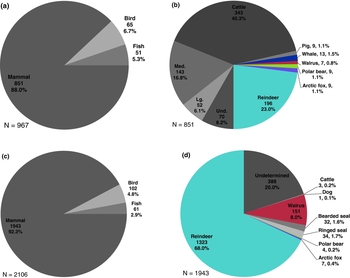
With the exception perhaps of surface finds, which do not find any mention in the publications, all animal remains from the Smeerenburg excavations were collected. Van Wijngaarden-Bakker (Reference Van Wijngaarden-Bakker and Hacquebord1984, Reference Van Wijngaarden-Bakker1987) undertook the analysis of one of the three sites known as SMB III. Fig. 5a shows a total of 967 animal bones and bone fragments from SMB III. The majority originated from mammals (88.0%), while birds (6.7%) and fish (5.3%) are also represented. Due to this paper's focus on mammals, bird and fish bones are disregarded. Of the mammal remains, the species could be determined for approximately 70% (n = 851) (Fig. 5b). As for the five key species, whale (1.5%), Atlantic walrus (0.8%), polar bear (1.1%) and Arctic fox (1.1%) are all present, but this mere presence is far outweighed by the remains of reindeer amounting to at least 23.0%, not including any undetermined remains. Reindeer bones are second only to the number of cattle remains (40.3%).
Pie charts showing the distribution of a. classes among the animal remains (n = 967) and b. species among the mammal remains (n = 851) recovered from site SMB III at Smeerenburg (Van Wijngaarden-Bakker, Reference Van Wijngaarden-Bakker and Hacquebord1984), and c. classes among the animal remains (n = 2,106) and d. species among the mammal remains (n = 1943) recovered from Kokerineset (Aalders, 2012). Und: Undetermined. Lg: Large mammals. Med: Medium mammals.

Van Wijngaarden-Bakker (Reference Van Wijngaarden-Bakker and Hacquebord1984) draws the conclusion that the whalers supplemented their diet, which included beef and to a much lesser extent pork (pig 1.1%), with the fresh meat of reindeer. The Svalbard reindeer thus achieves a much greater visibility and prominence in the archaeological record than in the documentary sources. Van Wijngaarden-Bakker (Reference Van Wijngaarden-Bakker and Hacquebord1984) also points out that from the zooarchaeological material alone, one would be very hard-pressed indeed to recognise Smeerenburg's primary purpose as a whaling station. As with the written evidence, the archaeological record is apparently skewed. Whereas the documents favour nations, industries and economies, the archaeology, at least at Smeerenburg, reconstructs daily lives and sustenance.
The archaeological site of Kokerineset is situated on the western shore of Grønfjorden. Across the bay at a distance of about 3 km lies the Russian mining town of Barentsburg. Kokerineset was used by whalers in the seventeenth century, Pomors in the eighteenth century, Norwegian hunters in the nineteenth century and as an anchorage for floating factory ships in the early twentieth century (Aalders, Reference Aalders and Hacquebord2012). Archaeological excavations in 2007 and 2008 concentrated on the Pomor material remains comprising four wooden structures, probably houses (Aalders, Reference Aalders and Hacquebord2012). Radiocarbon dating provides a date range between 180 ± 25 bp (before present) and 135 ± 15 bp, thus placing the Pomor occupation not in the eighteenth but in the nineteenth century, keeping in mind that their last recorded wintering took place in 1851–1852. Surface finds again appear not to have been taken into account. During the excavations, all animal remains were systematically collected.
The analysis of the animal remains was undertaken by Aalders (Reference Aalders and Hacquebord2012). There is a methodological issue in that part of a human skull fragment was found under the floor boards of one of the structures, which she does not consider for the reason of it not being an animal bone (Y.I. Aalders, personal communication, 2010). This lacks an appreciation for the taphonomic conditions and processes that lead to archaeological site formation. An Arctic fox could have taken this bone from the nearby graves and brought it here, just as it may have brought in or taken away many other bones, thereby affecting the original assemblage. Wherever it came from, the human bone must be counted.
Nevertheless, Aalders’ (Reference Aalders and Hacquebord2012) analysis of a total of 2,106 animal bones and bone fragments (Fig. 5c) suggests that the distribution of remains originating from mammals (92.3%), birds (4.8%) and fish (2.9%) is not dissimilar to that of Smeerenburg. The species of approximately 80% of the mammal bones (n = 1,943) could be determined. The distribution of species, however, differs greatly from that of Smeerenburg (Fig. 5d). As many as 151 fragments (8.0%) could be attributed to the Atlantic walrus – 138 cranium, two mandible and 11 teeth fragments. There are only minor findings of polar bear and Arctic fox as well as cattle and dog, but they are present nonetheless. Van Wijngaarden-Bakker (Reference Van Wijngaarden-Bakker and Hacquebord1984) makes a point of referring to the absence of ring seal (Pusa hispida) and bearded seal (Erignathus barbatus), at least in SMB III, while at Kokerineset, ring seal (1.7%) and bearded seal (1.6%) are both represented in the mammal assemblage (Fig. 5d). Above all, the mammal bones at Kokerineset are dominated by the Svalbard reindeer with 68.0%. All body parts are accounted for, suggesting that whole animals were brought to and processed on site.
Aalders’ (Reference Aalders and Hacquebord2012) conclusions mix real, timely and important observations with some unfounded conjecture. Based on the zooarchaeological material alone, van Wijngaarden-Bakker would again fail to recognise a whaling station – which was of course never the primary purpose of these excavated Pomor structures. The question is, however, if 151 walrus skull fragments, from an unknown number of individuals but with clear signs of the tusks having been broken out, constitute the primary purpose of a walrus hunting station. As with Smeerenburg, the marine focus of Kokerineset is underrepresented in its archaeological record and a commercial function is very difficult to assign at face value.
Like van Wijngaarden-Bakker (Reference Van Wijngaarden-Bakker and Hacquebord1984), Aalders (Reference Aalders and Hacquebord2012) deduces that the Svalbard reindeer played an important role, if not the most important role, in the Pomor diet. Again, the unassuming reindeer attains a prominence in the excavations unobserved in any documentary sources. The excavations and the zooarchaeological material are all the more important because there are barely any written sources to speak of from the Pomor period. Aalders (Reference Aalders and Hacquebord2012) suggests that reindeer hide and antlers could also have been used commercially, but the question is how to prove this and other assumptions about Pomor hunting and trading archaeologically. Similarly, whether Pomor practices led to the overexploitation of the primary prey cannot be discerned using a single archaeological site.
Conclusion
This study of historical catch data from Svalbard pursued three lines of enquiry. The following section highlights the most important findings and discusses additional issues arising from them.
First, the desk-based collation of historical catch data has been a worthwhile exercise, but the outcome has only been moderately successful due to the fact that there are few readily accessible publications on the subject. None of the datasets cover all game animals, all human industry or the total 420 years of human presence in Svalbard. Therefore, the quantification of the catch data is incomplete. Nevertheless, the visualisation of this incomplete and practically untreated catch data is a powerful tool, which gave rise to expressive and instructive charts of annual catches and of zooarchaeological remains.
Second, in its present fragmentary state, historical catch data may infer but does not suitably indicate, let alone measure, long-term anthropogenic pressure on land and at sea. Despite the large amounts of historical catch data that has already been generated, there are many crucial gaps in the record. These knowledge gaps hinder meaningful analytical progress and render any attempts at interpretation largely inconclusive. The charts in the results section begin to depict the magnitude, scale and speed of the commercial hunt in Svalbard; they even hint at an underlying threat of overexploitation and species extinction. Gaps in the data must be closed to arrive at running totals that truthfully reflect the numbers of animals killed and removed from Arctic ecosystems over the last four centuries.
Third, only renewed original research can retrieve previously overlooked data from documentary and archaeological sources. Since this study may have exhausted the historical catch data available from readily accessible publications, it is not thought likely that the existing knowledge gaps can be closed simply by consulting more publications. Prior to the renewed research drive, the spatial and temporal scales should be carefully delineated. It is therefore useful to look at the task ahead not from the human perspective, that is to say from the perspective of any nation or industry or market, from a perspective focussed on changes in game animal populations. The collective human impact on the bowhead whale, for example, can only be fully understood under two circumstances: if one does not take the islands of Svalbard as the spatial focus but concentrates on the whole historical range, that is to say the Greenland Fishery, over which whaling will have taken place, and if one takes the whole period from 1596 to present into consideration, outlining not only all hunting but also any recovery periods. Unusual for any historian and archaeologist, the animals are thus the point of departure, and incoming humans subsequently put them under pressure.
Accounts of this human pressure can be found in the archives, libraries and collections of Germany, Great Britain, the Netherlands, Norway, Russia, Sweden, the USA and any other nation whose citizens participated either primarily or as a pastime in the hunt of animals in Svalbard over time. First-hand accounts, such as logbooks, diaries, journals, books and scientific literature, alongside trade registers and customs records must be maximised. Retold versions are not a priority because environmental data is often the first detail to be discarded in the re-telling. On the subject of maximising the written evidence, it would be an invaluable project to digitise and freely disseminate all historical documents, thereby making Svalbard history widely available to interdisciplinary research.
The archaeological reports available from the archives of the Governor of Svalbard in Longyearbyen and any associated publications must be assessed for their zooarchaeological content. In fact, it would be a great service to the understanding of Svalbard's human past if the reports and publications could be assessed for their full archaeological potential. This could form the basis of a much needed archaeological research framework for Svalbard, outlining the current state of archaeological knowledge, formulating the most pressing research questions, and guiding future research directions and projects.
The collections at the Svalbard Museum must also be assessed for their faunal remains and zooarchaeological potential. Such an evaluation could at the same time look into the possibility of applying modern archaeological science to the artefacts and ecofacts to address crucial issues such as the absolute dating of Svalbard's archaeological sites.
In light of the archaeological reports and museum collections being so rich yet so little analysed and understood. In light of the archaeological reports and museum collections being so rich, yet so little analysed and understood, there is a need for increased attention on such material. It would, however, be useful if the archaeological landscape of Svalbard were studied to greater detail and if marine mammal bones on raised beaches, which may lend themselves to genomic research, were registered. The detailed survey of surface bone scatters at known archaeological sites would advance historical ecology as would the application of archaeological survey to hunters’ cabins and other sites that are too recent to fall under protection as cultural heritage. The bone assemblages of modern sites, too, are a material indication of the human impact on ecosystems. So while excavation for research purposes may currently be unnecessary, creative and innovative survey work will yet add an invaluable dimension.
As for the key species of this paper, some guiding questions may be formulated for further historical–archaeological research. These quickly and intentionally spill over into the realm of the life sciences. Concerning the bowhead whale, for example, who were all the nations involved in whaling? How many whales were killed between 1611 and 1662? How many whales were killed after 1842? Were the whales in question always bowhead whales as opposed to other species? Can genetic analyses tell if an original Svalbard subpopulation survives? How did the removal of the bowhead (and other whales) affect the Svalbard ecosystem and marine food web? To answer the latter, complementary interdisciplinary research, for example into the historical distribution and size of bird colonies, could be carried out.
In the case of the Atlantic walrus, the historical range of a possible Svalbard subpopulation needs to be better defined. Better catch data must be sought for the whaling period from logbooks and other primary sources. Does the Pomor Museum in Vardø hold data for the Pomor period in Svalbard? What was the involvement and impact of the Hammerfest and Vardø sealing fleets? Can genetic analyses say anything about an original and present-day Svalbard stock? How can the impact of the walrus hunt on the ecosystem and food web best be assessed?
For the polar bear and Arctic fox, there is very little historical catch data prior to the Norwegian industries. For the Arctic fox, only the trappers’ catches are known but not that of other hunters.
Because of its initial unassuming role in sustenance rather than commercial hunting, the Svalbard reindeer is somewhat a special case. An attempt should be made to reconstruct its historical range in the archipelago, including the outermost islands. Historical data is almost entirely lacking, yet the Svalbard reindeer is very prominent on archaeological sites. This will most likely also be the case in the museum collections. What did the excessive hunt of the Svalbard reindeer mean for the terrestrial ecosystem and food web?
In conclusion, the data at the centre of this paper is the readily available historical catch data for five species of game animal in Svalbard since 1596. It has only partially been possible to collate and quantify this data. The piecemeal record is not a suitable indicator of anthropogenic pressure on archipelago's marine and terrestrial environments. The objective of renewed archival and archaeological research would be to fill the existing knowledge gaps. The goal would be to add crucial data and much needed time-depth to the understanding of long-term human impacts on this Arctic ecosystem.
Acknowledgements
I am grateful to Maarten Loonen for his unwavering enthusiasm and valuable thoughts on the original manuscript. I thank the two anonymous reviewers for their constructive criticism.
Financial support
This study forms part of the research project Ecological consequences of four hundred years resource exploitation in Svalbard within the core project Anthropogenic impact on Svalbard ecosystems. This work is supported by the Netherlands Organisation for Scientific Research (NWO) (grant number 866.12.405).
Conflicts of interest
None.