Only a decade ago, a very few researchers considered the study of language disorders in bilingual population worth pursuing. It was mostly argued that there were enough challenges in studying bilingualism, and even more challenges in the study of specific language impairment (SLI). So why complicate things and combine the two domains?
The large waves of migration in recent years led to a growth in the number of children being raised in multilingual societies, and elucidated the importance of studying language disorders in bilingual children. In Israel, for example, these demographic changes yield an extremely diverse population. According to the Central Bureau of Statistics (CBS) and the Ministry of Education, 20% of school children who attended Hebrew-speaking secular schools in 2004 came from families in which at least one parent did not speak Hebrew (CBS, 2006).
Among the few researchers who rose to the challenges posed by looking at bilingualism and SLI were Paradis and her collaborators (Paradis, Reference Paradis1999; Paradis & Crago, Reference Paradis and Crago2000), whose research paved the way for the study of bilingual SLI (BISLI). In the Keynote Article, Paradis takes us from the first studies that compared the use of verb morphosyntax by monolingual children with SLI and that of bilingual children to the present challenges posed by the study of BISLI, focusing on the many studies of verbal morphology in this population. This Commentary follows Paradis' lead in arguing that bilingualism and SLI are not “two of a kind” (Crago & Paradis, Reference Crago, Paradis, Levy and Schaeffer2003), and that bilingual children with SLI do not show a “double delay.” Data from English–Hebrew and Russian–Hebrew bilinguals with typical linguistic development (TLD) and with SLI are presented to support the claim that impaired bilinguals achieve levels of morphosyntactic knowledge similar to impaired monolinguals. Finally, the commentary addresses Paradis' suggestion that “learning one language bootstraps the learning of a second one” (p. 29), arguing along with Roeper (Reference Roeper2009) that bilingualism can be instructive for children with SLI.
One of the major challenges posed by the study of BISLI is the parallel found between the language of sequential bilingual children and the language of children with SLI. Crago and Paradis (Reference Crago, Paradis, Levy and Schaeffer2003) addressed this issue asking whether they are two of a kind. This Keynote Article argues that despite the similarities, bilingualism, and SLI are not two of a kind, and that “profile differences have been found with respect to the distribution of error types and the differential timing of the acquisition of BE and inflectional tense morpheme” (p. 15) in English. More specifically, it is argued that while children with SLI tend to omit the auxiliary in past or future periphrastic verb constructions, second language (L2) children substitute the auxiliary with the base or present tense form (Paradis & Crago, Reference Paradis and Crago2000). Furthermore, Paradis (Reference Paradis, Gavruseva and Haznedar2008) shows that only L2 children generalize the use of BE. She argues that they do it in order to fill a gap between their communicative demands and their knowledge of the L2 with a morphosyntactic expression. Both the high proportions of commission errors and the overgeneralization of BE single out L2 children from children with SLI.
The findings Paradis presents from English L2 children and monolingual children with SLI to show that these are not two of a kind also gain support from Hebrew-speaking children with SLI and Hebrew L2 speakers. Dromi et al. (Reference Dromi, Leonard and Shteiman1993, Reference Dromi, Leonard, Adam and Zadunaisky-Ehrlich1999) studied the use of verbal morphology in 4- to 6-year-old Hebrew-speaking children with SLI using a sentence completion task. With verbal morphology so central in Hebrew, a Semitic language, it was predicted that very few inflections, if any, would pose a problem for children with SLI. More specifically, it was predicted that inflections that carry more features would be more difficult than those that carry fewer features with errors that show a simpler feature complex. Dromi et al. (Reference Dromi, Leonard, Adam and Zadunaisky-Ehrlich1999) targeted present tense morphemes that can be marked for gender (fem.), number (pl.), or both (fem. pl.), using a sentence completion task. They found that although monolingual children with TLD scored at ceiling on all three morphemes, children with SLI showed 80% success when one feature was involved, but hardly ever produce the target morpheme that represented two features (fem. pl.). In English, most errors were omissions, but in Hebrew most errors were substitutions in which a morpheme that marked just one feature was used. Armon-Lotem (Reference Armon-Lotem2010), using the same task, found that speakers of Hebrew as L2 whose first language (L1) is English, are almost at ceiling for all three morphemes after 2 years of exposure to Hebrew, whereas speakers whose L1 is Russian with a similar length of exposure to Hebrew, were at ceiling for two of the three morphemes, but scored like monolingual children with SLI on the plural morpheme (see Figure 1). This similarity was only superficial because it reflected L1 influence that triggered the use of the feminine plural morpheme. The few errors documented in the Hebrew L2 data included erroneous choice of tense, which did not involve a fewer number of features, or, for the children with L1 Russian use of the more complex agreement morpheme (fem. pl.) because of code interference (CI) from L1. These data confirm that SLI and L2 are not two of a kind.
Further support for this conclusion comes from a study of the use of prepositions in L2 Hebrew and the Hebrew of monolingual children with SLI (Armon-Lotem et al., Reference Armon-Lotem, Danon and Walters2008). Two types of prepositions were tested: free prepositions (F-preps), which introduce an adverbial prepositional phrase (locatives, temporals, directionals), for example, inthe morning, atschool, to school, and obligatory prepositions (O-preps), which are selected by the verb (dative, oblique), for example, laugh at, chase after. O-preps may or may not form a PP with the NP that follows, but they are not arguments of the verb; that is, the theta role is assigned to the NP that follows the preposition (cf. Botwinik-Rotem, Reference Botwinik-Rotem2004). O-preps primarily serve a grammatical function in case assignment and often do not contribute to the meaning of the sentence, whereas F-preps form a prepositional phase (PP) with the following noun phrase (NP) contributing to the meaning of the sentence. This distinction accounts for the difficulty of SLI children with O-preps, which are prone to omission because they only serve a grammatical function while contributing little to the meaning of the sentence (Clahsen, Bartke, & Göllner, Reference Clahsen, Bartke and Göllner1997; Tsimpli, Reference Tsimpli2001). Armon-Lotem et al. (Reference Armon-Lotem, Danon and Walters2008) found that both substitution and omission errors are prevalent among Hebrew-speaking monolingual children with SLI, with significantly more omission errors on O-preps. No such omissions were found in the L2 Hebrew data from children with TDL, showing again that these are not two of a kind.
Paradis further shows that bilingual children with SLI or LD show very similar abilities with BE to those of bilinguals with TDL. This finding is also addressed by Paradis in her discussion of the theoretical implications of the study of BISLI, when she weighs the possibility that BISLI might result in a double delay. Paradis addresses the predictions of limited processing capacity (LPC) theories that “seek to derive a wide range of linguistic and nonlinguistic outcomes of SLI from lower level, domain general deficits alone, in contrast to the maturational model put forward by Rice (Reference Rice, Rice and Warren2004), which posits the presence of additional domain-specific deficits in SLI” (p. 19). She points out that a “key assumption inherent in LPC theories of morphological acquisition is that children with SLI would need more exposure, more time on task, to fully acquire a morphological paradigm” (p. 20). That is, by the PLC theories, children with SLI have functionally less exposure, and bilingual children with SLI have less frequent exposure to each language by being bilingual, and have functionally less exposure being SLI. Thus, Paradis argues, the PLC theories predict a “double delay” among bilingual children with SLI that are expected by these models to show lower performance when compared to monolingual children with SLI.
Paradis reports, however, that bilingual children with SLI are as accurate as monolingual children with SLI in their use of 10 different grammatical morphemes in their spontaneous speech (Paradis, Reference Paradis2007; Paradis, Crago, & Genesee, Reference Paradis, Crago and Genesee2005/2006; Paradis, Crago, Genesee, & Rice, Reference Paradis, Crago, Genesee and Rice2003). These findings are supported again by comparing the results for Hebrew of monolingual children with SLI (Dromi et al., Reference Dromi, Leonard, Adam and Zadunaisky-Ehrlich1999) and findings for Hebrew as L2 of bilingual English–Hebrew children who attend language preschool following an earlier diagnosis for SLI (Armon-Lotem et al., Reference Armon-Lotem, Adam, Blass, Fine, Harel and Saiegh-Haddad2010). The bilingual children were all sequential bilinguals and were exposed to Hebrew for at least 2 years. The two studies used an enactment task developed by Dromi et al. (Reference Dromi, Leonard, Adam and Zadunaisky-Ehrlich1999) that targeted first- and second-person morphology. Of the three inflectional categories that were tested in both studies, no significant difference was found between the two groups, either in the degree of success, or in the type of errors (choosing the third-person form, which has no suffix instead of a form inflected with a suffix for first and second person). That is, impaired bilinguals achieve a similar level of performance to impaired monolinguals, thus showing no double delay effects for the impaired children (see Figure 2).
Moreover, in the present tense, when tested with the sentence completion task described above, bilingual children with SLI seemed to do better than Dromi et al.'s (Reference Dromi, Leonard, Adam and Zadunaisky-Ehrlich1999) monolingual children with SLI, in particular, in the use of the rare and marked feminine plural (see Figure 3).
These findings further suggest that bilingual children with SLI are not only as accurate as monolingual children with SLI, but also sometimes even do better. That is, bilingual children seem to rely on their knowledge of L1 in acquiring the L2, which gives them an advantage over monolingual children with SLI.
Additional support for the instructive role of bilingualism comes from a set of studies of prepositions conducted with English–Hebrew bilingual children with TLD and with SLI and with monolingual children with SLI (Shimon, Reference Shimon2008). Armon-Lotem and Walters (Reference Armon-Lotem and Walters2009) report that children with SLI, both monolinguals and bilinguals, omit prepositions in a sentence repetition task. This finding replicates previous findings from Roeper, Ramos, Seymour, and Lamya (Reference Roeper, Ramos, Seymour and Lamya2001) and Watkins and Rice (Reference Watkins and Rice1991). In contrast, bilingual children exhibited commission errors in their use of prepositions, both because of CI, but also in the absence of CI. Like Paradis' findings for the use of BE, Armon-Lotem and Walters found that bilinguals with SLI like bilinguals with TLD showed evidence of CI in contrasting environments, as manifested by erroneous choice of prepositions (commission errors). As a result, omission errors were less frequent among bilingual children with SLI than among monolingual children with SLI. That is, the lack of omission errors by bilingual children with TLD distinguishes L2 children from monolingual children with SLI who exhibit omission errors. The commission errors are indicative of grammatical knowledge, because the L2 children realize that they need to fill the slot of the O-prep. These errors also reveal knowledge of the L1 as indicated by CI errors. Thus, the commission errors are supposed to place BISLI children in a better position regarding language acquisition than omission errors, because they are indicative of both grammatical knowledge and knowledge of their other language. These findings suggest again that bilingual children with SLI rely on their knowledge of the L1 in acquiring the L2, giving them an advantage over monolingual children with SLI.
Could these findings mean, as Paradis indicates, that bilingualism offers compensatory mechanisms for children with SLI, either by counteracting the effects of limitations in processing abilities or because of their dual linguistic system? Is it the case that “learning one language bootstraps the learning of a second one?”
Bialystok (Reference Bialystok2007) argues that bilingual children have certain superior executive functions that are manifested by enhanced metalinguistic awareness, and in her Keynote Article Paradis speculates that “the superior executive functions emerging from dual language learning could compensate to some extent for some of the processing deficits that come along with SLI.” Iluz-Cohen (Reference Iluz-Cohen2008) tested 40 bilingual preschool children with TLD and with SLI for nonverbal inhibition and shifting abilities, using an adaptation of the embedded figures task (based on De Avila & Duncan, Reference De Avila, Duncan and Alatis1980; Pascual-Leone, Reference Pascual-Leone, Globerson and Zelniker1989; Piaget & Inhelder, 1966) and the classification task (from Ben-Zeev, Reference Ben-Zeev1977) as nonlinguistic measures. Performance on these tasks was compared with scores on standardized language tests in both languages and showed a relationship between language proficiency and executive function abilities, pointing to a lower performance in executive function abilities among bilingual children with BISLI when compared to bilingual children with TLD. These findings suggest that children with SLI exhibit cognitive deficits even when language is not specifically tested and indicate the necessity of a domain general component in any account for SLI.
Iluz-Cohen's (Reference Iluz-Cohen2008) findings also show that the main difference among the groups is between children with SLI and all other bilingual children with typical language development, whether highly balanced (scoring within the monolingual norm on standardized tests in both languages) or not balanced (scoring within the monolingual norm on standardized tests in only one of the two languages), lending empirical support to the theoretical notion that a bilingual child can be diagnosed with SLI only if he/she is impaired in both languages. These findings suggest that even if Bialystok is right and bilingualism enhances executive function abilities, a gap in nonlinguistic processing remains between bilingual children with TLD and those with SLI. It is necessary, however, to compare monolingual children with SLI to bilingual children with SLI to determine “if bilingual children with SLI show evidence of enhanced executive functions like their peers with TLD” (p. 28), counteracting the effects of limitations in processing abilities.
Roeper (Reference Roeper2009) argues that bilingualism can be instructive, because of the organization of the dual linguistic system. He points out that alles (all) in German triggers exhaustivity and helps German-speaking children with TLD and with SLI acquire this notion earlier than English monolinguals with TLD. He suggests that German–English bilinguals might acquire this notion earlier than English monolinguals, showing evidence for an instructive effect in their L2. Relevant to this commentary is his suggestion that the presence of particle verbs in English could promote awareness of phrasal verbs in both languages of a bilingual child, and can facilitate the use of O-preps in a language that has no particles. If we assume that errors that are not because of CI in children with SLI (both omissions and substitutions) emerge from a difficulty in encoding syntactic relations in the absence of semantic motivation, often the case for phrasal verbs, then English–Hebrew bilingual children have an advantage. They encounter particle verbs in which the preposition contributes to the meaning of the verb in their L1, providing semantic motivation at the lexical level. Thus, they have a better chance at realizing that O-preps are indeed obligatory, than children who have no slot in their language where O-preps are semantically motivated (e.g., monolingual Hebrew-speaking children with SLI). This suggestion is supported by findings from Armon-Lotem, Gordishevsky, and Walters (Reference Armon-Lotem, Gordishevsky and Walters2009) who show that Russian–Hebrew bilingual children, whose L1 Russian has no particles, do not show such benefits. Such findings suggest that learning one language could bootstrap the learning of a second one. Crucially, though, bootstrapping depends on the nature of the two languages.
A final concern raised by Paradis is the clinical implication of the various studies, with particular attention to the possibility of overdiagnosis. Analysis of data from Russian–Hebrew (N = 80) and Russian–German (N = 60) bilingual children with TLD (Walters, Armon-Lotem, Gagarina, & Remennick, Reference Walters, Armon-Lotem, Gagarina and Remennick2009) shows that after 2 to 3 years of exposure only two of three bilingual children with TLD score within the norm on standardized tests in their L2. Below-norm kids had mean exposure of 30 months, whereas at-norm kids had 39 months of exposure, but this difference was not significant. Unfortunately, there are no standardized tests for their L1, which could lead to overdiagnosis. Paradis, Nicholadis, and Crago (Reference Paradis, Nicoladis, Crago, Caunt-Nulton, Kulatilake and Woo2007) found that bilingual children with TD ages 4–6 can perform similarly to their monolingual peers in their dominant language, but might lag behind peers in their other language. There are similar findings for Spanish–English bilinguals (Gutiérrez-Clellen, Restrepo, & Simón-Cereijido, Reference Gutiérrez-Clellen, Restrepo and Simón-Cereijido2006; Gutiérrez-Clellen & Simon-Cereijido, Reference Gutiérrez-Clellen and Simón-Cereijido2007). As Paradis points out, these findings show the need for tools that are sensitive to the bilingual situation, are more precise regarding length of exposure and language dominance and use these factors for setting norms for TLD for bilingual children.
This last point demonstrates that although L2 knowledge and impaired knowledge are probably not two of a kind, and bilingualism does not seem to lead to “dual delay” in bilingual children with SLI and might even have a facilitative effect and an instructive value for children with SLI, many challenges still face the study of BISLI. In this seminal paper, Paradis clearly directs our attention to these challenges, and the further research necessary to meet the challenges she presents to us all.





 You have
Access
Only a decade ago, a very few researchers considered the study of language disorders in bilingual population worth pursuing. It was mostly argued that there were enough challenges in studying bilingualism, and even more challenges in the study of specific language impairment (SLI). So why complicate things and combine the two domains?
The large waves of migration in recent years led to a growth in the number of children being raised in multilingual societies, and elucidated the importance of studying language disorders in bilingual children. In Israel, for example, these demographic changes yield an extremely diverse population. According to the Central Bureau of Statistics (CBS) and the Ministry of Education, 20% of school children who attended Hebrew-speaking secular schools in 2004 came from families in which at least one parent did not speak Hebrew (CBS, 2006).
Among the few researchers who rose to the challenges posed by looking at bilingualism and SLI were Paradis and her collaborators (Paradis, Reference Paradis1999; Paradis & Crago, Reference Paradis and Crago2000), whose research paved the way for the study of bilingual SLI (BISLI). In the Keynote Article, Paradis takes us from the first studies that compared the use of verb morphosyntax by monolingual children with SLI and that of bilingual children to the present challenges posed by the study of BISLI, focusing on the many studies of verbal morphology in this population. This Commentary follows Paradis' lead in arguing that bilingualism and SLI are not “two of a kind” (Crago & Paradis, Reference Crago, Paradis, Levy and Schaeffer2003), and that bilingual children with SLI do not show a “double delay.” Data from English–Hebrew and Russian–Hebrew bilinguals with typical linguistic development (TLD) and with SLI are presented to support the claim that impaired bilinguals achieve levels of morphosyntactic knowledge similar to impaired monolinguals. Finally, the commentary addresses Paradis' suggestion that “learning one language bootstraps the learning of a second one” (p. 29), arguing along with Roeper (Reference Roeper2009) that bilingualism can be instructive for children with SLI.
One of the major challenges posed by the study of BISLI is the parallel found between the language of sequential bilingual children and the language of children with SLI. Crago and Paradis (Reference Crago, Paradis, Levy and Schaeffer2003) addressed this issue asking whether they are two of a kind. This Keynote Article argues that despite the similarities, bilingualism, and SLI are not two of a kind, and that “profile differences have been found with respect to the distribution of error types and the differential timing of the acquisition of BE and inflectional tense morpheme” (p. 15) in English. More specifically, it is argued that while children with SLI tend to omit the auxiliary in past or future periphrastic verb constructions, second language (L2) children substitute the auxiliary with the base or present tense form (Paradis & Crago, Reference Paradis and Crago2000). Furthermore, Paradis (Reference Paradis, Gavruseva and Haznedar2008) shows that only L2 children generalize the use of BE. She argues that they do it in order to fill a gap between their communicative demands and their knowledge of the L2 with a morphosyntactic expression. Both the high proportions of commission errors and the overgeneralization of BE single out L2 children from children with SLI.
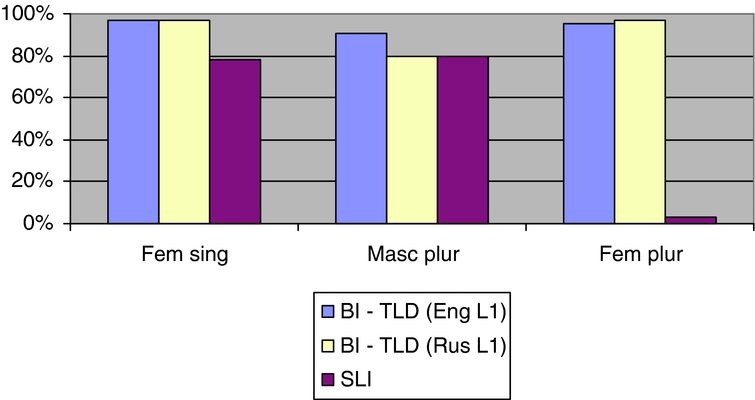
The findings Paradis presents from English L2 children and monolingual children with SLI to show that these are not two of a kind also gain support from Hebrew-speaking children with SLI and Hebrew L2 speakers. Dromi et al. (Reference Dromi, Leonard and Shteiman1993, Reference Dromi, Leonard, Adam and Zadunaisky-Ehrlich1999) studied the use of verbal morphology in 4- to 6-year-old Hebrew-speaking children with SLI using a sentence completion task. With verbal morphology so central in Hebrew, a Semitic language, it was predicted that very few inflections, if any, would pose a problem for children with SLI. More specifically, it was predicted that inflections that carry more features would be more difficult than those that carry fewer features with errors that show a simpler feature complex. Dromi et al. (Reference Dromi, Leonard, Adam and Zadunaisky-Ehrlich1999) targeted present tense morphemes that can be marked for gender (fem.), number (pl.), or both (fem. pl.), using a sentence completion task. They found that although monolingual children with TLD scored at ceiling on all three morphemes, children with SLI showed 80% success when one feature was involved, but hardly ever produce the target morpheme that represented two features (fem. pl.). In English, most errors were omissions, but in Hebrew most errors were substitutions in which a morpheme that marked just one feature was used. Armon-Lotem (Reference Armon-Lotem2010), using the same task, found that speakers of Hebrew as L2 whose first language (L1) is English, are almost at ceiling for all three morphemes after 2 years of exposure to Hebrew, whereas speakers whose L1 is Russian with a similar length of exposure to Hebrew, were at ceiling for two of the three morphemes, but scored like monolingual children with SLI on the plural morpheme (see Figure 1). This similarity was only superficial because it reflected L1 influence that triggered the use of the feminine plural morpheme. The few errors documented in the Hebrew L2 data included erroneous choice of tense, which did not involve a fewer number of features, or, for the children with L1 Russian use of the more complex agreement morpheme (fem. pl.) because of code interference (CI) from L1. These data confirm that SLI and L2 are not two of a kind.
The level of success on present tense agreement items for BI-TLD English L1 according to Armon-Lotem (Reference Armon-Lotem2010), BI-TLD Russian L1 according to Armon-Lotem (Reference Armon-Lotem2010), and SLI according to Dromi et al. (Reference Dromi, Leonard, Adam and Zadunaisky-Ehrlich1999). [A color version of this figure can be viewed online at journals.cambridge.org/aps]
Further support for this conclusion comes from a study of the use of prepositions in L2 Hebrew and the Hebrew of monolingual children with SLI (Armon-Lotem et al., Reference Armon-Lotem, Danon and Walters2008). Two types of prepositions were tested: free prepositions (F-preps), which introduce an adverbial prepositional phrase (locatives, temporals, directionals), for example, inthe morning, atschool, to school, and obligatory prepositions (O-preps), which are selected by the verb (dative, oblique), for example, laugh at, chase after. O-preps may or may not form a PP with the NP that follows, but they are not arguments of the verb; that is, the theta role is assigned to the NP that follows the preposition (cf. Botwinik-Rotem, Reference Botwinik-Rotem2004). O-preps primarily serve a grammatical function in case assignment and often do not contribute to the meaning of the sentence, whereas F-preps form a prepositional phase (PP) with the following noun phrase (NP) contributing to the meaning of the sentence. This distinction accounts for the difficulty of SLI children with O-preps, which are prone to omission because they only serve a grammatical function while contributing little to the meaning of the sentence (Clahsen, Bartke, & Göllner, Reference Clahsen, Bartke and Göllner1997; Tsimpli, Reference Tsimpli2001). Armon-Lotem et al. (Reference Armon-Lotem, Danon and Walters2008) found that both substitution and omission errors are prevalent among Hebrew-speaking monolingual children with SLI, with significantly more omission errors on O-preps. No such omissions were found in the L2 Hebrew data from children with TDL, showing again that these are not two of a kind.
Paradis further shows that bilingual children with SLI or LD show very similar abilities with BE to those of bilinguals with TDL. This finding is also addressed by Paradis in her discussion of the theoretical implications of the study of BISLI, when she weighs the possibility that BISLI might result in a double delay. Paradis addresses the predictions of limited processing capacity (LPC) theories that “seek to derive a wide range of linguistic and nonlinguistic outcomes of SLI from lower level, domain general deficits alone, in contrast to the maturational model put forward by Rice (Reference Rice, Rice and Warren2004), which posits the presence of additional domain-specific deficits in SLI” (p. 19). She points out that a “key assumption inherent in LPC theories of morphological acquisition is that children with SLI would need more exposure, more time on task, to fully acquire a morphological paradigm” (p. 20). That is, by the PLC theories, children with SLI have functionally less exposure, and bilingual children with SLI have less frequent exposure to each language by being bilingual, and have functionally less exposure being SLI. Thus, Paradis argues, the PLC theories predict a “double delay” among bilingual children with SLI that are expected by these models to show lower performance when compared to monolingual children with SLI.
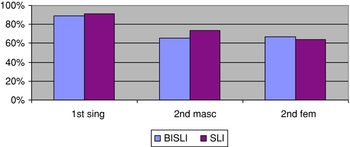
Paradis reports, however, that bilingual children with SLI are as accurate as monolingual children with SLI in their use of 10 different grammatical morphemes in their spontaneous speech (Paradis, Reference Paradis2007; Paradis, Crago, & Genesee, Reference Paradis, Crago and Genesee2005/2006; Paradis, Crago, Genesee, & Rice, Reference Paradis, Crago, Genesee and Rice2003). These findings are supported again by comparing the results for Hebrew of monolingual children with SLI (Dromi et al., Reference Dromi, Leonard, Adam and Zadunaisky-Ehrlich1999) and findings for Hebrew as L2 of bilingual English–Hebrew children who attend language preschool following an earlier diagnosis for SLI (Armon-Lotem et al., Reference Armon-Lotem, Adam, Blass, Fine, Harel and Saiegh-Haddad2010). The bilingual children were all sequential bilinguals and were exposed to Hebrew for at least 2 years. The two studies used an enactment task developed by Dromi et al. (Reference Dromi, Leonard, Adam and Zadunaisky-Ehrlich1999) that targeted first- and second-person morphology. Of the three inflectional categories that were tested in both studies, no significant difference was found between the two groups, either in the degree of success, or in the type of errors (choosing the third-person form, which has no suffix instead of a form inflected with a suffix for first and second person). That is, impaired bilinguals achieve a similar level of performance to impaired monolinguals, thus showing no double delay effects for the impaired children (see Figure 2).
The level of success on past tense agreement items for BISLI according to Armon-Lotem et al. (Reference Armon-Lotem, Adam, Blass, Fine, Harel and Saiegh-Haddad2010) and SLI according to Dromi et al. (Reference Dromi, Leonard, Adam and Zadunaisky-Ehrlich1999). [A color version of this figure can be viewed online at journals.cambridge.org/aps]
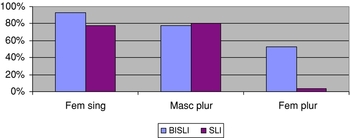
Moreover, in the present tense, when tested with the sentence completion task described above, bilingual children with SLI seemed to do better than Dromi et al.'s (Reference Dromi, Leonard, Adam and Zadunaisky-Ehrlich1999) monolingual children with SLI, in particular, in the use of the rare and marked feminine plural (see Figure 3).
The level of success on present tense agreement items for BISLI according to Armon-Lotem et al. (Reference Armon-Lotem, Adam, Blass, Fine, Harel and Saiegh-Haddad2010) and SLI according to Dromi et al. (Reference Dromi, Leonard, Adam and Zadunaisky-Ehrlich1999). [A color version of this figure can be viewed online at journals.cambridge.org/aps]
These findings further suggest that bilingual children with SLI are not only as accurate as monolingual children with SLI, but also sometimes even do better. That is, bilingual children seem to rely on their knowledge of L1 in acquiring the L2, which gives them an advantage over monolingual children with SLI.
Additional support for the instructive role of bilingualism comes from a set of studies of prepositions conducted with English–Hebrew bilingual children with TLD and with SLI and with monolingual children with SLI (Shimon, Reference Shimon2008). Armon-Lotem and Walters (Reference Armon-Lotem and Walters2009) report that children with SLI, both monolinguals and bilinguals, omit prepositions in a sentence repetition task. This finding replicates previous findings from Roeper, Ramos, Seymour, and Lamya (Reference Roeper, Ramos, Seymour and Lamya2001) and Watkins and Rice (Reference Watkins and Rice1991). In contrast, bilingual children exhibited commission errors in their use of prepositions, both because of CI, but also in the absence of CI. Like Paradis' findings for the use of BE, Armon-Lotem and Walters found that bilinguals with SLI like bilinguals with TLD showed evidence of CI in contrasting environments, as manifested by erroneous choice of prepositions (commission errors). As a result, omission errors were less frequent among bilingual children with SLI than among monolingual children with SLI. That is, the lack of omission errors by bilingual children with TLD distinguishes L2 children from monolingual children with SLI who exhibit omission errors. The commission errors are indicative of grammatical knowledge, because the L2 children realize that they need to fill the slot of the O-prep. These errors also reveal knowledge of the L1 as indicated by CI errors. Thus, the commission errors are supposed to place BISLI children in a better position regarding language acquisition than omission errors, because they are indicative of both grammatical knowledge and knowledge of their other language. These findings suggest again that bilingual children with SLI rely on their knowledge of the L1 in acquiring the L2, giving them an advantage over monolingual children with SLI.
Could these findings mean, as Paradis indicates, that bilingualism offers compensatory mechanisms for children with SLI, either by counteracting the effects of limitations in processing abilities or because of their dual linguistic system? Is it the case that “learning one language bootstraps the learning of a second one?”
Bialystok (Reference Bialystok2007) argues that bilingual children have certain superior executive functions that are manifested by enhanced metalinguistic awareness, and in her Keynote Article Paradis speculates that “the superior executive functions emerging from dual language learning could compensate to some extent for some of the processing deficits that come along with SLI.” Iluz-Cohen (Reference Iluz-Cohen2008) tested 40 bilingual preschool children with TLD and with SLI for nonverbal inhibition and shifting abilities, using an adaptation of the embedded figures task (based on De Avila & Duncan, Reference De Avila, Duncan and Alatis1980; Pascual-Leone, Reference Pascual-Leone, Globerson and Zelniker1989; Piaget & Inhelder, 1966) and the classification task (from Ben-Zeev, Reference Ben-Zeev1977) as nonlinguistic measures. Performance on these tasks was compared with scores on standardized language tests in both languages and showed a relationship between language proficiency and executive function abilities, pointing to a lower performance in executive function abilities among bilingual children with BISLI when compared to bilingual children with TLD. These findings suggest that children with SLI exhibit cognitive deficits even when language is not specifically tested and indicate the necessity of a domain general component in any account for SLI.
Iluz-Cohen's (Reference Iluz-Cohen2008) findings also show that the main difference among the groups is between children with SLI and all other bilingual children with typical language development, whether highly balanced (scoring within the monolingual norm on standardized tests in both languages) or not balanced (scoring within the monolingual norm on standardized tests in only one of the two languages), lending empirical support to the theoretical notion that a bilingual child can be diagnosed with SLI only if he/she is impaired in both languages. These findings suggest that even if Bialystok is right and bilingualism enhances executive function abilities, a gap in nonlinguistic processing remains between bilingual children with TLD and those with SLI. It is necessary, however, to compare monolingual children with SLI to bilingual children with SLI to determine “if bilingual children with SLI show evidence of enhanced executive functions like their peers with TLD” (p. 28), counteracting the effects of limitations in processing abilities.
Roeper (Reference Roeper2009) argues that bilingualism can be instructive, because of the organization of the dual linguistic system. He points out that alles (all) in German triggers exhaustivity and helps German-speaking children with TLD and with SLI acquire this notion earlier than English monolinguals with TLD. He suggests that German–English bilinguals might acquire this notion earlier than English monolinguals, showing evidence for an instructive effect in their L2. Relevant to this commentary is his suggestion that the presence of particle verbs in English could promote awareness of phrasal verbs in both languages of a bilingual child, and can facilitate the use of O-preps in a language that has no particles. If we assume that errors that are not because of CI in children with SLI (both omissions and substitutions) emerge from a difficulty in encoding syntactic relations in the absence of semantic motivation, often the case for phrasal verbs, then English–Hebrew bilingual children have an advantage. They encounter particle verbs in which the preposition contributes to the meaning of the verb in their L1, providing semantic motivation at the lexical level. Thus, they have a better chance at realizing that O-preps are indeed obligatory, than children who have no slot in their language where O-preps are semantically motivated (e.g., monolingual Hebrew-speaking children with SLI). This suggestion is supported by findings from Armon-Lotem, Gordishevsky, and Walters (Reference Armon-Lotem, Gordishevsky and Walters2009) who show that Russian–Hebrew bilingual children, whose L1 Russian has no particles, do not show such benefits. Such findings suggest that learning one language could bootstrap the learning of a second one. Crucially, though, bootstrapping depends on the nature of the two languages.
A final concern raised by Paradis is the clinical implication of the various studies, with particular attention to the possibility of overdiagnosis. Analysis of data from Russian–Hebrew (N = 80) and Russian–German (N = 60) bilingual children with TLD (Walters, Armon-Lotem, Gagarina, & Remennick, Reference Walters, Armon-Lotem, Gagarina and Remennick2009) shows that after 2 to 3 years of exposure only two of three bilingual children with TLD score within the norm on standardized tests in their L2. Below-norm kids had mean exposure of 30 months, whereas at-norm kids had 39 months of exposure, but this difference was not significant. Unfortunately, there are no standardized tests for their L1, which could lead to overdiagnosis. Paradis, Nicholadis, and Crago (Reference Paradis, Nicoladis, Crago, Caunt-Nulton, Kulatilake and Woo2007) found that bilingual children with TD ages 4–6 can perform similarly to their monolingual peers in their dominant language, but might lag behind peers in their other language. There are similar findings for Spanish–English bilinguals (Gutiérrez-Clellen, Restrepo, & Simón-Cereijido, Reference Gutiérrez-Clellen, Restrepo and Simón-Cereijido2006; Gutiérrez-Clellen & Simon-Cereijido, Reference Gutiérrez-Clellen and Simón-Cereijido2007). As Paradis points out, these findings show the need for tools that are sensitive to the bilingual situation, are more precise regarding length of exposure and language dominance and use these factors for setting norms for TLD for bilingual children.
This last point demonstrates that although L2 knowledge and impaired knowledge are probably not two of a kind, and bilingualism does not seem to lead to “dual delay” in bilingual children with SLI and might even have a facilitative effect and an instructive value for children with SLI, many challenges still face the study of BISLI. In this seminal paper, Paradis clearly directs our attention to these challenges, and the further research necessary to meet the challenges she presents to us all.
ACKNOWLEDGMENTS
This research was supported in part by The Israel Science Foundation (Grant 938) and by the BMBF funded Consortium entitled “Migration and Societal Integration.”