1. Introduction
As bilingual and multilingual language proficiencies are increasingly considered to be important for success in a globalizing world, second language (L2) and foreign language (FL) education, focused on young learners, has gained a great deal of attention. East Asia is no exception to this trend. Various East Asian nations—indeed, entire regions—have implemented L2/FL instruction in their formal school curricula at increasingly lower grade levels, focusing primarily on languages, such as English, that are associated with politically and economically powerful populations. A variety of L2 and FL learning opportunities, including private lessons, technology-based learning tools, and study-abroad programs, are also available outside of formal educational systems for those who can afford them.
Despite the rapid increase in the number of young L2/FL learners in the world,Footnote 1 we still have relatively limited information on young learners’ L2/FL education outside of certain contexts. Much of the information comes from either L2 learning among immigrant and language minority children, primarily in English-speaking contexts such as in the U.S. and U.K. (e.g., Genesee et al. Reference Genesee, Lindholm-Leary, Saunders and Christian2006; August & Shanahan Reference August and Shanahan2008; Philp, Oliver & Mackey Reference Philp, Oliver and Mackey2008) or FL learning in Europe (e.g., Nikolov Reference Nikolov2009; Enever Reference Enever2011; Nikolov & Mihaljević Djigunović Reference Nikolov and Mihaljević Djigunović2011). A growing number of studies have called for more contextualized research among diverse populations in the areas of second language acquisition (SLA) and applied linguistics. In the context of Asia, little effort has been made to systematically synthesize research on young learners’ L2/FL education, with the exception of recent efforts to synthesize language-in-education policy documentation (Baldauf et al. Reference Baldauf, Kaplan, Kamwangamaly and Bryant2011, Reference Baldauf, Kaplan, Kamwangamaly and Bryant2012; Spolsky & Moon Reference Spolsky and Moon2012).
The aim of this review, therefore, is to synthesize empirical studies on young learners’ L2/FL education in East Asia—studies that are often scattered across countries and regions. This review focuses on English as an FL (EFL) or a lingua franca because the overwhelming majority of the research on this topic deals with English. Unfortunately, there is still limited research on acquisition of other languages by young learners in East Asia, despite the observation that young learners in East Asia are increasingly learning other Asian languages as L2/FL. Young learners in this review are defined as children up to and including the primary school level (typically, children up to age 12).Footnote 2 Research on simultaneous bilinguals is not included in this review. Geographically, I focus on China (including Hong Kong), South Korea (referred to as Korea hereafter),Taiwan, and Japan, reflecting the body of work represented in the literature on this topic in East Asia.Footnote 3
My aim is to identify specific problems and characteristics that Asian learners of English generally encounter in their given cultural and educational contexts, while at the same time shedding light on contextual differences within Asia. In the past, we often have seen rather stereotypical East-versus-West arguments in language learning and teaching (such as arguments regarding potential conceptual conflicts between underlying notions of communicative language teaching in the West and Confucian norms of teaching and communication in the East). Though cultural influences are undeniably substantial, this review takes a closer look at contexts within Asia. In addition, I shed light on diversities within a given country, such as the role of early English education in growing disparities by socio-economic status (SES), another topic that has not been discussed sufficiently in the SLA literature.
Included in the review are articles, books, monographs, policy documents, and publicly available statistics that were published in the English language over the last ten years (2004–2014).Footnote 4 Some older studies are included to provide context for current research. Unpublished documents (including unpublished dissertations and masters’ theses), regional working papers, conference proceedings, opinion papers, and other non-empirical papers were excluded because the review process for these items is not clear.
I begin by reviewing policy literature to illustrate the social and policy contexts of early English education in East Asia and to identify major policy-related concerns. Next, I review empirical studies on English learning and teaching, organizing them according to the policy concerns I identified previously. The conclusion offers suggestions for future research.
2. Society and policy contextsFootnote 5
2.1 Influential societal and global factors
English teaching and learning among young learners is situated in larger societal and global contexts. Although each of the focal countries in this review has unique factors influencing their early English language education, two societal factors are worth mentioning because they are influential across East Asia.
First, even though English has been taught as an FL for a number of years in formal schooling (at the secondary school level and beyond), it has never been a major means of communication in the given communities. While it is undeniable that the use of English is on the rise in certain areas of East Asian societies, such as in media and business (Feng Reference Feng2012), most people have limited opportunities to use English in their daily lives. For example, Song (Reference Song2011) described the situation in South Korea as ‘impersonal bilingualism’ and argued that a seeming increase in the use of English among Koreans is ‘for appealing to the public's positive feelings, not for practical communication’ (p. 37). Given this situation, it is generally hard for learners to receive sufficient input to acquire practical communicative competency in English. For learners who want more opportunities to use English, extra money and resources are often required. This condition partially contributes to widening gaps in accessibility and achievement in English by SES and region (which is also usually associated with SES).
Second, in East Asia, exams have been institutionalized in many aspects of society and play a significant role in these countries’ meritocratic policies and attitudes (e.g., Butler & Iino Reference Butler and Iino2005; L. Y. Cheng & Curtis Reference Cheng and Curtis2009; Carless Reference Carless2011). Under a prevailing belief system in which a person's achievement is primarily attributed to effort rather than innate talent (Stevenson & Stigler Reference Stevenson and Stigler1992), exam results are often seen as a sign of effort and diligence and, as such, are greatly valued. Exams are considered a vehicle for obtaining success and status. With the rise of English as an academic subject that can influence future educational and career opportunities, access to early English education has gained tremendous public attention in East Asia.
Such societal factors are embedded in larger global contexts. Since the 1980s, English, as a global language of political and economic power, has frequently been recognized as a critical competence for nations’ survival and success. Around the turn of the twenty-first century in both in Korea and Japan, proposals were made to designate English as an official language along with the national language; these proposals created heated debates in both countries. It is beyond the scope of this article to review different explanations of the spread of English in Asia, and why the English-learning boom—which is often described as ‘English fever’ (Park Reference Park2009: 50) or an ‘obsession’ (J.-J. Song Reference Song2011: 36)—developed. However, it is worth noting that the intensity of the fever has varied. For example, the ‘obsession’ seems to be much less intense in Japan than in Korea (J.-J. Song Reference Song2011).
Individuals and organizations invest tremendous amounts of money in private entities that provide English-learning services. There is no doubt that ‘English proficiency has become a very expensive commodity’ (Hu Reference Hu2009: 50). In their formal education systems, East Asian nations began to actively reform English teaching around the turn of the 21st century. Perhaps the biggest reform was introducing English as a foreign language at the primary school level (referred to as EFLPS hereafter).
2.2 Language-in-education policies at the primary school level
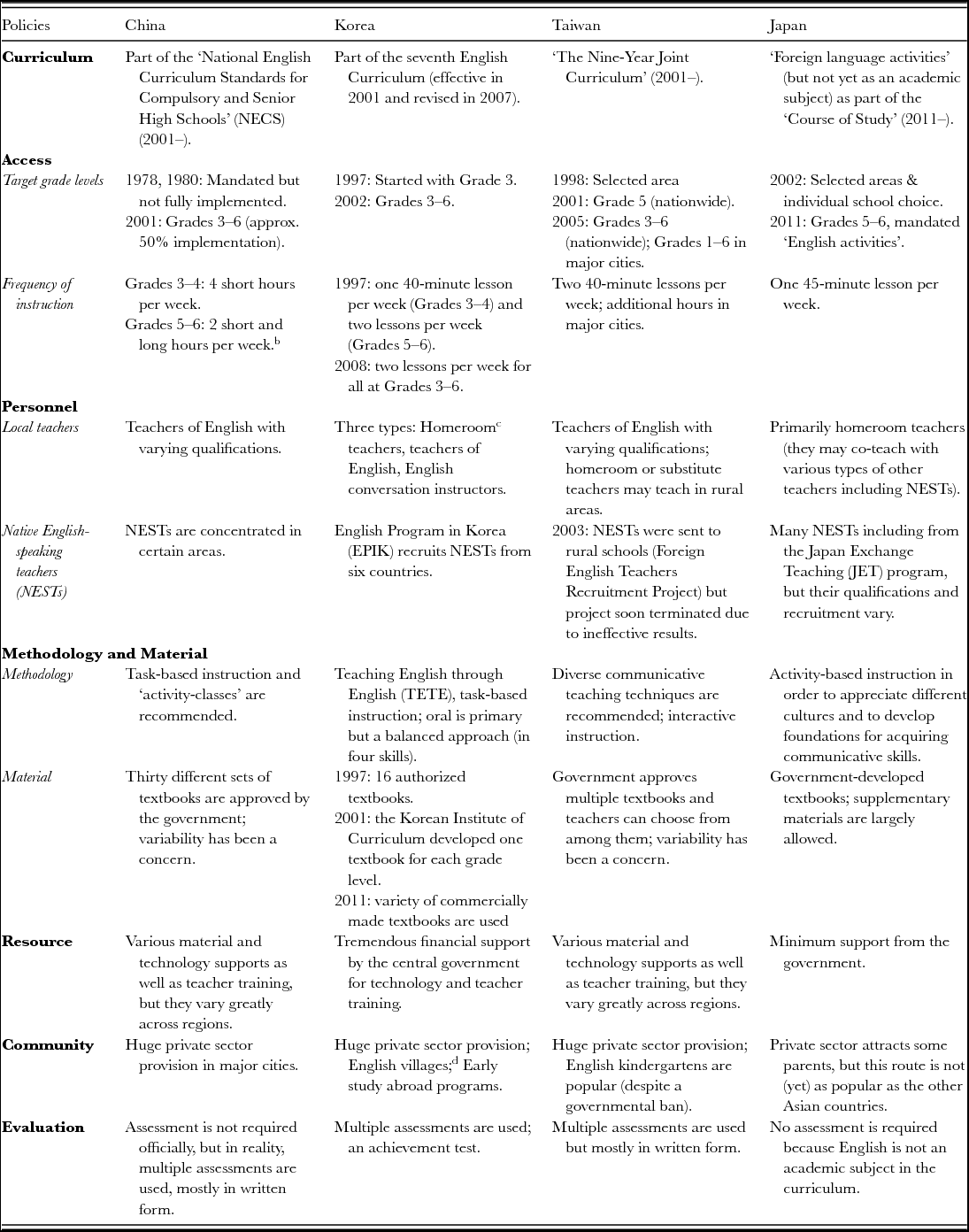
Kaplan & Baldauf (Reference Kaplan, Baldauf and Hinkel2005) proposed a model for language-in-education policy planning and argued that the following interrelated elements influence the success of language policies: curriculum policy; access policy; personnel policy; methodology and material policy; resources policy; community policy; and evaluation policy. Following Kaplan & Baldauf's framework, Table 1 summarizes the EFLPS policies (as of 2013) in the four focus countries. In the following sections, I discuss these major policy issues as they relate to early English education in East Asia.
A policy sketch (as of 2013)a

Notes: aThis table is based on Baldauf et al. (Reference Baldauf, Kaplan, Kamwangamaly and Bryant2011, Reference Baldauf, Kaplan, Kamwangamaly and Bryant2012); Butler (Reference Butler2004, Reference Butler2007a); Chen (Reference Chen2011); Hashimoto (Reference Hashimoto2011); Joo (Reference Joo2008); Kang (Reference Kang, Spolsky and Moon2012); Li (Reference Li2011); Shiga (Reference Shiga2008); Wu (Reference Wu, Spolsky and Moon2012); Zhang & Wang (Reference Zhang, Wang and Feng2011).
bA minimum of 80–90 minutes total; exact durations are not specified and, in practice, vary.
c‘Homeroom teachers’ are generalists and not specialist teachers of English.
d‘English villages’ are English-speaking environments in Korea suitable for immersive study.
2.2.1 Curriculum policies
Curriculum policy refers to the objectives of teaching and learning the target language. The introduction of EFLPS was part of the larger national curriculum in all four countries covered in this review, and they all have similar goals: (1) to develop basic communicative abilities in English; and (2) to enhance cross-cultural and cross-linguistic understanding. However, their curricula differ in the level of communicative abilities that they target and the skill domains that they cover. China, Korea, and Taiwan teach English as a formal academic subject at school. Although the oral domains (i.e., listening and speaking) are considered primary, their curricula have become more balanced in covering all four skill domains. In contrast, as of 2013, ‘English activities’ in Japan are not an academic subject in the curriculum but can instead be characterized as exploratory programs that focus almost exclusively on the oral domain.Footnote 6
In China, Korea, and Taiwan, there is growing interest in programs in which content subject teaching is partially or mostly conducted in English. Rather confusingly, different types of ‘bilingual’ and ‘immersion’ programs have been implemented under different labels (Feng Reference Feng2007; He Reference He2011). In China, most ‘immersion’ programs are offered at prestigious schools and experimental schools in wealthier regions and attract parents who can afford them. Thus, they are regarded as ‘a synonym for quality education’ (Hu Reference Hu2009: 51). However, it is not uncommon to find programs that were implemented on a trial-and-error basis without securing sufficient resources, such as trained teachers (Zhang & Adamson Reference Zhang, Adamson and Feng2007; Song & Cheng Reference Song and Cheng2011). In 1996, due to the rising costs of private tutoring, the Taiwanese government started allowing schools to implement bilingual programs as experimental programs or programs for gifted children (Chen & Hsieh Reference Chen, Hsieh and Feng2011); these bilingual programs, too, are associated with prestige or gifted/talented students. In Korea, the Presidential Transition Committee under President Lee made a proposal to promote English-immersion education in 2008. Ironically, the proposal itself failed, but since then English-immersion programs have gained tremendous public interest (Jeon Reference Jeon2012). Despite widespread enthusiasm for immersion/bilingual programs in East Asia, the effectiveness of such programs remains largely unknown. Curiously, in Japan, with the exception of a few private schools, Japanese-English bilingual programs are rare at the primary school level.
2.2.2 Access policies
Access policy refers to ‘who learns what when?’ (Kaplan & Baldauf Reference Kaplan, Baldauf and Hinkel2005: 1014). As shown in Table 1, as of 2013, English is a required subject from Grade 3 and beyond in China, Korea, and Taiwan. As of 2013 in Japan, ‘English activities’ are mandated from Grade 5. In China, there are substantial differences in access to and quality of early English education between rural and urban areas. Researchers repeatedly noted the limited access to English education among language minority students in China (Feng Reference Feng2012).
In all four countries, policy makers constantly discuss whether English should be taught beginning at younger grade levels. This is partially due to a widespread belief that ‘the younger the better’ for language acquisition, despite the lack of empirical evidence supporting this claim in FL contexts (e.g., Muñoz Reference Muñoz2006).
Butler (Reference Butler2009a) argued that one of the major dilemmas plaguing English-in-education policies in East Asia is how to account for diversity while providing equal access. On the one hand, numerous policy analyses have shown that strong top-down initiatives often do not meet local needs and create substantial problems at the local level (e.g., Zhang & Adamson Reference Zhang, Adamson and Feng2007 for a case in China). On the other hand, granting greater autonomy to local levels may lead to diversity in implementation, which is easily problematized as ‘unequal access’ in East Asian contexts. Many schools in major East Asian cities already teach English at younger grade levels than the policy regulates. Higher SES parents pay for private English education for their young children regardless of whether it is offered in schools. Thus, lowering the official starting age in the central policy might minimize regional and socio-economic gaps in access among children, although the actual effect of such a policy action is largely unknown.
2.2.3 Personnel policies
Personnel policy deals with teachers and teacher training. Securing qualified teachers for young learners’ English classes is a major issue in the focal countries, both in terms of how best to train local teachers and how best to utilize the abilities of native speakers (NS) in classrooms. With respect to training local teachers, part of the challenge is that we don't fully understand what qualifications teachers need to successfully teach FLs to young learners. Insufficient oral communicative skills and lack of confidence among teachers are serious concerns in East Asia (Butler Reference Butler2004; Hu & McKay Reference Hu and McKay2012). In Korea and Japan, where primary school teachers are responsible for teaching multiple subjects to their ‘homeroom’ students, there have been heated discussions about whether the homeroom teachers (i.e., generalists) or specialists, or both, should teach English. In Korea, in addition to the homeroom teachers, both special teachers of English and English conversation instructors (Korean personnel with high English proficiency) teach English, but they tended to be isolated or have conflicts in the homeroom-teacher-centered culture when these teachers were added to the school system initially (H. D. Kang Reference Kang, Spolsky and Moon2012). Even in China and Taiwan, where specialists teach English in primary school, teacher qualifications vary tremendously by region (Hu & McKay Reference Hu and McKay2012; Wu Reference Wu, Spolsky and Moon2012). Apparently, teachers’ qualifications include not only their proficiency in English but also a number of other elements, including pedagogical knowledge/skills, personal- and interpersonal-based qualities (e.g., friendliness), and knowledge about learners. Adding to the complexity of the issue, the qualifications needed for teachers may differ greatly depending on the context in which teaching takes place, the teaching objectives, and the students’ ages.
All four countries have aggressively recruited NSs with various capacities both at the central and local levels, partially in response to the general public's preference for NSs as ideal English teachers. Sometimes, NSs were hired as substitutes for local teachers with insufficient oral proficiency. In Taiwan's Foreign English Teachers Recruitment Project, NSs were specifically sent to rural areas to compensate for a shortage of local teachers, and they were encouraged to work with local teachers. However, the program had to be terminated due to unsatisfactory results; in addition to dissatisfaction among NSs living in remote areas, the program did not help to resolve the shortage of qualified teachers (Chen Reference Chen2011). Various ‘problems’ with respect to personnel policies for NSs came from the fact that the policies do not clearly articulate what they expect from NSs, what roles NSs should play in the existing education systems, or how best to assist NSs in order to maximize their abilities in the given context (Butler Reference Butler2009a).
2.2.4 Methodology and materials policies
These policies deal with which methodologies and materials are employed over what periods. Because primary school English education focuses on communicative language skills, methods such as communicative language teaching (CLT) and task-based language teaching (TBLT) have been recommended by policies. However, various issues have been raised when implementing CLT and TBLT in East Asian contexts, including conceptual constraints (e.g., conflicts with local traditional notions of learning and teaching), classroom-level constraints (e.g., large class sizes), and societal-instructional level constraints (e.g., college exams oriented toward grammar/translation) (Butler Reference Butler2011).
Material development has been largely conducted on a trial-and-error basis. This is partially due to a lack of theoretical frameworks and empirical data about children's FL learning to inform the material development. The process of material development is also a good example of how policy makers are trying to find an optimal balance between central initiatives and local autonomy. For example, in Korea, there were 16 textbooks when English was first introduced in primary schools in 1997. In 2001 the government (the Korean Institute of Curriculum and Evaluation, KICE) decided to standardize material and developed one textbook for each grade level. However, ten years later, the government again decided to have a variety of textbook options (developed by private publishers and authorized by the KICE) because of the diverse needs of the students (H. D. Kang Reference Kang, Spolsky and Moon2012).
2.2.5 Resource and community policies
Resource policy refers to financing. Community policy deals with people who are involved in policy development. In East Asia, English education at primary school, being compulsory, is largely funded and controlled by the central governments. Notably, while East Asian countries’ public expenditures on education are low, their private expenditures are very high.
In East Asia, many parents, especially those who can afford to pay for it, are very proactive in helping their children learn English. In Korea, a growing number of children go abroad to study, either alone or with their mothers, leaving their fathers behind. But various problems (e.g., academic and emotional problems as well as negative impacts on family relations) have been repeatedly reported (Y. Kang Reference Kang, Spolsky and Moon2012). For those who cannot afford to go abroad, local governments in Korea built English villages across the country where students can be immersed in English-speaking environments. There were 30 English villages in Korea in 2010, but they were criticized for not being cost-effective. Many villages suffered severe financial difficulties while trying to maintain their programs and facilities (Jeon Reference Jeon2012). Despite their extremely high costs, English-only and bilingual kindergartens (which are usually private) are popular among those who can afford them in China, Taiwan, and Korea.
2.2.6 Evaluation policies
Evaluation is perhaps the most problematic policy area for EFLPS in East Asia (Butler Reference Butler2009b). None of the four countries have systematic measures for evaluating children's language learning or program effectiveness in a way that corresponds to the objectives of their English education policies. For example, although the development of oral communicative abilities is a primary goal in all four countries, assessments are often done using traditional paper-and-pencil tests. Classroom-based assessments, such as teacher observations, portfolio assessments, and self-assessments (e.g., ‘can-do’ tests), have gradually gained recognition; however, as I discuss in more detail below, teachers often find it challenging to implement them due to a lack of clear guidelines or sufficient training. Meanwhile, various types of commercial, international proficiency tests have become increasingly popular. In some areas, they have been used for high-stakes decisions such as secondary schools admissions and student placements in ability-based programs (e.g., Choi Reference Choi2008; Chik & Besser Reference Chik and Besser2011).
In the following sections, I detail the range of published empirical studies about teaching English as a foreign language (EFL) to young learners in East Asia, organizing them in such a way that readers can see their associations with the above-mentioned policy concerns.
3. Research on learning (relevant to curriculum policy)
Deeper understanding of children's L2/FL learning has potential implications for curriculum development as well as theorizing Child-SLA, which is still an emergent field in East Asia. Researchers have examined learning largely in two domains: (a) language development; and (b) affective/attitudinal issues (including cross-cultural awareness). With the exception of phonological processing, we still don't have sufficient empirical studies to inform curriculum policy in East Asia. A couple of studies on the effectiveness of immersion programs in China appear to be promising, but potential selection bias and contextual factors need to be more thoroughly considered before drawing conclusions. Despite a growing number of studies on motivation, we still have little knowledge about how best to help children maintain motivation in the East Asian context.
3.1 Research examining language development
3.1.1 Studies of phonological processing skills
Research on children's L2/FL language development in East Asia is concentrated on the development of phonological skills and its relation to reading. One major concern among these studies was to understand cross-linguistic transfer in phonological skills, and phonological awareness (PA) in particular, between the children's first language (L1) and English (L2/FL) in relation to reading in both languages. PA refers to ‘one's ability to recognize, discriminate, and manipulate the sounds of a language, regardless of the size of the word unit that is the focus’ (Anthony & Francis Reference Anthony and Francis2005: 256).
The previous literature on adult L2 reading found that a student's phonemic level of awareness is important for reading in alphabetic languages such as English. It is also known that among adult learners, PA in L1 is correlated with PA in L2, even when the two languages have different writing systems (Koda & Zehler Reference Koda and Zehler2008).
In the studies that I reviewed, various types of tests were used to measure children's PA at different levels, including the syllabic level, the onset/rhyme level, and the phonemic level. Reading was also measured in various ways, ranging from word recognition and word reading to reading comprehension. Such variability in measurement makes it difficult to compare the studies directly and draw a comprehensive picture of cross-linguistic transfer.
Chow, McBride-Chang & Burgess (Reference Chow, McBride-Chang and Burgess2005) conducted a nine-month study of Hong Kong kindergarteners in order to examine the relationships among three phonological processing skills in Chinese (i.e., PA, rapid automatized naming and verbal short-term memory) and word reading in Chinese (L1) and English (L2/FL). After controlling for visual skills that were considered to be an important predictor for Chinese reading, the authors found that the three phonological processing skills were moderately associated with word reading in both Chinese and English, and that the association remained stable over time. In addition, PA in Chinese (measured by a syllable deletion test) was a relatively strong predictor for word reading both in Chinese and English, suggesting that PA is important not only for learning to read in alphabetic languages but also for reading in Chinese (a morphosyllabic/logographic language). The authors further claimed that ‘[p]honological processing skills in a nonalphabetic language can aid in the acquisition of an alphabetic language’ (p. 86). However, the authors acknowledged that only syllable awareness was tested in this study. In Chinese, a syllable constitutes a morpheme that carries the semantic information of a word. Reading was also restricted to word-level reading in their study.
Bialystok and her colleagues conducted a series of studies on the acquisition of reading across languages. Most of their participants were recruited from bilinguals and monolinguals in Canada, but Bialystok, McBride-Chang & Luk (Reference Bialystok, McBride-Chang and Luk2005) included kindergarteners and first graders in Hong Kong. Building upon their previous findings that PA (measured at the phonemic level) was correlated across languages but that reading (word reading) was not transferred across two different writing systems (e.g., English and Chinese), Bialystok et al. investigated the roles of proficiency (the degree of bilingualism) and instruction to better understand the transfer of PA and reading across two different writing systems. They found that PA was common across languages but that it was facilitated only through learning an alphabetic language. Compared with English monolinguals and English-Cantonese bilinguals in Canada, Hong Kong children had a harder time acquiring the phonemic level of PA even though their syllabic level of PA was compatible with the other two groups. This can be attributed to the fact that children in Hong Kong, unlike children in mainland China and Taiwan, do not learn Chinese reading with the aid of a Romanized mediating system such as pinyin; they largely learn how to read Chinese by rote memorization. The authors also found that the children's proficiency in the two languages mattered for reading (decoding skills in this case). According to the authors, decoding skills were developed separately for different writing systems. Although this was a tightly controlled experimental study, as with many studies of bilinguals’ PA, it failed to distinguish between phonological segments/structures that exist in bilinguals ‘dominant language from those that exist in the weaker language’ as Kuo & Anderson (Reference Kuo and Anderson2010: 370) pointed out. Bialystok et al. included items that had up to five phonemes in a syllable, which is possible in English but not in Cantonese. In other words, the study compared Hong Kong children (Cantonese-dominant) with the other groups using a measurement involving phonological structures that they might not be familiar with.
A set of studies in Hong Kong by Leong and his colleagues examined the relationships among three reading-related constructs in English: orthographic knowledge, PA, and word identification skills (in this case, referring to both word reading and spelling). Leong et al. (Reference Leong, Hau, Cheng and Tan2005), using structural equation analyses, found that Hong Kong children (aged 10–12) relied more on orthographic knowledge than PA when processing English words. In Leong et al. (Reference Leong, Hau, Cheng and Tan2005), the authors examined the effects of the same three constructs on the respective skill performance when the children were 10 to 11 years old (Time 1) and a year later (Time 2). Whereas Time 1 word identification best predicted Time 2 word identification, Time 1 word identification influenced orthographic knowledge more than PA in Time 2. Given the heavy reliance on visual-orthographic strategies when learning to read in L1, as well as a lack of explicit instruction in decoding skills in English among Hong Kong children, the authors concluded that strategies developed for reading in L1 influenced their L2 reading strategies.
In mainland China, as part of an evaluation study, Knell et al. (Reference Knell, Haiyan, Miao, Yanping, Siegel, Lin and Wei2007) investigated variables that predict English word reading among children (Grades 1–3) in a partial English immersion program. Consistent with previous findings about monolingual English-speaking children, they found that the immersion children's phonological awareness (measured by onset-rhyme detection and phoneme deletion tests) and letter-name knowledge were strong predictors for English reading (word identification, the same as word reading in this case). The study also found that the immersion children outperformed non-immersion children in vocabulary, word identification, and oral proficiency in English; furthermore, even though the immersion children received less instruction in Chinese than the children in the control group, the immersion children were not behind their control-group counterparts in Chinese reading skills (Chinese character reading).
A series of studies conducted by Li and her colleagues (Cheng et al. Reference Cheng, Li, Kirby, Qiang and Wade-Woolley2010; Li, Kirby & Georgiou Reference Li., Kirby and Georgiou2011; Cheng Reference Cheng2012; Li et al. Reference Li, Cheng and Kirby2012a, Reference Li, Kirby, Cheng, Wade-Woolley and Qiang2012b) was part of evaluation research on Chinese-English bilingual programs in the China-Canada-United States English Immersion (CCUEI) projects; the studies were all based on the same data set from three immersion programs in mainland China. Li et al. (Reference Li, Kirby, Cheng, Wade-Woolley and Qiang2012b) examined the effect of PA and naming speed (also known as rapid automatized naming [RAN]) in Chinese and English on English ‘reading comprehension’ (measured by the total score of Reading and Writing in the Cambridge Young Learners English test [YLE]) among students in Grades 2 and 4 in the immersion programs. PA and naming speed were chosen as critical cognitive predictors of reading. The researchers compared immersion students’ performance of PA and naming speed in Chinese and mathematics (measured by in-house mathematics tests issued separately by each school and by each grade) with those of non-immersion students. The results indicated that English PA had unique effects on reading in both Grades 2 and 4, whereas naming speed did not. The authors found little evidence for cross-linguistic transfer from Chinese PA and naming speed to English reading. The non-immersion children outperformed only in PA in Chinese at Grade 2; no difference was found in Chinese PA and naming speed and mathematics at Grade 4. Similarly, Cheng et al. (Reference Cheng, Li, Kirby, Qiang and Wade-Woolley2010) reported that the immersion students outperformed in Chinese and math at Grade 6.
Li et al. (Reference Li., Kirby and Georgiou2011) examined the development of two subcomponents—articulation time and pause time—in RAN (the same as naming speed above) in English and Chinese in relation to English reading comprehension. Articulation time is considered to be an indicator of ‘response automaticity,’ while pause time is an indication of ‘the automaticity of the retrieval of phonological codes’ (p. 7). The authors found that while both articulation and pause times in English and Chinese decreased as grade level increased, English pause time showed the biggest decrease. In addition, only English pause time significantly explained variances of English reading comprehension at Grade 6. Neither articulation nor pause times in Chinese predicted English reading comprehension. These results led the authors to conclude that ‘pause time is the more sensitive indicator of language proficiency’ (p. 17) and ‘RAN is a language-specific skill and predicts reading comprehension’ (p. 19).
Focusing on listening instead of reading, Li, Cheng & Kirby (Reference Li, Cheng and Kirby2012a) examined the relationship between PA and listening comprehension (measured by Listening in Cambridge YLE). After controlling for school-issued Chinese and math test scores (treated as ‘students’ general background and prior achievement’ [p. 56] by the authors), bi-directional relationships were found between English PA and English listening comprehension, although the evidence for cross-linguistic transfer from PA in L1 to English listening was weak.
In Taiwan, Hu & Schuele (Reference Hu and Schuele2005) and Hu (Reference Hu2008) examined the effect of PA in L1 (Chinese) on vocabulary learning in L2/FL (English) among Grade 3 students. Hu & Schuele found that poorer PA in L1 (measured at the phonemic level) negatively influenced vocabulary learning in L2/FL, and that the negative influence did not disappear with increased practice. Hu (Reference Hu2008) tested the presence of written forms in auditory word learning in English in relation to the children's PA skills in their L1. The study found that presenting written forms was certainly helpful but that the effect was bigger among students with higher PA in L1.
Little information about the relationship between PA and reading is available outside of Chinese-speaking contexts. Allen-Tamai (Reference Allen-Tamai2012) conducted a longitudinal study of the effect of PA in English on English word knowledge among Japanese Grade 5 students, following them for two years. (The basic phonological unit of Japanese is a mora, which is similar to a syllable. The Japanese writing system is composed of kana, a syllabic writing system, and kanji, a logographic system.) The aim of her study was not to examine the cross-linguistic transfer but to see the effect of explicit training that the students received that was meant to facilitate PA in English between the fifth and sixth grade levels. The children with higher PA in English before the training gained more in PA after the training. The study also found that the development of PA in English, along with alphabetical knowledge, significantly predicted English word knowledge at Grade 7.
From a slightly different angle, J.-S. Kim (Reference Kim2007) conducted a running record (a reading assessment method) and a free-recall among Grade 6 students in Korea to examine the relationship between the children's English-language decoding skills and reading comprehension. As expected, there was a reasonably high correlation (r = 0.64). However, performance on the free-recall (treated as reading comprehension) was low overall. Kim interpreted this finding to mean that the students were still at the ‘partial-alphabetic phase’ (p. 301) in their decoding skills despite having had three years of formal English instruction, and that they spent much of their cognitive resources on decoding letters but not on comprehension.
To summarize, the Chinese-English bilingual immersion programs that were examined seemed to have positive effects not only on students’ English learning but also on their Chinese and math learning. However, we need to be careful about a possible selection bias of participants when comparing the performance between immersion students and non-immersion students. (Remember that most immersion programs attract students with higher SES backgrounds.) With respect to cross-linguistic transfer of phonological and orthographic skills, the picture is not yet clear. Varying measurements were used in the studies described above, and the validity of some of the measurements was questionable. The definition of cross-linguistic transfer itself did not seem to be consistent across researchers. To make sense of research findings on the relationship between a micro-level of phonological processing (e.g., articulation and pause times) and a macro-level of processing (e.g., reading comprehension), we need a psycholinguistic model connecting these constructs cross-linguistically. Moreover, across studies there were inconsistent controls over factors that are possibly influential on phonological skill development, such as memory, vocabulary knowledge, and the types and amount of instruction. The field would benefit from studies that specifically investigate the roles that these factors play in the development of phonological and orthographical processing skills. Such studies would have direct implications for policy decisions (e.g., when and what kinds of instruction would be most effective for developing decoding skills?). Finally, we need more research from different combinations of languages in order to obtain a more comprehensive picture of cross-linguistic transfer among young learners.
3.1.2 Studies on language development in other linguistic domains
There is scant research on young East Asian learners’ English development in domains other than phonological processing skills. In public discourse, the acquisition of pronunciation skills is frequently mentioned as an advantage of early foreign language learning, but I found little empirical research on phonology development among young learners in the last ten years in the East Asian context. Lee's (Reference Lee2006) longitudinal study of a boy (followed from Grade 4 to 6) indicated that the child had particular difficulty pronouncing word-final consonant clusters and two phonemes, /f/ and /r/, which were both missing in his L1, Korean.
However, as it has been long pointed out in adult L2 acquisition research, not all the errors that learners make can be attributed to their L1. Lee & Huang (Reference Lee and Huang2004) examined the acquisition of English be among Hong Kong Grade 4 students, using a writing task in English (FL). The children indeed showed difficulty using the be-preposition structure accurately (this structure is missing in Chinese, L1). However, they could appropriately use the copula be with predicative adjectives even though such a construction is not required in their L1. The relative ease with acquiring copula be compared with auxiliary be in English was common among English-learning children with different L1 backgrounds (e.g., Ionin & Wexler Reference Ionin and Wexler2002 for the case of Russian children). The frequent omission of be among children in Lee & Huang (Reference Lee and Huang2004) is more similar to problems experienced by children learning English as their L1 than it is to adult learners of English as L2/FL. At the same time, Lee & Huang found a unique variability of errors among their children. In addition to L1 transfer, therefore, other factors—including developmental and instructional factors—seem to play significant roles in young learners’ FL acquisition.
A couple of longitudinal case studies of upper primary school students’ development of morphosyntax in writing (Kym Reference Kym2006, two-year duration) and in oral narratives (Lee Reference Lee2013, one-year duration) were reported from Korea. The children in both studies generally showed incremental development of noun phrase (NP) and verb phrase (VP) structures in their productions. They also showed salient ‘errors’ such as inserting be-verbs before main verbs, omitting articles, and making errors in subject-verb and tense agreements. These ‘errors’ are often found among adult English learners in East Asia as well. Interestingly, in Kym (Reference Kym2006), six weeks of explicit grammar instruction reduced the children's agreement errors; however, it did not reduce the first two types of errors.
Chung & Lwin (Reference Chung and Lwin2012) and Butler & Zeng (Reference Butler, Zeng, Connor-Linton and Amoroso2014a) examined children's narratives both in their L1 and FL (English) based on wordless picture books. Chung & Lwin (Reference Chung and Lwin2012) looked at the use of referring expressions such as determiners, pronouns, and proper nouns among Korean students (aged 9–10). They found that the students appeared to grasp the referential system in English but that their use of referring expressions was influenced by the Korean referential system; for example, they frequently dropped articles in English in noun phrases where the references were newly introduced. Butler & Zeng (Reference Butler, Zeng, Connor-Linton and Amoroso2014a), based on cross-sectional data of Chinese students (Grades 4, 6, and 8), examined the development of the students’ narratives, focusing on structural coherence and content (i.e., information conveyed in narratives). Using a well-known story-grammar framework developed by Stein (Reference Stein, Franklin and Barten1988), the authors found that the students’ story-grammar scores in L1 and FL showed increasingly higher correlations as grade levels increased, but that it seemed to require a threshold level in their L1 in order to have a high coherence in FL. The students’ story coherence did not seem to develop in tandem with their vocabulary growth. Most strikingly, the students’ story content in L1 and FL did not overlap much: the students dealt with different aspects of the story or told the story from different perspectives in L1 and FL. The authors suggested that this could be due to the children compensating for their limited knowledge in FL. The difference may also come from a different conceptualization of ‘a good story’ in Chinese compared to one in English.
Focusing on the lexical domain, Ma & Ma (Reference Ma and Ma2013) examined formulaic language use among 75 high-proficiency level students in China (aged 7–17) who were selected from participants in a local speaking competition. Formulaic speech is considered ‘a core component of language acquisition’ (Bannard & Lieven Reference Bannard and Lieven2012: 14) for children learning L1. Ma & Ma's study, however, revealed that even the fluent young FL speakers in their study had limited use of formulaic language in their FL both in terms of the frequency and types, especially at the primary and junior high school levels. Frequent repetitions and high rates of non-conventional uses (or ‘errors’) were also observed. The authors attributed these results to insufficient input, the grammar-centered instruction that they received, and anxiety associated with spontaneous talking. Unconventional uses of formulaic language in FL were also observed in Lee (Reference Lee2006), mentioned above. Because frequent errors of formulaic language are common among children learning L1 as well (Bannard & Lieven Reference Bannard and Lieven2012), it would be interesting to see the extent to which such ‘errors’ are potentially fossilized or become non-communicative outside of a given L2/FL community.
Finally, in the writing domain, K.-H. Kim (Reference Kim2009) found that young learners in Korea tended to take a more holistic and meaning-based approach to writing than their adult counterparts, judging from the different strategies employed during the revising process (the young learners focused on revising themes as opposed to forms).
In sum, the limited research on language development among young learners of English in East Asia suggests that while some features seem to be unique to this group, other features are similar to those experienced by adult L2 English learners and/or child L1 English learners.
3.2 Research examining affective/attitudinal domains
The research on affective/attitudinal domains, and motivation in particular, among young EFL learners in Asia has received increasing attention. This growing popularity is partially due to the fact that numerous anecdotes from teachers indicate that children gradually lose their motivation for learning English during the primary school years. So far, however, most studies in East Asia have examined whether previous findings among older learners or children in non-Asian contexts such as Europe can be applied to East Asia. Thus, a number of problems that have been identified in the existing motivation literature, such as inconsistent use of constructs for motivation as well as definitions of the term itself (Murphy & Alexander Reference Murphy and Alexander2000), also mar the studies that I reviewed.
Carreira (Reference Carreira2006, Reference Carreira2011, Reference Carreira2012a, Reference Carreira, Muller, Herder, Adamson and Broan2012b) conducted a series of studies on motivation, using different sets of cross-sectional survey data from Japan. Her primary interest was to test if predictions in self-determination theory (SDT) (Deci & Ryan Reference Deci and Ryan1985) are applicable to primary school students in Japan who are learning English. SDT classifies motivations according to the degree of autonomy, ranging from a higher degree of external control (a higher form of extrinsic motivation) to a higher degree of self-regulation (a higher form of intrinsic motivation). SDT concerns how a person's motivation, which may be driven originally by external control, can be made more self-regulated through the use of social supports that meet his or her psychological needs, namely autonomy, competence and relatedness. Carreira (Reference Carreira2006) found that Japanese children's intrinsic and extrinsic motivation declined as the grade level increased. Carreira (Reference Carreira2011) reported that not only Japanese students’ motivation for learning English but also their intrinsic motivation for studying in general declined as the grade level increased. Carreira's (Reference Carreira2012a) exploratory factor analysis showed that two of the adjacent extrinsic motivational constructs predicted by SDT (i.e., introjected and identified regulations) were undifferentiated among her primary school students, but her correlational analysis confirmed the predicted order of constructs in the self-regulation continuum. Carreira (Reference Carreira2012a) found that the three psychological needs (i.e., autonomy, competence, and relatedness) were more strongly associated with intrinsic motivation than extrinsic motivations, also as predicted by SDT. Finally, Carreira (Reference Carreira, Muller, Herder, Adamson and Broan2012b) investigated how instrumental motivation (considered a type of extrinsic motivation) and two other ‘affective factors’ (p. 197)—interests in foreign countries (which is considered an integrative motivation based on Gardner's socio-educational model of motivation, Gardner Reference Gardner1988) and children's perceived parental involvement—were associated with intrinsic motivation. The results showed that although integrative motivation strongly related to intrinsic motivation, children's perceived parental involvement did not.
Some authors tried to identify factors contributing to children's willingness to communicate, defined as ‘the intention to initiate communication, given a choice’ (MacIntyre et al. Reference MacIntyre, Baker, Clément and Conrod2001: 369). Adachi (Reference Adachi2011, Reference Adachi2012) conducted survey analyses, claiming that Japanese children's ‘attitudes towards learning’ positively influenced their willingness to communicate as well as their motivation. In both of her studies, attitudes towards learning was composed of ‘confidence in English, belief in effort, positive attitude towards learning general subjects, positive attitudes towards multiple languages, and understanding of ALT’ (Adachi Reference Adachi2011: 9).Footnote 7 Nishida & Yashima (Reference Nishida and Yashima2009) found that Japanese children's perceived classroom atmosphere influenced their perceived competence, which in turn led to their willingness to communicate. A similar finding was reported in Kunimoto (Reference Kunimoto2006) in Japan as well. Nishida (Reference Nishida2012) followed a group of Japanese students for one year and reported that their willingness to communicate decreased over time, as did their motivation, perceived competence, and interests in language. Instead of willingness to communicate, Nakata (Reference Nakata2009) included willingness to continue learning as one of the components for intrinsic motivation along with two other components (enjoyment and meaningfulness). He asked Japanese junior high school students to retrospectively evaluate their motivation in English classes at each grade level during the primary school years; he found complex, ‘intertwined’ (p. 263) relations among the three components.
Jin, Liang, Jiang, Zhang, Yuan & Xie (Reference Jin, Liang, Jiang, Zhang, Yuan and Xie2014) elicited metaphors related to English learning from Chinese children (Grades 1 and 3, aged 7 and 9, respectively) and interpreted their reasoning about what the metaphors entailed. The researchers found that while children in Grade 1 used positive metaphors to describe their English learning and their achievements, some children in Grade 3 started using negative metaphors to describe the difficulties they encountered in English learning.
T.-Y. Kim (Reference Kim2011) and Kim & Seo (Reference Kim and Seo2012) sought to understand Korean children's demotivation. Kim (Reference Kim2011), based on a cross-sectional survey data, found that Korean primary school students increasingly showed dissatisfaction with English learning and lowered their motivation as the grade level increased. In Kim & Seo (Reference Kim and Seo2012), which employed a mixed method (adding teachers’ interviews to the survey), children who experienced private lessons had higher motivation than those who did not. The teachers attributed their students’ demotivation for learning English to negative influences from teachers’ practices and attitudes, excessive societal pressures, and widening achievement gaps among students.
In Taiwan, Chan & Wu (Reference Chan and Wu2004) investigated fifth graders’ anxiety based on surveys (including the Foreign Language Classroom Anxiety Scale [FLCAS], which has been widely used for adults), interviews with select students and teachers, and classroom observations. Types of anxiety identified by the authors included pressure from testing, feelings of incompetence, and fear of speaking. The major sources of these anxieties were lower proficiency levels, fear of receiving a negative evaluation, having an anxious personality, competition created by games in class, and pressure caused by their own and their parents’ expectations.
As we have seen, most of these studies were based on surveys. We need to be cautious when administering surveys to children; the items used in the studies above were often decontextualized and potentially confusing for children. They sometimes contained dichotomous types (items that force children to respond to one answer over the other), which also potentially contain a lot of noise in their responses. Additionally, although it makes sense to give children as few items as possible, some of the studies reviewed above used surveys with only one or two items per construct, which may make the constructs unreliable psychometrically. Yim & Yu (Reference Yim and Yu2011) proposed using the English Learning Anxiety Scale, which is a revised and shorter version of the FLCAS mentioned above, and they conducted a validity check among fourth to sixth grade students in Korea. Conducting such a validation test is important before administering a survey to children. It is also important to question whether the nature of motivation remains the same across age groups and contexts. The ‘same’ response to an item may mean something different depending on a student's age. Indeed, Butler's (Reference Butler2015a) interviews with primary school students in China indicated that the nature of both intrinsic and extrinsic motivation differed across different grade levels and the students’ SES. Given the complex nature of motivation constructs, we may not be able to expect motivation to change linearly in any consistent fashion; linear statistical models need to be employed with care. As has been suggested in the general motivation literature, we need more contextualized approaches to understand motivation. Finally, because declining motivation among primary school students seems to prevail, we need more studies on the mechanism of the demotivation process, as attempted in Kim & Seo (Reference Kim and Seo2012), as well as more research on instructional strategies for preventing children from losing motivation.
4. Research on the effects of early FL learning (relevant to access policy)
This section deals with studies examining the effect of EFLPS, while paying special attention to studies looking at the effect in relation to age and exposure to the target language (English). It is worth noting that even though ‘the earlier the better’ is often used to justify lowering the starting age of FL education, research on the topic of language learning and processing does not necessary support this claim.
From Korea, Kwon (Reference Kwon2006) reported the results of a large-scale evaluation study; they were consistent with previous smaller-scale studies. High school students in 2006 who received EFLPS were compared with those in the 2003 cohort who did not receive EFLPS (8,062 in total). Using multiple methods (students’ and teachers’ perceptions and objective measurements), the study reported a positive effect of EFLPS in Korea both in terms of language development (listening, reading, and writing skills) and affective components (e.g., motivation and confidence). In addition to EFLPS at school, Kwon suspected that increase in private tutoring, outside of formal schooling after the official implementation of EFLPS, also contributed to the positive effect.
In Japan, this topic has been of intense interest to researchers in the last ten years partially due to the fact that policy decisions about the starting age and hours of formal English instruction at primary school had not yet been made. A few studies compared English performance between secondary or college students who experienced some forms of EFLPS and those who did not, but they yielded mixed results. Some found positive effects of EFLPS experience in a phonemic task (Larson-Hall Reference Larson-Hall2008), in listening and reading (Shizuka Reference Shizuka2007), and in speaking (Uematsu Reference Uematsu2012), but others failed to find positive effects in listening (Takada Reference Takada2004), in pronunciation (Kajiro Reference Kajiro2007), in morphosyntax (Larson-Hall Reference Larson-Hall2008), and in grammar and vocabulary (Shizuka Reference Shizuka2007). Such mixed results are not surprising given the substantial variability across the studies in measurements used and types of English-learning experiences studied (i.e., during and after the primary school as well as inside and outside of formal schooling). Most children in those studies in Japan had minimal English instruction during primary school (mostly 35–90 hours in total). Considering their brief exposure to English in school, one can assume that any delayed effects included a number of external factors in their results. In affective domains, Watanabe (Reference Watanabe2007) reported a positive effect of EFLPS in Japanese children's motivation, consistent with previous studies in Europe and other parts of Asia.
In studying the effect of EFLPS in relation to age and exposure, researchers must contend with the fact that the age of first exposure (AOE) to FL is usually confounded with the hours of instruction (HOI) (i.e., earlier starters tend to receive more hours of instruction), which poses a serious methodological challenge. Larson-Hall (Reference Larson-Hall2008) in Japan found an advantage for earlier starters in a phonemic task after controlling for the HOI, but the effect was marginal. In a large-scale study in Japan, Butler & Takeuchi (Reference Butler and Takeuchi2008) found that the HOI positively predicted scores on a proficiency test (the STEP Silver Test measuring mostly basic listening abilities) among Grade 5 and 6 students but not among Grade 3 and 4 students. The authors thus suggested that ‘the one-hour block of instruction commonly taught might have exerted a different influence on students’ performance on the Silver Test’ (p. 88).
Recently, a growing number of neuropsychological studies have provided unique insights into the effects of age and instruction on children's language processing. Xue et al. (Reference Xue, Dong, Jin, Zhang and Wang2004) used functional magnetic resonance imaging (fMRI) to examine if there is a common neural system or distinct neural systems for L1 and FL semantic processing even among children who receive minimal FL instruction. Chinese children aged 10 to 12 who had received two hours of school-based English instruction weekly from the age of eight already showed similar brain activations in L1 and FL during word-level semantic processing. Sugiura et al. (Reference Sugiura, Ojima, Matsuba-Kurita, Dan, Tsuzuki, Katura and Hasegawa2011) introduced functional near-infrared spectroscopy (fNIRS), a newer brain imaging technique that is more suitable than fMRI for capturing real-time brain activities of children, and they found that there was a different cortical organization in the brains of children (aged 6–10) when processing L1 (Japanese) and FL (English). When the children learned phonologically unfamiliar FL words, they appeared to depend more on right-hemispheric suprasegmental processing than left-hemispheric segmental processing, meaning that they processed the words as if they were non-word auditory stimuli. Although the bilateral activation found in this study may be an advantage for FL learning, as the authors indicated, it is not clear if it was due to the children's age, proficiency levels, or a task-specific effect.
Takahashi et al. (Reference Takahashi, Suzuki, Shibata, Fukumitsu, Gyoba, Hagiwara and Koizumi2011) and Hidaka et al. (Reference Hidaka, Shibata, Kurihara, Tanaka, Konno, Maruyama, Gyoba, Hagiwara and Koizumi2012) examined the effect of FL exposure among preschool children (aged 4–5) in Japan. Using electrophysiological methods of event-related potentials (ERPs), Takahashi et al. examined the effect of early exposure to English (15 minutes and 45 minutes per day during the first and second year of preschool, respectively) on sentence processing in L1 (Japanese). In ERP research, N400 (a negative wave observed 200–500ms after the onset of a stimulus with its peak being around 400ms) is considered as an indication of semantic processing. The study found that, among the second-year preschoolers, there were differences both in the time course and scalp distribution of N400 during L1 processing between the English exposure and non-exposure groups. But the effect was not found among the first-year preschoolers. The result led the authors to conclude that ‘the development and processing ability of four- and five-year olds in their native language is vulnerable to exposure to non-native language, depending on the length of exposure’ (p. 251). Hidaka et al. used fNIRS to study whether early exposure to English (15 minutes and 4 hours per day during the first and second year of preschool, respectively) influenced children's brain activities when they listened to connected speech (in this case, an oral story) in L1 (Japanese), familiar FL (English) and unfamiliar FL (Chinese). They found that brain activities in the bilateral frontal regions were higher in L1 and the familiar FL than in the unfamiliar FL among the second-year preschoolers but not among the first-year preschoolers. They drew the same conclusion as Takahashi et al.: early exposure to FL affected children's language processing. However, the nature of processing captured in the brain activities in this study—whether it was semantic processing, auditory processing, some sort of strategic processing, or a combination of these processing types—was not clear.
Ojima et al. (Reference Ojima, Nakamura, Matsuba-Kurita, Hoshino and Hagiwara2010) and Ojima et al. (Reference Ojima, Matsuba-Kurita, Nakamura, Hoshino and Hagiwara2011) conducted a three-year longitudinal study of Japanese primary school students (6–11-year-olds) with various AOE, HOI, and English proficiencies. In Ojima et al. (Reference Ojima, Matsuba-Kurita, Nakamura, Hoshino and Hagiwara2010), children's ERP was measured during a picture-word mismatch task in FL (English). As the children's English proficiency increased, various ERP features known in L1 acquisition appeared in the identical sequential order. The authors concluded that ‘FL learning in childhood reproduces identical developmental stages in an identical order to L1 acquisition’ (p. 183). Ojima et al. (Reference Ojima, Matsuba-Kurita, Nakamura, Hoshino and Hagiwara2011), combining a behavioral measure and ERP, showed that Japanese primary school students’ longer HOI contributed to higher English scores in a proficiency test (STEP Test) as well as larger N400 amplitudes regardless of their AOE. The study also found that later starters, not earlier starters, had higher English scores and higher N400 amplitudes after controlling for HOI. The results did not seem to support the ‘earlier the better’ assumption of language learning. However, the authors were careful to acknowledge that the study could not say anything about the children's ultimate FL acquisition.
As these findings illustrate, neuropsychological research is an exciting and emerging field, and in combination with behavioral studies, it can help us better understand processing and development of both L1 and L2/FL among children. It is important to note, however, that most neuropsychological studies limit their scope to semantic processing (mostly at the single-word lexical level), and there has been little neuropsychological research in other linguistic domains. We also need to better understand the relationship between neural-level activities and actual language use. Finally, the relationships among AOE, HOI, and FL proficiency is still unclear. In addition to HOI, the quality of the instruction should be considered more seriously.
5. Research on teachers (relevant to personnel policy)
This section deals with studies on teachers: local teachers who teach English (teachers who are non-native speakers of English (NNS) and teachers who are native speakers of English (NS teachers). The studies mainly focus on the qualifications of NNS teachers and the roles of NS teachers of EFLPS in East Asia. They gradually uncovered the complicated nature of teachers’ qualifications for being English teachers at primary schools.
5.1 NNS teachers’ qualifications
Among different qualifications considered necessary for a good language teacher, NNS teachers’ English proficiency has been a leading concern across East Asia. However, we have little empirical data about their proficiency or how their proficiency influences children's English learning. Butler (Reference Butler2004), using the Stanford Foreign Language Oral Skills Evaluation Matrix (FLOSEM), asked primary school NNS teachers in Korea, Japan, and Taiwan to self-rate their current English proficiency as well as to describe the minimum level that they thought necessary to teach English under the current policies. The results indicated that 91.1%, 85.3%, and 80.1% of NNS teachers in Korea, Japan, and Taiwan, respectively, believed that their current proficiency levels fell short of the minimum levels required, particularly in oral productive domains. I found no published studies of NNS teachers’ proficiency using objective measures.
In a 2008 case study, Chou used interviews and classroom observations to research three Taiwanese NNS teachers’ knowledge. The study confirmed previous findings that ‘these teachers’ practical knowledge [was] formulated through a process of reshaping their existing knowledge of English teaching and learning from training programs and their classroom practices rather than just having language learning theories, methods, or materials imposed’ (p. 539). In China, the policy encourages teachers to conduct action research as a means of evaluating their performance. Through a survey and interviews with Chinese NNS teachers in an in-service teacher training program, Gao and his colleagues (Gao, Barkhuizen & Chow Reference Gao, Barkhuizen and Chow2010; Gao & Chow Reference Gao and Chow2011) revealed a number of contextual constraints (e.g., lack of funding, appropriate training, and resource to conduct research) that made teachers’ research efforts less effective for their own professional development.
5.2 The role of NS teachers
Since implementing EFLPS, East Asian countries have recruited NS teachers to serve in various capacities; however, their roles in the English education systems are often controversial.
Among the general public in East Asia, there is a widespread belief that native speakers are ideal language teachers. In Japan, Butler (Reference Butler2007b) found that NNS teachers with lower perceived English proficiency, with more negative attitudes toward non-standard forms of English, and with a higher sense of pride in their own language and culture (i.e., Japanese language and culture) tended to support the notion that native speakers are ideal language teachers.
NS teachers often co-teach classes with NNS teachers, and several studies examined challenges that both types of teachers faced in team-teaching, or what Carless (Reference Carless2006a) called ‘intercultural team-teaching’ (p. 341). Luo (Reference Luo2007) and Chen & Cheng (Reference Chen and Cheng2010) are case studies that each focused on three NS teachers in Taiwan, using interviews and classroom observations as well as insights from the NS teachers’ NNS colleagues. In Luo, the NS teachers thought that major obstacles for team-teaching included NNS teachers’ low English proficiency; NNS teachers’ unwillingness to try new teaching approaches; and large class sizes. The NNS teachers saw as major problems the NS teachers’ lack of pedagogical context knowledge and their inflexibility when dealing with local practices. Chen & Cheng also noted that NNS teachers were unhappy about some of their NS colleagues’ non-standard English accents (e.g., South African English accents). Carless's (Reference Carless2006a) case study focused on three NS teachers with ‘good practice’ (one from Korea, one from Japan, and one from Hong Kong) and identified a few features for successful team-teaching with NNS teachers. Such features included being sensitive to interpersonal relationships with local participants; developing relationships inside and outside of class; letting minor obstacles go; being respectful of established local practices; and having a long-term commitment. Carless (Reference Carless2006b) evaluated team-teaching in Hong Kong in light of its three policy objectives: ‘impact on pupils, innovative teaching, and professional development’ (p. 328). While the teachers’ experiences were positive in general, they thought that team-teaching had a positive influence on the first objective but less of a positive influence on the other two objectives.
While the studies described above examined teachers’ perceptions, Oga-Baldwin & Nakata (Reference Oga-Baldwin and Nakata2013) asked fifth-grade students about different combinations of team-teaching among NS teachers, NNS Japanese homeroom teachers, and NNS Japanese teachers of English. The students reported that they received input from NS teacher-led classes most; however, the students reported little difference in their perceived influence by both NS teachers and NNS Japanese teachers of English. The students evaluated the team-teaching led by NNS homeroom teachers as most helpful when it came to speaking. It would be interesting to see if the same result would be obtained after controlling for the NNS teachers’ English proficiency and the frequency of different types of team-teaching that the students experienced.
Butler (Reference Butler2007c) examined how NS and NNS teachers’ accented English influenced the listening comprehension of Korean primary school students. Butler used a matched-guise technique in which a Korean-American individual recorded a story both in American-accented English and Korean-accented English. The students were tested on their comprehension of the story recorded in the different accents and were asked their perceptions of the two accented guises. (The students did not know that both recordings came from the same person.) The study found that the students thought that the American-accented English guise had better pronunciation, was more confident, would focus on fluency (rather than accuracy) in class, and would use less Korean in class; the students showed a preference for the American-accented guise. However, the accents did not influence the students’ listening comprehension, contrary to a general concern about NNS teachers’ accented-English, at least as far as listening goes.
In sum, to better inform policy decisions, we need more empirical studies that can help identify teachers’ knowledge and skills as they relate to teaching EFLPS. What types of practical knowledge and skills are most helpful for teaching young learners? When it comes to English proficiency, we need guidelines that suggest necessary or optimal proficiency levels for teachers depending on their teaching objectives. Such guidelines would provide teachers with sufficient assistance to improve their proficiency and bolster their confidence. Many studies reviewed above tried to identify distinctive features of NS and NNS teachers. Instead, these studies revealed that teachers’ perceptions heavily depended on individual teachers’ specific experiences of and views about language teaching. We probably need to focus more on what kinds of qualifications are necessary regardless of NS or NNS status, and how best to train FL language teachers or to assist their professional development in the specific East Asian educational systems in which they teach.
6. Research on teaching methodology (relevant to methodology and material policy)
Communicative language teaching (CLT) and task-based language teaching (TBLT) have been promoted in EFLPS curriculum and policies in East Asia. A number of studies have illustrated how various instructional methods and strategies in line with CLT and TBLT can be adapted for young learners in specific educational contexts. A particularly exciting development is the growing number of studies on the use of technology as an instrumental tool for young learners.
6.1 Communicative activities and tasks
By conducting a series of classroom observations and interviews with teachers, Carless (Reference Carless2004b, Reference Carless2008) and Deng & Carless (Reference Deng and Carless2009, Reference Deng and Carless2010) revealed that many activities introduced in primary schools in Hong Kong and Guangdong were not ‘communicative’ in nature, and that teachers’ beliefs about CLT as well as various contextual factors made it difficult to implement communicative activities in class. Zhang & Adamson's (Reference Zhang, Adamson and Feng2007) three teachers in Shenzhen also exhibited varying beliefs about TBLT. Major challenges with CLT/TBLT identified by these studies included the students’ excessive use of their L1, difficulties with classroom management, the quality of target language production by the students, and exam pressures. Taiwanese teachers in Su (Reference Su2006) also believed that skill-based components (e.g., drills and exercises) were necessary even in communicative activities. Peng & Zhang (Reference Peng, Zhang and Nikolov2009) reported that Chinese Grade 5 students still heavily depended on L1-based communication strategies (e.g., used L1 when not knowing how to say something in L2) in supposedly CLT classes. Using a sociocultural framework, Butler (Reference Butler2005) focused on concerns with CLT among teachers in Japan, Korea, and Taiwan with respect to ‘(1) creating motives and goals that drive communicative activities; (2) identifying developmentally appropriate mediational means; and (3) situating activities in specific contexts’ (p. 423). By employing multivocal ethnography (Tobin, Wu & Davidson Reference Tobin, Wu and Davidson1989), which allowed the researcher to incorporate multiple people's perspectives in addition to her own in interpreting focus teachers’ classroom activities, Butler found that the teachers’ difficulties with implementing communicative activities were largely due to their lack of understanding of what constitutes ‘teaching for communicative purposes’, the roles that developmental factors play in EFL learning and teaching, and strategies for harmonizing learning/teaching in context’ (p. 423).
Teaching English through the medium of English only (TETE) also has been promoted by curriculum and policies in East Asia, and several studies examined the use of L1 and the target language (English) by teachers and students in class. Carless (Reference Carless2004a), a case study of a primary school teacher in Hong Kong, indicated that the teacher's experience of and beliefs about TETE, as well as her proficiency in English, largely determined the way that she used English in class. The same conclusion was drawn from Kang's (Reference Kang2008) case study of one teacher in Korea. Qian, Tian & Wang (Reference Qian, Tian and Wang2009) performed a longitudinal (for four years) study of two Chinese teachers’ code-switching between their L1 and the target language (English). They found that inter-sentential switching, as opposed to tag or intrasentential switching, was used by the teachers much more frequently, and that the code-switching was intentionally used for clarifying instructions and eliciting responses from students. The researchers also found that the frequency of code-switching by the teachers drastically decreased from the first to the second year and beyond. Comparing adults’ and young learners’ perceptions of TETE, Macaro & Lee (Reference Macaro and Lee2013) found that the sixth graders showed less favorable attitudes toward English-only instruction than the adults. We suspect, however, that their responses were greatly influenced by the instruction and teachers that they had had as well as the goals of instruction.
Based on sociocultural theories, some researchers examined how knowledge was constructed during activities and tasks. Kim & Kellogg (Reference Kim and Kellogg2007) compared Korean primary school students’ language production during role-plays and rule-based games, and discussed the significance of these plays in language development. Based on their observations that role-plays had more complex grammar whereas rule-based games produced more complex discourse, the researchers argued that the latter was a precursor to the former, and that the transition from inter-mental discourse complexity observed in the rule-based games to intra-mental grammar complexity observed in role-plays was precisely what Vygotsky (Reference Vygotsky1978) called a zone of proximal development (ZPD). Yi & Kellogg (Reference Yi and Kellogg2006) examined Korean primary school students’ reported speech in their English writing and saw ‘a progression from inter-sentential cohesive links and simple sentences suggestive of other mediation and spoken dialogue to intra-sentential links that include subordination more typical of self-mediation and written language’ (p. 50). Importantly, according to the authors, this process is not simply a development of abstract knowledge but also indicates the children's greater awareness of audience. Nishida & Yashima (Reference Nishida and Yashima2010) examined Japanese children's interaction during a musical project and reported that peer scaffolding emerged as the frequency of teacher scaffolding decreased over time.
6.2 Specific instructional strategies and interventions
A number of studies examined the effectiveness of different instructional methods and strategies. Shintani & Ellis (Reference Shintani and Ellis2010) compared the effectiveness of comprehension-based and production-based instructions on Japanese children's (6–8-year-olds) incidental acquisition of plural –s. Incidental learning is defined as learning without intention but not necessarily without awareness (i.e., implicit learning). Interestingly, the study failed to find a significant difference between the two types of instructions when it came to student comprehension, but students receiving the comprehension-based instruction outperformed in production. It turned out that the nature of corrective feedback that the students received differed. The students receiving comprehension-based instruction received feedback on their comprehension errors, which appeared to help them acquire the meaning of singular and plural. In contrast, the students in the production-based instruction received recasts (rephrasing without changing meaning) on their production errors, which did not lead to corrections of the errors. Similarly, Shintani (Reference Shintani2011, Reference Shintani2013) compared the effectiveness of comprehension-based instruction and production-based instruction on English vocabulary learning among Japanese children (6–8-year-olds). While both types of instruction were effective in the children's noun production, the comprehension-based instruction was more effective in their adjective production. Shintani, after analyzing the interaction between the teachers and the children during instruction, suggested that the comprehension-based instruction, which offered the children more opportunities for contextualized input, negotiations of meaning, and student-initiated production, is better suited for children to develop knowledge for using adjectives. Rhee (Reference Rhee2012) examined the effect of recasts when they were combined with explicit form-focused instruction on the acquisition of English past-tense skills among Korean fifth graders. Not too surprisingly, in both oral and written production tests, the students who received both recasts and form-focused instruction performed better than the students in the form-focused-only group and in the control group. The effect was larger among students with higher proficiency, suggesting the importance of readiness for intake.
Jeon & Shin (Reference Jeon and Shin2011) and Y.-H. Lee & H.-K. Lee (Reference Lee and Lee2012) examined the effects of different explicit vocabulary instructional strategies among Korean students. In Jeon & Shin, Grade 3 students who had been given a chance to spell out words showed higher retention not only in an immediate test but also in a delayed test (conducted two weeks after the treatment) compared to students who learned the words from the list receptively. Lee & Lee examined the effects of three input enhancement techniques: visual enhancement; semantic enhancement; and input flooding (unfortunately, the details of these treatments were not reported). At an immediate recall, the visual enhancement and input flooding techniques facilitated the children's recall of the forms of the target words, whereas the semantic enhancement facilitated recall of the meanings of the words. However, all of the differentiated effects disappeared within a week.
As a literacy instructional method, storytelling and extensive reading are increasingly popular in EFLPS in East Asia. Cho & Choi (Reference Cho and Choi2008) examined the effect of the combination of listening to stories (read by the teacher) and free reading (self-selected reading) among Korean sixth graders. In addition to listening to stories for 10 to 15 minutes per week for 21 weeks, the students in the treatment group engaged in one hour of free reading per week. The results indicated that the students in the treatment group outperformed in English tests (listening, reading, and writing), showed higher interest and confidence in reading, and had lower anxiety. A positive result was also reported in Tsou (Reference Tsou2011), who examined the effectiveness of Readers Theater, a read-aloud activity, in reading and writing among Taiwanese fifth graders. To identify successful factors for extensive reading implemented in Korean primary schools, Kim (Reference Kim2013) conducted a meta-analysis. Kim found that extensive reading was effective both cognitively and affectively at both lower and upper grade levels. The effect was bigger at private schools than public schools; the biggest effect was found in private schools in economically wealthier areas. This result suggests that external support by teachers and schools is important, in particular for children who are economically less privileged.
In Butler & Okazawa (Reference Butler, Okazawa, Ogura and Kobayashi2009), Japanese teachers who participated in a year-long, extensive reading program for Grade 6 students reported a number of instructional supports that they found effective for their students early in the year. Strategies included giving tips for choosing books, reading aloud to students individually, and asking guiding questions to help them follow story lines. Butler & Okazawa also shed light on how aspects of extensive reading were a social activity in addition to being an individual activity. For example, after trying extensive reading for one semester, the students collectively decided not to switch books for at least ten minutes so that they could better engage in stories. The students also voluntarily created a space where they could talk about stories with their peers.
Content-based instruction (CBI, or content and language integrated learning, CLIL), in which parts of academic subjects are taught in the target language, is increasingly popular at EFLPS. Using an adapted version of Communicative Orientation of Language Teaching (COLT), a classroom observational scheme, in combination with qualitative analyses of classroom observations, Huang (Reference Huang2011) compared classroom interaction in CBI sessions and form-focused EFL sessions (e.g., phonics and spelling instructions) among the same group of students in Taiwan. The result indicated that the students showed more active verbal participation and produced more cognitively complex sentences during the CBI sessions. According to Huang, this was because CBI, a type of meaning-focused instruction, created more opportunities for children to engage in meaning negotiation in class.
6.3 Use of technology in instruction
Various types of technologies have been used to educate young learners of English in East Asia. In Korea, Joo (Reference Joo2008) and Im (Reference Im2009) both surveyed students and teachers, asking them their opinions of a multimedia electronic English textbook (Joo) and CD-ROMs (Im), both of which were developed by the government. Joo found that both students and teachers, particularly those from rural areas, viewed the multimedia electronic textbook favorably. According to Im, the teachers depended on the CD-ROMs heavily when demonstrating conversations and songs in class; however, the students rarely used the CD-ROMs at home, suggesting that the content should be made more attractive for students.
A couple of intervention studies examined the effectiveness of new instructional technology. Based on their preliminary observation of a lack of collaboration among students in a Taiwanese EFLPS class, Lan, Sung & Chang (Reference Lan, Sung and Chang2007) developed ‘a mobile-device-supported peer-assisted learning system’ (MPAL) that was designed to promote peer collaboration through online reading partnerships and peer assessments. The researchers found that MPAL not only facilitated collaboration among students in class but also increased their motivation for reading. Lai, Tsai & Yu (Reference Lai, Tsai and Yu2009) developed a multimedia English learning (MEL) system to help children develop phonemic awareness and pronunciation by providing instant feedback. They tested the MEL system with Taiwanese students (aged 9–10) for 12 weeks and found that it improved the students’ phonemic awareness, spelling, and reading abilities. It was particularly effective among children who had lower phonemic awareness before the intervention. Suh, Kim & Kim (Reference Suh, Kim and Kim2010) examined the effectiveness of a ‘massive multiplayer online role-playing game’ (MMORPG) implemented in five schools in Korea. The students in the treatment group outperformed their peers in English listening, reading, and writing tests but not in a speaking test. The students’ prior knowledge (unfortunately, how it was defined and measured is unclear), motivation for learning, and network speed also influenced the game's effectiveness.
Butler, Someya & Fukuhara (Reference Butler, Someya and Fukuhara2014) examined Japanese children's (aged 4–12) use of online instructional games as part of a learning tool for a set of online assessments. The study identified game features shared by attractive games (games played by the children frequently); such game features included requiring optimal cognitive demand, having elements that can evoke children's curiosity, allowing greater player control and autonomy, and having multiple players to stimulate competition. Different game-playing behaviors were found by age but not by gender. The study also showed varying relational patterns between the children's game scores and their English performance, depending on which games they played and the difficulty level of the assessments.
7. Research on the effect of parents and communities (relevant to resource policy and community policy)
East Asian public school classrooms are not the only places where children are getting English instruction; various agencies and individuals—and parents in particular—are increasingly proactive in their children's English learning outside of the classroom. As a result, the means by which children learn English and the outcomes they achieve largely depend on their parents’ SES or class. While this is an emergent topic in research in East Asia, the results of the existing studies suggest the importance of making proactive policies in order to minimize growing disparities in achievement among children starting from an early stage of their English learning.
In Taiwan, survey studies indicated that more educated parents, compared with less educated parents, tended to wish that formal English education started earlier (Oladejo Reference Oladejo2006) and preferred to have native English speakers as their children's teachers (Chou Reference Chou2008). Excessive reliance on the private sector, especially in urban areas, made the students feel that school English lessons were boring (Chung & Huang Reference Chung and Huang2010). Very similar results were reported from Korea as well (Kwon Reference Kwon2006). Butler (Reference Butler2014) examined how parents’ SES influenced their children's English learning in an eastern city in China. Butler found that the parental SES did not show much effect on the children's listening and reading performance during the primary school years, but that it did show a significant difference in speaking at an early stage of their English learning. Lower SES parents lowered their expectations for their children's competence in learning English by Grade 8, which in turn was the strongest predictor of their children's English performance. The school factor (highly segregated by SES) was also increasingly influential as the children's grade level increased.
In Korea, English education is considered to be ‘an inter-generational gendered project’ (Park & Abelmann Reference Park and Abelmann2004: 647), and a few ethnographic studies describe the ways that mothers committed themselves to—and often made big sacrifices for—their children's English education. These studies illustrate the variability of their experiences and outcomes. Park & Abelmann focused on three mothers in Seoul who differed in SES. The researchers argued that the way that mothers managed their children's after-school English activities reflected ‘South Korean's cosmopolitan striving in the global order’ (p. 645) while also reflecting the degree to which the mothers’ valued English-language skills, which varied by their SES backgrounds. In hoping to make their children global elites, a growing number of mothers and children decided to go abroad, leaving their fathers behind in Korea. Song (Reference Song2012a, Reference Song2012b) examined two middle-class, educated, transnational Korean families in the U.S. The struggles and contradictions that these families exhibited (e.g., they tried to keep distance from ‘regular’ study-abroad or educational migrants who were only concerned about their children's English learning) demonstrated ‘how globalization affects individuals’ practices and subjectivity and how it compels them to reinvent their identities (and capital) in the process’ (Song Reference Song2012b: 214). Y. Kang (Reference Kang2012) examined Korean study-abroad mothers and children in Singapore. In addition to its relative lower cost of living and geographical advantages, Singapore attracts parents who want their children to acquire English as well as Chinese, another increasingly powerful language in Asia. The Korean parents and children in Kang's study exhibited different attitudes about Singlish, a local variety of English. Whereas the parents tended to see Singlish as undesirable, the children saw it as fun and acceptable as long as they were able to code-switch appropriately according to context. Kang suggested that the children's attitudes toward Singlish was a sign of ‘a new type of Asian global, a more sophisticated transnational subject who is more practical, multicultural, and sociocentric while still showing greater adaptability to and flexibility in varying local contexts’ (p. 180). Such a sophisticated sociolinguistic competency may not be an option for lower SES Korean families in Singapore. J.-H. Kim's (Reference Kim, Hannum, Park and Butler2010) ethnographic studies of 18 Korean families in Singapore described families as having completely different educational and social experiences depending on the types of schooling that they could access in Singapore, which was largely determined by their SES. Bae (Reference Bae2013) found that young learners who study abroad have difficulties in acquiring the multilingual competencies that their parents originally envisioned for them. Huang & Yeoh (Reference Huang and Yeoh2005) reported very similar difficulties experienced by ‘study mothers’ from China with non-privileged backgrounds who had brought their children to Singapore to learn English.
Finally, Besser & Chik (Reference Besser and Chik2014) examined Hong Kong children's (aged 10–12) identity formation as English speakers by examining their narratives using a photo-elicitation technique. In this technique, children were asked to take photos of their English-learning opportunities and to describe what they took. Two distinct identities emerged through their narratives: ‘cosmopolitans’ and ‘pragmatists.’ The cosmopolitans were children with affluent backgrounds who could enjoy bilingual identities and code-switching and could develop relationships with others in both L1 and L2. Such identities were largely due to their privileged access to various bilingual resources and popular English culture in their daily lives. The pragmatists, in contrast, largely came from non-privileged families and were greatly influenced by current Hong Kong education policies and societal ideologies. They were primarily concerned about obtaining English proficiency for entering English-medium schools (which are considered prestigious in Hong Kong), and they based their identity as English speakers almost entirely on whether or not they gained admission to these schools.
Because there is a growing concern about gaps in achievement among young learners by SES, we need more research investigating how children with different SES learn FL and the kinds of special needs that children with less privileged backgrounds may have.
8. Research on assessment (relevant to evaluation policy)
Empirical studies on young learners’ assessment are scarce. The limited research is mainly concerned with how best to conduct assessment for learning (as well as assessment of learning) while taking age into consideration. The influence of exams (i.e., washback effects) has garnered attention recently as well.
8.1 Challenges with assessment for learning and age-appropriate assessment
East Asian governments promote the use of assessment for learning in EFLPS, but implementing such assessment does not seem to be easy. According to survey studies among teachers in Korea (Hwang Reference Hwang2006) and Taiwan (Chan Reference Chan2008), although the teachers still depended on traditional paper-and-pencil tests, they also claimed to use various types of classroom-based assessments. However, such assessments were not necessarily administered systematically nor used for formative purposes.
Butler (Reference Butler2009c) compared how English teachers in Korean primary and secondary schools observed and evaluated Grade 6 students’ oral performance in group activities. The author found that there was a substantial variability among teachers both within and across school levels. Major differences in views between primary and secondary school teachers included their conceptualizations of evaluation criteria, evaluations of students’ motivation and confidence, and inclusion/exclusion of students’ potential ability in their evaluations. Such differences in views appeared to be deeply rooted in the teachers’ respective teaching environment and previous assessment experiences.
In line with the recent emphasis on learner-centered language teaching and self-regulated language learning, self-assessment has been widely promoted in EFLPS. Butler & Lee (Reference Butler and Lee2006) questioned the validity of a holistic type of self-assessment that is frequently employed in EFLPS programs (referred to as off-task self-assessment) and compared it with a more contextualized self-assessment that was designed to assess one's performance in a specific task or lesson (referred to as on-task self-assessment) in Korean primary schools. They found that young learners could evaluate their performance more accurately in the on-task self-assessment condition in relation to a proficiency test and their teachers’ evaluation. The sixth graders evaluated themselves more accurately than did the fourth graders. Moreover, for students in both grades, on-task self-assessment was less influenced by personality factors compared with off-task self-assessment. Butler & Lee (Reference Butler and Lee2010) examined the effect of self-assessment among Korean students longitudinally. They found that the students became better at assessing themselves over time, and that the regular administration of self-assessments positively influenced their English learning as well as their confidence. However, the degree of such effects differed depending on the teachers’ beliefs about assessments and their teaching environments.
Several studies looked into classroom-based speaking assessments in which teachers or peers were allowed to mediate during the assessments. Lin's (Reference Lin2010) exploratory study showed that the teachers’ mediation helped children's English learning in a bilingual kindergarten in China from the point of view of their final English production, although the details of the mediation process were not reported.
Butler & Zeng (Reference Butler, Zeng, Tsagari and Csepes2011) compared the interactions between the individual assessment (student–teacher pair) format and the paired-assessment (student–student pair) format among Grade 6 students in China. The researchers found that individual assessment can be beneficial, especially for students with lower English proficiency, in that it enabled teachers to stretch their students’ abilities. However, in the individual assessment format, the teachers’ dominant and authoritative manners tended to result in simpler teacher–student interactions. On the other hand, paired assessments tended to yield a variety of communicative strategies and language use from the students as long as they could collaborate with each other; otherwise, teachers’ careful oversight was necessary. Butler (Reference Butler, Thomas and Reinders2015b), however, showed that there was substantial variability in the way that individual Chinese teachers interacted with their students during both types of assessments (i.e., individual and paired assessments) and during the mediation that they provided to the students during the assessments. As a result, the language that they elicited from the students varied as well. Such variability of interactions among teachers seemed to reflect their beliefs about assessments and the challenges that they saw in implementing assessment for learning in a context where traditional, measurement-driven exams were dominant.
Butler & Zeng (Reference Butler, Zeng, Connor-Linton and Amoroso2014b) focused on a task-based language assessment in the paired-assessment format (paired-TBLA) and investigated developmental differences in interaction between fourth and sixth graders in China. The younger student dyads, compared with the older dyads, worked less collaboratively in general, had a harder time developing mutual topics and taking the partners’ perspectives, and showed more formulaic turn-taking patterns. In order to test the age effect separately from the proficiency levels (because age and proficiency levels are often confounded in EFLPS programs), Butler & Zeng (Reference Butler and Zeng2013) examined the students’ interaction during the paired-TBLA in their L1 as well as in their FL and obtained the same result as above. Taken together, these results suggest that the potential benefits of the paired-assessment format—eliciting wider ranges of language use and interactional strategies—–may have limited applications for younger children.
Yukawa and her colleagues in Japan (Yukawa, Koyama & Takanashi Reference Yukawa, Koyama and Takanashi2010; Koyama & Yukawa Reference Koyama and Yukawa2012) developed Let's Talk, a speaking test with scaffolding in which primary school students, in pairs, converse with a foreign/native English-speaking teacher. The students were allowed to help each other and use their L1 (Japanese) if necessary during the test. The individual students’ speaking abilities were evaluated on six criteria (phonology, vocabulary, syntax, attentiveness, expressiveness, and management) using a four-level point system. Koyama & Yukawa validated Let's Talk in four different ways: intercorrelations validity; convergent validity; discriminant validity; and known-groups validity (p. 28). The results indicated that Let's Talk was reasonably high in validity.
Finally, Bae & Lee (Reference Bae and Lee2010) showed a process for validating two parallel sets of test forms that use pictures as prompts. Pictures are often used as prompts in assessments, especially for young learners, but it was not known how to ensure that any given ‘parallel’ forms are indeed parallel psychometrically. By presenting empirical evidence for the parallel nature of pictorial forms in an assessment for young learners (tested with Korean primary school students), the authors not only made the tests available as an oral assessment tool but also shared a validation method with other researchers.
8.2 Washback effects
Considering the vulnerability of children, the influence of assessments (washback effect) is a critical topic for empirical investigations. Although it is commonly believed that exam pressure prevents teachers from implementing innovative pedagogies and assessments in their classrooms in East Asia, Deng & Carless's (Reference Deng and Carless2010) case study of four primary school teachers in Hong Kong revealed that their perceived influence of exams varied greatly among the teachers, reflecting their beliefs about pedagogy and assessment as well as where the instruction took place.
Deng & Carless's finding notwithstanding, children may feel pressure starting from an early stage of their English learning. Employing group interviews and a picture-drawing technique with lower-grade primary school students in Hong Kong, Carless & Lam (Reference Carless and Lam2012) asked the children how they perceived tests and how their parents reacted to their test performances. Although good test results induced positive feelings in the children, there were ‘considerable negative student perceptions’ (p. 7) of tests, such as anxiety, unhappiness, and fearfulness. It is important to note that the parents and teachers played significant roles in children's feelings about testing—both positive and negative.
A growing number of commercial proficiency tests targeted at young learners of English have become available in East Asia in recent years, and researchers have considered the impact of the availability of these tests. Taiwanese teachers believed that the introduction of EFLPS made parents push their children to take various proficiency tests (Su Reference Su2006). Chik & Besser (Reference Chik and Besser2011) asked stakeholders (including teachers and parents) their perceptions of the use of the Cambridge tests (YLE), a popular commercial proficiency test, in order to understand its social consequence. The authors found that YLE was not used for official placement/admission purposes for secondary schools. However, at the less-privileged school that they observed, only a few chosen students were allowed to take the test because of budgetary limitations, and taking YLE was considered a means of empowering students to be admitted into English-medium secondary schools (more prestigious than Chinese-medium schools). At the more privileged school, students who felt pressure from their parents and feared being left behind by their peers took any possible tests and compared their scores with their peers. The authors argued that, despite the YLE's unofficial status within the formal educational system in Hong Kong, the test gave additional advantages to those who could afford to take it, while ‘systematically’ disadvantaging other groups (p. 88) at an early stage of their schooling.
9. Conclusions and future directions
In this paper, I reviewed studies on English language education among young learners in East Asia, organizing them around the relevant policy concerns. The research on this topic in East Asia is relatively new, but it has the potential to make significant contributions to wider contexts. In this final section, I discuss four areas—theory building, research methodology, diversifying target populations, and the role of technology—that would greatly benefit from further inquiry.
9.1 Develop more robust theories of L2/FL acquisition
We need more studies on young learners’ L2/FL acquisition (SLA), which can contribute to theory building and theory testing. Language acquisition research to date has focused on either child L1 acquisition (FLA) or adult L2 acquisition (Adult-SLA). Identifying unique features of child L2 acquisition (Child-SLA) as well as its similar features with FLA and Adult-SLA can enhance our understanding of fundamental mechanisms of language acquisition. The limited number of studies of Child-SLA was conducted predominantly in European languages. To develop robust SLA theories, we need information drawn from a wide variety of language combinations. According to recent review papers on Child-SLA (Paradis Reference Paradis, Hoff and Shatz2007; Lakshmanan Reference Lakshmanan, Ritchie and Bhatia2009), for example, a growing number of studies on morphology acquisition among young L2 learners (mostly in Europe) suggests that Child-SLA shares similar features with both FLA and Adult-SLA, depending on the age of first exposure to the target language, but that the morphological variation in development due to L1-L2 typologies is controversial. In phonology, children seem to maintain two separate phonological systems from a very young age. However, curiously, L1 transfer is observed in some properties but not in others; the reasons for this are unclear. Older children's higher degree of cognitive maturity and cognate knowledge make Child-SLA lexical acquisition different from that of FLA, but Child-SLA also seems to have distinct features from Adult-SLA in lexical processing and strategies. Research on English acquisition among young learners in Asia can potentially make unique contributions to language acquisition theories because the children's L1s are drastically different from European languages typologically, phonologically, lexically, and orthographically. Accumulating a larger corpus, particularly based on longitudinal studies, would provide a better overall picture of Child-SLA.
9.2 Develop research methodologies appropriate for working with children
Researchers must take special precautions when they work with children. Any tasks and tests they use in their studies need to be age appropriate: the targeted children's cognitive, affective and socio-cognitive developmental factors should be taken into account thoroughly at the research planning stage. Validities and reliabilities of tasks and tests used in some of the studies reviewed above appeared to be questionable.
Surveys were a popular method among the studies, but careful attention must be paid to item construction, wording, and survey length. Retrospective survey formats need to be employed with special caution. It is always challenging to develop good survey items for children, and so it is advisable to conduct a pilot study before implementing the full study. Including survey items in published research would be helpful for other researchers.
Interviews with children were also a common method among the studies reviewed. While gathering children's perspectives is critically important, it is difficult not to lead children's responses during the interview process. Because children are so susceptible to adults’ intentions, it is almost impossible to eliminate the power imbalance between children and adults in research.
As Pinter, Kuchah & Smith (Reference Pinter, Kuchah and Smith2013) rightly suggested, researchers should try innovative and creative approaches to studying children: researching with children as opposed to researching on children. To collectively advance the field, researchers should report in their publications any challenges that they encountered as well as any tips for overcoming such challenges.
9.3 Broaden scope of research to include diverse groups of learners and comparative studies
We need more research on diverse groups of children (as well as their parents and teachers), such as children from socio-economically less privileged backgrounds, language-minority children, and children with special needs. Such studies could have great implications for both theory building and practice. In addition, while we know that there is substantial variability in children's language learning, research focused on individual differences is scarce. Gender-related factors needs to be explored as well. Additionally, the field could benefit from more research examining the dynamic process of children's learning across different contexts.
It is also notable that East Asian regions share a number of common challenges as well as differences when it comes to English education for young learners. Systematic, cross-national, comparative studies, like those that have been done productively in Europe, would be very beneficial in East Asia.
9.4 Further investigate the role of technology in language learning and teaching
Technology shows promise for FL education for young learners. Technology also has drastically changed the way we communicate. As boundaries between oral and written, verbal and non-verbal, individual and collective, and synchronic and diachronic become increasingly opaque because of technology, we need new conceptualizations for communication and literacy. Although there were some studies on technology in EFLPS in East Asia, they mostly examined the effectiveness of instructional technology devices implemented in a particular context by using holistic outcome measures. Positive results of using technology are encouraging, but such intervention studies may not have wider applications beyond the particular case. It would be beneficial to have more studies analyzing the ways in which technology was developed, adapted, and used, either as instructional tools or learning tools, across different ages and proficiency levels, and its impact on language learning and affective components of individual students as well as that of groups. In the spirit of researching with children (mentioned previously), it would be particularly insightful to understand young learners’ autonomous communication via technology inside and outside of FL classrooms. Such information could be used to develop technology that is better suited for children's needs and interests.
This article, one of the first extensive overviews of the current research on teaching and learning English among young learners in East Asia, is limited in that it includes only studies published in English, primarily due to the space constraints. It would be desirable to accumulate knowledge and experiences that are currently available only in local languages and circulated locally. Although the teaching and learning of English among young learners is a new area of empirical inquiry, it has the potential to make significant contributions to Child-SLA theory building, the development of innovative research methodology, and policy planning.
Yuko Goto Butler earned her Ph. D. in educational psychology at Stanford University and is currently Associate Professor of Educational Linguistics at the Graduate School of Education at the University of Pennsylvania. She is also the Director of the Teaching English to Speakers of Other Languages (TESOL) program at Penn. Dr. Butler is interested in understanding how young learners acquire additional language(s) and how this relates to their L1, particularly when considering the dynamic social contexts. She is also interested in identifying assessment methods for young learners that take into account the relevant linguistic and cultural contexts in which instruction takes place. Most recently, Dr. Butler has been conducting a longitudinal project looking at the effect of various contextual factors, including parents and peers, on the development of the motivation to learn among young learners and their acquisition of language.