Introduction
Two previous studies laid the foundation for this investigation into design research methodologies in architecture, pointing to the opaque definitions of design research, and the lack of clear library support models for students engaging with design research. In 2021, Tess Colwell and Jessica Quagliaroli pursued a research study investigating the unique information-seeking behaviour and needs of M.Arch II, or “post-pro” students at Yale School of ArchitectureFootnote 1. One surprising outcome of the study was the recurring use of the term “design research” by students. While “design research” is a phrase understood in art librarianship as precedent-based or research for inspiration, students described design research more broadly.
These findings prompted an exploratory survey that asked peer architecture librarians to define design research and describe how they create instructional and research support for architecture and design studio populations. The outcome of the exploratory survey revealed a discrepancy in terminology and a gap in resources available to facilitate design research support for architecture students and faculty.Footnote 2
This new understanding of the design research landscape, combined with the M.Arch II students research behaviour, led to a new line of inquiry: What design research methodologies are M.Arch II graduate students incorporating in their theses at Yale School of Architecture? And how do M.Arch II students define their research methodologies? This study aims to examine these questions through content analysis of M.Arch II students’ thesis work to better understand design research methodologies used by students in their final projects and the extent to which they describe their research methodology.
Literature review
Design research is a broad and expansive topic that covers many disciplines. For the scope of this research, the author examined design research literature specific to architecture education and library research support services.
Design research in architecture education
Over the last decade, numerous journals, conferences, and lectures focused on design research have emerged, signalling an interest in the field and desire to professionalize it. This growing interest in design research is also reflected in architecture school curricula, such as “design research” courses and research requirementsFootnote 3. The Bauhaus is often credited as having influenced design research in architecture education, as they incorporated architecture history and research into the curriculum, which subsequently impacted architecture schools in the United StatesFootnote 4. As Joan Ockman in the article “Slashed” notes, “By the 1930s, the hands-on workshop model pioneered at the Bauhaus started to be widely disseminated, giving meaning to a modern concept of design as research, and displacing the dominant model of the Beaux-Arts atelier.”Footnote 5
Researchers have proposed various taxonomies and definitions for design research within architecture, but there is no clear, agreed-upon definition of design research. One consistent characteristic of design research in the literature is how design research emphasizes the importance of integrating various research activities and methodologies throughout the entire design process, from start to finish, not at a particular point of the design process.
The literature acknowledges that the history and development of design research, including design methodologies, require additional extensive research.Footnote 6 These themes highlight the dynamic and evolving nature of design research as a field, emphasizing its potential for growth and the ongoing efforts to establish its identity and methodologies within the broader context of academic and professional discourse.
Christopher Frayling’s design research methods
Christopher Frayling is a British writer, scholar, and cultural historian who published the 1993 paper “Research in Art and Design” that provided a definition and categorization of design research.Footnote 7 The paper offered a useful pathway for examining students’ design research work and thus was identified as the framework for this study’s content analysis. Frayling categorized design research into three main methods:
Research into art and design: This category reflects on design work from a distance, typically through historical, theoretical, or critical approachesFootnote 8
Research for art and design: This type of research operates externally, with researchers acting as suppliers of knowledge for design workFootnote 9
Research through design: In this category, the act of designing is an essential component of the research processFootnote 10
It’s important to note that Frayling’s definition, while widely cited, has been subject to criticism. It has been described as ambiguous and potentially oversimplified, leading to confusion in the field of design research. Some argue that Frayling’s paper was intended more as “a probe…intended to open possibilities” rather than provide a definitive frameworkFootnote 11. Despite these criticisms, Frayling’s categorization has been influential in shaping discussions about design research and its methodologies.Footnote 12
Library support for design research
The Association of College and Research Libraries (ACRL) developed two foundational standards for librarians working with those studying the arts: The Framework for Information Literacy in Higher Education Footnote 13 and the Framework for Visual Literacy in Higher Education.Footnote 14 The Art Libraries of North America (ARLIS/NA) developed a report on Art, Architecture, and Design Information Competencies as a response to the specific needs of creative populations.Footnote 15
Several case studies in the library literature illustrate how librarians have applied the info literacy framework to creative populations.Footnote 16 There are also examples of curriculum-embedded librarianship models for architecture, particularly emphasizing successful relationship building and research support.Footnote 17
A 2024 exploratory survey, which asked peer architecture librarians how they define design research and create instructional and research support for architecture and design studio populations, revealed a discrepancy in terminology (similar to broader design research literature) and a gap in resources available to facilitate design research support for architecture students and faculty.Footnote 18 Building on that research, this study aims to fill a gap in the literature through content analysis of M.Arch II students’ thesis work to better understand design research methodologies used by students in their final projects with the goal of identifying library support models for architecture students engaging with design research methodologies.
Methodology
The data collection method involved deductive content analysis of 59 M.Arch II theses produced between 2022 and 2024. This timeframe coincided with the school’s transition to a research-intensive curriculum. The theses were drawn from the annual submissions of the Yale School of Architecture.
The units of analysis were thematic distinctions, which were organized using a codebook that was developed based on Frayling’s three modalities of design research: Research Through Design, Research into Design, and Research for Design. This codebook served as a framework for analysing the student theses in order to identify the design research modalities applied by students in their final projects. This codebook was tested by a colleague who previously worked closely with Yale architecture students in their former role as architecture records archivist. The theses were categorized and coded based on the predominant design research method employed. Additionally, the theses were analysed for the frequency of the explicit use of the term “research method” in their descriptions.
Findings
Research methodology stated in theses
The majority (73%) of M.ArchII students from 2022–2024 did not explicitly state a research methodology in their theses (Figure 1).
Research methods stated in M.Arch II theses between 2022–2024 (total).

Design research methods used by students in their master’s theses (total)
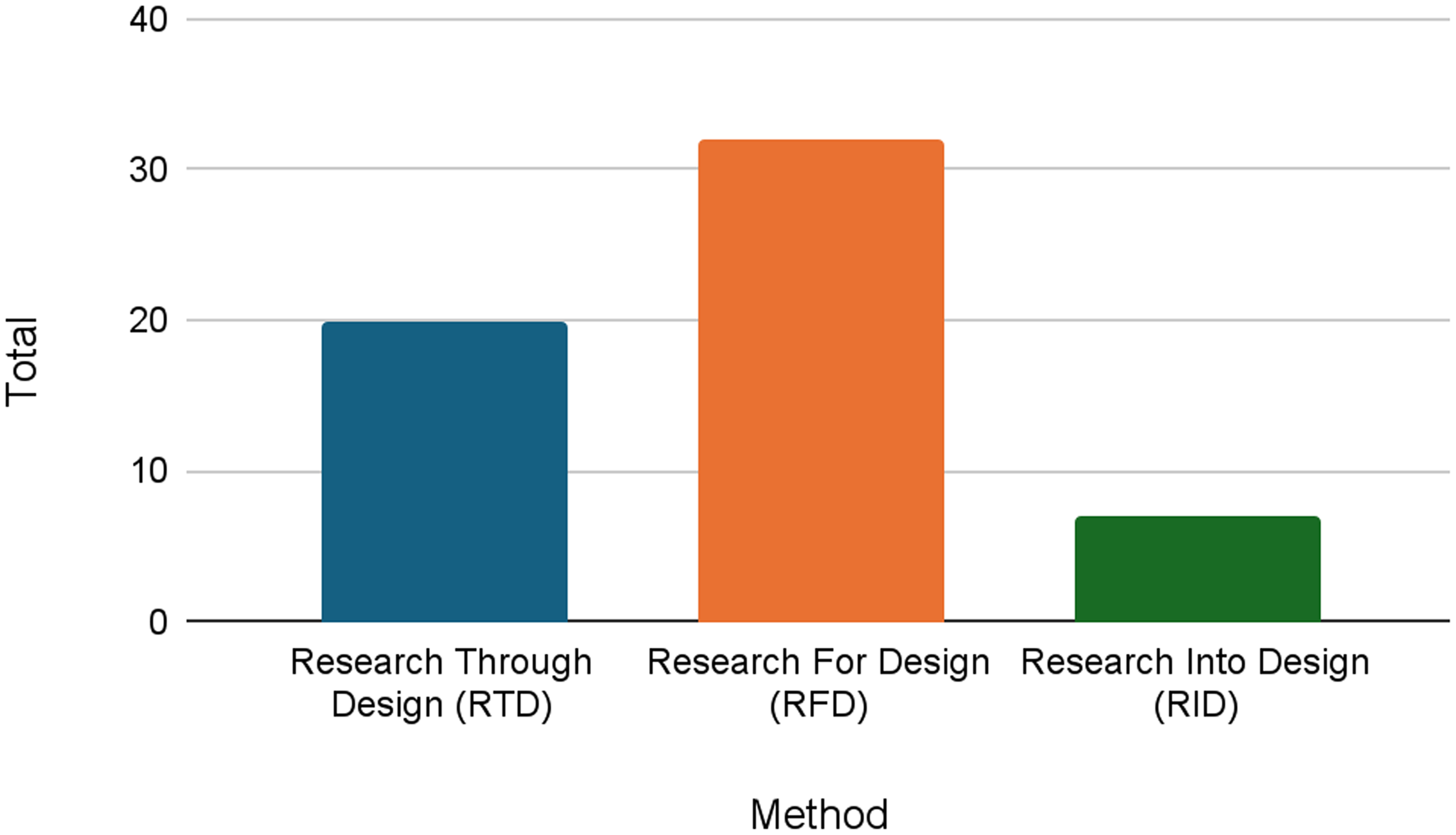
Research for Design was the most utilized research method in the M.ArchII theses between 2022–2024 (Figure 2). More than half of the 59 M.Arch II theses (54%) used Research for Design as the most prominent methodology. 34% of theses used Research Through Design as the primary design research method in their theses. 12% of theses were theory or history based (Research into Design).
Design Research Methods used in M.ARch II Theses from 2022–2024 (total).

Design research methods used (by year)
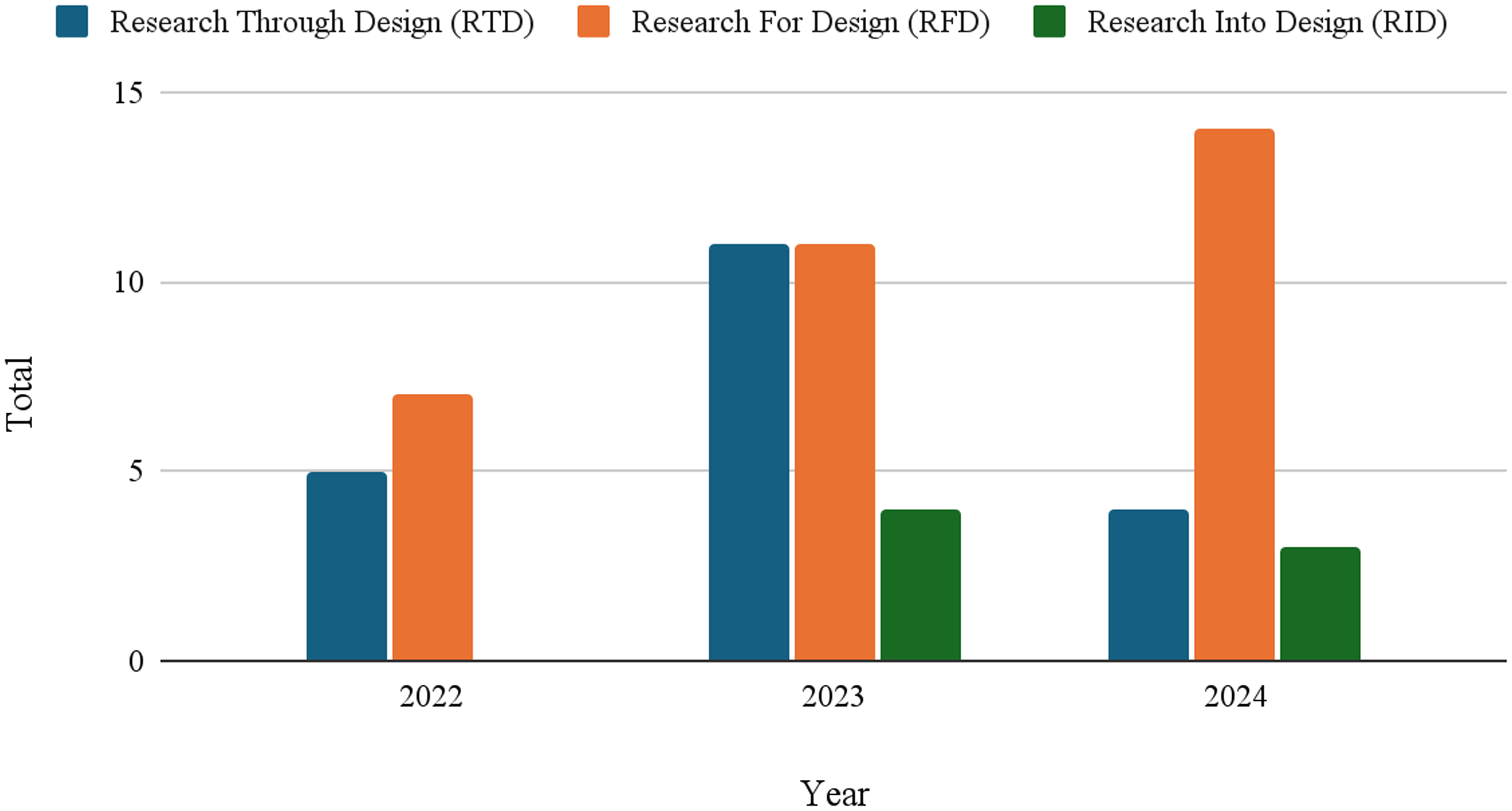
The 2022 group had the fewest theses in total. Of the 12 theses, none incorporated Research into Design methodology, 58% incorporated Research for Design, and 41.7% incorporated Research Through Design (Figure 3). The 2023 class had 26 total theses. 42% incorporated Research for Design and 42% incorporated Research Through Design. 15% of theses incorporated Research into Design. The 2024 class had 21 total theses. The majority of theses (67%) incorporated Research for Design methodology in their theses; 19% incorporated Research Through Design, and 14% incorporated Research into Design.
Design Research Methods used in M.ARch II Theses from 2022–2024 (by year).

Discussion
With a curriculum largely focused on research, it is surprising that research methodologies were not explicitly stated in 73% of the student thesis projects. Of the three Fraying design research methods, Research into Design is the most theory and history based. Considering Research into Design is the most straightforward research method and falls most in line with more traditional research methods, a connection was expected between Research into Design methods and theses that explicitly stated their research method. The data suggests that there is no clear association between design research method used and whether a research method was explicitly stated in the thesis work. Within the group of theses that did explicitly state a research method, many research methods stated did not fall within traditional social science research methods and none explicitly stated the phrase “design research method.”
The coding of the theses was limited to identifying the most prominent design research method employed, but it is worth noting that much of the student thesis work utilized multiple design research methods as described by Frayling. This reflects the iterative and individual nature of design research, aligning with findings from an earlier study examining M.Arch II students’ information-seeking behaviourFootnote 19.
It came as no surprise that research through design and Research for Design were the most used by students (88%). Yale School of Architecture has a long history and reputation for design and studio output, so this finding aligns with that history and emphasis within the school. How does design research fit into a more traditional architecture education curriculum focused on studio/design output?
The findings suggest that students do not necessarily see their work as falling within design research methods, or that perhaps they do not have the language to describe their research methodologies. In a program focused on design research and interdisciplinary work, perhaps these findings could be a call to arms for students to be equipped with the tools to do so more explicitly—by faculty or by librarians.
Nigel Cross and other scholars emphasized the importance of establishing commonality in research methods: “We have to be able to demonstrate that standards of rigor in our intellectual culture at least match those of others.”Footnote 20 There is an opportunity for students to make those connections and research standards clearer in their work. For librarians who support students engaging with design research, there are opportunities to incorporate design research methods into library instruction sessions and research requests. Further, discussing these findings with architecture faculty within the M.Arch II program could lead to productive conversations related to student research competencies and opportunities for future collaboration between the library and curriculum to support students engaging with design research.
Study limitations
Content analysis can be overly simplistic in its attempt to categorize and organize information. Defining design research methods is subjective and challenging. The existing literature on design research, along with its findings, raises more questions than answers regarding how to define design research in architecture. Given this, each effort to create a clear and replicable codebook can lead to different interpretations of design research methods and definitions.
In particular, distinguishing between research for and research through design can be difficult, especially when students use multiple methods in their research. The outcomes may vary based on the researcher’s perception and personal experience with design research in architecture. Since the thesis work was coded based on the most prominent research method used, the results might have differed if all employed research methods had been considered. Even applying a different design research framework could yield different results.
Additionally, due to the author’s liaison responsibilities within the School of Architecture, there may be a potential for bias. The subjective nature of defining design research methods is an important consideration.
Recommendations for future research
This study examines a small subset of an already limited population at the Yale School of Architecture. There is an opportunity to expand this research by exploring other architecture programs at YaleFootnote 21 to determine how their design research methods might differ from those of M.Arch II students. It would be valuable to investigate the themes that students focus on in their work and how these relate to their design research methods. Applying this codebook to architecture programs at other schools could also provide further insights into the design research methods utilized by students beyond the Yale context. The author intends to continue this research by conducting in-depth interviews with M.Arch II students to better understand how they define their design research methods in their own words.
Conclusion
In recent years, the Yale School of Architecture M.Arch II curriculum has shifted from a primarily design-focused curriculum to one that emphasizes research. Through the content analysis of 59 M.Arch II theses, this study revealed that the term “design research” is challenging to define and categorize, even within a design-research-based curriculum. 73% of analysed student thesis projects did not explicitly outline a research method. None of the theses clearly described their work as “design research.”
Between 2022 and 2024, many theses incorporated design research methods where the researcher also act as the designer (Research Through Design and Research for Design). This aligns with the historical context of the studio program at the School of Architecture. Surprisingly, however, in the theses that employed more straightforward or traditional research methods (Research Into Design), most did not explicitly state a research method.
The findings of this study are consistent with previous research investigating the definitions and methods of design research, highlighting the challenges of defining and categorizing this termFootnote 22. When students and faculty do not understand or define the various design research methods available, it complicates collaboration and support from external partners.
There is an opportunity for librarians to engage with architecture faculty to better understand how design research is discussed in courses and what expectations exist for students in research-intensive programs, such as the M.Arch II program. In a program focused on equipping students in cross-disciplinary design research, clearly describing these research methods could be beneficial.
Acknowledgements
The author would like to express gratitude to Chris Marino for their guidance, mentorship, and support of this research, as well the faculty, participants, and mentors of the Institute for Research Design in Librarianship (IRDL), with special thanks to Kris Brancolini and Marie Kennedy. In addition, the author extends sincere thanks to Jessica Quagliaroli for her collaboration and partnership in investigating design research methodologies