Introduction
In recent times, dominant social and policy trends, such as increasing maternal labour market participation and rising costs of living, including the cost of early childhood education and care, are placing pressure on older people to provide care for grandchildren (Timonen and Arber, Reference Timonen, Arber, Arber and Timonen2012; Hamilton and Jenkins, Reference Hamilton and Jenkins2015; Adamson, Reference Adamson2017). But at the same time, there has been a heavy policy emphasis on boosting the workforce participation of older men and women, and encouraging them to work longer (Organisation for Economic Co-operation and Development (OECD), 2006, 2015). As a result, for many, competing demands of work and care increasingly dominate the time in later life which, in the collective imagination, should be devoted to leisure (Hamilton and Hamilton, Reference Hamilton and Hamilton2006). Research shows that as older women (women over 50 years old) undertake considerably more care for grandchildren than older men do (Whelan, Reference Whelan2012; Hamilton and Jenkins, Reference Hamilton and Jenkins2015; Horsfall and Dempsey, Reference Horsfall and Dempsey2015; Craig et al., Reference Craig, Hamilton, Brown and Timonen2018), it is grandmothers who are likely feel the tension between work and child care most strongly. Internationally, research is growing on the importance of grandparent child-care provision as a family practice and policy issue. However, to date, there is scant attention paid to the ways in which grandparents who provide regular child care for their grandchildren experience the dual roles of paid worker and unpaid child-care provider.
Drawing on focus groups and a national survey of 209 Australian grandparents, of whom over three-quarters were grandmothers, this paper sheds new light on the experiences of older Australians caught between the dual imperatives of working longer and providing child care for grandchildren to support their adult children. First, the paper sheds new light on grandparents’ lived experience of negotiating paid work and unpaid care, the strategies they use to navigate this tension and the impacts child care has on their paid work. Second, the paper provides new insights into the way in which grandparents make sense of their roles as worker and carer within gendered moral rationalities about the distribution and value of paid work and unpaid care across genders and generations.
Background
In Australia and internationally, there has been increasing policy emphasis on boosting mature-age labour market participation. This has taken place in the context of an ageing population and concerns about the decline in the proportion of the working relative to the non-working population, and the effects this may have on the sustainability of welfare states (OECD, 2006). The aims of mature-age employment policy have therefore been to improve opportunities and incentives for older people to participate in paid work, boosting workforce participation rates, reducing expenditure on social protection, and improving the tax base and retirement savings (OECD, 2006). Internationally, this has seen a number of common trends in policy, including extending activation requirements for older people in receipt of income support, investment in mature-age training, anti-discrimination legislation and awareness campaigns, incentives for employers to employ mature-age workers, and increasing retirement ages (OECD, 2015). Indeed, over the last 30 years in Australia and in many other OECD countries, the participation rate of people aged 55 and over has been increasing. The participation rate of women aged over 55 is increasing more rapidly than the participation rate of men of that age, though the proportion of older men in paid work remains higher than women (Chomik and Piggott, Reference Chomik and Piggott2012). As the focus of policy is placed more heavily on mature-age labour market participation, there is now a considerable body of literature examining the factors that may be shaping or limiting the labour market participation of older people (Chomik and Piggott, Reference Chomik and Piggott2012; Oakman and Wells, Reference Oakman and Wells2013). In spite of growing recognition that provision of child care by grandparents is widespread, its potential impact on labour market participation in later life remains under-examined.
In OECD countries, grandparents play an important role in the provision of child care while parents participate in paid work. An increase in dual-earner households and increasing prevalence of marital breakdown and sole-parent households are creating greater demand for child care (Timonen and Arber, Reference Timonen, Arber, Arber and Timonen2012; Hamilton and Jenkins, Reference Hamilton and Jenkins2015). In Australia and some other Western liberal countries, limited accessibility and affordability in early childhood education and care (ECEC) systems create barriers to the use of formal ECEC (i.e. long day care, before or after school care, or family day care) among working parents (Phillips, Reference Phillips2014). Casualisation of work and the increase in non-standard working hours are also seeing more parents seek flexible child-care options (Adamson, Reference Adamson2017). Consequently, there is pressure on many grandparents to provide child care to help parents overcome some of the problems they face in finding an affordable child-care place that is flexible enough to accommodate what are sometimes unusual or variable working hours.Footnote 1 This is compounded by a strong normative preference in Australia and many other countries for family care (Kwon, Reference Kwon2005; Craig and Jenkins, Reference Craig and Jenkins2016a), whereby parents and grandparents prefer that grandparents provide child care instead of or in addition to formal child care. In Australia in 2017, approximately 864,000 Australian children aged 0–12 were cared for by their grandparents in a typical week, representing (by children) 43.7 per cent of all child care, far outstripping other forms of child care like long day care or before and after school care (Australian Bureau of Statistics (ABS), 2018).Footnote 2
Internationally, over the last 15 years, research has begun to investigate the importance of grandparenting as a family practice and policy issue. The research has examined the characteristics of grandparents who provide child care and the frequency and intensity of that care (Wheelock and Jones, Reference Wheelock and Jones2002; Goodfellow, Reference Goodfellow2003; Timonen and Arber, Reference Timonen, Arber, Arber and Timonen2012; Glaser et al., Reference Glaser, Price, Di Gessa, Montserrat and Tinker2013; Craig and Jenkins, Reference Craig and Jenkins2016a). This research suggests that most grandparent child care is provided by grandmothers, who shoulder much greater caring responsibilities than grandfathers. In Australia, it is estimated that around three-quarters of grandparent child-care providers are women (Craig and Jenkins, Reference Craig and Jenkins2016a), and internationally we see a similar pattern (Glaser et al., Reference Glaser, Price, Di Gessa, Montserrat and Tinker2013). Grandmothers are also more likely to be providing more intensive child care (Horsfall and Dempsey, Reference Horsfall, Dempsey, Buchanan and Rotkirch2016) and where grandfathers are involved in child-care provision, they spend less child-care time doing routine care activities like bathing and feeding and more time providing play-based care (Craig and Jenkins, Reference Craig and Jenkins2016b; Craig et al., Reference Craig, Hamilton, Brown and Timonen2018).
Research has also explored the child-care needs of parents and the reasons why they use grandparent child care (Wheelock and Jones, Reference Wheelock and Jones2002; Gray, Reference Gray2005; Baxter et al., Reference Baxter, Hand and Sweid2016). This research suggests that grandparent child-care provision improves mothers’ opportunities to participate in paid work (Gray, Reference Gray2005; Kanji, Reference Kanji2018). It also suggests that, beyond the practical support grandparents offer for mothers to participate in paid work, grandparent child care also supports mothers to navigate gendered moral rationalities about motherhood, child rearing and paid work. A large body of literature (i.e. Hochschild, Reference Hochschild1989; Duncan et al., Reference Duncan, Edwards, Reynolds and Alldred2003) has examined the way in which women negotiate the dual roles of mother and paid worker. Some have used the concept of gendered moral rationalities to describe the way in which mothers’ decisions about paid work are shaped by ‘deeply gendered moral requirements to take responsibility for children's needs and to place these first’ (Duncan et al., Reference Duncan, Edwards, Reynolds and Alldred2003: 310). These requirements are described by others as ‘moral geographies of mothering’, whereby social institutions and networks generate idealised versions of care and motherhood within which mothers make decisions about participation in paid work (Holloway, Reference Holloway1998; McDowell et al., Reference McDowell, Ray, Perrons, Fagan and Ward2005). These moral norms about motherhood are inextricably linked with considerations about the economic and intrinsic benefits of participating in paid work and the availability and suitability of alternative forms of child care (McDowell et al., Reference McDowell, Ray, Perrons, Fagan and Ward2005). Research suggests that the availability of grandparent child care not only supports mothers with economic decisions about their level of participation in paid work, but also enables mothers to navigate the moral geographies of motherhood by providing a form of ‘extended’ maternal care. According to Wheelock and Jones (Reference Wheelock and Jones2002), for example, where mothers are participating in paid work, mothers and grandmothers describe grandparent care as ‘the next best thing’ to maternal care. Grandparent child care therefore provides a form of ‘proxy’ through which mothers participating in paid work are able to attain idealised versions of child rearing.
However, though it is now acknowledged that grandparents have a positive impact on mothers’ labour market participation, little is known about the impacts of care-giving on grandparents’ labour force participation, and on how grandparents balance work and care. To date, there is a small amount of research that suggests a possible gendered relationship between grandparent child care and labour market participation (Hamilton and Jenkins, Reference Hamilton and Jenkins2015). While for grandfathers, there does not appear to be a strong relationship between paid employment and propensity to care (Condon et al., Reference Condon, Corkindale, Luszcz and Gamble2013), for grandmothers the findings are more mixed. One Australian study found that employed grandmothers are more likely than grandmothers who are not employed to provide child care (Condon et al., Reference Condon, Corkindale, Luszcz and Gamble2013), but other studies have found the opposite (Gray, Reference Gray2005; Whelan, Reference Whelan2012).
Current Australian quantitative data-sets related to grandparent care (see e.g. Condon et al., Reference Condon, Corkindale, Luszcz and Gamble2013; Craig and Jenkins, Reference Craig and Jenkins2016a; ABS, 2018) tend to focus on patterns of care (hours of care, numbers of children in care) as well as the demographic characteristics of grandparents (e.g. age, gender). While these studies have uncovered an association between grandparent child-care provision and attachment to the paid labour market, to date there is little exploration of how and why child-care provision affects labour market participation, and how grandparents navigate the competing demands of mature-age worker and provider of child care (Hamilton and Jenkins, Reference Hamilton and Jenkins2015). Fewer still – and no quantitative studies – explore the way in which grandparents’ decisions about paid work and unpaid care are also shaped by gendered moral rationalities that are intrinsically linked to those shaping mothers’ decisions.
Understanding this is essential for uncovering the distribution of child care across genders and generations. In the current policy context that focuses on boosting mature-age labour market participation, this paper draws on the concept of gendered moral rationalities of paid work and unpaid child care to shed new light on grandparents’ lived experience of negotiating paid work and unpaid care, the strategies they use to navigate this tension and the impacts child care has on their paid work.
Method
The study combined a national online survey of 209 grandparents and five focus groups with 23 grandparents in one Australian state, New South Wales. All participants in the survey and focus groups were providing regular child care for their grandchildren and were either employed or had left work in the last five years. The online survey was open for a period of three months in 2014–2015. The link to the survey was advertised on a range of online and print forums regularly visited or read by seniors, and on radio. Designed to examine the impact of regular intergenerational child-care provision on grandparents’ employment and retirement decisions, the online survey collected information on the care commitments of regular grandparent child-care providers, demographic information about grandparents, their current and recent labour force participation patterns, and factors relevant to their decision-making about work and care. While the survey collected data about the impact of care on both work and retirement decisions, the focus of this paper is on decisions about participation in employment, rather than retirement or complete withdrawal from employment. Following the closing of the survey, statistical testing was conducted on the quantitative data using SPSS software, to determine any statistically significant relationships between the key variables.
Five focus groups were conducted between December 2014 and February 2015. The participants were recruited by advertising the project in print media and on social media sites that grandparents frequent, in local clubs, libraries and community centres, and through snowballing. The online survey also finished with a question asking participants if they were interested in learning more about the focus groups and to provide contact details, and some participants were recruited this way. The five groups were conducted in a mix of metropolitan, outer-metropolitan and regional areas in NSW. Two participants opted to participate in a telephone interview. Locations were selected to include grandparents from across the socio-economic spectrum, and included two predominantly high-income inner-metropolitan regions, two outer-metropolitan areas (one low income and one with a high culturally and linguistically diverse population) and one regional area north of Sydney to capture a low-income and sometimes commuter population. The focus groups provided greater insight into the contextual and individualised decision-making processes surrounding grandparent child care and employment. The qualitative data were transcribed in full and coded using NVivo coding software. Responses to the qualitative questions in the online survey were also coded in NVivo. The analytical framework combined axial and open codes, in order to allow analysis of the project's research areas and the emergence of other themes (Grbich, Reference Grbich1999).
Participant characteristics
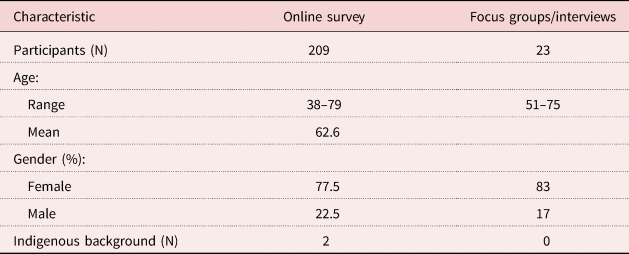
In the survey sample (N = 209), the majority of respondents (86%) were aged 55–70 years, with a mean age of 62.6 years. Just over three-quarters of the sample (77.5%) were female and 22.5 per cent were male. The participants in the qualitative work were broadly comparable in key characteristics such as gender and age. Select demographics from the survey and focus groups appear in Table 1.
Demographic characteristics of the samples

Once household income was equivilised,Footnote 3 the sample was clustered in the low (Aus $599 or less per week) and lower middle (Aus $600–999 per week) income categories.
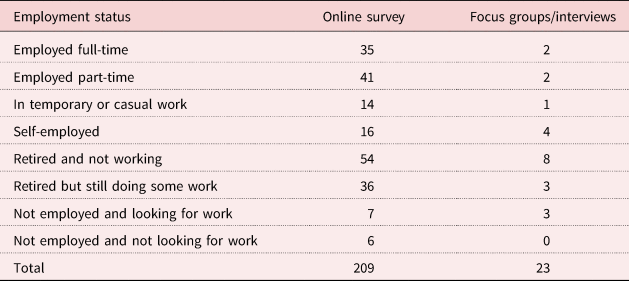
There was considerable variation in the employment patterns of the participants. According to the survey, around half were employed (full-time, part-time, casually or self-employed) and the other half, who had left work in the last five years, reported being retired or not working. Notably, just over a third of those who said they were retired said that they continued to do some paid work. The proportion of those working to not working was similar among the focus group and interview participants (see Table 2).
Employment status, online survey, and focus groups and interviews, by number of participants

Limitations
The data, drawn from a survey of 209 grandparents and focus groups with 23 grandparents, is relatively small in scope. Whilst the survey cohort was broadly consistent with the age and gender profile of grandparent care-givers in the literature (Jenkins, Reference Jenkins2010; Condon et al., Reference Condon, Corkindale, Luszcz and Gamble2013; Horsfall and Dempsey, Reference Horsfall and Dempsey2015), the relatively small sample size, combined with the lack of large-scale quantitative data about the characteristics (age, gender, employment status) of grandparent child-care providers does limit our ability to generalise these findings to the wider population of grandparent child-care providers in Australia. Respondents were self-selected, meaning that there may be some inherent bias in the findings. In particular, it may be that grandparents who are providing more hours of care than average, or who identify more as child-care providers, were more likely to participate in this study. Because the survey was conducted in an online format only, people with limited access to computers or the internet, or low digital literacy, may be underrepresented in the survey. No grandparents from rural or remote locations participated in the focus groups; their particular challenges or experiences were therefore not explored qualitatively. Grandparents from non-English-speaking backgrounds, and grandparents from Aboriginal and Torres Strait Islander backgrounds, were underrepresented.
Conceptually, one focus of the work on moral geographies of mothering (Duncan et al., Reference Duncan, Edwards, Reynolds and Alldred2003; McDowell et al., Reference McDowell, Ray, Perrons, Fagan and Ward2005) is the intra-household distribution of unpaid tasks. The focus of this study, however, was on the impact of regular child-care provision on grandparents’ work decisions, so it did not produce detailed data on the ways in which grandparents share child-care tasks. Grandparents in the study were asked extensively about their own child-care responsibilities and how they balanced this with their paid work, and while this did produce some qualitative data about how couples shared child-care responsibilities, participants were not explicitly asked about how they shared tasks. Instead, this has been the subject of other work by the authors and others, noted above (Glaser et al., Reference Glaser, Price, Di Gessa, Montserrat and Tinker2013; Horsfall and Dempsey, Reference Horsfall and Dempsey2015; Craig and Jenkins, Reference Craig and Jenkins2016b; Craig et al., Reference Craig, Hamilton, Brown and Timonen2018).
In addition, as the research was focused on the impact of grandparental care, the survey did not query respondents about managing and balancing other care responsibilities, including care for older parents or other family members. Navigating the demands of care for both parents and grandchildren has been a theme in some of the qualitative studies on grandparental care (Goodfellow, Reference Goodfellow2003; Horsfall and Dempsey, Reference Horsfall and Dempsey2015), however, as the current study was focused particularly on the impact of grandparental care, this issue of care for ageing parents is not explored in the current research.
Finally, this study did not collect quantitative data on the characteristics or circumstances of parents (income, professional status, housing situation, etc.). Recent data from the ABS shows that grandparent care is popular with parents across the socio-economic spectrum (ABS, 2018), however, future research could explore the extent to which patterns and experiences of grandparental care are mediated by parents’ characteristics and circumstances.
Moral geographies of grandparenting
Doing what's best for their children and grandchildren
The survey asked grandparents why their adult children needed child care and why their adult children had called on them when a child care need arose. Most grandparents reported that they provided regular child care to support the workforce participation of their children and children-in-law, especially their daughters and daughters-in-law. Two-thirds of the survey participants (67%) reported that the primary reason their adult children required care was so that the mother (i.e. their adult daughter or daughter-in-law) could work. Roughly a quarter (27%) reported that the primary reason for care was because of paternal labour force commitments.Footnote 4 Parental work commitments, therefore, far outweighed other primary reasons proffered in the survey, including ‘parents need a break’ (9.6%), ‘parental health condition’ (2.4%) or ‘parental study’ (1.9%).
When asked why their adult children had called on them when a need for care arose, 47.8 per cent of grandparents responded that the primary reason their adult children had called on them for child care was because they faced difficulties accessing formal child care (i.e. their adult children could not afford formal child care, could not find child care in the right location, could not find it at the right time and/or could not find high-quality child care). A further 39.2 per cent said that the primary reason they were called on for child care was because their adult children knew that they wanted to spend time with their grandchild/ren. Far fewer cited the special needs of their grandchild (2.8%), a desire to pass on culture or language (2.4%) or the perception by their children that their grandchild was too young for formal child care (6.7%) as the primary reasons their adult children had called on them for child care.
In the focus groups and interviews (and the qualitative responses in the survey), the grandparents framed their reasons for taking on regular child-care responsibilities in terms of their desires both to support their adult children and to build strong relationships with their grandchildren while they were young. The stronger emphasis was placed on doing what was best for their adult children, and this was focused on supporting their children – especially their daughters or daughters-in-law – to work or to earn. Here, participants reported wanting to support their daughters or daughters-in-law to re-engage in or remain attached to the labour market, to work the hours that were required of them (particularly for shift workers or casual workers) or, in one case, to study.
This desire to support their daughters and daughters-in-law to participate in work was situated in different family circumstances and values. For example, many reported that their daughters and daughters-in-law returned to work due to financial necessity: to pay the mortgage or other living expenses:
I came back to Sydney [to provide regular care for the grandchildren] when she had the second child or when he turned 18 months, there were problems and she needed to go back to work, to bring enough money into the house to keep the house running and to pay the mortgage that she had on investment units that she didn't want to lose. (Grandmother, metropolitan area)
I mean I can't, I don't feel like I can say no because that's her opportunity to get some extra money to get their head a little bit further up so they can afford some luxuries maybe. (Grandmother, metropolitan area)
Linked to the focus on resourcing, a common theme was that formal child care did not provide a realistic option due to lack of affordability or availability. According to one respondent:
My daughter needs to stay in touch with the workforce as once her children are school age … They cope with her doing part-time and her husband having two jobs. If the children went into child care it would NOT be worth her going back to work as costs and earnings level. (Grandmother, Qualitative response in survey, emphasis original)
Others focused on supporting their daughters or daughters-in-law to pursue their careers or find fulfilment in work:
When [daughter] was saying that she felt she needed to go back to work, I said I can do two days a week … I just assumed that I would be doing it because I wanted to. (Grandmother, metropolitan area)
I think in my situation there'd be no uni [university; for my daughter] …, which is her passion, and I don't want to stand in her light. This is such a little thing for me to do, and I enjoy doing it. (Grandmother, outer-metropolitan area)
Some grandparents also described providing child care in order to support their children in other ways, such as giving them a break to improve their health and wellbeing, or giving them time to invest in their intimate relationships.
While there was a strong focus by the grandparents on providing child care because it was what is best for their adult children, simultaneously, a strong narrative emerged about providing child care because it was the best thing for their grandchildren. All grandparents in the study said that they valued building relationships with their grandchildren, especially when their grandchildren were very young, and presented a number of idealised ways of caring for their grandchildren, including ideas about the importance of family care and the importance of developing strong grandparent–grandchild bonds early in their grandchildren's lives. For example, comments like those below were common:
I was never going to mind grandchildren, because I've always had my own life; always said that, my own life. But I fell in love with the first one didn't I, and I couldn't bear the thought of somebody looking after her that I didn't know. (Grandmother, metropolitan area)
I was happy to do a permanent day and another day if necessary but I felt it was very important that they know their grandparents and I feel if they don't know them before they go to school, it's too late, you can't form that bond once they're at school. That was my main reason for doing it. (Grandmother, metropolitan area)
[When my daughter returned to work full-time] my husband just said you'll have to go down and look after the kids. My daughter said I will have to book them into preschool full-time, I said well no, your father says I'm to look after them. She said oh mum, would you? We just, as a whole family and even my son-in-law, felt it was important that they have one person looking after them. (Grandmother, metropolitan area)
These findings suggest that grandparents assume child-care responsibilities because of a complex mix of a desire to support parental and particularly maternal labour market participation (and consequently, financial wellbeing), a desire to build relationships between grandparents and grandchildren, and contextual factors such as economic constraints, access to other ECEC options and preferences for family care. It also suggests that grandparents assume child-care responsibilities because they believe that they are doing what's best for their children and grandchildren, based on normative judgements about the appropriate role of parents and grandparents and in the context of wider social factors such as the value placed on mothers’ labour market participation and notions of good and appropriate care for grandchildren. The normative nature of grandparent care was also evident in the response to the statement in the survey ‘I believe that child care is a normal part of the grandparent role’, with which 72.5 per cent agreed (and only 8.8% disagreed).
The grandparents in this study therefore contextualised their decisions about assuming these roles within idealised notions of parenthood and grandparenthood, in which their motivations and decisions were based on deep moral requirements about supporting their adult children and building relationships with their grandchildren. These moral geographies of parenthood and grandparenthood were intrinsically interconnected. Supporting their adult child was akin to supporting their grandchild, and vice versa. Supporting their adult children with child care also enabled their adult children to navigate their own moral geographies of parenthood:
Grandchildren are an extension of the children and I think, for us, we do things to help our children so it's just an extension and that help goes on with our grandchildren as well. (Grandmother, metropolitan area)
I think everyone is the same, you do anything you can for your own children and if that means looking after your grandchildren then so be it. (Grandfather, metropolitan area)
These moral geographies of parenthood and grandparenthood were often situated within participants’ past experiences of parenthood and grandparenthood, in highly gendered ways. For example, in all focus groups, grandmothers situated their own motivations about grandparenting within their family histories of grandparental involvement – always articulated as grandmaternal involvement. At times, this was a desire to re-enact the grandmaternal roles that they had observed and valued. In others, it was a desire to do grandmothering differently to how they observed it in their family histories. Grandmothers in the focus groups framed their approach to grandmothering in the following ways:
I had a lovely grandmother and my father, his mother died when he was young and he had a grandmother that he spoke of in glowing terms and I thought gee … if I could do that, you could die happy couldn't you? (Grandmother, metropolitan area)
There are times, even though I promised myself I wouldn't do it, there are some times when I get asked to do something and I look at what the situation is and I think, if that was me, those are the times when I wished I had mum and so, there are times when I say yes, when I would probably, if I was being cold-hearted and just looking after what's good for me, I would have said no. (Grandmother, metropolitan area)
My mother was dead and my mother-in-law was in England, so I had no support when my kids were born. We were in Sydney when – and my family's from Adelaide, when [daughter] was born … So, I always swore that I would do whatever I could for my children to try and soften some of that because it was tough. (Grandmother, metropolitan area)
In contrast, grandfathers in the focus groups described their motivations and experiences of grandparenthood in the context of their own experience of fathering, for example:
I didn't get to see special things that were happening at school, all those things one would miss out on because one had to go to work. Of course now the granddaughter has something special at school, I get to go to that. I also get to take her to school and pick her up at different times too which again is, well to me is special and it's special time with her. (Grandfather, outer-metropolitan area)
In the accounts of both grandmothers and grandfathers, the moral geographies of grandparenting were articulated in highly gendered ways.
The grandparent care commitment
While there was great variation in their care arrangements, the grandparents in our study reported what were often very demanding child-care responsibilities. Many provided care over a number of years, looking after sequential families of grandchildren, and most provided substantial amounts of care, often several days per week or more. In the survey, the mean number of hours of care was 19.4 hours per week and the median was 13 hours per week. Care most often took place on weekdays during business hours, but a considerable number of grandparents also provided care on the weekends or overnight. Some had grandchildren stay or even live with them and some regularly stayed away from their own homes to care for their grandchildren. Many travelled substantial distances each week – sometimes hundreds of kilometres – to fulfil their caring commitments, and most equipped their houses with cots, change tables, nappies and food. There was also evidence of grandparents helping in more unusual or atypical circumstances that may be more difficult for parents to plan for or for formal child care to accommodate. In the survey, a high proportion of grandparents ‘sometimes’ or ‘always’ provided care in an emergency or crisis (89.5%), during the school holidays (85.6%), when the child's parents were sick (70.8%), when the grandchild was sick (70.8%) or when parents were suddenly called into work (64.6%). These findings suggest that the grandparents in our study played a critical role in facilitating both routine and non-routine care in families where parents work.
At times, grandparents identified differences in the grandparent role compared with the parent role. In contrast to their role as parents of young children, most reported that as grandparents of young children, they were able to focus more on the children and less on the ‘daily grind’ of work schedules and household chores. In some aspects, they felt less responsible, able to take a step back when it came to discipline and to ‘hand them back’ at the end of the day. In others, they felt greater responsibility associated with the children not being their own, as they needed to ‘answer to somebody else if they fell’ (grandmother, outer-metropolitan area). However, a number reported that in some instances, they were ‘stepping in’ to fulfil a parenting role, for example:
The other day we got a phone call just before high school finished and the eldest one was getting some sort of award. His mum and dad were both working that day. He only told them that morning that he was going to get an award so they said ‘what are you doing?’ I went oh – we did have plans but it was just to be at the high school to listen, to go and watch him get the award. So those sort of things they're not child minding as such but it still takes chunks out of your day. (Grandmother, metropolitan area)
One grandmother described the way in which she supported her recently divorced daughter in the following way:
I'm the second parent, not quite sure what I am because it seems to get muddled up at times but whoever answers, it's mum or grandma and mum gets grandma sometimes and they get muddled up but in their eyes they know what it is. (Grandmother, metropolitan area)
There was no statistically significant difference in the number of hours of child care provided by grandmothers compared with grandfathers. However, the study only surveyed grandparents who were ‘providing regular child care’, so the quarter of the sample who were men only included grandfathers who were providing considerable amounts of child care. However, according to recent research by the authors and others, there are very large differences in the gendered organisation of child care between grandmothers and grandfathers. In Australia, on average, grandfathers spend less than half the time that grandmothers do on daily child-care activities. Grandfathers also spend less child-care time doing routine care activities like bathing and feeding, and more time playing, and grandfathers are much more likely than grandmothers to multi-task their child care with leisure, whereas grandmothers tend to multi-task their child care with domestic work or other child care (Craig and Jenkins, Reference Craig and Jenkins2016b). Grandfathers also do almost all their child care with their partner present, whereas grandmothers do only 60 per cent of their child care with their partner present, suggesting that the responsibility for managing care is more likely to reside with grandmothers, with grandfathers providing ‘ancillary’ care (Craig and Jenkins, Reference Craig and Jenkins2016b). International comparative research also suggests that, across different welfare regime types and cultural contexts, grandmothers take on more routine child-care tasks than grandfathers (Craig et al., Reference Craig, Hamilton, Brown and Timonen2018). Some research suggests that this unequal distribution of child-care tasks among grandparents is shaped by gendered norms and expectations in older couples about child-care provision (Horsfall and Dempsey, Reference Horsfall and Dempsey2015, Reference Horsfall, Dempsey, Buchanan and Rotkirch2016).
The survey did not ask about the gendered allocation of tasks between grandmothers and grandfathers, but the focus groups and some qualitative survey responses produced some data on this subject. In every focus group, and a number of qualitative survey responses, some grandmothers reported taking on a greater proportion of the child-care tasks than their male partners and/or co-ordinating their partners’ contribution to child care. At times, this gendered division crossed generations. For example, a number of grandmothers reported that when their grandchildren were sick, they negotiated with their daughters and daughters-in-law about who took time off work to care for them. One grandmother described the difficulties in the way she and her daughter-in-law negotiated the workplace disruption when a child needed to be picked up from day care in the following way:
I have been rung by the day care because my number's there as a third number. But … I'm not the parent and I see that it is their responsibility to leave their workplace. But my daughter-in-law … it is harder for her. When they're professionals I mean they've got responsibility. We all have. It's very hard. It's very stressful I think for parents and grandparents. (Grandmother, metropolitan area)
For her, the tensions associated with balancing work and care in the family were managed in a heavily gendered manner – fathers and grandfathers were not involved in the negotiation.
Gendered moral rationalities on balancing work and care
The data suggested that participants adjusted their own patterns of work considerably to accommodate these child-care responsibilities. As roughly 80 per cent of the survey and focus group samples were women, most of the following discussion pertains to the impact of child care on grandmothers’ paid work. Most went to considerable lengths to be able to provide the care that their children required while also remaining in paid employment. Among the grandparents surveyed, 70 per cent of respondents revealed that their child-care commitments had altered the way they organised their work, such as the days or shifts that they work. Over half (53.8%) reported that their child-care responsibilities had affected the number of hours or days they worked. Most strikingly, one in six grandparents (16.8%) reported that they had changed their job because of their child-care commitment. In addition to making major and ongoing changes to their working arrangements, the grandparents in the study also regularly disrupted their patterns of work to accommodate atypical, often short notice, requests for care such as when a child was sick or if a parent was called into work. There was no statistically significant difference between the impacts of child care on the paid work of grandmothers compared with grandfathers, but this is likely to be due to the sampling process (see above).
The focus groups shed further light on how grandparents altered their patterns of paid work. The grandparents in the groups condensed working hours into several days so that they could offer ‘whole care days’, starting late or finishing early so that they could do drop-offs and pick-ups, working at night to make up for time spent caring during the day and reducing their working hours to accommodate caring commitments:
It was taking him to school, picking him up … we did work around it that's all. So I just – because I was also working from a home office, I just did later hours at home. (Grandmother, regional area)
I do later classes so I can take my youngest granddaughter to drop her off to day care and then I go to work. Yes I know that my daughter's got something on every [Wednesday] so it'll be a bit of a rush because I've got a class till 6:00 and an hour's drive. But I'll get there. I'll go straight there. (Grandmother, metropolitan area)
I chose to work only nine days per fortnight so I could go down [to Melbourne] once a fortnight to care for my other four grandchildren. (Grandmother, Qualitative response in survey)
Their care commitment also affected the way they used their workplace entitlements. Many organised their leave around their care, such as saving annual leave for school holidays or drawing on carer or family leave in emergencies, and many requested flexible working arrangements. Most reported that employers and colleagues had been fairly accommodating when they made changes to their patterns of work because of their care:
So in terms of having to be off early or be a bit later to drop [granddaughter] to school and then me get[ting back] to school and things like that, fortunately my boss wasn't too bad with it. (Grandmother, metropolitan area)
I mean the workplace is I think very understanding really. If something happened like I did have a situation once just with a sick child and I just left and someone else stepped in and took my classes so it's a very collegial workplace. (Grandmother, metropolitan area)
We found, therefore, that many participants were ‘working around care’, balancing work and care responsibilities, and making significant adjustments to their working arrangements as a result.
The survey also asked grandparents if they had found it difficult to juggle work and caring. While most had altered their working arrangements in some way, not all reported difficulty. In total, 41.3 per cent agreed or strongly agreed with the statement ‘it is/was difficult to balance work and caring for my grandchild’ and 42 per cent disagreed or strongly disagreed with this statement. Further analysis showed that some groups were more likely to find juggling work and care difficult. Higher levels of care were correlated with difficulty balancing work and care. Respondents who provided 13 hours or more of child care per week were more likely to agree that it was difficult to juggle work and care, compared with those providing 12 hours or less of child care per week (p < 0.01). Grandparents reporting that their employers were not accommodating of their care commitment were also more likely to report difficulty juggling work and care, compared with those whose employers were accommodating.
The focus groups provided a more nuanced picture of the difficulties of balancing paid work and care. They suggested that reorganising work to accommodate regular caring responsibilities had, for most grandparents, been manageable, perhaps because their employers had been fairly accommodating. However, it was more difficult to juggle work and the unpredictable care commitments that were also a large part of what the grandparents did. Whilst those working casually or those who were self-employed found it easier than others to accommodate these unpredictable demands for care, most found that it was much easier for them to access ‘planned flexibility’: they were able to create a permanent arrangement with their employer to change their working hours but it was difficult for them to respond to a last-minute request for care.
The participants framed the changes they made to their working arrangements in terms of a moral requirement to take responsibility for their children's and grandchildren's needs and to place these first:
So basically what I do is I treat her time as being my number one priority as to looking after the boys, predominately the boys and the daughter, then I work whatever I am doing around that. (Grandfather, outer-metropolitan area)
I have three daughters and I have this connection with my daughters, it's a very strong bond together, you know, as a family. So when they got married, we have to wait for so long to have kids, grandkids with me and my husband and I just told them, as soon as you've got a baby I'm going to stop working full-time, that's my decision and that is it. (Grandmother, outer-metropolitan area)
However, for most of the participants, this was marginally tempered by a sense that they were the secondary providers of care (their adult children were the primary providers), and this placed limits on the extent to which they placed their care responsibilities above their work. This deepened their sense of moral ambivalence about how to balance their care and their employment responsibilities. In the focus groups, most grandparents described times when they could not be the worker, or the carer, that they wanted to be because they were juggling both. On the one hand, their child-care responsibilities affected their feelings about the type of ‘worker’ they were. They reported that trying to fulfil the care needs as best they could sometimes put pressure on them at work. One in five said that their child-care responsibilities affected their ability to do their job. They described times when they were unable to conduct their work in the way that they would prefer, for example, adjusting their work when they knew that it created difficulties for their employers or colleagues:
I mean not that I've called in that much the back-up but you feel guilty as we said before about work. You feel guilty about not being there on time. (Grandmother, metropolitan area)
Like any board I'm on I'm always saying ‘well don't do it on this time and these and don't have a committee meeting in these hours’, trying to get the rest of them to accommodate me. I feel bad about it but I've also made a commitment so that [my daughter] knows I'll be there those days collecting those children and taking them home. So there's always feeling I'm putting pressure on people and other people have rights and their responsibilities as well so it's negotiating that. (Grandmother, metropolitan area)
One grandparent recalled taking her grandchildren to a meeting:
I said I can come to the meeting but I will have a two-year-old and a baby and they said not a problem, and everyone ended up playing with them for a while. So I did make it well known that I had taken on this responsibility. (Grandmother, outer-metropolitan area)
On the other hand, most found their work fulfilling (86.1%) and said they were very committed to their work, which sometimes meant that their child care suffered. They recalled times when they were not able to respond to additional requests for care and as a result, felt guilty:
I've put on myself the responsibility to be available [for child care] … If I can't help out, I do feel bad. (Grandmother, regional area)
So I can't control when … meetings are set to not being on a day I do child care. I still get the guilts. I can't stop it. (Grandmother, metropolitan area)
Some also said that, while they enjoyed both their work and their care, balancing the two left them feeling tired. According to one participant:
I used to laugh leaving work. I used to literally say ‘I'm off to feral hour’ [a time in the evening when her grandchildren were tired and poorly behaved] … every night I used to go to feral hour and I'd get home at 8:30 or 9 o'clock and just be dead. (Grandmother, metropolitan area)
Hence, for most, their care commitments did not stop them from working but it did initiate a shift towards more flexible or reduced working hours, alongside a change in focus in the way they organised their lives, from a focus on their role as ‘worker’ to one that was more oriented to their role as family carer. This emerged from a moral rationality associated with their adult children starting families of their own, in which idealised conceptions of parenthood and grandparenthood began to exert a strong influence on their labour market decisions.
Discussion
In this study of over 200 grandparents, of whom about 80 per cent were women, many combined paid work with substantial child-care responsibilities. Most went to considerable lengths to alter their work arrangements to accommodate their child-care responsibilities, and many found creative ways to continue working and support their adult children in the way that they required. Most commonly, grandparents altered the hours or shifts they worked or reduced their working hours, but a substantial proportion changed their job, and most made ongoing adjustments to their work to accommodate changing requests for care, including using their workplace entitlements or arranging their daily work tasks around their care commitments.
While many grandparents navigated the twin demands of worker and carer, not all of them found it difficult. Almost all participants strongly emphasised that they enjoyed providing care for their grandchildren, that they derived great benefits from it and that they wanted to continue providing child care. Balancing work and care became difficult when they provided high levels of child care, were required to disrupt their working patterns more than they were comfortable with, or when their employers were not understanding or flexible. It also became difficult when, at times, the participants felt overwhelmed by their child-care responsibilities, such as during times when their children lent on them more heavily than usual. Some described the work–child care balance as exhausting, and some found challenging the feeling that at times they were unable to be the worker or the carer that they wished they could be.
Grandparents’ approaches to work and child care were deeply embedded in gendered moral rationalities. Their approaches were gendered because they were underpinned by highly gendered notions of parenthood and grandparenthood. Grandmothers drew on idealised grandmother roles generated from their own experience of being mothered/grandmothered, a desire to reproduce the ‘good mother/grandmother’ or to compensate for one that did not live up to this gendered ideal. Grandfathers, in contrast, drew on idealised grandfather roles generated from their own experience of fathering; an opportunity to ‘be more involved’. Drawing on previous experiences of mothering and fathering as a ‘moral reference point’ in this way at times provided opportunities to disrupt or reconfigure familial gender norms but also provided deeply gendered parameters within which ideals of male and female grandparent care provider were formed and within which decisions about work and care were made. These rationalities were also based on deeply gendered assumptions about the distribution of work and care among their adult children: that grandparent care replaces maternal care, and enables a maternal labour market participation, rather than paternal care and paternal labour market participation. While the grandparents in this study were not explicitly asked about the way in which they shared child-care responsibilities between grandmothers and grandfathers, we know from other work by the authors and others (Whelan, Reference Whelan2012; Horsfall and Dempsey, Reference Horsfall and Dempsey2015; Craig and Jenkins, Reference Craig and Jenkins2016b; Craig et al., Reference Craig, Hamilton, Brown and Timonen2018) that grandmothers are much more heavily involved in child care than grandfathers, and that the gendered division of child-care tasks (whereby women carry out more routine tasks and men carry out more play-based tasks) persist into grandparenthood, though with some recalibration, such as an increase in grandfathers’ involvement in the activity of accompanying/transporting grandchildren around, compared with fathers (Craig and Jenkins, Reference Craig and Jenkins2016a; Craig et al., Reference Craig, Hamilton, Brown and Timonen2018). This suggests that grandfathers’ involvement in child care is based on gendered norms about care provision, though this is an area in need of more research.
The approaches were moral because they were based on idealised conceptions of parenting and grandparenting and the associated notions of the care and support that grandparents ‘should’ provide to their adult children and grandchildren. This included supporting their adult children to develop or sustain careers or to be financially secure, and providing loving, familiar or consistent care for, and building close bonds with, grandchildren, especially while they are young. The approaches are rationalities because they provide ‘a framework for taking decisions’ (Duncan et al., Reference Duncan, Edwards, Reynolds and Alldred2003) about the labour market participation and financial security of both themselves and their adult children. These gendered moral rationalities were situated in complex moral geographies of parenthood and grandparenthood that are inextricably linked. Idealised versions of care and support are situated in the broader context of the social organisation of child care (Holloway, Reference Holloway1998), in which mothers’ work is highly valued and formal early childhood education and care is not adequately available, flexible or affordable. Grandparents described the ways in which the care that they provided supported their adult children to navigate their own gendered moral rationalities about motherhood, child rearing and paid work, by offering an affordable familial child-care option that could serve as ‘the next best thing’ to parental care, supporting their adult children – mostly daughters and daughters-in-law – to make decisions about participation in paid work. The grandparents also navigated gendered moral rationalities of their own, whereby motivations and decisions were based on deep moral requirements about supporting their adult children and grandchildren, which interacted with social and cultural norms about mature-age labour market participation to form complex and at times conflicting attachments to their roles as parents, grandparents and workers. Whilst there was no meaningful relationship uncovered between age or lifecourse stage, and grandparents’ experiences of care, in the current study, this is an area which warrants further exploration, particularly given that other studies have shown that older grandparents are more likely to struggle to balance care-giving against their health and wellbeing (Condon et al., Reference Condon, Corkindale, Luszcz and Gamble2013; Craig and Jenkins, Reference Craig and Jenkins2016b).
The linked nature of the gendered moral rationalities of parenting and grandparenting also at times for some grandparents gave rise to ambivalence over both the extent of their responsibilities for child care and the extent to which they were willing to disrupt their patterns of paid work to accommodate that care. While most agreed at a broad level that they placed the needs of their adult children and grandchildren above their own employment requirements and preferences, in the daily negotiation over child-care responsibilities, many described times – especially with short notice requests such as when a child was sick – when they felt that the primary responsibility for meeting the needs of the grandchildren should lie with their adult children, and it was not reasonable for them as grandparents to disrupt their patterns of paid work or even leisure in these instances, though this was tempered by considerations about the level of employer understanding and flexibility available to them compared with their adult children. These assessments were heavily gendered, and often involved negotiating between mother and grandmother (and at times grandfather) to fill a gap in child care, rather than involving fathers when an unanticipated care need arose. In articulating this, the grandparents expressed a sense of moral ambivalence about where their responsibilities as parents and grandparents began and ended, and guilt at prioritising their own needs.
Conclusion and implications
These findings draw attention to enduring trends in the way social and policy structures shape the gendered distribution of care, both within and across generations. While almost all grandparents assumed child-care responsibilities because they wanted to build relationships with their grandchildren, the most common reason why their adult children required child care was so that the parents, particularly the mothers, could participate in work. This suggests some important, heavily gendered, ‘intergenerational trade-offs’ in the familial dynamics of child-care provision that challenge the dual policy priorities of boosting paid work among older people and among mothers. Many grandparents – mostly grandmothers – in our study were adjusting or reducing their own workforce participation to facilitate the workforce participation of their daughters and daughters-in-law. In other words, one generation of women is reorganising or reducing their employment participation to increase the participation of another. In many families in our study, both the mothers and the grandmothers were balancing work and child care, and there was evidence that the tensions associated with balancing work and care in the family could be managed in a highly gendered manner. Two generations of women were, in effect, sharing the tensions and impacts associated with child care in the family. This suggests that in families in which mothers participate in paid work, paid and unpaid work in the family may be reallocated to grandmothers (and to a much lesser extent grandfathers) rather than or as well as fathers.
The concept of gendered moral rationalities provides a useful lens through which to examine the phenomenon of grandparent child-care provision in the contemporary era of ‘working longer’, or ‘productive ageing’. As greater numbers of older women participate in work, tension between work and care in later life is likely to become more common. Grandmothers are finding creative ways of negotiating the demands of the ‘two jobs’ of paid work and unpaid care. But if governments are going to encourage, and even compel, older people to work longer, this should be accompanied by the extension of work–life balance policies beyond the focus on parents of young children, and an investment in policies that support older women, and support and encourage older men, to balance work and child care, and which mitigate the costs associated with care provision. It should also be accompanied by policies that increase fathers’ involvement in the lives of their young children and which improve the availability, flexibility and affordability of formal early childhood education and care services so that the moral geographies of care in which parents and grandparents make decisions about child care include a wider range of opportunities for the redistribution of care. Creating policy levers which encourage women and older people to increase their participation in work, without creating policies to support the equitable and sustainable distribution of unpaid care, can create new inequalities or deepen existing ones.
In spite of its importance to the functioning of Australian families and to Australia's social and economic fabric, there is currently no recognition in Australian policy discourse of regular child-care provision by grandparents, particularly grandmothers, and the gendered pressures they face in juggling work and care. It is almost completely invisible in the policy areas in which it is likely to have the biggest impact: ECEC, maternal employment policy, mature-age employment policy and retirement incomes policy. In some countries, governments are beginning to recognise the important role of grandparents in providing child care and the impacts that it has on their work and retirement incomes. In the United Kingdom, for example, the right to request flexible working hours was recently extended to grandparents providing regular child care, its system of carer credits was extended to grandparents, and a legislative change is proposed that will give parents the option of transferring some of their paid and unpaid parental leave to a grandparent (Australian Human Rights Commission (AHRC), 2013). In Hungary, the child-care allowance (or income support payment while caring for children, which includes a compulsory pension contribution) for parents becomes available to grandparents once the child turns one. In addition, across many countries, some companies now offer grandparent leave following the birth of a grandchild (AHRC, 2013). Yet in Australia, grandparent child care has been largely absent from policy debates in ECEC, employment and retirement incomes policies. The goal of boosting labour market participation of mothers and older women should be pursued in a context in which there is better recognition and understanding of how unpaid care will be reorganised and redistributed across genders and generations, and the impacts this has on older people, particularly older women.
Acknowledgements
We would like to acknowledge National Seniors Australia for funding the project and for their support with recruiting research participants and the dissemination of the project findings to older people and the wider community. The authors would also express our indebtedness to the grandparents who participated in the study.
Financial support
This work was supported by National Seniors Australia, through a competitive National Seniors Australia Productive Ageing Grant.
Ethical standards
This project was approved by the University of New South Wales’ Human Research Ethics Committee (approval number HC14243).