Introduction
Although crop diversity has been identified as essential to enhance global food security and adapt to climate change (Thrupp, Reference Thrupp2000; Pascual et al., Reference Pascual, Narloch, Nordhagen and Drucker2011), high loss of genetic resources is occurring due to agricultural industrialization and market requirements (Brush, Reference Brush and Brush2000, Reference Brush2004; Drucker et al., Reference Drucker, Smale and Zamborano2005). Agrobiodiversity exists at multiple scales and relates to biological components embedded in agricultural production, including genetic resources, plants, livestock, soil organisms, natural pest controls and agroecosystem characteristics (Thrupp, Reference Thrupp2000; Frison et al., Reference Frison, Cherfas and Hodgkin2011). Crop diversity is one aspect of agrobiodiversity and may be assessed according to different species grown or the genetic variation that exists within one species (Brush, Reference Brush and Brush2000; Smale, Reference Smale and Smale2006). Typically, smallholders who continue to implement traditional agricultural practices are the primary keepers of crop diversity (Brush, Reference Brush and Brush2000; Bellon, Reference Bellon2004; Isakson, Reference Isakson2011). Much of this diversity is in the form of native crop varieties, often called landraces, which are valuable to farmers for they typically possess unique traits well-adapted to local environments (Harlan, Reference Harlan1975; Brush, Reference Brush1995). However, most of these indigenous landraces are not connected to well-developed markets and are therefore underutilized (Drucker et al., Reference Drucker, Smale and Zamborano2005; Lockie and Carpenter, Reference Lockie, Carpenter, Lockie and Carpenter2010).
Integrating smallholders into high-value markets has emerged as a market-oriented development strategy to alleviate poverty and food insecurity (Horton, Reference Horton2008; Brinkerhoff and Brinkerhoff, Reference Brinkerhoff and Brinkerhoff2011). Value chains are considered as all the activities necessary to bring a product from production to consumption and disposal (Kaplinsky, Reference Kaplinsky2000). The prominence of value chain development as a poverty reduction strategy may be evidenced by the organizations advocating for this market-oriented approach, including the World Bank, Food and Agriculture Organization, CGIAR Consortium and the U.S. Agency for International Development. The proliferation of value chain projects globally also indicates their current importance in development policy and practice. For example, value chain opportunities have been developed for taro and coffee smallholders in Nicaragua, poultry in India, organic cotton in Tanzania, plantains in the Dominican Republic and potatoes in Uganda, to name just a few (Horton et al., Reference Horton, Akellow, Aliguma, Bernet, Devaux, Lemaga, Magala, Mayanja, Sekitto, Thiele, Velasco, Devaux, Ordinola and Horton2011; Donovan and Stoian, Reference Donovan and Stoian2012). In addition to poverty reduction, value chain development has also been identified as having potential to conserve agrobiodiversity (Hellin and Higman, Reference Hellin and Higman2005; Giuliani, Reference Giuliani2007; Keleman and Hellin, Reference Keleman and Hellin2009; Hellin et al., Reference Hellin, Higman, Keleman, Lockie and Carpenter2010). The role and function of value chains in the maintenance of agrobiodiversity is an important option to consider among the suite of market mechanisms incentivizing biodiversity conservation (Brush, Reference Brush1995, Reference Brush and Brush2000, Reference Brush2004; Bellon, Reference Bellon2004; Lockie and Tennent, Reference Lockie, Tennent, Lockie and Carpenter2010; Stone and Wu, Reference Stone, Wu, Lockie and Carpenter2010). While studies exist on how various market pressures affect on-farm diversity (Carpenter, Reference Carpenter, Lockie and Carpenter2010; Isakson, Reference Isakson2011; Gill et al., Reference Gill, Bates, Bicksler, Burnette, Ricciardi and Yoder2012; Garcia-Yi, Reference Garcia-Yi2014), more attention must be dedicated to investigating how value chain development specifically contributes to conservation goals (Hellin et al., Reference Hellin, Higman, Keleman, Lockie and Carpenter2010; Lockie and Carpenter, Reference Lockie, Carpenter, Lockie and Carpenter2010). As value chains typically offer stable, competitive prices, research must investigate how these new market opportunities influence local dynamics of agrobiodiversity conservation.
The purpose of this research was to explore how value chain development for native potatoes in the highlands of Peru interacts with the conservation of native potato varieties by smallholding farmers. A biodiversity hotspot (Myers et al., Reference Myers, Mittermeier, Mittermeier, da Fonseca and Kent2000), Peru offers a compelling example to investigate the intersection of value chain development and potato conservation. Native potato varieties constitute a fundamental livelihood component for smallholders in the highlands, who are keepers of more than 4000 varieties, but also suffer from persistent poverty and malnutrition (Zimmerer, Reference Zimmerer1996; Meinzen-Dick et al., Reference Meinzen-Dick, Devaux and Antezana2009). With these conditions as the context, this study focused on one example of the Papa Andina Initiative, an effort spearheaded by the International Potato Center (CIP) from 1998 to 2011 to facilitate public–private partnerships in the Andean highlands that would develop market niches for the native potato varieties maintained by smallholders. A mixed method study was conducted in one particular community in the central highlands of Peru, where a national NGO, FOVIDA, has been working with farmer associations to aggregate specific native varieties being demanded by PepsiCo, owner of Frito Lay's and a national supermarket, Plaza Vea. By developing market opportunities with (trans)national agrifood corporations, the aim of this value chain project was to simultaneously stimulate economic opportunities for smallholders and conserve potato biodiversity. Given the implications for biodiversity conservation in this particular case of value chain development, the objectives of this study were to characterize smallholders who cultivate a number of potato varieties in communities where value chain opportunities are being implemented and to ascertain if and how emerging value chain opportunities influence production decisions of smallholding farmers.
Crop Biodiversity
Native landraces help fulfill various functions for farmers such as minimizing risk, adapting to production conditions, managing pests and pathogens, satisfying culinary preferences and fulfilling market demand (Brush, Reference Brush and Brush2000, Reference Brush2004; Bellon, Reference Bellon2004; Jackson et al., Reference Jackson, Pascual and Hodgkin2007; Love and Spaner, Reference Love and Spaner2007). These kinds of private benefits provide reasons for farmers to continue to maintain crop diversity in their fields (Bellon, Reference Bellon1996; Brush, Reference Brush and Brush2000; Smale, Reference Smale and Smale2006). The practice and maintenance of both cultural and biological heritages of particular places are also embedded in conservation practices (Graddy, Reference Graddy2013). In addition to the private benefits flowing to farmers, crop diversity provides public benefits in the form of ecosystem services and social progress (Thrupp, Reference Thrupp2000; Bellon, Reference Bellon2004; Narloch et al., Reference Narloch, Drucker and Pascual2011). Thus, the benefits of agrobiodiversity conservation range from the household level to the global (Pascual et al., Reference Pascual, Narloch, Nordhagen and Drucker2011). According to Bellon (Reference Bellon2004), it is the public value provided by crop diversity that makes it particularly worthy of investment. One difficulty in conserving crop diversity, however, is that the smallholders who continue to act as its keepers are not often compensated for the public value they produce (Isakson, Reference Isakson2011; Narloch et al., Reference Narloch, Drucker and Pascual2011). The integrated global economy typically demands a standardized supply of consistent yields of modern crop varieties, not the diversity of traditional varieties that can be crucial to the livelihoods of smallholding farmers (Bellon, Reference Bellon2004; Drucker et al., Reference Drucker, Smale and Zamborano2005; Carpenter, Reference Carpenter, Lockie and Carpenter2010). Given the tension that appears to exist between marketplace demand and biodiversity maintenance, a common assumption exists that market expansion contributes to biodiversity erosion and environmental degradation (Isakson, Reference Isakson2011; Jacobsen, Reference Jacobsen2011).
Previous research has investigated the interaction between market integration among smallholders and their conservation of crop diversity (Carpenter, Reference Carpenter, Lockie and Carpenter2010; Cavatassi et al., Reference Cavatassi, Gonzalez-Flores, Winters, Andrade-Piedra, Espinosa, Thiele, Devaux, Ordinola and Horton2011; Isakson, Reference Isakson2011; Garcia-Yi, Reference Garcia-Yi2014). Empirical evidence indicates that market integration does not necessarily erode biodiversity (Isakson, Reference Isakson2011) and may even contribute to it (Garcia-Yi, Reference Garcia-Yi2014), although Jacobsen (Reference Jacobsen2011) observed profound environmental degradation in Bolivian communities as they integrated into global quinoa chains. As market integration occurs, variation in outcomes is common and farmers' decision-making regarding their production and marketing strategies is complex (Zimmerer, Reference Zimmerer1996; Smale, Reference Smale and Smale2006; Isakson, Reference Isakson2011). Farmers are generally more likely to conserve crop diversity when they are more geographically isolated from markets (Van Dusen and Taylor, Reference Van Dusen and Taylor2005; Winters et al., Reference Winters, Hintzy, Ortiz and Smale2006), though evidence does exist to the contrary (Perales et al., Reference Perales, Brush and Qualset2003). Most farmers who reside in centers of diversity, or places rich in biological diversity, have long histories of mixed market and subsistence activities (Brush, Reference Brush1995, Reference Brush and Brush2000; Bellon, Reference Bellon2004). Crop diversity loss has also been associated with greater reliance on off-farm activities (Zimmerer, Reference Zimmerer1996; Winters et al., Reference Winters, Hintzy, Ortiz and Smale2006; Mazid et al., Reference Mazid, Shideed and Amri2013), although labor opportunities to conserve agrobiodiversity in communities arise when household members migrate (Zimmerer, Reference Zimmerer2014). Rather than any generalizable trend, the existing evidence indicates that the relationship between market integration and crop diversity conservation is contextually specific.
Value Chain Development and Crop Diversity
The lack of market demand for traditional varieties threatens the in situ maintenance of these crops (Kumar et al., Reference Kumar, Gopi, Prajeesh, Lockie and Carpenter2010; Pascual et al., Reference Pascual, Narloch, Nordhagen and Drucker2011). To encourage conservation practices, various market and non-market mechanisms have been implemented. Non-market-oriented methods include strategies such as diversity fairs, participatory plant breeding, seed banks and capacity-building for the collective management of biodiversity (Brush, Reference Brush and Brush2000; Tapia, Reference Tapia2000; Gill et al., Reference Gill, Bates, Bicksler, Burnette, Ricciardi and Yoder2012; Galluzzi et al., Reference Galluzzi, Estrada, Apaza, Gamarra, Pérez, Gamarra, Altamirano, Cáceres, Sevilla, Noriega and Jäger2015). Experimentation has also occurred with market mechanisms to encourage conservation. Payments for Ecosystem Services (PES), and more specifically Payments for Agrobiodiversity Conservation Services (PACS), taxes, and labeling and certification, for example, are market-based instruments that have been implemented in various regions around the globe to help correct biodiversity erosion (Jackson et al., Reference Jackson, Pascual and Hodgkin2007; Mutersbaugh and Klooster, Reference Mutersbaugh, Klooster, Lockie and Carpenter2010; Narloch et al., Reference Narloch, Drucker and Pascual2011). However, their forms, implementation processes and impacts are widely variable, causing Lockie and Tennent (Reference Lockie, Tennent, Lockie and Carpenter2010) to caution that ‘the current enthusiasm for MBIs [market-based instruments] among natural resource policy makers needs to be tempered by a more realistic assessment of their potential’ (p. 299).
Value chain development is another emerging market strategy that seeks to simultaneously achieve agrobiodiversity conservation and economic goals. Through value chains, some see opportunity to create market niches demanding the crop varieties maintained by smallholding farmers (Hellin and Higman, Reference Hellin and Higman2005; Meinzen-Dick et al., Reference Meinzen-Dick, Devaux and Antezana2009). Potential for value chains to contribute to crop diversity conservation has been identified for quinoa and potatoes in the Andes, maize in Mexico, minor millets in India, and capers, figs, jujube, laurel, caper, purslane and mallow in Syria (Hellin and Higman, Reference Hellin and Higman2005; Giuliani, Reference Giuliani2007; Keleman and Hellin, Reference Keleman and Hellin2009; Hellin et al., Reference Hellin, Higman, Keleman, Lockie and Carpenter2010). Studies that have investigated value chains have consistently found that they provide higher capital gains to smallholding farmers (Masakure and Henson, Reference Masakure and Henson2005; Miyata et al., Reference Miyata, Minot and Hu2009; Cavatassi et al., Reference Cavatassi, Gonzalez-Flores, Winters, Andrade-Piedra, Espinosa, Thiele, Devaux, Ordinola and Horton2011; Escobal and Cavero, Reference Escobal and Cavero2012), but far less evidence exists regarding how they interact with decision-making around conservation practices (Lockie and Carpenter, Reference Lockie, Carpenter, Lockie and Carpenter2010). Furthermore, the potential for value chains to contribute to biodiversity goals must be moderated by realistic expectations. Value chains may expand market demand for more varieties but the scope will also likely be limited by the quality characteristics required by downstream actors in value chains, and market demand for a few varieties may lead to the displacement of other landraces (Drucker, Reference Drucker2013). Thus, while research has begun to explore how value chains interact with biodiversity conservation, no generalizable trends have yet been identified. Given the lack of understanding regarding this relationship, the intent of this research is to provide further insights into the complexity that occurs when market niches are developed for smallholders who maintain rich crop diversity.
Native Potato Value Chain Development in the Peruvian Highlands
Peru has experienced strong economic growth for the past decade that has resulted in significant strides in poverty reduction. Over the past decade, Peru has experienced an average 6.1% growth in GDP, and poverty rates have declined from 42% in 2007 to 24% in 2014 (World Bank, 2015). However, inequality remains prevalent as rural peasants, particularly those who live in the highlands, experience high rates of poverty and malnutrition (INEI, 2013a). To improve these conditions, value chain development for the native potato varieties that smallholders cultivate in the highlands is being pursued (Hellin and Higman, Reference Hellin and Higman2005). Domesticated in the Andes about 6000 years ago, an estimated 4000 potato landraces exist, the majority of which are cultivated above 3500 m (Brush, Reference Brush1992; Meinzen-Dick et al., Reference Meinzen-Dick, Devaux and Antezana2009). In the highlands, smallholders often produce potatoes for the dual purpose of home consumption and market sales (Mayer, Reference Mayer2001; Antezana et al., Reference Antezana, Fabian, Freund, Gehrke, Gimmann and Seher2005). Market sales are typically limited to local spot markets where producers sell either to wholesalers or consumers and are vulnerable to low and unpredictable prices. Because smallholders struggle to produce potatoes at economies of scale, they have not been desirable partners in the past for agrifood corporations that pay competitive prices consistently but are interested in efficient supply chains and low transaction costs (Escobal and Cavero, Reference Escobal and Cavero2012).
Given that the potato continues to be the most important staple crop produced in the Andean highlands and is a popular product for the urbanizing population, the International Potato Center (CIP), an international agricultural research center, has recently dedicated extensive efforts to enhancing the market opportunities available to smallholding potato producers in the highlands. Between 1998 and 2011, CIP coordinated the Papa Andina Initiative, the focus of which was to create market niches that are competitively advantageous for poor potato producers of the Andean highlands (Meinzen-Dick et al., Reference Meinzen-Dick, Devaux and Antezana2009). In Peru, the Papa Andina Initiative established partnerships among private, public and civil society sector stakeholders to make the potato chain more advantageous for smallholder farmers (Thiele and Devaux, Reference Thiele, Devaux, Devaux, Ordinola and Horton2011). Papa Andina recognized that smallholders possess important resources that can give them a competitive advantage in value chains that demanded the native potato varieties that they cultivated (Meinzen-Dick et al., Reference Meinzen-Dick, Devaux and Antezana2009). What has resulted is the marketing of several new potato products, including sacked whole native potatoes sold in supermarkets as a gourmet item and native potato chips (Ordinola et al., 2011).
In highland communities, diversity across and within crops is prominent with the potato often considered as the most important staple (Brush, Reference Brush1995; Thiele, Reference Thiele1999; Mayer, Reference Mayer2001; Perez et al., Reference Perez, Nicklin, Dangles, Vanek, Sherwood, Halloy, Garrett and Forbes2010; Galluzzi et al., Reference Galluzzi, Estrada, Apaza, Gamarra, Pérez, Gamarra, Altamirano, Cáceres, Sevilla, Noriega and Jäger2015). However, the introduction and increasing adoption of improved varieties since the 1950s has caused concern that potato agrobiodiversity is eroding as native varieties are replaced by those that are high yielding (Zimmerer, Reference Zimmerer1998; Scurrah et al., Reference Scurrah, Andersen and Winge2008; Perez et al., Reference Perez, Nicklin, Dangles, Vanek, Sherwood, Halloy, Garrett and Forbes2010). Despite such predictions, evidence exists that households continue to cultivate diverse varieties of native potatoes even as they adopt improved varieties (Brush, Reference Brush1992; Zimmerer, Reference Zimmerer1996; Mayer, Reference Mayer2001). In the 1990s, hundreds of landraces were still being found in Andean valleys in the central and southern highlands as households continued to produce more than ten native varieties on average (Brush, Reference Brush1992; Zimmerer, Reference Zimmerer1998). Studies over the last two decades have shown that wealthier farmers with better access to agricultural resources, including more labor, land and livestock, are commonly the keepers of potato diversity (Zimmerer, Reference Zimmerer1996; Mayer, Reference Mayer2001). Increasingly, rural households with a more limited resource base than their neighbors are reducing their market-oriented potato production and are pursuing off-farm labor activities, leading Horton and Samanamud (Reference Horton and Samanamud2012) to conclude that ‘over time, a declining number of potato farmers is producing and marketing an increasing share of the potatoes’ (p. 4). Given the lack of knowledge related to this case of value chain development specifically and to the effects of value chains on crop diversity conservation more generally, this study seeks to better understand how farmers respond to value chain opportunities through their decisions around crop diversity.
Methods
Research design
A mixed methods case study approach was utilized to investigate the dynamics between value chain development and crop diversity conservation. Case studies provide the ability to select the kinds of methods that best suit the research questions (Creswell, Reference Creswell2007; Greene and Hall, Reference Greene, Hall, Tashakkori and Teddlie2010). Seeking to comprehensively depict the inner-workings of a particular case, studies often rely on triangulation of data, a particular strength of mixed methods (Stake, Reference Stake, Denzin and Lincoln2000; Small, Reference Small2011). Through mixing quantitative and qualitative methods, complementarity was pursued so that the strengths of each data type reinforce the weaknesses of the other (Creswell and Plano Clark, Reference Creswell and Plano Clark2011).
Quantitative and qualitative data on potato biodiversity conservation were collected as part of a larger study on value chain development. To identify the households, which conserve higher levels of potato biodiversity, key livelihood characteristics relevant to the Andean region were measured on the survey: native potato conservation, on-farm diversification, value chain participation, livelihood portfolios, social resources and demographics (Brush, Reference Brush1992; Zimmerer, Reference Zimmerer1996; Mayer, Reference Mayer2001; Antezana et al., Reference Antezana, Fabian, Freund, Gehrke, Gimmann and Seher2005; Escobal and Cavero, Reference Escobal and Cavero2012). Conceptually, native potato conservation was represented by the number of different potato varieties a household cultivated. This has been found to be reasonably accurate at the variety level (not the species or ploidy levels) as long as measurements are taken at the household level, given the likelihood that multiple names exist for a single variety leading to overestimations (Brush, Reference Brush1992). Value chain participation referred to whether a household currently or formerly had a member that participated in the FOVIDA Project. On-farm diversification was represented by access to land parcels, number of different crops cultivated and number of different types of animals owned. Livelihood portfolios were reflected by a composite score of the number of different categories households engaged in among self-employed agriculture, wage agriculture, self-employed non-agriculture, wage non-agriculture and non-labor activities. Social resources were indicated by a composite score based on household participation in community organizations/associations, the number of hours dedicated to those community activities and the number of leadership positions within them held. The number of household members, household structure (dual-headed or single-headed), household head age (the age of the elder head was used if a dual-headed household), household head educational status and two proxies for wealth (total number of hectares accessed and total market value of animals owned) comprised household demographics.
Site selection and sampling
To select a case exhibiting the dynamics of value chain development and the conservation of potato diversity, contact was made with a national NGO and partner in the Papa Andina Initiative, FOVIDA, which had been coordinating market linkages between smallholders in the central highlands and PepsiCo and Plaza Vea, a national supermarket. Across two regions in the central highlands, FOVIDA had worked with 20 producer associations in 11 localities since 2007 across two contiguous regions of Peru. Preliminary research was conducted in May 2013 to better understand the structure of the project and the actors involved. To assure that effects of value chain development had taken root, only districts that had participated in value chains for more than a year were considered acceptable. In addition, the site had to have at least 15 value chain participants, a threshold not met by the majority of the 11 localities. Based on these criteria and site visits to several communities in the region assessing the ability to gain access and build rapport (Lofland and Lofland, Reference Lofland and Lofland1995), one community in the region of Junín was selected. Based on secondary data from the most recent Peruvian agricultural census, it was found that this site was similar to the other localities participating in this value chain initiative in terms of its population, altitude, distance (in km) to closest market town, educational levels and reliance on agriculture as a primary livelihood activity (INEI, 2013b).
In this study, because the quantitative data sought to identify the characteristics of conservers of potato biodiversity, all households in the study site were surveyed; the sample for qualitative data collection was selected purposefully according to variance found on key criteria (potato production, value chain participation, labor activities, etc.) during preliminary quantitative analysis. In total, 152 households resided in the study site, of which 149 were surveyed for a 98.0% response rate. Of the 149 surveyed, 30 households (20.1%) were current or former participants in the FOVIDA value chain project. Sampling for semi-structured interviews sequentially followed the survey implementation and continued until saturation in perspective was achieved. In total, 27 household members were interviewed, providing various perspectives on potato production and value chain development. Of the interview participants, 14 of the 27 (51.8%) were members of households that were either currently or had formerly participated in the FOVIDA project.
Data collection and analysis
The survey was implemented in September 2013 by a six-person research team. All surveys were conducted in Spanish, although a few indigenous Quechua terms were used when deemed appropriate based on the results of a panel of experts and field testing. Face-to-face surveys were conducted door-to-door, and any member of the household over the age of 18 was deemed appropriate to respond, although preference was given to the heads of household. Because the household served as the unit of analysis, respondents were asked to provide answers that represented the entirety of their household to their best estimation. Each survey lasted approximately 30 min. Following preliminary quantitative analysis, purposive sampling for semi-structured interviews took place. Scheduling each interview with the selected respondent in advance, the principal author traveled to the study site to conduct interviews, all of which were completed in Spanish and lasted 45 min on average. This phase of data collection lasted from October to December 2013. With consent from all interview participants, interviews were audio recorded and subsequently transcribed in Spanish.
The datasets were analyzed separately using conventional techniques before integrating the data. For quantitative analysis, the data were entered into SPSS and tested for statistical normality. A variety of descriptive and bivariate analyses were performed to understand household characteristics and their relationships to native potato production. Within-case analysis (relating the data gathered from each interviewee to itself) was conducted before moving to cross-case analysis during which data are considered across interviews. The data were horizontally coded, an analytical method that validates each statement regardless of how frequently it was articulated across the sample (Creswell, Reference Creswell2007). This approach allowed the identification of patterns that existed across the qualitative data and considered evidence that diverged from those apparent patterns. Through this process of open analysis, emergent themes were generated to organize the data.
Findings
Household characteristics
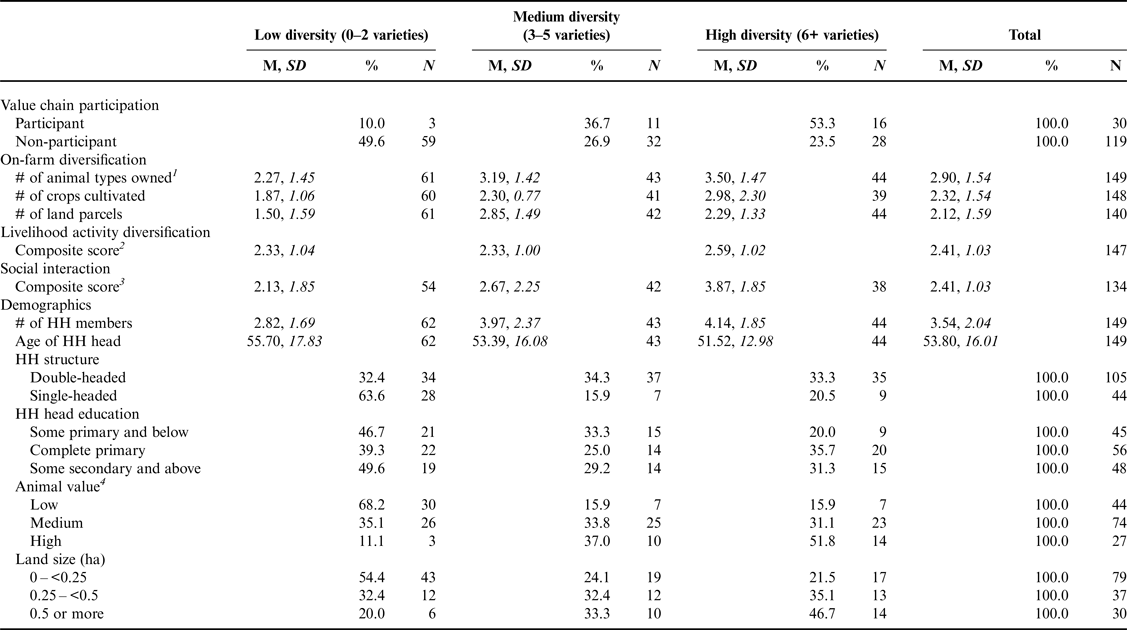
The first objective of this study sought to understand which households in the study site were commonly the keepers of diverse varieties of potatoes. Households were separated into three categories based on their native potato production: a low diversity group (0–2 native varieties in production), a medium diversity group (3–5 varieties in production) and a high diversity group (6+ varieties in production).
According to descriptive analysis (Table 1), households that participated in the FOVIDA project and therefore cultivated native varieties for value chains produced more varieties than those households who did not participate in value chains. Nearly half of non-participating households (49.7%) were categorized as producers of low diversity; only 10.0% of participating households cultivated less than two varieties. In terms of on-farm diversification, both the medium and high diversity groups owned on average more than three types of animals (M = 3.19, SD = 1.42 and M = 3.50, SD = 1.47, respectively), while the low diversity group owned closer to two animal groups on average (M = 2.27, SD = 1.45). Overall, all households, regardless of their native potato production, appear to expand their livelihood strategies beyond agriculture. The high diversity group also engage in more social activities (M = 3.87, SD = 1.85) than either the low (M = 2.13, SD = 1.85) or medium diversity groups (M = 2.67, SD = 2.25).
Household characteristics according to native potato production.

1 Theoretical range was from 0 to 8; the actual range was from 0 to 7.
2 Theoretical and actual ranges were from 0 to 5.
3 Theoretical and actual ranges was from 0 (low social interaction) to 9 (high social interaction).
4 Low, S/0–999; Medium, S/1000–4999; High, S/5000 or more; S/0.31 Peruvian Nuevo Sol (S/) = $1USD.
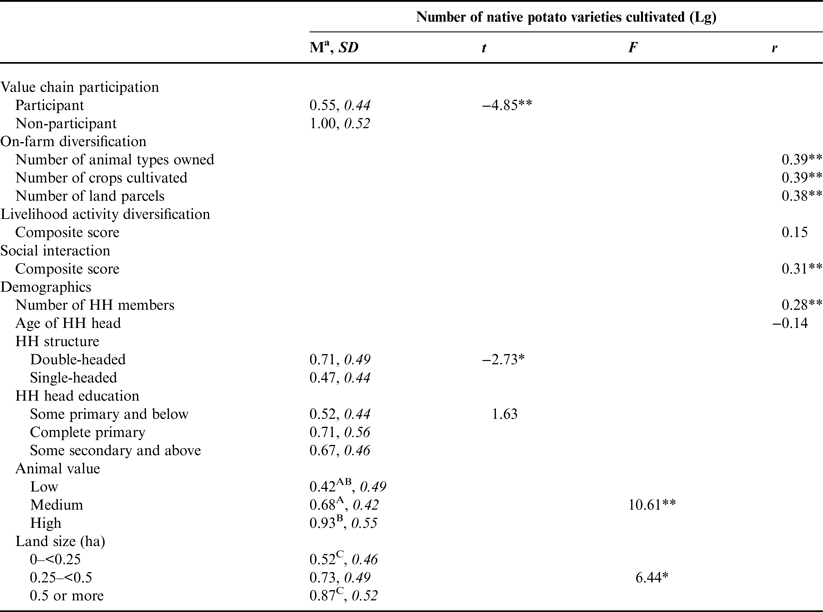
Demographically, households that grew more potato cultivars had an average of four members while households that raised two or fewer varieties had an average of three members (see Table 2). In addition, 67.3% of households cultivating more than two varieties were dual-headed households, about double that of the low diversity group (36.4%). The findings related to household members and dual-headed households together indicate more labor availability for households that engage in more native potato production. The two proxies for wealth, total hectares and total animal value, also indicate that the households in the high diversity group have more resources than their counterparts. Over half of households cultivating more than five varieties (51.8%) owned high market value in animals, more than either the medium diversity group (37.0%) or the low diversity group (11.1%). Likewise, nearly half (46.7%) of the high diversity group have access to 0.5 ha of land or more, while more than half (54.4%) of the low diversity group only have access to <0.25 ha. Collectively, the descriptive findings provide initial evidence that some association likely exists between the number of native varieties a household produces and its resource endowment.
t-tests, ANOVAs and PPMr on household characteristics and native potato production.

aMeans followed by the same superscript are significantly different from one another at the P < 0.05 using Scheffe post-hoc test.
*Significant at P < 0.01.
**Significant at P < 0.001.
Bivariate analysis
Bivariate analyses were conducted to further test the trend appearing from the descriptive statistics that those households who cultivated more native varieties have more resources than their counterparts. To perform these analyses, the number of native varieties was transformed logarithmically in order to ensure that the data adhered to statistical assumptions. The bivariate results largely support the findings of the descriptive analysis (Table 2). Households participating in native potato value chains were found to grow significantly more native varieties than non-participating households (t = −4.85, P < 0.001). Moderate relationships (Fink, Reference Fink1995) also existed between native potato production and number of different types of animals owned (r = 0.39, P < 0.001), number of crops cultivated (r = 0.39, P < 0.001), number of land parcels to which households had access for productions (r = 0.38, P < 0.001) and social resources (r = 0.31, P < 0.001). A weak, though approaching moderate, relationship was found to exist between number of household members and number of potato varieties cultivated (r = 028, P < 0.001). Dual-headed households were significantly more likely to cultivate more native varieties than single-headed households (t = −2.73, P < 0.01), and households owning at least medium value in animals were significantly more likely to produce more native varieties than households owning low value in animals (F = 10.61, P < 0.001). In terms of land size, households that had access to at least 0.5 ha were significantly more likely to cultivate more native varieties than households with access to <0.25 ha (F = 6.44, P < 0.01).
Native potatoes and their qualities
Native potatoes were described as ‘tasty,’ ‘delicious,’ ‘creamy,’ ‘satisfying,’ and ‘flavorful.’ Farmers generally plant their native potato varieties as a mix in small parcels, a method to buffer against risk: ‘We plant various varieties because we can lose one or the frost takes one or blight gets it in another case, but yes we have some to eat, so we have to plant various things.’ Some native varieties are more tolerant to frost, hail and disease, although farmers also explained that the majority are vulnerable to difficult weather conditions. Planting native varieties not only constitutes a practical production strategy, but also provides households with additional benefits. For example, one household that cultivates 300 varieties, the most in the study site, explained that its members enjoyed admiring the beauty of the potato fields when they flower.
Even more important for many is the preservation of cultural heritage. One farmer, who had 32 varieties in production, linked his household's production with the past: ‘Our ancestors were nourishing themselves with these potatoes and we continue with this custom.’ Connections with the past embedded in native potatoes extend to the methods by which they are produced. The cultivation of native potatoes is a labor intensive process, relying on traditional hand-held tools. Despite the difficult and time-consuming labor, this process is a source of pride for older community members in particular. As a widowed household head articulated: ‘This is the custom from our grandfathers that had this custom to plant native potatoes with chaki taquia [a traditional tool]. And this is how we cultivate until now. The culture of the grandparents. We have the pride to plant with the culture of the grandfathers.’
Despite the cultural value that households identify in cultivating various varieties, concern exists that current conditions are eroding those traditions. One farmer from a household recently expanding its native production described his motivation for doing so: ‘The intention is to recuperate the varieties that our grandfathers had before. The Incas had these varieties and for situations related to the climate and economic factors, they are being lost.’ The difficulties confronting native potato production are exemplified by the household that cultivated 300 potato varieties. On the one hand, the male household head demonstrated pride in his conservation: ‘We conserve because [native potatoes are] the most beautiful of what we have…one could say, in other words, the wealth of Peru, it's the wealth of Peru.’ On the other hand, both he and his wife explained that they were considering dedicating themselves to other livelihood activities in place of native potato production. Because no markets exist for the vast majority of the varieties they cultivated, they took a yearly economic loss and were having difficulty taking care of their healthcare costs.
Production zones
The value of diversity extends beyond native potato production. Accessing land parcels at various altitudes also buffers against damaging weather events, as households can expand their crop and animal production. Land parcels used for agriculture exist in and around the valley where the population center is located (~3650 m) and extend upwards into the highlands above (~4000 m). Crop production primarily consists of potatoes, ulluco, mashua, fava beans, oats and forage crops. In the valley lands, close to the population center, households often grow forage for dairy cattle, white potatoes (potatoes varieties grown from certified seed), and a handful of native varieties that are recognized by consumers at local and regional markets. Nearly all households at least occasionally descend to the closest market town 17 km away and a further 250 m lower in elevation for the twice weekly spot markets to sell their portions of their harvests and make purchases. Often considered ‘commercial’ production, at least part of the harvest from the valley lands ends up in reserve for consumption.
Generally, people consider the commercial potatoes they grow in the valley lands distinct from the tasty native varieties that are grown in the highlands using traditional methods. The varieties grown in the highlands are planted almost entirely for home consumption and generally lack demand among consumers at local, regional, and national levels, for they are not well known and do not often adhere to the quality expectations of consumers or commercial supply chains. Consistently, households indicated that the native potatoes that they grow at elevation have a much better taste than the commercial varieties grown in the valley. Comparing the qualities of potatoes in the two different production zones, a widowed household head explained, ‘The potato isn't the same in the highlands. From there they're creamier and worms want them only a little bit.’ For many, the different production practices applied to the valley lands and highlands explain the difference in quality. One community member presented this view: ‘It's that those that they take to the market, they put a lot more [pesticides] and there is more production and they put the hormones so that the potatoes grow more. But these potatoes don't have flavor. But the natural potatoes, yes they have flavor.’
Farmers recognized that their two sets of production methods had varying effects on the quality of their land. Commonly, interviewees lamented the acidity of their soils in the valley but extolled the soil quality in the highlands. As one farmer who grew potatoes in both production zones explained: ‘For the white potato, we use a lot [of inputs] but the part above, no. Because in the first place, the land is of black soil. It is land that is resting for a lot of time, but here [below] no: every year they are being cultivated and they are infected, the land.’ However, despite the use of traditional methods in the highlands, farmers readily admit that they use inputs, especially fertilizer, on their native potatoes in the highlands but claim to do so to a much lesser degree. The use of synthetic inputs on native potato production in the highlands was not entirely unproblematic for interviewees. For one household, the keeper of 200 varieties, the use of synthetic inputs on native potatoes erodes the cultural identity of native potatoes ‘We are saying that we are native. Because we are utilizing Tamaron [a pesticide], we are using fertilizer, this is not native.’
Value chains and native potato production
Value chain development in the study site has introduced new market outlets for certain varieties of native potatoes for those producers who are members of a farmer association. For individual households to successfully sell their native varieties, they must produce varieties that adhere to specific quality requirements. PepsiCo was most interested in potatoes for chip processing that contained specific sugar levels ideal for frying. To select the acceptable native varieties, PepsiCo experimented with varieties that could provide the necessary quality requirements for potato chips prior to its first season of purchasing in 2009. The following two seasons, PepsiCo purchased seven varieties from farmers in producer associations whose production satisfied the quality requirements. However, challenges in processing and marketing the new line of native potato chips led PepsiCo to suspend the contracts with FOVIDA, the NGO that managed the production and transaction of the native varieties, in 2011. For the 2012 season, contracts were reinitiated, although the number of varieties that were accepted was reduced to three until the 2013–2014 seasons when contracts were suspended indefinitely.
In 2013, the national supermarket chain, Plaza Vea, began to also purchase native varieties from the producer associations with which FOVIDA works. Quality requirements for Plaza Vea are different from those of PepsiCo. More interested in visual appeal, Plaza Vea demands native varieties that have colored flesh, no external damage and long shelf lives. For the initial season, the supermarket accepted five native varieties, although company executives indicated they were open to accepting more in the future given promising initial results in sales. PepsiCo also purchases one of the five varieties accepted by Plaza Vea. Together, PepsiCo and Plaza Vea accept seven different native varieties, a fraction of the 300 varieties that can be found in the study site, though only a handful of producers cultivate such a high degree of potato diversity. Still, the average household in the study site produces more varieties than seven. On average, households produced ten native varieties in 2013, an increase from the nine varieties they produced 5 years prior. Households which participate in value chains in particular cultivate 22 varieties on average.
Although the varieties purchased by both PepsiCo and Plaza are native, they are considered by producers as ‘industrial potatoes’ and ‘commercial varieties.’ They are therefore planted in the valley lands and tended with synthetic inputs to maximize production and better assure that they adhere to quality requirements. In other words, they are categorized as a market-oriented crop and produced as such. The PepsiCo varieties in particular contain primarily economic value for their producers. Because they are ideal for frying and not boiling, the preferred preparation method, value chain participants found their taste unpleasant. This was problematic when PepsiCo rejected potatoes for failing quality standards, a common occurrence. When the potatoes of a female head were rejected, her household was so put off by the taste that they ‘fed them to our pigs. They're not like other potatoes.’ After that experience, the household left the value chain project. Because the Plaza Vea varieties are intended to be sold as raw varieties, their taste is more palatable to households.
Households that currently or formerly participated in the FOVIDA project explained their motivations to plant potato varieties for value chains as economically sensible: both PepsiCo and Plaza Vea paid about three times better than the prices received at spot markets where products are sold directly to consumers or wholesaler. For those households able to access the value chains, they offer an opportunity to diversify their livelihood portfolios. In addition to planting potatoes for value chains, members of participating households are also seeking off-farm labor in local construction, driving taxis and local government, or through emigrating to urban areas. For many households that do not participate in value chains, the investments in inputs and time discourage them. One widowed head explained that her household increasingly engaged in agricultural activities other than potato production: ‘It's that one spends little on insecticide. The potato, lots of insecticide. More management, one has to be there daily. If not, they'll go bad.’ As these households diversify their livelihood strategies, they have reduced the scale of their potato production. A former participant of the value chain project implied that he had ended his commercial potato production due to the expense: ‘For only my consumption I'm growing…because if you want to grow at a bigger scale, you need capital.’
Discussion
The findings from this study indicate that those households that have a more endowed resource base are the ones who typically maintain higher levels of potato biodiversity. Households that cultivate more native varieties are more likely to have more land access, value in and types of animals, engage in more social activities and cultivate a more diverse array of crops. They are also more likely to consist of dual-headed households with more members, indicating that more labor availability allows households to continue to conserve potato varieties despite the lack of economic value generated through this activity. Collectively, these findings add to previous evidence, which has found that higher-resource households are becoming the keepers of potato biodiversity in the Andes (Zimmerer, Reference Zimmerer1996; Mayer, Reference Mayer2001), and provide micro-level data to support Horton and Samanamud's (Reference Horton and Samanamud2012) macro-level analysis that concluded that a diminishing number of native potato producers are marketing their harvests as lower-resource households pursue off-farm labor in mines, construction, and factories. As described by interviewees in this study, the high costs of labor and time to produce potatoes for both value chain and local spot markets are causing many of them to scale back their production and primarily dedicate it to home consumption. Thus, it appears that in this case, all households, regardless of their native potato production, are diversifying their labor activities but the ones with adequate resources are keeping production of diverse native varieties as a component of their livelihood portfolios. This finding points to the need to further examine the relationship between off-farm labor and biodiversity conservation (Winters et al., Reference Winters, Hintzy, Ortiz and Smale2006; Isakson, Reference Isakson2011).
The custodians of the potato biodiversity are also more commonly participants in the value chain project, which seeks to connect members of producer associations to high-value market outlets for certain native varieties that adhere to specific quality requirements. This finding has two important implications: (1) higher-resource households are more likely to engage in value chain development, which adds to the concern expressed by Escobal and Cavero (Reference Escobal and Cavero2012) that the exclusion of lower-resource households from value chains may intensify social stratification locally and (2) these households are mixing subsistence and market-oriented potato production, a finding consistent with previous studies (Brush, Reference Brush and Brush2000, Reference Brush2004; Bellon, Reference Bellon2004). As indicated by the findings, value chain participants cultivate 22 potato varieties on average, 15 more than the seven that have been purchased in the value chains. Though the potatoes sold in value chains are native, they are considered ‘commercial’ or ‘industrial’ and so are planted alongside other market-oriented crops in the valley lands, not in the highlands where diverse native varieties are commonly cultivated for home consumption. Thus, households seem to organize their production into two zones, each with their own locations, production methods, and goals, a finding consistent with Mayer (Reference Mayer2001) who described Andean peasants having a ‘conscious strategy to separate commercial and subsistence spheres’ (p. 229).
For those households that continue to cultivate high levels of native potato biodiversity, the value of this production extends beyond the economic sphere. Despite low economic potential and intensive labor requirements, some households cultivate a diverse array of native potato varieties to fulfill their culinary preferences, buffer against biotic and abiotic risks, and preserve cultural heritage. The continued maintenance, albeit by a limited number of community households, adheres to what Zimmerer (Reference Zimmerer1996) describes as a ‘fit livelihood,’ or an Andean ethic that prescribes ideal conditions, including vertical access to land, the cultivation of diverse crops and consumption satisfaction. In addition, the reasons that households articulated regarding their cultivation of diverse native varieties adhere to the assertions made by Graddy (Reference Graddy2013) that understanding the biocultural heritage of agrobiodiversity is essential in the pursuit of conservation. Attention must be dedicated to the cultural and social dimensions of agrobiodiversity conservation in addition to the biophysical.
In this study, households seem to organize their potato production along the lines of different types of value. In the highlands, where native varieties are cultivated for home consumption, biocultural value characterizes the production, as evidenced by the emphasis on taste, traditional methods, and risk management. However, there is concern that the application of synthetic inputs in the highlands compromises the biocultural value of native varieties. In the valley lands, where market-oriented production takes place, including the native potato varieties grown for value chains, crops primarily hold economic value. They are produced in ways that intend to maximize production and adhere to market demands. Despite the separation of production into two spheres (subsistence and commercial), rigid boundaries do not exist between them. The unsatisfactory taste of a harvest of native potatoes intended for PepsiCo that had been rejected caused one household to end its participation in the value chain project outright. Therefore, even in the valley lands, it appears that households desire some degree of biocultural value to their crops, even if the importance of economic value predominates.
Collectively, the findings of this study indicate that the native potato value chains under consideration are not eroding potato biodiversity but are only marginally contributing to conservation. Among the 300 potatoes found in the study site, only seven are sold in the value chains. The evidence presented from this case study supports Lockie and Tennent's (Reference Lockie, Tennent, Lockie and Carpenter2010) assertion that expectations for value chains to promote agrobiodiversity conservation must be tempered. As acknowledged previously, the quality standards in the value chain outlets inherently limit the number of varieties that are acceptable. Furthermore, value chains in this case study are also not contributing to the preservation of biocultural heritage embedded in native varieties. Many of the varieties produced for value chains are not well known locally, are not produced using traditional methods, and are not desirable from a culinary standpoint. At the same time, the introduction of new market opportunities, ones that favor modern production techniques and higher prices, are not eroding agrobiodiversity either. Households that grow potatoes for value chains also continue to produce potatoes for home consumption; while market-oriented crops provide means for income generation, native varieties grown in the highlands fulfill other non-economic values embedded in Andean livelihoods. Given that the production of commercial and subsistence potatoes generally exist in two different zones and fulfill different needs, it does not appear that value chain production, at least in this case, is substituting production for home consumption.
While findings from this study indicate that the value chains being implemented in the Peruvian highlands do not have much effect on the conservation of potato biodiversity, further research is needed to provide more nuances. A lack of data on the spatial distribution of native variety cultivation limits any conclusions on whether value chains are reducing the extent to which diverse varieties within and across species are being produced. More robust representations of crop conservation should be pursued that consider both the number of varieties present and their relative distribution in a given area (Isakson, Reference Isakson2011). In addition, utilizing the household as the unit of analysis is useful to make comparisons across households but limits insight into what occurs within households, which future studies should investigate to determine who makes decisions regarding conservation and how these decisions are negotiated within households. While the findings from this study provide further evidence that the relationship between value chain development and biodiversity conservation is complex, this study is limited in its ability to characterize the household-level processes that occur as decisions are made to pursue market opportunities and/or conserve native potato varieties. Further, the cross-sectional nature of this study prevents analysis on how decision-making about native potato conservation changes over time. Longitudinal studies, which capture how native potato production changes over time from the perspectives of both the number of varieties and their spatial distribution will provide deeper insight into whether the introduction of value chains are crowding out native varieties that lack economic value (Isakson, Reference Isakson2011).
Conclusions
Though future research can help further elucidate the dynamics that occur at the intersection of value chain development and biodiversity conservation, this study contributes important empirical evidence supporting previous assertions that quality requirements inevitably limit the number of varieties that formalized markets will demand (Drucker et al., Reference Drucker, Smale and Zamborano2005; Carpenter, Reference Carpenter, Lockie and Carpenter2010). Native potato value chains righteously expand market demand for native varieties but only for a fraction of native potatoes that are in existence. While economic value provides one essential impetus for conservation, it is not the only kind of value in play when decisions are made regarding conservation, an observation made by scholars previously and supported by the findings from this study (Brush, Reference Brush and Brush2000, Reference Brush2004; Bellon, Reference Bellon2004). In addition to the economic value that conservation can provide, recognizing the ethical value, biocultural value, value to ecosystems, and value in germplasm is important to develop comprehensive strategies (Jackson et al., Reference Jackson, Pascual and Hodgkin2007; Love and Spaner, Reference Love and Spaner2007; Graddy, Reference Graddy2013).
Because value chains appear to only marginally contribute to crop diversity conservation, continuing to pursue complementary conservation strategies in addition to ones that are market-oriented is essential. Seed fairs, in situ, local seed banks, and Payments for Agrobiodiversity Conservation continue to require attention as mechanisms to support agrobiodiversity conservation (Brush, Reference Brush and Brush2000; Tapia, Reference Tapia2000; Narloch et al., Reference Narloch, Drucker and Pascual2011; Pascual et al., Reference Pascual, Narloch, Nordhagen and Drucker2011; Gill et al., Reference Gill, Bates, Bicksler, Burnette, Ricciardi and Yoder2012). Ex situ conservation is also necessary to ensure the conservation of varieties that are not locally maintained but still may hold important genetic material (Love and Spaner, Reference Love and Spaner2007). At the same time, identifying new value chain outlets that demand native varieties, along with other regional and local market opportunities, is an important research agenda that can encourage the conservation of more native varieties. Crop varieties demanded by value chains but also are deemed satisfactory for other uses in the household can avert negative perceptions of value chain development among smallholding producers. Case studies that document the implementation and effects of value chains, therefore, need to be conducted. Doing so will further articulate the potential for value chain development to meaningfully contribute to agrobiodiversity goals.
Acknowledgements
We would like to thank the anonymous reviewers and associate editor for their comments, as well as Andre Devaux, Maria Scurrah and Raul Canto for their critical feedback. In particular, our appreciation extends to all the research participants. Partial funding for the work reported here was provided by the United States Borlaug Fellowship in Global Food Security, as well as the Graduate Student Competitive Grant and a Graduate International Research Competitive Grant from The Pennsylvania State University. The views presented here do not necessarily represent those of the funders.