Over the last decade several studies have suggested that United Nations (UN) peacekeeping works: peacekeeping deployments tend to achieve their core security objectives.Footnote 1 UN peacekeeping makes it more likely that post-war peace will last, a finding that largely persists across different data sets, statistical models, and attempts to address the nonrandom assignment of peacekeeping missions.Footnote 2 More recent studies have suggested that UN peacekeeping deployments prevent the contagion of conflict and are associated with a reduction in both battlefield fatalities and civilian casualties.Footnote 3
A world without UN peacekeeping would be a more violent and insecure place. However, the role of UN peacekeepers in a series of sexual abuse scandals,Footnote 4 peacekeepers' introduction of a deadly strain of cholera that killed over 8,000 people in Haiti,Footnote 5 and concerns about the creation of a “peacekeeping economy” that caters to the consumption needs of expat UN and NGO workers rather than to the long-term development needs of the host countryFootnote 6 raise the question of whether the UN can fulfill its vital peacekeeping role with less damage to its other peace-building goals of social and economic development.
Transactional sex, defined as the “exchange of sex for money, favors, or gifts,”Footnote 7 involves all three of these concerns: sexual exploitation and abuse (SEA), public health, and the host country's social and economic development.Footnote 8 However, existing studies and journalistic accounts of the problem have relied on anecdotal evidence,Footnote 9 and thus its prevalence remains to be established. To fill this evidentiary gap, this article presents the first systematic quantitative study of the association between a UN peacekeeping operation and transactional sex. In fact, this study is, as far as we can tell, the first to provide a rigorous population estimate of the incidence of transactional sex with foreign military personnel of any kind.Footnote 10
To do so, we conducted a survey in Monrovia, Liberia in the summer of 2012.Footnote 11 Liberia has hosted an average of about 12,000 peacekeepers of the United Nations Mission in Liberia (UNMIL) at any given point in time since 2003, with usually about one-fifth of them stationed in Monrovia.Footnote 12 Our findings are stunning. We estimate that more than half of eighteen- to thirty-year-old women in greater Monrovia have engaged in transactional sex and that most of them (more than three-quarters, or about 58,000 women) have done so with UN personnel, typically in exchange for money.Footnote 13 The data we collected show unambiguously that transactional sex with UN personnel is a ubiquitous life experience among young women in Monrovia.Footnote 14
Our analysis also examines whether and to what extent the presence of UN peacekeepers has led to young women engaging in transactional sex who would not otherwise have done so.Footnote 15 Did high-paying UN peacekeepers merely displace non-UN buyers from an otherwise stable transactional sex market, or did the arrival of UNMIL lead to an actual increase in the volume of sexual transactions? The latter is more likely. Most of our analysis indicates that the presence of UNMIL peacekeepers has been associated with a substantial and statistically significant increase in the rate of entry into the transactional sex market, that is, the probability that a woman engages in her first transactional sex. A conservative estimate links each additional UNMIL battalion, which consists of about 1,000 troops, to a 3 percent increase in the probability that a woman will engage in her first transactional sex in a given year, with the estimate rising to 6 percent for a battalion of African troops, which have generally made up the majority of forces in Monrovia.Footnote 16 Consider, for example, UNMIL as it stood in 2008—an average year in terms of the number of deployed peacekeepers. In this context, the estimated 3 percent annual per-battalion increase in a woman's probability of engaging in her first transactional sex implies that the median Monrovian woman's chance of reaching age twenty-five without engaging in transactional sex would be nearly 50 percent greater if there were no UNMIL troops. In total, this estimate suggests that more than 12,000 women in Monrovia entered the transactional sex market who would not have done so in the absence of UNMIL. This corresponds to about one of every five women aged eighteen to thirty in 2012 that have engaged in transactional sex with UN personnel. However, we cannot entirely dismiss the possibility that the association between UNMIL's presence and the growth of the transactional sex market is coincidence, even though the large-scale participation of well-paying UN personnel in this market is in our view beyond doubt.
The commonality of transactional sex in itself may be cause for concern. Some women can gain significant income and status by engaging in transactional sex,Footnote 17 and we acknowledge that women in a postconflict environment such as Monrovia “are not only victims but also survivors who have agency to make consensual decisions.”Footnote 18 But in terms of public health, transactional sex is generally associated with a heightened risk of contracting sexually transmitted diseases,Footnote 19 and studies in both the developing and developed world have indicated that women engage in risky sexual practices when they engage in transactional sex.Footnote 20 Transactional sex has also been linked to gender-based violence.Footnote 21 While some women choose and are able to improve their livelihoods through transactional sex, Dupas found that young women are less likely to report sex with “sugar daddies” when they receive information about health risks, and Baird and colleagues observed that cash transfers lead to declines in marriage and pregnancy among school drop-outs, consistent with the notion that improved economic circumstances make it possible for young women to opt out of remunerative sexual relationships.Footnote 22
Our findings are particularly troubling because they suggest that the actions of UN peacekeepers are undermining the UN's broader peace-building goals in Liberia, especially its gender equality and economic development goals. When UNMIL withdraws it will leave behind a distorted economy in which more than half of Monrovia's young women will have been making, or at least augmenting, their livelihoods by selling sex.Footnote 23
This research has implications for at least two broad literatures in international relations: on peacekeeping effectiveness and on international norm diffusion. Our paper matches recent literature on the effectiveness of peacekeeping missions in using temporally and spatially disaggregated data to study the impact of peacekeepers not only on battlefield statistics but also on civilians. However, we take issue with how this literature focuses on the benefits of UN peacekeeping without examining its negative externalities and broader societal costs. Peacekeeping's evident impact in prolonging post-war periods of peace would make it inappropriate to argue that these costs outweigh peacekeeping's benefits. Our analysis cannot make such a determination. However, host countries should fully understand the implications of a peacekeeping presence and our analysis provides clarification on this point.
Our results also carry implications for the literature on compliance with international norms. Recent empirical studies indicate that states operating in the same circles of international organizations begin to behave similarly in a variety of ways, most prominently through a process of “socialization,” which can include persuasion, social pressure to conform, and acculturation.Footnote 24 For example, Greenhill argues that human rights norms spread by way of intergovernmental organizations that provided a forum for “high-level government representatives” to convince one another of the benefits of adopting these norms and to pressure holdouts by calling into question “acceptance from their peers” and “their status within that community.”Footnote 25
Such a process of socialization has led to widespread acceptance of the norm against transactional sex involving peacekeepers among high-level officials and decision makers at the UN, but efforts to extend this process to peacekeepers themselves have not been as successful. The UN has sponsored robust education campaigns and the Security Council has issued explicit norm-based directives about how UN peacekeepers should interact with host-country women and penalties for failing to comply have been put in place. Yet we have strong evidence that front-line personnel flout the norm against transactional sex. Norm diffusion among decision makers, expressed in norm-consistent policies and rules, has in this case not been enough to affect desired behaviors among front-line personnel.
In principle, front-line compliance could be accomplished in at least two ways. First, the UN could instill the relevant norms in on-the-ground personnel. UNMIL has tried as much by emphasizing the inherent wrongness of transactional sex in its information campaigns targeted at UN personnel (i.e., the demand side) as well as the local population (i.e., the supply side), but transactional sex remains common.Footnote 26
Second, a system of incentives, monitoring, and punishment could perhaps succeed where appeals to appropriateness and social sanctions have not. In fact, the UN has put in place significant penalties for transactional sex, such as dismissal, repatriation, and loss of future employment opportunities but the application of available enforcement procedures has been lacking.Footnote 27 The severity of punishments may even have backfired because a troop-contributing country can be asked to reduce its personnel contribution as a result of SEA violations, negatively affecting the very individuals who are asked to initiate investigations. While an extensive campaign to exert social pressure failed, it remains an open question whether a fine-tuned system of monitoring and calibrated material incentives that did not exist in this case could have induced compliance.
Background
UN Policy on Sexual Exploitation and Abuse
UN policy defines transactional sex as a form of sexual exploitation and abuse.Footnote 28 The UN Secretariat is sensitive to the fact that peacekeeping operations face challenges in this regard, although it may have been unaware of the problem's magnitude given the lack of reliable data.Footnote 29 In 2003, the UN adopted a strict “zero-tolerance” policy that forbids its peacekeepers from exchanging money, food, help, or anything of value for sex. In 2005, the Department of Peacekeeping Operations (UNDPKO) established a Conduct and Discipline Team to train peacekeepers about the new policy and process allegations of misconduct.Footnote 30 In 2007, the policy was extended to all UN personnel and the Conduct and Discipline Team within UNDPKO became the Conduct and Discipline Unit within the UN's Department of Field Support.
Transactional Sex in Sub-Saharan Africa
Anthropological and sociological accounts indicate that transactional sex is common in sub-Saharan Africa and that affected women do not typically self-identify as sex workers. It is particularly common, according to these accounts, for young women and adolescent girls to exchange sexual favors with older men for money and gifts.Footnote 31 However, quantitative evidence has been mixed. Rates of young women engaging in transactional sex were above 5 percent in only three of the twelve African countries that Chatterji and colleagues studied.Footnote 32 In contrast to these relatively low rates, Dunkle and her colleagues found that about 18 percent of men reported giving gifts for casual sex in rural South Africa and that 21 percent of women receiving care at an antenatal clinic in Soweto reported engaging in transactional sex.Footnote 33 There is some evidence suggesting that the sex trade may be particularly pervasive in post-war societies.Footnote 34
In Liberia, the 2007 Demographic and Health Survey (LDHS) asked women if they had received money, gifts, or favors in return for sex within the last twelve months.Footnote 35 This was the case for an estimated 4 percent of all fifteen- to forty-nine-year-old women across the entire country. If we restrict the analysis to eighteen- to thirty-year-old never-married women in Monrovia, the estimate is about 10 percent. (The LDHS did not ask about sex with UN personnel.) Since the LDHS survey inquired about only the last twelve months, this estimate is not on its face inconsistent with our estimate of the share of women who have ever engaged in transactional sex.
It is also possible that the LDHS figure is an underestimate because interviews were conducted face to face, with interviewers recording subjects' responses. Transactional sex is a sensitive issue for some subjects, although perhaps less so in Monrovia than elsewhere, and this might depress the reported rate of transactional sex.Footnote 36 For this reason we took extensive measures to ensure that respondents could answer sensitive questions about their sexual histories in private, without enumerators knowing their responses.Footnote 37
The Liberian Civil War and UNMIL
Liberia suffered two brutal civil wars between 1989 and 2003 that caused some 250,000 deaths in a country with a population of between two and three million people during that period.Footnote 38 In September 2003 the UN Security Council established the UN Mission in Liberia (UNMIL) to monitor a peace agreement and provide security. The Economic Community of West African States (ECOWAS), or more specifically the Economic Community of West African States Monitoring Group (ECOMOG), provided the first contingent and UNMIL has had a large presence of African peacekeepers ever since. Initially the force was mandated to consist of 15,000 personnel, mostly soldiers, but also including police and civilians. The largest concentration of soldiers has been stationed in the nation's capital, Monrovia, which hosts mission headquarters and one of the largest bases in the country, and virtually all of our respondents were aware of UNMIL's presence in the city. Numerous civilian support workers and UN staff (from UNDP, UNHRC, UNICEF, and other agencies) are also concentrated in Monrovia.
Survey and Results
We surveyed 1,381 randomly selected households throughout greater Monrovia. Our sample-selection procedures described here and in greater detail in the supplementary materials give us high confidence that we have obtained a representative sample of households in greater Monrovia.
We first geolocated all dwellings (about 110,000) in greater Monrovia using current satellite imagery. Next, we subdivided greater Monrovia into eighty-one similarly sized enumeration areas and randomly selected thirty-nine of these areas as primary sampling units, with selection probabilities proportional to the number of dwellings in each enumeration area. We then randomly sampled target residences within each sampled enumeration area, and GPS-equipped enumerators visited these sites to conduct interviews. If the selected residence contained more than one household, enumerators would record the number of households and randomly select one of them for an interview. Each selected household was visited up to four times if necessary to speak to an adult member of the household.
The vast majority (88.7 percent) of targeted households participated in the survey. Only four households (0.3 percent) refused.Footnote 39 In 8.1 percent of the cases, enumerators were unable to locate or approach the building at the geocoded location, in 2 percent of the cases the building was not a residence, and in 0.9 percent of the cases the sampled household could not be reached despite multiple visits.
We completed two types of questionnaires with participating households.Footnote 40 First, we completed a household roster containing basic demographic and socioeconomic data for all individuals living in the household. Second, we collected detailed information from one randomly sampled individual household member.Footnote 41
If this household member was a woman between the ages of eighteen and thirty, enumerators asked a series of questions about her experiences with transactional sex in general and with UN personnel specifically. Because of the sensitive nature of these questions we used an all-female team of Monrovian enumerators to administer them, and we ensured that subjects could answer the questions privately, without enumerators seeing the responses. Enumerators asked questions verbally, and each respondent then recorded her answer herself on an iPod. Since some women were illiterate, possible responses were depicted iconographically, and enumerators carried cards to show respondents what each icon meant. An iPod screenshot of a typical question is shown in the supplementary materials.Footnote 42
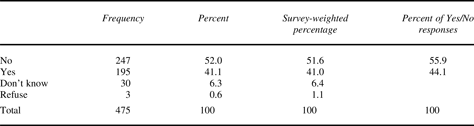
Tables 1 through 7 provide an overall description of the transactional sex market in Monrovia. When asked directly whether they have engaged in transactional sex (either with UN personnel or some other man), about 41 percent of the women in our sample reported having done so, as Table 1 shows. A number of women who did not acknowledge transactional sex in this direct question (either by not responding or by answering “no”) did respond to related subsequent questions as if they had in fact engaged in transactional sex, even though they could have refused to answer those questions or could have answered “not applicable.” Tables 3 to 7 show that for each of these questions roughly half of the women in our sample gave a response that indicates that they have engaged in transactional sex.
Distribution of answers to the question: “Have you ever received money, food, shelter, help or anything of value from a man for doing men business (engaging in sexual intercourse) with him?”

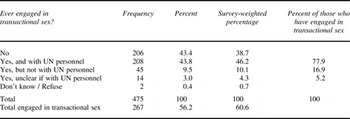
We incorporate this information in our estimate of the total incidence of transactional sex (both with UN personnel and in general) reported in Table 2. For this estimate we identified a subject as having had transactional sex if she directly reported having engaged in transactional sex, provided an age of first transactional sex, gave a frequency with which she engages in transactional sex, or had transactional sex with UN personnel. We coded a subject as having had transactional sex with UN personnel if she reported a frequency with which she engages in transactional sex with UN personnel, indicated that her last transactional sex was with UN personnel, or indirectly acknowledged transactional sex with a UN peacekeeper (i.e., knew someone who has been asked for transactional sex by a peacekeeper, that person actually received something of value in exchange for sex, and then the subject reported that this person was herself).Footnote 43
Total incidence of transactional sex with UN personnel and in general

Notes: Subjects are coded as having had transactional sex with UN personnel if at least one of the following is true: (1) the subject indirectly acknowledges transactional sex with a UN peacekeeper (i.e., knows someone who has been asked for transactional sex by a peacekeeper, that person actually received something of value in exchange for sex, and then the subject reports that this person was herself); (2) the subject reports transactional sex with UN personnel with any frequency; (3) the subject reports that her last transactional sex was with UN personnel. Subjects are coded as having had any kind of transactional sex if at least one of the following is true: (1) the subject directly reports having engaged in transactional sex; (2) the subject reports an age of first transactional sex; (3) the subject reports transactional sex with any frequency; (4) the subject is coded as having had transactional sex with UN personnel.
The coding yields an estimate of 56 percent for the share of women in our sample who engaged in transactional sex, with 61 percent as the survey-weighted population estimate for all women aged eighteen to thirty in Monrovia. We identify 44 percent of our subjects as having engaged in transactional sex with UN personnel, which corresponds to 78 percent of those who have engaged in transactional sex in general.Footnote 44 This does not necessarily imply that most UN personnel in Monrovia have breached the UN's SEA rules, since we did not conduct a survey of UN staff and peacekeepers and therefore cannot rule out the possibility that only a small number of them account for a disproportionate share of all sexual transactions. But it does mean that transactional sex with UN personnel is a prevalent feature of young women's life histories in Monrovia.
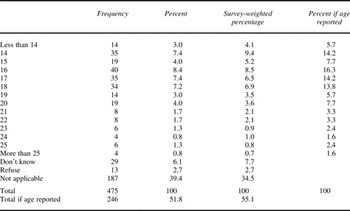
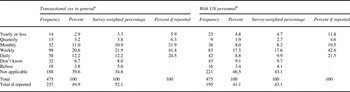
Women begin engaging in transactional sex at a young age. About 72 percent of those who provided an age of first transaction reported an age of eighteen or younger, and about 28 percent report having transactional sex before they were sixteen, as shown in Table 3. Among women who engage in transactional sex, about 25 percent do so on a daily basis and more than 65 percent on a daily or weekly basis, as seen in Table 4. These figures look very similar to those for women who engage in transactional sex with UN personnel: 22 percent report doing so on a daily basis and 64 percent on either a daily or weekly basis.
Distribution of answers to the question: “When was the first time you had men business in exchange for something of value (money, food, medicines, help)?”

Frequency of transactional sex

Notes: a Question: “In general, how often do you receive money/food/help in exchange for doing men business?”
b Question: “About how often do you have men business in exchange for something of value with a man who you think is a UN peacekeeper or works for the UN?”
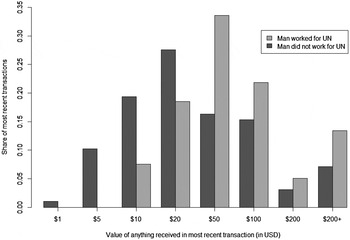
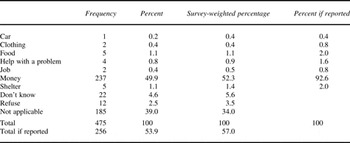
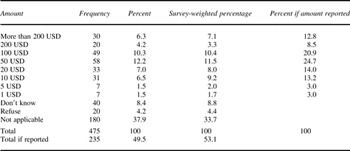
Money is by far the most common recompense. Table 5 shows that over 92 percent of the women who have engaged in transactional sex report that they received money in exchange. Sixty-seven percent of women who engage in transactional sex receive about 50 US dollars or more per week for doing so, as shown in Table 6. Remuneration is particularly high for transactional sex with UN personnel, as Figure 1 shows. Among subjects who reported the value of what they received in their last transaction with UN personnel, 74 percent received fifty US dollars or more, compared to 42 percent among subjects reporting the value of what they received in their last transactions with non-UN men.Footnote 45
Compensation received in most recent transaction, by UN status of transactional sex partner

Distribution of answers to the question: “When you receive something of value for doing men business, what do you usually receive?”

Distribution of answers to the question: “When you think of all the things you receive in return for doing men business with a man (money, food, clothing, and so on), how much do you think you make in an average week for doing men business? What is the approximate dollar value?”

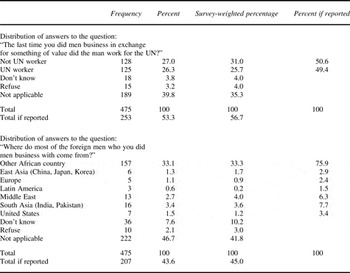
When we asked respondents where most of their foreign transactional sex partners come from, 76 percent of those who provided an answer said another African country (other than Liberia), as Table 7 shows. Other regions make up considerably smaller percentages: Middle Easterners and people from South Asia account for about 6 and 8 percent, respectively, and Americans account for 3 percent. The predominance of African partners is not surprising considering that the largest peacekeeper contingents in Monrovia are from Nigeria and Ghana.
Characteristics of transactional sex partners

An important question is whether UNMIL actually caused an increase in the incidence of transactional sex. Perhaps women would have engaged in transactional sex to the same extent in the absence of a UN peacekeeping force, but with Liberian and other non-UN men. We answer this question by testing to what extent the probability of a woman entering the transactional sex market, that is, engaging in her first transaction, moves in tandem with UNMIL troop levels.
More specifically, we estimate a series of multivariate survival models to explain the time until a woman in our sample engages in her first transactional sex, if ever. Our models use the subject's life year until entry in the transactional sex market as the time unit for analysis, that is, the subject-year for subjects at risk. For example, the record of a woman whose first transaction occurred at the age of nineteen and who was interviewed when she was twenty-one would consist of nineteen rows in the data. If a woman had not engaged in transactional sex by the time of our survey, her record is right-censored, which is accounted for in the estimation. Thus the record of a twenty-five-year-old woman who by the time of our survey had never engaged in transactional sex would consist of twenty-five rows of data.
Our explanatory measure of interest is the number of UNMIL personnel stationed in the country as of 31 December each year.Footnote 46 We account for temporal dependence by including a linear calendar-year trend and indicators for Liberia's civil wars (1989–1996 and 1999–2003).Footnote 47 We also include a cognitive test score as a measure of employment prospects in the formal economy.Footnote 48
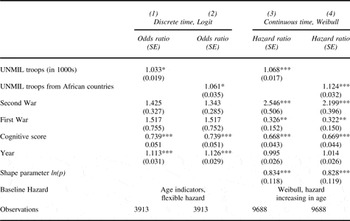
The estimates in Table 8 show how the number of UNMIL troops and other covariates are associated with the probability that a woman will enter the transactional sex market at a particular age, given that she has not done so up to that point. The results in columns (1) and (2) assume a discrete time logistic model, where the baseline hazard is specified using analysis-time (i.e., life year) indicators and thus extremely flexible. In columns (3) and (4), we assume continuous time and use a standard Weibull specification for the baseline hazard.Footnote 49
Correlates of first transactional sex among women 18–30 in Monrovia

Notes: * p < .10; ** p < .05; *** p < .01.
The results suggest that the number of UNMIL troops is positively related to a woman's probability of entering the sex trade for the first time. The estimates in columns (1) and (3) indicate that, all else equal, the probability that a woman will engage in her first transactional sex at a particular age is between 3 and 7 percent higher for each additional 1,000 peacekeepers (roughly an extra battalion). Results in columns (2) and (4) show that this effect is even larger for an additional 1,000 troops from African countries, ranging from 6 to 12 percent. African contingents make up the majority of troops in Monrovia, so the larger estimates for African peacekeepers may in fact more accurately capture the effect of UN peacekeepers in the locale under study.
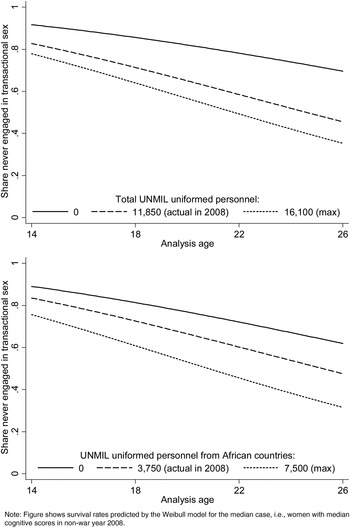
The estimated cumulative effect of the peacekeeping mission on a woman's probability of engaging in her first transactional sex is considerable. Figure 2 illustrates the difference in the survivor functions for varying levels of UNMIL troops in general (top panel) and UNMIL troops from African countries in particular (bottom panel), using the models from columns (3) and (4) in Table 8. By construction, a given cohort's share of women that have never engaged in transactional sex declines as the group ages, but it declines considerably more steeply in the presence of a peacekeeping mission as sizable as UNMIL. Figure 2 suggests that the probability with which a typical woman would live to the age of twenty-five without engaging in transactional sex would be about 72 percent in the absence of UNMIL, but only 49 percent when mission strength is close to its long-term average of about 12,000 (which is approximately equal to the mission's force strength in 2008).Footnote 50
Expected share of women engaging in transactional sex across UNMIL deployment scenarios

Since our survey took place in 2012 only, one could be concerned that subjects do not accurately recall the timing of their first transactional sex. Perhaps subjects simply provide salient dates, even if they are salient for other reasons, such as the arrival of UNMIL troops. We are not particularly worried about this issue for two reasons. First, we did not actually ask subjects to date their first transactional sex, but we asked them how old they were when they first had sex in exchange for something of value (and then inferred the year from this information and their current age). Related work on women's sexual histories and sex work in India reports “age at first sex” as being a more reliable measure than “year of first sex.”Footnote 51 This also ensures that any one value of the age measure cuts across calendar years, since we interviewed women from different cohorts. That is, even if respondents were biased toward reporting certain salient ages (for example, eighteen), this will not principally mean that a particular calendar year (such as a year with a large number of peacekeepers) will be reported more frequently than it should be (since our subjects turned eighteen in different calendar years).
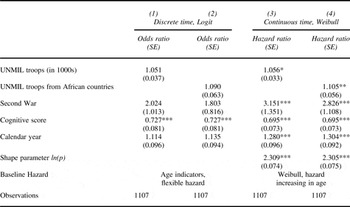
Second, variation in our measure of cognitive ability could indicate subjects' ability to accurately recall past events. We therefore run our analysis using only the data from the 40 percent of subjects who received a perfect score on cognitive performance. The results are reported in Table 9 and are consistent with the argument that women enter the transactional sex market as a result of UNMIL's presence. In fact, the effects appear considerably stronger when we look at only women who perform well on cognitive tasks. These women are significantly less likely to engage in transactional sex in general, because they are more likely to be gainfully employed in other ways, but the rate at which they enter the transactional market is more responsive to the presence of well-paying peacekeepers than it is for other women.
Correlates of first transactional sex among women 18–30 in Monrovia, including only subjects with top scores on cognitive ability tests

Notes: * p < .10; ** p < .05; *** p < .01.
Another important concern is that we interviewed women aged eighteen to thirty in 2012, which means that our age distribution shifts as we analyze different years. In 2003, for example, subjects in our sample were between nine and twenty-one years old, and it is possible that women who first engaged in transactional sex prior to UNMIL's arrival in 2003 were not included in our sample. Our analysis does take into account age effects, either through the inclusion of analysis-age indicators (in the first two models in Table 8) or by modeling a subject's baseline hazard as a parametric function of age (in the last two models).Footnote 52 But this may not fully address problems arising from the fact that analysis age is not balanced across calendar years.
We address this problem by analyzing an adjusted sample for which age distributions are comparable across all calendar years. This involves two steps. First, we have to limit the range of age groups and calendar years. We could not, for example, include both 1997 and 2010 in such an analysis because the age distribution for 1997 has no support above age fifteen (the oldest subjects who answered questions about transactional sex were thirty in 2012) and the age distribution for 2010 has no support below age sixteen (our youngest subjects were eighteen in 2012). Similarly, we cannot include twenty-five-year-olds in an analysis that covers 2003, because we did not ask any thirty-four-year-old subjects about transactional sex in 2012. We identify an optimal interval given these limitations and focus on fourteen- to eighteen-year-olds in the years 2000 to 2008.Footnote 53 Second, we construct and use weights to ensure that each calendar year's age distribution reflects our estimate of the true age distribution of women at that time.Footnote 54
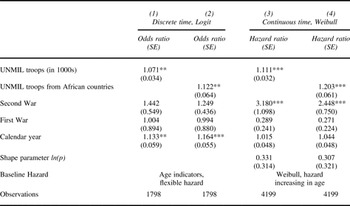
We report results in Table 10. As before, the estimated odds and hazard ratios indicate that women, in this case fourteen to eighteen year olds, are more likely to engage in their first transactional sex when the number of deployed UN peacekeepers is larger, in particular if these peacekeepers come from African countries. But while these estimates are statistically significant when we impose parametric structure on the baseline hazard in models (3) and (4), they are not in models (1) (p = .16) and (2) (p = .14). Note that the estimated odds ratios have in fact gotten larger compared to Table 8, but are much more inefficiently estimated. This is consistent with the fact that the restricted sample is less than a third of the full sample used for Table 8. While we have presented overwhelming evidence that UN personnel are frequent participants in the transactional sex market, this means that we cannot rule out the possibility that the apparent association between UNMIL troop levels and women's entry into the transactional sex market is coincidence.
Correlates of first transactional sex in an age-balanced sample of women

Notes:* p < .10; ** p < .05; *** p < .01.
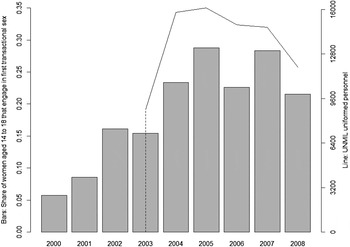
Figure 3 provides some intuition for why it is difficult to conclusively attribute changes in the size of the transactional sex market to variation in the size of UNMIL, given our sample of women aged fourteen to eighteen in the years 2000 to 2008. The figure shows the share of women who engage in their first transactional sex in a given year as well as the size of the UNMIL force. Clearly larger shares of women at risk engage in their first transactional sex once UNMIL deploys in 2003. But Liberia's second civil war also ended in 2003, and we include a war indicator in our statistical analysis to absorb the mean shift in transactional sex propensities that distinguishes the post-war era from earlier years. We also include a yearly time trend that absorbs any linear increase in the share of women engaging in their first transactional sex because we want to separate the impact of UNMIL from other contemporaneous developments (e.g., rising acceptance of transactional sex or technological advancements that facilitate transactional sex).Footnote 55 Thus the only changes in the rates of entry into the transactional sex market that we associate with UNMIL throughout this article are deviations from a long-term, war-adjusted trend, which leaves us with suggestive statistical evidence that UNMIL's presence led to women engaging in transactional sex who would not otherwise have done so, but not enough statistical power to say so conclusively.
UNMIL troop levels and share of women aged 14–18 who engage in transactional sex for the first time

Implications for the Literature on Norm Compliance
Clearly international norms forbid transactional sex between UN peacekeepers and host-country civilians. The UN Security Council agreed on clear standards of behavior for UN peacekeepers, and the adoption of several resolutions (1325, 1820, 1888, 1889, 1960, and 2122) placed the issue at the forefront of the UN's agenda. The Department of Peacekeeping Operations developed its Gender Office, nearly all peacekeeping mandates include a specific prohibition of engaging in sexual exploitation and abuse since UNSC Resolution 1325, and all UN peacekeeping missions have a Conduct and Discipline Team tasked with the prevention of SEA incidents.Footnote 56
The gulf between the rules that govern UN personnel's interaction with local populations and our findings of actual conduct raises a general question of whether social sanctions are sufficient to enforce international norms or whether material incentives and punishments are necessary to produce compliance. Many constructivist scholars claim that social inducements can engender state compliance with international norms and rules, while political economists tend to be skeptical of social sanctions' power and argue that compliance results from material incentives.Footnote 57
We offer an interesting test case of these two approaches. It is hard to imagine a more robust socialization campaign than the one conducted in Monrovia to stamp out transactional sex involving peacekeepers. Although the UN has widely disseminated the rules, regulations, and standards to its personnel and impressed upon them the inappropriateness of such conduct through training programs and information campaigns,Footnote 58 we find no evidence that the norm is being adopted by ordinary personnel and ample evidence that it is being ignored.Footnote 59
At the same time, material incentives to refrain from transactional sex are largely ineffectual because neither troop-contributing countries nor the UN monitor compliance among peacekeepers routinely and proactively. To be sure, the UN has put in place punishments for soldiers who are caught engaging in transactional sex, including dismissal and repatriation, but the UN relies on an allegation-based system of investigations that fails if local units do not effectively report misconduct. While the UN's Conduct and Discipline Unit (CDU) and its field teams are supposed to solicit and process allegations, they are also in charge of preventing incidents in the first place and have therefore been less than keen to uncover misconduct.Footnote 60
This leaves local commanders of peacekeeping troops to play a central role in the monitoring and sanctioning of SEA violations. In many cases they are the most obvious point of contact for residents wishing to register a complaint, and troop-contributing countries retain full authority over any deployment-related legal proceedings that may be initiated against peacekeepers. However, troop-contributing countries have largely failed to implement procedures that would ensure compliance. If the norm against transactional sex had been effectively propagated through the UN's socialization campaign, we would expect local contingents and their commanders to take actions in support of the UN's zero-tolerance policy and to coordinate effectively with the relevant UN institutions. This is not the case.Footnote 61
Constructivists might object that their claim about the effect of socialization processes on international norms concerns the behavior of states, not outcomes at the level of the individual soldier. We would respond that troop-contributing states have both the legal and the material wherewithal to make rules for the conduct of their soldiers and to enforce them. Thus the behaviors that we catalog here are as much a failure of states to enforce international norms to which they have putatively subscribed as they are a failure of individual soldiers to comply with those norms. Socialization among states, that is, persuasion and peer pressure among high-level politicians and decision makers, has surely contributed to a consensus among policy-makers that transactional sex involving peacekeepers constitutes inappropriate behavior, but this does not amount to much in the absence of enforcement at the mission level.
Thus our findings leave us skeptical of claims that socialization can bring about compliance with international norms in the absence of material incentives. In the case we document in this article, we observe both UN-sponsored socialization campaigns to encourage compliance and a virtual absence of material incentives resulting from a lack of effective monitoring, and the result appears to be widespread non-compliance in the form of transactional sex.
Conclusion
We report results from a survey that addresses UN peacekeeping and transactional sex. The survey, conducted in Monrovia, Liberia, in the summer of 2012, shows transactional sex between UN personnel and local women to be quite common. More than half of all women aged eighteen to thirty reported having transactional sex and more than three-quarters of those have done so with UN personnel. These women almost always received money for sex. Our estimates also suggest that the demand for transactional sex by UN personnel may have led to an expansion of the transactional sex market. Women's hazard of engaging in transactional sex for the first time rises as additional peacekeepers are stationed in Liberia. This is a problem that can impede the international community's broad peace-building goals of public health, economic development, and gender equality and should be cause for alarm.
Our findings in Liberia must also raise concerns about the possible involvement of UN personnel in transactional sex elsewhere. It is possible that Liberia, and more specifically greater Monrovia, is an unusual case. The Liberian civil war brought heavy fighting to the capital region and so a particularly large share of all UN personnel deployed to Liberia has been sent to Monrovia, where our survey took place. In Monrovia's dense metropolitan environment, it is relatively easy for foreigners to interact with local residents without arousing suspicion, which could result in high rates of transactional sex compared to what we might expect in more remote locations where UN personnel may be stationed in camps that are physically removed from local settlements. Furthermore, a large portion of UN personnel in Monrovia come from other English-speaking West African countries, so cultural and linguistic similarities could reduce the effort required to engage in transactional sex compared to, for example, Mongolian peacekeepers in South Sudan. It is also conceivable that there is little social stigma attached to transactional sex, at least relative to other UN deployment sites such as Mali. In fact, social pressure sometimes cuts the opposite way in Liberia, as UNMIL campaign materials suggest that are targeted at young women and encourage them to resist parental demands to sell sex.Footnote 62
On the other hand, numerous other UN missions have deployed troops to high-density urban areas, and Liberia is not so different from many other postconflict societies in terms of characteristics that have long been associated with extensive transactional sex markets in the literature, such as lack of economic opportunity, poverty, and inequality.Footnote 63 Liberia is also one of many post-war societies in which wartime sexual violence was widespread—a correlate of allegations of sexual exploitation and abuse during subsequent peacekeeping missions.Footnote 64 Finally, Liberia is one of numerous countries where media reports and qualitative studies have alleged the involvement of UN personnel in the transactional sex market.Footnote 65
At this point we lack systematic cross-mission data on local transactional sex markets and the extent to which they cater to UN personnel. This means we need to be cautious in generalizing beyond the Liberian experience. It also means there is an urgent need for future data collection efforts to fill this gap.
We can already suggest implications for two related scholarly literatures. First, our Liberian data indicate that the literature on peacekeeping should more carefully consider potential social costs and negative side effects of peacekeeping deployments. Existing studies have shown that UN peacekeeping appears to strengthen security and stability, but future assessments should broaden their scope to discuss benefits and costs beyond the provision of security.
Second, we contribute to the literature on compliance with international norms by discussing a case in which there is widespread agreement among high-level diplomats and government officials engaged in addressing global security challenges—transactional sex involving UN personnel is inappropriate. Yet despite the fact that this norm has been codified in numerous UN rules and procedures, compliance by front-line personnel has been lacking, at least in Monrovia. We do not see high-level consensus translating into norm adoption by on-the-ground UN personnel, despite the UN's concerted efforts. The lack of monitoring by both troop-contributing countries and the UN makes it difficult to gauge the effects of material incentives, but our findings clearly indicate that a UN-led socialization campaign is a weak mechanism to bring about compliance.
Is there a way to close this compliance gap? Our study did not intend to evaluate policy solutions, but we conclude by tentatively offering three suggestions. One short-term solution to the problem of SEA by peacekeepers may be to staff missions with personnel from countries where gender-equality norms are already widely held throughout society (including, for example, the Philippines). There is some evidence suggesting that the number of sexual exploitation and abuse allegations is lower in missions that are composed of personnel from relatively more gender-equal countries,Footnote 66 although others have found no significant relationship between the main troop-contributing country's spousal rape laws as an indicator of gender norms and SEA allegations.Footnote 67 Sufficient troop contributions from the relevant set of countries may, in any case, be unattainable.Footnote 68
Second, it could be helpful to include more women in peacekeeping contingents. The UN has long recognized the need for female peacekeepers. It has successfully deployed all-female formed police units since 2007, when the first such unit of Indian police officers arrived in Liberia,Footnote 69 and Secretary-General Ban Ki Moon launched an effort in 2009 to increase the share of women to 20 percent in police and 10 percent in military contingents by 2014.Footnote 70 Unfortunately, these goals have proved elusive.Footnote 71 Across all missions, a mere 7 percent of police officers in formed units and 3 percent of troops were women at the end of 2015 because troop-contributing countries either cannot or will not recruit more women.Footnote 72 So while it is possible that a large increase in the share of female peacekeepers could meaningfully reduce rates of transactional sex among deployed personnel, such an increase appears presently unachievable.
Finally, the UN could develop alternative monitoring and enforcement mechanisms to increase compliance with SEA rules. Currently, an investigation, which is usually conducted by the Office of Internal Oversight Services (OIOS), is initiated once an allegation is received by the Conduct and Discipline Unit (CDU) or one of its field teams.Footnote 73 The problem is that CDU teams are a poor conduit for allegations because these teams are in charge of preventing SEA incidents, and SEA allegations they log could be construed as statements of their own poor performance. Prevention on the one hand and the processing of allegations on the other should therefore be housed in separate units. Furthermore, OIOS, another independent office within the UN, or perhaps a third party should be authorized and funded to monitor compliance on an ongoing and proactive basis. Allegation-based investigations and infrequent audits are not sufficient for a comprehensive compliance assessment, as the evidence we presented in this article shows.
Supplementary Material
Supplementary material for this article is available at <https://dx.doi.org/10.1017/S0020818316000242>.