Implications
Starter feeding significantly promoted the development of runimal epithelia, which is important for reducing weaned stresses and promoting the growth of lambs after weaning. But, starter feeding may decrease volatile fatty acid (VFA) absorption and increase ketone body metabolism, which probably have an adverse effect on the health of the lambs. Therefore, an appropriate starter feeding strategy need to consider the suitable time, ration and composition that can improve the feed efficiency and productive performance of lambs.
Introduction
Important and unique physiological challenge as complete development of the rumen facilitates nutrient digestion and absorption. In order to facilitate effective weaning and ensure better post-weaning performance and health, the process must run smoothly. The best time to manipulate is during the differentiation process of the gastrointestinal tract (Heinrichs and Heinrichs, Reference Heinrichs and Heinrichs2011; Meale et al., Reference Meale, Chaucheyras-Durand, Berends, Guan and Steele2017). Thus, the promotion of rumen development during early life is important for reducing weaned stresses and promoting the growth of lambs after weaning.
The current industry standard for rearing lambs is to begin feeding starter diets containing high-starch content from 7 to 10 days after birth. Many previous studies demonstrated that starter feeding promoted ruminal papilla growth at a morphology level during the milk-feeding period (Lesmeister and Heinrichs, Reference Lesmeister and Heinrichs2005; Meale et al., Reference Meale, Chaucheyras-Durand, Berends, Guan and Steele2017). However, the molecular mechanism by which starter feeding promotes ruminal papilla growth is not well understood. Cell proliferation and cell apoptosis are two important biological processes of cell life. The cell proliferation were associated with changes in cell cycle, which is mainly regulated by cyclins and cyclin-dependent kinases (CDKs) (Norbury and Nurse, Reference Norbury and Nurse1992). Lu et al. (Reference Lu, Zhao, Xu, Zhang, Yan and Shen2013) demonstrated that, the molecular level, high-energy diet promoted rumen epithelial growth associated with acceleration of cell cycle in mature goat. And, cell apoptosis also plays a crucial role in the development of homoeostasis of animals. Mentschel et al. (Reference Mentschel, Leiser, Mulling, Pfarrer and Claus2001) found that butyrate infusion stimulates rumen mucosa development in the calf mainly by a reduction of apoptosis in ruminal epithelia. Therefore, we hypothesized that starter feeding would promote the development of runimal epithelia which was associated with cell cycle acceleration and apoptosis inhibition in pre-weaned lambs.
Moreover, rumen development entails growth and cellular differentiation of the ruminal epithelia, and results in a major shift in the pattern of nutrients being delivered to the intestines and liver, and thus the peripheral tissues of the animal (Baldwin et al., Reference Baldwin, McLeod, Klotz and Heitmann2004). Previous research found that young ruminants receiving only milk or milk replacer had limited metabolic activity in the rumen epithelia and minimal absorption of VFA (Lesmeister and Heinrichs, Reference Lesmeister and Heinrichs2005). Laarman et al. (Reference Laarman, Ruiz-Sanchez, Sugino, Guan and Oba2012) found that, compared with only milk replacer intake, starter feeding promoted rumen development and increased VFA absorption and metabolism in ruminal epithelia. In the present study, we have adopted the natural model of ewe milk-feeding strategy to investigate the effect of starter feeding on VFA absorption and metabolism in ruminal epithelia in pre-weaned lambs. We have also adopted the model of twin lambs, which diminishes potential differences among hosts because of the genetic similarities between twins. Therefore, the objective of this study is to examine the molecular mechanism by which starter feeding promotes ruminal epithelial development, and the effect of starter feeding on the metabolic activity of rumen epithelia in pre-weaned lambs.
Material and methods
Animal experiment design
The details of animal experimental design were reported in a previous study (Liu et al., Reference Liu, Bian, Sun, Zhu and Mao2017). Briefly, eight pairs of new-born twin lambs were selected. At 10 days of age, one kid remained with the dam and received milk (M group), while the other kid was separated from the dam and received starter (M+S group) ad libitum at 0400 to 1900 h every day in individual pens. During this period, lambs were fed with ewe milk for 1 h at regular time (at 0630, 1030 and 1530 h). The lambs received ewe milk ad libitum during the milk-feeding period. Both the M and M+S group lambs received oat hay (10.05% CP, 28.71% crude fibre) and water ad libitum. None of the lambs had access to the ewes’ feed. The dry matter intake of starter was recorded every day in the lambs. The BW of the lambs was measured every week. The experimental starter diets were designed according to the nutrient requirement of Hu sheep lambs (NY/Y816-2004; Ministry of Agriculture of China, 2004). The nutrient compositions of the three starter diets are presented in Supplementary Table S1.
Sample collection
At 56 days of age, lambs in the M+S group were slaughtered at 3 to 4 h after the last starter feeding in a local slaughterhouse. The jugular vein blood was collected using a blood collection tube containing 40 KIU Na-heparin/ml blood. Plasma was harvested by centrifuging the blood samples at 1500 g at 4°C for 10 min and stored at −20°C until IGF-1, β-hydroxybutyric acid (BHBA), insulin and glucose concentration analysis. Immediately after blood collection, lambs were stunned by captive bolt and killed by exsanguinations. Immediately after slaughter, a representative sample of rumen digesta was used to determine the pH value and was then strained through four layers of cheesecloth. A sample of the ruminal fluid was preserved in 25% (wt/vol) metaphosphoric acid (5 ml ruminal fluid: 1 ml metaphosphoric acid) and stored at −20°C until later analysis for VFA concentration. Within 5 min after slaughter, a segment of the rumen wall from the ventral sac was collected and the ruminal epithelium was separated from the muscular and serosal layers by blunt dissection and immediately washed three times in ice-cold phosphate buffer saline. The tissue was taken an visual graph by camera (Canon 750d; Canon, Tokyo, Japan), and then cut into smaller pieces of ~0.5×0.5 cm. These samples were frozen immediately in liquid nitrogen, and then used for extracting RNA. Washed papillae were immediately fixed in 4% paraformaldehyde (Sigma, MO, USA) for histomorphometric microscopy analysis.
Physiological parameter measurements
A portable pH meter (HI 9024C; HANNA Instruments, Woonsocket, RI, USA) was used to determine ruminal pH. Capillary column gas chromatography (GC-14B; Shimadzu, Tokyo, Japan; capillary column: 30 m×0.32 mm×0.25 mm film thickness; column temperature=110°C; injector temperature=180°C; detector temperature=180°C) was used to measure VFA concentration. The IGF-1 concentration in blood plasma was determined by competitive solid-phase immunoassay based on the method described by Sugino et al. (Reference Sugino, Hasegawa, Kurose, Kojima, Kangawa and Terashima2004) using human IGF-1 (Novozymes Gropep, Adelaide, Australia). The insulin concentration in blood plasma was measured with the Sheep Insulin Elisa Kit (AngleGene BioTechnology Co. Ltd, Nanjing, China). The BHBA and glucose concentration in blood plasma was determined using the BHBA Test Kit and Glucose Test Kit, respectively (Jiancheng Bioengineering Institute, Nanjing, China).
Microscopic study
Five papillae per lamb were prepared for light microscopy histomorphometric analysis using methods previously described by Odongo et al. (Reference Odongo, Alzahal, Lindinger, Duffield, Valdes, Terrell and McBride2006). Paraformaldehyde-fixed, paraffin-embedded papillae were sectioned at a 6 μm thickness, stained with haematoxylin and eosin, and mounted for analysis. The microscopist was blinded to treatment conditions during the histomorphometric analysis. Measurements of each stratum were made using the 40× objective lens, and five images were captured per papillae for a total of 25 replicates per measurement per animal. Image Pro Plus software (Media Cybernetics, Bethesda, MD, USA) was used to measure predefined criteria previously described by Malhi et al. (Reference Malhi, Gui, Yao, Aschenbach, Gabel and Shen2013). In brief, the stratum corneum (SC) was defined as the outermost cell layer that is heavily stained and composed of cell remnants (no nuclei), the stratum granulosum (SG) was defined as the layer of long axes cells which were lighter staining and lay perpendicular to that of the stratum spinosum (SS) and stratum basale (SB), and the SS and basale were defined as the group of cells nested between the lamina propria and the SG.
RNA isolation and complementary DNA synthesis
Total RNA was extracted from the ruminal epithelium samples with acid using Trizol (Takara Bio, Otsu, Japan) as described by Chomczynski and Sacchi (Reference Chomczynski and Sacchi1987). The RNA concentration was determined using a Nanodrop spectrophotometer ND-1 000UV-Vis (Thermo Fisher Scientific, Madison, WI, USA). The absorption ratio at 260/280 nm of all samples was between 1.95 and 2.08, indicating high RNA purity. The integrity of RNA samples was checked by electrophoresis through a 1.4% agarose-formaldehyde gel. The concentration of RNA was adjusted to 500 ng/μl based on optical density and stored at −80°C. Total RNA (1 μg) was carefully reverse-transcribed using a PrimeScript® RT reagent Kit with genomic DNA Eraser (Takara Bio) according to the manufacturer’s instructions.
Primer design and quantitative real-time PCR
Primers were designed using the Primer 5 computer program (Whitehead Institute, Cambridge, MA, USA) , and were identified using the BLAST (Basic Local Alignment Search Tool) computer program (National Center for Biotechnology Information, Bethesda, MD, USA). All of the primers were synthesized by Invitrogen Life Technologies (Shanghai, China). The target genes IGF-1, IGF-1 receptor (IGF-1R), cyclins, CDKs, caspases B-cell lymphoma 2 (Bcl-2), Bcl-2-associated X protein (Bax) were involved in cell proliferation and cell apoptosis. The target genes involved in VFA absorption were monocarboxylate transporter isoform 1 (MCT1), downregulated in adenoma (DRA), putative anion transporter isoform 1 (PAT1). The target genes involved in VFA metabolism were β-hydroxybutyrate dehydrogenase isoforms (BDHs), 3-hydroxy-3-methylglutaryl-CoA synthase isoform 1 (HMGCS1), 3-hydroxy-3-methylglutaryl-CoA lyase (HMGCL). Quantitative real-time PCR (qRT-PCR) of all genes were performed using the QuantStudio 5 Real-time PCR Instrument (Applied Biosystems, Foster City, CA, USA) with fluorescence detection of SYBR green dye. Amplification conditions were as follows: 30 s at 95°C followed by 40 cycles composed of 5 s at 95°C, 34 s at 60°C, 15 s at 95°C, 60 s at 60°C and 15 s at 95°C. The PCR amplification efficiencies for all genes ranged between 93.1% and 101.2%. Each sample contained 1 to 10 ng complementary DNA in 2×SYBR Green PCR Master Mix (Takara Bio) and 200 nmol/l of each primer in a final volume of 20 μl. All samples were performed in triplicate. A reverse-transcription-negative blank of each sample and a no-template blank served as negative controls. The relative expression of each gene was normalized to glyceraldehyde-3-phosphate dehydrogenase messenger RNA (mRNA) levels as a housekeeping gene, and the data were calculated by the 2−ΔΔCT method. The primers and amplicon sizes of all genes are presented in Table 1.
Primers for quantitative real-time PCR

IGF-1R=IGF-1 receptor; CDKs=cyclin-dependent kinases; Bax=Bcl-2-associated X protein; Bcl-2=B-cell lymphoma 2; BDHs=β-hydroxybutyrate dehydrogenase isoforms; HMGCL=3-hydroxy-3-methylglutaryl-CoA lyase; HMGCS1=3-hydroxy-3-methylglutaryl-CoA synthase isoform 1; MCT1=monocarboxylate transporter isoform 1; DRA=downregulated in adenoma; PAT1=putative anion transporter isoform 1; GAPDH=glyceraldehyde-3-phosphate dehydrogenase.
Statistical analysis
Paired sample t-test in SPSS software packages (SPSS version 20.0.1 for Windows; SPSS Inc., Chicago, IL, USA) was used to assess statistical significance. GraphPad Prism version 5.00 for Windows (GraphPad Software, San Diego, CA, USA; www.graphpad.com) was used to measure correlation between the ruminal physiological parameters and cell cycle proteins and caspase protein mRNA levels. P<0.05 was considered as were considered as significant differences between treatments. The P-values of the gene’s relative abundance were corrected for the false discovery rate (FDR). The statistical significance was defined when the FDR below 0.05 (q<0.05), and the statistical trend was defined when the FDR below 0.1 and above 0.05 (0.05<q<0.10).
Results
Animal performance
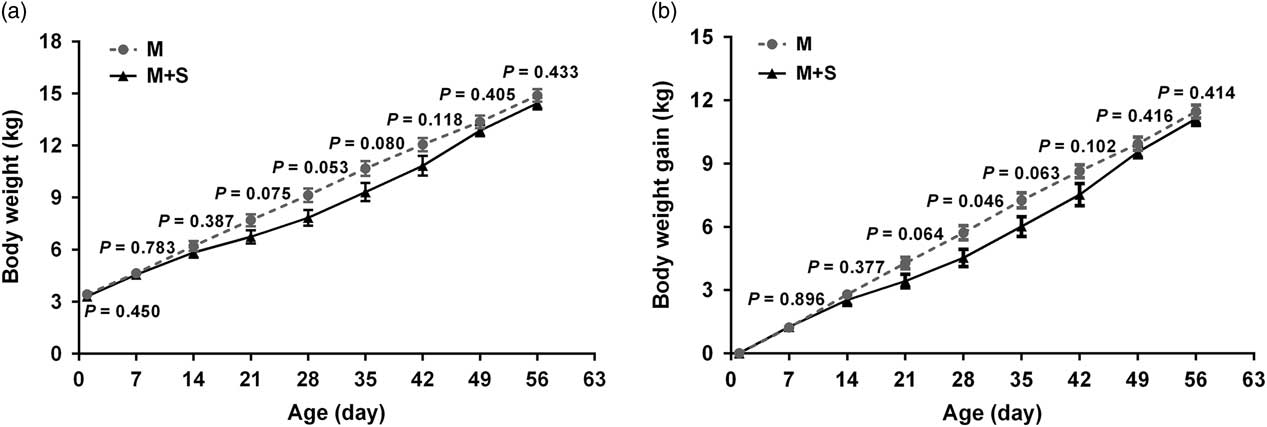
The weight of each lamb was recorded weekly (Figure 1). Compared with the M group, the BW of the M+S group had a decreased trend (P<0.10) at 21th, 28th and 35th days, but there was no significant (P>0.05) difference in BW between the two groups at other time points. The results of BW gain were similar to those of BW – the BW gain of the M+S group had a decreased trend (P<0.10) at 21th and 35th days and decreased significantly (P<0.05) at 28th days, but there was no significant (P>0.05) difference at other time points between the M and M+S groups.
Effects of starter feeding on BW (a) and BW gain (b) of lambs at different ages. M=milk group; M+S=milk plus starter group. Values are mean ± SEM, n=8.

Rumen fluid pH, volatile fatty acid and blood metabolites
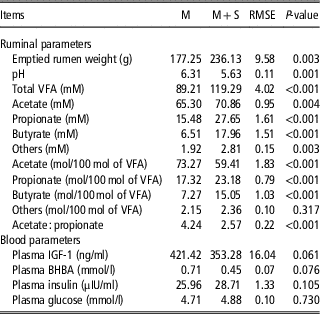
As shown in Table 2, starter feeding increased (P<0.05) rumen weight (excluding rumen content), total VFA, acetate, propionate, butyrate, other VFA concentration, propionate proportion and butyrate proportion, while decreasing ruminal pH, acetate proportion and acetate to propionate ratio. Starter feeding had an increased trend with plasma BHBA concentration (P=0.08), whereas it had a decreased trend with plasma IGF-1 concentration (P=0.06). The concentrations of glucose and insulin in plasma were no different (P>0.10) between the two groups.
Effects of starter feeding on rumen parameters and blood parameters in lambs at the time of slaughter

M=milk group; M+S=milk plus starter group; VFA=volatile fatty acid; BHBA=β-hydroxybutyric acid.
Histology and morphology of rumen papillae
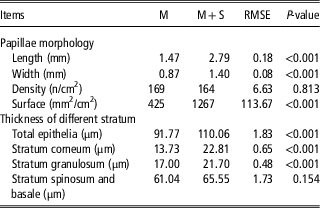
As shown in Figure 2 and Table 3, starter feeding increased (P<0.05) the length, width and surface area of rumen papillae. There was no significant difference in the density of the rumen papillae between the two groups. Starter feeding increased (P<0.05) the thickness of total epithelia, SC and SG of rumen epithelia in lambs, but there was no significant difference in thickness of the SS+SB (P>0.05) of rumen papillae between two groups.
(Colour online) Reprehensive ruminal epithelial visual graph (a, b) and micrograph (c, d) of lambs from M and M+S group. M=milk group; M+S=milk plus starter group; SC=stratum corneum; SG=stratum granulosum; SS=stratum spinosum; SB=stratum basale.

Effects of starter feeding on papillae morphology and the thickness of different stratum of rumen epithelium in lambs

M=milk group; M+S=milk plus starter group.
IGF-1 signal pathway proteins, cell cycle proteins and volatile fatty acid metabolism messenger RNA expression in rumen epithelium
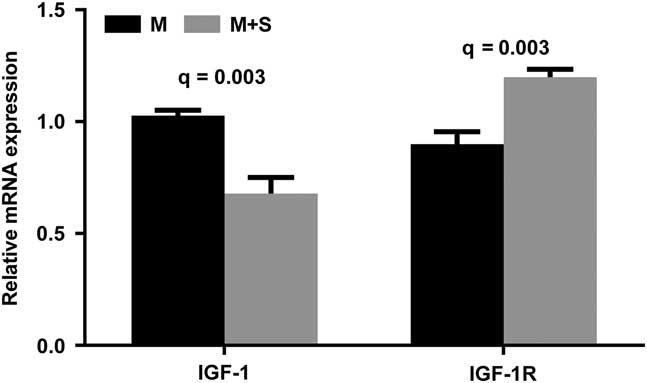
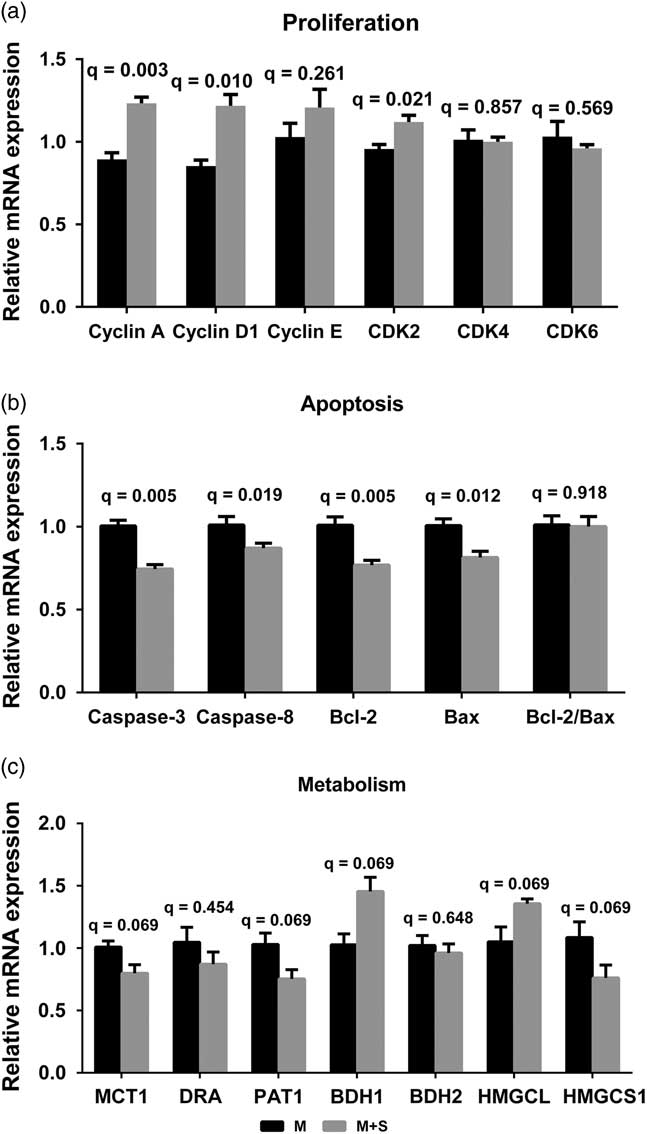
Starter feeding decreased ruminal epithelial IGF-1 mRNA expression (q<0.01), whereas increasing ruminal epithelial IGF-1R mRNA expression (q<0.01) (Figure 3). As shown in Figure 4a, compared with the M group, the M+S group had higher (q<0.05) relative mRNA expression of cyclin A, cyclin D1 and CDK2 in ruminal epithelia of lambs. There were no significant difference (q>0.05) of ruminal epithelial cyclin E, CDK4 and CDK6 mRNA expression in lambs. As shown in Figure 4b, starter feeding caused a decrease (q<0.05) in the relative mRNA expression of caspase-3, caspase-8, Bcl-2 and Bax. No significant difference in Bcl-2/Bax was observed in the present study (q>0.05). As shown in Figure 4c, starter feeding caused a decreased trend (q<0.10) in relative mRNA expression of MCT1, PAT1 and HMGCS1, and an increased trend (q<0.10) in the relative mRNA expression of BDH1 and HMGCL.
Effects of starter feeding on ruminal epithelial IGF-1 and IGF-1 receptor messenger RNA (mRNA) expression in lambs. Expression were normalized to glyceraldehyde-3-phosphate dehydrogenase, and the data were calculated by the 2−ΔΔCT method. M=milk group; M+S=milk plus starter group; q=false discovery rate. Values are means ± SEM, n=8.

Effects of starter feeding on relative messenger RNA (mRNA) expression of genes involved in ruminal epithelial proliferation (a), apoptosis (b) and metabolism (c) in lambs. Expression were normalized to glyceraldehyde-3-phosphate dehydrogenase, and the data were calculated by the 2−ΔΔCT method. CDKs=cyclin-dependent kinases; Bcl-2=B-cell lymphoma 2; Bax=Bcl-2-associated X protein; MCT1=monocarboxylate transporter isoform 1; DRA=downregulated in adenoma; PAT1=putative anion transporter isoform 1; BDHs=β-hydroxybutyrate dehydrogenase isoforms; HMGCL=3-hydroxy-3-methylglutaryl-CoA lyase; HMGCS1=3-hydroxy-3-methylglutaryl-CoA synthase isoform 1; M=milk group; M+S=milk plus starter group; q=false discovery rate. Values are means ± SEM, n=8.

Correlation between the ruminal physiological parameters and cell cycle proteins messenger RNA levels
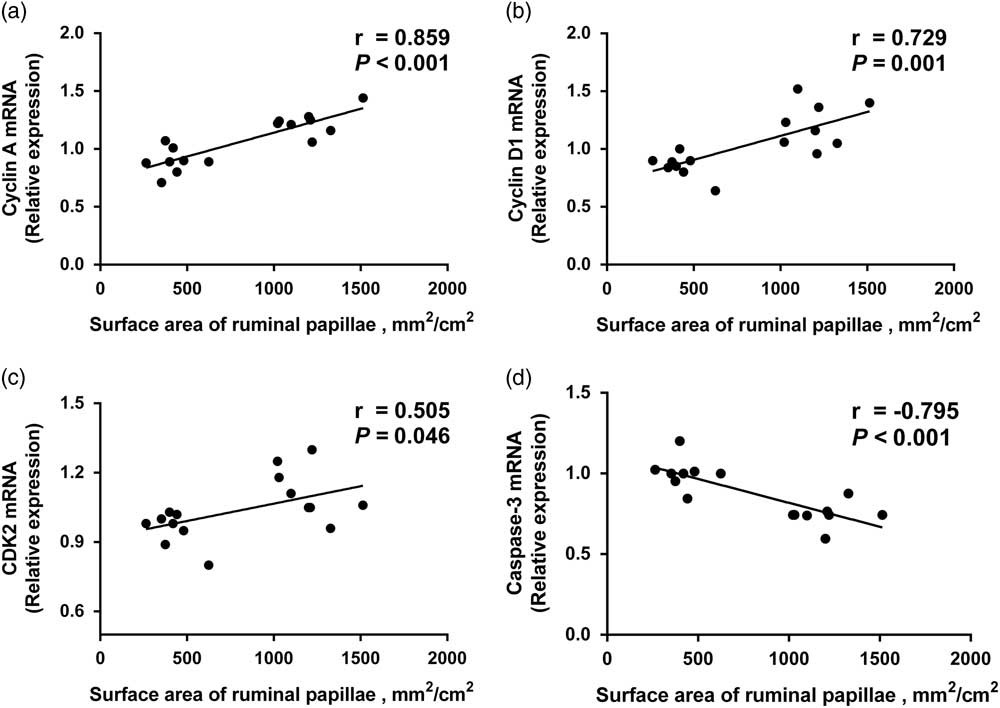
Correlation analysis revealed that there were positive correlations between the surface area of rumen papilla and cyclin A (P<0.001; r=0.859; Figure 5a), cyclin D1 (P=0.001; r=0.729; Figure 5b), and CDK2 (P=0.046; r=0.505; Figure 5c) mRNA expression in ruminal epithelia. The surface area of the rumen papilla had a negative correlation with caspase-3 (P<0.001; r=−0.795; Figure 5d) mRNA expression in ruminal epithelia.
Correlation analysis of the surface area of rumen papillae and relative messenger RNA (mRNA) expression of genes involved in cell proliferation and apoptosis in rumen papillae of lambs. CDK2=cyclin-dependent kinases 2; M=milk group; M+S=milk plus starter group.

Discussion
Animal performance
In the present study, we found that there was no difference in BW and BW gain at the beginning and ending of study. However, at the age of 21 to 35 days, the lambs of M+S group had an lower BW and BW gain than in M group. Obviously, the BW of lambs of the two groups began to diverge when the lambs in M+S group were separated from the dam and started intake starter. The results indicated that the event of separation from the dam was a major factor affecting the BW of lambs in M+S group. Sevi et al. (Reference Sevi, Napolitano, Casamassima, Annicchiarico, Quarantelli and De Paola1999) showed that the lambs which were separated from ewes to receive milk replacer exhibited lower weight gains than those which were maintained with their mothers in pre-weaned period. The similar results were also reported by Abecia et al. (Reference Abecia, Ramos-Morales, Martinez-Fernandez, Arco, Martin-Garcia, Newbold and Yanez-Ruiz2014). After the age of 28 days, the lambs began to adapt to the event and the BW gradually increased; there was no significant difference in BW between the two groups at the end of the experiment, but the effects of starter feeding on BW gain in the post-weaned period need to be investigated further. The results indicated that early starter feeding may be beneficial to the lamb with regard to adapting to weaning stress, which is beneficial to the early weaning of lambs. Moreover, in this study, feeding ewe milk to the lambs is a more reasonable way to ensure the growth of lambs. It has been recently reported that lambs reared with the dam had greater growth than their twins fed on milk replacer (Abecia et al., Reference Abecia, Ramos-Morales, Martinez-Fernandez, Arco, Martin-Garcia, Newbold and Yanez-Ruiz2014). This suggested that seeking efficient feeding management is crucial to the growth of lambs.
Effect of starter feeding on rumen fermentation
Volatile fatty acid is the vital source of energy for ruminants. It, especially butyrate, could stimulate the development of rumen papilla (Gorka et al., Reference Gorka, Kowalski, Pietrzak, Kotunia, Jagusiak, Holst, Guilloteau and Zabielski2011). In the present study, we found that starter feeding increased rumen fermentation, as reflected by higher VFA concentrations and lower rumen pH. This might be expected as starter feed contains a large number of easily fermentable carbohydrates, which ferment into VFA and caused a pH decrease in the rumen. Lane et al. (Reference Lane, Baldwin and Jesse2000) also found that, compared with an only milk replacer intake, solid feed increased the VFA concentration of rumen in lambs. However, this finding was somewhat inconsistent with those of Laarman and Oba (Reference Laarman and Oba2011), who found that starter did not affect rumen pH. This discrepancy may be attributed to the differences between ruminant species, feeding strategies, and methods of sampling and pH determination.
Effect of starter feeding on rumen papilla growth
In the present study, the weight of emptied rumen was greater in the M+S group than the M group. This is consistent with previous studies; Baldwin et al. (Reference Baldwin, McLeod, Klotz and Heitmann2004) indicated that starter feeding is associated with an increase in rumen mass. Research showed that diet type and nutrition level are important factors affecting the development of rumen epithelia in young ruminants (Wardrop, Reference Wardrop1961). In the present study, we found that starter feeding promoted rumen papillae growth, as reflected by higher papillae length, width and surface. Previous research showed that only milk intake delayed the development of rumen papilla in lambs (Wardrop, Reference Wardrop1961), and the addition of VFA into the rumen stimulated rumen development (Gorka et al., Reference Gorka, Kowalski, Pietrzak, Kotunia, Jagusiak, Holst, Guilloteau and Zabielski2011). Laarman et al. (Reference Laarman, Ruiz-Sanchez, Sugino, Guan and Oba2012) found that, compared with only milk replacer intake, starter feeding promoted rumen development in calves. Therefore, in the present study, although it is solely ewe milk feeding that promotes the rapid and efficient growth of lambs at early ages, it is not beneficial to prepare the lambs to utilize solid diets because of immature rumen development.
The mucosal surface of rumen is covered by stratified squamous epithelia, which are composed of four cell layers: SC, SG, SS and SB (Malhi et al., Reference Malhi, Gui, Yao, Aschenbach, Gabel and Shen2013). Further histomorphometric analysis displayed that starter feeding increased the thickness of the total epithelia, SC and SG of rumen epithelium in lambs. Wardrop (Reference Wardrop1961) also found that the development of SG and SC were delayed in only milk intake lambs. This may be contributed to enlarged rumen surface area and absorption of nutrition.
Effect of starter feeding on rumen epithelial cell proliferation
From the presented data and the previous discussion, we concluded that starter feeding significantly promotes rumen epithelia growth. In order to further confirm this result, we conducted qRT-PCR analysis to investigate the mRNA expression of cell cycle proteins and apoptosis genes in rumen epithelia. Cellular proliferation is controlled primarily by the regulation of the cell cycle that was regulated by cyclins and CDKs(Norbury and Nurse, Reference Norbury and Nurse1992). In the present study, the results showed that starter feeding increased the gene expression of cyclin A, cyclin D1 and CDK2. Cyclin A plays an important role in the S phase and G2/M phase. The cyclinA-CDK2 complexes, which assemble at the onset of the S phase, drive chromosome duplication through the phosphorylation of key DNA replication factors (Norbury and Nurse, Reference Norbury and Nurse1992). Cyclin D1 combines with CDK4 or CDK6 to form complexes that are essential for the G1-phase. Previous study found that supplying a high-metabolic energy diet (400 g/day of concentrate plus peanut straw) can accelerate the cell cycle progression of the rumen epithelial cells in goats due to upregulated cyclin D1(Lu et al., Reference Lu, Zhao, Xu, Zhang, Yan and Shen2013). Filmus et al. (Reference Filmus, Robles, Shi, Wong, Colombo and Conti1994) also found that the elevated expression of cyclin D1 and/or complexes of cyclin D1-CDK4 led to a shortening of the G1-phase duration in rat intestine epithelial cells. In addition, we found that there were positive correlations between the surface area of rumen papilla and cyclin A, cyclin D1 and CKD2 mRNA expression in ruminal epithelia. Therefore, we suggest that cyclin A, cyclin D1 and CDK2 are important genes that facilitate rumen epithelial development by promoting cell cycle progression in the M+S group.
Cell apoptosis is also important in the development of rumen epithelia. In the present study, we found that starter feeding decreased the gene expression of caspase-3 and caspase-8 in the rumen epithelia. Previous studies showed that caspase-3 is a downstream effector caspase that is activated by upstream caspases, predominantly caspase-8 and caspase-9, which play an important role in the process of apoptosis. The activation of caspase-3 causes the cleavage of cellular substrates and decompositions of the cell (Schwab et al., Reference Schwab, Reynders, Ulrich, Zahn, Stein and Schroder2006). Until now, two primary pathways – the receptor-mediated pathway and the intrinsic pathway – for activating caspase-3 were identified (Cory and Adams, Reference Cory and Adams2002). The intrinsic pathway is regulated by Bcl-2 and its relatives, and the ratio of Bcl-2 to Bax is the key index to cell apoptosis (Korsmeyer et al., Reference Korsmeyer, Shutter, Veis, Merry and Oltvai1993). In the present study, we found that starter feeding decreased the gene expression of Bcl-2 and Bax in the rumen epithelia, but, the ratio of Bcl-2 to Bax shows no difference between the two groups. These results suggest that starter feeding promotes the development of rumen papilla associated with the receptor-mediated pathway of cell apoptosis instead of intrinsic pathway. Besides, the surface area of rumen papilla was negatively correlated to caspase-3 mRNA expression in ruminal epithelia. The above results show that starter feeding increased the development of runimal epithelia associated with accelerated cell cycle and inhibited apoptosis.
From the present data and the previous discussion, we found that starter feeding significantly promotes the development of rumen epithelia. Previous studies indicate that IGF-1 may induce the upregulation of cyclin D1, advance the cell cycle, and finally promote cell proliferation. In the present study, we found that the starter feeding increased the expression of IGF-1R in ruminal epithelia. However, the concentration of IGF-1 in plasma and the expression of IGF-1 in ruminal epithelia in the M+S group were lower than that in the M group. This could be related to a high concentration of IGF-1 in sheep’s milk affecting the result of this experiment (Faulkner, Reference Faulkner1999). However, although the concentration of IGF-1 in plasma in the M+S group was lower than that in the M group, the ruminal papillae surface area was significantly higher than that of the M group. Previous studies showed that high-concentrate diets could stimulated the secretion of IGF-1 and promoted the development of rumen papilla (Lu et al., Reference Lu, Zhao, Xu, Zhang, Yan and Shen2013). These results suggest that the initiation of the rumen epithelial development of lambs was different than that of adult sheep. This result is very interesting, and how the rumen epithelium of lambs is initiated is worthy of further study.
In the present study, we found that starter feeding increased butyrate concentration in rumen, which may be the cause of ruminal epithelial development in lambs during starter feeding. Malhi et al. (Reference Malhi, Gui, Yao, Aschenbach, Gabel and Shen2013) demonstrated that ruminal butyrate infusion promoted ruminal epithelial growth by increasing cyclin D1 expression in goats. Mentschel et al. (Reference Mentschel, Leiser, Mulling, Pfarrer and Claus2001) also found that butyrate infusion stimulated rumen mucosa development in the calf mainly by a reduction of apoptosis in ruminal epithelia. In the present study, we also found that starter feeding increased the butyrate concentrate in the rumen of lambs, promoted the mRNA expression of cell cycle protein and decreased the mRNA expression of caspase protein. However, the underlying mechanism wherein starter feeding promotes rumen papillae growth is associated with which signalling pathways needs more elucidating in vitro experiments.
Effect of starter feeding on rumen epithelial metabolism
Metabolic changes of VFA is important to develop proper nutritional management programs for lambs during the weaning transition. In the present study, we found that starter feeding had an increased trend regarding the concentration of BHBA in plasma. Previous research found that the synthesis of ketone bodies, which was the primary pathway for VFA metabolism in the rumen epithelia, exerted profound influences on energy metabolism and function development of rumen epithelia (Penner et al., Reference Penner, Steele, Aschenbach and McBride2011). However, in the present study, there was no difference in the glucose and insulin concentration in plasma between the two groups. These results were similar to previous studies, which found that plasma glucose and insulin concentrations appear to be effected by age rather than diet type (Laarman et al., Reference Laarman, Ruiz-Sanchez, Sugino, Guan and Oba2012).
We also examined the expression of genes involved in VFA absorption (MCT1, DRA and PAT1) and VFA metabolism (BDH1, BDH2, HMGCL and HMGCS1) in the rumen epithelia. Of the genes investigated, the expression of BDH1 and HMGCL had an increased trend with starter feeding. However, the expression of HMGCS1, MCT1 and PAT1 had a decreased trend with starter feeding. This finding was somewhat inconsistent with those of Laarman et al. (Reference Laarman, Ruiz-Sanchez, Sugino, Guan and Oba2012), who showed that starter feeding did not affect the expression of BDH1, BDH2, HMGCL and PAT1, only increasing the expression of MCT1 in ruminal epithelia. This discrepancy may be attributed to the difference in milk-feeding strategy, starter diet, animal species and feeding management. We have adopted the mode of a natural milk-feeding strategy, whereas Laarman used milk replacer to feed the Lambs. The feeding strategy (natural v. artificial) had an effect on metabolism in ruminal epithelia in pre-weaned lambs (Abecia et al., Reference Abecia, Ramos-Morales, Martinez-Fernandez, Arco, Martin-Garcia, Newbold and Yanez-Ruiz2014). In addition, differences in ruminant species also contribute to this discrepancy; twin lambs were used in our study, which may have a smaller individual difference when compared with the calve in Laarman’s study.
Aschenbach et al. (Reference Aschenbach, Penner, Stumpff and Gabel2011) reported that the apical VFA absorption is mediated by passive diffusion and facilitated transport mechanisms. Schlau et al. (Reference Schlau, Guan and Oba2012) proposed that PAT1 and DRA, located at the apical membrane, are responsible for neutralizing acid in the rumen by importing dissociated VFA and exporting bicarbonate from epithelial cells. And, MCT1, located at the basal side of the ruminal epithelium, contributes to transport protons from the ruminal epithelium into the blood (Malhi et al., Reference Malhi, Gui, Yao, Aschenbach, Gabel and Shen2013). In the present study, we found that the mRNA expression of PAT1 and MCT1 had a decreased trend with starter feeding, which indicated that starter feeding may decrease the capacity for VFA absorption within rumen in lambs. These results could explain the reason that starter feeding caused the decreased pH and increased VFA concentrations within rumen in lambs.
In the present study, the expression of two genes involved in the ketogenesis (BDH1 and HMGCL) had an increased trend with starter feeding. HMGCL is the rate-limiting enzyme in the biosynthesis of ketone bodies in ruminal epithelia (Steele et al., Reference Steele, Vandervoort, AlZahal, Hook, Matthews and McBride2011). The final step of ketogenesis is the production of BHBA catalyzed by BDH1 (Naeem et al., Reference Naeem, Drackley, Stamey and Loor2012). Moreover, starter feeding also appears to affect the synthesis of cholesterol. Specifically, HMGCS1 has been shown to be downregulated with starter feeding, possibly to mitigate excess cellular cholesterol (Steele et al., Reference Steele, Vandervoort, AlZahal, Hook, Matthews and McBride2011; Laarman et al., Reference Laarman, Ruiz-Sanchez, Sugino, Guan and Oba2012). The enzyme HMGCS1 catalyzes butyrate metabolism for cholesterol synthesis in the cytoplasm (Penner et al., Reference Penner, Steele, Aschenbach and McBride2011). Cholesterol biosynthesis is an alternative pathway of VFA metabolism in the rumen epithelial cells besides ketogenesis (Steele et al., Reference Steele, Vandervoort, AlZahal, Hook, Matthews and McBride2011). This result suggest that starter feeding may promote the biosynthesis of ketogenesis at the gene level, while decreasing the biosynthesis of cholesterol. Regarding changes in gene expression, the above results indicated that the decreased VFA absorption may be adapting to increase the metabolism activity of VFA in ruminal epithelia, which inclines to ketone body metabolism for supplying energy to the body.
With the development of ruminal papilla, starter feeding is favourable for lambs to adapt to solid feed, which is important for reducing weaned stresses and promoting the growth of lambs after weaning. In the present study, however, we found that starter feeding may decrease VFA absorption and increased ketone body metabolism, which may have an adverse effect on the health of the lambs such as ruminal acidosis and lower feed conversion rates. Therefore, in the future we need to research a starter feeding strategy that addresses suitable time, dosage and diet compositions that not only promote the development of ruminal papillae, but also benefits VFA absorption and metabolism in the ruminal epithelia.
Conclusion
In summary, all results showed that starter feeding promoted the development of runimal epithelia associated with cell cycle acceleration and apoptosis inhibition, and probably inhibited the uptake of VFA, promoting ketogenesis in the rumen epithelium in pre-weaned lambs. These findings provide new insights into nutritional interventions to promote the development of the rumen in young ruminants.
Acknowledgements
This work was supported by the National Natural Science Foundation of China (No. 31501980), Jiangsu Natural Science Foundation of China (No. BK20150655) and Fundamental Research Funds for the Central Universities (KJQN201610).
Declaration of interest
The authors declare no conflicts of interest.
Ethics statement
The experimental design and procedures were approved by the Animal Care and Use Committee of Nanjing Agricultural University following the requirements of the Regulations for the Administration of Affairs Concerning Experimental Animals (The State Science and Technology Commission of P. R. China 1988).
Software and data repository resources
Data are not deposited in an official repository.
Supplementary material
To view supplementary material for this article, please visit https://doi.org/10.1017/S1751731118000290