



1 Introduction
Let X be a smooth projective algebraic variety over the field of complex numbers, of dimension
 $n \geqslant 2$
. If
 $T_X$
is numerically flat, then X is a finite étale quotient of an abelian variety as a classical consequence of Yau’s theorem on the existence of a Kähler–Einstein metric. In [Reference Jahnke and Radloff42], Jahnke and Radloff proved that if the normalized tangent bundle
 $\text {S}^nT_X\otimes \mathscr {O}_X(K_X)$
is numerically flat, then
 $K_X \equiv 0$
, and hence
 $T_X$
is numerically flat. Thus, X is again a finite étale quotient of an abelian variety. Let
 $\mathscr {E}$
be a vector bundle of rank
 $r \geqslant 1$
on X. Recall from [Reference Jahnke and Radloff42, Theorem 1.1] that the normalized vector bundle
 $\text {S}^r\mathscr {E}\otimes \det (\mathscr {E}^*)$
is numerically flat if and only if
 $\mathscr {E}$
is semistable with respect to some ample divisor H on X and equality holds in the Bogomolov–Gieseker inequality,
 $$ \begin{align*}c_2(\mathscr{E})\cdot H^{n-2}=\frac{r-1}{2r}c_1(\mathscr{E})^2\cdot H^{n-2}.\end{align*} $$
The aim of this paper is to generalize the theorem of Jahnke and Radloff to codimension
 $1$
regular foliations.
Theorem 1.1. Let X be a complex projective manifold of dimension
 $n\geqslant 4$
, and let
 $\mathscr {F} \subset T_X$
be a regular codimension
 $1$
foliation. Suppose that the normalized vector bundle
 $\mathrm{S}^{n-1}\mathscr {F}\otimes \det (\mathscr {F}^*)$
is numerically flat. Then one of the following holds.
-
(1) There exists a
 $\mathbb {P}^1$
-bundle structure
$\varphi \colon X \to Y$
onto a finite étale quotient of an abelian variety and
$\mathscr {F}$
induces a flat Ehresmann connection on
$\varphi $
.
-
(2) There exists an abelian variety A as well as a finite étale cover
$\gamma \colon A \to X$
such that
$\gamma ^{-1}\mathscr {F}$
is a linear foliation. -
(3) There exists an abelian scheme
$f\colon B \to C$
onto a smooth complete curve of genus at least
$2$
as well as a finite étale cover
$\gamma \colon B \to X$
such that
$\gamma ^{-1}\mathscr {F}$
is induced by f. -
(4) The divisor
$K_X$
is ample and
$\kappa (K_{\mathscr {F}})=\dim X$
. Moreover, the vector bundles
$\mathscr {N}^*$
and
$\Omega _X^1$
are nef.





Notice that no example of foliations satisfying the conclusion of Theorem 1.1 (4) is known to the author.
If
 $\dim X =2$
, then the conclusion of Theorem 1.1 is false. Indeed, turbulent and Riccati foliations do not fit in the description of Theorem 1.1 above (see [Reference Brunella11]).
The assumption
 $\dim X \geqslant 4$
is only used to prove Theorem 5.1. Nevertheless, we expect the above result to be true if
 $\dim X = 3$
as well.
The proof of Theorem 1.1 makes use of the following result, which might be of independent interest.
Theorem 1.2. Let X be a complex projective manifold of dimension
 $n \geqslant 1$
, and let
 $\mathscr {F} \subset T_X$
be a regular codimension
 $1$
foliation with normal bundle
 $\mathscr {N}$
. Then, either
 $\mathscr {N}$
is pseudo-effective or
 $\mathscr {N}^*$
is nef.
In fact, a more general statement is true (see Theorem 4.4).
Previous results
Greb, Kebekus and Peternell generalized the theorem of Jahnke and Radloff to projective varieties with klt singularities in [Reference Greb, Kebekus and Peternell31]. More precisely, they proved that torus quotients are the only klt varieties with semistable tangent sheaf and extremal Chern classes. In [Reference Druel26], the structure of projective log smooth pairs with numerically flat normalized logarithmic tangent bundle is described. Passing to an appropriate finite cover and up to isomorphism, these are projective spaces and log smooth pairs with numerically flat logarithmic tangent bundles blown up at finitely many points away from the boundary. In addition, it has been shown in [Reference Druel and Lo Bianco17] that log smooth pairs with numerically flat logarithmic tangent bundle are toric fiber bundles over finite étale quotients of abelian varieties.
Structure of the paper
Section 2 gathers notation, known results and global conventions that will be used throughout the paper. In Section 3, we provide technical tools for the proof of our main results. Section 4 is mostly taken up by the proof of Theorem 1.2. The proof of Theorem 1.1 is long and therefore subdivided into numerous steps: Sections 5 to 9 prepare for it. In Section 5, we describe regular codimension
 $1$
foliations with numerically projectively flat tangent bundle on nonminimal complex projective manifolds. Next, we prove abundance for
 $K_X$
in Section 6 following the strategy employed in [Reference Jahnke and Radloff42]: We use a Shafarevich map construction to prove that it reduces to the special case where
 $\mathscr {F} \cong \mathscr {L}^{\oplus n}$
for some line bundle
 $\mathscr {L}$
. In Section 7, we address regular codimension
 $1$
foliations with numerically projectively flat tangent bundle and nef conormal bundle on minimal varieties. Section 9 describes regular codimension
 $1$
foliations with numerically projectively flat tangent bundle and pseudo-effective normal bundle still on minimal varieties. To this end, we show in Section 8 that the nef reduction map for
 $K_{\mathscr {F}}$
is an abelian scheme up to a finite étale cover. With these preparations at hand, the proof of Theorem 1.1 which we give in Section 10 becomes short.
2 Notation, conventions and used facts
2.1 Global conventions
Throughout the paper, all varieties are assumed to be defined over the field of complex numbers. We will freely switch between the algebraic and analytic context.
2.2 Projective space bundles
If
 $\mathscr {E}$
is a locally free sheaf of finite rank on a variety X, we denote by
 $\mathbb {P}_X(\mathscr {E})$
the variety
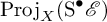 $\text {Proj}_X(\text {S}^{\bullet }\mathscr {E})$
.
2.3 Stability
The word stable will always mean slope-stable with respect to a given ample divisor. Ditto for semistable and polystable. We refer to [Reference Huybrechts and Lehn37, Definition 1.2.12] for their precise definitions.
2.4 Numerically flat vector bundles
For the reader’s convenience, we recall the definition of numerically flat vector bundles following [Reference Demailly, Peternell and Schneider22, Definition 1.17].
Definition 2.1. A vector bundle
 $\mathscr {E}$
of rank
 $r\geqslant 1$
on a smooth projective variety is called numerically flat if
 $\mathscr {E}$
and
 $\mathscr {E}^*$
are nef vector bundes.
Remark 2.2. Let X be a smooth projective variety, and let
 $\mathscr {E}$
be a vector bundle of rank
 $r \geqslant 1$
on X with
 $c_1(\mathscr {E}) \equiv 0$
. Then
 $\mathscr {E}$
is numerically flat if and only if
 $\mathscr {E}$
is nef.
Theorem 2.3. Let X be a smooth projective variety, and let
 $\mathscr {E}$
be a vector bundle of rank
 $r \geqslant 1$
on X. Let H be an ample divisor on X. Then the following conditions are equivalent.
-
(1) The vector bundle
$\mathscr {E}$
is numerically flat. -
(2) The vector bundle
$\mathscr {E}$
is flat and semistable with respect to H. -
(3) The vector bundle
$\mathscr {E}$
admits a filtration by vector subbundles such that the quotients
$$ \begin{align*}\{0\}=\mathscr{E}_0 \subset \mathscr{E}_1 \subset \cdots \subset \mathscr{E}_m=\mathscr{E}\end{align*} $$
$\mathscr {Q}_k:=\mathscr {E}_k/\mathscr {E}_{k-1}$
are Hermitian flat.



Proof. This follows easily from [Reference Demailly, Peternell and Schneider22, Theorem 1.18] and [Reference Simpson54] together (see [Reference Druel26, Theorem 2.9]).
Remark 2.4. Setting and notation as in Theorem 2.3. If
 $\mathscr {E}$
is numerically flat, then it is semistable with respect to any ample divisor.
Lemma 2.5 [Reference Demailly, Peternell and Schneider22, Corollary 1.19].
Let
 $\mathscr {E}$
be a vector bundle on a smooth projective variety. If
 $\mathscr {E}$
is numerically flat, then
 $c_i(\mathscr {E})\equiv 0$
for any integer
 $i \geqslant 1$
.
2.5 Projectively flat and numerically projectively flat vector bundles
Next, we recall the definition of projectively flat vector bundles.
Definition 2.6. A vector bundle
 $\mathscr {E}$
of rank
 $r\geqslant 1$
on a smooth projective variety X is called projectively flat if
 $\mathbb {P}(\mathscr {E})$
comes from a representation
 $\pi _1(X) \to \text {PGL}(r,\mathbb {C})$
.
Lemma 2.7
[Reference Jahnke and Radloff42, Proof of Proposition 1.1 (2)]. Let
 $\mathscr {E}$
be a vector bundle on a smooth projective variety. If
 $\mathscr {E}$
is projectively flat, then
 $c_i(\mathscr {E})\equiv \frac {1}{r^i}\binom {r}{i}c_1(\mathscr {E})^i$
for any integer
 $i \geqslant 1$
.
One key notion is that of a numerically projectively flat vector bundle. We recall the definition.
Definition 2.8. A vector bundle
 $\mathscr {E}$
of rank
 $r\geqslant 1$
on a smooth projective variety X is called numerically projectively flat if
 $\text {S}^r\mathscr {E} \otimes \det \mathscr {E}^*$
is numerically flat.
Remark 2.9. Setting and notation as in Definition 2.8. Then
 $\mathscr {E}$
is numerically projectively flat if and only if
 $\text {S}^r\mathscr {E} \otimes \det \mathscr {E}^*$
is nef since
 $\det (\text {S}^r\mathscr {E} \otimes \det \mathscr {E}^*)\cong \mathscr {O}_X$
(see Remark 2.2).
Remark 2.10. Setting and notation as in Definition 2.8. Then
 $\mathscr {E}$
is numerically flat if and only if
 $\mathscr {E}$
is numerically projectively flat and
 $c_1(\mathscr {E})\equiv 0$
.
We will need the following characterization of numerically projectively flat vector bundles.
Theorem 2.11. Let X be a smooth projective variety of dimension
 $n\geqslant 2$
, and let
 $\mathscr {E}$
be a vector bundle of rank
 $r \geqslant 1$
on X. Let H be an ample divisor on X. Then the following conditions are equivalent.
-
(1) The vector bundle
$\mathscr {E}$
is numerically projectively flat. -
(2) The vector bundle
$\mathscr {E}$
is projectively flat and semistable with respect to H. -
(3) The vector bundle
$\mathscr {E}$
admits a filtration by vector subbundles such that the quotients
$$ \begin{align*}\{0\}=\mathscr{E}_0 \subset \mathscr{E}_1 \subset \cdots \subset \mathscr{E}_m=\mathscr{E}\end{align*} $$
$\mathscr {Q}_k:=\mathscr {E}_k/\mathscr {E}_{k-1}$
are Hermitian projectively flat with
$$ \begin{align*}\frac{1}{\mathrm{rank}\,\mathscr{Q}_k} c_1(\mathscr{Q}_k)\equiv \frac{1}{r}c_1(\mathscr{E}).\end{align*} $$
-
(4) The vector bundle
$\mathscr {E}$
is semistable with respect to H and equality holds in the Bogomolov–Gieseker inequality,
$$ \begin{align*}c_2(\mathscr{E})\cdot H^{n-2}=\frac{r-1}{2r}c_1(\mathscr{E})^2\cdot H^{n-2}.\end{align*} $$
-
(5) For any morphism
$C \to X$
from a smooth complete curve C, the vector bundle
$\mathscr {E}|_C$
is semistable.





Proof. This follows easily from [Reference Jahnke and Radloff42, Theorem 1.1] and [Reference Jahnke and Radloff42, Proposition 1.1] together (see also [Reference Druel26, Theorem 2.13]).
Remark 2.12. Setting and notation as in Theorem 2.11. If
 $\mathscr {E}$
is numerically projectively flat, then it is semistable with respect to any ample divisor.
Example 2.13. Let
 $\mathscr {L}$
be a line bundle on a smooth projective variety X. Then
 $\mathscr {L}^{\oplus m}$
is numerically projectively flat for any integer
 $m\geqslant 1$
.
The following is an easy consequence of Theorem 2.11.
Lemma 2.14. Let X be a smooth projective variety of dimension
 $n\geqslant 1$
, and let
 $\mathscr {E}$
be a vector bundle of rank
 $r \geqslant 1$
on X.
-
(1) If
$\mathscr {E}$
is numerically projectively flat, then
$\mathscr {E}\otimes \mathscr {L}$
is numerically projectively flat as well for any line bundle
$\mathscr {L}$
on X. -
(2) Let Y be a smooth projective variety, and let
$f \colon Y \to X$
be a morphism. If
$\mathscr {E}$
is numerically projectively flat, then
$f^*\mathscr {E}$
is also numerically projectively flat. In addition, the converse statement is true if f is surjective. -
(3) Let
$\mathscr {G}$
be a vector bundle on X of rank
$s \geqslant 1$
. Then
$\mathscr {E}\oplus \mathscr {G}$
is numerically projectively flat if and only if
$\mathscr {E}$
and
$\mathscr {G}$
are numerically projectively flat and
$$ \begin{align*}\frac{1}{r}c_1(\mathscr{E})\equiv \frac{1}{s}c_1(\mathscr{G})\equiv \frac{1}{r+s}c_1(\mathscr{E}\oplus \mathscr{G}).\end{align*} $$


We will need the following easy observation.
Lemma 2.15. Let
 $f\colon X \to Y$
be a smooth projective morphism with connected fibers between smooth algebraic varieties, and let
 $\mathscr {E}$
be a vector bundle of rank
 $r \geqslant 1$
on X. Suppose that the restriction of
 $\mathscr {E}$
to every fiber of f is numerically projectively flat. Suppose in addition that
 $\mathscr {E}|_F\cong \mathscr {O}_F^{\oplus r}$
, where F is a general fiber of f. Then there exists a vector bundle
 $\mathscr {G}$
on Y such that
 $\mathscr {E} \cong f^*\mathscr {G}$
.
Proof. Let F be any fiber of f. Because the function
 $y \mapsto h^0(X_y,\mathscr {E}|_{X_y}\!)$
is upper semicontinuous in the Zariski topology on Y (see [Reference Hartshorne36, Theorem 12.8]), we have
 $h^0(F,\mathscr {E}|_F) \geqslant r$
. By [Reference Demailly, Peternell and Schneider22, Proposition 1.16], the evaluation map
 $H^0(F,\mathscr {E}|_F)\otimes \mathscr {O}_F \to \mathscr {E}|_F$
is an injective morphism of vector bundles. This implies that
 $\mathscr {E}|_F \cong \mathscr {O}_F^{\oplus r}$
. By [Reference Hartshorne36, Corollary 12.9] together with the base change theorem [Reference Hartshorne36, Theorem 12.11], the sheaf
 $\mathscr {G}:=f_*\mathscr {E}$
is locally free of rank r and the formation of
 $f_*\mathscr {E}$
commutes with arbitrary base change. This easily implies that
 $\mathscr {E} \cong f^*\mathscr {G}$
.
2.6 Foliations
In this section, we have gathered a number of results and facts concerning foliations which will later be used in the proofs.
Definition 2.16. A foliation on a smooth variety X is a coherent subsheaf
 $\mathscr {F}\subseteq T_X$
such that
-
(1)
$\mathscr {F}$
is closed under the Lie bracket, and -
(2)
$\mathscr {F}$
is saturated in
$T_X$
. In other words, the quotient
$T_X/\mathscr {F}$
is torsion-free.


The rank r of
 $\mathscr {F}$
is the generic rank of
 $\mathscr {F}$
. The codimension of
 $\mathscr {F}$
is defined as
 $q:=\dim X-r$
.
The canonical class
 $K_{\mathscr {F}}$
of
 $\mathscr {F}$
is any Weil divisor on X such that
 $\mathscr {O}_X(-K_{\mathscr {F}})\cong \det \mathscr {F}$
.
Let
 $X^\circ \subseteq X$
be the open set where
 $\mathscr {F}$
is a subbundle of
 $T_X$
. The foliation is called regular if
 $X^\circ = X$
.
A leaf of
 $\mathscr {F}$
is a maximal connected and immersed holomorphic submanifold
 $L \subseteq X^\circ $
such that
 $T_L=\mathscr {F}_{|L}$
.
The normal sheaf of
 $\mathscr {F}$
is
 $\mathscr {N}:=(T_X/\mathscr {F})^{**}$
. The q-th wedge product of the inclusion
 $\mathscr {N}^*\subseteq \Omega ^1_X$
gives rise to a nonzero global section
 $\omega \in H^0(X,\Omega ^{q}_X\otimes \det \mathscr {N})$
whose zero locus has codimension at least
 $2$
in X. Moreover,
 $\omega $
is locally decomposable and integrable. To say that
 $\omega $
is locally decomposable means that, in a neighborhood of a general point of X,
 $\omega $
decomposes as the wedge product of q local
 $1$
-forms
 $\omega =\omega _1\wedge \cdots \wedge \omega _q$
. To say that it is integrable means that for this local decomposition one has
 $d\omega _i\wedge \omega =0$
for every
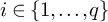 $i\in \{1,\ldots ,q\}$
. The integrability condition for
 $\omega $
is equivalent to the condition that
 $\mathscr {F}$
is closed under the Lie bracket. Conversely, let
 $\mathscr {L}$
be a line bundle on X, and let
 $\omega \in H^0(X,\Omega ^{q}_X\otimes \mathscr {L})$
be a global section whose zero locus has codimension at least
 $2$
in X. Suppose that
 $\omega $
is locally decomposable and integrable. Then the kernel of the morphism
 $T_X \to \Omega ^{q-1}_X\otimes \mathscr {L}$
given by the contraction with
 $\omega $
defines a foliation of codimension q on X. These constructions are inverse of each other.
Let X and Y be smooth complex algebraic varieties, and let
 $f\colon X\to Y$
be a dominant morphism that restricts to a smooth morphism
 $f^\circ \colon X^\circ \to Y^\circ $
, where
 $X^\circ \subseteq X$
and
 $Y^\circ \subseteq Y$
are dense open subsets. Let
 $\mathscr {F}$
be a foliation on Y. The pull-back
 $f^{-1}\mathscr {F}$
of
 $\mathscr {F}$
via f is the foliation on X whose restriction to
 $X^\circ $
is
 $(df^\circ )^{-1}\big (\mathscr {F}_{|Y^\circ }\big )$
. We will need the following easy observation.
Lemma 2.17. Let
 $f\colon X \to Y$
be a finite étale cover of smooth projective varieties, and let
 $\mathscr {F}$
be a regular foliation on Y. Then the following holds.
-
(1) The foliation
$f^{-1}\mathscr {F}$
is regular. Moreover
$f^{-1}\mathscr {F} \cong f^*\mathscr {F}$
, and
$\mathscr {N}_{f^{-1}\mathscr {F}} \cong f^*\mathscr {N}_{\mathscr {F}}$
. -
(2) We have
$\kappa (K_{f^{-1}\mathscr {F}})=\kappa (K_{\mathscr {F}})$
, and
$\nu (K_{f^{-1}\mathscr {F}})=\nu (K_{\mathscr {F}})$
.





Proof. The first part of the statement is obvious. For the second part, note that
 $K_{f^{-1}\mathscr {F}}=f^*K_{\mathscr {F}}$
by (1). Then we have
 $\kappa (K_{f^{-1}\mathscr {F}})=\kappa (K_{\mathscr {F}})$
by [Reference Ueno58, Theorem 5.13] and
 $\nu (K_{f^{-1}\mathscr {F}})=\nu (K_{\mathscr {F}})$
by [Reference Nakayama52, Proposition V.2.22].
2.7 Ehresmann connections
Let
 $f \colon X \to Y$
be a surjective proper morphism between smooth varieties. An Ehresmann connection on f is a distribution
 $\mathscr {D} \subseteq T_X$
such that the restriction of the tangent map
 $Tf\colon T_X \to f^*T_Y$
to
 $\mathscr {D}$
induces an isomorphism
 $\mathscr {D} \cong f^*T_Y$
. The Ehresmann connection
 $\mathscr {D}$
is said to be flat if
 $\mathscr {D}$
is a foliation.
If f has an Ehresmann connection, then f is a locally trivial fibration for the analytic topology since complex flows of vector fields on analytic spaces exist.
Suppose that f has a flat Ehresmann connection
 $\mathscr {D}$
. Let F be any fiber of f, and set
 $y:=f(F)$
. Let also
 $\rho \colon \pi _1(Y,y) \to \text {Aut}(F)$
be the monodromy representation of
 $\mathscr {D}$
. Then
 $$ \begin{align*}X \cong (\widetilde{Y} \times F)/\pi_1(Y,y),\end{align*} $$
where
 $\widetilde {Y}$
denotes the universal cover of Y based at y and
 $\pi _1(Y,y)$
acts diagonally on the product.
Example 2.18. Let
 $n \geqslant 2$
be an integer. Let
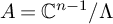 $A=\mathbb {C}^{n-1}/\Lambda $
be a complex abelian variety, and let
 $\rho \colon \pi _1(A) \to \text {PGL}(2,\mathbb {C})$
be a representation of the fundamental group
 $\pi _1(A)\cong \Lambda $
of A. Then the group
 $\pi _1(A)$
acts diagonally on
 $\mathbb {C}^{n-1}\times \mathbb {P}^1$
by
 $\gamma \cdot (z,p)=\big (\gamma (z),\rho (\gamma )(p)\big )$
. Set
 $X:=(\mathbb {C}^{n-1} \times \mathbb {P}^1)/\pi _1(A)$
, and denote by
 $\psi \colon X \to A \cong \mathbb {C}^{n-1}/\pi _1(A)$
the projection morphism, which is
 $\mathbb {P}^1$
-bundle. The foliation on
 $\mathbb {C}^{n-1} \times \mathbb {P}^1$
induced by the projection
 $\mathbb {C}^{n-1} \times \mathbb {P}^1 \to \mathbb {P}^1$
is invariant under the action of
 $\pi _1(A)$
and gives a flat Ehresmann connection
 $\mathscr {F}$
on
 $\psi $
. Then
 $\rho $
identifies with the monodromy representation of
 $\mathscr {F}$
.
2.8 The standard setting
Throughout the present paper, we will be working in the following setup and use the notation below.
Setup 2.19. Let X be a complex projective manifold of dimension
 $n\geqslant 3$
, and let
 $\mathscr {F} \subset T_X$
be a regular codimension
 $1$
foliation with normal bundle
 $\mathscr {N}$
. Suppose that
 $\mathscr {F}$
is numerically projectively flat. Let
 $\rho \colon \pi _1(X) \to \text {PGL}(n-1,\mathbb {C})$
denote a representation that defines the projectively flat structure on
 $\mathscr {F}$
.
Remark 2.20. Setting and notation as in Setup 2.19. Let
 $f \colon Y \to X$
be a finite étale cover. Then the pull-back
 $f^{-1}\mathscr {F}$
of
 $\mathscr {F}$
on Y satisfies all the conditions listed in Setup 2.19 (see Lemma 2.17).
We will need the following observation.
Lemma 2.21. Setting and notation as in 2.19. Then
 $\mathscr {F}^*$
is a nef vector bundle.
Proof. In order to prove the lemma, it suffices to show that
 $K_{\mathscr {F}}$
is nef since the vector bundle
 $\mathscr {F}^*|_C$
is semistable for any morphism
 $C \to X$
from a smooth complete curve C by Theorem 2.11. We argue by contradiction and assume that
 $K_{\mathscr {F}}$
is not nef. Then there exists a smooth complete curve
 $C \to X$
such that
 $\deg _C K_{\mathscr {F}} <0$
. This implies that the vector bundle
 $\mathscr {F}|_C$
is ample since it is semistable with positive slope by our current assumption. By [Reference Bogomolov and McQuillan9, Main Theorem] (see also [Reference Kebekus, Conde and Toma50, Theorem 1]), the leaf F of
 $\mathscr {F}$
through a general point in C is algebraic and rationally connected. It follows that
 $\mathscr {F}$
is induced by a morphism with connected fibers
 $f \colon X \to B$
onto a smooth complete curve B. By [Reference Kollár49, Theorem IV.2.10] applied to a general fiber F of f, there exists a minimal free rational curve
 $\mathbb {P}^1 \to F$
which means that there exists an integer
 $0 \leqslant p \leqslant n-2$
such that
 $$ \begin{align*}\mathscr{F}|_{\mathbb{P}^1}\cong T_F|_{\mathbb{P}^1}\cong \mathscr{O}_{\mathbb{P}^1}(2)\oplus\mathscr{O}_{\mathbb{P}^1}(1)^{\oplus p} \oplus \mathscr{O}_{\mathbb{P}^1}^{\oplus n-2-p}.\end{align*} $$
Since
 $\mathscr {F}|_{\mathbb {P}^1}$
is projectively flat by assumption, we must have
 $p=0$
and
 $n=2$
, yielding a contradiction. This finishes the proof of the lemma.
3 Preparations for the proof of Theorem 1.1
In this section, we provide technical tools for the proof of our main results.
3.1 Bott (partial) connection and applications
We briefly recall the relevant notions first. Let X be a complex manifold, and let
 $\mathscr {F}\subset T_X$
be a regular foliation with normal bundle
 $\mathscr {N}$
. Let
 $p\colon T_X\to \mathscr {N}$
denotes the natural projection. For sections U of
 $\mathscr {N}$
, T of
 $T_X$
and V of
 $\mathscr {F}$
over some open subset of X with
 $U=p(T)$
, set
 $D_V U=p([V,T])$
. This expression is well defined,
 $\mathscr {O}_X$
-linear in V and satisfies the Leibnitz rule
 $D_V(fU)=fD_V U+(Vf)U$
so that D is an
 $\mathscr {F}$
-connection on
 $\mathscr {N}$
(see [Reference Baum and Bott3]). We refer to it as the Bott connection on
 $\mathscr {N}$
.
Lemma 3.1. Let X be a complex manifold of dimension
 $n\geqslant 2$
, and let
 $\mathscr {F}\subset T_X$
be a regular foliation of codimension
 $1 \leqslant q \leqslant n-1$
with normal bundle
 $\mathscr {N}$
.
-
(1) The Bott connection is flat when restricted to the leaves of
$\mathscr {F}$
. -
(2) The cohomology class
$c_1(\mathscr {N})\in H^1(X,\Omega ^1_X)$
lies in the image of the natural map
$$ \begin{align*}H^1(X,\mathscr{N}^*) \to H^1(X,\Omega^1_X).\end{align*} $$
In particular, we have
$c_1(\mathscr {N})^{q+1}=0 \in H^{q+1}(X,\Omega ^{q+1}_X)$
.




Proof. Item (1) follows from an easy (local) computation. The arguments of [Reference Baum and Bott3, Proof of Corollary 3.4] give a proof of Item (2).
The following easy consequence of Lemma 3.1 above will prove to be crucial.
Proposition 3.2. Let X be a complex manifold of dimension
 $n\geqslant 3$
, and let
 $Y\subseteq X$
be a compact Kähler submanifold. Let
 $\mathscr {F} \subset T_X$
be a regular codimension
 $1$
foliation with normal bundle
 $\mathscr {N}$
. Suppose that
 $\mathscr {F}\cong \mathscr {L}_1\oplus \cdots \oplus \mathscr {L}_{n-1}$
for some line bundles
 $\mathscr {L}_i$
with
 $c_1(\mathscr {L}_1)=\cdots =c_1(\mathscr {L}_{n-1})\in H^1(X,\Omega _X^1)$
. Then
 $$ \begin{align*}c_1(\mathscr{L}_i|_Y)^2=c_1(\mathscr{N}|_Y)^2=c_1(\mathscr{L}_i|_Y)\cdot c_1(\mathscr{N}|_Y)\equiv 0.\end{align*} $$
Moreover, the linear subspace
 $$ \begin{align*}L:=\langle c_1(\mathscr{L}_1|_Y),\ldots,c_1(\mathscr{L}_{n-1}|_Y), c_1(\mathscr{N}|_Y)\rangle \subseteq H^1(Y,\Omega^1_Y)\end{align*} $$
has dimension at most one.
Proof. The second assertion follows immediately from the first using the Hodge index theorem.
Set
 $c:=c_1(\mathscr {L}_1)=\cdots =c_1(\mathscr {L}_{n-1})\in H^1(X,\Omega _X^1)$
. Notice that
 $\mathscr {L}_i \subset T_X$
defines a regular foliation for any index
 $i\in I$
. Denote by
 $\mathscr {N}_i$
its normal bundle. Then Lemma 3.1 shows that
 $c_1(\mathscr {N}_i)=c_1(\mathscr {N})+(n-2)c\in H^1(X,\Omega ^1_X)$
lies in the image of the natural map
 $$ \begin{align*}H^1(X,\mathscr{N}^*_i) \to H^1(X,\Omega^1_X).\end{align*} $$
On the other hand, we have
 $$ \begin{align*} \bigcap_{1 \leqslant i \leqslant n-1} \text{Im}\left (H^1(X,\mathscr{N}^*_i) \to H^1(X,\Omega^1_X)\right) & = \bigcap_{1 \leqslant i \leqslant n-1} \text{Ker}\left (H^1(X,\Omega^1_X) \to H^1(X,\mathscr{L}^*_i) \right) \\ & = \text{Ker}\left ( H^1(X,\Omega^1_X) \to \bigoplus_{1 \leqslant i \leqslant n-1} H^1(X,\mathscr{L}^*_i) \right)\\ & = \text{Ker}\left ( H^1(X,\Omega^1_X) \to H^1(X,\mathscr{F}^*) \right) \\ & = \text{Im}\left (H^1(X,\mathscr{N}^*) \to H^1(X,\Omega^1_X)\right),\\ \end{align*} $$
and hence
 $c_1(\mathscr {N})+(n-2)c\in H^1(X,\Omega ^1_X)$
lies in the image of the natural map
 $H^1(X,\mathscr {N}^*) \to H^1(X,\Omega ^1_X)$
. By Lemma 3.1 again,
 $c_1(\mathscr {N})\in H^1(X,\Omega ^1_X)$
lies in the image of the natural map
 $$ \begin{align*}H^1(X,\mathscr{N}^*) \to H^1(X,\Omega^1_X).\end{align*} $$
Now, we have a commutative diagram

The first assertion follows easily since
 $\mathscr {N}$
has rank
 $1$
by assumption.
The proof of Proposition 3.4 below makes use of the following result.
Lemma 3.3. Let X be a complex projective variety, and let
 $\nu \colon \widetilde {X} \to X$
be the normalization morphism. Suppose that
 $\omega _X$
is invertible. Then the following holds.
-
(1) There exists an effective Weil divisor on
$\widetilde {X}$
such that
$\omega _{\widetilde {X}}\cong \nu ^*\omega _X(-E)$
. -
(2) We have
$E=0$
if and only if X is normal.



Proof. By [Reference Kollár and Mori45, Proposition 5.67] and [Reference Kollár and Mori45, Proposition 5.68] together, we have
 $\nu _*\omega _{\widetilde {X}}\cong \mathscr {C} \otimes \omega _X$
, where
 $\mathscr {C}:=\mathscr {H} om_{\mathscr {O}_X}(\nu _*\mathscr {O}_{\widetilde {X}},\mathscr {O}_X)\subseteq \mathscr {O}_X$
is the conductor ideal of
 $\widetilde {X}$
in X. This gives
 $\omega _{\widetilde {X}}\cong \widetilde {\mathscr {C}}\otimes \nu ^*\omega _X$
, where
 $\widetilde {\mathscr {C}}:=\mathscr {C}\cdot \mathscr {O}_{\widetilde {X}}\subseteq \mathscr {O}_{\widetilde {X}}$
. Recall that
 $\omega _{\widetilde {X}}$
is reflexive since
 $\widetilde {X}$
is normal. It follows that
 $\widetilde {\mathscr {C}}$
is reflexive as well. Hence, there exists an effective Weil divisor on
 $\widetilde {X}$
such that
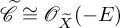 $\widetilde {\mathscr {C}}\cong \mathscr {O}_{\widetilde {X}}(-E)$
, proving (1).
If
 $E=0$
, then
 $\mathscr {C}\cong \mathscr {O}_{X}$
. This immediately implies that
 $\nu $
is an isomorphism, finishing the proof of the lemma.
Proposition 3.4. Let X be a complex manifold of dimension
 $n\geqslant 3$
, and let
 $Y\subseteq X$
be a compact Kähler submanifold of dimension
 $m \geqslant 2$
. Let
 $\mathscr {F} \subset T_X$
be a regular codimension
 $1$
foliation with normal bundle
 $\mathscr {N}$
. Suppose that
 $\mathscr {F}\cong \mathscr {L}_1\oplus \cdots \oplus \mathscr {L}_{n-1}$
for some line bundles
 $\mathscr {L}_i$
with
 $c_1(\mathscr {L}_1)=\cdots =c_1(\mathscr {L}_{n-1})\in H^1(X,\Omega _X^1)$
. Let
 $\mathscr {M}$
be a line bundle on Y such that
 $c_1(\mathscr {M})\in \langle c_1(\mathscr {L}_1|_Y),\ldots ,c_1(\mathscr {L}_{n-1}|_Y), c_1(\mathscr {N}|_Y)\rangle \subseteq H^1(Y,\Omega ^1_Y)$
. Suppose that
 $\mathscr {M}$
is nef and
 $\mathscr {M} \equiv \sum _{i\in I}b_i B_i$
, where
 $b_i\in \mathbb {Q}_{>0}$
and the
 $B_i$
are distinct prime divisors. Suppose in addition that
 $\mathscr {N}_{Y/X}^*|_{B_i}$
is nef if
 $m<n$
. Then the following holds.
-
(1) For every index
$i\in I$
,
$B_i$
is a finite étale quotient of a complex torus. -
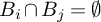
(2) We have
$B_i\cap B_j =\emptyset $
if
$i\neq j$
. -
(3) The vector bundles
$\mathscr {N}_{B_i/Y}$
and
$\mathscr {N}_{B_i/X}$
are numerically flat. In particular,
$B_i\subset Y$
is a nef divisor.




Proof. Suppose that
 $m<n$
. If
 $m=n$
, the proof of the proposition is very similar and therefore omitted.
We may assume without loss of generality that
 $c_1(\mathscr {M})\not \equiv 0$
. In other words, assume that I is not empty. By Proposition 3.2, we have
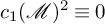 $c_1(\mathscr {M})^2 \equiv 0$
. It follows that
 $\mathscr {M}|_{B_i}\equiv 0$
for any
 $i \in I$
since
 $\mathscr {M}$
is nef by assumption. By Proposition 3.2 again,
 $$ \begin{align*}L:=\langle c_1(\mathscr{L}_1|_Y),\ldots,c_1(\mathscr{L}_{n-1}|_Y), c_1(\mathscr{N}|_Y)\rangle = \langle c_1(\mathscr{M}|_Y)\rangle \subseteq H^1(Y,\Omega^1_Y).\end{align*} $$
Thus,
 $\mathscr {L}_j|_{B_i}\equiv 0$
and
 $\mathscr {N}|_{B_i}\equiv 0$
. As a consequence, the vector bundle
 $\Omega _X^1|_{B_i}$
is numerically flat. Consider the exact sequence
 $$ \begin{align*}0 \to \mathscr{N}_{Y/X}^*|_{B_i} \to \Omega_X^1|_{B_i} \to \Omega_Y^1|_{B_i}\to 0.\end{align*} $$
Since
 $\mathscr {N}_{Y/X}^*|_{B_i}$
is nef by assumption, we infer that
 $\mathscr {N}_{Y/X}^*|_{B_i}$
and
 $\Omega _Y^1|_{B_i}$
are numerically flat as well.
Next, consider the exact sequence of sheaves
 $$ \begin{align*}0 \to \mathscr{O}_{B_i}(-B_i) \to \Omega_Y^1|_{B_i} \to \Omega_{B_i}^1 \to 0.\end{align*} $$
Since
 $-B_i|_{B_i}\equiv \frac {1}{b_i}\sum _{j\neq i}b_j B_j|_{B_i}$
, we conclude that
 $-B_i|_{B_i}\equiv 0$
and that
 $\mathscr {O}_{B_i}(-B_i)$
is a subbundle of
 $\Omega _Y^1|_{B_i}$
(see [Reference Demailly, Peternell and Schneider22, Proposition 1.16]). As a consequence, the sheaf
 $\Omega _{B_i}^1$
is locally free and numerically flat. Moreover,
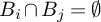 $B_i \cap B_j =\emptyset $
if
 $i\neq j$
.
Let
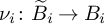 $\nu _i\colon \widetilde {B}_i \to B_i$
be the normalization morphism. By the adjunction formula,
 $$ \begin{align*}\omega_{B_i} \cong \mathscr{O}_Y(K_Y+B_i)|_{B_i}\equiv 0.\end{align*} $$
In particular,
 $\omega _{B_i}$
is locally free. By Lemma 3.3 above, there exists an effective Weil divisor
 $E_i$
on
 $\widetilde {B}_i$
such that
 $\omega _{\widetilde {B}_i}\cong \nu _i^*\omega _{B_i}(-E_i)$
.
Suppose that
 $E_i \neq 0$
. Then
 $K_{\widetilde {B}_i}$
is not pseudo-effective, and hence
 $B_i$
is uniruled by [Reference Boucksom, Demailly, Păun and Peternell5, Corollary 0.3] applied to a resolution of
 $\widetilde {B}_i$
. Let
 $C \subseteq B_i$
be a rational curve. Then
 $\Omega ^1_Y|_C$
is the trivial vector bundle since
 $\Omega ^1_Y|_C$
is numerically flat, yielding a contradiction. This shows that
 $E_i=0$
, and hence
 $B_i$
is normal by Lemma 3.3. Then [Reference Boucksom, Demailly, Păun and Peternell5, Corollary 0.3] applies to show that
 $B_i$
has canonical singularities since
 $K_{B_i}\equiv 0$
. By the solution of the Zariski–Lipman conjecture for canonical spaces (see [Reference Greb, Kebekus, Kovács and Peternell29, Theorem 6.1] or [Reference Druel23, Theorem 1.1]), we conclude that
 $B_i$
is smooth. In addition, we have
 $c_1(B_i)\equiv 0$
and
 $c_2(B_i)\equiv 0$
by [Reference Demailly, Peternell and Schneider22, Corollary 1.19]. As a classical consequence of Yau’s theorem on the existence of a Kähler–Einstein metric,
 $B_i$
is then covered by a complex torus (see [Reference Kobayashi47, Chapter IV Corollary 4.15]). This finishes the proof of the proposition.
Proposition 3.5. Let X be a complex manifold of dimension
 $n\geqslant 3$
, and let
 $Y\subseteq X$
be a compact Kähler submanifold of dimension
 $m\geqslant 2$
. Let
 $\mathscr {F} \subset T_X$
be a regular codimension
 $1$
foliation. Suppose that
 $\mathscr {F}\cong \mathscr {L}_1\oplus \cdots \oplus \mathscr {L}_{n-1}$
for some line bundles
 $\mathscr {L}_i$
with
 $c_1(\mathscr {L}_1)=\cdots =c_1(\mathscr {L}_{n-1})\in H^1(X,\Omega _X^1)$
. Suppose furthermore that
 $c_k(\mathscr {N}_{Y/X})=0$
for any
 $k \in \{1,\ldots ,m\}$
if
 $m<n$
. Then
 $c_1(Y)^2=0$
and
 $c_k(Y)=0$
for any
 $k \in \{2,\ldots ,m\}$
. Moreover, we have
 $\chi (Y,\mathscr {O}_Y)=0$
.
Proof. Suppose that
 $m<n$
. If
 $m=n$
, the proof of the proposition is very similar and therefore omitted.
The Chern polynomial
 $c_t(T_X|_Y)$
of
 $T_X|_Y$
satisfies
 $$ \begin{align*}c_t(T_X|_Y)=c_t(\mathscr{N}|_Y)\cdot\prod_{1\leqslant i\leqslant n-1}c_t(\mathscr{L}_i|_Y),\end{align*} $$
where
 $\mathscr {N}$
denotes the normal bundle of
 $\mathscr {F}$
. Therefore, by Proposition 3.2, we have
 $c_1(T_X|_Y)^2=0$
and
 $c_k(T_X|_Y)=0$
for any
 $k \in \{2,\ldots ,n\}$
. On the other hand,
 $$ \begin{align*}c_t(T_X|_Y)=c_t(\mathscr{N}_{Y/X})\cdot c_t(T_Y)=c_t(T_Y)\end{align*} $$
since
 $c_t(\mathscr {N}_{Y/X})=1$
by assumption. This easily implies
 $c_1(Y)^2=0$
and
 $c_k(Y)=0$
for any
 $k \in \{2,\ldots ,m\}$
. Then
 $\chi (Y,\mathscr {O}_Y)=0$
by the Hirzebruch–Riemann–Roch theorem. This finishes the proof of the proposition.
3.2 Abelian schemes
The proof of Theorem 1.1 uses Kollár’s characterisation of étale quotients of abelian schemes [Reference Kollár48, Theorem 6.3]. We recall the relevant notion first. Let X be a normal projective variety, and let
 $Y \subseteq X$
be a closed subvariety. We say that X has generically large fundamental group on Y if for any very general point
 $y\in Y$
and for every closed and positive-dimensional subvariety
 $y\in Z \subseteq Y$
with normalization
 $\overline {Z}$
, the image of the natural morphism
 $\pi _1(\overline {Z}) \to \pi _1(X)$
is infinite. The following observation will prove to be crucial.
Lemma 3.6. Let
 $f \colon X \to Y$
be a projective morphism with connected fibers between smooth algebraic varieties, and let F be a general fiber of f. Suppose that every fiber of f (with its reduced structure) is a finite étale quotient of an abelian variety. Then the homomorphism
 $\pi _1(F) \to \pi (X)$
is injective. In particular, X has generically large fundamental group on F.
Proof. By [Reference Höring39, Proof of Lemma 2.2] and [Reference Nakayama51, Lemma 7.3], there exists an open subset
 $Y^\circ \subseteq Y$
with complement of codimension at least
 $2$
such that the restriction
 $f^\circ $
of f to
 $X^\circ :=f^{-1}(Y^\circ )$
is locally homotopically Q-smooth (we refer the reader to [Reference Nakayama51, Definition 7.2] for this notion). Then [Reference Nakayama51, Theorem 7.8] applies to show that
 $f^\circ $
is birational to a Q-smooth Q-torus fibration
 $g^\circ \colon Z^\circ \to Y^\circ $
over
 $Y^\circ $
. In other words, there exists a finite morphism
 $Y_1^\circ \to Y^\circ $
such that the normalization
 $Z_1^\circ $
of
 $Y_1^\circ \times _{Y^\circ } Z^\circ $
is étale over
 $Z^\circ $
and such that the morphism
 $Z_1^\circ \to Y_1^\circ $
is smooth with fibers being finite étale quotients of abelian varieties. This immediately implies that any fiber of
 $g^\circ $
(with its reduced structure) is a finite étale quotient of an abelian variety. It then follows that
 $X^\circ /Y^\circ \cong Z^\circ /Y^\circ $
. Let
 $X_1^\circ \to X^\circ $
be the induced finite étale cover, and denote by
 $f_1^\circ \colon X_1^\circ \to Y_1^\circ $
the corresponding smooth fibration. By [Reference Nakayama51, Theorem 3.14], there exists a finite étale cover
 $X_2^\circ \to X_1^\circ $
such that any fiber of the composition
 $f_2^\circ \colon X_2^\circ \to X_1^\circ \to Y_1^\circ =:Y_2^\circ $
is an abelian variety. Let
 $F_2$
be a general fiber of
 $f_2^\circ $
. By [Reference Claudon16, Proof of Lemma 2.3], the homomorphism
 $\pi _1(F_2) \to \pi _1(X_2^\circ )$
is injective. Moreover, there is a commutative diagram

where F denotes the image of
 $F_2$
in
 $X^\circ $
. By [Reference Nakayama51, Corollary 3.7],
 $\pi _1(F)$
is torsion-free. This easily implies that the homomorphism
 $\pi _1(F) \to \pi (X^{\circ})$
is also injective since
 $\pi _1(F_2)$
has finite index in
 $\pi (F)$
. Finally, the inclusion induces an isomorphism
 $\pi _1(X^\circ )\cong \pi _1(X)$
of fundamental groups since
 $X\setminus X^\circ $
is a closed subset of codimension at least
 $2$
. This finishes the proof of the lemma.
We will also need the following auxiliary result.
Lemma 3.7. Let
 $f \colon X \to Y$
be a smooth projective morphism with connected fibers between smooth algebraic varieties. Suppose that there exists
 $y_0 \in Y$
such that the fiber
 $f^{-1}(y_0)$
of f over
 $y_0$
is a finite étale quotient of an abelian variety. Then every fiber of f is a finite étale quotient of an abelian variety. Moreover, there exist a dense open set
 $Y^\circ \subseteq Y$
and a finite étale cover
 $X_1^\circ \to X^\circ :=f^{-1}(Y^\circ )$
such that the fibration
 $X_1^\circ \to Y_1^\circ $
obtained as the Stein factorization of the composition
 $X_1^\circ \to X^\circ \to Y^\circ $
is an abelian scheme equipped with a level three structure.
Proof. By [Reference Nakayama51, Theorem 3.14], there exists a finite étale cover
 $X_1 \to X$
such that the fiber
 $f_1^{-1}(y_0)$
of the composition
 $f_1 \colon X_1 \to X \to Y=:Y_1$
is an abelian variety. Notice that
 $f_1$
is a smooth morphism. By Ehresmann’s theorem, any fiber
 $F_1$
of
 $f_1$
is homeomorphic to an abelian variety. Then [Reference Catanese13, Theorem 4.8] applies to show that
 $F_1$
is an abelian variety. Finally, shrinking
 $Y_1$
if necessary, we can find a suitable finite étale cover
 $Y_2\to Y_1$
such that the projection morphism
 $Y_2 \times _{Y_1} X_1 \to Y_2$
has a section. Then
 $Y_2 \times _{Y_1} X_1$
is an abelian scheme over
 $Y_2$
. Replacing
 $Y_2$
by a further finite étale cover, we may assume that
 $Y_2 \times _{Y_1} X_1/Y_2$
admits a level three structure, finishing the proof of the lemma.
The proof of Theorem 1.1 makes use of the following result, which might be of independent interest.
Lemma 3.8. Let
 $f\colon X \to Y$
be an abelian scheme over a projective base equipped with a level three structure, and let
 $\beta \colon X \to M$
be a birational morphism onto a smooth projective variety. Then M is an abelian scheme over a smooth projective base N and there exists a birational morphism
 $Y \to N$
such that
 $X/Y \cong Y \times _N M/Y$
.
Proof. Let
 $\Sigma \subseteq X$
be the neutral section of f, and let N be the normalization of
 $\Lambda :=\beta (\Sigma )$
. Let also
 $\mathscr {A}(3)$
be the fine moduli space of polarized abelian varieties with a level three structure.
Recall that there exists a composition
 $Z \to M$
of a finite number of blow-ups with smooth centers such that the induced rational map
 $Z \dashrightarrow X$
is a morphism. This easily implies that every positive-dimensional fiber of
 $\beta $
is rationally chain connected.
Let
 $C\subseteq X$
be a rational curve such that
 $\dim \beta (C)=0$
, and set
 $B:=f(C)$
. By [Reference Kollár48, Lemma 5.9.3],
 $\big (f^{-1}(B)/B,\Sigma|_{f^{-1}(B)}\big )\cong (B \times A/B, B\times \{0_A\})$
, where
 $(A,0_A)$
is an abelian variety. Notice that
 $C=B \times \{a_0\}$
for some point
 $a_0 \in A$
. In particular, either C is disjoint from
 $\Sigma $
or C is contained in
 $\Sigma $
. This immediately implies that
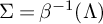 $\Sigma =\beta ^{-1}(\Lambda )$
since every positive-dimensional fiber of
 $\beta $
is rationally chain connected. By the rigidity lemma (see [Reference Debarre19, Lemma 1.15]), the morphism
 $Y \to \mathscr {A}(3)$
corresponding to f factorizes through the map
 $\eta \colon Y\cong \Sigma \to N$
induced by
 $\beta|_\Sigma $
. In other words, the abelian scheme f is the pull-back of an abelian scheme
 $M_1$
over N via
 $\eta $
. Let
 $\beta _1\colon X \to M_1$
be the induced morphism.
To prove the statement, it suffices to show that there exists an isomorphism
 $\tau \colon M \to M_1$
such that
 $\beta _1=\tau \circ \beta $
or equivalently that
 $\beta $
(resp.
 $\beta _1$
) factorizes through
 $\beta _1$
(resp.
 $\beta $
).
Let F be a positive-dimensional fiber of
 $\beta $
. Recall that F is rationally chain connected. Set
 $G:=f(F)$
. By [Reference Kollár48, Lemma 5.9.3] again,
 $\big (f^{-1}(G)/G,\Sigma|_{f^{-1}(G)}\big )\cong (G \times A_2/G, G\times \{0_{A_2}\})$
, where
 $(A_2,0_{A_2})$
is an abelian variety. Moreover,
 $F=G \times \{a_2\}$
for some point
 $a_2 \in A_2$
. Since G is a fiber of
 $\eta $
, F is contracted by
 $\beta _1$
. By the rigidity lemma (see [Reference Debarre19, Lemma 1.15]),
 $\beta _1$
factorizes through
 $\beta $
. Let now
 $F_1$
be a fiber of
 $\beta _1$
. Set
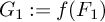 $G_1:=f(F_1)$
. Then
 $G_1$
is a fiber of
 $\eta $
. Moreover,
 $\big (f^{-1}(G_1)/G_1,\Sigma|_{f^{-1}(G_1)}\big ) \cong (G_1 \times A_1/G_1, G_1 \times \{0_{A_1}\})$
for some abelian variety
 $(A_1,0_{A_1})$
, and
 $F_1\cong G_1 \times \{a_1\}$
for some point
 $a_1 \in A_1$
. Since
 $G_1 \times \{0_{A_1}\}\cong \Sigma \cap f^{-1}(G_1)$
is contracted by
 $\beta $
,
 $F_1$
is contracted by
 $\beta $
as well. By the rigidity lemma (see [Reference Debarre19, Lemma 1.15]),
 $\beta $
factorizes through
 $\beta _1$
. This finishes the proof of the lemma.
3.3 Descent of line bundles
Let
 $f \colon X \to Y$
be a morphism of algebraic varieties, and let
 $\mathscr {L}$
be a line bundle on X. We give sufficient conditions that guarantee that there exist a line bundle
 $\mathscr {M}$
on Y and a positive integer m such that
 $\mathscr {L}^{\otimes m} \cong f^*\mathscr {M}$
. The following observation is rather standard. We include a proof here for the reader’s convenience.
Lemma 3.9. Let
 $f \colon X \to Y$
be a flat projective morphism with integral fibers between smooth complex algebraic varieties. Let
 $\mathscr {L}$
be a line bundle on X, and let F be a general fiber of f. Suppose that
 $\mathscr {L}|_F$
is a torsion line bundle. Then there exists a line bundle
 $\mathscr {M}$
on Y and a positive integer m such that
 $\mathscr {L}^{\otimes m} \cong f^*\mathscr {M}$
.
Proof. Let m be a positive integer such that the set of points
 $y\in Y$
with
 $\mathscr {L}^{\otimes m}|_{X_y} \cong \mathscr {O}_{X_y}$
is dense. Because the functions
 $y \mapsto h^0\big (X_y,\mathscr {L}^{\otimes \pm m}|_{X_y}\big )$
are upper semicontinuous in the Zariski topology on Y (see [Reference Hartshorne36, Theorem 12.8]), we have
 $h^0\big (X_y,\mathscr {L}^{\otimes \pm m}|_{X_y}\big )=1$
for every
 $y\in Y$
. This implies that
 $\mathscr {L}^{\otimes m}|_{X_y} \cong \mathscr {O}_{X_y}$
since
 $X_y$
is integral by assumption. By [Reference Hartshorne36, Corollary 12.9] together with the base change theorem [Reference Hartshorne36, Theorem 12.11],
 $\mathscr {M}:=f_*\mathscr {L}^{\otimes m}$
is a line bundle and the formation of
 $f_*\mathscr {L}^{\otimes m}$
commutes with arbitrary base change. This easily implies that
 $\mathscr {L}^{\otimes m} \cong f^*\mathscr {M}$
.
Remark 3.10. Setting and notation as in Lemma 3.9. Suppose in addition that
 $\mathscr {L}|_F \cong \mathscr {O}_F$
. Then the proof of Lemma 3.9 shows that there exists a line bundle
 $\mathscr {M}$
on Y such that
 $\mathscr {L}\cong f^*\mathscr {M}$
.
Proposition 3.11. Let X be a complex projective manifold, and let
 $f \colon X \to B$
be a surjective morphism with connected fibers onto a smooth complete curve. Let
 $\mathscr {L}$
be a nef line bundle on X such that
 $\mathscr {L}|_F$
is torsion, where F is a general fiber of f. Then there exist a line bundle
 $\mathscr {M}$
on B and a positive integer m such that
 $\mathscr {L}^{\otimes m}\cong f^*\mathscr {M}$
. In particular,
 $\mathscr {L}\equiv _B 0$
.
Proof. Let
 $B^\circ \subseteq B$
be a dense open set such that
 $f^\circ :=f|_{X^\circ }$
is a smooth morphism, where
 $X^\circ :=f^{-1}(B^\circ )$
. Let m be a positive integer. Because the functions
 $b \mapsto h^0\big (X_b,\mathscr {L}^{\otimes \pm m}|_{X_b}\big )$
are upper semicontinuous in the Zariski topology on B (see [Reference Hartshorne36, Theorem 12.8]), the set of points b on
 $B^\circ $
such that
 $\mathscr {L}^{\otimes m}|_{X_b}\cong \mathscr {O}_{X_b}$
is closed. As a consequence, there exists a positive integer
 $m_1$
such that
 $\mathscr {L}^{\otimes m_1}|_{X_b}\cong \mathscr {O}_{X_b}$
for all
 $b \in B^\circ $
. From [Reference Hartshorne36, Corollary 12.9], we see that
 $f^\circ _*(\mathscr {L}^{\otimes m_1}|_{X^\circ })$
is a line bundle. Thus, there exists a divisor D on X with
 $f(\text {Supp}\,D)\subsetneq B$
such that
 $\mathscr {L}^{\otimes m_1}\cong \mathscr {O}_X(D)$
.
Let
 $S \subset X$
be a two-dimensional complete intersection of general elements of a very ample linear system on X. This is a smooth surface in X and the restriction
 $f|_S$
of f to S is a surjective morphism with connected fibers onto B. By Zariski’s lemma (see [Reference Barth, Peters and Van de Ven10, Lemma III.8.2]), we have
 $D|_S^2 \leqslant 0$
. Since D is nef by assumption, we must have
 $D|_S^2 = 0$
. By Zariski’s lemma again, there exist a positive integer
 $m_2$
and a divisor G on B such that
 $m_2 D|_S=f|_S^*G$
. The claim now follows from the Grothendieck–Lefchetz hyperplane theorem.
The following result is an easy consequence of Proposition 3.11 above.
Corollary 3.12. Let
 $f\colon X \to Y$
be an equidimensional morphism with connected fibers between normal projective varieties, and let
 $\mathscr {L}$
be a nef line bundle on X such that
 $\mathscr {L}|_F$
is torsion, where F is a general fiber of f. Then
 $\mathscr {L}\equiv _Y 0$
.
Proof. Notice that a general fiber of f is irreducible by [Reference Debarre19, 5.5]. By a theorem of Chevalley (see [Reference Grothendieck34, Corollaire 14.4.4], the morphism f is universally open.
Let
 $y \in Y$
be a point, and let
 $B \to Y$
be a morphism from a smooth complete curve B whose image contains y and a general point in Y. Observe that product
 $B \times _Y X$
is irreducible since the projection
 $B \times _Y X \to B$
is open with irreducible general fibers. Let Z be a resolution of
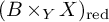 $(B \times _Y X)_{\text {red}}$
. Our claim follows from Proposition 3.11 applied to the pull-back of
 $\mathscr {L}$
to Z.
We will also need the following elementary observation.
Lemma 3.13. Let
 $f \colon X \to Y$
be a surjective morphism of normal projective varieties with
 $n:=\dim X \geqslant 2$
and
 $m:=\dim Y \geqslant 1$
. Let D be a prime
 $\mathbb {Q}$
-Cartier divisor on X such that
 $\dim f(D)=0$
. Suppose in addition that
 $D^2\cdot H^{n-2} \geqslant 0$
for some very ample divisor H on X. Then
 $\dim Y = \kappa (D) = 1$
, and f is induced by the linear system
 $|mD|$
for m sufficiently large.
Proof. Let us first show that
 $\dim Y =1$
. We argue by contradiction and assume that
 $\dim Y \geqslant 2$
. Let
 $S \subseteq X$
be a two-dimensional complete intersection of general elements of
 $|H|$
, and set
 $C:= S \cap D$
. By Bertini’s theorem (see [Reference Jouanolou41, Théorème I.6.10]), we may assume without loss of generality that S and C are reduced and irreducible. Then
 $D^2\cdot S = (D|_S)^2 <0$
since C is contracted by the generically finite morphism
 $f|_S$
, yielding a contradiction since
 $D^2\cdot S = D^2\cdot H^{n-2} \geqslant 0$
by assumption. This shows
 $\dim Y =1$
.
Zariski’s lemma then applies to show that some nonzero multiple of
 $D|_S=C$
is a fiber of
 $f|_S$
. This easily implies that some nonzero multiple of D is a fiber of f, and hence
 $\kappa (D) = 1$
. This finishes the proof of the lemma.
3.4 Abundance
We will later use the following special case of the abundance conjecture, whose proof relies on an extension theorem proved in [Reference Demailly, Hacon and Păun21].
Proposition 3.14. Let X be a smooth complex projective manifold of dimension
 $n \geqslant 2$
, and let B be a nonzero divisor on X. Let
 $B:=\sum _{i \in I} B_i$
be its decomposition into irreducible components. Suppose that
 $B_i$
is smooth with
 $K_{B_i} \equiv 0$
and
 $B_i^2 \equiv 0$
. Suppose moreover that
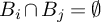 $B_i \cap B_j = \emptyset $
if
 $i \neq j$
. Suppose finally
 $\kappa (X)\geqslant 0$
and
 $K_X$
nef. Then there exists a morphism with connected fibers
 $f \colon X \to C$
onto a smooth complete curve such that
 $B_i$
is a fiber of f for every
 $i\in I$
. In addition,
 $K_X$
is semiample,
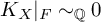 $K_X|_F\sim _{\mathbb {Q}}0$
for a general fiber F of f and
 $\kappa (X)=\nu (K_X)\leqslant 1$
. In particular,
 $K_X+B$
is semiample with
 $\kappa (K_X+B)=\nu (K_X+B)\leqslant 1$
.
Proof. Let D be an effective
 $\mathbb {Q}$
-divisor such that
 $K_X \sim _{\mathbb {Q}} D$
. Notice that
 $D \cdot B_i = K_X\cdot B_i \equiv 0$
since
 $B_i^2\equiv 0$
and
 $K_{B_i}\equiv 0$
by assumption. Thus, there is a decomposition
 $D=D_1+D_2$
, where
 $D_1$
and
 $D_2$
are effective
 $\mathbb {Q}$
-divisor with
 $\text {Supp}\, D_1 \cap \text {Supp}\, D_2 = \emptyset $
and
 $\text {Supp}\, D_2 \subseteq \text {Supp}\, B$
.
Let us show that
 $D_1$
is nef. We argue by contradiction and assume that there exists a curve
 $C \subset X$
such that
 $D_1 \cdot C < 0$
. Then
 $C \subseteq \text {Supp}\, D_1$
and hence
 $C \cap \text {Supp}\, D_2 =\emptyset $
. Thus,
 $K_X \cdot D =D \cdot C = D_1 \cdot C <0$
, yielding a contradiction. Notice also that
 $B_i$
is nef since
 $B_i^2 \equiv 0$
by assumption.
Pick
 $i_0 \in I$
. Then
 $K_X+B_{i_0}+\varepsilon \big (D_1+\sum _{i \in I\setminus \{i_0\}}B_i\big )$
is nef as well for every
 $\varepsilon>0$
. Let
 $0<\varepsilon \ll 1$
be a rational number such that the pair
 $\big (X,B_{i_0}+\varepsilon \big (D_1+\sum _{i \in I\setminus \{i_0\}}B_i\big )\big )$
is plt. Then [Reference Demailly, Hacon and Păun21, Corollary 1.8] applies to show that there exists an effective
 $\mathbb {Q}$
-divisor
 $G_1$
such that
 $K_X+B_{i_0}+\varepsilon \big (D_1+\sum _{i \in I \setminus \{i_0\}}B_i\big )\sim _{\mathbb {Q}} G_1$
and
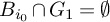 $B_{i_0} \cap G_1 =\emptyset $
since
 $\big (K_X+B_{i_0}+\varepsilon \big (D_1+\sum _{i \in I \setminus \{i_0\}}B_i\big )\big )|_{B_{i_0}}\sim _{\mathbb {Q}} K_{B_{i_0}}$
is torsion. Set
 $G_2:=D+B_{i_0}+\varepsilon \big (D_1+\sum _{i \in I \setminus \{i_0\}}B_i\big )$
. Then
 $G_2 \sim _{\mathbb {Q}} G_1$
and
 $\text {mult}_{B_{i_0}}\, G_2 \geqslant 1$
.
Let m be a positive integer such that
 $mG_1$
and
 $m G_2$
are
 $\mathbb {Z}$
-divisors, and let
 $X \dashrightarrow \mathbb {P}^1$
be the corresponding rational map. Let
 $p\colon Y \to X$
and
 $q\colon Y \to \mathbb {P}^1$
be a common resolution of singularities. We may assume without loss of generality that p restricts to an isomorphism over some Zariski open neighborhood of
 $B_{i_0}$
since
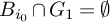 $B_{i_0} \cap G_1 =\emptyset $
by construction. Let
 $g \colon Y \to C$
be the Stein factorization of q. By Zariski’s lemma, some positive multiple of the strict transform of
 $B_{i_0}$
in Y is a fiber of g since
 $B_{i_0}^2\equiv 0$
. This immediately implies that the rational map
 $f \colon X \dashrightarrow C$
is a morphism. By Zariski’s lemma again, for every
 $i\in I$
, some positive multiple of
 $B_i$
is a fiber of f. Let now F be a general fiber of f. Then, by construction,
 $\big (K_X+B_{i_0}+\varepsilon \big (D_1+\sum _{i \in I \setminus \{i_0\}}B_i\big )\big )|_F = K_X|_F$
is torsion. But
 $K_X|_F \sim _{\mathbb {Z}} K_F$
by the adjunction formula. The statement easily follows from Proposition 3.11.
3.5 Foliations and rational curves
In order to study foliations on nonminimal varieties it is useful to understand their behavior with respect to rational curves. The following result is a minor generalization of [Reference Figueredo28, Lemma 2.18].
Lemma 3.15. Let X be a complex projective manifold of dimension
 $n\geqslant 2$
, and let
 $\mathscr {F} \subset T_X$
be a regular codimension
 $1$
foliation. Let S be a rational ruled surface, and let
 $\gamma \colon S \to X$
be a generically finite morphism. Then there exists a rational curve
 $C \subset S$
which is not contracted by
 $\gamma $
such that
 $\gamma (C)$
is tangent to
 $\mathscr {F}$
.
Proof. Let
 $\mathscr {N}$
denote the normal bundle of
 $\mathscr {F}$
, and let
 $f\colon S \to \mathbb {P}^1$
denote the natural morphism. Recall that
 $\text {N}^1(S)\cong \mathbb {Z}[C_0]\oplus \mathbb {Z}[F]$
, where F is any fiber of f and
 $C_0$
is a section of f with
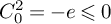 $C_0^2=-e\leqslant 0$
.
Set
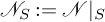 $\mathscr {N}_S:=\mathscr {N}|_S$
. By Lemma 3.1, we have
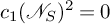 $c_1(\mathscr {N}_S)^2 = 0$
. Write
 $c_1(\mathscr {N}_S)\equiv a C_0 + b F$
. Then
 $$ \begin{align*}0=c_1(\mathscr{N}_S)^2=(a C_0 + b F)^2=a(-ae+2b),\end{align*} $$
 $$ \begin{align*}c_1(\mathscr{N}_S)\cdot F=a\end{align*} $$
and
 $$ \begin{align*}c_1(\mathscr{N}_S)\cdot C_0=-ae+b.\end{align*} $$
We may obviously assume that F is not tangent to
 $\mathscr {F}$
. Then the composition
 $T_{\mathbb {P}^1}\cong T_F \to T_X|_F \to \mathscr {N}|_F=\mathscr {N}_S|_F$
is nonzero, and hence
 $a=c_1(\mathscr {N}_S)\cdot F\geqslant 2>0$
. It follows that
 $2b=ae$
. In particular, we have
 $b \geqslant 0$
.
If
 $C_0$
is contracted by
 $\gamma $
, then
 $c_1(\mathscr {N}_S)\cdot C_0=0$
. This immediately implies
 $b=e=0$
. Then
 $S \cong \mathbb {P}^1 \times \mathbb {P}^1$
and f identifies with the projection onto the first factor. Moreover, the image of a general fiber of the projection onto the second factor is tangent to
 $\mathscr {F}$
.
Suppose from now on that
 $C_0$
is not contracted by
 $\gamma $
and that
 $\gamma (C_0)$
is not tangent to
 $\mathscr {F}$
. Then, as above, we must have
 $c_1(\mathscr {N}_S) \cdot C_0 \geqslant 2$
. It follows that
 $b \geqslant ae+2$
, and hence
 $b+2 \leqslant 0$
, yielding a contradiction. This finishes the proof of the lemma.
We will also need the following auxiliary results.
Lemma 3.16. Let X be a complex projective manifold of dimension
 $n\geqslant 2$
, and let
 $\mathscr {F} \subset T_X$
be a regular codimension
 $1$
foliation. Let
 $\varphi \colon X \to Y$
be an elementary Fano–Mori contraction. Suppose that there exists an irreducible component
 $F_1$
of a positive-dimensional fiber F of
 $\varphi $
which is not tangent to
 $\mathscr {F}$
. Then Y is smooth, and either
 $\varphi $
is the blow-up of a smooth codimension
 $2$
submanifold or
 $\varphi $
is a conic bundle.
Proof. Let
 $\mathscr {N}$
denote the normal bundle of
 $\mathscr {F}$
, and let
 $C \subseteq F$
be a rational curve. Suppose that
 $\mathscr {N}\cdot C=0$
. Then C is tangent to
 $\mathscr {F}$
and moreover
 $\mathscr {N}|_F\equiv 0$
since
 $\varphi $
is elementary by assumption. This in turn implies that any irreducible component of F is tangent to
 $\mathscr {F}$
since F is rationally chain connected by [Reference Hacon and McKernan38, Corollary 1.4], yielding a contradiction. This shows that
 $\mathscr {N}\cdot C \neq 0$
. On the other hand,
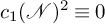 $c_1(\mathscr {N})^2\equiv 0$
by Lemma 3.1. This immediately implies that any positive-dimensional fiber of
 $\varphi $
is one-dimensional. The claim now follows from [Reference Wiśniewski62, Theorem 1.2].
Lemma 3.17. Let X be a complex projective manifold of dimension
 $n\geqslant 2$
, and let
 $\mathscr {F}$
be a regular codimension
 $1$
foliation. Suppose that
 $\mathscr {F}$
is projectively flat, and let
 $C \subset X$
be a rational curve such that
 $K_{\mathscr {F}} \cdot C \leqslant 0$
. Then
 $T_X|_C$
is nef. In particular, X is uniruled.
Proof. Let
 $\mathscr {N}$
denote the normal bundle of
 $\mathscr {F}$
, and let
 $\mathbb {P}^1 \to C \subset X$
be the normalization morphism. Since
 $\mathscr {F}$
is projectively flat, there exists
 $a \in \mathbb {Z}$
such that
 $\mathscr {F}|_{\mathbb {P}^1}\cong \mathscr {O}_{\mathbb {P}^1}(a)^{\oplus n-1}$
. Notice that
 $a \geqslant 0$
since
 $K_{\mathscr {F}} \cdot C \leqslant 0$
by assumption.
If C is tangent to
 $\mathscr {F}$
, then
 $\mathscr {N}|_{\mathbb {P}^1}$
is a flat line bundle by Lemma 3.1, and hence
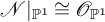 $\mathscr {N}|_{\mathbb {P}^1}\cong \mathscr {O}_{\mathbb {P}^1}$
. If C is not tangent to
 $\mathscr {F}$
, then the composition
 $T_{\mathbb {P}^1} \to T_X|_{\mathbb {P}^1} \to \mathscr {N}|_{\mathbb {P}^1}$
is nonzero, and hence
 $\mathscr {N} \cdot C \geqslant 2$
. In either case, the exact sequence
 $$ \begin{align*}0 \to \mathscr{F}|_{\mathbb{P}^1} \to T_X|_{\mathbb{P}^1} \to \mathscr{N}|_{\mathbb{P}^1} \to 0\end{align*} $$
shows that
 $T_X|_{\mathbb {P}^1}$
is nef. But then X is uniruled by [Reference Kollár49, Theorem IV.1.9].
3.6 Special cases
In this subsection, we treat a few easy special cases of Theorem 1.1.
Proposition 3.18. Setting and notation as in 2.19. Suppose in addition that
 $K_{\mathscr {F}}\equiv 0$
. Then one of the following holds.
-
(1) There exists a
$\mathbb {P}^1$
-bundle structure
$\varphi \colon X \to Y$
onto a finite étale quotient of an abelian variety, and
$\mathscr {F}$
induces a flat Ehresmann connection on
$\varphi $
. -
(2) There exists an abelian variety A and a finite étale cover
$\gamma \colon A \to X$
such that
$\gamma ^{-1}\mathscr {F}$
is a linear foliation on A. -
(3) There exists a smooth complete curve B of genus at least
$2$
as well as an abelian variety A, and a finite étale cover
$\gamma \colon B \times A \to X$
such that
$\gamma ^{-1}\mathscr {F}$
is induced by the projection morphism
$B \times A \to B$
.





Proof. This follows easily from [Reference Touzet56, Théorème 1.2] together with [Reference Druel24, Lemma 5.9].
Remark 3.19. In the setup of Proposition 3.18, there exists a finite étale cover
 $\eta \colon Z \to X$
such that
 $\eta ^{-1}\mathscr {F} \cong \mathscr {O}_Z^{\oplus n-1}$
.
Proposition 3.20. Setting and notation as in 2.19. Suppose in addition that
 $\mathscr {F}$
is algebraically integrable. Then one of the following holds.
-
(1) There exists an abelian variety A as well as a smooth complete curve C of genus at most
$1$
and a finite étale cover
$\gamma \colon A \times C \to X$
such that
$\gamma ^{-1}\mathscr {F}$
is induced by the projection
$A \times C \to C$
. -
(2) There exists a smooth abelian scheme
$f\colon B \to C$
over a smooth complete curve C of genus at least
$2$
as well as a finite étale cover
$\gamma \colon B \to X$
such that
$\gamma ^{-1}\mathscr {F}$
is induced by f.






In particular,
 $K_{\mathscr {F}}$
is semiample with
 $\kappa (\mathscr {F})=\nu (\mathscr {F})\in \{0,1\}$
.
Proof. By assumption,
 $\mathscr {F}$
is induced by a morphism with irreducible fibers
 $f\colon X \to C$
onto a smooth complete curve C. By [Reference Jahnke and Radloff42, Theorem 0.1], any leaf of
 $\mathscr {F}$
is a finite étale quotient of an abelian variety. By Lemma 3.6 and [Reference Kollár48, Theorem 6.3] together, after replacing X by a finite étale cover, the fibration f is birational to an abelian scheme over C. This easily implies that f is an abelian scheme. Replacing X by a further finite étale cover, we may also assume that f is polarized with a level three structure. Let
 $\mathscr {A}(3)$
be the corresponding fine moduli space of polarized abelian varieties with a level three structure, and let
 $C \to \mathscr {A}(3)$
be the moduli map. By [Reference Kollár49, Lemma 5.9.3], either the moduli map is the constant morphism or C has genus at least
 $2$
. The proposition now follows easily.
Remark 3.21. In the setup of Proposition 3.20 (2), we have
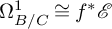 $\Omega ^1_{B/C} \cong f^*\mathscr {E}$
with
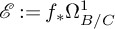 $\mathscr {E}:=f_*\Omega ^1_{B/C}$
. Then
 $\mathscr {F}$
is numerically projectively flat if and only if
 $\mathscr {E}$
is semistable by Lemma 2.14.
Lemma 3.22. Setting and notation as in 2.19. Suppose in addition that X is a finite étale quotient of an abelian variety. Then
 $K_{\mathscr {F}} \equiv 0$
.
Proof. Replacing X by a finite étale cover, if necessary, we may assume without loss of generality that X is an abelian variety. Then
 $\mathscr {N}$
is generated by its global section. On the other hand, we have
 $\mathscr {N}^2\equiv 0$
by Lemma 3.1. If
 $\mathscr {N}\cong \mathscr {O}_X$
, then
 $K_{\mathscr {F}}\equiv 0$
by the adjunction formula. Suppose that
 $\mathscr {N} \not \equiv 0$
. Then, after a further finite étale cover, we have
 $X \cong A \times E$
, where A is an abelian variety of dimension
 $n-1$
and E is an elliptic curve by Poincaré’s complete reducibility theorem. Moreover,
 $\mathscr {N}\cong f^*\mathscr {M}$
for some line bundle
 $\mathscr {M}$
on E, where
 $f\colon X \to E$
denotes the morphism induced projection onto E. Then Lemma 3.23 below applies to show that
 $K_{\mathscr {F}} \equiv 0$
since
 $n \geqslant 3$
by assumption. This implies
 $\mathscr {N}\equiv 0$
, yielding a contradiction. This finishes the proof of the lemma.
Lemma 3.23. Let C be a smooth complete curve, and let A be an abelian variety of dimension
 $n-1 \geqslant 1$
. Set
 $X:=C \times A$
and
 $f:=\mathrm{pr}_C$
. Let
 $\mathscr {F}$
be a codimension
 $1$
foliation on X with normal bundle
 $\mathscr {N}\cong f^*\mathscr {L}$
for some line bundle
 $\mathscr {L}$
on C. Then
 $\mathscr {F}$
is regular and one of the following conditions holds.
-
(1) We have
$\mathscr {F}\cong \mathscr {O}_X^{\oplus n-1}$
. -
(2) We have
$\mathscr {F}\cong \mathscr {O}_X^{\oplus n-2}\oplus f^*(T_C \otimes \mathscr {L}^*)$
. -
(3) We have
$\mathscr {L}\cong \mathscr {O}_C$
, and there is an exact sequence
$$ \begin{align*}0 \to \mathscr{O}^{\oplus n-2} \to \mathscr{F} \to f^*T_C\to 0.\end{align*} $$
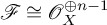



Proof. Let
 $\omega \in H^0(X,\Omega _X^1\otimes \mathscr {N})$
be a twisted
 $1$
-form defining
 $\mathscr {F}$
. Let
 $F \cong A$
be a fiber of f. Then
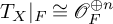 $T_X|_F\cong \mathscr {O}_F^{\oplus n}$
and
 $\mathscr {N}|_F \cong \mathscr {O}_F$
. This immediately implies that
 $\mathscr {F}|_F\cong \mathscr {O}_F^{\oplus n-1}$
and that
 $\mathscr {F}$
is regular since the zero set of
 $\omega $
has codimension at least
 $2$
in X. Moreover, there exists a vector bundle
 $\mathscr {E}$
on C such that
 $\mathscr {F} \cong f^*\mathscr {E}$
.
We may obviously assume that
 $\mathscr {F}\neq T_{X/C}$
. If F is a general fiber of f, then
 $\mathscr {F}\cap T_{X/C}|_F \subset T_F$
is a linear codimension
 $1$
foliation on
 $F \cong A$
. Hence, there exists a subbundle
 $\mathscr {K} \subset \mathscr {E}$
of rank
 $n-2$
such that
 $\mathscr {F}\cap T_{X/C} = f^*\mathscr {K} \subset \mathscr {F}$
. Set
 $g:=\text {pr}_A$
. Write
 $\omega =\alpha + \beta \in H^0(X,\Omega _X^1\otimes \mathscr {N}) \cong H^0(X,f^*\omega _C\otimes \mathscr {N}) \oplus H^0(X,g^*\Omega _A^1\otimes \mathscr {N})$
with
 $\alpha \in H^0(X,f^*\omega _C\otimes \mathscr {N})$
and
 $\beta \in H^0(X,g^*\Omega _A^1\otimes \mathscr {N})\cong H^0(A,\Omega _A^1) \otimes H^0(C,\mathscr {L})$
. By construction, there is an effective divisor
 $D_1$
on C and an exact sequence
 $$ \begin{align*}0 \to \mathscr{K} \to H^0(A,\Omega_A^1)^*\otimes \mathscr{O}_C \to \mathscr{L}(-D_1) \to 0,\end{align*} $$
where the map
 $H^0(A,\Omega _A^1)^*\otimes \mathscr {O}_C \to \mathscr {L}(-D_1)$
is induced by
 $\beta $
. Since
 $\mathscr {F}\neq T_{X/C}$
, the natural map
 $\mathscr {O}_X^{\oplus n-1}\cong T_{X/C} \to \mathscr {N}$
is nonzero, and hence
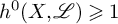 $h^0(X,\mathscr {L}) \geqslant 1$
. Let
 $D_2$
be any effective divisor on C such that
 $\mathscr {L} \cong \mathscr {O}_C(D_2)$
. We view
 $\omega $
,
 $\alpha $
and
 $\beta $
as rational
 $1$
-forms on X with poles along the divisor
 $f^*D_2$
. We have
 $\text {d}\alpha =0$
and
 $\text {d}\beta \wedge \alpha =0$
. But then
 $\text {d}\beta \wedge \beta =\text {d}\omega \wedge \omega =0$
. Let
 $\gamma _1,\ldots ,\gamma _{n-1}$
be a basis of
 $H^0(A,\Omega _A^1)$
, and let
 $U \subset C\setminus \text {Supp}\, D_2$
be an open affine subset. Then
 $$ \begin{align*}\beta|_{U \times A}=\sum_{1 \leqslant i \leqslant n-1} t_i \gamma_i\end{align*} $$
for some regular functions
 $t_i$
on U. Moreover,
 $\text {d}\beta \wedge \beta =0$
if and only if
 $\frac {\text {d}t_i}{t_i}=\frac {\text {d}t_j}{t_j}$
for all indices i and j. Suppose that
 $t_j\neq 0$
. Then
 $t_i=c_{ij}t_j$
for some
 $c_{ij}\in \mathbb {C}$
. This implies that there exists
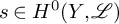 $s \in H^0(Y,\mathscr {L})$
such that
 $\beta = \gamma \otimes s$
, where
 $\gamma := \sum _{1 \leqslant i \leqslant n-1} c_{ij} \gamma _i \in H^0(A,\Omega _A^1)$
. Then
 $\text {div} \, s = D_1$
and
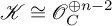 $\mathscr {K}\cong \mathscr {O}_C^{\oplus n-2}$
.
Set
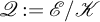 $\mathscr {Q}:=\mathscr {E}/\mathscr {K}$
. Then
 $\mathscr {Q} \cong T_C\otimes \mathscr {L}^*$
. If
 $h^0(C,\mathscr {L}^*)=0$
, then
 $h^1(C,\mathscr {Q}^*)=h^1(C,\omega _C\otimes \mathscr {L})=h^0(C,\mathscr {L}^*)=0$
by Serre duality, and hence the exact sequence
 $$ \begin{align*}0 \to \mathscr{K} \to \mathscr{E} \to \mathscr{Q} \to 0\end{align*} $$
splits. Then
 $\mathscr {F}\cong \mathscr {O}_X^{\oplus n-2}\oplus f^*(T_C \otimes \mathscr {L}^*)$
.
Suppose finally that
 $h^0(C,\mathscr {L}^*) \geqslant 1$
. Then
 $\mathscr {L}\cong \mathscr {O}_C$
since we also have
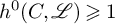 $h^0(C,\mathscr {L}) \geqslant 1$
. Then
 $\mathscr {Q}\cong T_C$
, finishing the proof of the lemma.
4 Normal bundles of regular foliations
In this section, we prove Theorem 1.2 and give a few applications to codimension
 $1$
foliations on varieties of general type. If C is a smooth complete curve, then
 $\pm K_C$
is pseudo-effective. Theorem 1.2 can be seen as the analogous statement for the canonical divisor of the space of leaves of a codimension
 $1$
regular foliation.
We will need the following Bertini-type result.
Lemma 4.1. Let X be a projective variety of dimension
 $n \geqslant 2$
, and let
 $Y \subset X$
be a subvariety of codimension
 $c \geqslant 2$
. Let
 $1\leqslant k \leqslant c-1$
be an integer, and let
 $H_1,\ldots ,H_k$
be very ample divisors on X. Suppose that X is Cohen–Macaulay. Then there exist large enough positive integers
 $m_1,\ldots ,m_k$
and dense open subsets
 $V_i \subseteq |\mathscr {I}_Y(m_iH_i)|$
such that for any tuple
 $(A_1,\ldots ,A_k)\in V_1\times \cdots \times V_k$
, the associated complete intersection
 $S:=A_1\cap \cdots \cap A_k$
is reduced and irreducible. In addition, S is Cohen–Macaulay.
Proof. To prove the statement, we argue by induction on k.
Suppose
 $k=1$
. Let
 $\beta \colon Z \to X$
be the blow-up of X along Y, and let E be the effective divisor on Z corresponding to the invertible sheaf
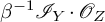 $\beta ^{-1}\mathscr {I}_Y\cdot \mathscr {O}_Z$
. Notice that Z is reduced and irreducible. Let
 $m_1$
be a positive integer such that
 $\mathscr {I}_Y(m_1H_1)$
is generated by its global sections. Then the linear system
 $|m_1\beta ^*H_1-E|$
induces a morphism
 $\varphi _1\colon Z \to \mathbb {P}^{N_1}$
, where
 $N_1:=\dim |\mathscr {I}_Y(m_1H_1)|$
. We may also assume without loss of generality that
 $\dim \varphi _1(Z) \geqslant 2$
. By Bertini’s theorem (see [Reference Jouanolou41, Théorème I.6.10]), a general member of the linear system
 $|m_1\beta ^*H_1-E|$
is reduced and irreducible. This immediately implies that a general member
 $A_1$
of
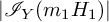 $|\mathscr {I}_Y(m_1H_1)|$
is generically reduced and irreducible. Since
 $A_1$
is Cohen–Macaulay (see [Reference Eisenbud27, Proposition 18.13]), we see that
 $A_1$
is reduced by Serre’s criterion.
Suppose
 $k\geqslant 2$
. Then the induction hypothesis applied to
 $A_1$
and
 $H_2|_{A_1},\ldots ,H_k|_{A_1}$
show that there exist positive integers
 $m_2,\ldots ,m_k$
and dense open subsets
 $V_i \subseteq |\mathscr {I}_Y(m_iH_i|_{A_1})|$
such that for any tuple
 $(B_2,\ldots ,B_k)\in V_2\times \cdots \times V_k$
, the associated complete intersection
 $S:=B_2\cap \cdots \cap B_k$
is reduced and irreducible. In addition, S is Cohen–Macaulay. We may also assume without loss of generality that
 $h^1(X,\mathscr {O}_X(m_iH_i-m_1H_1))=0$
for any
 $i \geqslant 2$
. This implies that
 $|\mathscr {I}_Y(m_iH_i)|_{A_1}=|\mathscr {I}_Y(m_iH_i|_{A_1})|$
. The claim now follows easily.
The proof of Theorem 4.4 below makes use of the following elementary results.
Lemma 4.2. Let S be a smooth projective surface, and let D be a divisor on S such that
 $D^2=0$
. Then
 $\pm D$
is pseudo-effective.
Proof. Let H be an ample divisor on S. Replacing D by
 $-D$
if necessary, we may assume without loss of generality that
 $D\cdot H \geqslant 0$
. Let
 $\varepsilon>0$
be a rational number, and set
 $D_\varepsilon :=D+\epsilon H$
. Then
 $$ \begin{align*}D_\varepsilon\cdot H = D\cdot H + \varepsilon H^2>0 \quad\text{and}\quad D_\varepsilon^2=\varepsilon(2D\cdot H + \varepsilon H^2)>0.\end{align*} $$
Applying [Reference Hartshorne36, Corollary V.1.8], we see that
 $D_\varepsilon $
is
 $\mathbb {Q}$
-effective. This shows that D is pseudo-effective, proving the lemma.
Lemma 4.3. Let S be a smooth projective surface, and let D be a pseudo-effective divisor on S with
 $D^2=0$
. Suppose in addition that
 $\kappa (D) \leqslant 1$
. Then D is nef.
Proof. Let
 $D=P+N$
be the Zariski decomposition of D. Then P is a nef
 $\mathbb {Q}$
-divisor while N is an effective
 $\mathbb {Q}$
-divisor. In addition,
 $P\cdot N=0$
and, either
 $N=0$
or the intersection matrix
 $(N_i\cdot N_j)_{i,j \in I}$
is negative definite, where the
 $N_i$
with
 $i \in I$
are the irreducible components of N. Now,
 $\kappa (P)\leqslant \kappa (D) \leqslant 1$
by assumption, and hence
 $P^2=0$
. It follows that
 $0=D^2=N^2$
, and hence
 $N=0$
, proving the lemma.
Theorem 4.4. Let X be a complex projective manifold of dimension
 $n \geqslant 1$
, and let D be a divisor on X such that
 $D^2\equiv 0$
. Suppose in addition that D is not pseudo-effective and that
 $h^0(X,\Omega ^1_X(D))\geqslant 1$
. Then
 $-D$
is nef.
Proof. If
 $n=1$
, then
 $\deg D \leqslant 0$
since D is not pseudo-effective by assumption, and hence
 $-D$
is
 $\mathbb {Q}$
-effective. Suppose from now on that
 $n\geqslant 2$
. By [Reference Boucksom, Demailly, Păun and Peternell5, Theorem 1.5], there exists a smooth projective variety Z, as well as a birational morphism
 $\beta \colon Z \to X$
, and very ample divisors
 $H_1,\ldots ,H_{n-1}$
on Z such that
 $$ \begin{align*}\beta^*D\cdot H_1\cdots H_{n-1}<0.\end{align*} $$
Let
 $C \subset Z$
be a curve. By Lemma 4.1 there exist positive integers
 $m_1,\ldots ,m_{n-2}$
and a tuple
 $(A_1,\ldots ,A_{n-2})\in |\mathscr {I}_C(m_1H_1)|\times \cdots \times |\mathscr {I}_C(m_{n-2}H_{n-2})|$
such that the surface
 $S:=A_1\cap \cdots \cap A_{n-2}$
is reduced and irreducible.
We have
 $\beta ^*D|_S\cdot H_{n-1}|_S<0$
and
 $\beta ^*D|^2_S=0$
. Let
 $S_1 \to S$
be a resolution of singularities. Applying Lemma 4.2 to the pull-back
 $\beta ^*D|_{S_1}$
of
 $\beta ^*D|_S$
on
 $S_1$
, we conclude that
 $-\beta ^*D|_{S_1}$
is pseudo-effective.
Let
 $\omega \in H^0(X,\Omega ^1_X(D))\setminus \{0\}$
. The twisted
 $1$
-form
 $\omega $
yields an injective map
 $\mathscr {O}_X(-D) \to \Omega ^1_X$
of sheaves. We may assume without loss of generality that the composition
 $\mathscr {O}_X(-D)|_{S_1} \to \Omega ^1_X|_{S_1} \to \Omega ^1_{S_1}$
is nonzero. By the Bogomolov–Sommese vanishing theorem, we then have
 $\kappa (\mathscr {O}_X(-D)|_{S_1})\leqslant 1$
. Applying Lemma 4.3, we conclude that
 $-\beta ^*D|_{S_1}$
is nef. In particular,
 $-\beta ^* D \cdot C \geqslant 0$
. This shows that
 $-D$
is nef, completing the proof of the proposition.
Proof of Theorem 1.2.
This is an immediate consequence of Theorem 4.4 since
 $\mathscr {N}^2\equiv 0$
by Lemma 3.1.
The same argument used in the proof of Theorem 4.4 above shows that the following holds.
Theorem 4.5. Let X be a complex projective manifold of dimension
 $n \geqslant 2$
, and let
 $\mathscr {L}\subseteq \Omega _X^1$
be a locally free subsheaf of rank
 $1$
. Suppose
 $\mathscr {L}\cdot H^{n-1}>0$
and
 $\mathscr {L}^2\cdot H^{n-2}=0$
for some ample divisor H on X. Then
 $\mathscr {L}$
is nef.
The following is an immediate consequence of Theorem 4.4. Note that Touzet described the structure of codimension
 $1$
foliations with pseudo-effective conormal bundle in [Reference Touzet57].
Proposition 4.6. Let X be a complex projective manifold, and let
 $\mathscr {F}$
be a codimension
 $1$
foliation on X with normal bundle
 $\mathscr {N}$
. Suppose
 $\mathscr {N}^2\equiv 0$
and
 $\nu (K_{\mathscr {F}})\leqslant \nu (K_X) - 1$
. Then
 $\mathscr {N}^*$
is nef.
Proof. If
 $\mathscr {N}$
is pseudo-effective, then
 $\nu (K_{\mathscr {F}})\geqslant \nu (K_X)$
by [Reference Nakayama52, Proposition V.2.7] since
 $K_{\mathscr {F}}=K_X+c_1(\mathscr {N})$
by the adjunction formula, yielding a contradiction. The claim now follows from Theorem 4.4.
The following result extends [Reference Brunella11, Lemme 9] to arbitrary regular codimension
 $1$
foliations on complex projective varieties of general type.
Corollary 4.7. Let X be a smooth projective variety of general type, and let
 $\mathscr {F}$
be a regular codimension
 $1$
foliation on X with normal bundle
 $\mathscr {N}$
. Suppose
 $\nu (K_{\mathscr {F}})\leqslant \dim X - 1$
. Then
 $\mathscr {N}^*$
is nef.

5 Projectively flat foliations on nonminimal varieties
In this section, we address regular codimension
 $1$
foliations with numerically projectively flat tangent bundle on nonminimal complex projective manifolds. The following is the main result of this section.
Theorem 5.1. Setting and notation as in 2.19. Suppose in addition that
 $n \geqslant 4$
and that
 $K_X$
is not nef. Then there exists a
 $\mathbb {P}^1$
-bundle structure
 $\varphi \colon X \to Y$
onto a finite étale quotient of an abelian variety, and
 $\mathscr {F}$
induces a flat Ehresmann connection on
 $\varphi $
.
Proof. For the reader’s convenience, the proof is subdivided into a number of steps.
Step 1. We will need the following easy observation.
Claim 5.2. Any rational curve on X is generically transverse to
 $\mathscr {F}$
.
Proof. Let C be a rational curve on X, and let
 $\mathbb {P}^1\to C$
be the normalization morphism. Suppose that
 $T_{\mathbb {P}^1} \subset \mathscr {F}|_{\mathbb {P}^1}$
. Then
 $\mathscr {F}|_{\mathbb {P}^1}$
is an ample vector bundle since
 $\mathscr {F}$
is numerically projectively flat by assumption. But this contradicts Lemma 2.21, proving the claim.
Let
 $\varphi \colon X \to Y$
be an elementary Fano–Mori contraction. By Lemma 3.16 and Claim 5.2 together, Y is a smooth variety, and either
 $\varphi $
is the blow-up of a smooth codimension
 $2$
submanifold or
 $\varphi $
is a conic bundle. The proof of Theorem 5.1 uses the following notation.
Setup 5.3. Suppose that
 $\varphi $
is a singular conic bundle, and let
 $\Delta :=\{y \in Y \, | \, \varphi ^{-1}(y)\text { is not smooth}\}$
be the discriminant locus of
 $\varphi $
. The same argument used in the proof of [Reference Beauville6, Proposition 1.2] shows that
 $\Delta $
has pure codimension
 $1$
. Moreover,
 $\Delta $
has normal crossings in codimension
 $1$
. Let
 $Z_{-2} \subseteq \Delta $
be an irreducible component, and let
 $E_{-1}$
be the normalization of
 $E_{-2}:=\varphi ^{-1}(Z_{-2})$
. Then there exists a normal projective variety
 $Z_{-1}$
as well as morphisms
 $E_{-1} \to Z_{-1}$
and
 $Z_{-1} \to Z_{-2}$
, and a commutative diagram

In addition,
 $p_{-1}$
is a
 $\mathbb {P}^1$
-bundle and
 $\iota $
is a finite morphism of degree
 $2$
. By [Reference Beauville6, Lemme 1.5.2], there exists an open set
 $Z_{-2}^\circ \subseteq Z_{-2}$
with complement of codimension at least
 $2$
such that
 $Z_{-1}^\circ :=\iota ^{-1}(Z_{-2}^\circ )$
is smooth and such that the morphisms
 $E_{-1}^\circ \to X$
and
 $Z_{-1}^\circ \to Y$
induced by
 $\nu|_{E_{-1}^\circ }$
and
 $\iota|_{Z_{-1}^\circ }$
are unramified, where
 $E_{-1}^\circ :=p_{-1}^{-1}(Z_{-1}^\circ )$
. Let
 $Z \to Z_{-1}$
be a quasi-étale cover with Z normal and projective, and let
 $E:=Z \times _{Z_{-1}} E_{-1}$
with natural morphism
 $p\colon E \to Z$
. Let
 $Z^\circ $
be the inverse image of
 $Z_{-1}^\circ $
and set
 $E^\circ :=p^{-1}(Z^\circ )$
and
 $p^\circ :=p|_{E^\circ }$
. By the Nagata–Zariski purity theorem, the morphism
 $Z^\circ \to Z_{-1}^\circ $
is étale. As a consequence, the natural morphisms
 $E^\circ \to X$
and
 $Z^\circ \to Y$
are unramified.
Suppose now that
 $\varphi $
is a
 $\mathbb {P}^1$
-bundle. Set
 $Z_{-1}:=Y$
. Let
 $Z \to Z_{-1}$
be a finite étale cover, and set
 $E:=Z\times _{Z_{-1}} E_{-1}$
with natural morphism
 $p\colon E \to Z$
. Set also
 $E^\circ :=E$
and
 $Z^\circ :=Z$
.
Suppose finally that
 $\varphi $
is the blow-up of a smooth subvariety
 $Z_{-1}$
of codimension
 $2$
in Y with exceptional locus
 $E_{-1}$
. Let
 $Z \to Z_{-1}$
be a finite étale cover, and set
 $E:=Z\times _{Z_{-1}} E_{-1}$
with natural morphism
 $p\colon E \to Z$
. Set also
 $E^\circ :=E$
and
 $Z^\circ :=Z$
.
We obtain a diagram

By choice of
 $E^\circ $
,
 $T_{E^\circ }$
is a subbundle of
 $T_X|_{E^\circ }$
.
Step 2. By Claim 5.2, the composition
 $T_{E/Z} \to T_X|_{E} \to \mathscr {N}|_{E}$
is nonzero.
Claim 5.4. To prove Theorem 5.1, it suffices to show that the map
 $T_{E/Z} \to \mathscr {N}|_{E}$
is an isomorphism.
Proof. Suppose that the map
 $T_{E/Z} \to \mathscr {N}|_{E}$
is an isomorphism, and let F be a fiber of p. Since
 $\mathscr {F}$
is projectively flat, there exists
 $a \in \mathbb {Z}$
such that
 $\mathscr {F}|_{\mathbb {P}^1}\cong \mathscr {O}_{\mathbb {P}^1}(a)^{\oplus n-1}$
. In particular, we have
 $K_{\mathscr {F}} \cdot F=(n-1)a$
. If
 $\varphi $
is a singular conic bundle or a blow-up, then
 $K_X\cdot F = -1$
by choice of F. The adjunction formula
 $K_{\mathscr {F}}=K_X+c_1(\mathscr {N})$
then gives
 $$ \begin{align*}(n-1)a = K_{\mathscr{F}} \cdot F = K_X\cdot F + c_1(\mathscr{N})\cdot F = -1 +2 =1.\end{align*} $$
This is impossible and hence
 $\varphi $
is a
 $\mathbb {P}^1$
-bundle. Moreover,
 $\mathscr {F}$
is a flat Ehresmann connection on
 $\varphi $
. It follows that
 $T_Y$
is numerically projectively flat. But then [Reference Jahnke and Radloff42, Theorem 0.1] applies to show that Y is a finite étale quotient of an abelian variety.
We argue by contradiction and assume the following.
Assumption 5.5. The map
 $T_{E/Z} \to \mathscr {N}|_{E}$
is not an isomorphism.
There are finitely many prime divisors
 $(\Sigma _i)_{i\in I}$
on E and positive integers
 $m_i$
for
 $i\in I$
such that
 $$ \begin{align*}\mathscr{N}|_{E}\cong T_{E/Z}(\sum_{i\in I}m_i\Sigma_i).\end{align*} $$
By Claim 5.2 again, the restriction of p to
 $\Sigma _i$
is a finite morphism
 $\Sigma _i \to Z$
.
Claim 5.6. Let
 $i \in I$
. Then
 $\Sigma _i$
is smooth in codimension
 $1$
, and the finite morphism
 $\Sigma _i \to Z$
is quasi-étale. Moreover, the vector bundles
 $T_{E/Z}|_{\Sigma _i}$
,
 $T_X|_{\Sigma _i}$
,
 $\mathscr {N}_{\Sigma _i/E}$
,
 $\mathscr {F}|_{\Sigma _i}$
and
 $\mathscr {N}|_{\Sigma _i}$
are numerically flat. In addition,
 $\mathscr {O}_E(\Sigma _j)|_{\Sigma _i}\equiv 0$
for all indices
 $j \in I$
.
Proof. Set
 $\Sigma _i^\circ :=\Sigma _i \cap E^\circ $
. Let
 $C \subset Z$
be a complete intersection curve of general elements of very ample linear systems on Z. By general choice of C, we may assume without loss of generality that
 $C \subset Z^\circ $
. Set
 $S:=p^{-1}(C)\subset E^\circ $
and
 $f:=p|_S$
. Write
 $T_f:=T_{S/C}=T_{E/Z}|_S$
. By Bertini’s theorem (see [Reference Jouanolou41, Théorème I.6.10]), we may assume that S is smooth and that the complete curve
 $B_i:=\Sigma _i\cap S$
is reduced and irreducible.
We show that
 $B_i \to C$
is étale and that
 $$ \begin{align*}T_f\cdot B_i=\mathscr{N}\cdot B_i=B_j\cdot B_i =0\end{align*} $$
for all indices
 $j \in I$
. Let
 $\mathscr {E}_C$
be a normalized vector bundle on C such that
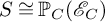 $S\cong \mathbb {P}_C(\mathscr {E}_C)$
. Recall that
 $\text {N}^1(S)\cong \mathbb {Z}[C_0]\oplus \mathbb {Z}[F]$
, where
 $F\cong \mathbb {P}^1$
is any fiber of f and
 $C_0$
is a section of f with
 $C_0^2=-e=\deg \mathscr {E}_C$
. In addition,
 $T_f\equiv 2C_0+eF$
, and hence
 $T_f^2=0$
. By Lemma 3.1, we have
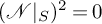 $(\mathscr {N}|_S)^2 = 0$
. This easily implies that
 $$ \begin{align*}\mathscr{N}|_S\equiv \frac{\mathscr{N}|_S\cdot F}{2}T_f\end{align*} $$
so that
 $(\sum _{i\in I}m_iB_i)^2=0$
.
Let
 $a_i$
and
 $b_i$
be integers such that
 $B_i\equiv a_i C_0+b_i F$
. Then
 $a_i=B_i\cdot F> 0$
. By construction, we have
 $T_f|_{B_i}\subset \mathscr {F}|_{B_i}$
. By Theorem 2.11 and Lemma 2.21 together, we have
 $$ \begin{align*}T_f \cdot B_i = (2C_0+eF)\cdot(a_iC_0+b_iF)=-ea_i+2b_i \leqslant 0.\end{align*} $$
Suppose first that
 $e \geqslant 0$
.
If
 $I=\{i\}$
and
 $B_i=C_0$
, then
 $e=0$
since
 $0=(\sum _{i\in I}m_iB_i)^2=-m_i^2 e$
. Moreover,
 $T_f\cdot B_i=\mathscr {N}\cdot B_i=B_i\cdot B_i =0$
. Otherwise, there exists
 $j \in I$
such that
 $B_j \neq C_0$
. Then
 $b_j \geqslant ea_j$
by [Reference Hartshorne36, Proposition 2.20], and hence
 $e=0$
,
 $b_j=0$
and
 $B_j\equiv a_j C_0$
. Hence, we have
 $T_f\cdot B_i=\mathscr {N}\cdot B_i=B_j\cdot B_i =0$
for all indices
 $j \in I$
. Moreover, the morphism
 $B_i \to C$
is étale by [Reference Hartshorne36, Proof of Proposition 2.21].
Suppose now that
 $e<0$
.
Then
 $2b_i \leqslant ea_i<0$
. Moreover,
 $B_i\neq C_0$
since
 $T_f\cdot C_0=-e>0$
. Therefore, we have
 $a_i\geqslant 2$
and
 $2b_i \geqslant ea_i$
by [Reference Hartshorne36, Proposition 2.21], and hence
 $2b_i=ea_i$
. This implies
 $B_i\cdot B_j=0$
for all
 $j \in I$
and
 $T_f\cdot B_i=\mathscr {N}\cdot B_i=0$
. In addition, the morphism
 $B_i \to C$
is étale by [Reference Hartshorne36, Proof of Proposition 2.21].
Since the morphism
 $B_i \to C$
is étale, we see that
 $\Sigma _i$
is smooth in codimension
 $1$
and that
 $\Sigma _i \to Z$
is quasi-étale. Let
 $\widetilde {\Sigma }_i$
denote the normalization of
 $\Sigma _i$
. Replacing E by
 $\widetilde {\Sigma }_i\times _Z E$
, if necessary, we may assume without loss of generality that
 $\Sigma _i$
is a section of p. Then Kleiman’s criterion for numerical triviality (see [Reference Greb, Kebekus and Peternell30, Lemma 4.1]) applies to show that the vector bundles
 $T_{E/Z}|_{\Sigma _i}$
,
 $\mathscr {N}_{\Sigma _i/E}$
and
 $\mathscr {N}|_{\Sigma _i}$
are numerically flat. In addition,
 $\mathscr {O}_E(\Sigma _j)|_{\Sigma _i}\equiv 0$
for all indices
 $j \in I$
. Recall that
 $T_f|_{B_i}\subset \mathscr {F}|_{B_i}$
. By Theorem 2.11 and Lemma 2.21 together, we see that
 $\mathscr {F}|_{B_i}$
is numerically flat. As a consequence,
 $K_{\mathscr {F}}\cdot B_i =0$
. By Kleiman’s criterion for numerical triviality again, we conclude that
 $K_{\mathscr {F}}|_{\Sigma _i}\equiv 0$
. This in turn implies that
 $\mathscr {F}|_{\Sigma _i}$
is numerically flat by Theorem 2.11. Since
 $\mathscr {N}|_{\Sigma _i}\equiv 0$
, the vector bundle
 $T_X|_{\Sigma _i}$
is numerically flat as well, finishing the proof of Claim 5.6.
Step 3. Let us show Z is a finite quasi-étale quotient of an abelian variety.
By Claim 5.6, the morphisms
 $\Sigma _i \to Z$
are quasi-étale covers. Let
 $i\in I$
. To lighten notation, set
 $\Sigma :=\Sigma _i$
and
 $\Sigma ^\circ :=\Sigma _i^\circ $
. Let
 $\widetilde {\Sigma }$
denote the normalization of
 $\Sigma $
. Replacing E by
 $\widetilde {\Sigma }\times _Z E$
, if necessary, we may assume without loss of generality that
 $\Sigma $
is a section of p. Set
 $\mathscr {E}:=p_*\mathscr {O}_E(\Sigma )$
. Then
 $E\cong \mathbb {P}_Z(\mathscr {E})$
and there is an exact sequence
 $$ \begin{align*}0 \to \mathscr{O}_Z \to \mathscr{E} \to \mathscr{L} \to 0,\end{align*} $$
where
 $\mathscr {L} \cong \mathscr {N}_{\Sigma /E}$
is a flat line bundle on Z by Claim 5.6. Notice that
 $T_{E/Z}\cong \mathscr {O}_E(2\Sigma )\otimes p^*\mathscr {L}^*$
.
Let F be any fiber of p. Notice that
 $\mathscr {N}|_E\equiv c \, T_{E/Z}\equiv 2c \Sigma $
with
 $c:=\frac {\mathscr {N} \cdot F}{2}$
since
 $\mathscr {N}|_E\cdot F = c \, T_{E/Z} \cdot F$
and
 $\mathscr {N}|_{\Sigma } \equiv T_{E/Z}|_\Sigma \equiv 0$
by Claim 5.6.
Let now k be an integer such that
 $\mathscr {F}(k\Sigma )|_F \cong \mathscr {O}_F^{\oplus n-1}$
. Then
 $\mathscr {F}|_E \cong p^*\mathscr {K}\otimes \mathscr {O}_E(-k\Sigma )$
for some vector bundle
 $\mathscr {K}$
on Z. Since
 $\mathscr {F}|_\Sigma $
and
 $\mathscr {N}_{\Sigma /E}$
are numerically flat by Claim 5.6, the locally free sheaf
 $\mathscr {K}$
is numerically flat as well. This immediately implies that
 $$ \begin{align*} c_1(\mathscr{F}|_E) & = p^*c_1(\mathscr{K}) -k(n-1)\Sigma\\ & \equiv -k(n-1)\Sigma \end{align*} $$
and
 $$ \begin{align*} c_2(\mathscr{F}|_E) & = p^*c_2(\mathscr{K}) -(n-2)k\Sigma\cdot p^*c_1(\mathscr{K})+\frac{(n-1)(n-2)}{2}k^2\Sigma^2\\ & \equiv 0 \end{align*} $$
since
 $\Sigma ^2\equiv 0$
. The exact sequence
 $$ \begin{align*}0 \to \mathscr{F}|_E \to T_X|_E \to \mathscr{N}|_E \to 0\end{align*} $$
then gives
 $$ \begin{align*} c_1(T_X|_E) & = c_1(\mathscr{F}|_E)+c_1(\mathscr{N}|_E)\\ & \equiv \Sigma \end{align*} $$
using
 $K_X\cdot F=-1$
, and
 $$ \begin{align*} c_2(T_X|_E) & =c_2(\mathscr{F}|_E)+c_1(\mathscr{F}|_E)\cdot c_1(\mathscr{N}|_E) \\ & \equiv 0 \end{align*} $$
using
 $c_1(\mathscr {N})\cdot \Sigma \equiv 0$
. In particular, there exists a flat line bundle
 $\mathscr {M}$
on Z such that
 $$ \begin{align*}\mathscr{N}|_E \cong p^*\mathscr{M}\otimes\mathscr{O}_E((k(n-1)+1)\Sigma).\end{align*} $$
By the projection formula, there exist rational numbers
 $a_1$
,
 $a_2$
and
 $a_3$
such that
 $$ \begin{align} p_*c_2(T_X|_E) = a_1c_1(\mathscr{K})+a_2c_1(\mathscr{M})+a_3c_1(\mathscr{N}_{\Sigma/E}) \end{align} $$
as cycle classes in
 $\text {CH}^1(Z)$
. The exact sequence
 $$ \begin{align*}0 \to T_{E^\circ/Z^\circ} \to T_{E^\circ} \to (p^\circ)^*T_{Z^\circ} \to 0\end{align*} $$
gives
 $$ \begin{align*} c_1(T_{E^\circ}) & = 2\Sigma^\circ-(p^\circ)^*c_1(\mathscr{L}|_{Z^\circ})+(p^\circ)^*c_1(T_{Z^\circ})\\ & \equiv 2\Sigma^\circ+(p^\circ)^*c_1(T_{Z^\circ}) \end{align*} $$
and
 $$ \begin{align*} c_2(T_{E^\circ}) & =c_1(T_{E^\circ/Z^\circ})\cdot (p^\circ)^*c_1(T_{Z^\circ})+(p^\circ)^*c_2(T_{Z^\circ})\\ & = (2 \Sigma^\circ - (p^\circ)^*c_1(\mathscr{L}|_{Z^\circ}))\cdot (p^\circ)^*c_1(T_{Z^\circ})+(p^\circ)^*c_2(T_{Z^\circ}). \end{align*} $$
Notice that the cokernel
 $\mathscr {N}_{E^\circ /X^\circ }$
of the tangent map
 $T_{E^\circ }\to T_X|_{E^\circ }$
is locally free since the morphism
 $E^\circ \to X$
is unramified by choice of
 $E^\circ $
. Then we have
 $$ \begin{align*} c_2(T_X|_{E^\circ}) & = c_2(T_{E^\circ})+c_1(T_{E^\circ})\cdot c_1(\mathscr{N}_{E^\circ/X^\circ}) \\ & = c_2(T_{E^\circ})+c_1(T_{E^\circ})\cdot (c_1(T_X|_{E^\circ})-c_1(T_{E^\circ}))\\ & \equiv 2 \Sigma^\circ\cdot (p^\circ)^*c_1(T_{Z^\circ})+(p^\circ)^*c_2(T_{Z^\circ})+(2\Sigma^\circ+(p^\circ)^*c_1(T_{Z^\circ}))\\&\quad \cdot (-\Sigma^\circ-(p^\circ)^*c_1(T_{Z^\circ}))\\ & \equiv - \Sigma^\circ\cdot (p^\circ)^*c_1(T_{Z^\circ})+(p^\circ)^*c_2(T_{Z^\circ})-(p^\circ)^*c_1(T_{Z^\circ})^2. \end{align*} $$
By the projection formula again, there exist rational numbers
 $b_1$
,
 $b_2$
,
 $b_3$
et
 $b_4$
such that
 $$ \begin{align} (p^\circ)_*c_2(T_X|_{E^\circ}) = - c_1(T_{Z^\circ}) + b_1c_1(\mathscr{K}|_{Z^\circ})+b_2c_1(\mathscr{M}|_{Z^\circ})+b_3c_1(\mathscr{L}|_{Z^\circ})+b_4c_1(\mathscr{N}_{\Sigma^\circ/E^\circ}) \end{align} $$
as cycle classes in
 $\text {CH}^1(Z^\circ )$
. Equations (5.1) and (5.2) together then show that
 $K_Z$
is
 $\mathbb {Q}$
-Cartier using the fact that
 $Z \setminus Z^\circ $
has codimension at least
 $2$
in Z. Moreover,
 $K_Z \cdot C = 0$
for any complete intersection curve C of general elements of very ample linear systems on Z so that Kleiman’s criterion for numerical triviality (see [Reference Greb, Kebekus and Peternell30, Lemma 4.1]) applies to show that
 $K_Z\equiv 0$
.
Suppose that
 $\varphi $
is a
 $\mathbb {P}^1$
-bundle. Then
 $T_\Sigma $
is numerically projectively flat since both
 $T_X|_\Sigma $
and
 $\mathscr {N}_{\Sigma /X}$
are numerically projectively flat by Claim 5.6 above. This implies that
 $T_Y$
is numerically projectively flat as well. Then [Reference Jahnke and Radloff42, Theorem 0.1] applies to show that
 $Y=Z$
is a finite étale quotient of an abelian variety.
Suppose now that
 $\varphi $
is a singular conic bundle or a blow-up. By Lemma 3.15 and Claim 5.2 together, Z contains no rational curve. Then [Reference Boucksom, Demailly, Păun and Peternell5, Corollary 0.3] applied to a resolution of Z shows that Z has canonical singularities. By [Reference Demailly, Peternell and Schneider22, Proposition 1.16], the map
 $\det T_\Sigma \to \wedge ^{n-2}(T_X|_{\Sigma })$
does not vanish anywhere since
 $T_X|_{\Sigma }$
is numerically flat by Claim 5.6. This immediately implies that
 $T_\Sigma $
is locally free and numerically flat. By the solution of the Zariski–Lipman conjecture for klt spaces (see [Reference Greb, Kebekus, Kovács and Peternell29, Theorem 6.1] or [Reference Druel23, Theorem 1.1]), we see that
 $Z\cong \Sigma $
is smooth. Moreover, by [Reference Demailly, Peternell and Schneider22, Corollary 1.19], we have
 $c_2(Z)=0$
. As a classical consequence of Yau’s theorem on the existence of a Kähler–Einstein metric, Z is then covered by a complex torus (see [Reference Kobayashi47, Chapter IV Corollary 4.15]).
This shows that Z is a quasi-étale quotient of an abelian variety.
Step 4. Finally, let us obtain a contradiction.
Claim 5.7. The vector bundle
 $\mathscr {F}|_E$
is not numerically flat.
Proof. Suppose first that
 $\varphi $
is a
 $\mathbb {P}^1$
-bundle. Using Claim 5.2, we then conclude that
 $\mathscr {F}$
induces a flat Ehresmann connection on p. This immediately implies that the map
 $T_{E/Z} \to \mathscr {N}|_{E}$
is an isomorphism, which contradicts Assumption 5.5.
Suppose now that
 $\varphi $
is a singular conic bundle or a blow-up. Then
 $T_X|_F \cong \mathscr {O}_{\mathbb {P}^1}(2)\oplus \mathscr {O}_{\mathbb {P}^1}^{n-2}\oplus \mathscr {O}_{\mathbb {P}^1}(-1)$
. But this is impossible by Lemma 3.17, proving our claim.
By Step 3, replacing Z by a finite quasi-étale cover, if necessary, we may also assume that Z is an abelian variety. Recall also that
 $E\cong \mathbb {P}_Z(\mathscr {E})$
, where
 $\mathscr {E}$
is numerically flat. In particular,
 $\mathscr {E}$
is flat by the Corlette—Simpson correspondence (see Theorem 2.3). As a consequence, there is a flat Ehresmann connection
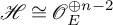 $\mathscr {H}\cong \mathscr {O}_E^{\oplus n-2}$
on p.
Let
 $\omega \in H^0(X,\Omega _X^1\otimes \mathscr {N})$
be a twisted
 $1$
-form defining
 $\mathscr {F}$
, and let
 $\mathscr {G}$
be the foliation on E induced by
 $\mathscr {F}$
. Suppose that
 $\omega|_E\in H^0(E,\Omega _E^1\otimes \mathscr {N}|_E)$
vanishes at some point
 $x \in E$
. Then
 $x \in \Sigma _i$
for some
 $i\in I$
. In addition,
 $\omega|_E$
vanishes along
 $\Sigma _i$
since
 $\Omega _E^1\otimes \mathscr {N}|_{\Sigma _i}$
is numerically flat (see [Reference Demailly, Peternell and Schneider22, Proposition 1.16]). Repeating the argument, we see that there exist integers
 $0 \leqslant k_i \leqslant m_i$
such that
 $\mathscr {N}_{\mathscr {G}}\cong T_{E/Z}(\sum _{i\in I}k_i\Sigma _i)$
and that
 $\mathscr {G}$
is regular.
Suppose first that
 $\mathscr {O}_E^{\oplus n-2}\cong \mathscr {H}=\mathscr {G}\subset T_E$
. Then
 $\mathscr {F}|_E$
is numerically flat by Theorem 2.11 and Lemma 2.21 together. But this contradicts Claim 5.7.
Suppose from now on that
 $\mathscr {H} \neq \mathscr {G} \subset T_E$
, and let
 $x \in X$
be a general point. Then there exists
 $v \in H^0(E,\mathscr {H})$
with
 $v(x) \in \mathscr {G}_x\setminus \{0\}$
since
 $n \geqslant 3$
. If
 $h^0(E,\mathscr {F}|_E)\geqslant 1$
, then
 $\mathscr {F}|_E$
is numerically flat by Theorem 2.11 and Lemma 2.21 together, which is impossible by Claim 5.7 again. Thus, we have
 $h^0(E,\mathscr {F}|_E)=0$
. But then v induces a nonzero section
 $s \in H^0(E,\mathscr {N}|_E)$
vanishing at x. Let
 $\sum _{j\in J}d_j \Lambda _j$
be the zero divisor of s. Since
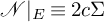 $\mathscr {N}|_E\equiv 2c\Sigma $
is nef and
 $\Sigma ^2 \equiv 0$
we see that
 $\Lambda _j\cdot \Sigma \equiv 0$
. This easily implies
 $\Lambda _j^2\equiv 0$
since
 $\mathscr {E}$
is numerically flat. Arguing as in the proof of Claim 5.6, we conclude that
 $\Lambda _j$
is smooth in codimension
 $1$
and that
 $\Lambda _j \to Z$
is quasi-étale. By Serre’s criterion for normality,
 $\Lambda _j$
is normal and
 $\Lambda _j \to Z$
is étale by Nagata–Zariski purity theorem. Let
 $j \in J$
such that
 $x \in \Lambda _j$
. Then
 $\Lambda _j \cap \Sigma = \emptyset $
since
 $x \not \in \Sigma $
. Replacing Z by a finite étale cover, if necessary, we may therefore assume that p has
 $3$
pairwise disjoint sections. Then
 $E \cong \mathbb {P}^1 \times Z$
. In addition,
 $\mathscr {N}_{\mathscr {G}}\cong q^*\mathscr {R}$
for some line bundle
 $\mathscr {R}$
on
 $\mathbb {P}^1$
, where
 $q:=\text {pr}_{\mathbb {P}^1}$
. By Lemma 3.23, we have
 $h^0(E,\mathscr {F}|_E) \geqslant h^0(E,\mathscr {G}) \geqslant 1$
since
 $n\geqslant 4$
by assumption, yielding a contradiction. This finishes the proof of Theorem 5.1.
6 Abundance
In this section, we prove a special case of the abundance conjecture (see Proposition 6.3 below). More precisely, we prove that if the pair
 $(X,\mathscr {F})$
satisfies all the conditions listed in Setup 2.19, then
 $\kappa (X)=\nu (X)$
. First, we consider foliations with projectively trivial tangent bundle. The proof of Proposition 6.1 below follows an argument that goes back at least as far as [Reference Brunella12, Chapter 9].
Proposition 6.1. Let X be a complex projective manifold of dimension
 $n\geqslant 3$
, and let
 $\mathscr {F}$
be a regular codimension
 $1$
foliation. Suppose that
 $\mathscr {F}\cong \mathscr {L}^{\oplus n-1}$
for some line bundle
 $\mathscr {L}$
. Then
 $\mathscr {L}^*$
is semiample with
 $\nu (\mathscr {L}^*)\leqslant 1$
.
Proof. For the reader’s convenience, the proof is subdivided into a number of steps. Notice that
 $\mathscr {L}^*$
is nef by Lemma 2.21 and that
 $\nu (\mathscr {L}^*)\leqslant 1$
by Proposition 3.2. Therefore, in order to prove the proposition, it suffices to show that
 $\kappa (\mathscr {L}^*)=\nu (\mathscr {L}^*)$
(see [Reference Kawamata43, Proposition 2.1]). Notice also that
 $\kappa (\mathscr {L}^*)\leqslant \nu (\mathscr {L}^*)$
by [Reference Kawamata43, Proposition 2.2].
Step 1. We show that
 $\kappa (\mathscr {L}^*)\geqslant 0$
.
Suppose first that
 $q(X)>0$
.
If
 $h^0(X,\mathscr {L}^*) \geqslant 1$
, then there is nothing to show. Suppose now that
 $h^0(X,\mathscr {L}^*)=0$
. Let
 $a\colon X \to A$
be the Albanese morphism, and let
 $f \colon X \to Y$
be its Stein factorization. Notice that
 $\dim Y \geqslant 1$
since
 $q(X)>0$
by assumption. Now, the standard pull-back map of Kähler differentials
 $$ \begin{align*}H^0(X,\Omega_X^1)\otimes \mathscr{O}_X\cong a^*\Omega_A^1 \to \Omega_X^1\end{align*} $$
identifies with the evaluation map. It follows that
 $\mathscr {F}$
is contained in the kernel of the tangent map
 $$ \begin{align*}Ta \colon T_X \to a^*T_A\end{align*} $$
since
 $h^0(X,\mathscr {L}^*)=0$
by our current assumption. Thus,
 $\dim Y=1$
, and
 $\mathscr {F}$
is induced by the fibration f. Let F be a general fiber of f. By [Reference Jahnke and Radloff42, Theorem 0.1], F is a finite étale quotient of an abelian variety. In particular,
 $\mathscr {L}|_F$
is a torsion line bundle. This easily implies that there exists a line bundle
 $\mathscr {M}$
on Y and a positive integer m such that
 $\mathscr {L}^{\otimes m}\cong f^*\mathscr {M}$
(see also Proposition 3.11). Notice that
 $\mathscr {M}^*$
is nef since
 $\mathscr {L}^*$
is nef. But then
 $\kappa (\mathscr {M}^*)\geqslant 0$
and hence
 $\kappa (\mathscr {L}^*)\geqslant 0$
.
Suppose now that
 $q(X)=0$
.
If
 $\mathscr {L}\equiv 0$
, then
 $\mathscr {L}$
is a torsion line bundle, and hence
 $\kappa (\mathscr {L}^*)=0$
. Suppose now that
 $\mathscr {L}\not \equiv 0$
. From Proposition 3.5, we get
 $\chi (X,\mathscr {O}_X)=0$
and hence
 $h^p(X,\mathscr {O}_X)>0$
for some
 $p> 0$
. By Hodge symmetry, we then have
 $h^0(X,\Omega _X^p)>0$
. Using the exact sequence
 $$ \begin{align*}0 \to \mathscr{N}^* \to \Omega_X^1 \to \mathscr{F}^* \to 0\end{align*} $$
we see that
 $h^0\big (X,(\mathscr {N}^*)^{\otimes u}\otimes (\mathscr {L}^*)^{\otimes v}\big )>0$
for some nonnegative integers u and v such that
 $u+v=p$
. By Proposition 3.2, there exist integers
 $r>0$
and s such that
 $\mathscr {N}^{\otimes r}\cong \mathscr {L}^{\otimes s}$
. It follows that
 $h^0\big (X,(\mathscr {L}^*)^{\otimes su+rv}\big )>0$
. Since
 $\mathscr {L}^*$
is nef and
 $\mathscr {L}^*\not \equiv 0$
, we must have
 $su+rv \geqslant 0$
. This shows that
 $\kappa (\mathscr {L}^*)\geqslant 0$
in the case where
 $q(X)=0$
.
Step 2. Write
 $$ \begin{align} -c_1(\mathscr{L}) \sim_{\mathbb{Q}} \sum_{i \in I} b_i B_i \end{align} $$
with
 $b_i \in \mathbb {Q}_{>0}$
. If
 $\mathscr {L}\equiv 0$
, then
 $\mathscr {L}$
is a torsion line bundle since
 $\kappa (\mathscr {L}^*)\geqslant 0$
by Step 1, proving the proposition in this case. Suppose from now on that
 $\mathscr {L}\not \equiv 0$
. In other words, assume that I is not empty. Then Proposition 3.4 applies to show that for any index
 $i\in I$
,
 $B_i$
is a finite étale quotient of an abelian variety. Moreover,
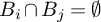 $B_i\cap B_j =\emptyset $
if
 $i\neq j$
and
 $\mathscr {N}_{B_i/X}$
is a flat line bundle. Notice that
 $\mathscr {L}|_{B_i}$
is a flat line bundle as well by Equation (6.1).
Step 3. Suppose now that the composition
 $\mathscr {L}^{\oplus n-1}|_{B_i}\cong \mathscr {F} \to T_X|_{B_i} \to \mathscr {N}_{B_i/X}$
is nonzero. In other words, assume that
 $B_i$
is not a leaf of
 $\mathscr {F}$
. Then there exists a foliation by curves
 $\mathscr {G}\cong \mathscr {L} \subset T_X$
such that
 $B_i$
is everywhere transverse to
 $\mathscr {L}$
since both
 $\mathscr {L}|_{B_i}$
and
 $\mathscr {N}_{B_i/X}$
are flat line bundles. In particular, we have
 $\mathscr {N}_{B_i/X}\cong \mathscr {L}|_{B_i}$
. Moreover, there is a section
 $s \in H^0(X,\mathscr {O}_X(m K_{\mathscr {G}}))$
for some integer
 $m \geqslant 1$
that vanishes on
 $B_i$
and nowhere else in some analytic open neighborhood of
 $B_i$
by Equation 6.1 again. Arguing as in the proof of [Reference Brunella12, Theorem 9.2] on page
 $112$
, we conclude that there exists a fibration
 $f \colon X \to C$
onto a smooth complete curve C such that
 $B_i$
is a (set-theoretic) fiber of f. This easily implies that
 $\kappa (\mathscr {L}^*)=\nu (\mathscr {L}^*)=1$
.
Step 4. Suppose finally that
 $B_i$
is a leaf of
 $\mathscr {F}$
for all indices
 $i \in I$
. Then
 $T_{B_i} \cong \mathscr {F}|_{B_i}\cong (\mathscr {L}|_{B_i})^{\oplus n-1}$
so that Lemma 6.2 below applies to show that
 $B_i$
is an abelian variety and
 $\mathscr {L}|_{B_i} \cong \mathscr {O}_{B_i}$
. Moreover,
 $\mathscr {N}_{B_1/X}$
is a flat vector bundle by Lemma 3.1.
Let m be a positive integer such that
 $-mc_1(\mathscr {L}) \sim _{\mathbb {Z}} \sum _{i \in I} mb_i B_i=:B$
. In particular,
 $mb_i$
is an integer. Let
 $\gamma \colon X_1 \to X$
be the associated cyclic cover (see [Reference Kollár and Mori45, Definition 2.52]) which is étale away from B. Notice that
 $X_1$
is smooth. Set
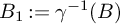 $B_1:=\gamma ^{-1}(B)$
. By [Reference Druel25, Lemma 3.4(1)], the foliation
 $\mathscr {F}_1$
induced by
 $\mathscr {F}$
on
 $X_1$
is regular and
 $\mathscr {F}_1 \cong \gamma ^*\mathscr {F}$
. Using [Reference Ueno58, Lemma 5.12], one readily checks that
 $\mathscr {L}^*$
is semiample if and only if so is
 $\gamma ^*\mathscr {L}^*$
. Moreover,
 $\nu (\mathscr {L}^*)=\nu (\gamma ^*\mathscr {L}^*)$
. Therefore, replacing X by
 $X_1$
, we may assume without loss of generality that
 $-c_1(\mathscr {L}) \sim _{\mathbb {Z}} \sum _{i \in I} b_i B_i=:B$
with
 $b_i \in \mathbb {Z}$
.
Suppose first that
 $q(X)>0$
.
Let
 $a\colon X \to A$
be the Albanese morphism, and let
 $f \colon X \to Y$
be its Stein factorization. By assumption, we have
 $\dim Y \geqslant 1$
.
Suppose that
 $\dim f(B_i) \geqslant 1$
for some
 $i \in I$
. Then there exists a global
 $1$
-form on X whose restriction to
 $\mathscr {F}|_{B_i}$
is nonzero at a general point in
 $B_i$
. This implies
 $\kappa (\mathscr {L}^*) = \nu (\mathscr {L}^*) = 1$
.
Suppose now that
 $\dim f(B_i) = 0$
for any
 $i \in I$
. Then Lemma 3.13 applies to show that
 $\dim Y=1$
. Now, by Zariski’s lemma, some nonzero multiple of
 $B_i$
is a fiber of f since
 $B_i^2\equiv 0$
. This again implies
 $\kappa (\mathscr {L}^*) = \nu (\mathscr {L}^*) = 1$
.
Suppose finally that
 $q(X)=0$
.
Then
 $\mathscr {O}_X(b_iB_i)|_{B_i}\cong \mathscr {L}^*|_{B_i}\cong \mathscr {O}_{B_i}$
. In other words,
 $\mathscr {O}_X(B_i)|_{B_i}$
is torsion, say of order
 $m_i$
. In particular, for any
 $1 \leqslant k\leqslant m_i-1$
,
 $h^1(B_i,\mathscr {O}_X(k B_i)|_{B_i})=0$
. The short exact sequence
 $$ \begin{align*}0 \to \mathscr{O}_X((k-1) B_i) \to \mathscr{O}_X(k B_i) \to \mathscr{O}_X(k B_i)|_{B_i} \to 0\end{align*} $$
then gives
 $h^1(X,\mathscr {O}_X(k B_i))=0$
for all
 $1\leqslant k\leqslant m_i-1$
. It follows that the restriction map
 $$ \begin{align*}H^0(X,\mathscr{O}_X(m_i B_i))\to H^0(X,\mathscr{O}_X(m_i B_i)|_{B_i})\cong H^0(X,\mathscr{O}_{B_i})\end{align*} $$
is surjective. This implies
 $\kappa (\mathscr {L}^*) \geqslant \kappa (\mathscr {O}_X(B_i)) \geqslant 1$
, and hence
 $\kappa (\mathscr {L}^*) = \nu (\mathscr {L}^*) = 1$
.
Lemma 6.2. Let X be a compact Kähler manifold of dimension
 $n \geqslant 2$
. Suppose that
 $T_X\cong \mathscr {L}^{\oplus n}$
for some line bundle
 $\mathscr {L}$
on X. Then X is a torus.
Proof. By [Reference Greb, Kebekus and Peternell31, Proposition 4.3],
 $c_1(\mathscr {L})=0$
. If
 $q(X)=0$
, then
 $\mathscr {L}$
is torsion. Otherwise, we have
 $\mathscr {L}\cong \mathscr {O}_X$
. In either case,
 $\mathscr {L}$
is torsion, say of order m. Let
 $\gamma \colon Y \to X$
be the associated cyclic cover (see [Reference Kollár and Mori45, Definition 2.52]) which is étale with Galois group
 $G=\langle \tau \rangle $
. By construction,
 $T_Y \cong \gamma ^*T_X \cong \mathscr {O}_Y^{\oplus n}$
. By a result proved by Wang ([Reference Wang61, Corollary 2]), Y is a complex torus,
 $Y=V/\Lambda $
, where V is complex vector space of dimension n and
 $\Lambda \subset V$
is a lattice. Set
 $y_0:=\tau (0)$
. There exists a
 $\mathbb {C}$
-linear map
 $L \colon V \to V$
satisfying
 $L(\Lambda )\subseteq \Lambda $
such that
 $\tau = t_{y_0}\circ \overline {L}$
, where
 $\overline {L}$
is the automorphism of Y induced by L. Notice that the linear map L can be identified with
 $\tau _*$
acting on
 $H^0(Y,T_Y)\cong V$
. Since
 $T_Y \cong \gamma ^*T_X \cong (\gamma ^*\mathscr {L})^{\oplus n}$
, we see that
 $L=\lambda \text {Id}$
for some
 $\lambda \in \mathbb {C}$
with
 $\lambda ^m=1$
. By [Reference Birkenhake and Lange8, Lemma 13.1.1], the set of fixed points of
 $\overline {L}$
is a positive-dimensional analytic subvariety since
 $\tau $
has no fixed point. But this immediately implies that
 $\lambda =1$
. As a consequence,
 $\tau $
is a translation by a point of finite order. This in turn implies that X is torus and that
 $\mathscr {L}\cong \mathscr {O}_X$
.
The following is the main result of this section.
Proposition 6.3. Setting and notation as in 2.19. Suppose in addition that
 $K_X$
is pseudo-effective. Then
 $K_X$
is abundant.
Proof. Let
 $\text {H} \subseteq \text {PGL}(n-1,\mathbb {C})$
be the Zariski closure of
 $\rho (\pi _1(X))$
. This is a linear algebraic group which has finitely many connected components. Applying Selberg’s lemma and passing to an appropriate finite étale cover of X, we may assume without loss of generality that
 $\text {H}$
is connected and that the image of the induced representation
 $$ \begin{align*}\rho_1 \colon \pi_1(X) \to \text{H} \to \text{H}/\text{Rad}(\text{H})\end{align*} $$
is torsion-free, where
 $\text {Rad}(\text {H})$
denotes the radical of
 $\text {H}$
. Let
 $$ \begin{align*}\text{sh}_{\rho_1}\colon X \dashrightarrow Y\end{align*} $$
be the
 $\rho _1$
-Shafarevich map, where
 $\text {sh}_{\rho _1}$
is dominant and Y is a smooth projective variety. The rational map
 $\text {sh}_{\rho _1}$
is almost proper with connected fibers. By [Reference Campana, Claudon and Eyssidieux14, Théorème 1], we may assume without loss of generality that Y is of general type and that the representation
 $\rho _1$
factorizes through
 $\text {sh}_{\rho _1}$
. If
 $\dim Y = \dim X$
, then X is of general type and there is nothing to show. Suppose from now on that
 $\dim Y < \dim X$
.
Let F be a general (smooth) fiber of
 $\text {sh}_{\rho _1}$
. By [Reference Druel26, Proposition 2.23], in order to prove that
 $K_X$
is abundant, it suffices to prove that
 $K_F$
is abundant.
Suppose first
 $\dim Y = 0$
and
 $q(X)=0$
.
Since
 $\rho (\pi _1(X)) \subseteq \text {Rad}(\text {H})$
, the restriction of
 $\rho $
to a finite index subgroup of
 $\pi _1(X)$
is the trivial representation. Thus, there exists a finite étale cover
 $\gamma \colon Y \to X$
, as well as a line bundle
 $\mathscr {L}$
on Y such that
 $\gamma ^{-1}\mathscr {F}\cong \mathscr {L}^{\oplus n-1}$
. Then Proposition 6.1 applies to show that
 $\mathscr {L}^*$
is semiample. This in turn implies that
 $\mathscr {O}_X(K_{\mathscr {F}})$
is semiample ([Reference Ueno58, Lemma 5.12]).
If
 $K_{\mathscr {F}}\equiv 0$
, then our claim follows from Proposition 3.18.
Suppose now that
 $K_{\mathscr {F}}\not \equiv 0$
. By Proposition 3.2 and using the fact that
 $q(X)=0$
, there exist integers
 $r>0$
and s such that
 $\mathscr {N}^{\otimes r}\cong \mathscr {O}_X(K_{\mathscr {F}})^{\otimes s}$
. The claim now follows easily from the adjunction formula
 $\mathscr {O}_X(K_X)\cong \mathscr {O}_X(K_{\mathscr {F}})\otimes \mathscr {N}^*$
.
Suppose from now on that either
 $\dim Y>0$
or
 $q(X)>0$
.
Let
 $a \colon F \to \text {A}$
be the Albanese morphism. By construction, we have
 $\dim \text {A} = q(F)$
. Let G be a general (smooth) fiber of the Stein factorization of
 $F \to a(F)$
. By [Reference Hu40, Theorem 1.1], in order to prove that
 $K_F$
is abundant, it suffices to prove that
 $K_G$
is abundant. Thus, we may assume without loss of generality that
 $\dim G>0$
. Repeating the process finitely many times, we may also assume that
 $q(G)=0$
. Since
 $\rho (\pi _1(G)) \subseteq \text {Rad}(\text {H})$
, the restriction of
 $\rho $
to a finite index subgroup of
 $\pi _1(G)$
is the trivial representation.
Let
 $U \subseteq X$
be a neighborhood of G in X for the analytic topology. Shrinking U, if necessary, we may assume that there exists a smooth projective morphism with connected fibers
 $f \colon U \to T$
onto a simply connected complex manifold T such that G is a fiber of f. Then
 $\mathscr {N}_{G/U}\cong \mathscr {O}_{G}^{\oplus \dim X - \dim G}$
. Moreover, we have
 $\dim G < \dim X$
because
 $\dim Y>0$
or
 $q(X)>0$
by our current assumption. Since
 $\rho (\pi _1(G))$
is finite, there exists a finite étale cover
 $g \colon U_1 \to U$
such that the inverse image
 $G_1$
of G in
 $U_1$
is connected and such that
 $\mathscr {F}_{U_1}:=g^{-1}(\mathscr {F}|_U)\cong \mathscr {L}_{U_1}^{\oplus n-1}$
for some line bundle
 $\mathscr {L}_{U_1}$
on
 $U_1$
.
If
 $G_1$
is a leaf of
 $\mathscr {F}_{U_1}$
, then
 $G_1$
is an abelian variety by Lemma 6.2. This in turn implies that
 $K_G$
is torsion.
Suppose from now on that either
 $\dim G_1 \leqslant n-2$
or that
 $\dim G_1 = n-1$
and
 $G_1$
is not a leaf of
 $\mathscr {F}_{U_1}$
. Then the composition
 $$ \begin{align*}\mathscr{F}_{U_1}|_{G_1}\cong \mathscr{L}_{U_1}|_{G_1}^{\oplus n-1} \to T_{U_1}|_{G_1} \to \mathscr{N}_{G_1/U_1}\cong \mathscr{O}_{G_1}^{\oplus \dim X - \dim G}\end{align*} $$
is nonzero, and hence
 $h^0(G_1,\mathscr {L}_{G_1}^*)\geqslant 1$
, where
 $\mathscr {L}_{G_1}:=\mathscr {L}_{U_1}|_{G_1}$
.
Suppose that
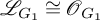 $\mathscr {L}_{G_1}\cong \mathscr {O}_{G_1}$
. If
 $T_{G_1} \subset \mathscr {F}_{U_1}|_{G_1}\cong \mathscr {O}_{G_1}^{\oplus n-1}$
, then
 $\Omega _{G_1}^1$
is generated by its global sections and hence
 $K_{G_1}$
is abundant. It follows from [Reference Ueno58, Theorem 5.13] that
 $K_G$
is abundant as well. Suppose now that
 $T_{G_1} \not \subset \mathscr {F}_{U_1}|_{G_1}$
. Then
 $T_{G_1} \cap (\mathscr {F}_{U_1}|_{G_1}) \subset T_{G_1}$
is a codimension
 $1$
foliation with trivial tangent bundle. Then
 $K_{G_1}$
is abundant by Proposition 3.18, using the fact that
 $K_{G_1}=K_X|_{G_1}$
is pseudo-effective. Again, by [Reference Ueno58, Theorem 5.13], we conclude that
 $K_G$
is abundant.
Suppose finally that
 $\mathscr {L}_{G_1}\not \equiv 0$
. By Lemma 2.21,
 $\mathscr {L}_{G_1}^*$
is nef. Moreover, by Proposition 3.2, there is a number
 $\lambda \in \mathbb {Q}$
such that
 $K_{G_1} \equiv \lambda c_1(\mathscr {L}_{G_1})$
. Observe that
 $\lambda \leqslant 0$
since
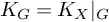 $K_G=K_X|_G$
is pseudo-effective. Since
 $h^0(G_1,\mathscr {L}_{G_1}^*)\geqslant 1$
, we see that
 $\kappa (G_1) \geqslant 0$
by [Reference Campana, Koziarz and Păun15, Corollary 3.2]. Notice also that
 $K_{G_1}$
and hence
 $K_G$
are nef. Then [Reference Ueno58, Theorem 5.13] implies that
 $\kappa (K_G) \geqslant 0$
. Write
 $K_G\sim _{\mathbb {Q}}\sum _{i \in I} b_i B_i$
with
 $b_i \in \mathbb {Q}_{>0}$
,
 $B_i$
irreducible and
 $B_i \neq B_j$
if
 $i\neq j$
. By Proposition 3.4 applied to
 $K_{G_1}=(g|_{G_1})^* K_G\sim _{\mathbb {Q}}\sum _{i \in I} b_i (g|_{G_1})^*B_i$
,
 $B_i$
is a finite étale quotient of an abelian variety and
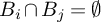 $B_i \cap B_j=\emptyset $
if
 $i\neq j$
. Moreover, we have
 $B_i^2\equiv 0$
. Then Proposition 3.14 applies to show that
 $K_G$
is abundant. This finishes the proof of the proposition.
7 Projectively flat foliations with nef conormal bundle
In this section, we address codimension
 $1$
regular foliations with numerically projectively flat tangent sheaf and nef conormal bundle. The proof of Theorem 7.2 below makes use of the following auxiliary result.
Lemma 7.1. Setting and notation as in 2.19. Suppose that X is an abelian scheme over a smooth projective base Y of dimension
 $m:=\dim Y \leqslant n-1$
, and denote by
 $f \colon X \to Y$
the natural morphism. Suppose in addition that
 $\mathscr {N}\cong f^*\mathscr {M}$
for some line bundle
 $\mathscr {M}$
on Y and that
 $T_{X/Y} \not \subseteq \mathscr {F}$
. Then f is isotrivial.
Proof. Let
 $\omega \in H^0(X,\Omega _X^1\otimes \mathscr {N})$
be a twisted
 $1$
-form defining
 $\mathscr {F}$
, and let
 $\Sigma \subset X$
be the neutral section of f. By assumption, the composition
 $\mathscr {F} \to T_X \to f^*T_Y$
is generically surjective. Notice that the sheaf
 $f_*T_{X/Y}$
is locally free of rank
 $n-m$
. Let F be a general fiber of f. The morphism
 $ \mathscr {O}_F^{\oplus n-m} \cong T_{X/Y}|_F \to \mathscr {N}|_F\cong \mathscr {O}_F$
induced by
 $\omega $
is generically surjective by assumption, and hence surjective. This implies that the saturation
 $\mathscr {E}$
of
 $f_*(\mathscr {F}\cap T_{X/Y})$
in
 $f_*T_{X/Y}$
has rank
 $n-m-1$
. Let
 $Y^\circ \subseteq Y$
be an open subset with complement of codimension at least
 $2$
such that
 $\mathscr {E}^\circ :=\mathscr {E}|_{Y^\circ }$
is a subbundle of
 $f_*T_{X/Y}$
. Set
 $X^\circ :=f^{-1}(Y^\circ )$
and
 $f^\circ :=f|_{X^\circ }$
. Then
 $(f^\circ )^*\mathscr {E}^\circ =\mathscr {F}^\circ \cap T_{X^\circ /Y^\circ }\subset T_{X^\circ /Y^\circ }$
since
 $\mathscr {F}^\circ \cap T_{X^\circ /Y^\circ }$
is saturated in
 $T_{X^\circ /Y^\circ }$
. In particular,
 $\mathscr {F}^\circ \cap T_{X^\circ /Y^\circ }$
is a subbundle of
 $\mathscr {F}^\circ $
. Set
 $\mathscr {Q}^\circ :=\mathscr {F}^\circ /(\mathscr {F}^\circ \cap T_{X^\circ /Y^\circ })$
. Notice also that
 $$ \begin{align*}\mathscr{Q}^\circ|_F \cong (f^*T_Y)|_F\cong \mathscr{O}_F^{\oplus m},\end{align*} $$
where F is a general fiber F of
 $f^\circ $
. In particular,
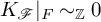 $K_{\mathscr {F}}|_F \sim _{\mathbb {Z}} 0$
. Then Lemma 3.9 applies to show that there exists a line bundle
 $\mathscr {K}$
on Y such that
 $\mathscr {O}_X(K_{\mathscr {F}})\cong f^*\mathscr {K}$
.
Let now F be any fiber of
 $f^\circ $
. Then the vector bundle
 $\mathscr {F}|_F$
is numerically flat since
 $K_{\mathscr {F}}|_F \sim _{\mathbb {Z}} 0$
. It follows that
 $\mathscr {Q}^\circ|_F$
is numerically flat as well. Then Lemma 2.15 applies to show that there exists a vector bundle
 $\mathscr {G}^\circ $
on
 $Y^\circ $
such that
 $\mathscr {Q}^\circ \cong (f^\circ )^*\mathscr {G}^\circ $
. By construction, there is an exact sequence
 $$ \begin{align*}0 \to (f^\circ)^*\mathscr{E}^\circ \to \mathscr{F}^\circ \to (f^\circ)^*\mathscr{G}^\circ \to 0.\end{align*} $$
Let again F be a general fiber of
 $f^\circ $
. To prove the statement, it suffices to show that the exact sequence
 $$ \begin{align} 0 \to T_{X/Y}|_F \to T_X|_F \to (f^*T_Y)|_F \to 0 \end{align} $$
splits. This is because complex flows of vector fields on analytic spaces exist. If the short exact sequence
 $$ \begin{align} 0 \to (f^\circ)^*\mathscr{E}^\circ|_F \to \mathscr{F}^\circ|_F \to (f^\circ)^*\mathscr{G}^\circ|_F \to 0 \end{align} $$
splits, then the exact sequence (7.1) splits as well, proving our claim. Suppose from now on that the exact sequence (7.2) does not split. Then the image of
 $\text {Id}_{\mathscr {G}^\circ }\in H^0(Y^\circ ,\mathscr {E} nd(\mathscr {G}^\circ ))$
under the connecting homomorphism
 $$ \begin{align*}H^0(Y^\circ,\mathscr{E} nd(\mathscr{G}^\circ)) \to R^1 f^\circ_*\big((f^\circ)^*\mathscr{E}^\circ\otimes((f^\circ)^*\mathscr{G}^\circ)^*\big) \cong R^1 f^\circ_*\mathscr{O}_{X^\circ} \otimes \mathscr{E}^\circ\otimes(\mathscr{G}^\circ)^*\end{align*} $$
is nonzero. Let C be a complete intersection curve of general elements of a very ample linear system on Y. By general choice of C, we have
 $C \subseteq Y^\circ $
since
 $Y \setminus Y^\circ $
has codimension at least
 $2$
. Moreover,
 $$ \begin{align*}\mu^{\text{max}}\big((R^1 f^\circ_*\mathscr{O}_{X^\circ} \otimes \mathscr{E}^\circ\otimes(\mathscr{G}^\circ)^*)|_C\big) \geqslant 0.\end{align*} $$
Then
 $$ \begin{align*} \mu^{\text{max}}\big((R^1 f^\circ_*\mathscr{O}_{X^\circ} \otimes \mathscr{E}^\circ\otimes(\mathscr{G}^\circ)^*)|_C\big) & = \mu^{\text{max}}\big(R^1 f^\circ_*\mathscr{O}_{X^\circ}|_C\big)+\mu^{\text{max}}\big(\mathscr{E}^\circ|_C\big)+\mu^{\text{max}}\big((\mathscr{G}^\circ)^*|_C\big)\\ & = \mu^{\text{max}}\big(R^1 f^\circ_*\mathscr{O}_{X^\circ}|_C\big)+\mu^{\text{max}}\big(\mathscr{E}^\circ|_C\big)-\mu^{\text{min}}\big(\mathscr{G}^\circ|_C\big), \end{align*} $$
and hence
 $$ \begin{align*}\mu^{\text{min}}\big(\mathscr{G}^\circ|_C\big) \leqslant \mu^{\text{max}}\big(R^1 f^\circ_*\mathscr{O}_{X^\circ}|_C\big)+\mu^{\text{max}}\big(\mathscr{E}^\circ|_C\big).\end{align*} $$
Since
 $(R^1 f_*\mathscr {O}_X)^*\cong f_*\Omega ^1_{X/Y}$
is nef (see [Reference Griffiths33, Theorem 5.2]), we have
 $$ \begin{align*}\mu^{\text{max}}\big(R^1 f^\circ_*\mathscr{O}_{X^\circ}|_C\big) \leqslant 0.\end{align*} $$
On the other hand, viewing C as a curve in
 $\Sigma $
, there is an exact sequence
 $$ \begin{align*}0 \to \mathscr{E}^\circ|_C \to \mathscr{F}^\circ|_C \to \mathscr{G}^\circ|_C \to 0.\end{align*} $$
It follows that
 $$ \begin{align*}\mu^{\text{max}}\big(\mathscr{E}^\circ|_C\big) \leqslant \mu(\mathscr{F}|_C) \leqslant \mu^{\text{min}}\big(\mathscr{G}^\circ|_C\big)\end{align*} $$
since
 $\mathscr {F}|_C$
is semistable by assumption. This gives
 $$ \begin{align*}\mu(\mathscr{F}|_C) \leqslant \mu^{\text{min}}\big(\mathscr{G}^\circ|_C\big)\leqslant \mu^{\text{max}}\big(R^1 f^\circ_*\mathscr{O}_{X^\circ}|_C\big)+\mu^{\text{max}}\big(\mathscr{E}^\circ|_C\big) \leqslant \mu^{\text{max}}\big(\mathscr{E}^\circ|_C\big) \leqslant \mu(\mathscr{F}|_C),\end{align*} $$
and hence
 $$ \begin{align*}\mu^{\text{max}}\big(R^1 f^\circ_*\mathscr{O}_{X^\circ}|_C\big) = 0 \quad \text{and}\quad \mu^{\text{max}}\big(\mathscr{E}^\circ|_C\big) = \mu(\mathscr{F}|_C) = \mu^{\text{min}}\big(\mathscr{G}^\circ|_C\big).\end{align*} $$
This implies that the vector bundle
 $f_*\Omega ^1_{X/Y}|_C$
is numerically flat. In particular, we have
 $\deg (f_*\mathscr {O}(K_{X/Y})|_C) = 0$
. Then [Reference Ueno59, Corollary 2.3] applies to show that f is isotrivial. This finishes the proof of the lemma.
The following is the main result of this section.
Theorem 7.2. Setting and notation as in 2.19. Suppose in addition that the conormal bundle
 $\mathscr {N}^*$
of
 $\mathscr {F}$
is nef. Then one of the following holds.
-
(1) There exists an abelian variety A as well as a finite étale cover
$\gamma \colon A \to X$
such that
$\gamma ^{-1}\mathscr {F}$
is a linear foliation. -
(2) There exists an abelian scheme
$f\colon B \to C$
onto a smooth complete curve of genus at least
$2$
as well as a finite étale cover
$\gamma \colon B \to X$
such that
$\gamma ^{-1}\mathscr {F}$
is induced by f. -
(3) The variety X is of general type, and
$\nu (K_{\mathscr {F}})=\dim X$
.



Proof. By Lemma 2.21,
 $\mathscr {F}^*$
is a nef vector bundle. This in turn implies that
 $\Omega _X^1$
is nef since
 $\mathscr {N}^*$
is nef by assumption. In particular,
 $K_X$
is nef. On the other hand,
 $K_X$
is abundant by Proposition 6.3. Then [Reference Kawamata43, Theorem 1.1] applies to show that
 $K_X$
is semiample. Moreover, by [Reference Höring39, Theorem 1.2], replacing X by a finite étale cover, if necessary, we may assume that X is an abelian scheme over a smooth projective variety Y with ample canonical divisor (see Lemma 2.17). Let us denote by
 $f\colon X \to Y$
the natural morphism and by
 $\Sigma $
any section of f. Set
 $m:= \dim Y$
.
Suppose that
 $m=0$
. Then X is an abelian variety. This easily implies
 $\mathscr {N}^* \cong \mathscr {O}_X$
. As a consequence,
 $\mathscr {F}$
is a linear foliation on X, and we are in case (1) of Theorem 7.2.
Suppose from now on that
 $m\geqslant 1$
.
Set
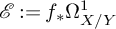 $\mathscr {E}:=f_*\Omega ^1_{X/Y}$
so that
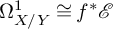 $\Omega ^1_{X/Y} \cong f^*\mathscr {E}$
. By [Reference Viehweg and Zuo60, Theorem 1 and Remark 2], we have
 $$ \begin{align} 2 \mu(\mathscr{E}) \leqslant \mu(\Omega^1_Y), \end{align} $$
where
 $\mu $
denotes the slope with respect to
 $K_Y$
, which is ample by construction. A celebrated theorem proved by Aubin and Yau moreover asserts that Y is Kähler–Einstein. As a consequence, the tangent bundle
 $T_Y$
is polystable with respect to
 $K_Y$
by a result proved by Kobayashi and Lübke independently.
The short exact sequences
 $$ \begin{align*}0\to \mathscr{N}^* \to \Omega^1_X \to \mathscr{F}^* \to 0\quad \text{and} \quad 0 \to f^*\Omega^1_Y \to \Omega^1_X \to \Omega^1_{X/Y} \to 0\end{align*} $$
give
 $$ \begin{align} \frac{\mu(\mathscr{N}^*|_\Sigma)+(n-1)\mu(\mathscr{F}^*|_\Sigma)}{n}=\mu(\Omega^1_X|_\Sigma)=\frac{m\mu(\Omega^1_Y)+(n-m)\mu(\mathscr{E})}{n}. \end{align} $$
Suppose first that the composition
 $\mathscr {N}^*|_\Sigma \to \Omega ^1_X|_\Sigma \to \Omega ^1_{X/Y}|_\Sigma \cong \mathscr {E}$
vanishes. Then
 $$ \begin{align*}\mathscr{N}^*|_\Sigma \subseteq f^*\Omega^1_Y|_\Sigma\cong \Omega^1_Y\end{align*} $$
and there exists a surjective morphism
 $$ \begin{align*}\mathscr{F}^*|_\Sigma \twoheadrightarrow f^*\mathscr{E}|_\Sigma\cong \mathscr{E}.\end{align*} $$
Moreover, by Lemma 2.14, the vector bundle
 $\mathscr {F}|_\Sigma $
is numerically projectively flat. It follows that
 $$ \begin{align*}\mu(\mathscr{N}^*|_\Sigma) \leqslant \mu(\Omega^1_Y) \quad \text{and} \quad \mu(\mathscr{F}^*|_\Sigma) \leqslant \mu(\mathscr{E}).\end{align*} $$
Then Equation (7.4) yields
 $$ \begin{align*}m\mu(\Omega^1_Y)+(n-m)\mu(\mathscr{E}) = \mu(\mathscr{N}^*|_\Sigma)+(n-1)\mu(\mathscr{F}^*|_\Sigma) \leqslant \mu(\Omega^1_Y) + (n-1)\mu(\mathscr{E}),\end{align*} $$
and hence, using Equation (7.3), we obtain
 $$ \begin{align*}(m-1)\mu(\Omega^1_Y) \leqslant (m-1)\mu(\mathscr{E}) \leqslant \frac{m-1}{2}\mu(\Omega^1_Y).\end{align*} $$
This immediately implies
 $m=1$
since
 $\mu (\Omega ^1_Y)>0$
. Moreover, we have
 $\mathscr {N}^*=f^*\Omega ^1_Y \subset \Omega _X^1$
. As a consequence,
 $\mathscr {F}$
is induced by f, and we are in case (2) of Theorem 7.2.
Suppose finally that the composition
 $\mathscr {N}^*|_\Sigma \to \Omega ^1_X|_\Sigma \to \Omega ^1_{X/Y}|_\Sigma \cong \mathscr {E}$
is nonzero. Then the composition
 $\mathscr {F}|_\Sigma \to T_X|_\Sigma \to f^*T_Y|_\Sigma \cong T_Y$
is generically surjective. Since the vector bundle
 $\mathscr {F}|_\Sigma $
is numerically projectively flat, we have
 $$ \begin{align} \mu(\Omega^1_Y) \leqslant \mu(\mathscr{F}^*|_\Sigma). \end{align} $$
Together with Equations (7.3) and (7.4), we obtain
 $$ \begin{align*} &2\mu(\mathscr{N}^*|_\Sigma)+2(n-1)\mu(\Omega^1_Y) \leqslant 2\mu(\mathscr{N}^*|_\Sigma)+2(n-1)\mu(\mathscr{F}^*|_\Sigma)=\\ &\quad 2m\mu(\Omega^1_Y)+2(n-m)\mu(\mathscr{E})\leqslant 2m\mu(\Omega^1_Y)+(n-m)\mu(\Omega^1_Y)=(n+m)\mu(\Omega^1_Y), \end{align*} $$
and thus
 $$ \begin{align*}(n-2-m)\mu(\Omega^1_Y)+2\mu(\mathscr{N}^*|_\Sigma) \leqslant 0.\end{align*} $$
Notice that
 $\mu (\mathscr {N}^*|_\Sigma )\geqslant 0$
since
 $\mathscr {N}^*$
is nef and that
 $\mu (\Omega ^1_Y)>0$
since
 $m\geqslant 1$
. In particular,
 $m \in \{n-2,n-1,n\}$
.
Claim 7.3. There exists a line bundle
 $\mathscr {M}$
on Y such that
 $\mathscr {N}^*\cong f^*\mathscr {M}$
.
Proof. Let F be a general fiber of f. The composition
 $\mathscr {N}^* \to \Omega ^1_X \to \Omega ^1_{X/Y}$
is nonzero by our current assumption and induces an injective map
 $\mathscr {N}^*|_F \to \Omega ^1_{X/Y}|_F\cong \mathscr {O}_F^{\oplus n-m}$
. Since
 $\mathscr {N}^*$
is nef, we have
 $\mathscr {N}^*|_F\cong \mathscr {O}_F$
. The claim now follows from Lemma 3.9.
Suppose that
 $m=n$
. Then
 $X=Y$
is of general type and
 $\nu (K_{\mathscr {F}})=\dim X$
by Lemma 7.4 below. We are in case (3) of Theorem 7.2.
Suppose that
 $m \in \{n-2,n-1\}$
. By Lemma 7.1, after replacing X by a finite étale cover, we may assume that
 $X \cong Y \times A$
for some abelian variety A of dimension
 $n-m\in \{1,2\}$
and that f is induced by the projection onto Y. Since the composition
 $\mathscr {N}^*|_\Sigma \to \Omega ^1_X|_\Sigma \to \Omega ^1_{X/Y}|_\Sigma \cong \mathscr {O}_\Sigma ^{\oplus n-m}$
is nonzero and
 $\mathscr {N}^*$
is nef, we have
 $\mathscr {N}\cong \mathscr {O}_X$
.
If
 $m=n-1$
, then
 $\mathscr {F}$
is everywhere transverse to f. This implies that
 $T_Y$
is numerically projectively flat. But then
 $K_Y\equiv 0$
by [Reference Jahnke and Radloff42, Theorem 0.1], yielding a contradiction.
Suppose finally that
 $m=n-2$
. Then Equations (7.3), (7.4) and (7.5) give
 $\mu (\mathscr {F}^*|_\Sigma ) = \mu (\Omega ^1_Y)$
and
 $2 \mu (\mathscr {E}) = \mu (\Omega ^1_Y)$
. Now, this is impossible since
 $\mu (\mathscr {E})=0$
and
 $\mu (\Omega ^1_Y)>0$
. This finishes the proof of the theorem.
Lemma 7.4. Setting and notation as in 2.19. Suppose in addition that X is of general type. Then
 $\nu (K_{\mathscr {F}}) = \dim X$
.
Proof. We argue by contradiction and assume that
 $\nu (K_{\mathscr {F}})\leqslant \dim X - 1$
. By Corollary 4.7,
 $\mathscr {N}^*$
is nef. It follows that
 $\Omega _X^1$
is nef since
 $\mathscr {F}^*$
is also nef by Lemma 2.21. This implies that X contains no rational curve, and hence
 $K_X$
is an ample divisor. A celebrated theorem proved independently to Aubin ([Reference Aubin2]) and Yau ([Reference Yau63]) then asserts that X is Kähler-Einstein. As a consequence, the tangent bundle
 $T_X$
is polystable with respect to
 $K_X$
by a result proved by Kobayashi and Lübke independently (see [Reference Kobayashi47, Theorem V.8.3] and the references therein).
Set
 $n:=\dim X$
. Then
 $$ \begin{align*}K_{\mathscr{F}}^n=(K_X+c_1(\mathscr{N}))^n=K_X^n+nK_X^{n-1}\cdot c_1(\mathscr{N})=0\end{align*} $$
since
 $K_{\mathscr {F}}=K_X+c_1(\mathscr {N})$
by the adjunction formula and
 $c_1(\mathscr {N})^2 = 0$
by Lemma 3.1. It follows that
 $\mu (\mathscr {N})=\mu (T_X)$
, where
 $\mu $
denotes the slope with respect to
 $K_X$
, and hence
 $T_X \cong \mathscr {F} \oplus \mathscr {N}$
since
 $T_X$
is polystable.
By Lemma 7.5 (1) below, we then have
 $$ \begin{align*}(2nc_2(\mathscr{F})-(n-1)c_1(\mathscr{F})^2)\cdot K_X^{n-2} \geqslant 0.\end{align*} $$
Since
 $c_2(\mathscr {F})=\frac {n-2}{2(n-1)}c_1(\mathscr {F})$
(see Lemma 2.7), we obtain
 $$ \begin{align*}c_1(\mathscr{F})^2\cdot K_X^{n-2}=0.\end{align*} $$
But this contradicts Lemma 7.5 (2) below, finishing the proof of the lemma.
Lemma 7.5. Let X be a complex projective manifold with
 $K_X$
ample, and let
 $\Omega ^1_X:=\mathscr {A}\oplus \mathscr {B}$
be a decomposition of
 $\Omega ^1_X$
into locally free subsheaves. Suppose that
 $\mathscr {A}$
has rank
 $a \geqslant 2$
, and set
 $n:=\dim X$
. Then
-
(1)
$(2(a+1)c_2(\mathscr {A})-a c_1(\mathscr {A})^2)\cdot K_X^{n-2} \geqslant 0$
, and -
(2)
$c_1(\mathscr {A})^2\cdot K_X^{n-2}> 0$
.


Proof. Let
 $\mathscr {E}:=\Omega _X^1\oplus \mathscr {O}_X$
equipped with the Higgs field
 $\vartheta $
defined by
 $$ \begin{align*}\Omega_X^1\oplus \mathscr{O}_X \ni \alpha+f \mapsto (0 + 1)\otimes \alpha \in (\Omega_X^1\oplus \mathscr{O}_X)\otimes\Omega_X^1.\end{align*} $$
Notice that
 $\vartheta (\mathscr {A}\oplus \mathscr {O}_X) \subset (\mathscr {A}\oplus \mathscr {O}_X)\otimes \Omega _X^1$
so that
 $(\mathscr {G}:=\mathscr {A}\oplus \mathscr {O}_X,\vartheta|_{\mathscr {G}})$
is a Higgs bundle as well.
Arguing as in the proof of Lemma 7.4 above, we see that
 $T_X$
is polystable with respect to
 $K_X$
. This in turn implies that
 $\mathscr {A}$
is polystable with respect to
 $K_X$
with
 $\mu (\mathscr {A})=\mu (\Omega _X^1)>0$
, where
 $\mu $
denotes the slope with respect to
 $K_X$
.
Next, we show that the Higgs bundle
 $(\mathscr {G},\vartheta|_{\mathscr {G}})$
is stable with respect to
 $K_X$
. Let
 $\mathscr {H} \subset \mathscr {G}$
be a saturated subsheaf of rank
 $0 < r < a+1$
preserved by
 $\vartheta|_{\mathscr {G}}$
, and let
 $p\colon \mathscr {H} \to \mathscr {O}_X$
be the composition
 $\mathscr {H} \to \mathscr {G}=\mathscr {A} \oplus \mathscr {O}_X \to \mathscr {O}_X$
. Observe that p is not the zero map since
 $\mathscr {H}$
is preserved by
 $\vartheta|_{\mathscr {G}}$
by assumption.
If p is injective, then
 $\mu (\mathscr {H}) \leqslant 0 < \mu (\mathscr {G})=\frac {a}{a+1}\mu (\mathscr {A})$
. Suppose that p is not injective. Note that we must have
 $r\geqslant 2$
and
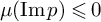 $\mu (\text {Im}\, p) \leqslant 0$
. Moreover,
 $\mu (\text {Ker}\,p)\leqslant \mu (\mathscr {A})$
since
 $\text {Ker}\, p \subseteq \mathscr {A}$
and
 $\mathscr {A}$
is polystable with respect to
 $K_X$
. Then, we have
 $$ \begin{align*}\mu(\mathscr{H}) =\frac{(r-1)\mu(\text{Ker}\,p)+\mu(\text{Im}\, p)}{r} \leqslant \frac{r-1}{r}\mu(\mathscr{A})=\frac{r-1}{r}\frac{a+1}{a}\mu(\mathscr{G})\leqslant \frac{a^2-1}{a^2}\mu(\mathscr{G})<\mu(\mathscr{G}),\end{align*} $$
proving our claim.
Item (1) now follows from [Reference Simpson53, Theorem 1 and Proposition 3.4].
Let
 $b \geqslant 0$
denote the rank of
 $\mathscr {B}$
. By [Reference Beauville7, Lemma 3.1], we have
 $c_1(\mathscr {A})^{a+1}\equiv 0$
and
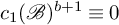 $c_1(\mathscr {B})^{b+1}\equiv 0$
. Then
 $$ \begin{align*}c_1(\mathscr{A})^2\cdot K_X^{n-2} = c_1(\mathscr{A})^2\cdot (c_1(\mathscr{A})+c_1(\mathscr{B}))^{n-2} = \binom{n-2}{b} c_1(\mathscr{A})^a\cdot c_1(\mathscr{B})^b,\end{align*} $$
and
 $$ \begin{align*}K_X^n = \binom{n}{b} c_1(\mathscr{A})^a\cdot c_1(\mathscr{B})^b.\end{align*} $$
It follows that
 $c_1(\mathscr {A})^2)\cdot K_X^{n-2}> 0$
since
 $K_X^n>0$
by assumption, proving Item (2).
Kodaira fibrations provide examples of regular foliations by curves
 $\mathscr {F}$
on surfaces of general type with
 $\kappa (\mathscr {F})=2$
. However, no example of foliations satisfying the conclusion of Theorem 7.2 (3) is known to the author. Let us show that these foliations have no compact leaves.
Proposition 7.6. Setting and notation as in 2.19. Suppose in addition that
 $K_X$
is pseudo-effective and that
 $\mathscr {F}$
has a compact leaf. Then
 $\kappa (X)=\nu (X)\in \{0,1\}$
.
Proof. By Proposition 6.3,
 $K_X$
is abundant. Let B denote an algebraic leaf of
 $\mathscr {F}$
. Then B is a finite étale quotient of an abelian variety by [Reference Jahnke and Radloff42, Theorem 0.1]. Moreover,
 $\mathscr {N}|_B\cong \mathscr {O}_X(B)|_B$
is a flat vector bundle by Lemma 3.1. This immediately implies that
 $B^2 \equiv 0$
. Proposition 7.7 below then applies to show that
 $\nu (X)\leqslant 1$
, completing the proof of the proposition.
We refer to [Reference Kollár and Mori45] and [Reference Kawamata, Matsuda and Matsuki46] for standard references concerning the minimal model program.
Proposition 7.7. Let X be a complex projective manifold of dimension
 $n \geqslant 2$
with
 $\kappa (X)=\nu (X)\geqslant 0$
. Suppose that there exists a smooth prime divisor
 $B \subset X$
with
 $K_B \equiv 0$
and
 $B^2\equiv 0$
. Then
 $\nu (X)\leqslant 1$
.
Proof. By [Reference Gongyo and Lehmann32, Theorem 4.3], we may run a minimal model program for X and end with a minimal model. Hence, there exists a birational map
 $\varphi \colon X \dashrightarrow Y$
, where Y is a normal
 $\mathbb {Q}$
-factorial projective variety with
 $K_Y$
nef. Moreover, Y has terminal singularities, and
 $\varphi ^{-1}$
does not contract any divisor. Let
 $p\colon Z \to X$
and
 $q\colon Z \to Y$
be a common resolution of singularities. Let C be the strict transform of B in Z. If B is contracted by
 $\varphi $
, then it is uniruled by [Reference Kawamata44, Theorem 1], yielding a contradiction since
 $K_B\equiv 0$
by assumption. Set
 $D:=\varphi _*B$
.
Let
 $\varepsilon \in \mathbb {Q}$
be a positive number such that
 $\varphi $
is a minimal model program for
 $K_X+\varepsilon B$
. By [Reference Kollár and Mori45, Lemma 3.38], there exists an effective q-exceptional
 $\mathbb {Q}$
-divisor F such that
 $$ \begin{align*}p^*(K_X+\varepsilon B) = q^* (K_Y+\varepsilon D) + F.\end{align*} $$
Moreover, by the negativity lemma, there exists an effective q-exceptional
 $\mathbb {Q}$
-divisor G such that
 $$ \begin{align*}p^*B+G=q^*D\end{align*} $$
since B is nef. Notice also that
 $K_X|_B\equiv 0$
by the adjunction formula
 $K_B=(K_X+B)|_B$
. We then have
 $$ \begin{align*}0 \equiv p^*(K_X+\varepsilon B)|_C = q^*(K_Y+\varepsilon D)|_C + F|_C \equiv (q^* K_Y)|_C + \varepsilon G|_C +F|_C. \end{align*} $$
Since
 $G|_C +F|_C$
is effective and
 $(q^* K_Y)|_C$
is nef, we have
 $$ \begin{align*}K_Y|_D \equiv 0\quad\text{and}\quad G \cap C =\emptyset.\end{align*} $$
This immediately implies
 $D^2\equiv 0$
. Now, we have
 $\kappa (X)=\kappa (Y)$
and
 $\nu (X)=\nu (Y)$
by [Reference Nakayama52, Proposition V.2.7], and hence
 $\kappa (Y)=\nu (Y)$
. Then [Reference Kawamata43, Theorem 1.1] applies to show that
 $K_Y$
is semiample. We denote the Iitaka fibration of Y by
 $f \colon Y \to T$
. Since
 $K_Y|_D \equiv 0$
, we have
 $\dim f(D)=0$
. If
 $\dim T =0$
, then
 $\nu (X)= 0$
and there is nothing to show. If
 $\dim T \geqslant 1$
, then Lemma 3.13 applies to show
 $\nu (X)= 1$
. This finishes the proof of the proposition.
8 The nef reduction map
In this section, we provide a technical tool for the proof of Theorem 9.1 below. We briefly recall the relevant notions first. Let X be a smooth projective variety, and let
 $\mathscr {L}$
be a nef line bundle on X. Then there exists an almost proper, dominant rational map
 $f \colon X \dashrightarrow Y$
such that
-
(1)
$\mathscr {L}|_F \equiv 0$
for a general fiber F of f, -
(2) for every general point
$x \in X$
and every irreducible curve C passing through x with
$\dim f(C) = 1$
, we have
$\mathscr {L} \cdot C> 0$
.


The map f is unique up to birational equivalence of Y. We refer to it as the nef reduction map of
 $\mathscr {L}$
. The dimension of Y is an invariant of
 $\mathscr {L}$
called the nef dimension. We write
 $\text {nd}(\mathscr {L}):=\dim Y$
. We have
 $\kappa (\mathscr {L})\leqslant \nu (\mathscr {L})\leqslant \text {nd}(\mathscr {L})$
. We refer to [Reference Bauer, Campana, Eckl, Kebekus, Peternell, Rams, Szemberg and Wotzlaw4] for further explanations concerning these notions. Let
 $\mathscr {F}$
be a regular foliation on a complex projective manifold and suppose that
 $\mathscr {F}$
satisfies all the conditions listed in Setup 2.19. Recall from Lemma 2.21 that
 $K_{\mathscr {F}}$
is nef. Then Proposition 8.1 below gives sufficient conditions that guarantee
 $\text {nd}(K_{\mathscr {F}})< \dim X$
.
Proposition 8.1. Setting and notation as in 2.19. Suppose in addition that
 $K_X$
is nef and that
 $\mathscr {N}$
is pseudo-effective. Set
 $m:=\min (\nu (K_X),n-2)$
. Then
 $\nu (K_X) \leqslant n-1$
and
 $\text {nd}(K_{\mathscr {F}})\leqslant m+1\leqslant n-1$
.
Proof. Let us first show
 $\nu (K_X) \leqslant n-1$
. Let H be an ample divisor on X. By [Reference Guenancia and Taji35, Theorem B], we have
 $$ \begin{align*}\Big(c_2(X)-\frac{n}{2(n+1)}c_1(X)^2\Big)\cdot K_X^m\cdot H^{n-2-m} \geqslant 0.\end{align*} $$
We have
 $$ \begin{align*}c_2(X)= c_2(\mathscr{F})+c_1(\mathscr{F})\cdot c_1(\mathscr{N})\quad\text{and}\quad c_1(X)^2\equiv c_1(\mathscr{F})^2+2c_1(\mathscr{F})\cdot c_1(\mathscr{N})\end{align*} $$
since
 $c_1(\mathscr {N})^2\equiv 0$
by Lemma 3.1. In addition, we have
 $$ \begin{align*}c_2(\mathscr{F})\equiv \frac{n-2}{2(n-1)}c_1(\mathscr{F})^2\end{align*} $$
by [Reference Jahnke and Radloff42, Proposition 1.1]. We obtain
 $$ \begin{align} \Big(-\frac{1}{n^2-1}c_1(\mathscr{F})^2+\frac{1}{n+1}c_1(\mathscr{F})\cdot c_1(\mathscr{N})\Big)\cdot K_X^m\cdot H^{n-2-m} \geqslant 0. \end{align} $$
On the other hand,
 $K_{\mathscr {F}}=-c_1(\mathscr {F})$
is nef by Lemma 2.21. This immediately implies
 $$ \begin{align*}-c_1(\mathscr{F})^2 \cdot K_X^m\cdot H^{n-2-m} \leqslant 0\end{align*} $$
and
 $$ \begin{align*}c_1(\mathscr{F})\cdot c_1(\mathscr{N})\cdot K_X^m\cdot H^{n-2-m} \leqslant 0\end{align*} $$
since
 $\mathscr {N}$
is pseudo-effective by assumption. Equation (8.1) then gives
 $$ \begin{align} c_1(\mathscr{F})^2 \cdot K_X^m\cdot H^{n-2-m}=c_1(\mathscr{F})\cdot c_1(\mathscr{N})\cdot K_X^m\cdot H^{n-2-m}=0. \end{align} $$
Therefore, we have
 $K_X^{m+2}\cdot H^{n-2-m}=0$
, and hence
 $K_X^{n}=0$
since
 $m=\min (\nu (K_X),n-2)$
. This shows
 $\nu (K_X)\leqslant n-1$
.
Let us now show
 $\text {nd}(K_{\mathscr {F}}) \leqslant m+1$
. If
 $\mathscr {F}$
is algebraically integrable, then
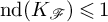 $\text {nd}(K_{\mathscr {F}}) \leqslant 1$
by Proposition 3.20. Suppose from now on that
 $\mathscr {F}$
is not algebraically integrable.
By Proposition 6.3 and [Reference Kawamata43, Theorem 1.1] together,
 $K_X$
is semiample. We denote the Iitaka fibration by
 $f\colon X \to Y$
. Let F be a general fiber of f. Then F is smooth. By construction, there exists an ample divisor A on Y such that
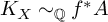 $K_X \sim _{\mathbb {Q}} f^*A$
. In particular, we have
 $K_F \sim _{\mathbb {Q}} 0$
by the adjunction formula.
Suppose first that
 $m = \dim Y = \nu (K_X) \leqslant n-2$
.
Then
 $c_2(T_X|_F)\cdot H|_F^{n-2-m}=\frac {1}{A^m} c_2(X)\cdot K_X^m\cdot H^{n-2-m}=0$
by Equation (8.2). The exact sequence
 $$ \begin{align*}0 \to T_F\to T_X|_F\to \mathscr{N}_{F/X}\cong \mathscr{O}_F^{\oplus m }\to 0\end{align*} $$
then gives
 $c_2(T_F)\cdot H|_F^{n-2-m}=0$
. As a classical consequence of Yau’s theorem on the existence of a Kähler–Einstein metric, F is then covered by a complex torus (see [Reference Kobayashi47, Chapter IV Corollary 4.15]). Thus, there exist an abelian variety
 $F_1$
of dimension at least
 $2$
and a finite étale cover
 $\eta \colon F_1 \to F$
. Then [Reference Greb, Kebekus and Peternell31, Proposition 3.3] applies to show that there exists a line bundle
 $\mathscr {L}_1$
on
 $F_1$
as well as a flat vector bundle
 $\mathscr {G}_1$
on
 $F_1$
such that
 $\eta ^*(\mathscr {F}|_F) \cong \mathscr {G}_1 \otimes \mathscr {L}_1$
. In addition,
 $\mathscr {G}_1$
admits a filtration
 $0=F_0\mathscr {G}_1 \subsetneq F_1\mathscr {G}_1 \subsetneq \cdots \subsetneq F_{n-1}\mathscr {G}_1=\mathscr {G}_1$
by flat subbundles
 $F_i\mathscr {G}_1$
with
 $\text {rank}\, F_i\mathscr {G}_1 = i$
. By Equation (8.2), we have
 $$ \begin{align} c_1(\eta^*(\mathscr{F}|_F))^2\cdot \eta^*(H|_F)^{n-2-m} = 0. \end{align} $$
If
 $K_{\mathscr {F}}|_F\equiv 0$
, then
 $\text {nd}(K_{\mathscr {F}}) \leqslant \dim Y = m \leqslant m+1$
.
Suppose that
 $K_{\mathscr {F}}|_F\not \equiv 0$
.
If
 $m=0$
, then
 $F=X$
and there exists a generically surjective morphism
 $\Omega ^1_{F_1} \to \eta ^*(\mathscr {F}|_F)^*$
. This immediately implies
 $h^0(F_1,\mathscr {O}_{F_1}(\eta ^*(K_{\mathscr {F}}|_F)))\geqslant 1$
. Then [Reference Debarre18, Théorème VI.5.1] applies to show that the line bundle
 $\mathscr {O}_{F_1}(\eta ^*(K_{\mathscr {F}}|_F))$
is semiample. Notice that
 $\nu (\mathscr {O}_{F_1}(\eta ^*(K_{\mathscr {F}}|_F))) = 1$
by Equation (8.3). This easily implies
 $\text {nd}(K_{\mathscr {F}}) =1 = m+1$
.
Suppose that
 $m\geqslant 1$
. Since
 $\mathscr {F}$
is not algebraically integrable by our current assumption, the composition
 $\mathscr {F}|_F \to T_X|_F \to \mathscr {N}_{F/X}\cong \mathscr {O}_F^{\oplus m}$
is nonzero. As a consequence, there is an index
 $1 \leqslant i \leqslant n-1$
such that the line bundle
 $\mathscr {Q}_i:=\big ((F_{i+1}\mathscr {G}_1/F_i\mathscr {G}_1)\otimes \mathscr {L}_1\big )^*$
has a nonzero global section. Then [Reference Debarre18, Théorème VI.5.1] again applies to show that
 $\mathscr {Q}_i$
is semiample. We have
 $\nu (\mathscr {Q}_i)=1$
since
 $c_1(\mathscr {Q}_i) \equiv c_1(\mathscr {L}_1) \equiv \frac {1}{n-1}\eta ^*(K_{\mathscr {F}}|_F)$
. This implies
 $\text {nd}(K_{\mathscr {F}}) \leqslant \dim Y+1 = m+1$
.
Suppose finally that
 $\nu (K_X) = n-1$
. In particular,
 $m=n-2$
.
Then F is a smooth curve of genus
 $1$
. By Equation (8.2), we have
 $$ \begin{align*}K_{\mathscr{F}}\cdot F = \frac{1}{A^{n-1}} K_{\mathscr{F}}\cdot K_X^{n-1}= \frac{1}{A^{n-1}}c_1(\mathscr{F})\cdot (c_1(\mathscr{F})+c_1(\mathscr{N})) \cdot K_X^{n-2}=0.\end{align*} $$
As before, this implies
 $\text {nd}(K_{\mathscr {F}}) \leqslant n-1 = m+1$
, completing the proof of Proposition 8.1.
The following is the main result of this section.
Proposition 8.2. Setting and notation as in 2.19. Suppose in addition that
 $K_X$
is nef and that
 $\mathscr {N}$
is pseudo-effective. Then, there exist an abelian scheme
 $f_1 \colon X_1 \to Y_1$
over a smooth projective base and a finite étale cover
 $\gamma \colon X_1 \to X$
such that
 $f_1$
is the nef reduction map of
 $\gamma ^*K_{\mathscr {F}}$
. Moreover, there exist line bundles
 $\mathscr {M}_1$
and
 $\mathscr {K}_1$
on
 $Y_1$
such that
 $\gamma ^*\mathscr {N} \cong f_1^*\mathscr {M}_1$
and
 $\gamma ^*\mathscr {O}_X(K_{\mathscr {K}}) \cong f_1^*\mathscr {K}_1$
. In addition, if
 $F_1$
is a general fiber of
 $f_1$
, then
 $(\gamma ^{-1}\mathscr {F})|_{F_1} \cap T_{F_1}$
is a linear foliation on
 $F_1$
of codimension at most
 $1$
.
Proof. For the reader’s convenience, the proof is subdivided into a number of steps. Let
 $$ \begin{align*}f \colon X \dashrightarrow Y\end{align*} $$
be the nef reduction map of
 $K_{\mathscr {F}}$
. By Proposition 8.1 above, we have
 $m:=\dim Y \leqslant n-1$
.
Step 1. Fibers of the nef reduction map.
Let us show that a general fiber F of f is a finite étale quotient of an abelian variety and that
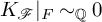 $K_{\mathscr {F}}|_F \sim _{\mathbb {Q}}0$
. Then
 $\mathscr {N}|_F$
is a torsion line bundle by the adjunction formula
 $K_{\mathscr {F}}=K_X+c_1(\mathscr {N})$
.
Suppose first that F is a very general fiber. Then
 $\mathscr {N}|_F$
is pseudo-effective while
 $K_X|_F$
is nef and
 $K_{\mathscr {F}}|_F\equiv 0$
by construction. It follows that
 $K_X|_F\equiv 0$
and
 $\mathscr {N}|_F\equiv 0$
since
 $K_{\mathscr {F}}=K_X+c_1(\mathscr {N})$
by the adjunction formula. Let now F be a general fiber of f. By [Reference Druel and Guenancia20, Lemma 2.13], we have
 $K_X|_F\equiv 0$
. By the adjunction formula again, we have
 $\mathscr {N}|_F\equiv 0$
. Now, the vector bundle
 $\mathscr {F}|_F$
is numerically flat by Theorem 2.11 since
 $K_{\mathscr {F}}|_F\equiv 0$
. It follows that the composition
 $$ \begin{align*} \mathscr{F}|_F \to T_X|_F \to \mathscr{N}_{F/X}\cong \mathscr{O}_F^{\oplus m} \end{align*} $$
has constant rank, and hence
 $\mathscr {F}|_F\cap T_F$
is a numerically flat subbundle of
 $T_F$
.
If
 $T_F \subseteq \mathscr {F}|_F$
, then F is a finite étale quotient of an abelian variety by [Reference Kobayashi47, Chapter IV Corollary 4.15]. Moreover,
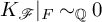 $K_{\mathscr {F}}|_F \sim _{\mathbb {Q}}0$
since
 $\mathscr {F}|_F/ T_F \subset \mathscr {N}_{F/X}\cong \mathscr {O}_F^{\oplus m}$
is numerically flat.
Suppose that
 $\mathscr {F}|_F\cap T_F \subsetneq T_F$
. Then F is again a finite étale quotient of an abelian variety by Proposition 3.18 since
 $K_F\equiv K_X|_F\equiv 0$
by the adjunction formula. Moreover,
 $K_{\mathscr {F}|_F\cap T_F}\sim _{\mathbb {Q}} 0$
, and hence
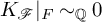 $K_{\mathscr {F}}|_F \sim _{\mathbb {Q}}0$
since
 $\mathscr {F}|_F/(\mathscr {F}|_F\cap T_F) \cong \mathscr {N}_{F/X}\cong \mathscr {O}_F^{\oplus m}$
. This proves our claim.
Step 2. Next, we show that X has generically large fundamental group on F.
We argue by contradiction and assume that X does not have generically large fundamental group on F. There exists a positive-dimensional finite étale quotient of an abelian variety
 $G \subseteq F$
passing through a general point of F such that the image of the natural morphism
 $\pi _1(G) \to \pi _1(X)$
is finite. By [Reference Kollár48, 3.10], the algebraic varieties G fit together to form an almost proper rational map
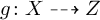 $g \colon X \dashrightarrow Z$
such that f factorizes through g. Let
 $X^\circ \subseteq X$
and
 $Z^\circ \subseteq Z$
be dense open sets such that the restriction
 $g^\circ \colon X^\circ \to Z^\circ \subseteq Z$
of g to
 $X^\circ $
is a smooth projective morphism with connected fibers. Shrinking
 $Z^\circ $
, we may assume that there exists a finite étale cover
 $X_1^\circ \to X^\circ $
such that the fibration
 $g_1^\circ \colon X_1^\circ \to Z_1^\circ $
obtained as the Stein factorization of the composition
 $X_1^\circ \to X^\circ \to Z^\circ $
is an abelian scheme equipped with a level three structure (see Lemma 3.7). We obtain a diagram as follows:

Let
 $G_1$
be a fiber of
 $g_1^\circ $
. There is a split exact sequence of fundamental groups

Let
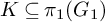 $K \subseteq \pi _1(G_1)$
denotes the kernel of the representation
 $$ \begin{align*}\pi_1(G_1) \to \pi_1(X_1^\circ) \to \pi_1(X) \to \text{PGL}(n-1,\mathbb{C})\end{align*} $$
induced by
 $\rho $
. Then the subset
 $K \cdot \pi _1(Z_1^\circ )$
of
 $\pi _1(X_1^\circ )$
is a (normal) subgroup. Moreover, it has finite index since the image of the composition
 $\pi _1(G_1) \to \pi _1(X_1^\circ ) \to \pi _1(X)$
is finite by our current assumption. Therefore, replacing
 $X_1^\circ $
by a further finite étale cover, if necessary, we may assume that the representation
 $$ \begin{align*}\pi_1(X_1^\circ) \to \pi_1(X) \to \text{PGL}(n-1,\mathbb{C})\end{align*} $$
induced by
 $\rho $
factorizes through
 $Z_1^\circ $
. Shrinking
 $Z_1^\circ $
, if necessary, we may assume in addition that
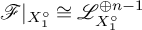 $\mathscr {F}|_{X_1^\circ }\cong \mathscr {L}_{X_1^\circ }^{\oplus n-1}$
for some line bundle
 $\mathscr {L}_{X_1^\circ }$
on
 $X_1^\circ $
. Notice that by construction,
 $\mathscr {L}_{X_1^\circ }|_{G_1} \equiv 0$
. The short exact sequence
 $$ \begin{align*}0 \to T_{G_1} \cong \mathscr{O}_{G_1}^{\oplus n-m} \to T_{X_1^\circ}|_{G_1} \to \mathscr{N}_{G_1/X_1^\circ}\cong \mathscr{O}_{G_1}^{\oplus m} \to 0\end{align*} $$
then shows that
 $\mathscr {L}_{X_1^\circ }|_{G_1}\cong \mathscr {O}_{G_1}$
. Therefore, shrinking
 $Z^\circ $
, we may assume that
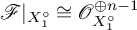 $\mathscr {F}|_{X_1^\circ }\cong \mathscr {O}_{X_1^\circ }^{\oplus n-1}$
.
Claim 8.3. The fibration
 $g_1^\circ $
is locally trivial for the analytic topology, and hence
 $X_1^\circ /Z_1^\circ \cong Z_1^\circ \times A/Z_1^\circ $
for some positive-dimensional abelian variety A.
Proof of Claim 8.3.
Suppose first that
 $T_{G}\subseteq \mathscr {F}|_{G}$
for a general fiber G of g.
Then, there exists a regular foliation
 $\mathscr {G}^\circ $
on
 $Z^\circ $
such that
 $\mathscr {F}|_{X^\circ }=(g^\circ )^{-1}\mathscr {G}^\circ $
. Let
 $L_1$
be a leaf of
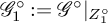 $\mathscr {G}_1^\circ :=\mathscr {G}^\circ|_{Z_1^\circ }$
, and set
 $M_1:=(g_1^\circ )^{-1}(L_1)$
. Notice that
 $M_1$
is a leaf of
 $\mathscr {F}|_{X_1^\circ }$
. By construction, there is an exact sequence:
 $$ \begin{align*}0 \to T_{M_1/L_1} \to \mathscr{F}|_{M_1}\cong T_{M_1} \to (g_1^\circ|_{M_1})^*T_{L_1}\to 0.\end{align*} $$
Since
 $\mathscr {F}|_{X_1^\circ }\cong \mathscr {O}_{X_1^\circ }^{\oplus n-1}$
, the above exact sequence is locally split. A classical result of complex analysis says that complex flows of vector fields on analytic spaces exist. As a consequence, the fibration
 $g_1^\circ|_{M_1}\colon M_1 \to L_1$
is locally trivial for the analytic topology. Let
 $\mathscr {A}(3)$
be the fine moduli space of polarized abelian varieties with a level three structure, and let
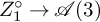 $Z_1^\circ \to \mathscr {A}(3)$
be the morphism corresponding to
 $g_1^\circ $
. Then every leaf of
 $\mathscr {G}_1^\circ $
is contained in a fiber of
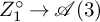 $Z_1^\circ \to \mathscr {A}(3)$
. Thus, either
 $\mathscr {G}_1^\circ $
has algebraic leaves, or the morphism
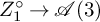 $Z_1^\circ \to \mathscr {A}(3)$
is constant. In the former case,
 $\mathscr {F}$
is algebraically integrable. By Proposition 3.20, we must have
 $K_{\mathscr {F}}\equiv 0$
and
 $F=X$
is a finite étale quotient of an abelian variety since
 $\mathscr {N}$
is pseudo-effective by assumption. In particular, X has generically large fundamental group on F, yielding a contradiction. In the latter case,
 $X_1^\circ /Z_1^\circ \cong Z_1^\circ \times A/Z_1^\circ $
for some positive-dimensional abelian variety A, proving the claim in this case.
Suppose now that
 $T_{G}\not \subseteq \mathscr {F}|_{G}$
for a general fiber G of g.
Then the composition
 $$ \begin{align*} \mathscr{F}|_{G_1}\cong \mathscr{O}_{G_1}^{\oplus n-1} \to T_{X_1^\circ}|_{G_1} \to (g_1^\circ)^*T_{Z_1^\circ}|_{G_1}\cong \mathscr{O}_{G_1}^{\oplus \dim Z^\circ} \end{align*} $$
is generically surjective, and hence surjective. This immediately implies that the exact sequence
 $$ \begin{align*}0 \to T_{X_1^\circ/Z_1^\circ} \to T_{X_1^\circ} \to (g_1^\circ)^*T_{Z_1^\circ} \to 0\end{align*} $$
is locally split. As before, it follows that the fibration
 $g_1^\circ $
is locally trivial for the analytic topology, and hence
 $X_1^\circ /Z_1^\circ \cong Z_1^\circ \times A/Z_1^\circ $
for some positive-dimensional abelian variety A. This finishes the proof of Claim 8.3.
Let W be the normalization of the closed subvariety of the Chow variety of X whose general point parametrizes a general fiber of g, and let U be the normalization of the universal cycle. By Claim 8.3, the morphism p is generically isotrivial. Hence, there exists a smooth projective variety
 $W_1$
as well as a generically finite morphism
 $\eta \colon W_1 \to W$
and a rational map
 $W_1\times A \dashrightarrow U$
fitting into the following commutative diagram:

Claim 8.4. The map
 $W_1 \times A \dashrightarrow U$
is a morphism.
Proof. Let
 $p_1\colon Z \to W_1\times A$
be a composition of a finite number of blow-ups with smooth centers such that the induced rational map
 $q_1\colon Z \to U$
is a morphism. Let
 $Z_{(w_1,a)}$
be a positive-dimensional fiber of
 $p_1$
over
 $(w_1,a)\in W_1\times A$
. Then
 $Z_{(w_1,a)}$
is rationally chain connected, and the composition
 $$ \begin{align*}q_1(Z_{(w_1,a)}) \subseteq U_{\eta(w_1)} \to X\end{align*} $$
is finite, where
 $U_{\eta (w_1)}$
denotes the fiber of p over the point
 $\eta (w_1)$
. Thus, if
 $\dim q_1(Z_{(w_1,a)}) \geqslant 1$
, then
 $U_{\eta (w_1)}$
contains a rational curve C such that
 $\dim q(C) \geqslant 1$
. By Corollary 3.12, we must have
 $q(C)\cdot K_{\mathscr {F}}=0$
. But this contradicts Lemma 3.17 since
 $K_X$
is nef by assumption. Therefore, every fiber of
 $p_1$
is contracted by
 $q_1$
. Our claim now follows from the rigidity lemma (see [Reference Debarre19, Lemma 1.15]).
A consequence of Claim 8.4 is that every fiber of p is irreducible. This implies that the exceptional locus E of q satisfies
 $E=p^{-1}(p(E))$
. Set
 $X^{\bullet }:=X \setminus q(E)$
and
 $W^{\bullet }:=W \setminus p(E)$
. Then the rational map
 $p\circ q^{-1}$
induces an equidimensional morphism
 $p^{\bullet }\colon X^{\bullet } \to W^{\bullet }$
with irreducible fibers. By construction,
 $X \setminus X^{\bullet }$
has codimension at leat
 $2$
. Shrinking
 $W^{\bullet }$
, if necessary, we may assume without loss of generality that
 $W^{\bullet }$
is smooth and that there exists a smooth divisor
 $D^{\bullet }$
on
 $W^{\bullet }$
such that the restriction of
 $p^{\bullet }$
to
 $(p^{\bullet })^{-1}(W^{\bullet }\setminus D^{\bullet })$
is a smooth morphism. Notice that every smooth fiber of
 $p^{\bullet }$
is a finite étale quotient of an abelian variety by Lemma 3.7.
Claim 8.5. Let
 $w\in D^{\bullet }$
be a general point. Then the fiber
 $(p^{\bullet })^{-1}(w)$
(with its reduced structure) is a finite étale quotient of an abelian variety.
Proof of Claim 8.5.
The statement is local on
 $D^{\bullet }$
, hence we may shrink
 $W^{\bullet }$
and assume that
 $D^{\bullet }$
is irreducible. Let m denote the multiplicity of
 $(p^{\bullet })^*D^{\bullet }$
, and let
 $\gamma ^{\bullet }\colon W_1^{\bullet } \to W^\circ $
be a quasi-finite morphism with
 $W_1^{\bullet }$
smooth such that
 $(\gamma ^{\bullet })^*D^{\bullet } = m D_1^{\bullet }$
with
 $D_1^{\bullet }$
smooth (and
 $D_1^{\bullet }\neq \emptyset $
). We may also assume that
 $\gamma ^{\bullet }$
is étale away from
 $\text {Supp}\, D_1^{\bullet }$
. Let
 $X_1^{\bullet }$
be the normalization of the product
 $W_1^{\bullet } \times _{W^{\bullet }} X^{\bullet }$
. Then an easy local computation shows that the natural morphism
 $X_1^{\bullet } \to X^{\bullet }$
is étale away from a closed subset of codimension at least
 $2$
, and hence étale by the Nagata–Zariski purity theorem. In particular,
 $X_1^{\bullet }$
is smooth. Shrinking
 $W_1^{\bullet }$
further, if necessary, we may assume that the natural morphism
 $g_1^{\bullet } \colon X_1^{\bullet } \to W_1^{\bullet }$
has generically reduced fibers. Observe also that its fibers are irreducible since p has irreducible fibers and
 $X_1^{\bullet } \to X^{\bullet }$
is étale.
Let
 $w \in D_1^{\bullet }$
be a general point. By [Reference Eisenbud27, Proposition 18.13], the scheme theoretic fiber
 $G_w:=(g_1^{\bullet })^{-1}(w)$
is Cohen–Macaulay, and hence reduced by Serre’s criterion. Moreover, by the adjunction formula,
 $\omega _{G_w}\cong \omega _{X_1^{\bullet }}|_{G_w}$
. In particular,
 $G_w$
is Gorenstein. By miracle flatness, the morphism
 $g_1^{\bullet }$
is flat (see [55, Tag 00R4]). Because the functions
 $w \mapsto h^0\big (G_w,\omega _{X_1^{\bullet }}^{\otimes \pm 1}|_{G_w}\big )$
are upper semicontinuous in the Zariski topology on
 $W_1^{\bullet }$
(see [Reference Hartshorne36, Theorem 12.8]), we have
 $\omega _{G_w}\cong \mathscr {O}_{G_w}$
. Let
 $\nu _w\colon \widetilde {G}_w \to G_w$
be the normalization morphism. By Lemma 3.3, there exists an effective Weil divisor
 $E_w$
on
 $\widetilde {G}_w$
such that
 $\omega _{\widetilde {G}_w}\cong \nu _w^*\omega _{G_w}(-E_w)\cong \mathscr {O}_{\widetilde {G}_w}(-E_w)$
. Suppose that
 $E_w \neq 0$
. Then
 $K_{\widetilde {G}_w}$
is not pseudo-effective and hence
 $G_w$
is uniruled by [Reference Boucksom, Demailly, Păun and Peternell5, Corollary 0.3] applied to a resolution of
 $\widetilde {G}_w$
. Let
 $C \subseteq G_w$
be a rational curve. By Corollary 3.12, we have
 $C\cdot K_{\mathscr {F}}=0$
. But this contradicts Lemma 3.17 since
 $K_X$
is nef. This shows that
 $E_w=0$
, and hence
 $G_w$
is normal by Lemma 3.3. Then [Reference Boucksom, Demailly, Păun and Peternell5, Corollary 0.3] applies to show that
 $G_w$
has canonical singularities since
 $K_{G_w}=0$
.
Now, replacing
 $W_1^{\bullet }$
with a neighborhood of w for the analytic topology, we may assume without loss of generality the
 $W_1^{\bullet }$
is biholomorphic to the open unit ball in
 $\mathbb {C}^{\,\dim W_1^{\bullet }}$
. The same argument used in the proof of [Reference Kollár48, Lemma 5.2.2] shows that there is a surjective homomorphism
 $$ \begin{align*}\pi_1(G_{w_1}) \twoheadrightarrow \pi_1(X_1^{\bullet}),\end{align*} $$
where
 $\omega _1 \in W_1^{\bullet }\setminus D_1^{\bullet }$
is any point. This implies that the image of the composition
 $$ \begin{align*}\pi_1(X_1^{\bullet}) \to \pi_1(X^\circ) \to \pi_1(X)\end{align*} $$
is finite by our current assumption. Thus, replacing
 $X_1^{\bullet }$
by a finite étale cover, if necessary, we may assume that there exists a line bundle
 $\mathscr {L}_{X_1^{\bullet }}$
on
 $X_1^{\bullet }$
such that
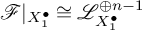 $\mathscr {F}|_{X_1^{\bullet }} \cong \mathscr {L}_{X_1^{\bullet }}^{\oplus n-1}$
. By Step 1, the restriction of
 $\mathscr {L}_{X_1^{\bullet }}$
to a general (smooth) fiber of
 $g_1^{\bullet }$
is a torsion line bundle. Moreover, shrinking
 $(W_1^{\bullet },w)$
further, we may assume without loss of generality that
 $\mathscr {L}_{X_1^{\bullet }}$
is a torsion line bundle as well (see Lemma 3.9). Thus, replacing
 $X_1^{\bullet }$
by a finite étale cover, if necessary, we may therefore assume that
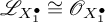 $\mathscr {L}_{X_1^{\bullet }}\cong \mathscr {O}_{X_1^{\bullet }}$
. It follows that the composition
 $$ \begin{align*} \mathscr{F}|_{G_w} \to T_{X_1^{\bullet}}|_{G_w} \to \mathscr{N}_{G_w/X_1^{\bullet}}\cong \mathscr{O}_{G_w}^{\oplus m} \end{align*} $$
has constant rank. This in turn implies that the reflexive sheaf
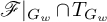 $\mathscr {F}|_{G_w}\cap T_{G_w}$
is a numerically flat locally free sheaf.
Suppose first that
 $T_{G_w}\subseteq \mathscr {F}|_{G_w}$
for a general point
 $w\in D_1^{\bullet }$
. Then
 $T_{G_w}$
is locally free. By the solution of the Zariski–Lipman conjecture for klt spaces (see [Reference Greb, Kebekus, Kovács and Peternell29, Theorem 6.1] or [Reference Druel23, Theorem 1.1]), we see that
 $G_w$
is smooth. The claim now follows from Lemma 3.7.
Suppose finally that
 $T_{G_w}\not \subseteq \mathscr {F}|_{G_w}$
for a general point
 $w\in D_1^{\bullet }$
. Then the composition
 $$ \begin{align*} \mathscr{F}|_{G_w} \to T_{X_1^{\bullet}}|_{G_w} \to (g_1^{\bullet})^*T_{W_1^{\bullet}}|_{G_w} \end{align*} $$
is generically surjective, and hence surjective. This in turn implies that
 $g_1^{\bullet }$
is a locally trivial fibration for the analytic topology in a neighborhood of a general point in
 $D_1^{\bullet }$
. In particular,
 $G_w$
is smooth. The claim now follows again from Lemma 3.7.
By Claim 8.5, replacing
 $W^{\bullet }$
by an open subset with complement of codimension at least
 $2$
, we may assume that every fiber of
 $p^{\bullet }$
(with its reduced structure) is a finite étale quotient of an abelian variety. By Lemma 3.6 applied to
 $p^{\bullet }\colon X^{\bullet } \to W^{\bullet }$
,
 $X^{\bullet }$
has generically large fundamental group on G. On the other hand, the inclusion induces an isomorphism
 $\pi _1(X^{\bullet })\cong \pi _1(X)$
of fundamental groups since
 $X\setminus X^{\bullet }$
is a closed subset of codimension at least
 $2$
by construction. It follows that X has generically large fundamental group on G, yielding a contradiction. This shows that X has generically large fundamental group on F.
Step 3. End of proof.
By [Reference Kollár48, Theorem 6.3] and Step 2 together, there exists a finite étale cover
 $\gamma \colon X_1 \to X$
such that the fibration
 $f_1\colon X_1 \dashrightarrow Y_1$
obtained as the Stein factorization of the almost proper map
 $X_1 \to X \dashrightarrow Y$
is birational to an abelian group scheme
 $f_1 \colon X_2 \to Y_2$
over a projective base equipped with a level three structure.
Let
 $W_1$
be the normalization of the closed subvariety of the Chow variety of
 $X_1$
whose general point parametrizes a general fiber of
 $f_1$
, and let
 $U_1$
be the normalization of the universal cycle. Replacing
 $Y_2$
by a birational modification, if necessary, we may assume that there exist a birational morphism
 $Y_2 \to W_1$
and a commutative diagram

Arguing as in the proof of Claim 8.4, we see that rational map
 $X_2 \dashrightarrow U_1$
is a morphism. Then Lemma 3.8 applies to show that
 $X_1$
is an abelian scheme
 $f_3\colon X_1 \to Y_3$
over a smooth projective base
 $Y_3$
and that there exists a birational morphism
 $Y_2 \to Y_3$
such that
 $X_2/Y_2 \cong Y_2 \times _{Y_3} X_1/Y_2$
. This finishes the proof of first statement of Proposition 8.2.
Finally, we show that there exist line bundles
 $\mathscr {M}_3$
and
 $\mathscr {K}_3$
on
 $Y_3$
such that
 $\gamma ^*\mathscr {N} \cong f_3^*\mathscr {M}_3$
and
 $\gamma ^*\mathscr {O}_X(K_{\mathscr {K}}) \cong f_3^*\mathscr {K}_3$
. By Step 1,
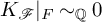 $K_{\mathscr {F}}|_F \sim _{\mathbb {Q}}0$
and
 $\mathscr {N}|_F$
is a torsion line bundle. Then Lemma 3.9 applies to show that there exists a positive integer k such that
 $\gamma ^*\mathscr {N}^{\otimes k} \cong f_3^*\mathscr {M}_3$
and
 $\gamma ^*\mathscr {O}_X(k K_{\mathscr {K}}) \cong f_3^*\mathscr {K}_3$
, where
 $\mathscr {M}_3$
and
 $\mathscr {K}_3$
are line bundles on
 $Y_3$
. Let
 $\Sigma _3 \subseteq X_1$
be the neutral section of
 $f_3$
. Then
 $\mathscr {M}_3 \cong (\gamma ^*\mathscr {N}|_{\Sigma _3})^{\otimes k}$
viewing
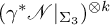 $(\gamma ^*\mathscr {N}|_{\Sigma _3})^{\otimes k}$
as a line bundle on
 $Y_3$
. Hence
 $\gamma ^*\mathscr {N}^{\otimes k}\cong f_3^*(\gamma ^*\mathscr {N}|_{\Sigma _3})^{\otimes k}$
. Replacing
 $X_1$
by the associated cyclic étale cover (see [Reference Kollár and Mori45, Definition 2.52]), we may assume without loss of generality that
 $k=1$
. This completes the proof of the proposition.
Corollary 8.6. Setting and notation as in 2.19. Suppose in addition that X is of general type and
 $\dim X \geqslant 4$
. Then
 $\mathscr {N}^*$
is nef.


9 Projectively flat foliations with pseudo-effective normal bundle
Theorem 9.1. Setting and notation as in 2.19. Suppose in addition that
 $K_X$
is nef and that
 $\mathscr {N}$
is pseudo-effective. Then
 $K_{\mathscr {F}}\equiv 0$
.
Proof. Let
 $f \colon X \dashrightarrow Y$
be the nef reduction map of
 $K_{\mathscr {F}}$
, and let F be a general fiber of f. Set
 $m:= \dim Y$
. Notice that
 $m \leqslant n-1$
by Proposition 8.1. By Proposition 8.2, replacing X by a finite étale cover, if necessary, we may assume without loss of generality that
 $f \colon X \to Y$
is an abelian group scheme over a smooth projective base equipped with a level three structure. We may also assume that
 $\mathscr {F}|_F \cap T_F$
is a linear foliation of codimension at most
 $1$
and that there exist line bundles
 $\mathscr {M}$
and
 $\mathscr {K}$
on Y such that
 $\mathscr {N}\cong f^*\mathscr {M}$
and
 $\mathscr {O}_X(K_{\mathscr {F}})\cong f^*\mathscr {K}$
. Let
 $\Sigma \subset X$
be the neutral section of f. Notice that
 $\mathscr {K} \cong \mathscr {O}_X(K_{\mathscr {F}})|_\Sigma $
.
Notice that
 $m=0$
if and only if
 $K_{\mathscr {F}}\equiv 0$
.
Let us first show that
 $T_{X/Y}\not \subseteq \mathscr {F}$
. We argue by contradiction and assume that
 $T_{X/Y}\subseteq \mathscr {F}$
. In particular, we have
 $m \geqslant 1$
.
If
 $m =1$
, then
 $\mathscr {F}=T_{X/Y}$
. In other words,
 $\mathscr {F}$
is algebraically integrable. By Proposition 3.20, X is a finite étale quotient of an abelian variety and
 $K_{\mathscr {F}}\equiv 0$
since
 $\mathscr {N}$
is pseudo-effective by assumption, yielding a contradiction.
Suppose now that
 $m \geqslant 2$
. There is a regular foliation
 $\mathscr {G}$
on Y such that
 $\mathscr {F}=f^{-1}\mathscr {G}$
since
 $T_{X/Y}\subseteq \mathscr {F}$
by assumption (see [Reference Araujo and Druel1, Lemma 6.7]). Then
 $\mathscr {M} \cong \mathscr {N}_{\mathscr {G}}$
. Moreover, there is an exact sequence
 $$ \begin{align*}0 \to T_{X/Y} \to \mathscr{F} \to f^*\mathscr{G} \to 0.\end{align*} $$
In addition, the composition
 $$ \begin{align*}T_{X/Y}|_\Sigma \subset \mathscr{F}|_\Sigma \subset T_X|_\Sigma \to \mathscr{N}_{\Sigma/X}\end{align*} $$
is an isomorphism, and hence
 $$ \begin{align*}\mathscr{F}|_\Sigma\cong T_{X/Y}|_\Sigma\oplus \mathscr{G}.\end{align*} $$
By Lemma 2.14, the vector bundles
 $\mathscr {F}|_\Sigma $
and
 $\mathscr {G}$
are numerically projectively flat. Moreover, we have
 $$ \begin{align*}\frac{1}{n-1}c_1(\mathscr{F}|_\Sigma)\equiv\frac{1}{d}c_1(T_{X/Y}|_\Sigma)\equiv \frac{1}{m-1}c_1(\mathscr{G}).\end{align*} $$
Since f is the nef reduction map of
 $K_{\mathscr {F}}$
, we must have
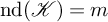 $\text {nd}(\mathscr {K})=m$
. It follows that the nef reduction map of
 $K_{\mathscr {G}}\equiv \frac {m-1}{n-1}c_1(\mathscr {K})$
is the identity map. Notice that
 $\mathscr {N}_{\mathscr {G}}$
is pseudo-effective because
 $\mathscr {N}$
is pseudo-effective by assumption.
Claim 9.2. The divisor
 $K_Y$
is nef.
Proof. We argue by contradiction and assume that
 $K_Y$
is not nef. Then there is a rational curve C on Y such that
 $K_Y \cdot C <0$
. Let
 $B \to C$
denotes the normalization of C, and set
 $S:=B \times _Y X$
and
 $\sigma :=B \times _Y \Sigma $
. By [Reference Kollár48, Lemma 5.9.3], we have
 $(S/B,\sigma ) \cong (B \times A/B,B\times 0_A)$
for some abelian variety A. Moreover,
 $K_{X/Y}|_S = K_{S/B} \sim _{\mathbb {Z}} 0$
. This immediately implies that
 $K_X$
is not nef, yielding a contradiction. This proves the claim.
Applying Proposition 8.1 to
 $\mathscr {G}$
, we see that
 $m = 2$
.
If
 $\kappa (Y)=2$
, then
 $\mathscr {N}_{\mathscr {G}}^*$
is pseudo-effective by [Reference Brunella11, Lemme 9] and [Reference Brunella11, Corollaire 1], and hence
 $\mathscr {N}\equiv 0$
since
 $\mathscr {N} \cong f^*\mathscr {N}_{\mathscr {G}}$
is pseudo-effective by assumption. By Theorem 7.2 and Proposition 8.1 together, we have
 $K_{\mathscr {F}}\equiv 0$
, yielding a contradiction.
From [Reference Brunella11, Section 5], we see that either Y is an elliptic surface or the minimal model of Y is an abelian variety. In the latter case, X is an abelian variety by [Reference Kollár48, Lemma 5.9.3]. Then Lemma 3.22 applies to show that
 $K_{\mathscr {F}}\equiv 0$
. This again gives a contradiction. Suppose finally that Y is an elliptic surface over a smooth connected curve B. By [Reference Brunella11, Proposition 2], the fibers (with their reduced structure) of
 $Y \to B$
are smooth curves of genus
 $1$
. Then, by [Reference Brunella11, Proposition 3], we have
 $m=\mathrm{nd}(\mathscr {K})\leqslant 1$
. This again yields a contradiction.
This shows that
 $T_{X/Y}\not \subseteq \mathscr {F}$
.
Then Lemma 7.1 applies to show that, after replacing X by a finite étale cover, we may assume that
 $X \cong Y \times A$
for some abelian variety A of dimension and that f is induced by the projection onto Y.
Let us show that
 $m \leqslant 1$
. The composition
 $$ \begin{align*}\mathscr{O}_X^{\oplus n-m}\cong T_{X/Y} \to T_X \to \mathscr{N}\end{align*} $$
is generically surjective, and hence
 $h^0(X,\mathscr {N})\geqslant 1$
. Since
 $\mathscr {N}\cong f^*\mathscr {M}$
, there exist prime divisors
 $D_i$
on Y for
 $i \in I$
and positive integers
 $m_i \geqslant 1$
such that
 $\mathscr {N} \cong \mathscr {O}_X(\sum _{i\in I}m_i B_i)$
, where
 $B_i:=f^*D_i$
.
Then
 $\mathscr {O}_{B_i}^{\oplus d} \cong T_{X/Y}|_{B_i} \subseteq \mathscr {F}|_{B_i}$
. Since
 $\mathscr {F}$
is numerically projectively flat and
 $K_{\mathscr {F}}$
is nef by Lemma 2.21, we see that
 $\mathscr {F}|_{B_i}$
is numerically flat.
If
 $B_i$
is a leaf of
 $\mathscr {F}$
, then it is a finite étale quotient of an abelian variety by [Reference Jahnke and Radloff42, Theorem 0.1]. Moreover,
 $\mathscr {N}|_{B_i}$
is a flat line bundle by Lemma 3.1, and hence
 $B_i^2\equiv 0$
since
 $\mathscr {N}|_{B_i}\cong \mathscr {N}_{B_i/X}$
.
Suppose now that
 $B_i$
is not a leaf of
 $\mathscr {F}$
. Then the composition
 $$ \begin{align*}\mathscr{F}|_{B_i} \to T_X|_{B_i} \to \mathscr{N}_{B_i/X}\end{align*} $$
is generically surjective. Since
 $\mathscr {F}|_{B_i}$
is numerically flat, it follows that
 $B_i^2$
is numerically equivalent to an effective cycle.
Now, by Lemma 3.1, we have
 $\mathscr {N}^2\equiv 0$
. This immediately implies that
 $B_i^2 \equiv 0$
for every
 $i\in I$
and that
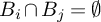 $B_i \cap B_j=\emptyset $
if
 $i \neq j$
.
If
 $\mathscr {N}\equiv 0$
, then
 $K_{\mathscr {F}}\equiv 0$
by Theorem 7.2 and Proposition 8.1 together. Then
 $m=0$
. Suppose from now on that
 $\mathscr {N}\not \equiv 0$
.
Let
 $i\in I$
such that
 $B_i$
is not a leaf of
 $\mathscr {F}$
. Let us show that
 $B_i$
is smooth with
 $K_{B_i}\equiv 0$
. The exact sequence
 $$ \begin{align*}0 \to \mathscr{F}|_{B_i} \to T_X|_{B_i} \to \mathscr{N}|_{B_i} \to 0\end{align*} $$
shows that
 $T_X|_{B_i}$
is numerically flat. In particular,
 $K_X|_{B_i}\equiv 0$
, and hence
 $\omega _{B_i} \equiv 0$
by the adjunction formula. Let
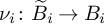 $\nu _i\colon \widetilde {B}_i \to B_i$
be the normalization morphism. By Lemma 3.3, there exists an effective Weil divisor
 $E_i$
on
 $\widetilde {B}_i$
such that
 $\omega _{\widetilde {B}_i}\cong \nu _i^*\omega _{B_i}(-E_i)$
. Suppose that
 $E_i \neq 0$
. Then
 $K_{\widetilde {B}_i}$
is not pseudo-effective and hence
 $B_i$
is uniruled by [Reference Boucksom, Demailly, Păun and Peternell5, Corollary 0.3] applied to a resolution of
 $\widetilde {B}_i$
. Let
 $C \subseteq B_i$
be a rational curve. By Corollary 3.12, we have
 $C\cdot K_{\mathscr {F}}=0$
. But this contradicts Lemma 3.17 since
 $K_X$
is nef. This shows that
 $E_i=0$
, and hence
 $B_i$
is normal by Lemma 3.3. Then [Reference Boucksom, Demailly, Păun and Peternell5, Corollary 0.3] applies to show that
 $B_i$
has canonical singularities since
 $K_{B_i}\equiv 0$
. The natural map
 $T_X|_{B_i} \to \mathscr {N}_{B_i/X}$
is generically surjective and hence surjective since
 $T_X|_{B_i}$
and
 $\mathscr {N}_{B_i/X}$
are numerically flat vector bundles. It follows that the tangent sheaf
 $T_{B_i}$
is locally free and numerically flat. By the solution of the Zariski–Lipman conjecture for canonical spaces (see [Reference Greb, Kebekus, Kovács and Peternell29, Theorem 6.1] or [Reference Druel23, Theorem 1.1]), we conclude that
 $B_i$
is smooth.
By Proposition 6.3, we have
 $\kappa (X)=\nu (X) \geqslant 0$
. Applying Proposition 3.14 to
 $(X,\sum _{i \in I}B_i)$
, we see that
 $K_{\mathscr {F}}$
is semiample with
 $\nu (K_{\mathscr {F}}) \leqslant 1$
. This proves that
 $m=1$
.
By Lemma 3.23 and Lemma 2.21 together, the vector bundle
 $\mathscr {F}$
is then numerically flat, and hence
 $K_{\mathscr {F}}=0$
, yielding a contradiction. This finishes the proof of the theorem.
10 Proof of Theorem 1.1
We are now in position to prove Theorem 1.1.
Proof of Theorem 1.1.
Suppose first that
 $K_X$
is not nef. Then there exists a
 $\mathbb {P}^1$
-bundle structure
 $\varphi \colon X \to Y$
onto a finite étale quotient of an abelian variety, and
 $\mathscr {F}$
induces a flat Ehresmann connection on
 $\varphi $
by Theorem 5.1.
Suppose from now on that
 $K_X$
is nef.
If
 $\mathscr {N}$
is pseudo-effective, then Theorem 9.1 applies to show that
 $K_{\mathscr {F}}\equiv 0$
. By Proposition 3.18, there exists an abelian variety A and a finite étale cover
 $\gamma \colon A \to X$
such that
 $\gamma ^{-1}\mathscr {F}$
is a linear foliation on A.
Suppose finally that
 $\mathscr {N}$
is not pseudo-effective. Then
 $\mathscr {N}^*$
is nef by Theorem 1.2. Thus Theorem 7.2 applies to show that either there exists a smooth complete curve B of genus at least
 $2$
as well as an abelian variety A, and a finite étale cover
 $\gamma \colon B \times A \to X$
such that
 $\gamma ^{-1}\mathscr {F}$
is induced by the projection morphism
 $B \times A \to B$
, or X is of general type and
 $\nu (K_{\mathscr {F}})=\dim X$
. In the latter case,
 $\Omega _X^1$
is nef by Lemma 2.21, and hence
 $K_X$
is ample. In addition,
 $\kappa (K_{\mathscr {F}})=\dim X$
by Lemma 7.4. This finishes the proof of theorem.
Remark 10.1. If we relax the integrability condition, then the conclusion of Theorem 1.1 is false. Indeed, let E be an elliptic curve, and let B be an abelian variety of dimension
 $\dim B =n-1 \geqslant 1$
. Set
 $A:= E \times B$
. Let
 $\mathscr {M}$
be a line bundle of degree
 $2$
on E, and set
 $\mathscr {L}:=\text {pr}_E^*\mathscr {M}^*$
. Let
 $(s_i,t_i) \in H^0(A,\mathscr {L}^*)^{\times 2}$
for
 $i \in \{1,\ldots ,n-1\}$
. Suppose that the zero sets of the
 $s_i$
and the
 $t_i$
are pairwise disjoint. Write
 $T_A=\oplus _{1 \leqslant i \leqslant n}\mathscr {O}_A v_i$
. Then the sections
 $s_i$
and
 $t_i$
give an injective map of vector bundles
 $\mathscr {L} \subset \mathscr {O}_A v_i \oplus \mathscr {O}_A v_{i+1}$
. In addition, the induced map
 $\mathscr {D}=\mathscr {L}^{\oplus n-1} \to T_A$
is an injective map of vector bundles as well. The vector bundle is obviously numerically projectively flat.
Acknowledgements
This article owes much to the ideas and work of Marco Brunella. We would also like to thank Michel Brion, Benoît Claudon and Adrien Dubouloz for their help and many interesting discussions. Finally, we thank the referee for the helpful and detailed report.
Competing interests
The authors have no competing interest to declare.



