Introduction
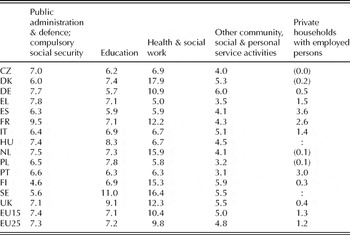
Spain has the highest figures of registered household employees in the EU (see Table 1). In 2005, persons employed in private households accounted for 3.6 per cent of total employment. In the same year that category represented only 0.2 per cent of total employment in Denmark, 0.5 per cent in Germany, 1.4 per cent in Italy and 0.4 per cent in the UK (European Commission, 2006: 58).
Employment structure in 2005 (% of total employment 15+, by selected employment categories)

Notes: Data in parentheses “()” are not reliable due to small sample size; “:” indicates sample too small to show a figure at all.
Source: Elaborated from Eurostat, LFS Spring 2005 results (European Commission, 2006: 58).
The percentage of registered domestic workers in Spain is so high partly because domestic work in Spain is legally recognised as a formal labour market occupation, even if the ‘hidden’ numbers are high, as they are in other economic sectors such as construction and agriculture. Data from the 2008 Spanish Labour Force Survey (Encuesta de Población Activa) indicate that 545,800 people declared themselves employed in the domestic sector.Footnote 1 The total figure of domestic employees almost halves when we look at those who are in a ‘regular’ situation, that is domestic employees who are officially registered with Social Security within the Special Regime of Household Employees (280,000 in 2009). The difference reflects the very strong presence of the sector in the underground economy. Still, in comparative terms, the number of regular domestic employees is remarkable and higher than in any other European country, which makes the study of the household sector in Spain somewhat more feasible, in the sense of data availability, than in countries where domestic work lies entirely outside the scope of public regulation.
Drawing on qualitative in-depth interviews with selected key informants from the central government as well as from trade unions and civic organisations,Footnote 2 policy documents and secondary data, this study focuses on the effect of the interaction between the welfare state and the migratory model in consolidating the presence of domestic employment in Spain, which is undertaken very largely although not exclusively by foreign-born women. Special attention is given to ‘regular’ domestic employment, that is domestic workers who are registered with the special social security scheme of household employees. In this way, domestic work is studied within the framework of employment relations, to assess the extent to which the growth of the household sector in Spain has been accompanied by a process of modernisation and formalisation, converting, as Meagher (Reference Meagher2002: 56) would argue, the previous ‘contract of service’ into a ‘contract for service’.
Developments of domestic work in Spain
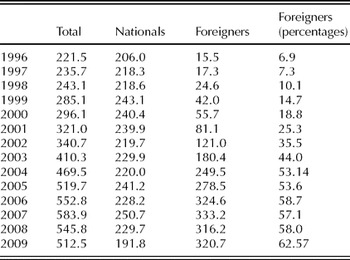
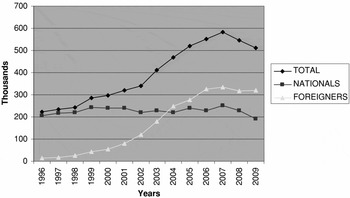
Data on the Spanish domestic sector reveal two very important interrelated trends. First, there has been a steady increase in numbers of domestic workers in recent years: from 221,500 in 1996 to over 500,000 in 2009. Second, such an increase can be explained only by the incorporation of female foreign workers into the sector. While the number of Spanish domestic workers has remained unaltered since 1996 (at just over 200,000), the number of foreign domestic workers has risen from 15,500 in 1996 to 320,700 in 2009 (see Table 2 and Figure 1).
Trends in numbers employed as domestic employees, thousands

Source: INE (2009). Employed in occupation 911 and Activity 950 CNAE-93/970 CNAE-2009.
Evolution Domestic Employees (Spanish Labour Survey).

The Spanish special social security scheme for household employees was created in 1969. It is one of a total of five special schemes within Spanish Social SecurityFootnote 3 that coexist with the General Regime of salaried employees. These special regimes were created to reflect the extraordinary and atypical circumstances of certain groups of workers. Miners, farmers, sea workers, the self-employed and household employees are the five groups whose working conditions deserve special consideration in terms of national insurance contributions and entitlements. In the past, the number of special regimes was much larger; but since the beginning of the 1980s attempts have been made to reduce the number of special regimes and to classify all employees in two broad categories, one for salaried employees and one for the self-employed. However, as it will be shown later, household employees are still far from benefiting from the same rights to sickness leave, unemployment subsidy and retirement pension that are enjoyed by workers who belong to the general scheme.
During the 1980s and early 1990s, the Special Regime of Household Employees seemed to be counting its days. The number of women affiliated to this regime was in decline, despite an increase, albeit slow, in the overall rate of female participation in the labour market. Affiliations to the Special Regime of Domestic Employees decreased from 341,804 persons in 1980 to 141,257 in 1997. Democracy and rapid modernisation of the country meant that the costs of hiring a domestic employee were rising and that the supply of domestic labour was falling. While the first generation of women who migrated from rural to urban areas during the 1960s and 1970s were now benefiting from better job opportunities in other occupational sectors, younger and better educated women expected more from their lives. This downward trend, however, turned into an upward curve in the late 1990s as significant flows of international migrants began arriving in the country. Although Spain used to have one of the lowest participation rates of foreigners in the total labour force at the beginning of the 1990s (645 thousand foreign-born workers in 1999), it now has one of the highest (2,241 thousands in 2004, representing 11.2 per cent of the total labour force) (OECD, 2006). Since the beginning of the 1990s, the share of foreign women employed in this sector has been higher than that in the total economy (CES, 2006). A significant event was the 2005 regularisation process put in place to normalise the situation of foreign workers in illegal employment. Almost 200,000 people, mainly women, were granted work permits in the household sector (OECD, 2006). Nowadays the domestic sector is not just highly feminised but also remarkably ‘foreignised’. According to the most recent 2009 data, over 90 per cent of the more than 280,000 employees registered with the Special Regime of Household Employees are women and 61 per cent of all registered workers are non-nationals, of which the large majority (87 per cent) are non-EU citizens, mainly coming from Latin American countries, in particular Ecuador, Colombia and Bolivia (Ministry of Labour and Immigration, 2009). Another interesting aspect of the affiliation to this special regime is its territorial concentration: 46 per cent of all registered employees work in the two largest Spanish cities, Madrid (29 per cent) and Barcelona (17 per cent).
Although the data on household work do not allow us to differentiate between different ‘types’ of domestic employment, it is believed that the growth of household employment today is closely linked to the strong demand for personal care service jobs (Hochschild, Reference Hochschild, Hutton and Giddens2000; Salazar Parreñas, Reference Salazar Parrenas2001; Cancedda, Reference Cancedda2001; Yeandle, Reference Yeandle2002). In the case of Spain, and as Martínez Buján (Reference Martínez Buján, Fassman, Haller and Lane2009: 216) argues, all reproductive tasks, from cleaning to caring, are officially counted as domestic service. It certainly is unfortunate that the current definition of household employment does not allow us to identify what part of the volume of household employment corresponds to ´newer´ forms of domestic service, such as looking after a dependent elder, and what part remains within the remit of traditional domestic work. In any case, we should not forget that one problem associated with home-based care work is precisely the difficulty of drawing clear boundaries between various domestic tasks (see for instance Tronto, Reference Tronto2002).
In what follows attention is paid to the growth of the domestic sector in Spain with reference to demand and supply factors. As it has been pointed out by Williams and Gavanas (Reference Williams, Gavanas and Lutz2008: 15), the case of migrant domestic care workers illustrates the changing nature of work (an increase in women's employment and in service jobs), of families (ageing populations and greater demand on childcare services) and the changing internal and external boundaries of the ‘nation’. In the Spanish case, the historical trajectory of a familial welfare regime and the migration model of the last two decades have converged in facilitating and even encouraging the expansion of the household sector as the main site of care provision for the elderly and small children.
Explaining demand
Population ageing and the increasing participation of women in the labour market have put a great deal of pressure on the Spanish care system. The Spanish welfare state, just as in other southern European countries, has historically relied on the informal role of women inside families to provide care and support to those who need it. The central role that families, and especially women inside those families, play in the provision of care has by and large been used to compensate for a clear deficit in state provision. But, contrary to other countries in continental Europe where the state actively supports that role, mainly through the taxation system, in Spain and in other countries of southern Europe, there has never been any active state intervention. Naldini (Reference Naldini2003) argues that southern European welfare states implicitly promote an ‘unsupported familialism’, whereby the family is a main informal pillar of welfare support. In the particular case of Spain, despite significant policy change in a number of fields, most notably in pre-school education (see León, Reference León2007), the lack of welfare state intervention in the sphere of social care and the absence of effective implementation of policies addressing work–life balance dilemmas – especially for women with caring responsibilities, in the context of the increasing liberalisation of womenFootnote 4 – have combined to give to the household sector a central role in the commodification of care.
The recent Spanish law on long-term care approved in 2006Footnote 5 is also unexpectedly consolidating paid care work inside private homes. The law was designed to mitigate the historical absence of institutional support for the needs of dependent citizens. It was promoted as a long-term care system of service provision with the aim of triggering a supply of institution-based care provision and of professionalising a sector that hitherto had remained largely informal. However, since the law was approved, cash allowances, which the law left for ‘exceptional circumstances’, are clearly dominating services. The evidence so far suggests that the majority of the monetary benefits that are being given to those assessed as ‘dependents’ are being used to subsidise the work of family or non-professional carers (that is, carers without formal qualifications).Footnote 6 Although we are unable to explore this issue in any detail (see León, Reference León2009), the lack of a national network of social service provision, together with the still entrenched reliance on and social acceptability of private and informal forms of care (Parrela Rubio, Reference Parella Rubio2003; Bettio et al., Reference Bettio, Simonazzi and Villa2006) and a certain animosity towards more institutionalised forms of care provision, would explain people's preference for cash over care. In this vein, Simonazzi (Reference Simonazzi2008: 16) argues that national employment models also interact with care regimes to shape the features of the care labour market, which in turn affect both the quantity and the quality of labour supply and the degree of dependence on migrant carers.
Explaining supply
The migration model of southern European countries has been characterised by a high permeability of borders, which results in the existence of a large underground economy, a strong pull factor for irregular migration. Illegal immigrants have constituted a significant part of these flows, ‘fitting in’ quite easily in the existing irregular economies (Arango, Reference Arango, King, Lazaridis and Tsardanidis2000; Reyneri, Reference Reyneri2004). The household sector has been a straightforward entry route for foreign women who arrive without a working permit. Successive governments of Spain, and also in other southern European countries, have adopted a policy of successive amnesties to bring to the surface the millions of workers who have lived and worked in the country illegally. As argued earlier, a significant event was the 2005 regularisation process when 83 per cent of applicants were granted working permits (548,700 people), of whom one third applied through the domestic sector (183,000) (OECD, 2006: 82). The 2005 regularisation process required the existence of a formal employment contract. This certainly boosted the number of migrant workers registered under the special social security regime (Climent, Reference Climent2008).
According to government officials, the main goal of these amnesties was to bring to the surface undeclared employment. However, while the 2005 regularisation process resulted in a substantial increase in the number of registered household employees, there is no evidence to suggest that the volume of illegal or irregular employment in the household sector was reduced. This outcome seems to support the argument that regular amnesties can in fact act as a strong pull factor for would-be migrants (Boswell and Straubhaar, Reference Boswell and Straubhaar2004: 6). An NGO representative interviewed for the purposes of the current study pointed out that, in practice, the government was responding to a strong demand on the part of families to hire immigrants, especially women from a Latin American country. In fact, a recent study on long-term care and immigration (IMSERSO, 2005) found that families maintained that cultural and language proximity made women from Latin American countries more suitable as personal carers in private homes. On the other hand, for the majority of Latin American women, employment in the domestic sector is the sole opportunity to access the labour market (Colectivo IOE, Reference Ioé1999), although many see it as a stepping stone towards a better job and the attainment of permanent residence status (Escriva and Skinner, Reference Escriva, Skinner and Lutz2008: 115).
Conditions of domestic work in Spain – key challenges
When we examine the specific features of household employment, the first striking fact is that, although the special regime was created in the late 1960s to protect those working in private homes with no formal recognition, household work was not recognised in labour law until 1985. Before then, ‘domestic service’ was regulated by the civic code, which is in itself revealing of the atypical character of this type of employment and its difficulties in being assimilated to a formal contractual relationship (Banyuls et al., Reference Banyuls, Cano, Picher and Sanchez2003: 83). Still, the 1985 regulation,Footnote 7 which established the contractual aspects of domestic employment in Spain, defined private homes as ‘exceptional contexts’, which, by appealing to the priority of the constitutional rights of privacy and private family life over labour rights, in practice means that workers’ rights are subordinated to employers’ rights (Climent, Reference Climent2008: 9). Furthermore, the recognition of this exceptional character by the 1985 regulation meant that domestic employment would not be included within the Workers’ Bill of Rights (Estatuto de los Trabajadores). The nature of this form of employment and the site where it is performed seem to be erecting barriers to the assimilation of such jobs to more standard ones in such important respects as unemployment protection, career progression, collective bargaining, or protection against abuse.
As for pay, the 1985 Decree stipulates that a salary cannot be less than the National Minimum Wage. For the year 2006, the minimum monthly salary for a 40 hour/week job was 541 euros or 18 euros per day. For those working part-time or in two or several households, the hourly rate is 4 euros. There is, however, wide scope for manoeuvre. Live-in domestic workers, for instance, can experience a reduction of up to 45 per cent of their salary for the provision of food and shelter. On the social security contributions that employers and employees are required to pay, the regime is much ‘cheaper’, and much ‘weaker’ in terms of the protection offered, than any other. As things stand today, employees affiliated to this occupational regime have no unemployment insurance, no cover in case of sickness and an extremely poor retirement pension. The employer is required to pay social security contributions only if the number of working hours exceeds 20 per week. There is no obligation to draft and sign a written employment contract, but only a mutual verbal agreement, which leaves the employee in a weak position in the event of bad practice on the part of her employer.
An attempt to equalise the working conditions and social rights of these employees with other employees affiliated to Social Security has been on the political agenda since 2004. The obvious driver of the reform has been the regularisation process of migrant workers throughout the domestic sector. The aim is to regularise and to professionalise a sector in which there is a strong demand for labour. Among the proposed changes are: an obligation on the part of employers to pay social security contributions, which would increase along with salary, even if the working hours are low; the obligation to draft and sign a proper written employment contract; and a maximum working week of 40 hours. However, this reform proposal has made no further progress. Four years after the reforms were announced by the government, the occupational category of household employees remains as it was conceived in 1985. Government officials argue that there are two major obstacles to the reform of this occupational regime. First, the ‘special character’ of the home makes certain rights and obligations difficult to enforce. As explained by an informant from the Ministry of Labour and Immigration interviewed in the course of the current study, the impossibility of enforcing labour inspections in private homes makes unemployment protection unfeasible in practical terms since there are no mechanisms that allow the administration to control fraud. Second, the reform of the domestic workers’ special regime needs to be carefully tailored since too much employment protection can backfire in the sense that it could encourage households to transfer to the undeclared economy, where domestic services are available more cheaply. Therefore, the margin of possible improvement of domestic employees’ working conditions is very narrow, given the parallel existence of domestic employment in the underground economy. Representatives of household employees, however, vehemently rebutted these arguments. On the first point, a key informant from the NGO Caritas argued that household work was not that different from self-employment or indeed from the conditions of those employed in small family businesses, where labour inspections very rarely take place. On the second point, a member of the Association of Domestic Employees argued that the state can, by assuming a percentage of national insurance contributions, create incentives that make it convenient for head of households to declare their employees. In this respect, the ‘real’ barrier to the reform of the special regime of household employees is financial, and the question becomes how much the state would be ready to pay to improve the conditions of those working under this regime. The fact that household employees are not represented by trade unions in collective agreements is a factor that militates against the promotion of the demands of this group on the political agenda.
Conclusions
Triggered by a deficit in the provision of care and by a strong influx of migrant women into the sector, the high percentage of registered household employees in Spain has been promoted to a large extent by recent initiatives in social and migration policies. In a context of an increasing presence of care-related household employment in the majority of European countries, the household sector has in fact become a form of provision which operates either outside or within public regulation. The increase in commodified forms of care work inside private homes is challenging previous conceptions of ‘familialistic’ practices in the countries of southern Europe. While it is undeniable that housework is low-paid, at the bottom of occupational categories and markedly carried out by migrant women in particularly vulnerable situations, there certainly is capacity for improvement, via formalisation and regularisation of the household sector. This paper has argued that the capacity to regulate the household sector will affect the conditions of those who perform it as well as the shape that this form of employment adopts. The question is whether household employment, which has always been a prototypical example of pre-modern employment relations characterised by low pay, insecurity and exploitation, can effectively be modernised and professionalised with the right policies in place.
The chances of improving the status of domestic workers seem to be limited by a number of factors, the most important of which seem to be obstacles to equalising their working conditions with those of standard employment relationships. In many ways, this form of care work, more than representing a new form of care arrangement, might embody a way of reviving the patterns of traditional societies, ‘replacing’ the social group that performs these tasks under similar working conditions. The implications in terms of social inequalities (be they based on gender, ethnicity, or class) are strong. Nevertheless, this article has shown that a wide margin for improvement still exists. Recent policy initiatives to channel the demand for care work through households should be implemented in order to increase the visibility of an occupational sector that is always tempted to go underground and, equally relevant, in order to dignify the conditions of those who perform these jobs.
Acknowledgement
The author is grateful to the British Academy for supporting this work under grant no. 48482.