Introduction
Many of the recently discovered habitable exoplanets orbit Red Dwarf stars (RDs), which constitute about 75% of the stars in the Milky Way Galaxy. They are characterized by luminosity much lower than that of our sun. Consequently, habitable planets (in the habitable zone, HZ, defined as enabling surface liquid water in the presence of an adequate atmosphere) orbit closely and hence are likely to be gravitationally locked. The findings of the Kepler mission have shown that 10–75% of the RDs have habitable Earth to Super-Earth-sized planets, depending on the precise definition of the HZ (e.g. Batalha et al., Reference Batalha, Rowe, Bryson, Barclay, Burke, Caldwell, Christiansen, Mullally, Thompson, Brown, Dupree, Fabrycky, Ford, Fortney, Gilliland, Isaacson, Latham, Marcy, Quinn, Ragozzine, Shporer, Borucki, Ciardi, Gautier TN, Haas, Jenkins, Koch, Lissauer, Rapin, Basri, Boss, Buchhave, Carter, Charbonneau, Christensen-Dalsgaard, Clarke, Cochran, Demory, Desert, Devore, Doyle, Esquerdo, Everett, Fressin, Geary, Girouard, Gould, Hall, Holman, Howard, Howell, Ibrahim, Kinemuchi, Kjeldsen, Klaus, Li, Lucas, Meibom, Morris, Prša, Quintana, Sanderfer, Sasselov, Seader, Smith, Steffen, Still, Stumpe, Tarter, Tenenbaum, Torres, Twicken, Uddin, Van Cleve, Walkowicz and Welsh2013; Dressing and Charbonneau, Reference Dressing and Charbonneau2015). This implies that such planets could be found within less than 10 light years from Earth (Wandel, Reference Wandel2015, Reference Wandel2017).
While some authors point out some disadvantages for the evolution of life on planets orbiting M-type stars, such as high levels of XUV radiation and stellar winds, which may cause atmosphere erosion (Heller et al., Reference Heller, Leconte and Barnes2011; Leconte et al., Reference Leconte, Wu, Menou and Murray2015; Lingam and Loeb, Reference Lingam and Loeb2017; Tilley et al., Reference Tilley, Segura, Meadows, Hawley and Davenport2019), other works argue that such planets may nevertheless host life as we know it (e.g. Tarter et al., Reference Tarter, Backus, Mancinelli, Aurnou, Backman, Basri, Boss, Clarke, Deming, Doyle, Feigelson, Freund, Grinspoon, Haberle, Hauck SA, Heath, Henry, Hollingsworth, Joshi, Kilston, Liu, Meikle, Reid, Rothschild, Scalo, Segura, Tang, Tiedje, Turnbull, Walkowicz, Weber and Young2007, Gale and Wandel, Reference Gale and Wandel2017). They point out that the impact of the high-XUV flux received by planets orbiting in the HZ of young M-type hosts may be less important for aquatic life. Moreover, atmospheric erosion may be inhibited by a planetary magnetic field (like in the case of Earth). Even for planets with a weak magnetic field, the eroded atmosphere may be compensated by accretion of a secondary atmosphere during the later calmer phases in the evolution of the M-type host, which also last longer. A massive prime atmosphere could survive the extended erosion during the energetic early evolution of M-dwarfs (e.g. Tian, Reference Tian2009). Furthermore, HZ-planets of K-type stars (which do not have high levels of energetic radiation, characterizing the early evolutionary stages of M-type stars) may be locked or in nearly synchronous rotation, like Venus. Locked or nearly locked planets have been shown to have peculiar climates which may affect their habitability (e.g. Kopparapu et al., Reference Kopparapu, Wolf, Haqq-Misra, Jun, Kasting, Mahadevan and Terrien2016; Checlair et al., Reference Checlair, Menou and Abbot2017). Simulations show that locked or synchronous HZ planets of M-type stars may support liquid water oceans (e.g. Del Genio et al., Reference Del Genio, Way, Amundsen, Aleinov, Kelley, Kiang and Clune2019). We look at the habitability of locked, synchronous and slowly rotating planets of M- and K-stars, from the viewpoint of bio-habitability. Using a simple analytic climate model we derive expressions for the surface temperature dependence on heat circulation and greenhouse heating. A self-consistent analytic treatment of habitability in combination with atmospheric properties is presented. We consider the implications to the evolution and sustainability of life, and in particular oxygenic photosynthesis, an essential precursor of complex life on Earth.
Model predictions of the climates of RD-planets
A major requirement for the appearance and evolution of life is a temperature range which supports liquid water and complex organic molecules. This depends not only on the irradiation from the host star, but to a large extent also on the planet's atmosphere. Global circulation models (GCMs) using radiative transfer, turbulence, convection and volatile phase changes can be used to calculate the conditions on planets, given the properties of their atmospheres. Such 3D climate models of M-dwarf planets suggest the presence of liquid water for a variety of atmospheric conditions (e.g. Pierrehumbert, Reference Pierrehumbert2011, Wordsworth, Reference Wordsworth2015). Climate modelling studies have shown that an atmosphere only 10% of the mass of Earth's atmosphere can transport heat from the day side to the night side of tidally locked planets (TLPs), enough to prevent atmospheric collapse by condensation (Joshi et al., Reference Joshi, Haberle and Reynolds1997; Scalo et al., Reference Scalo, Kaltenegger, Segura, Fridlund, Ribas, Kulikov, Grenfell, Rauer, Odert, Leitzinger, Selsis, Khodachenko, Eiroa, Kasting and Lammer2007; Tarter et al., Reference Tarter, Backus, Mancinelli, Aurnou, Backman, Basri, Boss, Clarke, Deming, Doyle, Feigelson, Freund, Grinspoon, Haberle, Hauck SA, Heath, Henry, Hollingsworth, Joshi, Kilston, Liu, Meikle, Reid, Rothschild, Scalo, Segura, Tang, Tiedje, Turnbull, Walkowicz, Weber and Young2007; Heng and Kopparla, Reference Heng and Kopparla2012). On locked planets the water may be trapped on the night side (e.g. Leconte et al., Reference Lecont, Forget, Charnay, Wordsworth and Pottier2013), but on planets with enough water or geothermal heat, part of the water remains liquid (Yang et al., Reference Yang, Yonggang, Yongsun and Abbot2014). 3D GCM simulations of planets in the HZ of M-dwarfs support scenarios with surface water and moderate temperatures (Yang et al., Reference Yang, Yonggang, Yongsun and Abbot2014; Leconte et al., Reference Leconte, Wu, Menou and Murray2015; Kopparapu et al., Reference Kopparapu, Wolf, Haqq-Misra, Jun, Kasting, Mahadevan and Terrien2016; Owen and Mohanty, Reference Owen and Mohanty2016; Turbet et al., Reference Turbet, Leconte, Selsis, Bolmont, Forget, Ribas, Raymond and Anglada-Escudé2016; Wolf et al., Reference Wolf, Shields, Kopparapu, Haqq-Misra and Toon2017 to name a few).
While rocky planets with no or little atmosphere, like Mercury, have an extremely high day-night contrast and planets with a thick, Venus-like atmosphere tend to be nearly isothermal, intermediate cases, with up to 10 bar atmospheres, conserve significant surface temperature gradients (e.g. Selsis et al., Reference Selsis, Wordsworth and Forget2011).
We argue that life clement environments may be supported on TLPs. Recent calculations (Wandel, Reference Wandel2018; Wandel and Tal-Or, Reference Wandel and Tal-Or2019) suggest that planets orbiting M-type stars may have life supporting temperatures, at least on part of their surface, for a wide range of atmospheric properties. We extend this treatment to habitable planets of early M-type and K-type stars that are not totally locked but only synchronously rotating, and explore the conditions allowing photosynthesis. Given the very large number of potential planets, and the possibility of liquid water on at least some of the TLPs, we discuss here the characteristics of complex life which may evolve on the TLPs and how they may differ from life on Earth.
Wandel (Reference Wandel2018) supplements the usual treatment of the HZ (the region around a star where planets can support liquid water, e.g. Kasting et al., Reference Kasting, Whitmire and Reynolds1993), with the definition of a bio-HZ, where surface temperatures can support complex organic molecules, in addition to liquid water. The atmospheric properties that affect the surface temperature distribution are reduced to three factors: irradiation by the host star, circulative heat redistribution and atmospheric heating due to the greenhouse effect. In the following the presence of surface liquid water and life supporting temperatures are analysed within this parameter space.
Surface temperature distribution on locked planets
The planet is defined as being within the bio-HZ, if its highest surface temperature is above freezing, that is, T max > 273 K, and its lowest surface temperature is below the highest temperature which allows complex organics, that is T min ~ < 400 K.
The lower temperature limit is naturally chosen as the freezing point of water, which is only weakly dependent on pressure.
The surface temperature of a planet with no atmosphere is given by

where σ is the Stefan Boltzmann constant, A is the Bond albedo and F is a function of the angular distance θ*** from the sub-stellar point (θ = 0). The irradiation or insolation is given by S = L */4πa 2, where a is the distance of the planet from its host star and L * is host's luminosity.
If the planet is locked and has no horizontal heat circulation, then F = cos(θ) for 0 < θ < 90 and F = 0 for 90 < θ < 180.
On the other hand, planets with an efficient surface heat distribution or rapidly spinning planets are nearly isothermal. In that caseFootnote 1F = 1/4 and the equilibrium surface temperature is

We present a parametric form of the effect of circulative heat redistribution by the atmosphere or an ocean (e. g. Del Genio et al., Reference Del Genio, Way, Amundsen, Aleinov, Kelley, Kiang and Clune2019). This form can be enhanced to include the movement of the sub-stellar point due to a spin-orbit resonance, between a completely locked planet with no atmosphere on the one hand and an isothermal planet on the other hand. We assume that a fixed fraction, f, of the stellar irradiation at each point is redistributed homogeneously over the whole planetary surface, due to circulation in the planet's atmosphere or oceans. While in the day hemisphere heating is modulated by the angular distance (‘latitude') from the sub-stellar point, on the night hemisphere it is homogenous:

The highest surface temperature on TLPs occurs at the sub-stellar point, θ = 0. From equation (1) we have

The lowest surface temperature occurs at the far end of the night hemisphere, the opposite side of the sub-stellar point, θ=180°.
In the presence of an atmosphere, the temperature is modified by atmospheric screening, namely the fraction of radiation from the host star that reaches the surface, α, and atmospheric blanketing, described by the greenhouse factor H g, or the amount by which the atmosphere reduces the heat radiation from the surface via scattering and absorption/reemission. Including these effects equation (4) becomes

while at the opposite point

The bio-habitable zone
The conventional HZ is defined as the annular region around a star where liquid water can exist on the planetary surfaceFootnote 2. The inner edge of the HZ is located at the distance from the host star, where surface water is completely vaporized or at which water reaches the upper atmosphere, where it can be dissociated by ultraviolet radiation. Runaway greenhouse processes may push this inner edge outwards, while cloud coverage may push it inwards to radii as small as about 0.5 AU for a Sun-like host (e.g. Yang et al., Reference Yang, Yonggang, Yongsun and Abbot2014). The extent of the liquid water zone around the host star may be described by the Kombayashi–Ingersoll radiation limit (e.g. Kasting et al., Reference Kasting, Whitmire and Reynolds1993), also called the ‘runaway greenhouse limit'. The outer edge of the HZ is determined by water being completely frozen on the planet surface. For planets with a present Earth atmosphere and Sun-like host, this limit may be not much larger than Earth's orbit, because of the positive feedback of the runaway snowball effect. The outer limit may, however, be increased considerably, beyond 2 AU for a Sun-like host, by increasing the CO2 atmospheric abundance (Forget, Reference Froget2013). The freezing point of water may also be lowered by high salinity. Wolf et al. (Reference Wolf, Shields, Kopparapu, Haqq-Misra and Toon2017) find four stable climate states defined by their global mean surface temperatures (T s); snowball (T s ≤ 235 K), water belt (235 K ≤ T s ≤ 250 K), temperate (275 K ≤ T s ≤ 315 K) and moist greenhouse (T s ≥ 330 K), with the latter three being able to maintain habitable ocean worlds.
We follow Wandel (Reference Wandel2018), defining the HZ in the parameter space spanned by the heating factor (H) and heat redistribution (f). We define the ‘Bio-habitable zone', which differs from the usual definition of the HZ in two ways. First, rather than quantifying the spatial boundaries where planets can globally support liquid water, we consider the domain in the parameter space, defined by atmospheric heating and heat redistribution, where liquid water and life-supporting temperatures occur at least on part of the surface of a TLP. The definition of the bio-HZ is different from the traditional HZ also in that it excludes high temperatures (T > 400 K) where water may be liquid, yet is unfavourable for organic life. Depending on the pressure, water may be liquid at temperatures far beyond the temperatures allowing organic complex molecules. We adopt 373 K as an upper temperature, although this value may be too low, as organic molecules and even life may survive at somewhat higher temperatures, as demonstrated, e.g. by life forms found near thermal vents in the bottom of Earth's oceans. On the other hand, moist greenhouse runaway may start at average global surface temperatures as low as 355 K (Wolf et al., Reference Wolf, Shields, Kopparapu, Haqq-Misra and Toon2017). The lower temperature limit is chosen as the freezing point of water, which is only weakly dependent on pressure, and is widely accepted as a lower limit for organic processes. Also this limit is somewhat conservative, as high salinity can lower the freezing point to ~250 K. In any case, our results are not very sensitive to minor variations of the temperature range. Yet lower surface temperatures, far beyond the HZ, do not exclude liquid water and life under an ice cover, e.g. in the case of geothermal or tidal heat as in Europa and Enceladus. Tidal heating may be important also in habitable planets of M-type stars (Dobos et al., Reference Dobos, Heller and Turner2017).
The bio-habitable parameter range
In this section we identify the range of atmospheric parameters suitable for liquid water and complex organic molecules. It is convenient to combine the albedo, the atmospheric screening α and greenhouse factor H g with the insolation (irradiation) into a single dimensionless parameter, which we call the heating factor

where $S/S_\oplus$ is the insolation relative to Earth. With this notation equations (5) and (6), which give the highest and lowest surface temperature, respectively, can be written as

and

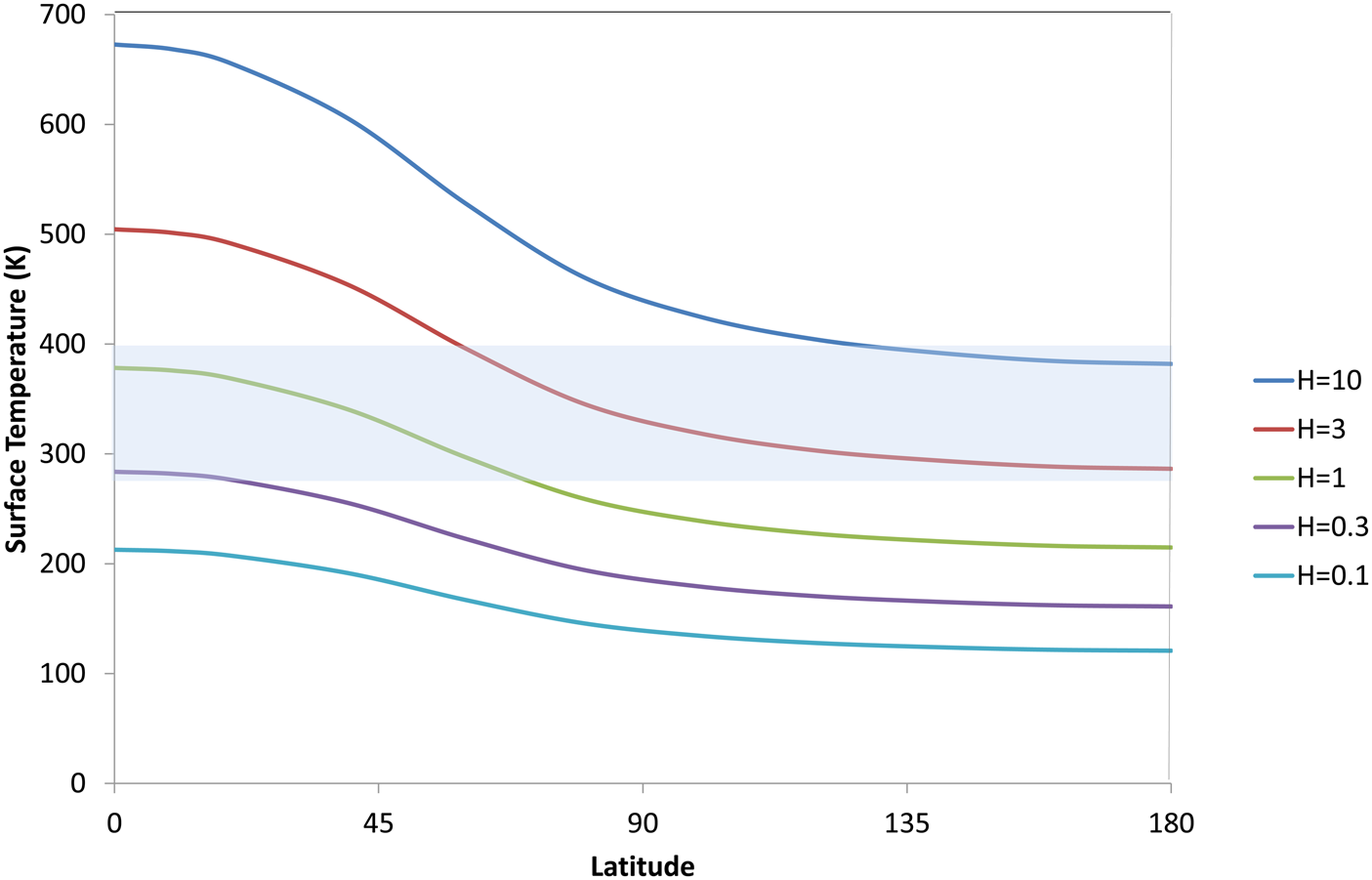
Surface temperature profiles for various values of the combined heating factor H are shown in Fig. 1, where a moderate local heat transport (Wandel, Reference Wandel2018) has been assumed.
Temperature profiles for several values of the heating factor H. A global heat redistribution of f = 0.1 is assumed. The bio-habitable temperature range is indicated by the shaded light blue area.

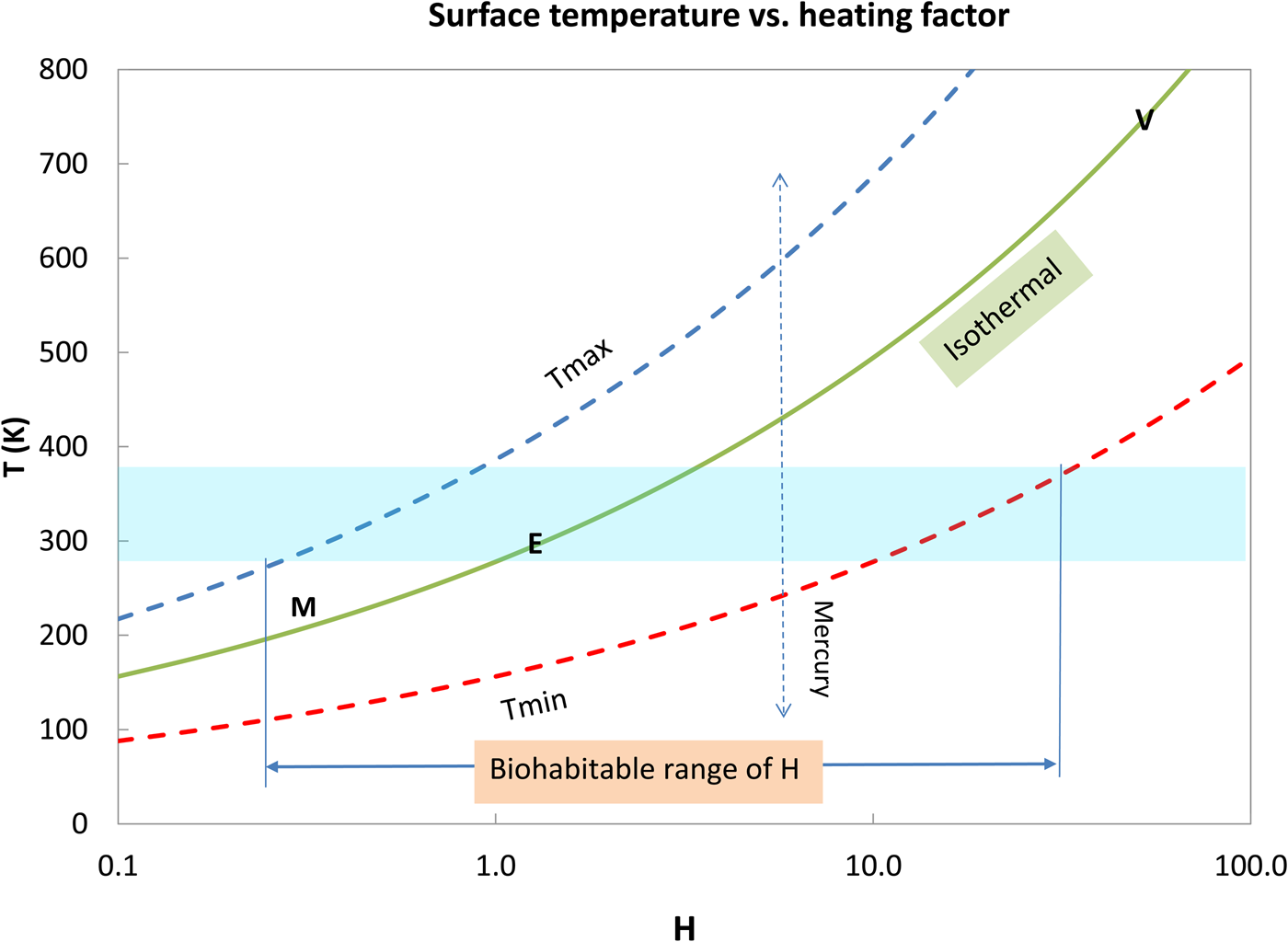
The dependence of the minimum and maximum temperatures (equations 8 and 9) on the heating factor H is shown in Fig. 2. From the intersection of the curves with the boundaries of the bio-habitable temperature zone it is possible to derive the range of the heating factor. As shown in the figure by the arrows at the bottom, for 273 < T < 373 K and f = 0.1, the bio-habitable range of the heating factor turns out to be 0.2 < H < 30. Letters denote the terrestrial planets of the Solar System. Note that Venus, Earth and Mars have average temperatures consistent with the equilibrium solid green curve (isothermal surface, f = 1), while Mercury's temperature gradient is shown by the dashed vertical arrow, indicating that it's effective redistribution parameter is f < 0.1.
Minimum and maximum surface temperatures of TLPs as a function of the heating factor H. The green solid curve shows the equilibrium temperature for an isothermal planet, while the dashed curves show the highest and lowest surface temperatures of a TLP with 10% redistribution (f = 0.1). Also shown are the locations of the four terrestrial planets of our Solar System. The bio-habitable temperature range is indicated by the shaded light blue area.

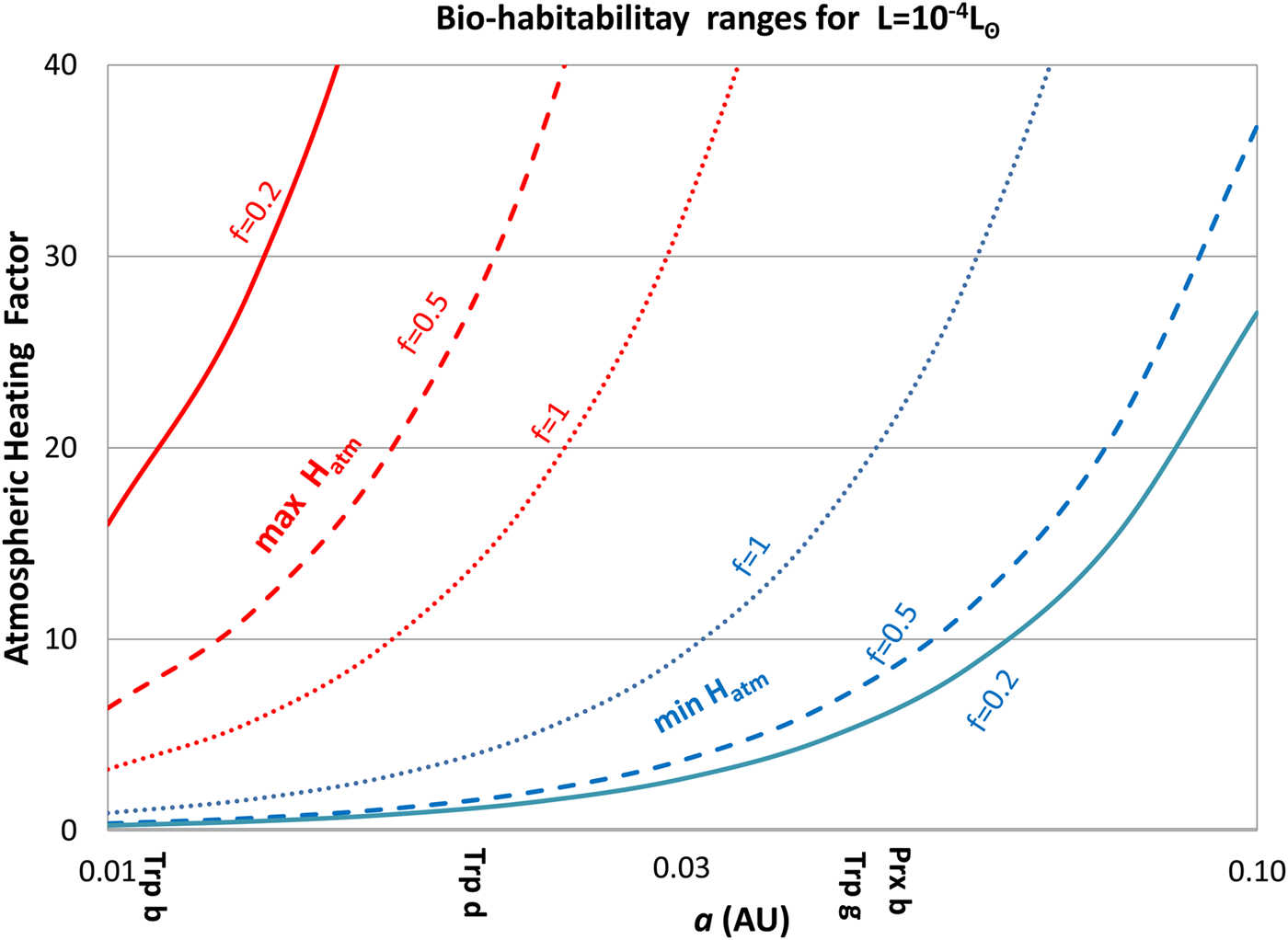
Figure 3 shows the bio-habitable range in terms of the atmospheric heating factor as a function of the distance from the host star. The curves are calculated for a low-mass RD with a luminosity of 10−4 that of our Sun (similar to that of Trappist-1), for several values of the redistribution parameter f. In particular, f = 1 corresponds to the isothermal case, which includes rapidly spinning planets. The locations of Proxima Cen b and of three of the Trappist-1 planets are marked on the x-axis. The y-axis shows the atmospheric part of the heating factor (equation 7) normalized at zero, that is, (1 − A)H gα − 1. The bio-habitability range of the heating factor, which corresponds to the highest and lowest surface temperature being consistent with liquid water at some point on the planet's surface, is given by the vertical distance between the upper and lower curves, corresponding to the redistribution parameter and orbital distance of the planet.
Maximal (red, upper) and minimal (blue, lower) bio-HZ boundaries of the atmospheric heating factor versus. distance from the host star, for three values of the heat redistribution parameter: f = 0.2 (solid), 0.5 (dashed) and 1 (dotted). The host luminosity is assumed to be L = 10−4L ʘ. The locations of Proxima b and 3 of the Trappist-1 planets are marked on the x-axis.

Synchronous orbits and slowly spinning planets
In this section we extend the surface temperature model for TLPs to synchronously orbiting planets (like Mercury, which has a spin-to-orbit period ratio of 3:2) and nearly synchronous ones (e.g. Venus), for which the spin (day/night) period is relatively long, comparable to the orbital period.
If the planet is not completely locked, but rather in a synchronous or nearly synchronous orbit, the sub-stellar point moves slowly. This movement causes various parts of the planet to be illuminated in a slow periodic pattern. This may affect the surface temperature distribution by enhancing the heat redistribution. The importance of this effect depends on the rate of the surface temperature change due to heating by radiation from the host star, or cooling by heat emission from the planetary surface into space. Given the average specific heat capacity of the surface and the flux from the host, it is possible to calculate the effective heating and cooling time constants t H, and t C.
The heating timescale is

where κ is the typical specific heat capacity, ρ − the density, Δh − the thickness of the layer that needs to be heated, ΔT − the temperature difference, S − the radiative flux from the host star and α − the atmospheric screening factor.
As an example, suppose that the surface is rock (typical specific heat capacity of κ = 800 J kg−1 K−1 and density ρ ~ 3000 kg m−3) and that a layer of Δh ~ 10 cm needs to be heated, to increase its temperature by ΔT ~ 100 K. We normalize the irradiation to that of Earth ($S_\oplus$ = 1670 J m−2 s−1), which is approximately the insolation within the HZ. Then the heating time required is approximately
t H ~ κ ρ Δh ΔT/S ~ 800 × 3000 × 0.2 × 100($S/S_\oplus$ )−1/1670 ~ 0.17($S/S_\oplus$
 )−1 days.
Taking A = 0.3 for the albedo of rock, and assuming α = 0.7, the heating time would be ~0.33 days. In the case of water, the time is considerably longer. The specific latent heats of melting and evaporation are 334 and 2260 kJ kg−1, respectively, and heating from 273 to 373 K would require 420 kJ kg−1, together κW ~ 3000 kJ kg−1. For a 10 cm thick layer of water, melting, heating to the boiling temperature and evaporation takes
t H ~ κW ρ Δh/($S/S_\oplus$ ) α(1−A)~3 × 106 × 1000 × 0.1($S/S_\oplus$
 )−1/1670 × 0.5 × 0.5 ~ 8.8 ($S/S_\oplus$
 )−1 days,where we assumed a higher albedo, A = 0.5 for ice/water and a lower α = 0.5 (enhanced screening) to take into account water vapour (clouds).
Similarly, assuming the surface heat loss rate is approximately black body, moderated by the atmospheric greenhouse factor H g, the cooling from the high-daytime temperature to the low-night time one is

Assuming the temperature is equal to the equilibrium surface temperature, substituting equation (2) and adding the atmospheric effects (screening and greenhouse) gives

For T = T 0 rather than T eq, equation (6) gives t C ~ (4–3f)t H. For the parameter values of the above example equations (11) and (12) give t H ~ 1.4($S/S_\oplus$ )−1 days for rock and t C ~ 33($S/S_\oplus$
 )−1 days for water. Coincidently, this cooling time range is comparable to the orbital period in the HZ of M-type stars.
In order to estimate the effect of rotation on the surface temperature, the heating and cooling times have to be compared with the rotation period. For synchronous or nearly synchronous orbits we define an effective rotation time t r as the time it takes for the host star, as seen from a fixed point on the planet, to complete one cycle (‘day')Footnote 3. Obviously, if t r is much longer than the heating/cooling times, the momentary surface temperature distribution of the planet can be approximated by that of a TLP. In the opposite case, when t r ~ < t H or t r ~ < t C, the surface does not have enough time to adjust to the TLP temperature, hence the surface temperature varies between the isothermal equilibrium temperature T eq = 278 H 1/4 K and the TLP temperature is given by equations (8) and (9).
Life on tidally locked planets
Although the climates on TLPs would not have the same seasonal and circadian cycles of radiation as on Earth, there may be a slow variation, e.g. in near synchronously, slowly orbiting planets, like Venus, if the axis of the planet was tilted to the ecliptic (Kite et al., Reference Kite, Gaidos and Manga2011). However, we assume here that although such variations are possible, and likely, the environment on many TLPs would be generally stable.
Recently Stevenson and Large (Reference Stevenson and Large2017), Stevenson (Reference Stevenson2018a, Reference Stevenson2018b) considered that the surface temperature structure of locked planets would deny the development of biological complexity, as the habitable belt around the sub-stellar point may be narrower than the latitudinal habitable bands on asynchronously rotating planets. However, as can be seen in Fig. 1, the habitable region on a locked planet often extends over a significant part of the surface. Actually, our results support the suggestion (Gale and Wandel, Reference Gale and Wandel2017) that locked HZ planets provide conditions not very different from those during the summer season at high latitudes on Earth. Furthermore, the time available for the evolution of biological complexity is even longer than on Earth, as the luminosity of the host changes slower for the lower main sequence M and K type stars, whose lifetime is much longer than that of the Sun. M type stars have an early flaring phase, with a high luminosity of X and UV radiation, which could endanger life unless it is protected under water. However, K type stars, as well as M type ones in their later evolutionary stages, are more quiescent and hence more hospitable also to land life.
In the case of M-type stars, TLPs are mostly within the HZ. Recently, Lingam and Loeb (Reference Lingam and Loeb2017) suggested that planets orbiting red dwarfs are less likely to be habitable due to atmospheric erosion as they may experience greater exposure to stellar winds and extreme ultraviolet radiation. However, atmospheric erosion may be avoided or limited by several factors, such as a strong enough planetary magnetic field or a thick primary atmosphere and the acquisition of a secondary atmosphere after the early energetic high-activity phase of the M-host (Tarter et al., Reference Tarter, Backus, Mancinelli, Aurnou, Backman, Basri, Boss, Clarke, Deming, Doyle, Feigelson, Freund, Grinspoon, Haberle, Hauck SA, Heath, Henry, Hollingsworth, Joshi, Kilston, Liu, Meikle, Reid, Rothschild, Scalo, Segura, Tang, Tiedje, Turnbull, Walkowicz, Weber and Young2007, Gale and Wandel, Reference Gale and Wandel2017).
Importance of a high oxygen atmosphere for the evolution of complex life
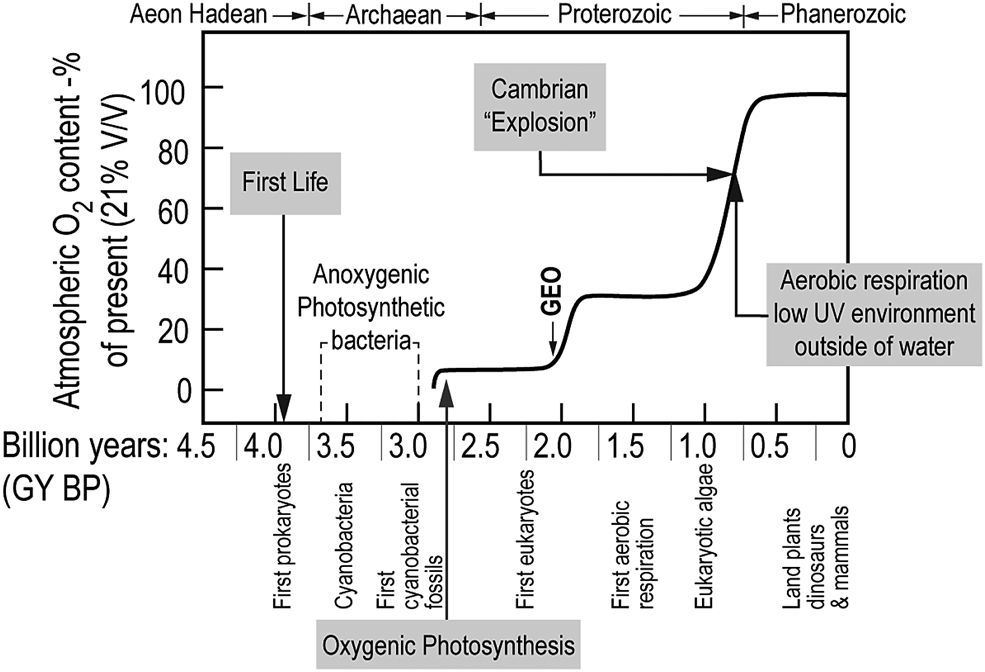
As depicted in Fig. 4, following Lyons et al. (Reference Lyons, Reinhard and Planavsky2014) and others, life first appeared on Earth some 4 Gy before present (BP). For ~3.5 Gy only single celled life prevailed under a very low-oxygen atmosphereFootnote 4. The first anoxygenic photosynthesis appeared about 3.8 Gy BP, followed one Gy later by water splitting, oxygenic photosynthesis. The release of oxygen from water resulted in an increase in the level of O2 in the atmosphere. The first significant O2 rise began in ~2.0 Gy BP when it reached some 10% (the ‘Great Oxygen Event' or GEO, which was partly responsible for some of the first great Ice Ages). The relatively low-initial levels of oxygen delayed the evolution of animal life in the Mid-Proterozoic (2.5 to 0.6 Gy BP) (Planavsky et al., Reference Planavsky, Reinhard, Wang, Thomson, McGoldrick and Robert2014). Around 0.6 Gy BP the atmospheric level started rising more steeply, reaching the present level in ~500 My BP. During the same period, first Protists (unicellular Eukaryotes) then complex, multi-cellular Eukaryotes evolved. This has been termed the Cambrian ‘Explosion’, although it is now recognized that the process took many tens of millions of years.
The evolution and consequences for life of the high-oxygen atmosphere on Earth.

The reason for the coincidence of the high-oxygen atmosphere and the appearance of complex life has been ascribed to two effects of high oxygen: the enablement of aerobic respiration, which produces nine times the energy from each unit of substrate than anaerobic respiration and the screening of UV radiation, which allowed the emergence of life from the protection of water, to dry land (Lambers et al., Reference Lambers, Chapin and Pons2008). A rapid supply of energy is required for complex life forms, especially for motility and brain metabolism (Belanger et al., Reference Belanger, Allaman and Magistretti2011). On Earth, dry-land life is protected by the UV absorption of oxygen and the ozone produced. However, this consideration may be less important on planets of M-type stars after their early flary stage, as Red Dwarfs radiate much less than our Sun in the UV waveband.
Could TLPs support oxygenic photosynthesis and oxygen-rich atmospheres?
The surface temperatures of RDs are cooler than our sun (2500–4000 versus 5800 °K). Although they radiate less photons in the photo-synthetically active radiation (PAR) waveband (400–700 nm) than is incident on Earth, there is still enough PAR flux to support Earth-like plant life (Gale and Wandel, Reference Gale and Wandel2017).
Ritchie et al. (Reference Ritchie, Larkum and Ribas2018) made theoretical estimates and laboratory measurements of the photosynthesis of different species of algae exposed to radiation levels which could be expected at the Sub-stellar points of TLPs. They concluded that the PAR incident on TLPs may produce high levels of basic plant productivity: from 13–22% of what would be expected on Earth. Their calculations were made for productivity per second or per hour. However, compared to the annual incident radiation on Earth, this may be an underestimate. As pointed out by Gale and Wandel (Reference Gale and Wandel2017), vegetation on TLPs would be exposed to continuous light. This is analogous to the summer season at high-Earth latitudes, where plants receive almost continuous radiation, resulting in lush growth. On most TLPs there will be no seasons and radiation would be continuous.
By way of example, the vegetation in midsummer on the Scottish Loch Creran, at latitude 57.5°N enjoys 17 h of moderate PAR (Johnston et al. (Reference Johnston, Jones and Hunt1977)). ‘Enjoys’ as radiation at this latitude does not reach damaging levels (Gale and Wandel, Reference Gale and Wandel2017, Fig. 5).
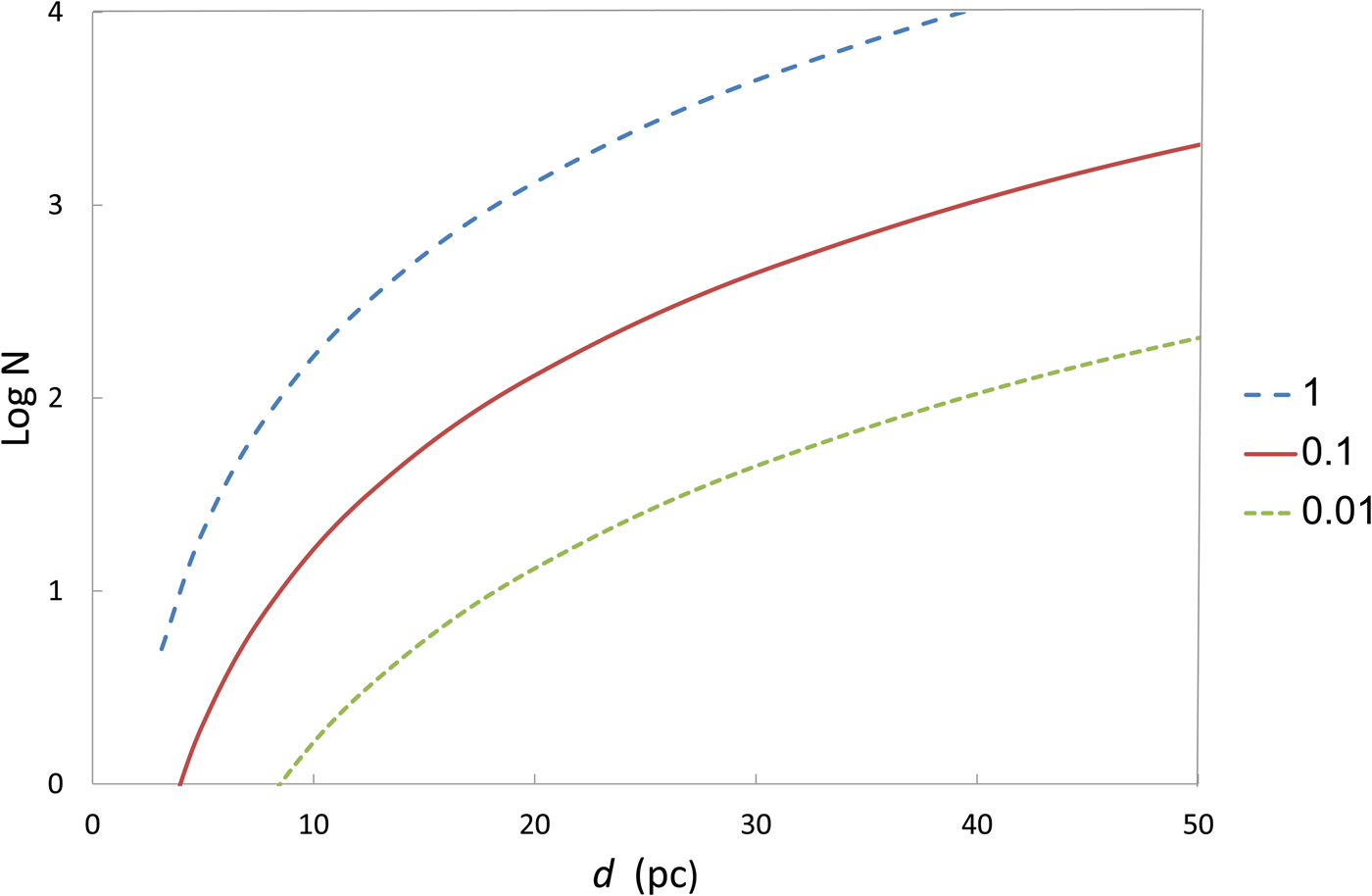
The number of red dwarf planets with oxygenic bio-signatures expected within a distance d, for several values of the product F EHZF b (marked on the right), where F b is the biotic probability (see text) and F EHZ is the fraction of M-type stars with Earth-sized HZ planets.

Zhang et al. (Reference Zhang, Xiao, Wu, Zhou, Zhang, Qin and Dong2017) calculated the potential gross primary production of plants (GPP) as a function of PAR at different latitudes on Earth. The maximum GPP at 55°N was found to be very high (in midsummer) resulting in an annual GPP (almost entirely produced in the summer months) reaching to about one third of that in the tropics (0 ± 10° latitude). By extrapolation, this should at least double the productivity on TLPs as calculated by Ritchie et al. Furthermore, damaging levels of radiation would be avoided on TLPs, by the plants ‘selecting’ locations with optimum radiation regimes, between the substellar point and light termination (Gale and Wandel, Reference Gale and Wandel2017).
Some Earth algae already have pigments which utilize small parts of the NIR (Reference Larkum, Ritchie and RavenLarkum 2Reference King, Segura, Tinetti, Govindjee, Blankenship, Cohen, Siefert, Crisp and Meadows018; Nurnberg et al., Reference Nurnberg, Morton, Santabarbara, Telfer, Joliot and Antonaru2018). King et al. (Reference King, Siefert, Govindjee and Blankenship2007a, Reference King, Segura, Tinetti, Govindjee, Blankenship, Cohen, Siefert, Crisp and Meadows2007b) have discussed the theoretical possibility that plants exposed to the copious near infra-red (NIR) radiation of M-stars (in the 700–1000 nm waveband) could evolve pigments which would utilize this waveband for oxygenic photosynthesis. However, although theoretically possible, there would be little evolutionary pressure for this step to appear, as there may be a surfeit of PAR in the 400–700 nm waveband on TLPs. Moreover, photosynthesis in the NIR would have lower photonic efficiency (Wolstencroft and Raven, Reference Wolstencroft and Raven2002). On Earth, land plants actually evolved leaves which reject NIR (by reflection), presumably to reduce water loss in situations where there is sufficient PAR (Gale and Wandel, Reference Gale and Wandel2017).
In view of the above, it is concluded that there should be no shortage of PAR on TLPs (even before extending the PAR-range to 400–1000 nm). If high rates of oxygenic photosynthesis produce a high-oxygen atmosphere then, in analogy to Earth, conditions would exist for the appearance of complex, multi-cellular, life. However, such life would probably differ from that on Earth which is subject to seasonality and a 24-h light–dark radiation cycle, which are absent on TLPs. We emphasize again that the mere appearance of clement conditions does not guarantee the evolution of complex or even simple life. By way of analogy, on ‘Goldilocks’ Earth, most geological niches which contain liquid water do not support life (Jones and Lineweaver, Reference Jones and Lineweaver2010).
The effect of tidal locking and the absence of seasonal and circadian cycles on complex life
Habitable planets of M-stars would be close enough to be tidally locked. We discuss the special conditions on such planets, which are different from those on Earth, and how, after the mono-cellular evolutionary phase, they will affect complex, multi-cellular life. We first address the question of the importance of the oxygen-rich environment to the evolution of complex life on Earth.
Vegetation on Earth operates anabolic and catabolic metabolisms. Photosynthesis, the beginning of an anabolic chain, is active in the light, while respiration, with its basically catabolic chain, followed by the construction of cellular components, continues throughout the day. Enzymes involved in the two processes are balanced accordingly (Amthor, Reference Amthor1989). This would necessarily be different on TLPs, where both operate continuously.
On Earth, vegetation adapts to seasons, from little radiation seasonality in the tropics (with climate affected by seasonal rainfalls) to extreme variation at far northern, or southern latitudes. Plants respond with adaptations of germination, flowering, root versus stem production, leaf fall and many other processes. These temporal responses are governed by mechanisms which measure day/night length and temperature cycles (Lambers et al., Reference Lambers, Chapin and Pons2008). Such adaptations would be absent on TLPs, where plants would be exposed to continuous steady radiation, although geographic features (Stevenson, Reference Stevenson2018a, Reference Stevenson2018b) and planet obliquity (Kite et al., 2011) may produce some climate variations.
Animal life on Earth shows response to seasonality by special adaptations, such as migration, hibernation of large animals during the cold of winter in latitudes above ~50°, north or south, and estivation of some drought avoiding animals in desert summers (Storey and Storey, Reference Storey and Storey1990). Such adaptations would not be relevant to life on TLPs.
Earth's movement around the Sun at an oblique angle to the ecliptic produces seasons at latitudes not close to the equator. However, the most significant movement of Earth, is its rotation. Earth's rotation was not always of 24 h, but started at 10 h (Hadhazy, Reference Hadhazy2010). The day slowly increased in length as the moon receded. Hadhazy, who reviewed the literature on Moon–Earth attraction and the many other factors which effect day length, estimated a 22 h rotation at 650 My BP. Sonett et al. (Reference Sonett, Kvale, Zakharian, Chan and Dernko1996) estimated that at 900 My BP, day length was as low as 18 h.
This means that mechanisms which evolved to govern circadian rhythms must have included resettable clocks. This is something which all who have travelled long distances by plane, East or West, are familiar with. We are at first confused by ‘Jet lag’, but our internal clocks readjust, at the rate of about one day for each hour of change. Such adaptations would be unnecessary and therefor absent on TLPs.
The most outstanding adaptation of animal life to Earth's rotation (above the arthropod and cordate phyla) is sleep during the dark periods of the day (Stickgold and Walker, Reference Stickgold and Walker2013). Sleep appears throughout the animal world, and is recognized even in some insects such as Drosophila (Shaw, Reference Shaw2000). There are only conjectures for the reason for this phenomenon. Sleep probably evolved to conserve resources during periods when animals could not hunt or gather food and would risk injury and exposure to dark adapted enemies. What we do know today is that advanced nervous systems have adapted to utilize sleep for maintenance (Krueger et al., Reference Krueger, Rector, Roy, Van Dongen, Belenky and Panksepp2008). Sleep deprivation in humans, and probably in other sleeping animals, causes disorientation and even immune system damage (Imeri and Opp, Reference Imeri and Opp2009). This maintenance is probably a secondary adaptation. If periodic sleep does not appear in higher, complex life forms on TLPs, some other forms of maintenance would probably evolve. An example of such an adaptive mechanism evolved on Earth in Dolphins and Porpoises. These animals keep half their brains awake while the other half sleeps. This allows them to continue eating throughout the day, while being on guard against night-active predators (Makhametev, Reference Makhametev1987).
The cosmic abundance of life
The above arguments show that life bearing planets of RDs may be copious. Following Wandel (Reference Wandel2015, Reference Wandel2018) we estimate the abundance and probability of biotic life. Assuming that biotic life is long lived, as on Earth (~4 Gyr for mono-cellular life), the number of biotic planets can be expressed by a Drake-like equation,

where N * is the number of stars in the Galaxy, F s is the fraction of stars suitable for evolution of life and F EHZ is the fraction of such stars that have Earth-sized planets within their HZ. The last parameter, F b, is the (yet unknown) biotic probability, that a habitable planet actually becomes biotic within a few billion years. In the following we assume that the duration of biotic life, once it has emerged on an Earth-like planet, is like on Earth, at least a few billion years.
Note that this assumption does not refer to any single species, but rather to mono-cellular life, which has existed on Earth for about 4 Gy. In particular, oxygenic photosynthetic organisms, which are responsible for Earth's high oxygen atmosphere, appeared about 2.8 Gy BP (Fig. 4) and survived ever since.
With this assumption the average distance d b between biotic neighbour planets can be shown to be (Wandel, Reference Wandel2015, Reference Wandel2017)

where n * is the stellar number-density in the solar neighbourhood. For RDs, n * ~ 0.2 pc−3 and F s ~ 0.7 (Henry et al., Reference Henry, Jao, Subasavage, Beaulieu, Ianna, Costa and Méndez2006; Winters et al., Reference Winters, Henry, Lurie, Hambly, Jao, Bartlett, Boyd, Dieterich, Finch, Hosey, Ianna, Riedel, Slatten and Subasavage2015).
The fractional abundance of Earth-sized habitable planets, F EHZ, can be estimated from the Kepler data (e. g. Dressing and Charbonneau, Reference Dressing and Charbonneau2015), F EHZ ~ 0.1–0.75, depending on the definition of the HZ. Substituting in equation (14) gives

For example, assuming one in ten Earth-sized habitable planets of M-stars becomes biotic (F b = 0.1), equation (15) gives d b ~ 1.5–3 pc. The results of the previous sections may indicate that the actual value of F EHZ is nearer to unity than to 0.1, and furthermore, increase the expected value of F b.
The expected number of biotic planets within a distance d may be derived from equation (15) by substituting the values of n * and F s,

Figure 5 shows the expected number N b as a function of the distance and the product F EHZF b. The previous sections imply that the effective value of F EHZ (the fraction of Earth-sized planets in the bio-HZ) could be close to unity. Bio-habitability, as defined in sections ‘Synchronous orbits and slowly spinning planets' and ‘Life on Tidally Locked Planets’ (surface temperatures supporting liquid water and organics), allows evolution of oxygenic photosynthesisFootnote 5 (Gale and Wandel, Reference Gale and Wandel2017) and hence an oxygenic bio-signature. This gives a direct relationship between the observed number of planets with oxygenic signatures and the biotic probability F b, with the caveat of non-biotic false-positive oxygen signatures.
TESS, launched in April 2018, is expected to find hundreds of transiting Earth-to-Super-Earth sized planets, many of them in the HZs of nearby M-dwarfs (Ricker et al., Reference Ricker, Winn, Vanderspek, Latham, Bakos, Bean, Berta-Thompson, Brown, Buchhave, Butler, Butler, Chaplin, Charbonneau, Christensen-Dalsgaard, Clampin, Deming, Doty, De Lee, Dressing, Dunham, Endl, Fressin, Ge, Henning, Holman, Howard, Ida, Jenkins, Jernigan, Johnson, Kaltenegger, Kawai, Kjeldsen, Laughlin, Levine, Lin, Lissauer, MacQueen, Marcy, McCullough, Morton, Narita, Paegert, Palle, Pepe, Pepper, Quirrenbach, Rinehart, Sasselov, Sato, Seager, Sozzetti, Stassun, Sullivan, Szentgyorgyi, Torres, Udry and Villasenor2014; Seager, Reference Seager2014). Given the bio-signature detection range, we can determine the number of expected candidates by calculating the cumulative number of biotic planets as a function of distance (Wandel, Reference Wandel2018).
Using equation (16) and Fig. 5, we can calculate the expected number of candidate planets within a given distance (the bio-signature detection range). If the M-dwarf habitability fraction is F EHZ = 0.5 (i.e. 0.5 Earth-sized HZ-planets per Red Dwarf), one could expect ~2000 habitable planets of RDs within 30 pc. With a transiting probability of 1–2%, TESS can be expected to detect 20–40 transiting ones.
As an example, let us assume that out of 30 candidates we find oxygenic signatures in 20 planets, and half of them have other supporting bio-signatures. One could then estimate the biotic probability to be F b ~ 0.3 ± 0.05.
Of course, such signatures may be inconclusive, as oxygen may be produced abiotically, but combinations of several components, such as oxygen, water and methane could be more unique (e.g. Seager and Deming, Reference Seager and Deming2010).
Discussion and conclusions
The habitability of gravitationally locked planets is investigated, taking into account irradiation, albedo, circulative heat transport and atmospheric effects such as screening and greenhouse effects. Our model supplements earlier calculations, combining the circulation and radiative heating calculations with habitability and life-supporting conditions. We find that HZ planets of M-dwarf stars may have temperatures supporting liquid water and complex organic molecules on at least part of their surface, for a wide range of irradiation and atmospheric properties, in particular taking into account the greenhouse and circulation effects.
Some recent works argued that planets of RDs may be less favourable to life because of atmosphere erosion and being tidally locked. Projections of the present model suggest that the HZ of RD stars may be less hostile to life than previously thought. We argue that oxygenic photosynthesis and perhaps complex life on tidally locked and synchronously orbiting planets around RDs may be possible. Combined with the vast number of RD stars and their planets in the Galaxy, these results seem to make the possibility of finding life on such planets plausible.
It is argued that PAR, between 400–700 nm would not be lacking on RD planets, even for plants developing under water, where they are protected from the XUV radiation. Moreover, should plant life spread to dry land, after the evolution of an XUV absorbing atmosphere, theoretical considerations indicate that photosynthetic pigments could evolve to utilize the copious NIR radiation of the RD stars, which is not being absorbed by a water cover. This may add to the availability of PAR, even though its efficiency would be lower than that in the 400–700 nm waveband.
By analogy to Earth, if oxygenic photosynthesis is possible and produces an oxygen-rich atmosphere, then complex life could evolve. However, plants and animals, which evolve on such planets, are likely to differ from those on Earth in many ways, such as the anabolic/catabolic enzyme balance and circadian and seasonal rhythms in plants. Animals would not evince seasonal hibernation and estivation and, not being exposed to diurnal radiation cycles, would have different sleep patterns.
Using Kepler data, we estimate the abundance of habitable candidates to harbour life. E.g. within a biomarker detection range of 30 parsec TESS should find 20–40 transiting habitable super-Earth-sized planets. Observing such a sample of planets and searching for spectral signatures of water and oxygen could yield an estimate of the abundance of biotic planets and of the probability for the evolution of organic life on habitable planets.
Acknowledgements
We thank the reviewer for his helpful comments.
Note added in proof
The recent discovery of water vapor in K2-18b (Tsiaras et al., Reference Tsiaras, Waldmann, Tinetti, Tennyson and Yurchenko2019, Nature Astronomy) is a major breakthrough in the search for life, not only because it is the first discovery of water in a Superearth-size exoplanet in the HZ, but also because it demonstrates that Habitable-Zone locked planets of M-dwarf stars are capable of conserving an atmosphere and significant amounts of surface water. This supports our arguments presented in the introduction and in the section Life on tidally locked planets, as well as in Gale and Wandel (Reference Gale and Wandel2017).