Voluntary assisted dying allows access to medication with the purpose of ending a person's life, enabling them to make a decision about the timing and manner of their death (Government of the State of Victoria, 2017). Countries such as Switzerland, Belgium, Canada, Netherlands, and Luxembourg, some states in the United States and Australia have various forms of assisted dying, with different legislative frameworks (Government of the State of Victoria, 2017; The Federal Assembly the Swiss Confederation, 2018). This issue is contentious and stimulates discussion in the wider community (Blendon et al., Reference Blendon, Szalay and Knox1992; White and Willmott, Reference White and Willmott2018).
One issue for consideration is stigmatization, defined as disapproval of, and discrimination against, those in society who are perceived to be different (Link and Phelan, Reference Link and Phelan2006). Public stigma is seen in labeling, stereotyping, and discrimination of others, loss of status, an “us” and “them” mentality (Link and Phelan, Reference Link and Phelan2006), and is influenced by prevailing norms in society (Goffman, Reference Goffman1968). Self-stigma occurs when individuals internalize the stereotypes, prejudices, and discriminations of others, which has a negative effect on their self-perceptions (Corrigan, Reference Corrigan2004). In studies of people with mental health issues, self-stigma has been shown to be associated with an increased risk of suicide and reduced help seeking behavior and to lead to low self-esteem and a loss of social opportunities (Cryer et al., Reference Cryer, Calear and Batterham2018).
Circumstances of death may influence stigmatization and offers of support following bereavement (Logan et al., Reference Logan, Thornton and Breen2018a). People bereaved by voluntary assisted dying, often report perceived social disapproval and stigma; they hide the manner in which the death occurred (Gamondi et al., Reference Gamondi, Pott and Forbes2015) and are reluctant to have assisted dying on death certificates, fearing disapproval (Downie and Oliver, Reference Downie and Oliver2016). People bereaved by assisted dying may withdraw from others, report feelings of shame, rejection, and abandonment (Gamondi et al., Reference Gamondi, Pott and Forbes2015), and are fearful of being judged by others (Gamondi et al., Reference Gamondi, Pott and Preston2018). People are also careful about whom they disclose information to and are hesitant to put themselves in a situation where they have to defend their or the deceased's decision for assisted dying (Srinivasan, Reference Srinivasan2019). This secrecy management around voluntary assisted dying may prevent people expressing their grief, increase their risk of complications of grief, and lead to less social support and greater stigma (Gamondi et al., Reference Gamondi, Pott and Forbes2015). In the context of bereavement, indicators of public stigma include emotional responses to the person and social distance desired from them (Eisma et al., Reference Eisma, te Riele and Overgaauw2019).
Public expectations of grief symptomatology are used to identify recognition of support need in some studies, alongside measures of stigma (Penman et al., Reference Penman, Breen and Hewitt2014; Logan et al., Reference Logan, Thornton and Kane2018b). Social support is a complex process in that a potential supporter must recognize the need for support, the support must be available, sufficient, and extended, and then perceived as helpful by the recipient (Logan et al., Reference Logan, Thornton and Kane2018b). Additionally, the usefulness can depend on the source, type, and timeliness of the support offered (Aoun et al., Reference Aoun, Breen and White2018). Social support is a key protective factor for grieving people and is readily amenable to intervention (Logan et al., Reference Logan, Thornton and Kane2018b), yet bereaved people often do not receive the quantity or quality of social support that they would like (Aoun et al., Reference Aoun, Breen and Howting2015). Public stigma and expectations of grief symptomatology have been observed in vignette-based experimental studies of bereavement (Penman et al., Reference Penman, Breen and Hewitt2014; Eisma, Reference Eisma2018; Logan et al., Reference Logan, Thornton and Kane2018b; Eisma et al., Reference Eisma, te Riele and Overgaauw2019) but is yet to be investigated in studies of bereavement through assisted dying.
Another issue to consider is age of death. Findings from the United Kingdom and Austria have found that the age of an individual accessing assisted dying is a contributing factor in attitudes surrounding assisted dying (Lamers and Williams, Reference Lamers and Williams2016), with both the public and health professionals more comfortable with elderly people utilizing assisted dying than younger adults (Lamers and Williams, Reference Lamers and Williams2016) or children (Frileux et al., Reference Frileux, Lelièvre and Muñoz Sastre2003; Bevacqua and Kurpius, Reference Bevacqua and Kurpius2013; Stolz et al., Reference Stolz, Burkert and Großschädl2015). One study found that the public considered assisted dying to be more acceptable for older adults (85 years) than for middle-aged (60 years) or younger adults (35 years) (Frileux et al., Reference Frileux, Lelièvre and Muñoz Sastre2003). Similarly, counseling students indicated more support and social approval for older (77 years) than younger (25 years) people requesting assisted dying (Bevacqua and Kurpius, Reference Bevacqua and Kurpius2013).
The current study
Concern that being bereaved by assisted dying will elicit public stigma has not been tested experimentally. This study aimed to investigate experimentally the effects of cause of death (death as a result of voluntary assisted dying vs. death after a long-term illness) and age of the deceased (28 vs. 80 years) on emotional responses to the bereaved, desire for social distance from the bereaved, and expectations of the bereaved person's grief symptomatology. We predict that participants will report greater negative emotions, a stronger desire for social distance, and expect more intense grief symptomatology for people bereaved through voluntary assisted dying (rather than long-term illness) and by the loss of a younger person (than by the loss of an older person). Furthermore, we will also investigate whether there are interactions between the cause of death and age of the deceased on the variables of interest.
Method
Research design
A 2 (cause of death: voluntary assisted dying vs. long-term illness) × 2 (age of bereaved: 28 or 80 years) randomized between-groups, vignette-based experiment was used to test the effects of cause of death and age of the deceased on multiple indicators of public stigma (feelings of anger, fear, prosocial emotions; desire for social distance) and expectations of grief symptomatology. The ages of the deceased chosen represent the youngest and oldest stages of adulthood (Bevacqua and Kurpius, Reference Bevacqua and Kurpius2013).
Participants
A G*power a priori analysis (Faul et al., Reference Faul, Erdfelder and Lang2007) with a Bonferroni-adjusted alpha level of 0.01 (two-tailed), estimated 127 participants would be required to achieve 80% power to detect a moderate (f 2 = 0.15) effect. One hundred sixty-four Australian adults (130 women, 34 men, M age = 37.69 years, SD = 10.295) were recruited using convenience sampling through social media and snowball sampling, to represent the general population. Respondents were highly educated, with 48.8% completing a tertiary degree and an additional 20.1% completing post-graduate studies. Of the sample, 61.6% engaged in religious services at least once a year.
Procedure
Ethics approval was granted by the Human Research Ethics Committee at Curtin University (HRE2019-0286). The vignettes and associated questionnaires were loaded onto Qualtrics. The Qualtrics link was shared on social media with a statement encouraging those who see it to share it. Participants were asked to read a detailed information sheet and provided informed consent by clicking a consent box. Participants were then randomly assigned to read one of four vignettes. The survey comprised the outcomes measures (which were presented in random order), followed by demographic questions and the post-manipulation check. A prize draw to win one of five $20 gift cards was available upon completion of the questionnaire. Participants indicating interest were redirected to a separate survey to provide their information. The whole survey took 10–15 min and participants were thanked for their time and provided with information about services they could contact should they have difficult or uncomfortable reactions to the survey.
Measures
Demographic questions
This included age in years, gender, level of education, religious engagement (never, daily, weekly, fortnightly, and yearly).
Vignettes
Vignettes allow the gathering of responses as an analog to real-life behavior (Price and Neijens, Reference Price and Neijens1998). Vignettes were developed using Logan et al. (Reference Logan, Thornton and Kane2018b) example which allows for responses which would best evaluate how a participant may react in real-life situations. Each vignette described an individual who had experienced spousal bereavement, for example: “W.G.'s spouse of 10 years died after a long term illness at the age of 28.” Age of the deceased (28 or 80) and mode of death (voluntary assisted dying or long-term illness) were the only elements to change from one vignette to the next; the vignettes remained gender neutral and free of unnecessary, distracting information.
Emotional reactions scale
Emotional reactions toward a person are a component of stigma (Link and Phelan, Reference Link and Phelan2006). Common reactions to people who are perceived as different are anger, fear, and prosocial emotions (Eisma et al., Reference Eisma, te Riele and Overgaauw2019). An adapted Emotional Reactions Scale was used, comprising three subscales: anger, fear, and prosocial emotions (Eisma et al., Reference Eisma, te Riele and Overgaauw2019). The scale is a 13-item Likert-type interval scale. Participants score 1–4 their level of agreement with the statements from 1 (Strongly disagree) to 4 (Strongly agree) on, for example, “When I read about W.G. I feel annoyed.” Each subscale has demonstrated good internal consistency in the general population with α = 0.85 (fear), α = 0.82 (anger), and α = 0.75 (prosocial behaviour; Eisma et al., Reference Eisma, te Riele and Overgaauw2019), and in the current study, α = 0.83 (fear), α = 0.86 (anger), and α = 0.64 (prosocial behavior).
Social distance scale
Preferred social distance from the bereaved person in the vignettes were measured with the scale first developed by Link et al. (Reference Link, Cullen and Frank1987). The statements determined to what degree a participant was willing to interact with W.D.; the bereaved person in the vignettes (Eisma et al., Reference Eisma, te Riele and Overgaauw2019). For example, “How would you feel having someone like W.D. as a neighbour?.” The measure is a 7-item Likert scale, where participants score 1 (Definitely willing) to 4 (Definitely unwilling) to interact with the person in each situation. Revisions made to the original measure included changing the word “child” to “relative” in one item in order to make the scale relevant to a broader audience (Penman et al., Reference Penman, Breen and Hewitt2014) and simplifying “Worker on the same job” to “colleague” (De Ruddere et al., Reference De Ruddere, Bosmans and Crombez2016). We followed recent changes in scoring statements 1–4 rather than using the original 0–3 scoring (Penman et al., Reference Penman, Breen and Hewitt2014; Eisma, Reference Eisma2018). All versions of the scale had good internal consistency as did the current study α = 0.84.
Expectations of grief symptomatology scale
This 12-item scale determines a participant's expectations of the intensity of another's grief (Penman et al., Reference Penman, Breen and Hewitt2014). Participants rate expected grief symptoms on a Likert scale of 1 (Never) to 5 (Always); higher scores indicated that more intense grief was expected (Logan et al., Reference Logan, Thornton and Kane2018b). For example, “How often do you think the person in the scenario would be experiencing trouble accepting loss?.” The scale displays acceptable internal consistency with α = 0.87 (Penman et al., Reference Penman, Breen and Hewitt2014), current study α = 0.88.
Post-manipulation check
A post-manipulation check asked “How old was the loved one described?” and “How was the death described?” to confirm participants attended to the manipulations (Kane and Barabas, Reference Kane and Barabas2019).
Analyses
Only 12 cases were missing responses (0.6%). Given the very small amount of missingness, missing data were replaced using Expectation Maximization (Tabachnick and Fidell, Reference Tabachnick and Fidell2013).
Only 6.1% responded to manipulation checks incorrectly. Removal of these cases did not alter results, and therefore, the analysis from the full sample are reported. The hypotheses were tested using a two-way multivariate analysis of variance (MANOVA). Mode of death (voluntary assisted dying, long-term illness) and age of the deceased (28, 80), as well as their interaction, were entered as fixed factors. Anger, fear, prosocial emotions, social distance, and expectations of grief symptomatology were entered as outcome variables. If any significant multivariate effects were identified, these were followed-up with univariate ANOVAs to identify which outcome variables differed between the group(s) and in which direction. All P-values for these univariate analyses were adjusted using the Bonferroni–Holm correction to account for the multiple comparisons.
For all results, partial eta squared ( $\eta _p^2$) is presented as a measure of effect. A
 $\eta _p^2 > 0.06$ is considered a “medium” effect, and
 $\eta _p^2 \;> 0.14$ considered a “large” effect (Cohen, Reference Cohen2013).
Results
Multivariate differences
The MANOVA identified a statistically significant main effect of age group of the deceased spouse, with a medium-large effect size (F(5, 156) = 3.38, P = 0.006,  $\eta _p^2 = 0.99$). This relationship did not significantly change depending on the mode of death (F(5, 156) = 0.77, P = 0.572,
 $\eta _p^2 = 0.02$), nor was there a significant main effect of mode of death (F(5, 156) = 1.16, P = 0.330,
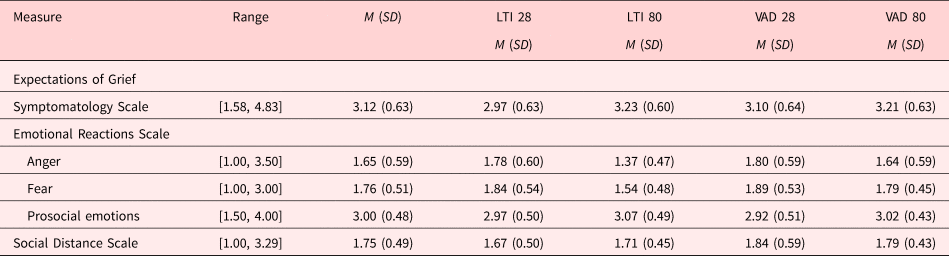
 $\eta _p^2 = 0.04$). This implies that there were differences between age groups of the deceased (28 or 80) on these measures, but that there were no differences between the modes of death (voluntary assisted dying vs. long-term illness). Table 1 shows the mean and standard deviation of results. The univariate ANOVAs were then used to identify which of the measures differed between the age groups.
Means and standard deviations for grief expectations, anger, fear, prosocial emotions, and social distance

Note. N = 164. LTI, long-term illness; VAD, voluntary assisted dying.
Univariate differences
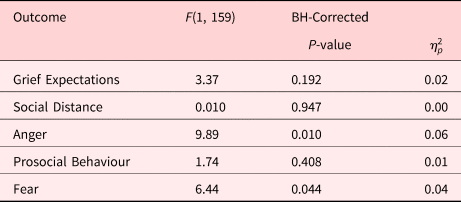
The Univariate ANOVAS identified that Anger and Fear significantly differed between the age groups (see Table 2). On average, those bereaved of younger-aged spouses elicited more anger (0.29 points higher) and fear (0.20 points higher) than those bereaved of older-aged spouses.
Age group main effect from univariate ANOVAs

Discussion
This is the first study to include voluntary assisted dying in an experimental investigation of cause of death on public stigma and expectations of grief symptomatology. Contrary to expectations, there were no interaction effects between age and mode of death, and no main effect for mode of death, demonstrating no difference in emotional reactions, desire for social distance, or expectations of grief symptomatology for those bereaved by assisted dying over long-term illness. While studies show that people bereaved by assisted dying express concerns about stigma (Gamondi et al., Reference Gamondi, Pott and Forbes2015; Downie and Oliver, Reference Downie and Oliver2016; Gamondi et al., Reference Gamondi, Pott and Preston2018; Srinivasan, Reference Srinivasan2019), our data demonstrate that these concerns may be unfounded. If those bereaved via assisted dying engage in secrecy management due to these concerns about stigma, they could risk receiving less social support, which could exacerbate their grief (Wagner et al., Reference Wagner, Keller and Knaevelsrud2012). That is, people bereaved via assisted dying might experience self-stigma due to perceiving the potential for public stigma. Thus, our findings may have educative value in encouraging people bereaved in this circumstance to talk about their loss and seek support from others.
Participants demonstrated more anger and fear toward people whose family members died at a young age, regardless of mode of death. Our finding of stigma in the form of anger and fear directed toward the bereaved person, when a younger person died, is in line with many studies that show age-related stigma is prevalent within western society (Widrick and Raskin, Reference Widrick and Raskin2010). Perceptions that the elderly are needy, fragile, and severely impaired remain (Widrick and Raskin, Reference Widrick and Raskin2010), and those who are younger benefit from positive perceptions (Hummert, Reference Hummert1990), such that they deserve more time to live (Stolz et al., Reference Stolz, Burkert and Großschädl2015).
Age of the deceased was not a factor determining desire for social distance from those who are bereaved by either mode of death. Although participants had negative emotional reactions toward those bereaved by the death of a 28-year-old spouse, it seems that they are not inclined to desire social distance from the bereaved person. Our finding that negative emotional reactions were not corollary of a desire for social distance, deviates from previous studies (e.g., Eisma et al., Reference Eisma, te Riele and Overgaauw2019). Furthermore, there was no difference in participants’ emotional reactions toward, or desire for social distance from, those bereaved by assisted dying and those bereaved by long-term illness. Findings also indicate that there was no difference in participants’ expectations of grief according to mode of death or age of the deceased.
Limitations
Limitations that should be considered in interpreting the results include that only one Australian state had legalized assisted dying at the time of gathering data (Government of the State of Victoria, 2017), meaning that participants likely had no direct experience with someone who is bereaved by assisted dying. However, this study provides findings of stigma and expectations of grief symptomatology before assisted dying becomes legal in other states, which is useful in measuring public stigma over time. Conducting research with those who have experienced loss to assisted dying in the future, would give insight to any changes in public perceptions. Additionally, including more participants in future studies is recommended, so that small effects of voluntary assisted dying versus other death types on public stigma can be detected.
The proportion of the sample with a university qualification is higher than the figure of 24% found across the Australian population (Australian Bureau of Statistics, 2017) and may limit generalizability, although education level had little effect on the outcome variables. There were also more women than men in our sample which, although common to studies about stigma and supportive behaviors following bereavement (Logan et al., Reference Logan, Thornton and Breen2018a), potentially affects generalizability of findings. Finally, we focussed only on spousal bereavement, future studies could explore the potential for stigma across different losses and relationships (Hirooka et al., Reference Hirooka, Fukahori and Ozawa2017).
Conclusion
This is the first study to examine experimentally public stigma and expectations of grief of those bereaved of assisted dying. Stigma elicited by those bereaved of assisted dying does not differ from stigma elicited by those who experienced a death due to another cause. This does not rule out that some bereaved by assisted dying will experience stigma and the same is true for those bereaved by long-term illness. Findings highlighted that public stigma exists in the form of negative emotional reactions toward someone who is bereaved through the death of a person in early adulthood (28 years old). However, the public did not desire greater social distance from, nor have expectations of an increase in grief symptomatology for someone bereaved from assisted dying compared to long-term illness. Findings highlighted that there is no evidence for more severe stigma toward those bereaved of assisted dying and suggest that concerns about public stigma toward those bereaved via assisted dying may be unfounded.
Funding
This research did not receive any specific grant from funding agencies in the public, commercial, or not-for-profit sectors.
Conflicts of interest
There are no conflicts of interest.