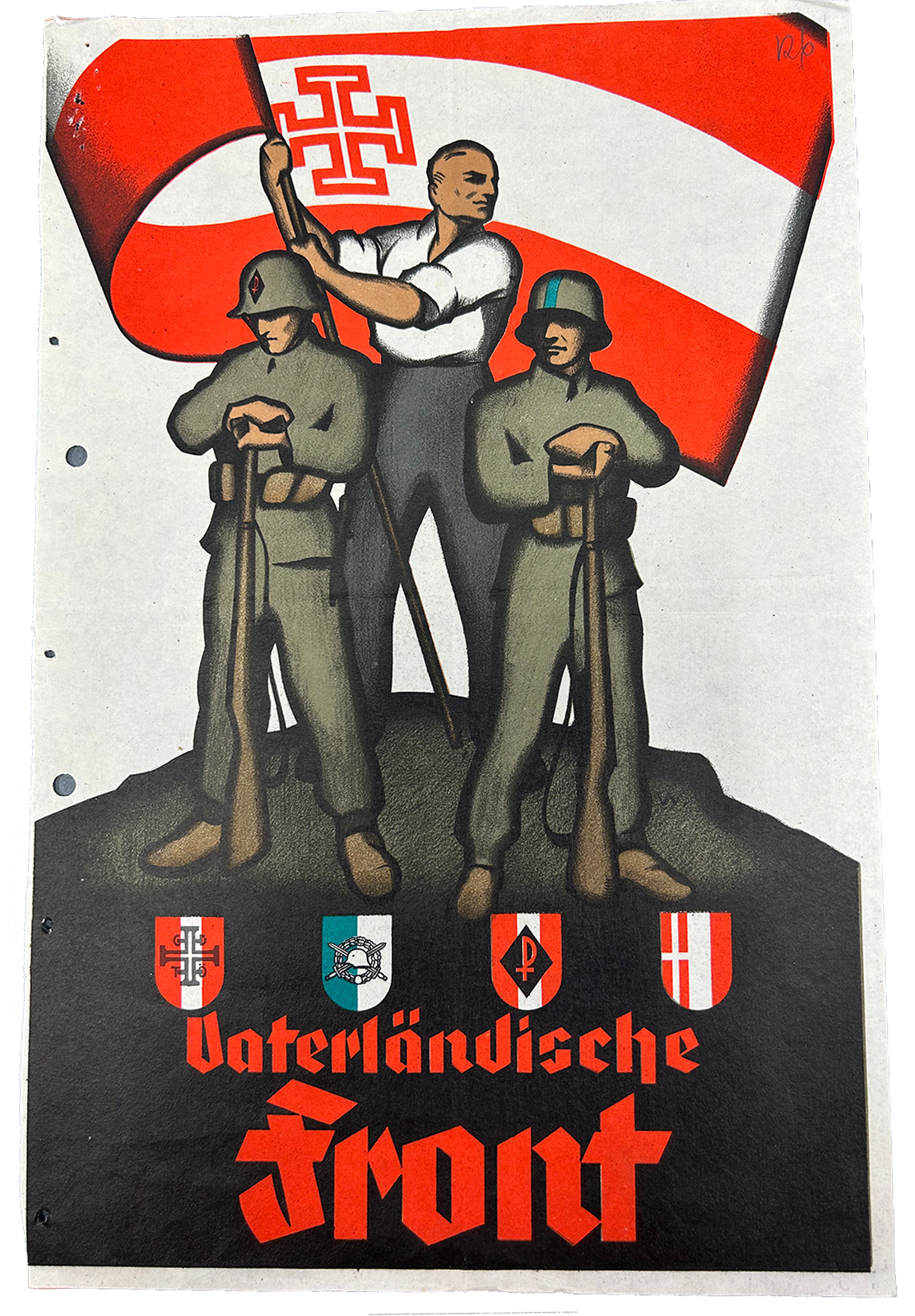
The Austrian Ständestaat (“Corporate State”) was an authoritarian experiment that began in 1933. Buried in the paperwork produced by its “non-political association,” the Fatherland Front, lies a bleak assessment. A long, typed 1935 internal report mournfully noted, “The organization of the VF [Vaterländische Front] exists for the most part only on paper.”Footnote 1 The document, filed in a box devoted to memos from a Tyrolian propaganda office, suggested only setbacks for the organization. The Fatherland Front's energetic attempt to create a sense of national identity and control the message of the Ständestaat was faltering. Widespread joblessness sapped political enthusiasm. Monarchist and National Socialist propaganda vied for the people's support. Previous members of the banned Social Democratic Workers’ Party still circulated messages of resistance. Money for posters and school educational materials was in short supply. Austria's unclear relationship with fascist Italy and the loss of South Tyrol still rankled the common man. Opponents [Gegner] seemed legion. The Fatherland Front, paper party that it was, struggled to succeed in its mission to lead Austrians to a Christian-based, traditional order within a sovereign state (Figure 1).
1935 Publicity Department poster available for regional offices to order by the thousands. The insignia along the bottom represent various militia groups.

Appearances were central to the Fatherland Front. The Ständesaat was a complicated façade with little substance; the regime's structure, based in the cooperation of estates under a chancellor with dictatorial power, was only partially complete when Austria was annexed to National Socialist Germany in 1938.Footnote 2 In this article, I explore an intricately twinned effort from within the Fatherland Front to create the conditions necessary for a sovereign Austria through cosplay and threat analysis. The Fatherland Front dressed the part of fascism, yet it lacked the popular backing that would facilitate and justify power over the Austrian population. Its propaganda and Publicity Department, led by Dr. Hans Sidonius Becker, was caught in a positive feedback loop.Footnote 3 An obsession with rooting out opponents to the regime led the bureaucracy headed by Becker to see enemies everywhere. This enhanced the threat perception and sense of failure, which encouraged more posturing and performance.
Austrian scholars of the Ständestaat refer to the botched authoritarian experiment as Austrofascist.Footnote 4 The regime's inability to stave off the Anschluß is well-known to readers. What the sources highlighted here suggest is unusual: acute self-awareness of failure within the Fatherland Front. Unsuccessful movements often avoid evidence of impending catastrophe. Yet participants in the Fatherland Front Publicity Department assiduously documented and acknowledged their shortcomings. Their response was to double down on games of dress-up. The Publicity Department's logical quantification of danger drove it to an illogical fixation on appearances. The uniqueness of this story thus lies both in the way that the Fatherland Front persisted in playing a losing game and its response to imminent fiasco. Creative self-fashioning and careful surveillance of internal and external threats were the central modes of operation in Becker's office. Pressed to proceed despite numerous failures, the Publicity Department chose to dress up the Fatherland Front even as it faced facts: it was losing its competition with political opponents. Becker's colleagues were always aware of the looming disaster ahead.
The files of the Fatherland Front illustrate an improvisational approach to organization. Against a backdrop of economic and political emergency, the Publicity Department staged an unsuccessful show with dire consequences for Central Europe. This article details the performance of para-fascism in Austria. Para-fascism attempted to harness the raw energy of fascism and to reign in that energy, limiting disorder, upheaval, and violence.Footnote 5 In the Austrian case, para-fascism meant a strong connection to the bureaucracy of the old Habsburg Empire and a commitment to Catholicism. Fatherland Front propaganda endlessly referred to the “New Austria,” but in fact very little about the regime was truly new; rather, the Fatherland Front drew upon systems of neo-absolutism that were well within the memories of living Austrians in the 1930s.Footnote 6 In this way, the Ständestaat might best be compared to Francisco Franco's Spain, in that it attempted a restoration of traditional sites of power within a “modern” framework of fascism.Footnote 7 As a concept, para-fascism allows historians to consider the elements of fantasy that either caught or failed to catch the population's imagination of the country in question. As such, it is helpful when considering the plans that clutter the files of the Fatherland Front. Importantly, para-fascism was in competition with other domestic and international far-right alternatives to parliamentary democracy in the 1930s. This competition played out in the Publicity Department's paperwork.
Ongoing historical inquiry into European forms of fascism emphasize movements that historical actors at the time judged by action, rather than rhetoric.Footnote 8 This research helps us see complexity across the continent. Austrian para-fascism belongs in this conversation. It is instructive to revisit the compressed Austrian experience of authoritarian rule, not least because its failure was predicted by its own leadership. Action was precisely what was missing in Austrian para-fascism. The forceful, fascist style was in keeping with other regimes, but most of that energy was, in the end, expended on keeping up with more vigorous parties and opponents. Austria was distinctive among the constellation of would-be fascisms in that it did not feature a mass movement of action, but rather a carefully choreographed yet unconvincing routine by elites. As an example of a para-fascist flop, Austria throws into clear contrast the many fascist movements that succeeded.
This is an article about an overmatched regime caught in a cycle of performance, comparisons to other actors, and self-critique. In the files of the Fatherland Front, Becker's colleagues created a unique assessment of their own failures in real time. I situate the movement within interwar Austrian history and explain the provenance of the Fatherland Front documents that structure my research. To focus on the surface-oriented enactment of sovereignty within the Publicity Department, I define cosplay and suggest its usefulness as a category for Austria in the 1930s. A section on the organization's self-presentation is followed by one on its relentless documentation of danger. I end by reframing the Fatherland Front as a movement deeply aware of its shortcomings. Throughout, I analyze the paperwork of the regime, perhaps otherwise dismissed as futile self-promotion, for what it can tell us about the quest for Austrian identity.
Publicizing the “New Austria”
Interwar Austria was marked by severe political polarization. The dominant parties of the First Austrian Republic, the Social Democrats, the German Nationalists, and the Christian Social Party, offered elaborate means of belonging, ranging from youth clubs to sporting associations to militias. Yet few citizens “belonged” to Austria. Instead, interwar citizens were largely loyal to their political subcultures.Footnote 9 State-level elections in 1932, in which the Austrian Nazi Party eclipsed the German Nationalist party, destabilized this balance of power. The previous right-wing coalition broke up, and Engelbert Dollfuß, former agricultural minister and current (Christian Social) federal chancellor, began to rule by decree. He was supported by the Home Guards militia led by Ernst Rüdiger von Starhemberg, and in close contact with Benito Mussolini, whose fascist Italy practiced political and economic corporatism. A year later Dollfuß suspended the deadlocked parliament. After a brief worker uprising in February 1934 in which the Social Democratic Worker's Party was defeated, a new constitution was fashioned in May that created the Ständestaat. National Socialists assassinated Dollfuß that July. His successor, Kurt von Schuschnigg, continued the work of the Fatherland Front, whose mission was to unite the “New Austria.”
The Ständestaat sought to preserve Austrian independence. Framing itself as a bulwark against both communism and National Socialism, the regime dismantled democracy in the name of security. The pillars of sovereignty—authority over territory and population, combined with recognition by other sovereign states—were thus elaborately, and at times desperately, emphasized by Fatherland Front functionaries. They projected vigor, devotion, and stalwart service to the state. The setting was grim. The country was in the grip of an economic depression and locked into an uneasy dependency on Mussolini's Italy to protect itself from Hitler's Germany. Urban and rural areas were out of synch. Culturally, the Ständestaat relied upon props like Papal Encyclicals to bolster its authority.Footnote 10 Fatherland Front actors representing the regime were quite aware that they were losing the battle for hearts and minds. Their persistent performances, in the face of the tepid response they received from their fellow countrymen, is remarkable for their commitment to an audience they knew they were losing. Their unsuccessful play for sovereignty led to the erasure of their state and a catastrophe for Europe.
The Fatherland Front sought an identity for Austrians. It claimed itself to be the “sole bearer of the political will of Austria” for the five years it ruled.Footnote 11 This oft-repeated phrase captures the no-man's land of the Fatherland Front: it was not a political party, but it was the only approved political expression within the Ständestaat. Few Austrians considered their country to be a nation in the 1930s. “Nation” meant Germany; Austria was an unwanted federal state created in 1918 that few were willing to defend in 1935, when the pessimistic memo that opened this article was penned.Footnote 12 Fatherland Front propaganda in fact used concepts of “Germanness” to define what it meant to be loyal to Austria: “The best German will always be a good Austrian” was an adage of the interwar years.Footnote 13 The playfulness of such a phrase obscured the danger it posed to Fatherland Front's task of securing sovereignty via a clear national identity.
The Fatherland Front, concerned with the viability of the Austria it strove to unite, documented its labors extensively on paper. As a historian working in the twenty-first century, my experience of the Fatherland Front has been on paper, as well.Footnote 14 National Socialists seized many of their files during the Anschluß and thereafter deposited them in another German-annexed territory, Czechoslovakia. After World War II, these documents were brought by the Soviet army back to Moscow, as part of a larger project of documenting fascism in late-capitalist Western Europe. Here they stayed until 2010, when, after almost twenty years of negotiation, they were returned to the Archiv der Republik, an arm of the Austrian state archives. The Publicity Department files attested to a vast correspondence spanning the country, maintained and controlled by the chief officer in Vienna, Becker. Becker, an aristocrat, World War I military officer, trained engineer, world traveler, freemason, and student of anthropology, directed the Publicity Department from the very inception of the Fatherland Front in 1933.Footnote 15 He reported directly to General Secretary Walter Adam, as many of the “top secret” documents in the files attest. Becker's presence in the papers is surprisingly minimal: several invitations are addressed to him, some initialed memos and underlined reports show his handwriting, but few letters originating from his desk were saved (although several drafts exist). Becker led a unit with the unenviable task of relaying the messages of a half-constructed state to a population weary of political posturing.
The paperwork that animates this article was sent to Becker's office in Vienna from the provinces. Most of the notes were typed, although some of the documents seemed like copies of a lost (or sent) original form or letter. Folded in were some handwritten personal letters, completed forms, and annotations on printed texts. Items were loosely grouped by year and office of origin, yet organization was minimal. Memos, reports from every region, speeches, budgets, scrap-paper sketches, party guestlists, personal invitations, examples of propaganda from both the Fatherland Front and its adversaries, and final directives from the Vienna office were lumped together indiscriminately. The result was a mountain of Fatherland Front material, but, as the organization itself was painfully aware, only a very tenuous hold on the population.
The files of Becker's Publicity Department offer an intimate glimpse of what functionaries thought to document about the world around them. In these records, a curious dichotomy of concern emerges. An overwhelming amount of energy is spent in cosplay: designing uniforms, sketching new medals to be awarded, planning pennants and flags to be unfurled at key moments during rallies, organizing official trips to Rome, state balls, and educational evenings. In the files was a rainbow of specialized Fatherland Front stationery replete with separate state and city letterheads. Memos were stamped with a variety of official seals. A patois of patriotic signoffs emerged. Finally, even copies of a weekly newspaper designed for Fatherland Front bureaucrats and their wives to read (Die Beamte) got folded into the piles of party invitations and sketches of edelweiss nestled into the Fatherland Front cross. The effect is one of young men playing dress-up, or of an extended scouting sketch comedy of what the future might look like if the funding came through for an epic den meeting. Yet at the same time, the files brim with gimlet-eyed threat assessments. There are tips on who might be printing underground newspapers, copies of competing propaganda flowing in from Germany, reports of Fatherland Front leaders betraying the movement, color-coded maps of monthly illegal political activity by the “Reds” and the “Browns,” and an intricate, baseball-like scorecard of which known and unknown opponents were connecting more deeply with the people of Austria than the Fatherland Front itself. Official speaker appraisal forms were designed that judged movement organizers on their ability to persuade. Unctuous language was used to address leaders and highborn potential collaborators in a desperate attempt to communicate the viability of the regime. Both cosplay and dead-serious scrutiny of potential political violence signal what the Ständestaat Publicity Department was really selling: a sovereign state.
I regard the play-acting of the Fatherland Front as necessary work. “Cosplay” is a portmanteau that emphasizes the creative group performance of fans who dress as favorite characters from a variety of media, including television, cinema, and comic books. These characters might be drawn from different narratives and combined in imaginative, unique ways according to the participants. The word cosplay was first developed in Japanese as an alternative to “masquerade,” which in that language connoted aristocratic practices that were at odds with the science fiction conventions that inspired the new word.Footnote 16 Admittedly, this is an unusual analytical category to employ in a history of para-fascism. Yet many European interwar movements delineated their newness via visual and behavioral cues taken from World War I soldiers. Animated by young men “unfinished” with the Great War, early fascist movements created a style that reiterated the heroism, and barbarism, of the front.
Multiple particularities of the Austrian situation justify thinking with cosplay. The characteristics of cosplay are that of commitment, performance, sociability, and site-specificity.Footnote 17 All of these are present in the work of the Fatherland Front Publicity Department. “Layered signs of identity,” so central to cosplay, were precisely what the Publicity Department peddled: Austrian, Catholic, provincial, patriot.Footnote 18 Although some of the people I introduce here were aristocrats, the term “masquerade” is far too refined to describe the activities of a repressive regime. Furthermore, cosplay signals that the participants seek to emulate aspects of their chosen personae; it is “akin to performance art, taking on the habitus of a particular character.”Footnote 19 The idea of fandom is useful for the practitioners of far-right politics I highlight, who drew inspiration from Italy and Germany. Equally fitting is the bricolage nature of cosplay, involving as it does multiple sites of reference and improvised responses. Finally, the established Austrian culture of Schlamperei [sloppiness, slipshodness, or attention to appearances at the cost of quality] dovetails well with Fatherland Front cosplay. From the beginning, the Ständestaat traded in a pastiche of national identity repeated from clumsily reformatted, borrowed scripts.
To describe the act of governing 1930s Austria as a performance is not to malign the work dictatorship did for the region. As political scientist Cynthia Weber has written, the reiterative, citational labor of performativity is the “there” of sovereignty: “the identity of the state is performatively constituted by the very expressions that are said to be its result.”Footnote 20 The act of dressing up, and the practice of watchfulness regarding political opponents, mutually reinforced the short-lived regime's identity. The Ständestaat was based in the rejection of liberal democracy, socialism, communism, capitalism, cosmopolitanism, and National Socialism. Anton Staudinger has referred to this as a “defensive ideology,” meaning that state identity was based in what it was not.Footnote 21 The regime's lack of vision stemmed directly from its obsession with competing ideologies; in many ways, the Ständestaat was a plan based on the refutation of other plans, rather than a real polity.Footnote 22 To be aware of the menace of communism or German National Socialism served to heighten the importance of appearing to be in control and dressing the part. Dressing the part, in turn, demanded knowing what the other players were doing and being able to assess the dangers they posed, if only to respond cohesively to the evolving script. Cosplay and threat assessment were thus appropriate concerns for the Fatherland Front as it cultivated patriotism in an ill-defined country.
Fascist movements signaled strength and unity to their audiences. Yet as recent work on fascism as a pan-European practice has emphasized, this often involved papering over disrespect, disorganization, and unauthorized violence. All forms of fascism were new, and thus amateur enactments were common.Footnote 23 Fascist parties in the Netherlands, Finland, and Britain made embarrassing missteps, and even German stormtroopers needed to be taught to present themselves, along with their flags and torches, properly.Footnote 24 The disarray of Austrian para-fascism was not what made it original. However, the repeated, flustered documentation of failure in the files of the Publicity Department of the Fatherland Front was unique. Strength and unity were chimeric in 1930s Austria: promised, planned for, but never achieved.
Patriots and Enemies
The Ständestaat was backwards looking. It reveled in the old histories of Habsburg glory, emphasizing tradition and Catholicism at every opportunity. It featured not one Führer, but rather, simultaneously, at least three: Dollfuß, the assassinated chancellor who was quickly framed as a martyr in 1934, Schuschnigg, his professorial successor as political leader, and Starhemberg, the glamorous head of the Home Guards. The regime was muddled and haphazard on its best days. Yet it was also a dictatorship that curtailed freedom of the press, abrogated voting rights, abolished parliamentarism, and imprisoned political enemies. That it was unsuccessful and unloved does not remove its bile. But it does help explain the odd sense of both juvenile excitement and real fear that emerges from the files of Becker and his bureaucrats. Performance anxiety, or perhaps stage fright, lay at the heart of the documents. For whom were these functionaries shilling? How could they direct the people when they themselves were still working out the message? Would they succeed, and what was riding on their show? Such questions demand an analysis of both appearances and assessment.
The Publicity Department, whose documents form the backbone of this article, was a small corner of a sprawling propaganda operation directed from the Federal Chancellery.Footnote 25 Becker's 1933 position as an editor of the Wiener Zeitung, which reported glowingly on the formation of the Fatherland Front, made him a solid choice as the “political apostle” to spread the good word.Footnote 26 Together with the much younger Fritz Bock, a law student, he created a two-pronged approach to propaganda that would be both outward and inward facing.Footnote 27 This served the needs of an organization that needed external validation and internal buy-in. The Fatherland Front was designed to coordinate society, economy, and government by replacing the divergent parties of the First Republic with a uniquely Austrian, and explicitly Catholic, vision of the future. The fuzzy project of the Fatherland Front was integration; it was a highly coveted product, rather than a motor, of the Ständestaat system of power.Footnote 28 The imagined and the real blur within Fatherland Front advertisements, as they might in any marketing strategy. Both were essential to the repressive politics practiced in the 1930s.
A variety of opponents harried the Fatherland Front. The most physically dangerous were the German-funded Austrian National Socialists, whose goal was union with the Third Reich. They employed assassinations, bombings, and street fighting to weaken the Ständestaat. Far-right Austrian journals decried the “brother strife” between Austrians and Germans, which paradoxically normalized the real violence employed by the National Socialists on both sides of the border.Footnote 29 The opponents who most rankled the Fatherland Front, however, were not the “Browns,” but rather the “Reds.” The Austrian First Republic was marked by a socialist experiment in the capital, where the Social Democratic Workers’ Party (SDAP) enacted a series of economic, cultural, and infrastructure innovations loosely referred to as “Red Vienna.” The violence that broke out in February 1934, in which workers’ housing blocks were shelled by the military forces of conservatism, was fresh in the minds of Fatherland Front leadership, which continued to fear a return of socialism. The SDAP loomed large for years in the minds of the Fatherland Front functionaries who tracked socialist critiques of the Ständestaat from abroad. Lumped with the SDAP in the “Reds” category was the much smaller Communist Party of Austria (KPÖ), which the Fatherland Front understood as taking orders directly from Moscow. The Fatherland Front assessed this (also banned) party as even more likely to organize disruptions and potentially revolt against the state.
The opponents the Fatherland Front sought to corral into cooperation were the monarchists. Becker himself may have identified with this worldview.Footnote 30 The Publicity Department walked a fine line of respect for the monarchist position and gratitude for past Habsburg leadership. The Fatherland Front framed itself as the caretaker, and sometimes the inheritor, of Habsburg values and achievements.Footnote 31 Yet a restoration was out of the question, as the Publicity Department politely insisted and repeatedly explained. Otto von Habsburg was simply too young, and the work of reestablishing German-speaking dominance in Central Europe was too delicate to entrust with anyone but professional bureaucrats and diplomats. Monarchism instead served a kind of “last card” in the hand that Schuschnigg held as he gambled with National Socialism; throughout his tenure, the chancellor stayed in touch with Otto.Footnote 32 The Fatherland Front and the forces of restoration moved in similar directions, but did not converge.
Finally, conservative Austrian intellectuals, although not a political party, were wooed by the Fatherland Front but could be critical of the movement and its lack of progress toward “the True State.” University of Vienna professor Othmar Spann theorized this term in 1921, and his philosophy was central to the creation of the Corporations.Footnote 33 By the 1930s, in the minds of the war-generation students who reveled in Spann's distain for democracy, demanding the “True State” meant securing a more robust role for elites and the Corporations within the Ständestaat.Footnote 34 This educated population grew impatient with the half-realized structure of the new polity. Intellectuals who had railed against Red Vienna in the 1920s could be quite cold towards the actual expression of conservative reaction in the 1930s. Some believed that the Fatherland Front was standing in the way of the union of Germany and Austria, an act ardently wished for by most Austrians since 1918.Footnote 35 Such critiques often were delivered through praise for National Socialist Germany and tepid support for the “efforts” of Austria.Footnote 36 The result was an Austrian regime determined to at least meet the competition across the border. To do so, propaganda offices focused on appearances and kept score of their perceived opponents.
Dressing up a Regime
The work of the Fatherland Front Publicity Department circulated between Vienna and the provinces. Sometimes this movement was organic and successful. The Association for Young Tyrolians, a Catholic organization for “German” youth, wrote to the Vienna office in July 1935, suggesting that the new state Children's Vacation Homes be supplied with copies of the “Chancellor Dr. Dollfuß Song (We Young People Stand Ready)” and the accompanying piano music.Footnote 37 Such homes were at the center of a Fatherland Front-sponsored program to send city children into the countryside for holidays. The request was accompanied by a handsome, printed list of all the Children's Vacation Homes opened that year in Tyrol. Also in the files was a report on a speech by Schuschnigg that touted the 12,000 “lucky” Viennese children who had spent Christmas 1934 in the mountains, replete with snowy vistas, locally-sourced holiday trees, and a “splendid, unforgettable [experience of] true, essential Austrianness!”Footnote 38 Here identity formation and emphasis on surface appearances collide with positive results for the Publicity Department. The cycle of packaged propaganda from the leader (in the form of Schuschnigg's speech), requests for deepening the message (and songs about Dollfuß), and yet more propaganda (in the form of the list of Children's Vacation Homes completed), was a never-ending ronde.
At other times, the dancers in Vienna and the provinces fell out of step with each other. Regional Fatherland Front offices often wrote to Vienna with polite requests for more effective propaganda materials. Such correspondence could be maddening in its minutia. The office in the mountain village of Kirchbichl, for example, explained that, although the local schoolchildren took a “lively interest” in Fatherland Front placards, the wall upon which they were hung was too small.Footnote 39 A gentle request for reformatted posters followed. Another letter from Tyrol from the same year mildly applied for propaganda “better suited” for a rural audience. Advertisements for the Austrian film industry or machine construction were not working, for “naturally they hold no interest for our peasants,” wrote the provincial leaders.Footnote 40 Another 1935 letter was more direct, claiming that for “the last few months,” the propaganda materials sent were “entirely unusable” and unsuited for the countryside, whose population responded better to newspapers, which were requested in the tens of thousands.Footnote 41 Fatherland Front leadership tailored propaganda to its audience, yet its failure to connect is suggestive of a larger pattern of myopia. Cases such as the one in Tyrol demonstrate a propaganda machine desperate to be in touch with the population and better able to indulge in self-criticism than to achieve its aims.
Whether obsequious in their language or blunt in their assessments, letters kept in the Publicity Department files were formatted with formal addresses. Fatherland Front correspondence reveled in polite greetings and patriotic signoffs. These were important steps in connecting the various cosplay actors. Letters might be addressed to “Your Highborn Excellence,” or, if being sent to a friend from the war days, “Dear Comrade.” Higher educational degrees were always acknowledged in the greetings, as were political and militia ranks. “Austria!” was the most common way to end a letter or memo, usually in quotation marks and with an exclamation point to express its shouted nature. “Heil Austria,” “Austrian Greetings!,” “True Austria,” “With the Frontgruß ‘Austria!,’” and “Front-Heil True Austria!” were popular, but some letters, especially from militia members, worryingly ended with “Heil Starhemberg.” The variety suggests a regime desperately searching for a tagline that would stick. One letter from 1935, however, was gently critical of a certain “German greeting” popular amongst Fatherland Front functionaries in Tyrol. Whatever was being said was too close to the greetings currently popular in the Third Reich, according to the author of the report, who wondered aloud if some sort of policy should be created around greetings to better identify loyal Austrians.Footnote 42 The Alice-in-Wonderland nature of this problem indicates the pleasure and danger of cosplay in the Fatherland Front files. If addressing a hello or goodbye was already problematic, what might the contents of the conversation open? Put another way, if the very format of the greeting was up for grabs, the message itself was out of reach.
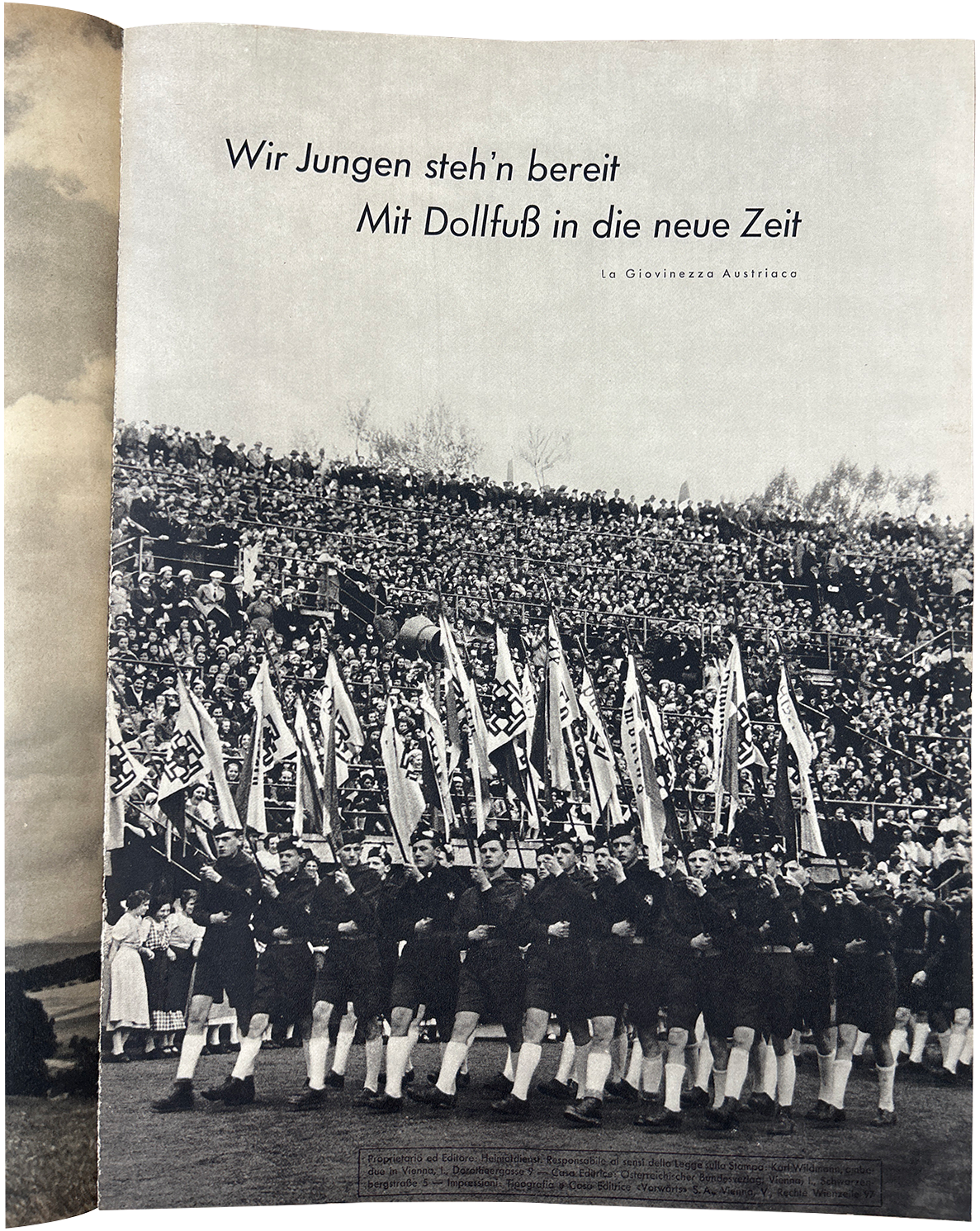
Invitations and RSVPs littered the files of the Publicity Department.Footnote 43 Officials registered their intention to attend parties and commemorative events at a fast clip; such festivities allowed actors to coordinate their cosplay. Administrators and bureaucrats frequently invited each other to speak at events.Footnote 44 Official occasions demanded uniforms, medals, and pennants, the designs of which were all well documented. Photographs of state functions with international leaders showed off Austria's recognition by other sovereign states.Footnote 45 Youth uniforms and school flags received special attention, suggesting that the Fatherland Front appreciated the photogenic power of young, massed, well-appointed (male) bodies (Figure 2).Footnote 46 Frequently, letters from the provinces requested higher-quality flags, music, and meeting trappings, so that the Fatherland Front could better compete with outlawed oppositional parties.Footnote 47 One such letter to Becker from 1936, originating in the pilgrimage town of Mariazell, helpfully suggested both flag and uniform designs.Footnote 48 Included in the correspondence were hand-drawn sketches and a photograph, cut out from a German newspaper, of new National Socialist uniforms. Their leather trench coats and military garb were sources of inspiration, and something to imitate. The National Socialist threat was tacit in this letter; what was explicit was how good the German party looked.
1937 propaganda featuring the newly-created youth organization of the Fatherland Front (Oesterreichisches Jungvolk) and a line from the “Chancellor Dr. Dollfuß Song.”

That this rapt attention to looks dominated the Publicity Department files is not surprising. Keeping up appearances was more manageable than the regime's unsuccessful attempt to keep supporters on message, or even to establish the appropriate message. However, this frantic activity becomes questionable when we contextualize these planned parties, their decorations, and the requisite uniforms. Amid an economic disaster, the regime's new trappings were costly expenditures. One is left with the impression of an expensive outer shell that did not contain content of similar value. More pressingly, the Gegner that the Fatherland Front sought to vanquish were unlikely to care whether the Fatherland Front stayed “on brand” at an event or rally. The competition, particularly the National Socialists, used not only propaganda props, but also real weapons. It is possible that the trappings of success were all the Fatherland Front could muster. The enemies of the regime were much less controllable than its set-designs.
Knowing The Opposition
The Publicity Department of the Fatherland Front kept tabs on materials contrary to the regime circulating throughout the country. Hand-made circulars and hastily typeset papers were sent to Vienna. The Tyrolian office, for example, wrote to Vienna in October 1935 about an illegal handout to the “Christian People of Austria, Workers and Employees,” reassuring Vienna that orders “were given out without delay” to confiscate the printed messages.Footnote 49 A standard form used to report on illegal papers was developed by early 1936, which asked for numbers of editions seized, numbers of pages within the publication, tell-tale print marks that could identify the source of the publication, and the general contents of the issue(s).Footnote 50 Sometimes established newspapers fell afoul of such forms. In March of 1936, the Upper-Austrian Innviertler Nachrichten was written up by two district leaders for reporting approvingly of Hitler's reoccupation of the Rhineland, publishing a separate story disparaging the Austrian economy, and following that with a “scandalous representation of the dire want of our peasants.”Footnote 51 This report was followed by another, from the Linz office, assuring Vienna that the paper had published its last edition, for, “in the interests of our movement, we cannot allow it [to continue].”Footnote 52
Reports on “unpatriotic” activities clogged Fatherland Front files. Sometimes, other Fatherland Front members were the malefactors. One “top secret” letter from Tyrol in 1935, for example, testified that a local militia leader, a certain Captain Wodenegg, was dismissed for comments contrary to national leadership.Footnote 53 Even Home Guards meetings, should they veer into controversial topics, were reported on, usually with another “top secret” stamp across the form.Footnote 54 However, the most striking documents were those that tracked the actions of confirmed political opponents. Starting in 1936, the Fatherland Front documented these in a complicated monthly chart that was color-coded “Red,” “Brown,” and “Blue” (for “attacks from unknown sides”).Footnote 55 Propaganda, found explosives, weapons, and acts of terrorism were tallied for each federal territory in multiple colors, then totaled for the month in black. The result was both thrilling and dispiriting: the city streets, village squares, and rural fields of Austria were brimming with activity, but the ultimate tally, in black ink, signaled defeat.
The National Socialist threat to the Ständestaat was existential. The Fatherland Front stood at the center of resistance to and competition with Nazi Germany.Footnote 56 Nazi propaganda flowing into Austria was the best-represented illegal material saved in the files of the Publicity Department. It was fine-tuned for localities and could be bitterly cutting toward Ständestaat leadership. Saved in the files from 1935, for example, was a small, swastika-bearing card designed to commemorate the day, twenty years before, when Italy declared war on Austria-Hungary in World War I. The card quoted Franz Josef (“A betrayal that History has never known”) and said simply beneath, “Schuschnigg and Starhemberg have forgotten—We have not.”Footnote 57 With a “Heil Hitler” at the bottom, the text ended. No internal memo accompanied this counter-propaganda; the devastating message spoke for itself. The Styrian office reported in 1936 that Nazi counter-propaganda was now their biggest concern, noting that preparations for that year's accord between Germany and Austria had “amnestied” a variety of repeat offenders.Footnote 58 The Styrian office, in a hail of conditional verbs and clauses, asked for guidance on what to do with these supporters of National Socialism, should they, as all signs suggested, continue to attack the Fatherland Front.
In 1936, the Publicity Department reported a huge cache of National Socialist propaganda seized in Vienna. Becker himself filed the brief, using the standard form and attaching a typed addendum. Hundreds of thousands of illegal items attested to the organized, well-funded propaganda machine the Fatherland Front was up against.Footnote 59 At the bottom a table tallied flyers, posters, swastika pins, and illegal printed material. Most worryingly, National Socialist propaganda could be polished, professional looking, and persuasive. Its power lay in questioning the viability of the Ständestaat. One attractively printed example from 1936 was turned in by Wilhelmina Hroch, who found it in her Vienna letterbox situated in the Hietzing district that June. The flyer pointedly asked, “what have three years of the ‘authoritarian, Christian Ständestaat’ brought?” It answered with a litany of complaints, including high taxes, a collapsed economy, corruption, joblessness, and general suffering for the Volk.Footnote 60 These were difficult contexts that the Fatherland Front propaganda machine struggled to paper over. Another, similarly-formatted National Socialist flyer was turned in anonymously from Vienna's middle-class Josefstadt district a month later, with a note to say that such material was “in front of all the doors of the neighborhood.”Footnote 61 Both mailers highlighted the suffering, “bad luck,” resignation, and doubt of the Austrian people under the Fatherland Front.
Despite the obvious threat of the “Brown Terror,” the propaganda files were often more preoccupied with the “Reds,” including the former Social Democrats of Austria and “international revolutionaries,” meaning socialists and communists abroad. Indeed, the Fatherland Front could not, in light of developments in France and Spain, “draw a clear border between revolutionary socialists and communists… particularly [among] the young, radicalized population.”Footnote 62 This frustrated statement, deep within a “top secret” 1936 report, built upon the Fatherland Front's continued fear of the Austrian Social Democrats, who although now underground, “could not be discounted.”Footnote 63 Fatherland Front bureaucrats tracked SDAP and Communist propaganda as it flowed into Vienna from Czechoslovakia, imagining Trotskyites rubbing elbows with the former SDAP functionaries exiled to Brno.
The obsession with “Red” opponents persisted even when Fatherland Front research itself suggested that the “Brown Terror” was more pressing. A special form developed in 1937 asked publicity offices across Austria to tally political allies and opponents by locality. The Lower-Austrian report from Lang-Enzersdorf (4,494 inhabitants) estimated 200 “sharply National Socialist” and 600 “Brown leaning” townspeople.Footnote 64 A mere 100 “sharply Red” with an additional 350 “Red leaning” residents were reported. Tellingly, another metric on the form was the unemployed (168 men). The additional information requested regarded the outlook of the youth and the number of people participating in the Fatherland Front program “New Life.”Footnote 65 A note at the end suggested that the anomalous number of “sharply Brown” people in Lang-Enzersdorf was best explained by the high proportion of civil servants there, who “surely belong to the side of traitors of the Fatherland.”Footnote 66 Such internal betrayal was distressing.
The Fatherland Front also struggled with monarchist forces, who seemed to exasperate, rather than to frighten, the regime's leadership.Footnote 67 In one fussy letter from late 1935, the central office of the Fatherland Front in Tyrol clarified for those who wished for Otto's return exactly what the Vienna office had already messaged in early October: Monarchist propaganda would not be allowed to circulate in the Ständestaat. Taking a conciliatory tone, the Tyrolian office explained to regional leaders that, although the Fatherland Front “respected Austrian tradition and therefore the Habsburg dynasty,” only “our propaganda” would be distributed.Footnote 68 Restoration of the monarchy worked against the current needs, “inner development,” and international tensions that Austria found itself facing at the moment, and thus propaganda supporting the Habsburgs “contradicted the Fatherland and also the interests of the dynasty.”Footnote 69 The regional leaders, who perhaps needed to be reminded that monarchism ran counter to Fatherland Front aims, were asked to please register any legitimist speeches “which were not in line with the principles and ideas of the Fatherland Front or which did not seem to come from our highest leader.” Should such political speech “come to their attention,” the regional office in Tyrol wanted to be alerted.Footnote 70 This modest tone of frustration was different from the Fatherland Front attitude toward other Gegner. Even reports that tallied who was flying which (oppositional) flag on patriotic days made allowances for monarchist colors.Footnote 71 Monarchist propaganda provoked less anxiety in Fatherland Front functionaries. Habsburg restoration, although divergent from the present that the Fatherland Front desperately tried to establish, was not entirely antithetical to its imagined future.
Assessing the Performance
Becker's Publicity Department carefully documented internal weakness. At times, the Fatherland Front faced intractable forces that were impossible to contain or control. Problems larger than mere banned political parties dogged the regime. Messages regarding such adversity could be surprisingly direct, using visual cues and verbiage rarely seen in day-to-day correspondence. A heavily underlined report from the Innsbruck office in early 1935 outlined the threats to the movement succinctly: joblessness, lack of trust, popular impatience, fear of the German army, and difficulties within the regime itself. The local Fatherland Front head of propaganda, Josef Hellwig, forcefully requested action: “For a countermeasure [Gegenmittel], we beg not for advertising material, but rather deeds. We can only win back the trust of our population through action.”Footnote 72 His strongly worded suggestion was to better combat unemployment, to build the Corporations, and to “clean out the administration of saboteurs.” The letter ended with a call for the highest authorities to, in essence, do their jobs: “We ask for the fastest remedy, for we cannot do anything else but watch the coming decay of the Front. Talking no longer works, and deeds we cannot show. [Such deeds] must come from on high!Footnote 73 Hellwig's desperation critiqued the cosplay he sensed and signaled his true belief in the project of the Ständesaat. A regime of poses and speeches alone could not rule, in Hellwig's assessment, and decisive action was needed. His chosen targets, which included overplayed propaganda, lack of productive action, and saboteurs, can be read as the concerns of an earnest participant in a rigged game.
The Publicity Department sought success, as well. To that end, it created a form to be filled out by every locality, every five months, that organized knowledge of membership in various patriotic associations for the Vienna office. It asked Fatherland Front neighborhood leaders to assess how many members existed, who was making reports, and who was a member of the five most prominent national militias. It requested examples of locally developed propaganda, as well as elicited personal judgments upon the efficacy of centralized messaging. Finally, the names and activities of civil service instructors were requested, presumably to make sure their assignments were in keeping with the wishes of the Vienna office.Footnote 74 By far the most impressive forms, however, were the monthly maps, starting in at least 1936, that tracked illegal political activity. These were an arm-span large and featured a special inset that broke Vienna down by district. A separate such map was developed for “Reds” and “Browns” that tracked the flyers, demonstrations, captured weapons caches, house-searches, fund seizures, and ultimately arrests made by the Austrian regime.Footnote 75 The endless quantification of rival activity heightened the perception of it as ubiquitous, which in turn called for more monitoring, more paperwork, and more posturing. Success, and the celebration of achievement, was only ever temporary.
Fatherland Front reports were frank about the shortcomings of the Ständestaat. Some were mistakes by the organization itself; others were acts of God. A 1937 report out of Lienz, situated between the Hohe Tauern and the Gailtal Alps, baldly stated that “the organization of the Fatherland Front is not very well constructed, because it lacks the financial means [to succeed].”Footnote 76 This lack of funds played out in the daily life of the province, as well. The same report stressed the economic collapse impacting the patriotism among otherwise “fanatical Austrian [supporters]” and contained news that “here, all peasant children lack shoes and must go to school barefoot in the winter, in deep snow.”Footnote 77 An even more dour, “top secret” 1936 report stressed the inroads allowed to political opponents through the regime's ineptitude—certainly something that could be rectified with effort. But the same report also belabored “weather catastrophes” in Styria and Carinthia that sapped the energies of Austrian farmers, as well as the ongoing worry of Austrian workers that they would be downsized or put out of a job by new technologies.Footnote 78 Such problems were beyond the control of the Fatherland Front. However, that they were lumped into a report about illegal political parties is suggestive: administrators ultimately framed all these challenges as impossible for the Fatherland Front to meet or rectify. To counter the inroads of the National Socialists was just as quixotic a task, it seemed, as to stop heavy rains from impacting peasants’ outlook on the regime. To participate in honest reporting meant enumerating the failures of the movement. Here cosplay, as contingent of knowing that the game was make-believe, broke down as it collided with actual setbacks and crises. It is difficult to assess how “real” the game was in such moments. Certainly the threat of National Socialist intrigue and violence, especially on a national level, required a believable performance from the Fatherland Front. The organization was intimately aware when it failed to deliver.
Faltering Para-Fascism
As a variant of fascism in 1930s Europe, para-fascism sought to carefully channel change in ways that built upon tradition and offered new energy to established elites.Footnote 79 This was the case in Austria, where aristocratic, Catholic leadership dressed itself in the trappings of fascism but did not unleash the same level of disorder and violence in which other regimes trafficked. The paperwork amassed in Austrian archives reveals the limits of para-fascism and the perils of performance-based identity. Fatherland Front files squarely illustrate para-fascism, but also painfully reiterate in real time the movement's inability to match the demands of its moment.
Power in the Ständestaat was hierarchical. It literally flowed from above; the May 1934 constitution explained that the Austrian people “received” rights from God, and then through the leaders of their new regime.Footnote 80 Inspired by the 1931 Papal Encyclical Quadragesimo Anno, Dollfuß and his co-designers understood the Corporations (which included a union of industrialists, a federation of trade unions, a banking advisory body, etc.), as an antithesis to parliamentarianism, which had failed Austria.Footnote 81 These various bodies, composed of leaders and representatives from across the economy, were planned but in most cases never fleshed out or implemented. Corporate offices were staffed, but action was limited. The Fatherland Front predated and existed alongside this edifice. Dollfuß cobbled it together with pieces of the old Christian Social Party, the Landbund, and existing militia members. Its task, assigned by Dollfuß, was to transcend class- and cultural struggle.Footnote 82 As one state-sponsored explanation framed it: “The program of the Fatherland Front is that of its creator, the federal chancellor Dr. Engelbert Dollfuß. Their plan is for honor, peace, the freedom of Austria, independence, and the right to self-determination for the Austrian people.”Footnote 83 The Fatherland Front, with its vague assignments, functioned alongside the Corporations and not as a part of them. The result of this jumbled structure was that the regime itself was largely on paper, be that a grandiose plan for a Corporation or a mundane membership card for a movement.Footnote 84
The Ständestaat lacked the zeal to remake the world that other fascisms used to justify tearing down old ways of being. Although it operated as a dictatorship, the leadership model was complicated. The highest-ranking militia leader, Starhemberg, had fought with the Freikorps immediately following World War I and possessed the charisma and daring of a successful fascist leader. The actual architect and original chancellor of the regime at its inception was Dollfuß, who although skilled at connecting with the common man, was also pious and petite. He remained as a martyred presence animating the Fatherland Front and justifying, through his death, the para-fascist experiment.Footnote 85 Schuschnigg was more aloof than Dollfuß and less able to work with Starhemberg, whose power Schuschnigg curtailed in 1936. Authority ultimately came from the power of God, rather than the verve of a politician. These modifications of fascism are crucial to understanding its practice in Austria.
Some of what animated interwar fascism, especially its self-fashioning as a response to disorder and the re-sacralization of politics, is present in the Austrian case. Julie Thorpe suggests that, if we see fascism as a process rather than an achieved norm, certainly the Ständestaat was moving toward fascism.Footnote 86 She persuasively cites developments within the militias that suggest a fascist trajectory. The Home Guards, themselves a holdover militia from the old Christian Social Party established in the fin-de-siècle, emerged with new life in the 1920s and sometimes crossed the purposes of that party. The Home Guards certainly turned to fascism by at least 1930, when they took their famous Korneuberg Oath.Footnote 87 In the early 1930s, Schuschnigg created the Ostmärckische Sturmscharen (OSS) militia. Designed to rival the Home Guards, the OSS also traveled to the extreme right during the regime.Footnote 88 The many militias of the era all participated in a kind of cosplay of readiness, replete with competing symbols and uniforms.Footnote 89 Fascist militia performances throughout the era lent a sense of purpose and urgency to the project of sovereignty. When fascism is understood as an elastic plan, rather than a realized ideology, it becomes more appropriate for use in interwar Austria.
The Fatherland Front devoted itself to protecting Austrian sovereignty. Austrian para-fascism was thus in competition with other forms of fascism. One possible explanation for the variety of threat assessment materials in a Publicity Department lies within the office's perception of itself as a contender. What Gegner were pinpointing as vulnerabilities of the regime, and exploiting for their own uses, was valuable information. Establishing the day-to-day weaknesses of the Ständestaat was not difficult; knowing how to counter competing claims for the people's trust and loyalty challenged the Fatherland Front. As the office responsible for communicating the value of all branches of activity, including militias, work units, and even social services (like sending urban children on holiday to Tyrol), the Vienna Fatherland Front Publicity Department's correspondence record establishes the priorities and self-perception of the regime. The files make clear the pitched battle for Austria's very sense of identity. Did anyone feel that they “belonged” to para-fascist Austria? The bureaucrats themselves may have been the only population to answer in the affirmative, but as the brief from Lang-Enzersdorf suggested, even this could not be assumed. Delirious reporting, surely pleasing to Becker, on the thousands of Fatherland Front gatherings and millions of pieces of propaganda produced by his office could not convince the population that they were secure in a sovereign state.Footnote 90 The Publicity Department attempted to both dress up the Ständestaat regime and to assess the techniques of its competitors. In the end, Fatherland Front reports confirmed that the competition had its fingers closer to the pulse of the population's dissatisfaction with the regime. The play-acting nature of the Publicity Department and the dangerous business at hand, addressing aggressive organizations determined to destroy the regime, revealed the hybrid nature of the Fatherland Front itself. In the liminal space created by these opposing concerns, a sovereign “Austria” was desirable, but only became distinct when threatened on all sides.
The Fatherland Front propaganda files, both in their cosplay and threat assessment modes, might be thought of as an extended climate survey. Provincial feedback made clear to the Vienna office that most Austrians were ambivalent about, if not actively working against, the Ständestaat. And yet functionaries frenetically continued to sketch designs for new flags, write to fellow bureaucrats, color-code reports on illegal activity, and plan patriotic festivities that commemorated aspects of the “New Austria.” These men were part of a bloated administration. Like many administrators, those in the Publicity Department organized initiatives and created new work for underlings. They attended meetings, undertook re-organizations, designed questionnaires to be filled out, maintained a vast correspondence, and collated mind-boggling amounts of paper.Footnote 91 Yet their busy work did not effectively address the economic emergency Austria was experiencing, nor the disconnect between city and countryside, nor the necessary diplomatic relations that might have kept Austria independent. Instead, Becker's office engaged in cosplay and analysis of rival parties, each informing and reinforcing the other as crucial to the success of the regime. The Publicity Department's greatest success was its ability to document, in excruciating detail, the impending fall of the regime it sought to advertise.
The Fatherland Front's Publicity Department illustrates the limits of cosplay in a propaganda machine. New uniforms, handsome letterhead, and detailed maps of Gegner could not compensate for a missing “message,” much less a functional state. The odd, Janus-faced profile of the Publicity Department kept in its view both decorative trappings and real threat assessments. The combination of self-awareness and delusion present in the files assessed here circled back on itself, rather than leading to a productive future. The quick collapse of the Ständestaat regime in March 1938, despite the last-ditch effort of Schuschnigg to rally the general population in favor of sovereignty, attests to the fruitlessness at the bottom of the files.Footnote 92 The catastrophic result is well documented: explosive and often civilian-initiated antisemitic attacks, Austrian political leaders (including Becker) in German concentration camps, and the replacement of an independent state with an Ostmark within the Greater German Reich. Austria would reappear on the map of Europe in 1945, devastated by World War II and occupied for another ten years. Only then would its leadership successfully message Austria's distinctiveness, to better distance itself from Germany.Footnote 93 Although they were ensconced in Moscow by that time, the files of the Fatherland Front would have been useful to the men who rebuilt Austria. The unmet goal of the Publicity Department, that of communicating a uniquely Austrian identity and securing sovereignty, was successfully realized in the postwar years.