Introduction
The impact of noise pollution on human beings has been recognized as a problem for decades in developed countries, but is still ignored in developing and underdeveloped countries. The effects of noise on humans can be complicated by a variety of factors that can interfere with the determination of its effects. Acoustic overstimulation (i.e. noise exposure) can affect hearing sensitivity and induce hearing disorders. The discovery of otoacoustic emissions (OAEs) by Kemp in 1978Reference Kemp1 provided a noninvasive method of studying the mechanical sensitivity of the organ of Corti, which relies mainly on the function of the outer hair cells. In general, the amplitude of OAEs is reduced when the outer hair cells are damaged by exposure to excessive noise.
However, a few studies have demonstrated that acoustic overstimulation can enhance the amplitude of OAEs and lead to cochlear hypersensitivity.Reference Yoshida and Liberman2–Reference Kirk and Patuzzi8 The phenomenon of cochlear hypersensitivity has previously been observed from several minutes to a few days after exposure to pure tone,Reference Cianfrone, Ingrosso, Altissimi, Ralli and Turchetta7, Reference Kirk and Patuzzi8 octave bandReference Yoshida and Liberman2, Reference Kujawa and Liberman6 and white noise.Reference Peng, Tao and Huang4, Reference Oeken and Menz5
In the present study, hypersensitivity was observed after repeated exposure to wide band noise. Distortion product OAE amplitudes were recorded before, during and after noise exposure. Intriguingly, we observed that enhancement of distortion product OAE amplitudes could persist after repeated wide band noise exposure, in contrast to the results of previous studies. This discrepancy may be due to the effects of various distortion product OAEs mechanisms.
Materials and methods
Animals and experimental procedure
All animal procedures were performed in accordance with the National Institutes of Health guidelines and were approved by the animal research committee of Wuhan University, China.
The study used 12 pigmented guinea pigs (weighing 250–300 g) with normal pinna reflexes and without middle-ear infection.
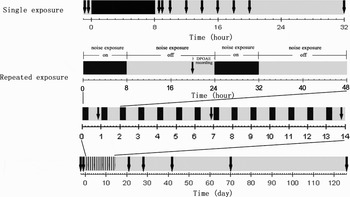
These animals were randomly assigned to groups receiving either single or repeated noise exposure. Wide band noise at 93 dB(A) was used. In the single noise exposure group, six animals (12 ears) were exposed continuously for 8 hours, and distortion product OAE amplitudes were measured before and within 24 hours after noise cessation. In the repeated noise exposure group, six animals (12 ears) were exposed to noise using a schedule of 8 hours on and 16 hours off, for 14 consecutive days. Distortion product OAE amplitudes were measured before exposure, on exposure days 1, 7 and 14, and on post-exposure days 7, 14, 28, 56 and 112. During 14-day noise exposure, distortion product OAE amplitudes were measured at 12 hours after each noise exposure, prior to the next noise exposure. The timing of experimental manipulations is shown in Figure 1.
Timing of experimental manipulations for single and repeated noise exposure groups. Black areas represent noise exposure periods and grey areas represent non-exposure periods. Arrows indicate distortion product otoacoustic emission amplitude recordings points.

Noise exposure
During noise exposure, the (unanaesthetised) guinea pigs were housed in a wire mesh cage with free access to food and drinking water. The cage was placed in the middle of a reverberation room (v = 3.9 m3). Noise was generated by an Orbiter 922 version 2 clinical audiometer (Madsen Electronics, Taastrup, Denmark) routed through a power amplifier (Amplaid sf 40, Amplaid, Milan, Italy) to a loudspeaker enclosure (Feiyue, Shanghai, China). The noise exposure level was measured at various time points at the tip of the animal's tragus using a sound pressure meter (AWA 6291, Hangzhou Aihua Instrument, Hangzhou, China). Overall, the level varied between measuring points by less than ±1 dB.
In vivo distortion product otoacoustic emission measurements
A cubic distortion component of 2f1–f2 in the distortion product OAEs was measured using a Celesta 503 cochlear emissions analyser (Madsen Electronics) in a double-walled, soundproof room. The procedure was performed as in our previous study.Reference Huang, Luo, Wu, Tao, Jones and Zhao9
Briefly, guinea pigs were placed in a restrainer without anaesthesia, and head movements were restricted by a ring placed over the nose. Animals were trained prior to measurement to accustom them to the testing environment. A 5-cm plastic tube with a 3-mm internal diameter was inserted into the external ear canal and sealed with an earplug. Two pure tones (f1 and f2) were simultaneously delivered into the ear. The ratio of f2 versus f1 (f2/f1) was 1.22. The test frequency was represented by the geometric mean of f1 and f2 [f0 = (f1 × f2)1/2] from f0 = 1.5−8 kHz at 1/2 octave band corresponding to f2 = 1.67−8.94 kHz. The primaries of L1/L2 were fixed at 70/65 dB sound pressure level (SPL). Three hundred responses were averaged. The recording was set to stop automatically when the amplitude of the component of 2f1–f2 was greater than two standard deviations (SDs) of the noise floor level.
Data analysis
Statistical analysis was performed using the Statistical Package for the Social Sciences version 13.0 software (SPSS Ltd, Chicago, Illinois, USA). The mean ± SD was calculated for all parameters, for all ears tested. Statistical analysis was performed using the paired t-test to compare the amplitudes recorded during and after exposure with those recorded before exposure. A level of p < 0.05 was considered to be statistically significant.
Results
Effect of single noise exposure on distortion product otoacoustic emission amplitude
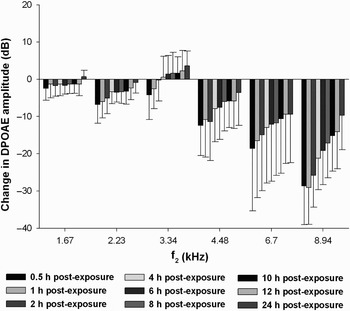
Exposure to 93 dB(A) noise for 8 hours significantly reduced the distortion product OAE amplitudes at all test frequencies, compared with pre-exposure levels (p < 0.05), as shown in Figure 2. Over the following 24 hours, there was a tendency for this reduced amplitude to recover. However, at higher frequencies (f2 = 4.48−8.94 kHz) the distortion product OAE amplitude failed to completely recover to pre-exposure levels. The change in distortion product OAE amplitude at higher frequencies was significant at all time points tested (p < 0.05). The distortion product OAE amplitude at f2 = 2.23 kHz had returned to pre-exposure levels by 24 hours after noise exposure cessation (p > 0.05). The distortion product OAE amplitude at f2 = 1.67 kHz was significantly reduced until 1 hour post-exposure. The distortion product OAE amplitude at f2 = 3.34 kHz had completely recovered by 4 hours post-exposure, but it significantly exceeded the pre-exposure level by about 3.6 dB by 24 hours after noise exposure cessation (p < 0.05).
Changes in 2f1–f2 distortion product otoacoustic emission (DPOAE) amplitudes recorded in the single noise exposure group, comparing pre- and post-exposure values. Data are shown as means ± standard deviations.

Effect of repeated noise exposure on distortion product otoacoustic emission amplitude
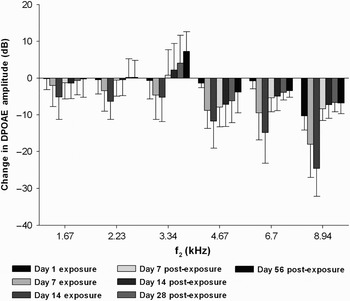
During exposure to wide band noise at 93 dB(A) for 8 hours per day for 14 consecutive days, the distortion product OAE amplitude was progressively reduced (at all test frequencies) with increasing exposure time, as shown in Figure 3. Higher frequencies were associated with greater reductions in distortion product OAE amplitude. The mean distortion product OAE amplitude was significantly reduced by about 5–25 dB at 12 hours after the end of 14 days of noise exposure (p < 0.05).
Changes in 2f1–f2 distortion product otoacoustic emission (DPOAE) amplitudes recorded in the repeated noise exposure group, comparing pre- and post-exposure values. Data are shown as means ± standard deviations.

After repeated noise exposure, the reduced distortion product OAE amplitudes showed a tendency to recover. This recovery was most noticeable in the first seven days after the end of repeated noise exposure. However, by 56 days after repeated noise exposure, the distortion product OAE amplitudes at f2 = 6.70 and 8.94 kHz had still not recovered to pre-exposure levels (p < 0.05), and the distortion product OAE amplitude at f2 = 4.48 kHz was also reduced by about 3.86 dB, compared with pre-exposure levels, although this difference was not significant (p > 0.05). The distortion product OAE amplitudes at f2 = 1.67, 2.23 and 3.34 kHz recovered to the pre-exposure level within seven days post-exposure (p > 0.05), and the amplitude at f2 = 3.34 kHz continued to increase to above the pre-exposure level, reaching approximately 7.3 dB at 56 days post-exposure (p < 0.05). Distortion product OAE amplitudes in four ears were still elevated at 112 days post-exposure, but the distortion product OAE amplitudes were not acquired for other eight ears they were not subjected to statistical analysis.
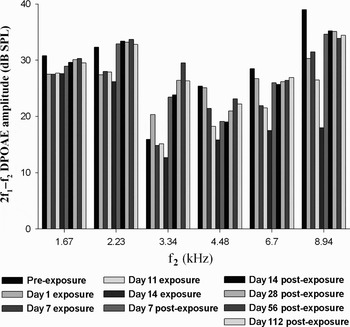
Figure 4 shows the full time course of the changes in distortion product OAE amplitude recorded from one ear, from pre-exposure to day 112 post-exposure.
Full time course of distortion product otoacoustic emission (DPOAE) amplitude changes in one ear in the repeated noise exposure group.

Discussion
Comparison with previous studies
One of the main findings of the present study was the frequency-specific, sustained enhancement of distortion product OAE amplitude which occurred after repeated noise exposure. To our knowledge, this is the first report of a long-term increase in distortion product OAE amplitude induced by acoustic overstimulation in an animal model. The enhancement of distortion product OAE amplitude was maintained at 112 days post-exposure.
Some previous studies have described the phenomenon of increased distortion product OAE amplitude in response to noise exposure in several species, including guinea pigs,Reference Peng, Tao and Huang4, Reference Kujawa and Liberman6, Reference Cianfrone, Ingrosso, Altissimi, Ralli and Turchetta7 miceReference Yoshida and Liberman2 and humans.Reference Wagner, Staud, Frank, Dammann, Plontke and Plinkert3, Reference Oeken and Menz5, Reference Kim, Leonard, Fallon, Bobbin, Dancer, Henderson, Salvi and Hamernik10 The time at which the distortion product OAE amplitude increased ranged from 14.9 minutesReference Wagner, Staud, Frank, Dammann, Plontke and Plinkert3 to seven daysReference Peng, Tao and Huang4 after cessation of noise exposure. However, there is some agreement between the current investigation and previous studies. In the current study, enhancement of distortion product OAE amplitude was frequency-specific – noise exposure did not result in an increase in distortion product OAE amplitude at all test frequencies. Similarly, Kujuwa and LibermanReference Kujawa and Liberman6 stated that an enhancement of distortion product OAE amplitude occurred at f2 = 2.78 and 3.34 kHz on day six after exposure to octave band noise (2–4 kHz) at 85 dB SPL. It is notable that these authors observed an enhancement of distortion product OAE amplitude in the same frequency region as in the present study, although the timing of the amplitude increase differed. Yoshida and LibermanReference Yoshida and Liberman2 applied octave band noise (8–16 kHz) at 89 dB SPL for 15 minutes or octave band noise at 81 dB SPL for one week to mice, and found an increase in distortion product OAE amplitude at f2 = 7.27 kHz. Wagner et al. Reference Wagner, Staud, Frank, Dammann, Plontke and Plinkert3 reported that humans with normal hearing displayed a distortion product OAE amplitude increase at 1.5–5 kHz but an amplitude reduction at 6 kHz, after magnetic resonance imaging noise exposure. This difference in frequency ranges is possibly due to differences between species and also to the sound frequency spectrum used. It is important to note that no permanent threshold shift or permanent reduction in distortion product OAE amplitude was observed in these previous studies. However, in the current study, at higher frequencies the distortion product OAE amplitude did display permanent depression. Previous studies may not have observed the process of distortion product OAE amplitude increases because of differing experimental aims or limitations in clinical instrumentation.
KempReference Kemp, Hamernik, Henderson and Salvi11 described a temporary increase of 2–3 dB in the amplitude of transient evoked OAEs from the human ear approximately 1.5 minutes after brief exposure to low-frequency tones, followed by a reduction in amplitude. This change in transient evoked OAE amplitude, described as a ‘bounce’,Reference Kim, Leonard, Fallon, Bobbin, Dancer, Henderson, Salvi and Hamernik10, Reference Kemp12 displayed a course paralleling the non-monotonic change in hearing threshold described by Hirsh and Ward.Reference Hirsh and Ward13
However, the persistent enhancement of distortion product OAE amplitude observed in the present study does not conform to the bounce phenomenon – the increased distortion product OAE amplitude recorded after repeated noise exposure did not return to pre-exposure levels. It is important to note that, after single noise exposure, the distortion product OAE amplitude at f2 = 3.34 kHz was reduced within 2 hours post-exposure and then increased with increasing rest time, although the enhancement of about 2.3 dB by 12 hours post-exposure was not significant compared with the pre-exposure level. In the repeated noise exposure group, by 12 hours post-exposure on day one of noise exposure, the distortion product OAE amplitude was increased at f2 = 3.34 or f2 = 2.23 kHz in only six of 12 ears and two of 12 ears, respectively. An increase in distortion product OAE amplitude at both f2 = 3.34 kHz and f2 = 2.23 kHz was found in only one ear. However, the enhanced distortion product OAE amplitude declined to below the pre-exposure level with increasing noise exposure times. Following 14 days of repeated noise exposure, the reduction in distortion product OAE amplitude, at frequencies in the region at which the distortion product OAE amplitude had increased on day one of noise exposure, recovered and exceeded the pre-exposure level again, as shown in Figure 4. The mechanism responsible for this paradoxical change in distortion product OAE amplitudes requires further investigation.
Possible significance of long-term enhancement of distortion product otoacoustic emission amplitude
Enhancement of distortion product OAE amplitude has been found in other studies as well as the current one, and this phenomenon poses some interesting questions regarding its significance. Data from previous studies have suggested that the enhancement of distortion product OAE amplitude induced by noise exposure accounts for the effect of sound conditioning, as described by Kujuwa and Liberman.Reference Kujawa and Liberman6 An increase in distortion product OAE amplitude has also been demonstrated using another sound conditioning protocolReference Yoshida and Liberman2 and other conditioning exposures (such as heat stressReference Yoshida, Kristiansen and Liberman14, Reference Murakoshi, Yoshida, Kitsunai, Iida, Kumano and Suzuki15 and physical restraintReference Wang and Liberman16).
However, some questions about the hypothesis remain to be answered. Firstly, analysis of the frequency region responsible for the increased distortion product OAE amplitude, and of the magnitude of the conditioning-related protection, shows that the frequency region associated with the greatest conditioning-related protection did not show the greatest increase in distortion product OAE amplitude. Secondly, enhancement of distortion product OAE amplitude can also be induced by other non-conditioning treatments, as seen in other studies.Reference Huang, Luo, Wu, Tao, Jones and Zhao9, Reference Raveh, Mount and Harrison17–Reference Yu, Zhu, Johnson, Liu, Jones and Zhao20 Further studies are needed to determine the significance of distortion product OAE amplitude enhancement.
Distortion product OAE amplitude was measured in the ear canal when the animal was presented with two tones. The tones combine at mathematical combinations of the input frequencies, f1 and f2, the most prominent of which is at 2f1–f2. They are suppressed by manipulations that reduce cochlear sensitivity.Reference Davis, Qiu and Hamernik21–Reference Gaskill and Brown23 In the present study, distortion product OAE amplitude was persistently increased after repeated noise exposure, suggesting cochlear hypersensitivity and an increase in the gain of the active amplifier.
KempReference Kemp24 suggested that physiologically spontaneous active cochlear micromechanics were a cause of tinnitus. In fact, multiple mechanisms are implicated in tinnitus perception. Many factors may complicate the detection of spontaneous OAEs in people with tinnitus. Although further evidence has demonstrated that spontaneous OAE is not an indicator of tinnitus – rather, increased cochlear micromechanics sensitivity is thought to be one of the principal mechanisms for tinnitus. Salicylate has been shown to reversibly increase the amplitude of the 1-kHz peak of the average spectrum of electrophysiological cochlear activity,Reference Cazals, Horner and Huang25 paralleling the progression of tinnitus in humans; in addition, doses of salicylate increase the distortion product OAE amplitude in guinea pigs.Reference Huang, Luo, Wu, Tao, Jones and Zhao9 Clinical studies have found that the distortion product OAE amplitude is increased in people with tinnitus.Reference Janssen, Kummer and Arnold26, Reference Hesse, Schaaf and Laubert27 The perceived tinnitus pitch has consistently been shown to correspond to the frequencies at which hearing loss is present. Tinnitus pitch is predominantly matched to frequencies above the audiographic edge of normal hearing.Reference Henry, Meikle, Gilbert and Hazell28–Reference Roberts, Moffat and Bosnyak31
In the present study, the frequencies causing enhancement of distortion product OAE amplitude were consistent with these findings. Enhancement of mean distortion product OAE amplitude occurred at f2 = 3.34 kHz, which was above the frequency level producing normal distortion product OAE amplitudes. Distortion product OAE amplitudes at frequencies higher than f2 = 3.34 kHz displayed permanent shifts, whereas amplitudes at frequencies below f2 = 3.34 kHz showed temporary shifts. Thus, the long-term enhancement of distortion product OAE amplitudes following repeated noise exposure could have important implications for the development of tinnitus.
Frank and KössloReference Frank and Kösslo32 found that the 2f1–f2 distortion product OAE amplitude relied on the clipping of some signal within the transduction chain at both peak excursions of the signal, and this was complicated by the phase cancellation of contributions from different cochlear regions. It has been demonstrated that hearing at higher frequencies affects the distortion product OAE amplitude at lower frequencies.Reference Kakigi, Hirakawa, Harel, Mount and Harrison18, Reference Arnold, Lonsbury-Martin and Martin33 In the present study, the appearance, disappearance and reappearance of the enhanced 2f1–f2 distortion product OAE amplitude, and the change in distortion product OAE amplitudes at higher and lower frequencies, may reflect the mechanism responsible for the generation of the 2f1–f2 distortion product OAE. In 1997, Kirk and PatuzziReference Kirk and Patuzzi8 reported that a low frequency tone exposure for 3 minutes resulted in no noticeable change in 2f1–f2 distortion product OAE amplitude and the enhancement of both hearing sensitivity and f2–f1 distortion product OAE amplitude. Thus, it is possible that the gain of the active amplifier was increased at the frequencies causing increased distortion product OAE amplitude, although the 2f1–f2 distortion product OAE amplitude was reduced during repeated noise exposure. This may be one reason why distortion product OAE amplitude is reduced in people with noise-induced tinnitus.
Further studies into the significance of the distortion product OAE amplitude changes detected in this study are warranted.
Conclusion
We administered repeated exposures to 93 dB(A) wide band noise to awake guinea pigs, following a schedule of 8 hours on and 16 hours off, and observed the time course of the changes in distortion product OAE amplitude. Repeated noise exposure resulted in permanent enhancement of distortion product OAE amplitude. The pattern of distortion product OAE amplitude change comprised an initial reduction followed by an increase, a further reduction and a re-increase. The frequency region of the increased distortion product OAE amplitude located at the middle frequency region which was between “temporary” to “permanent” distortion product OAE amplitude shift.
Our results suggest the likely existence of intermediate stages between permanent threshold shift and temporary threshold shift. The observed long-term increase in distortion product OAE amplitude suggests that repeated noise exposure may cause persistent hypersensitivity of the cochlea, similar to the generation of noise-induced tinnitus in humans (e.g. in cases of occupational noise exposure). Such an increase in distortion product OAE amplitude may be an indicator of tinnitus, and could also explain the induction of tinnitus by noise exposure. It is possible that the mechanism responsible for the enhancement of distortion product OAE amplitude following single noise exposure is different to that causing distortion product OAE amplitude enhancement after repeated noise exposure. It is also possible that different mechanisms of auditory hypersensitivity were induced in the present and previous studies.
• The impact of noise pollution on humans has been long recognized as a problem in developed countries, but is still ignored in developing and underdeveloped countries
• Hearing sensitivity is usually reduced due to noise exposure
• This study examined the effect of 93 dB (A) wide band noise on cochlear micromechanical sensitivity in awake guinea pigs
• This level of noise exposure reduced the distortion product otoacoustic emission amplitudes at all tested frequencies
• It is likely that there are intermediate stages between permanent threshold shift and temporary threshold shift; in addition, long-term enhancement of distortion product OAE may be an indication of tinnitus generation
Further studies are needed to clarify the mechanisms responsible for the observed changes in distortion product OAE amplitude, and to determine the significance of these phenomena.