




No CrossRef data available.
“Draining the Sea”: Mass Killing and Guerrilla Warfare
Published online by Cambridge University Press: 19 May 2004
Abstract
Why do some wars result in the intentional killing of large numbers of civilians? In this article we examine the incidence of mass killing in all wars from 1945 to 2000. In the statistical analysis of our data set of 147 wars, we find strong evidence supporting our hypothesis that mass killing is often a calculated military strategy used by regimes attempting to defeat major guerrilla insurgencies. Unlike conventional military forces, guerrilla armies often rely directly on the local civilian population for logistical support. Because guerrilla forces are difficult to defeat directly, governments facing major guerrilla insurgencies have strong incentives to target the guerrillas' civilian base of support. We find that mass killing is significantly more likely during guerrilla wars than during other kinds of wars. In addition, we find that the likelihood of mass killing among guerrilla conflicts is greatly increased when the guerrillas receive high levels of active support from the local population or when the insurgency poses a major military threat to the regime.For their helpful comments on previous versions of this article the authors thank Bear Braumoeller, Alex Downes, Jim Fearon, Hazem Goborah, Stathis Kalyvas, Gary King, Will Lowe, Matthew Krain, Lisa Martin, Manus Midlarsky, Bruce Russett, Nicholas Sambanis, Naunihal Singh, Abdulkader Sinno, Allan Stam, Jeremy Weinstein, and the anonymous reviewers of International Organization. We are also grateful to Wolfgang Moehler for his research assistance.Our coauthor Dylan Balch-Lindsay was killed in an automobile accident on 1 September 2002, cutting short a promising career. He was a gifted young scholar, without whom this article would not have been possible. He is sorely missed by his friends and colleagues. Donations in his name can be sent to the Dylan Balch-Lindsay Memorial Fund for Graduate Education/Foundation of the University of New Mexico, c/o Carol Brown, Department of Political Science, University of New Mexico, Albuquerque, NM, 87131-1121.
Information
- Type
- Research Article
- Information
- Copyright
- © 2004 The IO Foundation and Cambridge University Press
There is an African saying that describes the plight of civilians during times of war: “When elephants fight, the grass suffers.” Indeed, the killing of civilians is a common consequence of armed conflict. We estimate that between thirteen and twenty-six million civilians have died in civil, international, and colonial wars since 1945.1
Ruth Leger Sivard estimates at least 7,552,000 civilian war-related deaths in a partial review of conflicts from 1945–92. Sivard 1989, 21.
Not all armed conflicts, however, result in the intentional killing of civilians on a massive scale. Civilians are killed in virtually all wars, but they suffer much more in some conflicts than in others. Two wars fought between Eritrea and Ethiopia provide powerful examples of this distinction. The first war, in which Eritrean rebels fought for independence from Ethiopia, reached its peak violence in the mid-1980s. Tens of thousands of soldiers on both sides perished, along with hundreds of thousands of Eritrean civilians. Many of these civilians were killed as a result of the Ethiopian government's intentional policy of starvation targeted against the Eritrean population.2
See De Waal 1991; and Kaplan 1988.
See “Playing By the Rules: From an Old Fashioned War, a Very Modern Calamity,” New York Times Week in Review, 4 June 2000, 5; and “Awful War, Real Peace: The Model of Eritrea,” New York Times, 6 April 2001, A3.
What explains the stark differences between these conflicts? Why do some wars escalate to the massive, intentional killing of civilian populations? The existing theoretical literature offers few answers. As Stathis Kalyvas has observed, scholarly writing on war and rebellion has generally neglected violence against civilians or simply assumed that this kind of violence is irrational, driven by sadism or the frenzy of battle.4
Scholars of war have devoted a great deal of effort to understanding the causes of conflict, but little systematic research has been conducted on its consequences, especially for civilian populations. A smaller body of scholarship on genocide and related atrocities, on the other hand, has focused more directly on intentional violence against civilians. We believe it is possible to derive at least two testable hypotheses from this scholarship that pertain to the killing of civilians during war. First, mass killing during war may be driven by ethnic hatred and discrimination between combatant groups. Second, mass killing during war may be associated with nondemocratic regimes.These explanations have intuitive appeal, but we argue that neither is adequate to explain the variation in the intentional killing of civilians during war. We present an alternative theory, focusing on the strategic incentives for targeting civilians created by certain forms of combat. We argue that the intentional killing of civilians during war is often a calculated military strategy designed to combat powerful guerrilla insurgencies. Directly defeating a large, well-organized guerrilla army can be extremely difficult, because guerrilla forces themselves almost always seek to avoid decisive engagements with opposing forces, opting instead to wage a protracted campaign of hit-and-run attacks. As a result, counterinsurgent forces often choose to target the guerrillas' base of support in the population. This kind of counterinsurgency strategy can lead to the intentional killing of massive numbers of civilians.
From this perspective, therefore, one of the primary reasons for the differing fate of civilians during the two conflicts between Eritrea and Ethiopia is that the Eritrean rebels fought the first war against Ethiopia using mass-based guerrilla tactics, while the second war was waged between two armies with conventional tactics and weapons along well-defined front lines.
Despite the incentives for targeting civilians during counterinsurgency warfare, it is important to recognize that most guerrilla wars never escalate to mass killing. We argue that mass killing in guerrilla warfare usually emerges out of frustration with conventional tactics in an effort to stave off defeat. When insurgent groups lack popular support or do not pose a serious military threat to the regime, states usually manage to keep insurgencies in check without targeting civilians in large numbers. When regimes face powerful, mass-based guerrilla insurgencies, however, policies of policing and limited targeting of civilians are unlikely to be effective. Mass killing can then become an attractive strategy regardless of the character of ethnic relations between the combatants or the democratic nature of the regime.
The remainder of this article is divided into seven sections. In the first section we define the term “mass killing.” In the second section we discuss hypotheses on mass killing during war derived from the literature on genocide and related atrocities. The third section presents our theoretical argument regarding the causal relationship between guerrilla warfare and mass killing. In the fourth section we discuss the measurement of our variables and describe our research design for testing hypotheses. The fifth section reports the results of our statistical analyses. The sixth section illustrates these results with several examples from the history of guerrilla warfare. In the concluding section we discuss some implications of our findings and directions for future research.
Mass Killing
In this article we seek to explain the causes of the intentional killing of large numbers of civilians during war. We do not attempt to account for the overall level of civilian fatalities during war, because civilians are unintentionally killed in nearly all conflicts and because it is the intentional killing of large numbers of unarmed people that most offends our moral sensibilities.5
Nevertheless, based on the data we have collected on civilian fatalities during wars since 1945, we find very few conflicts in which very large numbers of civilian losses were not attributable to intentional policies of mass killing.
This definition was first proposed by Valentino 2000.
For a complete list of mass killings in the twentieth century, see Valentino 2004.
A “massive number” is defined as at least 50,000 intentional deaths over the course of five years or less. Adopting this specific numerical criterion for mass killing is to some extent arbitrary, but the relatively high threshold we have selected helps establish a greater degree of confidence that massive violence has occurred despite the often poor quality of the data available on civilian fatalities.
Two additional aspects of this definition require further elaboration. First, mass killing focuses on “intentional killing” in order to distinguish acts of mass killing from accidental deaths including those unintentionally caused by the spread of disease, the destruction of infrastructure, or by the interposition of civilian populations between armies during war. This definition includes not only “direct” killings such as executions and massacres, but also deaths caused in more indirect ways when perpetrators deliberately create conditions expected to cause widespread death among civilians.
Deaths are considered intentional only if the affected civilian population is the direct object of a policy that results in widespread death. Thus, civilians killed by aerial bombardment would be considered victims of mass killing only if their attackers intentionally aimed to kill civilians as part of an effort to coerce survivors to surrender. If the civilians were killed as the attackers attempted to destroy nearby military forces or infrastructure, however, these deaths are considered unintentional even though civilian casualties might have been expected by the attacker. Of course, distinguishing the causes of death during wars is difficult in practice. We have not attempted, therefore, to account for the causes of civilian death on a microlevel. Rather, for each war, we have sought to identify major patterns of violence and descriptions of combatant motivations. Combined with estimates of the overall civilian fatalities during the war, we made the determination of whether a mass killing occurred.
The second aspect of the definition of mass killing that must be clarified is the term “noncombatant.” A noncombatant is defined as any unarmed person who is not a member of a professional or guerrilla military group and who does not actively participate in hostilities by intending to cause physical harm to enemy personnel or property.8
This definition is generally consistent with the definition of “civilian” adopted by the two 1977 additional Protocols of the Geneva Convention. See Bothe, Partsch, and Solf 1982, 274–318.
Hypotheses on Mass Killing from the Existing Literature
The theoretical and empirical literatures on war offer few hypotheses or findings that explain why mass killing occurs during some conflicts but not in others. Most social science research on war has focused on questions relating to its causes, or, more rarely, to its outcomes defined in terms of victory or defeat. The widely used quantitative data set on wars produced by the Correlates of War (COW) Project, for example, defines and identifies interstate and civil wars by the level of military fatalities suffered by the armed forces of the combatants, without regard to the severity of the war for civilians. No distinction is drawn between wars that produce a few thousand combat deaths and major conflagrations that result in hundreds of thousands or even millions of civilian fatalities.
In contrast, scholars of genocide and related atrocities have focused more directly on violence against civilians. Unfortunately, adopting hypotheses from these literatures to explain mass killing during war is complicated by important qualitative differences between the two phenomena. There are at least two significant distinctions between mass killing as defined above and most conceptualizations of genocide. First, scholars of genocide generally reject definitions based on absolute death tolls, focusing instead on the intent or attempt of perpetrators to destroy specific groups, in whole or in substantial part.9
This formulation follows the United Nations Genocide Convention, although many scholars take issue with other aspects of the Convention, including its limitation of genocide to attacks on “national, ethnical, racial or religious” groups, and the convention's language that includes nonlethal actions such as “causing serious bodily or mental harm to the members of the group” as acts of genocide. For the text of the genocide convention, see LeBlanc 1991, 245–49. For reviews of the debate on the definition of genocide, see Straus 2001; Fein 1993b, xi–31; Markusen and Kopf 1995, 39–64; and Chalk and Jonassohn 1990, 12–23.
Harff 2003, 58.
Second, genocide scholars have not developed specific theories to explain genocides that occur during war but have typically focused on theories based on common underlying motives for the violence regardless of whether it occurs during war or peace. In fact, many definitions of genocide explicitly exclude the intentional killing of civilians during war if the violence was not motivated by the intent to destroy a specific ethnic or political group, even if hundreds of thousands of civilians were intentionally killed during the war.11
In light of these important distinctions, one should use caution when applying hypotheses from the literature on genocide to explain mass killing during war. Testing these hypotheses using a sample of cases limited to wartime mass killings cannot tell us how well these hypotheses explain the incidence of genocide more narrowly defined. Nevertheless, there are three reasons why it may still be constructive to examine hypotheses from the literature on genocide in the context of mass killing during war.
First, despite the important differences in the definitions of genocide and mass killing, there is overlap between the two phenomena. For example, of the forty-nine episodes of genocide and politicide identified by Barbara Harff and Ted Gurr from 1945–2000, thirty-one (63 percent) meet the definition of mass killing described above.12
The remaining eighteen of Harff's cases were excluded as mass killing because none was estimated to have taken more than 50,000 lives in five or fewer years. See Harff and Gurr 1996, 49–51; and Harff 2003.
Second, not all scholars studying genocide and related violence restrict their definitions to attempts to destroy ethnic or political groups. For example, Leo Kuper, in his pioneering work on the comparative study of genocide, argued that the intentional killing of civilians such as the strategic bombings of World War II should be considered genocide.13
See Kuper 1981, 46. For other proponents of this view, see Sartre 1968; and Markusen and Kopf 1995.
Rummel 1994, 36.
Third, although scholars of genocide seldom limit their analyses to genocides that occur during war, several studies have suggested a strong relationship between armed conflict and at least some forms of genocide.15
See Fein 1993a; Krain 1997; Markusen and Kopf 1995; and Harff 2003.
See Markusen and Kopf 1995; and Fein 1993a. For a partial exception, see Harff 2003, who identifies conditions that distinguish “national upheavals,” a broadly defined class of events including violent conflicts and abrupt regime changes.
Krain 1997, 335.
Ibid. Krain's study applies not only to genocides that occurred during wars but also to genocides that took place in the years following wars.
Nevertheless, the literature on genocide does suggest at least two factors that might account for this variation.19
A range of factors that may contribute to genocide, although not necessarily in times of war, are described in Harff 2003.
See Kuper 1981; Charny and Rapaport 1982, 206–7; Kelman 1973, 25–61; Chalk and Jonassohn 1990, 27–28; and Hirsch and Smith 1988.
Some scholars studying civil wars have argued that there are important differences between ethnic and political/ideological conflicts that might also have implications for variations in the incidence of mass killing. Chaim Kaufmann, for example, argues that whereas combatants in ideological civil wars must compete to win the loyalty of the majority of the civilian population regardless of their ethnicity, ethnic conflicts tend to produce exclusive group identities, making cross-ethnic appeals extremely difficult. Kaufmann argues that this characteristic of ethnic wars makes them particularly difficult to resolve peacefully. If correct, his analysis also seems to suggest, however, that ethnic wars would be more likely to involve intentional violence against noncombatants. Indeed, Kaufmann suggests that because it is more difficult for individuals to disguise their ethnicity than their political affiliation, combatants in ethnic conflicts “can treat all co-ethnics as friends without risk of coddling an enemy agent and can treat all members of the other group as enemies without risk of losing a recruit.”21
Kaufmann 1996, 145.
Although various authors point to different causal mechanisms linking ethnic differences to violence, at the most basic level these explanations would seem to suggest that ethnic conflicts in general are more likely to experience mass killing than conflicts waged primarily over political or economic issues. This implies the following hypothesis:
H1: Mass killing will be more likely during ethnic or “identity conflicts” than during political or ideological conflicts.
A second factor highlighted by some scholars that may help to explain the incidence of mass killing during war is the character of the regimes involved in the conflict. Several authors have suggested that the structural characteristics of democratic systems and the normative orientation of democratic leaders make them less likely to engage in genocide or other human rights abuses than leaders of highly authoritarian governments. Rudolph Rummel is perhaps the most prominent advocate of this explanation.22
See also Fein 1993a; Poe and Tate 1994; Henderson 1991; and Davenport 1999. A number of studies have also argued that highly democratic states are less likely to experience civil wars than nondemocracies. For example, see Hegre et al. 2001, 33–48; Gurr 2000; Benson and Kugler 1998, 196–209; Henderson and Singer 2000, 275–99; and Krain and Myers 1997, 109–18. Because the vast majority of mass killings occur during civil wars, democracies may be less likely to engage in mass killings for this reason alone.
Through democratic institutions social conflicts that might become violent are resolved by voting, negotiation, compromise, and mediation. The success of these procedures is enhanced and supported by the restraints on decision makers of competitive elections, the cross-pressures resulting from the natural pluralism of democratic … societies, and the development of a democratic culture and norms that emphasize rational debate, toleration, negotiation of differences, conciliation, and conflict resolution. Moreover, democratic leaders see others, even political opponents, as within the same moral universe, as equally nonviolent, as disposed to negotiate differences peacefully.23
Rummel 1995, 4.
Some of these mechanisms apply most directly to the effect of democracy on the emergence of conflict, but others also suggest that democracies should be more likely to respect human rights during war. If democratic values promote tolerance, nonviolence, and respect for legal constraints, then democracies should wage their wars more humanely than other forms of government. If democratic citizens and opposition elites are more sensitive to appeals to human rights and international legal principles on the laws of war, these citizens might be expected to pressure their governments to uphold those rights, even during war. In fact, several scholars have found that democratic regimes are more likely to negotiate settlements to civil conflicts whereas autocratic regimes are far less likely to do so.24
See Gurr 2000, 204; and Walter 2002, 10–11.
Rummel 1995, 25.
Harff 2003, 72.
This suggests a second hypothesis relevant to the incidence of mass killing during war:
H2: Highly autocratic regimes are more likely to engage in mass killing during armed conflicts than highly democratic regimes.
Mass Killing, Strategy, and Guerrilla War
In his study of massacres perpetrated by Islamist guerrilla groups against civilians in Algeria during the 1990s, Stathis Kalyvas argues that the violence was not driven by a radical “ideology that justifies the extermination of a category of people” or by senseless bloodlust, as many observers had suggested.27
Kalyvas 1999, 247.
Kalyvas's research focuses on violence perpetrated by insurgents, but as he acknowledges, the worst violence during civil wars is usually associated with government forces.28
Ibid.
For our purposes, guerrilla war may be distinguished from other forms of combat by three central characteristics. First, guerrilla warfare relies primarily on irregular forces, organized in small, highly mobile units, and operating mostly without heavy weaponry such as tanks, artillery, or aircraft. Second, guerrilla tactics seek to avoid decisive set-piece battles in favor of prolonged campaigns focusing on hit-and-run attacks, assassinations, terror bombing, sabotage, and other operations designed to increase an opponent's political, military, and economic costs, as opposed to defeating the opposing military forces directly. Third, clear lines of battle in guerrilla warfare are rare and guerrilla forces usually operate in territories under the military control of their opponents.
It is a fourth characteristic of guerrilla warfare, however, one common to many but not all guerrilla conflicts, that is the most critical for understanding the causal connections between guerrilla tactics and mass killing. Unlike conventional military forces, guerrilla armies often rely directly on the local population for food, shelter, supplies, and intelligence, as well as to act as a form of “human camouflage” into which the guerrillas can disappear to avoid detection.29
Wickham-Crowley 1990, 223–26.
Because guerrilla warfare basically derives from the masses and is supported by them, it can neither exist nor flourish if it separates itself from their sympathies and cooperation…. Many people think it is impossible for guerrillas to exist for long in the enemy's rear. Such a belief reveals lack of comprehension of the relationship that should exist between the people and the troops. The former may be likened to water and the latter to the fish who inhabit it… .30
Mao 2000, 44, 92–93.
Guerrilla warfare can be an extraordinarily powerful weapon. Skillfully applied, guerrilla tactics can provide even relatively small and weak groups with the capability to inflict significant military and political costs on an opponent, even when that opponent is capable of fielding vastly superior conventional forces. As a result, powerful guerrilla forces have proven extraordinarily difficult to defeat, even by the most advanced Western armies. Conventional military tactics are poorly suited to combating enemy forces who seek to avoid direct military confrontations, have no permanent lines of supply or communication, and are often indistinguishable from the civilian population. Policing the vast spaces and large populations resident in areas of guerrilla activity requires resources beyond those of all but the largest military organizations. These dilemmas force regimes threatened by powerful guerrilla insurgencies to search for unconventional strategies capable of defeating their adversaries. The logic of guerrilla war has often led military and political leaders to conclude that the massive killing of civilian populations may be a bloody but effective solution to the seemingly intractable problems of guerrilla warfare.
While the support of the local population may be one of the great strengths of guerrilla forces, it can also be a weakness. Rather than fighting the guerrillas on their own terms, regimes determined to defeat a guerrilla opponent may adopt a strategy designed to sever the guerrillas from their base of support in the people. Unlike guerrilla forces themselves, this civilian support infrastructure is largely immobile and nearly impossible to conceal. As such, civilian populations offer an obvious target for counterinsurgent operations.
Thus, like the insurgent violence described by Kalyvas, government violence against civilians during war is often designed to influence patterns of civilian support. States, however, face a different combination of incentives and capabilities that make mass killing by the government substantially more likely than mass killing by insurgent groups. First, state military organizations have a greater capacity for violence because they are usually larger and better armed than insurgents. Second, states can devote greater resources to defending their own civilian supporters than can insurgents. Guerrillas seldom can afford to engage in the static defense of specific territories or population centers, because this would expose their forces to direct combat with militarily superior government troops. Because insurgents are simultaneously less capable of killing government supporters in large numbers and less able to defend their own supporters, states are less likely to be deterred from attacking the insurgents' supporters by the threat of retaliation in kind. Insurgents, on the other hand, are more likely to be deterred from launching attacks on government supporters for fear that such attacks will provoke massive state reprisals. Finally, whereas a successful insurgency usually requires the active support and cooperation from the civilian population, government forces do not depend on civilians so directly. The primary interest of counterinsurgent forces is simply to prevent civilians from supporting the guerrillas. Insurgents, therefore, usually have stronger incentives to be selective in their use of violence to avoid alienating the civilians on whom they depend.
Governments also must be wary that excessive violence will backfire by driving civilians into the arms of the guerrillas, but it usually is easier to prevent or deter cooperation through violence than it is to win it. Thus, as many political leaders and military commanders engaged in counterinsurgency warfare have openly acknowledged, if the civilian population is the “sea” in which the guerrilla “fish” swim, the surest way to catch the fish is by draining the sea. This strategy usually takes the form of selective terror designed to intimidate the population into withdrawing their support from the insurgents, but at its most extreme it can shade into a policy of extermination designed to physically eliminate entire populations suspected of supporting the guerrillas.
This perspective on the causes of mass killing during war suggests the following hypothesis:
H3: The probability that a state will engage in mass killing during large-scale armed conflicts will be greater when the armed opposition relies primarily on guerrilla tactics than when the opposition uses other military tactics.
Although this logic suggests that states confronting guerrilla warfare should be more likely to engage in mass killing than states involved in conventional wars, guerrilla tactics are extremely common (especially in civil conflicts), and most regimes facing guerrilla insurgencies have not resorted to mass killing. Of the seventy-five states fighting large-scale guerrilla insurgencies from 1945 to 2000, twenty-four used mass killing. While this is a relatively high proportion, it also means that 68 percent of regimes fighting guerrilla opponents did not resort to this kind of violence. What might explain this pattern?
Because we argue that mass killing during guerrilla war is a means to an end, we also theorize that governments have little incentive to resort to mass killing if they believe less violent strategies will be effective. In addition to normative pressures against killing civilians, mass killing involves real risks for those who carry it out, including the possibility of increasing resistance from victim groups, alienating domestic populations and foreign powers, or provoking intervention by third parties. For this reason, governments are likely to prefer less violent methods for dealing with insurgents if they believe they will be effective. These strategies might include increased policing efforts, defensive measures to protect government supporters and infrastructure, conventional tactics targeting guerrilla combatants, direct negotiations with the insurgents, or the provision of positive economic and political incentives to civilians who agree to support the government.
When less violent tactics fail to control the insurgency, however, the incentives to resort to mass killing will rise. On the basis of this reasoning, we argue that two additional factors play significant roles in determining whether a regime facing a guerrilla insurgency will respond with mass killing.
First, states are most likely to respond to guerrilla insurgencies with massive violence when the guerrillas pose a major military threat to the regime. When guerrilla groups are small and weak, less violent tactics are more likely to keep the insurgency in check. Some states may even prefer to let very low-level guerrilla conflicts persist indefinitely rather than devote the resources, risk the casualties, or incur the domestic and international political consequences necessary to defeat them unconditionally. When an insurgency threatens the political survival of a regime, however, escalation is likely to appear more attractive. The costs associated with more violent strategies become less significant when compared to the prospect of mounting military and economic losses as well as declining political support. Mass killing may then emerge out of frustration with the ineffectiveness of conventional means and the desperate effort to maintain power.
H4: The probability that a state will engage in mass killing during a guerrilla conflict will increase the greater the military threat posed by the guerrillas to the regime and its political survival.
A second, often related factor, which can influence the likelihood of mass killing in guerrilla war, is extent of the ties between the guerrillas and the local civilian population. Not all guerrilla forces depend heavily on the local civilian population for support. Guerrillas may receive the majority of their support from foreign sources.31
On the role of foreign support for insurgencies see Byman et al. 2001, especially 83–102.
See Guevara 1997; and Laqueur 1976, 330–38.
H5: The probability that a state will engage in mass killing during a guerrilla conflict will increase the greater the number of civilians who provide support to the guerrillas.
Controls and Measurement of Variables
In addition to the five hypotheses described above, we also examine two additional hypotheses to account for relevant control variables. First, because mass killing is defined on the basis of the total number of noncombatants killed, wars involving larger civilian populations could be at greater risk for mass killing. As such, population size constitutes an important control variable in our model:
H6: The probability of mass killing during large-scale armed conflict will increase the greater the size of the population from which the opposition is drawn.
Second, although the definition of mass killing specifies that 50,000 or more deaths must be incurred in five years or fewer, conflict duration is another important control variable, ensuring that mass killing does not merely reflect the larger civilian casualties incurred during longer wars.
H7: The probability of mass killing during large-scale armed conflict will increase the longer the duration of the conflict.
Some of the variables used in our analysis, such as regime type, were drawn from other quantitative data sets, but several important variables are new to this study. These variables include mass killing, guerrilla war, the degree of military threat posed by guerrillas, and the degree of civilian support for the insurgents. In coding these variables we relied on numerous secondary histories, journalistic accounts and general reference sources.33
Sources consulted are too numerous to cite here. Among the more comprehensive reference sources consulted are Clodfelter 2002; Corbett 1986; Asprey 1994; and Lomperis 1996.
Mass Killing
This variable was defined above and was coded as a dummy variable. A value of 1 was assigned to all wars in which a mass killing occurred and a value of 0 if not (see the Appendix for a listing of all cases).
War
A war is defined as a sustained violent conflict between two organized armed groups and may take place in a civil, international, or colonial (“extra-systemic”) environment.34
Our codings draw on Singer and Small 1994; Fearon and Laitin 2003; Licklider 1995; Doyle and Sambanis 2000; Wallensteen and Sollenberg 2001; and Regan 2000.
The same government may be engaged in more than one war during any given period of time. If a government is engaged in armed conflicts with multiple opposition groups that are not closely allied with each other and each of which is seeking to achieve significantly different political aims, we code a separate armed conflict for each government-opposition dyad that meets the criteria for a war. In addition, if opposition forces gain control of the central government of the state during the course of the war but former government forces continue to engage in large-scale armed conflict against the former opposition, we code the onset of a new war (with the identities of the opposition and government transposed).
Our analysis of wars focuses on the two primary belligerents involved in the conflict only. The primary belligerents are the forces with the primary political and military control of combat operations. When coding for military force sizes and fatalities, however, all allied forces involved in the war are included for each side. In the case of civil wars, only the government is considered at risk to commit mass killing. As described above, substate groups usually (although not always) lack the physical capabilities and access to target populations necessary to carry out this level of violence. In addition, theoretically interesting variables (such as regime type) are not available for substate actors, which renders comparative analyses of these actors difficult. In international conflicts both sides are by definition government actors and could potentially engage in mass killing. All international wars, therefore, are included as two directed-dyads in our data set. Using these coding rules, we have identified 147 cases of war since 1945. 115 of these are classified as civil wars, eighteen are classified as international wars, and fourteen are classified as “extra-systemic” or colonial wars.35
Our classification of civil and international wars differs somewhat from most other data sets. When international intervention occurs during a domestic dispute, the conflict is coded as a civil war if it met all the criteria for civil war prior to the intervention and if the subsequent combat occurred primarily within the borders of that state even if an international power or powers subsequently assumed the primary role in the fighting.
Guerrilla Warfare
Because many large-scale armed conflicts involve a mix of tactics or experience a transition from guerrilla tactics to more conventional strategies during the course of the conflict, coding was based on the primary tactics used by the opposition. Primary tactics are defined as the tactics to which the opposition devoted the greatest amount of time during the conflict. A dummy variable (guerrilla warfare) was then created with a value of 1 assigned to cases of guerrilla or mixed tactics cases and a value of 0 otherwise.
Degree of Military Threat Posed by Guerrillas
For this measure (guerrilla threat) we focus on the total size of guerrilla opposition forces and the number of fatalities inflicted on government forces as a percentage of the government forces engaged in the war.36
Focusing on the fatalities inflicted by the opposition on government forces (as opposed to, for example, the ratio of government and opposition force sizes) helps highlight those opposition groups engaged in the most intense military operations against government interests.
We measured the peak strength of government forces engaged in the conflict similarly. Because standard data sets such as the COW data set on national capabilities only provide information on the total strength of government armed forces, not the forces engaged in a particular war, we also collected data on the strength of government forces from secondary and reference sources. We collected estimates of fatalities suffered by government armed forces similarly. The number of fatalities was then divided by the number of engaged government troops to calculate the ratio of fatalities to the peak strength of engaged armed forces.
The peak number of guerrilla armed forces and the percentage of fatalities suffered by government troops are highly interrelated measures. Both represent a different aspect of the military threat posed by the guerrillas, but each might also be expected to influence the other. The larger the size of opposition forces, for example, the higher the percentage of government troops they might be expected to kill. Moreover, the greater the size of opposition forces, the greater the effort that government troops might be expected to devote to defeating them, and consequently, the greater the percentage of fatalities government troops might suffer in the process. Conversely, the greater the effort that government forces devote to defeating the guerrillas, the more likely that the guerrillas will respond by increasing their recruitment efforts and thereby their total size.
To avoid collinearity between these variables and because either of these conditions could represent a real threat to the government, we combined the two measures into a single dummy variable. We assigned the variable a value of 1 if either the size of opposition forces or ratio of government armed forces fatalities suffered to government armed forces engaged was in the top quartile among guerrilla conflicts.37
The top quartile for the size of opposition forces begins at 37,500 troops. The top quartile for government fatalities as a proportion of engaged troops begins at 19 percent of peak strength.
Degree of Civilian Support for Guerrillas
This variable (civilian support) measures the peak number of active civilian supporters of the opposition in wars in which the opposition relied primarily on guerrilla tactics. We define active support as providing food, shelter, information, portage, or other logistical aid to the guerrilla forces. We do not include political sympathy for the guerrillas, because we argue that mass killing is primarily a response to the civilian logistical support network used by guerrilla armies. Determining the exact level of civilian support for guerrillas can be difficult. Secondary sources often do not provide quantitative estimates for this important variable. In those cases for which quantitative estimates were unavailable, we relied on qualitative statements about the degree and nature of civilian support combined with estimates of the total size of the populations from which these supporters were drawn to reach rough estimates of the size of civilian support. To reduce the possibility for coding errors in this process, we chose to create a dummy variable with a relatively high threshold for civilian support. The variable was assigned a value of 0 if support was low, which we defined as less than 100,000 active supporters. A value of 1 was assigned if support for the guerrillas was high, defined as more than 100,000 active supporters. This variable applies to cases of guerrilla warfare only, and was therefore automatically assigned a value of 0 in all nonguerrilla cases.
One potential problem with relying on the peak level of civilian support as our operational measure is the possibility that mass killing itself may actually lead to increased civilian support for the guerrillas. Scholars continue to debate why state violence and repression of rebels sometimes leads to submission and sometimes seems to provoke increased opposition to the state.38
See Gurr 1970; Lichbach 1987; Gupta and Singh 1993; and Moore 1998.
Ultimately, there is no way to exclude entirely the possibility of endogeneity in the measurement of this variable. The test results associated with this variable, therefore, should be interpreted with caution. On the other hand, there are also strong reasons to believe that this endogenous process is not the dominant cause of high civilian support for guerrilla insurgencies and, therefore, that a measure of peak civilian support may still be of considerable value in explaining mass killing during guerrilla warfare.
First, approximately 44 percent of guerrilla wars with high civilian support do not experience mass killing. High civilian support for guerrillas, therefore, cannot be solely a reaction to government policies of mass killing.
Second, it is important to note that even relatively widespread killings on the part of the government do not invariably generate widespread public support for guerrillas. In mid-1960s, for example, the Guatemalan government cracked down on a small leftist guerrilla movement with extreme brutality. Although the guerrillas probably had fewer than 500 men under arms and less than 6,000 active supporters, the government offensive killed between 5,000 and 10,000 people, most of them civilians.39
See Schirmer 1998, 16, 36; and Black, Jamail, and Stoltz 1984, 82.
Jonas 1991, 69.
Finally, in the cases of mass killing we have identified, accounts from secondary sources usually described patterns of civilian support for guerrillas prior to large-scale government attacks on civilians. Although both support for guerrillas and the level of violence against civilians tend to escalate over the course of the conflict, government violence seems to be targeted against suspected supporters and thus causally prior to mass killing.
Ethnic/Identity Conflict
For this variable (identity conflict) we used the coding of “identity based conflicts” provided by Roy Licklider. Licklider defines identity-based conflicts simply as “those driven primarily by ethnic-religious-identity issues.”41
Licklider 1995, 685.
See Huth 1996; and Huth and Allee 2002.
Regime Type
We used data on regime type collected in the Polity IV data set.43
Marshall and Jaggers 2002. The polity categories of transition, interruption, and interregnum were filled with data from two primary sources: The democracy data set of Tatu Vanhanen available at 〈http://www.sv.ntnu.no/iss/data/vanhanen〉, and Freedom House scores at: 〈http://www.freedomhouse.org/ratings/index.htm〉. Accessed 15 January 2004.
Although regime type is measured on an annual basis, the rest of the variables in our analyses are measured only once for the entire course of the war. We coded regime type, therefore, using the modal value, or if multiple modes existed, the median value for the armed conflict. In so doing, we effectively code for the government that was in power for the greatest period of time during the war, and thus had the greatest opportunity for mass killing.
Population Size
The ideal variable for testing hypothesis H6 would measure the absolute size of the potential victim group's civilian population. Unfortunately, data on the population of such groups is often impossible to obtain. In cases of secessionist conflict, we limited the potential victim population to the total population of the secessionist region in which the conflict was fought. In many other conflicts, however, the pool of potential victims is not as easy to define or measure. Even in ethnically defined conflicts, counterinsurgency forces do not always consider all members of opposing ethnic groups throughout the country to be targets. In politically based conflicts, the size of the potential civilian political support base for the opposition is even more difficult to estimate because political allegiances are highly unstable and very difficult to observe. In these cases, therefore, we coded the population as the log of the total population (log population) of the state or colony in which the majority of the war took place measured on the first year of the conflict.44
Population data was obtained from Singer and Small 1982; Singer 1990; and Banks 1979. The Singer and Small data was generated using the EUGene program (Bennett and Stam 2000). Missing data on population was collected from 〈http://www.library.uu.nl/wesp/populstat/populhome.html〉. Accessed 15 January 2004.
Conflict Duration
This variable (war duration) is measured as the total length of the conflict in years.
Analysis and Empirical Findings
Three stages of logit analyses were performed to test our hypotheses. In the first stage we examined the general relationship between guerrilla warfare and mass killing in all wars from 1945–2000. In the second stage we tested hypotheses relating the specific characteristics of different guerrilla conflicts to the likelihood of mass killing, and, therefore, we limited the population of cases to guerrilla wars only. In the third stage we examined the ability of the specific guerrilla warfare variables examined in stage two to account for the incidence of mass killing during all wars.
The findings of our analyses are presented in Tables 1–3. The coefficient, Z score, and significance level are reported for each variable. In addition, we report the associated relative risk ratio for each variable. This ratio estimates the impact on the probability of mass killing resulting from an increase of one unit (for dichotomous variables) or an increase from the 25th percentile to the 75th percentile (for continuous variables) in the variable of interest while holding all other variables at their median/modal values.
The results strongly support our theory of guerrilla warfare and mass killing. Most notably, guerrilla warfare proved to have highly significant and powerful effects on the likelihood of mass killing, strongly confirming hypothesis H3. Hypotheses H4 and H5 were also strongly supported by the results. The guerrilla threat and civilian support variables were highly statistically significant and produced large substantive effects on the probability of mass killing in all stages of the analysis. The democracy variable was also significant in all three stages of analysis and produced relatively strong substantive effects, supporting hypothesis H2. In addition, conflict duration and population were significant in at least some stages of analysis. The substantive effects of these variables, however, were dwarfed by those of the guerrilla and regime type variables. Identity conflict was not significant in any of the models, casting doubt on hypothesis H1.
The results of the first stage of our analysis are presented in Table 1. Hypothesis H3 was strongly confirmed by the results. Guerrilla warfare was highly significant, increasing the probability of mass killing by more than three times. Democracy also proved significant. Full democracies were only 28 percent as likely as highly autocratic states to engage in mass killing during wars, providing support for hypothesis H2. In addition, population and conflict duration were both significant, lending some support to hypotheses H6 and H7. The substantive effects of these variables, however, were comparatively small. An increase in the population of a state from the 25th percentile to the 75th percentile increased the risk of mass killing only 1.7 times. An increase from the 25th percentile to the 75th percentile (from roughly four months to more than seven years) in the duration of a war increases the risk of mass killing by 1.6 times.
Stage 1: Logit analysis of probability of mass killing in wars, 1945–2000

Table 2 presents the results of the second stage of our analysis. Hypotheses H4 and H5 are strongly confirmed. Both the level of military threat posed by the guerrillas and the level of active civilian support for the guerrillas are highly significant.45
These findings are consistent with and extend the findings of Timothy Wickham-Crowley's comparative study of several cases of guerrilla warfare in Latin America from 1956–76. Wickham-Crowley found that “the deeper and more thorough the overlap between the guerrilla combatants and the civilian population, the more likely that the government would engage in terror against the civilian population.” Wickham-Crowley 1990, 226.
The relative risk ratio of guerilla threat would be even higher, but the modal value of the civilian support variable is already high in the comparison scenario. The marginal impact of this variable is more accurately represented in Table 4 below.
Stage 2: Logit analysis of probability of mass killing in guerrilla conflicts, 1945–2000

As noted above, the results associated with civilian support variable must be interpreted with a degree of caution because of the possibility of endogeneity. On the other hand, the strong association between guerrilla war and mass killing reported in Table 1 should at least partially diminish these concerns. Our theoretical model suggests that guerrilla warfare is associated with mass killing, because guerrilla wars tend to involve more direct civilian participation than other forms of combat. In other words, civilian support provides a single causal mechanism that explains both the general association between guerrilla warfare and mass killing, as well as the increased likelihood of mass killing in those guerrilla wars with the highest levels of civilian support. Any argument contending that civilian support simply reflects the reaction of the population to a preexisting policy of massive violence must also explain why mass killing occurs with much less frequency in forms of combat other than guerrilla warfare.
Democracy maintains significance and produces strong substantive effects in this model. Highly democratic states were only 27 percent as likely as highly autocratic ones to commit mass killing during guerrilla wars. Population ceases to be significant in this equation, perhaps suggesting that among guerrilla conflicts, the effect of population on the likelihood of mass killing is manifest through a greater likelihood of high civilian support or high guerrilla threat.
Interestingly, war duration also ceases to be significant in this model (and the subsequent model, which also includes guerrilla threat and civilian support variables). In fact, war duration now assumes a negative coefficient. This result suggests that the significance of conflict duration on the likelihood of mass killing in large-scale armed conflicts (as reported above) may actually be because of an increased prevalence of highly threatening or popular guerrilla insurgencies among relatively longer conflicts. This result should not be surprising because guerrilla groups that receive significant popular support or have the capacity to pose a high threat to the government are likely to take longer to defeat, if they are defeated at all, than guerrilla groups lacking these advantages.
Table 3 presents the results of the third stage of our analysis, examining the impact of variables specifically relating to guerrilla conflicts in all cases of large-scale armed conflict. Both the level of guerrilla threat and the level of civilian support remain highly significant with large risk ratios. Of the remaining variables, only democracy is statistically significant at high levels while population is very close to the conventional .05 level. These results suggest that among the variables included in this model, factors relating to guerrilla war account for much of the explained variation in the incidence of mass killing during armed conflicts.
Stage 3: Logit analysis of probability of mass killing in wars, 1945–2000

The marginal effects of these variables on the probability of mass killing during guerrilla wars are presented in Table 4. This table reports the predicted changes in the probability of mass killing for each of the significant variables from Table 3 as they increase from low risk to high risk values. In Figure 1 we present the change in the risk ratio associated with the probability changes reported in Table 4.47
Because of space constraints, the predicted probabilities of variables that were not significant at the 0.1 level or better, with the exception of regime type, are not reported.
Both guerrilla threat and civilian support are set at 1, democracy is set at 0 (with the midrange polity variable set at 1 to emphasize midrange polities), population is set at its median value, duration is set at its median value, and identity conflict is set at 1. When analyzing the guerilla threat and guerrilla support variables, however, whichever of these two variables is not being analyzed is set at 0 to measure the independent effect of guerrilla threat or civilian support on the probability of mass killing. The effects of increasing both variables simultaneously are shown in the row labeled “guerrilla threat and civilian support.” The changes in probabilities as well as risk ratios were calculated with CLARIFY 2.1. See King, Tomz, and Wittenberg 2000.
Marginal impact of variables on the probability of mass killing during wars, 1945–2000


Changes in the risk of mass killing during wars, 1945–2000
Both the level of civilian support and guerrilla threat variables generate powerful effects on the probability of mass killing. Conflicts in which a guerilla opponent posed a major threat to the government increased the probability of mass killing by 21 percent. This change in probability translates into a sixfold increase in the risk of a mass killing (see Figure 1). Varying the level of civilian support produced similarly powerful effects. Conflicts in which guerrilla insurgents received high levels of support from the civilian population were nearly 8 times more likely to experience a mass killing (see Figure 1). When the guerrillas both posed a major threat and received high support from the civilian population, the change in the probability of mass killing was 72 percent (see Table 4), an eighteenfold increase. These variables not only produce a strong increase in the relative probability of mass killing, they also result in high absolute probabilities of this kind of violence. Indeed, our estimate of the probability of mass killing when both civilian support and guerrilla threat are high and other variables are at their moderate baseline values is close to 0.77 (see Table 4).
Regime type also had a substantial effect on the probability of mass killing. There was a 32 percent decrease in the probability of mass killing for highly democratic regimes compared to highly autocratic regimes (see Table 4). Put differently, the risk of mass killing declines almost 1.5 times for democracies (see Figure 1). Although these results suggest that strong democracies are substantially less likely than autocratic states to respond to powerful and popular guerrilla insurgencies with mass killing, it should be noted that even full democracies have a 0.53 estimated probability of mass killing when guerrilla threat, and civilian support are high and other variables are at their baseline values.49
Seventeen of seventy-five guerrilla wars involved democratic regimes according to our definition (most of these conflicts involved democratic states engaged in extra-systemic/colonial wars). Among these wars, the guerrillas posed a major threat in three and had high levels of civilian support in eleven. The guerrillas both posed a major threat and had high levels of support in three cases. Of these, two resulted in mass killings: France in Indochina from 1945–54 and the United States in Vietnam from 1965–75.
Case Illustrations
Some selected examples from the history of guerrilla warfare help to illustrate the generalizations suggested by these statistical findings. Evidence from these cases, including statements by leaders of counterinsurgency campaigns and variations in the patterns of violence across cases, reveal how state-sponsored mass killing during guerrilla wars can often be an explicit military strategy designed to sever powerful and popular guerrilla insurgencies from their civilian supporters.
In the Guatemalan civil war of the late 1970s and early 1980s, for example, the government faced a leftist insurgency backed by a large number of active civilian supporters. An estimated 250,000 to 500,000 civilians contributed to the insurgency, many providing food, clothing, shelter, and information to the rebels.50
Arias 1990, 255.
See Manz 1988, 15; and Schirmer 1998, 42.
Initially, the Guatemalan regime attempted to suppress the rebellion through a more selective campaign targeting key opposition political leaders.52
Schirmer 1998, 41.
Quoted in Richards 1985, 95.
to accomplish this “separation,” certain areas are targeted for massive killings; that is, the military must treat the civilians they are to “rescue” as though they are combatants, killing and burning all living things within the “secured area.” … Nor are killings accidental “abuses” or “excesses”; rather, they represent a scientifically precise, sustained orchestration of a systematic, intentional massive campaign of extermination.54
Schirmer 1998, 45. Emphasis in original. For similar views on the motives behind the killings in Guatemala, see Rubenstein 1987, 221–22; McClintock 1985, 240–59; Jonas 1991, 68–71, 148–52; and Landau 1993, 184–86.
During eighteen months, 75,000 people, nearly all civilians, were slaughtered. In the area of highest guerrilla activity, known as the Ixil triangle, approximately one-third of the local population may have been killed.
The war in Guatemala illustrates the violence that can result when regimes are militarily threatened by insurgencies with strong popular support from the local population. States facing insurgencies that do not pose such a substantial military threat or that lack strong popular support, on the other hand, have frequently waged war with much lower levels of intentional violence against civilians.
When guerrillas do not pose a military threat to the regime's survival, governments may be prepared to let even relatively popular insurgencies persist at low levels rather than escalate to mass killing. For example, although the IRA insurgency in Northern Ireland and the Basque separatist movement in Spain have put political pressure on the British and Spanish governments, neither insurgency has challenged state control militarily. As a result, both states adopted strategies focused primarily on policing, defense, and (especially in Northern Ireland) negotiation rather than mass killing of civilians.
This kind of restraint in the conduct of counterinsurgency is not limited to liberal democratic states such as Britain and Spain. Even the explicitly racist South African regime did not resort to mass killing in its effort to crush the African National Congress (ANC) during the 1970s and 1980s. Although the ANC had the support of the majority of the black African population, and its military arm comprised 27,000 members, it generally limited its operations to acts of sabotage, demonstrations, and economic boycotts.55
Other black resistance organizations, such as the Pan-Africanist Congress, did advocate escalating violent attacks on whites, including civilian targets. These groups, however, never received widespread support and carried out relatively few attacks.
Adam 1983, 133–34.
Although comprehensive figures for the entire Apartheid era are not available, according to one estimate, South African security forces were responsible for roughly 1,200 killings from 1984–88, a relatively violent phase of the conflict. See “South Africa Racial Toll Put at 4,000 in 4 Years,” New York Times, 5 March 1989, A4.
Even militarily threatening insurgencies are much less likely to generate strong incentives for targeting civilians if guerrillas do not receive widespread support from the domestic population. This dynamic is reflected in the pattern of violence observed during the Cuban Revolution. In 1959, Fidel Castro and fewer than 1,000 communist guerrillas won a stunning victory over the corrupt dictatorship of Fulgencio Batista, which was backed by more than 30,000 troops. Yet most historians agree that the guerrillas had little active support among the local population until the final days of the insurgency.58
See Corbett 1986, 82–87; Laqueur 1976, 299–303; and Asprey 1994, 698–717.
Wickham-Crowley 1990, 203.
Sometimes guerrillas obtain most of their support from abroad rather than from domestic civilian populations. The Contra guerrillas of Nicaragua, for example, were based primarily in camps across the border in Honduras and received the majority of their logistical support from the United States. The Sandinista regime could not launch major attacks against Contra bases in Honduras without risking direct American intervention.60
The Sandinistas launched several cross-border raids but never used large numbers of troops or remained on Honduran territory for extended periods for fear of U.S. intervention. See Kagen 1996, 393.
See LeoGrande 1998, 309, 490; Gutman 1988, 301; and “U.S. Backed Rebels Can't Wing in Nicaragua, CIA Finds,” Washington Post, 25 November 1983, A1.
Conclusion: War by Other Means
We have argued that mass killing during war can often be a calculated military strategy designed to overcome the difficult problems associated with combating major guerrilla insurgencies. Mass killing, in other words, sometimes can be war by other means. Hypotheses derived from the literature on genocide do not account for most of the variation in mass killing during wars. We found that ethnic conflicts were not significantly more likely to escalate to mass killing than political or ideological conflicts. As some scholars expected, democracies were less likely than highly authoritarian states to resort to mass killing during war, but the impact of regime type was comparatively weak. When faced with powerful and popular guerrilla insurgencies, even highly democratic states are likely to resort to mass killing.
As noted above, these findings should not be considered as conclusive evidence for or against hypotheses about the causes of genocide because of the important differences between genocide and mass killing as defined here. Because many cases commonly considered as genocide are included among the list of mass killings examined in this article, however, and because many of these episodes occurred in the context of guerrilla wars, the results suggest that counterinsurgency may be a motive for at least some genocides as well. Indeed, twenty-three of the forty-nine cases (approximately 47 percent) of genocide and politicide identified by Harff and Gurr during the period between 1945 and 2000 occurred during guerrilla wars.
Interestingly, although there is strong evidence that states resort to mass killing in an effort to defeat insurgencies, in practice this strategy seems to have produced decidedly mixed results for its perpetrators, especially in the long run. The Soviet Union, for example, was unable to prevail in its war in Afghanistan despite a brutal counterinsurgency campaign that left more than one million people dead. As long as Soviet leaders were willing to pour troops and resources into the war, they managed to prevent the collapse of Soviet-backed Afghani regime. Yet the Soviets were unable to defeat the Mujahideen guerrillas, and the costs of the war, including between 15,000 and 26,000 Soviet troops killed in action, ultimately proved too much to bear, prompting the Soviet Union to withdraw from Afghanistan in 1988.
Although we cannot examine this question in detail in this article, we believe that mass killing has often failed as a military strategy for the same reasons that states seem hesitant to employ it in the first place. The costs and risks of mass killing—including its potential to provoke greater opposition, alienate supporters, and draw third parties into the conflict—often outweigh its potential as a counterinsurgency strategy. Mass killing can keep guerrilla forces at bay, but even the most extreme levels of violence are often insufficient to decisively defeat mass-based insurgencies.
If this is so, why do states continue to employ this kind of strategy in guerrilla wars? Why, for example, did Russia revert to brutal attacks on civilians in its war in Chechnya, only a few years after its withdrawal from Afghanistan? We believe that states facing powerful and popular guerrilla opponents have continued to engage in mass killing because less violent strategies for counterinsurgency have proven at least equally costly and prone to failure. Regimes facing well-organized guerrilla opponents with strong support from the civilian population have few attractive options for meeting this threat. Counterinsurgency theorists have often touted “hearts and minds” strategies designed to win public support through the promise of material benefits and political reforms as more humane alternatives to counterinsurgency. These strategies may be effective when insurgent groups lack strong public support, but strategies such as this are seldom practical for regimes facing mass-based insurgencies. Few regimes possess the resources necessary to provide meaningful, lasting improvements in the lives of hundreds of thousands or millions of disaffected citizens. For leaders determined to stave off defeat and unwilling to make major political concessions to the opposition, therefore, mass killing simply may appear as the most attractive choice among a set of highly unattractive options.
Although our results strongly suggest that guerrilla wars present a major risk of provoking mass killing, counterinsurgency clearly is not the only motivation for the intentional killing of civilians during war. The British starvation blockade of Germany during World War I, for example, is estimated to have killed at least 250,000 civilians.62
Gilbert 1994, 391.
Sherry 1987, 260, 314.
Two additional mass killings occurred in mixed guerrilla/nonguerrilla cases.
For a general theoretical investigation of mass killing, including those occurring in nonconflict situations, see Chalk and Jonassohn 1990; and Valentino 2004. For reviews of other theories of genocide see Fein 1993b; and Kuper 1981.
Appendix
Mass killing during wars 1945–2000

References
REFERENCES
Adam, Heribert.
1983.
The Manipulation of Ethnicity: South Africa in Comparative
Perspective. In
State Versus Ethnic Claims: African Policy Dilemmas, edited by
Donald Rothchild and
Victor Olorunsola,
127–47.
Boulder, Colo.:
Westview Press.
Arias, Arturo.
1990.
Changing Indian Identity: Guatemala's Violent Transition to
Modernity. In
Guatemalan Indians and the State: 1540 to 1988, edited by
Carol Smith,
230–57.
Austin:
University of Texas Press.
Asprey, Robert.
1994.
War in the Shadows: The Guerrilla in History.
New York:
William Morrow.
Banks, Arthur.
1979.
Cross National Time-Series Data Archive Codebook.
Binghamton, N.Y.:
Center for Social Analysis.
Banks, Arthur.
1996.
Cross-Polity Time Series Data Archive.
Binghamton, N.Y.:
Department of Political Science.
Bennett, D. Scott, and
Allan Stam.
2000.
EUGene: A Conceptual Manual.
International Interactions
26 (2):179–204.Google Scholar
Benson, Michelle, and
Jacek Kugler.
1998.
Power Parity, Democracy, and the Severity of Internal Violence.
Journal of Conflict Resolution.
42 (2):196–209.Google Scholar
Black, George,
Milton Jamail, and
Norma Stoltz Chincilla.
1984.
Garrison Guatemala.
London:
Zed Books.
Bothe, Michael,
Karl Josef Partsch, and
Waldemar Solf.
1982.
New Rules for Victims of Armed Conflicts: Commentary on the Two
1997 Protocols Additional to the Geneva Conventions of 1949.
The Hague, Netherlands:
Martinus Nijhoff.
Byman, Daniel,
et al.
2001.
Trends in Outside Support for Insurgent Movements.
Santa Monica, Calif.:
RAND.
Chalk, Frank, and
Kurt Jonassohn.
1990.
The History and Sociology of Genocide: Analyses and Case Studies.
New Haven, Conn.:
Yale University Press.
Charny, Israel, and
Chanan Rapaport.
1982.
How Can We Commit the Unthinkable? Genocide, the Human Cancer.
New York:
Hearst Books.
Clodfelter, Michael.
2002.
Warfare and Armed Conflicts: A Statistical Reference to Casualty and
Other Figures, 1500–2000,
2d ed.
London:
McFarland.
Corbett, Robin.
1986.
Guerrilla Warfare: From 1939 to the Present Day.
London:
Orbis.
Davenport, Christian.
1999.
Human Rights and the Democratic Proposition.
Journal of Conflict Resolution
43 (1):92–116.Google Scholar
De Waal, Alexander.
1991.
Evil Days: 30 Years of War and Famine in Ethiopia.
New York:
Human Rights Watch.
Doyle, Michael, and
Nicholas Sambanis.
2000.
International Peacebuilding: A Theoretical and Quantitative
Analysis.
American Political Science Review
94 (4):779–801.Google Scholar
Fearon, James D., and
David D. Laitin.
2003.
Ethnicity, Insurgency, and Civil War.
American Political Science Review
97 (1):75–90.Google Scholar
Fein, Helen.
1993a.
Accounting for Genocide After 1945: Theories and Some Findings.
International Journal on Group Rights
1 (2):79–106.Google Scholar
Fein, Helen.
1993b.
Genocide: A Sociological Perspective.
London:
Sage.
Fein, Helen.
1994.
Genocide, Terror, Life Integrity, and War Crimes: The Case for
Discrimination. In
Genocide: Conceptual and Historical Dimensions, edited by
George J. Andreopoulos,
95–107.
Philadelphia:
University of Pennsylvania Press.
Gilbert, Martin.
1994.
The First World War: A Complete History.
New York:
Henry Holt.
Guevara, Ernesto “Che.”
1997.
Guerrilla Warfare, edited by
Brian Loveman and
Thomas M. Davies, Jr.
Wilmington, Del.:
Scholarly Resources.
Gupta, Dipak, and
Harinder Singh.
1993.
Government Coercion of Dissidents: Deterrence or Provocation.
Journal of Conflict Resolution
37 (2):301–39.Google Scholar
Gurr, Ted.
1970.
Why Men Rebel.
Princeton, N.J.:
Princeton University Press.
Gurr, Ted.
2000.
Peoples Versus States.
Washington, D.C.:
United States Institute of Peace Press.
Gutman, Roy.
1988.
Banana Diplomacy: The Making of American Policy in Nicaragua,
1981–1987.
New York:
Simon and Schuster.
Harff, Barbara.
2003.
No Lessons Learned from the Holocaust? Assessing Risks of Genocide
and Political Mass Murder Since 1955.
American Political Science Review
97 (1):57–73.Google Scholar
Harff, Barbara, and
Ted Gurr.
1996.
Victims of the State: Genocides, Politicides and Group Repression
from 1945–1995. In
Contemporary Genocides: Causes, Cases, Consequences, edited by
Albert Jongman,
33–58.
Leiden, Germany:
PIOOM/University of Leiden.
Hegre, Havard,
Tanja Ellingsen,
Scott Gates, and
Nils Peter Gleditsch.
2001.
Toward a Democratic Civil Peace? Democracy, Political Change, and
Civil War, 1816–1992.
American Political Science Review
95 (1):33–47.Google Scholar
Henderson, C. W.
1991.
Conditions Affecting the Use of Political Repression.
Journal of Conflict Resolution
35 (1):120–42.Google Scholar
Henderson, Errol A., and
J. David Singer.
2000.
Civil War in the Post-Colonial World, 1946–92.
Journal of Peace Research
37 (3):275–99.Google Scholar
Hirsch, Herbert, and
Roger W. Smith.
1988.
The Language of Extermination in Genocide. In
Genocide: A Critical Bibliographical Review,
Vol. 2, edited by
Israel Charny,
386–403.
New York:
Facts on File.
Huth, Paul.
1996.
Standing Your Ground: Territorial Disputes and International
Conflict.
Ann Arbor:
University of Michigan Press.
Huth, Paul, and
Todd Allee.
2002.
The Democratic Peace and Territorial Conflict in the Twentieth
Century.
New York:
Cambridge University Press.
Jonas, Susanne.
1991.
The Battle for Guatemala: Rebels, Death Squads, and U.S. Power.
Boulder, Colo.:
Westview Press.
Kagen, Robert.
1996.
A Twilight Struggle: American Power and Nicaragua, 1977–1990.
New York:
Free Press.
Kalyvas, Stathis.
1999.
Wanton and Senseless? The Logic of Massacres in Algeria.
Rationality and Society
11 (3):243–85.Google Scholar
Kaplan, Robert.
1988.
Surrender or Starve: The Wars Behind the Famine.
Boulder, Colo.:
Westview Press.
Kaufmann, Chaim.
1996.
Possible and Impossible Solutions to Ethnic Civil Wars.
International Security
20 (4):136–75.Google Scholar
Kelman, Herbert.
1973.
Violence Without Moral Restraint: Reflections on the Dehumanization
of Victims and Victimizers.
Journal of Social Issues
29 (4):25–61.Google Scholar
King, Gary,
Michael Tomz, and
Jason Wittenberg.
2000.
Making the Most of Statistical Analyses: Improving Interpretation
and Interactions.
American Journal of Political Science
44 (2):347–61.Google Scholar
Krain, Matthew.
1997.
State Sponsored Mass Murder: The Onset and Severity of Genocides
and Politicides.
Journal of Conflict Resolution
41 (3):331–60.Google Scholar
Krain, Matthew, and
Marissa Myers.
1997.
Democracy and Civil War: A Note on the Democratic Peace Proposition.
International Interactions
23 (1):109–18.Google Scholar
Kuper, Leo.
1981.
Genocide: Its Political Use in the Twentieth Century.
New Haven, Conn.:
Yale University Press.
Landau, Saul.
1993.
The Guerrilla Wars of Central America: Nicaragua, El Salvador, and
Guatemala.
New York:
St. Martin's.
Laqueur, Walter.
1976.
Guerrilla: A Historical and Critical Study.
Boston:
Little Brown.
LeBlanc, Lawrence.
1991.
The United States and the Genocide Convention.
Durham, N.C.:
Duke University Press.
LeoGrande, William.
1998.
Our Own Backyard: The United States in Central America,
1977–1992.
Chapel Hill:
University of North Carolina Press.
Lichbach, Mark.
1987.
Deterrence or Escalation? The Puzzle of Aggregate Studies of
Repression and Dissent.
Journal of Conflict Resolution
31 (2):266–97.Google Scholar
Licklider, Roy.
1995.
The Consequences of Negotiated Settlements in Civil Wars,
1945–1993.
American Political Science Review
89 (3):681–90.Google Scholar
Lomperis, Timothy.
1996.
From People's War to People's Rule: Insurgency,
Intervention, and the Lessons of Vietnam.
Chapel Hill:
University of North Carolina Press.
Manz, Beatriz.
1988.
Refugees of a Hidden War: The Aftermath of Counterinsurgency in
Guatemala.
Albany:
State University of New York Press.
Mao, Tse-Tung.
2000.
On Guerrilla Warfare.
Translated by Samuel B. Griffith II.
Urbana:
University of Illinois Press.
Markusen, Eric, and
David Kopf.
1995.
The Holocaust and Strategic Bombing: Genocide and Total War in the
Twentieth Century.
Boulder, Colo.:
Westview Press.
Marshall, Monty G., and
Keith Jaggers.
2002.
Polity IV Data Set Users Manual.
College Park:
Center for International Development and Conflict Management,
University of Maryland.
Available at
〈http://www.cidcm.umd.edu/inscr/polity/〉.
Accessed 15 January 2004.
McClintock, Michael.
1985.
The American Connection, vol. 2, State Terror and Popular
Resistance in Guatemala.
London:
Zed Books.
Moore, Will.
1998.
Repression and Dissent: Substitution, Context and Timing.
American Journal of Political Science
42 (3):851–73.Google Scholar
Poe, Steven, and
C. Neal Tate.
1994.
Repression of Human Rights to Personal Integrity in the 1980s: A
Global Analysis.
American Political Science Review
88 (4):853–72.Google Scholar
Regan, Patrick.
2000.
Civil Wars and Foreign Power: Outside Intervention in Interstate
Conflicts.
Ann Arbor:
University of Michigan Press.
Richards, Michael.
1985.
Cosmopolitan World View and Counterinsurgency in Guatemala.
Anthropological Quarterly
58 (3):90–107.Google Scholar
Rubenstein, Richard.
1987.
Alchemists of Revolution: Terrorism in the Modern World.
New York:
Basic Books.
Rummel, Rudolph.
1994.
Death by Government.
New Brunswick, N.J.:
Transaction.
Rummel, Rudolph.
1995.
Democracy, Power, Genocide and Mass Murder.
Journal of Conflict Resolution
39 (1):3–26.Google Scholar
Sartre, Jean Paul.
1968.
On Genocide.
Boston:
Beacon Press.
Schirmer, Jennifer.
1998.
The Guatemalan Military Project: A Violence Called Democracy.
Philadelphia:
University of Pennsylvania Press.
Sherry, Michael.
1987.
The Rise of American Air Power: The Creation of Armageddon.
New Haven, Conn.:
Yale University Press.
Singer, J. David.
1990.
Reconstructing the Correlates of War Data Set on Material
Capabilities of States, 1816–1985. In
Measuring the Correlates of War, edited by
J. David Singer and
Paul F. Diehl,
53–71.
Ann Arbor:
University of Michigan Press.
Singer, J. David, and
Melvin Small.
1982.
Resort to Arms: International and Civil Wars, 1816–1980.
Beverly Hills, Calif.:
Sage.
Singer, J. David, and
Melvin Small.
1994.
Correlates of War Project: International and Civil War Data,
1816–1992.
[computer file] (study no. 9905).
Ann Arbor, Mich.:
Inter-University Consortium for Political and Social Research.
〈http://www.icpsr.umich.edu〉. Accessed 15 January
2004.
Sivard, Ruth Leger.
1989.
World Military and Social Expenditures, 1989.
Leesburg, Va.:
WMSE Publications.
Straus, Scott.
2001.
Contested Meanings and Conflicting Imperatives: A Conceptual
Analysis of Genocide.
Journal of Genocide Research
3 (3):349–75.Google Scholar
Valentino, Benjamin.
2000.
Final Solutions: The Causes of Mass Killing and Genocide.
Security Studies
9 (3):1–59.Google Scholar
Valentino, Benjamin.
2004.
Final Solutions: Mass Killing and Genocide in the Twentieth Century.
Ithaca, N.Y.:
Cornell University Press.
Walter, Barbara.
2002.
Committing to Peace: The Successful Settlement.
Princeton, N.J.:
Princeton University Press.
Wallensteen, Peter, and
Margareta Sollenberg.
2001.
Armed Conflict, 1989–2000.
Journal of Peace Research
38 (5):629–44.Google Scholar
Wickham-Crowley, Timothy.
1990.
Terror and Guerrilla Warfare in Latin America, 1956–1970.
Comparative Studies in Society and History
32 (2):201–37.Google Scholar
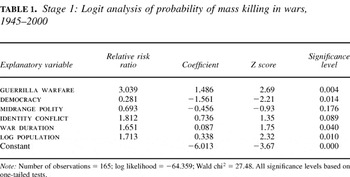
Stage 1: Logit analysis of probability of mass killing in wars, 1945–2000
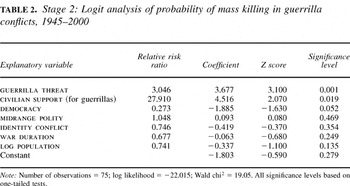
Stage 2: Logit analysis of probability of mass killing in guerrilla conflicts, 1945–2000
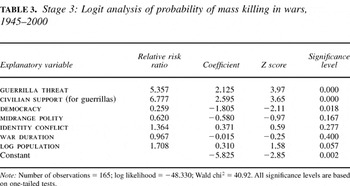
Stage 3: Logit analysis of probability of mass killing in wars, 1945–2000
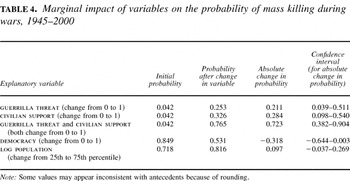
Marginal impact of variables on the probability of mass killing during wars, 1945–2000
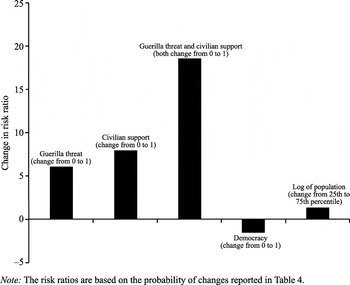
Changes in the risk of mass killing during wars, 1945–2000
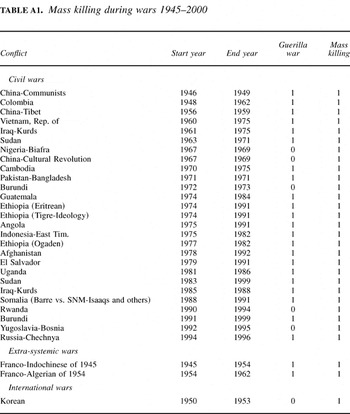
Mass killing during wars 1945–2000
 You have
Access
- 379
- Cited by