In recent years, we have witnessed a sharp increase in research dedicated to the storage and processing of so-called multiword units (MWUs). MWUs include idioms, collocations, phrasal verbs, binomials, lexical bundles, and so forth. Despite obvious similarities among MWUs, some important distinctions can be drawn between them as well. Idioms, for example, are often semantically opaque and noncompositional. As a result, they frequently need to be learned as whole units of meaning. Binomials (such as black and white or bride and groom), in contrast, are typically transparent in meaning but simply standardized in form. For their part, collocations often vary between patterns that are fully decomposable (e.g., pay the bills) and patterns that involve figurative interpretation of one of the component words (e.g., pay attention, in which pay is not used in its core sense).Footnote 1 One aspect of collocations that distinguishes them from many other MWUs, particularly idioms, is the fact that even when some degree of figurative interpretation is necessary, they seldom cause trouble for L2 learners from a comprehension perspective (e.g., Biskup, Reference Biskup, Arnaud and Bejoint1992; Henriksen, Reference Henriksen, Bardel, Lindqvist and Laufer2013; Henriksen & Stenius Staehr, 2009; Laufer & Waldman, Reference Laufer and Waldman2011; Nesselhauf, Reference Nesselhauf2005). That is, if the component words are known, the meaning of many collocations can be deduced, even without recognition of the collocation as a whole. This means that nonnative speakers (NNSs) can potentially rely solely on a “words and rules” (Pinker, Reference Pinker1999) approach to understanding collocations rather than recognize them as MWUs with a single meaning assigned to the collocation.
Indeed, it has been argued by some researchers, most notably Wray (Reference Wray2002, Reference Wray2008), that native speakers (NSs) and NNSs process such formulaic structures in fundamentally different ways, with NSs relying heavily on their knowledge of meaning assigned to larger chunks for both receptive and productive purposes, and NNSs relying heavily, or even exclusively, on words and rules. Wray (Reference Wray2002) gives the example of the expression major catastrophe, and suggests that NSs understand this as a single unit of meaning with no conscious recognition of the meaning of the component words:
The NS would simply know that the idiomatic way to talk about a big disaster (in a particular context) was to call it a major catastrophe. There would be no automatic assumptions about what else may be referred to as “major” because major would not have been singled out as a separate component of this string. There would not have been any cross-reference with any other strings containing major, or with the separate entry for major as a lexical item. (p. 209)
In contrast, Wray suggests that NNSs decompose major catastrophe, and other formulaic expressions, into individual words and process them through the semantic value of the component words.
The adult language learner, on encountering major catastrophe, would break it down into a word meaning “big” and a word meaning “disaster” and store the words separately, without any information about the fact that they went together. When the need arose in the future to express the idea again, they would have no memory of major catastrophe as the pairing originally encountered, and any pairing of words with the right meaning would seem equally plausible. (p. 209)
This view has come under criticism. Durrant and Schmitt (Reference Durrant and Schmitt2010), for example, found a learning effect for collocations presented in a training session, and concluded that it is ultimately a lack of exposure to L2 input that accounted for apparent differences in L2 collocational processing. Along these lines, Wolter and Gyllstad (Reference Wolter and Gyllstad2013) found that advanced L2 speakers of English showed sensitivity to frequency effects for L2 collocations in an online task, indicating that L2 learners can recognize longer recurrent patterns in the L2, and are sensitive to the distributional properties of these patterns. These findings were supported in a meta-analysis conducted by Durrant (Reference Durrant2014), who showed positive correlations between collocational frequencies and learner knowledge of collocations across a range of tests of collocational knowledge. Furthermore, González Fernández and Schmitt (2015) found that collocational frequency could be used to accurately predict acquisition of these collocations for learners at three levels of proficiency. Similar findings were reported by Siyanova-Chanturia, Conklin, and van Heuven (2011), who observed sensitivity to frequency effects for NSs and advanced NNSs, but not for intermediate NNSs, using an eye-tracking paradigm. These studies suggest that NNSs might be sensitive to frequency effects for longer stretches of language than single words, perhaps particularly as they gain in proficiency, which would conflict with Wray’s (2002, 2008) views reported in the preceding text.
In addition to frequency effects, there is also evidence to suggest that the L1 has a considerable influence on how NNSs produce and process collocations in the L2. This influence may partially offset the effects of frequency, and it sometimes marks L2 speakers’ collocation knowledge and use as distinct from L1 speakers. In terms of production, corpus-based studies have shown that learners differ from NSs considerably in terms of their use of collocations in the L2, with the L1 having a strong influence on their collocational choices (e.g., Altenberg & Granger, Reference Altenberg and Granger2001; Granger, Reference Granger and Cowie1998; Howarth, Reference Howarth1998; Nesselhauf, Reference Nesselhauf2003, Reference Nesselhauf, Allerton, Nesselhauf and Skandera2004). Other research has shown that the L1 influences receptive processing of L2 collocations as well. Specifically, studies investigating recognition of L2 collocations that have a congruent form in the L1 have found a processing advantage for these over incongruent collocations (i.e., collocations that are felicitous in the L2 but not the L1). In both Wolter and Gyllstad (Reference Wolter and Gyllstad2011, Reference Wolter and Gyllstad2013) and Yamashita and Jiang (Reference Yamashita and Jiang2010) it was reported that congruent collocations were processed significantly faster and more accurately than incongruent collocations.
Nonetheless, the underlying mechanisms for this processing advantage remain only partly understood. Wolter and Gyllstad (Reference Wolter and Gyllstad2011, Reference Wolter and Gyllstad2013) suggested that the apparent processing advantage for L1-based sequences might be due to automatic lexical priming from L2 words to their L1 equivalents (see also Carrol & Conklin, Reference Carrol and Conklin2014, Reference Carrol and Conklin2017; and Carrol, Conklin, & Gyllstad, Reference Carrol, Conklin and Gyllstad2016, for a discussion regarding L2 idiom processing). That is, when the L2 speaker encounters an L2 word, the word triggers the L1 translation equivalent(s). These activated L1 words, in turn, trigger known lexical sequences, including collocations, from the L1. Wolter and Gyllstad (Reference Wolter and Gyllstad2011, Reference Wolter and Gyllstad2013) also put forth an alternate explanation to supplement the idea of L1-based lexical priming. They suggested that collocations might be stored and processed as single units, and posited that these units might be copied directly from the L1 lexicon into the L2 lexicon (see Jiang, Reference Jiang2000). This copying, they argued, could account for the congruency advantage seen in the processing of congruent collocations. In short, the L1 provides the L2 speaker with ready-made collocations that can be slotted into the L2 lexicon.
Wolter and Yamashita (Reference Wolter and Yamashita2015) tested this explanation through a double lexical decision task (LDT). The task presented L1 speakers of Japanese with word-for-word English translations of Japanese collocations that were not felicitous in English (e.g., far eye, buy anger) alongside collocations that were felicitous in English but not Japanese (i.e., incongruent collocations), and baseline items containing pseudo-words. The results showed no priming effect for the translated collocations for the L1 Japanese speakers, regardless of whether they were of intermediate or advanced proficiency. Based on this, Wolter and Yamashita (Reference Wolter and Yamashita2015) concluded that collocations are likely not copied into the L2 lexicon as whole units, and instead suggested that the congruency effect might be better accounted for through age/order of acquisition effects (Carroll & White, Reference Carroll and White1973), combined with frequency of input effects (e.g., Wolter & Gyllstad, Reference Wolter and Gyllstad2013).
One potential limitation of the LDT used by Wolter and Yamashita (Reference Wolter and Yamashita2015), however, is how the L2 speakers may have attended to the letter strings. It has been shown that L2 speakers can process form without processing meaning on word recognition tasks (Miki, Reference Miki2010), which could potentially eliminate lexical activation for the L1-based sequences. Furthermore, it is likely that pseudo-word items, such as those used in Wolter and Yamashita (Reference Wolter and Yamashita2015), encourage an overt focus on form because the task demands only form-level identification with no consideration of meaning. It would seem, then, that a methodology that encourages participants to attend to meaning would be of use for helping us to gain better insights into the influence of L1-based sequences on L2 collocational processing. Furthermore, to the best of our knowledge, no studies have compared processing times for translated L1 items, congruent items, and incongruent items in the same study. This is unfortunate because it prohibits us from gaining a better understanding of how the L1 affects the processing of L2 collocations.
The first aim of this study, then, was to address some of these gaps in the existing research literature. Specifically, the current study modifies the study by Wolter and Yamashita (Reference Wolter and Yamashita2015) in two ways. First, it replaces the double LDT with an acceptability judgment task to encourage participants to attend to meaning and not just form. Second, it includes all three item types listed previously (i.e., congruent collocations, English-only collocations, and translated Japanese-only collocations) as well as baseline items. The second aim of this study was to more closely examine the influence of both word-level and collocation-level frequency for learners at different levels of proficiency to gain a better understanding of the influence of frequency of input on collocational processing in an L2, and whether it changes with improvements in proficiency. Specifically, the current study sought to test the following hypotheses.
1. L2 speakers will not process translated (but infelicitous) L1 collocations that they view as acceptable more rapidly than matched baseline items. This hypothesis is based largely on the results of Wolter and Yamashita (Reference Wolter and Yamashita2015). The results will be used to gain further insights into accounts of the congruency effect in processing L2 collocations.
2. L2 speakers will process congruent collocations more rapidly than incongruent collocations, which will in turn be processed more rapidly than matched baseline items. This hypothesis is based on the results of previous studies, including Wolter and Gyllstad (Reference Wolter and Gyllstad2011, Reference Wolter and Gyllstad2013) and Yamashita and Jiang (Reference Yamashita and Jiang2010). The results will be used to further validate the congruency effect for L2 collocational processing.
3. Advanced NSs and advanced L2 speakers will show sensitivity to L2 collocational frequency, while intermediate L2 speakers will not. This hypothesis is based on the results of Wolter and Gyllstad (Reference Wolter and Gyllstad2013), and Siyanova-Chanturia et al. (Reference Siyanova-Chanturia, Conklin and Heuven2011). The results will be used to assess Wray’s (2002, 2008) claims regarding NS and NNS processing of MWUs (including collocations).
METHOD
PARTICIPANTS
The participants were one group of English NSs and two groups of English NNSs. The NS group consisted of 24 undergraduate students, 2 graduate students, and 1 nondegree-seeking postbaccalaureate student, all from a university in North America. None of these participants reported anything more than a rudimentary knowledge of Japanese. The first group of NNSs was comprised of 24 graduate students (an advanced group, hereafter HNNS group for a higher-proficiency NNS group) and the other group 23 undergraduate students (an intermediate group, hereafter a LNNS proficiency group for lower NNS group). The NNSs were NSs of Japanese studying at a university in Japan. All participants answered a questionnaire that included questions about age, vision, and dexterity. None of them reported problems in their natural/corrected vision. The NNSs were additionally asked to provide information about their English learning background and their self-reported proficiency in English. Table 1 summarizes the participants’ background information.
Biographical data for participants (standard deviation in parentheses)

Note: LOS = Length of studying English through formal education; LOR = length of residence in English-speaking countries (periods shorter than one month being counted as none); EVST = Eurocentres Vocabulary Size Test.
a 1 = none, 10 = nativelike.
b Excluding one participant who did not indicate sex.
Among the NNS groups, there was no significant difference in the mean starting age of English learning between the HNNS (10.0 years old) and the LNNS (11.5 years old) groups (t (38) = -1.81, p = .08, d = 0.53). The HNNS group had studied English for a longer period (12.1 vs. 7.2 years: t (26) = 7.09, p < .001, d = 2.07). Fifteen students in the HNNS group had lived in English-speaking countries for longer than one month, whereas none in the LNNS group had such an experience. To further verify differences in proficiency, the average vocabulary size of each group was estimated by Eurocentres Vocabulary Size Test (EVST; Meara & Jones, Reference Meara and Jones1990). The results indicated that on average the HNNS group had a significantly larger vocabulary size than the LNNS group (5607 vs. 4431, t (45) = 3.33, p = .002, d = 0.97).
ITEM DEVELOPMENT
Because this study used L1 Japanese participants, all items were developed with L1 Japanese speakers in mind. The items were of four types: (1) congruent collocations (JE, e.g., deep love, strong wind), (2) English-only (incongruent) collocations (E-only, e.g., busy road, low speed), (3) Japanese-only (translated) collocations (J-only, e.g., straight thought, tall danger), and (4) baseline items. The E-only and J-only collocations were selected from the items that were used in Wolter and Yamashita (Reference Wolter and Yamashita2015). The JE items were developed for use in this study in the same way as the items in the J-only and E-only conditions. Namely, the initial list of potential items was developed by the second author (an NS of Japanese with high command of English) using only high-frequency words to ensure that the participants knew the words.Footnote 2 Each individual item was checked against a large corpus to ensure the suitability for the JE category (see the following text). The baseline items were created by recombining the words from the other three conditions. This was done to avoid the difference in lexical frequency of individual words between the baseline items and the other items (see Wolter & Yamashita, Reference Wolter and Yamashita2015).
It should be noted that the baseline items were different than the other items, including the J-only items, in the sense that they were less semantically meaningful than the other items. This, in turn, could have affected how these items were processed, and consequently the response times (RTs). Nonetheless, the baseline items were necessary to establish a threshold RT that could be used for purposes of judging the relative speed of processing for the J-only items, especially in respect to the NNS groups. This allowed us to more closely examine the potential influence of the L1 on L2 collocational processing. In total, there were 144 items: 24 in each of JE, E-only, and J-only conditions, and 72 baseline items. All items were adjective-noun pairings.
All items were checked against the Corpus of Contemporary American English (COCA; Davies, Reference Davies2008) to make sure the classifications were appropriate. Theoretically, E-only and JE collocations are supposed to occur frequently in the corpus, while J-only and baseline items should not be found. In the case of the former two types, it was indeed the case. However, given the tremendous size of the COCA, some J-only and baseline items did register a small number of occurrences. However, for all such items, mutual information (MI) scores were either small (< 1.00) or negative (which indicates that the two words are dissociated rather than associated and that the expressions were idiosyncratic rather than significant co-occurrences in English). Thus, the information from the COCA suggested that the classification of the items was appropriate for the purposes of the study.
Lexical frequencies, collocation frequencies, and MI scores were obtained for the items from the COCA.Footnote 3 MI scores were included as an extra level of analysis because these scores consider the frequency of the words that comprise the collocations rather than the frequency for the entire collocation. As a result, MI scores served as more of a measure of strength of association between the two words comprising the collocations. Furthermore, MI scores is one of two measures available in the COCA (the other being frequency). For example, the COCA reports approximately the same overall frequencies for the collocations brief moment (594 occurrences) and broad daylight (553 occurrences). However, the MI score for brief moment (6.87) is considerably lower than that of broad daylight (11.36) when COCA’s search span is set at 0:1, due to the comparatively low frequency for the word daylight.
For this study, we used nonlemmatized frequency counts at both the lexical level and collocation level. Although arguments have been put forth favoring either the use of lemmatized over nonlemmatized forms or vice versa (see, e.g., Sinclair, Reference Sinclair1991), Durrant (Reference Durrant2014) found “no clear differences” between the two forms and learner knowledge of collocations (p. 465) based on his meta-analysis of collocational testing research. Lexical frequencies and collocational frequencies were from the fiction subsection of the COCA. The decision to use values from this section was based on Durrant’s (2014) finding that this subcorpus most reliably predicted collocational knowledge for NNSs.
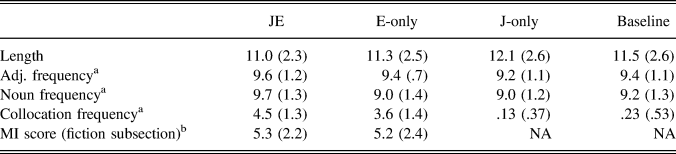
All word frequencies and collocational frequencies were log transformed using natural logs.Footnote 4 There were no significant differences across the four conditions for item length (i.e., the total number of letters for each item) F(3, 140) = .75, p = .53, η2 = .02. As for adjective frequencies, there was no significant difference F (3, 140) = .70, p = .55, η2 = .01. This was true of noun frequencies as well F(3, 140) = 1.38, p = .25, η2 = .03. However, there was a significant difference between collocational frequencies from the JE and E-only subcorpus t (45.6) = 2.22, p = .03, d = .64, but not the MI scores t (45.7) = .04, p = .97, d = .01. The difference between frequency counts could have proven problematic if the comparatively higher frequencies for the JE items, rather than their status as congruent collocations, had affected the results. However, as can be seen in the following text, the NS group demonstrated almost no difference in RTs between the JE and E items while the NNS groups did. Therefore, we feel the results can be attributed to the difference in congruency for the two NNS groups rather than frequency effects. A complete description of the items is provided in Table 2. The items are shown in Appendix A.
Summary of test items means (with log transformed frequencies and standard deviations in parentheses).

a One was added to each raw frequency score before calculating the natural logs. This was done because many of the J-only and baseline collocations had raw frequency values of zero (the log of which is undefined).
b MI scores were not calculated for these J-only and baseline items due to uncertainty about how to report missing MI scores. That is, while frequency has a minimum value of zero, MI scores can be either positive or negative depending on the likelihood of co-occurrence. However, when no instances of co-occurrence are reported, the corpus interface generates no MI output. Although in theory we could have added one to all the frequency values and calculated MI scores manually, this would have proven problematic because collocations with starting frequencies of zero and low word frequencies would have generated high MI scores, while those with starting collocational frequencies of zero and high word frequencies would have generated low MI scores.
PROCEDURE
The test was administered using DMDX software developed at Monash University and at the University of Arizona by K. I. Forster and J. C. Forster. All items were presented on a computer screen in an individually determined, randomized order. To improve the likelihood that participants would attend to meaning and not just form, we opted for the acceptability judgment task that asked participants to determine whether the word combinations were commonly used in English rather than simply asking if the letter string was a word as was done in Wolter and Yamashita (Reference Wolter and Yamashita2015). Test takers were instructed to press one key (the right ctrl key) if they felt “the word combinations [were] commonly used in English” and another key (the left ctrl key) if they felt “the word combinations [were] NOT commonly used in English.” No other instructions were given in respect to the items. Although this procedure could not ensure attention to meaning over form, we felt it considerably improved the likelihood of attention to meaning because participants would presumably have to read and process each item before reaching their decisions regarding commonality.
The test began with a practice session followed by a main session. A self-timed break was provided both after the practice session and in the middle of the main session. The test was administered in the following procedure. First, a fixation target (a series of 12 asterisks) was presented in the middle of the screen. This was followed by a blank screen presented for about 66 milliseconds, which was followed by an item. The item remained on the screen until either a response was made or the item timed out at 4,000 milliseconds. RTs (in milliseconds) and response patterns (i.e., a “yes” or “no” response to each item) were logged. Generally, it took less than 10 minutes for participants to finish the test.
RESULTS
Because our main concern was how participants processed items they viewed as acceptable, we assessed RTs to items that received a “yes” response, regardless of whether this was the expected response. This could have potentially proven problematic if very few of the translated collocations or baseline items were judged as acceptable, but this was not the case. The NSs judged 39% of the translated collocations to be acceptable in English, which was similar to the values for the HNNS group (44%) and the LNNS group (51%). For the baseline items, the figures were 24% for the NSs, 20% for the HNNSs, and 32% for the LNNSs. As for the congruent items, the acceptability rates were 95% for NSs, 87% for HNNSs, and 86% for LNNSs. For the incongruent (i.e., English-only) items, the results were as follows: 92% for NNSs, 58% for HNNSs, and 55% for LNNSs.
There are a couple of explanations to account for the fact that several baseline items were judged as correct by all three groups. One is that the corpus data do not fully represent the experience of the participants and that individual variation may have led some participants to accept items based on their own language experiences, as discussed in the preceding text (see also, e.g., Gablasova, Brezina, & McEnery, Reference Gablasova, Brezina and McEnery2017). Another possibility is that many participants did not rely solely on familiarity, but also on plausibility. That is, participants may have judged some items as common and acceptable based not solely on experience, but rather on the meaning that the individual words contributed to the item. Indeed, it is not hard to see how some items that were either rare or unattested in the corpus might be judged as legitimate combinations, such as hard injury or good moment. This suggests, in line with common sense, that many participants likely employed a combination of experience and real-time processing when judging items.
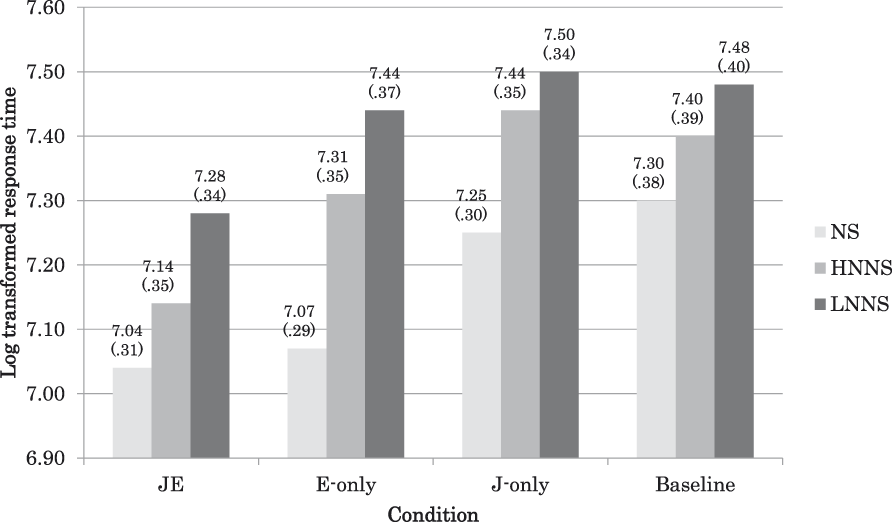
Based on suggestions by Ulrich and Miller (Reference Ulrich and Miller1994), data were minimally trimmed. The only responses that were excluded were four responses that were faster than 450 milliseconds. The remaining RTs were log transformed to control for skewing. In addition, the model selection process (see the following text) introduced quadratic terms for each continuous predictor variable to control for any remaining nonlinearity in the RT data. A summary of the RT results is shown in Figure 1.
Mean log transformed response times in milliseconds and standard deviations (parentheses).

The data were analyzed using linear mixed-effects modeling employing the lme4 (Bates, Maechler, Bolker, & Walker, Reference Bates, Maechler, Bolker and Walker2015) and lmerTest (Kuznetsova, Brockhoff, & Christensen, Reference Kuznetsova, Brockhoff and Christensen2015) packages in the R statistical software platform (R Core Team, 2016). Mixed-effects models allow for the inclusion of both random and fixed effects. In this study, item and participant were entered as crossed random effects while all other variables were entered as fixed effects. The model fitting procedure started a maximal model that included (1) log transformed RT as the outcome variable, (2) all potential predictor variables as main effects, (3) all possible second-order interactions, and (4) all possible quadratic terms. The predictor variables included group (NS, HNNS, LNNS), item type (JE, E-only, J-only, baseline), lexical frequency for adjectives, lexical frequency for the nouns (both log transformed using data from the COCA), frequency of collocations (also log transformed using data from the COCA), item length (number of letters), trial (i.e., the order in which the participant saw an item), first versus second occurrence of the adjective (i.e., whether a participant was seeing a word for the first or second time owing to the fact that the baseline items consisted of random recombinations), and first versus second occurrence of the noun. All continuous variables were centered and standardized prior to the analyses. First versus second occurrence was treated as categorical. To ensure there were no problems with multicollinearity among the predictor variables, variance information factor values were calculated using the usdm package in R (Naimi, Reference Naimi2015). This indicated no issues, so all predictor variables were retained.Footnote 5
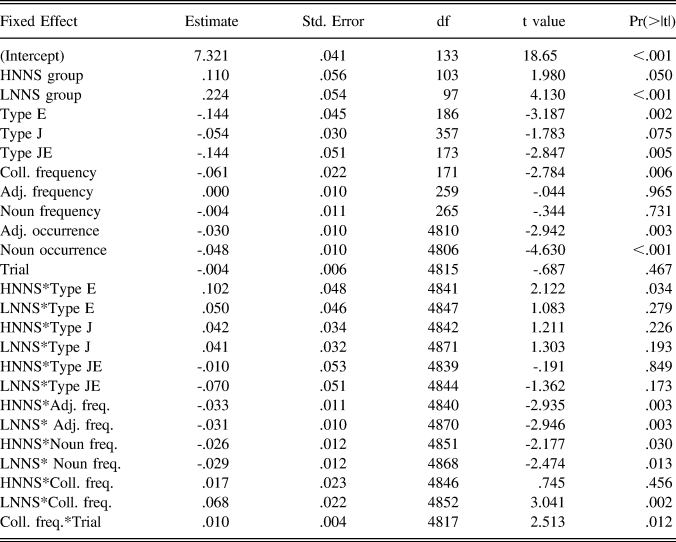
After fitting the maximal model, we next conducted a backward stepwise regression analysis to identify the most plausible model. The stepwise procedure used Akaike information criterion (AIC) values to identify the most plausible model (i.e., the most parsimonious model). No distinctions were made between main effects, second-order interactions, or quadratic terms in the stepwise procedure. The procedure simply involved eliminating, one by one, the predictor variable that had the least impact on the AIC values until only variables that significantly improved the fit were included. After this, we visually inspected a quantile-quantile plot of the model’s residuals that confirmed normal distribution. The results for the identified model are shown in Table 3. Effect sizes for this model were calculated using the MuMIn package in R (Barton, Reference Barton2016). This procedure generates R 2 values for the fitted mixed model in two forms: marginal and conditional. Marginal R 2 values are associated with only the fixed effects while conditional R 2 values reflect both the fixed and the random effects combined. As can be seen, the final model included group, item type, collocational frequency, adjective frequency, noun frequency, occurrence of the adjective, occurrence of the noun, and trial as main effects. Group by type, group by adjective frequency, group by noun frequency, group by collocational frequency, and collocational frequency by trial were included as interactions.Footnote 6 As can also be seen, the NS group had significantly faster RTs on average than both NNS groups. Further analysis, which involved refitting the model using the LNNS group as the reference group, indicated that there was also significant difference in overall RTs between the two NNS groups t (101) = 2.0, p = .048.
Results of mixed model comparing all three groups for JE, J-only, E-only, and baseline items (NS group, baseline items, and first occurrence of words as reference categories).

R 2 marginal =.20, R 2 conditional = .44
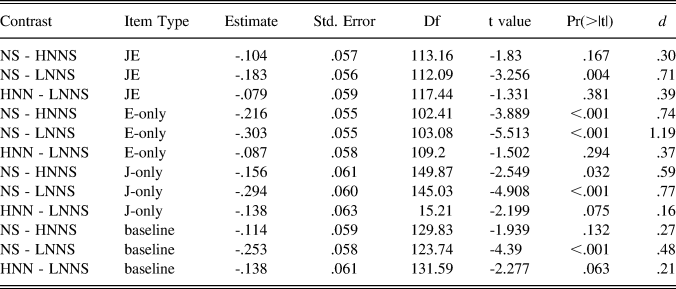
To gain a clearer understanding of the results, as well as to more adequately address our hypotheses, we ran a series of post-hoc tests using least squares means calculated using the lsmeans package in R (Lenth, 2016), with Tukey adjustments for multiple comparisons. The first post-hoc test investigated the interaction between group and item type. The results (Table 4) indicated that NSs responded significantly faster to all four item types than did the intermediate NNSs, and significantly faster than the advanced NNSs for the E-only and J-only items, but not the JE items or the baseline items. As for the two NNS groups, there were no significant differences in RTs for any item types.
Results of post-hoc, between-group tests of RTs for JE, E-only, J-only, and baseline items.

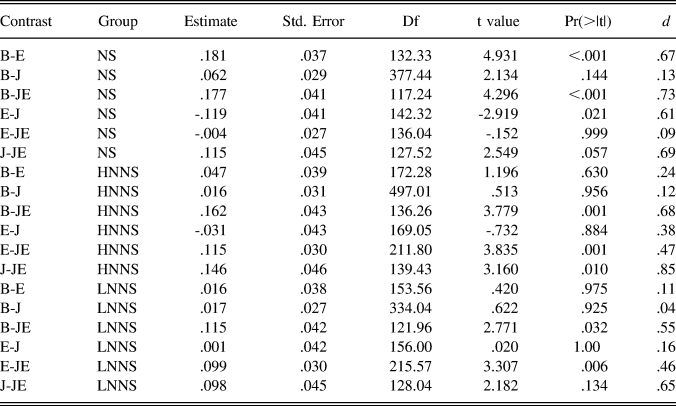
More germane to the main aims of this study, particularly hypotheses 1 and 2, were the within group comparisons. To recap, hypothesis 1 stated that L2 speakers would not process translated (but infelicitous) L1 collocations that they view as acceptable more rapidly than matched baseline items. Hypothesis 2 stated that L2 speakers would process congruent collocations more rapidly than incongruent collocations, and incongruent collocations more rapidly than matched baseline items. The results of this test are shown in Table 5. As expected, there were no significant differences in RTs for either NNS group when comparing the J-only items with the baseline items, suggesting no clear processing advantage (or disadvantage) for translated Japanese collocations. As for the JE and E-only items, both NNS groups responded significantly faster to the JE items, once again indicating a processing advantage for congruent over incongruent L2 collocations. Crucially, the same result was not shown in the NS data; the NSs demonstrated almost no difference in RTs for these two item types.
Results of post-hoc, within-group tests of RTs for JE, E-only, J-only, and baseline (B) items.

The third hypothesis stated that NSs and HNNSs would show sensitivity to collocational frequency, but LNNSs would not. The results of the interactions (Table 3) largely confirmed this hypothesis. The NS and HNNS groups showed a significant difference from the LNNS group in respect to the degree to which collocation-level frequency affected RTs, yet no significant difference was detected between the NS group and the HNNS group. Furthermore, releveling the data to directly compare the two NNS groups indicated that there was also a significant difference between the HNNS group and the LNNS group t (4775) = 2.07, p = .038. Nonetheless, it would be erroneous based solely on these results to conclude that the LNNS did not attend to collocational frequency at all. Rather, as was confirmed by a visual inspection of regression lines, changes in collocation-level frequency simply had a more pronounced effect on RTs for NS and HNNS RTs than for LNNS.
Furthermore, it would be erroneous to conclude that the HNNSs attended to all frequency information in the items in the same way as NSs. In particular, the NSs interactions were significantly different from both NNS groups in respect to adjective and noun frequency (Table 3). Furthermore, there were no significant differences (as revealed through releveling) between the two NNS groups in respect to adjective frequency t (4820) = .17, p = .0.862 and noun frequency t (4830) = .24, p = .807 interactions. A visual inspection of regression lines indicated that changes in word-level frequency had a more pronounced effect on NNS RTs than NS RTs for both word classes. This suggests more attention to word-level frequency for the NNSs than the NSs, even if the HNNSs seemed to also attend to collocation-level frequency in a similar manner as the NSs.
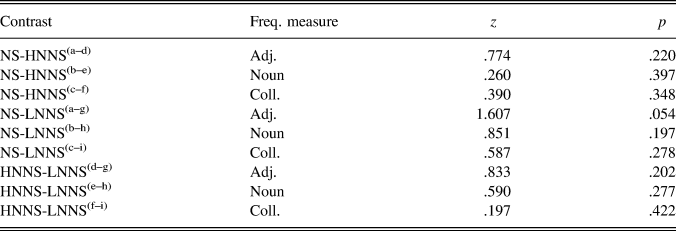
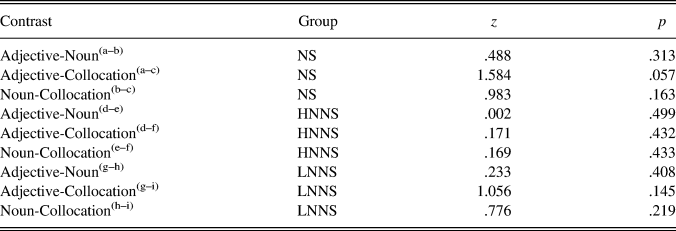
The results of the mixed-effects model allowed us to gauge differences in regression line slopes when comparing RTs with the various frequency measures. However, these results provide no indication regarding potentially important differences related to strength of association between the various frequency measures and the RTs for each group. Because such associative comparisons were not obtainable through the mixed-effects model, we decided to calculate correlation coefficients for RTs and the three frequency measures for each of the three groups. These correlations were determined using items, rather than participants, as units of analysis because RTs and frequency comparisons were not possible using participants as the unit of analysis. An average RT was calculated for each item from all participants within the groups for the JE and E-only items. J-only and baseline items were excluded from this analysis because most of these items had identical frequency values for the collocations (because they were not attested in the COCA), which would have led to several items with identical frequency values near zero. The correlations coefficients are shown in Table 6. As can be seen, there was a tendency for correlations to decrease with the adjective and noun frequencies and increase with the collocational frequencies gradually from LNNS to HNNS and finally to NS. To determine if there were any significant differences between the correlations, the coefficients were transformed to z scores using Fischer’s r to z transformation and compared using a Bonferroni adjustment to account for multiple comparisons (meaning the alpha level was set at .017 instead of .05). Comparisons were made both across (Table 7) and within (Table 8) the groups. As can be seen in Table 7, no significant differences were detected across the groups for any of the three correlations (i.e., the RT-adjective frequency correlations, the RT-noun frequency correlations, and the RT-collocational frequency correlations). Similarly, as shown in Table 8, no significant differences were detected within the groups for any of the correlations comparisons.
Correlations between RTs and frequency measures for NS group, HNNS group, and LNNS group.

Between group correlations comparing correlation coefficients for RTs and frequency measures for NS group, HNNS group, and LNNS group.

Within group correlations comparing correlation coefficients for RTs and frequency measures for NS group, HNNS group, and LNNS group.

DISCUSSION
INFLUENCE OF THE L1 ON L2 COLLOCATIONAL PROCESSING
As expected, congruent collocations were processed significantly faster than incongruent collocations for both NNS groups, while the NSs processed them at almost the same speed. This indicates that there was a processing advantage for congruent collocations over incongruent collocations for L2 learners. Similar results have been reported in other studies using different methodologies and different learners. Wolter and Gyllstad, using L1 Swedish learners, found a congruency advantage using both a primed LDT (2011) and an acceptability judgment task (2013). Additionally, Wolter and Gyllstad (2011, Reference Wolter and Gyllstad2013) reported significantly higher error rates for NNSs for incongruent collocations compared to congruent collocations in both studies. Yamashita and Jiang (Reference Yamashita and Jiang2010) also used an acceptability judgment task comparing two groups of L1 Japanese speakers (differing in terms of proficiency) and found that both groups produced significantly more errors for incongruent items over congruent items. In contrast, however, they reported that only the lower proficiency group showed significantly slower RTs to incongruent items; the higher-proficiency group’s RTs were nearly the same for both item types. This led Yamashita and Jiang to conclude that although incongruent collocations may be harder to acquire initially, they are processed separately from the L1 once they are acquired.
Reconciling the differences in results between Yamashita and Jiang and the current study is not straightforward, particularly because Yamashita and Jiang and the current study used a similar task with similar groups of learners with the same L1. One possibility, however, is related to the fact that the items were arguably not as carefully controlled in Yamashita and Jiang, particularly in respect to the repetition of individual words. Whereas the current study used each word once in a collocation and once in a baseline item, the distribution was much less structured in Yamashita and Jiang. Many words appeared twice and some appeared three times. The noun tea, for example, appears once in a congruent item (cold tea) and twice in incongruent items (make tea and weak tea). A similar pattern can be seen for the noun salary, which appears twice in congruent items (pay a salary and high salary), and once in an incongruent item (large salary). In fact, by our calculations a total of 39 of the 48 test items contained repeated words. Given the fact that the current study demonstrated a significant effect for noun occurrence for both NNS groups, it is possible that this factor influenced the results reported in Yamashita and Jiang, which caused them to not align with the other studies that have investigated congruency and incongruency in collocations, including the present one.
With this in mind, and given the similar findings reported in two studies by Wolter and Gyllstad (Reference Wolter and Gyllstad2011, Reference Wolter and Gyllstad2013), it seems prudent to assume that congruency does lead to accelerated processing of L2 collocations. The question that arises here is why this should be the case. At the moment, there are three main explanations that have been put forth. One, suggested by Wolter and Gyllstad (Reference Wolter and Gyllstad2011) is that collocational information is “copied” directly from the L1 into the lexical entries for the L2, and this, in turn accelerates processing of congruent L2 collocations. For example, an L2 learner of English would, upon learning an English word, copy into their lexical entry not only semantic and syntactic information from their corresponding L1 entry at the lemma level (see Jiang, Reference Jiang2000), but also L1 collocates for that word. This would lead to accelerated recognition of the last word in a collocation through priming patterns presumably borrowed from the L1. A second explanation, put forth both by Carrol and Conklin (Reference Carrol and Conklin2017, in respect to idioms) and Wolter and Gyllstad (Reference Wolter and Gyllstad2011) is the automatic L2-L1 priming described in the preceding text. Under this explanation, the L2 word automatically primes its L1 translation equivalent. The L1 word, in turn, primes its L1 collocates, which leads to more rapid recognition of the congruent collocation in the L2. However, neither of these explanations by themselves has received much in the way of empirical support. In both Wolter and Yamashita (Reference Wolter and Yamashita2015) and the current study, there was no significant processing advantage seen for translated collocations. This suggests that there is likely not direct copying or automatic priming and parallel activation of L1 and L2 collocations that gives congruent collocations their processing advantage.
The third explanation comes from the idea that the age or order in which something is learned has a profound effect on how deeply it becomes entrenched in the language system, particularly once the language system begins to stabilize. This phenomenon is known as the age of acquisition/order of acquisition (AoA/OoA) effect, and it has been applied not only to language but also other types of learning that occur cumulatively and over a long period of time. From a theoretical perspective, Izura et al. (Reference Izura, Pérez, Agallou, Wright, Marín and Stadthagen-González2011) examined plausible theoretical accounts for AoA/OoA, and ultimately concluded that the so-called mapping hypothesis provided the best account. The mapping hypothesis (Ellis & Lambon Ralph, 2000; Lambon Ralph & Ehsan, 2006; Monaghan & Ellis, Reference Monaghan and Ellis2002) is based on connectionist models of learning and draws largely on simulations using artificial neural networks. In simulations conducted by Ellis and Lambon Ralph (2000), it was found that sets of items that were learned earlier retained their supremacy in the network even when additional sets of items were introduced later. However, this supremacy was contingent upon continued training with the early sets in the network. When training was halted for the early sets upon presentation of later sets, the early sets were forgotten and ultimately replaced by later sets, a phenomenon known as “catastrophic interference” (Lewandowsky, Reference Lewandowsky, Hockley and Lewandowsky1991; McCloskey & Cohen, Reference McCloskey, Cohen and Bower1989; Sharkey & Sharkey, Reference Sharkey and Sharkey1995).
This account of learning seems capable of explaining the discrepancies found in respect to L2 processing of congruent and incongruent L2 collocations, as well as the lack of accelerated processing observed for the translated L1 collocations observed in this study and in Wolter and Yamashita (Reference Wolter and Yamashita2015). It seems possible that at the outset of learning, the L2 learner has available to them all the collocational knowledge from their L1. This includes not only congruent collocations, but also L1 collocations that are nontransferable to the L2 (like the J-only collocations in the present study). As the learner gains experience in the L2, the transferred congruent collocations become reinforced and further entrenched through repeated exposure in the L2, while the nontransferable collocations become a less prominent part of the network due to lack of reinforcement until they reach a point where they, ideally, are no longer part of the active network of L2 collocational associations. That is, although they may still be judged as acceptable in the L2, they are not readily activated as part of the network of collocational associations. At the same time, the learner will no doubt be exposed to incongruent L2 collocations (i.e., those that are acceptable in the L2 but not the L1), but these will not displace the supremacy displayed by congruent collocations, perhaps unless there is vastly disproportionate exposure in favor of certain incongruent collocations (i.e., a high-frequency incongruent collocations gaining supremacy over a low-frequency congruent collocation).Footnote 7
Not only does this explanation have solid empirical and theoretical backing, it seems capable of accounting for a wide range of empirical results found thus far in respect to L2 collocational processing. To begin with, it explains why the congruency effect has been demonstrated so consistently in studies using L2 learners with different L1s. At the same time, it accounts for the comparative “lag” demonstrated for incongruent collocations, even among highly advanced learners (e.g., Wolter & Gyllstad, Reference Wolter and Gyllstad2011, Reference Wolter and Gyllstad2013). Additionally, and crucially for the current study, it explains why nontransferable collocations (e.g., the Japanese-only L1 collocations in this study) have not shown a processing advantage over baseline items, regardless of whether the task is a LDT (Wolter & Yamashita, Reference Wolter and Yamashita2015), or a commonality judgment task, as was the case in this study. Finally, it explains results obtained in Wolter and Gyllstad (Reference Wolter and Gyllstad2013), who noted that congruency effects could be partially offset by frequency, with high-frequency incongruent collocations being judged as acceptable more quickly than low-frequency congruent collocations.
Nonetheless, this explanation needs to be tempered by the phenomenon of fossilization in L2 learning (Selinker, Reference Selinker1972). More specifically, this explanation cannot account for fossilization as we would expect L1-based errors to be forgotten as well. As is well established, fossilization can occur across many types of linguistic structures and despite what should, presumably, be sufficient language input in the L2 to destabilize a fossilized structure. This clearly occurs with L2 collocations as well, as is evidenced in several corpus-based studies evaluating the collocational output of L2 learners (see, e.g., Altenberg & Granger, Reference Altenberg and Granger2001; Granger, Reference Granger and Cowie1998; Howarth, Reference Howarth1998; Nesselhauf, Reference Nesselhauf2003, Reference Nesselhauf, Allerton, Nesselhauf and Skandera2004). Therefore, to reach a fuller understanding of how the network of collocational structures develops in L2 learners, it will ultimately be necessary to try to gain a better understanding of the processes that lead learners to retain and deploy nonnativelike, L1-based collocations as well as the processes that allow them to abandon such collocations in favor of those that are more nativelike. Additionally, it will be necessary to understand the interface between input and output for collocations, particularly because it has been argued that even unfamiliar collocations seldom cause receptive problems for learners given that learners can typically decipher them through the aforementioned words and rules approach.
WORD FREQUENCY AND COLLOCATIONAL FREQUENCY IN L1 AND L2 SPEAKERS
In addition to congruency, the current study also investigated whether there would be differences among the three groups in respect to collocational frequency. In line with our hypothesis, the results of the mixed model indicated that the NSs and HNNSs attended to more to collocational frequency than did the LNNSs. This is not to say, however, that the LNNSs did not attend to collocational frequency. The key difference seems to be in respect to the extent to which the different groups attended to collocational frequency versus word-level frequency. In brief, there seems to be a shift away from reliance on word-level frequency to collocational frequency that occurred with gains in proficiency.
In this respect, the results of the present study and the study by Siyanova-Chanturia et al. (Reference Siyanova-Chanturia, Conklin and Heuven2011) (as well as the other studies mentioned in the preceding text) add to the growing body of research indicating that NNSs, like NSs, attend to frequency distributions for common MWUs in the target language. Both the results of the mixed-effects model and the correlations indicate that RTs became faster for all participants as collocational frequency increased. Furthermore, it is noteworthy that all three groups, including the NS group, appeared to attend to word-level frequency and collocational frequency simultaneously. These findings (i.e., the NNSs attending to collocational frequency and the NSs attending to word-level frequency) conflict with Wray’s (2002, 2008) claims that NSs and NNSs process MWUs, including collocations, in fundamentally different ways. Instead, the results indicate a more unified approach in which all language users, or at least those at or higher than intermediate proficiency, attend to frequency information at multiple levels of representation. This view is in line with many findings from L1-based psycholinguistic and neurolinguistic research reported in Siyanova-Chanturia (Reference Siyanova-Chanturia2015). These studies have consistently shown that even when there is a processing advantage for frequent formulaic sequences as a whole, frequency effects for the individual words comprising these phrases remain intact, regardless of whether the phrases are idioms (Cutting & Bock Reference Cutting and Bock1997; Konopka & Bock, Reference Konopka and Bock2009; Peterson, Burgess, Dell, & Eberhard, Reference Peterson, Burgess, Dell and Eberhard2001; Snider & Arnon, Reference Snider, Arnon, Gries and Divjak2012; Sprenger, Levelt, & Kempen, Reference Sprenger, Levelt and Kempen2006), complex prepositions (Molinaro, Canal, Vespignani, Pesciarelli, & Cacciari Reference Molinaro, Canal, Vespignani, Pesciarelli and Cacciari2013), or lexical bundles (Tremblay & Baayen, Reference Tremblay, Baayen and Wood2010).
It would seem, then, that the main difference between NSs and NNSs, at least in this study, was not in respect to their tendency to attend to frequency effects in categorically different ways. Rather, the difference seems to be in respect to the degree to which attention was focused on the entire collocations versus the component words. The mixed-effects model demonstrates a progression toward nativelike processing for collocational frequencies with advances in proficiency. However, the advanced group in this study still seemed to rely more heavily on word-level frequency than did the NS group. Furthermore, although the lack of significance in comparisons for the correlations across the groups mandates a cautious approach in interpreting the results, the consistency of the pattern for the component adjectives and nouns as well as the collocations across the three groups is uniform and points to a progression from less reliance on word-level frequency to more reliance on collocation-level frequency with gains in proficiency. To be specific, the LNNS’s correlations indicated that they relied more on word-level frequency than collocation-level frequency, followed by the HNNSs, who appeared to rely almost equally on word-level and collocation-level frequency. Finally, the NSs appeared to rely more heavily on collocation-level frequency than word-level frequency, but still showed attention to word-level frequency. Again, this appears to point to processing systems that are similar in their tendency to attend simultaneously to frequency effects at different grain sizes, but with variations in their level of focus. Furthermore, the NNSs appear to be trending toward a system that is more similar to that of NSs, as evidenced in the difference between the two NNS groups.
More generally, the results suggest that emergentist approaches (see, e.g., Bybee, Reference Bybee2007; Goldberg, Reference Goldberg2006; MacWhinney, Reference MacWhinney, Barlow and Kemmer2000; Tomasello, Reference Tomasello2000, Reference Tomasello2003) to understanding language learning and representation, which place frequency of input and probability at their core, should be considered more earnestly in respect to L2 collocational acquisition and processing (and indeed other types of L2 acquisition and processing). In brief, the cumulative experience one has with a target language appears to have an impact on both L1 and L2 speakers. It would seem, then, that what is needed for understanding L2 acquisition, including but beyond collocational acquisition, is an approach that attempts to better understand the potential interface between one’s experience with the L2 and existing L1 knowledge, as previously called for by Ellis (Reference Ellis2002a, Reference Ellis2002b). Our results suggest that both factors affect processing. Therefore, an approach that considers both frequency and L1 similarity might allow us to gain a more comprehensive and accurate picture of L2 acquisition. One possible scenario that we would like to offer, based both on the results of the current study and the results of Wolter and Gyllstad (Reference Wolter and Gyllstad2013), is that congruency allows L2 learners to make more efficient, or perhaps more immediate, use of input in the L2. Incongruency, by contrast, either lessens or delays the effects of frequency in input, thus leading to a processing lag for incongruent patterns when compared to congruent patterns of approximately equal frequency. This would seem to explain the differences reported here (and elsewhere) regarding the processing advantage for congruent patterns, but it still does not exclude situations in which higher-frequency incongruent patterns come to be more readily activated than less frequent congruent ones. However, more research is needed to determine if this is indeed the case.
In conclusion, this study set out to investigate the effects of frequency, congruency, and proficiency on collocational processing. The results suggest that both frequency and congruency affect processing. As for proficiency, it is notable that the two NNS groups behaved similarly in respect to the congruent and incongruent collocations. The main potential difference seemed to be in respect to how their attention is directed to word-level versus collocation-level frequency. In the future, it would be worth more closely investigating the frequency tendencies observed in this study for collocations to see if they can be replicated with other multiword units as well. Furthermore, it would be worth more closely investigating the mechanisms underpinning the apparent interface between frequency and congruency to get a better understanding of how these two aspects affect collocational acquisition, representation, and processing.
APPENDIX A
LIST OF ITEMS USED ON ACCEPTABILITY JUDGMENT TASK