Early film theory sought to attain critical and philosophical acceptance of the new medium by theorizing its essential distinctions from theatre. As the commercial balance of power has shifted, live theatrical performance is now often theorized according to its essential distinctions from film. One clear consequence of these formulations is a denigration of ‘filmed theatre’ as inferior, immature cinematic technique, on the one hand, and as equally inferior, mediatized dilution of the live performance experience on the other. Building on work revaluing theatricality in early Chinese cinema, this article analyses representative adaptations of stage xiqu for moving-image media (including film, television and marketed video recordings) and argues that the hybrid form of ‘filmed theatre’ continues as a viable and valued stream of access to xiqu performance in contemporary China.
Xiqu, China's pre-eminent indigenous performance structure, is a highly stylized synthesis of music, speech, dance-acting and acrobatics. Xiqu is an umbrella term that encompasses several hundred local regional forms as well as kunqu and jingju, forms that achieved national prominence in the Ming and Qing dynasties respectively.Footnote 1 The traditional repertoire drew heavily on well-known legends and novels, while important twentieth-century innovations have led to many successful ‘modern’ xiqu productions, including the politically potent plays of the Cultural Revolution. But xiqu has declined significantly in popularity since the end of the Cultural Revolution and the death of Mao. The ‘Reform and Opening-up’ policies of his successor, Deng Xiaoping, resulted in huge growth in the variety of accessible entertainment options. Xiqu has been losing ground to film, television and other moving-image media, and becoming increasingly perceived as slow and outmoded, so that one of the most pressing issues for xiqu artists today is how to attract and maintain audiences. Whereas the earliest Western cinematic projects documented aspects of ‘daily life’, early Chinese cinematic experimentations drew heavily on popular pre-existing xiqu raw material.Footnote 2 Experiments in the transposition of stage productions to moving-image media has been continuous throughout the twentieth century and these transposed renditions are crucial participants in the drive to move xiqu from its current state of crisis to sustainability in the twenty-first century.
Xiqu and film theory: rejecting the realist prejudice
Prior to the 1980s, film theorists tended to dismiss traces of theatricality in film as evidence of that film's primitive, immature, technically inferior cinematic expression as compared to feature cinema in Hollywood's classic realistic mode. Re-evaluation of early cinema, such as Tom Gunning's analysis of early American film, rejects ‘the realist prejudice that disparages early cinema as theatrical, and therefore somehow not really cinematic at all’.Footnote 3 Berry and Farquhar engage a similar reclamation of Chinese cinema, asserting that xiqu rather than realism is the primary language of Chinese national cinematic presentation. They adopt the term ‘shadow opera’ for genres ‘spun out of’ xiqu conventions, including filmed versions of traditional xiqu plays, Hong Kong martial arts films, and costume epics. The term defines a subgenre of the larger category, first identified by Gunning as a ‘cinema of attractions’ in which ‘theatrical display dominates over narrative absorption’,Footnote 4 and extended by Berry and Farquhar to the transcultural successes of Ang Lee's Crouching Tiger, Hidden Dragon and Zhang Yimou's Hero.Footnote 5
The importance of Xiqu in the development of Chinese film is clear given that the first film made in China, the first sound film made in China and the first colour film made in China all used xiqu performance as their subject matter. After Communist victory, the genre of filmed xiqu performance flourished with extensive governmental support, constituting nearly a third of all feature productions from 1960 to 1963.Footnote 6 In Gao Xiaojian's recent comprehensive study, xiqu film is recognized as a separate genre whose boundaries are articulated in relation to the preservation of xiqu performance conventions in order to distinguish it from ‘narrative feature film’ (gushi yingpian).Footnote 7 Similarly, Berry and Farquhar validate non-realistic features of martial arts films such as rhythmic structures that alternate action with moments of held stillness as successful cinematic adaptation of the pre-existing xiqu performance technique called liangxiang (lit. ‘show the appearance’; a culminating pose somewhat similar to Japanese kabuki's mie):
Shadow opera is not anachronistic but the living core of a distinctive Chinese cinema. It is the site where opera and film interact to produce forms at once culturally familiar, hybrid, and locally distinct. This provides the basis for a new archaeology of Chinese cinemas based not on Chinese appropriations of Western-style realism but on the dynamic extension of local popular cultural forms. In this sense, the mode is culturally nationalist. It represents an ongoing sinicization of cinema, which came into China as a foreign import.Footnote 8
In their analysis, elements recognizable as influenced by or derived from xiqu – rather than marking a film as ‘primitive’ cinematic expression – are held out as positive markers of Chinese-ness worthy of examination according to culturally informed standards of inquiry. They can be said to be examining the question ‘what has xiqu done for Chinese cinema?’
My concern is for the continued viability of xiqu, whether on the stage or on the screen. As a result, my analysis engages past and present transpositions of xiqu to moving-image media (including film, television and marketed video recordings) to address the question ‘what have moving-image media done for xiqu, especially lately?’ Berry and Farqhuar have already provided one important answer to this question. Their use of xiqu-based aesthetic criteria to validate a trajectory of films leading to Crouching Tiger and Hero is a clear boon to xiqu and xiqu studies: xiqu has value at least as the progenitor of these enormous transcultural successes.
Moving-image xiqu as a hybrid form
Rather than police the increasingly illusory border territory between media of artistic expression, Noël Carroll in his work on dance argues for a functional approach that acknowledges hybridity and allows for a full spectrum of emphasis between the constituent elements of raw material and the territory of moving-image media.Footnote 9 Carroll's model is readily applicable to xiqu. Like dance, xiqu movement is organized through complex rhythmic patterns. Moreover, xiqu performances adapt fairly comfortably into cinematic structures, such as length of shot. Traditional aesthetic demands of synthesis and effortless beauty produce a performative ‘raw material’ that alternates physically still vocal work appropriate to filmic close-ups with upper-body gestures appropriate to mid-range shots and full-body movements and dynamic floor patterns appropriate to longer-range shots.
Carroll uses the label ‘dance documentation’ for works in which a minimum of cinematic technique is added beyond the recording itself. At the other end of the spectrum fall works created specifically for film so as to fully exploit uniquely cinematic elements. Between these poles are works created originally for the stage that are then re-created for other media. The first film made in China adopted a ‘documentation’ approach using a ‘fixed camera, natural light, and no scenery’ to record jingju star Tan Xinpei performing his famous role from Dingjun Mountain.Footnote 10 Increasingly sophisticated integrations of xiqu and cinematic techniques have produced projects covering a range of hybrid possibilities that will be discussed below.
I will first review several fundamental principles of film semiotics and relate these to xiqu aesthetics in live performance, focusing particularly on audience reception. I will then examine the ability of cinematic techniques to either serve or frustrate these basic principles in a comparative analysis of two film transpositions of xiqu plays, one made just before the Cultural Revolution (Women Generals of the Yang Family Footnote 11), and one made just after (White Snake Footnote 12). These films offer extreme and inverse examples in the comparative foregrounding of film and xiqu, the constituent elements of this hybrid form. Next, I will explore the role of television, particularly China Central Television's xiqu-focused Channel 11, in providing access to xiqu performance. I give an overview of general programming approaches and examine three current trends in detail: broadcasts of recordings made during live stage performances, television serials which privilege xiqu performative structures, and television serials presented primarily in the style of realistic spoken drama but incorporating xiqu arias. To answer the question ‘what have moving-image media done for xiqu?’, I then evaluate these various approaches in terms of their effectiveness in attracting and maintaining xiqu audiences.
Constituent elements: codes and ‘raw’ materials
Eli Rozik has recently reasserted the theoretical positioning of cinema as ‘filmed theatre’. He argues that theatre is the essential medium in which cinematic texts are formulated. He questions film's ‘codedness’ on the grounds that the mechanics of moving-image recording do not change the nature of the object recorded, and concludes that cinema must thus be decoded and interpreted as a ‘theatrical text’.Footnote 13 A corollary of his argument is relevant here: assuming that moving-image technology does not change the nature of the object recorded, if the object of the recording is already complexly encoded, then that code becomes implicated in the recording. When a particular xiqu play is transposed to film, cinematic techniques of framing shots, camera movement and angles, as well as editing and post-production special effects, can actively enhance or disrupt the functioning of xiqu's coded communications. In order to analyse moving-image xiqu in these terms, I will outline how some of these processes function in live performance.
A key aesthetic goal of xiqu performance is the stylization of all signifying elements to make them beautiful, particularly through the display of performer skill. Discussing eminent post-1949 xiqu theorist and director A Jia's (1907–94) articulation of the complex process of reception by an initiated xiqu audience, contemporary xiqu scholar Liu Yizhen concludes,
The actor maintains the interchange with the audience. Outstanding actors will frequently call attention to their acting skills, consciously and concurrently with their efforts to express the feelings of their characters. The audience appreciates the activities of the characters and the [fictional] events on stage, empathizing with them and at the same time enjoying the actors' performance skills. Throughout the performance, alienation, empathy and aesthetic appreciation are interwoven.Footnote 14
The concept of alienation used by both Liu and A Jia, while based on Brechtian performance theory, has primarily to do with the artistic desire to beautify the signifier, such that audience response includes an appreciation of the artistic skill used to produce it.
More recently, Haiping Yan draws on Nobel author Gao Xingjian's analysis of xiqu acting as ‘suppositional’ in that a xiqu actor onstage only ‘points at what there is to know’, achieving full communication by actively engaging audience imagination.Footnote 15 For example, through manipulation of a prop horsewhip and stylized movements signifying riding, a performer on an otherwise bare stage ‘points at’ the existence of the horse and the nature of the terrain over which the character is travelling. Both Yan and Gao acknowledge beauty as an aesthetic goal in this process, but perhaps do not give full credence to the power of a xiqu performer's extraordinary skill to expand this notion of ‘what there is to know’ beyond intellectual meanings associated with the dramatic narrative. In other words, there are at least two levels of ‘what there is to know’ in a xiqu performance: ‘what there is to know’ about the characters and their fictional world, and ‘what there is to know’ about this performer's ability to meet or exceed audience expectations of skill, and then to fuse this skill with the emotional charge of the character's circumstance. As shown below in the comparison of Women Generals and White Snake, effective use of cinematic techniques in the transposition of stage performance to moving-image media can provide ideal access to the performer's integration of skill and empathetic portrayal. Conversely, it can easily disrupt its effective functioning.
Women Generals is based on stories of the great military Yang family of the Song Dynasty (c.960–1279). After all the Yang male military leaders are killed in battle, the Yang clan matriarch takes command. Her daughter leads a score of Yang women in a surprise attack, defeating the enemy army and killing its general. The style of the film is theatrical and the performers utilize the stylized vocal and movement techniques of xiqu. The settings are more elaborate than those of traditional xiqu, which consist of a table and a few chairs, but they are still stylized and suggestive. Critical assessment acknowledges the film as one of the most successful adaptations of a xiqu stage play, and recognizes that it laid important theoretical and practical ground for future experimentation.Footnote 16 Soon after the film's release, its director, Cui Wei, articulated his theory of adapting xiqu for film. Acknowledging that the process integrates two separate art forms, he argued that filmic elements should always be subordinated to xiqu elements and that a xiqu film should ‘absolutely never be made like a narrative feature film’. In Cui's mind, the only time cinematic techniques should be given more prominence than traditional performance techniques when making a xiqu film is in cases where they can be exploited to highlight the unique characteristics of xiqu.Footnote 17 For example, to carry forward the xiqu convention of marking the first entrance of an important character with a focal liangxiang pose, in Women Generals Cui establishes depth of field through a long shot, then zooms in to a mid-range shot following a line of Yang servants, then cuts to a tight close empty frame into which the Yang daughter, Mu Guiying, enters for her pose.Footnote 18 The depth of field and the movement of the preceding shots create emphasis through contrast for the still moment of the liangxiang pose while the close-up further accentuates the focus achieved onstage by this convention. Despite its critical success, the film's popularity was hampered by the extreme political shifts leading to the Cultural Revolution, when traditional performance techniques were banned as feudal remnants and obstacles to pro-Communist cultural reforms. As with all traditional xiqu plays, the film was banned during the Cultural Revolution, and many of those who participated in its making were arrested or sent to the countryside for re-education.Footnote 19
The second film, White Snake, is based on Tian Han's jingju adaptation of the legend of two snake spirits, White Snake and Blue Snake, who change to human form. White Snake meets a young scholar who does not know of her true nature. They fall in love and marry. An evil Buddhist priest, Fa Hai, disapproves of the union, making several attempts to keep them apart. He eventually imprisons White Snake under a pagoda. However, she is rescued by Blue Snake, who kills the priest and reunites the lovers.Footnote 20
Produced by the Shanghai Film Studio, and starring Shanghai Jingju Company performers, the film adopted the daringly innovative approach typical of Shanghai-based xiqu. The film opens with what by early 1980s Chinese standards must have been very exciting special effects. The model of a volcanic mountain shudders, then explodes, releasing two animated snakes that slither through the air into a fog bank. When the fog clears, two beautiful young women dressed in traditional xiqu costumes are in their place. Some scenes in the film are shot on location, others on a sound stage – all shots incorporate representational scenery. The supernatural powers of the snake spirits and the Buddhist priest give rise to increasingly elaborate special effects. In a later scene, Blue Snake engulfs the priest in flame, then has him eaten by a giant crab. The camera's X-ray vision allows the audience to see through the crab's shell to watch his final death throes. To a contemporary spectator the special effects in White Snake appear quite amateurish, but one should perhaps bear in mind that the film was released only three years after the 1977 opening to the West and the decade-long steady diet of model revolutionary works. It won the 1980 Ministry of Culture Prize for Outstanding Film, as well as the important Hundred Flowers Prize for Best Film in 1982, awarded by the hugely popular People's Movie magazine.Footnote 21 Recent criticism, however, disparages White Snake for subordinating xiqu artistry to cinematic special effects, finding that the overall feeling of the film is closer to a ‘narrative feature film’.Footnote 22
I will now use several fundamental tools drawn from film theory to compare Women Generals and White Snake and assess in more detail the balance each film achieves between the constituent elements of xiqu performance and cinematic technique.
Framing the shot
Conventional film theory identifies categories of filmic mise en scène based on ‘open-form’ and ‘closed-form’ shot framing. Open form is associated with realist, stylistically recessive films in which the frame is de-emphasized so that the viewer is aware of space continuing beyond the shot. Closed form is associated with expressionist or stylistically conspicuous films in which the frame is emphasized and the shot ‘represents a miniature proscenium arch, with all the necessary information carefully structured within the confines of the frame.’Footnote 23 Because Women Generals is filmed in a theatrical style that consciously acknowledges the physical boundaries of the stage, it can usefully be classified as a closed-style film. In an early scene, two messengers aligned with the Yang family enter an empty frame, perform an intricate series of traditional movements representing horse riding, then exit. The next scene shows the Yang family hall, as servants again enter an empty frame in a carefully choreographed sequence. Implicit in each of these scenes is the existence of the place from which the subjects are coming or to which they are going, places that the viewer is clearly invited to identify as ‘offstage’. This repeated alignment of ‘out-of-frame’ space with ‘offstage’ space is consistent with the theatrical style of the film, and forestalls the expectation that additional visual information will be forthcoming through, for example, panning of the shot. Viewers are thus required to supply any ‘missing’ elements with their own imagination, consistent with the effective functioning of the suppositional acting of xiqu. The offstage area also has a dual identity: it is a continuation of the fictional world of the drama, but it is also the domain of the actor, independently of any character portrayed. Repeated cinematic acknowledgement of the physical boundaries of the stage through conscious closed-shot framing encourages spectator awareness of the actor, in a manner that contributes to the successful completion of xiqu aesthetic expression and reception.
In White Snake the first moments are essentially open. The camera follows the snake spirits in flight; their movement is indicated by the passing scenery behind them. In the subsequent scenes, Blue Snake and White Snake stroll through a real garden, admiring its beauty. The shot composition de-emphasizes the frame by acknowledging the continuity of space beyond its boundaries, with extended panning shots giving the viewer access to the grandeur of the ‘on-location’ scenery. This is essentially an open form that creates a significantly more passive role for the spectator than in Women Generals or traditional xiqu. The open form encourages spectator passivity, since it sets up the expectation that cinematically delivered visual information, rather than the performance conventions of xiqu and viewer imagination, will supply missing elements. The open form also limits spectator awareness of the actor as actor by implying infinite continuation of the fictional world beyond the frame.
Reading the Shot
Elements outside of a particular shot also work to determine connotatively constructed meanings through paradigmatic and syntagmatic approaches in film semiotics. In a paradigmatic analysis, one can compare a particular shot with the universe of all other possible shots. For example, a xiqu actor shot from below – a fairly common portrayal of communist heroes in the film versions of the Cultural Revolution model plays – appears more impressive because we, perhaps unconsciously, compare the image with a xiqu actor shot from above, which would diminish his or her importance. In a syntagmatic approach, a particular shot is compared to the other shots that actually precede it in an analysis of potential meanings.Footnote 24
The paradigmatic referent
The paradigmatic model is extremely useful in analysis of xiqu performance. First, considering xiqu in its pure stage form, the possible universe from which movements and images are chosen is limited by the physical restrictions of the stage. Arguably, it is precisely the spectator's awareness of these limitations that makes xiqu so exciting. For example, the famous boat scene in the traditional xiqu play Autumn River (Qiu Jiang) is exciting because the performers are able to create a sensation of travelling in a boat on the water despite the spectator's clear perception that there is neither boat nor water. The gravity-defying acrobatics of xiqu are most amazing because the spectator knows that the performers are in fact gravity-bound. The floating/flying sensation created by the performer's lifted torso and quick running steps in the frequently used paoyuanchang (‘run the round field’) technique is magical precisely because we know that the performer is moving on solid ground.
When the two films are viewed from this paradigmatic level of analysis, the makers of White Snake chose not to transfer this aesthetic aspect of xiqu to the screen while the makers of Women Generals did so quite successfully. In White Snake the limitation of the physical stage is removed in the first frame, and replaced with representational special effects that leave nothing to the imagination. There is no longer any tension between the physical limitation of a stage performance and the perception that the performers – through the mastery of their art and by engaging the imagination of the spectator – have creatively transcended these physical barriers.
In Women Generals the dynamic tension of traditional xiqu is preserved. The settings are suggestive and stylized. The messengers do not arrive on real horses, they maintain the xiqu convention of walking while carrying a horse whip to denote riding. Conversely, rather than using paoyuanchang to signify travel, White Snake and Blue Snake are pasted against a film clip of real mountain scenery whizzing by. The choice emphasizes cinematic technique, which at the time of the film's release was excitingly innovative for its intended audience. But the choice also eliminates the performer-created attraction of seeming to fly with feet still firmly on solid ground. In Women Generals a major focus of spectator perception remains on the skill of the performers. In White Snake this focus shifts to cinematic technique, with the result that the work of the performers is often trivialized.
The syntagmatic referent
Another relevant method of establishing connotative meaning in film analysis is the syntagmatic process of comparing a particular shot to those that precede it. A comparison of battle scenes from Women Generals and White Snake illustrates how a particular sequence of shots can either enhance or defeat the exhibition of performance skills. On the traditional xiqu stage, a crowded battlefield is established by symmetrical lines of opposing soldiers, who enter from opposite sides of the stage and execute a series of precisely choreographed parallel movements before exiting. Next comes a series of battle scenes, often alternating between segments involving one-on-one combat and those involving a single hero against several enemies. Battles frequently end in large group tableaux so that the presence on the stage of large numbers of soldiers brackets, rather than coexists with, a series of individual battles.
In Women Generals extended single shots are used, allowing for spectator perception of the intricate and precise movements of an entire combat sequence. Uniquely cinematic techniques are also employed. An individual battle is foregrounded, while other groups of combatants are seen in the background, each involved in distinct battle choreography, as opposed to the unison or parallel group movement of a traditional xiqu staged battle. The effect is to heighten the tension, danger and confusion of real battle, while still allowing for appreciation of the foregrounded combatants' skill. In one particularly successful sequence, the camera begins at eye level with a Yang soldier, maintaining its position in a continuous shot as the soldier leaps to the battlefield far below. The extended take emphasizes his skill while narratively framing the camera's high vantage point, which gives the best view of the ensuing combat sequence involving a Yang woman general spinning repeatedly around the spear of an enemy. Viewed from above, the speed of her turn and the fanning out of her costume are shown to their best advantage. The scenery consists primarily of a flat open space with a backdrop suggestive of mountainous terrain. The setting allows the performers to use a full range of movement. It is a cinematic example of what Tao-Ching Hsü celebrates as xiqu's ‘unadorned stage’, where ‘scenery and property tend to enrich the acting, especially acting in the Chinese style, if they are imaginary, but are handicaps if they are real’.Footnote 25
The climactic scene in White Snake, in which marine animal spirits aligned with White Snake battle the priest's spirit army underwater, provides a sharp contrast. This scene was clearly filmed on a sound stage, but the setting is a representational, elaborate array of three-dimensional coral and vegetation in a tightly crowded setting, which blocks the view of the performers' feet and appears to restrict their movement severely. The editing of this sequence includes many awkward cuts that eliminate the take-off and landing of flips and other acrobatic moves, in a way that serves the rhythmic build of the montage but detracts from the display of individual combat skills. Moreover, camera angles frequently decrease the visual impact of acrobatic moves through foreshortening. Again, the syntagmatic choices made in White Snake emphasize elaborate scenery and cinematic techniques over performer artistry.
While conventional film theory might criticize Women Generals as insufficiently ‘cinematic’, Berry and Farquhar's reclamation of ‘shadow operas’ in this theatrical mode shows that the film operates effectively within the ‘cinema of attractions’ genre. It preserves the power of the traditional performance language of xiqu, maintaining important paradigmatic and syntagmatic limitations of the physical stage so as to emphasize the attraction of the performers' skills and the suppositional engagement of the viewer's imagination. White Snake may work by cinematic standards, but it is not an effective conveyor of xiqu aesthetic experience. Despite being based on a successful xiqu stage play and incorporating many costume, prop and gestural elements of traditional xiqu, performance skills and conventions in the film are too frequently made subservient to cinematic special effects. Nonetheless, transpositions of xiqu plays to moving-image media continue to explore a range of approaches.
Moving-image xiqu for other media
Today the niche of ‘filmed theatre’-style xiqu is effectively occupied by television broadcasts and Video CD/DVD sales. China Central Television (CCTV, Zhonguo Dianshitai) Channel 11 is dedicated to xiqu-related programming, including a mix of the following range: recordings of live stage performances; television serials performed in various levels of xiqu stylization; films and serials performed in realistic style but treating the world of xiqu performers or the stories on which xiqu plays are based; educational programming such as the show ‘Study with Me’, in which master performers teach the vocal and movement sequences of important play excerpts; rebroadcasts of the yearly variety shows created for Chinese New Year; and numerous interviews with xiqu artists and scholars. The first two categories bear most directly on the situation of live xiqu performances and are discussed further below.
Broadcasts of stage performances
Of particular interest to the current question ‘what have moving-image media done for xiqu?’, is the practice in mainland China of broadcasting multi-camera, effectively edited recordings of important xiqu stage performances. Serving commercial and/or pro-Communist propagandistic functions, numerous feature-film versions of important xiqu plays have been made. The model works of the Cultural Revolution were all adapted to film to achieve mass dissemination of their exclusionary Maoist messages. Televised broadcasts of contemporary productions can be seen as a natural continuation of this practice and are generally understood to spark, rather than compete with, interest in the stage production at hand. A common explanation given is that the interaction between the audience and performers in a live xiqu performance is considered indispensable to the xiqu aesthetic experience.Footnote 26 Conversely, the head of the National Peking Opera Company (Zhongguo Guojia Jingjuyuan), Wu Jiang, expressed considerable frustration with the practice, but said CCTV's current political clout is such that he feels it is impossible to refuse requests to record and broadcast his company's stage performances.Footnote 27
CCTV's broadcasts are usually of very high calibre – clearly directed and edited by people with a working understanding of xiqu aesthetics, particularly its rhythmic structures. For example, on 16 November 2006, CCTV-11 broadcast a recording of the new play Peach Blossoms (Yi Pian Tao Hua Hong) by the Shanghai Kunju Opera Troupe (Shanghai Kunjutuan). Close analysis of an aria by the female antagonist reveals that cuts between shots occur consistently on rhythmic breaks in the sung line. The moving-image composition enhances the artistry of the performer by giving the viewer access to intimate close-ups during sung sections unaccompanied by movement, pulling back to mid-range for hand gestures and upper-body movements, and to longer shots for full-body movements. The careful editing ensures that the visual rhythms support the aural rhythms of the aria. The case of Peach Blossoms perhaps supports the argument that broadcasts generate interest in the live performance. The 16 November 2006 national broadcast of the play preceded by exactly two weeks its live performance at Peking University (Beijing Daxue), which I attended. Following the performance, the lead performer was mobbed in the lobby by scores of young autograph-seekers.
Several other changes in contemporary staging practices show the potential advantages of televised over live xiqu performance. First, xiqu acting, particularly in ‘civil’ plays that emphasize song and speech, contains much elegant subtlety in facial expressions. A comprehensive encyclopedia of xiqu performance techniques has thirty-three separate entries for facial expressions under the general label ‘eye spirit’, including ‘happy surprise eyes’, ‘loving eyes’, ‘bitter laughing eyes’, and ‘fiercely watching eyes’.Footnote 28 Much of this nuance is lost for patrons seated far from the stage in the large proscenium theatres in which xiqu is usually performed for contemporary urban audiences. Second, for decades live performances have been accompanied by projected side-titles to aid comprehension of aria lyrics that often incorporate more elevated language than spoken sections and are difficult to follow when extended over many musical notes. Until recently, spoken sections were rarely supported with this aid. Marking recognition that declining numbers of spectators are comfortable with the vocal conventions of xiqu, it is now common practice to project the text of spoken sections as well. As a result, side-titles now compete to a much greater degree with the visual elements of the performance, as spectators shift their line of sight between the stage and the projected titles. Moving-image xiqu uses subtitling, and so can keep the textual and visual elements of the performance in the same line of vision. Increasing traffic congestion in urban areas and high ticket prices are two other compelling reasons why a patron might wait for the inevitable broadcast of an important new play.
Television serials
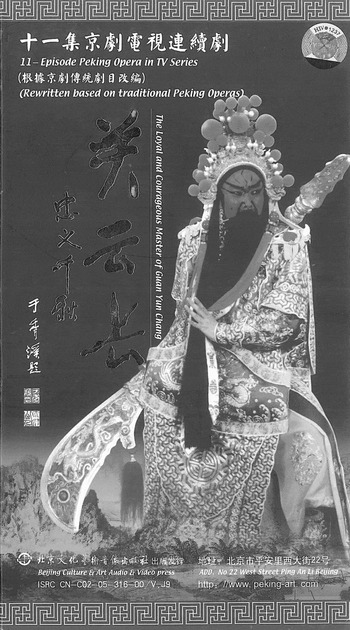
A second important interaction between stage and television xiqu involves the creation of television serials based on xiqu plays. Two recent examples offer a glimpse of the range of approaches such programmes have taken. The National Peking Opera Company (Zhongguo Guojia Jingjuyuan) and the Beijing (Municipal) Peking Opera Theatre (Beijing Jingjuyuan) both recently produced major television serials. Both series have played in rotation on CCTV-11 and are readily available in DVD format at book and media outlets in Beijing. The National Company created an eleven-part series based on traditional plays about Guan Yu (nicknamed Guan Yun Chang), from the famous historical novel Romance of the Three Kingdoms set in the Three Kingdoms period (220–80 CE) (Fig. 1). The series strikes a balance between xiqu and moving-image technologies similar to that of Women Generals. It uses traditional costumes and props, such as horsewhips, and stylized backdrops with flat open spaces allowing for full execution of the many horse riding and battle sequences demanded by the narrative. Camera placement, shot depth and compositional decisions highlight the performers' skills and support the rhythmic structures of the aural performance.
Cover from DVD of National Peking Opera Company of China's television serial Guan Yun Chang.

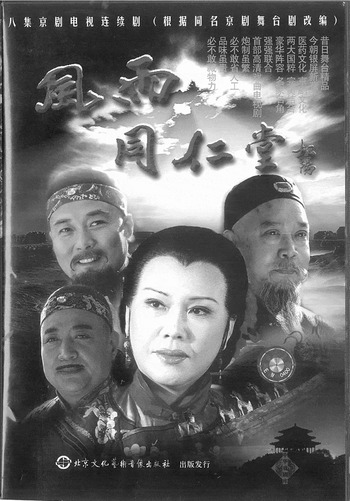
Cover from DVD of Beijing Jingju Company's television serial Feng yu Tong Ren Tang.

The Beijing City Company's serial followed its successful stage play called Feng yu Tong Ren Tang (Tong Ren Tang through Wind and Rain) about a famous herbal medicine store in nineteenth-century Beijing. The original stage production won a first-level prize at the 1998–9 National Jingju Festival and was in the style of ‘modern’ jingju: settings and costumes clearly referenced the specific period of late imperial Beijing, and spoken lines were delivered in a less highly stylized manner than in traditional xiqu, yet were smoothly integrated with the arias.
In contrast, the television serial adopts a style much closer to television realism than traditional jingju (Fig. 4). As with White Snake, settings contain much representational detail. Shot composition is essentially open, emphasizing the location filming and continuity of space beyond the frame. Multi-camera setup and editing present realistic-style dialogue through alternating close-ups, and the actors use minimal head movements and gestures to serve the close-up filmic structures. The serial includes brief jingju arias but does not utilize the stylized speech and gestures and accenting percussion that mark the aesthetically valued synthesis of traditional xiqu. Plays that do not meet this level of synthesis receive the pejorative label ‘spoken [i.e. realistic, western-style] drama with song added’ (huaju jia chang). The compositional choices evidenced in Tong Ren Tang clearly emphasize plot development and intimate performer–camera relationships over expanded opportunities for the performers to exhibit their xiqu skills.
Conclusion
Zhou Huabin, a leading scholar on television xiqu, notes that there are three types of xiqu audiences: first, the foundation audience of xiqu fans who will see and enjoy any xiqu play; second, expert or specialist xiqu audiences whose deep love of the form motivates them to give rigorous public criticism and whose participation can help push xiqu artists forward to the creation of effective new plays; third, audiences randomly encountering xiqu, rarely going to the theatre or watching xiqu on television. They have interests in other areas and after superficial encounters with xiqu often find it too slow and repetitive.Footnote 29 Zhou argues that just because a play is good does not mean the filmed version will be good, and, conversely, a mediocre play can still produce a good moving-image version – even giving the viewer a better artistic appreciation than could be achieved in the theatre.Footnote 30 Films such as White Snake and television serials such as Tong Ren Tang emphasize moving-image techniques over xiqu skills and may serve as an entry point for new viewers, encouraging them to learn more about the form. But because moving-image media in this style limit the display of xiqu artistry, they do not satisfy the ‘specialist’ or even ‘foundation’ groups of xiqu audiences. Moving-image media such as Women Generals (which is a film) and Guan Yun Chang (a serial for TV produced digitally) offer a more effective integration of cinematic techniques and xiqu's performance artistry, satisfying the specialist spectator. They also offer increased visual variety through editing, and added intimacy through close-up framing for moments of subtle emotional expression. These changes arguably give the performances a more contemporary feel and perhaps increase their attractiveness to younger viewers. Working against this attraction is the current ‘ghettoizing’ of xiqu-related television programming on CCTV-11, making serendipitous encounters with moving-image xiqu much less likely.
The approaches to transposing xiqu to moving-image media discussed above, and every permutation in between, are readily available via broadcast, cable and Video CD/DVD sales to potential xiqu consumers. Though stage performance continues to struggle for market share, there are positive signs that burgeoning Chinese national pride is spurring increased interest in traditional elements of Chinese culture, including xiqu. Most notably, the National Peking Opera Company's Mei Lanfang Grand Theatre opened in November 2007. Fronting a massive building complex, it is now the largest venue for xiqu performance in Beijing.Footnote 31 With China's extraordinary economic growth, Chinese consumers have rising disposable income but they also have increasingly varied entertainment options and radically decreasing amounts of leisure time to divide between those options. In such circumstances, it seems unlikely that moving-image xiqu will continue to hold the place of supportive second-best and will come instead to be seen as a direct competitor with stage xiqu productions. In this event, the current free flow of stage xiqu to moving-image media will undoubtedly change, although the specific extent and manifestation of these changes may depend significantly on the relative political and economic leverage of such institutions as CCTV and the National Peking Opera Company.