The prevalence of infections caused by multidrug-resistant organisms (MDROs) has been steadily increasing in both healthcare and community settings.Reference Sader, Farrell, Flamm and Jones 1 – Reference Sievert, Ricks and Edwards 3 In particular, Enterobacteriaceae that produce extended-spectrum β-lactamase (ESBL) enzymes have rapidly proliferatedReference Kallen, Hidron, Patel and Srinivasan 4 and now account for 18.6% of Gram-negative organisms isolated from patients in intensive care units (ICUs) in the United States.Reference Sader, Farrell, Flamm and Jones 1 Infection with ESBL bacteria and the associated delay in effective antimicrobial therapy often leads to increased length of stay (LOS), higher healthcare costs, and increased mortality.Reference Lee, Kotapati, Kuti, Nightingale and Nicolau 5 , Reference Schwaber and Carmeli 6
Patients with spinal cord injury or disorder (SCI/D) have an increased risk of infection compared with the general patient population due to frequent healthcare contact, comorbidities, and use of invasive medical devices.Reference Evans, LaVela and Weaver 7 – Reference LaVela, Evans, Miskevics, Parada, Priebe and Weaver 11 Furthermore, rehabilitation hospitals and long-term care facilities (LTCFs) have become important reservoirs for MDROs.Reference Lim, Cheng and Kennon 12 , Reference Ludden, Cormican, Vellinga, Johnson, Austin and Morris 13 Given the frequency with which SCI/D patients require admission to these types of facilities, the threat of infection with MDROs remains a significant burden in this population.
Studies describing the prevalence, risk factors for acquisition, and outcomes of MDRO infections in general acute-care facilities may not adequately reflect the SCI/D population.Reference LaVela, Smith, Weaver and Miskevics 14 A few small studies have shown high rates of MDROs, including ESBL, in SCI/D patients in rehabilitation hospitals.Reference Mylotte, Kahler, Graham, Young and Goodnough 15 – Reference Slim, Smit, Bos and Peerbooms 17 However, data are limited on the burden and outcomes of infection or colonization with multidrug-resistant Gram-negative organisms (MDRGNOs) among patients with chronic SCI/D, and this population is likely to be at greater risk compared with those acutely injured, due to repeated healthcare exposures. Likewise, limited data are available on the prevalence of MDRGNOs among SCI/D patients across a range of healthcare settings.
In this study, we investigated the prevalence of ESBL-producing Enterobacteriaceae, identified risk factors for ESBL acquisition, and examined clinical outcomes in a large population of veterans with SCI/D. We used a case-case-control design with 3 comparison groups: (1) ESBL patients; (2) patients with non-ESBL organisms; and (3) uninfected control participants. Thus, we were able to analyze predictors specific to acquisition of the ESBL resistant phenotype, rather than just acquisition of Enterobacteriaceae.
METHODS
Study Setting and Design
This was a retrospective case-case-control study that included adult SCI/D patients treated at VA medical facilities between January 1, 2012, and December 31, 2013. Clinical data were collected retrospectively through January 1, 2011, for the risk factor analysis. The cohort was drawn from a cumulative list of veterans with SCI/D maintained by the VA Allocation Resource Center.Reference Smith, Evans and Ullrich 18 Veterans with multiple sclerosis, amyotrophic lateral sclerosis, and Guillain-Barre syndrome were excluded because the VA SCI/D system of care focuses on individuals with stable, non-progressive, spinal-cord neurological deficits. National VA datasets were used to identify cases and controls and to collect clinical data.
We studied the medical records of patients with a positive culture for ESBL-producing Escherichia coli, Klebsiella pneumoniae, or Proteus mirabilis. These organisms were chosen because they are among the most common Gram-negative bacteria isolated from SCI/D patients and because they frequently produce ESBLs.Reference Vasoo, Barreto and Tosh 19 – Reference Waites, Chen, DeVivo, Canupp and Moser 21 This cohort included patients with cultures performed in any healthcare setting (ie, inpatient, outpatient, rehabilitation, or LTCF) from any site, with the exception of rectal screening cultures. Thus, both infected and silently colonized patients were included. Patients with cultures positive for >1 organism were included if at least 1 organism was identified as E. coli, K. pneumoniae, or P. mirabilis. Only the first positive culture was included if patients had >1 ESBL isolate identified during the study period.
For all analyses, ESBL cases were matched in a 1:1 ratio with 2 comparison groups: (1) SCI/D patients with non-ESBL E. coli, K. pneumoniae, and P. mirabilis and (2) uninfected SCI/D control patients. Controls were identified by the absence of cultures positive for Enterobacteriaceae and the absence of an International Classification of Disease-Clinical Modification, 9th revision (ICD9-CM) code for an infection. All patients were matched to group 1 (non-ESBL group) by organism, facility, and level of care (outpatient vs inpatient vs LTCF) and to group 2 (control group) by facility and level of care. Additionally, inpatients and residents of LTCFs were matched by time at risk, which was defined as the number of days from admission to the index positive culture date and was matched within ±60 days. This flexibility in matching was required because SCI/D patients frequently have long inpatient, rehabilitation, and LTCF stays. The institutional review board at the Edward Hines, Jr. VA Hospital approved this study.
Clinical and Microbiology Data Collection
Data regarding patient demographics, characteristics, and comorbid conditions were collected from national VA datasets, including the Veterans’ Health Administration (VHA) Corporate Data Warehouse (CDW). These datasets were also used to gather information on healthcare and antibiotic exposures and clinical outcomes. The modified Charlson comorbidity indexes at the time of culture for ESBL and non-ESBL groups and at the index outpatient encounter or admission date for controls were also calculated.Reference Charlson, Pompei, Ales and MacKenzie 22
To determine ESBL cases, we obtained information from the CDW on all bacterial cultures for which antibiotic susceptibility testing was performed. Given that each local VA laboratory may have entered results of ESBL testing into the electronic medical record in slightly different places, we used both microbiology and general laboratory domains of the CDW to identify positive ESBL results. Medical charts were reviewed from a random subset of 100 patients in each group to validate the administrative data with regard to accurate assignment of patients into ESBL, non-ESBL, and control groups.
Statistical Analysis
To identify risk factors for ESBL and non-ESBL organisms, paired t tests and Wilcoxon signed-rank tests were used to compare continuous variables and univariate logistic regression was used for categorical variables. Bonferroni correction for multiple comparisons was applied, with P<.017 considered significant. Variables with P<.05 or a 95% CI not including 1 were considered for inclusion in multivariate matched logistic regression analyses. Separate analyses were conducted comparing each group to the others. Variables were added with stepwise selection, and the variance inflation factor was used to assess for multicollinearity. Multivariate adjusted logistic regression models were created to examine the association between ESBL and clinical outcomes, with the exception of post-culture LOS, which was assessed using a multivariate adjusted negative binomial model. For all multivariate models, the individual clinical variables that make up the modified Charlson score were used to examine associations between individual comorbidities and outcomes. To avoid being overly conservative and increasing type II errors, correction for multiple comparisons was not applied to multivariate analyses. P<.05 was considered statistically significant. Statistical analyses were carried out using SAS, version 9.4 (SAS Institute, Cary, NC) and Stata, version 12.1 (Stata Corp LP, College Station, TX).
RESULTS
A total of 19,665 veterans with SCI/D were eligible for inclusion; 13,862 patients (70.5%) had bacterial cultures performed during the study period. Among these, 7,067 patients (51.0%) had a positive culture for E. coli, K. pneumoniae, and/or P. mirabilis, and 745 (10.5%) of these patients had ESBL-producing organisms. We successfully matched 492 of 745 ESBL cases (66.0%) to both comparison groups for a final cohort of 1,476 patients. Within this cohort, there were 924 outpatients (62.6%), 528 inpatients (35.8%), and 24 patients (1.6%) in rehabilitation units or LTCFs. Overall, 1,107 visits or admissions (75%) took place at a VA SCI specialty center. For the ESBL and non-ESBL groups, urine was the most common culture site (n=791; 80.4%) followed by blood (n=159; 16.2%), respiratory (n=6; 0.6%), and other sites (n=28; 2.8%). Among ESBL cases, 245 patients (49.8%) had positive cultures for E. coli, 208 patients (42.3%) had positive cultures for K. pneumoniae, 17 patients (3.5%) had positive cultures for P. mirabilis, and 22 patients (4.5%) had positive cultures for >1 organism.
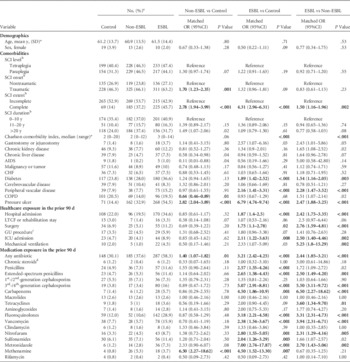
Demographic and clinical characteristics and the results of the univariate analysis are summarized in Table 1. Patients in the ESBL group had higher median Charlson comorbidity index scores. Prior healthcare exposure (including hospital admission, surgery, ICU admission, and/or mechanical ventilation) was associated with ESBL but not non-ESBL organisms. Fluoroquinolones were the most common prior antibiotic exposure for all 3 groups, and exposure to a number of antibiotics was associated with increased odds of ESBL (Table 1).
Univariate Analysis of Risk Factors for Acquisition of Non-ESBL and ESBL-Producing Enterobacteriaceae

NOTE. ESBL, extended-spectrum β-lactamase; OR, odds ratio; CI, confidence interval; SD, standard deviation; SCI, spinal cord injury; AIDS, acquired immune deficiency syndrome; CHF, congestive heart failure; COPD, chronic obstructive pulmonary disease; LTCF, long-term care facility; GU, genitourinary; ICU, intensive care unit.
a All data displayed are number (%) unless otherwise indicated.
b Some data missing for this variable.
c Minimally invasive or non-invasive GU procedures.
d Defined as ≥85d of use in the prior 90 d.
*Paired t test was used for age and Wilcoxon signed-rank test was used for Charlson score.
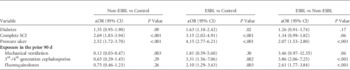
Matched multivariate analyses for acquisition of ESBL are displayed in Table 2. Compared with uninfected controls, the following variables were significant independent predictors of ESBL: diabetes, complete SCI, pressure ulcer, prior use of fluoroquinolones, and prior use of third- and fourth-generation cephalosporins. However, diabetes, complete SCI, and pressure ulcer were also associated with increased odds of non-ESBL organisms. Therefore, the only independent predictors of ESBL organisms but not non-ESBL organisms were recent prior use of fluoroquinolones and recent prior use of third- or fourth-generation cephalosporins.
Multivariate Conditional Logistic Regression Analysis of Risk Factors for Acquisition of Non-ESBL and ESBL-Producing Enterobacteriaceae

NOTE. ESBL, extended-spectrum β-lactamase; aOR, adjusted odds ratio; CI, confidence interval; SCI, spinal cord injury.
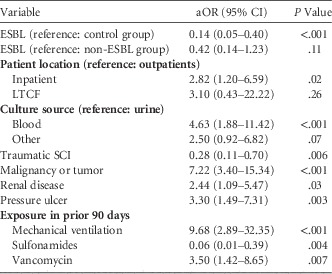
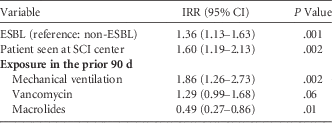
The univariate analysis of clinical outcomes stratified by comparison group is shown in Table 3. Patients in both the non-ESBL and ESBL groups had lower 30-day mortality and greater odds of hospital readmission within 90 days than controls, but there was no difference between non-ESBL and ESBL groups. Inpatients with ESBL had longer post-culture LOS than the non-ESBL group. In adjusted multivariate models, ESBL was not an independent predictor of increased 30-day mortality (Table 4). Similarly, patients in the ESBL group did not have increased 1-year mortality compared with the control group (adjusted odds ratio [aOR], 0.45; 95% confidence interval [CI], 0.28–0.71) or the non-ESBL group (aOR, 0.87; 95% CI, 0.54–1.39). Inpatients with ESBL had greater odds of hospital readmission within 90 days compared with the control group (aOR, 3.73; 95% CI, 2.20–6.32) and the non-ESBL group (aOR, 1.56; 95% CI, 0.99–2.47), although this did not reach statistical significance. Finally, ESBL was significantly associated with increased post-culture LOS among inpatients (Table 5).
Clinical Outcomes Stratified by Comparison Group

NOTE. OR, odds ratio; CI, confidence interval; ESBL, extended-spectrum β-lactamase; LOS, length of stay.
a For inpatients only.
Multivariate Logistic Regression Analysis of Variables Associated with 30-Day Mortality

NOTE. aOR, adjusted odds ratio; CI, confidence interval; ESBL, extended-spectrum β-lactamase; LTCF, long-term care facility; SCI, spinal cord injury.
Multivariate Negative Binomial Regression Analysis of Variables Associated with Increased Post-culture Hospital Length of Stay for Inpatients

NOTE. IRR, incidence rate ratio; CI, confidence interval; ESBL, extended-spectrum β-lactamase; SCI, spinal cord injury.
Chart reviews were conducted for a random subset of 100 patients from each group to estimate the validity of the clinical and administrative data in assigning patients to comparison groups. No patients in the non-ESBL group actually had ESBL organisms, but 1 patient in the ESBL group had a non-ESBL organism. Moreover, 6 of 100 uninfected control patients (6.0%) were actually infected based on presence of signs and/or symptoms identified via chart review.
DISCUSSION
This study represents a large and comprehensive evaluation of risks for and clinical outcomes of ESBL acquisition in SCI/D patients. This population deserves specific attention due to increased comorbidities and frequent use of healthcare services and indwelling devices, factors that broadly increase risk for many types of MDROs.Reference Safdar and Maki 23 The VHA treats more than 26,000 patients with SCI/D every year in multiple care settings, 24 making VA data a robust resource for studying this population.
Few studies have characterized MDRGNO epidemiology in SCI/D patients. Prior work by our group showed that hospital-acquired infections in SCI/D patients are frequently caused by methicillin-resistant Staphylococcus aureus, vancomycin-resistant Enterococcus faecium, and Pseudomonas, suggesting common risks for many MDROs in this population.Reference Evans, LaVela and Weaver 7 Other studies have been limited by small size,Reference Slim, Smit, Bos and Peerbooms 17 , Reference Martins, Bronzatto, Neto, Magalhaes, D’Anconna and Cliquet 25 – Reference Cremet, Bemer and Rome 27 inclusion of only urinary isolates,Reference Yoon, Lee, Lee, Hwang, Lee and Han 16 , Reference Waites, Chen, DeVivo, Canupp and Moser 21 , Reference Martins, Bronzatto, Neto, Magalhaes, D’Anconna and Cliquet 25 , Reference Cremet, Bemer and Rome 27 and imprecise definitions of antimicrobial resistance.Reference Slim, Smit, Bos and Peerbooms 17 , Reference Girard, Mazoyer, Plauchu and Rode 26 Our study included all cultures collected from a large SCI/D population and identified laboratory-confirmed ESBL cases. We found that prior use of fluoroquinolones and prior use of third- and fourth-generation cephalosporins were significant independent predictors of ESBL but not non-ESBL organisms. Although prior antibiotic use is a well-recognized risk factor for ESBL,Reference Ben-Ami, Rodriguez-Bano and Arslan 2 , Reference Lim, Cheng and Kennon 12 , Reference Chopra, Marchaim and Johnson 28 , Reference Rodriguez-Bano, Picon and Gijon 29 some studies have had conflicting results. Many of these conflicting studies did not examine individual antibiotic classes and, thus, may have missed associations with specific antibiotics not reflected in overall antibiotic exposure.Reference Marchaim, Chopra and Bhargava 30 – Reference Van Aken, Lund, Ahl, Odenholt and Tham 32
Frequency and type of antibiotic use in SCI/D patients is likely different from that observed in general patient populations. We have previously identified increased antibiotic prescribing for SCI/D patients in the emergency department and higher prescribing for patients seen at non-SCI centers.Reference Evans, Rogers and Chin 33 These patients’ multiple comorbidities may create more opportunities for inappropriate antibiotic use, especially among providers less familiar with SCI/D. One such circumstance may be treatment of asymptomatic catheter-associated bacteriuria, a practice not recommended due to lack of efficacy and emergence of resistance.Reference Nicolle, Bradley and Colgan 34 Waites et alReference Waites, Canupp, Brookings and DeVivo 35 found that administration of ciprofloxacin for 10 days in men with SCI/D who had undergone intermittent urinary catheterization resulted in a subsequent increase in resistant staphylococci, enterococci, and Acinetobacter spp. Clearly, these results, and those from our study, suggest that fluoroquinolone use strongly contributes to subsequent colonization and infection with MDROs in SCI/D patients.
In contrast to prior studies,Reference Schwaber and Carmeli 6 we did not identify increased mortality in our ESBL group compared with the control group. Our chart reviews estimated that 6% of patients classified into the control group were actually infected. This estimate is consistent with prior literature evaluating the validity of observational administrative dataReference Barber, Lacaille and Fortin 36 , Reference Drahos, Vanwormer, Greenlee, Landgren and Koshiol 37 and suggests that our criteria for classifying patients performed well but not perfectly. Erroneously including enough infected patients in the control group may have contributed to a higher observed mortality than expected. Furthermore, our cohort included patients with ESBL isolated from any site and those who were colonized as well as infected, both factors that may have lowered the mortality observed in our ESBL group. Interestingly, we did observe increased post-culture hospital LOS for inpatients with ESBL, a finding previously reported in a small single-center studyReference Lee, Kotapati, Kuti, Nightingale and Nicolau 5 but not validated in a larger population until now.
Our study has a number of important limitations. First, it was subject to selection bias, particularly from the exclusion of ESBL patients who could not be matched. Despite this, our final cohort included a diverse population with a range of SCI severity, who sought care in multiple settings, and who visited both SCI specialty centers and non-SCI centers. Second, we did not collect data on antibiotic treatment; thus, we could not analyze adequacy or timeliness of antibiotic therapy in regard to clinical outcomes. Finally, data were missing for some of the SCI characteristics such as level and extent of injury, which may have introduced bias into analyses including these variables.
In conclusion, we used a national cohort of veterans to demonstrate that colonization and infection with ESBL organisms is common in SCI/D patients, particularly in the urine. Prior use of fluoroquinolones or third- and fourth-generation cephalosporins independently increases the odds of the presence of ESBL but not non-ESBL organisms. Interventions that reduce inappropriate fluoroquinolone and third- and fourth-generation cephalosporin use will be particularly effective in decreasing ESBL acquisition in this population. Furthermore, given that ESBL was associated with longer post-culture hospital LOS, these same interventions are likely to have clinical and financial benefits on a broader, systemwide scale.
ACKNOWLEDGMENTS
We would like to thank Scott Miskevics for his assistance with programming and data analysis. This work was supported by The Department of Veterans Affairs, Veterans Health Administration, Office of Research and Development, Rehabilitation Research and Development Service Merit Review Award (grant no. B-1583-P), Health Services Research and Development Service Post-Doctoral Fellowship Award (grant no. TPR 42-005), and the Spinal Cord Injury Quality Enhancement Research Initiative (grant no. SCI-98-001). Dr. Nasia Safdar is additionally supported by a VA-funded Patient Safety Center of Inquiry. The views expressed in this article are those of the authors and do not necessarily reflect the position or policy of the Department of Veterans Affairs or the U.S. government.
Financial support. No financial support was provided relevant to this article.
Potential conflicts of interest. All authors report no conflicts of interest relevant to this article.