Introduction
In recent years, there has been increasing emphasis on a transdiagnostic approach to identifying fundamental processes underlying the comorbidity among different forms of psychopathology (Insel & Cuthbert, Reference Insel, Cuthbert, Garvey, Heinssen, Pine, Quinn, Sanislow and Wang2009; Kring & Sloan, Reference Krueger2010; Mansell et al., 2009; Nolen-Hoeksema & Watkins, 2011). The transdiagnostic approach posits the existence of basic neurobehavioral emotional, cognitive, and behavioral processes that underlie a more parsimonious dimensional and hierarchical system for classifying mental disorders. Despite distinct theoretical and clinical advantages (e.g., Mansell et al., 2009), a major challenge for the transdiagnostic approach is explicating how a given transdiagnostic risk factor results in both multiple symptom presentations and particular symptom presentations (Nolen-Hoeksema & Watkins, 2011).
Transdiagnostic processes may be considered dispositional risk factors as these neurocognitive and affective processes may be causally linked to the development of symptoms. Such risk factors are thought to explain comorbidity and multifinality, however, transdiagnostic models have difficulty explaining how individuals with a broad dispositional risk factor develop specific disorders (i.e., divergent trajectories). A recent heuristic proposed by Nolen-Hoeksema & Watkins (2011), suggests that dispositional risk factors may produce one cluster of symptoms over another in the presence of moderating factors; specifically, this heuristic points to environments and biologically based individual differences that draw an individual’s attention to certain concerns, goals, or themes. Therefore, dispositional risk factors may account for comorbidity and multifinality, with moderators accounting for the divergent trajectories that produce specific symptom presentations. To advance this heuristic, the current study examined the moderating effect of inhibitory control on affiliative capacity in relation to diverging trajectories of distinct psychopathological outcomes.
There may be critical developmental periods, such as young childhood, in which certain risk factors – individually, and in combination – exert particularly strong influence in determining the trajectory of symptom development and expression. Understanding common underlying transdiagnostic risk factors in developmental terms is important for early identification and intervention efforts, given that clinically relevant symptoms emerge as early as 5–10 years of age and that nearly half of all lifetime diagnoses have their onset by the age of 14 (Kessler & Wang, Reference Kessler and Wang2008). Moreover, rates of diagnostic comorbidity are often higher in youth samples, both within disorder classes (e.g., anxiety-related conditions) and across them (e.g., anxiety and disruptive behavior disorders; Angold, et al., Reference Angold, Costello and Erkanli1999; Garber & Weersing, Reference Gladstone, Parker, Mitchell, Wilhelm and Malhi2010), highlighting a need to characterize processes or attributes in childhood that give rise to different outcomes in adulthood. Socioemotional and cognitive processes are particularly compatible with child models of psychopathology, as they can be readily measured across various developmental periods in conjunction with dynamic environmental effects. In particular, an extant literature demonstrates the stability of social affiliation and attachment (hereafter referred to as "affiliative capacity") and inhibitory control as they emerge in childhood and persist into adulthood, while also examining their influence as both risk and protective factors (e.g., Burt et al., Reference Burt, Obradović, Long and Masten2008; Tone & Tully, Reference Utendale and Hastings2014).
Socioemotional proclivities reflecting low affiliative capacity (AFF–) have been implicated transdiagnostically, manifesting as symptoms evident in both internalizing and externalizing disorders, such as social apathy and a lack of concern for others (e.g., Blanchard et al., Reference Blanchard, Horan and Brown2001; Oldehinkel et al., Reference Oldehinkel, Hartman, De Winter, Veenstra and Ormel2004; Palumbo et al., Reference Palumbo, Perkins, Yancey, Brislin, Patrick and Latzman2021). Such evidence for multifinality suggests the presence of moderating factors contributing to divergent developmental trajectories among individuals lacking in AFF. Individual differences in inhibitory control (INH), for example, have been implicated in salient risk factors (e.g., rumination, worry, poor emotion regulation; Snyder et al., Reference Snyder, Miyake and Hankin2015) relevant for the development of multiple forms of psychopathology (Gray, Reference Hall, Drislane, Patrick, Morano, Lilienfeld and Poythress1987; Quay, 1988, Reference Quay1993; Kotov et al., Reference Kotov, Gamez, Schmidt and Watson2010). Indeed, trait behavioral inhibition and activation in infancy and early childhood have been demonstrated to prospectively predict anxiety disorders and antisocial behavior, respectively, in middle childhood and adolescence (Gladstone et al., Reference Goldberg2005; Kagan & Snidman, Reference Kaufman, Birmaher, Brent, Rao, Flynn, Moreci and Ryan1999; Oldehinkel et al., Reference Olino, Dougherty, Bufferd, Carlson and Klein2004; Raine et al., Reference Rettew and McKee1998; Rosenbaum et al., Reference Rothbart, Ellis and Posner1993). Though some moderators (e.g., INH) may produce symptoms on their own without the added vulnerability stemming from an underlying transdiagnostic risk factor (i.e., low AFF), they likely do not fully explain the frequent comorbidity between dimensions of psychopathology. Additionally, not all children who display extreme variants of inhibition develop clinical problems, further supporting the interactive relationship among transdiagnostic risk factors. Taken together, a dispositional risk factor (i.e., AFF) may explain comorbidity, while a moderating trait risk factor (i.e., INH) may explain how specific psychopathology develops via divergent trajectories (Nolen-Hoeksema & Watkins, 2011).
Despite the burgeoning literature regarding transdiagnostic factors and the development of psychopathology, as well as the concrete approaches for advancing the transdiagnostic model (e.g., Patrick & Hajcak, Reference Patrick, Fowles and Krueger2016), little work has been done to empirically test this interactive heuristic, as Nolen-Hoeksema and Watkins (2011) proposed (e.g., Kessel et al., Reference Kessler and Wang2016; Klein et al., Reference Klein, Dougherty, Kessel, Silver and Carlson2021). Indeed, given that multifinality implies that a construct of interest may function differently depending on the organization of the system in which it operates, observed outcomes will depend on the conditions set by the nature of additional components with which it is linked (Cicchetti & Rogosch, Reference Cicchetti and Rogosch1996). Applied to the current research question, the component of interest (AFF) would function as the dispositional risk factor that functions differently and leads to various effects/outcomes (i.e., multifinality) in the presence of variation in structurally related conditions (INH). Research aimed toward clarifying how low AFF interacts with other factors such as INH in childhood is crucial for a more thorough understanding of the cause, nature, and implications of risk and protective factors contributing to the development and emergence of psychopathology.
Integration of transdiagnostic models with quantitative structure of psychopathology
Within recent decades, the investigative emphasis on dimensional quantitative structural models of psychopathology has coincided with the emergence of transdiagnostic models demarcating underlying neurobehavioral processes and risk factors of psychopathology. The historical view of psychiatric disorders as discrete, categorical entities that persists in current diagnostic nosologies (e.g., DSM-5; American Psychological Association, 2013) has been challenged by mounting evidence that many disorders exist on a continuum and are highly comorbid with other disorders. Consistent with the transdiagnostic approach, a growing body of data suggests that there may be a more parsimonious structure of psychopathology undergirded by shared risk factors and dysfunctional processes (Castellanos-Ryan et al., Reference Castellanos-Ryan, Brière, O’Leary-Barrett, Banaschewski, Bokde, Bromberg and Garavan2016; Zald & Lahey, Reference Zald and Lahey2017).
As such, a large robust literature exists documenting the contribution of shared processes to systematic disorder comorbidity by organizing varying forms of psychopathology within quantitative structural models (Caspi et al., Reference Caspi, Houts, Belsky, Goldman-Mellor, Harrington, Israel and Moffitt2014; Kotov et al., Reference Kotov, Perlman, Gámez and Watson2017; Krueger et al., Reference Krueger and Markon2018; Krueger, 1999). Indeed, empirical comparisons demonstrate the applicability of an early influential structural model of child psychopathology (Achenbach & Edelbrock, Reference Achenbach and Edelbrock1984; Achenbach, Reference Achenbach1966) – involving two broad, correlated symptom dimensions, labeled internalizing and externalizing – to disorders of adulthood (Krueger & Markon, Reference Krueger and Markon2006a, Reference Krueger and Markon2006b). However, competing structural models have been proposed to more accurately represent mental disorder comorbidity, including a three-factor model (e.g., Krueger & Markon, Reference Krueger and Markon2006a, Reference Krueger and Markon2006b; Krueger, 1999; Doyle et al., Reference Doyle, Murphy and Shevlin2016) and models featuring a general psychopathology (p) factor (e.g., Caspi et al., Reference Caspi, Houts, Belsky, Goldman-Mellor, Harrington, Israel and Moffitt2014; Lahey et al., 2012; Martel et al., 2017; Olino et al., 2014).
Regarding these alternative models, the three-factor model of common psychopathological conditions includes separable fear and distress factors along with an externalizing factor (Krueger, 1999; Krueger et al., Reference Krueger, Hobbs, Latzman, Michelini, Patrick, Sellbom, Slade, South, Sunderland, Tackett, Waldman, Waszczuk, Wright, Zald, Watson and Kotov2021) and exhibits reliably effective goodness-of-fit (e.g., Eaton et al., Reference Eaton, Keyes, Krueger, Balsis, Skodol, Markon and Hasin2012; Slade & Watson, Reference Snyder2006; Vollebergh et al., Reference Waller and Wagner2001; Watson, Reference Watts, Poore, Lilienfeld and Waldman2009). While fear and distress factors are generally highly correlated (e.g., children, r = .86, Vollebergh et al., Reference Waller and Wagner2001; r = .87, Doyle et al., Reference Doyle, Murphy and Shevlin2016; adults, r = .71, Eaton et al., Reference Eaton, Keyes, Krueger, Noordhof, Skodol, Markon and Hasin2013; r = .80, Kotov et al., Reference Kozak and Cuthbert2015), the model’s inclusion of an overarching internalizing factor presumptively implies that fear and distress disorders share a similar developmental etiology, trajectory, and risk factors. At the same time, the bifurcation of broad internalizing into fear and distress subfactors is supported by observed patterns of covariance among disorders of these types (Clark & Watson, Reference Clark and Watson2006; Etkin & Wager, Reference Etkin and Wager2007; Kendler et al., 2007; Watson et al., Reference Watson, Levin-Aspenson, Waszczuk, Conway, Dalgleish, Dretsch, Eaton, Forbes, Forbush, Hobbs, Michelini, Nelson, Sellbomm, Slade, South, Sunderland, Waldman, Witthöft, Wright, Kotov and Krueger2022), differing physiological and cognitive correlates (e.g., startle modulation [Vaidyanathan, et al., Reference Vollebergh, Iedema, Bijl, de Graaf, Smit and Ormel2009], threat avoidance versus vigilance [Waters et al., Reference Waters, Bradley and Mogg2014]), and genetic vulnerabilities (Kendler et al., Reference Kendler, Prescott, Myers and Neale2003).
In line with the burgeoning literature identifying shared and unique processes underlying broad factors of psychopathology, recent initiatives, such as the NIMH’s Research Domain Criteria (RDoC; Insel & Cuthbert, Reference Insel, Cuthbert, Garvey, Heinssen, Pine, Quinn, Sanislow and Wang2009), have sought to shift the focus of ongoing research toward multi-modally assessed transdiagnostic neurobehavioral processes relevant to human behavior in general, and psychopathology more specifically. Whereas categorical clinical disorders represent narrow-scope heterogeneous clusters of symptoms considered unique to each, the aforementioned dispositional risk factors are conceived as neurocognitive and affective processes that are causally linked to the development of symptoms that cross diagnostic boundaries (Cannon & Keller, Reference Cannon and Keller2006).
The RDoC matrix includes six broad domains reflecting major systems of emotion, cognition, motivation, and social behavior encompassing lower order constructs responsible for capturing distinctive neurobehavioral aspects of their respective domain, with clear referents to the developmental literature. Of particular interest for the current research are the Affiliation and Attachment (i.e., AFF) and Inhibition (i.e., INH) constructs subsumed within RDoC’s Social Processes and Cognitive Systems domains, respectively. Consideration of affiliation and inhibitory control allows for the construction of standardized and replicable transdiagnostic phenotypic indicators that may serve as a critical link between biobehavioral systems and quantitative structural models of psychopathology. However, the ways in which these transdiagnostic processes contribute interactively to the liability and development of psychopathology remains unclear.
Situated squarely within a) transdiagnostic frameworks (i.e., RDoC), b) a robust literature surrounding the neural bases of AFF and INH, and c) the associated risk for developing psychopathological symptoms, AFF and INH are well-positioned as relevant risk factors for clarifying the mechanisms of diverging symptom trajectories and resultant multifinality. All told, considering the current aims within the RDoC framework addresses the inherent need for multimodal research on distinct sets of traits corresponding to RDoC process constructs – evident across animal, child, and adult literatures – to serve as an interface between RDoC-matrix constructs and clinical problems (e.g., Latzman et al., Reference Latzman, Lilienfeld, Latzman and Clark2017; Latzman, et al., Reference Latzman, Lilienfeld, Latzman and Clark2017; Patrick & Hajcak, Reference Patrick, Fowles and Krueger2016; Palumbo & Latzman, Reference Palumbo, Latzman, Miller and Lynam2019; Kessel et al., Reference Kessler and Wang2016; Kozak & Cuthbert, 2016; Perkins et al., Reference Quay and Bloomingdale2020; Venables et al., 2018).
Affiliative capacity as a transdiagnostic risk factor
Deficits in social processes have been shown to be of particular transdiagnostic value in both youth and adulthood, manifesting as symptoms, outcomes, or both. Affiliative capacity is reliant upon accurate detection of and attention to social cues, as well as social learning and motivation associated with the formation and maintenance of interpersonal relationships. Indeed, breakdowns in these processes starting in early childhood may have severe consequences for cognitive and affective functioning (Calkins & Fox, Reference Calkins and Fox2002; Coplan et al., Reference Coplan, Rose-Krasnor, Weeks, Kingsbury, Kingsbury and Bullock2013) that may contribute to maladaptive trajectories extending into adulthood (Deater-Deckard, Reference Deater-Deckard2001; Dodge et al., Reference Dodge, Lansford, Burks, Bates, Pettit, Fontaine and Price2003). Further, disruptions in dispositional AFF can be observed transdiagnostically and expressed in the form of symptoms at bipolar extremes. High AFF can manifest clinically as over-attachment and fear of abandonment, apparent in clinical phenomena such as borderline personality disorder and dependent personality disorder (Bornstein, Reference Bornstein1998; Levy, 2005; Gude et al., Reference Gude, Hoffart, Hedley and Rø2004). Conversely, low dispositional AFF links to internalizing and externalizing dimensions and manifests as a general lack of interpersonal effectiveness (i.e., low agreeableness, inability to establish peer relationships, social anhedonia, blunted social responsiveness and emotional expressivity, lack of empathy; Cusi et al., Reference Cusi, MacQueen, Spreng and McKinnon2011; Frick et al., 2014, respectively).
In recent years, an accumulating research literature has emerged surrounding the operationalization, contributing risk factors, and resulting psychopathological outcomes of low dispositional AFF – alternatively termed callousness (Brislin et al., Reference Brislin, Patrick, Flor, Nees, Heinrich, Drislane and Büchel2018; Frick et al., 2014) or meanness (Patrick, et al., Reference Perkins, Latzman and Patrick2009) – in children and adults (e.g., Palumbo, Latzman, et al., Reference Palumbo, Latzman and Patrick2021; Palumbo, Perkins, et al., Reference Palumbo, Perkins, Yancey, Brislin, Patrick and Latzman2021; Waller & Wagner, Reference Waller and Wagner2019). Through this effort, component traits of AFF–, such as low empathy, social withdrawal and anhedonia/apathy, and low agreeableness, have evidenced parallel associations with distress-based internalizing, particularly, and externalizing symptomology. Specifically, internalizing symptoms appear to be accompaniments of passivity, social withdrawal, and disaffiliation (e.g., Boivin et al., Reference Boivin, Hymel and Bukowski1995; Morison & Masten, 1991; Rubin, et al., Reference Rueda, Posner and Rothbart2009), whereas externalizing relates instead to active, agentic expressions of disaffiliation (e.g., Patrick et al., Reference Perkins, Latzman and Patrick2009). For example, the agreeableness dimension of the Five Factor Model of personality (Digman, Reference Digman1990; Goldberg, 1990) covaries with affiliation and encompasses traits relating to both communal (e.g., “can be cold and aloof”) and agentic (e.g., “sometimes rude to others”) behavioral expressions, and there is evidence that low dispositional Agreeableness (i.e., Antagonism) is associated with distress-based internalizing and externalizing psychopathology to a similar degree (Kotov et al., Reference Kotov, Gamez, Schmidt and Watson2010; Malouff et al., Reference Mansell, Harvey, Watkins and Shafran2005; Sleep et al., Reference Snyder, Miyake and Hankin2018; Watts et al., 2019), indicating commonality between agentic and social disaffiliation through shared deficits in compassion, altruism, and trust within interpersonal relationships. Callousness, the most commonly studied expression of low AFF, has been reliably identified as a distinct risk factor for the development of externalizing psychopathology (for reviews, see Frick & White, Reference Frick and White2008; Hawes et al., Reference Hawes, Price and Dadds2014), as well as internalizing-related temperament traits (Berg et al., Reference Berg, Lilienfeld, Reddy, Latzman, Roose, Craighead and Raison2013; Latzman et al., 2013) and internalizing problems of some kinds (Barker & Salekin, Reference Barker and Salekin2012; Essau et al., Reference Essau, Sasagawa and Frick2006), even after controlling for demographics and conduct problems (Enebrink et al., Reference Enebrink, Andershed and Långström2005; Hipwell et al., 2007).
While it is well established that measures of AFF– predict externalizing problems, it is important to address the existing literature demonstrating inconsistent findings between internalizing psychopathology and low AFF (Sevecke & Kosson, Reference Sleep, Hyatt, Lamkin, Maples-Keller and Miller2010). Theoretically, low anxiety and depression characterize youth with high callous or antagonistic traits, and empirically, callousness has evidenced negative (Barry et al., Reference Barry, Frick, DeShazo, McCoy, Ellis and Loney2000; Pardini et al., Reference Pardini, Stepp, Hipwell, Stouthamer-Loeber and Loeber2012) or null associations with broad internalizing symptoms (Fanti et al., Reference Fanti, Demetriou and Kimonis2013; Pardini & Loeber, 2008; Pardini, Reference Pardini and Loeber2006). Notably, studies reporting positive associations between low AFF, and internalizing disorders have considered distress and fear symptoms separately, demonstrating that distress disorders, specifically, are associated with lower dispositional AFF (e.g., Waller, Wright, et al., 2015). The implication is that low AFF may relate specifically to self- and informant-reports of children being socially withdrawn, isolated, or low in mood – consistent with the conceptualization of low AFF more broadly. Through the use of an RDoC-conformant index of AFF– (Palumbo, Latzman, et al., Reference Palumbo, Latzman and Patrick2021), the current study sought to clarify the common and unique associations with fear, distress, and externalizing psychopathology.
Inhibitory control as a unique predictor and moderator
Inhibitory control (INH) is defined here as the regulatory system that influences the functioning of other cognitive and emotional systems, in the service of goal-directed behavior, when prepotent responding is not adequate to meet the demands of the current context (Diamond, Reference Diamond2013; McTeague et al., Reference McVay and Kane2016; Rothbart et al., Reference Rothbart, Ellis, Rosario Rueda and Posner2003; Rueda et al., Reference Rueda, Posner and Rothbart2004). INH-system processes are also invoked in novel situations in which appropriate responses need to be selected among competing alternatives. INH demonstrates explicit links to the developmental literature and has been conceptualized as the self-regulatory aspect of temperament encapsulated within effortful control (Diamond, Reference Diamond2002; Rothbart & Bates, Reference Rothbart, Bates, Damon and Eisenberg1998). INH impairments are associated with most forms of psychopathology in youth and adulthood (e.g., Latzman et al., Reference Latzman, Green and Fernandes2016; Hecht & Latzman, Reference Hecht and Latzman2018; for a review see, Snyder et al., 2015) and relate to several potent risk factors, including worry (Crowe et al., Reference Crowe, Matthews and Walkenhorst2007; Snyder et al., Reference Snyder, Hutchison, Nyhus, Curran, Banich, O’Reilly and Munakata2010, Reference Snyder, Kaiser, Whisman, Turner, Guild and Munakata2014) and poor use of adaptive emotion regulation strategies (McRae et al., Reference McRae, Jacobs, Ray, John and Gross2012; Andreotti et al., Reference Andreotti, Thigpen, Dunn, Watson, Potts, Reising, Robinson, Rodriguez, Roubinov, Luecken and Compas2013). Individual differences in INH abilities have been implicated in socioemotional and behavioral information processing and differential liability for psychopathological symptoms, through the interaction with initial temperamental dispositions (e.g., Eisenberg et al., Reference Eisenberg, Valiente, Spinrad, Cumberland, Liew, Reiser, Zhou and Losoya2009). Indeed, INH in youth has been negatively associated with both externalizing (Utendale & Hastings, Reference Venables, Foell, Yancey, Kane, Engle and Patrick2011) and internalizing behaviors (Rhoades et al., Reference Rhoades, Greenberg and Domitrovich2009; Bufferd et al., Reference Bufferd, Dougherty, Olino, Dyson, Laptook, Carlson and Klein2014). While this evidence underscores the relevance of INH in children, not all studies have found that high INH is unequivocally helpful, and there is evidence that the adaptiveness of INH may depend on dispositional risk factors (Sette et al., Reference Sette, Hipson, Zava, Baumgartner and Coplan2018; White et al., Reference White, McDermott, Degnan, Henderson and Fox2011; Thorell et al., Reference Thorell, Bohlin and Rydell2004).
Along these lines, although INH appears to play a significant role in psychopathology broadly, the mechanisms underlying this association are nuanced and not well-understood. One approach for identifying these mechanisms is to examine narrower components of INH that may account for its associations with higher-order psychopathology dimensions. Specifically, studies examining facets of disinhibition/conscientiousness demonstrate that difficulties with inhibition that characterize poor impulse control, a failure to plan ahead, and disregard for rules are especially operative in externalizing disorders (Ruiz et al., 2008; for meta-analytic reviews, see Morgan & Lilienfeld, Reference Morison and Masten2000; Ogilvie et al., Reference Oldehinkel, Hartman, De Winter, Veenstra and Ormel2011), whereas deficient INH reflected in beliefs about oneself as ineffective in initiating goals and progressing toward them contributes more to internalizing problems (Naragon-Gainey & Simms, Reference Naragon-Gainey and Simms2017; Grahek et al., Reference Gray2018; Snyder, 2013). That is, externalizing symptoms appear more related to the inability to constrain actions that may lead to undesirable outcomes, whereas internalizing problems involve strong inhibitory tendencies that hinder the ability to enact appropriate responses in the presence of distractors and potential undesired outcomes.
Indeed, it has been proposed that INH deficits may be transdiagnostic risk factors for emotional, impulsive-behavioral, and psychotic disorders (e.g., Nolen-Hoeksema and Watkins, 2011; Buckholtz & Meyer-Lindenberg, Reference Buckholtz and Meyer-Lindenberg2012; Goschke, Reference Goschke2014). As describes, evidence exists for INH not only as a risk factor in itself, but also as a transdiagnostic moderating factor contributing to associations of low dispositional AFF with differing clinical outcomes. Indeed, in the interest of elucidating multifinality, existing research suggests that the moderating variable should be one with which the associations with the outcome variable are opposing (i.e., situating itself as a possible moderator that influences divergent/unique outcomes). Although one recent study examined the interactive relationship between low AFF (i.e., callousness) and INH in the explanation of externalizing problems (Waller et al., 2017), no research has yet been published on the interplay of these transdiagnostic factors in relation to internalizing as well as externalizing psychopathology. The current study was undertaken to address this gap in the literature.
Current study
Identifying and integrating risk and protective factors present in childhood is crucial for understanding and differentiating alternative developmental trajectories of psychopathology. Specifically, the integration of social and cognitive processes with developmental approaches to psychopathology has been an important advancement in the field. Given extensive research demonstrating the transdiagnostic relevance of AFF and INH to clinical outcomes across developmental stages (i.e., early childhood, adolescence, adulthood) and modes of measurement (e.g., self-report, task-based, neurophysiology), these traits hold promise for advancing our understanding of developmental liabilities for, and divergent trajectories of, internalizing and externalizing psychopathology. As described below, consideration of parent-report measures of AFF–, in conjunction with interview-based assessments of psychopathology and neurocognitive assessments of INH, affords opportunities to investigate interactive effects of RDoC constructs operationalized using different modes of measurement.
To this end, the Child Mind Institute (CMI) has launched the Healthy Brain Network (HBN), an ongoing initiative focused on creating and sharing a biobank of data from 10,000 New York area participants (ages 5-21; Alexander et al., Reference Alexander, Escalera, Ai, Andreotti, Febre, Mangone, Vega-Potier, Langer, Alexander, Kovacs, Litke, Camacho and Milham2017). Attributable to its large sample and comprehensive assessment battery, the CMI-HBN study provides a unique opportunity to accomplish the following aims: 1) Integrate multiple methodologies to assess latent psychopathology, AFF–, and INH (via clinician interview, parent-report, and task-based methods, respectively); 2) Model the three-factor quantitative structure of psychopathology in young children; 3) Examine affiliative and INH correlates of resulting latent psychopathology dimensions (i.e., fear, distress, and externalizing); 4) Investigate the moderating influence of individual variation in INH capacity on dispositional AFF– in accounting for divergent trajectories of psychopathology. Specifically, the current study is among the few to use a multi-modal approach across different information sources (i.e., parent and child) to elucidate a) how an individual trait transdiagnostic risk factor (i.e., AFF–) leads to multiple psychopathologies (i.e., multifinality) and b) how distinct forms of psychopathology (i.e., inhibited or uninhibited; divergent trajectories) emerge from the moderating effects of individual differences in INH on low AFF. All proposed study details (i.e., number of subjects, procedures, assessments), plans for analyses, and hypotheses were pre-registered through the Open Science Framework (OSF; https://osf.io/hnbcr/?view_only=b5a526f783444a49981231a7e739c436).
Regarding the aim of elucidating the transdiagnostic utility of AFF, hypotheses were built with explicit links to current biobehavioral nosologies (i.e., RDoC). Specifically, affiliation is defined as being influenced by both social information processing (lack of empathy) and social motivation (withdrawal/social disregard). As previous studies have demonstrated the significance of examining subfactors of trait AFF– in relation to psychopathology (Berg et al., Reference Berg, Lilienfeld, Reddy, Latzman, Roose, Craighead and Raison2013; Gao & Zhang, Reference Garber and Weersing2016; Kimonis et al., 2008; Waller, Hyde, et al., Reference Waller, Hyde, Grabell, Alves and Olson2015; Waller, Wright, et al., 2015), the current study evaluated alternative one- and two-factor structures of AFF– using an item-level exploratory factor analytic (EFA) approach. Consistent with previous evidence that a coldhearted demeanor and lack of empathy can contribute to other symptoms besides social disregard/withdrawal (Berg et al., Reference Berg, Lilienfeld, Reddy, Latzman, Roose, Craighead and Raison2013; Gao & Zhang, Reference Garber and Weersing2016; Waller 2015), we expected a two-factor model to better explain the data and to reflect the aforementioned processes.
In addition, it was expected that both transdiagnostic latent AFF– factors, modeled using parent-report indicators, would be positively associated with both distress and externalizing symptoms (i.e., deficient AFF associated with greater psychopathology), with the AFF– cold-heartedness/lack of empathy factor (F1) evidencing stronger associations with each than the AFF– social disregard/withdrawal factor (F2; Frick & White, Reference Frick and White2008; Latzman et al., 2013; Waller, Hyde, et al., Reference Waller, Hyde, Grabell, Alves and Olson2015; Waller, Wright, et al., 2015). Regarding fear symptoms, given the lack of studies testing for associations of this subfactor of internalizing with AFF–, a specific hypothesis regarding the directionality of associations was not proposed. Additionally, consistent with previous research, INH was expected to correlate similarly with fear and distress symptomatology, but differentially with externalizing symptomatology (positively and negatively, respectively; Grahek et al., Reference Gray2018; Ogilvie et al., Reference Oldehinkel, Hartman, De Winter, Veenstra and Ormel2011).
Finally, it was hypothesized that INH would moderate the impact of low AFF, such that higher INH would combine with AFF– to predict distress symptoms specifically (Eisenberg et al., Reference Eisenberg, Fabes, Guthrie and Reiser2000; Eisenberg et al., Reference Eisenberg, Sadovsky, Spinrad, Fabes, Losoya, Valiente and Shepard2005; Rothbart et al., 2004), whereas low INH would combine with AFF– to predict externalizing symptoms (Song et al., Reference Song, Waller, Hyde and Olson2016; Waller et al., 2017) – with the moderating effect of INH expected to emerge more strongly for AFF– Factor 1 (cold-heartedness/lack of empathy) than AFF– Factor 2 (social disregard/withdrawal).
Method
Participants
Participants consisted of 1,671 children, ages 5–10 years (M age = 8.07, SD = 1.63 years; 34.4% female), recruited and tested through the CMI-HBN consortium project described above (Alexander et al., Reference Alexander, Escalera, Ai, Andreotti, Febre, Mangone, Vega-Potier, Langer, Alexander, Kovacs, Litke, Camacho and Milham2017). The racial composition of the sample includes 50.0% Caucasian, 16.5% Black/African American, 11.1% Hispanic, and 22.4% Biracial or Other. Participants were provided with study information and children and parents provided written assent and consent, respectively.
Psychopathology
Kiddie Schedule for Affective Disorders and Schizophrenia (K-SADS; Kaufman et al., Reference Kendler, Gardner, Gatz and Pedersen1997). The K-SADS is a semi-structured diagnostic interview developed to assess current and past episodes of psychopathology in children and adolescents according to criteria outlined in the fourth edition of the DSM-IV (American Psychiatric Association, 2000). Parents and children responded to both open and closed questions and diagnostic ratings were made through clinician consensus (N = 1360). Participants were rated as either endorsing symptom criteria for the disorder, or not, for both past and current periods. Lifetime diagnostic symptom counts were computed by identifying whether each participant endorsed each symptom, either currently, in the past, or both, for each disorder. Of the 1360 children, 23.7% endorsed at least one symptom of distress disorders, 39.9% endorsed at least one symptom of fear disorders, and 89.6% of participants endorsed at least one symptom of externalizing disorders. Due to low endorsement of symptoms, and thus considerably low base rates, substance use disorders were not included in subsequent analyses.
Affiliative capacity
Following procedures used to develop dispositional trait scales from other item sets (e.g., Brislin et al., Reference Brislin, Drislane, Smith, Edens and Patrick2015; Brislin et al., Reference Brislin, Patrick, Flor, Nees, Heinrich, Drislane and Büchel2018, Hall et al., 2014; Sellbom et al., Reference Slade and Watson2016), existing parent-report measures within the larger CMI-HBN protocol (N = 1430) were used to create a psychometric index of AFF, in the form of the HBN Meanness scale (see Palumbo et al., Reference Palumbo, Perkins, Yancey, Brislin, Patrick and Latzman2021 for details concerning scale creation). Item content of the HBN Meanness scale reflects core characteristics such as a lack of empathy, social disregard, and a coldhearted demeanor. Given the numerous deficiencies of coefficient alpha documented in the psychometric literature (Dunn et al., Reference Dunn, Baguley and Brunsden2013; Deng & Chan, Reference Deng and Chan2017; Peters, Reference Peters2014), an additional measure of internal scale reliability, McDonald’s omega, is reported; internal reliability (Cronbach’s alpha and McDonald’s omega) in this sample were .86 and .88, respectively.
Inhibitory control
Task-based neurocognitive measures
The Adaptive Cognitive Evaluation (ACE; Younger et al., Reference Younger, O’Laughlin, Anguera, Bunge, Ferrer, Hoeft, McCandliss, Mishra, Rosenberg-Lee, Gazzaley and Uncapher2021) is a mobile assessment battery that presents standard neuropsychological paradigms to assess fundamental domains of cognitive function. The ACE assessments have integrated adaptive psychometric staircase algorithms into each cognitive task that allows for a personalized assessment reliant upon an individual’s cognitive performance on each task. Task difficulty is dynamically adjusted after each trial to ensure that each participant’s performance converges to an ∼80% accuracy level to reflect true differences in cognitive ability and not disparities in the testing parameters or biases related to ceiling/floor effects. Reliability and validity efforts show robust support for the use of mobile assessment methods (Younger et al., Reference Younger, O’Laughlin, Anguera, Bunge, Ferrer, Hoeft, McCandliss, Mishra, Rosenberg-Lee, Gazzaley and Uncapher2021). Further, ACE developers have shown high test–retest reliability across developmental age groups, as well as construct validity in comparison to standard lab-based assessments (Raz & Rodrigue, Reference Raz and Rodrigue2006).
In service of measuring INH, the ACE battery includes three RDoC-conformant tasks designed to assess an individual’s ability to selectively process information that is relevant to the immediate goals, while ignoring goal-irrelevant distractions (N = 794). In a Flanker task (Eriksen & Eriksen, Reference Eriksen and Eriksen1974), participants are required to indicate the left–right orientation of a centrally presented stimulus while inhibiting attention to the potentially incongruent stimuli that surround it (i.e., the flankers, two on either side). In the adapted ACE version, participants are responding to letters (e.g., CCACC or DDDDD; indicating "A" and "B" with the left key and "C" and "D" with the right). Participants also completed the Boxed task, a visual scan task designed to measure directed attention and inhibition in the context of distractors. In this task, individuals are required to find a green box that is open at the top (indicated by the left key) or bottom (by right key). Within each trial, the green target box is surrounded by distractor red boxes that can be open from either of the four sides or distractor green boxes open from the left or right. Finally, participants completed the Sustained Attention and Impulsivity Task (SAIT), analogous to the Sustained Attention and Response Task (SART; McVay & Kane, Reference McVay and Kane2009; Reference McVay and Kane2012), a variant of the Go/No-Go task commonly used to measure INH. Consistent with the SART task paradigm, the Go stimulus occurred more frequently than the No-Go stimulus in order to establish a prepotent response set that required application of INH to override.
Analytic approach
Measurement models
All models were estimated using MPlus (Version 7.4; Muthen & Muthen, Reference Naragon-Gainey and Simms1998-2014), with FIML estimation to accommodate missing data by estimating a likelihood function for each individual based on all available data. From among the base sample of 1,671, diagnostic interview data was available for 1360 subjects, 1430 had parent-reported scores for the HBN Meanness scale, and 794 had neurocognitive task data. The CFA model of psychopathology was fitted using the MLR estimator, which does not assume normally distributed variables, such as with diagnostic symptom counts (Brown, Reference Brown2015). All other models were estimated using ML estimation. GFI for each model was evaluated with the RMSEA, CFI, and the likelihood ratio χ2 test.
To examine the structure of psychopathology in youth, a three-factor CFA model was fitted comprising fear, distress, and externalizing factors (Krueger & Markon, Reference Krueger and Markon2006; Zald & Lahey, Reference Zald and Lahey2017), demarcated by specific diagnostic symptom counts, as described above. In an attempt to elucidate the nature of AFF– as indexed by the HBN Meanness scale, item-level exploratory factor models were fitted using a goemin (oblique) rotation to extract a one- and two-dimensional model. CFIs and factor content were considered to determine which model to retain in the full structural models.
Currently, concerns regarding the utility of neurocognitive task-based indicators in capturing individual differences in INH (e.g., low between-subjects reliability, inconsistency due to a large number of derived component and difference scores, low intercorrelations; Draheim et al., Reference Draheim, Mashburn, Martin and Engle2019; Engle et al., Reference Engle, Tuholski, Laughlin and Conway1999; Hedge et al., Reference Hipwell, Pardini, Loeber, Sembower, Keenan and Stouthamer-Loeber2018) limit the ability to propose strongly supported hypotheses about the component indicators of latent INH. Based on the current literature, several indicators have been derived from such neurocognitive tasks in attempt to address such concerns, optimize individual differences, and increase reliability (e.g., component scores, difference scores, integrative scores; Draheim et al., Reference Draheim, Mashburn, Martin and Engle2019; Engle et al., Reference Engle, Tuholski, Laughlin and Conway1999). Therefore, based on theoretical and empirical considerations, an iterative approach was taken towards operationalizing INH, in that intercorrelations among task indicators were examined to identify those which showed potential to create a cohesive latent construct (described in more detail in the Supplemental Materials) from which various competing models were considered via structural modeling.
Full structural model
Structural equation modeling (SEM) was used to test for unique and interactive effects of latent AFF– and INH on internalizing and externalizing forms of psychopathology. If allowed to be freely estimated within the full structural model, the estimates of the observed variables encompassed by each measurement model would be influenced by both the latent factors and by constituent observed variables in other measurement models (e.g., Flanker task accuracy would be influenced both by lifetime MDD symptomatology and by the latent Distress factor). Therefore, the parameters of each measurement model were retained and fixed in order to maintain focus on how each latent factor operated within the full structural model. To estimate the unique predictive power of the trait transdiagnostic constructs of interest, the factors of the three-factor psychopathology model were regressed onto the AFF– and INH factors. Finally, to test for moderating effects of INH on AFF– in differing psychopathology outcomes, latent CFA-based fear, distress, and externalizing factors were evaluated as predictors of regression-estimated AFF– factor score(s) along with INH interaction terms (i.e., AFF–*INH, created via the XWITH function in Mplus).
Results
Measurement models
Psychopathology
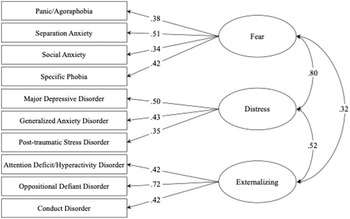
Consistent with the extant literature (Krueger & Markon, Reference Krueger and Markon2006; Zald & Lahey, Reference Zald and Lahey2017), the current study fitted a three-factor CFA model of psychopathology using lifetime diagnostic symptom counts as indicators. Maximum likelihood estimation with robust standard errors (MLR) was used to account for the non-normality of symptom count data. As expected, the correlated three-factor model fit the data adequately (RMSEA = .037, CFI = .876, TLI = .825, SRMR = .039, χ2 = 92.836, p < .001). The Fear factor reflected shared variance among lifetime symptom counts of panic/agoraphobia, specific phobia, separation anxiety, and social anxiety (loadings ranging from .34 to .51). Distress was defined by common variance among MDD, GAD, and PTSD (loadings .50, .43, and .35, respectively). Finally, Externalizing comprised ADHD, ODD, and CD (loadings .42, .72, .42, respectively). A strong positive association was evident between Fear and Distress (r = .797, p < .001) and each of these scales showed a moderate positive association with Externalizing (rs = .319 and .521, respectively, ps < .001; see Figure 1).
Confirmatory factor analysis of K-SADS psychopathology lifetime symptom counts (RMSEA = .037, CFI = .876, TLI = .825, SRMR = .039, Chi-squared = 92.836, p < .001); K-SADS = Kiddie Schedule Affective Disorders and Schizophrenia. N = 1360.

Affiliative capacity
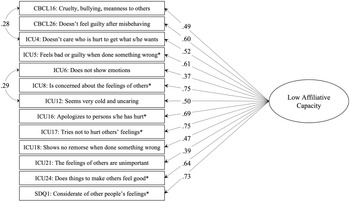
The current study evaluated alternative one- and two-factor models of AFF– as indexed by the HBN Meanness scale, estimated via item-level EFA using a geomin oblique rotation and maximum likelihood (ML) estimation. Although the two-factor model exhibited better fit to the data (RMSEA = .059, CFI = .949, TLI = .925, SRMR = .031, χ2 = 317.031, p < .001) than the one-factor model (RMSEA = .086, CFI = .867, TLI = .840, SRMR = .057, χ2 = 759.440, p < .001), the two factors appeared to reflect differential item keying (i.e., one factor was defined entirely by negatively keyed items, whereas the other was defined entirely by positively keyed items; see Appendix A) rather than distinct substantive facets of AFF–. For example, the two items “Does not feel guilty after misbehaving” (CBCL 26) and “The feelings of others are unimportant to him/her” (ICU 21) loaded onto factor 1 of the model, whereas their two reverse-worded counterparts, “Feels bad or guilty when she/he has done something wrong” (ICU 5) and “Considerate of other people’s feelings” (SDQ 1), loaded onto factor 2 of the model. Given this outcome, the expected partitioning of the AFF– construct into cold-heartedness/lack of empathy and social disregard/withdrawal subdimensions was not empirically supported, and the one-factor model was employed in further analyses, with higher scores on this factor indicating deficient affiliative capacity.
To improve fit further and to enhance reliability of the resulting Meanness/AFF– factor, modification indices and item descriptors were reviewed to evaluate whether items were similar enough to justify correlating their associated residuals. The residual variances of the following two item pairs overlapped (i.e., indexed something in common not captured by the general AFF– factor of the model): (1) ICU 12 (“Seems very cold and uncaring”) and ICU 6 (“Does not show emotions”), reflecting the perception of oneself as unemotional (r = .29, p < .001), and (2) ICU 4 (“Does not care who s/he hurts to get what s/he wants”) and CBCL 16 (“Cruelty, bullying, or meanness to others”), reflecting a shared component of aggressive exploitativeness (r = .28, p < .001). The resulting one-factor model with correlated residuals demonstrated similar item loadings and increased fit (RMSEA = .075, CFI = .901, TLI = .877, SRMR = .051, χ2 = 578.562, p < .001) and was thus retained in the full structural models (see Figure 2).
Exploratory factor analysis of affiliative capacity (RMSEA = .075, CFI = .901, TLI = .877, SRMR = .051, Chi-squared = 578.562, p < .001); ICU = Inventory of Callous Unemotional Traits, CBCL = Child Behavior Checklist, SDQ = Strengths and Difficulties Questionnaire. * indicates reverse-keyed items. N = 1430.

Inhibitory control
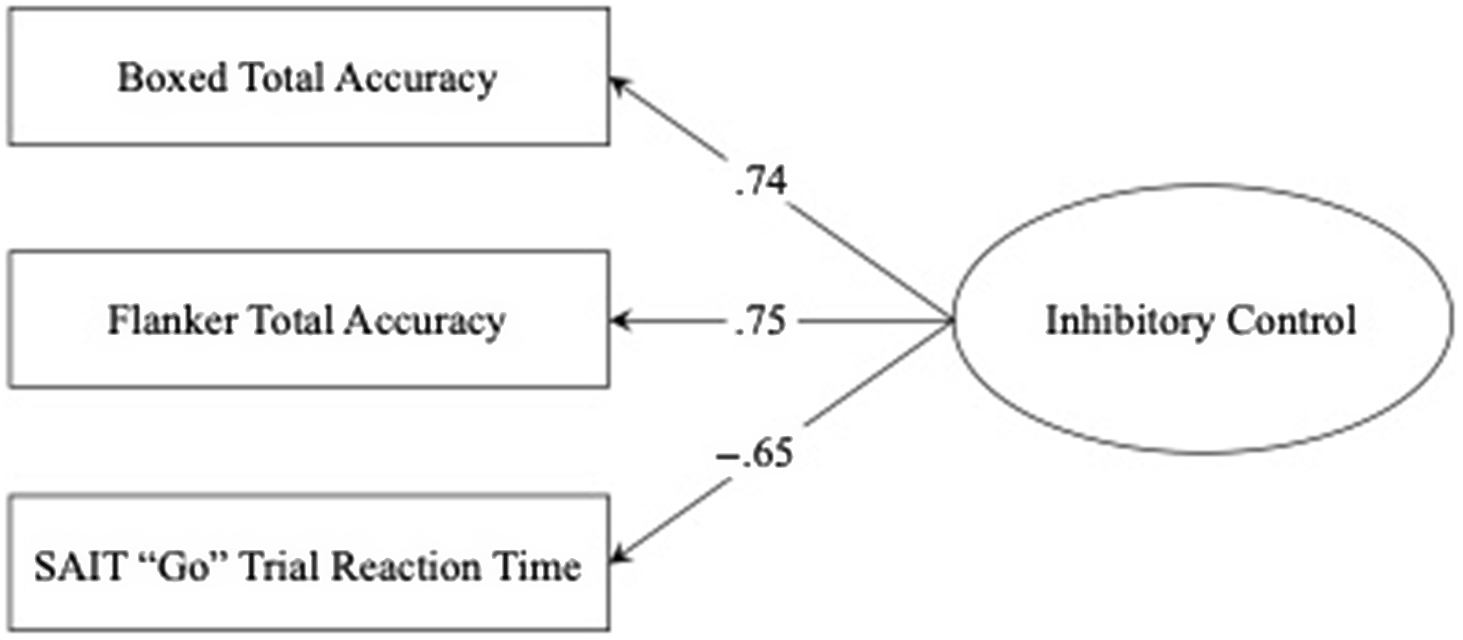
As described above, an iterative process was taken towards operationalizing INH. Eight competing models, estimated via EFA, consisted of various combinations of Boxed-task total accuracy and total reaction time, Flanker-task total accuracy and reaction time, and SAIT-task total accuracy and reaction time (see Supplemental Table 1). Since each model was just-identified, fit comparisons were made via AIC and sample size-adjusted BIC, with consideration also given to balance of factor loadings and analytical recommendations (e.g., Magnus et al., Reference Magnus, Willoughby, Blair and Kuhn2019; Draheim et al., Reference Draheim, Mashburn, Martin and Engle2019). Two comparable models fit considerably better than the other six: Model 1 consisted of Boxed total accuracy, Flanker total accuracy, and SAIT reaction time to Go trials (AIC = 6103.012; ss adj BIC = 6116.526); Model 2 comprised Boxed total accuracy, Flanker total accuracy, and SAIT total accuracy (AIC =6096.509; ss adj BIC = 6110.023). Although Model 2 demonstrated marginally better fit, the factor loadings for Model 1 were more balanced across indicators (0.75, 0.75, and −0.65, respectively) than in Model 2 (0.83, 0.71, 0.66). Further, Mangus et al. (2019) demonstrated the advantage of using joint models of accuracy and reaction time in service of improving measurement precision, particularly in young children. Thus, Model 1 (Figure 3) was retained for further analyses within the full SEM model.
Confirmatory factor analysis of neurocognitive task-based indicators (df = 0; model just-identified); SAIT = Sustained Attention and Impulsivity Task. N = 794.

Full structural equation model
As described above, all component measurement models (i.e., psychopathology, AFF–, INH), and their respective fixed estimates, were considered simultaneously in a full structural model using ML estimation to characterize main effects of AFF– and INH in the prediction of psychopathology symptom dimensions, as well as the moderating effect of INH on the relationship between AFF– and dimensions of psychopathology. Further, given variations in age and sex within the sample, these two demographic variables were included as covariates in each model.
Unique predictive effects of affiliative capacity and inhibitory control on psychopathology
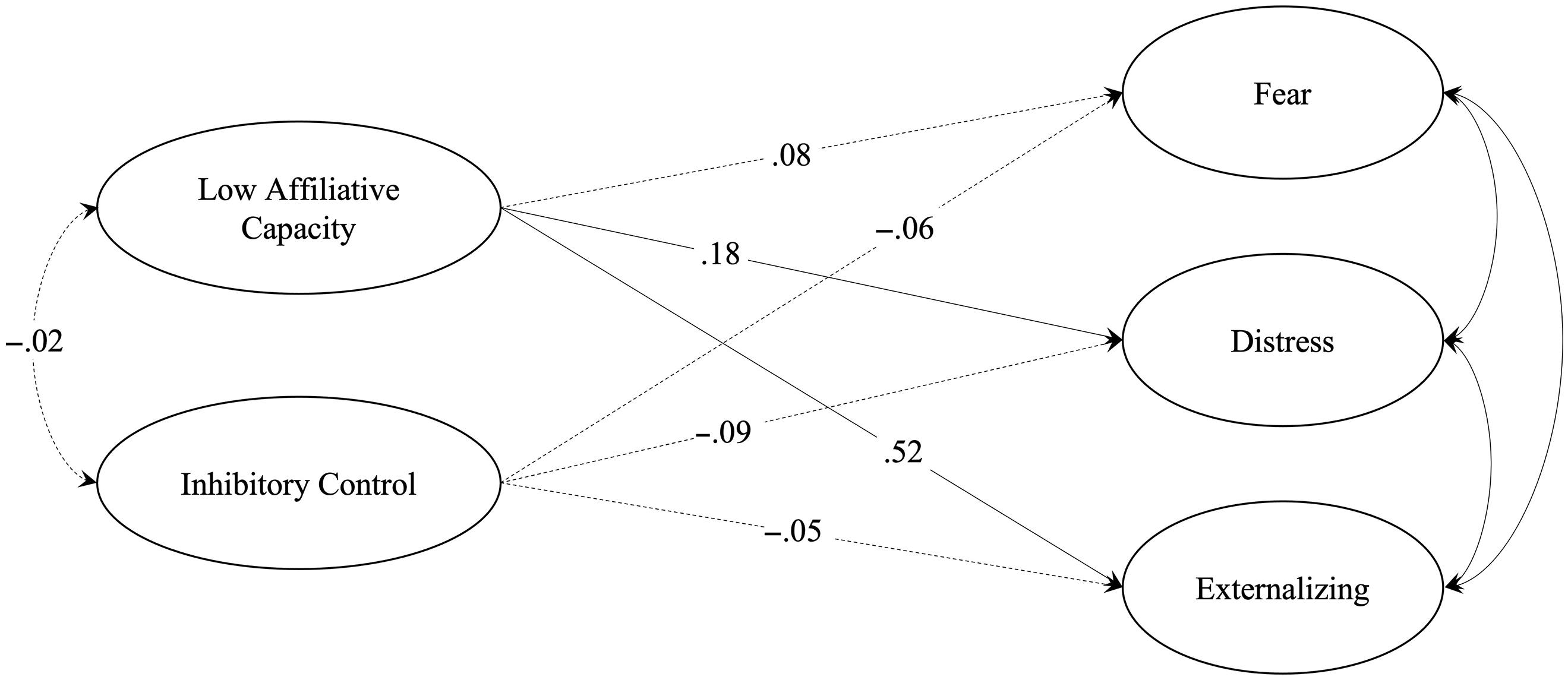
To test for unique effects of AFF– and INH in the prediction of broad dimensions of psychopathology, the Fear, Distress, and Externalizing dimensions were regressed onto AFF– and INH, simultaneously. As shown in Figure 4, neither Meanness/AFF– nor INH were unique significant predictors of Fear (ß AFF = .077, p = .084; ß INH = −.060, p = .357). AFF–, however, evidenced significant associations with both Distress (ß AFF = .176, p < .001) and Externalizing (ß AFF = .524, p < .001); importantly, the unique effect of AFF– was in the same direction for Distress and Externalizing, indicating that low AFF is a risk factor for symptomatology within both domains of psychopathology. Main effects of INH did not meet conventional cutoffs for statistical significance for either Distress (ß INH = −.085, p = .191) or Externalizing (ß INH = −.052, p = .252).
Main effect of low affiliative capacity and inhibitory control on factors of psychopathology; N = 1671.

Moderating effect of inhibitory control on the relationship between affiliative capacity and psychopathology
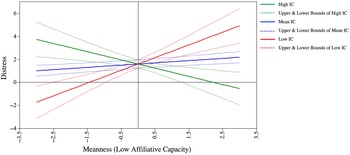
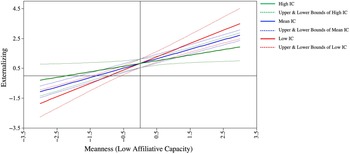
To test for possible moderating effects of INH on the relationship between AFF– and psychopathology factors, Fear, Distress, and Externalizing were regressed simultaneously onto AFF–, INH, and the product term for these two latent factors (i.e., AFF–*INH). The region of significance signifies the specific values of the moderator at which the slope of the regression of the outcome on the focal predictor transitions from non-significance to significance, such that values are significant outside of the given region are significant. Consistent with hypotheses, INH did not evidence a significant moderating effect on the relationship between AFF– and Fear (ß AFFxINH = −.140, p = .063), but the AFF–*INH interaction term emerged as a significant predictor of Distress (ß AFFxINH = .168, p = .037; region of significance = −0.09 to 0.37, N = 525, 31%), such that among individuals with low AFF, greater symptomatology was predicted by low INH, whereas high INH served as a protective factor against Distress symptoms (Figure 5). Finally, a significant moderating effect of INH on AFF– was evident in the prediction of Externalizing problems (ß AFFxINH = .101, p = .022; region of significance = −.04 to 0.91, N = 311, 19%). Probing of this relationship through simple slope analyses revealed low AFF to be a robust predictor of Externalizing symptoms, with the presence of low INH exacerbating this association (Figure 6).
Simple slopes plot of interaction between HBN meanness (low affiliative capacity) and inhibitory control in the prediction of distress.

Simple slopes plot of interaction between meanness (low affiliative capacity) and inhibitory control in the prediction of externalizing. Note. Region of significance: lower bound = −0.40, upper bound = 0.91; N = 311; 19%. Region of significance: lower bound = −0.09, upper bound = 0.37; N = 525, 31%.

Discussion
Given increasing interest in transdiagnostic models as a framework for understanding psychopathology (e.g., Insel et al., 2010; Kotov et al., Reference Kotov, Perlman, Gámez and Watson2017; Krueger et al., Reference Krueger and Markon2018), the current study was undertaken to demonstrate the multifinality associated with (low) affiliative capacity, and the potentially moderating effect of inhibitory control to explain the development of specific dimensions of psychopathology. Through integration of multiple units of analysis and careful operationalization of AFF and INH in an RDoC-conformant manner (i.e., Affiliation and Attachment and Inhibition constructs, respectively), the current study demonstrates the utility of integrating RDoC with quantitative-structural models of psychopathology (e.g., HiTOP) to facilitate progress in elucidating the etiology and common, as well as distinct, risk factors for psychopathology at various levels of specificity (Kozak & Cuthbert Reference Kozak and Cuthbert2016; Latzman et al., Reference Latzman and DeYoung2020; Michelini, Palumbo, DeYoung, Latzman, & Kotov, Reference Michelini, Palumbo, DeYoung, Latzman and Kotov2021). Further, investigation of transdiagnostic processes and their interplay in children allows for identification of developmental risk factors prior to the emergence of clinically significant impairment.
In service of this effort, the current study took a multi-modal, cross-informant approach to addressing the critical issue of method variance. Specifically, parent-reported AFF–, in conjunction with child-performed neurocognitive INH tasks, allowed us to investigate independent and interactive effects of transdiagnostic constructs on clinician-administered interview-based symptoms of psychopathology from a multimodal perspective (see Cuthbert & Insel, Reference Cuthbert and Insel2013).
Affiliative capacity and inhibitory control correlates of psychopathology dimensions
In the current study, items originating from existing parent-report measures were used to model a factorial dimension of AFF– (Palumbo et al., Reference Palumbo, Perkins, Yancey, Brislin, Patrick and Latzman2021). Contrary to a priori hypotheses, a one-factor model best accounted for observed covariance among item indicators of AFF–; although the two-factor structure demonstrated more robust fit, the variance captured by these factors reflected positive versus negative keying of items, rather than distinct content. Thus, a one-factor model was retained.
The AFF– factor was not significantly related to the Fear subfactor of internalizing but accounted for significant variance in the Distress and Externalizing factors, such that low AFF– served as a common predictor of greater symptoms of both types of psychopathology, albeit more strongly for externalizing. The relationship we found with externalizing has been extensively demonstrated the broader literature (for reviews, see Frick & White, Reference Frick and White2008; Hawes et al., Reference Hecht and Latzman2014). Our results are further in line with previous studies suggesting that the less consistent associations for AFF– (and related constructs such as callousness) with internalizing can be clarified by considering distress-based symptoms independently of fear symptoms (e.g., Latzman et al., 2019; Palumbo, Latzman, et al., Reference Palumbo, Latzman and Patrick2021; Palumbo, Perkins, et al., Reference Palumbo, Perkins, Yancey, Brislin, Patrick and Latzman2021; Waller, Hyde, et al., Reference Waller, Hyde, Grabell, Alves and Olson2015; Waller, Wright, et al., 2015). These observed effects likely reflect common processes underlying a lack of interest in social reciprocity and interpersonal relationships, withdrawal, and low mood (Gao & Zhang, Reference Gao and Zhang2016), consistent with the conceptualization of low AFF more broadly and with manifest symptoms of distress and externalizing syndromes.
Based on consideration of supporting literature (e.g., Draheim et al., Reference Draheim, Mashburn, Martin and Engle2019; Engle et al., Reference Engle, Tuholski, Laughlin and Conway1999; Hedge et al., Reference Hipwell, Pardini, Loeber, Sembower, Keenan and Stouthamer-Loeber2018; Washburn et al., Reference Watson, Levin-Aspenson, Waszczuk, Conway, Dalgleish, Dretsch, Eaton, Forbes, Forbush, Hobbs, Michelini, Nelson, Sellbomm, Slade, South, Sunderland, Waldman, Witthöft, Wright, Kotov and Krueger2015) and an iterative analytic process, INH was modeled via three neurocognitive task-based indicators consisting of accuracy scores for the Boxed and Flanker tasks, and mean reaction time for “go” trials of the SAIT task. There were no observed main effects of INH in the prediction of any of the three psychopathology dimensions, perhaps due to certain limiting factors. First, in line with the cognitive-neuroscience literature, which emphasizes the relatively late maturation of the prefrontal brain structures crucial for INH, developmental constraints may have restricted the range of INH capacity in the current sample (Bedard et al., Reference Bedard, Nichols, Barbosa, Schachar, Logan and Tannock2002; Dowsett & Livesey, Reference Dowsett and Livesey2000; Ridderinkhof et al., Reference Rosenbaum, Biederman, Bolduc-Murphy, Faraone, Chaloff, Hirshfeld and Kagan1999; Williams et al., Reference Zald and Lahey1999) relative to variation observed in older samples. A restricted range of INH would hamper efforts to test for moderating effects of this dispositional factor. In addition, it has been argued that experience with neurocognitive tasks, or analogous activities in everyday life, can increase the acquisition of complex rules by placing demands on and increasing mastery of executive processes (Dowsett & Livesey, Reference Dowsett and Livesey2000); such exposure likely varies substantially between ages 5 and 10 years old. Lastly, it may be that low INH contributes to risk for psychopathology more in the presence of other temperament traits or cognitive abilities than in isolation (e.g., De Pauw & Mervielde, Reference De Pauw and Mervielde2010; Muris & Ollendick, Reference Muthen and Muthen2005; Rettew & McKee, Reference Ridderinkhof, Band and Logan2005; Palumbo, Latzman, et al., Reference Palumbo, Latzman and Patrick2021).
Joint contributions of affiliative capacity and inhibitory control in the explanation of psychopathology
As expected, the moderating effect of INH on AFF– in the prediction of Fear-based symptoms did not reach statistical significance; however, the direction of association, whilst nonsignificant, was notably opposite to that observed for Distress and Externalizing symptoms. Contrary to hypotheses, however, among participants low in AFF, lower scores on INH exacerbated risk for Distress; that is, high INH, operationalized via cognitive-task performance, appeared to operate as a protective factor against Distress symptomatology in the presence of low AFF. This unexpected finding may be attributable to the current operationalization of high INH reflecting adaptive abilities, rather than the excessive degree of inhibition that motivates problematic behavior. Specifically, the mechanisms underlying poor performance (i.e., the tendency for poor impulse control vs. problems with initiation) may not be considered independently but, rather, are contributing comparably to low INH.
Coupled with low AFF, the results of the current study suggest that poor INH appears to exacerbate risk for externalizing problems. Notably, low AFF appears to be a robust predictor of externalizing psychopathology, with its antagonistic elements contributing in particular to antisocial-aggressive expressions of externalizing proneness, irrespective of degree of disinhibition. Whereas both low AFF (i.e., callousness or meanness) and low INH (i.e., disinhibition) are well established as correlates of externalizing proneness (Frick & White, Reference Frick and White2008; Hawes et al., Reference Hecht and Latzman2014; Nelson & Foell, 2018; Krueger et al., Reference Krueger, Markon, Patrick, Benning and Kramer2007; Krueger et al., 2001), the current results suggest the possibility that, in young children, low INH may contribute to externalizing only in the presence of low AFF, rather than in isolation. These results are in line with a recent study of young children (Palumbo, Latzman, et al., Reference Palumbo, Latzman and Patrick2021) that found the association between disinhibition and externalizing psychopathology to vary by level of AFF–, operationalized as dispositional meanness. Importantly, this study focused on an externalizing composite that specifically encompassed oppositional, rule-breaking, and aggressive behaviors – with attentional problems considered separately. Taken together, the major processes underlying disinhibited externalizing (i.e., substance use and inattention/hyperactivity) may be distinct from those influencing antagonistic externalizing. This is consistent with the externalizing spectrum model (Krueger et al., Reference Krueger, Markon, Patrick, Benning and Kramer2007), as well as the more recently developed Hierarchical Taxonomy of Psychopathology (HiTOP; Kotov et al., Reference Kotov, Perlman, Gámez and Watson2017); however, further research is needed to confirm such a distinction.
Although the hypothesis of divergent developmental trajectories was only partially supported in the present study (i.e., in the presence of low AFF, low INH predicted higher levels of both distress and externalizing symptoms), these results are in line with the current state of the field and serve to highlight outstanding gaps in the literature. There is a critical need to clarify underlying mechanisms of poor INH, as broader-level analyses likely obscure differential relations with broad dimensions of psychopathology. For example, Naragon-Gainey and Simms (Reference Naragon-Gainey and Simms2017) found that, whereas internalizing and externalizing psychopathology evidenced opposing associations (negative and positive, respectively) with two trait constructs similar to INH, conscientiousness and disinhibition, unique associations were observed with lower-order facets of these traits. Specifically, whereas distress disorders and antagonistic externalizing disorders were both negatively associated with conscientiousness (high INH), these associations were uniquely driven by feelings of low self-efficacy/competence and low deliberation or impulsivity, respectively. Overall, the current results, together with prior work, highlight a pressing need to identify and utilize measures that isolate components of cognitive control in research seeking to elucidate specific mechanisms underlying poor INH that contribute to the differential expression of psychopathology.
Limitations and future directions
Some notable limitations of the present study must be acknowledged, which highlight important avenues for future research. First, the current work was limited by the availability of measures within the larger HBN study protocol. While large, publicly accessible datasets, such as the CMI-HBN project, are advantageous, they pose limitations on what data are available for use. For example, it is recommended that new data collection efforts, which aim to optimize AFF measurement, carefully consider which instruments are selected for inclusion, being sure to include explicit assessment of socioemotional affiliation-related content to more fully capture the AFF dimension. For example, the inclusion of items regarding the desire, yet inability, to affiliate (e.g., “I have difficulty maintaining interpersonal relationships”), may allow for effective partitioning of AFF– factors (i.e., coldhearted demeanor/lack of empathy and social disconnect/withdrawal). It may then be possible to further elucidate unique associations among processes within the affiliative domain and broad dimensions of psychopathology. However, it is recommended that multimeasure, integrative, item-level factor analysis continue to be the analytic approach (e.g., Palumbo, Perkins, et al., Reference Palumbo, Perkins, Yancey, Brislin, Patrick and Latzman2021; Patrick et al., Reference Patrick, Iacono and Venables2019) as this allows for maximization of construct reliability while systematically removing error that would otherwise be included in manifest variables.
Another limitation of the current operationalization of AFF– is the purpose underlying the previous development of this index (Palumbo, Latzman, et al., Reference Palumbo, Latzman and Patrick2021). Initially, this scale was developed as a child-analogous measure of dispositional antagonistic externalizing and is therefore located in the callousness vector space. Whereas meanness/callousness can be utilized as a proxy for low AFF, it likely reflects a subcomponent of a broader affiliative construct and requires further revision to be more fully situated within the conceptualization of socioemotional affiliation more broadly. Further, as this index was developed to be unidimensional, as is supported in the current study, consideration of item content and revision may facilitate the parcellation and investigation of distinct subfactors of AFF– in terms of their relations with clinical criterion measures.
In addition, despite the advantages of using different informants, it is possible that parents may not be accurate reporters of levels of AFF in their children, given that many of the emotional and cognitive items of this trait reflect internal processes and traits that are not directly observable in or communicated effectively by young children. Future studies may consider integrating scores across different informants in order to remove variance unique to a single reporter and isolate variance related to the construct of interest.
Several limitations surrounding INH also warrant discussion and further research. One notable limitation of the current operationalization of INH is the nature of the task-based indicators. As currently operationalized, this measure may be capturing processes related to effortful control, which reflects both attentional and inhibitory processes. This remains a pervasive concern within the literature, where these terms are often conflated, and is exacerbated by limitations of task-based measures that may not be sensitive to the uniqueness of these processes (described further below). Although the current study maximized approaches to overcome these limitations, future research may first seek to reaffirm these associations using psychometric measures (e.g., self-report) in which construct boundaries are clear to then build out this theory using robust biobehavioral measures.
Although the tasks included in the HBN protocol demonstrate considerable experimental reliability, with robust and easily replicable experimental effects (Hedge et al., Reference Hipwell, Pardini, Loeber, Sembower, Keenan and Stouthamer-Loeber2018), this can largely be attributed to low between-subjects variability (Dang et al., Reference Dang, King and Inzlicht2020). Inopportunely, between-subjects variability is necessary to detect individual differences in task performance, raising questions about the utility of such tasks in correlational research. Although the indicators used in the current study are not without their own limitations, they have been shown to be preferable to difference scores (i.e., a subject’s performance in one condition is subtracted from their performance in another condition), which fail to overcome these concerns and are poorly suited for the purpose of differential and developmental research (Draheim et al., Reference Draheim, Mashburn, Martin and Engle2019). Further, it is important to note that the latent modeling approach facilitates the isolation of variance within these indicators associated with INH processes, while parceling out error-related or non-related variance, thereby increasing construct reliability (Engle et al., Reference Engle, Tuholski, Laughlin and Conway1999; Washburn et al., Reference Watson, Levin-Aspenson, Waszczuk, Conway, Dalgleish, Dretsch, Eaton, Forbes, Forbush, Hobbs, Michelini, Nelson, Sellbomm, Slade, South, Sunderland, Waldman, Witthöft, Wright, Kotov and Krueger2015).
Consistent with suggestions for future research (Draheim et al., Reference Draheim, Mashburn, Martin and Engle2019; Magnus et al., Reference Magnus, Willoughby, Blair and Kuhn2019), the current study operationalized INH through the joint use of accuracy and reaction time data, which has been shown to result in modest improvements in the measurement precision and reliability of INH abilities, particularly in early school-aged children (Magnus et al., Reference Magnus, Willoughby, Blair and Kuhn2019). This combined approach further reduced floor and ceiling effects that often occur when accuracy data alone are considered. Although integration of such indicators in the current study (i.e., Boxed and Flanker accuracy and SAIT reaction time) may improve between-subject reliability, the underlying mechanisms behind subject performance (i.e., over- or under-controlled) may be less well captured,
Future researchers may consider operationalizing AFF and INH by fully integrating multiple units of analysis and multiple informants into each of their target constructs. Previous work indexing AFF– (Palumbo, Perkins, et al., Reference Palumbo, Perkins, Yancey, Brislin, Patrick and Latzman2021) and INH (Patrick et al., Reference Patrick, Kramer, Krueger and Markon2013; Venables et al., 2018) has successfully integrated neurophysiological indicators, task-based performance, and psychometric scale measures to 1) address concerns regarding method variance, and 2) operationalize such constructs in a manner that facilitates the interface between biological (i.e., RDoC) and quantitatively derived psychiatric nosologies (i.e., HiTOP) (Latzman et al., Reference Latzman and DeYoung2020; Perkins et al., Reference Perkins, Latzman and Patrick2020).
Finally, the current analyses were exclusively cross-sectional in nature. To establish trait measures as predictive risk factors for psychopathology, follow-up assessments of psychopathology at later time points will be needed. Alternatively, although indirect, developmental risk may be assessed through the comparison of unique and interactive effects within different age cohorts. Fortunately, the HBN project was designed as a prospective-longitudinal study, with an age range of 5–21 years, and therefore additional follow-up assessments and availability of older cohorts (i.e., young adolescence and young adulthood) will be available in the future.
Conclusions
Notwithstanding these limitations, the current study provides notable insights into the unique contributions of fundamental transdiagnostic biobehavioral processes, and the interplay between them, in the explication of dimensions of psychopathology in young children. Specifically, in a large sample of young children, low AFF predicted risk for distress, as opposed to fear-based internalizing, as well as externalizing symptomatology, which was further exacerbated by the presence of low INH. These results provide an example of how transdiagnostic biobehavioral processes can be interfaced with quantitatively derived dimensions of psychopathology in order to clarify common and distinct risk factors for psychopathology at varying levels of specificity, and illustrate the utility of a unified, dimensional, and neurobiologically grounded psychological nosology. Looking to the future, by incorporating additional developmentally sensitive indicators of AFF and INH from different measurement modalities (including self- and other-report, neurophysiology, and task performance), further systematic progress can be made in understanding the nature and bases of risk for psychopathology across periods of development.
Supplementary material
The supplementary material for this article can be found at https://doi.org/10.1017/S0954579422000347
Funding statement
This research received no specific grant from any funding agency, commercial, or not-for-profit sectors.
Conflicts of interest
None.