Childhood and adolescent problem behaviors have been related to a multitude of adverse developmental outcomes, including poor academic performance, increased risk for school drop-out, peer rejection, conflicts with family, and persistent, life-course antisocial behavior (Dodge & Pettit, Reference Dodge and Pettit2003; Tremblay, Reference Tremblay2000). Therefore, a main goal of developmental psychopathology is to understand the processes underlying developmental adaptation or dysfunction. One theme in developmental psychopathology is the need to understand these outcomes as residing in the adaptiveness of the relationship between the individual and context (Sameroff, Reference Sameroff1975; Sameroff & MacKenzie, Reference Sameroff and MacKenzie2003). Empirical studies, however, often implicitly view the individual and the context as static systems without an appreciation of changes in either individual or context. Moreover, a linear environmentalism that has a strong focus on the context but little to say about intraindividual processes is frequently emphasized (Smetana, Campione-Barr, & Metzger, Reference Smetana, Campione-Barr and Metzger2006). In this study, from a transactional perspective we aimed to increase the knowledge base on adolescent development, by examining how two types of externalizing and two types of parenting change as children progress throughout adolescence (age 9–17 years), by investigating interrelations between the development of these parenting and externalizing behaviors, and by exploring differences across parental and child gender in the development of, and interrelations between these parenting and externalizing behaviors.
Development of Adolescent Behaviors
Empirical studies have identified two related yet different externalizing behaviors, namely, aggressive and rule-breaking behaviors (see Dishion & Patterson, Reference Dishion, Patterson, Cohen and Cicchetti2006; Stanger, Achenbach, & Verhulst, Reference Stanger, Achenbach and Verhulst1997). Aggressive behaviors comprise overt problematic behaviors such as fighting and arguing a lot, whereas rule-breaking behaviors consist of more covert problematic behaviors such as stealing, truancy, or vandalism. Not all children who display the one behavior display the other type too, and aggressive and rule-breaking behaviors are differentially concurrently related to risk factors (for an overview, see Dishion & Patterson, Reference Dishion, Patterson, Cohen and Cicchetti2006; Prinzie, Onghena, & Hellinckx, Reference Prinzie, Onghena and Hellinckx2006). Further, aggressive and rule-breaking behaviors show different developmental trajectories. Both types of externalizing behaviors tend to decline throughout childhood (Prinzie et al., Reference Prinzie, Onghena and Hellinckx2006; Stanger et al., Reference Stanger, Achenbach and Verhulst1997) and aggression shows a continuing decreasing trend, but rule-breaking behaviors increase throughout adolescence (Bongers, Koot, Van der Ende, & Verhulst, Reference Bongers, Koot, Van der Ende and Verhulst2003, Reference Bongers, Koot, Van der Ende and Verhulst2004; Stanger et al., Reference Stanger, Achenbach and Verhulst1997). Therefore, in the current study, a distinction is made between aggressive and rule-breaking behaviors.
Development of Parenting Behaviors
Much research has indicated that family factors that are related to the parent–adolescent relationship are the most important in fostering or reducing problem behaviors (for an overview, see Dishion & Patterson, Reference Dishion, Patterson, Cohen and Cicchetti2006). Early adolescence is a critical period in the development of many risk behaviors, with some researchers even suggesting that early adolescence is the key period in which a trajectory is set for future problem behaviors (Pettit, Bates, Dodge, & Meece, Reference Pettit, Bates, Dodge and Meece1999). During adolescence children need support from their parents as they strive for autonomy. Two substantive parenting tasks during this period are, first, to set and enforce reasonable rules and standards, and second, to provide a safe, warm, and nurturing environment. These two parental tasks are conceptualized as two dimensions that are consistently used to describe parenting: control and support (for overviews, see Paulussen-Hoogenboom, Stams, Hermanns, & Peetsma, Reference Paulussen-Hoogenboom, Stams, Hermanns and Peetsma2007; Smetana et al., Reference Smetana, Campione-Barr and Metzger2006). An important aspect of the control dimension is behavioral control, which comprises behaviors with which parents try to constrain children's behaviors, such as parental rules, regulations, and supervision. Negative strategies of control, which are characterized by high power assertion, intrusiveness, overinvolvement, or overreactive behavior, are likely to be unsupportive of autonomy in the child and thus may be particularly problematic, resulting in a poor fit between the adolescent's developmental stage and the parenting context (Eccles et al., Reference Eccles, Midgley, Wigfield, Miller Buchanan, Reuman and Flanagan1993). Negative control strategies, such as coercive discipline and the conceptually related overreactive discipline, have been found to be associated with externalizing behaviors (Deković, Janssens, & Van As, Reference Deković, Janssens and Van As2003; Van den Akker, Deković, & Prinzie, Reference Van den Akker, Deković and Prinzie2010; for overviews, see Dishion & Patterson, Reference Dishion, Patterson, Cohen and Cicchetti2006; Smetana et al., Reference Smetana, Campione-Barr and Metzger2006). The second parenting dimension, support, comprises behaviors that make the child feel comfortable in the relationship with his parent. An important aspect of supportive parenting regards parental warmth and involvement, which is considered indispensable for the formation of secure attachments. A closer, more secure attachment to parents during adolescence promotes normative socialization opportunities and is related to a reduced chance of negative adolescent behaviors (Rothbaum & Weisz, Reference Rothbaum and Weisz1994).
Parenting behaviors are known to vary with child age. Empirical work indicates that harsh discipline decreases as children grow older (Loeber et al., Reference Loeber, Drinkwater, Yin, Anderson, Schmidt and Crawford2000; Smetana et al., Reference Smetana, Campione-Barr and Metzger2006). Further, both adolescents' perceptions and objectively observed assessments of warmth in parent–adolescent relationships decline throughout childhood and adolescence (Loeber et al. Reference Loeber, Drinkwater, Yin, Anderson, Schmidt and Crawford2000; Smetana et al., Reference Smetana, Campione-Barr and Metzger2006). In the current study, therefore, two parenting behaviors that fall into the typology of behavioral control (overreactivity) and support (warmth) are examined from a developmental perspective by specifically addressing changes in each parenting behavior.
Child on Parent Effects
Parenting behaviors not only cause child behaviors but are also displayed in response to child behaviors (Bell, Reference Bell1968). In his process model of parenting, Belsky (Reference Belsky1984) too posits that in addition to characteristics of the parent and of the social context, characteristics and behaviors of the child should be considered when examining why parents parent the way they do (Belsky & Barends, Reference Belsky, Barends, Bornstein and Webber2002). Shiner and Caspi (Reference Shiner and Caspi2003) similarly emphasize that through environmental solicitation child characteristics and behaviors shape the responses of the immediate environment (parents, peers) to the child. Empirical work shows evidence of child on parent effects beginning already in the first few months of life (Borkenau & Liebler, Reference Borkenau and Liebler1995). These elicitation processes may become more prominent as children grow older. For example, a number of longitudinal studies show an increment of negative disciplinary techniques (Deković et al., Reference Deković, Janssens and Van As2003; Laird, Pettit, Bates, & Dodge, Reference Laird, Pettit, Bates and Dodge2003) and diminishing levels of positive parenting behaviors, such as warmth in response to externalizing behaviors of children (Deković et al., Reference Deković, Janssens and Van As2003; Scaramella, Conger, Spoth, & Simons, Reference Scaramella, Conger, Spoth and Simons2002; Stice & Barrera, Reference Stice and Barrera1995).
Transactional Relations
Although existing studies offer insight in bidirectional relations between levels of externalizing and levels of parenting, family processes and adolescent behaviors should be viewed as coevolving. A useful theoretical approach to understanding the interrelated development of parenting and externalizing behaviors is provided by the coercion model (Patterson, Reference Patterson1982; Patterson, Reid, & Dishion, Reference Patterson, Reid and Dishion1992). Coercion theory is a model that describes at two different but interrelated levels how parents and children mutually reinforce each other to increase the probability that children develop behavior problems and that parents' control over these aversive behaviors will decrease. The first level consists of a description of coercive interactions which are, in short, characterized by parental demands for compliance, the child's refusal to comply and his or her escalating complaints, the parent's capitulation, and finally, the child's backing off. These coercive interactions can be viewed as the fundamental microsocial behavioral mechanisms by which externalizing behaviors emerge and stabilize over development (Granic & Patterson, Reference Granic and Patterson2006). The second level of coercion theory consists of a multimethod- and multiagent-defined macromodel that describes in very general terms how parenting practices control the contingent parent–child interactions. A strong correlation has been found between harsh, abrasive, and inconsistent parental discipline, parental monitoring, and child externalizing behavior (for overviews, see Dishion & Patterson, Reference Dishion, Patterson, Cohen and Cicchetti2006; Smetana et al., Reference Smetana, Campione-Barr and Metzger2006). According to this model, the impact of contextual variables (social disadvantage, divorce) and of children's characteristics on child adjustment is mediated by the impact on parenting practices (Patterson et al., Reference Patterson, Reid and Dishion1992).
Although the transactional perspective acknowledges that child and parent behaviors coevolve, few empirical studies have examined how changes in parenting are related to (the development of) adolescent problem behaviors. The limited empirical work that has examined this issue found that increases in overreactive parenting (Van den Akker et al., Reference Van den Akker, Deković and Prinzie2010) and in inconsistent discipline and parental rejection (Lengua, Reference Lengua2006) from childhood to middle adolescence were related to higher levels of adolescent externalizing behaviors in middle adolescence. These results show that a developmental perspective is needed when examining relations between externalizing and parenting behaviors.
To summarize, both theory and empirical research indicate that a simultaneous examination of child and parenting effects may substantially improve the description, prediction, and explanation of adolescent development. Researchers have to take into account the fact that adolescent behaviors and parenting change over time. In the current study we recognize the importance of studying both child and parental behaviors while explicitly taking into account the possibility that child and parental behaviors change over time. In addition, we incorporate bidirectional effects to study how and when adolescent externalizing and parenting behaviors impact each other.
Gender and Individual Differences
An examination of transactional relations between adolescent and parenting behaviors should acknowledge both gender and interindividual differences. The prevalence of externalizing behaviors across ages is higher among boys than girls (for an overview, see Dishion & Patterson, Reference Dishion, Patterson, Cohen and Cicchetti2006). Parenting has also been shown to be (partly) gender specific, although most of this knowledge regards the parenting of mothers, as fathers are relatively understudied. Mothers have been observed to display more warmth to daughters than to sons (Prinzie, Van der Sluis, De Haan, & Deković, Reference Prinzie, Van der Sluis, De Haan and Deković2010) and to show more harsh discipline with boys than with girls (McKee et al., Reference McKee, Roland, Coffelt, Olson, Forehand and Massari2007). Fathers may not distinguish between boys and girls in their parenting to the extent that mothers do (Deković & Groenendaal, Reference Deković and Groenendaal1997).
In addition, although gender intensification theory suggests that adolescent girls may respond more strongly to disruptions in family relationships, given the salience of interpersonal relationships during this period (Hill & Lynch, Reference Hill, Lynch, Brooks-Gunn and Petersen1983), empirical evidence regarding this issue remains inconclusive. Several empirical studies support gender intensification theory and indicate that maladaptive parental coping (Davies & Windle, Reference Davies and Windle1997) and closeness to fathers (Werner & Silbereisen, Reference Werner and Silbereisen2003) is related to externalizing behaviors more strongly among girls than boys. Another study, however, indicates that boys are more likely than girls to respond with oppositional behaviors to maternal controlling behaviors (McFadyen-Ketchum, Bates, Dodge, & Pettit, Reference McFadyen-Ketchum, Bates, Dodge and Pettit1996), and other longitudinal studies do not find gender differences in associations between boys' and girls' externalizing behaviors and maternal negative discipline (Combs-Ronto, Olson, Lunkenheimer, & Sameroff, Reference Combs-Ronto, Olson, Lunkenheimer and Sameroff2009) or warmth (Eisenberg et al., Reference Eisenberg, Zhou, Spinrad, Valiente, Fabes and Liew2005). No longitudinal studies on relations between adolescent externalizing and parenting have, to our knowledge, included both mothers and fathers and empirical work that has included both boys and girls is still very limited. It is therefore difficult to draw conclusions about gender-specific associations between adolescent and parenting behaviors.
Moreover, research should acknowledge the developmental heterogeneity in the development of child externalizing and parenting behaviors. Individual differences might be situated in both differences between individuals in the development of child and parental behaviors, and in differential relations between child and parental behaviors.
In the current study, we include both parents and test for possible differences in the associations across both parental and child gender, while incorporating interindividual differences in the interrelated development of adolescent and parent behaviors.
Aims and Hypotheses
The overarching aim of the current study is to increase understanding of how the development of boys' and girls' aggressive and rule-breaking behaviors is associated with the development of maternal and paternal overreactivity and warmth. We examined (a) developmental change in each behavior, (b) interrelations between the development of externalizing and the development of parenting separately for the two types of externalizing and the two types of parenting behaviors, and (c) direction of effects across adolescence. For each of these aims, we also explored (d) child and/or parental gender differences.
Based on theory and empirical work the following hypotheses were formulated. First, children are expected to decline in aggressive behaviors and increase in rule-breaking behaviors (e.g., Stanger et al., Reference Stanger, Achenbach and Verhulst1997). Further, parents are expected to decline in levels of warmth and overreactivity (Smetana et al., Reference Smetana, Campione-Barr and Metzger2006).
Second, it is hypothesized that aggressive and rule-breaking behaviors at child age 9 years are positively concurrently related to overreactivity and negatively concurrently related to warmth. In addition, regarding interrelations between the development of externalizing and the development of parenting, two sets of hypotheses were formulated. It can be expected that children whose parents display higher overreactivity and lower warmth when the child is aged nine decrease less in aggression and/or increase more in rule-breaking behaviors (Dishion & Patterson, Reference Dishion, Patterson, Cohen and Cicchetti2006; Smetana et al., Reference Smetana, Campione-Barr and Metzger2006). Conversely, parents whose children display higher levels of either externalizing behavior at age nine are expected to decrease less in overreactivity and decrease more in warmth over time.
Third, regarding direction of effects, we expect that higher overreactivity and lower warmth are related to higher aggression and rule breaking at a later time point. Conversely, higher levels of either externalizing behavior are expected to be related to higher levels of overreactivity and lower levels of warmth at a later time point.
Fourth, girls are hypothesized to display less aggressive and rule-breaking behaviors at age 9 years. However, we do not necessarily expect boys and girls to change differentially in aggressive and rule-breaking behaviors. Mothers are expected to display more warmth and lower overreactivity toward daughters than sons aged 9 years (Larson & Richards, Reference Larson and Richards1994; Laursen, Coy, & Collins, Reference Laursen, Coy and Collins1998; Prinzie et al., Reference Prinzie, Van der Sluis, De Haan and Deković2010). Because gender differences in the development of parenting have been scarcely studied, our examination of this issue is exploratory. Further, given the inconsistent findings regarding interrelations between parenting and boys' and girls' externalizing, no hypotheses regarding gender differences in the interrelations between parenting and externalizing were formulated.
Method
Procedure and participants
This study is part of the longitudinal Flemish Study on Parenting, Personality, and Development that started in 1999 (Prinzie et al., Reference Prinzie, Onghena, Hellinckx, Grietens, Ghesquière and Colpin2003). A proportional stratified sample of elementary school-aged children attending regular schools was randomly selected. Strata were constructed according to geographical location, sex, and age. All participants gave written informed consent. Recruitment procedures are described more extensively in Prinzie and colleagues (Reference Prinzie, Onghena, Hellinckx, Grietens, Ghesquière and Colpin2003).
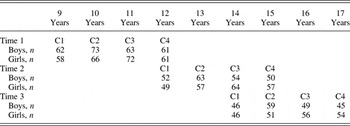
At Time 1 (T1; 2004), 511 mothers, and 478 fathers participated (a total of 516 families). All participants had the Belgian nationality. Children's ages ranged between 9 and 12 years (M = 10 years, 6 months), 50.2% (N = 259) were girls. Mothers' age ranged between 36 and 61 years (M = 45 years, 7 months), fathers' age ranged between 37 and 69 years (M = 47 years, 7 months). At T1, 491 families (95.7%) were a two-parent household, 19 families (3.7%) were divorced. Of three families (0.6%) the father had passed away, and three families (0.6%) did not indicate household composition. The number of children living at home ranged between one and seven (mean = 2.4 children). Percentages of mothers (M) and fathers (F) with various educational levels were elementary school, M = 0.9%, F = 3.0%; secondary education, M = 41.1%, F = 43.3%; nonuniversity higher education, M = 45.2%, F = 34.4%; and university, M = 12.8%, F = 19.2%. Mothers' and fathers' average vocational levels, scored on a 6-point scale (6 = highest vocational level; Van Westerlaak, Kropman, & Collaris, Reference Van Westerlaak, Kropman and Collaris1975) were 3.49 (SD = 1.38) for mothers and 3.59 (SD = 1.58) for fathers. At Time 2 (T2; 2007), 446 families participated (441 mothers, 413 fathers; 86% of the original sample), and at Time 3 (T3; 2009) 412 families participated (404 mothers, 374 fathers; 80% of the original sample). For an overview of the exact numbers of boys and girls in each cohort at T1, T2, and T3 (see Table 1).
Number of boys (B) and girls (G) in each cohort (C) at each measurement wave

Mothers and fathers rated their own parenting and child externalizing behaviors at T1, T2, and T3. Given their high intercorrelations for externalizing, ranging from .57 to .67 (ps < .001) for aggression, and from .59 to .65 (ps < .001) for rule-breaking behaviors, father and mother ratings were averaged. In this way, observer bias was reduced. We employed a cohort-sequential design, and combined information from four cohorts (aged 9, 10, 11, and 12 years at T1) to approximate a longitudinal study from ages 9 to 17 years (Nesselroade & Baltes, Reference Nesselroade and Baltes1979). There were no significant differences between respondents having missing values at T2 and/or T3 regarding either their parenting scores or child aggressive/rule-breaking scores at T1. For mothers and fathers, missing values were completely at random. Values of Little's missing completely at random were χ2 (215, N = 511) = 183.91, p = .94 and χ2 (270, N = 481) = 274.81, p = .41, respectively. Therefore, to maximize sample size at T2 and T3, missing values were imputed with the expected-maximization algorithm (Schafer & Graham, Reference Schafer and Graham2002). In this way, data from all participants for who scores regarding either parenting or externalizing behaviors were available at Time 1 could be included in the analyses.
Measures
Aggressive and rule-breaking behaviors
Aggressive and rule-breaking behaviors were assessed by mothers and fathers using the Dutch translation of the Child Behavior Checklist (CBCL; Achenbach, Reference Achenbach1991; Verhulst, Van der Ende, & Koot, Reference Verhulst, Van der Ende and Koot1996). The CBCL is an extensively validated instrument with adequate reliability and validity (Achenbach, Reference Achenbach1991; Verhulst et al., Reference Verhulst, Van der Ende and Koot1996). Each item is rated as 0 = not true, 1 = somewhat/sometimes true, or 2 = very/often true. Cronbach alphas for the composite score of aggression (20 items) at T1, T2, and T3 were 0.90, 0.90, and 0.89, respectively, and for rule breaking (13 items) were 0.70, 0.73, and 0.80, respectively.
Overreactivity
Mothers and fathers rated their own overreactive parenting using the overreactivity scale of the Parenting Scale (Arnold, O'Leary, Wolff, & Acker, Reference Arnold, O'Leary, Wolff and Acker1993; Prinzie, Onghena, & Hellinckx, Reference Prinzie, Onghena and Hellinckx2007). Overreactivity consists of nine items and measures parents' tendency to respond with anger, frustration, meanness and irritation, impatiently and aversively to problematic behavior of their children. Items present discipline encounters followed by two options that act as opposite anchor points for a 7-point scale where 1 indicates a high probability of using an effective discipline strategy (e.g., “When my child misbehaves. . . ” “I speak to him/her calmly”) and 7 indicates a high probability of making a discipline mistake (“I raise my voice or yell”). The instrument has adequate test–retest reliability, distinguishes clinical from nonclinical samples, and has been validated against behavioral observations of parenting (Arnold et al., Reference Arnold, O'Leary, Wolff and Acker1993; Locke & Prinz, Reference Locke and Prinz2002). In this study, Cronbach's alphas for mothers' and fathers' overreactivity were at T1, T2, and T3 0.77/0.76, 0.78/0.81, and 0.80/0.84, respectively. Mothers' and fathers' overreactivity scores were moderately correlated, correlations ranged between r = .24, p < .001 (2007) and r = .27, p < .001 (2004).
Warmth
Mothers and fathers assessed their own warmth using the warmth/involvement scale of the Parenting Practices Questionnaire (Robinson, Mandleco, Olsen, & Hart, Reference Robinson, Mandleco, Olsen and Hart1995). This scale comprises 11 items and assesses the extent to which parents exhibit warm parenting and are involved in their children's lives (e.g., “I show empathy when my child is hurt or frustrated”). Items are on a 5-point scale ranging from 1 = never to 5 = always. In this study, Cronbach alphas for mothers' and fathers' warmth at T1, T2, and T3 were 0.82/0.87, 0.85/0.86, and 0.87/0.91, respectively. Mothers' and fathers' warmth were moderately correlated, and intercorrelations ranged between r = .26, p < .001 (2009) and r = .33, p < .001 (2004).
Overview of analyses
The overarching goal of the current study was to increase existing knowledge on associations between the development of girls' and boys' aggressive and rule-breaking behaviors and the development of maternal and paternal dysfunctional discipline and supportive parenting. First, the shape of growth of each of the externalizing and the parenting behaviors was examined and subsequently, interrelations between the growth trajectories of externalizing and of parenting were investigated. Finally, we examined directionality of effects between, at the one hand, externalizing, and at the other, parenting behaviors. For all analyses, a distinction was made between boys and girls using a multigroup design. The specifics of each analysis are given in the relevant section of the results. All analyses were conducted in M-Plus version 5.0 (Muthén & Muthén, Reference Muthén and Muthén2004). Because a nonsignificant chi-square statistic is unlikely given the sample size, we also included comparative fit index, Tucker Lewis index, and root mean square error analysis statistics. The minimal requirements for adequate structural equation modeling model fit include comparative fit index and Tucker Lewis index values larger than 0.90 and root mean square error analysis smaller than 0.08 (Kline, Reference Kline1998).
Results
Preliminary analyses and descriptive statistics
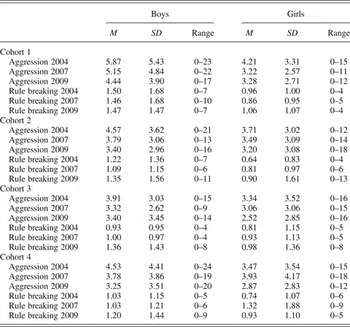
Raw score means, standard deviations, and ranges for the aggressive and rule-breaking scores are presented in Table 2, for each cohort separately and with a distinction between boys and girls. Compared to a large norm group (Bongers et al., Reference Bongers, Koot, Van der Ende and Verhulst2003) the current sample shows somewhat less aggression, although this difference seems to decrease with increasing age. The current sample has nearly identical scores in terms of average scores on rule-breaking behaviors. The percentages of this sample in the normative, subclinical, and clinical ranges of aggressive behaviors were at each time point around 92%, 3% and 5%, respectively, and for rule-breaking behaviors around 93%, 3%, and 4%, respectively (Verhulst et al., Reference Verhulst, Van der Ende and Koot1996). Aggression and rule-breaking scores were positively skewed (mean γ1 = 2.16, range = 1.79–3.05, ps < .05) and leptokurtic (mean γ2 = 7.28, range = 4.18–15.38, ps < .01). After taking the square roots, the scores showed nonsignificant skewness (mean γ1 = 0.29, range = 0.16–0.41, ps > .05) and kurtosis (mean γ2 = 0.20, range = 0.05–0.40 ps > .05).
Descriptive statistics for the Child Behavior Checklist scores

Development of adolescent and parenting behaviors: Univariate growth models
To address the shape of change in adolescent and parental behaviors, univariate latent growth models were fitted (Duncan, Duncan, & Strycker, Reference Duncan, Duncan and Strycker2006). Growth models are able to test linear and nonlinear growth and when used in a multigroup design, allow for testing for cohort and gender differences. Cohort differences can be addressed because of the cohort-sequential design where different but overlapping cohorts are assessed at each time point (see Table 1), whereas child gender differences can be investigated by including both boys and girls in the more traditional multigroup design.
With these univariate growth models, the following growth parameters were examined. First, mean initial levels (intercepts) of each externalizing behavior and of each parenting behavior when children were aged 9 years were investigated. Second, mean changes (slopes) in these constructs between child age 9 and 17 years were examined. In addition, it was explored whether the initial level in a given behavior was related to the change in this behavior (intercept–slope covariances). Further, the extent to which people differ in initial levels and changes over time was examined (variances around means intercept and slope). In a final step, we explored whether (mothers and fathers of) boys and girls differed in their mean initial levels, in mean changes, in relations between initial levels and changes, and in the extent to which they show interindividual variability in development. Gender differences were explored by comparing a baseline model in which all growth parameters were free to vary across gender, with a constrained model in which the growth parameters were constrained to be equal across child gender. If the constrained model yielded significantly worse fit to the data (i.e., a significant increase in chi-square), each of the growth parameters was tested separately for differences between boys and girls.
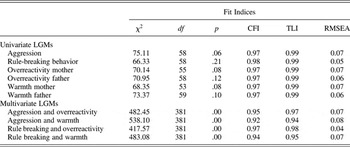
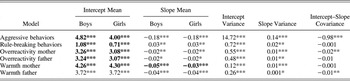
Fit statistics for all univariate linear growth models (LGMs) are included in Table 3, and growth parameter estimates of the univariate LGMs are presented in Table 4. Only the best-fitting models are presented to conserve space. Lack of significant modification indices indicated that there were no cohort effects, that is, the four cohorts could be used to approximate a common longitudinal curve (Duncan et al., Reference Duncan, Duncan and Strycker2006). LGMs did not fit the data significantly worse than unspecified growth models for aggression, Δχ2 (7) = 5.08, p = .65, rule breaking, Δχ2 (7) = 10.91, p = .14, overreactivity mother, Δχ2 (7) = 7.15, p = .41, overreactivity father, Δχ2 (7) = 12.97, p = .07, warmth mother, Δχ2 (7) = 9.97, p = .19, or warmth father, Δχ2 (7) = 14.01, p = .05. Thus, the development of all constructs could be captured by LGMs. To facilitate interpretation, the trajectories were transformed back to the original metric of the CBCL.
Model fit indices of the univariate and the multivariate multigroup latent growth models (LGMs)

Note: CFI, comparative fit index; TLI, Tucker–Lewis index; RMSEA, root mean square error of approximation.
Multigroup univariate latent growth models' fixed effects, variances, and parameter covariances

Note: Coefficients in bold indicate statistically significant (p < .05) gender differences in the respective growth parameter.
*p < .05. **p < .01. ***p < .001.
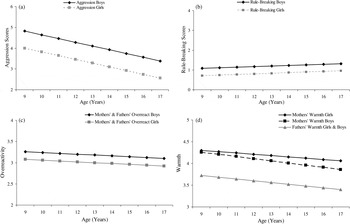
Several gender differences were found for the development of aggression and rule-breaking behaviors. Boys showed higher levels of aggressive and rule-breaking behaviors at age 9 years than girls, Δχ2 (1) = 8.12, p < .001, and Δχ2 (1) = 11.20, p < .001, respectively. However, boys and girls decreased to a similar extent in levels of aggression and increased similarly in levels of rule-breaking behaviors between ages 9 and 17 years (Figure 1a and 1b). The size of the growth in rule-breaking behaviors was, however, only modest. There were significant interindividual differences in initial levels of and in changes in both externalizing behaviors. No gender group differences were found for the amount of variance around initial levels and changes over time or for the interrelations between initial levels and changes. The interrelations between initial levels and changes in aggression and rule-breaking behaviors suggest that those children who showed higher levels of aggression at age 9 decreased less in aggression over time, but initial levels and changes in rule-breaking behaviors were not significantly related (Table 4). Mothers and fathers showed higher levels of overreactivity toward boys than girls aged 9 years, Δχ2 (1) = 11.91, p < .001, and Δχ2 (1) = 6.34, p < .05, respectively. Mothers and fathers decreased in levels of overreactivity, and no differences in the extent of the changes for the overreactivity of sons versus daughters were found (Figure 1c) Mothers, but not fathers, displayed higher levels of warmth toward girls than boys aged 9 years, Δχ2 (1) = 5.47, p < .05. Mothers and fathers decreased in levels of warmth throughout their child's adolescence, and mothers decreased more in warmth toward sons than daughters, Δχ2 (1) = 4.83, p < .001 (Figure 1d). For both parents, significant interindividual variability in initial levels of and in changes in both parenting behaviors were found, and the amount of variance around initial levels and changes did not differ for mothers versus fathers, or for parents of boys versus girls. For mothers, but not fathers, higher initial levels of overreactivity were related to smaller decreases over time. For fathers, but not mothers, higher initial levels of warmth were related to smaller decreases over time (Table 4).
Development of boys' and girls' (a) aggressive and (b) rule-breaking behaviors, and mothers' and fathers' (c) overreactivity and (d) warmth. All coefficients are unstandardized. *p < .05. **p < .01. ***p < .001.

Relations between adolescent and parenting behaviors: Multivariate growth models
In the next step, we examined whether the development of parenting behaviors was associated with the development of externalizing behaviors. This step involved fitting four (cohort-sequential) multigroup multivariate LGMs, which combined the univariate growth models of the two externalizing behaviors and the two parenting behaviors. Given concerns about the large number of parameters being estimated if all constructs had been included in the same model and given our focus on the comparative impact of mothers' versus fathers' parenting, models were evaluated that combined (a) aggression with mothers' and fathers' overreactivity, (b) aggression with mothers' and fathers' warmth, (c) rule breaking with mothers' and fathers' overreactivity, or (d) rule breaking with mothers' and fathers' warmth. Cross-gender differences (boys/girls; mothers/fathers) in the interrelated development of aggression/rule breaking and of overreactivity/warmth were explored. Possible gender differences were again tested by comparing a baseline model in which all associations freely estimated for boys/girls and mothers/fathers to a model in which the interrelations between the development of externalizing and of parenting were constrained to be equal for boys/girls and mothers/fathers. Because our aim is to understand how adolescent and parent behaviors develop together, our focus here is on correlations between externalizing and parenting (Table 5), and not on correlations between maternal and paternal parenting. Table 3 presents the model fit indices of the multivariate LGMs, only the best-fitting models are presented to conserve space.
Multivariate multigroup latent growth model parameter covariances

Note: As none of the interrelations differed significantly across either parental or child gender, distinction is made between boys and girls or mothers and fathers.
*p < .05. **p < .01. ***p < .001.
Aggression and overreactivity
The model in which interrelations between child aggression and parental overreactivity were constrained to be equal for boys and girls and mothers and fathers did not fit the data significantly worse than the model in which these interrelations were freely estimated across child and parental gender, Δχ2 (12) = 19.66, p = .08. These results suggest that interrelations between the development of child aggression and of parental overreactivity did not differ across child or parental gender. Higher levels of child aggression at age 9 years were associated with higher levels of parental overreactivity at that age, and to smaller decreases in parental overreactivity. Conversely, higher initial levels of parental overreactivity were related to smaller decreases in child aggression. Decreases in aggression were associated with larger decreases in parental overreactivity.
Aggression and warmth
Interrelations between the development of child aggression and parental warmth did not differ across child or parental gender, Δχ2 (12) = 15.62, p = .21. Higher levels of child aggression at age 9 years were related to lower levels of parental warmth at that age and to larger decreases in parental warmth over time. Conversely, higher initial levels of parental warmth were related to larger decreases in adolescent aggression. Decreases in aggression were related to smaller decreases in warmth.
Rule breaking and overreactivity
Associations between the development of child rule-breaking behaviors and parental overreactivity were similar for mothers and fathers, and boys and girls, Δχ2 (12) = 6.98, p = .86. Higher initial levels of rule-breaking behaviors were related to higher initial levels of parental overreactivity and increases in rule-breaking behaviors were associated with smaller decreases in parental overreactivity. Initial levels of rule-breaking behaviors were not significantly related to changes parental overreactivity, or vice versa.
Rule breaking and warmth
Interrelations between the development of child rule-breaking behaviors and parental warmth did not differ between boys and girls or between mothers and fathers, Δχ2 (12) = 11.16, p = .52. Higher levels of rule-breaking behaviors at age 9 were related to lower levels of parental warmth at that age and increases in rule-breaking behaviors over time were associated with larger decreases in parental warmth. Initial levels of rule-breaking behaviors were not related to changes in warmth, or vice-versa.
Direction of effects between adolescent and parenting behaviors: Cross-lagged models
Third, we investigated direction of effects between adolescent aggressive/rule-breaking behaviors and parental overreactivity/warmth. Because latent growth models do not offer insight into the direction of effects between externalizing and parenting, this step involved estimating autoregressive path models with cross-lagged paths between parenting and externalizing. Because using the cohort-sequential design was not possible for these analyses (given the age-measurement wave confound that resulted from the overlap in ages; see Table 1), we combined the data of the two younger (9 and 10 years old at T1) and the two older (11 and 12 years old at T1) cohorts. As such, it was possible to examine whether adolescent behaviors affected later parenting, whether parenting affected later adolescent behaviors, or whether these longitudinal relations were reciprocal, for an extended age period ranging from pre- to late adolescence. Stability of each construct was taken into account by regressing later scores of each construct on earlier scores (i.e., T3 on T2, T2 on T1). Concurrent relations between parenting and externalizing were taken into account by estimating within-time point correlations. Finally, direction of effects was addressed by estimating paths from parenting to externalizing at the subsequent time point (i.e., cross-lagged paths; T1 to T2 and T2 to T3) and vice versa. Significant cross-lagged paths indicate parent on child effects and/or of child on parent effects. In all four models we tested whether child-driven or parent-driven effects were stronger and whether cross-lagged paths changed in size over time. Further, using the multigroup design, it was examined whether cross-lagged paths and within time point correlations between externalizing and parenting differed across child and parental gender. Gender differences were again tested by comparing a model in which all associations were free to vary across child and parental gender to a stricter model in which all associations were constrained to be equal for boys and girls, and mothers and fathers. The relative strength of parent on child versus child on parent effects was similarly tested by comparing a baseline model that included the cross-gender constraints that had been shown to be tenable in the preceding analyses, to a model that included equality constraints on the parent on child effects versus the child on parent effects.
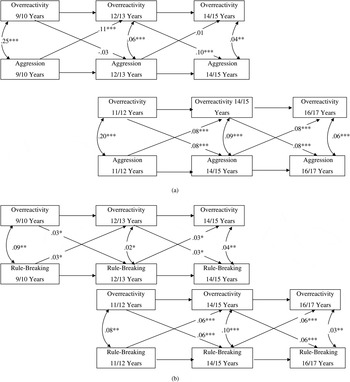
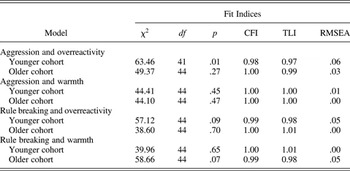
Because the shape of development has already been discussed in detail in the latent growth analyses, the focus for the cross-lagged models lies with the within-time correlations and cross-lagged paths. Table 6 shows the model fit indices of the final models, the coefficients are presented in Figure 2a–d.
Cross-lagged paths between (a) aggression and overreactivity and (b) rule breaking and overreactivity for younger and older cohorts separately. All coefficients are unstandardized. *p < .05. **p < .01. ***p < .001.

Model fit indices of the multigroup cross-lagged models

Note: CFI, comparative fit index; TLI, Tucker–Lewis index; RMSEA, root mean square error of approximation.
Aggression and overreactivity
For both the younger and the older cohorts, aggression and overreactivity showed moderate to strong stability throughout adolescence (aggression: rs = .60 < .82, ps < .001; overreactivity: rs = .47 < .68, ps < .001). Aggression and overreactivity were concurrently positively related (see Figure 2), which indicates that if parents show higher overreactivity, adolescents show higher aggression at that same time point. None of the within-time correlations or the cross-lagged paths between aggression and overreactivity differed across parental or child gender, Δχ2 (21) = 32.71, p = .05, and Δχ2 (21) = 21.75, p = .41, for the younger and older cohort, respectively. In addition, in the older cohort, parent on child effects were similar in size as child on parent effects, Δχ2 (2) = 2.24, p = .33, and cross-lagged effects did not change in size across time, Δχ2 (1) = 1.55, p = .21. In the younger cohort, in contrast, there were significant differences between parent on child and child on parent effects, Δχ2 (2) = 15.78, p < .001, such that higher aggression at T1 was related to higher overreactivity 3 years later, which in turn, was related to higher levels of aggression at the last assessment. Among the older cohort, aggression and overreactivity were fully reciprocally related, thus higher levels of aggression or overreactivity at the first and second assessment were related to higher levels of overreactivity and aggression at the second and third assessment.
Aggression and warmth
Warmth showed moderate to strong stability throughout adolescence (rs = .42 < .71, ps < .001). Further, within-time correlations and cross-lagged paths between aggression and warmth did not differ across parental or child gender, Δχ2 (21) = 24.43, p = .27, for the younger cohort, and Δχ2 (21) = 24.54, p = .27, for the older cohort. Further, parent on child effects did not differ significantly from child on parent effects in both the younger and older cohorts, Δχ2 (2) = 0.19, p = .91, and Δχ2 (2) = 0.25, p = .88, respectively. In addition, cross-lagged effects did not change in size throughout adolescence for both the younger and older cohorts, Δχ2 (1) = 0.17, p = .93 and Δχ2 (1) = 2.25, p = .11, respectively. For both cohorts, aggression and warmth were concurrently negatively related (rs = −.03 < −.09, ps < .05), but not significantly longitudinally related (rs = .01, ns).
Rule breaking and overreactivity
Rule-breaking behavior showed moderate to stability throughout adolescence (rs = .51 < .67, ps < .001). Within- and across-time associations between rule-breaking behaviors and overreactive parenting did not differ across either parental or child gender, Δχ2 (21) = 22.41, p = .38, and Δχ2 (21) = 19.33, p = .56 for the younger and older cohorts, respectively. Further, parent on child effects were similar in size to child on parent effects, Δχ2 (2) = 1.75, p = .42 and Δχ2 (2) = 3.47, p = .18 for the younger and older cohorts, respectively. Moreover, cross-lagged paths did not change in size throughout adolescence, Δχ2 (1) = 0.97, p = .32 and Δχ2 (1) = 0.94, p = .33, respectively. Associations were highly similar across the two cohorts. Specifically, rule-breaking behaviors showed strong stability and rule-breaking behaviors and overreactivity were concurrently positively related. Overreactive parenting was positively related to later rule-breaking behaviors and conversely, rule-breaking behaviors were positively related to later overreactive parenting. Thus, rule breaking and overreactivity show bidirectional effects (both child on parent and parent on child) throughout adolescence.
Rule breaking and warmth
The model in which within- and across-time associations between rule breaking and warmth were constrained to be equal across parental and child gender did not fit the data significantly worse than the model in which these associations were freely estimated for either the younger cohort, Δχ2 (21) = 14.03, p = .87, or the older cohort, Δχ2 (21) = 36.73, p = .02. Parent on child effects were not significantly different from child on parent effects, Δχ2 (2) = 0.14, p = .93 for the younger cohort, and Δχ2 (2) = 2.25, p = .32 for the older cohort. Again, the cross-lagged effects were similar in size throughout adolescence, Δχ2 (1) = 0.30, p = .58, and Δχ2 (1) = 0.48, p = .49, respectively. For both cohorts, rule breaking and warmth were concurrently negatively related (rs = −.02 < −.03, ps < .05), but no significant cross-lagged paths were found (rs = −.03, ns).
Discussion
In this study, the interrelated development of parental overreactive discipline or warmth and adolescent aggressive or rule-breaking behaviors were examined from early to late adolescence among a large community sample of boys and girls and their mothers and fathers. In addition, it was explored whether the interrelated development of adolescent and parent behaviors differed for mothers and fathers, or for boys and girls.
Development of adolescent behaviors
First, in line with our expectations, girls and boys decreased similarly in aggression and increased similarly in rule-breaking behaviors (cf. Bongers et al., Reference Bongers, Koot, Van der Ende and Verhulst2003, Reference Bongers, Koot, Van der Ende and Verhulst2004; Stanger et al., Reference Stanger, Achenbach and Verhulst1997). The increase in rule-breaking behaviors is in this sample only modest, which may be normative for rule-breaking behaviors (Bongers et al., Reference Bongers, Koot, Van der Ende and Verhulst2003). Another explanation for this relatively small increase in rule-breaking behaviors may lie in the fact that, as adolescents spend more time unsupervised by parents, parents are increasingly less knowledgeable of the (problem) behaviors of their children. Our use of parent reports may thus have underestimated the increase in rule-breaking behaviors. Nevertheless, the differential development of aggressive and rule-breaking behaviors indicates the importance of distinguishing between the two externalizing behaviors in the examination of adolescent problem behaviors. Further, although girls show less rule-breaking behaviors than boys do, they also are equally likely as boys to show increasing levels of rule-breaking behaviors as they grow older. Research should continue to examine why girls show problem behaviors to further clarify the heterogeneity in girls' development. Such knowledge may help optimize gender-specific prevention and treatment programs (Kroneman, Loeber, Hipwell, & Koot, Reference Kroneman, Loeber, Hipwell and Koot2009).
Development of parenting behaviors
Second, parents displayed differential levels of parenting toward boys and girls aged 9 years, but no substantive differences were found between mothers and fathers. Parents showed more overreactivity and less warmth toward boys than girls aged 9 years (McKee et al., Reference McKee, Roland, Coffelt, Olson, Forehand and Massari2007; Prinzie et al., Reference Prinzie, Van der Sluis, De Haan and Deković2010). In addition, mothers and fathers similarly declined in overreactivity toward boys and girls (Kroneman et al., Reference Kroneman, Loeber, Hipwell and Koot2009; Smetana et al., Reference Smetana, Campione-Barr and Metzger2006). Given the similar change in overreactivity, the differential levels of overreactivity toward sons versus daughters may originate in early childhood and be the result of a stronger emphasis on an orientation toward interpersonal relationships in girls' compared to boys' socialization (see, e.g., Kroneman et al., Reference Kroneman, Loeber, Hipwell and Koot2009; Smetana et al., Reference Smetana, Campione-Barr and Metzger2006). Girls, in other words, may be more compliant in childhood and parents may thus be less inclined to display overreactive discipline toward girls. In contrast, mothers showed a stronger decrease in warmth toward boys than girls during adolescence, whereas fathers showed an equally strong decrease in warmth toward boys and girls. Maternal warmth thus became increasingly more gender differentiated, which is possibly because mothers and daughters are both strongly oriented to their relationship, more than mothers and sons. Overall, our findings indicate that distinguishing between levels of and changes in behaviors may advance our understanding of the dynamics of development substantially.
Relations between adolescent and parenting behaviors
Adolescent aggressive and rule-breaking behaviors were related to parental overreactive discipline and warmth and, of importance, interrelations were different for specific combinations of adolescent and parental behaviors. Higher overreactivity and lower warmth at child age 9 years had detrimental effects on the development of aggressive, but not rule-breaking behaviors, and conversely, higher aggressive (but not rule-breaking) behavior at age 9 was adversely related to the development of overreactive and warm parenting. The significant interrelations between aggression and overreactive and warm parenting are suggestive of their close interrelatedness, by which they may continue to shape each other's development across an extended period of time. The finding that the development of rule-breaking behavior was not affected by the initial levels of either rule-breaking behaviors or of parenting behaviors suggests that other factors, such as involvement with deviant peers, may be more relevant in explaining rule-breaking behaviors during adolescence (see, e.g., Dodge & Pettit, Reference Dodge and Pettit2003). However, changes in aggression and rule breaking were related to changes in overreactive and warm parenting, which indicates that both parenting behaviors are responsible for part of the developmental heterogeneity in both types of externalizing behaviors, and vice versa. Nevertheless, given that rule-breaking behaviors had very different relations with parenting than aggressive behaviors did, a developmental theory of antisocial behavior should be sensitive to specific problem behaviors during adolescence.
Complementary analyses regarding timing of effects showed that aggression and rule-breaking behaviors were reciprocally longitudinally related to overreactivity and thus, that both parent- and child-driven effects may be responsible for the development of externalizing behaviors and overreactive parenting. No longitudinal relations were found between warmth and either externalizing behavior, above and beyond the stability in warmth and concurrent relations of warmth with externalizing behaviors. These different findings compared to the growth models may have several reasons. In the cross-lagged analyses only the group level was assessed, whereas in the growth models interindividual differences were taken into account. Further, in the cross-lagged models the development of externalizing and parenting is specified for each time point separately, whereas in the growth models, changes are specified as the overall (mean) change across the full time period. Finally, for the cross-lagged models the sample was split up, resulting in smaller power. Nevertheless, findings from the cross-lagged models provide additional evidence for the theoretical contention that parents and children continue to affect each others' behaviors as children progress throughout adolescence.
Interrelations between the development of parenting and the development of externalizing behaviors were similar for the behaviors of boys and girls and of mothers and fathers. This study adds to the accumulating longitudinal evidence that shows that the development of girls and boys may be affected by similar processes (Combs-Ronto et al., Reference Combs-Ronto, Olson, Lunkenheimer and Sameroff2009; Eisenberg et al., Reference Eisenberg, Zhou, Spinrad, Valiente, Fabes and Liew2005), although researchers have suggested that, as girls are more focussed on interpersonal relationships and gaining social approval, they may be more susceptible to parenting than boys (see, e.g., Kroneman et al., Reference Kroneman, Loeber, Hipwell and Koot2009; Werner & Silbereisen, Reference Werner and Silbereisen2003). Possibly, because of the relative safety of the parent–adolescent relationship, girls' tendency for gaining social approval is not that much relevant for girls' behaviors with parents, whereas peers may be more influential for girls' than boys' behaviors (e.g., Leadbeater, Kuperminc, Blatt, & Hertzog, Reference Leadbeater, Kuperminc, Blatt and Hertzog1999). In addition, existing evidence suggests that children's temperament (Van Zeijl et al., Reference Van Zeijl, Mesman, Stolk, Alink, Van IJzendoorn and Bakermans-Kranenburg2007) and personality (De Haan, Prinzie, & Deković, Reference De Haan, Prinzie and Deković2010) may make them more susceptible to their environment, and these dispositional factors are possibly more important than child gender. Researchers should continue to include boys and girls to resolve the inconclusive findings on their differential susceptibility to parenting. Including other individual (e.g., temperament, personality) and contextual (peers, neighborhood) risk factors in addition to the inclusion of multiple aspects of parenting may further elucidate gender-specific processes of externalizing behaviors.
Limitations and future directions
Several methodological limitations warrant caution in the interpretation of results. First, our sample is relatively low risk in terms of aggressive and rule-breaking behaviors and results from this study cannot be generalized to high risk samples. The small amount of variance that results from the low-risk nature of our sample also means that found associations are conservative estimates. Relations between parenting and externalizing behaviors may thus be stronger in samples that are more diverse in terms of externalizing behaviors. Further, given the large sample size, this study used questionnaire data only, although a combination of methods of assessments (e.g., questionnaire data with observations) would provide a more robust test of the interrelated development of parenting and adolescent adjustment. In addition, our measure of externalizing behaviors has its limitations, as it does not sample the full range of deviant behaviors and the frequency anchors are limited. However, the CBCL is often used in research examining the development of antisocial behaviors and using the CBCL facilitates comparison of results of this study with previous work. Another limitation lies in our sole reliance on parent reports to measure all constructs. Although averaging mother and father scores of adolescent behaviors reduced rater bias, the small sizes of the cross-lagged paths (although not uncommon in cross-lagged analyses) should be carefully interpreted in light of possible shared method variance. Conversely, given previous findings that suggest that the impact of parenting on adolescent adjustment is mediated by adolescents' perceptions of parental behaviors (e.g., Neiderhiser, Pike, Hetherington, & Reiss, Reference Neiderhiser, Pike, Hetherington and Reiss1998), not including adolescent-reported parenting may have underestimated relations between parenting and adolescent behaviors. Moreover, omitting peers as a source of influence may have lead to some spurious results. For example, decreased parental knowledge has been related to adolescent problem behaviors through its impact on increased engagement with delinquent peers (Reitz, Deković, Prinzie, & Buist, Reference Reitz, Prinzie, Deković and Buist2007). However, an increasing impact of peers does not necessarily translate into a decreasing influence of parents (Moffitt & Caspi, Reference Moffitt and Caspi2001).
The results from this study also suggest directions for additional research. First, we addressed the impact of isolated parenting behaviors, but the interplay between parenting behaviors may also importantly affect problem behaviors. For example, previous work has shown that high negative maternal discipline was only related to later externalizing behaviors in the context of low maternal responsiveness (e.g., Alink et al., Reference Alink, Mesman, Van Zeijl, Stolk, Juffer and Bakermans-Kranenburg2009). Therefore, future research could combine parenting behaviors (e.g., interactions between discipline and support) to further the knowledge of the dynamics of parenting and externalizing. Second, there may be an interaction between the initial level and change in parenting that predicts adolescent rule-breaking behaviors. High-risk children whose parents decrease in warmth may be more likely to escalate in rule-breaking behaviors, and the development of rule-breaking behaviors may show a nonlinear (i.e., U-shaped) trend for these adolescents. Future research among high-risk children could thus examine linearity of both the development in rule-breaking behaviors and of the effects of parenting on the development of rule-breaking behaviors. Further, results from this study show that significant interindividual differences exist between parents regarding the change in overreactivity and warmth. A complementary approach to studying interindividual differences is to identify subgroups of individuals who follow distinct developmental trajectories. Although existing work has examined the development of externalizing behaviors using this approach (e.g., Bongers et al., Reference Bongers, Koot, Van der Ende and Verhulst2004), to our knowledge, no research has examined the development of parenting in this way. Given the significant interindividual differences for the development of parenting in this study, future research could examine whether subgroups of parents can be identified who follow distinct trajectories of parenting and relate group membership of externalizing to group membership of parenting.
Overall, our results indicate that parental overreactivity and warmth substantially affect adolescent externalizing behaviors and are, in turn, affected by adolescent externalizing behaviors. Moreover, including the shape of the change in parenting and in externalizing behaviors further elucidates the dynamics of parenting and externalizing during adolescence.
Conclusions
This study made important contributions to the knowledge on the development of parenting and adolescent behaviors. First, results show that girls and boys similarly decrease in aggression and increase in rule-breaking behaviors throughout adolescence, also when taking into account interindividual differences in their development. Further, mothers and fathers show different parenting toward boys and girls, and for mothers, these differences may become more pronounced as children grow older. Second, the development of the two types of externalizing behaviors was related to the development of the two types of parenting. Average levels of and changes in parenting and externalizing behaviors each provide unique information about their interrelated development. Moreover, interrelations were specific for the type of externalizing and the type of parenting that was examined, but no differences in these interrelations were found between boys and girls. This study shows that, although the development of externalizing behaviors and of parenting may be somewhat different when considering boys versus girls, the impact of parenting on the development of aggressive and rule-breaking behaviors is comparable across child gender and conversely, boys' and girls' externalizing behaviors similarly affect the development of parental overreactivity and warmth.