Introduction
The past thirty years have witnessed a wealth of studies on language differentiation in early bilingual development. Early findings from such studies were interpreted as evidence that bilingual-to-be children go through an initial stage in which their two languages are represented in a unitary or fused system (unitary language system hypothesis, as coined by Genesee, Reference Genesee1989), at the phonological, lexical, and syntactic level (Vogel, Reference Vogel1975; Volterra and Taeschner, Reference Volterra and Taeschner1978; Redlinger and Park, Reference Redlinger and Park1980; Vihman, Reference Vihman1985; Schnitzer and Krasinsky, Reference Schnitzer and Krasinski1994; to name a few). More recent research, however, in correcting the methodological problems of these earlier studies, has shown that bilinguals can show signs of language differentiation from their earliest productions (Maneva and Genesee, Reference Maneva, Genesee, Skarabela, Fish and Do2002), in their phonology (Deuchar and Quay, Reference Deuchar and Quay2000; Paradis, Reference Paradis2001), in their lexicon (Pearson, Fernández and Oller, Reference Pearson, Fernández and Oller1995; Deuchar and Quay, Reference Deuchar and Quay2000; Holowka, Brosseau-Lapré and Petitto, Reference Holowka, Brosseau-Lapré and Petitto2002), and in their language choice (Nicoladis and Genesee, Reference Nicoladis and Genesee1996; Deuchar and Quay, Reference Deuchar and Quay2000; Comeau, Genesee and Lapaquette, Reference Comeau, Genesee and Lapaquette2003) (differentiated language system hypothesis, Genesee, Reference Genesee1989). Likewise, as soon as there is evidence for syntax, bilingual children have been found to use their two syntaxes differentially (see De Houwer, Reference De Houwer, Kroll and de Groot2005, for a review). Thus, it appears that bilingual children can be credited with language differentiation from very early on in development.
Despite this recent effort towards the study of bilingual language acquisition, relatively little work has been done to examine language differentiation in children exposed to more than two languages from birth, and research on early trilingual development is literally in its infancy (Quay, Reference Quay2001, Reference Quay2008; Barnes, Reference Barnes2006; Montanari, Reference Montanari2008). Quay (Reference Quay2008) and Montanari (Reference Montanari2008) have shown that trilingual-to-be-children can show signs of pragmatic differentiation – i.e. they can modify the amount that they use of each language to match the language of their addressees – from as early as 1;10. However, no previous study has systematically examined whether children learning three languages simultaneously develop differentiated language systems – and, in particular, show signs of differentiation in their early combinations – similarly to bilingual children. Early trilingual development provides an interesting case for the investigation of children's ability to develop separate linguistic systems. On the one hand, if it is uneconomical for children to set up two or more systems for each of their languages, or if a relatively large amount of exposure to each input language is necessary for language differentiation, early exposure to three sets of input is more likely to result in a unitary language system than early exposure to two. On the other hand, however, simultaneous exposure to three rather than two languages might even lead to an “enhanced language discrimination capacity”, making language differentiation in general, and syntactic differentiation in particular, “precociously available” (Bosch and Sebastián-Gallés, Reference Bosch and Sebastián-Gallés2001, p. 79).
It is the aim of this study to examine the issue of syntactic differentiation in a developing Tagalog–Spanish–English trilingual child. In practice, the study of syntactic differentiation has involved establishing, in bilingual children, whether early combinations in one language exhibit the same word order as those combinations in the other language, and whether utterances containing elements from both languages (mixed) are brought about by the existence of a single syntactic system. According to early investigators, the proponents of what Meisel (Reference Meisel2001) calls the fusion hypothesis (Volterra and Taeschner, Reference Volterra and Taeschner1978; Redlinger and Park, Reference Redlinger and Park1980; Vihman, Reference Vihman1985), bilingual children go through an initial one-system stage in which “the same syntactic rules are applied to both languages” (Volterra and Taeschner, Reference Volterra and Taeschner1978, p. 312). This explains their extent of language mixing in early multi-word combinations. More recent investigators, however, pointing to the methodological problems of these early studies, have shown that language mixing results from input- and proficiency-related factors rather than from a unified syntax (Lanza, Reference Lanza1992, Reference Lanza1997b; Genesee, Nicoladis and Paradis, Reference Genesee, Nicoladis and Paradis1995; Deuchar and Quay, Reference Deuchar and Quay2000; Nicoladis and Secco, Reference Nicoladis and Secco2000), and that syntactic differentiation is the normal case once there is evidence for syntax (differentiation hypothesis, as coined by Meisel, Reference Meisel2001). A wealth of recent studies report, for instance, that the word orders produced by bilingual children with an MLU of 1.75 and above consistently reflect the different ordering patterns and properties specific to each input language (see Meisel, Reference Meisel, Hyltenstam and Obler1989, and the work of Meisel and colleagues in Meisel, Reference Meisel1990, Reference Meisel1994a; see also Paradis and Genesee, Reference Paradis and Genesee1996, Reference Paradis and Genesee1997), and that bilinguals’ rate of morphosyntactic development proceeds at the same rate as monolinguals’, at least for the dominant language (see De Houwer, Reference De Houwer, Kroll and de Groot2005, for a review).
While the results of these studies have been taken as unambiguous evidence that bilingual-to-be children develop separate syntactic systems once their combinations are syntactically marked (that is to say, around two years of age), there remains the possibility, as argued by Deuchar and Quay (Reference Deuchar and Quay2000, p. 81), of a single “rudimentary syntax” in the earliest combinations, when inflectional morphology has yet to appear. Although some investigators have argued that such early combinations are not governed by syntactic but rather by universal cross-linguistic pragmatic and semantic principles (Meisel, Reference Meisel2001), Deuchar and Quay (Reference Deuchar and Quay2000) argue that the juxtaposition of two words in predicate–argument structures (and in some noun phrases containing two nouns) can be taken as the earliest evidence for syntactic organization. In their case study of Spanish–English bilingual acquisition, the authors examine all the multi-word utterances produced by their subject between 1;7 and 1;9 (for a total of 287 combinations), and they attempt to describe the syntax of these utterances in terms of the framework proposed by Radford (Reference Radford1990), which was designed to account for two-word combinations in early child English. Radford argued that early two-word utterances could be analyzed as “small clauses” made up of a subject and a predicate, or an NP and an XP, where XP could be any of the following “lexical categories”: NP, VP, PP, or AP. Deuchar and Quay (Reference Deuchar and Quay2000) find that the majority of the bilingual child's multi-word utterances – be they English, Spanish or mixed – conform to Radford's scheme, except for a few cases in which the predicate is “acategorical”, i.e. cannot be assigned to a lexical category. These predicates include words such as no, more, sí “yes”, and más “more”. Irrespective of the extent to which Deuchar and Quay's data conform to Radford's framework, the authors conclude that early multi-word utterances – be they Spanish, English, or mixed – appear to have “a rudimentary syntax consisting of the juxtaposition of two words, an argument and a predicate”, and that word order in these utterances “is quite variable . . . [and does] not seem to correspond to a variation in meaning of any kind” (Reference Deuchar and Quay2000, p. 81). In sum, following Deuchar and Quay's (Reference Deuchar and Quay2000) approach, evidence for a stage of ‘syntactic fusion’ should take the form of a language-independent ‘primitive syntax’ accompanied by free variation in word order, both in utterances that combine same-language and mixed-language elements.
Despite their thorough analysis, Deuchar and Quay (Reference Deuchar and Quay2000) overlooked an important aspect: the frequencies of particular word order sequences in each of the child's languages. Although the authors showed, for instance, that mixed utterances were not the by-product of syntactic fusion but rather were due to vocabulary gaps, they failed to examine whether the frequencies of specific combination types reflected target-dependent preferences; as a result, their qualitative, rather than quantitative, analysis led them to conclude that the same “primitive syntax” was equally applied to both Spanish and English combinations. Some studies have shown, however, that even at a period when syntactic marking has yet to appear in children's combinations, early word order regularities tend to reflect the patterns found in the input languages rather than some universal semantic, pragmatic, or syntactic principles (Köppe, Reference Köppe1996, Reference Köppe1997; Paradis, Nicoladis and Genesee, Reference Paradis, Nicoladis and Genesee2000). In Köppe's (Reference Köppe1996) study, for instance, two of the three German–English bilingual children studied between approximately one-and-a-half and three years of age displayed language-specific word order in their combinations even before the appearance of inflectional morphology (before around 2;2 and 1;11 respectively), a result that was interpreted as evidence for “early differentiation of two grammatical systems” (Köppe, Reference Köppe1996, p. 927). Thus, unless a relatively large amount of exposure to each input language is necessary for differentiation – and hence trilingual exposure delays differentiation – one could in theory expect, even in early trilingual development, that the overall frequencies of particular word order sequences will mirror the basic sentence structures of the target languages.
It is the aim of this study to examine the multi-word utterances produced by a trilingual child with an MLU of less than 1.5 and assess (i) whether mixed utterances do indeed originate from vocabulary gaps rather than from ‘syntactic fusion’, and (ii) whether there is evidence of differentiated ordering patterns in each language. In order to examine (i), early mixed utterances are analyzed in terms of the child's reconstructed cumulative vocabulary to examine whether the choice of a specific lexical item was indeed available at a particular point in time. As to the analysis of (ii), the frequencies of particular word order sequences are calculated and compared cross-linguistically. While Tagalog differs considerably from English and Spanish in its basic word order (predicate-initial vs. predicate-final), Spanish and English vary in the extent to which they adhere to the predicate-final or SVO order (see section “English, Spanish, and Tagalog word order in declarative sentences” below).
According to a usage-based acquisitional approach (Tomasello, Reference Tomasello2000, Reference Tomasello, Damon and Lerner2006), which sees development as gradual and uneven and guided by the input that the child receives in concrete acts of communication, combinations at this early stage (MLU < 1.5) are item-based constructions, or concrete pieces of language of many different shapes and sizes, that the child learns to express in specific communicative functions. Although some of these early combinations – pivot schemas – might show a systematic pattern (they usually combine a fixed item – an “event word” – with a variable slot, usually an object label as in more milk or gone daddy), it is argued that generalizations are not made across constructions and even within themselves, pivot schemas have no syntax (e.g. word order is doing no syntactic work so that hat off and off hat have the same meaning) (Tomasello, Reference Tomasello, Damon and Lerner2006). If this is the case, then the child in this study should be found to be ordering words in her utterances variably and similarly across languages, analogously to the child in Deuchar and Quay (Reference Deuchar and Quay2000).
Alternatively, the frequencies with which particular word order sequences are used might reveal target-dependent preferences, as in Köppe (Reference Köppe1996), providing evidence that the child is attuned to the combinatorial properties of her languages, that she is capable of reproducing them, and hence is in the process of developing different syntactic systems. Notice that the existence of differentiated word orders in the data does not imply that the child has arrived at the complex, abstract categories and schemas that adults possess (hence the term word order rather than syntactic differentiation throughout the paper). After all, combinations at this point are likely to start out as item-specific (Tomasello, Reference Tomasello2000, Reference Tomasello, Damon and Lerner2006). However, early word order differentiation is a first step towards later syntactic differentiation, and provides insights into the gradual emergence of different syntaxes out of pieces of language that are variably strung together in the input.
Before proceeding to the study, a brief description of Tagalog, Spanish, and English word order in basic (declarative) sentences is presented. The description is limited to declarative sentences given that the types of combinations found, early on, in the trilingual data consist almost exclusively of argument/predicate structures. Also, the description is restricted to the linear word order found in these constructions since this will be sufficient to compare whether the child can arrange the items in her combinations following adult sequencing patterns.
English, Spanish, and Tagalog word order in declarative sentences
English, Spanish, and Tagalog differ in important respects as far as the order of constituents within basic, or declarative, sentences. In English, word order is the basic carrier of grammatical relations: the position immediately before the verb is reserved exclusively for the subject while the position immediately after the verb is reserved for the direct object, an ordering that results in fixed SVO sequences (Comrie, Reference Comrie1989). This order holds true not only when the subject is an agent, but also when it is a patient, an instrument, or an experiencer. In other words, it is grammatical relations rather than semantic roles that determine word order. Pragmatics also plays a minimal role in the syntactic structure of sentences. In fact, it is not possible in English to carry differences of pragmatic structure by simply varying word order: sentences such as James kissed Hannah and Hannah kissed James represent different distribution of grammatical relations and cannot be used to encode different pragmatic roles.
In Spanish, on the other hand, the order of constituents in basic sentences is not fixed according to grammatical function but may instead be determined in large part by the information load that constituents carry in the discourse (Zagona, Reference Zagona2002). Hence, the unmarked order of constituents in declaratives may follow either of the following patterns: (a) Subject + Predicate (or SVO), as in Susana leyó el diario “Susana read the paper”; or (b) (XP) – Predicate + Subject (or (XP)VOS), as in (esta mañana) leyó el diario Susana, literally “(this morning) read the paper Susana”, where XP is an optional constituent other than the subject (Zagona, Reference Zagona2002). According to the author (p. 49), “the mechanisms which derive surface order appear to be sensitive to the information content of clausal constituents”; for instance, the appropriate answer to the question ¿quién leyó el diario? “who read the paper?” would be the SVO sentence Susana leyó el diario “Susana read the paper”, in which “read the paper” is the old or given information while Susana is the comment or focus, that is, what provides the new information. On the other hand, in leyó el diario Susana “read the paper Susana”, Susana is what is known, while her having read the paper is the newly asserted information. In both sentences, intonation helps the interpretation since the focus constituent, or what provides new information, contains the main sentence stress. Yet, with respect to ‘fixed’ word order languages such as English and French, pragmatic roles are a more important determinant of Spanish syntactic structure than grammatical relations.
In addition to not being a strictly SVO language, Spanish differs from English (and Tagalog) in that subject pronouns are not overtly expressed, a phenomenon that often produces mere VO sequences (Zagona, Reference Zagona2002). Also, Spanish clitics, both accusative and dative, occur almost exclusively in preverbal position in declarative sentences producing SoV or SioV sequences (Zagona, Reference Zagona2002).Footnote 1 This adds further variation to Spanish basic sentence structure.
Similarly to Spanish, the order of components in Tagalog declarative sentences is relatively free (Schachter and Otanes, Reference Schachter and Otanes1972; Schachter, Reference Schachter and Li1976; Kroeger, Reference Kroeger1993). In pragmatically unmarked sentences, the predicate always comes first, but there is considerable flexibility in the ordering of the constituents that come afterwards. One of these constituents is indeed marked for topic – what functions as the center of attention in the discourse context – and all the others for case, leaving no space for misinterpretation. Thus, the English sentence The man gave the woman a book can be translated as any of the following six sentences, because the topic is openly expressed through the marker ang (Topic Marker or TM), the object complement through the marker ng (Object complement Marker or OM), and the directional complement through the marker sa (Directional complement Marker or DM).
(1)

(2)
(3)
(4)
(5)
(6)

According to many linguists who have described Tagalog word order (Bowen, Reference Bowen1969; Schachter and Otanes, Reference Schachter and Otanes1972; Kroeger, Reference Kroeger1993), the six sentences above have the same components, are equally grammatical, and are identical in meaning. Some have argued that the preferred word order is the one where the topic follows all other constituents as in (1), and that the length of a given component in relation to others (i.e. the number of words and/or syllables each contains) may determine sequencing preferences (so that shorter components, pronouns, and enclitics precede longer ones as in Nagluto iyon ng pagkain, literally “cooked that one-tm [i.e. that person] the-om food”, i.e. “he cooked the food” versus Nagluto ng pagkain ang babae “cooked the-om food the-tm woman”, i.e. “the woman cooked the food”; or Humiram siya ng pera “borrowed he-tm the-om money”, i.e. “he borrowed the money” versus Humiram ng pera ang lalaki “borrowed the-om money the-tm man”, i.e. “the man borrowed the money” (Schachter and Otanes, Reference Schachter and Otanes1972; Segalowitz and Galang, Reference Segalowitz and Galang1978). Others, however, have claimed that except for the initial position of the predicate, Tagalog word order is “essentially free” (Kroeger, Reference Kroeger1993, p.112) and that “there does not even seem to be any clearly preferred ordering of post-verb constituents” (Schachter, Reference Schachter and Li1976, p. 495; emphasis in the original). The rich morphological system, indeed, makes sentence interpretation easy and straightforward irrespective of the order of a given component with respect to the others.
It is clear from the examples above, then, that “there are two ‘unmarked’ word orders in [Tagalog] active clauses, VSO or VOS” (Kroeger, Reference Kroeger1993, p. 112). Although there is disagreement as to whether Tagalog topics can be fully equated to traditional subjects,Footnote 2 what is important for the present analysis is that, unlike in English, the predicate strictly precedes the topic and other constituents in Tagalog declarative sentences and unlike in Spanish, this is the only acceptable order in such constructions. Displacing the predicate does not result in ungrammaticality; yet, it causes significant changes of meaning (for example, sa babae nagbigay ng libro ang lalaki “to-dm woman gave the-om book the-tm man” translates into the non-canonical sentence “it was the woman that the man gave the book to”). Notice, also, that unlike in Spanish, topics must be always expressed in Tagalog (with the exception of existential, phenomenal, exclamatory and a few other constructions), and therefore that predicate and topic are the minimal elements that a declarative sentence should contain (Schachter and Otanes, Reference Schachter and Otanes1972).
To summarize, English, Spanish, and Tagalog display considerably different basic ordering patterns in declarative sentences. These differences, which are confirmed by an analysis of word order in the speech of the adults providing the input (see section “Word order in argument/predicate sequences” below), constitute the ideal ground to investigate whether the child in this study structured her utterances differentially depending on the language in which she was interacting, showing an overall preference for predicate-initial structures in Tagalog, predicate-final combinations in English, and both types of utterances in Spanish.
Method
The child and her family
The data in this study come from a longitudinal investigation of trilingual first language acquisition in a girl, Kathryn, born in Los Angeles to a Filipino-American mother and a Chilean-American father. The child's mother, a clinical lab scientist in her late thirties, came to the United States from the Philippines at age nine; her father, also a clinical lab scientist in his late thirties, moved to Los Angeles from Chile at age twelve. From birth, Kathryn was addressed primarily in Tagalog by her mother and maternal grandparents, in Spanish by her father and paternal grandmother, and she heard English from her sister, nine years older than herself, and, more indirectly, from family conversations (English was the main medium of communication in the home).
Since the child was taken care of by her Tagalog-speaking grandparents until 2;2, it was estimated that, during the period of study her direct exposure to Tagalog approximated 48 percent, her direct exposure to Spanish was roughly 29 percent, and her direct exposure to English was 23 percent. These percentages, based on 12 waking hours per day, seven days a week, were calculated in terms of the number of hours spent with each interlocutor. The reader should keep in mind, however, that English was the main medium of communication in the home, and thus it might have been heard more often than estimated.
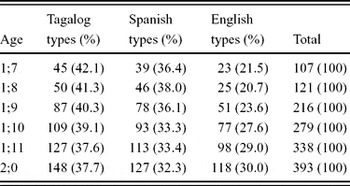
During the period of study, the child's dominant language was Tagalog, the language in which she had the largest vocabulary. This can be seen in Table 1, which shows Kathryn's total number of word types in each language from age 1;7 to 2;0. These values were derived from the child's reconstructed trilingual lexicon, a chronological list of the first 400 words spontaneously produced by the child from age 1;3.24. The trilingual lexicon, which includes information about the child's age when a word first appeared, its pronunciation, and the context in which it was produced, was re-constructed on the basis of words that appeared in weekly reports and audio recordings (including those used for the present analysis) made by the child's grandmother (a linguist) and the author (see Montanari, Reference Montanari2006, for more details).
Kathryn's total number of word types in each language from 1;7 to 2;0 (percentages in parentheses).

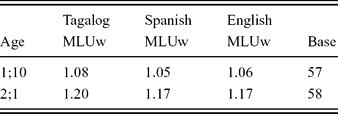
Table 2 presents the child's MLUwords (MLUw) in Tagalog, Spanish, and English at age 1;10 and 2;1. MLU values, given in words rather than morphemes because the three languages are characterized by distinct morphological patterns, were calculated over the same number of utterances (“base”) produced by the child in each language during a two-week period.
Kathryn's MLUwords (MLUw) in her three languages at 1;10 and 2;1 of age.
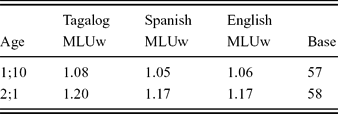
As shown by the table, Kathryn was predominantly at the one-word stage of production in all her languages during the period of study. In addition, inflectional morphology had not yet appeared in her utterances. For instance, the few verbs produced between 1;7 and 2;1 lacked inflection altogether in Tagalog and English (as in sit and sayaw “dance-infinitive”), while in Spanish, a language in which uninflected forms are not allowed, only one instance of the third person singular (tiene “it has got”) and one of the first person singular (prendo “I turn”) of the present tense were produced. Determiners (or topic/complement markers) were basically absent from Tagalog productions (only one token); they were generally reduced to mere schwas in English, and appeared in only four Spanish utterances between 1;7 and 2;1. There is, thus, no doubt that Kathryn's multi-word utterances during the period of study constituted her first attempts to combine words and were produced at a stage when concrete syntactic/morphological markings were overall absent.
Data collection
Diary notes along with fifteen 90-minute audio recordings of Kathryn's spontaneous speech between 1;7 and 2;1 of age were used to track down early combinations. The diary records were kept by Kathryn's Spanish-speaking grandmother, a Spanish–English bilingual linguist and a trained phonetician; they were taken on a weekly or bi-weekly basis, and they recorded the child's utterances while interacting with her grandmother and other family members. These data include information on the child's utterances, their pronunciation (in narrow phonetic transcription) and the context in which they were uttered. Although the diary records were kept by the child's grandmother, most of the notes were in fact taken during family gatherings when Kathryn's mother, father and other family members were also present. In this way, not only Spanish but also English and Tagalog utterances could easily be identified and noted down in the diary. Priority was given to noting down new utterances, especially when the child became more productive.
The recordings were made by the author once a month until the child was approximately 1;9; from then on, that is, when she became more productive, recordings were made weekly or bi-weekly. All recordings were made at the child's home during four main activities: drawing, book-reading, eating meals, and free play. In each session, the child was being addressed, in a natural and uncontrolled discourse context, in Tagalog by her mother, in Spanish by her father and/or grandmother, and in English by her sister and/or the author. Thus, unlike previous studies, the child was not recorded exclusively in the presence of one language user; rather, the data were collected in a context in which multiple languages were heard, a situation that reproduced more faithfully the child's natural language environment.
Transcription
The recording sessions were transcribed on the day following the session to maintain the most faithful record of the non-verbal context. Passages in which the adults were talking to each other and Kathryn did not participate in the conversation were omitted from the transcriptions. The recordings were initially transcribed in regular orthography, together with an identification of unintelligible and unclear passages, English translations, and information about non-verbal events that became relevant to the interaction and clarified the discourse. The child's utterances were transcribed in regular orthography if they were clearly comprehensible as words of a specific language; when this was not the case, narrow phonetic transcription was used. The transcriptions were further checked by Kathryn's mother, by a Tagalog-speaking assistant, and by a Spanish–English bilingual. Disagreements on utterances/passages were discussed by listening several more times to the recordings. When agreement was reached, the affected utterances/passages were transcribed a second time adopting the consensus.
Three specific criteria were employed for word – and hence language – identification. The child's words were transcribed as Tagalog, English, or Spanish (or Tagalog/Spanish, Tagalog/English, and Tagalog/English/Spanish words if they were common to two or three languages) only if: (i) the same sequence of sounds was consistently employed in relation to the same set of referents (e.g. ['tatas], consistently used to refer to Kathryn's bottle of milk, was coded as gatas “milk” in Tagalog); (ii) the child's form exhibited at least two phonetic units in common with the adult form of the word or utterance (e.g. ['ta], produced to refer to a bike, was coded as the Spanish/Tagalog word /bisi'kleta/ “bike”); (iii) the child's verbal production displayed a similar pattern of syllabification and stress to the adult's form (e.g. ['papa], for “daddy”, was considered as having a Tagalog source, /'papa/, because “daddy” in Spanish has opposite stress /pa'pa/). This third criterion was justified by the finding that children tend to replicate adult stress from their earliest productions (Cruz-Ferreira, Reference Cruz-Ferreira2006). Note that in this article Tagalog words are indicated in italics, English words are in bold italics, and Spanish items are in underlined italics.
For reliability measures, a native speaker of Tagalog, a native speaker of Spanish, and a native speaker of English were asked to examine 20 percent of the transcriptions, and code each of the child's utterances as either “belonging to their native language” or “not belonging to their native language”. Inter-rater agreement ranged from 94.6 percent for English to 97.9 percent for Spanish, and 96.9 percent for Tagalog.
Identifying, coding, and analyzing multi-word combinations
All the multi-word combinations produced by Kathryn both in same-language or in mixed-language utterances between 1;7 and 2;1 were tracked down from the diary data and from the transcriptions of the recording sessions. These utterances were included in the analysis only if clear contextual information was available to identify their exact meaning. In order to exclude rote learned, unanalyzed combinations, only those multi-word utterances whose words also appeared independently (in one or other two-word utterances), were included (for example, although what's this? was first produced when Kathryn was 1;5.25, this multi-word combination was not analyzed as such until the child was 1;9.30, when both what and this appeared independently in single-word utterances). A small subset of multi-word utterances that were ambiguous as far as the language source (for example, ['patos 'mami], literally “shoes mommy”, could equally be either a Tagalog sapatos ni mommy or a Spanish zapatos de mami “mommy's shoes”) were counted separately in each language in order not to underestimate the child's combinatorial knowledge in those specific languages.
This analysis yielded a total of 438 combinations, 58 of which contained Tagalog lexical items, 81 were utterances made up of Spanish words, 176 were sequences consisting of English elements, and 123 contained lexical items from more than one language. Of the 123 mixed combinations, 34 occurred in the Tagalog context, 70 in the Spanish context, and 19 in the English context (the few mixed utterances that occurred in ambiguous language contexts were excluded).
The first step was to assess whether mixed combinations originated from vocabulary gaps. For this part of the study, the child's mixes were analyzed in terms of her reconstructed trilingual lexicon (the chronological list of the first 400 words she produced from age 1;3.24) to assess whether the choice of a specific lexical item was indeed available at a particular age. Thus, if Kathryn produced the mixed combination daddytakbo “daddy run”, i.e. “daddy is/went running”, while interacting with the English-speaking author, and if an analysis of her reconstructed lexicon revealed that she did not have the English equivalent for takbo, it was concluded that she was trying to produce an English combination, and that her mix was due to a lexical gap rather than language-general ordering patterns. Since all adult interlocutors addressed Kathryn primarily in their own language and the child was quite good, in turn, at addressing them in that language from early on in development (see Montanari, Reference Montanari2008), the ‘base’ language of the child's mixed combinations was determined by the language of her addressee. Although not all researchers would agree that this is a valid assumption, many investigators of child language mixing, including Lanza (Reference Lanza1992, Reference Lanza1997b) and Paradis et al. (Reference Paradis, Nicoladis and Genesee2000) to name a few, have pointed out that it is indeed “the context of the utterance that is a major factor for determining which element in a mixed utterance is the mix” (Lanza, Reference Lanza1992, p. 643).
An extensive body of research on the grammatical properties of intra-utterance mixing by children acquiring a variety of language pairs has shown that children mix languages systematically and in accordance with the word order patterns of the two languages from very early on (Köppe, Reference Köppe1996; Lanza, Reference Lanza1997a; Paradis et al., Reference Paradis, Nicoladis and Genesee2000; Allen, Genesee, Fish and Crago, Reference Allen, Genesee, Fish, Crago, Andronis, Ball, Elston and Neuvel2002).Footnote 3 That is, in their early mixed utterances, bilingual children often insert a single word from one language into the base language, and treat this mixed item as if it were part of the base language, thereby leaving intact the structure of the utterance in which the mix is embedded. For example, Paradis et al. (Reference Paradis, Nicoladis and Genesee2000) found that a French–English bilingual child aged 1;11, when interacting in English, would produce the mixed possessive construction madame cookies “lady's cookies”, placing the French mix before the English noun as in the Possessor + Possessed order specific to English. At the same time, when interacting in French, she would invert this sequence even in mixed utterances, producing constructions that would preserve the French Possessed + Possessor order, as in flowermadame “flower lady”, i.e. “lady's flower”.
In light of these findings, the mixed combinations produced by the child in this study that were caused by vocabulary gaps were then analyzed together with those non-mixed combinations that occurred in the same language context. For example, utterances such as daddytakbo “daddy run”, with the meaning “daddy is/went running”, produced in the English context and in the absence of the English word for “run”, were coded as English combinations and were examined as declarative, in particular argument + predicate, sequences together with parallel English structures such as Kathryn sleeping. In this way, there were a total 86 ‘Tagalog’ combinations (58 non-mixed + 28 mixed), 129 ‘Spanish’ combinations (81 non-mixed + 48 mixed), and 189 ‘English’ multi-word utterances (176 non-mixed + 13 mixed) that could be subject to syntactic analysis.
The next step was to examine the types of combinations produced by the child and calculate their percentages in each language. These combinations were grouped into five categories: (i) declarative utterances (e.g. Barney sit, meaning “Barney is sitting”), (ii) imperatives (look ᵊ this!), (iii) wh-questions (where phone?), (iv) greetings (hi/bye Brennan), and (v) modified noun phrases (a category that included not only adjectival – arbol grande “big tree” – and possessive constructions – susi tiya “aunt's keys” – but also determiner/preposition + noun sequences, to/my daddy).
The final step was to analyze word order within declarative utterances. All declarative utterances consisted of an argument and a predicate. Following Deuchar and Quay (Reference Deuchar and Quay2000), an argument was defined as a subject or a topic and was used as in predicate calculus “to refer to the relationship of a name to the simple proposition of which it is a part” (Crystal, Reference Crystal1980, p. 31). The term “predicate” was also employed in the sense used by Deuchar and Quay (Reference Deuchar and Quay2000) as “that term in a proposition which provides information about the individual or entity” which is “its argument” (Crystal, Reference Crystal1980, p. 280). Thus, in the propositions Barney sit, meaning “Barney is sitting”, and this big, meaning “this is big”, Barney and this were coded as “arguments” and sit and big as “predicates”. On the other hand, in the utterances labas tubig “outside water”, i.e. “the water is outside”, and owie aso “pain dog”, i.e. “the dog inflicts pain”, the first element of the sequences (labas and owie) was coded as the predicate and the last element (tubig and aso) as the argument of the proposition.
Identifying predicate/argument structures from modified noun phrases in the presence of a noun and an adjective (or pronoun/demonstrative) was quite straightforward thanks to detailed contextual notes and audio information. In particular, if a pause or a schwa occurred between the two elements of the combination, as in pen ᵊ mine, the schwa was taken as cue that the correct interpretation of the child's utterance was “the pen is mine”, i.e. an argument + predicate sequence, rather than a misordered formulation of the adult target “my pen”. Likewise, the mixed combination hotᵊsol produced in the presence of a Spanish speaker and in the absence of the Spanish translation equivalent for hot was coded as a predicate + argument sequence rather than a modified noun phrase. The schwa between the modifier and the noun phrase was indeed taken as cue that the correct interpretation of the child's utterance was the adult target “está caliente el sol” “(is) hot the sun”, an argument-final structure, rather than the modified noun phrase “hot sun”. On the other hand, utterances such as luz verde “light green” and luz roja “light red” produced without a pause between the noun and the adjective and used to refer to a green or red light were taken to represent modified noun phrases. Notice that of the 438 multi-word combinations only four (less than 1%) could be considered slightly ambiguous as to whether they were argument/predicate structures or modified noun phrases.
For reliability measures, a second researcher independently coded 25 percent of the data (110 utterances) and the two coding procedures were compared. Inter-rater agreement was very high: 96.5% for Spanish, 98.2% for Tagalog, and 100% for English.
After the coding and the inter-reliability check, the frequencies of argument + predicate and of predicate + argument structures in declarative utterances were calculated and compared cross-linguistically. The types of combinations (declaratives, imperatives, yes–no questions, wh-questions, incomplete sentences/small clauses) produced by the Tagalog-speaking mother, the Spanish-speaking father, and the English-speaking author were also examined and the frequencies of argument + predicate and predicate + argument structures in their declarative utterances were calculated. These frequencies were calculated over 500 utterances for each speaker (for a total of 1,500 utterances). This analysis was done to assess whether there was a correlation between adult and child word order in basic sentences.
Results and discussion
Mixed utterances and vocabulary gaps
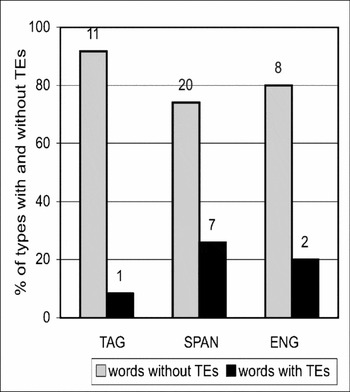
Figure 1 shows the percentage of mixed types with and without translation equivalents produced by Kathryn in ‘Tagalog’, ‘Spanish’, and ‘English’ combinations between 1;7 and 2;1.
Percentage of mixed types with and without translation equivalents (TEs) produced by Kathryn in Tagalog, Spanish, and English combinations between 1;7 and 2;1 (number of types on top of columns).

As can be seen, lexical gaps account for most of the child's mixed utterances. Over 90 percent of mixed types in the Tagalog context and around 80 percent of such mixes in the English and Spanish context do not have translation equivalents and can therefore be argued to be caused by the lack of a specific vocabulary item. It is not the purpose of the present analysis to examine why Kathryn mixed languages even in the context of translation equivalents. Montanari (Reference Montanari2008) deals, in detail, with the child's patterns of language choice and the nature of her mixes. Here, it is sufficient to note that mixed combinations are, for the most part, caused by lexical gaps rather than by an undifferentiated syntax, a result that corroborates a large number of previous studies on the issue (Genesee et al., Reference Genesee, Nicoladis and Paradis1995; Deuchar and Quay, Reference Deuchar and Quay2000; Nicoladis and Secco, Reference Nicoladis and Secco2000).
Combination types
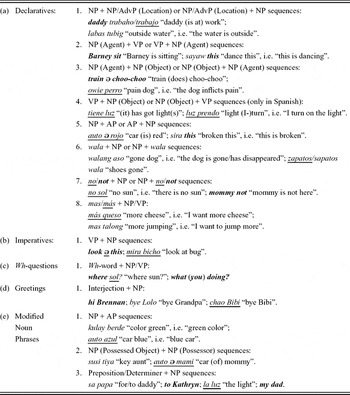
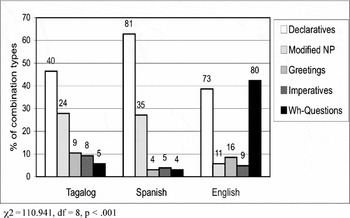
The types of constructions produced by Kathryn in Tagalog, Spanish and English are reported in Table 3 and their percentages in each language are shown in Figure 2.
The types of combinations produced by Kathryn between 1;7 and 2;1.

Combination types produced by Kathryn in Tagalog, Spanish, and English between 1;7 and 2;1 (number of tokens on top of columns).

As can be seen in Table 3, Kathryn's early multi-word combinations include a variety of utterance types, in particular, declaratives, imperatives, wh-questions, greetings or routines, and modified noun phrases. Declaratives constitute the most varied category and they include utterances that describe the location (NP or AdvP) or the quality (AP) of an object (NP), the action (VP) or the object/patient (NP) of an agent (NP), and the object (NP) of an action (VP). Also, some utterances combine an object (NP) or an action (VP) with words that express a change of state (wala “gone/no more”), recurrence (más/mas “more”), or nonexistence/denial (no/not). Imperatives, wh-questions and greetings combine a VP, a wh-word, and an interjection, respectively, with an NP. Finally, the category “modified noun phrases” includes object (NP) + quality (AP) sequences, object (NP) + possessor (NP) combinations, and utterances made up of a determiner or a preposition and an NP.
As for the distribution of different combination types in Tagalog, Spanish and English (Figure 2), the results of a chi-square test between combination types and language indicate significant cross-language differences (χ2 = 110.941, df = 8, p <.001): wh-questions are almost absent from Tagalog and Spanish utterances whereas they are very frequent in English. On the other hand, modified noun phrases abound in Tagalog and Spanish but they are less common in English. It is also interesting to note, as shown in Table 3, that Verb/NP (Object) sequences (tiene luz “(it) has got light(s)” and luz prendo “light (I)-turn”, i.e. “I turn on the light”) are produced in Spanish (nine tokens), a language that licenses null subjects, but they are completely absent from Tagalog and English utterances, languages in which subjects (or topics) must be overtly expressed. These findings seem to provide evidence that the child is learning different constructions at different times in her three languages. Structures that have been or are being acquired in one language are not mastered in or are minimally transferred to other languages, suggesting that the development of different sentence types proceeds “along separate, non-intersecting lines for each language” (De Houwer, Reference De Houwer1990, p. 338) (but see Matthews and Yip, Reference Matthews, Yip and Ramat2003, for evidence of syntactic transfer due to asynchronous development of specific constructions).
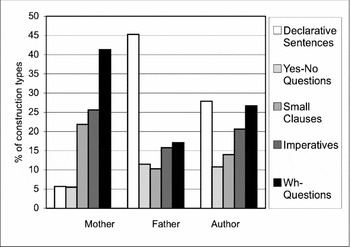
Figure 3 shows the combination types produced in Tagalog by the child's mother, in Spanish by her father, and in English by the English-speaking author. As can be seen, child and adults display similar sentence preferences in Spanish and English, but they do not do so in Tagalog. Declaratives are indeed the most represented construction type in Spanish, and they are more common in Spanish than in the other languages, both for the child and for the adults. In English, wh-questions are roughly as frequent as declaratives, both in the child's and the adult's data. On the other hand, Kathryn and her Tagalog-speaking mother diverge when it comes to their preferred sentence type: the child favors declaratives; her mother, wh-questions and imperatives. Interestingly, analogous frequencies of interrogatives and imperatives have been found in parental speech in other non-Western communities, for example among Luo caregivers in Kenya and among Samoan adults in Western and American Samoa (Blount, Reference Blount1972; Ochs, Reference Ochs1988). Blount (Reference Blount1972), in particular, found that in elicitation settings the most common type of sentence by Samoan and Luo adult caregivers was an interrogative. However, in non-elicitation settings, i.e. in routine communication, the proportion of imperatives was much larger. “In either case”, he concluded, “it is noteworthy that declarative statements are relatively infrequent” (Reference Blount1972, p. 123), less than 15 percent of the total input in his own study, much like in Kathryn's case. As Blount (Reference Blount1972, p. 123) puts it, children in Luo and Samoan society “are not considered to be conversational equals . . . The adult initiates almost all of the interaction, and in his turn in the conversational round he most frequently issues a command and issues a request, either in the direct form of an imperative or the indirect one of a question”. This also seemed to be the case with Kathryn's mother, who tended to order the child either to perform or not to perform some action (kain na! “eat”, sabihin mo “gunting”! “say ‘scissors’!”, huwag mong alisin iyan! “don't open that!”), or to provide some information (ano ’to/’yan? “what's this/that?”, saan mo ilalagay iyan? “where are you going to put that?”, sinong nagtapon ng tubig? “who threw the water on the floor?”). It is thus possible that the differences between child and adult Tagalog speech and among varying sets of input were due to interactional and cultural practices.
Combination types produced by Kathryn's adult interlocutors: the Tagalog-speaking mother, the Spanish-speaking father, and the English-speaking author (calculated over 500 utterances for each speaker).

Notice also that Kathryn's Tagalog input differed from her Spanish and English input in the amount of small clauses. This category included utterances that consisted of a simple or modified noun (“a [black] cat”), a single adjective (“cute”), a prepositional phrase (“on top of the tree”), a routine or interjection (“hi”, “very good”, “thank you”, “you know”) and, more generally, any utterance that could not be classified as a well-formed declarative, interrogative or imperative. Although these utterances were fairly common in all languages, they were more frequent in Tagalog than in Spanish and English for two reasons. First, a small subset of Tagalog adjectives can occur in a sentence not only without a copula, which is usually not expressed in this language, but also without a topic, as in mainit “it's hot”, or maginaw “it's cold”. Note that the corresponding English utterance requires both a subject and a verb (it's cold), and the parallel Spanish sentence requires at least a verb (hace or está frío, literally “makes” or “is cold”). Also, in conversations with her daughter, Kathryn's mother made more extensive use of ‘telegraphic speech’ than the father and the researcher: she often repeated parts of her own or her child's utterances, producing sequences not only without a topic but also without a predicate. These constructions seemed to reflect a strategy by which the mother reduced the complexity of her utterances, tailored them to her daughter's needs, and hence facilitated her comprehension. Given the large proportion of such telegraphic utterances and the limited number of declaratives in the input, it is therefore of particular interest to examine the extent to which the child could extrapolate the word order properties of Tagalog in declarative sentences.
Word order in argument/predicate sequences
The data in Table 3 seem to indicate that all of the child's declarative utterances can be analyzed, as in Deuchar and Quay (Reference Deuchar and Quay2000), as “small clauses” made up of an argument and a predicate. The argument is always an NP and the predicate can be either assigned to a “lexical category” (NP, VP, AP, AdvP, PP) or classified as acategorical (as in the case of wala “no more/gone”, no/not, and mas/más “more”). More importantly, as in Deuchar and Quay (Reference Deuchar and Quay2000), arguments seem to either precede or follow their predicate in all of the child's three languages.
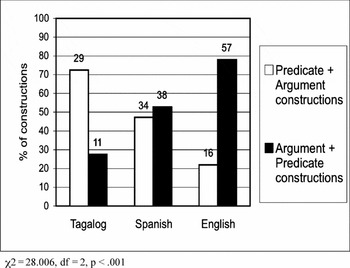
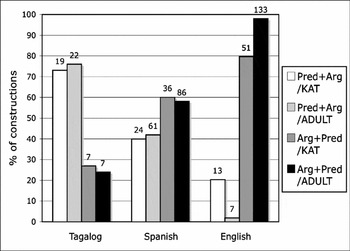
When the distribution of argument + predicate and predicate + argument constructions in each language are nonetheless calculated, interesting target-dependent preferences are found, as shown in Figure 4.Footnote 4
Argument + predicate and predicate + argument constructions in Kathryn's Tagalog, Spanish, and English multiword combinations between 1;7 and 2;1 (mixed utterances included).

Although the numbers are small, the results show an overall preference for predicate + argument structures in Tagalog but they indicate the opposite trend for English combinations. On the other hand, there is more variation in Spanish multi-word utterances which alternate between argument + predicate sequences and predicate + argument constructions. Surprisingly, these results mirror the surface structures of basic sentences in Kathryn's input languages; thus, despite some instances of variation (for example, daddy this “this is daddy” in English and Barney maligo “Barney takes bath” in Tagalog) the child appears to be quite good at reproducing the basic word orders of each of her languages. For instance, 80 percent of Tagalog combinations that describe location (e.g. unan aso “pillow dog”) exhibit the basic predicate + argument order as in the adult language, nasa unan ang aso “on pillow the dog”, i.e. “the dog is on the pillow”. On the other hand, almost 70 percent of combinations expressing location in English exhibit the opposite argument + predicate order: daddytrabaho/trabajo “daddy work”, i.e. “daddy is at work”.Footnote 5 Despite her lack of the English word for “work”, Kathryn clearly reproduces a construction the structure of which mirrors the adult English target rather than the Tagalog one. Similarly, 70 percent of Tagalog combinations involving a predicate and an argument (e.g. owie aso “pain dog”, i.e. “the dog inflicts pain”, or sira this “broken this”, i.e. “this is broken”) reflect the adult predicate + argument order: pinasasakit siya ng aso “inflict-pain to-him/her (generic) the dog” and sira ito “broken this”. On the other hand, 78.6 percent of analogous English combinations mirror the English argument + predicate order: Barney sit “Barney is sitting” and this big “this is big”. Finally, in Spanish, this type of combinations follows either the argument + predicate order (60 percent of the utterances) or the predicate + argument order (40 percent). Argument-initial combinations such as arbol luz “tree light”, i.e. “the tree (has) light(s)”, and argument-final constructions hotᵊsol “hot the sun”, i.e. “the sun is hot”, are thus equally legitimate.
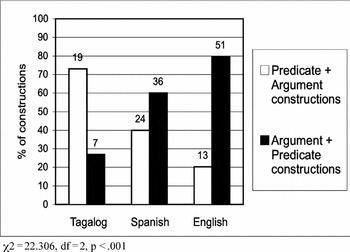
As shown in Figure 4, a chi-square test applied to the argument + predicate and predicate + argument sequences produced by the child in each language indicates that there is a significant association between word order and language (χ2 = 28.006, df = 2, p < .001). These results confirm that Kathryn is displaying different ordering patterns depending on the language in which she is interacting. Further support for this claim comes from an analysis of single-language combinations alone. As can be seen in Figure 5, the association between word order and language remains as strong when mixed combinations are excluded (χ2 = 22.306, df = 2, p < .001).
Argument + predicate and predicate + argument constructions in Kathryn's Tagalog, Spanish, and English multi-word combinations between 1;7 and 2;1 (mixed utterances excluded).

An examination of the position of acategorical predicates (wala “no more/gone”, no/no, and not) with respect to their argument provides further evidence for word order differentiation. In Tagalog, for instance, these predicates are always positioned sentence-initially as in the adult language: walang aso “no more/gone dog”, walang bola “no more/gone ball”. In Spanish, on the other hand, Kathryn alternates between sentence-initial and sentence-final acategorical predicates as in the adult language: no sol “no sun”, i.e. “there is no sun, it's not sunny”, and avión no “plane no”, i.e. “there is no plane”. Notice that although no is generally positioned sentence-initially in adult Spanish (no hay sol/avión “no (there) is sun/plane”, i.e. “there is no sun/plane”), it can also follow the argument in a contrastive context (e.g. nubes hay, sol no hay “clouds (there) are, sun (there) is not”). Finally, in English, the child does not employ no to negate or express a change in a state of affairs; rather she resorts to not to express what appears to be a similar meaning. Not is always positioned after the argument as in mommy not “mommy is not here”. Although it remains uncertain whether wala, no, and not perform similar semantic functions, it is informative that they are positioned differentially following language-specific patterning.
An analysis of the order of predicates with respect to arguments in the adults’ speech further supports the claim that Kathryn is highly attuned to the word order properties of her languages. For instance, as can be seen in Figure 6, which shows word order in Kathryn's and the adults’ declarative sentences, roughly 75 percent of both mother's and child's utterances follow the predicate + argument order.Footnote 6 The limited number of declaratives in the maternal input is thus sufficient for Kathryn to extrapolate the correct ordering pattern in basic sentences and use it to the same extent as her mother. After all, as shown in Table 4, which compares word order in Tagalog declarative and non-declarative utterances, several other Tagalog constructions have the same exact structure of declarative sentences (81.5 percent of the mother's “yes–no” questions, 96.1 percent of her wh-questions, and 87 percent of her imperatives follow indeed the basic predicate + argument order).
Argument + predicate and predicate + argument constructions produced by Kathryn and the adult interlocutors in Tagalog, Spanish, and English (calculated over 500 utterances for the adults).

A comparison of word order in Tagalog declarative and non-declarative utterances.

TM = Topic Marker.
The frequencies of argument + predicate and predicate + argument constructions are also basically the same for both the child and the Spanish-speaking father (Figure 6). However, the correlation between child and adult word order is slightly less strong in English. This is surprising given that arguments quite strictly precede predicates in English. Since the English-speaking author was not Kathryn's everyday source of English input, it is possible that Kathryn was normally exposed to an English that was at times ‘influenced’ by Tagalog or Spanish word order. Recall that English was the language spoken between mother and father and it is not unlikely that their English displayed some cross-language influence that the child could overhear. Alternatively, pragmatic factors might have been at play: an analysis of the 13 combinations that do not follow English basic word order suggests that in utterances such as OWIEthis, and DADDY this (produced as answers to the question WHATis this?) Kathryn might have been placing particular emphasis on the constituent carrying the new information, namely, her “owie”, and her “daddy”. In other words, it is possible that ordering preferences were sometimes overridden by a few pragmatic principles (such as “place the predicate before the argument when the predicate is particularly salient”) when the context particularly favored this ‘violation’. This would explain the percentage, even though limited, of non-target sequences in Tagalog and English.
In sum, the analysis reported in this study indicates that early word order differentiation is possible not only before the appearance of clear morphological/syntactic markings but also in the context of multiple languages: the frequencies of language-specific word order sequences reflect target-dependent preferences, and the child appears to be quite good, overall, at reproducing the basic word orders of her various languages. Although it remains to be seen whether Kathryn has developed some sort of language-specific combinatorial knowledge or rather she is just imitating the ordering patterns heard in adult speech, early word order differentiation is testimony that the child is gradually building different syntaxes out of pieces of language that are variably strung together in the adult input.
Summary and conclusion
The purpose of this paper was to examine whether early multilingual development is characterized by an initial stage in which the child orders the words of her sentences variably and similarly across languages, or rather whether signs of differentiated sequencing patterns can be found from the earliest stage of multi-word production. This is an important issue since it carries implicit assumptions about children's ability to differentiate – and hence acquire – more than two languages without delay. Evidence that young multilinguals can arrange items in their utterances variably following language-specific schemas does indeed imply that such children are capable of reproducing what they hear in the input, and, possibly, they might even possess some language-specific generalization regarding basic word order. In addition, the fact that trilinguals, and not only bilinguals, can combine the words of their languages differently from the start demonstrates that trilingual exposure does not slow down the process of differentiation and that learning three languages is not necessarily more ‘costly’ than learning two.
The findings of this study indicate that (a) the percentages of the different combination types that the child produced vary significantly from language to language (Figure 2); (b) argument/predicate sequences are differentially ordered depending on their language (Figure 5) and following input-dependent preferences (Figure 6); (c) mixed utterances are, for the most part, caused by vocabulary gaps rather than by fusion of syntactic systems (Figure 1), and they follow the same organizing principles as those single-language utterances produced in the same language context (Figure 4). These results, taken together, portray a child who displays different structural preferences depending on the language in which she is interacting and following input-related patterning. The fact that constructions mastered in one language are indeed not transferred to other languages and that word order in basic sentences significantly differs cross-linguistically supports the claim that early word order differentiation is possible, contrary to Deuchar and Quay's (Reference Deuchar and Quay2000) proposal of a language-general “rudimentary syntax” in early bilingual development, and that differentiation is possible even in the case of trilingual exposure. This finding is important because it indicates that trilingual – as opposed to bilingual – exposure does not delay the process of language differentiation; on the contrary, it might even facilitate it. Although no such generalization can be drawn from a case study, it is not excluded that increased input diversity leads the child to an enhanced language discrimination capacity and, in turn, to a heightened attention towards the structural properties of her languages, thereby enhancing the course and timing of differentiation. Of course, signs of differentiation will be found only if children are learning languages that allow them to show such signs, i.e. languages that display varying ordering patterns. The evidence presented in Köppe (Reference Köppe1996, Reference Köppe1997) and Paradis et al. (Reference Paradis, Nicoladis and Genesee2000) indicates that even bilinguals learning languages with relatively similar word orders can produce differentiated sequencing patterns early on if some of these patterns differ from language to language. Yet, in order to determine how good multilingual children can be at replicating – and perhaps generalizing – what they hear in the input early on in development, and whether there is indeed any facilitation in the case of trilingualism, more studies need to be conducted with children learning pairs and triplets of typologically unrelated languages.
The results of this study – that a trilingual child produces different word orders in her first combinations following the patterns specific to her three languages – are thus only partly in line with a usage-based theoretical perspective on the process of language acquisition. As predicted by such perspective, the emergence of differentiated syntactic systems appears to be a gradual process that starts with the acquisition of concrete language chunks that are of different shapes and sizes in each language. This process, as predicted by a usage-based approach, is crucially guided by the input: frequently-used basic patterns and specific constructions produced by the adults allow the child to identify the meaning and structure of these constructions and to incorporate them in her own use of language to the same extent as her models. This can be seen in the striking similarity between adult and child word order in declarative statements.
However, whether Kathryn's early combinations completely lack productivity, as predicted by a usage-based theoretical framework, remains a matter of debate. Recall that such framework predicts that first constructions are item-based, or pivot schemas, and that any regular arrangement found in them most likely results from piecemeal learning – from the memorization of pieces of language – rather than from some sort of combinatorial knowledge (Tomasello, Reference Tomasello2000, Reference Tomasello, Damon and Lerner2006). Kathryn's constructions do seem to be pivot schemas: (a) they include the same basic types of scenes (existence–non-existence–recurrence, exchange–possession, movement–location, and identification); (b) different words are used to indicate different components of the scene (in sira this “broken this”, autoᵊrojo “car (is) red”, ᵊ pen ᵊ mine, the predicates sira, rojo, and mine indicate a property, and the arguments this, auto, and pen indicate the object involved); and (c) the same predicate is used with a wide variety of arguments (walang aso “gone dog”, walang bola “gone ball”, auto aː luz “car (has) light”, arbol aː luz “tree (has) light”, ᵊ pen ᵊ mine, they(’re) mine). At the same time, despite their ‘pivot look’, Kathryn's combinations do not completely lack productivity. First, a participant role in an already partitioned scene can be filled by many different entities (e.g. walang X, X luz, X mine). This productivity suggests that the child in this study “possesses some kind of paradigmatic category of ‘noun’ or ‘noun phrase’ corresponding to the types of linguistic items that can play particular roles in specific pivot-type constructions” (Tomasello and Brooks, Reference Tomasello, Brooks and Barrett1999, p. 168). Second, and most importantly, the consistent ordering patterns of predicates and arguments found in each language are used contrastively to indicate the role played by a word in a larger combinatorial structure: examples such as sayaw this “dance this”, and sira this “broken this”, produced in the Tagalog context in the absence of the Tagalog equivalent for this, as opposed to combinations such as this daddy, this ᵊ bottle in English do indicate that the final position is reserved for the argument in Tagalog but for the predicate in English, and hence that word order for Kathryn is doing some sort of ‘sentence-organizing’ work.
As a matter of fact, the strongest evidence in support of some degree of productivity in Kathryn's early constructions comes precisely from an analysis of the structure of mixed combinations. Recall that Kathryn, as Montanari (Reference Montanari2008) shows in detail, was minimally exposed to mixed utterances. Yet, her own mixed combinations tend to display the same word order as those single-language utterances that occur in the same language context. In other words, despite the lack of exposure to mixed constructions, the child appears capable of taking one item from one language and collocating it in an utterance in another language while at the same time preserving the order specific to this utterance. This seems good evidence in support of the claim that, at least in some utterances, Kathryn is not merely imitating adult sequences, that is she is not ordering elements following language-general sequencing patterns, but rather she is STARTING to creatively combine words according to the distinct sentence-organizing principles found in her languages.