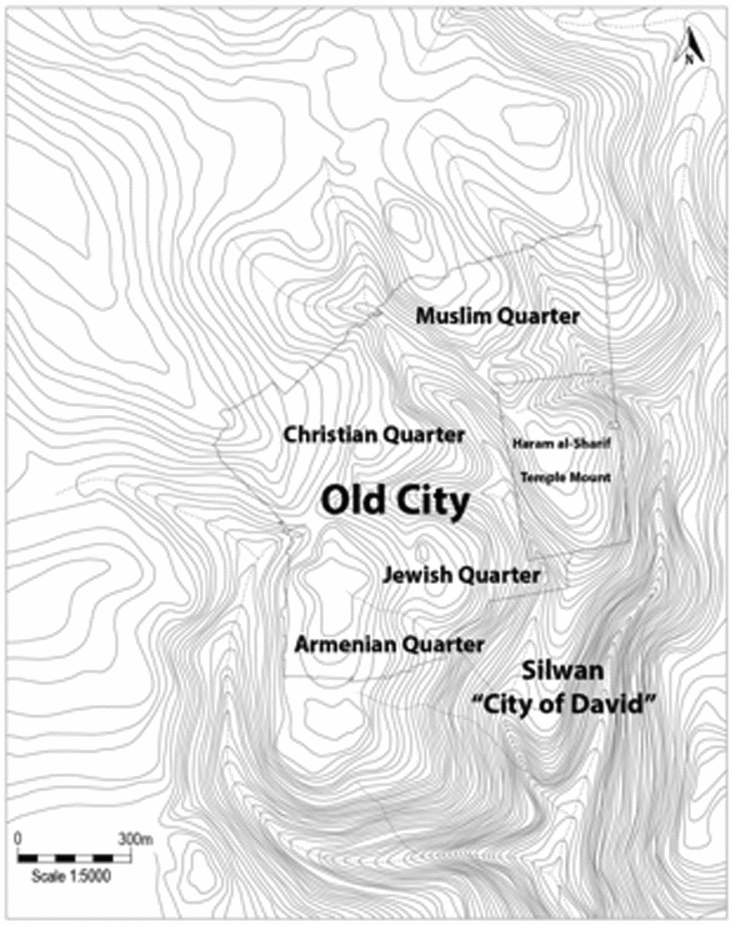
Very few cities are defined as much by their antiquities as Jerusalem: religiously, culturally, politically, and economically. Erasing the Old City, or at least part of it, as suggested variously by Theodor Herzl and David Ben-Gurion, would have been an act difficult to reverse.Footnote 1 The ruins of the past are now recognized and protected as the city's most distinct physical and visual attribute, in which past and present landscapes mingle to project the deceitful image of harmony. That said, this paper is not concerned with the usual questions of how certain monuments or artifacts inform us about past accomplishments or lost cultures. It in fact distances itself from the material and visual dimensions of Jerusalem's antiquities and addresses instead the human aspects exclusively, questioning the interaction between those who explore Jerusalem's antiquities and those who dwell amongst the surviving remnants. This polarized encounter between archaeologists and residents has defined most of Silwan's 150 years of excavation, reaching new heights of tension with the escalating geopolitical conflict between Israelis and Palestinians. As a case study, explorations in the City of David (figure 1), demonstrate how professional interests increasingly compromise and indeed violate the needs and rights of those who are most closely tied to, and indeed dependent on, the locus of exploration (Galor Reference Galor2017, 126–131).Footnote 2 Silwanis, both the small minority of Jewish settlers and the predominantly Palestinian population, have been persuaded and largely misguided as to the area's biblical heritage. In contrast, the 1300-years of nearly continuous Islamic presence, is perceived by neither as a legacy, which can be archaeologically explored and publicly validated.
Topographical map of Jerusalem's Old City and surrounding area, including Silwan south of the Haram al-Sharif and outside the Ottoman walls. Redrawn by Katharina Galor, after: Vincent, Louis-Hugues, and Steve, Marie-Joseph. Jérusalem de l'Ancien Testament: recherches d'archéologie et d'histoire, I. Paris: J. Gabalda. Plate 1.

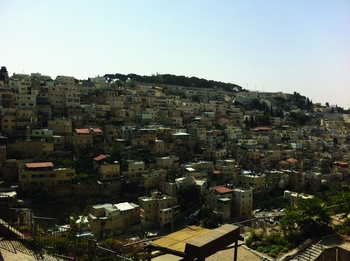
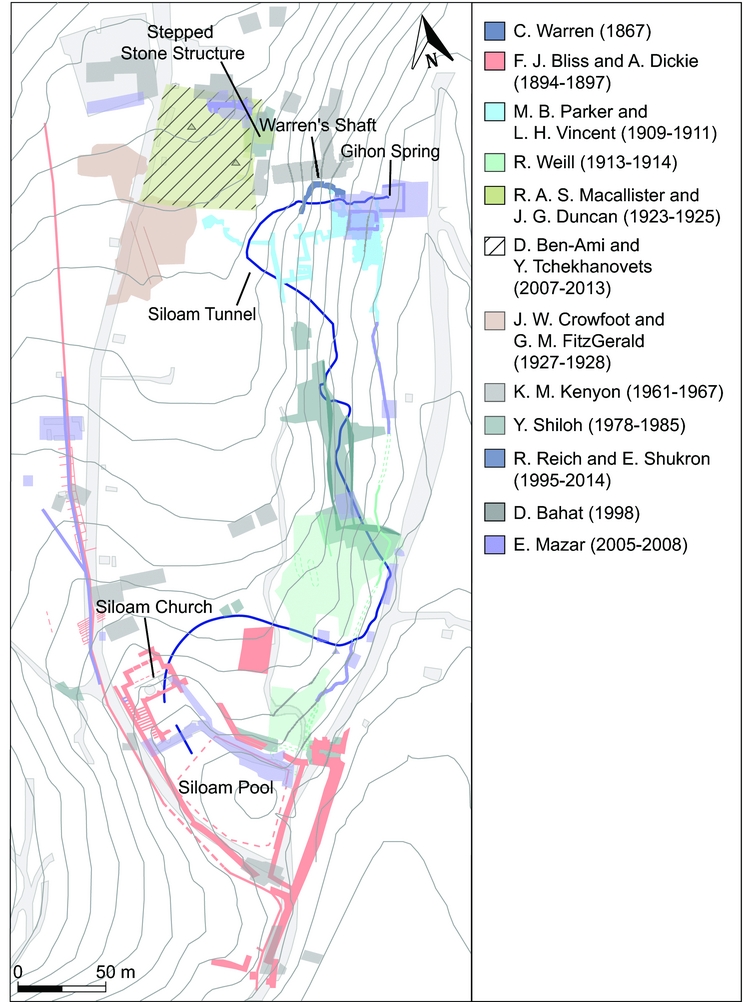
Located to the south of Jerusalem's Old City, within the boundary of its Historic Basin, Silwan has been identified as the city's earliest site of permanent settlement, beginning in the Bronze Age (3300 BCE).Footnote 3 It has attracted hundreds, indeed thousands of archaeologists as well as millions of pilgrims and tourists, most of whom have been intrigued by the potential to uncover the physical traces of the biblical narrative (figure 2). Remains from the early and late Islamic periods (from the Umayyads through the Mamluks), in contrast, have been largely ignored. Several examples from different key periods in the history of Jerusalem's archaeological exploration demonstrate the significant bias in heritage preservation practice and policy.Footnote 4 Despite the growing awareness that archaeologists’ obligations are as much, if not more, towards the living communities (figure 3) than towards anything and anyone from the past, the biblical lore combined with colonial and nationalist agendas appear to overpower professional standards and the international agencies claiming to preserve Jerusalem's cultural heritage for all humankind.Footnote 5 In more concrete terms, more efforts should be invested in preserving archaeological remains and standing monuments relevant to the Christian and Muslim heritage, and increased attention should be paid to the education of all populations, in which the biblical legacy is part of a much richer representation of the region's past.
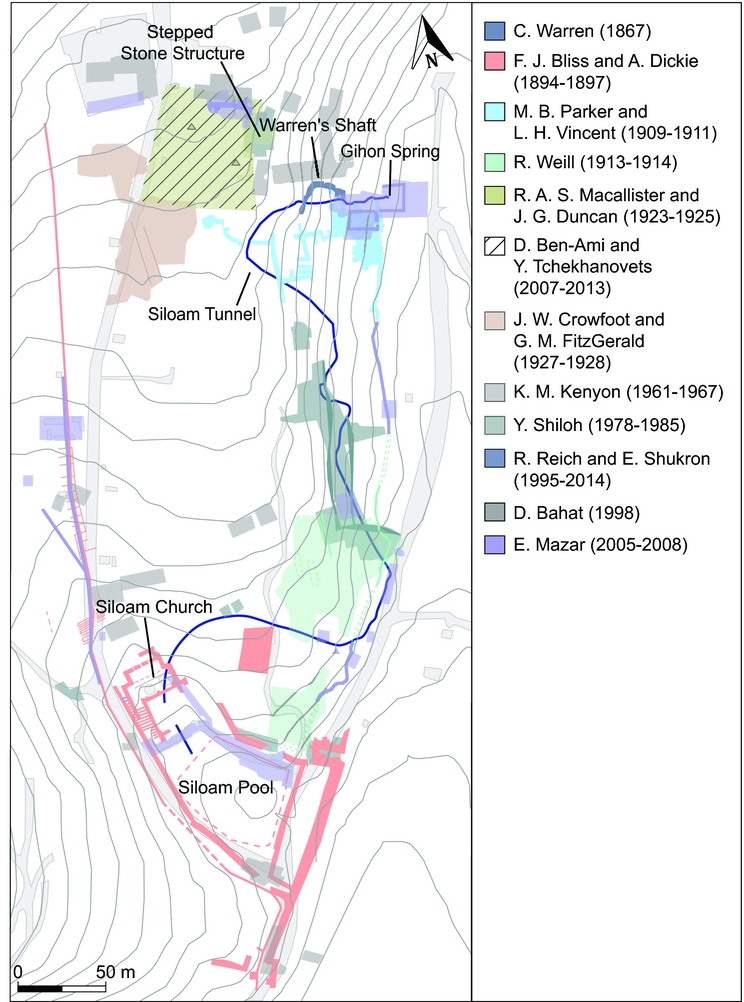
City of David, areas of major excavations. Redrawn by Franziska Lehmann, after: Reich, Ronny. Excavating the City of David. Where Jerusalem's History Began. Jerusalem: Israel Exploration Society and Biblical Archaeology Society. Plates 11, 57, 74 and 83.
The village of Silwan on the eastern slope of the Kidron Valley. Photo by Katharina Galor.

Among Jerusalem's earliest explorers (1867), Sir Charles Warren of the British Royal Engineers has been celebrated as one of the most important individuals to unravel the mysteries of the city's biblical and postbiblical past. The vertical sinkhole in Silwan still carries his name, and owes its fame to Warren's claim—only recently proven wrong—that it enabled King David to conquer the city around 1000 BCE (Reich and Shukron 1999). Warren is rarely remembered for disturbing Muslim worshippers through his work near the Haram, which resulted in the loss of an official work permit and caused him to carry out his work illegally. His spiteful description of the local villagers as “a lawless set, credited with being the most unscrupulous ruffians in Palestine” (Warren Reference Warren1876, 149) is also easily overlooked. Warren's attitude, after all, inserts itself harmoniously into the colonial arrogance of the first generation of western explorers convinced that their religious and scientific agendas justified the disturbance their work imposed on local worshippers and residents (Galor Reference Galor2017, 32–34).
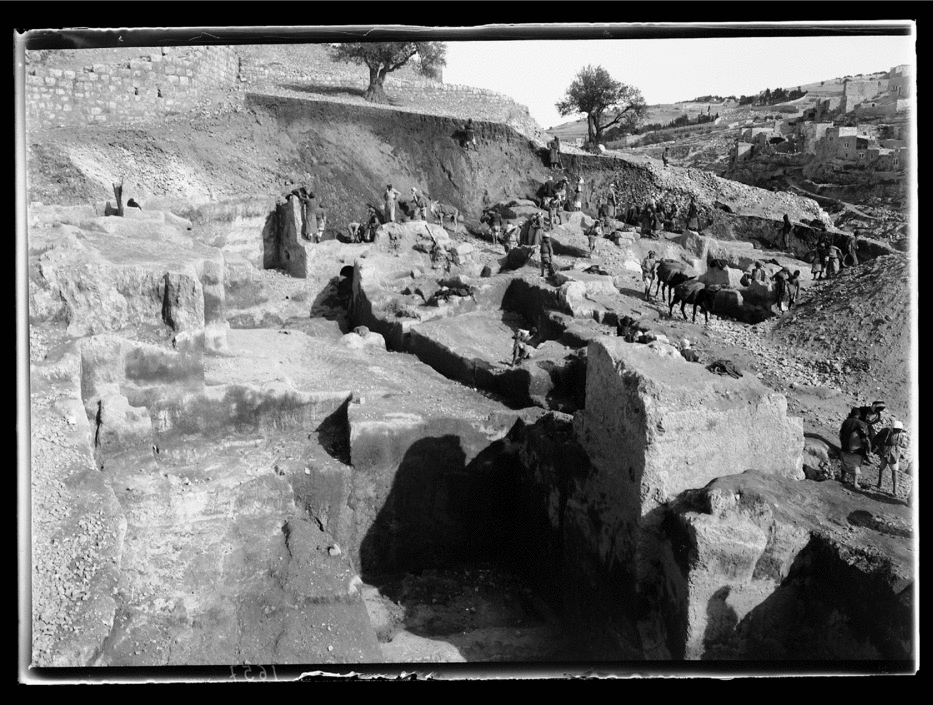
The first active involvement of Silwan residents occurred during Raymond Weill's expedition (1913–1914; Weill Reference Weill1920). Financed by Baron Edmond de Rothschild as part of his larger Zionist project, this first Jewish excavation was modeled after the otherwise exclusively Protestant and Catholic missions at the site. Photographs from the excavation (figure 4) suggest that workers from various religious backgrounds participated in this colonial enterprise side by side, including recently immigrated Yemenite Jews (recognizable by their sidelocks or peyot).
Raymond Weill's expedition. Courtesy of the École biblique et archéologique française de Jérusalem.

One of three large-scale excavations in the city conducted after Israel's capture of East Jerusalem in 1967 was directed by Yigal Shiloh on behalf of the Hebrew University of Jerusalem (1978–1985). Clashes of interests emerged within Israeli society, represented on one side by professional archaeologists and their scientific efforts to explore the history of the site and on the other by the ultra-Orthodox community vested in protecting the Jewish heritage by preventing the potential disturbance of ancient burials (Reich Reference Reich2011, 9, 138–140). Despite the resulting legal reform of excavation procedures regarding the exposure and study of human remains (Einhorn Reference Einhorn1997, 48, 65–74), the scholarly quest persisted in the mostly fruitless effort to uncover the physical stage for the biblical stories.
Eilat Mazar's claim to have uncovered the remains of King David's palace during her campaign (2005–2008; Mazar Reference Mazar2006) has convinced few if any of her archaeologist colleagues, but it has gained great popularity among the general public. The claim has been successfully promoted by Elad, the Israeli NGO, also known as the City of David Foundation, with authority over the archaeological park and associated tourist and education industry. Elad's heritage efforts converge with their practice of seizing or purchasing Palestinian homes for occupancy by Jewish families.
The interest in biblical discoveries evinced by the hundreds of tourists who visit the site daily is countered by the reality of daily life in Silwan. Here, a Jewish minority of about 700 families lives among their 20,000 to 50,000 Palestinian neighbors, a disproportionate demography which Israeli municipal and governmental policies aim to impact further by increasing the numbers of Jewish housing units (Hasson Reference Hasson2014a). The segregation of Jewish residents and visitors from the Palestinian villagers of Silwan and the latter group's estrangement from the archaeological process and indeed heritage is visibly apparent. The barbed wire, the security equipment, as well as the police and military presence, clearly demonstrate who maintains the upper hand. Efforts of resistance among the Palestinian population take on various forms of spontaneous or organized action. These include protests against archaeological excavations recognized as political acts in disguise, or efforts to empower the local Palestinian population through educational and artistic activities (the latter coordinated by the Wadi Hilweh Information Center beginning in 2007).Footnote 6
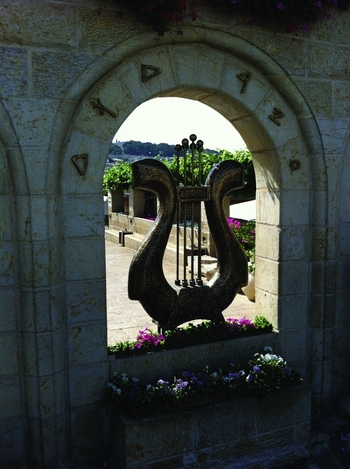
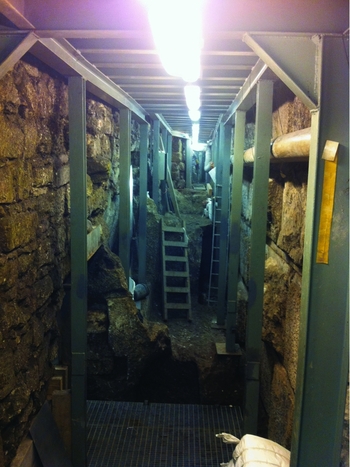
No other individual's professional achievements are as closely tied to the excavations in Silwan as Ronny Reich, who owes much of this success to the execution of the fieldwork (1995–2014) by his partner Eli Shukron, as well as to the unwavering financial and logistical support of Elad (figure 5). Despite Elad's explicit goals, however, Reich and most Israeli archaeologists working in the occupied sector of the city have insisted that their work is politically unbiased and follows the highest professional and scientific standards (figure 6). After his retirement, however, Reich appears to have altered his view of the excavation's impartiality, as evidenced in a 2016 interview in Haaretz (Hasson Reference Hasson2016), in which he is quoted: “This is an excavation in the service of tourism, and then of politics, or perhaps first politics and then tourism.” Even more relevant, though, is his relationship as one of the excavations’ chief archaeologists with Silwanis, many of whom were previously employed by him as workers. Since the late 1990s, the Palestinian workers have become aware of the ideological manipulation of archaeology in the City of David, and have stopped working for Reich. Reich in turn blames the Israeli NGO Emek Shaveh for this change in attitude. Emek Shaveh has exposed how the presentation of archaeological discoveries is often manipulated for political ends, which both justifies Israeli occupation and compromises the human rights of the regions’ Palestinian communities (Hasson Reference Hasson2014b). According to Emek Shaveh, archaeology in Silwan has compromised professional standards by using outdated field methods; manipulating the results for ideological purposes; and segregating and in fact abusing the Palestinian residents of the neighborhood.Footnote 7 Reich argues that the Silwanis’ refusal to partake in the excavation is ultimately to their own disadvantage as it eliminates income on which their livelihoods directly depend (2011, 150, 248–49). It is indeed not completely unreasonable to conclude that Emek Shaveh's activism is implicated in breaking the mostly successful apparatus of colonial exploitation, which for nearly a century and a half has maintained the binary situation in which archaeologists and the local residents are held hostage to diverging needs and opposing interests.
Entrance to Elad's sponsored City of David Archaeological Park featuring a harp, as a symbol of King David. Photo by Katharina Galor.

One of the numerous tunnel excavations in Silwan, which counter current scientific standards of stratigraphic excavations. Photo by Katharina Galor.

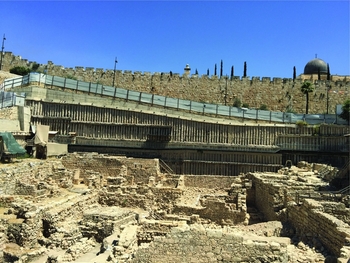
Equally tied to and dependent on the support and interests of Elad are the recent Givati Parking Lot excavations directed by Doron Ben-Ami and Yana Tchekhanovets (2007–2013; Ben-Ami and Tchekhanovets Reference Ben-Ami and Tchekhanovets2010). The unprecedented scale of the project corresponds to the vastness of the public space on which the excavation is carried out (figure 7), unconstrained by Silwan's otherwise densely built-up residential areas that sit on top of the rapidly expanding archaeological network of underground tunnels and spaces. Similarly ambitious also is the scale of the planned Kedem Center, a seven-story building spanning roughly 16,000 square meters, which will sit atop the excavation site and rise just slightly short of the height of the Old City walls (Hasson Reference Hasson2014b). Designed by Elad as a government center whose aim is to bring the biblical stories to the public, the construction—so Emek Shaveh says—will cause a “dramatic and irreversible shift in the character of Silwan and the quality of life of its inhabitants.”Footnote 8 Emek Shaveh's appeal to the Israel Supreme Court to halt the construction was rejected, a decision in line with Israel's commitment to promote the Jewish character of East Jerusalem's Old City and Silwan. The ability to distract from the political agenda of the excavation is one of Elad's talents, for which it has gained the full support and cooperation of the Israeli government, the Jerusalem municipality, as well as the Israel Antiquities Authority (Hasson Reference Hasson2014b). The enthusiastic participation of students and volunteers from Israel and around the world is just one of many signs indicative of the confusion between scientific and ideological endeavor.
Givati Parking Lot excavations with the Old City walls and the gray dome of the al-Aqsa Mosque visible in the background (north of the site). Photo by Katharina Galor.

Silwan is one of the most densely populated areas in East Jerusalem, and at the same time the most targeted locus of archaeological excavation in the city. The increased attention, budget, professional dedication, expertise, and indeed sophistication have done nothing though to reduce the tension between archaeologists and local inhabitants, a legacy of colonial times in which nationalist agendas and religious ambitions dictated the ideologically compromised science of archaeology. Though I have singled out a few select individuals, their power does not stand alone. Increasingly large teams of professionals and visitors participate in the success and visibility of these projects, which progressively intersperse every available and unavailable piece of land and gradually spread underneath the surface, establishing a new irreversible reality both above and below the ground. Rather than spending millions of dollars annually on the excavation, more efforts should be invested in preserving historic buildings above ground, in incorporating the Christian and Islamic legacy into the public display of antiquities’ sites, and finally, in the education of all locals regarding the historic legacy of Silwan, not only regarding the biblical past, but also in relation to the 2000 years of the city's post-biblical heritage.