Introduction
The elderly population is increasing in all European countries, which will lead to an increase in the number of people with dementia. Immigrants from Turkey form the largest ethnic minority in Western Europe, and in Denmark a threefold increase in the number of elderly in this population is expected during the next 20 years. With the changing composition of ethnic, linguistic, and cultural populations in European countries, the availability of methods for accurate assessment of cognitive functioning in patients from diverse backgrounds becomes increasingly important.
There is no gold standard for cross-cultural dementia diagnostics (Prince, Reference Prince2000; Nielsen et al., Reference Nielsen, Andersen, Kastrup, Phung and Waldemar2011). Cognitive testing is essential for diagnosing dementia, but assessment of cognitive dysfunction in persons from ethnic minority migrant populations may be challenging. Bilingual staff are rarely available in European dementia clinics (Nielsen et al., Reference Nielsen2010), and the majority of available neuropsychological tests used in assessment of dementia are affected by cultural factors (Parker and Philp, Reference Parker and Philp2004; Ardila, Reference Ardila2005). This represents a significant challenge when assessing cognitive dysfunction in elderly immigrant patients with limited acculturation level and fluency in the language of residence, and limited or no schooling (Lindesay, Reference Lindesay1998; Daker-White et al., Reference Daker-White, Beattie, Gilliard and Means2002; Nielsen et al., Reference Nielsen2010; 2011).
A number of studies have suggested that tests of recall of common objects (Zunzunegui et al., Reference Zunzunegui, Gutierrez, Beland, Del and Wolfson2000; Liu et al., Reference Liu, Teng, Chuang, Lin, Fuh and Wang2002; Nitrini et al., Reference Nitrini2004; Takada et al., Reference Takada2006; Kempler et al., Reference Kempler, Teng, Taussig and Dick2010), clock reading (Schmidtke and Hull, Reference Schmidtke and Hull2002; Schmidtke and Olbrich, Reference Schmidtke and Olbrich2007), and supermarket fluency (SF) (Reis et al., Reference Reis, Guerreiro and Petersson2003; da Silva et al., Reference da Silva, Petersson, Faisca, Ingvar and Reis2004) are affected by culture and language bias to a lesser extent than other cognitive tests while retaining their sensitivity to cognitive impairment in Alzheimer's disease (AD) and other forms of dementia. Common features of the tests are that they are short, require no reading skills, and are easy to apply with the help of an interpreter.
Appropriate neuropsychological tests for cross-cultural assessment of elderly ethnic and linguistic minorities are generally lacking in Europe (Nielsen et al., Reference Nielsen2010). As the diversity in ethnic, linguistic, and cultural backgrounds in the elderly population increases, there is a growing need to find appropriate tests for cross-cultural assessment of patients from these backgrounds. The aim of this study was to investigate the cross-cultural differences in the Recall of Pictures Test (RPT), Clock Reading Test (CRT), and SF for assessment of elderly Turkish immigrants and Danish elderly. Further, we wished to present the distribution of test scores in a sample of elderly Turkish immigrants.
Methods
Subjects
Contact information on a random sample of elderly Turkish immigrants residing in the Greater Copenhagen area was obtained from the Danish Civil Registration System (DCRS) (Pedersen et al., Reference Pedersen, Gotzsche, Moller and Mortensen2006), in which individual demographic data, including age, gender, current address, and country of residence before immigration are recorded. Based on addresses retrieved from the DCRS, Turkish subjects were recruited through personal letters of invitation and follow-up phone calls by bilingual research assistants. Danish elderly participants were recruited through newspaper advertisements. The Danish cohort was a convenience sample of subjects that was sampled to have limited education. Candidates for inclusion were screened by a comprehensive questionnaire including medical history and consumption of alcohol. When indicated, this was followed up by a clinical interview. Participants were excluded if they had a history of neurological or psychiatric disease or alcohol consumption above recommended national levels. In addition, all subjects had to be living independently and be free of any physical disabilities that could interfere with cognitive testing (e.g. movement disorders, uncorrected hearing, or vision problems). All participants underwent an approximately two-hour assessment where cognitive screening tests and a comprehensive battery of neuropsychological tests were applied. Approximately half of the tests administered to the two samples were identical, while the other half was specific for each test battery. In assessment of Turkish participants, a Danish neuropsychologist administered all cognitive tests with the assistance of an interpreter trained for the purpose. In addition, A Short Acculturation Scale for Hispanics (ASASH) (Marín et al., Reference Manly1987) was adapted and administered to the Turkish participants. ASASH consists of 12 items that measure acculturation level according to three dimensions on a five-point Likert scale, namely language use, media, and ethnic social relations (Marín et al., Reference Manly1987). The responses can be averaged across items (range of scores is one through five). The mean score can be used as an interval scale, where scores close to five indicate high levels of acculturation and those close to one indicate little acculturation. The scale has previously been reliably and validly adapted for other ethnic groups (dela Cruz et al., Reference dela Cruz, Padilla and Agustin2000; Choi and Reed, Reference Choi and Reed2011). Using methods similar to those of dela Cruz et al. (Reference dela Cruz, Padilla and Agustin2000) wordings such as “English” and “Americans” were changed to “Danish” and “Danes,” and “Spanish” and “Latinos/Hispanics” were changed to “Turkish” and “Turks.”
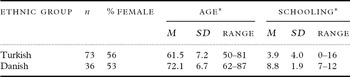
A total of 16 participants were excluded from the study. Three Turkish subjects were excluded because of current medically treated depression, and four because of traumatic head injury, stroke, brain tumors, and Parkinson's disease, respectively. One Danish subject with poor vision (to a degree that would interfere with cognitive testing) was excluded. In six participants (two Turkish and four Danish), symptoms of possible dementia were detected in clinical interviews or in the neuropsychological assessment. In these cases, in the Danish sample other tests were applied to confirm that persons scored below normal range, and in the Turkish sample symptoms of dementia were confirmed by a close relative. These six persons were referred for further diagnostic examination and excluded from the study. In total, 109 subjects were included in the study: 73 Turkish and 36 Danish. The mean time of residence in Denmark for included Turkish subjects was 31.6 ± 8.6 years, and the mean acculturation score on the adapted ASASH was 1.8 ± 0.4. Demographic characteristics of included participants are presented in Table 1.
Demographic characteristics of Turkish and Danish elderly participants

SD = standard deviation.
*Significant difference, p < 0.001. Age and Schooling both in years.
The distribution of men and women in the Turkish and Danish samples was comparable (χ 2 = 0.112, p = 0.738), whereas the Danish sample was significantly older (F = 53.52, p < 0.001) and had more years of schooling (U = 2367, p < 0.001).
The Committees on Biomedical Research Ethics for the Capital Region of Denmark, and the Danish Data Protection Agency approved the study. Written informed consent was obtained from all participants.
Instruments
Recall of Pictures Test
The RPT was developed to assess immediate and delayed recall. The test is similar to a word list learning test. But instead of learning and recalling a word list, subjects are required to learn and recall ten pictures. The test is similar to a test of delayed recall of ten simple objects from the Brief Cognitive Screening Battery (Nitrini et al., Reference Nitrini2004). However, instead of presenting black and white line drawings we used the colorized Snodgrass and Vanderwart pictures (Rossion and Pourtois, Reference Rossion and Pourtois2004), as it has been suggested that introducing color information can improve the recognition of pictures in illiterate and less schooled individuals (Reis et al., Reference Reis, Petersson, Castro-Caldas and Ingvar2001). Subjects were presented with a piece of paper with ten colored pictures of common objects that had to be named, and immediately thereafter recalled by the subjects (incidental recall). Then, the pictures were presented for 30 seconds two more times and subjects were asked to memorize and recall the pictures (immediate recall). After a 10-minute interference interval in which subjects performed executive and visuospatial function tests, delayed recall of the pictures was requested, followed by a recognition trial, in which the ten pictures had to be recognized among ten distracters. The immediate recall score was the mean score on three learning trials rounded to the nearest whole number, the delayed recall score was the number of pictures recalled after 10 minutes, and the recognition score was the number of pictures recognized among ten distracters. Also, the number of false positive answers on the recognition trial was recorded.
Clock Reading Test
In the CRT, subjects were required to read the time on a series of clocks showing different times. We used a slightly modified version of the CRT developed by Schmidtke and Olbrich (Reference Schmidtke and Olbrich2007), in which each clock face was presented on a separate page in a small booklet instead of being arranged in three lines on one sheet of paper. Subjects were presented with 12 sheets with clocks showing different times. Each clock face had hands to indicate the hour and minutes, and hour markings. There were no digits around the dial. The subjects were asked to read the time. Any correct form was accepted, e.g. “quarter after two” or “two fifteen.” One point was given for each correct reading of the time. A reading less than four minutes off the correct time was accepted as correct. A half point was given to readings which were four to five minutes or exactly one hour off the correct time. All other readings were given a score of zero.
When reading the four first clocks, subjects were encouraged to check their response if an error was committed. If the reading was changed in the first four clocks, the new reading was scored. The score was the sum of 12 clock readings.
Supermarket fluency
In SF, subjects are required to generate as many different “things you can buy in a supermarket” as possible within a one-minute period. The score is the number of different supermarket items produced in one minute.
Statistical analyses
The χ 2-test was used to test the significance of differences in the distribution of categorical variables. For continuous variables, analysis of covariance (ANCOVA) with age and years of schooling as covariates was used to investigate the significance of differences between groups. For non-parametric variables, the significance of differences between groups was tested with the Mann–Whitney U-test. The linear association between test performance and demographic variables was assessed using Spearman's rank-order correlation coefficient. The impact of demographic variables on test performance was investigated using step-wise linear regression analysis with plots of residuals as model control. A p-value of less than 0.05 was considered significant.
Results
Neuropsychological test performance
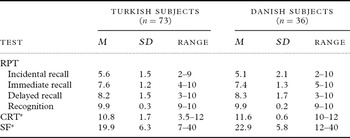
All participants were able to complete the RPT and SF, whereas five illiterate Turkish subjects were unable to complete the CRT, as they did not know how to read a clock. Data from these subjects were excluded from the analyses of CRT performance. On the RPT recognition trial, two Turkish and three Danish subjects had one false positive answer, and one Turkish subject had two false positive answers. Means, standard deviations, and range for RPT, CRT, and SF performance of Turkish and Danish samples are presented in Table 2.
Performance on RPT, CRT, and SF in Turkish and Danish elderly participants

SD = standard deviation; RPT = Recall of Pictures Test; CRT = Clock Reading Test; SF = supermarket fluency.
*Significant difference, p < 0.01.
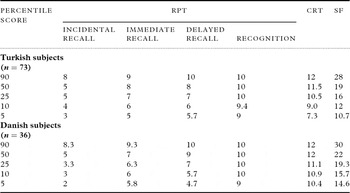
Significant differences were found between the Turkish and Danish samples in CRT and SF performance, but not in any RPT measures. Performance data for the Turkish and Danish samples are presented as percentiles in Table 3.
RPT, CRT, and SF performance in Turkish and Danish elderly participants expressed as percentiles

RPT = Recall of Pictures Test; CRT = Clock Reading Test; SF = supermarket fluency.
Effects of demographic variables
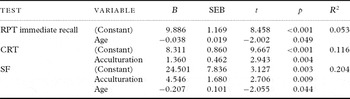
In the Turkish sample, age was negatively correlated with performance on RPT immediate recall (ρ = –0.263, p = 0.025) and delayed recall (ρ = –0.254, p = 0.030), SF (ρ = –0.369, p = 0.001) and CRT (ρ = –0.506, p < 0.001). Years of schooling was correlated with performance on CRT (ρ = –0.337, p = 0.005), and acculturation level was correlated with performance on SF (ρ = 0.305, p = 0.009) and CRT (ρ = 0.344, p = 0.004). No gender differences or correlations with years of residence in Denmark were found on any of the tests. When the demographic variables that were significantly correlated with test performance were entered into step-wise linear regression models of test performance, age and acculturation level were the only variables with significant impact on test performances (Table 4).
Linear step-wise regression analyses: contributions of age, years of schooling, and acculturation level to RPT, CRT, and SF performance in Turkish subjects

RPT = Recall of Pictures Test; CRT = Clock Reading Test; SF = supermarket fluency; SEB = standard error of B
In the Danish sample, no significant effects of age, years of schooling, or gender were found on RPT, SF, or CRT performances.
Discussion
In this study, the cross-cultural applicability of three short tests of memory, visuospatial function, and semantic fluency was investigated. To our knowledge, this is one of the first European studies to focus on cognitive testing of ethnic minority migrant populations. Test performances of a Turkish minority sample living in Denmark were compared with those of a sample of Danish elderly. No differences between the Turkish and Danish samples were found on any of the RPT measures, whereas the Danish sample performed slightly better on the CRT and SF. Data analyses showed that increasing age and acculturation level had a significant impact on test performances in the Turkish sample, while no effect of years of schooling and gender were found. No influences of demographic variables were found on any of the tests in the Danish sample. The last finding is not in keeping with general expectations. The limited number of participants in the Danish sample in combination with the fact that this sample was a convenience sample with a restricted range in age and years of schooling is the most likely reason for this finding.
The test materials and administration procedures for the three tests were appropriate for unschooled Turkish migrant participants who spoke no Danish, when they were administered with the help of an interpreter. Although the tests are short and simple, they are more complex than common brief cognitive screening tests such as the Mini-Mental State Examination (MMSE) (Folstein et al., Reference Folstein, Folstein and McHugh1975) and “culture reduced” screening tests such as the Rowland Universal Dementia Assessment Scale (RUDAS) (Storey et al., Reference Storey, Rowland, Basic, Conforti and Dickson2004) and test specific cognitive functions. Several studies report high sensitivity of tests of recall of common objects (Liu et al., Reference Liu, Teng, Chuang, Lin, Fuh and Wang2002; Takada et al., Reference Takada2006; Kempler et al., Reference Kempler, Teng, Taussig and Dick2010), clock reading (Tuokko et al., Reference Tuokko, Hadjistavropoulos, Miller and Beattie1992; O'Rourke et al., Reference O'Rourke, Tuokko, Hayden and Lynn1997; Schmidtke and Hull, Reference Schmidtke and Hull2002; Schmidtke and Olbrich, Reference Schmidtke and Olbrich2007), and semantic fluency (Monsch et al., Reference Monsch, Bondi, Butters, Salmon, Katzman and Thal1992; Gomez and White, Reference Gomez and White2006) in discriminating between the early stages of dementia and normal aging. Thus, the tests seem relevant for assessment of cognitive dysfunction in elderly Turkish migrant populations in Europe.
In general, test performances in the Turkish and Danish samples were comparable to previously reported normative data for the three tests in other cultural and linguistic groups (Monsch et al., Reference Monsch, Bondi, Butters, Salmon, Katzman and Thal1992; Kozora and Cullum, Reference Kozora and Cullum1995; Garces-Redondo et al., Reference Garces-Redondo, Santos, Perez-Lazaro and Pascual-Millan2004; Nitrini et al., Reference Nitrini2004; Schmidtke and Olbrich, Reference Schmidtke and Olbrich2007; Kempler et al., Reference Kempler, Teng, Taussig and Dick2010), providing evidence for broader cross-cultural applicability.
Acculturation can be used to assess the association of cultural experience with neuropsychological test performance among people with lifestyles that are very dissimilar to the majority culture. In the Turkish sample, acculturation level was found to have a small but significant impact on test performance. Specifically, acculturation level, as measured by the adjusted ASASH, was found to be a predictor of SF and CRT performance. This implies that as one becomes more familiar with and adopts the dominant Danish culture, SF and CRT scores tend to increase. This is most likely due to the fact that familiarity with the dominant culture and customs brings with it familiarity with test-taking formats and approaches.
Also, age had a significant impact on RPT immediate recall and SF performances. This was not surprising since performances on most cognitive tests decline with increasing age (Strauss et al., Reference Strauss, Sherman and Spreen2006). However, it is more noteworthy that the tests were little influenced by schooling in a sample of subjects with 0–16 years of schooling. However, our results are in line with previous studies on tests of delayed recall of pictures or photographs of common objects in elderly Spanish (Zunzunegui et al., Reference Zunzunegui, Gutierrez, Beland, Del and Wolfson2000), Brazilian (Nitrini et al., Reference Nitrini2004), Chinese (Liu et al., Reference Liu, Teng, Chuang, Lin, Fuh and Wang2002), and African-American, Caucasian, Chinese, Hispanic, and Vietnamese samples in the USA (Kempler et al., Reference Kempler, Teng, Taussig and Dick2010), and the CRT in a sample of elderly Germans (Schmidtke and Olbrich, Reference Schmidtke and Olbrich2007). As in our study, previous studies also find SF performance to be influenced by age (Kozora and Cullum, Reference Kozora and Cullum1995; Garces-Redondo et al., Reference Garces-Redondo, Santos, Perez-Lazaro and Pascual-Millan2004). But conflicting results have been reported on the influence of schooling on SF performance (Reis et al., Reference Reis, Guerreiro and Petersson2003; da Silva et al., Reference da Silva, Petersson, Faisca, Ingvar and Reis2004; Garces-Redondo et al., Reference Garces-Redondo, Santos, Perez-Lazaro and Pascual-Millan2004).
Differences in CRT and SF performances between the Turkish and Danish samples may partly be explained by sample bias. However, differences may also be related to the impact of acculturation on test performance in the Turkish sample. Previous studies have found differences in test performances between ethnic groups in the USA to be eliminated after controlling for acculturation level (Manly et al., Reference Manly1998).
A limitation of the study is the differences in sample sizes and demographic characteristics between the Turkish and Danish samples. Also, the Danish sample was a relatively small convenience sample that may not be representative of the general Danish elderly population. However, it was not possible to include Danish elderly subjects with less than seven years of schooling since this level of education was required at the time they attended school. Similarly, it was very difficult to recruit elderly Turkish subjects with more than five years of schooling. Another limitation is the small sample sizes, and consequently the data should be regarded as preliminary. Strengths of the study were that a Danish neuropsychologist performed all assessments with the help of an interpreter, rather than a bilingual researcher. This reflects the clinical practice in most European dementia clinics, where cognitive assessments of patients with diverse linguistic backgrounds are usually performed with the help of an interpreter as bilingual clinicians are lacking (Nielsen et al., Reference Nielsen2010; 2011).
There is a need for reliable methods for detecting cognitive deficits that are valid in European ethnic minority migrant populations. The cross-cultural applicability of the RPT seems very promising, and although small differences in CRT and SF performances were observed between the Turkish and Danish samples, we consider all tests to be important neuropsychological tests, when assessing dementia in elderly patients from ethnic minority migrant populations. In particular, the tests could be a valuable supplement to other “culture reduced” cognitive screening tests, such as the RUDAS, in cross-cultural evaluations of dementia. Future studies should attempt to assess the discriminative validity of the tests, and apply the tests in other ethnic minority populations.
Conflict of interest
None.
Description of authors' roles
T. Rune Nielsen designed the study, collected the data, analyzed the data, and wrote the paper. Asmus Vogel and Gunhild Waldemar assisted in designing the study, supervised the data analysis, and assisted in writing the paper.
Acknowledgments
The authors thank the Danish Council for Independent Research in the Humanities (FKK) for a PhD stipend to T. Rune Nielsen, and the Health Insurance Foundation and the Ministry of Health for support to the Danish Dementia Research Center. Also, the authors thank the two bilingual research assistants, Mustafa Olgun and Dilek Pinar Atici Secilmis, for their invaluable help in recruiting participants and for interpretation during assessments.