On January 21, 2017, approximately 4.2 million people participated in Women's Marches around the world, giving the impression that a unified women's movement had mobilized.Footnote 1 However, in the months and weeks leading up to and following the march, its organizers, like other women's organizations, wrestled with a perennial challenge: how much attention should they devote to the diversity of women's experiences? Answers to this question have taken on a greater significance since the contentious 2016 election, and debates about the Women's March have highlighted the divisions that exist between women of different races and different partisan and ideological orientations (Junn Reference Junn2017; New York Times 2017). However, asking whether women's organizations are sufficiently intersectional glosses over the fact that they participate in a pluralist policy-making environment that provides them with multiple, varied opportunities to represent and advocate for women. Thus, to fully understand and appreciate the choices that women's organizations make about whether and how to represent the diversity of women's experiences, the question we should ask is not simply whether women's organizations’ advocacy efforts are sufficiently intersectional but when and why do they advocate for women in terms of their intersectional identities? Are there some political contexts that are more conducive to advocating for the diversity of women than others? If so, what are those contexts, and do women's organizations take advantage of them?
To answer these questions, I provide one of the first examinations of whether and how women's organizations advocate for the women that they claim to represent when they participate in rulemaking, a later stage of the policy-making process that provides a unique opportunity to advocate for women based on their intersectional identities. By analyzing an original data set derived from 1,021 comments that women's organizations submitted to rulemakers between 2007 and 2013, I answer two questions about the representation that women's organizations provide during this process. First, how often do they refer to women's intersectional identities? Second, are there some types of organizations and policy-making contexts that are more likely to increase the focus on intersectionality?
Though rulemaking is not a highly visible or well-known site of gendered politics, I study it because the process provides women's organizations with a significant opportunity to represent women by highlighting their policy concerns and mobilizing them to participate in debates about which policies best serve their interests. As an under-the-radar, technically driven process, rulemaking also provides women's organizations with a unique opportunity to use their policy expertise to focus attention on the concerns of marginalized women and to bypass the problems associated with legislative gridlock. Thus, the strategic decisions that women's organizations make about whom to focus on during this process can play a crucially important role in determining which women are and are not represented in debates about American public policy.
Building on these insights, my analysis examines how well women's organizations represent intersectionally marginalized women by examining how often their comments mention women's sexual orientations, gender identities, races, ethnicities, nationalities, and socioeconomic statuses. Then, to understand how and why women's organizations make the strategic decision to focus on some women rather than others, I estimate a series of count models to determine how women's organizations’ references to women's intersectional identities vary depending on the organization's primary constituency and ideology, the proposed rule's target population, whether the media covered the process, and whether morality entered into the debate.
The results broadly indicate that rulemakings focused on women's issues are important sites of women's representation and that women's organizations do use their comments to focus on women's sexual orientations, gender identities, races, ethnicities, nationalities, and socioeconomic statuses. However, some women are better represented in this process than others. For example, women's organizations devote more attention to women's sexual orientations and gender identities than they do to their races, ethnicities, nationalities, or socioeconomic statuses. The results also suggest that intersectionally marginalized women are the most likely to be represented when the rulemaking process creates a policy niche for intersectionally focused women's organizations and bureaucrats to come together to craft policies that specifically address the interests and concerns of particular subgroups of women. Furthermore, some subgroups of women receive more attention when the process does not receive media coverage, when it addresses moral policy issues, or when women's organizations participate in coalitions. Taken together, these results indicate that women are represented during rulemakings on women's issues, but the characteristics of the commenters and the policy-making context play a role in determining which women are the most likely to benefit from women's organizations’ participation in the process.
RULEMAKING AS AN IMPORTANT SITE OF WOMEN’S REPRESENTATION
Though rulemaking lacks the drama and excitement of the Women's March or the legislative process, I focus on it because it provides women's organizations with a unique opportunity to represent differently situated subgroups of women and shape policy outcomes on their behalf. According to the Administrative Procedure Act, rulemaking occurs after Congress passes a law. The process has three steps. First, bureaucrats publish a proposed rule in the Federal Register. Second, they collect and review comments from interested organizations and members of the public and determine whether to change their proposed rule. Finally, bureaucrats publish their final rule and their responses to the comments they received in the Federal Register, and the rule goes into effect.
Though rulemaking gives bureaucrats considerable discretion to respond to comments they receive as they see fit (English Reference English2016; Golden Reference Golden1998; Kerwin and Furlong Reference Kerwin and Furlong2011, 54; West Reference West2004, Reference West2009), women's organizations’ participation in this process and the choices they make about which women to discuss when they participate contribute to women's representation in four crucially important ways.
First, women's organizations’ comments provide women with a form of substantive or active representation because it allows them to encourage bureaucrats to implement final rules that could benefit women as a group or some subgroups of women (Keiser et al. Reference Keiser, Wilkins, Meier and Holland2002; Riccucci and Meyers Reference Riccucci and Meyers2004; Wilkins Reference Wilkins2006; Wilkins and Keiser Reference Wilkins and Keiser2006). For example, when the Patient Protection and Affordable Care Act (ACA) was passed in 2010, it required group health insurance plans to cover “preventive care services and screenings” for women without co-payments, but it did not provide a detailed list of which services should be covered or which employer-provided plans should be subject to those requirements. Instead, rulemakers made those decisions, determining that “preventive services” included contraception and that only a small, carefully defined set of religious employers would be exempt from the requirements (IRS, EBSA, and HHS 2012, 2013a, 2013b). Thus, 55 million American women gained access to free birth control based on the way rulemakers responded to comments and defined terms that Congress had left blank (IRS, EBSA, and HSS 2013; HHS 2015). Many of the other 50,709 rules that the government has implemented since 2001 have also had major impacts on women by addressing a wide variety of policies, including issues related to the health care, citizenship, housing, student loans, labor, the environment, and federal contracts.Footnote 2
Second, rulemaking is a technical and detail-oriented process that is rarely covered in the media and dominated by political insiders (Golden Reference Golden1998; West Reference West2004; Yackee Reference Yackee2006; Yackee and Yackee Reference Yackee and Yackee2006). Therefore, it is not subject to the same kinds of public scrutiny and partisan fighting that have hamstrung Congress in recent years. In fact, federal agencies have implemented five times as many significant rules as Congress has passed in recent years.Footnote 3 Thus, participating in rulemaking presents women's organizations with an opportunity to bypass the legislative branch, which is frequently gridlocked and has chronically underrepresented women (Voteview 2016). When much of this study was conducted in 2012, women held 33.4% of high-level bureaucratic positions compared with only 18.5% of seats in the Congress (CAWP 2018a; OPM 2014). Consequently, participating in rulemaking also allows women's organizations to lobby a more descriptively representative set of government officials, which increases the chances that policy makers who understand the diversity of women's experiences will hear and respond to women's concerns (Dolan Reference Dolan2000, Reference Dolan2002, Reference Dolan2004; Mansbridge Reference Mansbridge1999).
Third, rulemaking provides women's organizations with a unique opportunity to advocate for some of the most marginalized women. Because it receives low levels of public scrutiny and policy experts tend to dominate the process (Golden Reference Golden1998; West Reference West2004; Yackee Reference Yackee2006; Yackee and Yackee Reference Yackee and Yackee2006), rulemaking gives women's organizations a chance to lobby for women of color, poor women, LGBTQ (lesbian, gay, bisexual, transgender, and queer) women, and others whom the broader public often sees as deviant, weak, or undeserving of policy benefits (Cassese, Barnes, and Branton Reference Cassese, Barnes and Branton2015; Schneider and Ingram Reference Schneider and Ingram1993).
Fourth, women's organizations’ rulemaking comments contribute to the process of women's representation. As feminist theorists have noted, it is difficult, if not impossible, to articulate a universal set of shared women's interests given women's multiple and intersecting identities in many groups (Crenshaw Reference Crenshaw1989; Dovi Reference Dovi2002; Young Reference Young and Young2000). Thus, newer approaches to women's representation move beyond the legislative context and studies relying on a preexisting set of women's interests to understand representation as a process, or a series of ongoing debates in a wide variety of policy-making venues, about what women's interests are (Celis et al. Reference Celis, Childs, Kantola and Krook2014; Escobar-Lemmon and Taylor-Robinson Reference Escobar-Lemmon, Taylor-Robinson, Escobar-Lemmon and Taylor-Robinson2014). Adopting this procedural approach to representation reveals that women's organizations’ comments make an important contribution to women's representation because they make visible debates about which women should be represented and addressed. For example, all of the comments that women's organizations submit to rulemakers are available for download and review at http://www.regulations.gov, allowing any interested woman to read and respond to the comments that women's organizations submit. Consequently, the comments have an impact on women as a constituency because they allow women to reinterpret, rewrite, or rethink their policy interests, understandings of public policy, and decisions about whether to participate in the process. If women read women's organizations’ comments and see their concerns reflected in them, they may see women's organizations as legitimate representatives of their interests and support them in the future. Alternatively, if they disagree with the comments, they may support women's organizations’ opponents or submit comments that register their disapproval. Either way, women's organizations’ comments contribute to the construction of women's interests from the ground up by helping women understand their interests, develop a shared sense of linked fate, and mobilize to take political action (Katzenstein Reference Katzenstein1998; Kenney Reference Kenney2003; Strolovitch Reference Strolovitch2007; Weldon Reference Weldon2011). Perhaps most importantly, women receive all of these representational benefits regardless of how bureaucrats respond to the comments that they receive.
STRATEGIC PARTICIPATON IN RULEMAKING AND HYPOTHESES
Because women's organizations’ participation in rulemaking can contribute to women's active or substantive representation, the process of constructing women's interests, and the representation of marginalized women, it is important to understand precisely which women do and do not benefit from their participation in the process. Do women's organizations use their policy expertise to comment on the diversity of women's experiences? Do all women's organizations feel a responsibility to advocate for the diversity of women in this process, or does this task fall more heavily on some organizations rather than others? Are there some policy-making contexts that encourage women's organizations to produce comments that are more inclusive?
To answer these questions, I assume that women's organizations participate in rulemaking but that submitting comments is costly because of the relative inaccessibility of the process and the policy expertise and resources it requires (Golden Reference Golden1998; West Reference West2004; Yackee Reference Yackee2006; Yackee and Yackee Reference Yackee and Yackee2006). It may also be risky when the debate has the potential to provoke a large public backlash. Therefore, women's organizations make strategic choices about when to submit comments and which women to focus on when they do. I assume that when women's organizations make these decisions, they primarily look for opportunities to participate that allow them to serve their members or constituents’ interests within favorable, or sympathetic, policy-making contexts. Therefore, women's organizations’ portrayals of women and their interests should be related to three key characteristics of organizations: their constituencies, their ideologies, and their memberships in coalitions. Three features of the policy-making context should also influence their comments—the rule's target population, whether the process receives media attention, and whether the rule addresses a moral issue. Building on these insights, I test two sets of hypotheses about how the number of references that women's organizations make to women's intersecting identities is related to the commenters’ characteristics and the policy-making context.
Commenter Characteristics
H1 Intersectional Constituency Hypothesis:
Women's organizations whose missions are focused on representing women based on their intersecting identities should be more likely to refer to women's intersectional identities in their comments than broad-based women's organizations.
Since the 1970s, organizations explicitly representing women based on their races, ethnicities, nationalities, sexual orientations, gender identities, and/or socioeconomic statuses have proliferated as many new organizations have formed to represent women who have long been excluded from the broader women's movement (Goss Reference Goss2013; Strolovitch Reference Strolovitch2007). Therefore, I expect organizations’ whose missions are focused on representing previously excluded intersectionally marginalized women will include more references to women's intersectional identities than comments from broad-based groups because they allow intersectional women's organizations to demonstrate their commitment to their intersectionally marginalized constituents. In contrast, many broad-based organizations may hesitate to focus on intersectionally marginalized women because they fear losing resources and support from a broader group of women or from their more advantaged constituents (Strolovitch Reference Strolovitch2007).
H2 Conservative Organization Hypothesis:
Conservative women's organizations should be less likely to refer to women's intersectional identities in their comments than liberal or feminist organizations.
Because conservative women's organizations exist to challenge feminist beliefs, eschew many forms of identity politics, and/or promote traditional or religious values (Deckman Reference Deckman2016; Schreiber Reference Schreiber2008), I expect that they will feel they best represent their constituents when they submit comments that downplay the differences between women. Thus, they should make relatively few references to women's intersectional identities compared with their liberal, feminist counterparts.
H3 Coalition Hypothesis:
Women's organizations should be more likely to focus on women's intersecting identities when they do not participate in coalitions.
Though many women's organizations join coalitions to pool their resources and include a wider array of diverse perspectives in policy debates (Strolovitch Reference Strolovitch2007), I expect that women's organizations’ comments will include more references to women's intersecting identities when they do not participate in coalitions because solo-authored comments produce fewer pressures to compromise with others and more opportunities to include language that focuses on particular constituencies of women. Moreover, coalitions, though they are popular, also often downplay the concerns of intersectionally marginalized women or only take symbolic actions on their behalf, replicating biases that exist within individual organizations (Strolovitch Reference Strolovitch2007).
Policy-Making Context
H4 Intersectional Target Population Hypothesis:
Women's organizations’ comments should contain more references to women's intersectional identities when the proposed rules they are responding to also contain references to women's intersecting identities.
When women's organizations write comments, they do not start with a blank slate. Instead, they respond to proposed rules, which include bureaucrats’ own carefully defined descriptions of the rules’ target populations (Kerwin and Furlong Reference Kerwin and Furlong2011). Existing research also indicates that bureaucrats are most likely to respond to comments that provide support for their proposed rules (English Reference English2016; Golden Reference Golden1998; Kerwin and Furlong Reference Kerwin and Furlong2011; West Reference West2004, Reference West2009). As a result, women's organizations should attempt to influence bureaucrats by echoing their proposals and indicating that they support many of the agencies’ decisions. One way they can do that is by mirroring the proposed rule's definition of the target population. Thus, women's organizations’ comments should contain more references to women's intersectional identities when bureaucrats refer to women in those terms first.
H5 Media Coverage Hypothesis:
Women's organizations should be more likely to refer to women's intersectional identities when rulemakings do not receive media coverage.
When the media covers the rulemaking process, I expect that participants’ comments will receive more public attention and scrutiny, creating more pressure to portray women as a broad-based, deserving group. Therefore, I expect that women's organizations will make more references to women's intersectional identities when the media does not cover the process. In those cases, women's organizations that refer to intersectionally marginalized women should face fewer risks in terms of losing their broader bases of resources and support.
H6 Moral Policy Hypothesis:
Women's organizations should make fewer references to women's intersectional identities when they comment on moral rules.
Moral rules are defined as issues of “morality or sin,” and they often raise issues related to families, marriage, reproductive rights, and protections for the religious community (Meier Reference Meier1999; Mooney Reference Mooney1999, Reference Mooney and Mooney2001). Moral rules also produce a unique form of politics. Because they focus on core beliefs and values, moral policies are more likely to invite public participation and scrutiny than rules that focus on technical issues or rules that require significant policy expertise (Meier Reference Meier1999; Mooney Reference Mooney1999, Reference Mooney and Mooney2001). Therefore, when women's organizations participate in moral rulemakings, they have to consider the possibility that members of the public will read and respond to their comments, and they have a greater incentive to write comments that appeal to the public's impressions of the rule's target population. Consequently, I expect that when women's organizations comment on moral rules, they will avoid referring to intersectionally marginalized women, who the public (and even some political elites) has consistently silenced and/or seen as lazy or immoral, and that this strategy will help them avoid a large public backlash and build a broader base of support (Abramovitz Reference Abramovitz1996; Cohen Reference Cohen1999; Gilens Reference Gilens1999; Hancock Reference Hancock2004; Mettler Reference Mettler1998; Mink Reference Mink2001; Skocpol Reference Skocpol1992).
DATA AND METHODS
Women's Organizations’ Comments and the Dependent Variable
The unit of analysis for this study is the comment. To test my hypotheses, I collected comments that women's organizations submitted to rulemakers using the website http://www.regulations.gov. To identify the comments, I first developed a comprehensive list of 471 women's organizations using the National Council of Women's Organizations Directory, Congressional Quarterly’s (2012) Washington Directory, the Women of Color Organizations and Projects National Directory (1998), and the literature on conservative women's organizations. Then, I searched http://www.regulations.gov for comments that each of those organizations submitted between January 1, 2007, and December 31, 2013.Footnote 4 That search identified 1,021 comments that responded to 264 rules, or 1.35% of the 19,562 rules that agencies implemented between 2007 and 2013.Footnote 5 Though these 1,021 comments only address a small percentage of the rules that bureaucrats implemented during this time period, this sample allow me to examine how women's organizations responded to the rules that they determined were the most important for women. As a result, my results and analysis provide insights about which women are and are not represented during rulemakings on a relevant set of “women's issues.”
After I identified those comments, I imported them into NVivo and used its automated text search feature to determine how many times each comment referred to women's intersectional identities. I used those text search results to produce counts for the number of times that each comment referred to women's sexual orientations, gender identities, races, ethnicities, nationalities, or socioeconomic statuses. Those counts serve as the dependent variables for my analyses.Footnote 6 I relied on raw counts for this analysis because they provide information about which intersectional identities women's organizations mentioned the most and the least often.
Independent Variables and Controls
Next, I exported the count data into Stata to produce a data set that relies on each individual comment as the unit of analysis and I added a series of independent variables to operationalize and test my hypotheses about the commenters’ characteristics and the policy-making context. The first of these variables, intersectional constituency, captures whether the commenting organization represents women based on their gender identities (for the gender identity model), races, ethnicities, or nationalities (for the race, ethnicity, or nationality model), sexual orientations (for the sexual orientation model), or socioeconomic statuses (for the socioeconomic status model). Organizations were considered to have an intersectional constituency when the mission or vision statements on their websites stated that they focus on representing women situated at particular intersections. For example, the Black Women's Health Imperative's mission states that its mission is to “lead in the effort to solve the most pressing health issues that affect Black women and girls,” so this organization's comments were coded as representing women based on race, ethnicity, or nationality in the race, ethnicity, or nationality model.Footnote 7 Likewise, the National Center for Lesbian Rights states that it is “a national legal organization committed to advancing the human rights of lesbian, gay, bisexual, and transgender people,” so it was coded as representing women based on their gender identities in the gender identity model and sexual orientations in the sexual orientation model.Footnote 8
The second variable, conservative organization, captures whether the commenter was from a conservative women's organization or a liberal/feminist one. Commenters were categorized as conservative when their websites indicated their missions or visions are focused on promoting conservative values and/or challenging feminist groups. For example, the Concerned Women for America was considered a conservative organization because its mission states that it “protect[s] and promote[s] Biblical values and Constitutional principles through prayer, education, and advocacy.”Footnote 9 The Independent Women's Forum was also included in this category because its mission is to “improve the lives of Americans by increasing the number of women who value free markets and personal liberty.”Footnote 10
The third variable, coalition, categorizes each comment based on whether it was submitted by a single organization or multiple organizations working together in a coalition.
The fourth variable, intersectional target population, identifies whether the proposed rule that each comment responded to referred to women in intersectional terms. To determine whether each proposed rule referred to an intersectional target population, I used http://www.regulations.gov to download the proposed rules that the comments responded to, and then I used NVivo's automatic text search feature to search each of those documents for references to women's intersectional identities. Using those data, I coded this dummy variable 1 when the proposed rule included at least one reference to women's gender identities (for the gender identity model), races, ethnicities, or nationalities (for the race, ethnicity, or nationality model), sexual orientations (for the sexual orientation model), or socioeconomic statuses (for the socioeconomic status model), and 0 when it did not refer to women's intersectional identities.
The fifth variable, media coverage, indicates whether each comment responded to a rule that was covered in American newspapers during the rule's public comment period. To determine whether a rule received coverage, I conducted a LexisNexis search for newspaper articles using keywords derived from the summaries of each rule. Comments were coded 1 when one or more of the articles that appeared in the LexisNexis search explicitly mentioned the proposed rule or the rulemaking process. In contrast, comments were coded 0 when the LexisNexis search produced no results or the articles did not explicitly discuss the rulemaking process.
The sixth variable, moral policy rule, uses the summaries of the rules that each comment addressed to determine whether each comment responded to a proposed rule related to a moral policy issue. Following the morality politics literature, a comment was coded 1 when the summary of the rule discussed “morality or sin” issues related to religious freedom, definition of the religious community, sex, and/or sexuality (Meier Reference Meier1999; Mooney Reference Mooney1999, Reference Mooney and Mooney2001). All other rules were coded 0, indicating that the rule did not address moral issues. Examples of moral policy rules include rules related to abortion and contraception coverage (and religious exemptions to those rules), conscience protections for religious health care workers, LGBTQ hospital visitations, prostitution and HIV/AIDS funding, the definition of LGBTQ families, and housing programs for LGBTQ families.
The seventh and eighth variables, Obama and divided government, control for two important features of the policy-making context. Obama captures the partisanship of the administration that received each comment. It is coded 1 for comments that were submitted to the Democratic Barack Obama administration and 0 for the Republican George W. Bush administration. I control for the partisanship of the administration because Democratic administrations have been more sympathetic to women and have included more high-level female officials since the early 1980s (CAWP 2018b; Kaufmann and Petrocik Reference Kaufmann and Petrocik1999; Sanbonmatsu Reference Sanbonmatsu2004). Thus, I expect that women's organizations’ comments include more references to women's intersectional identities when they write to Democratic administrations. Divided government is coded 1 when one party controlled the presidency and the other party controlled the House, the Senate, or both. Because divided governments tend to produce more partisan conflicts than unified governments and, therefore, more incentives for advocates to mobilize their supporters in an attempt to gain an advantage over the opposition party, I expect to find that women's organizations’ comments will include more references to women's intersectional identities during periods of divided government.
Finally, the ninth variable controls for the number of words in each comment because longer comments provide more opportunities for women's organizations to refer to intersectional identities.
Models
I test the hypotheses described earlier by first analyzing descriptive statistics about which women's organizations referred to in their comments. Then, I estimate four count models to determine how the number of references that women's organizations made to women's gender identities; races, ethnicities, or nationalities; sexual orientations; and socioeconomic statuses varied depending on the commenters’ characteristics and the policy-making context. Following the conventions described in Long and Freese (Reference Long and Freese2006) and Wilson (Reference Wilson2015), I conducted a comprehensive fit analysis to determine which models fit the data the best. I selected negative binomial models in all four cases because likelihood ratio tests indicated that all four sets of data were overdispersed.Footnote 11 After I ran each model, I also predicted the number of references that women's organizations would make to women's intersectional identities to determine the substantive effects of each of the variables on the number of references the commenters made to women's intersectional identities. I generated those predicted counts by setting the independent variables of interest to 1 and 0, holding the other nominal level variables at their medians, and setting the word count to its mean. Then I graphed those predicted counts, with 95% confidence intervals, in four figures: one for references to sexual orientations, one for gender identities, one for race, ethnicity, or nationality, and one for socioeconomic status.
REFERENCES TO WOMEN'S INTERSECTIONAL IDENTITIES BY COMMENTER CHARACTERISTICS AND CONTEXT
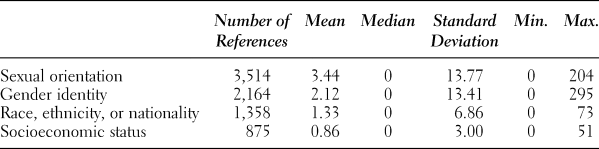
In terms of women's intersectional identities, Table 1 shows that the commenters made the largest number of references to women's sexual orientations, followed by references to their gender identities; races, ethnicities, or nationalities; and socioeconomic statuses.
References to women in women's organizations’ comments, 2007–13

Sexual Orientation
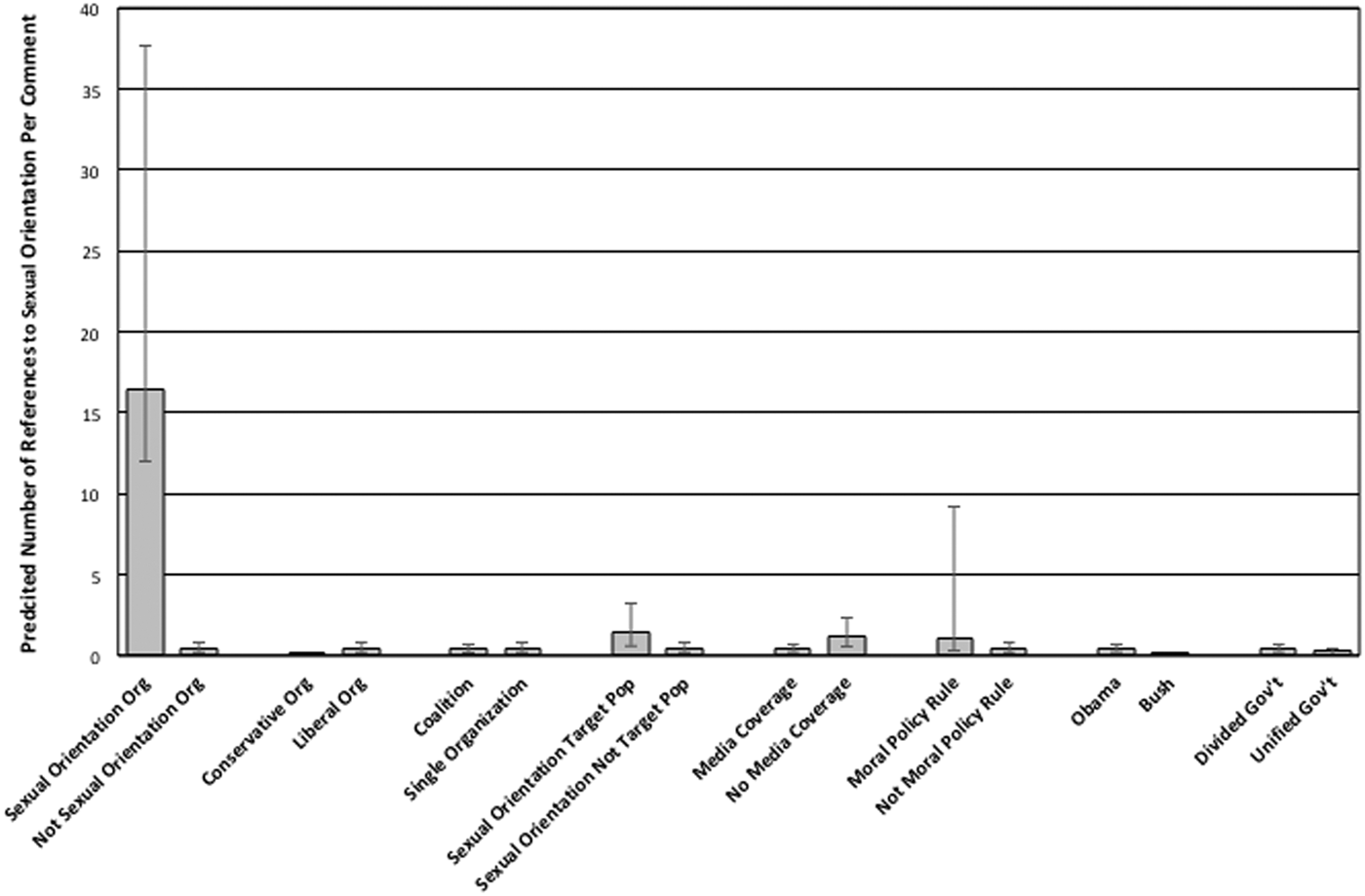
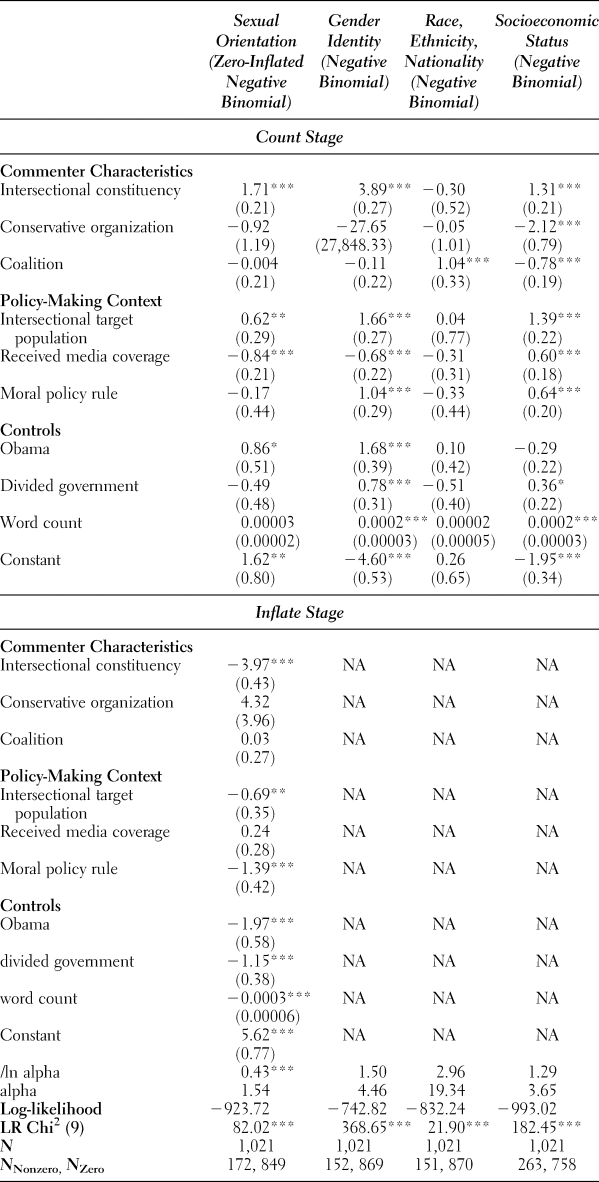
The results displayed in Table 2 indicate that four of the hypothesized independent variables had a significant effect on the number of references that women's organizations made to women's sexual orientations: the organization's intersectional constituency, the proposed rule's target population, whether the rule received media coverage, and whether the rule addressed a moral issue. Examining the predicted counts displayed in Figure 1 indicates that of those four factors, the organization's constituency had the largest substantive effect on the number of references that women's organizations made to sexual orientation, as organizations focused on sexual orientation made 16 more references to women's sexual orientations per comment than broader-based women's organizations did. Figure 1 also shows that, holding all else equal, the proposed rule's target population had the next largest effect, and women's organizations included an additional reference to sexual orientation when bureaucrats raised the issue first. Women's organizations also increased the number of references they made to sexual orientations when the media did not cover the process and when they commented on moral issues (Figure 1). However, the substantive increases in the number of references they made to women's sexual orientations in those situations were rather small, accounting for less than one additional reference to women's sexual orientations per comment.
Predicted Number of References to Women's Sexual Orientations in Women's Organizations' Comments by Commenter Characteristics and Context (2007–2013)

References to women's intersecting identities in women's organizations’ comments, by commenter characteristics and rulemaking context (2007–13)

*** p ≤ .01; ** p ≤ .05; * p ≤ .10.
Gender Identity
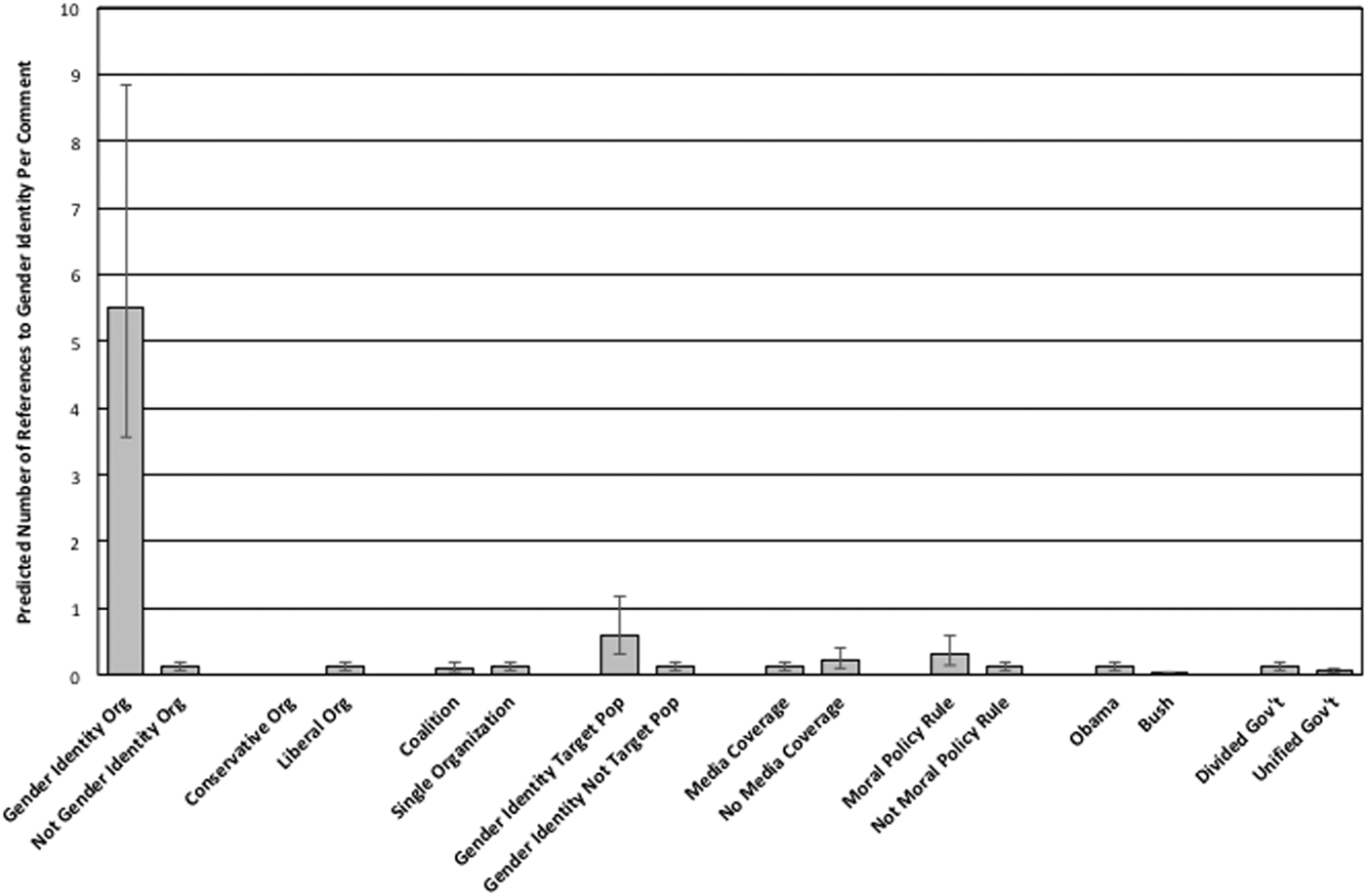
The results displayed in Table 2 also indicate that the four independent variables that had a significant effect on the number of references that women's organizations made to women's sexual orientations also had a significant effect on the number of references they made to women's gender identities. As with sexual orientation, the results in Figure 2 indicate that, after controlling for other factors, the organization's constituency had the largest substantive effect on the number of references that commenters made to women's gender identities with women's organizations focused on gender identity making 5.4 more references to women's gender identities than more broadly focused organizations. Confirming my expectations, Figure 2 also shows that women's organizations made more references to gender identity when the proposed rule referred to gender identity, when the rulemaking process did not receive media coverage, and when the rule addressed a moral issue. However, the substantive effects of those three variables were also generally small.
Predicted Number of References to Women's Gender Identities in Women's Organizations' Comments by Commenter Characteristics and Context (2007–2013)

Race, Ethnicity, and Nationality
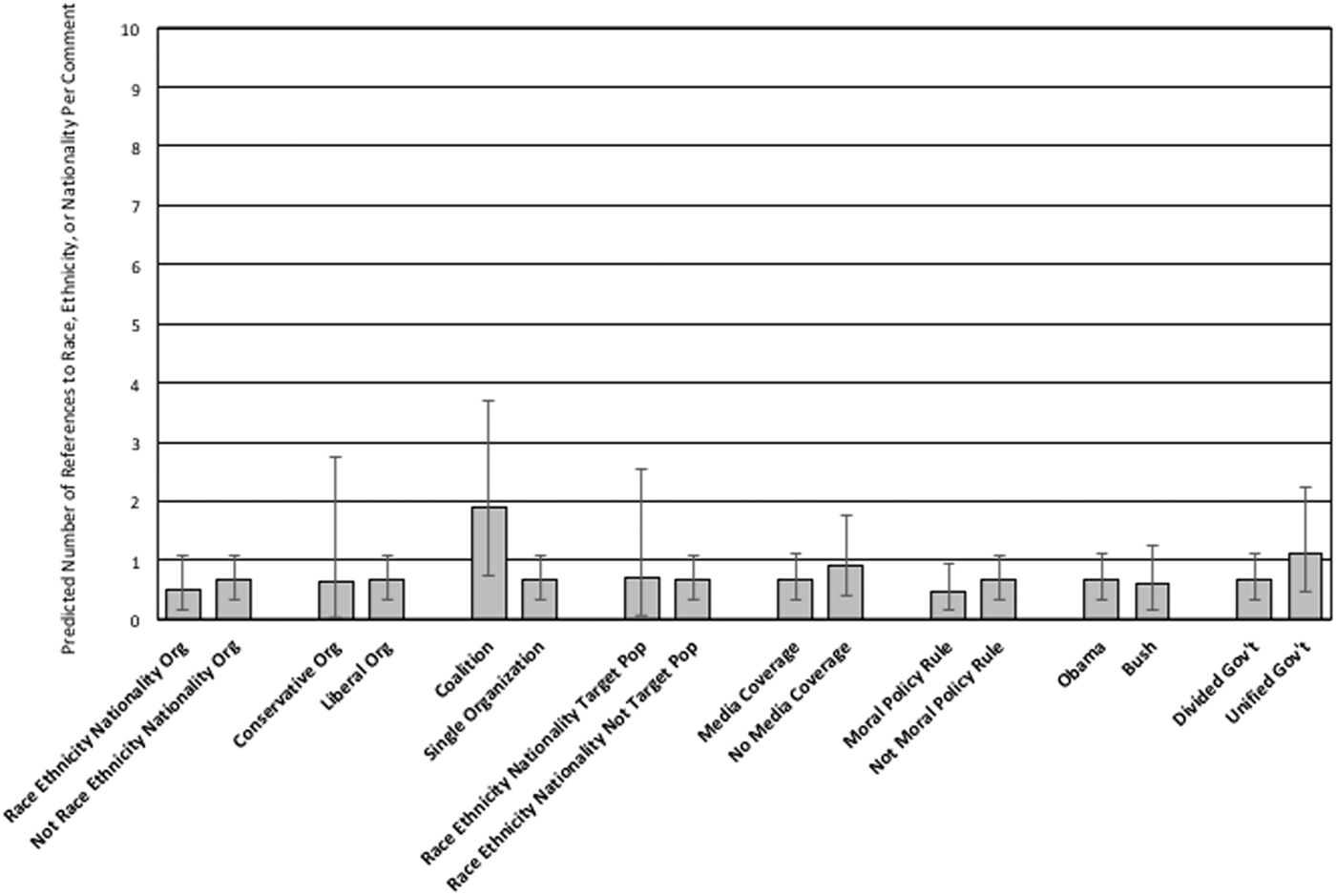
Women's organizations referred to women's races, ethnicities, and nationalities less often than they discussed their sexual orientations and gender identities, and many of my expectations about when and why women's organizations would focus on race, ethnicity, and nationality were not met. For example, Table 2 indicates that of the six independent variables I considered, holding all else equal, only one, whether the comment was written by a coalition, had a significant effect on references to women's races, ethnicities, and nationalities. Figure 3 shows that women's organizations that participated in coalitions made nearly three times as many references to women's races, ethnicities, and nationalities than single organizations did, disproving my hypothesis that women's organizations would refer to women's intersectional identities less when they participated in coalitions. Table 2 also indicates that the organizations’ intersectional constituencies and the proposed rule's target population had no effect on women's organizations’ references to women of color, even though they increased women's organizations focus on women's sexual orientations, gender identities, and socioeconomic statuses.
Predicted Number of References to Women's Races, Ethnicities, or Nationalities in Women's Organizations' Comments by Commenter Characteristics and Context (2007–2013)

Socioeconomic Status
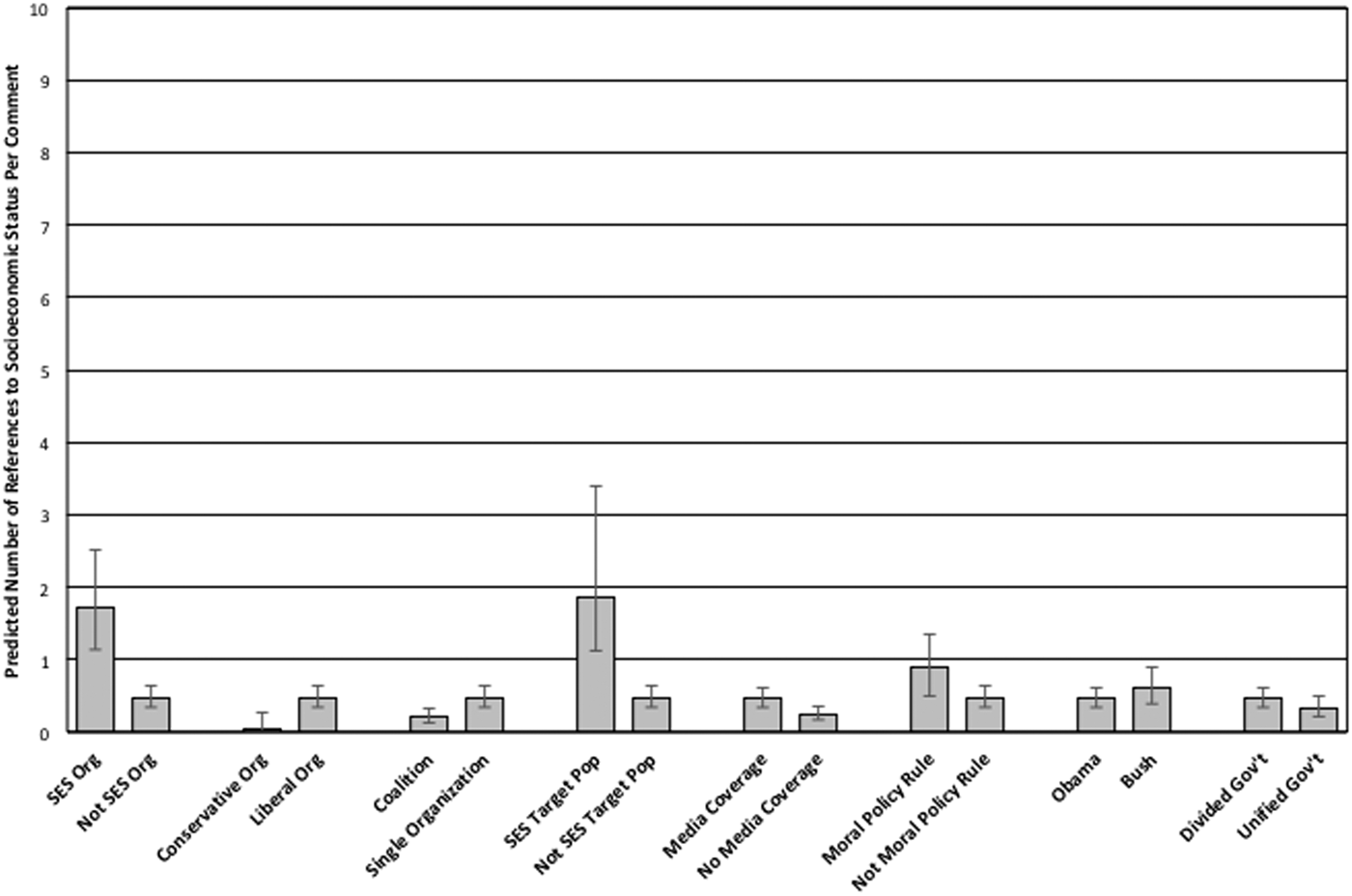
Lastly, women's organizations’ comments referred to women's socioeconomic statuses the least often, and the results in Table 2 indicate that the number of times they referred to women's socioeconomic statuses was significantly related to all six hypothesized independent variables. Figure 4 shows that after controlling for other factors, the proposed rule's target population had the largest substantive effect on the number of references that women's organizations made to class, and they mentioned it four times more often when bureaucrats raised class issues first. The organization's constituency and ideology also had relatively large substantive effects on the number of references that women's organizations made to socioeconomic status, with class-based organizations mentioning socioeconomic status 3.7 times more often than more broadly based groups and liberal organizations referring to class 8.3 times more often than conservative organizations. Finally, Figure 4 shows that women's organizations unexpectedly made more references to women's socioeconomic statuses when they commented on moral policies and when the process received media attention.
Predicted Number of References to Women's Socioeconomic Statuses in Women's Organizations' Comments by Commenter Characteristics and Context (2007–2013)

DISCUSSION
Altogether, my results indicate that when women's organizations participate in rulemakings on women's issues, they do represent women based on their intersectional identities, but the level of attention that they devote to different subgroups of women tends to vary depending on the characteristics of the commenters themselves and on the rulemaking context. First, my analysis of the predicted number of references that women's organizations made to women's intersectional identities indicates they are the most likely to dedicate attention to women's intersectional identities, particularly those in terms of sexual orientation, gender identity, and socioeconomic status, when their organizations are explicitly focused on representing intersectionally marginalized women and when bureaucrats target intersectionally marginalized women in their proposed rules. Together, these results suggest that rulemakings on women's issues can be important sites of women's representation because they create policy niches where bureaucrats and women's advocates with intersectional expertise on women's issues can come together to advocate for marginalized subgroups of women. However, the results also indicate that creating those policy niches could be a doubled-edged sword for marginalized subgroups of women. On the one hand, they create a space to discuss their issues and concerns, but on the other, they may also allow broad-based women's organizations to “delegate” this task to intersectional women's organizations, potentially contributing to the advanced marginalization of intersectionally marginalized women (Cohen Reference Cohen1999; Strolovitch Reference Strolovitch2007) within the broader movement.
Next, my results partially confirm my hypothesis that some marginalized women are better represented during rulemakings on women's issues because the process tends to receive low levels of attention. For example, women's organizations were more likely to discuss women's sexual orientations and gender identities when the media did not cover the process. Because the media rarely covers rulemaking and it receives low levels of attention, these findings suggest that the process can create unique opportunities to focus on groups of women that the public has historically seen in negative, deviant, or weak terms (Golden Reference Golden1998; Hancock Reference Hancock2004; Schneider and Ingram Reference Schneider and Ingram1993; West Reference West2004; Yackee Reference Yackee2006; Yackee and Yackee Reference Yackee and Yackee2006). That being said, my results also indicate that women's organizations unexpectedly made more references to women's socioeconomic statuses when they commented on rules that received media coverage.
Because many of the comments included in the data set responded to rules that implemented highly visible reproductive rights provisions of the ACA, I hypothesized that comments on those rules could be biasing the results. To test that hypothesis, I dropped the ACA reproductive rights rules from the analysis and reran the results, only to find that the significant findings related to media attention remained.Footnote 12 These confounding results suggest that more research is needed to determine why women's organizations do not, as expected, shy away from discussions of class, when they participate in more visible rulemakings. Interviews with women's organizations staff members and more in-depth qualitative case studies of the 26,231 pages of comments and proposed rules included in this study could address this issue. Lastly, the substantive effect of media coverage was quite small, which indicates that other factors, such as the organization's constituency and the rule's target population, have a stronger connection to whether marginalized women are represented during the rulemaking process.
Similarly, the moral nature of the rulemaking process had small, mixed effects on the level of attention women's organizations devoted to women's intersectional identities. The rules related to moral policies produced small, substantive increases in the number of references to women's sexual orientations, gender identities, and socioeconomic statuses. However, those findings were unexpected, as I hypothesized that women's organizations would actually make fewer references to women's intersectional identities during moral policy rulemakings. Once again, I hypothesized that the large number of comments on the ACA rules about reproductive rights could be biasing the socioeconomic status results so I dropped those comments from the data set and reran the analysis to test that hypothesis and confounding class results remained. Similarly, I assumed that the comments related to discrimination and conscience clauses, HIV, and the definition of families could be biasing the sexual orientation and gender identity results, so I dropped those comments and reran those analyses. When I dropped those cases from the sexual orientation model, the moral policy variable became insignificant, which confirmed that the unexpected sexual orientation results may be related to those rules. However, the confounding results remained in the gender identity model.Footnote 13 Together these findings indicate that more research is needed to examine precisely why some rules that focus on moral policy increase, rather than decrease, the level of attention that women's organizations pay to women's sexual orientations, gender identities, and classes.
Finally, my findings on references to women's races, ethnicities, and nationalities produced a number of unexpected results that future research should examine. First, only one variable, coalition participation, had a significant effect on references to women using these terms, and coalitions had a positive rather than a negative effect on references to women's races, ethnicities, and nationalities. Digging further into the data reveals that the positive effect of coalitions on references to women's races, ethnicities, and races is partially because 63% of the commenters who explicitly represented women based on their races, ethnicities, and nationalities were coalitions. In contrast, 51% of the commenters who focused on women's sexual orientation, 56% of the commenters who focused on women's gender identity, and 49% of the commenters who focused on women's socioeconomic statuses were coalitions. Moreover, four coalitions explicitly focused on women's races, ethnicities, and nationalities, the Leadership Conference on Civil Rights, the National Coalition for Immigrant Women's Rights, the National Network to End Violence Against Immigrant Women, and Raising Women's Voices for the Health Care We Need, were particularly active participants, submitting 24% of the comments from organizations focused on race, ethnicity, or nationality.
These data suggest that future research should ask why organizations focused on women of color choose to participate in coalitions during the rulemaking process rather than submitting comments on their own. One possibility is that some see coalitions as a way to demonstrate that their proposals focused on women of color have a broad base of support. As Strolovitch (Reference Strolovitch2007) notes, it is also possible that coalitions are important for women of color because many broader-based women's organizations advocate for intersectionally marginalized women by participating in coalitions. Another possibility is that organizations focused on women of color may be smaller and may have fewer resources than broader-based women's organizations, so participating in rulemaking coalitions may help them overcome those deficits. Future research based on interviews with women's organizations’ staffers could test those hypotheses and help elucidate why coalitions increase the focus on women's races, ethnicities, or nationalities but decrease the level of attention devoted to women's socioeconomic statuses.
CONCLUSION
Rulemaking rarely produces the same drama and excitement as other attempts to represent women, such as marching or lobbying legislators. However, it is an important policy-making venue that provides women's organizations with unique opportunities to overcome their underrepresentation in Congress, bypass partisan polarization and gridlock, and lobby on behalf of women, and marginalized subgroups of women in particular. My findings suggest that while women's organizations are more likely to focus on some subgroups of women than others when they participate in this process, bureaucrats and women's organizations that advocate for women who have been intersectionally marginalized based on their sexual orientations, gender identities, and socioeconomic statuses have carved out a niche for themselves to represent marginalized women during this process. Likewise, LGBTQ-identified women frequently benefit from the lower levels of public attention and scrutiny that rulemaking receives and women of color benefit from the opportunity to form advocacy coalitions during this process. Bringing these findings together suggests that scholars who are interested in fully understanding and appreciating how women, and intersectionally marginalized women in particular, are represented need to move beyond legislatures and protests to ask questions about how and why women's organizations strategically represent women at other stages of the process, and in other policy-making venues, including rulemaking.
SUPPLEMENTARY MATERIAL
To view supplementary material for this article, please visit https://doi.org/10.1017/S1743923X18000375