INTRODUCTION
The Congo Basin is a key area for the global carbon cycle, hosting the second largest tropical forest after the Amazon (Detwiler & Hall Reference DETWILER and HALL1988). Yet, the degree to which the Central African forest will cope with future global changes is under debate (Otto et al. Reference OTTO, JONES, HALLADAY and ALLEN2013, Zelazowski et al. Reference ZELAZOWSKI, MALHI, HUNTINGFORD, SITCH and FISHER2011). Understanding centennial scale growth dynamics of past tropical forests can provide baseline information for assessing future climate change impacts; unfortunately, such data are rare before the instrumental record (Gebrekirstos et al. Reference GEBREKIRSTOS, BRAEUNING, SASS-KLASSEN and MBOW2014, Rozendaal & Zuidema Reference ROZENDAAL and ZUIDEMA2011).
Tree rings can potentially fill this gap in our knowledge. In the tropics, the use of tree rings has been hindered by the lack of annual rings in most tree species, thus limiting their application for dendrochronological studies (Loader et al. Reference LOADER, YOUNG, MCCARROLL and WILSON2013, Rozendaal & Zuidema Reference ROZENDAAL and ZUIDEMA2011). However, tree-ring stable carbon and oxygen isotopes (δ13C, δ18O) in some cases have been shown to reflect tree growth response to climate forcing, even when annual rings are missing or unclear (Evans & Schrag Reference EVANS and SCHRAG2004, Poussart et al. Reference POUSSART, MYNENI and LANZIROTTI2006).
Stable isotopes in tree rings are determined by distinct processes (McCarroll & Loader Reference MCCARROLL and LOADER2004). Generally, tree physiology controls δ13C, with fractionation occurring during uptake of CO2 through the stomata (diffusion, c. −4‰) and during CO2-fixation (carboxylation, c. −27‰,). δ13C is therefore influenced by changes in the relative importance of diffusional versus biochemical limitations of photosynthesis (Francey & Farquhar Reference FRANCEY and FARQUHAR1982). Such changes occur as a result of environmental factors like water availability, light, but also nutrients and competition with neighbouring trees (McCarroll & Loader Reference MCCARROLL and LOADER2004). In contrast, tree-ring oxygen isotopes are more directly influenced by physical and climatic factors, rather than tree-internal physiological fractionations. Precipitation amount (amount effect, i.e. the depletion of heavy isotopes with increasing rainfall), together with altitudinal and continental effects (i.e. Rayleigh fractionation) are the most relevant factors determining δ18O in precipitation (equilibrium processes, Dansgaard Reference DANSGAARD1964). This precipitation isotope signal, taken up by the roots, is the major signal incorporated in plants, although further modification occurs in the plant leaves during transpiration, causing an enrichment controlled mainly by relative humidity and relatively constant biochemical enrichment (Roden et al. Reference RODEN, LIN and EHLERINGER2000). Stable isotope tree-ring series in the tropics are still rare and a relatively recent approach compared with temperate zones (Barbour Reference BARBOUR2007, Helle & Schleser Reference HELLE and SCHLESER2004, McCarroll & Loader Reference MCCARROLL and LOADER2004, Schleser et al. Reference SCHLESER, HELLE, LUCKE and VOS1999). Additionally, the attribution of isotopic changes to single environmental factors is often difficult to achieve (Gebrekirstos et al. Reference GEBREKIRSTOS, BRAEUNING, SASS-KLASSEN and MBOW2014). This is particularly true for regions characterized by a bimodal distribution in precipitation (e.g. Eastern Congo), where the responses of species are controlled by multiple factors and still poorly documented.
In this study, we explore the nature of isotopic variability in tree-ring series from Pericopsis elata (Harms) van Meeuwen, a light-demanding species common in moist semi-deciduous forest of Central and Western Africa (Vivien & Faure Reference VIVIEN and FAURE2011), and with the advantage of annual growth rings (De Ridder et al. Reference DE RIDDER, TOIRAMBE, VAN DEN BULCKE, BOURLAND, VAN ACKER and BEECKMAN2014). Specifically, we combine stable isotopes, ring-widths and precipitation data to test whether stable isotopes may record climate variability over the last c. 50 y, in an area characterized by a bimodal distribution in precipitation (two wet and two dry seasons). Alternatively, the isotopic composition in Pericopsis elata may be mostly driven by local growth conditions (e.g. light availability), thus masking the climate signal. For this study, we focused on two slow- and two fast-growing trees, to account for the relative importance of tree growth for isotopic fractionation.
METHODS
Site
The Yoko reserve (00°21′–00°06′N, 025°13′–025°17′E) is a protected area (Institut Congolais de la Conservation de la Nature, ICCN) located c. 20 km south of Kisangani (Tshopo district, Province Orientale, Democratic Republic of Congo, Figure 1). The area is relatively flat and with a total area of approximately 7000 ha, delimited by the Congo and the Biaro rivers (Figure 1b). It is presently covered by dense and semi-deciduous forest stands (Congolese mixed moist semi-evergreen forest), including light-demanding (P. elata, Milicia excelsa, Musanga cecropioides, Piptadeniastrum africanum) and shade-tolerant tree species (Cynometra sp., Gilbertiodendron dewevrei, and mostly Scorodophloeus zenkeri, see Lomba-Bosombo Reference LOMBA-BOSOMBO2002). Mean temperature in the region is around 25°C with maximum insolation between January–February and a minimum in August (Kisangani meteorological station, 1901–2009). Monthly precipitation (annual mean 1700 mm) shows a bimodal pattern (short and long rainy seasons: April–May and September–November, respectively), associated with the latitudinal migration of the Intertropical Convergence Zone (ITCZ). Relative humidity in the Congo Basin is mainly delivered by westerly winds from the Gulf of Guinea and recycled through the rain forests, before being delivered further east (Williams et al. Reference WILLIAMS, FUNK, MICHAELSEN, RAUSCHER, ROBERTSON, WILS, KOPROWSKI, ESHETU and LOADER2012). Continental-scale climate patterns, such as the ENSO or the Indian Ocean Dipole (IOD) can also affect precipitation variability over decades (Farnsworth et al. Reference FARNSWORTH, WHITE, WILLIAMS, BLACK and KNIVETON2011).
Map of the study site, with MODIS derived distribution of central African rain forest (a) (modified after Mayaux et al. Reference MAYAUX, PEKEL, DESDEE, DONNAY, LUPI, ACHARD, CLERICI, BODART, BRINK, NASI and BELWARD2013); values in brackets indicate long-term average δ18O, weighted by amount of precipitation at selected GNIP stations (Rozanski et al. Reference ROZANSKI, ARAGUAS-ARAGUAS, GONFIANTINI, Johnson and Odada1996). The location of the Yoko reserve (b) (modified after Lomba-Bosombo Reference LOMBA-BOSOMBO2002). The microscopic view of a Pericopsis elata tree ring (c), showing the anatomically distinct ring border, separating early (dark fibres) and late seasons (light fibres with parenchyma) (c). Monthly rainfall changes, showing the bimodal distribution of precipitation (d). Changes in total precipitation near Kisangani over the last century (van Oldenborgh & Burgers Reference VAN OLDENBORGH and BURGERS2005); the thick line represents the 5-y moving average (e).

Trees of Pericopsis elata have been planted in 1953 and 1954 in the reserve (00°19′35.2′′N, 25°15′29.7′′E), with a distance between trees of c. 5 m. A few Terminalia superba Engl. & Diels trees were planted close to the Pericopsis elata, and some other species (such as Elaeis guineensis Jacq. palms, Piptadeniastrum africanum (Hook.f.) Brenan and Petersianthus macrocarpus (P. Beauv.) Liben) established spontaneously between the planted trees. In 2010, the distance between trees was c. 9 m. Although a more complete description of the forest stands and micro-site conditions were not available in this remote area at the time of sampling, edaphic conditions were relatively homogeneous in the plantation, and competition for light is the main determinant of tree growth in this light-demanding species. For our study, we randomly selected from the plantation trees with regular stems and without scars.
Ecology of Pericopsis elata
Among the long-living, light-demanding tree species, P. elata is an ecologically versatile species, coping with both dry and waterlogged conditions (Bourland et al. Reference BOURLAND, KOUADIO, FETEKE, LEJEUNE and DOUCET2012). It can be found in small (1 ha) aggregates, reproducing with anemochoric dispersal. Because of decades of exploitation for its highly valuable timber, it is included in the CITES list of protected species. To establish, Pericopsis elata requires forest-gap disturbances (Hawthorne Reference HAWTHORNE1995); its distribution in Central Africa was favoured by moderate human impact before the colonial period (Brncic et al. Reference BRNCIC, WILLIS, HARRIS and WASHINGTON2007). Generally its growing season is determined by seasonal precipitation distributions (from March–April to November, Appendix 1), and wood formation is only interrupted for a few months during the driest season (December–March).
Tree-ring widths and stable isotopes (δ13C, δ18O) analysis
We collected stem discs from two slow- (discs 1 and 2) and two fast-growing trees (discs 3 and 4, Figure 2a), in the Yoko reserve during 2009–2010. Discs were cut at approximately 30 cm above soil level and tree-ring widths were measured on four rays for each disc, following standard procedures (De Ridder et al. Reference DE RIDDER, VAN DEN BULCKE, VAN ACKER and BEECKMAN2013a). We measured each ring considering the wood anatomical patterns specific to P. elata: a dark layer of fibres and no vessels, followed by a lighter layer with parenchyma produced later in the season (Figure 1c). An anatomically distinct growth-ring border is visible, and is also supported by information from cambial wounding experiments. For each disc, we used one measured ray (i.e. with no missing years, where possible), instead of the average tree-ring series. Cross-dating between trees (Douglas Reference DOUGLAS1941) was not successful due to different growth history of trees (Figure 2a).
Pericopsis elata tree-ring widths showing slow- (discs 1 and 2) and fast-growing trees (discs 3 and 4); values are on a log scale to highlight variation in low δ13C (a). δ13C series on alpha-cellulose expressed relative to the Vienna Pee Dee belemnite VPDB; δ13C values were corrected by adding the difference between preindustrial and present δ13C, to account for the increase in carbon dioxide from fossil fuels since 1950 (b).
We measured stable isotopes (δ18O, δ13C) on each tree and ring separately, without pooling samples for maximizing sample size (as sometimes done for temperate species, Saurer et al. Reference SAURER, SIEGENTHALER and SCHWEINGRUBER1995). This implied a lower number of measured samples, but allowed accounting for differences in the isotopic signal due to varying growth patterns (Figure 2a). For isotope analysis, we manually split each selected ray with a scalpel obtaining c. 50 samples per disc, with each sample representing 1 y of tree growth. Alpha cellulose was extracted using standard methods from 1 mg of ground wood material prior to stable isotope analysis (Boettger et al. Reference BOETTGER, HAUPT, KNOELLER, WEISE, WATERHOUSE, RINNE, LOADER, SONNINEN, JUNGNER, MASSON-DELMOTTE, STIEVENARD, GUILLEMIN, PIERRE, PAZDUR, LEUENBERGER, FILOT, SAURER, REYNOLDS, HELLE and SCHLESER2007). We excluded the innermost rings because photosynthesis rates may be different in the first years of growth and the influence of soil-respired CO2 higher (Fichtler et al. Reference FICHTLER, HELLE and WORBES2010). In total, we considered 47 rings for disc 1 (1962–2008), 51 for disc 2 (1960–2010), 53 for disc 3 (1958–2010) and 51 for disc 4 (1960–2010, Table 1). For data analyses, we considered the common period between discs (1962–2008).
Pericopsis elata tree-ring series used in this study. Trees were sampled in 2008 and 2010 in an even-aged plantation (1953–1954) located in the Yoko reserve (Eastern Congo). Age interval considered for stable isotope series did not include the first years of growth. Discs 2–4 were harvested at the beginning of the growing season, resulting in a not fully formed ring in year 2010.

To determine carbon isotopic ratios, samples were combusted to carbon dioxide at 1025°C using an elemental analyser (EA-1110; Carlo Erba Thermoquest, Milan, Italy), and the isotope ratios measured with a Delta S isotope ratio mass spectrometer (Thermo Finnigan, Bremen, Germany). Oxygen isotopic ratios were determined after pyrolysis to CO at 1420°C using a Pyro cube (Elementar, Hanau, Germany) connected in continuous flow mode to a Delta Plus XP (Thermo Finnigan, Bremen, Germany).
Carbon (δ13C) and oxygen (δ18O) isotopic ratios are expressed relative to the Vienna Pee Dee belemnite VPDB (δ13C, Coplen Reference COPLEN1995), and Vienna Standard Mean Ocean Water VSMOW (δ18O), respectively (details in Saurer & Siegwolf Reference SAURER, SIEGWOLF and De Groot2004). The overall precision was 0.1‰ for carbon and 0.2‰ for oxygen. For δ13C, we accounted for the global increase in carbon dioxide from fossil fuels since 1950 (Epstein et al. Reference EPSTEIN, KRISHNAMURTHY, OESCHGER, EDDY and PECKER1990), which reduced the 13C content in the atmosphere (McCarroll et al. Reference MCCARROLL, GAGEN, LOADER, ROBERTSON, ANCHUKAITIS, LOS, YOUNG, JALKANEN, KIRCHHEFER and WATERHOUSE2010). We therefore corrected all δ13C values by adding the difference between pre-industrial and present δ13C, for each year.
Data analysis
Instrumental climate data in the tropics are generally sparse and discontinuous; we therefore compared different precipitation datasets from instrumental records, including areas close to the sampling site (Kisangani, 20 km distant), or in the region (Yangambi, 100 km distant). Since most of these data are too fragmentary, or do not entirely cover our series (1958–2009), we only considered the interpolated (between 0 and 1°N and 24°and 25°E) precipitation time-series from 1908 to 2009, at local-to-regional scale (Royal Netherlands Metereological Institute KNMI, van Oldenborgh & Burgers Reference VAN OLDENBORGH and BURGERS2005, and NCAS British Atmospheric Data Centre). Temperature has generally little influence on growth conditions of tropical species, at least in this area (De Ridder et al. Reference DE RIDDER, TROUET, VAN DEN BULCKE, HUBAU, VAN ACKER and BEECKMAN2013b), and indeed our stable isotope series are only weakly correlated with temperature (Appendix 1). The KNMI data show a period of higher annual precipitation in the 1960s, followed by a drying trend (Figure 1e). When decomposing the time series, the distribution of seasonal precipitation during the two halves of the rainy season (short and long wet seasons) is also variable over the decadal time-scale (Appendix 1). We therefore compared our isotopic data, with changes in monthly and seasonal precipitation over the last 50 y (Appendices 2 and 3). All time-series are presented with raw data (with exception for the δ13C corrected for fossil-fuel emissions). No standardization was applied to avoid losing any low-frequency signal (Robertson et al. Reference ROBERTSON, ROLFE, SWITSUR, CARTER, HALL, BARKER and WATERHOUSE1997).
For carbon and oxygen isotopes, we calculated the expressed population signal EPS (Briffa & Jones Reference BRIFFA, JONES, Cook and Kairiukstis1990) to assess the common signal strength of different trees. We used the averaged oxygen isotopes values (but not δ13C series, because of lower inter-series correlations), to check whether oxygen isotopes in our series are related to precipitation data. The averaged δ18O values are reported with confidence intervals calculated with a Student's-t distribution. Additionally, we calculated the coefficient of variation CV (a normalized measure of dispersion), RBAR (a measure of common variance) and standard deviation statistics (Frank et al. Reference FRANK, ESPER and COOK2007, Kress et al. Reference KRESS, SAURER, SIEGWOLF, FRANK, ESPER and BUGMANN2010).
We also considered GNIP stations (Global Network of Isotopes in Precipitation) located in the west and the east of the Congo Basin (Figure 1a), to assess the isotopic signature of different source of air masses on precipitation (Araguas-Araguas et al. Reference ARAGUAS-ARAGUAS, FROEHLICH and ROZANSKI2000). We only used the weighted mean as reported in Rozanski et al. (Reference ROZANSKI, ARAGUAS-ARAGUAS, GONFIANTINI, Johnson and Odada1996), because GNIP series are often discontinuous and do not allow a full comparison with our δ18O series. Also, the closest station with continuous data (Entebbe, Uganda, Figure 1a), shows an isotopic signature which is mostly biased by moisture derived from evaporated water from Lake Victoria (Rozanski et al. Reference ROZANSKI, ARAGUAS-ARAGUAS, GONFIANTINI, Johnson and Odada1996), and therefore not considered in this study.
RESULTS
Ring-width series and stable isotopes
The analysed stem discs showed large differences in ring-width patterns (Figure 2a), reflecting the different growth dynamic of trees growing in monospecific plantations. Disc 1 showed relatively constant narrow rings, suggesting less favourable conditions for tree growth, likely caused by the presence of a nearby growing Terminalia superba tree. Disc 1 also showed series of narrower rings, with minimum values in 1965, 1990 and 1998 (Figure 2a). Discs 2 and 3 exhibited highly variable ring-widths, with narrower rings after 1971 (disc 2) and 1980 (disc 3, Figure 2a). Disc 4 was still dominant at the time of sampling, and under more open conditions and light availability; ring widths showed a constant growth pattern, with favourable conditions for tree growth after 1977 (Figure 2a).
The common signal strength was different between δ13C and δ18O series, with Expressed Population Signal (EPS) much lower for δ13C (= 0.37) than for δ18O (= 0.74). Fast-growing trees (discs 3 and 4) were less depleted (i.e. higher δ13C values) than slow-growing trees (i.e. disc 1, Figure 2b). For instance, between 1975 and 2010, discs 3 and 4 showed 2‰ higher values on average than discs 1 and 2 (c. −24‰ vs −26‰, Figure 2b). Disc 2, with high variability in tree-ring widths, had lower δ13C values when tree growth decreased (after 1971, Figure 2). We also observed more variability in δ13C during the period with highest total precipitation (1958–1970, Figure 1e), with disc 1 (slow-growing tree) reaching values as low as −29‰.
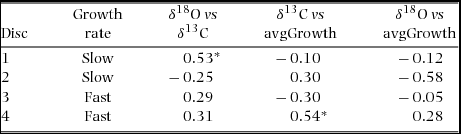
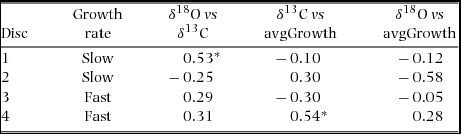
Correlations between oxygen and carbon, and between ring widths and stable isotopes, were significant only in a few discs and depended on their growth rates (Table 2). For instance, δ18O and δ13C were significantly correlated (r = 0.53, P < 0.01) only in disc 1, i.e. the tree with the slowest growth rates. Ring-widths and δ13C were significantly correlated only in disc 4 (r = 0.54, P < 0.01), a fast-growing tree (Figure 2a). δ18O and ring widths were instead weakly correlated for all discs (Table 2).
Pearson's product-moment correlation between ring widths and stable isotopes in Pericopsis elata, measured on four discs from the Yoko reserve (Eastern Congo). Positive correlations exist between δ18O and δ13C in disc 1 and between δ13C and tree growth in disc 4; asterisk (*) indicates significance level at P < 0.01. Correlations are calculated over the common interval 1962–2008.
δ18O and precipitation data 1958–2009
Considering the high common signal strength for δ18O, we averaged δ18O series (Figure 3a) to allow comparison with the available 50 y of instrumentally recorded changes in precipitation (Appendix 1). At multi-annual scale, trends in δ18O followed changes in total precipitation (but not in temperature, Appendix 1). In general, low δ18O values occurred during 1960–1970, i.e. the period with higher precipitation (and to a lesser extent, during 1990–1995, Figure 3b–d). This period was followed by increasing δ18O values and a declining precipitation trend (i.e. after 1970, Figure 3d). We found, however, low correlations between δ18O series and annual or seasonal precipitation (Appendix 2 and 3). In particular, the weakened δ18O signal strength after 1980 (see increased C.I. in Figure 3b), was due to changing growth rates in disc 2, particularly after 1988 (Figure 2a), overall weakening the correlation between total precipitation and our δ18O series. Low signal strength in δ18O was also particularly marked for years 1965, 1984 and 1992–1994 (high STDEV and CVar in Figure 3c), and reflected by lower mean inter-series correlation (e.g. low RBAR between 1992–1995). By considering 5-y average values, the correlation between total precipitation and δ18O series (all discs) was significant (r=−0.7, P < 0.01).
δ18O measured on four stem discs from Pericopis elata, relative to the Vienna Standard Mean Ocean Water VSMOW. Raw δ18O series on alpha-cellulose (a); note the inverted Y axis to allow comparison with precipitation variability. Averaged δ18O series (b); solid line represents the 5-y running mean and dashed lines the 90% CI of the four averaged series. Standard deviation (SD), 5-y running mean correlation coefficient (RBAR) and coefficient of variation (CV) (c). Total precipitation variability over the last 50 y; the blue line represents the 5-y running average (d).
DISCUSSION
Physiological and climatic controls over tree-ring δ13C
The δ13C signal in tree-rings is usually interpreted as the interplay between stomatal conductance (influenced by atmospheric humidity and soil moisture) and photosynthesis (influenced by light and nutrients availability), determining the total amount of intracellular CO2 in the leaf, and therefore the carbon isotope discrimination (McCarroll & Pawellek Reference MCCARROLL and PAWELLEK2001). For instance, high δ13C values may result from increased photosynthesis or stomatal closure, depending on the relative importance of moisture for tree growth in the considered region. In Kenya, Gebrekirstos et al. (Reference GEBREKIRSTOS, WORBES, TEKETAY, FETENE and MITLOEHNER2009) found that moisture stress results in high δ13C in different Acacia species from semi-arid areas of East Africa. The (inverse) relationship between precipitation and δ13C in tree rings has also been used for regional-scale river flow reconstructions (Wils et al. Reference WILS, ROBERTSON, ESHETU, KOPROWSKI, SASS-KLAASSEN, TOUCHAN and LOADER2010). In the Congo Basin instead, where moisture stress is a less limiting factor, we expect stomatal conductance to play a minor role for δ13C fractionation, compared with photosynthesis. We tested this by comparing our δ13C series with precipitation data and ring-width measurements, which can be used as indicators of photosynthetic rates (Worbes et al. Reference WORBES, STASCHEL, ROLOFF and JUNK2003).
Our data show a marked inter-tree variability in absolute δ13C values (Figure 2). Fast-growing trees tend to have around 2‰ higher values on average than slow-growing trees. Such differences in absolute δ13C have also been observed for subtropical forest species growing under different growth conditions, with lower δ13C values in shade conditions (West et al. Reference WEST, MIDGLEY and BOND2001). Indeed, shading is a limiting factor for tree growth, especially for long-lived, light-demanding species such as P. elata (Bourland et al. Reference BOURLAND, KOUADIO, LEJEUNE, SONKE, PHILIPPART, DAINOU, FETEKE and DOUCET2013). Instead, water stress is not controlling growth variation between trees, as stomatal closure would result in higher δ13C, rather than low δ13C values as in our data (i.e. in the slow-growing discs 1 and 2, Figure 2). In agreement with the carbon fractionation theory (McCarroll & Pawellek Reference MCCARROLL and PAWELLEK2001) our data therefore suggest that variation in 13C is driven by individual growth histories of each tree, which at our site is mainly determined by variation in light availability. For instance, Disc 1 grew under reduced light conditions, due to a nearby Terminalia superba tree. The weak correlation between δ13C and ring widths on the yearly basis (Table 2) is possibly due to the relative importance of photosynthesis and stomatal conductance, which may be different during wet (e.g. 1950–1970) and dry periods (e.g. after 1970, Figure 3d), thus indicating an unstable climate-isotope relationship (Reynolds-Henne et al. Reference REYNOLDS-HENNE, SIEGWOLF, TREYDTE, ESPER, HENNE and SAURER2007). In our data, photosynthetic rates are reflected in the δ13C variability in one tree only (disc 4, fast-growing), as suggested by the correlation with ring widths (r = 0.54, P < 0.01).
In the slow-growing disc 1, δ13C variability is instead more controlled by precipitation, as shown by δ13C values before 1970 (as low as −29‰, Figure 2b). Indeed, low δ13C values in slow-growing trees may result from the additive effect of low light availability (low photosynthetic rate), and wetter conditions (high stomatal conductance). A further mechanism explaining such low δ13C values could be related to CO2 from soil respiration (containing less 13C), during early stages of growth in a more closed canopy (isotope juvenile effect, Fichtler et al. Reference FICHTLER, HELLE and WORBES2010). Early-stage effects are instead less marked (or absent) in the other trees.
Taken together, such variable responses of carbon fractionation to photosynthesis and stomatal conductance in trees of different growth histories may explain why overall δ13C, tree-ring width and precipitation series are weakly related in our series (Appendix 2 and 3). Indeed, multiple controls over δ13C fractionation such as nutrient availability (Kyereh et al. Reference KYEREH, SWAINE and THOMPSON1999, Veenendaal et al. Reference VEENENDAAL, SWAINE, LECHA, WALSH, ABEBRESE and OWUSUAFRIYIE1996), root development (Ampofo Reference AMPOFO1972), solar irradiance and forest openness (e.g. grazing, fire, logging), are difficult to disentangle at this step. Notwithstanding these uncertainties, our data suggest that variation in δ13C in Pericopsis elata is driven by light availability, rather than water stress.
Relationship between tree-ring δ18O and precipitation
Factors controlling δ18O in tree rings mostly depend on precipitation sources and physiological processes, including transpiration (McCarroll & Loader Reference MCCARROLL and LOADER2004). Rayleigh fractionation should result in 18O depletion (i.e. low δ18O) in precipitation at our site, relative to values recorded closer to the ocean source (c. −2‰ to −3‰, Figure 1a; Araguas-Araguas et al. Reference ARAGUAS-ARAGUAS, FROEHLICH and ROZANSKI2000). The isotope ratio of precipitation is also influenced by transpiration processes resulting in recirculation of moisture, a mechanism less subject to 18O depletion than land-evaporated water (Gat & Matsui Reference GAT and MATSUI1991). Transpiration processes are still relatively less well documented in the Congo Basin than for the Amazon (Gat & Matsui Reference GAT and MATSUI1991). This isotopic signature (i.e. high δ18O values) is also visible in GNIP stations outside of the Congo basin (Levin et al. Reference LEVIN, ZIPSER and CERLING2009), highlighting the relative importance of the Congo rain forest as a source of moisture for neighbouring regions.
Superimposed on these large-scale, spatial patterns are temporal changes in δ18O of source precipitation (Levin et al. Reference LEVIN, ZIPSER and CERLING2009). These changes should be reflected in the variation of tree-ring oxygen isotopes, assuming source water to be the dominant factor (Saurer et al. Reference SAURER, BORELLA and LEUENBERGER1997), albeit modified by leaf water enrichment and biochemical fractionations (Roden et al. Reference RODEN, LIN and EHLERINGER2000). In our data, the forcing by regional variation in moisture balance is reflected by the strong signal coherency in δ18O of tree rings. This value (EPS = 0.74) is slightly lower than that conventionally accepted for reaching the theoretical population chronology (0.85, Wigley et al. Reference WIGLEY, BRIFFA and JONES1984), but still suggests a common signal in δ18O (in contrast to δ13C). In general, the similarity between total precipitation and δ18O trends (Figure 3b–d) shows that regional precipitation has influence over δ18O, at least at the decadal scale. This anti-phase (i.e. low δ18O values with high precipitation) is also more marked during periods of wetter conditions, such as 1950–1970 (Figure 1e). The Congo Basin and neighbouring areas (Sahel, Horn of Africa) experienced anomalously wetter conditions between 1950 and 1970, a trend out of phase with higher subtropical latitudes (Nicholson Reference NICHOLSON2000), also visible in the westernmost part of the Congo Basin (Samba & Nganga Reference SAMBA and NGANGA2012). It was followed by a reduction in precipitation during the 1970s and 1980s (mostly June–September precipitation, Williams et al. Reference WILLIAMS, FUNK, MICHAELSEN, RAUSCHER, ROBERTSON, WILS, KOPROWSKI, ESHETU and LOADER2012). These decadal scale changes in precipitation are well reflected by our δ18O series (Figure 3b–d). This decreasing trend in precipitation has been attributed to warming of the South Atlantic and Indian Oceans (Hagos & Cook Reference HAGOS and COOK2008, Williams et al. Reference WILLIAMS, FUNK, MICHAELSEN, RAUSCHER, ROBERTSON, WILS, KOPROWSKI, ESHETU and LOADER2012), although the relative sea surface temperature forcing (ENSO oscillations) on decadal scale precipitation variability is still relatively unclear (Camberlin et al. Reference CAMBERLIN, MORON, OKOOLA, PHILIPPON and GITAU2009, Nicholson Reference NICHOLSON2000).
The observed relationship between δ18O and total precipitation recorded in the instrumental record is in agreement with the theoretical fractionation mechanism related to precipitation intensity, or amount effect, and with the leaf isotope enrichment theory (Roden et al. Reference RODEN, LIN and EHLERINGER2000), suggesting higher enrichment under dry conditions (or less enrichment under humid conditions). Such local effects of changes in relative humidity can also be related to atmospheric circulation changes, and are therefore not easy to separate.
In general, the decadal changes in precipitation are mirrored by trends in δ18O, but the relationship between precipitation and δ18O is much weaker on the annual basis (Appendix 2 and 3). Partly, this could be related to the quality of the meteorological data, or data not being fully representative for the study site. In their record from the Amazon, Brienen et al. (Reference BRIENEN, HELLE, PONS, GUYOT and GLOOR2012) explained low δ18O-precipitation correlation scores with additional depletion resulting from air mass movement over the continent (Rayleigh distillation). If precipitation variability exerts a major control over δ18O fractionations over decades, other factors, such as local conditions for tree growth (e.g. disc 2 in Figure 2a), soil water evaporation and leaf water enrichment (Roden et al. Reference RODEN, LIN and EHLERINGER2000), can be dominant at the annual scale, weakening the correlation between precipitation and δ18O.
Potential and limitations of stable isotope analyses in Pericopsis elata tree rings
Factors controlling variation in tree-ring isotope ratios at low altitudes in the tropics are still poorly understood, and few tree-ring stable isotope series exist for tropical Africa, due to site remoteness and challenges in tree-ring dating. In this respect, our study contributes to ongoing research in the tropics, by focusing on a widespread light-demanding species, and on a key region for palaeoclimatological studies (Russell & Johnson Reference RUSSELL and JOHNSON2005, Verschuren et al. Reference VERSCHUREN, DAMSTÉ, MOERNAUT, KRISTEN, BLAAUW, FAGOT and HAUG2009). Species-specific responses to high-frequency climate variability can also complement information about long-term responses of plant communities in tropical Africa (Brncic et al. Reference BRNCIC, WILLIS, HARRIS and WASHINGTON2007, Colombaroli et al. Reference COLOMBAROLI, SSEMMANDA, GELORINI and VERSCHUREN2014, Oslisly et al. Reference OSLISLY, WHITE, BENTALEB, FAVIER, FONTUGNE, GILLET and SEBAG2013).
Our tree-ring δ13C and δ18O series generally agree with expected mechanisms for isotope fractionation (McCarroll & Loader Reference MCCARROLL and LOADER2004), but with some important differences. First, our results highlight the different sensitivity of stable carbon and oxygen isotopes to climatic factors in the light-demanding P. elata. δ13C absolute values seem to reflect local differences in growth factors, which in light-demanding species are controlled by competition for light (and to a lesser extent, by water stress). δ18O trends are instead controlled by precipitation over the multi-annual scale (Figure 3), with enriched δ18O values reflecting both large-scale atmospheric circulation changes, and humidity-driven enrichment by the leaves of the specific species. Secondly, the use of four trees for stable isotope studies in tree rings is often justified to represent a site isotope signal (Leavitt & Long Reference LEAVITT and LONG1984). However, this seems not to be sufficient for carbon isotopes series in P. elata, given the rather variable response of individual trees (Figure 2a). A larger sample size may be used to strengthen the link between δ13C and specific growth patterns (Figure 2), allowing estimation of local growth rates in P. elata and, indirectly, its productivity over time (Mbow et al. Reference MBOW, CHHIN, SAMBOU and SKOLE2013), or for reconstructing patch-scale dynamics (Gebrekirstos et al. Reference GEBREKIRSTOS, BRAEUNING, SASS-KLASSEN and MBOW2014). Also, once applied to a pool of species with different traits (e.g. pioneer vs shade-tolerant), δ13C series may allow differentiating the degree of shade tolerance, and thus classify functional types of species with poorly understood ecology (Werner & Maguas Reference WERNER and MAGUAS2010). Oxygen isotopes instead show a stronger signal coherency than carbon in our trees (Figure 3). A higher EPS for δ18O series could be achieved by including more trees with only constant growth rates (e.g. for discs 1, 3 and 4 in Figure 2). The sensitivity of δ18O to precipitation changes indicates the potential in P. elata tree rings for precipitation reconstructions before the historical record. Stable isotopes from tree-rings are available from Western (van der Sleen et al. Reference VAN DER SLEEN, GROENENDIJK and ZUIDEMA2015) and Eastern Africa (Gebrekirstos et al. Reference GEBREKIRSTOS, WORBES, TEKETAY, FETENE and MITLOEHNER2009), but are very scarce (if not absent) in this area, which is characterized by a complex bimodal precipitation distribution (Figure 1d). Climate reconstructions from the Congo Basin, one of three major convective regions on the planet, are urgently needed to improve our understanding about synoptic climate systems delivering rainfall to the African rain forest, as also highlighted by disagreements in the existing model projections of future Congo rainfall (IPCC 2013).
ACKNOWLEDGEMENTS
This study was financed by the Swiss National Science Foundation to DC (grant no. PZ00P2_145077) and supported by the Belgian Federal Science Policy Office (grant no.BR/132/A1/AFRIFORD). We thank L. di Gesualdo for laboratory help and D.G. Gavin, W. Tinner, D. Verschuren and the AFRIFORD group for fruitful discussions. We are also grateful to one anonymous reviewer for the evaluation of the manuscript and improvements to the text. Data will be available upon request from the author.
Temperature and precipitation time series (a–b, Kisangani area), showing the relative contribution of seasonal precipitation (c–f) to total annual rainfall (a). The bimodal pattern in precipitation (long and short rainy seasons) is mostly associated with the latitudinal migration of the ITCZ (see main text). Precipitation data are from the NCAS British Atmospheric Data Centre, accessed with the KNMI climate explorer (van Oldenborgh & Burgers Reference VAN OLDENBORGH and BURGERS2005). Temperature data are from Kahindo Muhongya (Reference KAHINDO MUHONGYA2011).
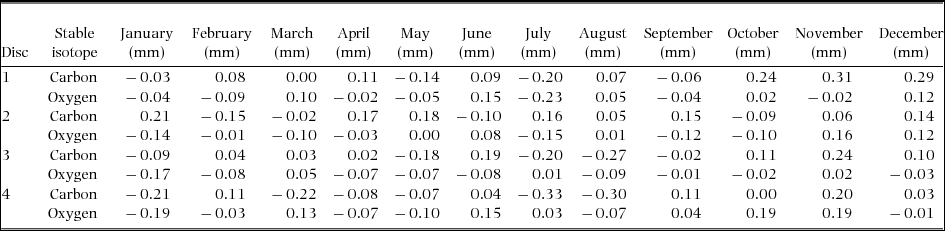
Pearson's product-moment correlation values showing a weak linear relationship on the annual basis between stable isotopes (δ18O and corrected δ13C) measured on Pericopsis elata, and monthly precipitation in Eastern Congo (Kisangani area).
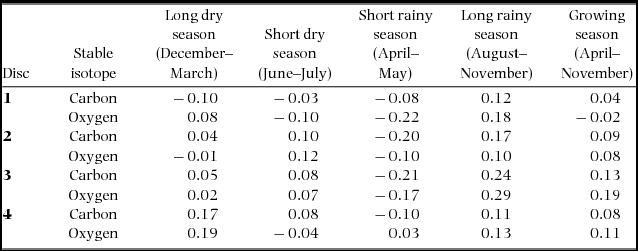
Pearson's product-moment correlation considering the seasonal distribution of precipitation in Eastern Congo (Kisangani area), with the growing season for Pericopsis elata between April and November.