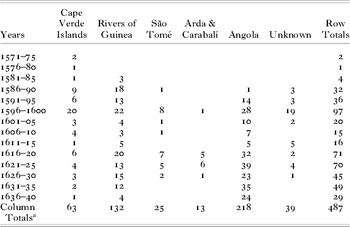
More than thirty years ago, Enriqueta Vila Vilar identified the late sixteenth and early seventeenth centuries as an era that witnessed ‘the first great wave of Africans to come to the Spanish Indies’.Footnote 1 As she and others have demonstrated, on the American side this early branch of the transatlantic slave trade was overwhelmingly concentrated in Cartagena de Indias, Veracruz, and Buenos Aires, with Cartagena receiving more captives than any other Spanish American seaport.Footnote 2 Far less is known of the African regions and ports of departure that supplied captives to the Americas during the same period. Rather, historiographical treatment of African provenance zones for the transatlantic slave trade up to 1650 remains fragmented, with several generations of historians alternately emphasizing the predominance of Upper Guinea or, more recently, Angola. An underlying problem with these hypotheses is that they are largely based on documentary evidence generated either in Iberia or in the Spanish American viceroyalties of Mexico City and Lima. There have been very few attempts to explore extant sources for the early transatlantic slave trade generated in the Spanish American slaving ports themselves.Footnote 3
Building on the works of Vila Vilar and others, including the collaborative project ‘Voyages: The Transatlantic Slave Trade Database’, this article draws on new source materials to provide an overview of the African regions of departure for all presently known slave trade voyages to Cartagena de Indias during the late sixteenth and early seventeenth centuries.Footnote 4 Among the vast corpus of colonial-era documentation preserved in Spain's Archive of the Indies, Cartagena royal officials' correspondence contains numerous references to the transatlantic slave trade, including detailed port entry records that have not been utilized by any historian previously. Corrected for errors and double-counts, the combined sources now reveal a minimum of 487 slave ships known to have arrived in Cartagena between 1573 and 1640, disembarking at least 78,453 enslaved Africans in the city and neighboring ports.Footnote 5 While our knowledge of slave ship arrivals and captives disembarked remains incomplete, particularly for the 1570s and early 1580s, the data presently available strongly indicates that Cartagena imported captives from Angola and Upper Guinea in roughly equal measure during the period under study, with a smaller wave of captives from Lower Guinea.
This assessment of the relative importance of three major African provenance zones for the slave trade to Cartagena contradicts prior interpretations of patterns in the early transatlantic slave trade, with significant implications for better understanding how and when captives were generated for export in both Upper Guinea and Angola. Broad estimates published in the Transatlantic Slave Trade Database suggest that West Central Africa, encompassing Angola, exported far more captives than Upper Guinea throughout the century before 1650.Footnote 6 Until now, however, actual voyage data collected for much of the period has remained quite limited, particularly for years prior to 1595. Yet materials in Spain's Archive of the Indies provide exceptionally detailed and abundant information for the slave trade to Cartagena during the first 150 years of the trade's existence. For Upper Guinea, where captives were produced through a combination of wars, raids, debt, and judicial enslavement, Cartagena slave trade data yields evidence that these mechanisms for procuring captives functioned throughout the period under study.Footnote 7 In addition to slave markets, long-distance trading networks, and tribute, warfare played a fundamental role in the enslavement of West Central Africans. By 1580, just five years after the founding of Luanda, diplomatic relations between Ndongo and the Portuguese colony of Angola deteriorated to the extent that the two powers were openly at war – and would remain so for most of the following century.Footnote 8 Whereas this article focuses on identifying the geographical origins of some of the earliest African diasporas in the Americas, further research may use Cartagena shipping records to gauge more precisely the immediate effects of conflict in Angola, or to link shifts in the slave trade to specific events in Upper Guinea with greater chronological precision.
This article divides extant voyage data into five distinct periods, revealing basic patterns in the direction and volume of the slave trade to Cartagena from each major African provenance zone. First, from the early 1570s through to the early 1590s, Upper Guinea supplied the vast majority of captives transported to Cartagena. The years 1593 to 1601 then witnessed an unprecedented surge in the transatlantic slave trade, with Upper Guinea providing nearly half of all voyages to Cartagena, and Angola providing slightly more than one-third. This ‘first great wave’ was followed by a fifteen-year period of decline from 1602 to 1616 in which much slave traffic was re-directed towards other ports, notably Veracruz. Though fewer voyages arrived in Cartagena, the proportion of voyages from Upper Guinea and Angola – approximately one-half and one-third, respectively – remained the same. In the fourth phase, a second surge in the transatlantic slave trade to Cartagena took place from 1617 to 1625, with Angola and Upper Guinea essentially reversing roles.Footnote 9 For the first time, Angola supplied approximately half of all voyages disembarking captives in Cartagena, while Upper Guinea provided just under one-third. Finally, the overall frequency of voyages to Cartagena decreased during the remainder of the period under study, but Angola's share of the traffic continued to grow, supplying exactly two-thirds of all known slave trade voyages to Cartagena between 1626 and 1640.Footnote 10
UPPER GUINEA–PERU VERSUS ANGOLA–MEXICO
In their search for sources regarding the transatlantic slave trade to the sixteenth- and seventeenth-century Americas, Africanists such as Philip Curtin long ago looked to Latin American history, only to discover colonial Latin Americanists' perennial attraction to Mexico City and Lima. Despite his failure to address either Cartagena or Veracruz, Curtin's path-breaking study The Atlantic Slave Trade: A Census offered a complex interpretation of the early modern transatlantic slave trade. Curtin described ‘an early-seventeenth century shift’ from Senegambia to Angola, particularly noticeable in ‘southern South America’.Footnote 11 He further speculated that slave traffic from Angola to Buenos Aires was redirected towards the Caribbean in the early 1620s – a hypothesis that, nearly half a century later, has been neither proven nor disproven.Footnote 12 Broad, synthetic interpretations of this kind, addressing shifts in volume and direction from multiple African regions to diverse American regions, have not been sustained for the study of the slave trade to early colonial Latin America. Instead, subsequent research on the transatlantic slave trade prior to 1700 often emphasizes direct connections between either Upper Guinea and Peru, or Angola and Mexico.
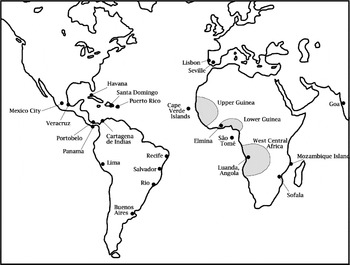
Major ports in the early modern Iberian Atlantic World.

Evoking Cartagena's role as a conduit for slave traffic to the viceroyalty of Peru and the New Kingdom of Granada, several studies have drawn on a handful of sources generated in the port to make broad assertions about the prominence of Upper Guineans in ‘Spanish America’. These works tend to avoid discussion of Cartagena itself, and downplay the seaport's connections to any other African region. As early as 1967, two years before the publication of Curtin's Atlantic Slave Trade, David Pavy argued that ‘Senegambia … probably was the principal source of supply of slaves to Colombia until the middle of the seventeenth century’. As for the slave trade from West Central Africa, he suggested that ‘a steady flow of slaves from Angola entered the Spanish Main throughout the years of slavery, but it is doubtful that they were ever the most numerous group’.Footnote 13 Pavy's conclusions were based on his reading of the Jesuit missionary Alonso de Sandoval's Treatise on Slavery, probably written in Cartagena during the 1610s or early 1620s, and a brief survey of colonial-era documents generated in various sites in the New Kingdom of Granada (a region roughly corresponding to present-day Colombia). In similar fashion, Walter Rodney surmised in 1970 that ‘Upper Guinea remained a key region for the supply of slaves to Spanish America’ up until 1640.Footnote 14 Like Pavy, Rodney relied on Sandoval's descriptions of slavery and the slave trade in early seventeenth-century Cartagena to support this claim. To his credit, Rodney also cited a list of 36 slave ships arriving in Cartagena between 1585 and 1590, noting that nearly all of them came from the Cape Verde Islands or Upper Guinea (this list is discussed in greater detail below).
Rather than portraying Cartagena-based sources as indirect evidence of broader trends elsewhere, other works skip Cartagena entirely, relying on Peruvian records to gauge Upper Guineans' presence in the early colonial Spanish Americas. By far the most influential study of this nature is Frederick Bowser's The African Slave in Colonial Peru. Though Bowser devoted several pages to describing the transatlantic slave trade to Cartagena and the port city's role in supplying captives to Peru, his interpretation of Peru's links to Upper Guinea and other African regions hinged upon comparison of ethnonyms ascribed to slaves in Lima's notarial records. Bowser's samples of slave sales conducted in Lima during selected years from 1560 to 1591, and at five-year intervals from 1595 to 1650, yielded information on nearly 5,300 enslaved Africans. Based on his analysis of this data set, he argued that ‘Guinea supplied some 55 to 56 per cent of the slaves exported to Peru between 1560 and 1650’. However, there were some minor problems with this general observation, since West Central Africans outnumbered Upper Guineans in the years 1595, 1600, 1635, and 1640. ‘On the basis of this mixed evidence’, Bowser wrote, ‘the most one can conclude is that despite the spectacular rise to prominence of Angola in the slave trade, Guinea remained a major supplier of blacks to Spanish America.’Footnote 15 Following Bowser, several historians have continued to explore the historical connections between Upper Guinea and colonial Peru.Footnote 16 Thus far, however, no subsequent work has offered a more precise analysis of the relative importance of diverse African provenance zones in the slave trade to the early colonial Spanish Americas using notarial records – or, for that matter, ecclesiastical sources, trial records, or Inquisition records – generated in Peru.Footnote 17
Just as historians of colonial Peru have turned to Upper Guinea and vice versa, a similar convergence of interests often characterizes scholarship on West Central Africans' presence in New Spain (colonial Mexico). Analyses of a variety of colonial Mexican source materials, including notarial records, slave rosters, and marriage records, repeatedly and consistently indicate that ‘Angolas’ predominated among seventeenth-century New Spain's African-born population.Footnote 18 Indeed, the degree to which inhabitants of precolonial Kongo and Angola shared common identities, languages, religious beliefs, and other cultural traits may eventually take on special significance for the history of Mexico. Nicolás Ngou-Mve, for example, writes of a historically unified Bantu culture that must have played a key role in the formation of colonial Mexican society, given the demographic importance of West Central Africans in New Spain. For Ngou-Mve, ‘Bantu Africa’ was the ‘sanctuary of a homogenous culture, whose evolution and new forms of expression in the Mexican diaspora remain to be investigated’.Footnote 19 Recent works addressing African influences elsewhere in the colonial Americas likewise depict ‘core cultures’ or broadly shared ‘Atlantic creole’ identities as common features of diasporic West Central African populations.Footnote 20
Based largely on Vila Vilar's uninterrupted data for Veracruz between 1595 and 1640, and her substantial data for Cartagena and other Caribbean ports (especially from 1595 to 1601 and 1623 to 1640), several historians have assumed that nearly all slave traffic to the Americas originated in just one African port – Luanda – during the late sixteenth and early seventeenth centuries. The evidence for Veracruz is compelling: African ports or regions of departure are known for 173 slave trade voyages to Veracruz between 1595 and 1640 and, of these ships, 140 (more than 80 per cent) sailed from Angola.Footnote 21 Linda Heywood and John Thornton have recently used the term ‘Angola wave’ to describe an influx of enslaved Africans arriving in Anglo- and Dutch American colonies during the first half of the seventeenth century; extrapolating from Vila Vilar's data, they argue that these forced migrants were predominantly West Central African.Footnote 22 The idea of an ‘Angola wave’ is by no means inappropriate, even within a broader Atlantic context. However, it may be misleading to assume that a data set dominated by voyages to Veracruz accurately reflects the orientation of the entire transatlantic slave trade. In other words, one might ask, to what extent did the seventeenth-century Angolan wave extend beyond New Spain? And when, approximately, did it begin?
Veracruz's strong connection to Angola, combined with the relative abundance and consistency of published data for that port city compared to other Spanish American ports, has led a number of prominent historians of colonial Latin America and the Iberian Atlantic world to make (or accept) bold speculations regarding West Central Africa's role in the early modern transatlantic slave trade. For some, ‘Portuguese slavers primarily transported Angolans to the Americas’; for others, ‘three out of four’ or even ‘ninety percent’ of the vessels carrying enslaved Africans to the Americas during the late sixteenth and early seventeenth centuries departed from Angola.Footnote 23 While these estimates are plausible for Veracruz, data presented here for the transatlantic slave trade to Cartagena places the Angola–Veracruz slaving circuit within a larger context in which such broad assertions quickly become untenable.
ROYAL OFFICIALS AND PORT ENTRY RECORDS
Since the publication of Vila Vilar's Hispanoamérica, historians have had access to detailed, if partial, information regarding the actual arrivals of slave ships in Spanish American ports between 1595 and 1640.Footnote 24 Port entry records are of tremendous historical value, enabling us to cross-check information for vessels known to have departed Iberian or African ports with ships that actually arrived in Cartagena (or elsewhere), regardless of their intended destinations.Footnote 25 As Vila Vilar and others have noted, there are significant gaps in the records she examined; even the most assiduously researched studies of the slave trade during this period have concluded that most of Cartagena's port entry records are missing or lost.Footnote 26 This is not entirely true. Archival research on the slave trade to the Spanish Americas during the late sixteenth and early seventeenth centuries has generally clustered around centralized accounts, compiled by slave trade administrators and royal officials, held in the Archive of the Indies. To this corpus of known source materials, the present study adds a set of sources housed in the same massive archive that have not been analyzed previously, namely Spanish American royal officials' letters to the crown. Archived separately by region or province, royal officials' correspondence to the metropole principally addresses matters of economic interest to the Spanish crown. Such letters from Cartagena are replete with references to the transatlantic slave trade.Footnote 27
As agents of the Spanish crown, royal officials in Cartagena – usually an accountant and a treasurer, aided by customs officials – counted and taxed the African captives disembarked in the city. While the actual sum collected per captive changed over time, and the funds thus generated were employed for a variety of purposes, one central tension remained constant during the period under consideration. Customs fees represented a serious outlay for slave merchants on the one hand, and an important source of revenue for the royal treasury and its administrators on the other. Throughout the late sixteenth and early seventeenth centuries, this tension led to accusations of both widespread contraband and rampant corruption. Many such accusations were well founded. In Cartagena during the 1570s, for example, royal officials themselves regularly traded slaves on their own behalf. The royal treasurer Baltasar Carrillo took advantage of his position to act as a middleman, purchasing captives directly from slave ship captains, then selling them for a profit. Meanwhile, the customs agent Bartolomé de Castillejo was accused of accepting bribes. During the inspection of one slave ship, its captain presented Castillejo with a ‘gift’ of two slaves, presumably for permitting the disembarkation of undeclared captives or merchandise. After holding his position for the space of just one year, Castillejo was said to be worth more than 1,000 pesos. As one witness remarked, ‘that kind of money isn't found on the street’.Footnote 28
In addition to providing numerous references to single or small groups of slave ships and their captains, Cartagena's royal officials compiled at least three major lists of vessels disembarking captives in the seaport during the years 1585–90, 1600–1, and 1615–23. Each offers a variety of details on individual voyages, including the names of slave ship maestres, pilots, owners, and scribes; their stated ports or regions of departure from Africa; voyages' dates of registration (if any) in Iberia; and the date of each ship's arrival and inspection in Cartagena. Royal officials also reported the numbers of ‘pieces of slaves’ found on board each vessel during their inspections, often calling attention to disparities between the number of captives landed and the number of captives each ship was registered to transport.Footnote 29 These slave ship rosters and account books provide a wealth of new information on the transatlantic slave trade to Cartagena during the late sixteenth and early seventeenth centuries. It should be noted that royal officials' accounts do not always agree with other extant sources such as Iberian port departure records. Yet, despite our knowledge of their vested interest in the trade as early as the 1570s, royal officials' reports to the Spanish crown provide a strikingly clear glimpse of the early transatlantic slave trade, with a degree of quality and detail seldom paralleled in other sources. Though their descriptions of voyages may be flawed in some respects (particularly regarding the numbers of captives disembarked), their accounts of slave ship itineraries, at least, are much more reliable than those specified in port departure records.
In the first slave ship list, responding to the Spanish crown's concerns over possible contraband slave trafficking, Cartagena's governor and royal officials enumerated 36 slave trade voyages, which had disembarked nearly 7,000 captives between 1585 and 1590.Footnote 30 The vast majority of these voyages departed from either the Cape Verde Islands (10 ships) or ‘Guinea’ (21 ships, including one from the ‘Rivers of Guinea’), disembarking a total of 5,979 enslaved Africans. One vessel departed from São Tomé, and another single ship sailed from Angola. In addition to individual ships sailing directly from Africa, three Indies fleets under the command of Antonio Osorio (1585), Miguel de Eraso (1586), and Diego de la Ribera (1589) landed a combined total of slightly fewer than 400 captives in Cartagena. On each of these occasions, royal officials noted that an unspecified number of captives remained on board the fleets, to be disembarked subsequently in Nombre de Dios.
A second major list drawn up by Cartagena's royal officials documents 33 slave ships entering Cartagena during the years 1600–1. Although the list largely confirms known voyages, it also provides additional information.Footnote 31 It was intended to serve as evidence of proceeds owed to João Rodrigues Coutinho, governor of Angola and holder of a contract to supply slaves from Angola to the Spanish Americas.Footnote 32 Registered to deliver a combined total of 4,637 captives, these ships actually disembarked over 6,000 enslaved Africans in Cartagena in the space of 15 months. Eleven ships from Upper Guinea and the Cape Verde Islands landed 1,714 captives, and 519 arrived on ships sailing from São Tomé. One ship sailing directly from ‘Congo’ – the only ship thus designated in the seven decades under study – disembarked 302 enslaved Africans in Cartagena; 17 ships from Angola landed a total of 3,282 captives.
The third and largest ship list, which does not appear to have been used by any previous historian, provides information on 99 slave trade voyages disembarking nearly 18,000 enslaved Africans in Cartagena between 1615 and 1623.Footnote 33 In response to crown directives, royal officials compiled this official summary of captives delivered on behalf of the slave trade magnate Antonio Fernández Delvas, who had contracted with the Spanish crown to provide slaves from both Angola (1615–23) and the Cape Verde Islands (1616–24).Footnote 34 As noted by Cartagena's royal officials, 8 ships arrived from the Cape Verde Islands, and another 25 sailed from ‘Guinea’ (including several ships from ‘the Rivers of Guinea’, and Cacheu).Footnote 35 As in the 1600–1 list, West Central Africa played a prominent role in the slave trade to Cartagena, with 47 ships said to have departed from Angola. Moreover, slave exports from Lower Guinea to Cartagena reached substantial numbers for the first time during this period. Seven ships sailed directly to Cartagena from ‘Arda’ (Ardra or Allada); another sailed from ‘Carabalí’ (Calabar) stopping in São Tomé en route to Cartagena. For another eight ships that arrived from São Tomé, we do not yet have any means of determining how many captives were drawn from West Central Africa as opposed to Lower Guinea. One voyage involved stops in both Arda and Angola.
Complementing these slave ship lists, the section Contaduría (Accounting), also housed in the Archive of the Indies, represents an additional source for the study of the slave trade that has not yet been systematically explored, especially for the years prior to 1595. The administrative reports collected here offer a variety of indirect information on slave ship arrivals, such as import duties on slaves landed, fees paid for unregistered merchandise, and taxes paid on slave ships sold or dismantled upon arrival in Cartagena.Footnote 36 These ledgers compiled by Cartagena's royal officials sometimes refer to slave ships that are not listed in any other known source. For example, the frigate Nuestra Señora de la Candelaria reached Cartagena in 1597, having departed from ‘the Rivers of Guinea’. Along with its cargo of nearly 250 enslaved Africans, the ship carried contraband ‘Guinea wax’ judged to be worth more than 500 silver pesos.Footnote 37 In September 1609, the dilapidated San Juan Evangelista was sold to one of Cartagena's religious officials, who planned to have the ship dismantled, salvaging only its lumber and riggings. This event was recorded only because the royal treasury customarily collected a 15 per cent tax on all ship sales. In their description of the vessel, royal officials casually noted that the San Juan Evangelista had entered Cartagena's port in July 1609, sailing from São Tomé ‘with slaves’. Thus far we have no further details on this voyage whatsoever, other than the name of its owner and captain, Juan de Nis Vizcardo.Footnote 38
A NEW PERIODIZATION FOR THE SLAVE TRADE TO CARTAGENA
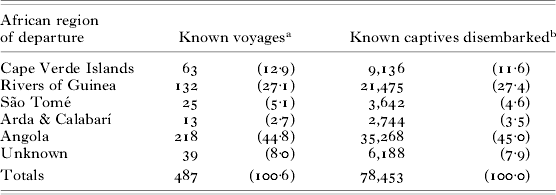
Combined voyage data for Cartagena (see Table 1) indicates that Angola and Upper Guinea provided roughly equal shares of captives to the city between 1573 and 1640, accompanied by a smaller wave of captives from Lower Guinea. Slave ships from Angola, including one ship from ‘Congo’, comprised nearly 45 per cent of all ships known to have arrived in Cartagena during these seven decades. Slave ships coming from Upper Guinea – the combined total of ships arriving from the Cape Verde Islands, the ‘Rivers of Guinea’, and ‘Guinea’ – constituted an additional 40 per cent of the total. Of the remaining voyages, almost 8 per cent were from Lower Guinea or from São Tomé. For the final 8 per cent, the African region of departure remains unknown. While some captives arriving from São Tomé beyond any doubt originated in West Central Africa, others were drawn from Lower Guinea. However, even if all ships sailing from São Tomé are presumed to have transported captives from Angola alone, West Central Africa would still have supplied just under 50 per cent of all slaving voyages to Cartagena. Voyages of unknown provenance could tip the balance a bit farther towards Angola, but at present Angola appears to have provided slightly less than half of all transatlantic slave traffic to Cartagena between 1573 and 1640.
Known slave trade voyages and captives disembarked in Cartagena de Indias, 1570–1640, by African regions of departure (percentages in brackets)
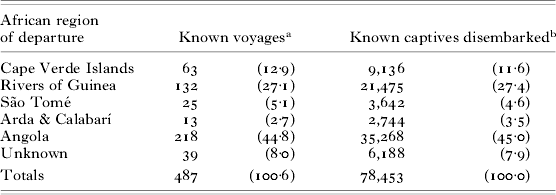
a Three ships that stopped in two African ports prior to arriving in Cartagena – Arda and São Tomé (1600), Arda and Angola (1618), and Carabalí and São Tomé (1621) – are double-counted in the ‘known voyages’ column, once for each African region. The ‘known voyages’ total has been adjusted from 490 to 487 to offset these voyages, but the total percentage of voyages remains slightly above 100 per cent.
b The ‘known captives disembarked’ column does not include twenty voyages that disembarked unknown numbers of captives. For voyages that may have embarked captives in two different African regions, the known numbers of captives disembarked are split evenly between each.
Sources: See Appendix A.
As a point of caution, it should be noted that information on slave ships arriving in Cartagena is currently available for only 51 of the 70 years between 1570 and 1640, with the largest gap falling between 1578 and 1584. Rather than a straightforward lull in the flow of the slave trade, this is an understudied period for which we simply do not yet have sufficient data to reconstruct most of the voyages that took place.Footnote 39 Scholarship on the transatlantic slave trade to the Spanish Americas prior to 1595 has long relied almost exclusively on peninsular Iberian sources such as lists of taxes paid prior to slave ships' departures, notarial records describing upcoming slave trade voyages, and ‘licenses’ authorizing the purchase of captives in Africa and/or their transportation to the Americas.Footnote 40 While for the most part these materials have not yet been matched with corresponding Caribbean port entry records (if such records exist), they nonetheless provide ample evidence of active slave trading. Between 1569 and 1579, the Spanish crown collected taxes from investors who intended to transport more than 4,300 captives from African ports – primarily the Cape Verde Islands – to ‘the Spanish Main’ (Cartagena).Footnote 41 Documents generated in Cartagena during the 1570s also yield a number of clues. As early as 1575, Cartagena's royal officials complained of illegal slave trafficking, and of the ineffectiveness of procedures for discovering, seizing, and appropriating contraband ‘merchandise’ such as African captives.Footnote 42 In the 1578–9 investigation of Cartagena's royal officials discussed above, witnesses mentioned a number of slave ship captains by name, including several identified as ‘Portuguese’.Footnote 43
Corresponding to a second sizeable gap in our current knowledge of the transatlantic slave trade (1602–8), letters from Cartagena's governor and royal officials addressed to the crown suggest a decline in the trade and a general economic slump during the first decade of the seventeenth century.Footnote 44 The slave trade did not, however, completely dry up during these years, as the paucity of specific data might suggest. Rather, these years were a lull in the trade only in comparison with the extraordinary surge in slave trafficking during the immediately preceding years. Royal officials compared 1603–4, the year of ‘this land's downfall and ruin’, with ‘the previous three years here’, in which ‘every day this place grew in prosperity’.Footnote 45 Yet the slave trade continued, if on a smaller scale. In 1604, Cartagena's governor complained that ‘only three or four ships from Guinea and Angola have entered this port within the past seven months’.Footnote 46 The following year, royal officials noted that the governor regularly interfered in their jurisdiction over slave ship inspections, citing as examples his actions during the recent arrival of two ships that carried inadequate registration. One unnamed ship had entered the port with 270 captives from Angola. A second unnamed vessel, captained by Pedro Vaez de Morales, landed another 120 captives.Footnote 47
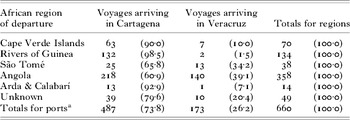
Despite remaining gaps in our knowledge of the slave trade to Cartagena, combined voyage data shows that waves of captives exported from any African region did not necessarily fan outwards to all American ports with equal intensity. A comparison of known slave trade voyages to Cartagena and Veracruz during the late sixteenth and early seventeenth centuries reveals stark contrasts, as Table 2 illustrates.Footnote 48 Even in the absence of data for slave trade voyages arriving in Veracruz between 1570 and 1595, it is readily apparent that the volume of slave traffic to Cartagena was much larger during the period under study. Furthermore, Angola's predominance in the traffic to Veracruz exaggerates West Central Africa's importance within the overall trade. While voyages arriving from Angola made up more than 80 per cent of known voyages arriving in Veracruz, they comprised less than half of all voyages known to have arrived in Cartagena. If slave ship traffic from both ports is combined, then voyages from Angola constitute slightly over half (54 per cent) of all known voyages to both ports. Several factors may add further weight to the importance of the ‘Angola wave’ during the early seventeenth century, including voyages of unknown provenance; Angola's share in slave traffic from São Tomé; and, most importantly, Angola's share in slave traffic arriving in other ports such as Pernambuco, Salvador da Bahia, Buenos Aires, Santo Domingo, and so forth. At present, we may note that Cartagena and Veracruz clearly had dissimilar relationships to Luanda. Both seaports received more slave ships from Angola than from any other single region, even when voyages from the Cape Verde Islands and Upper Guinea are combined. Unlike Veracruz, however, Cartagena did not acquire enslaved Africans almost exclusively from Angola.
African regions of departure for 660 slave trade voyages arriving in Cartagena and Veracruz, 1570–1640 (with row percentages in brackets)

a The total number of voyages arriving in Cartagena has been adjusted from 490 to 487, as explained in Table 1.
Sources: See Appendix A; also Vila Vilar, Hispanoamérica, 252–67.
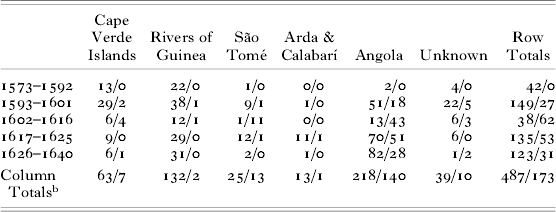
Analyzed chronologically, voyage data for the transatlantic slave trade to Cartagena reveals significant change over time in the numbers of slave ships arriving and captives disembarked from each of the major African provenance zones, most notably Upper Guinea and Angola. Given the scope and volume of the slave trade to the port city, trends in Cartagena's slave traffic during the late sixteenth and early seventeenth centuries provide a model against which the slave trade to other American ports during the same era may be measured. Table 3 divides known slave ship arrivals in Cartagena into five chronological periods, with voyages sorted into columns depending on their African ports or regions of departure. This periodization reveals two nine-year surges in the transatlantic slave trade: from 1593 to 1601 and 1617 to 1625, each drawing captives from multiple African provenance zones. Though slave ships arrived in Cartagena with less frequency during the years 1626 to 1640, this fifteen-year period's most notable characteristic was the ascendancy of slave traffic from West Central Africa. For the purpose of comparison, the numbers of slave ships from each provenance zone known to have arrived in Cartagena are followed by those arriving in Veracruz during the same period.
660 known slave trade voyages to Cartagena and Veracruz,Footnote a by year of arrival and African regions of departure, 1570–1640
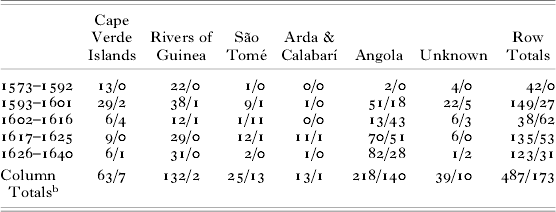
a Known voyages to the two port cities are separated by a forward slash.
b Row totals for Cartagena have been adjusted as explained in Table 1.
Sources: See Appendix A; also Vila Vilar, Hispanoamérica, 252–67.
During the first chronological period, from 1573 to 1592, the transatlantic slave trade to Cartagena was completely dominated by the forced migration of Upper Guineans. Of the 42 voyages known to have taken place during these two decades, 35 departed from either the Cape Verde Islands or Upper Guinea, with only two ships arriving from Angola, and one from São Tomé. The tremendous disparity in the number of voyages from the Cape Verde Islands and Upper Guinea to Cartagena, as opposed to Veracruz, between 1570 and 1640 provides another example of a single African region's dissimilar relationship with different American ports. Veracruz may have been closely linked to Upper Guinea and the Cape Verde Islands during the 1570s and 1580s, mirroring contemporary trends in Cartagena. However, and somewhat surprisingly, the historiography of the slave trade to sixteenth-century Mexico remains in such a state of neglect that we know of only a single slave ship that may have arrived in Veracruz prior to 1595!Footnote 49 If the voyage data for Cartagena presented here represents broader patterns in the geographical orientation and direction of the transatlantic slave trade, further research on the traffic to Veracruz and other circum-Caribbean ports should eventually provide a much better idea of the geographic distribution of Upper Guinean peoples in diaspora during the 1570s, 1580s, and 1590s, and during the early seventeenth century.
The second chronological period, corresponding to Vila Vilar's ‘first great wave’, witnessed an unprecedented and relatively sudden surge of African forced migrants to the Caribbean. An average of 16 or 17 slave ships per year entered Cartagena between 1593 and 1601, disembarking an absolute minimum of nearly 26,000 enslaved Africans in the city in the space of just nine years.Footnote 50 Known slave ship arrivals for Cartagena dwarf those for Veracruz during this period. With 67 vessels arriving in Cartagena from the Cape Verde Islands and Rivers of Guinea combined, Upper Guinea provided nearly half of the Caribbean's ‘first great wave’. Though only two slave ships from Angola are known to have sailed to Cartagena prior to 1593, a boom in the transatlantic slave trade from West Central Africa – fifty ships from Angola and a single ship from ‘Congo’ – accounted for slightly more than one-third of the 1593–1601 surge. The years 1595 and 1601 stand out as the only years prior to the 1620s in which vessels from Angola comprised more than half of all slave trade voyages entering Cartagena. Nine ships arrived from São Tomé during this period, and one additional ship made stops in both Arda and São Tomé before disembarking captives in Cartagena. This last voyage indicates that slave ships from São Tomé were already supplying captives from Lower Guinea to the Spanish Caribbean. As for the other voyages from São Tomé, we have no evidence as to whether the captives disembarked in Cartagena were drawn from West Central Africa or Lower Guinea. In sum, Upper Guinea and Angola supplied the bulk of this first wave of forced migrants arriving in Cartagena between 1593 and 1601. Lower Guineans may have figured prominently among the nearly 26,000 captives forcibly displaced to the Spanish Caribbean port city, but our data for voyages from São Tomé is mostly inconclusive in this regard.
While Cartagena received more captives from Upper Guinea than from any other African region between 1593 and 1601, vessels arriving from Angola predominated in Veracruz in the same years. Historians of Latin America have often interpreted the slave trade to Veracruz as a function of the high demand for slaves in Mexico City. However, given the relatively small volume of slave traffic to Veracruz in comparison to Cartagena's share during this period, it is also possible to analyze New Spain's connection to Angola as the result of slave merchants' search for secondary markets that were less saturated, and less competitive, than Cartagena. If African ports of departure for slave ships arriving in both Cartagena and Veracruz are combined for the years 1593–1601, voyages from Upper Guinea (70 ships) and Angola (69 ships) are almost perfectly balanced, with each region comprising roughly 40 per cent of all voyages known to have contributed to ‘the first great wave’ to both ports.
Immediately following the period of intense slave trafficking between 1593 and 1601, the transatlantic slave trade to Cartagena experienced a drastic downturn, lasting from 1602 to 1616. During this 15-year interlude, only 38 vessels are known to have disembarked African captives in the city. As noted above, our data for the first decade of the seventeenth century remains incomplete, and, despite the multiple complaints voiced by Cartagena's royal officials, their letters and other sources indicate the arrivals of several slave ships for which we have only partial information. African ports of departure are presently unknown for any of the four slave ships that arrived in Cartagena in 1614, and the numbers of captives disembarked are unknown for 13 vessels arriving in the city from various African regions between 1609 and 1614. For slave trade voyages with known African regions of departure, the portion of the trade from each provenance zone remained roughly the same as in the previous period. Upper Guinea provided 18 ships, or almost half of all slave trade voyages to Cartagena. Another 13 ships sailed from Angola, representing one-third of known voyages during these years. An additional ship arrived from São Tomé; African ports of departure for the remaining six voyages are unknown.
As noted by Mendes, we still know very little of the circumstances causing ‘the rapid rise and then decline of Veracruz as a rival for Cartagena in the first quarter of the seventeenth century’, other than that there was a noticeable shift in slave traffic, at least in terms of volume, from Cartagena to Veracruz.Footnote 51 Interestingly, this shift was evidently limited to voyages from Angola and São Tomé; known voyages from Upper Guinea appear to drop off sharply. Further research on other ports may well reveal that slave traffic from Upper Guinea during this period simply changed direction, shifting away from Cartagena to some other (unauthorized) region rather than vanishing into thin air. For now, our data for Cartagena and Veracruz combined suggests that Angola's share in the total slave trade increased during the years 1602 to 1616, a period in which the overall volume of the transatlantic slave trade from each major provenance zone declined.
The fourth chronological period delineated in Table 3 represents a second ‘great wave’ of African forced migrants landed in Cartagena between 1617 and 1625. Echoing the previous surge, 135 vessels disembarked more than 25,000 enslaved Africans in Cartagena in a period of just nine years.Footnote 52 This second surge loosely corresponds to the years in which Sandoval wrote and published his well-known tract De instauranda Aethiopum Salute. According to Sandoval, 12 to 14 slave ships entered Cartagena every year, each carrying from 300 to more than 600 captives.Footnote 53 Voyage data indicates that Sandoval in fact underestimated the frequency of slave ship arrivals; from 1617 to 1625, an average of 15 slave ships entered Cartagena each year, with no less than 21 arriving in 1620 alone. If Sandoval's estimate of 300 to 600 captives per ship was not exaggerated, then Cartagena would have received between 41,000 and 82,000 captives during these nine years. Voyage data for the period – drawn largely from royal officials' accounts – suggests a much lower number of captives disembarked, averaging roughly 190 captives per ship. Sandoval may have exaggerated his figures as a rhetorical and literary device in order to incite ‘great pity and compassion’ in his audience. Yet, as discussed earlier, Cartagena officials also took advantage of their position to enrich themselves and their associates through the slave trade. Surely they purposely concealed the arrival of larger numbers of captives on numerous occasions.Footnote 54 Newson and Minchin relate that agents employed by the slave merchant Manuel Bautista Pérez during the first half of the seventeenth century left several detailed account books that ‘even include bribes paid to royal officials’.Footnote 55 Although the question of the slave trade's volume falls beyond the scope of this article, it is hoped that the figures presented here may be useful as a basis for future estimates.
Analysis of the African ports of call for voyages contributing to Cartagena's second slave trade surge reveals two new developments. First, the re-intensified flow of African forced migrants to the Spanish Caribbean drew on three broad provenance zones, rather than two. In addition to much larger slave exports from Upper Guinea and West Central Africa, Cartagena received appreciable numbers of captives directly from ‘Arda’ and ‘Carabalí’ during the years 1617–25. Complementing Sandoval's descriptions of enslaved Africans from each of these broadly defined regions, various sources provide evidence for the transatlantic slave trade's reliance on all three provenance zones during this period. Antonio Vázquez de Espinosa, who visited the Americas between 1608 and 1622, wrote that ‘there is much commerce in this city and port’ of Cartagena, including ‘ten or twelve slave ships arriving every year’ from Angola, ‘and almost as many again from Cabo Verde, and the rivers of Guinea’.Footnote 56 Royal officials in Bogotá, writing in 1622, were even more specific:
The black slaves that are brought to Cartagena and sold are of three types – the first and most esteemed are those of the Rivers of Guinea, who are also called de ley. They have different names, and their common price is 200 pesos of assayed silver. The second type is that of the Ardas or Ararás. These are brought with least frequency, and are sold at 160 ducados of 11 reales. The third and worst is that of the Angolas and Congos, who are infinitely numerous in their lands, and who commonly sell for 150 ducados each.Footnote 57
Most slave trade voyages to Cartagena during the late 1610s and early 1620s continued to arrive from Upper Guinea and Angola, but at least nine sailed directly from Arda, transporting a combined total of more than 2,200 captives. A tenth ship stopped in both Arda and Angola prior to disembarking captives in Cartagena; another voyage had made previous stops in both Carabalí and São Tomé. Some Lower Guineans were probably also present among the captives shipped to Cartagena on an additional 11 ships arriving from São Tomé during the same years.
A substantial increase in traffic from Angola represents a second consequential pattern that emerged during Cartagena's 1617–25 slave trade surge. A total of 72 ships arriving from Angola constituted more than half (52 per cent) of all slave trade voyages arriving in Cartagena during this second ‘great wave’. Meanwhile, only forty slave ships – slightly less than one-third of all known voyages – arrived from Upper Guinea. By approximately 1620, Angola, rather than Upper Guinea, had become the preeminent region of departure for transatlantic slave trade voyages to Cartagena. From 1573 to 1592, Upper Guinea had provided the vast majority of slave ships arriving in the port. In the following two chronological periods (1593–1601 and 1602–16), approximately half of all known voyages to Cartagena had departed from Upper Guinea, while slave ships from Angola accounted for only one-third of the traffic. During the years 1617 to 1625, though Upper Guinea continued to export captives, and Lower Guinea contributed as well, for the first time Angola decisively surpassed Upper Guinea as the primary region supplying enslaved Africans to Cartagena. Angola's importance during this period is magnified by our knowledge of additional ships arriving in Veracruz and Santo Domingo.Footnote 58
The most salient features of the fifth chronological period, spanning the years 1626 to 1640, are a decrease in the overall frequency of slave traffic, and the continued rise of Angola as the chief provenance zone for the slave trade to Cartagena. Whereas during the preceding surge, an average of 15 slave ships arrived each year, after 1625 this figure dropped to a yearly average of 9 or 10. Slave trade voyages to Cartagena held steady at this reduced rate throughout the following decade, from 1626 to 1636. Towards the end of the 1630s, the number of ships disembarking captives in Cartagena grew steadily fewer, with only four slave ships known to have arrived in the port in 1639 and just one in 1640 – the year that marked the end of the Spanish and Portuguese ‘joint crown’ period and ‘the definitive loss of an Iberian monopoly in the Atlantic’.Footnote 59 While even slave ships from Angola arrived less often than they had during the previous nine-year surge, West Central Africa's predominance in the transatlantic slave trade to Cartagena during this fifth period is indisputable. With the exception of only three years in which voyages from Upper Guinea equaled or outnumbered those arriving from Angola (1627, 1629, 1635), this period may justly be considered the height of an ‘Angola wave’ in Cartagena: Angola was the stated port of departure for exactly two-thirds (66 per cent) of all slave trade voyages known to have disembarked captives in Cartagena between 1626 and 1640. Upper Guinea provided roughly one-third of all voyages to Cartagena until 1636, at which point the flow of captives from the region was reduced to a trickle, averaging only one ship per year. Only two ships sailing from São Tomé, accompanied by one voyage from Carabalí, are known to have arrived in Cartagena between 1626 and 1640. As in the previous periods, voyage data from Veracruz augments Angola's importance within the overall slave trade. During these fifteen years, vessels departing from Angola constitute a full 70 per cent of all slave trade voyages known to have arrived in Cartagena and Veracruz combined.
CONCLUSION
Voyage data for the transatlantic slave trade to Cartagena have been used here to identify waves of captives exported from major African provenance zones with greater chronological precision than sources generated in Lima or Mexico City. Cartagena port entry records also provide a fuller and more accurate portrayal of the trade's overall structure than voyage data for Veracruz alone. Unlike New Spain's primary slaving port, which was linked almost exclusively to Angola for its direct supply of enslaved Africans during the first four decades of the seventeenth century, Cartagena drew on multiple African provenance zones, particularly during the years 1593–1601 and 1617–25, when slave traffic was most intense. While the majority of Africans disembarked in Cartagena from 1573 to 1593 arrived from Upper Guinea, and most arriving between 1626 and 1640 came from West Central Africa, the flows of captives from both regions overlapped during the intervening years, accompanied by a smaller wave of forced migrants from Lower Guinea. Since the presently known volume of slave traffic to Cartagena is almost three times as large as that of Veracruz, patterns in the slave trade to Cartagena may best represent general trends in the overall sixteenth- and seventeenth-century transatlantic slave trade, at least until additional information comes to light. For now, one may reasonably conclude that Angola's role in the trade during the period under study was extremely important but not monolithic.
Further research on the traffic of enslaved Africans to Veracruz and other under-studied slaving ports such as Buenos Aires, Pernambuco, and Salvador da Bahia will be necessary to reconstruct the full scale of the early modern transatlantic slave trade, and to ascertain the approximate origins of many of its victims. As noted above, for Veracruz and Buenos Aires – the second and third most important Spanish American slaving ports for the period under study – thus far we have information confirming the outcome of only one slave trade voyage to each port prior to 1595. Though the slave trade to Pernambuco is believed to have begun in approximately 1560, and the trade to Bahia was underway by the 1580s, African provenance zones for the early Portuguese slave trade to Brazil remain equally uncertain.Footnote 60 Excluding voyages captured or detained by the Dutch, only five successful Portuguese voyages are presently known to have disembarked captives in Brazil before 1640.Footnote 61 Viewed in light of this general dearth of voyage data for Iberian slave traffic to principal American slaving ports before 1595, Cartagena's strong connection to Upper Guinea from the 1570s to the 1590s invites speculation that Upper Guinea played a more important role in the sixteenth-century slave trade than historians have previously believed.
For the decades after 1595, Upper Guinea's continued importance in the slave trade to Cartagena points to the development of multiple Iberian slaving networks connecting diverse African provenance zones to various regions of the colonial Americas. While Veracruz drew captives almost exclusively from Angola between 1595 and 1640, Cartagena continued to import enslaved Upper Guineans, despite a meteoric increase in slave traffic from Angola and an additional wave from Lower Guinea. If Upper Guineans were transported in large numbers directly to New Spain before 1595, such networks in the slave trade to Veracruz clearly were not sustained after the late sixteenth century. Indeed, Heywood and Thornton write that the ethnic origins of captives transported to Iberian colonies in the Americas ‘shifted dramatically from a near monopoly of Upper Guineans to a near monopoly of West Central Africans’.Footnote 62 This may have been what happened in Veracruz (and other regions of the Americas), but it was clearly not the case for Cartagena.
The ‘numbers game’, or the effort to quantify slave trade voyages or captives arriving in the Americas from various African regions, has already proven useful above and beyond estimating basic patterns in the flow of the transatlantic slave trade itself.Footnote 63 Our improved knowledge of the African regions of departure for nearly 80,000 captives disembarked in Cartagena enables a more accurate understanding of which regions of Africa were most affected by the transatlantic slave trade between 1570 and 1640. Cartagena shipping records reveal that the early slave trade drew on multiple African provenance zones simultaneously, rather than simply exploiting one region intensely before switching to another. They further prove that the regional and ethnic backgrounds of many of the African women, men, and children who played such important roles in the formation and evolution of Spanish American societies were less homogenous than previously believed, particularly from the 1590s through to the 1620s.
APPENDIX A: SLAVE SHIPS KNOWN TO HAVE ARRIVED IN CARTAGENA DE INDIAS, 1570–1640, BY AFRICAN REGIONS OF DEPARTURE AND QUINQUENNIUM

a Row totals for 1596–1600, 1616–20, 1621–25, and column totals have been adjusted as explained in Table 1.
Sources: AGI, SF 37, r. 6, n. 103, 107; AGI, SF 38, r. 6, n. 153; AGI, SF 56A, n. 21; AGI, SF 56B, n. 73; AGI, SF 72, n. 74–5, 77, 80–1, 105; AGI, SF 73, n. 30, 32, 38–9, 42, 71, 91, 110; AGI, SF 74, n. 5–6; AGI, Ctdra 1382; AGI, Ctdra 1384, n. 3, [?], 5; AGI, Ctdra 1385, n. 1–3, 5, 9; AGI, Ctdra 1388; AGI, Ctdra 1397, n. 1–6; AGI, Ctdra 1398, n. 1–3; AGI, Ctdra 1399, n. 1–4; AGI, Patronato 259, r. 52; Archivo General de la Nación (Bogotá), Fondo de Negros y Esclavos, Bolívar, legajos 4, 6, 7; Arquivo Histórico Ultramarino (Lisbon), Cabo Verde, cx. 1, n. 29, 93. See also TSTD; Vila Vilar, Hispanoamérica; and Borrego Plá, Cartagena de Indias, 58–61. For further details, see Wheat, ‘Afro-Portuguese maritime world’, 252–6.