Significant outcomes
-
∙ Recurrent major depressive disorder (MDD) patients had significantly lower plasma glial cell line-derived neurotrophic factor (GDNF) than first-episode patients before and after treatment.
-
∙ Our findings revealed that pre-treatment plasma GDNF level in MDD patients did not differ significantly from that in healthy controls.
Limitations
-
∙ Our sample size was relatively small.
-
∙ Our study examined plasma GDNF level. The source of plasma GDNF remains unclear. Further studies in which GDNF level is measured both in plasma and serum in larger samples of MDD patients are needed.
Introduction
The neurotrophic hypothesis states that major depression is associated with disrupted neuroplasticity, and that an antidepressant effect is induced by recovering neuronal networks (Reference Pittenger and Duman1). Neurotrophic factors play critical roles in that process.
Glial cell line-derived neurotrophic factor (GDNF) is a member of the transforming growth factor-β superfamily and is abundantly and widely expressed throughout the brain (Reference Airaksinen and Saarma2). This factor binds to GDNF family receptor α1, resulting in the activation of its intracellular tyrosine kinase domain (Reference Airaksinen and Saarma2). GDNF has neurotrophic effects on the development and maintenance of glial cells as well as dopaminergic and serotonergic neurons. It also regulates noradrenergic and GABAergic systems (Reference Ducray, Krebs, Schaller, Seiler, Meyer and Widmer3). Furthermore, GDNF protects both neurons and glial cells against oxidative stress (Reference Chao and Lee4).
In one animal experiment using a depression model of chronic unpredictable stress, GDNF expression was found to be significantly reduced in the hippocampi of rats presenting depression-like behaviour. Chronic antidepressant treatment with clomipramine ameliorated the reduced GDNF level and depression-like behaviour (Reference Liu, HY, Li, Wang, Yu and GC5). In another study, chronic antidepressant treatment with imipramine, desipramine, or citalopram increased GDNF expression and release in rat glioma cells (Reference Golan, Schreiber and Avissar6).
Peripheral blood, serum, and plasma GDNF levels have been examined in clinical patients with major depressive disorder (MDD). Several studies have suggested that serum GDNF level is reduced in MDD patients (Reference Diniz, Teixeira, Miranda, Talib, Gattaz and Forlenza7–Reference Tseng, Lee and Lin9). One early study found that serum GDNF level in MDD patients was significantly lower before treatment and increased after 8 weeks of antidepressant treatment (Reference Zhang, Zhang and Xie8). However, the clinical findings regarding serum or plasma GDNF level in MDD patients are not yet sufficient.
The aim of the present study was to determine whether plasma GDNF level is lower in MDD patients than in healthy controls. We explored changes in plasma GDNF level in MDD patients before and after antidepressant therapy. We also compared the GDNF levels of first-episode and recurrent-episode MDD subjects.
Methods
Subjects
In total, 23 MDD patients hospitalised in the Department of Psychiatry, Ansan Hospital, College of Medicine, Korea University, Kyunggi, Korea were included in this study. Patients were either medication naïve or medication free for at least 4 weeks before assessment. A trained psychiatrist interviewed patients using the Structured Clinical Interview for DSM-IV (SCID) (Reference First, Spitzer, Gibbon and William10). Depressive symptoms were assessed using the 21-item Hamilton Depression Rating Scale (HDRS) (Reference Hamilton11) at baseline and 6 weeks after treatment. Patients were diagnosed with MDD based on DSM-IV criteria. We included patients who scored 15 points or higher on the HDRS before entering the study and excluded patients with significant comorbid psychiatric disorders such as bipolar disorder, schizophrenia, or substance use disorder. We also excluded patients with a history of medical illness including diabetes mellitus or hypertension, as well as subjects who were pregnant or lactating. Among the MDD patients, 16 subjects were experiencing their first episode and seven were experiencing a recurrent episode. MDD patients were treated with venlafaxine (n=8), paroxetine (n=7), citalopram (n=5), or escitalopram (n=3), the doses of which were based on psychiatric symptoms.
A total of 23 randomly selected, healthy, non-psychiatric normal controls were recruited through local advertisements and received monetary compensation for their participation. Controls were age- and gender matched to the MDD patients and were also evaluated using the SCID. Controls had no personal or familial psychiatric history or medical history, and had normal laboratory findings for blood chemistry, renal function, thyroid function, liver function, and electrocardiography. All healthy controls had been free from physical illness for 2 weeks before enrolment.
The study protocol was approved by the Ethics Committee of Korea University. Written informed consent was obtained from each subject. Table 1 presents the demographic data of the subjects. There were no significant differences in gender, age, or body mass index (BMI) between the MDD patients and healthy controls.
Demographic data and clinical characteristics of study subjects
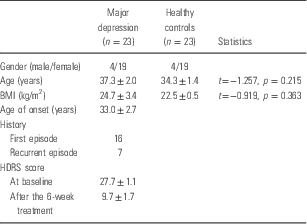
BMI, body mass index; HDRS, 21-item Hamilton Depression Rating Scale.
Data are presented as mean±SE.
Blood sample collection and plasma GDNF measurement
For all subjects, venous blood samples (2 ml) were collected and placed in lithium heparin vacuum tubes between 08:00 a.m. and 09:00 a.m. following an overnight fast. Plasma samples were separated after centrifugation at 3000 rpm for 10 min and were stored at −70°C until assay. For MDD patients, plasma GDNF level was measured at baseline and at the end of the 6-week treatment.
Plasma level of GDNF was determined using a solid-phase sandwich enzyme immunoassay with a human GDNF DuoSet ELISA Development System (R&D Systems, Minneapolis, MN, USA). The assay was performed in triplicate according to the manufacturer’s recommendations.
Statistical analysis
Study groups were compared using a two-tailed t-test for continuous variables and a χ 2 test for discrete variables. Pearson’s correlation coefficients were calculated to examine the relationships between plasma GDNF and clinical variables. Pre-treatment and post-treatment GDNF levels and HDRS scores of MDD patients were compared using paired t-tests. The null hypothesis was rejected at p<0.05. The statistical package used for analysis was SPSS 12.0 (SPSS IBM, New York, NY, USA).
Results
At baseline, the mean plasma GDNF level of MDD patients (23.35±5.59 pg/ml) did not differ from that of healthy controls (25.78±6.50 pg/ml) (t=0.284, p=0.778). There were no significant correlations between plasma GDNF level and gender, age, or BMI in any subjects (p>0.05). Moreover, there was no significant difference in plasma GDNF between subjects younger than 40 years and those older than 40 years (t=0.548, p=0.586). Plasma GDNF level was not significantly correlated with age of onset (r=0.133, p=0.543) or duration of illness (r=−0.163, p=0.468) among MDD patients. Recurrent-episode patients had significantly lower plasma GDNF level than first-episode patients (t=2.685, p=0.016) or healthy controls (t=2.509, p=0.019) (Table 2, Fig. 1).
Plasma glial cell line-derived neurotrophic factor (GDNF) levels in first-episode and recurrent-episode subjects with major depressive disorder (MDD) and healthy controls. A bar represents the mean plasma GDNF level of each group. Error bars present the 95% confidence interval of the mean. (a) At baseline, plasma GDNF level was significantly lower in recurrent-episode MDD patients (8.93±1.71 pg/ml) than in first-episode patients (29.66±7.53 pg/ml) (t=2.685, p=0.016) or healthy controls (25.78±6.50 pg/ml) (t=2.509, p=0.019). (b) After 6 weeks of treatment, plasma GDNF level was significantly lower in recurrent-episode MDD patients (7.43±1.95 pg/ml) than in first-episode patients (33.22±10.57 pg/ml) (t=2.399, p=0.029) or healthy controls (t=2.706, p=0.012).

First-episode and recurrent-episode subjects with major depressive disorder
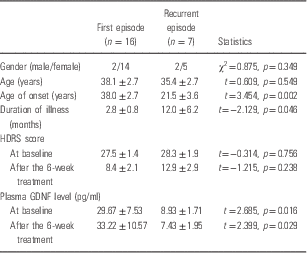
GDNF, glial cell line-derived neurotrophic factor; HDRS, 21-item Hamilton Depression Rating Scale.
Data are presented as mean±SE.
The mean plasma GDNF level in MDD patients at the end of treatment was 26.37±7.73 pg/ml. Plasma GDNF levels did not differ significantly according to type of antidepressant agent used (F=0.182, p=0.906). There was no significant change in GDNF level in MDD patients between baseline and the end of treatment (t=−0.267, p=0.792). GDNF level after treatment was significantly lower in recurrent-episode patients than in first-episode patients (t=2.399, p=0.029) or healthy controls (t=2.706, p=0.012) (Table 2, Fig. 1).
In MDD patients, the mean HDRS score was 27.7±1.1 at baseline and 9.7±1.7 at the end of treatment (t=9.188, p<0.001). Plasma GDNF level was not significantly correlated with HDRS score in MDD patients at baseline (r=0.144, p=0.512). There was no significant correlation between the difference in plasma GDNF levels and the difference in HDRS scores from baseline to the end of treatment (r=0.045, p=0.838).
Discussion
Our findings show that plasma GDNF level did not differ significantly between MDD patients and healthy controls. There was no significant change in the plasma GDNF level of MDD patients from baseline to the end of the 6-week treatment with antidepressants. However, recurrent-episode MDD patients had significantly lower plasma GDNF level than first-episode patients or healthy controls, both at baseline and after treatment.
Several clinical studies have reported lower serum GDNF level in MDD patients (Reference Diniz, Teixeira, Miranda, Talib, Gattaz and Forlenza7–Reference Tseng, Lee and Lin9). One study examining serum GDNF level in medication-free MDD patients and healthy control subjects between 20 and 65 years of age showed that serum GDNF level before treatment in MDD patients was significantly lower than that in control subjects (Reference Zhang, Zhang and Xie8). Another study found that serum GDNF level was significantly lower in elderly MDD patients compared with healthy controls (Reference Diniz, Teixeira, Miranda, Talib, Gattaz and Forlenza7). Our study found that plasma GDNF level was significantly lower in recurrent-episode MDD patients than in first-episode subjects or healthy controls, although plasma GDNF levels did not differ significantly between MDD patients and healthy controls in our study. In the previous studies, GDNF levels were not compared in recurrent-episode MDD patients and first-episode patients (Reference Diniz, Teixeira, Miranda, Talib, Gattaz and Forlenza7–Reference Tseng, Lee and Lin9). Some studies of plasma brain-derived neurotrophic factor (BDNF) in MDD patients have shown that patients with recurrent-episode MDD have significantly lower BDNF level than those with first-episode MDD (Reference Dell’Osso, Del Debbio and Veltri12,Reference Lee, Kim, Park and Kim13). In addition, some epidemiology studies have suggested that recall failure or unreported depressed episodes, especially in elderly subjects, influence results about the number of depressed episodes (Reference Simon and Vonkorff14,Reference Patten, Gordon-Brown and Meadows15). That is, it can be assumed that the incidence of recurrent-episode MDD is greater in elderly MDD subjects. In another study, subjects were divided into younger-, middle-, and older-aged groups, which revealed that MDD patients older than 40 years had significantly lower serum GDNF level than healthy controls (Reference Tseng, Lee and Lin9). However, this reduction was not observed in a younger-aged group (younger than 40 years). Our study included MDD patients younger than 60 years, 69.6% of whom were younger than 40 years. The mean age in our study was younger than those in the above studies (Reference Zhang, Zhang and Xie8,Reference Tseng, Lee and Lin9). The age distribution in our study might be related to the discrepancy between our findings and others (Reference Tseng, Lee and Lin9). Although our sample size was small and the accumulated findings are insufficient to allow conclusions, our clinical findings indicate that the recurrence of MDD and subject age affect peripheral GDNF level.
However, some studies have reported the opposite finding of higher serum or plasma GDNF level in depressed patients than in healthy patients. Several issues in these studies may explain such a discrepancy. In one study, serum GDNF level was measured in inpatients and outpatients with bipolar disorder-mania, bipolar/unipolar depression, schizophrenia, or obsessive–compulsive disorder (Reference Tunca, Kivircik Akdede and Ozerdem16). The authors reported a higher trend for GDNF level in patients with bipolar/unipolar depression and a significantly higher level in patients with mania than in healthy controls. However, bipolar and unipolar depressive episodes were not separated among depressed patients, and most of the subjects had taken psychotropic agents. Another study examined plasma GDNF level and neuropsychological test results in elderly patients with late-onset depression before antidepressant treatment (Reference Wang, Hou and Yuan17). This study showed significantly greater plasma GDNF level in elderly MDD patients than in healthy controls, which might have been associated with the absence of cognitive dysfunction but not with depression severity. Such findings suggest that higher plasma GDNF level might be among the protective factors of cognitive function in elderly MDD patients.
Animal studies have demonstrated that antidepressant medication is associated with increased GDNF synthesis and expression in glial cells (Reference Golan, Schreiber and Avissar6,Reference Hisaoka, Nishida and Koda18,Reference Hisaoka, Tsuchioka and Yano19). One clinical study found that 8-week antidepressant treatment increased serum GDNF level in MDD patients (Reference Zhang, Zhang and Xie8). However, we observed no significant change in GDNF level after antidepressant treatment. Some clinical studies have indicated that medication has no effect on peripheral GDNF level in MDD patients (Reference Tseng, Lee and Lin9,Reference Takebayashi, Hisaoka and Nishida20). Moreover, one recent study showed no significant alteration in plasma GDNF level after 6 weeks of treatment (Reference Brunoni, Machado-Vieira and Zarate21). These findings are consistent with our findings. Further observations are required to verify whether serum or plasma GDNF level differs before and after treatment in MDD patients.
There are several limitations to this study. First, our sample size was relatively small. Second, we examined plasma GDNF level, although the source of plasma GDNF remains unclear. GDNF is produced peripherally in the kidneys, ovaries, and muscles, as well as centrally by glia and neurons (Reference Golden, Demaro, Osborne, Milbrandt and Johnson22). Further studies in which GDNF level is measured both in the plasma and serum of a larger sample of MDD patients are needed. Moreover, it is unclear whether plasma or serum GDNF concentration is correlated with brain GDNF. A previous animal experiment found that GDNF penetration of the blood–brain barrier is poor (Reference Kastin, Akerstrom and Pan23). Another clinical study of early Alzheimer’s disease indicated that the level of GDNF in serum is not equal to that in cerebrospinal fluid (Reference Straten, Eschweiler, Maetzler, Laske and Leyhe24).
In conclusion, our findings reveal no significant difference in plasma GDNF level between MDD patients and healthy controls. However, we find that recurrent-episode MDD patients have reduced plasma GDNF in comparison with first-episode patients or healthy controls. The discrepancy between our study and previous clinical studies is thought to arise from differences in depression recurrence or the ages of the MDD patients. These collective findings provide evidence that recurrence of MDD and subject age should be considered in further studies exploring plasma or serum GDNF in MDD patients.
Acknowledgements
Authors’ Contributions: Yong-Ku Kim designed the study and wrote the protocol. Bun-Hee Lee and Jin-Pyo Hong managed the literature searches and analyses. Jung-A Hwang and Won-Joong Kim conducted the laboratory tests. Bun-Hee Lee and Kyoung-Sae Na performed the statistical analysis, and Bun-Hee Lee wrote the first draft of the manuscript. Jose Trigo consulted for the design and protocol of the study. All authors contributed to and have approved the final manuscript.
Financial Support
This study was supported by a grant from the Korean Health Technology R&D Project, Ministry of Health & Welfare, Republic of Korea (A120051).
Conflicts of Interest
None.
Ethical Standards
All authors assert that all procedures contributing to this work complied with ethical standards of the relevant national and institutional committees on human experimentation and with the Helsinki Declaration of 1975, as revised in 2008.