INTRODUCTION
Species without or with low levels of parasites are interesting for several reasons as they may cast light on adaptations that reduce the risk of becoming infected. Specific immunogenetic adaptations may protect a species from certain pathogens, but also acquired immunological resistance can develop as a result from the exposure by other pathogens. Moreover, there might be behavioural or ecological adaptations that reduce infection risks. Species with naturally low prevalence can be hard to correctly identify as it requires relatively large sample sizes (Jovani and Tella, Reference Jovani and Tella2006) and because negative results are likely to be under-represented in the literature. A host-parasite system that shows large variation in host specific prevalence patterns is avian blood parasites of the genera Haemoproteus, Plasmodium and Leucozytozoon (Valkiūnas, Reference Valkiūnas2005). Parasites belonging to any of these 3 genera are commonly found to infect birds in both temperate and tropical regions. The reported percentage of infected individuals (prevalence) differ substantially between species (Peirce, Reference Peirce1981). This variation has been used in comparative studies to examine patterns of parasitism relative to various host life history, adaptive and sexual traits (Hamilton and Zuk, Reference Hamilton and Zuk1982; Scheuerlein and Ricklefs, Reference Scheuerlein and Ricklefs2004; Møller, Reference Møller2008). To what extent the published information of species differences in prevalence of blood parasites indeed are attributes of the species, or reflecting the local conditions at the sites where these species have been studied are in many cases not clear. This is because the prevalence of blood parasites typically varies greatly both between years at the same site and between sites (Allander and Bennett, Reference Allander and Bennett1994; Apanius et al. Reference Apanius, Yorinks, Bermingham and Ricklefs2000; Freeman-Gallant et al. Reference Freeman-Gallant, O'Connor and Breuer2001; Bensch and Åkesson, Reference Bensch and Åkesson2003; Fallon et al. Reference Fallon, Bermingham and Ricklefs2005). For many species, prevalence has been estimated from rather small sample sizes (n<30) and restricted areas or time-periods. A further complication is that differences in the methodology (microscopy or PCR), the quality of blood smears or DNA for PCR, and experience of the researchers can greatly affect the estimates of parasite prevalence (Freed and Cann, Reference Freed and Cann2006; Valkiūnas et al. Reference Valkiūnas, Iezhova, Krizanauskiene, Palinauskas, Sehgal and Bensch2008). Hence, it is not safe to generalize from such multiple-source data on prevalence whether a certain species is more or less parasitized compared to some other species.
For some well-studied species we have sufficient information to draw general conclusions about the prevalence levels. For example, the blackcap Sylvia atricapilla shows consistently high levels (>40%) of local prevalence of Haemoproteus parasites that can reach as high as >80% in some populations (Pérez-Tris and Bensch, Reference Pérez-Tris and Bensch2005b; Krizanauskiene et al. Reference Krizanauskiene, Pérez-Tris, Palinauskas, Hellgren, Bensch and Valkiūnas2010; Santiago-Alarcon et al. Reference Santiago-Alarcon, Bloch, Rolshausen, Schaefer and Segelbacher2011). In contrast, the great reed warbler, studied in various parts of Europe and Africa show Haemoproteus levels between 10 and 40% (Bensch et al. Reference Bensch, Stjernman, Hasselquist, Östman, Hansson, Westerdahl and Torres-Pinheiro2000; Waldenström et al. Reference Waldenström, Bensch, Kiboi, Hasselquist and Ottosson2002; Zehtindjiev et al. Reference Zehtindjiev, Ilieva, Westerdahl, Hansson, Valkiūnas and Bensch2008). In targeted single species studies, like the two above examples, we argue that there might be a publication bias towards those reporting higher than average levels of true prevalence. This is because single species studies, as compared to community-based studies, normally start with a test screening of a restricted sample (typically 10–30). If such a screening falls out as negative the study is likely to be left unpublished. Hence, we have a better knowledge of prevalence of species with high compared to low prevalence.
There are some general patterns associated with lower prevalence. For example, low prevalence of haematozoan parasites has been associated with prolonged embryonic development periods, presumably reflecting a stronger immune system in such species (Ricklefs, Reference Ricklefs1992). Also, species with restricted geographical distribution ranges appear less infected by haemosporidians, possibly because they encounter fewer parasites that can be assimilated into the population (Tella et al. Reference Tella, Blanco, Forero, Gajón, Donázar and Hiraldo1999). Well documented is also the relative rarity of haemosporidians in shorebirds (Peirce, Reference Peirce1981; Mendes et al. Reference Mendes, Piersma, Lecoq, Spaans and Ricklefs2005; Yohannes et al. Reference Yohannes, Krizanauskiene, Valcu, Bensch and Kempenaers2009). This has been explained by shorebirds selecting habitats with few vectors (Piersma, Reference Piersma1997). However, since many shorebirds that winter in mosquito-abundant freshwater sites also show comparatively low prevalence levels of blood parasites, other mechanisms may also play a role, e.g. genetic resistance or loss of co-evolved parasites during the early evolution of shorebirds.
In a pilot screening of 30 chiffchaffs Phylloscopus collybita abietinus from northern Sweden we did not find a single individual infected by Haemoproteus or Plasmodium parasites (Bensch, unpublished observations). This was a surprising result since the co-existing and closely related willow warbler P. trochilus is commonly infected by Haemoproteus parasites (Bensch and Åkesson, Reference Bensch and Åkesson2003). However, absence of evidence is not evidence of absence. We therefore decided to further investigate whether low prevalence is typical for chiffchaffs by examining samples from 6 taxa within the chiffchaff species complex from Eurasia and compared patterns of prevalence and diversity with other species within the genus.
MATERIALS AND METHODS
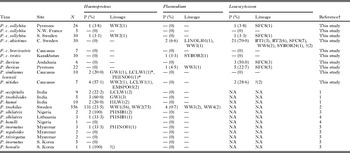
We used DNA samples previously collected for population genetic analyses from adult males of P. c. collybita and P. c. abietinus captured in May and June on territories in Sweden (Hansson et al. Reference Hansson, Bensch and Brännström2000) and P. c collybita and P. ibericus from adult males and females at breeding territories in France and the Iberian peninsula (Helbig et al. Reference Helbig, Salomon, Bensch and Seibold2001). Blood samples from breeding males and females of P.c. brevirostris, P. sindianus lorenzii and P. nitidus were collected in Georgia and Armenia (Caucasus region) in 2007 and from juvenile P. c. tristis during autumn migration in Kazakhstan in 2002. The blood samples were stored in SET-buffer or 70% ethanol until DNA was extracted using standard phenol-chloroform methods (Sambrook et al. Reference Sambrook, Fritsch and Maniatis1989). Extracted DNA was simultaneously screened for parasites of the genera Haemoproteus, Plasmodium and Leucocytozoon using a nested-PCR protocol, targeting a 479 bp fragment of the cytochrome b gene (Hellgren et al. Reference Hellgren, Waldenström and Bensch2004). We included repeated negative controls (water) in each experiment to check for contamination. Positive samples were sequenced as previously described (Bensch et al. Reference Bensch, Stjernman, Hasselquist, Östman, Hansson, Westerdahl and Torres-Pinheiro2000). Sequences were aligned in BioEdit (Hall, Reference Hall1999) and compared to the lineage in the MalAvi database (Bensch et al. Reference Bensch, Hellgren and Pérez-Tris2009). To compare prevalence and diversity of haemosporidians in chiffchaffs with other Phylloscopus species we used published data (Bensch et al. Reference Bensch, Stjernman, Hasselquist, Östman, Hansson, Westerdahl and Torres-Pinheiro2000; Bensch and Åkesson, Reference Bensch and Åkesson2003; Waldenström et al. Reference Waldenström, Bensch, Hasselquist and Östman2004; Hellgren et al. Reference Hellgren, Waldenström, Pérez-Tris, Szöllōsi, Hasselquist, Krizanauskiene, Ottosson and Bensch2007; Ishtiaq et al. Reference Ishtiaq, Gering, Rappole, Rahmani, Jhala, Dove, Melinsky, Olson, Peirce and Fleischer2007), see Table 1. The vast majority of these samples (>95%) are from breeding adult males captured with playback on territories.
Prevalence (P) and lineages of haemosporidian parasites in Phylloscopus warblers

* In mixed infection.
† 1, Bensch et al. (Reference Bensch, Stjernman, Hasselquist, Östman, Hansson, Westerdahl and Torres-Pinheiro2000); 2, Bensch and Åkesson (2003); 3, Waldenström et al. (Reference Waldenström, Bensch, Kiboi, Hasselquist and Ottosson2002); 4, Hellgren et al. (Reference Hellgren, Pérez-Tris and Bensch2009); 5, Ishtiaq et al. (Reference Ishtiaq, Gering, Rappole, Rahmani, Jhala, Dove, Melinsky, Olson, Peirce and Fleischer2007).
A phylogeny of the examined Phylloscopus warblers was constructed based on previous publications (Helbig et al. Reference Helbig, Martens, Seibold, Henning, Schottler and Wink1996; Richman, Reference Richman1996). We used both a narrow sense (collybita, abietinus, brevirostris and tristis) and broad sense (including also lorenzii and ibericus) delimitation of chiffchaffs when comparing the prevalence of haemosporidians in chiffchaffs with other species in the genus (Fig. 1).
Phylogeny of chiffchaffs and other Phylloscopus species for which there are data on Haemoproteus prevalence. The horizontal stippled line separate chiffchaffs (above) from the other species of Phylloscopus.

RESULTS
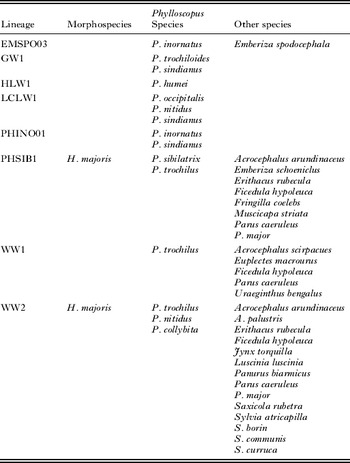
In total, 2 of the 128 chiffchaffs (narrow sense) were infected with Haemoproteus parasites (Table 1). The 2 positive samples were found in P. c. collybita (south Sweden and Pyrenees) and were both of the lineage WW2 (H. majoris), a widespread host generalist parasite of primarily warblers and tits (Table 2). In the taxa sometimes also included in the chiffchaff species complexes, we found 2 P. sindianus lorenzii infected with Haemoproteus (of which 1 carried a mixed infection). These were 3 different lineages that previously have been recorded in other species of Asian Phylloscopus. Hence, in 5 of the taxa within the chiffchaff species complex the prevalence was very low (0–3 6%), with only P. sindianus lorenzii (20%) reaching levels seen in other species of Phylloscopus. Using the taxa in Fig. 1 as the unit of analysis, chiffchaffs have significantly lower prevalence of Haemoproteus than other species of Phylloscopus (Mann-Whitney U-test; narrow sense chiffchaffs, U=2 5, P=0 015; broad sense chiffchaffs, U=1 5, P=0 005).
Host range of Haemoproteus cytochrome b lineages reported in Phylloscopus warblers according to the MalAvi database

The infection level of Plasmodium was low in chiffchaffs, similar to that previously recorded in other species of Phylloscopus. The 4 infected individuals carried 3 different lineages (Table 1). In contrast, Leucocytozoon infections were much more variable between the sampling sites with prevalence estimates reaching high levels in some populations; 70% in P. c. abietinus from central Sweden and 28% in P. ibericus from the Iberian Peninsula. In total we found 5 different lineages of Leucocytozoon of which 1 (SFC8) was common in both Sweden and in the Iberian Peninsula. At present we cannot evaluate whether the observed levels of Leucocytozoon in chiffchaffs differ from other species of Phylloscopus due insufficient reference data.
DISCUSSION
Strikingly, the prevalence of Haemoproteus parasites was consistently low in chiffchaffs, clearly different from other species in the genus. The low level of Haemoproteus in P. collybita compared to other Phylloscopus species cannot be explained by different methodologies as the present data were generated in the same laboratory using a standard method. Because the detection probability depends on the parasitaemia (the proportion of infected erythrocytes), one could argue that the lower prevalence in chiffchaffs is a result of a lower parasitaemia in these birds as compared to the birds within the other species of Phylloscopus. We argue that this is unlikely. First, all the chiffchaff samples except those from Kazakhstan were collected from adult birds during the breeding season when parasitaemia of Haemoproteus typically is peaking as a result of spring relapses of chronic infections or primary infections (Valkiūnas, Reference Valkiūnas2005). Second, the level of Haemoproteus parasitemias in wild-caught birds during the breeding season are typically between 0 01% and 1% (Valkiūnas, Reference Valkiūnas2005) and we have previously demonstrated that our nested PCR protocol robustly detects infections as low as 0 001% (Waldenström et al. Reference Waldenström, Bensch, Hasselquist and Östman2004; Pérez-Tris and Bensch, Reference Pérez-Tris and Bensch2005a).
The samples in the present study of chiffchaffs were collected in different years. Because prevalence might vary both temporally and spatially (e.g. Bensch and Åkesson, Reference Bensch and Åkesson2003) this would have been a major problem if the question had been to test for differences in prevalence between subspecies and localities. However, when inferring that the prevalence of Haemoproteus in chiffchaffs is lower than in other species of Phylloscopus, we argue that it is an advantage that the samples were not from the same year. Although each of the subspecies and locality sample sizes are on the low side for precise estimates of prevalence (N⩽30), repeatedly finding a prevalence <5% in the subspecies of chiffchaffs, compared to >20% in the samples from the other species of Phylloscopus strongly suggests that the chiffchaff differs from its congeners regarding infectiousness of Haemoproteus.
By ruling out that methodological biases are behind our finding of a low prevalence of Haemoproteus in chiffchaffs, it requires either ecological or evolutionary explanations. Earlier studies based on microscopic examinations of blood smears support the main finding of a low Haemoproteus prevalence in chiffchaffs. A compilation of data from European birds covering published studies between 1890 and 1978, reports a Haemoproteus prevalence in chiffchaffs of 3 2% (N=63). Likewise, a 4-year study of P. c. collybita (N=14) in Hertfordshire, England, did not find a single Haemoproteus infection (Peirce and Mead, Reference Peirce and Mead1984). As in other Phylloscopus warblers, chiffchaffs also showed a low prevalence of Plasmodium parasites whereas the local prevalence of Leucocytozoon was low to moderate, except in P. c. abietinus from Central Sweden (70%). The high prevalence of Leucocytozoon in P. c. abietinus probably reflects abundant populations of Leucocytozoon vectors (simulid flies) in this region (Malmqvist et al. Reference Malmqvist, Strasevicius, Hellgren, Adler and Bensch2004).
It is obvious that a low density of vectors would result in a low prevalence of Haemosporidians. The Haemoproteus parasites of passerine birds belong to the subgenus Parahaemoproteus and require biting midges (Ceratopogonidae) for transmission. However, it is unlikely that the overall low prevalence of Haemoproteus in P. collybita, as observed in the present study, is a result of low vector abundances. Some of the sampled populations are from areas where other co-existing Phylloscopus species are infected by Haemoproteus. For example, in Sweden, P. c. collybita and P. c. abietinus occur in the same habitat as the willow warbler which is frequently infected by 2 species of Haemoproteus (Bensch and Åkesson, Reference Bensch and Åkesson2003). More precisely, the Swedish chiffchaffs analysed in the present study were captured in the regions of Skåne and Ångermanland (Hansson et al. Reference Hansson, Bensch and Brännström2000) where the prevalence of Haemoproteus in willow warblers was found to be over 30% (Bensch and Åkesson, Reference Bensch and Åkesson2003). Likewise, the samples of P. c. brevirostris were taken at the same site in Georgia where P. nitidus carries Haemoproteus parasites at substantial frequencies. One could argue that the absence of Haemoproteus in P. c. tristis can be explained by the fact that these samples were collected during autumn migration when the parasite might have withdrawn from the blood stream. However, willow warblers on autumn migration in Finland have been found to be frequently infected (11%) by Haemoproteus (Rintamäki et al. Reference Rintamäki, Ojanen, Pakkala and Tynjala1998). We therefore conclude that the low frequency of Haemoproteus in chiffchaffs cannot be explained by simple ecological variables such as absence of vectors at the localities where these birds have been studied. A remaining possibility is, however, that chiffchaffs exhibit a yet unknown adaptation that make them less likely to be exploited by biting midges, the vectors of Haemoproteus parasites.
It is known that infection by one group of pathogens may exclude others; for example in humans malaria infections can lead to the clearance of syphilis (Richie, Reference Richie1988) and co-infections with helminths have been shown to give partial protection against malaria (Nacher, Reference Nacher2004). In some bird species, like the blue tit Cyanistes caeruleus, the relative frequency of infections by Haemoproteus and Plasmodium parasites has been shown to vary dramatically between different geographical locations (Wood et al. Reference Wood, Cosgrove, Wilkin, Knowles, Day and Sheldon2007; Stjernman et al. Reference Stjernman, Råberg and Nilsson2008). However, it is not known whether this is a result of exclusion of e.g. Haemoproteus in populations frequently infected by Plasmodium, or vice versa. In the chiffchaff we found a relatively high prevalence of Leucocytozoon infections in some populations, raising the possibility that Haemoproteus parasites might be outcompeted or blocked by Leucocytozoon infections. A limitation of our study is that we did not have access to blood smears as this would have allowed examination of the presence and potential interaction with other groups of blood parasites (e.g. Trypanosoma, Atoxoplasma, microfilariae) not covered by our PCR protocol (Valkiūnas et al. Reference Valkiūnas, Iezhova, Krizanauskiene, Palinauskas, Sehgal and Bensch2008).
With some striking exceptions, the vast majority of Haemoproteus lineages have a very narrow host distribution, sometimes excluding even the closest congeners (Reullier et al. Reference Reullier, Pérez-Tris, Bensch and Secondi2006; Pérez-Tris et al. Reference Pérez-Tris, Hellgren, Krizanauskiene, Waldenström, Secondi, Bonneaud, Fjeldså, Hasselquist and Bensch2007). Strict host specialists are living with the risk of going extinct if the transmission success is temporarily inhibited, e.g. if the host species passes through a population bottleneck. From a host perspective, parasites are likely to be lost when a small number of hosts are colonizing new continents or islands (MacLeod et al. Reference MacLeod, Paterson, Tompkins and Duncan2010). The wide geographical distribution of chiffchaffs and the many subspecies that are diagnosable in mtDNA (Helbig et al. Reference Helbig, Martens, Seibold, Henning, Schottler and Wink1996) suggest that the species has thrived in several populations during the last few million years. Hence, loss of species-specific parasites due to drift alone seems unlikely. Of the 8 Haemoproteus lineages encountered in Phylloscopus species, 3 (WW1, WW2 and PHSIB1) are broad host generalists. The other 5 lineages appear to be host specialists; however, this pattern may not hold since the vast majority of potential host species remains to be examined. Hence, in contrast to Phylloscopus species in general, the chiffchaff does not carry any host-specific Haemoproteus species and it is only rarely infected by one of the host generalists (WW2). Although parasites belonging to the genus Plasmodium often are considered to be less host specific compared to Haemoproteus, the finding of the Plasmodium lineage LINOLI01 from a chiffchaff in Central Sweden was surprising. This lineage has previously been reported from southern Africa, from several passerine species and a cape gannet Sula capensis (Beadell et al. Reference Beadell, Ishtiaq, Covas, Melo, Warren, Atkinson, Bensch, Graves, Jhala, Peirce, Rahmani, Fonseca and Fleischer2006). Sequences encountered as singletons should be cautiously interpreted, as contamination is always an issue when working with PCR and, in particular, nested PCR. However, the sequence of LINOLI01 has previously never been encountered in our laboratory and is therefore very unlikely to be a result of contamination. Since Swedish chiffchaffs winter north of the Sahara this parasite must have transmission also in northern Africa or the Mediterranean region.
Pathogens that are able to infect multiple host species are often differentially pathogenetic in these hosts (Palinauskas et al. Reference Palinauskas, Valkiūnas, Bolshakov and Bensch2008), presumably more benign to the species with which they have co-evolved and more pathogenic in recently acquired hosts (Tompkins et al. Reference Tompkins, White and Boots2003). Because closely related species are likely to share more pathogens than distantly related host species it was recently proposed that pathogens might be a primary driver in sister-species competition and in many cases preventing their co-existence (Ricklefs, Reference Ricklefs2010). In this respect, it is interesting to note that the distribution range of chiffchaffs in Sweden (Hansson et al. Reference Hansson, Bensch and Brännström2000) coincides with the two regions with the lowest abundances of the continuously distributed willow warblers (Svensson et al. Reference Svensson, Svensson and Tjernberg1999); P. c. collybita occurs in the very south and P. c. abietinus in a region in central Sweden. It is of course possible that other factors, abiotic or biotic, are behind the inverse correlation of abundances of the two species. To evaluate the role of haemosporidians as determinants of abundance and distribution of host species, it would be essential to carry out detailed epidemiological studies including the vectors and alternative hosts.
As it seems unlikely that the lack of Haemoproteus parasites is caused by environmental variables, it implies that the chiffchaff possesses an intrinsic resistance to Haemoproteus parasites. Alternatively, however, this pattern would also result if chiffchaffs would be so sensitive to Haemoproteus infections that they die shortly after being infected and hence rarely live long enough to become captured. These 2 hypotheses could be tested in controlled infection experiments with e.g. the lineage WW2 and using willow warblers as controls. Although logistically difficult to employ with Haemoproteus parasites as experiments require maintenance of infected vector populations (Culicoides sp.), such experiments have been carried out in other passerine species (Valkiūnas and Iezhova, Reference Valkiūnas and Iezhova2004). If chiffchaffs are experimentally confirmed to be resistant to Haemoproteus infections the reasons are likely to be found in genes governing the immune system. For example, it has been shown that house sparrows Passer domesticus show a much stronger adaptive immune response than tree sparrows P. montanus, and this was suggested to explain a lower prevalence of malaria parasites compared to tree sparrows as observed in the same study (Lee et al. Reference Lee, Martin II, Hasselquist, Ricklefs and Wikelski2006).
In conclusion, our results show that chiffchaffs from various parts of its Palaearctic range have exceptionally low prevalence levels of Haemoproteus infections compared to several other closely related species. Research on species that appear to have eliminated the pathogens otherwise common in related species will be the key to find the factors causing variation in parasite susceptibility. In regard to chiffchaffs and the almost absence of Haemoproteus parasites this research should particularly address the potential role of vector avoidance behaviour and physiological and immunogenetic adaptations. To address these questions we need to carry out infection experiments and identify the competent vectors for the Haemoproteus parasites commonly infecting other species of Phylloscopus.
ACKNOWLEDGEMENTS
We thank Martin Stervander for providing the samples of P. c. tristis, as well as Vasil Ananian, David Bigas, Giorgi Darchiashvili and Lars Svensson for the help during the fieldwork in the Caucasus. Olof Hellgren and two anonymous reviewers made useful comments on the manuscript.
FINANCIAL SUPPORT
The study was supported by the Swedish Research Council to S.B. (621-2007-5193).