Adverse fetal environments can have pervasive negative consequences for developmental sequelae across the life span. One of the most common and preventable of these environments, maternal smoking during pregnancy (MSDP), not only impedes healthy child development, but also has major public health implications. Children exposed to MSDP are more likely to require support resulting from the well-documented physical, socioemotional, behavioral, mental, and neurocognitive consequences of exposure (see Ross, Graham, Money, & Stanwood, Reference Ross, Graham, Money and Stanwood2015, for a review). As such, MSDP increases the socioeconomic burden on healthcare, criminal justice, and educational systems. Due to its relevance to key developmental outcomes, such as academic success (e.g., McClelland & Cameron, Reference McClelland and Cameron2011), and its repeated implication in most forms of psychopathology (see Snyder, Miyake, & Hankin, Reference Snyder, Miyake and Hankin2015, for a review), executive function (EF) has emerged as a fundamental neurocognitive outcome for studies of the effects of MSDP.
Defining EF
Children exposed to MSDP may exhibit decreases in later mental development and higher order capacities, such as EF, resulting from the early insult of MSDP to fundamental neurodevelopmental processes (Peterson et al., Reference Peterson, Anderson, Ehrenkranz, Staib, Tageldin, Colson and Ment2003). EF regulates and coordinates the internal and transactional processes that enable goal-directed thought, action, and emotion (Anderson, Reference Anderson2002; Zelazo, Müller, Frye, & Marcovitch, 2013), and facilitates a wide range of purposeful actions that allow us to fluidly approach novel behaviors and circumstances. EF is often theorized as multiple processes that function together as a supervisory system that is important for planning, reasoning, and the integration of thought and action (Shallice & Burgess, Reference Shallice and Burgess1996; Stuss & Alexander, Reference Stuss and Alexander2000).
EF has multiple layers of complexity (Jones, Bailey, Barnes, & Partee, Reference Jones, Bailey, Barnes and Partee2016), and many abilities have been suggested as either critical components or supportive, more basic skills (e.g., attention and regulating eye movements; Garon, Bryson, & Smith, Reference Garon, Bryson and Smith2008; Johnson, Reference Johnson1995) that serve as building blocks for EF (Anderson, Reference Anderson2002; Miyake & Friedman, Reference Miyake and Friedman2012; Snyder et al., Reference Snyder, Miyake and Hankin2015; Toplak, West, & Stanovich, Reference Toplak, West and Stanovich2013). However, the foundational and most commonly indexed domains of EF include (a) set-shifting, (b) inhibitory control, and (c) working memory (Best & Miller, Reference Best and Miller2010; Miyake et al., Reference Miyake, Friedman, Emerson, Witzki, Howerter and Wagner2000). Set-shifting involves flexibly switching among multiple tasks to meet changing environmental demands and is leveraged in the real world when, for example, successfully writing 2018 on January 1 instead of 2017. Inhibitory control involves the suppression or delay of a prepotent, salient response for one that is less dominant to achieve a goal and is recruited to, for example, remove your foot from the gas pedal and apply the brake when approaching a yellow light. Inhibitory control is often differentiated into hot (i.e., emotionally laden) and cool (i.e., emotionally neutral) aspects (Zelazo & Müller, Reference Zelazo, Müller and Goswami2002). Working memory is required to manipulate information held in short-term memory and is exerted when, for example, creating a mental to-do list and prioritizing multiple activities. Studies of the structure of the foundational components of EF find that they show both unity and diversity (i.e., are correlated but separable) and that individual differences at the latent-variable level are almost entirely genetic in origin (e.g., Friedman et al., Reference Friedman, Miyake, Young, DeFries, Corley and Hewitt2008).
Attention seems to play a critical role in the development of EF, as it allows children to control the internal and external information that they process (see Posner & Rothbart, Reference Posner, Rothbart and Kar2013, for a discussion of attention development in self-regulation, a broader construct that is subserved by EF; Hofmann, Schmeichel, & Baddeley, Reference Hofmann, Schmeichel and Baddeley2012). In fact, a core attention system has been proposed as a foundation upon which EF is built (Garon et al., Reference Garon, Bryson and Smith2008). Infants and young children become progressively more adept at regulating their emotions, thoughts, and behavior due to the increased connectivity of attentional control systems in the brain (Posner & Rothbart, Reference Posner, Rothbart and Kar2013). Development of the rudimentary ability to focus attention across infancy and preschool enables children to be resistant to distractors (e.g., Richards, Reference Richards1985). Although infants perform similarly to older children once in a state of focused attention, they are unable to sustain it for a long period of time (Garon et al., Reference Garon, Bryson and Smith2008); focused attention increases in duration from late infancy throughout the preschool period (e.g., Lansink, Mintz, & Richards, Reference Lansink, Mintz and Richards2000). Children also become increasingly skilled at selective attention (i.e., flexible and voluntary shifts of attention) across early childhood due to the development of two attentional subsystems: the orienting and anterior attention subsystems. The orienting subsystem develops during the first year of life and allows children to orient to stimuli in their environment and shift attention (Colombo, Reference Colombo2001). The anterior attention subsystem emerges in late infancy and shows dramatic increases from ages 2 to 6 years (Rothbart & Posner, Reference Rothbart, Posner, Nelson and Luciana2001). This subsystem selects and enhances the processing of stimuli and does so in part by operating on the orienting system (Ruff & Rothbart, Reference Ruff and Rothbart1996). Thus, the marked development of sustained attention across early childhood is thought to be due to the increased control of the anterior attention subsystem over the orienting subsystem (Ruff & Rothbart, Reference Ruff and Rothbart1996). Although substantial development in attentional systems occurs relatively early in life, development of prefrontal areas throughout adolescence and early adulthood subserves the maturation of attention (e.g., Kwon, Reiss, & Menon, Reference Kwon, Reiss and Menon2002) and in turn increasingly successful performance on complex EF tasks.
Development of EF
EF skills manifest in different ways across development (Best & Miller, Reference Best and Miller2010); foundational skills appear earlier in development, and complex skills emerge later as children mature and acquire more advanced knowledge and abilities (see Jones et al., Reference Jones, Bailey, Barnes and Partee2016, for a discussion of defining and measuring EE skills across development). For example, rudimentary developmental antecedents of EF emerge as simple behaviors, such as regulating eye movements and attending to and searching for hidden objects in early infancy (Diamond, Reference Diamond1990; Johnson, Reference Johnson1995; Wiebe, Fang, Johnson, James, & Espy, Reference Wiebe, Fang, Johnson, James and Espy2014). However, most research on EF focuses on sustained attention and the foundational components of EF during preschool and early school years (e.g., Garon et al., Reference Garon, Bryson and Smith2008), which reflects researchers’ attempts to understand the manifestations of EF during a period of rapid development in EF. However, as previously noted, EF development is protracted into adolescence or early adulthood, and behavioral performance on EF tasks continues to improve across the adolescent years.
The protracted development of EF poses a challenge for understanding the effects of MSDP on EF, as there are nonlinear and variable developmental trajectories for some of the components of EF over time (Anderson, Reference Anderson2002; Best & Miller, Reference Best and Miller2010). For example, the development of inhibitory control shows large improvements across the preschool years, and modest, linear improvements during adolescence, whereas for working memory, development is linear from preschool through adolescence. The developmental trajectory for set-shifting is more complex. Age-related improvements in set-shifting continue throughout adolescence, but the ability to successfully shift among tasks also occurs through the development of other processes, such as metacognition (Best & Miller, Reference Best and Miller2010). There are multiple detailed papers that outline theories and frameworks for understanding the development EF (we direct the reader to Best & Miller, Reference Best and Miller2010; Diamond, Reference Diamond, Bialystock and Craik2006; Garon et al., Reference Garon, Bryson and Smith2008; Munakata, Reference Munakata2001; Posner & Rothbart, Reference Posner and Rothbart2007; Zelazo et al., Reference Zelazo, Müller, Frye and Marcovitch2003). From these theories, we can extract a message that is particularly relevant to the current review: much of the story of the effects of MSDP on EF is lost by focusing on one developmental period. Thus, in order to provide a comprehensive picture of the effects of MSDP on EF, the present review considers the literature for each developmental period from infancy through adolescence.
State of the Literature
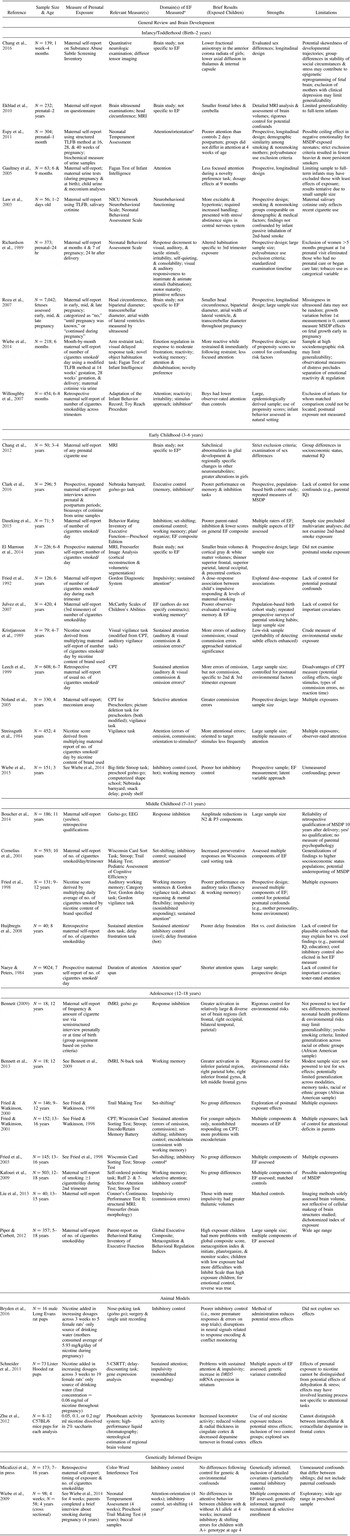
Existing reviews describe the effects of MSDP on child behavioral and neurocognitive outcomes (e.g., Clifford, Lang, & Chen, Reference Clifford, Lang and Chen2012; Ernst, Moolchan, & Robinson, Reference Ernst, Moolchan and Robinson2001; Hermann, King, & Weitzman, Reference Herrmann, King and Weitzman2008; Huizink & Mulder, Reference Huizink and Mulder2006; Knopik, Reference Knopik2009; Lassen & Oei, Reference Lassen and Oei1998; Olds, Reference Olds1997; Polańska, Jurewicz, & Hanke, Reference Polańska, Jurewicz and Hanke2015; Weitzman, Byrd, Aligne, & Moss, Reference Weitzman, Byrd, Aligne and Moss2002), but a nuanced review of the literature on the effects of MSDP on child EF across development is lacking. EF does not entirely overlap with other neurocognitive constructs (e.g., Arffa, Reference Arffa2007). Therefore, scientific evidence associated with other neurocognitive constructs may not generalize to EF, and findings of an effect of MSDP on a single EF component, skill, or measure may not extend to other measures of EF (Jones et al., Reference Jones, Bailey, Barnes and Partee2016; Toplak et al., Reference Toplak, West and Stanovich2013). Similarly, reviews that include limited studies of EF at isolated points in development may not generalize to different developmental periods. As such, the objectives of the current review are threefold. First, we aim to provide a comprehensive review of the literature on the relationship between MSDP and offspring EF from infancy to adolescence (see Table 1). For reviews specific to EF or its development, we direct the reader to excellent review by Best and Miller (Reference Best and Miller2010). In the current review, we present the available knowledge on the association between MSDP and EF by developmental period. To accomplish this, we focus on the links between MSDP and the most commonly assessed components of EF (i.e., inhibitory control, set-shifting, and working memory). However, we also present literature on the relationship between MSDP and key components or essential skills to EF (e.g., attention), which are thought to be important targets for intervention programs (Jones et al., Reference Jones, Bailey, Barnes and Partee2016). We also consider the links between MSDP and impulsivity, as EF and impulsivity may be antipodes (i.e., impulsivity as executive dysfunction; Bickel, Jarmolowicz, Mueller, Gatchalian, & McClure, Reference Bickel, Jarmolowicz, Mueller, Gatchalian and McClure2012). Second, we consider brain-based assessments, animal models, and genetically informed studies in an effort to elucidate plausible pathways of effects. Third, we discuss implications for prevention, intervention, and for future directions.
Studies of maternal smoking during pregnancy and child executive function

Note: For the purpose of this review, we only focus on the EF constructs reviewed in the text to be concise. CPT, continuous performance task; EF, executive function; fMRI, functional magnetic resonance imaging; MSDP, maternal smoking during pregnancy; TLFB, timeline follow-back.
aStudies also include additional measures to assess other constructs.
It is important to present these studies that follow with the note that in the field of MSDP–EF associations, the majority of the prior work that we outline below is primarily from the phenotypic point of view. These prior studies say very little, if anything, about how genetic factors may influence the reported associations between MSDP and offspring EF (discussed in detail below). The few studies that have considered genetic effects are reviewed toward the end of this section.
Offspring brain development relevant to MSDP and EF
MSDP has been suggested to modify genetically programmed fetal brain development (for a review, see Ekblad, Korkeila, & Lehtonen, Reference Ekblad, Korkeila and Lehtonen2015) that can impact later EF. Nicotine-induced alterations exert changes to cellular communication, neuronal pathfinding, mitosis, and synaptogenesis, among other key molecular and functional targets (for a review, see Slotkin, Reference Slotkin2004; Wessler, Kirkpatrick, & Racké, Reference Wessler, Kirkpatrick and Racké1998). Such alterations are hypothesized to be the primary mediators underlying the links between MSDP and neurobehavioral problems in offspring (e.g., Bublitz & Stroud, Reference Bublitz and Stroud2012). Further, behavioral gains in EF are consistent with development of the frontal lobe and myelination of prefrontal connections, processes that are protracted into adolescence (Anderson, Reference Anderson2002). As such, behavioral manifestations of brain alterations that result from exposure to MSDP may not emerge until the compromised area is recruited to support these behaviors later in development as trajectories of exposed and nonexposed children diverge (Goldman, Reference Goldman, Stein, Rosen and Butters1974; Wiebe et al., Reference Wiebe, Clark, De Jong, Chevalier, Espy and Wakschlag2015). That is, later developing EF skills may fail to develop normally due to early perturbation (Maurer, Monloch, & Lewis, Reference Maurer, Mondloch and Lewis2007). Thus, at question is whether the impact of prenatal exposure to MSDP endures to compromise later prefrontal area development and in turn EF. This is an open empirical question, but it underscores the need for developmental designs to identify the potentially delayed emergence of such problems. We also review the literature on the links between MSDP and child brain development relevant to EF by developmental period as a preliminary step in evaluating the state of knowledge and identifying areas requiring future research attention.
MSDP and EF across development
Fetal period and birth
Notable neurobehavioral and physical precursors of later complex neurocognitive functioning are apparent in exposed offspring prior to and shortly after birth. MSDP is related to reduced fetal movement and variation in heart rate, disruptions in fetal habituation, and less reactivity during nonstress tests (Coppens, Vindla, James, & Sahota, Reference Coppens, Vindla, James and Sahota2001; Gingras & O'Donnell, Reference Gingras and O'Donnell1998; Leader & Bennett, Reference Leader, Bennett, Levev, Lilford, Bennett and Punt1995; Oncken, Kranzler, O'Malley, Gendreau, & Campbell, Reference Oncken, Kranzler, O'Malley, Gendreau and Campbell2002; Zeskind & Gingras, Reference Zeskind and Gingras2006). Atypical arousal patterns are characteristic of later neurocognitive abnormalities in children (e.g., Powell & Voeller, Reference Powell and Voeller2004) and may serve as early risk markers for subsequent adverse developmental outcomes (Zeskind & Gingras, Reference Zeskind and Gingras2006). Physical risk markers are also present. There is a dose–response relationship between MSDP and birth weight, with roughly a 5% reduction in relative birth weight per pack of cigarettes smoked per day (Kramer et al., Reference Kramer, Olivier, McLean, Dougherty, Willis and Usher1990). Even when genetic effects are controlled for, the association between MSDP and low birth weight remains significant, suggesting a possible causal link between MSDP and birth weight (e.g., Knopik, Marceau, Palmer, Smith, & Heath, Reference Knopik, Marceau, Bidwell, Palmer, Smith, Todorov and Heath2016; Kuja-Halkola, D'Onofrio, Iliadou, Langstrom, & Lichtenstein, Reference Kuja-Halkola, D'Onofrio, Iliadou, Langstrom and Lichtenstein2010). Of note, low birth weight is one of the strongest predictors of future problems. For example, low birth weight is associated with poorer academic achievement, worse job performance, disruptive behaviors, and cognitive problems (for a review, see Chatterji, Lahiri, & Kim, Reference Chatterji, Lahiri and Kim2014).
Infancy/toddlerhood (birth–2 years)
There is evidence for atypical neurobehavior and poorer attention in infants who were exposed to MSDP. Exposed neonates were more excitable and hypertonic, required increased handling, presented with stress/abstinence signs in the central nervous system (Law et al., Reference Law, Stroud, LaGasse, Niaura, Liu and Lester2003), and showed altered habituation specific to third trimester MSDP exposure (Richardson, Day, & Taylor, Reference Richardson, Day and Taylor1989) 1 to 2 days after birth. Infants exhibited less orientation to and attentive tracking of auditory and visual stimuli than controls 2 days postpartum, but the groups did not differ in their attention at 4 weeks of age (Espy et al., Reference Espy, Fang, Johnson, Stopp, Wiebe and Respass2011). These children exhibited a developmental “catch-up” to their peers, with an average growth rate more rapid than nonexposed neonates. The adverse effects of MSDP on attention persist later in infancy, as 6- to 8-month-old exposed boys had lower observer-rated attention than controls during a home visit (Willoughby, Greenberg, Blair, & Stifter, Reference Willoughby, Greenberg, Blair and Stifter2007). Similarly, 6- and 9-month-olds exposed to MSDP exhibited less focused attention than their nonexposed peers during a novelty preference task (Gaultney, Gingras, Martin, & DeBrule, Reference Gaultney, Gingras, Martin and DeBrule2005; Wiebe et al., Reference Wiebe, Fang, Johnson, James and Espy2014).
To our knowledge, no studies have examined the structural and functional neural moderators of the effects of MSDP on the developmental antecedents of EF in infants exposed to MSDP. However, assessments of early brain development that are not specific to EF do highlight differences between exposed and nonexposed infants. Although these studies are not specific to EF, they are included here to provide a comprehensive picture of links between MSDP and early brain development and to inform future research in this area. Fetuses exposed to MSDP had smaller head circumferences than unexposed fetuses, suggesting a global reduction in brain volumes (Roza et al., Reference Roza, Verburg, Jaddoe, Hofman, Mackenbach, Steegers and Tiemeier2007). However, preterm infants exposed to MSDP had significantly smaller frontal lobes and cerebella (involved in motor control, language, and attention; Bublitz & Stroud, Reference Bublitz and Stroud2012), despite having typical head growth during the first 2 years of life (Ekblad et al., Reference Ekblad, Korkeila, Parkkola, Lapinleimu, Haataja and Lehtonen2010). This evidence suggests that these brain areas may be vulnerable to the effects of MSDP and that regional volumetric changes can occur even in the absence of decreased head circumferences (Ekblad et al., Reference Ekblad, Korkeila, Parkkola, Lapinleimu, Haataja and Lehtonen2010). This is an important consideration for identifying at-risk children, as it may not always be the case that head circumference is a marker of insult to brain development (Ekblad et al., Reference Ekblad, Korkeila, Parkkola, Lapinleimu, Haataja and Lehtonen2010).
Differences in white matter development in infants exposed to MSDP have also been found. Diffusion tensor imaging of infants exposed to MSDP revealed lower fractional anisotropy in the female anterior corona radiata suggesting less coherent axons in the tract, potentially resulting from greater dendritic branching and spine densities, delayed myelination, and malformed axons (Chang et al., Reference Chang, Oishi, Skranes, Buchthal, Cunningham, Yamakawa and Ernst2016). This finding, coupled with prior evidence for subclinical abnormalities in glial development and regionally specific changes in other neurometabolites related to MSDP in preschoolers (Chang et al., Reference Chang, Cloak, Jiang, Hoo, Hernandez and Ernst2012) and reduced expression of myelin genes in periadolescent female rats with prenatal exposure (Cao et al., Reference Cao, Wang, Dwyer, Gautier, Wang, Leslie and Li2013), suggests that prenatal exposure to MSDP may result in epigenetic effects, such as reduced myelin gene expression and delayed white matter development in the anterior corona radiata (Chang et al., Reference Chang, Oishi, Skranes, Buchthal, Cunningham, Yamakawa and Ernst2016). Further, there was lower axial diffusivity in the thalamus and posterior limb internal capsule of MSDP-exposed infants, potentially resulting from reduced myelination between compacted axons or greater dendritic branching and spine densities, as well as epigenetic alterations (e.g., upregulation of histone methylation complexes; Jung et al., Reference Jung, Hsieh, Lee, Zhou, Coman, Heath and Bordey2016; Mychasiuk, Muhammad, Gibb, & Kolb, Reference Mychasiuk, Muhammad, Gibb and Kolb2013). Taken together, these findings suggest that MSDP may alter white matter maturation in sex- and regionally specific manners (Chang et al., Reference Chang, Oishi, Skranes, Buchthal, Cunningham, Yamakawa and Ernst2016) and result in epigenetic effects (Knopik, Maccani, Francazio, & McGeary, Reference Knopik, Maccani, Francazio and McGeary2012).
There is a clear gap in studies of EF in children exposed to MSDP from 10 to 36 months of age. More advanced EF skills, such as holding representations in mind, inhibiting responses based on a rule held in mind, and suppressing motivated motor responses, build on the rudimentary EF skills across the first 3 years of life (Garon et al., Reference Garon, Bryson and Smith2008). Thus, this is a critical period in EF development. During periods of rapid developmental change, problematic behavioral manifestations resulting from early insult to EF processes may become increasingly apparent. Consequently, research attention is required to characterize MSDP-related EF problems during this period.
Taken together, the literature suggests that difficulties in the early developmental antecedents of EF (i.e., neurobehavior and attention) are potentially adversely affected by MSDP and that these issues persist across infancy. Of critical importance is the consideration that the negative impact of MSDP on EF in infancy may extend beyond the direct adverse effects of exposure. That is, children exposed to MSDP may elicit nonoptimal reactions from individuals in their environment through their own negative behaviors that further exacerbate the risk. For example, a child who is less attentive in infancy may elicit negative reactions from caregivers, creating a negative feedback loop that further impairs the child's development (Wiebe et al., Reference Wiebe, Fang, Johnson, James and Espy2014). It should be noted, however, that parent and child behavior is reciprocal, with each member of the dyad shaping the interaction (e.g., Micalizzi, Wang, & Saudino, Reference Micalizzi, Wang and Saudino2015). Therefore, it is essential to consider the contributions of both dyadic partners to shaping the bidirectional interactions that may promote or hinder child development.
Early childhood (3–6 years)
As previously noted, substantial development in attention occurs across early childhood. Consequently, it is important to assess the effects of MSDP on attention during this period. The continuous performance task (CPT) is a widely used measure of sustained attention that requires participants to stay vigilant to the serial presentation of a stimulus (or stimuli) over time and respond (e.g., press a button) when a particular stimulus is present and withhold the response when nontarget stimuli appear (Fried, Watkinson, & Gray, Reference Fried, Watkinson and Gray1992). Commission errors on the CPT (i.e., false alarms) are thought to reflect impulsive (i.e., noninhibited) responding and poorer attention resulting from increased overall activity, whereas omission errors (i.e., misses) are thought to reflect inattentiveness (Fried et al., Reference Fried, Watkinson and Gray1992). Four-year-olds exposed to MSDP made more attentional errors (i.e., errors of omission, commission, and the ratio of correct responses to total responses) in a visual vigilance paradigm, were oriented to the target stimulus less frequently compared to nonexposed children (Streissguth et al., Reference Streissguth, Martin, Barr, Sandman, Kirchner and Darby1984), and made more commission errors on the CPT and a visual search task (Noland et al., Reference Noland, Singer, Short, Minnes, Arendt, Kirchner and Bearer2005). Four- to 7-year-old children exposed to MSDP made more errors of auditory commission, whereas visual commission errors approached statistical significance (Kristjansson, Fried, & Watkinson, Reference Kristjansson, Fried and Watkinson1989). Similarly, 6-year-old exposed children demonstrated more errors of impulsivity during a vigilance task (Fried et al., Reference Fried, Watkinson and Gray1992) and made more errors of omission, but not commission, specific to second- and third-trimester exposure (Leech, Richardson, Goldschmidt, & Day, Reference Leech, Richardson, Goldschmidt and Day1999).
Three-year-olds who were exposed to MSDP had lower levels of hot EF, assessed with tasks requiring children to wait for appealing snacks and toys (i.e., those that are highly motivating). MSDP was not associated with cool EF in the same sample (Wiebe et al., Reference Wiebe, Clark, De Jong, Chevalier, Espy and Wakschlag2015). Exposed 4-year-olds had poorer tester-evaluated working memory and other components of EF, although the authors do not identify which (Julvez et al., Reference Julvez, Ribas-Fitó, Torrent, Forns, Garcia-Esteban and Sunyer2007). Similarly, 5-year-olds had poorer parent-rated inhibition and lower scores on a general EF composite comprising inhibition, shifting, emotional control, working memory, and planning/organizing (Daseking, Petermann, Tischler, & Waldmann, Reference Daseking, Petermann, Tischler and Waldmann2015) and had poorer memory and inhibition (Clark, Espy, & Wakschlag, Reference Clark, Espy and Wakschlag2016).
To our knowledge, only one study has assessed the brain morphology of children exposed to MSDP during early childhood. Exposed children ages 6 to 8 years had smaller brain volumes and cortical gray and white matter volumes, as well as thinner superior frontal, superior parietal, lateral occipital, and precentral cortices relative to controls (El Marroun et al., Reference El Marroun, Schmidt, Franken, Jaddoe, Hofman, van der Lugt and White2014). Although these differences were not examined in the context of EF, they do provide evidence that the early volumetric changes related to MSDP observed in infancy (Ekblad et al., Reference Ekblad, Korkeila, Parkkola, Lapinleimu, Haataja and Lehtonen2010) are not compensated by early childhood neuroplasticity (Huttenlocher, Reference Huttenlocher2002).
Taken together, these findings suggest that MSDP may also negatively impact EF in early childhood. Given the rapid development of sustained attention across these early years, poorer attention may reflect a problem with the anterior attention subsystem exerting control over the orienting system, but this is an open empirical question that requires future research attention to elucidate this as a possible pathway of the effect of MSDP on EF. The current literature on the early childhood EF outcomes of children exposed to MSDP is primarily limited to sustained attention. The recent advent of developmentally appropriate measures of EF (e.g., NIH Toolbox Early Childhood Cognitive Battery; Zelazo et al., Reference Zelazo, Anderson, Richler, Wallner-Allen, Beaumont and Weintraub2013) permits the assessment of all facets of EF during early childhood. Therefore, this is a call-to-action for future studies of the effects of MSDP on EF during this period to include measures of all foundational components of EF (i.e., set-shifting, inhibitory control, and working memory) to illustrate how widespread the adverse effects of MSDP are, as exposure may impact some, but not all, components or measures of EF (Toplak et al., Reference Toplak, West and Stanovich2013).
Middle childhood (7–11 years)
Although substantial growth in EF occurs in early childhood, typically developing children become increasingly adept at leveraging EF skills across middle childhood. Children exposed to MSDP, however, exhibit clear difficulties relative to controls. Eight-year-old children exposed to MSDP had problems with hot but not cool inhibitory control (Huijbregts, Warren, de Sonneville, & Swaab-Barneveld, Reference Huijbregts, Warren, de Sonneville and Swaab-Barneveld2008). This is perhaps not surprising, as children exposed to MSDP are more likely to be diagnosed with attention-deficit/hyperactivity disorder (ADHD; see Langley, Rice, Van den Bree, & Thapar, Reference Langley, Rice, Van den Bree and Thapar2005, for a review) and hot inhibitory control problems are commonly observed in this population (e.g., Yang et al., Reference Yang, Chan, Gracia, Cao, Zou, Jing and Shum2011). Ten-year-olds demonstrated increased perseverative responses in a set-shifting card-sort task, signifying less flexible problem solving (i.e., “cognitive rigidity” in persisting with an incorrect response and failure to attend to and learn from feedback; Cornelius, Ryan, Day, Goldschmidt, & Willford, Reference Cornelius, Ryan, Day, Goldschmidt and Willford2001). Errors of commission were related to third-trimester tobacco exposure, but the association was attenuated when current maternal smoking was taken into account, highlighting the adverse effects of current secondhand exposure. Consistent with Huijbregts et al. (Reference Huijbregts, Warren, de Sonneville and Swaab-Barneveld2008), cool EF was not related to MSDP, providing additional support for the notion that emotionally neutral EF may not be adversely affected by MSDP in middle childhood. In addition, sustained attention was not related to MSDP. The lack of an association may indicate a developmental shift away from the sustained attention deficits observed in early childhood, but is more plausibly a result of methodological considerations, as another assessment revealed that MSDP-exposed 7-year-olds had lower attention spans than their nonexposed peers (Naeye & Peters, Reference Naeye and Peters1984). Further, 9- to 12-year-old children exposed to MSDP performed more poorly than their nonexposed peers on auditory working memory (Fried, Watkinson, & Gray, Reference Fried, Watkinson and Gray1998).
To our knowledge, the only study to assess functional brain activation specific to EF during middle childhood in children exposed to MSDP used an event-related potential design to examine the neurophysiological correlates of inhibitory control impairments in 11-year-old children (Boucher et al., Reference Boucher, Jacobson, Burden, Dewailly, Jacobson and Muckle2014). Relative to nonexposed children, exposed children exhibited amplitude reductions in the N2 and P3 components. The no-go N2 component is thought to reflect conflict processes in the anterior cingulate cortex (e.g., Jonkman, Sniedt, & Kemner, Reference Jonkman, Sniedt and Kemner2007), and the no-go P3 component is an index of information processing that occurs when attentional resources are appropriately allocated to inhibit a response and involves regions of the prefrontal cortex (e.g., Smith, Jamadar, Provost, & Michie, Reference Smith, Jamadar, Provost and Michie2013). These findings suggest that children exposed to MSDP have impairments in conflict processing and the attentional allocation required to inhibit prepotent responses (Boucher et al., Reference Boucher, Jacobson, Burden, Dewailly, Jacobson and Muckle2014). Conflict is particularly relevant to EF. For example, inhibitory control requires overcoming conflict between a dominant and subdominant response. Similarly, set-shifting involves shifting to a new mental set that conflicts in some way with an existing mental set. As such, problems with conflict processing may be a pathway of the effect of MSDP on child EF.
Taken together, these results indicate that children exposed to MSDP exhibit hot inhibitory control, set-shifting, sustained attention, and conflict processing problems in middle childhood. Working memory was compromised in the only study that assessed it. It is important to note, however, that findings on auditory working memory may not extend to nonauditory working memory (e.g., visual working memory; Gevins & Cutillo, Reference Gevins and Cutillo1993). Children exposed to MSDP process auditory information differently than their nonexposed peers (e.g., Jacobsen et al., Reference Jacobsen, Picciotto, Heath, Frost, Tsou, Dwan and Mencl2007). Therefore, observed MSDP effects on auditory working memory may reflect more basic auditory processing differences than a true EF problem, but that is an open empirical question.
These findings have important implications for MSDP-exposed children in formal schooling, where good EF promotes skills that are critically important to achievement. Teachers report that the most important determinants of school success are those abilities that are governed by EF: sitting still, paying attention, and following rules (McClelland et al., Reference McClelland, Cameron, Connor, Farris, Jewkes and Morrison2007). As such, children who have poorer EF as a result of exposure to MSDP may struggle in the classroom due to challenges with both behavioral regulation and academic content.
Adolescence (12–18 years)
Behavioral gains in EF persist throughout adolescence in typically developing children, mirroring the development of frontal areas of the brain (e.g., Anderson, Reference Anderson2002). Children (5 to 18 years old) who were exposed to 10+ cigarettes per day had more problems with parent ratings of EF (including a global composite score, metacognition index, and initiate, plan/organize, and monitor scales) than nonexposed children (Piper & Corbett, Reference Piper and Corbett2012). For the behavioral regulation index, children with low nicotine exposure (i.e., 1–9 cigarettes per day) had significantly more difficulties on the inhibit scale than high exposure (i.e., 10+ cigarettes per day) children, whereas for emotional control, the reverse was true. In 13- to 16-year-olds, children exposed to MSDP had more problems with encoding/retaining (i.e., a construct that is consistent with working memory). For younger children only, noninhibited responding on the CPT was also related to MSDP (Fried & Watkinson, Reference Fried and Watkinson2001). These findings suggest that there may be a developmental delay in inhibition for children who were exposed to MSDP, but that eventually, they “catch up” to their nonexposed peers, mirroring the developmental pattern of attention in early infancy (Espy et al., Reference Espy, Fang, Johnson, Stopp, Wiebe and Respass2011).
However, not all studies find links between MSDP and EF. No group differences were observed in 9- to 12-year-olds during a set-shifting task once postnatal tobacco exposure was accounted for (Fried & Watkinson, Reference Fried and Watkinson2000) or for set-shifting and inhibitory control in 13- to 16-year-olds (Fried, Watkinson, & Gray, Reference Fried, Watkinson and Gray2003). Further, working memory, selective attention, inhibitory control, and set-shifting were not impaired in 12- to 18-year olds exposed to MSDP. The authors acknowledge that other key group differences between exposed and nonexposed children, such as cortical thickness and corpus callosum volume should preclude the interpretation that MSDP does not have adverse consequences for cognitive abilities (Kafouri et al., Reference Kafouri, Leonard, Perron, Richer, Séguin, Veillette and Paus2009). Nonetheless, these null findings highlight potentially confounding influences (e.g., postnatal secondhand smoke exposure) on the relation between MSDP and child outcomes and underscore the importance of accounting for these in design considerations.
Brain imaging of adolescents reveals structural and functional differences between the brains of children exposed to MSDP relative to their nonexposed peers (for a review, see Bublitz & Stroud, Reference Bublitz and Stroud2012). Differences relevant to EF have also been found. Adolescents who were exposed to MSDP and were more impulsive had greater thalamic volumes than their nonexposed counterparts (Liu et al., Reference Liu, Lester, Neyzi, Sheinkopf, Gracia, Kekatpure and Kosofsky2013). The thalamus is interconnected with the prefrontal cortex and basal ganglia and is responsible for integrating incoming sensory information, guiding attentional control, and coordinating behavioral responses (Newman, Reference Newman1995). Consequently, the association between impulsivity and thalamic volume in this population is suggestive of a liability for top-down control problems (Liu et al., Reference Liu, Lester, Neyzi, Sheinkopf, Gracia, Kekatpure and Kosofsky2013).
Functional differences between exposed and nonexposed adolescents have also been observed. Twelve-year-olds who were exposed to MSDP showed greater and more diffuse activation across diverse regions (e.g., left frontal, right occipital, bilateral temporal, and parietal regions) in a go/no-go response inhibition task. Conversely, nonexposed children activated the cerebellum, a pattern that is indicative of better attention and motor preparation (Bennett et al., Reference Bennett, Mohamed, Carmody, Bendersky, Patel, Khorrami and Lewis2009). During a working memory task, adolescents who were exposed to MSDP showed greater activation in the inferior parietal region, right parietal lobe, right inferior frontal gyrus, and the left middle frontal gyrus, relative to unexposed children, who exhibited greater activation in inferior, middle, superior frontal regions, right and left inferior frontal gyrus, and the right middle frontal gyrus (Bennett et al., Reference Bennett, Mohamed, Carmody, Malik, Faro and Lewis2013). The activation differences occurred during correct working memory responses, suggesting that diverse brain regions are recruited across the groups when correctly leveraging working memory. The pattern of activation in nonexposed children is consistent with the appropriate developmental shift to increased and more efficient activation of frontal regions and better behavioral performance on working memory tasks. It is possible that, with time, the exposed children would also show more mature, focal brain activation, but that the process is simply delayed. This would be consistent with the behavioral findings of a pattern of developmental delay in attention in exposed children (Espy et al., Reference Espy, Fang, Johnson, Stopp, Wiebe and Respass2011), but, again, this is an open question.
These studies provide preliminary evidence for structural and functional brain alterations in children exposed to MSDP relative to nonexposed controls, but more work is needed in this area. The components of EF can be dissociated neuroanatomically (Brocki, Fan, & Fossella, Reference Brocki, Fan and Fossella2008). Thus, it is important for future studies to examine structural and functional differences between exposed and nonexposed children across all foundational EF components and periods of development to elucidate precise pathways that may serve as risk biomarkers and targets for intervention and prevention efforts.
Animal models
Rats with intrauterine prenatal nicotine exposure (PNE) exhibit postnatal neurocognitive and behavioral disturbances (e.g., Schneider et al., Reference Schneider, Ilott, Brolese, Bizarro, Asherson and Stolerman2011). Consequently, rodent models are effective for investigating the pathways of MSDP exposure on EF. Rats with PNE displayed poorer inhibitory control (i.e., more premature responses and errors on stop trials) compared to controls in a rodent variant of the go/no-go task (Bryden et al., Reference Bryden, Burton, Barnett, Cohen, Hearn, Jones and Roesch2016). Further, exposed rats showed disruptions in neural signals that are related to response encoding and conflict monitoring, key components of inhibitory control, and overall firing in the medial prefrontal cortex (mPFC). There are similarities between the rodent mPFC and the human dorsolateral PFC (DLPFC; Kesner, Reference Kesner2000), potentially implicating this region in humans. Exposed rats exhibited increased locomotor activity, had reduced volume and radial thickness in the cingulate cortex, and had decreased dopamine turnover (i.e., a condition that may reflect decreased synaptic dopamine) in the frontal cortex relative to controls (Zhu et al., Reference Zhu, Zhang, Xu, Spencer, Biederman and Bhide2012). The cingulate cortex also plays a key role in attentional mechanisms in humans (e.g., alterations in the cingulate cortex are related to ADHD; Makris et al., Reference Makris, Seidman, Valera, Biederman, Monuteaux, Kennedy and Faraone2010). If these regions are truly homologous across species, cingulate cortex volume may serve as a biomarker of attentional problems in humans exposed to MSDP.
PNE rats also presented for a delayed ability to learn a task with a high attentional load and had decreased accuracy, increased anticipatory responding, smaller number of earned rewards, and response time variability in the task, suggesting problems with sustained attention and impulsivity (Schneider et al., Reference Schneider, Ilott, Brolese, Bizarro, Asherson and Stolerman2011). Further, there was a small increase in the dopamine receptor D5 (i.e., DRD5) mRNA expression in the striatum of exposed rats (Schneider et al., Reference Schneider, Ilott, Brolese, Bizarro, Asherson and Stolerman2011), a finding that is consistent with molecular genetic studies that implicate dopamine system genes in EF in humans (e.g., Wiebe et al., Reference Wiebe, Espy, Stopp, Respass, Stewart, Jameson and Huggenvik2009).
There is no question that animal work is vital to the study of human problems (for a transdisciplinary synthesis, see England et al., Reference England, Aagaard, Bloch, Conway, Cosgrove, Grana and Lanphear2017). As demonstrated in this review, these animal studies provide valuable information about the effects of MSDP on EF. First, the observed mPFC hypoactivation related to PNE may generate a potential pathway through the DLPFC in humans for behavioral deficits in EF. Second, the cingulate cortex supports attentional mechanisms, indicating a potential biomarker for the attentional problems observed in offspring exposed to MSDP. Third, animal models provide further support for dopaminergic system involvement in the effects of MSDP on offspring outcomes.
There are clear strengths of animal models in terms of, for example, the ability to design studies that incorporate a controlled dose of a specific drug (e.g., nicotine). However, as noted above, the human condition is considerably more complex. In humans, MSDP results in fetal exposure not only to nicotine but also to a large number of other toxic components, such as carbon monoxide, ammonia, nitrogen oxide, lead, and other metals (Huizink & Mulder, Reference Huizink and Mulder2006). Thus, one should not limit the effects of MSDP in humans to nicotine alone. In addition, the human brain is very different from the rodent brain. The effects of MSDP in humans often show up as higher level cognitive function, which are controlled by the prefrontal cortex (Knopik, Reference Knopik2009). Functional and structural differences in the region of rat brain traditionally considered homologous to the DLPFC in primates suggest that the rat may not have an equivalent region (Preuss, Reference Preuss1995). Therefore, while we can use the evidence of negative effects of prenatal nicotine exposure that we garner from animal work as a guide to narrow our focus on potential effects in humans, we cannot directly extrapolate from animal findings to the complex human condition (Knopik, Reference Knopik2009).
Genetically informed designs
It may be tempting at this point to assume causal effects of MSDP on EF. However, MSDP does not occur independent of other familial risk factors (Ellingson, Goodnight, Van Hulle, Waldman, & D'Onofrio, Reference Ellingson, Goodnight, Van Hulle, Waldman and D'Onofrio2014). In addition to environmental risk, mothers who smoke during pregnancy are also more likely to confer genetic risk for poorer functioning to their offspring. For example, if children of mothers who smoke present for EF deficits, such problems may be caused by MSDP in a direct way, but this association is muddied by the fact that mothers who have EF deficits themselves may more commonly smoke during pregnancy. Thus, poor and inconsistent control for covariates, notably heritability, preclude concluding causal effects of MSDP on child outcomes (Knopik, Reference Knopik2009). Studies that account for specific, measured confounds (e.g., socioeconomic status and educational attainment) typically find the relations between MSDP and psychological outcomes attenuated, but still significant. Studies that account for general, unmeasured familial confounds (i.e., genetic and environmental), however, tell a more complex story with potentially causal MSDP effects for some birth (e.g., Knopik, Marceau, Palmer, et al., Reference Knopik, Marceau, Palmer, Smith and Heath2016; Kuja-Halkola, D'Onofrio, Larsson, & Lichtenstein, Reference Kuja-Halkola, D'Onofrio, Larsson and Lichtenstein2014) and behavioral outcomes (Gaysina et al., Reference Gaysina, Fergusson, Leve, Horwood, Reiss, Shaw and Harold2013, Knopik, Marceau, Bidwell, et al., Reference Knopik, Marceau, Bidwell, Palmer, Smith, Todorov and Heath2016), and results suggest complete familial confounding for other behavioral and cognitive outcomes (e.g., Ellingson et al., Reference Ellingson, Goodnight, Van Hulle, Waldman and D'Onofrio2014). The reasons for this inconsistent pattern of results are unknown but may be due, in part, to differences in sampling, outcome assessment (e.g., medical registry data vs. lab-based assessments), and MSDP measurement.
As such, genetically informed designs are required to disentangle genetic liability for poor developmental outcomes from true MSDP liability. To our knowledge, the only genetically informed study to assess the links between MSDP and EF found that the accounting for familial confounds fully attenuated the association between MSDP and child and adolescent cool inhibitory control (Micalizzi et al., Reference Micalizzi, Marceau, Brick, Palmer, Todorov, Heath and Knopikin press). Although not specific to EF, a similar pattern emerged in two studies of the genetic and environmental influences on the cognitive abilities of MSDP-exposed children. A longitudinal sibling-comparison study (Ellingson et al., Reference Ellingson, Goodnight, Van Hulle, Waldman and D'Onofrio2014) revealed that the links between MSDP and cognitive outcomes (i.e., digit span, math, reading, and receptive vocabulary; reading recognition was the exception) was fully attenuated when controlling for familial confounds. That is, familial factors caused the intergenerational transmission of many, but not all, adverse cognitive outcomes for children exposed to MSDP in early and middle childhood and adolescence. Another genetically informed study of cognitive abilities (i.e., academic achievement and general cognitive ability) found that when controlling for differential MSDP exposure across siblings, there was no significant association between MSDP and academic achievement or general cognitive abilities (Kuja-Halkola et al., Reference Kuja-Halkola, D'Onofrio, Larsson and Lichtenstein2014). Again, these results contest the notion of causal effects of MSDP on cognitive abilities, and instead suggest that the link is primarily due to familial effects that influence cognitive abilities in both generations. Taken together, these findings suggest that co-occurring vulnerabilities may act as more salient risk factors for some child outcomes than MSDP and may serve as effective targets for intervention (Micalizzi et al., in press).
Genetic and environmental effects do not occur in isolation, however. Complex interactions between genes and environments (i.e., Gene × Environment interactions [G × E]) shape human development. That is, certain genotypes are more responsive to environmental variation than others, for better or for worse. As for MSDP, it remains unclear whether the effects are the same for all children or if some children are more vulnerable than others, but the limited literature in this area provides preliminary evidence for the latter. A study of the interaction between the dopamine receptor D2 (DRD2) Taq1A genotype and MSDP in neonates revealed that nonexposed children with the risky A1+ allele (i.e., one that is related to higher levels of novelty seeking; Berman, Ozkaragoz, Young, & Noble, Reference Berman, Ozkaragoz, Young and Noble2002) were more attentive to visual and auditory stimuli relative to those with the A1– allele (Wiebe et al., Reference Wiebe, Espy, Stopp, Respass, Stewart, Jameson and Huggenvik2009). In exposed neonates, there were no differences in attentive behavior between children with and without the A1 allele. The authors suggest that MSDP may attenuate the novelty preference in children with the A+ genotype, resulting in no difference from the exposed children with the A1– allele. In the same study using a different sample of preschoolers, the effect of MSDP status was specific to children with the A1+ genotype. That is, children with the A1+ allele made more inhibitory and shifting errors than children with the A1– allele. These findings provide preliminary evidence for G × E interactions in the association between MSDP and EF, and also implicate the dopaminergic system in MSDP–EF links humans. That is, genetic factors may confer susceptibility for, or protection against, EF problems for children exposed to MSDP. This area requires future research attention as it has substantial public health implications; G × E may be used to identify MSDP-exposed individuals who are at risk for developing EF problems.
To our knowledge, this is the only G × E study of MSDP and EF, although there are G × E studies of MSDP and other outcomes, such as ADHD (e.g., Neuman et al., Reference Neuman, Lobos, Reich, Henderson, Sun and Todd2007). Further, G × E is not a static question, as the interaction between genes and environments may vary across development. As such, although requisite large sample sizes may pose a challenge for deep phenotyping, genetically informed developmental designs are essential to identify avenues for prevention and intervention.
Discussion
MSDP is linked to EF. However, as has been noted here and elsewhere (e.g., Clifford et al., Reference Clifford, Lang and Chen2012), the associations between the MSDP and cognitive parameters are not straightforward. Below, we outline trends and gaps in the literature in an effort to elucidate possible pathways of effects and make calls to action for future research.
Pathways of effects
Attention problems
The present review indicates that children exposed to MSDP demonstrate poorer attention than nonexposed children across a wide range of ages and measures. Children who were exposed to MSDP may present for EF problems because they do not adequately engage their attention to meet the demands of such tasks. EF is cognitively taxing, and physiological arousal facilitates EF by activating available attentional resources. For typically developing, nonexposed children in middle childhood, a single bout of physical activity (i.e., induction of physiological arousal) enhances children's immediate EF (Best, Reference Best2012). It is unknown whether the positive effects on EF persist past the immediate benefits of the intervention, but nonetheless, future research should explore if these findings extend to children who were exposed to MSDP. If so, this would provide a compelling avenue for a relatively easy, low-cost intervention to enhance EF in this population.
Hot inhibitory control deficits
The three studies that distinguish between hot and cool EF in early and middle childhood found that hot, but not cool, EF was related to MSDP (Cornelius et al., Reference Cornelius, Ryan, Day, Goldschmidt and Willford2001; Huijbregts et al., Reference Huijbregts, Warren, de Sonneville and Swaab-Barneveld2008; Wiebe et al., Reference Wiebe, Clark, De Jong, Chevalier, Espy and Wakschlag2015). Similarly, adolescents with high intrauterine nicotine exposure (i.e., 10+ cigarettes per day) had more problems with emotional control than children with low exposure (i.e., 1–9 cigarettes per day; Piper & Corbett, Reference Piper and Corbett2012). This suggests that one pathway of the effects of MSDP for EF may be through emotion and motivation. It should also be noted that, consistent with the well-documented association between MSDP and externalizing behavior problems, conduct problems and hyperactivity–inattention were also more common in children exposed to MSDP (Huijbregts et al., Reference Huijbregts, Warren, de Sonneville and Swaab-Barneveld2008).
Studies that parse EF into hot and cool components may shed light on mixed findings in the MSDP–externalizing behavior problems literature (Wiebe et al., Reference Wiebe, Clark, De Jong, Chevalier, Espy and Wakschlag2015). MSDP has been repeatedly and robustly linked to disruptive behavior disorders such as oppositional defiant disorder and conduct disorder but shows inconsistent associations with ADHD (e.g., Nigg & Breslau, Reference Nigg and Breslau2007). Motivation and emotion are recognized as core deficits in disruptive behavior disorders (e.g., Matthys, Vanderschuren, & Schutter, Reference Matthys, Vanderschuren and Schutter2013). For ADHD, however, motivation and emotion are implicated in only a subset of children (Shaw, Stringaris, Nigg, & Leibenluft, Reference Shaw, Stringaris, Nigg and Leibenluft2015). Thus, if MSDP selectively impacts hot EF, then heterogeneity within children with ADHD may explain some of the inconsistent findings in studies of the MSDP–ADHD associations (Wiebe et al., Reference Wiebe, Clark, De Jong, Chevalier, Espy and Wakschlag2015).
Delayed development
A trend that emerged across two behavioral studies of MSDP and EF is a pattern of developmental catch-up of exposed children to their nonexposed peers. For both attention in infancy (Espy et al., Reference Espy, Fang, Johnson, Stopp, Wiebe and Respass2011) and noninhibited responding in adolescence (Fried & Watkinson, Reference Fried and Watkinson2001), poorer performance in exposed children compared to nonexposed children is followed by a period of rapid development in exposed children, resulting in comparable performance later in development (Espy et al., Reference Espy, Fang, Johnson, Stopp, Wiebe and Respass2011). Although not conclusive, these findings provide preliminary evidence that it may not be the case that exposed children never recover from the early insult, but instead exhibit developmental delays. It should be noted that the infancy study was completed shortly after birth, and it is possible that the poorer performance of exposed neonates was actually a function of immediate withdrawal from nicotine exposure and then a rebound following withdrawal (Espy et al., Reference Espy, Fang, Johnson, Stopp, Wiebe and Respass2011).
Similarly, the few studies that assess brain structure and function related to EF in children who were exposed to MSDP suggest that delayed brain development may underlie the poorer behavioral performance in exposed children. Brain development proceeds from global and diffuse to articulated and focal (e.g., Durston et al., Reference Durston, Davidson, Tottenham, Galvan, Spicer, Fossella and Casey2006). As such, the more diffuse brain activation in exposed children relative to nonexposed children indicates that children who were exposed to MSDP may have less mature brains than their nonexposed counterparts (Bennet et al., Reference Bennett, Mohamed, Carmody, Bendersky, Patel, Khorrami and Lewis2009, Reference Bennett, Mohamed, Carmody, Malik, Faro and Lewis2013). The cerebellar (Bennet et al., Reference Bennett, Mohamed, Carmody, Bendersky, Patel, Khorrami and Lewis2009) and inferior frontal (Bennet et al., Reference Bennett, Mohamed, Carmody, Malik, Faro and Lewis2013) hypoactivation observed in exposed adolescents during EF tasks relative to controls supports this notion. It may be the case that, with time, children exposed to MSDP also develop more mature brain activation, but this is an open question requiring future research attention and developmental designs.
Bennet et al. (Reference Bennett, Mohamed, Carmody, Bendersky, Patel, Khorrami and Lewis2009) and Espy et al. (Reference Espy, Fang, Johnson, Stopp, Wiebe and Respass2011) also note that their findings may indicate a delay in maturation rather than pervasive effects of early perturbation; patterns that would suggest a self-correcting resilience over time. Because longitudinal studies of EF in children who were exposed to MSDP are lacking, it is unknown whether EF has the same developmental trajectory in exposed children relative to nonexposed children, from both behavioral and brain-based perspectives. As such, future studies should employ longitudinal designs, ideally with three or more time points to permit examination of growth trajectories. If it is the case that children who were exposed to MSDP lag behind their peers in EF development, it may be more appropriate to characterize these problems as “developmentally delayed” rather than “deficits,” and interventions should strive to close the developmental gap.
The dopaminergic system
Another potential pathway that emerged in both rodent (Zhu et al., Reference Zhu, Zhang, Xu, Spencer, Biederman and Bhide2012) and human (Wiebe et al., Reference Wiebe, Espy, Stopp, Respass, Stewart, Jameson and Huggenvik2009) models is the involvement of the dopaminergic system in the relation between MSDP and EF. This may not be surprising, as polymorphisms in the dopaminergic system are independently linked to EF humans (Congdon, Constable, Lesch, & Canli, Reference Congdon, Constable, Lesch and Canli2009; Congdon, Lesch, & Canli, Reference Congdon, Lesch and Canli2008; Krämer et al., Reference Krämer, Rojo, Schüle, Cunillera, Schöls, Marco-Pallarés and Münte2009), and MSDP alters dopamine release in humans (Changuex, Reference Changeux2010; Muneoka et al., Reference Muneoka, Ogawa, Kamei, Muraoka, Tomiyoshi, Mimura and Takigawa1997) and rats (Drew, Derbez, & Werling, Reference Drew, Derbez and Werling2000). Nonetheless, future molecular genetics studies of G × E interactions in the association between MSDP and EF should focus their efforts in identifying risky alleles on the dopaminergic system.
Directions for future research
Timing of exposure to MSDP
One question that emerged in reviewing the literature surrounds sensitive periods (i.e., those of increased vulnerability to disturbances) to MSDP, as independent evidence supports the adverse effects of both early (Kafouri et al., Reference Kafouri, Leonard, Perron, Richer, Séguin, Veillette and Paus2009) and late (Leech et al., Reference Leech, Richardson, Goldschmidt and Day1999) exposure. It is reasonable to expect that exposure to MSDP at any point in fetal development would be harmful to EF. For example, nicotinic acetylcholine receptors are critical for proper early brain development and are present within the first 2 months of gestation. Chronic exposure to nicotine causes long-term changes in the function of the receptor and adversely impacts neonatal outcomes (see Ekblad et al., Reference Ekblad, Korkeila and Lehtonen2015, for a description of this mechanism). However, during the second and third trimesters, density of nicotonic receptor binding sites begin to increase (Roy, Andrews, Seidler, & Slotkin, Reference Roy, Andrews, Seidler and Slotkin1998; Slotkin, McCook, & Seidler, Reference Slotkin, McCook and Seidler1997), and insult during this period may disrupt this process.
A study of reaction time in MSDP-exposed children ages 5 to 7 years explored whether performance differed between children whose mothers quit smoking early in pregnancy compared to those whose mothers smoked throughout (Mezzacappa, Buckner, & Earls, Reference Mezzacappa, Buckner and Earls2011). Children whose mothers smoked throughout the duration of their pregnancies had slower reaction times compared to children whose mothers quit early in their pregnancies, suggesting that exposure to MSDP later in pregnancy has more negative consequences for reaction time. It should be noted that mothers who quit early in pregnancy also tended to smoke fewer cigarettes per day relative to those who continued to smoke, thus it is unclear whether this is indicative of an association with smoking later in pregnancy or magnitude of exposure in the early stages (Clifford et al., Reference Clifford, Lang and Chen2012). Nonetheless, designs of this type can be utilized to address this question. If it is the case that the second and third trimesters are periods of increased vulnerability to MSDP, it would underscore the importance of continuing smoking cessation interventions for pregnant mothers throughout the duration of the pregnancy.
Further, it may be that epigenetic alterations (i.e., changes in gene expression that are not caused by changes in the sequence of DNA; Bird, Reference Bird2007) may moderate the link between MSDP and neurocognitive outcomes, such as EF (see Knopik et al., Reference Knopik, Maccani, Francazio and McGeary2012, for a discussion of the epigenetics of MSDP and effects on child development). Both epigenome-wide association studies (EWAS) and gene-specific methylation studies yield significant associations between MSDP and placental methylation patterns. Epigenome studies assess the methylation status of cytosine nucleotide–phosphate–guanine nucleotide (CpG) loci across the entire genome (see Maccani & Maccani, Reference Maccani and Maccani2015, for a comprehensive review of genes in which one or more CpG sites show differential methylation associated with MSDP). In addition, EWAS using cord blood as the tissue of interest have also been conducted and suggest that prenatal smoke exposure may alter the epigenome resulting in global DNA hypomethylation (when considering all CpG sites across the genome; Ivorra et al., Reference Ivorra, Fraga, Bayón, Fernández, Garcia-Vicent, Chaves and Lurbe2015). In one of the largest EWAS studies to date, Joubert et al. (Reference Joubert, Håberg, Nilsen, Wang, Vollset, Murphy and Ueland2012) screened 1,062 newborn cord blood samples and found significant methylation changes at four genes. Similar patterns of methylation changes due to prenatal smoke exposure were also recently found in an independent sample of 3- to 5-year-old children, suggesting that that prenatal-exposure driven methylation changes persist and are still detectable in later childhood (Ladd-Acosta et al., Reference Ladd-Acosta, Shu, Lee, Gidaya, Singer, Schieve and Newschaffer2016). Taken together, these findings highlight the importance of looking across tissue types and understanding the level of gene expression in various tissues when examining the effects of MSDP, while also considering the important facts that there are epigenetic changes that occur as a natural and normal part of development and that gene expression is tissue dependent (i.e., that epigenetic changes found in placental tissue or cord blood may or may not correlate with epigenetic signatures present in brain tissue). This generates an interesting question surrounding how environmental exposures during sensitive periods of development, such as intrauterine exposure to MSDP, could induce epigenetic moderations that have consequences on the developing fetus, fetal programming, and thus, long-term developmental outcomes, such as EF. Longitudinal studies capable of measuring within-individual changes in DNA methylation in a variety of tissues over time will yield important data informative of the intragenerational plasticity of DNA methylation in various tissue types (Knopik et al., Reference Knopik, Maccani, Francazio and McGeary2012).
Assessing EF
There are clear gaps in the MSDP–EF literature. To our knowledge, there are no studies of MSDP and EF during toddlerhood, limited longitudinal studies of MSDP–EF associations, no studies of brain development specific to EF in children who were exposed to MSDP before middle childhood, and very few studies of MSDP and working memory across all ages. As previously discussed, because EF is multidimensional, it cannot be assumed that EF problems that are related to MSDP will be universal across all components. In addition, evidence suggests that performance-based and behavioral ratings of EF are not interchangeable; these measures correlate marginally and appear to assess different aspects of cognitive functioning (Toplak et al., Reference Toplak, West and Stanovich2013). As such, future studies should include measures of all foundational components of EF when assessing the relation between MSDP and EF and to be cautious in generalizing findings across EF components and measures. Further, the protracted development of EF underscores the importance of examining the association between MSDP and EF from a developmental perspective, as deficits may emerge at different developmental stages and in different components of EF. Although most of the studies reviewed here do find EF impairments related to MSDP, most of these studies are contemporaneous, and preclude examining trajectories of developmental change.
These findings may also shed light on studies of the structure of EF (e.g., Miyake et al., Reference Miyake, Friedman, Emerson, Witzki, Howerter and Wagner2000) and genetic and environmental contributions to individual differences in EF (Friedman et al., Reference Friedman, Miyake, Young, DeFries, Corley and Hewitt2008, Reference Friedman, Miyake, Altamirano, Corley, Young, Rhea and Hewitt2016). In this prior work by Friedman et al., the covariance between the three primary components of EF (i.e., inhibitory control, set-shifting, and working memory) was almost entirely due to genetic influences. While findings from this review suggest that MSDP or correlated risks may differentially impact the components of EF, this is not inconsistent with Friedman et al. (Reference Friedman, Miyake, Young, DeFries, Corley and Hewitt2008, Reference Friedman, Miyake, Altamirano, Corley, Young, Rhea and Hewitt2016). Even though Friendman et al. (Reference Friedman, Miyake, Young, DeFries, Corley and Hewitt2008, Reference Friedman, Miyake, Altamirano, Corley, Young, Rhea and Hewitt2016) report that the covariance among and the individual differences in the components EF were almost entirely genetic in origin, this does not preclude the latent variables or individual task measures for each EF component itself from having residual variance (i.e., genetic or nonshared environmental) that cannot be attributable to genetic influences that are common among the components of EF. Each individual task measure of EF in the Freidman et al. studies is influenced by unique (i.e., measure specific) nonshared environmental effects. That measure-specific nonshared residual variance includes measurement error as well as environments/events that twins do not share (e.g., differential exposures). In addition, both the working memory (“updating” in Friedman et al., Reference Friedman, Miyake, Young, DeFries, Corley and Hewitt2008, Reference Friedman, Miyake, Altamirano, Corley, Young, Rhea and Hewitt2016) and set-shifting latent variables have genetic influences that are independent from those genetic influences on the common EF factor. As such, effects of MSDP on EF may be genetic or nonshared and unique to each component of EF. It is difficult to determine how the MSDP findings around the hot/cool inhibitory control distinction maps onto these studies because Friedman et al. (Reference Friedman, Miyake, Young, DeFries, Corley and Hewitt2008, Reference Friedman, Miyake, Altamirano, Corley, Young, Rhea and Hewitt2016) do not include measures of hot inhibitory control. Future genetically informed studies should include both cool and hot measures of EF to explore sources of genetic and environmental covariance, an approach that may shed light on potential targets for MSDP interventions. If MSDP effects are specific to hot EF, it would emerge as unique (i.e., construct specific) influences on hot, but not cool, EF.
Consideration of genetic and environmental confounds
Confounds muddy the MSDP–EF literature. Several studies indicate that MSDP is not an isolated risk factor for child outcomes (Ellingson, Rickert, Lichtenstein, Långström, & D'Onofrio, Reference Ellingson, Rickert, Lichtenstein, Långström and D'Onofrio2012). That is, MSDP may be a false correlate of a causal relationship between characteristics of women who smoke during pregnancy and the environments in which they live (Wakschlag et al., Reference Wakschlag, Lahey, Loeber, Green, Gordon and Leventhal1997). For example, women who smoked during pregnancy may differ from those who do not on personality traits (e.g., depression, antisocial traits, and self-care; Ramsay & Reynolds, Reference Ramsay and Reynolds2000), demographics (e.g., socioeconomic status; Wakschlag et al., Reference Wakschlag, Lahey, Loeber, Green, Gordon and Leventhal1997), parenting (e.g., use of harsh discipline and parental supervision; Wakschlag et al., Reference Wakschlag, Lahey, Loeber, Green, Gordon and Leventhal1997), physical characteristics (e.g., age and weight; Ernst et al., Reference Ernst, Moolchan and Robinson2001; Weitzman et al., Reference Weitzman, Byrd, Aligne and Moss2002), drug use (e.g., smoking intensity and other drug use; Ernst et al., Reference Ernst, Moolchan and Robinson2001), and cognitive functioning (e.g., IQ; Ernst et al., Reference Ernst, Moolchan and Robinson2001). All of these may reflect a familial vulnerability for later disorders. Despite this, there is a surprising lack of examination of the joint roles of environmental factors (e.g., MSDP) and genetic transmission of risk in studies of MSDP and child outcomes. The quasi-experimental studies of MSDP and cognitive abilities discussed here (Ellingson et al., Reference Ellingson, Goodnight, Van Hulle, Waldman and D'Onofrio2014; Kuja-Halkola et al., Reference Kuja-Halkola, D'Onofrio, Larsson and Lichtenstein2014; Micalizzi et al., in press) and other studies of externalizing behavior (D'Onofrio et al., Reference D'Onofrio, van Hulle, Waldman, Rodgers, Harden, Rathouz and Lahey2008; Knopik, Marceau, Bidwell, et al., Reference Knopik, Marceau, Bidwell, Palmer, Smith, Todorov and Heath2016; Marceau et al., Reference Marceau, Bidwell, Karoly, Evans, Todorov, Palmer and Knopik2017) and academic achievement (D'Onofrio et al., Reference D'Onofrio, Singh, Iliadou, Lambe, Hultman, Neiderhiser and Lichtenstein2010; Lambe, Hultman, Torrång, MacCabe, & Cnattingies, Reference Lambe, Hultman, Torrång, MacCabe and Cnattingius2006) underscore the importance of including potentially confounding genetic variables in the study of the relation between MSDP and EF.
There is also a surprising lack of control for seemingly robust contextual confounds, such as postnatal secondhand smoke exposure. Exposure to secondhand smoke is inversely associated with child and adolescent cognitive functioning (see Chen, Clifford, Lang, & Anstey, Reference Chen, Clifford, Lang and Anstey2013, for a review), including EF (Julvez et al., Reference Julvez, Ribas-Fitó, Torrent, Forns, Garcia-Esteban and Sunyer2007). In the United States, approximately 41% of children ages 3–11 years were exposed to secondhand smoke during 2011–2012 (Homa et al., Reference Homa, Neff, King, Caraballo, Bunnell and Babb2015), and state-specific prevalence for postpartum women who relapsed to cigarette smoking within 4 months after delivery ranged from 4.1% to 37.5% in 2010 (Tong et al., Reference Tong, Dietz, Morrow, D'Angelo, Farr, Rokhill and England2013). As such, it is important to account for postnatal exposure, as a failure to may artificially create or inflate suspected links between MSDP and child EF (Knopik, Reference Knopik2009).
Therefore, it is evident that the association between MSDP and offspring outcomes are confounded by co-occurring risks. However, it is extremely difficult to parse these variables in human studies. We must consider the likelihood that multiple risks contribute additively or interactively to child outcomes and that mothers who smoke during pregnancy differ substantially from control groups. Therefore, a direction for future research is not solely to control for confounds, but instead to examine how they might serve to mediate, exacerbate, or diminish the effects of MSDP. It is unlikely that a single study design will provide the answer to the complex nature of the association between MSDP and EF (Knopik, Reference Knopik2009). Instead, a multimethod approach is likely to contribute a more complete picture.
Efficacy of EF interventions for MSDP-exposed children
Interventions aimed at attenuating the effects of MSDP on EF can take three forms. Of course, the most straightforward interventions can occur at the ground level, targeting smoking cessation in pregnant mothers. Evidence suggests that a woman-centered approach to smoking interventions increases intrinsic motivation, overall well-being and self-efficacy, and may be the most effective means of promoting sustained change (Huizink, Reference Huizink2015). Other opportunities for intervention may be those aimed at modifiable correlated factors of MSDP, for example, the smoking status of the partner (Knopik et al., Reference Knopik, Sparrow, Madden, Bucholz, Hudziak, Reich and Todd2005), parenting, or the rearing environment.
Another avenue for prevention and intervention efforts may be to target EF in children. EF is malleable and responsive to intervention in typically developing children (see Diamond & Lee, Reference Diamond and Lee2011). Because such little is known about the developmental trajectory of EF in children exposed to MSDP, two important questions surrounding EF interventions in this population remain. First, will children who were exposed to MSDP also benefit from such interventions? Second, because children exposed to MSDP may have developmental delays in EF, would the established windows for interventions in this population be the same as those for typically developing children?
Conclusion
Good EF is required for nearly all activities that allow us to be productive members of society. As such, it is critical to isolate if there are direct adverse effects of MSDP on EF independent of familial risk. While questions about the causal nature of the association remain (Herrmann et al., Reference Herrmann, King and Weitzman2008), we are approaching a clearer understanding of the impact of MSDP on child EF due to advances in conceptualizing and measuring EF coupled with the integration of findings from brain-based perspectives, animal models, and genetically informed designs. Taking a multimethod, interdisciplinary approach holds great promise to increase our understanding of the consequences of MSDP on child behavior and to translate these findings into clinical and public health policy (see Weitzman et al., Reference Weitzman, Byrd, Aligne and Moss2002, for suggestions). Many developmental and behavioral researchers do not consider the prenatal environment as a critical period that can affect some of the most well-studied outcomes later in life (e.g., EF, ADHD, and academic performance variables). This is a call-to-action for developmental psychologists and prenatal exposure researchers to come together to address gaps in the literature to obtain a more complete understanding of the developmental consequences of MSDP on EF.