‘The Principal of my Reform is to prevent the necessity of revolution. I am reforming to preserve, not to overthrow.’
Earl Grey, speaking in the 1831 parliamentary debate on extending suffrage
When first established -- in England, the United States, France, Spain and the newly independent Latin American republics -- representative government was not ‘democracy’ as we would define the term now, nor was it seen as such by its founders.Footnote 1 In spite of their egalitarian pronouncements, the ‘founders’, pretty much everywhere, sought to construct representative government for the propertied while protecting it from the poor. As a result, political rights were everywhere restricted to wealthy males.
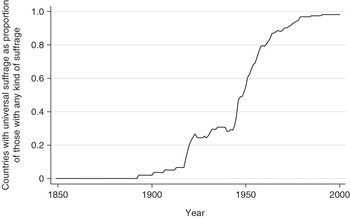
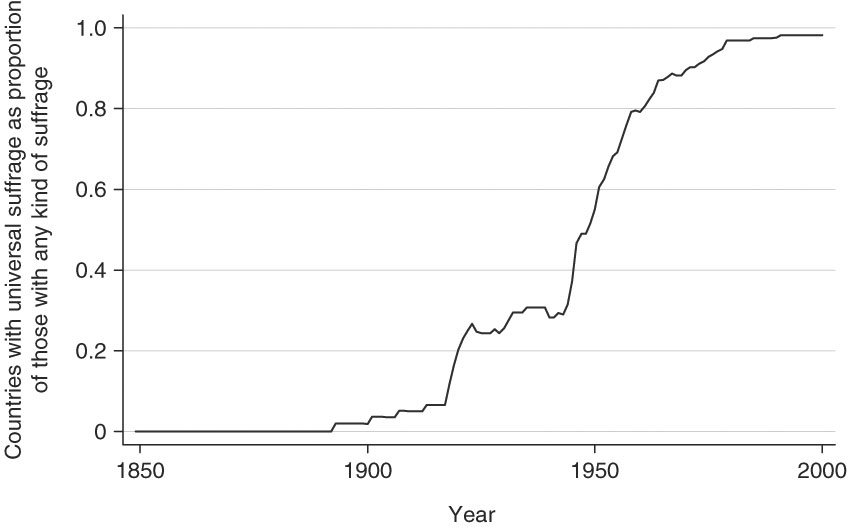
In all these societies suffrage was subsequently extended to poorer males and to women, while the newly emerging countries tended to immediately grant rights more broadly, so that political rights are now universal in almost all countries that have any kind of elections. Yet the road from representative government to mass democracy took a long time to traverse. As of 1900, one country had fully universal suffrage while seventeen enfranchised all males. Only during the second half of the twentieth century, more than 150 years after representative institutions were first established, did universal suffrage become an irresistible norm.
Proportion of countries with universal suffrage, by year
Why would people who monopolize political power ever decide to put their interests or values at risk by sharing it with others? Specifically, why would those who hold political rights in the form of suffrage decide to extend these rights to anyone else?
The question is sufficiently puzzling to have received intense attention. The classical explanation of extensions is the one offered by Earl Grey: reform to preserve. This explanation was echoed by Bendix and Rokkan,Footnote 2 who observed that following the French Revolution many if not most European countries have undergone a process of popular agitation demanding that extension of rights, some pattern of resistance to this agitation by the privileged and established sections of the population, and an eventual accommodation through a new definition of rights. Przeworski and CortésFootnote 3 as well as Freeman and SnidalFootnote 4 developed models in which elites extend franchise as a response to the declining viability or legitimacy of the political system. In turn, Conley and Temini argued that extensions of franchise occur when the interests of the enfranchised and disenfranchised groups conflict and the disenfranchised group presents a credible threat.Footnote 5 Albeit in different languages, the generic argument runs as follows: (1) Being excluded is a source of deprivation of some kind. (2) At some time, the excluded threaten to revolt (the political system suffers a deficit of legitimacy). (3) Although sharing political rights would have consequences that are costly for the incumbent elite, the elite prefers to bear these costs rather than risk a revolution. (4) Once admitted, the new citizens use their rights within the system, abandoning the insurrectionary strategy (they become encapsulated, co-opted or integrated). Hence, extensions of rights are a response of the incumbent holders of rights to revolutionary threats by the excluded.
This general argument is subject to a twist, recently provided by Acemoglu and Robinson.Footnote 6 In their model, when the elite is confronted by a revolutionary threat of a sufficient magnitude, it calculates that it would be better off making economic concessions than risking that a revolution would damage their property. But if the threat is ephemeral, that is, if the capacity of the masses to revolt is not due to their permanent organization but only to some transient circumstances, a promise by the elite that it would maintain these concessions when the threat evaporates is not credible and the masses would revolt even if granted economic concessions. The only credible response is to change the identity of the pivotal decision maker by extending suffrage. Hence, suffrage extensions are to be expected when the elite faces a transient insurrectionary threat, a sporadic outburst of political unrest.
In these explanations, rights are conquered by the excluded, in the sense that the elite concedes these rights only when it fears that those excluded may reach for power by the only means available to them, namely revolution. Yet this story is not without rivals, arguments that claim that franchise was granted voluntarily, in the self-interest of the elite in singular or a majority within it.
Lizzeri and Persico argued that extending suffrage changes the political equilibrium from one of redistribution to one where redistribution is curtailed in favour of providing public goods.Footnote 7 This is because those currently disenfranchised value transfers less than members of the extant elite. Hence, when suffrage is extended the value of transfers becomes diluted and they become less attractive in relation to public goods. What precipitates extensions, therefore, are exogenous changes in the evaluation of public goods by the incumbent elite. Specifically, Lizzeri and Persico, who focus on nineteenth-century Britain, argue that the precipitating factor was the rapid growth of cities, which generated demand for sanitation and for roads.
Ticchi and Vindigni claimed, in turn, that if an elite wants to induce men to engage in acts as costly as fighting and perhaps women to take men’s place in the factories, it must offer them a quid pro quo in terms of political rights.Footnote 8 This argument dates back to Machiavelli’s Discourses, where he argued that governments must extend benefits to the people in anticipation that they would need their co-operation in times of adversity.Footnote 9 Once an enemy is at the gates, concessions are not credible and thus ineffective:
For the people as a whole will consider that they owe this benefit not to you, but rather to your enemies, and, since they cannot but fear that, when the need has passed, you may deprive them of what you have been compelled to give, will in no way feel obliged to you.
Justification of suffrage in terms of conscription was indeed a frequent argument in the nineteenth century: a slogan in Sweden was ‘one man, one vote, one gun’. Hence, franchise is extended when elites prepare for wars.
Finally, if the elite is divided, a majority within it may want to extend suffrage for partisan reasons.Footnote 10 These reasons may be narrowly electoral, just a search for votes, but they may also entail looking for allies in pursuit of economic interests. Note that Acemoglu and Robinson considered but rejected the possibility that extensions were driven by partisan reasons in the cases they studied, while Lizzeri and Persico ruled out electoral considerations by an assumption. Yet Llavador and Oxoby think that a party of industrialists would extend suffrage to workers in order to obtain a mandate for pursuing industrialization policies, while a party of landowners may want to block such policies by enfranchising peasants in addition to workers.Footnote 11 Their model, however, focuses on whether extensions were partial or universal, rather than on whether they occur at all, and I do not consider their theory below.
Hence, in one class of stories, franchise is extended only in response to revolutionary threats: this is the sense in which political rights are conquered by the insurgent masses. In turn, in other models elites grant suffrage voluntarily, in their own interest, either because they prefer public goods to transfers or because they need to prepare for war or because they want to obtain an electoral mandate for particular economic policies. True, one might claim that in either case the elite extends suffrage only if it would be better off as a result of an extension than without it and that suffrage is thus always granted. But while extensions precipitated by a threat of revolution make the elite better off than they would have been if the revolution were to be successful, preventing revolution by means of extending political rights results in a redistribution of income in favour of the newly included, thus rendering the elite worse off than it was under the status quo. In contrast, extensions are voluntary when they make the elite or at least a majority thereof better off, for any of the reasons evoked in the particular stories. Those excluded conquer political rights when the elite realizes that although the extension will make it worse off, its fate without an extension would be or at least might be even worse. In turn, the excluded are not protagonists when the elite faces the choice only between the status quo or enhancing its own welfare by extending suffrage. To put it in a nutshell, rights are conquered when their extension makes the elite worse off than under the status quo; they are granted when extensions make the elite better off.
Since some of these stories focus on redistribution of income while others evoke demand for public goods or preparations for war, they may be applicable to different types of extensions. Specifically, one could think that revolutionary threat is more likely to induce extensions along class lines, while increasing demand for public goods should lead to increasing the electorate without changing its class composition. Put differently, since the revolutionary threat theory focuses on redistribution of income, it must apply at least to extensions along class lines.Footnote 12 In turn, since extensions along a pure gender line are more neutral with regard to redistribution, the Lizzeri–Persico model should hold at least for extensions to women alone.
The purpose of this article is to adjudicate empirically among these alternative explanations. While the literature on extensions of suffrage is by now extensive, the historical material adduced in support of different theories is limited to a few – almost exclusively Western European – cases, with an obsessive focus on the English reform of 1832. This evidence consists either of narratives about particular extensions or of analyses of their fiscal consequences. The first type of evidence is loose and sometimes tendentious, at least in so far as the same reforms are cited to support different theories. The second type of evidence assumes that the consequences were the same as motivations, which may or may not be true.Footnote 13
The data analysed here (see the Appendix) cover 187 countries or dependent territories from the time they established first national electoral institutions until year 2000, yielding 14,604 annual observations of franchise rules. Suffrage qualifications are distinguished by twenty-one categories that combine class and gender criteria. These distinctions generate 348 franchise extensions, of which sixty-three occurred in Western Europe. Extensions are further distinguished by the criteria by which the newly incorporated groups were identified, namely, class, gender or both.
The article is organized as follows. In the next section extensions are defined. The following section presents statistical analyses. Focusing on the distinction between extensions by class and by sex, the fourth section brings other additional materials to bear on the question formulated in the title. A brief conclusion closes the text.
A history of suffrage
While some early constitutions made male suffrage nearly universal, during most of the nineteenth century the right to vote was confined to adult men who owned property, earned some amount of income, or paid some amount of taxes.
Two countries – Liberia in 1839Footnote 14 and Greece in 1844 – extended the right to vote to all adult males when they established first uniformFootnote 15 suffrage requirements.Footnote 16 Beginning with France in 1792,Footnote 17 the first suffrage qualifications were also relatively extensive in nineteen countries that gave the right to vote to all independent males. The operative category that qualified for suffrage in Spanish America was vecino (literally neighbour): someone who had a regular source of income, had a permanent residence in a community and was not dependent on others.Footnote 18 As several essays in Sabato emphasize, this was a sociological, not a legal, concept: a vecino was simply someone who had a standing in a local community.Footnote 19 Moreover, while the early constitutions attempted to define this concept by phrases such as having a property, or exercising some profession, or a skill with a public title, or having an occupation in some useful pursuit, without subjection to another as a servant or day worker (Peru in 1823) or such as exercising some useful occupation or having known means of subsistence (Costa Rica in 1824),Footnote 20 since the eligibility for voting was determined by local authorities, the application of these criteria was informal and loose. As Canedo recounts, if Pedro was known to be a good person by members of the local electoral table, he was a vecino.Footnote 21 In these countries, the nationalization of citizenship, about which see Annino,Footnote 22 which transformed it from a social to a legal concept, meant replacing these vague criteria by specific income or tax thresholds, sometimes combined with the literacy requirement, which were more restrictive. Thus of the nineteen countries in which the first qualifications gave the right to vote to all independent males, suffrage was subsequently restricted in sixteen. Since Liberia also restricted franchise in 1847 and since all other countries that introduced suffrage before 1848 conditioned the right to vote on property, income or literacy, Greece, Mexico (which extended suffrage to all males in 1847) and El Salvador (which maintained the vecino suffrage) were the only countries with broad male suffrage as of 1847. Except for a few landowners in the Austrian Empire, no women could vote in national elections before 1893.
These original restrictions were either gradually or abruptly relaxed as time went on, but not without further reversals. In several countries, ‘Conservatives’, to use the Spanish terminology, repeatedly fought with ‘Liberals’ over suffrage, with the result that franchise qualifications alternated according to their political power. France is the best known example of a country that went from income qualifications to universal male suffrage, back to income qualifications, to income and literacy restrictions, back to income, to universal male suffrage, back to income and back to universal male, only to make suffrage universal for both sexes in 1945. The history of Spanish suffrage was not any less convoluted,Footnote 23 as was the history of several Latin American countries, notably Guatemala, which had ten different suffrage rules, plus periods without elections.
The qualifications for suffrage can be classified into several categories:Footnote 24
0 No suffrage rules.
For males:
1 Estate representation,
2 Property requirement,
3 (Property of some value or income above some threshold or tax payment of some magnitude or exercise of some professions) and literacy,
4 Property or income or tax payment or exercise of some professions,
5 Literacy or (literacy or income),
6 ‘Independent’,
7 All above some age, perhaps with residence requirements, except for those legally disqualified (‘manhood’).
For females, the first digit characterizes male qualifications. The second digit is:
0 if no women can vote,
1 if qualifications applying to women are stricter than those of males (higher age, only if no male household head, only relatives of military, etc.),
2 if women are qualified on the same basis as men.
Note that these franchise codes do not distinguish numerical thresholds, only the quality of the restrictions. The reason is that increasing incomes as well as inflation extended the electorate even without legal changes.Footnote 25
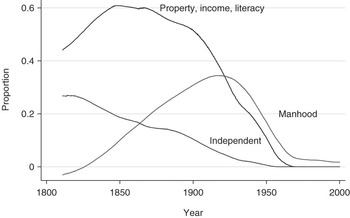
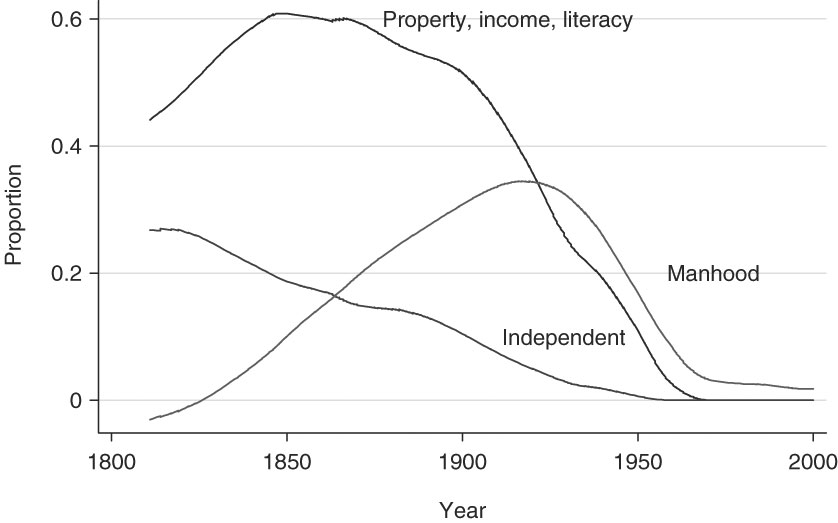
The prevalence of regime censitaire during the nineteenth century is obvious. Among the countries and dependent territories where only males could vote, requirements of property, income or literacy were by far the most frequent still around 1900 and more frequent than universal male (‘manhood’ in Figure 2) suffrage until the end of the Second World War.
Proportion of countries with different forms of male suffrage, 1810–2000 Note: Lowess smooth. The base is countries with any kind of suffrage, so the complement is women’s suffrage.
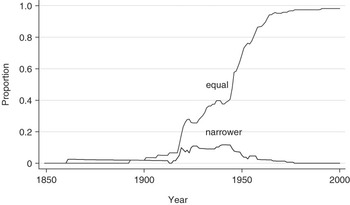
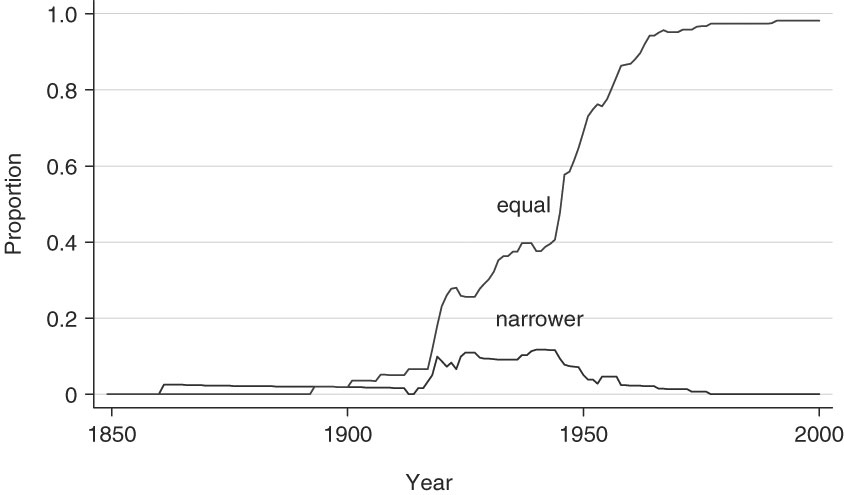
The first country in which women could vote on the same basis as men was New Zealand in 1893,Footnote 26 followed by Australia in 1901, Finland in 1907 and Norway in 1913. In Norway as of 1907, Iceland as of 1915, Canada as of 1917 and the United Kingdom as of 1918 women gained the right to vote on a basis narrower than that of men. Still as of 1950, only half of the countries with any kind of suffrage enfranchised women on the same basis as men.
Proportion of countries with female suffrage, narrower and equal to males, relative to countries with any kind of suffrage, 1850–2000
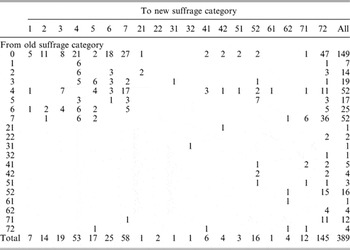
Given these different types of suffrage qualifications, we can identify suffrage reforms, that is, the instances when these qualifications differed during successive years. A summary of reforms is presented in Table 1 in the ‘from/to’ format:
Franchise Reforms

Note: The row headings (‘From old…’) and the column headings (‘To new…’) indicate suffrage categories. These are: For males: 0 none; 1 estate representation; 2 property; 3 income and literacy; 4 income; 5 literacy or (income or literacy); 6 independent; 7 universal. For females: first digit gives qualifications for males; second digit: 1, indicates that women had to satisfy stricter requirements; second digit: 2, indicates that they qualified on the same basis as males. The cell entries count reforms of particular kinds.
This classification of suffrage criteria is intended to be ordinal in terms of the proportion of the population they qualified to vote. The requirement of income (or its substitutes) and literacy is on purely logical grounds less inclusive than requiring either alone but it should be more inclusive than the criterion of property (which usually meant land or dwellings) unless an inordinate number of people hold unproductive property or a large number of property owners are illiterate. The criterion of literacy alone (most of the cases classified as 5 above), however, does not have a logically necessary relation to the criterion of income (and its substitutes). In times with very low educational levels, the criterion of literacy could have been more restrictive than that of income. The category of ‘independents’ is, in turn, clearly broader than that of literacy, and universal suffrage is broader than that of independents.
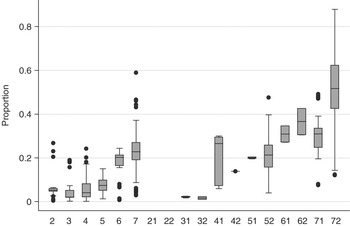
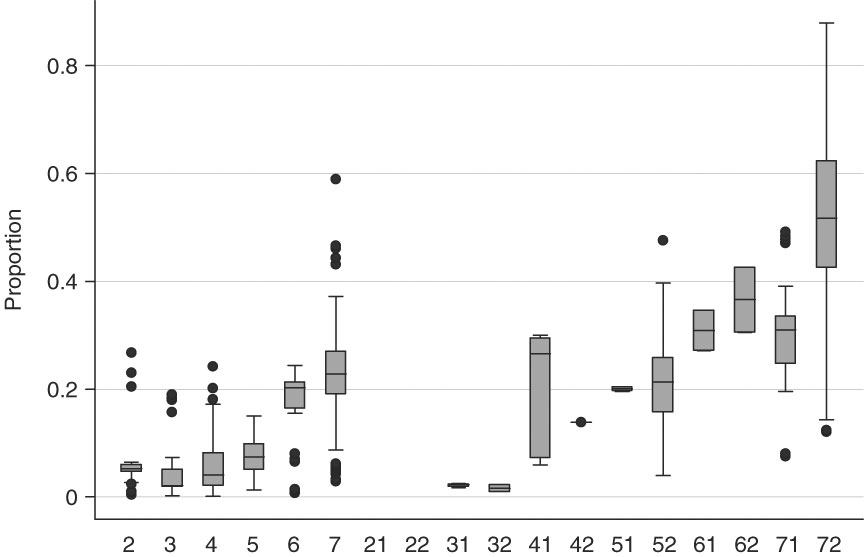
These logical relations should be in principle subject to verification by comparing the proportions of the population that were eligible to vote under the particular criteria. Figure 4 shows that with some minor exceptions the ordering of the categories is ordinal in terms of median proportions of eligibles associated with each type of qualification.Footnote 27
Proportion of total population eligible by franchise categories Note: Numbers on the horizontal axis represent suffrage categories. For males: 2 property; 3 income and literacy; 4 income; 5 literacy or (income or literacy); 6 independent; 7 universal. For females: first digit gives qualifications for males; second digit = 1 indicates that women had to satisfy stricter requirements; second digit = 2 indicates that they qualified on the same basis as males.
These medians, however, are not informative, because the effect of any fixed criterion, whether of property, income or literacy depends on the economic or educational levels of the country. Direct evidence would consist of comparing the extent of eligibility before and after the particular reforms but such information is almost non-existent. Fortunately, as seen in Table 1, it turns out that qualifications based on income and literacy never followed or preceded directly restrictions based on property. In turn, data on the proportion of the population enfranchised are available only for two cases in which suffrage qualifications were changed from property to income: the 1885 reform in Norway caused eligibility to increase from 5.2 to 6.3 per cent, while the British reform of 1867 seems not to have changed this proportion.Footnote 28 Other cases are not problematic on logical grounds and the evidence, albeit scarce, confirms the logical priors.
Given these caveats, one can define suffrage extensions. Suffrage reform is any instance in which the suffrage qualifications distinguished above are observed to have changed. Not all reforms, however, constitute extensions. Extensions are those instances in which either the first or the second digit of suffrage qualification became larger without the other digit becoming smaller. Note that reforms are indeterminate if franchise was extended to women (second digit) while it was restricted by class (first digit). There is only one such case and it is not treated as an extension. Given the definition of reforms, we count 389 of them. Since in forty cases suffrage was contracted,Footnote 29 and in one the reform was indeterminate, suffrage was extended in 348 instances.
Extensions are distinguished by the groups that were enfranchised as their result. Those extensions in which only the first digit increased are by class; those in which only the second digit increased are by gender, while those in which both digits increased are by both class and gender. Given these distinctions, there were 185 extensions by class (of which 155 only to males), seventy by gender, and ninety-three by both class and gender.
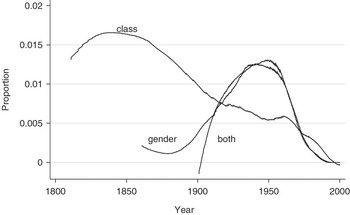
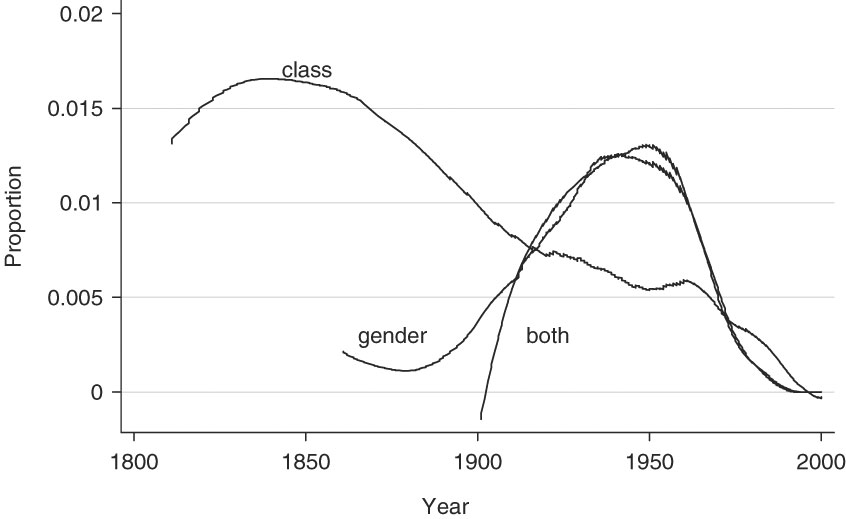
These extensions occurred during different periods. Until 1914, suffrage was extended along class lines in 112 instances, while only four extensions to women took place during this period and only two to both. After this date, suffrage was more frequently extended either to women alone or to poorer men and women.
The timing of different types of extensions Note: Lowess smooth. Only countries with earlier suffrage included.
Statistical analyses
Testing theories systematically entails several difficulties, some insurmountable. We have only one variable that speaks directly to the threat of revolution theory: unrest,Footnote 30 which is the sum of strikes, demonstrations and riots lagged one year, from Banks.Footnote 31 Moreover, this variable is available only for the period following the end of the First World War and only for independent countries. We do have relatively extensive information about the number of military personnel (milper), for several countries going back as far as 1816 (from Banks). In turn, following Lizzeri and Persico, to indicate the demand for public goods I use the proportion of the population in cities of 25,000 or more, a variable called urban (from Banks). One could also think that public goods, specifically sanitation or vaccination, are more in demand when infant mortality, infmor (from Mitchell),Footnote 32 is higher.Footnote 33 Hence, their theory is tested using urban and infmor. Finally, to test the modernization theory (about which see Przeworski and Limongi),Footnote 34 which claims that democratization is an automatic consequence of economic development, I use per capita income, gdpcap, from Maddison.Footnote 35
Several theories of democratization also derive conclusions concerning the impact of income inequality. A widely shared view is that higher inequality impedes or retards extensions. The typical reasoning is that democracy is costlier to the incumbent elite when income inequality is higher, since the median voter is then relatively poorer and opts for a higher degree of redistribution.Footnote 36 Acemoglu and Robinson, however, assume that revolution can occur only above some level of inequality, so that extensions are more likely in unequal societies. While the data for income inequality are available only for the post-1960 period, the relevant asset during most of the period under consideration was land and, following TherbornFootnote 37 as well as Engerman and Sokoloff,Footnote 38 I consider the effect of the proportion of farms owned and operated by family units, family farms, from Vanhanen.Footnote 39
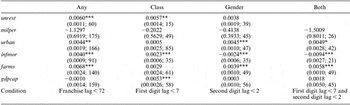
While all the theories discussed above refer to any kind of extensions, they may apply differently to extensions by class, by gender and by both criteria. Note that each type of extension is conditional on a different status quo: (1) pure class extensions cannot occur if suffrage is universal for males, (2) extensions by gender alone can occur only if women cannot vote already on the same basis as men, (3) extensions by class and gender can occur only if not all males and females can vote already. I show in Table 2 results obtained by probits applied to each type of extension at a time, with the appropriate conditioning.Footnote 40 Since numbers of observations and of extensions dwindle rapidly when more than two variables are considered simultaneously, I can examine them only one at a time.
Effect on the Probability of Particular Types of Extensions (Marginal Effects, Probit Estimates)
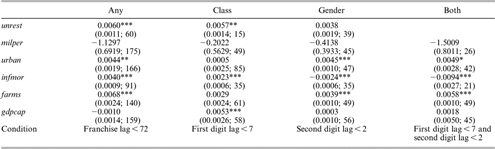
Note: The first number in parentheses is the country-clustered standard error of the estimate, while the second number is the count of extensions of a given type in the particular subset of data. Empty cell indicates insufficient number of observations.
In agreement with the revolutionary threat theories, unrest (which is lagged one year) has a strongly positive effect on the probability of extensions by class and a weaker but still significant effect on extensions by gender. The proportion of men under arms does not influence the probability of any kind of extensions.Footnote 41 The impact of urbanization on extensions entailing to women supports the Lizzeri and Persico model, but the sign of infant mortality is wrong from their point of view.Footnote 42 Equality of land distribution promotes inclusions of women. Finally, per capita income has a positive effect only on extensions by class. The impact of urbanization vanishes, however, when it is considered (in a smaller sample) together with impact mortality. In turn, infant mortality is negatively correlated with the proportion of family farms, and when they are both introduced into the specification only one remains significant. I am inclined to believe that mortality is an effect of inequality and to attribute the causal effect to the latter. Unfortunately, considering more than two variables at a time reduces rapidly the number of observations and of extensions among them.
To complete the analysis, we need to examine the effect of wars. According to Ticchi and Vindigni, concessions of suffrage are necessary to induce men to fight and perhaps women to replace them in production. Hence, extensions should occur when countries prepare for wars. Note that, perhaps informed by history, Ticchi and Vindigni stretch their argument to cover their aftermath, claiming to explain ‘political reforms implemented in several European countries during and in the aftermath of the two World Wars’.Footnote 43 But in their aftermath, the wars had already occurred, so that inducements to fight or to replace men in factories are no longer needed. If extensions occur after wars end, it must be for other reasons: perhaps it is just ‘gratitude’ but more plausibly because soldiers returning from wars are dangerous to their rulers: they believe they deserve rights and they know how to fight.
As always, there are some instances that support the theory. The French Revolution gave the right to vote to every Frenchman qui aura fait la guerre de la libertée [who would have fought in the war] (Decree of 3 August 1792 of the Legislative Assembly).Footnote 44 This provision was maintained through the Consulate and the Empire. Tadeusz Kościuszko in Poland made vague promises to peasants to induce them to join the anti-Russian insurrection in 1794; Simón Bolívar made at one moment interracial appeals to recruit for the war against Spain;Footnote 45 Bismarck wrote in his memoirs that the acceptance of general suffrage was a weapon in the struggle against Austria and the other foreign powers.Footnote 46 But an overwhelming number of extensions occurred after, not before, wars. Except for Italy, where the 1912 extension was made as part of building support for the war against Libya, none of the countries that would become belligerents in the First World War extended suffrage on its eve. In turn, nine belligerents extended suffrage at home between 1918 and 1922, while the United Kingdom also extended it in three of its colonies. The same happened around the Second World War: no suffrage extensions occurred during preparations for war; in fact, elections were abolished in the axis countries on the eve of the war. During the war suffrage reforms occurred in Barbados, Jamaica and Guyana. In turn, eight belligerents extended suffrage at home between 1945 and 1949, while at the same time suffrage was extended in twenty-one colonial territories.
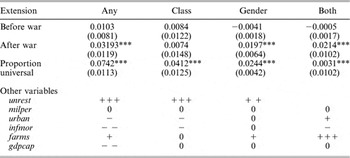
Systematic evidence concerning international wars covered by the Correlates of War Project shows that of the 226 extensions covered by this dataset, twenty occurred during five years preceding wars (of which in eight cases these were also years after another war ended), twelve occurred during wars, and thirty-five in the five years following an end of a war (of which in eight cases these were also years before another war began). As shown in Table 3, periods before wars do not differ from all other periods, while extensions involving women were much more likely after international wars.
Final Specifications of Extensions (Marginal Effects, Probit Estimates)
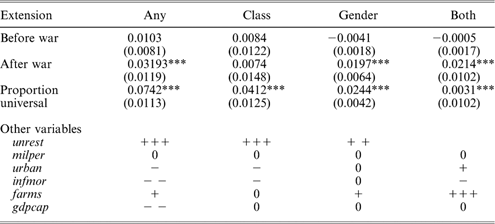
Note: For the dichotomous variables, the effects are the difference in probability between the two values. The analyses are conditioned in the same way as in Table 2. ‘Before’ stands for five years preceding an international war, ‘After’ for five years following one. Country clustered standard errors are in parentheses. ‘Proportion Universal’ is the proportion of countries with any kind of suffrage that had universal suffrage in a given year. The coefficients and the standard errors are based on the specification with these three variables alone. ‘Other variables’ show the sign and the level of significance of other variables when they are added one-at-a-time to the first three factors, where three signs indicate p < 0.01, two signs 0.01< p < 0.05, and one sign 0.5 < p < 0.10.
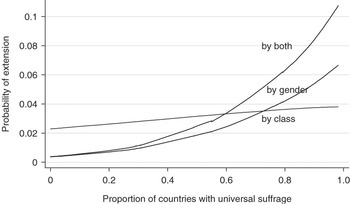
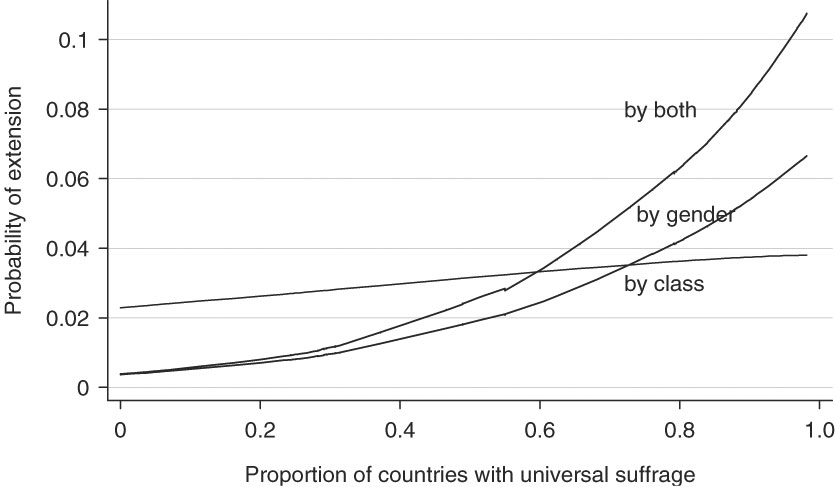
Finally, another factor, not considered in any of the models, that plays an obvious role, are international norms concerning political rights. To examine this impact, I consider the effect of the proportion of countries with universal suffrage in a particular year on the probability of an extension during this year. While these diffusion effects are relatively weaker for extensions by class, they are overwhelming for extensions involving women. The function that relates the probability of an extension by class and gender in any particular country to the proportion of countries that already had universal suffrage shows that when almost all countries reached universal suffrage, the pressure on a country that still did not have it was so overwhelming that the probability this country would yield in a particular year was 0.10. The effect on pure extensions to women may appear smaller, but it is only because countries that did not have universal male suffrage felt pressured to extend it both to all males and females simultaneously.
Diffusion effects: impact of the proportion of countries with universal suffrage on the probability of extensions Note: Probabilities estimated by multinomial logit.
To put these findings together, consider a specification in which periods before and after warsFootnote 47 as well as international conditions are first considered alone (the coefficients in Table 3 are based on the specification with only these three variables) and then each of the other variables is added one at a time (the signs and significance levels of the first three variables are never affected by these additions).
Let me highlight only negative findings.Footnote 48 The Lizzeri and Persico model, according to which extensions are driven by increased demand for public goods, is persistently rejected by the data: urbanization either has no effect or it is not robust, while infant mortality has a wrong sign whenever it is significant. Obviously, it is possible that that these variables do not provide a valid operationalization of the theory or that the data are not reliable. Moreover, the public goods motivation may have been important in extending suffrage at the municipal level, emphasized by Lizzeri and Persico. But with these caveats the conclusion concerning this explanation must be negative.Footnote 49 The Ticchi and Vindigni story about preparations for wars fares poorly insofar as the proportion of men under arms is never significant, while extensions including women follow rather than precede wars. Finally, modernization theory – the idea that democracy is secreted by economic development – fails here, as it does in other contexts.Footnote 50 In contrast, the revolutionary threat theory goes a long way to explain extensions by class and perhaps by gender. Note, however, that Acemoglu and Robinson appear to be wrong about the impact of inequality, at least insofar as extensions by gender and by both class and gender are more likely when land distribution is more equal.
Granted or conquered?
Since history is replete with instances in which good theories were thrown out by bad data, and the data available here are scarce and often unreliable, any conclusions are subject to this caveat. Yet, in spite of all the limitations of the data, the explanation in terms of revolutionary threats, and even more narrowly the Acemoglu–Robinson emphasis on unexpected mobilization of the excluded, makes good sense of extensions by class. Enfranchisement of women, however, is subject to different dynamics.
Extension of Citizenship to Lower Classes
To put these findings in context, note first that theories of enfranchisement assume that those excluded treat political rights as instrumental for their economic objectives, rather than as a goal in itself. The poor want political rights not because they want to be recognized as equals but only because these rights would advance their economic objectives. The assumption that political rights were merely instrumental may or may not be true, or perhaps may have been true with regard to the working-class movements but not with regard to women’s movements. But if it is not true, then purely economic concessions would not have sufficed to diffuse the threat of revolution. Hence, the argument that elites extend suffrage only in response to sporadic outbursts of political mobilization, while reverting to economic concessions when the poor are sufficiently well organized to think concessions are durable, is predicated on the assumption that the ‘masses’, in fact the working-class movement and in some countries the peasant movements, treated political rights as purely instrumental.
One may wonder why the elites would wait for the threat to manifest itself in the form of unrest rather than appease the potentially revolutionary masses by extending suffrage. But if extensions of political rights are more costly than economic concessions, there is a reason for the elite to wait until an extension becomes inevitable. One would thus expect, and Acemoglu and Robinson claim it to be true, that countries that developed social programmes earlier waited longer for the advent of manhood (or universal) suffrage. Yet except for the Danish pension law of 1891 and Lloyd George’s social policies of 1908–14,Footnote 51 such concessions occurred only after at least manhood suffrage was already in place.Footnote 52 Hence, if the elites staved off revolutions by means other than enfranchisement, these means were more plausibly repression rather than concession.
Finally, it is not obvious that extending suffrage to the poor was sufficient to mitigate their revolutionary ardour. While from the moment of their formation, socialist parties demanded universal suffrage, for quite a long time they were ambivalent how to use it. Only after years of heated discussions,Footnote 53 did Social Democrats become fully committed to electoral politics, adopting a stance sharply articulated in 1919 by J. McGurk, the chairman of the Labour Party:
We are either constitutionalists or we are not constitutionalists. If we are constitutionalists, if we believe in the efficacy of the political weapon (and we are, or why do we have a Labour Party?) then it is both unwise and undemocratic because we fail to get a majority at the polls to turn around and demand that we should substitute industrial action.Footnote 54
Yet in countries where no single party was able to organize and discipline the new entrants, workers or peasants, extensions of suffrage to the lower classes was not sufficient to prevent disruptive political conflicts.
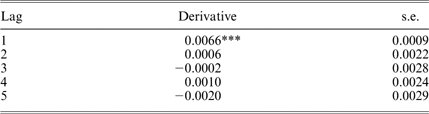
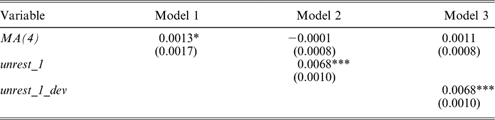
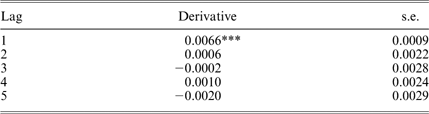
Hence, the argument that the elites extended suffrage to the lower classes only when they confronted visible signs of revolutionary threat is predicated on tenuous assumptions: that the poor treated political rights as merely instrumental, that they would be appeased by economic concessions, and that they would be deradicalized once they conquered the right to participate in electoral politics. Yet the effect of unrest on extensions is large and robust in the sample for which the data are available. Moreover, as seen in Table 4, while the incidence of unrest lagged one year has a strong effect on the probability of extensions, all tests indicate that earlier unrest plays no role: in the presence of the first, higher lags do not matter; a four-year moving average of unrest preceding the first lag has a positive but not a significant sign; and a difference between the observed incidence of the first lag and its value predicted by the four-year average of earlier unrest predicts extensions even better than its actual value.
Probability of Extensions as a Function of Successive Lags of Unrest (Probit Estimates, Marginal Effects)
Probability of Extensions as a Function of Past Unrest (Probit Estimates, Marginal Effects)
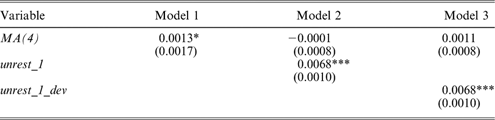
Note: MA(4) is a four year average of the second through the fifth lag. unrest_1 is the first lag. unrest_1_dev is the deviation of the observed value of the first lag from its value predicted by the four preceding lags. Standard errors are country clustered.
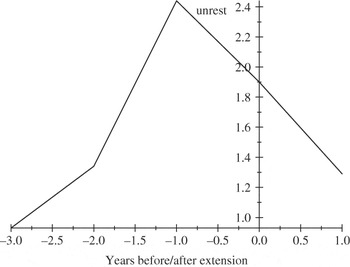
Finally, as seen in Figure 7, which shows the average intensity of unrest in years immediately preceding and following extensions, waves of mobilization peaked one year before extensions were granted and extensions reduced unrest. Hence, every possible test shows that unexpected mobilization of the masses induced elites to respond immediately with extending suffrage.
Average intensity of unrest in years before and after extensions

The story told by Verney about the advent of universal suffrage to Sweden in 1918 may be a caricature, but caricatures only exaggerate the truth:Footnote 55
No progress was made when Parliament assembled … On 11 November they [Left Socialists] had issued a communique calling for workers’ and soldiers’ soviets, the end of the monarchy and the First Chamber, a constituent National Assembly, land division, control of industry by the workers and preparations for a general strike … The People’s House [lower chamber of the parliament] was filled … Between speeches the crowd sung the Marseillaise and the Internationale. Branting was able to announce the new proposal by the Government promising universal suffrage … Two days later the danger of revolution was over.
The open question is whether this theory also holds for the period and for the countries for which systematic data are not available. Acemoglu and Robinson cite anecdotal evidence about the United Kingdom in 1832 and 1867, France and Germany in 1848 and Sweden in 1866, 1909 and 1918. Their list can be easily extended. The largest number of extensions before 1919 occurred in 1848, a year of revolutionary upheavals throughout Europe. Massive strikes or demonstrations preceded the extension of suffrage in Austria in 1907,Footnote 56 in Belgium in 1894,Footnote 57 in New Zealand in 1889Footnote 58 and in Finland in 1906.Footnote 59 Yet selecting cases in favour of a theory is a tendentious operation and proponents of alternative explanations are as good at finding cases that support their model, at times referring to the same extensions.
The strongest evidence in favour of the argument that suffrage was extended to the poor under the threat of revolution comes, however, not from the events themselves but from voices of the historical protagonists. Indeed, these voices were often so explicit that one does not need to impute the motivations. A Connecticut representative, Samuel Dana, thought it was quite proper that the society was to be divided into ‘the rich, the few, the rulers’ and ‘the poor, the many, the ruled’.Footnote 60 The drafter of the French Constitution of 1795, Boissy d’Anglas, declared, ‘We must be ruled by the best … a country governed by property-owners is within the social order, that which is dominated by non-property owners is in a state of nature’.Footnote 61 The consensus in mid-nineteenth century Colombia was: ‘We want enlightened democracy, a democracy in which intelligence and property direct the destinies of the people; we do not want a barbarian democracy in which the proletarianism and ignorance drown the seeds of happiness and bring the society to confusion and disorder.’Footnote 62 ‘The right to make laws belongs to the most intelligent, to the aristocracy of knowledge, created by nature,’ a Peruvian constitutionalist, Bartolomé Herrera, declared in 1846;Footnote 63 the Peruvian theorist José María Pando maintained that ‘a perpetual aristocracy … is an imperative necessity’; the Chilean Andrés Bello wanted rulers to constitute ‘a body of wise men (un cuerpo de sabios)’; while the Spanish conservative thinker Donoso Cortés juxtaposed the sovereignty of the wise to sovereignty of the people.Footnote 64 Still by 1867, Walter Bagehot would warn:Footnote 65
It must be remembered that a political combination of the lower classes, as such and for their own objects, is an evil of the first magnitude; that a permanent combination of them would make them (now that many of them have the suffrage) supreme in the country; and that their supremacy, in the state they now are, means the supremacy of ignorance over instruction and of numbers over knowledge.
As a result, the right to elect one’s representatives was limited almost everywhere to wealthy males. While the prevalence of suffrage censitaire may appear to contradict the norm of suppressing all distinctions in society and to be incompatible with the principle of political equality, suffrage restrictions were portrayed by their proponents as serving the common good of all. The French Declaration of Rights qualified its recognition of equality in the sentence that immediately followed: ‘Men are born equal and remain free and equal in rights. Social distinctions may be founded only upon the general good.’ The argument for restricting suffrage was spelled out already by Montesquieu, who started from the principle that ‘All inequality under democracy should be derived from the nature of democracy and from the very principle of democracy.’Footnote 66 His example was that people who must continually work to live are not prepared for public office or would have to neglect their functions. As barristers of Paris put it on the eve of the Revolution, ‘Whatever respect one might wish to show for the rights of humanity in general, there is no denying the existence of a class of men who, by virtue of their education and the type of work to which their poverty had condemned them, is … incapable at the moment of participating fully in public affairs.’Footnote 67 ‘In such cases,’ Montesquieu went on, ‘equality among citizens can be lifted in a democracy for the good of democracy. But it is only apparent equality which is lifted …’ The generic argument, to be found in slightly different versions, was that: (1) Representation is acting in the best interest of all. (2) To determine the best interest of all one needs reason.Footnote 68 (3) Reason has sociological determinants: not having to work for a living (‘disinterest’), or not being employed or otherwise dependent on others (‘independence’). As a Chilean statesman put it in 1865, to exercise political rights it is necessary ‘to have the intelligence to recognize the truth and the good, the will to want it, and the freedom to execute it.’Footnote 69 In turn, the claim that only apparent equality is being violated was built in three steps: (1) Acting in the best common interest considers everyone equally, so that everyone is equally represented. (2) The only quality that is being distinguished is the capacity to recognize the common good. (3) No one is barred from acquiring this quality, so that suffrage is potentially open to all.Footnote 70
The self-serving nature of these convoluted arguments for restricting suffrage was apparent. A French conservative polemicist, J. Mallet du Pan, was perhaps first to insist in 1796 that legal equality must lead to equality of wealth: ‘Do you wish a republic of equals amid the inequalities which the public services, inheritances, marriage, industry and commerce have introduced into society? You will have to overthrow property.’Footnote 71 Madison, who in Federalist No.10 maintained that representative government would protect property,Footnote 72 was less sanguine some decades later: ‘the danger to the holders of property can not be disguised, if they are undefended against a majority without property. Bodies of men are not less swayed by interest than individuals … Hence, the liability of the rights of property’.Footnote 73 The Scottish philosopher James Mackintosh predicted in 1818 that ‘if the laborious classes gain franchise, a permanent animosity between opinion and property must be the consequence’.Footnote 74 David Ricardo was prepared to extend suffrage only to ‘that part of them which cannot be supposed to have an interest in overturning the right to property’.Footnote 75 Thomas Macaulay in the 1842 speech on the Chartists vividly summarized the danger presented by universal suffrage:Footnote 76
The essence of the Charter is universal suffrage. If you withhold that, it matters not very much what else you grant. If you grant that, it matters not at all what else you withhold. If you grant that, the country is lost … My firm conviction is that, in our country, universal suffrage is incompatible, not only with this or that form of government, and with everything for the sake of which government exists; that it is incompatible with property and that it is consequently incompatible with civilization.
Systems of representative government were born under a mortal fear that participation by the broad masses of the population, a large part of whom were poor and illiterate, would threaten property. Suffrage was a dangerous weapon. Yet the poor did not think that their best interests were being represented by the propertied, and they would struggle for suffrage. The elites resisted as long as they could and yielded when they could not. Political rights were conquered by the poorer classes. As Georges Sorel put it on the very eve of the First World War, ‘the bourgeoisie was so troubled by the fear of revolution that it accepted out of resignation the claims of a democracy whose inevitable triumph had been predicted by so many ideologies.’Footnote 77
Partisan Politics and Women’s Suffrage
Extensions to women present, however, several puzzles. The first one is, ‘Why so late?’ Indeed, if the elites had wanted, as Lizzeri and Persico thinks they did, to dilute the value of transfers relative to public goods, they should have extended suffrage to women while preserving class restrictions: the number of voters would have increased, thus diminishing the value of transfers, while the demand for redistribution would not be enhanced by enfranchising poorer people. Yet, while J. S. Mill moved an amendment to give votes to women in 1867, this amendment was defeated, and the first women could vote in the United Kingdom only in 1918. With the notable exception of New Zealand, women were barred from participating in national politics throughout the nineteenth century and in many European and Latin American countries they gained the right to vote only after the Second World War.
The assumption that women are not capable of exercising political rights was so self-evident to founders of representative institutions that Kant referred to it as ‘natural’.Footnote 78 While early proponents of female suffrage observed that reason is not distributed along gender lines – after all, some rulers had been queensFootnote 79 – the main argument against giving the right to vote to women was that, like children, they were not independent, had no will of their own. To enfranchise them would be only to double the votes of their husbands.Footnote 80 Women were already represented by the males in their households and their interests were to be represented through a tutelary, rather than an electoral, connection. The fact that women are not capable of acting independently in the political sphere was so obvious to the male founders of representative institutions that often they did not even bother to restrict suffrage explicitly to men. According to Johnson, the 1776 Constitution of New Jersey, ‘through an error in wording’, admitted as voters all inhabitants who held a certain amount of property. Many women did vote until 1807 when ‘male’ was explicitly added as a qualification.Footnote 81 A similar situation ensued in Chile, where the electoral law of 1874 failed to mention sex as a qualification for citizenship. Only in 1884, when some women took this opportunity to register to vote, did the Congress pass a law explicitly excluding females. This was clearly an omission: as one senator admitted, ‘it did not occur to anyone to concede such rights (a nadie se le ha ocurrido concederle tales derechos)’.Footnote 82 Again the same occurred in France, where Mme Barbarousse claimed the right to vote, pointing out that tout français had this right according to the constitution and it took a court ruling in 1885 to decide that français did not include française women.Footnote 83
In turn, after the Second World War female suffrage became almost inevitable. The evidence in favour of the importance of international norms is overwhelming. The introduction of universal suffrage in New Zealand in 1893, Australia in 1901 and in Finland in 1906 broke the dam for other countries. The movement for women’s suffrage was international from the onset: suffragettes in the United Kingdom, the United States, Australia and New Zealand had maintained close contacts ever since the 1860s; international congresses of women took place regularly after the Berlin meeting of 1904. Six out of fourteen countries that emerged between the two world wars immediately adopted universal, male and female, suffrage. With the proclamation by the United Nations in 1948 of the Universal Declarations of Human Rights, which banned all kinds of discrimination and asserted equality of rights between men and women, all but three Muslim countries – Bahrain, Kuwait and The Maldives – that became independent after this date extended suffrage to all men and women.
Giving women the vote was inconceivable before 1860 and inevitable after 1948. But why were women fully enfranchised in New Zealand in 1893 and in Belgium in 1949? Although the literature on women’s suffrage is enormous – the lion’s share of writings about suffrage is dedicated to women – it tends to be hagiographic rather than analytical, implicitly assuming that suffrage was conquered as a result of heroic protagonism of eminent suffragettes. But while in some countries the struggle for women’s suffrage did indeed entail militancy and sacrifice, and while the statistical results indicate that extensions by gender followed outbursts of mobilization, actions of militant women are not sufficient to explain the timing of these extensions.
If one thinks in the long run, sociological determinants seem predominant: the very issue of female suffrage appeared on the political agenda only when a significant part of middle-class and upper-class women could find work outside the household. Note that poor women were always forced to work in factories and fields, as domestic servants, and often on the streets. But they were poor and illiterate, and would have been excluded by these criteria alone. Jobs for educated women became available only towards the end of the nineteenth century. Hence, the sociological hypothesis is that women’s suffrage became possible only when a sufficient number of educated women entered the public sphere by finding employment outside the household.
The effect of the two world wars is not obvious. They did accelerate the entrance of women onto the labour market.Footnote 84 But the issue of women’s suffrage was on the political agenda in many countries well before 1914 and in four countries women were enfranchised before the First World War. Hence, the question is whether suffrage would not have been extended to women, perhaps just a few years later, had the war not occurred. Indeed, Lloyd suggests that women would have been enfranchised in the United Kingdom before 1918 had the war not suppressed controversial domestic issues, while Collier makes the same argument with regard to the Netherlands and Belgium.Footnote 85 What does seem apparent is that the success of revolution in Russia, which introduced universal suffrage in 1918, and its role in the Second World War sparked revolutionary crises in several countries.
While the participation of educated women in the labour force and the international norms concerning women’s rights created a climate of opinion in which conflicts about female enfranchisement would proceed in particular countries, they provide only background conditions and do not explain the outcomes. The protagonists in these conflicts were organized groups that included political parties, women’s movements, even some that were opposed to suffrage, in some countries the Catholic Church and in some temperance movements and their opponents, liquor lobbies. Did these groups behave strategically?
One would think that if a party expects that women would vote disproportionately in its favour, it would enfranchise them simply in its search for votes. Here is a sketch of an explanation of the timing of female suffrage. If parties seek to maximize their vote shares, any party wants to enfranchise women if it expects that the share of the vote it would receive from them would be larger than its current share in the male electorate. Assume that left-wing and right-wing male voters have different preferences: this is why they vote for left or right parties. Now suppose that it is known that, while preferences of women are in some aspects different from those of men,Footnote 86 in some countries women were seen as more likely and in others as less likely to vote left (right) than men. Then different parties should have enfranchised women in different countries.
A clue to the partisan preferences is that none of the six countries that first enfranchised women were predominantly Catholic. The first Catholic countries that established universal suffrage were the newly independent Austria in 1918, Poland in 1919 and Ireland in 1923, followed by republican Spain in 1931. Five Latin American countries extended suffrage to women in the 1930s, but the rest of them, as well as the Catholic countries in Western Europe, waited until the end of the Second World War. But this delay was not due to the position of the Catholic Church. While the Church had long opposed female suffrage, arguing that the place of the woman is at home, by 1919 Pope Benedict XV abruptly changed this stance,Footnote 87 supporting the cause of votes for women, perhaps expecting that they would vote for conservative parties.
In turn, the timing of women’s suffrage makes sense if the preferences of non-Catholic women were seen as closer to those of male left-wing voters, while the preferences of Catholic women were nearer to those of right-wing males. Some evidence that this is what the protagonists had thought was available. The French Radical Party thought that Catholic women would be influenced by the Church to vote for the right and did nothing to advance their suffrage rights when it was in office in the 1920s.Footnote 88 In Belgium, Socialists adopted women’s suffrage as a part of their platform but had to give it up in 1906 as a price for entering a coalition with Liberals, who had a larger vote share and were opposed to votes for women. Still in 1923, a socialist feared: ‘If you give the vote to women, … Belgium will become one large house of Capuchins (capucinière).’Footnote 89 In Spain in 1931 even some women Socialists, notably Victoria Kent, feared that women would vote for conservative parties under the influence of the Church, but in the end their principles prevailed and women won the franchise.
The earliest data concerning the actual voting patterns of women date to several years after they obtained suffrage. Tingsten used the fact that in (some) German districts and in Austria votes were tabulated separately for the two sexes. His calculations show that in Germany, where the proportions of Catholics and Protestants were more balanced, women were almost as likely as men to vote for the SPD in the Reichstag elections of 1924, 1928 and 1930, while the gap was much larger in the 1927 and 1930 elections in predominantly Catholic Austria.Footnote 90 Earliest survey results are available only for the 1950s: they show that women were in fact somewhat more likely than men to vote for the Social Democrats in Protestant Finland,Footnote 91 slightly more likely to vote for the Christian Democrats in West Germany,Footnote 92 and much less likely to vote for the Left in Catholic Italy.Footnote 93 Obviously, these are just bits and pieces, but they show that party leaders may not have been wrong.
Assume, then, that Catholic women are less likely to vote for the Left than Protestant ones. Left-wing parties would want to extend suffrage to women in Catholic countries when their share of the vote among males is lower than the proportion of women who would vote for them if they were enfranchised. Since this proportion is low, left-wing parties want to do so only if their current vote share is very low, and when it is very low they cannot do it. Hence, no extensions occur when the share of the Left is low. In turn, conservative parties of any stripe would want to enfranchise women if the share of the Left among males exceeds the proportion of women who would vote Left. Hence, in Catholic countries women are enfranchised by the Right when it fears that the Left might win a sizeable share of the vote among the voting males. In Protestant countries, however, the Left wants to enfranchise women even when it wins a large share of the male vote and does so when this share is sufficiently large to elect a Left party or coalition. The Right, in turn, wants to give women the vote only if the share of the Left among males is very large but this means that the share of the Right is small and it is unable to do it. Moreover, if the Left had a chance to do it, women would already have been enfranchised.
Hence, women’s enfranchisement is likely to occur in Catholic countries only if the right-wing parties are in office but fear they would lose it because the proportion of males voting against them is increasing, which clearly was the rationale of Social Christians in Belgium in 1919, when suffrage was extended to some women, and again in 1949 when it became universal. Note that in the two countries with a sizeable but minority proportion of Catholics, Conservatives enfranchised women in Canada in 1921 even though Liberals had a chance to do it when they were in office between 1896 and 1911, while Catholics (AB) extended suffrage to women in Netherlands in 1922 even though Liberals controlled governments between 1913 and 1918. In the predominantly Catholic countries, France and Belgium, even Socialists did not use their tenure in government to enfranchise women. In France neither the Cartel des Gauches nor Front Populaire did it when they were in power during the inter-war period, but Christian Democrats did in 1945. In Belgium, Socialists were in office immediately before and after the Second World War, but women were enfranchised only when Christian Democrats came into office in 1949.
In non-Catholic countries, in turn, left-wing parties can enjoy a large vote share among males and still support female suffrage. Right-wing parties, however, should never enfranchise women. Indeed, among countries with a low proportion of Catholics, franchise was extended to women by Liberal governments in New Zealand and Norway,Footnote 94 a Protectionist Party in Australia and by the first Liberal–Social Democratic coalitions in Denmark and Sweden. The odd case is the United Kingdom, where women were enfranchised by a Conservative government and, along with the United States, this may be a case where women’s protagonism truly mattered.
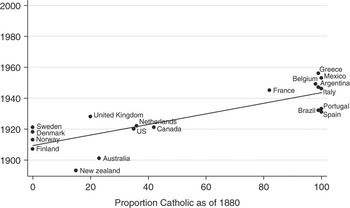
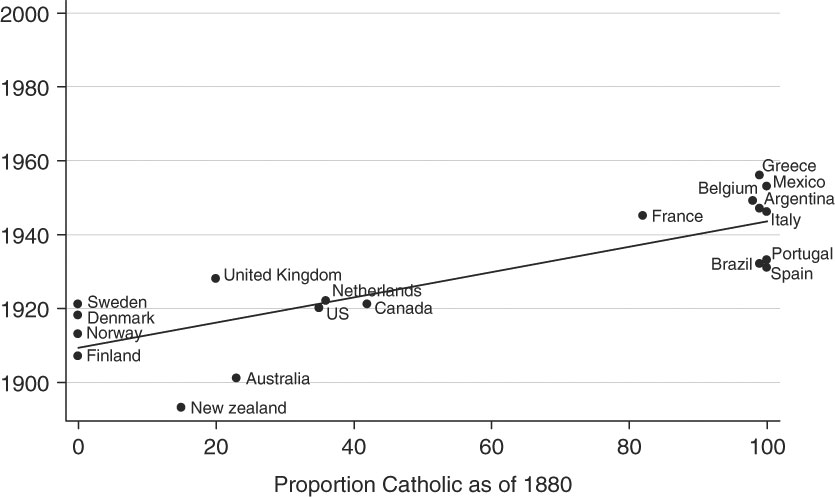
Obviously, the model oversimplifies, as models do. At least in New Zealand, where as of 1800 Catholics constituted 15 per cent of the population,Footnote 95 the electoral effect of enfranchising women was far from apparent to the protagonists: ‘Some believed women were a radical force; others that they were conservative upholders of traditional values … The suffrage issue cut across conventional lines of political allegiance.’Footnote 96 Hence, while Liberal backbenchers supported female suffrage, the leadership was divided. In Sweden, Conservatives opposed the 1918 Reform Bill even though ‘The extension of the franchise to women seemed harmless enough, since it could be assume that their vote would be distributed roughly in the same proportion as men’s.’Footnote 97 Yet this argument goes a long way in predicting the timing of extensions to women. In most Protestant countries women were enfranchised by left-wing parties, pretty much as soon as they had a chance, while in Catholic countries left-wing parties continued to procrastinate. At least for the handful of countries for which data are available, the relation between the proportion of the population that is Catholic and the date at which women were enfranchised on the same basis as men is quite tight.
This argument is applicable only to countries where religions are a reliable predictor of potential voting patterns. But at least for these countries it suggests that, in contrast to extensions to poorer classes, enfranchisement of women was only in rare cases, notably those of the United Kingdom and the United States, a consequence of a threat women’s movements presented to the incumbent elite. As Sulkunen observed:Footnote 98 ‘Countries with the most militant suffragetism had to wait for years, even decades, before they could enjoy the fruits of their struggle, while many small, peripheral countries gave women full parliamentary representation at an early date without much ado.’ These extensions seem to have resulted from the electoral calculus of political parties. Many women were active and some important protagonists in these parties before they had voting rights, but the calculus was electoral. Hence, in terms of the dichotomy posed here, women’s rights were granted, not conquered.
Figure 8 includes three Latin American countries for which Lindert provides data on religious distribution: Brazil, Argentina and Mexico. Mutatis mutandis, these cases support the conclusion reached above: in Brazil, literate women were enfranchised under the populist regime of Getúlio Vargas in 1934 after a series of military insurrections; in Argentina, women gained suffrage after the 1946 election that brought into office the populist regime of Juan Domingo Perón; and in Mexico suffrage was extended to women under the authoritarian reign of Partido Revolucionario Institucional in 1953. In fact, the first Latin American country to extend suffrage to all literate women was the arch-Catholic Ecuador in 1929, while the first one to make suffrage universal was Uruguay in 1932. They were followed by Cuba in 1935, El Salvador in 1939 and the Dominican Republic in 1942. In all these countries suffrage was granted (otorgado) to women by ruling or prospective dictators who sought political support, mostly for changing constitutions in their favour.
Year of equal female suffrage by proportion Catholic in each country Note: Source for ‘Catholic’: Peter H. Lindert, Growing Public, Vol. 1 (Cambridge: Cambridge University Press, 2004), Table 5.5.
Conclusion
For almost a century after representative institutions were first established, conflicts over suffrage were organized along class lines. Until well into the second half of the nineteenth century, whatever issues that may have divided propertied men were not sufficient for partisan considerations to prevail over the fear of the distributional consequences that would ensue from incorporating the poor into representative institutions. But the poorer classes fought their way into the representative institutions. Once admitted, they were organized by different political parties. In pursuit of their economic and social goals, these parties sought to enhance their electoral positions, treating the issue of female suffrage as an instrument of electoral competition. While women protagonism may have been prominent in the United Kingdom and the United States, in most countries women were granted suffrage by parties pursuing electoral advantage.
Appendix: data
The data cover independent countries that existed at any time after 1919 and colonies that would become independent countries before 2001. The period begins from the origins of any kind of unit-level (country or territory) elective institutions and ends in 2000.
Suffrage Data
Information about suffrage rules is available for 187 political units, including periods before independence, for the total of 14,604 country-years.Footnote 99 The sources include regional volumes by Nohlen and his collaborators, Caramani for Western Europe, and histories of particular countries.Footnote 100 Only those franchise qualifications that were implemented at least once are considered, which also means that we date changes of suffrage rules by the time of the first election under the new rules, not by the time a law was passed.
Note that some franchise qualifications, in particular 4, 6 and 7, are often difficult to distinguish. The category 6, ‘independent males’, is particularly amorphous, for reasons spelled out in the body of the text. The general coding rule was that if suffrage rules mention any specific thresholds (of income or tax), franchise was coded as 4; if they contained only vague phrases, such as ‘earns an honest living’ or ‘has known sources of income’, they were coded as 6. In turn, ‘independent’ males are distinguished from all males, coded as 7, by the requirement of having a ‘regular’, ‘known’, or ‘honest’ income or by an explicit exclusion of servants and day labourers. Again, however, the line is often slippery. For example, the Mexican Constitution of 1917, still in force today, contains a phrase about ‘independence’, while the Swedish Constitution of 1866, in force until 1975, required voters to appear on tax rolls, yet in both countries franchise was de facto universal, and these cases are coded as 7. Similarly, the Ottoman provision requiring the payment of taxes was enforced in 1877 but not when elections resumed in 1908: we code 1877 as 6 and the post 1908 period as 7.
Identifying suffrage extensions is surprisingly complex, both conceptually and practically. First, one must be careful about the units themselves. If one were to code all the information at the level of units that were not independent countries, one would introduce some observations that were clearly not independent. For example, in 1947 the French colonial authority reformed suffrage in seventeen of its African possessions. We treat this event as one, rather than seventeen independent observations. In general, whenever political decisions were taken at the level of some ‘supra’ unit and were uniform for the component territories, suffrage qualifications are coded only at this level. In turn, countries that broke away from these ‘supra’ units are considered to have inherited their suffrage rules, unless their suffrage qualifications were already distinct. Thus, for example, the French colonial authorities introduced suffrage restricted by income qualification for men and women (code = 42) in French Africa, of which one part was Dahomey. These restrictions were relaxed in 1947 and in 1951, and universal suffrage was introduced in 1956, still under colonial rule. The newly independent country of Benin inherited this qualification. One purely conceptual issue is whether to consider as ‘extensions’ only those cases in which some people already had the right to vote before new categories were granted this right or to include as well the instances in which suffrage qualifications were institutionalized for the first time in the history of a country. The definition of extensions used in the analysis does include them. Note that some new countries may have had suffrage at least in parts of the new territory before the country became independent. This is, for example, the case of Poland, which was reborn in 1918 having been partitioned for more than a century between Austria, Prussia and Russia. In turn, Czechoslovakia was born in 1918 of parts of the Austro-Hungarian Empire that had different suffrage rules. Still a different type of cases is presented by India and Pakistan (including Bangladesh), born out of British India, which had heterogeneous suffrage rules that did not correspond to the new boundaries. Finally, pre-1901 Australia consisted of provinces each of which regulated suffrage independently. In general, one can be almost certain that whenever the first recorded suffrage qualification falls short of universal for both sexes, this was indeed the first rule instituted. In some cases, however, in which the first recorded rule is universal suffrage, some or all parts of the new country may have had suffrage earlier.
The second conceptual issue is how to treat periods in which elections are abolished or suspended. A country holds elections under some suffrage rules, a dictator takes over, during some period no elections take place, and then electoral competition is re-established. Suffrage rules are irrelevant during some period. The practical aspect of this issue is that while some dictators change the constitution, formally abolishing elections and thus the attendant rules, most of them do not bother to declare formally that suffrage rules are no longer valid; they simply do not hold elections. The coding rule adopted here maintains the extant suffrage rules as long as they are not formally altered. Hence, if some suffrage qualification is in place before elections cease to take place, this qualification is recorded until and unless a new one is instituted. Note that, with a caveat that follows below, this rule implies that the first row of Table 1 gives the distribution of the first suffrage qualifications.Footnote 101
Another practical issue is presented by instances in which there are gaps in the data and the first suffrage rule observed after the information is again available differs from the last observed previously. For example, we know that male owners of property and some females on a narrower basis (code = 21) had the right to vote in Ghana as of 1945 and that as of 1950 individuals of both genders were qualified to vote if they earned some minimum income (code = 42). We cannot determine, however, when between 1946 and 1959 the reform occurred. There are eight such cases and in seven of them there was some other information that led us to believe that the reform took place at the latest date possible. Hence, the missing years are coded as having previously existing rules. The only exception is Columbia between 1863 and 1885, when suffrage qualifications were determined at the provincial level. These years were left as having missing data.
Given these decisions, current rules differ from those in force during the previous year in 389 instances. As Table 1 shows, in forty-seven countries first qualifications provided for universal suffrage and in none of these countries was suffrage subsequently restricted. In addition, five countries maintained other suffrage rules during the entire period of observation. Hence, we observe at least one change of qualifications in 135 political units either before or after independence.
Now, in forty instances suffrage was contracted, meaning that qualifications became more restrictive. In addition, one case (Iran in 1963) is ambiguous, since suffrage was extended to women while it was restricted by class. This leaves 348 suffrage extensions.
Other Data
To follow the statistical analyses, it is important to keep track of the fact that different variables and consequently their combinations are available for different periods and samples.
Table A1 summarizes this coverage. The variables are constructed as follows:
Samples for which Different Variables are Available

unrest: Sum of demonstrations, riots and strikes from Banks,Footnote 102 lagged one year. The unlagged values are available for the period between 1919 and 1995 and only for independent countries, yielding 7,023 observations. Values are missing for the years of the Second World War. Hence, lagged values were not available for the year of independence as well as for 1919 and 1946. In the variable used in the text these missing lagged values were replaced by the current values for the years of independence but not for the years following wars. All the analyses were replicated with the unmodified lagged values, and in all cases these results were even stronger than those reported. Hence, the results reported in the text are conservative.
milper: Military personnel as a proportion of the population. Covers independent countries between 1815 and 1981, with 6,194 observations. Constructed by taking absolute numbers from Banks (variable S08f6) and dividing by population, rather than from Banks’s original per 10,000 numbers (S08f7). The absolute numbers are available from the Correlates of War Project for years preceding wars, or 445 observations. The correlation between the two sources is 0.87.
urban: Population in cities of 25,000 and above per hundred, from Banks. Covers independent countries between 1815 and 1980, with 7,239 observations.
infmor: Mortality of infants during the first year of life, per hundred, from Mitchell.Footnote 103 Covers independent countries as well as colonies between 1809 and 1998, for the total of 4,886 observations.
gdpcap: Income per capita, from Maddison.Footnote 104 Covers independent countries as well as colonies between 1820 and 2000, yielding 8,814 observations.
before_war, war, after_war: The original data are from the Correlates of War Project. All these variables concern international wars, that is, wars between states as distinct from wars against non-state actors or civil wars. The dummy variable for war was created using the dates for the beginning and end of wars, but the ending date was modified for some countries during the Second World War, by extending it to the year when last hostilities occurred on a particular territory. (The original data seem to include only the initial hostilities, so that, for example, the Second World War in Poland begins and ends in 1939.) The variable before_war dummies five years before an international war in which a country participated and after_war codes five years after the war ended. Note that the coverage begins in 1815, so that Napoleonic wars are not recorded. Also note that wars are not coded for colonies, even if they took an active part in them.
family farms: Proportion of land holdings owned and operated by families, from Vanhanen.Footnote 105 Linearly interpolated between dates for which observations were available, yielding 5,850 observations. Covers independent countries between 1850 and 1971.