Introduction
Altered hypothalamus–pituitary–adrenal axis (HPA) activity leading to elevated cortisol is a characteristic feature of depression (de Kloet et al. Reference de Kloet, Joels and Holsboer2005a; Pariante, Reference Pariante2006; Holsboer & Ising, Reference Holsboer and Ising2010). Increased HPA axis activity has been reported both for basal cortisol secretion as well as in response to challenge (Burke et al. Reference Burke, Davis, Otte and Mohr2005; Vreeburg et al. Reference Vreeburg, Hoogendijk, van Pelt, Derijk, Verhagen, van Dyck, Smit, Zitman and Penninx2009) and is associated with symptom severity and outcome (Ising et al. Reference Ising, Horstmann, Kloiber, Lucae, Binder, Kern, Kunzel, Pfennig, Uhr and Holsboer2007). Furthermore, HPA axis overdrive has been associated with diminished memory function (Wingenfeld & Wolf, Reference Wingenfeld and Wolf2011). Memory is frequently impaired in depressed patients (Porter et al. Reference Porter, Bourke and Gallagher2007) and memory disturbances are described as a symptom of depression in the Diagnostic and Statistical Manual of Mental Disorders, fourth edition (DSM-IV).
One approach to understand HPA axis disturbances is the measurement of salivary cortisol in response to awakening. The cortisol awakening response (CAR) is a sharp rise in cortisol, which peaks about 30 min after awakening (Edwards et al. Reference Edwards, Clow, Evans and Hucklebridge2001; Wilhelm et al. Reference Wilhelm, Born, Kudielka, Schlotz and Wust2007).
The CAR is thought to reflect the sensitivity of the HPA axis to a natural challenge (the challenge of awakening) (Dedovic et al. Reference Dedovic, Engert, Duchesne, Lue, Andrews, Efanov, Beaudry and Pruessner2010) and can, therefore, be considered as a measure of reactivity (Fries et al. Reference Fries, Dettenborn and Kirschbaum2009). In depressed patients, the response to awakening is increased in some studies (Bhagwagar et al. Reference Bhagwagar, Hafizi and Cowen2005; Vreeburg et al. Reference Vreeburg, Hoogendijk, van Pelt, Derijk, Verhagen, van Dyck, Smit, Zitman and Penninx2009); however, a blunted CAR in depression has also been reported (Stetler & Miller, Reference Stetler and Miller2005).
To the best of our knowledge, only one study investigated the association between alterations in the CAR and hippocampus-dependent cognitive function (memory) in depressed patients: Krogh et al. (Reference Krogh, Videbech, Renvillard, Garde, Jorgensen and Nordentoft2012) did not find differences regarding memory function between depressed patients and healthy controls (HC) and no association between the CAR and cognitive function in depressed patients. However, the sample of that study consisted of mildly to moderately depressed out-patients, 72% of whom were on antidepressant treatment. Since antidepressants may influence HPA axis activity (Manthey et al. Reference Manthey, Leeds, Giltay, van Veen, Vreeburg, Penninx and Zitman2011), this might be one reason for this negative result. In fact, we found a normalization of the HPA axis (and cognitive improvement) after only 3 weeks of escitalopram treatment in depressed patients (Hinkelmann et al. Reference Hinkelmann, Moritz, Botzenhardt, Muhtz, Wiedemann, Kellner and Otte2012).
The purpose of the current study was to further elucidate HPA axis disturbances in depression and the relationship with memory function in depressed patients with and without antidepressant medication compared with HC. We hypothesized that the CAR would be increased in depressed patients compared with HC and that an increased CAR would be associated with impaired verbal and non-verbal memory.
As there is evidence that antidepressant treatment influences HPA axis activity (Manthey et al. Reference Manthey, Leeds, Giltay, van Veen, Vreeburg, Penninx and Zitman2011), we further hypothesized that unmedicated depressed patients would show a greater CAR and worse memory function.
Method
Subjects
We recruited 41 in- and out-patients from specialized depression clinics at the Department of Psychiatry and Psychotherapy and the Department of Psychosomatic Medicine, University Medical Center Hamburg (Germany). Inclusion criteria were: (1) a diagnosis of major depressive disorder (MDD), single or recurrent according to DSM-IV criteria, according to assessments by two experienced psychiatrists (K.H. and C.M.); (2) a minimum baseline score of 18 points on the Hamilton Rating Scale for Depression, 17-item version (HAMD-17); and (3) age from 18 to 70 years. Twenty-one depressed patients were free of psychotropic medication, 20 depressed patients were being treated with: selective serotonin reuptake inhibitors (n = 7), serotonin–noradrenaline reuptake inhibitors (SNRI) (n = 1), selective SNRI (n = 4), mirtazapin (n = 3), agomelatine (n = 1), St John's wort (n = 2), opipramol (n = 1), tranylcypromine (n = 1), lithium (n = 1) and quetiapine (n = 2). The mean duration time for antidepressant treatment was 226 (s.d. = 345) days.
Criteria for exclusion were: (1) dementia, schizophrenia spectrum disorder, bipolar disorder, or substance dependence < 6 months; (2) serious medical conditions, especially those associated with adrenal dysfunction, steroid use or well-known impact on HPA activity (e.g. diabetes mellitus) or cognitive function; and (3) pregnancy and nursing.
Psychopathology was assessed with the HAMD-17, Beck Depression Inventory (BDI) and Childhood Trauma Questionnaire (CTQ).
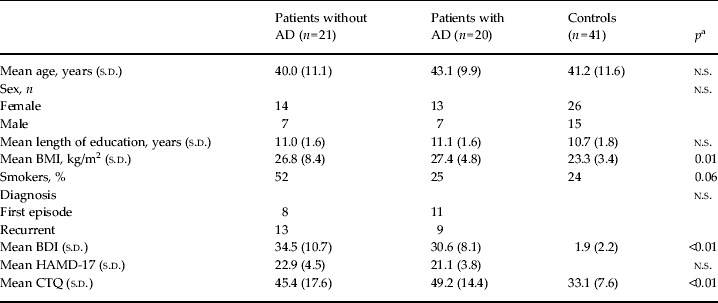
A control group of 41 healthy subjects matched for age, sex and years of education were enrolled in the study. Subjects were free of former and present DSM-IV Axis I disorders according to the Mini-International Neuropsychiatric Interview (Sheehan et al. Reference Sheehan, Lecrubier, Sheehan, Amorim, Janavs, Weiller, Hergueta, Baker and Dunbar1998), had no physical illness, and had been free of any medication for at least 3 months prior to study entry. The sociodemographic data are summarized in Table 1.
Demographic variables and psychopathology
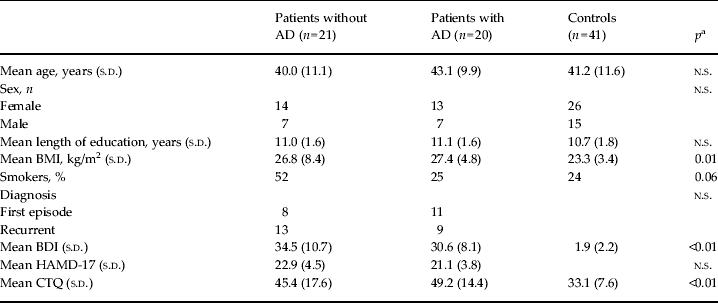
AD, Antidepressants; s.d., standard deviation; n.s., non-significant; BMI, body mass index; BDI, Beck Depression Inventory; HAMD-17, 17-Item Hamilton Depression Scale; CTQ, Childhood Trauma Questionnaire.
a Based on one-way analysis of variance for continuous variables and χ 2 for dichotomous variables.
The study was approved by the local ethics committee. After complete description of the study to the subjects, written informed consent was obtained.
Hormonal assessment
Salivary cortisol was collected on two consecutive days (preferably working days) at awakening, and at 30 and 60 min after awakening. All participants received oral and written instructions on the correct use of the Salivette® salivary collection device (Sarstedt, Germany). Participants were advised not to eat, drink, smoke, brush their teeth, or use mouthwash in the 30 min prior to salivary collection. Cortisol was determined by radioimmunoassay (DRG Diagnostics GmbH, Germany). Inter- and intra-assay coefficients of variation were below 8%. Detection limits were 0.5 ng/ml for cortisol.
Neuropsychological assessment
Auditory Verbal Learning Test (AVLT) (Lezak, Reference Lezak1995)
The AVLT is a measure of short-term and long-term verbal memory. The experimenter reads a list of 15 words (list A), which the participant is requested to repeat in loose order. After list A has been presented five times, the subject is asked to reproduce words from a newly presented list (list B). Following this, the subject is instructed to recall the words from list A without renewed presentation. After 30 min, the subject is again asked to repeat the words from list A.
Rey–Osterrieth Complex Figure Test (RCFT) (Osterrieth, Reference Osterrieth1944)
The RCFT measures visuospatial memory. The participant is first required to copy a complex figure. Immediately thereafter and 20 min later the figure has to be redrawn from memory. All memory tests were performed in the afternoon between 14.00 and 16.00 hours.
Statistical analyses
Differences in demographic characteristics between patient groups and HC were compared using univariate analysis of variance (ANOVA) for continuous variables and χ 2 tests for dichotomous variables. Cortisol values were averaged over 2 days for each time point. Repeated-measures ANOVA with cortisol values (awakening, 30 min, 60 min) as within-the subject factor and group as the between-subject factor was conducted.
For CAR, we also calculated the area under the curve (AUC) with respect to ground (AUCg) and to increase (AUCi) (Pruessner et al. Reference Pruessner, Kirschbaum, Meinlschmid and Hellhammer2003). AUCg is an estimate of total cortisol secretion within the first hour after awakening; AUCi a measure of the dynamic cortisol response.
Mixed ANOVAs were conducted to investigate differences in cortisol AUC values, AVLT and Rey scores between the two patient groups and HC.
To control for possible confounders, continuous variables were added as covariates while dichotomous variables were introduced as additional group factors into ANOVAs.
For exploratory purposes, correlation analyses for CAR and cognitive tests were applied and confirmatory regression analyses were conducted.
In all analyses, two-sided tests were used and as the nominal level of significance, α = 0.05 was accepted.
Results
There were no significant differences between groups on demographic variables except smoking and body mass index (BMI) (see Table 1). Only one woman in the patient group and none of the HC used oral contraceptives. Oral contraceptive use was therefore not controlled for.
Cortisol secretion
To test for possible confounders, smoking (as a group variable) and BMI (as a covariate) were added into the analysis of covariance (ANCOVA); however, smoking (p = 0.62) and BMI (p = 0.19) were not significantly associated with CAR and therefore omitted from the analysis. Weekday versus weekend sampling was added as a group factor; however, the day of sampling was not associated with CAR (p = 0.39).
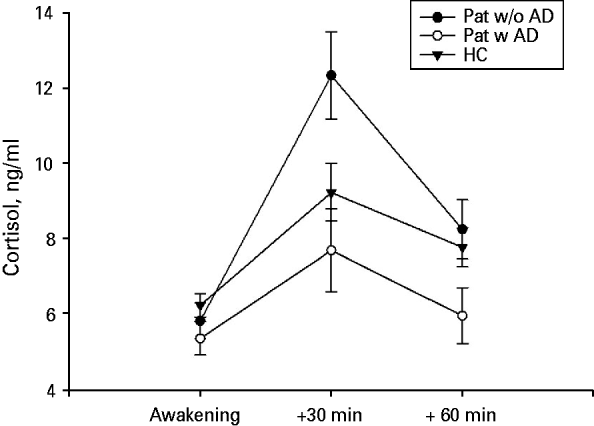
Repeated-measures ANOVA with three time points for CAR as the within-subject and group as the between-subject factor revealed a significant time effect (F = 34.2, p < 0.01) and a significant effect of group (F = 3.8, p = 0.03). Post-hoc tests (Tukey) showed that unmedicated patients had a significant higher CAR than medicated patients (p = 0.02), whereas differences between patient groups and HC were not significant (Fig. 1).
Cortisol awakening response across groups: patients treated without antidepressants (Pat w/o AD); patients treated with antidepressants (Pat w AD); healthy controls (HC). Values are means, with standard errors represented by vertical bars. Repeated-measures analysis of variance revealed a significant effect of group (p = 0.03).

ANOVA with the cortisol AUC with respect to ground (CARg) as the dependent variable revealed a significant effect of group (F = 5.1, p = 0.01). Post-hoc tests confirmed that unmedicated patients exhibited a greater CARg compared with medicated patients (p = 0.02) whereas differences compared with HC were not significant (p = 0.21). Medicated patients had a significantly smaller CAR than HC (p < 0.01). ANCOVA with the cortisol AUC with respect to increase (CARi) as the dependent variable revealed a significant effect of group (F = 3.3, p = 0.04). Post-hoc tests confirmed that medicated patients exhibited a smaller CARi compared with unmedicated patients (p = 0.01) and HC (p = 0.05) whereas differences between unmedicated patients and HC (p = 0.10) did not reach significance.
Memory function
To test if covariates were associated with memory, smoking (as a group variable) and BMI (as a covariate) were added into the ANCOVA; however smoking (p = 0.77) and BMI (p = 0.90) were not significantly associated and, therefore, omitted from the analysis.
ANOVA with Auditory Verbal Learning Task total score as the dependent variable revealed a significant effect of group (F = 3.52, p = 0.03). Post-hoc tests confirmed that unmedicated depressed patients were significantly impaired in verbal memory [AVLT total score, mean 77.8 (s.d. = 11.6), p = 0.01] whereas medicated depressed patients were impaired at trend level [AVLT total score, mean 80.1 (s.d. = 11.1)] when compared with HC [AVLT total score, mean 85.0 (s.d. = 10.1), p = 0.09]. Differences between both patients groups were not statistically significant (p = 0.52). Group differences regarding AVLT long-term memory did not reach statistical significance (p = 0.12).
Repeated-measures ANOVA with three time points of Rey figure (copy, direct recall, delayed recall) as the within-subject factor and group (patients without medication versus patients with medication versus HC) as the between-subject factor revealed a significant effect for group (p = 0.04). Post-hoc tests showed that unmedicated patients [Rey figure direct recall, mean 21.2 (s.d. = 6.7); delayed recall mean 21.0 (s.d. = 6.3)] were significantly impaired in non-verbal memory compared with medicated patients (Rey figure direct recall, mean 25.7 (s.d. = 5.2); delayed recall, mean 25.1 (s.d. = 4.9), p = 0.02] and compared with HC (Rey figure direct recall, mean 23.8 (s.d. = 5.7); delayed recall, mean 23.8 (s.d. = 5.7), p = 0.06] on trend level, whereas medicated patients and HC did not differ (p = 0.32).
Association of cortisol secretion and memory function
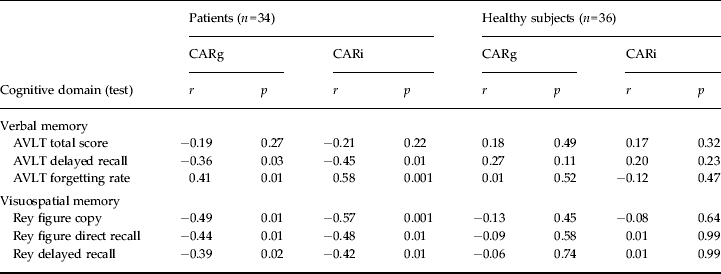
We pooled patient groups in correlation analyses for power reasons. In depressed patients, but not in HC, we found a negative correlation between salivary cortisol levels (AUC) and hippocampus-related neuropsychological domains (verbal memory, visuospatial memory; see Table 2).
Bivariate correlations between neuropsychological measures and salivary cortisol
CARg, Cortisol awakening response area under the curve with respect to ground; CARi, cortisol awakening response area under the curve with respect to increase; AVLT, Auditory Verbal Learning Test.
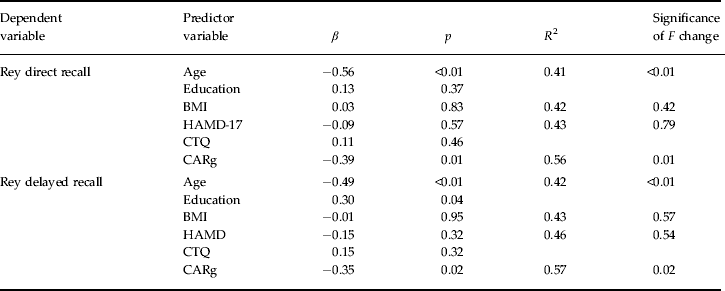
To further elucidate the association between CAR and memory function we conducted confirmatory linear regression analyses in the whole group (n = 66) with demographic variables (age, education) in step 1, BMI and sleep duration in step 2, psychopathology in step 3, and CAR in step 4.
The only predictors for non-verbal memory in the whole group were age (p < 0.01) and CARg (p < 0.01). Analysing the patients and HC separately, non-verbal memory was significantly associated with CARg in patients (see Table 3), but not HC.
Results of regression analyses in patients (n = 32)
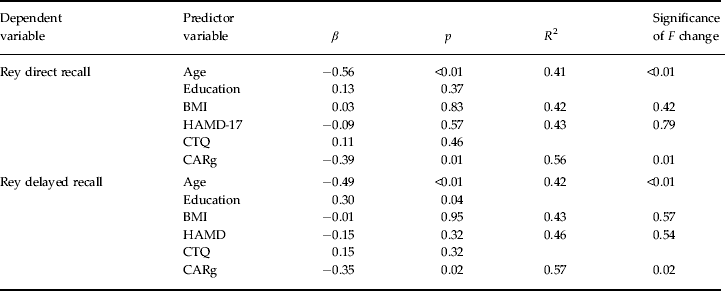
BMI, Body mass index; HAMD-17, 17-Item Hamilton Depression Scale; CTQ, Childhood Trauma Questionnaire; CARg, Cortisol awakening response area under the curve with respect to ground.
Verbal memory (AVLT total score, AVLT long-term memory) was not associated with age (p = 0.52), education (p = 0.12), BMI (p = 0.74), CTQ (p = 0.87) and BDI (p = 0.27). These confounders therefore were omitted from further analyses. Verbal memory was not significantly associated with CAR in the whole group. Analysing the patients and HC separately, AVLT long-term memory was associated with CARg (β = –0.36, t = –2.2, p = 0.04) in patients. AVLT total score was not significantly associated with CAR in regression analyses.
We did not find any associations between CAR and verbal memory in HC.
Discussion
In this study, we examined the association between CAR and memory function in medication-free depressed patients compared with depressed patients on antidepressant treatment and HC. Medication-free patients were impaired in memory function and showed a significant higher CAR compared with treated patients whose memory function did not differ from HC. After controlling for possible confounders, age and CAR were the only predictors of non-verbal memory and CAR the only predictor for verbal memory in patients.
Our results suggest a strong association between CAR and memory function. Our results further suggest that antidepressant treatment may reduce CAR and partially restore memory function even if depressive psychopathology is still present. However, due to the cross-sectional nature of our data, we cannot make definite inferences about causality. It is possible that a third factor (e.g. hippocampus damage) may have caused a smaller CAR and non-response to antidepressant treatment in the medicated patient group. However, if that were the case, one would expect a higher degree of memory impairment in that group. In contrast, memory was not significantly impaired in medicated patients in our study. Memory impairment was present in the unmedicated patient group only.
Interestingly, there is a growing literature supporting a causal role of elevated cortisol in cognitive deficits, e.g. detrimental effects of acute and chronic glucocorticoid treatment on cognition in healthy subjects (Het et al. Reference Het, Ramlow and Wolf2005; Lupien et al. Reference Lupien, McEwen, Gunnar and Heim2009) or improved memory function in depressed bipolar patients after blocking the glucocorticoid receptor (Young et al. Reference Young, Gallagher, Watson, Del-Estal, Owen and Ferrier2004; Watson et al. Reference Watson, Gallagher, Porter, Smith, Herron, Bulmer, Young and Ferrier2012).
Memory impairment and altered cortisol secretion and their association are frequently described in depression: six out of 11 studies found an association of memory performance and diurnal cortisol or alterations in the dexamethasone suppression test (Wingenfeld & Wolf, Reference Wingenfeld and Wolf2011).
Surprisingly, and to the best of our knowledge, only one study investigated the association of memory impairment in depressed patients with regard to CAR, which is a distinct phenomenon (Fries et al. Reference Fries, Dettenborn and Kirschbaum2009) superimposing the diurnal cortisol secretion of the HPA axis: Krogh et al. (Reference Krogh, Videbech, Renvillard, Garde, Jorgensen and Nordentoft2012) investigated a larger (mildly to moderately) depressed out-patient sample. However, neither did patients and controls differ regarding memory performance or CAR, nor was any association of CAR and memory performance visible in the patient group (in contrast, the authors found an association of post-dexamethasone cortisol level with memory in the healthy control group). Approximately two-thirds of that patient sample were on antidepressant medication, possibly restoring HPA axis activity and memory function in these patients. Furthermore, CAR was measured only once, which might have weakened the effect due to intra-individual variability (Hellhammer et al. Reference Hellhammer, Fries, Schweisthal, Schlotz, Stone and Hagemann2007).
In accordance with our study, Mannie et al. (Reference Mannie, Barnes, Bristow, Harmer and Cowen2009) found an increased CAR to be associated with memory impairment in first-degree relatives of MDD patients. Most other studies investigated the association of memory performance and diurnal cortisol (salivary or urinary free cortisol as well as plasma cortisol) or the association with the dexamethasone suppression test. Some studies (including our own group) found an association (Rubinow et al. Reference Rubinow, Post, Savard and Gold1984; Gomez et al. Reference Gomez, Fleming, Keller, Flores, Kenna, DeBattista, Solvason and Schatzberg2006, Reference Gomez, Posener, Keller, DeBattista, Solvason and Schatzberg2009; Hinkelmann et al. Reference Hinkelmann, Moritz, Botzenhardt, Riedesel, Wiedemann, Kellner and Otte2009); however, others did not (Adler & Jajcevic, Reference Adler and Jajcevic2001; Bremner et al. Reference Bremner, Vythilingam, Vermetten, Vaccarino and Charney2004; O'Brien et al. Reference O'Brien, Lloyd, McKeith, Gholkar and Ferrier2004; Vythilingam et al. Reference Vythilingam, Vermetten, Anderson, Luckenbaugh, Anderson, Snow, Staib, Charney and Bremner2004; Zobel et al. Reference Zobel, Schulze-Rauschenbach, von Widdern, Metten, Freymann, Grasmader, Pfeiffer, Schnell, Wagner and Maier2004; Reppermund et al. Reference Reppermund, Zihl, Lucae, Horstmann, Kloiber, Holsboer and Ising2007; Michopoulos et al. Reference Michopoulos, Zervas, Pantelis, Tsaltas, Papakosta, Boufidou, Nikolaou, Papageorgiou, Soldatos and Lykouras2008).
Interestingly, Egeland et al. (Reference Egeland, Lund, Landro, Rund, Sundet, Asbjornsen, Mjellem, Roness and Stordal2005) found a single morning cortisol sample (08.00 hours) to be associated with memory impairment in depressed patients, which may be at least in part due to the CAR.
There is some debate in the literature concerning which time point of elevated cortisol is more important regarding memory. In this study, we found morning cortisol to be associated with memory function which is in line with Egeland et al. (Reference Egeland, Lund, Landro, Rund, Sundet, Asbjornsen, Mjellem, Roness and Stordal2005) and Mannie et al. (Reference Mannie, Barnes, Bristow, Harmer and Cowen2009). Schatzberg and colleagues found most effects with evening cortisol (Gomez et al. Reference Gomez, Fleming, Keller, Flores, Kenna, DeBattista, Solvason and Schatzberg2006, Reference Gomez, Posener, Keller, DeBattista, Solvason and Schatzberg2009). However, the overall cortisol production of the first 45 min of awakening (as reflected by the AUC with respect to ground) is highly predicitve of the underlying diurnal HPA axis activity (Edwards et al. Reference Edwards, Clow, Evans and Hucklebridge2001).
Cortisol acts via mineralocorticoid and glucocorticoid receptors, which exhibit their highest density in the hippocampus (de Kloet et al. Reference de Kloet, Joels and Holsboer2005a; Otte et al. Reference Otte, Moritz, Yassouridis, Koop, Madrischewski, Wiedemann and Kellner2007, Reference Otte, Hinkelmann, Moritz, Yassouridis, Jahn, Wiedemann and Kellner2010). Therefore, we hypothesized that hippocampus-dependent cognitive domains would be impaired. Indeed, in unmedicated depressed patients, we found deficits in verbal and visuospatial memory as well as in visuoconstruction, which are all hippocampus-dependent domains and that were negatively correlated with the CAR in our study.
Another complementary mechanism for the association of HPA axis hyperactivity and cognitive deficits is inflammation: HPA axis hyperactivity is associated with activation of cytokines, which, again, is associated with cognitive impairment (Raison et al. Reference Raison, Capuron and Miller2006; Zunszain et al. Reference Zunszain, Anacker, Cattaneo, Carvalho and Pariante2011).
Study results regarding the association of CAR and depression are conflicting. Some studies found a blunted CAR in depression (Stetler & Miller, Reference Stetler and Miller2005; Huber et al. Reference Huber, Issa, Schik and Wolf2006) or in individuals with subclinical depressive symptoms (Dedovic et al. Reference Dedovic, Engert, Duchesne, Lue, Andrews, Efanov, Beaudry and Pruessner2010), which would be in line with the idea of depression being associated with hippocampal volume reduction (McKinnon et al. Reference McKinnon, Yucel, Nazarov and MacQueen2009) and hippocampal volume reduction or hippocampal damage being associated with an attenuated or abolished CAR (Buchanan et al. Reference Buchanan, Kern, Allen, Tranel and Kirschbaum2004; Dedovic et al. Reference Dedovic, Engert, Duchesne, Lue, Andrews, Efanov, Beaudry and Pruessner2010).
However, most studies point towards an increased CAR in currently depressed patients (Bhagwagar et al. Reference Bhagwagar, Hafizi and Cowen2005; Vreeburg et al. Reference Vreeburg, Hoogendijk, van Pelt, Derijk, Verhagen, van Dyck, Smit, Zitman and Penninx2009) as well as in remitted patients (Bhagwagar et al. Reference Bhagwagar, Hafizi and Cowen2003; Vreeburg et al. Reference Vreeburg, Hoogendijk, van Pelt, Derijk, Verhagen, van Dyck, Smit, Zitman and Penninx2009; Aubry et al. Reference Aubry, Jermann, Gex-Fabry, Bockhorn, Van der Linden, Gervasoni, Bertschy, Rossier and Bondolfi2010), which would be in line with a general overdrive of the HPA axis in depression (de Kloet et al. Reference de Kloet, Sibug, Helmerhorst and Schmidt2005b).
Furthermore, a higher CAR has been found to be a significant prospective risk factor for the development of MDD in young adults (Adam et al. Reference Adam, Doane, Zinbarg, Mineka, Craske and Griffith2010; Vrshek-Schallhorn et al. Reference Vrshek-Schallhorn, Doane, Mineka, Zinbarg, Craske and Adam2013) and seems to be increased in first-degree relatives of patients with MDD (Mannie et al. Reference Mannie, Barnes, Bristow, Harmer and Cowen2009; Vreeburg et al. Reference Vreeburg, Hartman, Hoogendijk, van Dyck, Zitman, Ormel and Penninx2010), implicating that an increased CAR might be a trait rather than a state factor.
Importantly, the CAR seems to be influenced by antidepressants (Manthey et al. Reference Manthey, Leeds, Giltay, van Veen, Vreeburg, Penninx and Zitman2011). A reduction of the CAR by antidepressant treatment would be in line with other studies showing a normalization of HPA axis activity after treatment in depressed patients (Vythilingam et al. Reference Vythilingam, Vermetten, Anderson, Luckenbaugh, Anderson, Snow, Staib, Charney and Bremner2004; Zobel et al. Reference Zobel, Schulze-Rauschenbach, von Widdern, Metten, Freymann, Grasmader, Pfeiffer, Schnell, Wagner and Maier2004; Aihara et al. Reference Aihara, Ida, Yuuki, Oshima, Kumano, Takahashi, Fukuda, Oriuchi, Endo, Matsuda and Mikuni2007; Schule, Reference Schule2007; Hinkelmann et al. Reference Hinkelmann, Moritz, Botzenhardt, Muhtz, Wiedemann, Kellner and Otte2012).
Antidepressant treatment and subsequent normalization of the HPA axis could be one factor for inconclusive results in the literature regarding the association of cortisol and memory in depression. To the best of our knowledge, only one study found a significant association between diurnal cortisol and memory in medicated patients: Gomez et al. investigated psychotic and non-psychotic depressed individuals and found a strong relationship between high cortisol and memory impairment that was driven by the psychotic depressed patients (Gomez et al. Reference Gomez, Fleming, Keller, Flores, Kenna, DeBattista, Solvason and Schatzberg2006). Psychotic depression is associated with a pronounced HPA axis disturbance, higher cortisol secretion and marked cognitive impairment (Schatzberg et al. Reference Schatzberg, Posener, DeBattista, Kalehzan, Rothschild and Shear2000). It may well be that insufficient antidepressant treatment is not able to restore HPA axis function in this group and therefore the high cortisol and memory impairment association remains visible.
Our study had several strengths. We examined treatment-seeking patients with moderate depression. We compared medicated and unmedicated patients, since medication status may be a contributing factor to conflicting results. We measured CAR on two consecutive days, thus reducing intra-individual variability.
However, several limitations must be acknowledged. We do not know if memory deficits and elevated cortisol existed prior to the onset of depression. Further, we do not have longitudinal data on the course of cognitive function and cortisol secretion after antidepressive treatment of the unmedicated patient group and we do not know the course of disease of the medicated patients. Finally, reduced hippocampal volume has been meta-analytically described in depression (McKinnon et al. Reference McKinnon, Yucel, Nazarov and MacQueen2009) and has been linked to both cognitive dysfunction and increased cortisol secretion (Belanoff et al. Reference Belanoff, Gross, Yager and Schatzberg2001). We did not measure hippocampal volume and thus do not know if elevated CAR and cognitive impairment in depressed patients in our study are associated with reduced hippocampal volume.
In summary, our results suggest that memory impairment appears to be related to cortisol secretion in depressed patients. Second, our results suggest a medication effect on both HPA axis activity and memory function. HPA activity may be a promising target to treat cognitive dysfunction in major depression.
Acknowledgements
We are grateful to the excellent technical assistance of Iris Remmlinger-Marten and Kirsten Huwald.
Declaration of Interest
K.W. served as a consultant to, or has been on the speakers' boards of, Astra Zeneca, Bristol Myers Squibb, Janssen, Pfizer, Servier and Wyeth. C.O. has received honoraria fees for lectures from Astra Zeneca, Berlin-Chemie, Lundbeck and Servier. K.H., C.M., L.D., A.A., S.M., K.W., C.S. and S.G. report no conflict of interest.