INTRODUCTION
In Mexico, beans (Phaseolus vulgaris L.) are one of the most important legumes, not just because of the significant cultivated area but also for their cultural role as a food source. Beans (Phaseolus vulgaris L.) demand high amounts of nitrogen due to the high seed protein content (20–22%). Symbiotic nitrogen fixation is often suboptimal, because Rhizobium-legume symbiosis is affected by many factors, like soil pH, temperature and humidity; in addition, high levels of nitrogen can inhibit nodulation. Nitrogen fixation among isolates is not consistent due to nodulation promiscuity, as some strains show high infection rates but low nitrogen fixation rates; therefore, some farmers apply synthetic nitrogen fertilisers, as in the state of Sinaloa, Mexico, where the synthetic doses applied vary between 80 and 120 kg of nitrogen per ha−1, mainly in the form of ammonium (NH4). The misuse and overuse of these inputs have resulted in increased production costs and negative environmental impacts, and often cause direct damage to human health from consumption of water with high nitrate levels (WHO, 2011).
Plant growth-promoting rhizobacteria (PGPR) are beneficial soil bacteria that colonise plant roots and promote plant growth through various mechanisms, such as production of growth-regulating substances (Verma et al., Reference Verma, Yadav, Tiwari, Lavakush and Singh2010), solubilisation of mineral nutrients (Gyaneshwar et al., Reference Gyaneshwar, Kumar, Parekh and Poole2002), and increased volume of roots and nitrogen fixation (Verma et al., Reference Verma, Yadav, Tiwari, Lavakush and Singh2010).
Rhizobium bacteria are included in the PGPR family mainly for their ability to fix atmospheric nitrogen when associated with leguminous plants and to promote the growth of crops, including non-legumes, through the synthesis of phytohormones, P solubilisation, siderophore production and metabolites that inhibit the growth of pathogens (Ahmed et al., Reference Ahmed, Elhassan, Abdelgani and Abdalla2011; Figueiredo et al., Reference Figueiredo, Martinez, Burity and Chanway2008; Gyaneshwar et al., Reference Gyaneshwar, Kumar, Parekh and Poole2002; Verma et al., Reference Verma, Yadav, Tiwari, Lavakush and Singh2010).
The genus Bacillus, also considered PGPR, has been widely studied for its effects in promoting plant growth, through direct mechanisms such as solubilisation of inorganic or organic phosphate (Gyaneshwar et al., Reference Gyaneshwar, Kumar, Parekh and Poole2002) or by producing growth regulators like indole acetic acid, cytokinins and gibberellin. Bacillus organisms can also promote plant growth through indirect mechanisms of plant protection, producing either antibiotics or chitinase-type substances capable of inhibiting the growth of pathogens.
Synergistic interactions have been reported among some Bacillus and Rhizobium strains in relation to nodulation, nitrogen fixation and yields of leguminous plants under either greenhouse or field conditions (Ahmed et al., Reference Ahmed, Elhassan, Abdelgani and Abdalla2011). In plants of common beans and soybeans, biological nitrogen fixation (BNF) increases in crops when Bacillus spp. is combined with Rhizobium or Bradyrhizobium, respectively (Srinivasan et al., Reference Srinivasan, Petersen and Holl1997). In greenhouse experiments, the co-inoculation of Rhizobium phaseoli with Bacillus spp. increases significantly the dry weight of roots, phosphorus concentration and nodulation and BNF efficiency in beans compared to the individual application of Rhizobium (Figueiredo et al., Reference Figueiredo, Martinez, Burity and Chanway2008).
Considering nodulation promiscuity (Michiels et al., Reference Michiels, Dombrecht, Vermeiren, Xi, Luyten and Vanderleyden1998) and all other nodulation-limiting factors, it is recommended to use as inoculants native Rhizobium adapted to environmental conditions specific to each region to achieve a better efficiency in the field.
Based on all the aforementioned factors, the objectives of this work were to: (1) isolate new native Rhizobium and Bacillus strains from Mexican soils that promote bean (Phaseolus vulgaris L.) growth, (2) evaluate the synergistic co-inoculation of Rhizobium and Bacillus (Rz + Bs) isolates as biofertilisers on Sinaloa's bean-growing fields, and (3) study the interaction of Rhizobium and Bacillus with inorganic fertilisers in the cultivation of beans under fertigation.
MATERIALS AND METHODS
Greenhouse selection of Rhizobium isolates
Rhizobium isolates were recovered from nodules of beans when plants were at the flowering stage during the autumn-winter crop season of 2009 from different fields located in northern Sinaloa state in Mexico.
In the laboratory, nodules that were larger and pink inside were selected, and immersed in 95% ethanol for 1–4 min. The nodules were sterilised by dipping them in 5% (v/v) sodium hypochlorite solution for 4 minutes and, then, washed 5–6 times in sterile water. The nodules were crushed and the juice transferred to congo-red yeast manitole agar media for growth (Vincent, Reference Vincent1970).
Bean seeds were planted in plastic pots with peat moss substrate plus soil (ratio, 2:1) previously subjected to solarisation. An inoculum of Rhizobium was prepared in yeast mannitol broth medium, incubated at 28 ± 2 °C under shaking at 100 rpm for three days. In the inoculated treatment, each plant received, at 15 days after planting (dap), rhizobia from a liquid culture that was washed and resuspended in 10 mL sterile water to a density of approx. 106 CFU mL−1. For inoculation, 1.5 mL of bacterial suspension was poured directly onto plants in each container; control seeds received 1.5 mL of water only. This was done for 15 native isolates of Rhizobium, each isolate was a treatment, a control (not inoculated and unfertilised) was also included. At 20 dap, Jensen's (Reference Jensen1942) nitrogen-deficient solution was applied to all treatment groups, including the control.
At the beginning of flowering (40 dap), the following variables were evaluated: plant height, foliar dry weight, root volume, number of nodules per plant and dry weight of nodules of beans to select only one Rhizobium isolate to test in the field.
Greenhouse selection of Bacillus isolates
From a previous collection of 50 isolates of Bacillus, some obtained from the rhizosphere of beans, others from corn and tomato farming areas of northern Sinaloa, 15 were randomly chosen and grown in potato dextrose medium (PD: potato, 200 g; dextrose, 20 g; and distilled water, 1 L), at 25 °C for 48 h and pasteurised at 80 °C for 15 minutes, then plated onto nutrient agar and incubated at 30 °C. Gram's stain and spore formation test were positive for these pure cultures.
The beans were sown in pots with soil peat moss substrate (ratio, 2:1) with prior solarisation treatment. The inoculum was prepared by growing Bacillus strains in 50% tryptic soy broth for 3 days (25 °C, 120 rpm), followed by centrifugation (approx. 3000 rpm for 15 min), washing, and resuspension in 10 mL sterile water to a density of approx. 107 CFU mL−1. For inoculation, 1.5 ml of a bacterial suspension was poured directly onto plants in each container; control plants received 1.5 ml of water only. At the beginning of flowering (40 dap), plant height, foliage dry weight and volume of roots were measured and tested in the greenhouse, and one isolate was selected for further field studies based on its effects on promoting seedling growth.
Molecular identification of Bacillus and Rhizobium strains
Extraction of DNA from Bacillus isolate Bs14 and Rhizobium isolate CIIDIR 13 was done using DNAzol reagent (Invitrogen) according to the manufacturer's protocol. Amplification of the 16S ribosomal DNA sequence of Bs14 was done using primers F (5´-AGAGTTTGATCATGGCTC-3´) and R (5´-ACGGGCGGTGTGTAC-3’), F (5´-ATCACCTCCTTAAGGGCGAATTC-3´) and R(5´- GAATTCGCCCTTAAGGAGGTGATCCAGCC) was used for CIIDIR 13. The fragments were cloned into TOPO2.1 (Invitrogen) and sequenced, and these sequences were compared with GenBank sequences using the NCBI BLAST tool.
Statistical analysis of Bacillus and Rhizobium treatments
The distributions of greenhouse treatments to select the Rhizobium and Bacillus strains were arranged in a completely randomised design with three replicates. For each variable evaluated, an ANOVA and Tukey mean test (p ≤ 0.05) were applied. All the data were analysed with the SAS statistical package.
Fieldwork
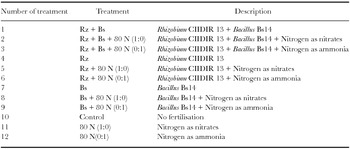
The fieldwork was established at the experimental research station of CIIDIR-IPN, located in Guasave, Sinaloa, Mexico, in soil with low organic matter content, without problems of salinity, and with a neutral pH, during the autumn-winter crop season of 2010–2011. Beans Azufrado Higuera (Nueva Granada race) were grown under a drip irrigation system. A total of 12 treatments were evaluated (Table 1), the experimental design was a random block with three replications. The experimental unit consisted of four rows of 10 m long, 80 cm apart, leaving 2-m spaces between blocks.
Treatments applied to the bean cultivar Phaseolus vulgaris L. var. “azufrado higuera” in field experiments. Rz = Rhizobium CIIDIR 13 isolate (previously selected in the greenhouse); Bs = Bacillus Bs14 isolate (previously selected in the greenhouse); control = no inoculation nor nitrogen application. 80 N (1:0) represents 80 kg N ha−1, using nitrate (NO3) as nitrogen source; 80N (0:1) represents 80 kg N ha−1, using ammonium (NH4) as nitrogen source.

As the source of nitrogen fertiliser, we used calcium nitrate [Ca(NO3)2], and as the ammonia source we used ammonium sulphate (NH4SO4). CIIDIR 13 was the Rhizobium strain, and it was applied at a dose of 3 L ha−1 to a density of approx. 106 CFU mL−1 (inoculum preparation is described above); Bs14 was the Bacillus isolate, used at a dose of 6 L ha−1 to a density of approx. 107 CFU mL−1 (inoculum preparation is described above). The variables evaluated were foliar nutrient concentration at flowering stage, number of nodules per plant, dry weight of nodules and grain yield.
Nutrient measurement
Foliar nitrogen concentration was measured using the micro-Kjeldahl method according to Ma and Zuazaga (Reference Ma and Zuazaga1942), and phosphorus was determined using the vanadate-molybdate method (Tandon et al., Reference Tandon, Cescas and Tyner1968). Other mineral element levels (K, Ca, Mg) were determined by atomic absorption spectrophotometry using lanthanum to mask interference (Gaines and Mitchell, Reference Gaines and Mitchell1979).
RESULTS
Selection of native strains of Rhizobium in the greenhouse
The height of those plants treated with CIIDIR 13 and CIIDIR 7 significantly exceeded (p ≤ 0.05) the control, and CIIDIR 13 produced the tallest plant (height, 54.6 cm); the control was the shortest (23.6 cm). Similarly, for foliar dry weight, CIIDIR 7 and CIIDIR 13 presented the highest values and exceeded statistically the control level, with CIIDIR 13 showing a stronger effect than CIIDIR 7 for this trait. As for the number of nodules per plant and nodule dry weight, treatments with CIIDIR 1, CIIDIR 2, CIIDIR 7, CIIDIR 9, CIIDIR 11 or CIIDIR 12 were statistically (p ≤ 0.05) different from the control (Supplementary Table S1 available online at http://dx.doi.org/10.1017/S0014479715000010); for these parameters, treatment with CIIDIR 13 was surpassed by other treatments, but CIIDIR 13 produced the highest dry weight when considering total nodule dry weight over the number of nodules. Root volume was not statistically affected by any treatment.
Selection of native isolates of Bacillus spp. in the greenhouse
The best plant height was obtained with treatment of Bs29 (45.66 cm); plants treated with Bs19 (45.3 cm), Bs14 (43.17 cm) or Bs44 (44.17cm) were all significantly taller than the control, whereas for foliar dry weight, the treatment with Bs14 was the only one that was statistically different from the control, at 2.63 g whereas the control weighed 1.51 g. In terms of root volume, there were no statistically significant differences among treatments; hence, for the analysis of the effects on both height and foliar dry weight, we selected isolate Bs14 to be tested in the field (Table S2).
Molecular identification of Bacillus and Rhizobium strains
The Bacillus strain Bs14 ribosomal 16S DNA sequence shares 95% identity with the EU652058.1 sequence from GenBank, suggesting that Bs14 is indeed a Bacillus strain. The ribosomal 16S DNA sequence of Rhizobium CIIDIR 13 aligned with the sequence JX436337.1 with a 97% identity; thus, CIIDIR 13 was identified as a Rhizobium strain.
Field: foliar nutrient concentration
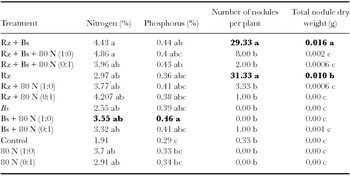
The highest foliar concentrations of nitrogen were found in those plants treated with Rz + Bs or Rz + Bs + 80N (1:0), with 4.43% and 4.86% concentrations, respectively, and both outperformed at a statistical level the control without nitrogen or inoculation (1.91%). The treatment Rz + Bs + 80N (1:0) with nitrates was better than Rz + Bs + 80N (0:1), which contained ammonium (Table 2). A higher foliar concentration of phosphorus (0.46%) was present in plants treated with Bs + 80N (1:0), and this exceeded statistically the 80N (1:0) treatment with nitrates and 80N (0:1) with ammonia, as well as the control (Table 2). For potassium, calcium, magnesium, zinc, manganese and copper, there were no statistically significant differences between treatments and the control (p ≤ 0.05).
Foliar nutrient concentration and number of nodules per plant and nodule dry weights in beans treated with different fertilisation methods under field conditions. Means with the same letter for each column are statistically equal, Tukey (p ≤ 0.05). 80 N (1:0) represents 80 kg N ha−1, using nitrate (NO3) as the nitrogen source; 80N (0:1) represents 80 kg N ha−1, using ammonium (NH4) as the nitrogen source.

Field: number of nodules and nodule dry weight
The treatments Rz + Bs and Rz were significantly more effective than the control regarding nodule formation, although the combination Rz + Bs led to a higher nodule dry weight (0.016 g) than treatment with Rz (0.010 g) (p ≤ 0.05) (Table 2). The diminished number of nodules and total dry weight of nodules in the Rz + Bs + 80N (1:0) and Rz + Bs + 80N (0:1) treatments demonstrated that the synthetic nitrogen fertiliser affected nodulation, and ammonium had a more detrimental effect than nitrates in this study.
Field: grain yield
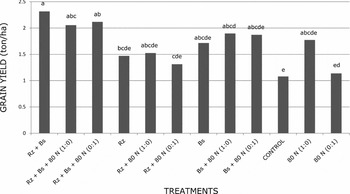
The Rz + Bs treatment had the highest grain yield, 2.3 t ha−1, and surpassed the Rz + 80N (0:1), 80N (0:1), Rz treatments, and the control. Overall, treatments with Bacillus isolate Bs14 performed better with regard to grain yield, and this trend is illustrated in Figure 1. The lowest yields were obtained with the ammonium treatment 80N (0:1), (1.13 t ha−1) and the control (1.08 t ha−1).
Grain yield. Means with the same letter for each column are statistically equal, Tukey (p ≤ 0.05).

DISCUSSION
The Rhizobium isolate CIIDIR 13 was selected in greenhouse tests over all others for its effects on plant height and foliar dry weight; although the number of nodules per plant was not significantly different from the control, nodule dry weight per nodule was higher, and this could be due to plant negative autoregulation of nodulation (Den Herder and Parniste, Reference Den Herder and Parniske2009), Bacillus isolate Bs14 has been shown to be the best plant growth promoter in the greenhouse, as it not only increases plant height but also foliar dry weight.
Sequences of 16S ribosomal DNA of Bs14 suggested this isolate is a Bacillus strain, whereas CIIDIR 13 sequences of the 16S ribosomal DNA confirmed the isolate is a Rhizobium, but it was not possible to identify the species. Therefore, further amplification of other genes, like nodC or nifH, and other biochemical assays might be needed to determine the species of each strain.
Bacillus isolate Bs14, when combined with nitrogen in the form of nitrates, had a higher assimilation of phosphorous in the plant; the mechanism(s) for this remains to be elucidated, but solubilisation of either inorganic or organic phosphorous might account for this effect, as Bacillus strains have been described as effective phosphate solubilizers (Rodriguez and Fraga, Reference Rodriguez and Fraga1999)
In field experiments, Rz + Bs and Rz + Bs + 80N (1:0) were the treatments that produced the highest plant nitrogen concentrations, because of the synergistic action of both PGPR; treatment with Rz + Bs + 80N (0:1) with ammonium did not produce the same effect, probably due to the inhibition of nodulation by ammonium.
Treatments with Rz and Rz + Bs showed in the field the highest number of nodules per plant, with 31.33 and 29.33 nodules/plant, respectively; these values were statistically superior to all other treatments. In this experiment, fertilisation with both sources of nitrogen negatively affected nodule formation, and these results are in agreement with those reported by Buttery et al. (Reference Buttery, Park and Findlay1986). In addition, nitrogen fertilisation with nitrates did not affect plant nitrogen foliar concentration compared with the application of ammonium. In this study, the control presented low nodulation (0.33), which might be attributed to the presence of native strains of Rhizobium with low infection rates (Michiels et al., Reference Michiels, Dombrecht, Vermeiren, Xi, Luyten and Vanderleyden1998).
Nodulation is inhibited by synthetic fertilisation with nitrates and ammonium, and the latter has a more detrimental effect, probably because ammonium, which is believed to be the main nitrogen transport form for the symbiosome (Den Herder and Parniske, Reference Den Herder and Parniske2009), has higher affinity to receptors of Rhizobium. Another plausible explanation is that ammonium reaches Rhizobium more effectively than nitrates, although this remains to be studied.
The variable dry weight of nodules was significantly increased in the Rz + Bs treatment group (0.016 g) compared to treatment with Rz (0.010) (p ≤ 0.05) (Table 2); in addition, nodules obtained in the Rz + Bs treatment group had the highest per unit dry weight (0.00054 g) compared to the dry weight of nodules in the Rz treatment group (0.00031 g). These findings are related to the reported effects of plant growth-promoting bacteria of the genus Bacillus, which improve plant nutrition and promote rhizobia efficiency within nodules (Camacho et al., Reference Camacho, Santamaría, Temprano, Rodriguez-Navarro and Daza2001).
In the field, fertilisation with Rz + Bs produced a better grain yield than fertilisation with ammonium, although compared with nitrogen fertilisation using nitrates, no statistical differences were found, which suggests that biological fertilisation can replace synthetic fertilisation. As shown in Figure 1, the treatment with Bacillus Bs14 improved grain yield, and its combination with Rz had a synergistic effect for this trait. It is possible that improved bean growth induced by this Bacillus strain is the result of enhanced N fixation, since somewhat enhanced dry weight of nodules and high plant nitrogen concentration in plant were detected in those treatments where Rz was co-inoculated with Bs. This effect has been reported by other authors (Srinivasan et al., Reference Srinivasan, Petersen and Holl1997).
Our results agree with other reports indicating improved legumes yield, health and nodulation when co-inoculating with PGPB, as compared to inoculation with Rhizobium alone (Egamberdieva et al., Reference Egamberdieva, Berg, Lindström and Räsänen2010, Shweta et al., Reference Shweta, Maheshwari, Dubey, Arora, Bajpai and Kang2008; Valverde et al., Reference Valverde, Burgos, Fiscella, Rivas, Velazquez, Rodriguez-Barrueco, Cervantes, Chamber and Igual2006, Yadegari et al., Reference Yadegari, Asadi, Noormohammadi and Ayneband2010).
Finally, results of this study support the use for Phaseolus vulgaris of biofertilisation, with inoculants such as the Rhizobium isolate CIIDIR 13 and Bacillus isolate Bs14, in replacement of synthetic fertilisation, in the fields of northern Sinaloa, Mexico.
SUPPLEMENTARY MATERIAL
To view supplementary material for this article, please visit http://dx.doi.org/10.1017/S0014479715000010