


Introduction
This is the first multi-site controlled trial of Anger Management training in Caribbean prisons. It was conducted in 2012–2015 across four correctional facilities on the island of Trinidad (estimated population 1.3m in 2014). As far as we have been able to ascertain, this may be the first controlled trial of any cognitive behavioural therapy (CBT)-based intervention within the Caribbean region.
CBT-based Anger Management programmes for offenders are now well established in developed-world Anglophone countries (e.g. Heseltine, Day and Sarre, Reference Heseltine, Sarre and Day2011). These CBT programmes have generally been shown to be effective in decreasing inappropriate expression of anger (Howells et al., 2005; Schamborg, Tully and Browne, Reference Schamborg, Tully and Browne2015), even when taking account of demographic variables such as age, gender, type of offence and ethnicity (Buttell and Carney, Reference Buttell and Carney2005; Cameron and Telfer, Reference Cameron and Telfer2004; Goldstein et al., Reference Goldstein, Serico, Romaine, Zelechoski, Kalbeitzer and Kemp2013; Ireland, Reference Ireland2004; Sorensen and Cunningham, Reference Sorensen and Cunningham2010) or when categorized by setting, comorbidities and methods of delivery (Davey, Day and Howells, Reference Davey, Day and Howells2005; Day, Kozar and Davey, Reference Day, Kozar and Davey2013; Hornsveld, Reference Hornsveld2005; Wilson et al., Reference Wilson, Gandolfi, Dudley, Thomas, Tapp and Moore2013; Wydo, DiGiuseppe and Unger, Reference Wydo, De Guiseppe and Unger2013). The quality of these studies is, in general, not high. Applying the quality framework proposed by Downs and Black (Reference Downs and Black1998), a systematic review identified 10 trials published between 1997 and 2014, which achieved scores ranging between 11 and 15 out of a total of 26: a mean of around 50% (see online Supplementary Materials).
There were two motivations underlying this project. The first was to have a positive impact on some of the underlying behavioural problems likely to be at the base of the great social concern caused by violent crime in Trinidad and Tobago. The United States Department of State Bureau of Diplomatic Security (2015) “. . . considers crime in Trinidad and Tobago to be rated at a Critical level. Crime is the principal threat to visitors. . . . Violent crime is a concern for local security services and the general population. . . . The murder rate for Trinidad and Tobago is 31 per 100,000 inhabitants”. Crimes against the person that are primary due to uncontrolled anger and aggression - murders, manslaughter, wounding (felonious), woundings and assaults causing bodily harm and other crimes against the person - continue to be dramatically high in Trinidad and Tobago (e.g. 3,550 in 2005: Trinidad and Tobago, Ministry of Planning and Development, Central Statistical Office, 2009). The Republic of Trinidad and Tobago Final Report of the Cabinet Appointed Task Force on Prison Reform and Transformation notes that “The number of long sentences for violence, i.e. Crimes against the person has increased. . . .There is an increase in the number of young inmates convicted of crimes of violence serving first sentences.” (Trinidad and Tobago, Ministry of Planning and Development, Central Statistical Office, 2000, p.154). The relative levels of violent crime in Trinidad are now considerable higher than in other countries with Caribbean, African and Indian Diaspora. For example ‘murder by youths’ in Trinidad is 1,267% higher than in the UK (11.4 in TT and 0.9 in UK per 100,000 population - World Health Organization, World Report on Violence and Health, 2002). In addition, few perpetrators of the violent crimes reported in Trinidad are caught and sent to prison (10%: Trinidad and Tobago, Ministry of Planning and Development, Central Statistical Office, 2000). Further, of the few that do get caught and serve a custodian sentence, as many as 65% re-offend when they are returned to their communities (Republic of Trinidad and Tobago Final Report of the Cabinet Appointed Task Force on Prison Reform and Transformation, 2002). Further, following their analysis of the Central Statistics Office data on the prison population of Trinidad and Tobago, the Cabinet Appointed Task Force on Prison Reform and Transformation concluded that the average number of offenders released “. . . is a direct threat to Public Safety” (Republic of Trinidad and Tobago Final Report of the Cabinet Appointed Task Force on Prison Reform and Transformation, 2002, p. 234). The justified fear of crime and personal victimisation is a major issue within Trinidadian communities (Boufoy-Bastick, Reference Boufoy-Bastick2009), and public expressions of anger and aggression have become a part of the social landscape. Anger and aggression are certainly not isomorphic, since either can be present in the absence of the other (Averill, Reference Averill1983), but anger is considered to be a particularly important antecedent of aggression (Novaco, Ramm and Black, Reference Novaco, Ramm, Black and Hollin2001), related to poor impulse control (Krakowski, Reference Krakowski2003; Witt, van Dorn and Fazel, Reference Witt, van Dorn and Fazel2013), and the purpose of referrals for anger treatment in a forensic context is typically to reduce the risk of occurrence of violent behaviour (Day and Vess, Reference Day, Vess and Fernandez2013). The focus of this study was prison inmates who had difficulties in managing anger, rather than violent prisoners per se, a proportion of whom use aggression and violence instrumentally in pursuit of their goals and require a different treatment approach (Serin, Reference Serin1994).
Second, the research also served the pedagogic and professional purpose of closing the research-practitioner gap in the Caribbean (Harding, Rush, Arbuckle, Trivedi and Pincus, Reference Harding, Rush, Arbuckle, Trivedi and Pincus2011). For example, over 130 compulsory research projects have been passed in the UWI Masters of Clinical Psychology programme – the best established clinical psychology programme in the region. Most research projects have utilized correlations between non-standard survey questions. None have been control trials using standardized outcome measures. For this research, following Long (Reference Long2008), a practitioner base of 24 Clinical Masters students were trained in the rigour of standardized outcome measurement of control trials to improve the research standards of regional practitioners. The project thus provided an opportunity to develop research and clinical skills in the same context.
The aim of this research was to evaluate an adapted CBT-based group anger management programme for prisoners who were identified as having difficulties with their management of anger within the prison service in Trinidad. A range of programmes for CBT-based Anger Management have been developed, including programmes for people with disabilities (e.g. Willner et al., Reference Willner, Rose, Jahoda, Kroese, Felce and Cohen2013): this programme has been subject to a rigorous controlled trial and has shown positive outcomes for participants. Given that the prevalence of intellectual disability can be high in prisons, as shown in countries where there are active diversion programmes for people with disabilities (e.g. Hayes, Shackell, Mottram and Lancaster, Reference Hayes, Shackell, Mottram and Lancaster2007) it was considered that this model could form a useful basis for intervention in a Caribbean Prison population.
The evaluation was designed as a control trial and it was predicted that participants in the intervention would develop coping skills and reduce levels of expressed anger.
Method
Participants and settings
Participants were recruited from among inmates in four prisons in Trinidad: a (male) maximum security prison, male and female general prisons, and a (male) young offenders’ institution. The study received ethical approval from the University of the West Indies, and was also approved by the Trinidad and Tobago Prison Service. The authors assert that all procedures contributing to this work complied with the ethical standards of the relevant national and institutional committees on human experimentation and with the Helsinki Declaration of 1975, and its most recent revision.
Prison officers from the four prisons were briefed about the programme at a management meeting and tasked with disseminating the information to inmates who could choose to attend the programme as part of the prison's Rehabilitation Services. (There was one exception, a male murderer whose death sentence was commuted to include Anger Management training.) All inmates were informed that Anger Management was an additional educational service option and that they could choose to attend the first information and selection session if they wanted to opt for the programme. They were also told they could still choose from the other educational service options – mainly vocational training courses – if after attending the session they decided the programme “was not for them” or if they were not selected for the programme. In addition, officers specifically spoke to inmates they personally considered “at risk”, recommending that they to come to the information and selection session. Volunteers were excluded if their release dates were within 6-months of the anticipated start date. Attendance at another psychological treatment and/or rehabilitation programme that could confound the intervention was another exclusion criterion but in practice this did not apply to any of the potential participants. Within each of the three male prisons, participants were allocated randomly, on a 2:1 (intervention:control) basis, to one of three groups of n = 7–9. Owing to difficulties of access, recruitment was lower in the women's prison, resulting in two intervention groups of n = 5 and a control group of n = 3. Participants gave informed consent to both the intervention and research participation.
Assessments were conducted and group sessions held in educational or multi-purpose areas within each prison, to which participants were escorted by prison officers. For the safety of the clinical researchers, security officers were stationed within earshot of, and with rapid access to, the session areas. Staffing, communication and logistical issues, including prison lockdowns, altercations between officers and inmates, and frequent reassignment of senior and junior prison staff, meant that attendance at group sessions was variable and although all intervention sessions were eventually held, some intervention and planned assessment sessions were inevitably delayed.
Intervention
The intervention was a 12 x 2h-session manualized anger management procedure that was developed and validated for people with mild intellectual disabilities (Willner et al., Reference Willner, Rose, Jahoda, Kroese, Felce and Cohen2013). (This choice was based on the assumption that many prison inmates with anger management problems would have IQs in the borderline or mild intellectual disability range as well as low levels of literacy – as was the case: see Results). Topics addressed over sessions included: the triggers that evoke anger; physiological and behavioural components of anger; behavioural and cognitive strategies to avoid the build-up of anger and for coping with anger-provoking situations; and acceptable ways of displaying anger (assertiveness). Presentation relied heavily on brainstorming (e.g. “What makes us angry?”) and role-play. After the first session, about a third of each session was devoted to discussion by facilitators and group members of one or two participants’ recent personal experiences, focusing primarily on problem solving ways in which situations might have been handled differently to produce a better outcome. In addition to simplifying the language used in sessions, the use of written materials was avoided wherever possible, in favour of pictorial representations. Towards the end of every session, participants were asked to undertake a homework assignment. This consisted of completing a functional analysis (hassle log) of a situation in which they had been angered that week. This was then described, analysed and evaluated, using a pictorial work-book.
Procedure
Initially, an intensive training session was held over 2 days in which an experienced UK consultant clinical psychologist trained 14 Masters level clinical psychologists on the use of the intervention manual. Subsequently, staff mobility necessitated the training of a further 10 Masters level clinical psychologists. The clinical researchers also received eight half-day training workshops in interviewing and in administering the screening and assessment instruments. While having a general familiarity with CBT techniques, none of these clinical researchers had any relevant prior experience of delivering CBT for anger problems or conducting assessments with prisoners.
An initial approach was made to the Assistant Commissioner of Prisons, who gave permission to approach individual prison governors. The governors identified groups of prison staff who (a) could suggest inmates who might benefit from an anger management intervention and (b) who might be interested to participate in delivery of the intervention. Twenty officers volunteered (average age 38 and 9 years of prison service). They completed the Anger Readiness to Change (ARTC) questionnaire (Williamson, Day, Howells, Bubner and Jauncey, Reference Williamson, Day, Howells, Bubner and Jauncey2003), and the three in each prison with the highest scores on that measure were selected. In light of the positive effects of the Relational Therapy model (Dalenberg, Reference Dalenberg2004; Tite, Reference Tite2013), it had been intended that any unresolved officer anger issues would be utilized to enhance inmates’ rapport and acceptance of the officers as lay therapists. However, at the insistence of the prisons’ psychologist, the officers experienced their own Anger Management training over four intensive 4-hour training sessions provided by the clinical researchers. These additional personal experiences were also used to augment the planned subsequent training of the officers by the clinical researchers to act as “lay therapists” (Willner et al., Reference Willner, Rose, Jahoda, Kroese, Felce and Cohen2013) in leading the inmate sessions. Each group session was then delivered and/or observed jointly by two clinical researchers and two prison officers. The clinical researchers assigned to each group also reported on the quality of delivery of the intervention, and that in practice some of the prison officers participated to a relatively minor extent. Because of difficulties of access, it was not possible to monitor group sessions to provide an independent evaluation of the fidelity of delivery of the manual.
Owing to the vicissitudes of prison life the time-tabling of the sessions was independent in each prison and, to a lesser extent, this was also true of the two groups within each prison. For any group, different clinical researchers were involved in delivery of the intervention and assessment of participants, such that researchers conducting the assessments were blind to group allocation. Assessment consisted of a set of baseline assessments, and a set of outcome assessments that were conducted shortly before the start of the intervention (Time 1), 1–3 weeks after the final intervention session (Time 2), and for some participants, 4 months later (Time 3). In addition to the measures described, some additional assessments were completed, the results of which will be reported separately.
Baseline measures
Demographic information was obtained from self-report and prison records on age, gender, ethnicity, severity of the index offence (coded on a 4-point scale where 1 represents minor offences, such as drunk driving, and 4 represents the most serious offences, including murder), and some other variables that are not reported here.
Full-Scale IQ was measured using the Wechsler Abbreviated Scale of Intelligence (WASI-2: Wechsler and Zhou, Reference Wechsler and Zhou2011), comprising two verbal and two non-verbal subtests.
Psychological distress was measured using the Global Severity Index of the 90-item Symptom Check-List (SCL-90 revised), which is the mean response-score across the 90 items (Derogatis and Unger, Reference Derogatis and Unger2010).
The 12-item Anger Readiness to Change Questionnaire (Williamson et al., Reference Williamson, Day, Howells, Bubner and Jauncey2003), which comprises three 4-item subscales addressing the Pre-contemplation (P), Contemplation (C) and Action (A) stages of change, was completed by the participants. Each item is scored from -2 (strongly disagree) to +2 (strongly agree) and the overall score was calculated as C+A-P.
Outcome measures
The State-Trait Anger Expression Inventory (STAXI), 2nd edition (Spielberger and Rheiser, Reference Spielberger and Rheiser2004; Schamborg et al., Reference Schamborg, Tully and Browne2015) is a 55-item standardized self-report instrument that provides a profile of an individual's experience and expression of anger. Items are rated using a 4-point scale. It consists of six sub-scales: State Anger (the intensity of angry feelings at the time of completion), Trait Anger (the frequency of angry feelings experienced over time), and four further scales (Anger-in, Anger-out, Anger control-in, Anger control-out) that combine to produce a third measure, the Anger Expression Index (the sum of the two anger expression scales minus the sum of the two anger control scales).
The Profile of Anger Coping Skills (Willner, Brace and Phillips, Reference Willner, Brace and Phillips2005) is an ideographic measure of the usage of anger coping skills, which can be completed by either a third-party informant (Willner et al., Reference Willner, Brace and Phillips2005) or, as here, by self-completion (Willner et al., Reference Willner, Rose, Jahoda, Kroese, Felce and Cohen2013). Participants are asked to identify and describe three scenarios in which they frequently experience anger, and then rate each scenario, using a 4-point scale for the actual usage of each of eight specific anger coping skills.
Statistical analysis
A power analysis using G*Power 3.1 (Faull, Erdfelder, Land and Buchner, Reference Faul, Erdfelder, Lang and Buchner2007) indicated that a total sample of N = 80 (53 intervention and 27 control) would be needed to achieve an effect size of d = 0.6 with 80% power. While this target was achieved, incomplete data led in practice to a smaller number being included in the analyses (see below).
Data cleaning rules were applied prior to statistical analysis of STAXI and PACS scores. For the STAXI, up to 2 missing values on any subscale were imputed as the subscale mean and subscales with >2 missing values were removed from the analysis. This led to 10 adjustments to subscale scores and 2 deletions (from the same participant) at Time 1, and 5 adjustments to subscale scores and 2 deletions (from the same participant) at Time 2. Missing PACS scores (never more than one per scenario) were imputed as the scale mean, and in the case of missing scenarios totals were pro-rated: there were 6 score adjustments and 1 pro-rating at Time 1 and 3 score adjustments at Time 2. The other instruments used were completed in full. For logistical reasons (e.g. illness, withdrawal of privileges, commitment to solitary confinement), some assessments were not offered to all participants, so the number of participants included varies from analysis to analysis.
The intention was to analyse the data using two-way analysis of variance (groups x times). However, preliminary analysis revealed that there were significant demographic differences between the groups (see Results) that invalidated further analysis of group differences. The data were therefore analysed by paired-samples t-tests (Time 1 vs. Time 2) applied independently to each group. Effect sizes (Cohen's d) were calculated according to Morris and DeShon (Reference Morris and DeShon2002). For 11 of the participants in the intervention group, data were also collected at Time 3 (4-month follow-up), and paired-samples t-tests were used to examine changes in outcome measures from Time 2 to Time 3.
Within the intervention group, Pearson product-moment correlations were used to examine relationships among outcome measures (changes from Time 1 to Time 2); and a series of multiple regression analyses were conducted, using a backward elimination procedure in SPSS-22 with standard entry/removal criteria of p < .05/p > .1, with age, gender, index offence, IQ, SCL-90 score, Readiness to Change, and number of sessions attended as the independent variables and the change in each of the four outcome measures as the dependent variables. The prison attended was not included as an independent variable because three of the four prisons were uniquely associated with other variables (age: young offenders’ institution; gender: women's prison; index offence: maximum security prison). In order to reduce loss of participants for analysis, the mean was substituted for missing values of three or fewer predictor variables; participants with more than three missing values were excluded. With 7 predictors, the planned sample size of >50 in the intervention group would be expected to have 80% power to detect a large effect size (f2 = 0.35) in the regression analyses at p < .05 (Soper, Reference Soper2016).
Results
Participants
A total of 85 potential participants were randomly allocated to one of the two conditions (control 26; intervention 59) and completed some or all of the baseline assessments. Of these, 15 completed outcome assessments at Time 1 but not Time 2, 11 were tested at Time 2 but not Time 1, and 2 completed only baseline assessments but not Time 1 or Time 2 outcome measures. A total of 57 participants (67%: 16 control, 41 intervention) provided outcome data at Times 1 and 2, and were included in the analyses. The sample analysed included a slightly higher proportion of the intervention group (70%) than the control group (62%). The numbers recruited and allocated within each prison (with the numbers included in the analysis in parentheses) were: maximum security, 25 (18); men, 23 (14); women, 13 (10); young offenders, 24 (15).
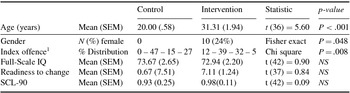
The demographics of the two groups (as analysed) are summarized in Table 1. The groups did not differ significantly in Full-Scale IQ, mental health status (SCL-90) or Readiness to Change. However, the intervention group were significantly older, and this group contained all of the women who were included in the analyses. The intervention group also had a significantly less serious distribution of index offences (for example, most of the murderers in the sample were in the control group).
Demographics

1 The four Index Offence categories represent increasing severity of offence
The sub-sample included in the analyses did not differ significantly from those lost to follow-up on any of the demographic or baseline outcome variables (p>.1). The mean (±SEM) scores of the participants included in the analyses on State Anger (26.8+1.4), Trait Anger (21.8+0.9) and Anger Expression (43.8+1.8) correspond, respectively, to the 90th, 75th and 75th percentile of the published normative adult sample (Spielberger, Reference Spielberger1999, Table A1).
Outcomes
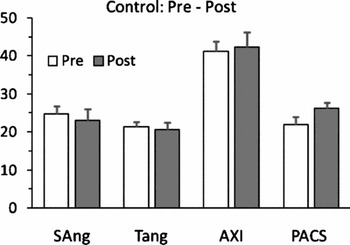
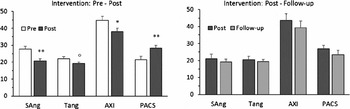
As shown in Figure 1, for the control group, values of the four outcome variables did not change from Time 1 to Time 2, corresponding to the pre and post assessments for the intervention group [t = 0.44 – 1.43, p > .1]. In the intervention group, by contrast, there were significant pre to post decreases in State Anger [t(38) = 3.23, p = .003], Trait Anger [t(38) = 1.94, p = .06], and Anger Expression [t(39) = 2.64, p = .012] scores, and a significant increase in the PACS score [t(29) = 3.02, p = .005]. These data are shown in Figure 2, left panel. The right panel of Figure 2 shows that following the intervention, these scores did not change significantly over the 4-month follow-up period [t = 0.78 – 1.49, p > .1]. Effect sizes for pre to post changes were: State Anger, d = 0.52; Trait Anger, d = 0.31; Anger Expression, d = 0.42; use of PACS, d = 0.56. These values represent small effects for Trait Anger and Anger Expression, and medium-sized effects for State Anger and use of anger coping skills.
STAXI State Anger (SAng), Trait Anger (TAng) and Anger Expression Index (AXI), and Profile of Anger Coping Skills (PACS) scores at the Time 1 and Time 2 assessments for the control group. Values are mean + SEM.

STAXI State Anger (SAng), Trait Anger (TAng) and Anger Expression Index (AXI), and Profile of Anger Coping Skills (PACS) scores for the intervention group, Pre- and Post-intervention (left panel) and from Post-intervention to Follow-up (right panel). Values are mean + SEM; 0 p = 0.06; * p < 0.02; ** p < 0.005

The pre to post changes in the three STAXI measures, in the Intervention group, were significantly inter-correlated [r(38-39) = 0.59 – 0.62, p < .001]. These measures were also significantly correlated with the change in PACS score [r(28-29) = 0.56 – 0.64, p < .002], indicating that decreases in anger measures were associated with an increase in the use of anger coping skills.
Attendance records showed that the modal number of sessions attended was 7 (range 1–10), meaning that, on average, participants attended just over half of the 12 sessions. No adverse events were recorded that could be ascribed to participation in the study.
Prediction of outcomes
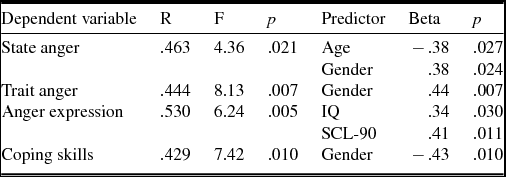
Six participants had more than three missing predictor variables and were excluded from the regression analyses. The final regression models are summarized in Table 2. The best predictor of outcome was gender, which significantly predicted changes in State and Trait Anger and PACS coping skill scores (better outcomes in women). Additionally, age was significantly associated with change in State Anger (better outcome in younger participants) and IQ and SCL-90 score were significant predictors of Anger Expression (better outcome in more able and more distressed participants). Index offence and number of sessions attended and Readiness to Change were not significantly associated with any of the outcomes, in the final regression models. While nonsignificant, for all four outcome measures there were small positive correlations with the number of sessions attended (r = 0.13-0.18) and Readiness to change (r = 0.10 – 0.25).
Prediction of outcomes

Discussion
The provision of regular psychotherapeutic groups on a large scale was novel within the prison system and the Caribbean context. These results suggest that anger management interventions can be effective at reducing anger assessed on a range of measures within a prison population in the Caribbean, albeit that the effect sizes were somewhat smaller than are typically observed for community anger management interventions (De Guiseppe and Tafrate Reference De Guiseppe and Tafrate2003; Del Vecchio and O'Leary Reference Del Vecchio and O'Leary2004). Participants had high levels of anger, relative to the general population. Changes on the STAXI suggest that a general reduction of both experience and expression of anger was observed in participants within the intervention group. These participants also reported significant improvements in their anger coping skills by the end of the intervention, and the correlations between improvement in coping and decreases in anger measures suggest that the clinical improvements resulted from a greater ability to manage anger, as previously reported for this intervention (Willner and Tomlinson, Reference Willner and Tomlinson2007). All improvements were maintained at 4-month follow-up, but this finding is based on a very small follow-up sample and so provides only weak evidence for a lasting effect of the intervention. The lack of change for individuals in the control group supports the assertion that change was due to participation in the intervention. However, as the two groups were not directly comparable, and considering the small size of the control group, this conclusion should also be treated with caution. The study reflects a growing body of research on anger management in prisons. However, to our knowledge, this is the first study from the Caribbean region to report positive changes. This was achieved without major changes to the intervention protocol.
Several variables were found to moderate outcomes. These results should be treated with particular caution, given the small sample size (and the consequent low ratio of cases to variables in the regression analyses), and the other methodological limitations of the study. A further weakness is that the moderating effects differed between the four outcome variables studied. It is likely that more reliable and consistent data might have been obtained with a larger sample: for example, considering the well-established, if somewhat unreliable, “dose effect” in psychotherapy (Orlinsky, Grawe and Parkes, Reference Orlinsky, Grawe, Parkes, Bergin and Garfield1994; Hansen, Lambert and Forman, Reference Hansen, Lambert and Forman2002), a larger sample might reveal a stronger relationship between the number of sessions attended and clinical outcomes. Nevertheless, despite their many limitations, the results obtained merit brief discussion.
-
(i) The finding that higher IQ scores were related to better outcomes for anger expression reflects previous research with this and a similar intervention (Rose, Loftus, Flint and Carey, Reference Rose, Loftus, Flint and Carey2005; Willner, Jones, Tams and Green, Reference Willner, Jones, Tams and Green2002). This suggests not only that more able participants were able to benefit more from the groups, but also that less able participants may need further adaptations, such as more sessions (as requested by some inmates). The format of the groups was based on groups previously developed for people with intellectual disabilities. They had little reliance on written materials and mainly used simple explanations and pictorial representations. On reflection this was an appropriate choice and endorsed by the Prison Officers leading the sessions: while it is difficult to describe accurately the abilities of the participants, the mean IQ of the group was in the low borderline range. While the WASI-2 has not been adapted to a Caribbean population, this does suggest that many of the participants would have struggled without test-specific reading accommodations, and that further simplification of content and delivery may be desirable for some participants.
-
(ii) The better outcome for more distressed participants is at first sight surprising (though not unprecedented: Holi, Reference Holi2003). However, the groups became highly supportive so it may be that they were having a broader psychological impact, giving more help to those in greater need by allowing participants to talk about and deal with a range of emotional difficulties. There was only one professional psychologist for the prisons, so while professional psychological interventions were sometimes available to officers they were not generally available to inmates in the prisons. System resources were limited and it is likely that inmates would only be able to access other psychological therapies from trainee students. As a result, these groups could potentially have had a greater impact on participants with other mental health issues by supporting improvement across a range of difficulties.
-
(iii) The potential greater efficacy of the intervention for younger people suggests tentatively that a greater focus on this key group might reduce the early development of reoffending. The suitability of the intervention for young offenders is supported by the earlier finding that this intervention was effective in adolescents with anger management problems (Down, Willner, Watts and Griffiths, Reference Down, Willner, Watts and Griffiths2011).
-
(iv) Finally, the possibility of improved outcomes for women – the strongest of these results – is also interesting and suggests tentatively that focusing on therapeutic work with women may have particular advantages within the criminal justice system. However, this conclusion is based on a very small overall sample and smaller group sizes for the female participants: further investigation of this issue would be desirable.
These improvements were observed despite a number of operational difficulties, including the relatively low participation rates within the intervention groups. Working in prison services can present particular challenges. For example, prisoners were often not available to participate in therapy due to unrelated demands and difficulties, such as the prisons being “locked down” as a result of the behaviour of other prisoners, or prisoners exercising their rights not to attend groups or choosing to attend different activities, this being one of the few optional activities they had in their schedule. There were many other reasons for non-attendance: for example, it was difficult to run groups when it rained as prisoners had to move between buildings and they were not allowed umbrellas. Arranging assessment sessions also presented major logistical difficulties, particularly in an environment where regular and repeated assessment was not done on a regular basis and the rationale for it was little understood. Inmates were often not available due to other demands or could not be accompanied to assessment sessions due to lack of staff. Despite our best efforts to obtain more complete data, this led to a patchy dataset, with only 67% of the participants being included in the analyses. However, these participants did not differ on demographic or baseline clinical variables from those lost to follow-up at Time 3, other than a marginal difference in readiness to change. It was not possible, for logistical reasons (prison access), to attempt to verify the fidelity of delivery of the intervention independently of the therapists. However, the manual used was detailed and prescriptive, and high fidelity has previously been demonstrated when it was delivered to people with intellectual disabilities by minimally trained day-care staff (Jahoda et al., Reference Jahoda, Willner, Rose, Kroese, Lammie and Shead2013). Because we were unable to access the groups to observe their delivery, we are unable to identify active ingredients of the treatment package. However, in earlier research we have observed that “lay therapists” were better able to deliver the behavioural aspects of the management program, but struggled with emotions and cognitions (Willner et al., Reference Willner, Rose, Jahoda, Kroese, Felce and Cohen2013) and it is likely that this was also the case here.
In the Caribbean there is a relative lack of psychological resources and, to combat this, the intervention was based around sessions being delivered by graduate (Masters) students training in clinical psychology. These individuals had some previous training in general psychotherapeutic interventions and received a brief specific training in the intervention they were delivering. They were paired with prison officers who were asked to participate in the running of the groups, but in practice most of the therapeutic work was conducted by the graduate students. This arrangement was similar to a large trial where the therapeutic work was conducted by care staff in the UK (Willner et al., Reference Willner, Rose, Jahoda, Kroese, Felce and Cohen2013). This proved to be a cost effective model and one that supports the development of psychological expertise and ethos. The positive results from the intervention area testament to the enthusiasm and effectiveness of the therapists. Nevertheless it should be noted that more experienced therapists have tended to achieve better results in similar interventions (Rose, Reference Rose2013).
Limitations
This study has many limitations, including the logistical problems outlined above and the lack of equivalence between the control and intervention groups. However, it compares favourably with earlier studies that have evaluated prison anger management programmes. We noted earlier that 10 such studies identified in a systematic review achieved scores ranging between 11 and 15 on the quality framework proposed by Downs and Black (Reference Downs and Black1998): this study achieved a score of 20 on the same measures (see online Supplementary Materials).
Despite the difficulties experienced in implementing this intervention, group anger management seems to be a promising approach in prison services within the Caribbean and the investment of time and resources to develop this approach is heartening. Hopefully it will lead to further research to investigate and evaluate interventions that will reduce anger, increase coping and tend to reduce aggressive behaviour in the future.
Acknowledgements
This work was conducted as part of a UWI-Trinidad and Tobago Research and Development Impact Fund (RDIf) project funded by the National Gas Company of Trinidad and Tobago (T.B.RDIf: 26607–447515). Conflict of interest: The authors have no conflicts of interest with respect to this publication.
Supplementary material
To view supplementary material for this article, please visit http://dx.doi.org/10.1017/S1352465816000266.




Comments
No Comments have been published for this article.