Introduction
Bennesherite, Ba2Fe2+Si2O7, the only Ba-member of the melilite group, has been recognised in xenolith samples from Caspar quarry, Bellerberg volcano, Germany (50.35°N, 7.23°E). This well-known geological locality, where over a dozen new minerals have now been described, is a part of the quaternary volcanic region in the Eastern Eifel, characterised by the occurrence of different thermally metamorphosed carbonate–silicate and silicate xenoliths within a basaltic, mostly leucite-tephrite lava (Hentschel, Reference Hentschel1987; Mihajlovic et al., Reference Mihajlovic, Lengauer, Ntaflos, Kolitsch and Tillmanns2004).
Bennesherite belongs to the melilite group, which contains the other mineral species: åkermanite, Ca2MgSi2O7 (Swainson et al., Reference Swainson, Dove, Schmahl and Putnis1992); alumoåkermanite, (Ca,Na)2(Al,Mg,Fe2+)(Si2O7) (Wiedenmann et al., Reference Wiedenmann, Zaitsev, Britvin, Krivovichev and Keller2009); hardystonite, Ca2ZnSi2O7 (Wolff, Reference Wolff1899); gugiaite, Ca2BeSi2O7 (Peng et al., Reference Peng, Tsao and Chou1962); hydroxylgugiaite, (Ca3□)Σ4(Si3.5Be2.5)Σ6O11(OH)3 (Grice et al., Reference Grice, Kristiansen, Friis, Rowe, Cooper, Poirier, Yang and Weller2017); okayamalite; Ca2B2SiO7 (Matsubara et al., Reference Matsubara, Ritsuro, Kato, Yokoyama and Okamoto1998); and gehlenite, Ca2Al(SiAl)O7 (Louisnathan, Reference Louisnathan1971). The general formula of the melilite-group minerals is X2T1(T2)2O7, where: X = □ [vacancy], Na, K, Ca, Ba and Sr; T1 = B, Be, Mg, Fe2+, Zn, Fe3+, Al and Si; and T2 = Si, Al, B and Be. All minerals of the melilite group are tetragonal. Their crystal structures consist of T22O7 dimers connected with cations at T1 tetrahedra, which form a sheet-like arrangement. These sheets are linked together by large cations coordinated by the eight oxygen atoms at the X site (Bindi et al., Reference Bindi, Bonazzi and Fitton2001). The members of the melilite group usually occur in igneous and metamorphic rocks, however they have also been identified in meteorites and blast-furnace slags (Ardit et al., Reference Ardit, Cruciani and Dondi2010). Nevertheless, for some characteristic localities such as the Bellerberg volcano, Germany (Galuskin et al., Reference Galuskin, Krüger, Krüger, Blass, Widmer and Galuskina2016) or the enigmatic Hatrurim Complex in Israel (Galuskin et al., Reference Galuskin, Gfeller, Galuskina, Pakhomova, Armbruster, Vapnik, Włodyka, Dzierżanowski and Murashko2015), these phases are rock-forming minerals.
Bennesherite was found recently in the veins of coarse-grained rankinite paralava in pyrometamorphic rocks of the Hatrurim Complex (Gurim Anticline locality, Krzątała et al., Reference Krzątała, Krüger, Galuskina, Vapnik and Galuskin2022). The authors performed a series of investigations, including chemical, structural and spectroscopic analyses of this new mineral, and compared the data with other members of the melilite group. However, the first description and chemical data of the natural Ba2Fe2+Si2O7 phase, named barium–iron silicate, came from highly peralkaline leucite nephelinites at the Nyiragongo volcano in the Virunga volcanic province, Democratic Republic of Congo (Andersen et al., Reference Andersen, Elburg and Erambert2014). In addition, in Russian-language literature, a synthetic phase named barium ferroåkermanite has been examined using Mössbauer spectroscopy (Bychkov et al., Reference Bychkov, Borisov, Kharamov, Guzhova and Urusov1992).
The research presents new data confirming the occurrence of the very rare mineral bennesherite. In this paper, we also describe other, potentially new, melilite-group minerals and some unique accessory Ba-bearing minerals such as walstromite, BaCa2Si3O9, fresnoite, Ba2TiO(Si2O7) and celsian, Ba(Al2Si2O8) from Caspar quarry xenoliths, which are recognised and investigated from this locality for the first time. The results and detailed analyses presented in this paper are compared and discussed with data reported previously.
Materials and methods
Samples of carbonate–silicate xenoliths were collected from Caspar quarry, Bellerberg volcano in Germany. The rock samples were cut, and thin sections were prepared for analytical investigations.
The preliminary study of the xenoliths, including minerals identification and composition, was using a scanning electron microscope (SEM) Phenom XL equipped with an energy-dispersive X-ray spectroscopy (EDS) detector (Institute of Earth Sciences, Faculty of Natural Sciences, University of Silesia, Sosnowiec, Poland). These semi-quantitative composition measurements were performed using a high vacuum (1 Pa), with a beam voltage of 15 kV and a working distance of 6 mm.
Quantitative analyses of minerals were carried out using a CAMECA SX100 electron-microprobe operating in WDS (wavelength dispersive X-ray spectroscopy) mode (Faculty of Geology, University of Warsaw, Warsaw, Poland) at 15 kV and 10–20 nA with beam size ~1–2 μm. The following X-ray lines (and standards) were used: NaKα (albite); CaKα, SiKα and MgKα (diopside); KKα and AlKα (orthoclase); TiKα (rutile); BaLα (baryte); FeKα (Fe2O3); SrLα (celestine); MnKα (rhodonite); and ZnKα (sphalerite).
The Raman spectra of bennesherite and accessory minerals presented in this paper were recorded on a WITec alpha 300R Confocal Raman Microscope (Institute of Earth Sciences, Faculty of Natural Sciences, University of Silesia, Sosnowiec, Poland) equipped with an air-cooled solid laser of 488 nm and a CCD camera operating at –61°C. The laser radiation was coupled to a microscope through a single-mode optical fibre with a diameter of 3.5 μm. An air Zeiss (LD EC Epiplan-Neofluan DIC–100/0.75NA) objective was used. Raman scattered light was focused by an effective Pinhole size of ~30 μm and a monochromator with a 600 mm–1 grating. The power of the laser at the sample position was 42 mW. Integration times of 5 s with an accumulation of 20 scans were chosen and a resolution of 3 cm–1. The monochromator was calibrated using the Raman scattering line of a silicon plate (520.7 cm–1). Spectra processing was performed using the Spectracalc software package GRAMS (Galactic Industries Corp, USA). The Raman bands were fitted using a Gauss–Lorentz cross-product function with the minimum number of component bands used for the fitting process.
Results and discussion
Mineral composition of the xenoliths
The SEM investigations revealed that some of the thermally metamorphosed carbonate–silicate xenoliths contain secondary alteration, and that low-temperature mineral assemblages prevail over the rock-forming minerals. The primarily high-temperature constituents of the altered xenoliths are larnite, gehlenite and magnesioferrite. Bredigite, kalsilite, chlormayenite, fluorapatite, srebrodolskite and members of the shulamitite–sharyginite series occur as accessory minerals. Some Zr-phases, such as lakargiite, baddeleyite, calzirtite and zircon, were also noted. Hematite, pyrite and an unidentified Y–Fe–Al oxide occur very rarely. The abundance of secondary phases is represented by different hydrated Ca-silicates and aluminosilicates such as tobermorite, jennite, afwillite, hydrocalumite, calcite, baryte, Sr-bearing baryte, minerals of the ettringite–thaumasite series and Sr-rich thomsonite-Ca.
The non-altered xenolith fragments are composed of wollastonite, nepheline and minerals of the melilite group, represented mainly by alumoåkermanite and Fe2+-rich åkermanite. The composition of the melilite-group minerals is variable and in some cases they are enriched in Na, Ba and Sr. Perovskite, rare Ba-minerals such as bennesherite, walstromite, fresnoite, celsian, zadovite and a P-analogue of gurimite, as well as wadeite, are accessory phases. Some of these accessory minerals are recognised for the first time in this locality.
Occurrence, chemical composition and Raman spectroscopy
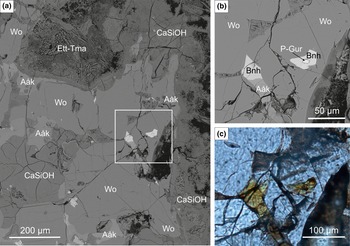
Bennesherite from the carbonate–silicate xenoliths formed subhedral crystals up to 30 μm in size and was detected within large wollastonite crystals in non-altered parts/zones of the xenolith (Fig. 1a). In addition to the wollastonite, the melilite-group mineral, alumoåkermanite, is associated with bennesherite (Fig. 1a,b). It is noteworthy that a small ~10–12 μm inclusion of the potentially new mineral, a P-analogue of gurimite, Ba3(PO4)2, was found in a bennesherite crystal (Fig. 1b). Under transmitted light, the bennesherite crystals are transparent and exhibit a bright yellow colour (Fig. 1c). The same optical properties were determined for the Israeli specimen, however, as reported for some Israeli crystals, bennesherite from Germany does not show low-temperature changes, such as partial substitution by hydrosilicates on the crystal edges (Krzątała et al., Reference Krzątała, Krüger, Galuskina, Vapnik and Galuskin2022).
(a) Mineral association of the carbonate–silicate xenolith; the framed section is magnified in (b), back-scattered electron (BSE) image. (b) Bennesherite and associated minerals, BSE image. (c) Bennesherite crystals with characteristic bright yellow colour, optical image. Aåk –alumoåkermanite; Bnh – bennesherite; CaSiOH – hydrated Ca-aluminosilicates; Ett-Tma – minerals of ettringite–thaumasite series; P-Gur – P-analogue of gurimite; Wo – wollastonite.

The analytical data for bennesherite from Caspar quarry, Bellerberg volcano, Gurim Anticline, Hatrurim Complex (holotype locality), and Nyiragongo volcano localities are presented in Table 1. The empirical formula of bennesherite from Caspar quarry calculated on the basis of 7 O atoms per formula unit (apfu) is: (Ba1.32Ca0.43Sr0.23Na0.05K0.02)Σ2.05(Fe2+0.79Ti0.06Mg0.05Al0.04Mn0.03Zn0.01)Σ0.98Si1.97O7, which can be simplified to the end-member formula Ba2Fe2+Si2O7. This mineral is represented by a complex solid solution containing the following end-members: ~68% bennesherite, ~12% Sr-analogue of bennesherite and ~12% åkermanite-like members (åkermanite, Fe2+-åkermanite and Mn-åkermanite). The remaining 10% comes from other components. The composition of the studied bennesherite differs in Ba, Ca and Sr contents compared to specimens from the other two localities (Table 1). Partial or complete isomorphic substitution of Ca, at the polyhedral X position, by Sr and Ba is a common phenomenon, which has been observed in synthetic analogues and some natural melilites (Kimata, Reference Kimata1983, Reference Kimata1984; Bindi et al., Reference Bindi, Bonazzi and Fitton2001; Ardit et al., Reference Ardit, Dondi, Merlini and Cruciani2012; Krzątała et al., Reference Krzątała, Krüger, Galuskina, Vapnik and Galuskin2022). However, bennesherite is the first mineral in which an element other than Ca prevails on the X structural position. The higher Ba content in the Israeli holotype sample indicates that the bennesherite end-member contribution of ~83% is more significant than other end-members (Table 1). Specimens from Germany and DRC (the Democratic Republic of the Congo) contain more Sr than the Israeli holotype (Table 1), both with 12% of the Sr-dominant end-member, Sr2FeSi2O7. Considering the tetrahedral positions, we assumed that for each specimen presented in Table 1, the T2 site is almost fully occupied by Si. Next in allocation, the T1 site is mixed, with a predominance of ferrous iron. Bennesherite from Germany and the holotype locality have a similar content of ~81% of Fe2+ at the T1 site whereas the DRC specimen is slightly more ferrous (0.87 apfu). The amount of additional impurities does not exceed 20% of this site occupancy and is represented mainly by Al, Mg, Ti, Mn and Zn, characteristic for melilite group minerals.
The representative chemical composition (wt.%) of bennesherite from three different localities.

Notes: S.D. = 1σ standard deviation; n – number of analyses; n.d. – not detected; *calculated based on charge balance; 1 – present study; 2 – Krzątała et al. (Reference Krzątała, Krüger, Galuskina, Vapnik and Galuskin2022); 3 – Andersen et al. (Reference Andersen, Elburg and Erambert2014).
Bennesherite crystals presented in Fig. 1 were extracted for single-crystal X-ray diffraction analysis. However, we failed to collect diffraction data due to intergrowths and poor quality of crystals. Nevertheless, identification of bennesherite was confirmed by the detailed Raman spectroscopy investigation described below.
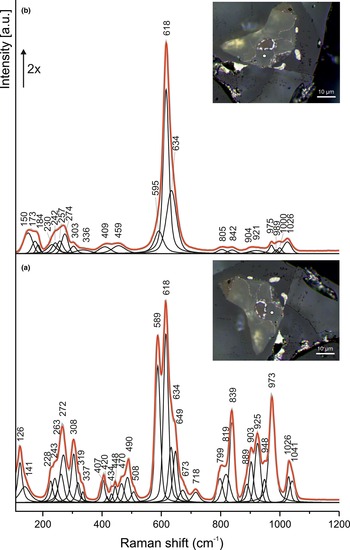
According to the factor-group analysis of the melilite-type structure, 28 (only for the Si2O7 group) or 45 Raman active modes were predicted by Hanuza et al. (Reference Hanuza, Ptak, Mączka, Hermanowicz, Lorenc and Kaminskii2012) and Sharma et al. (Reference Sharma, Yoder and Matson1988), respectively. In the Raman spectrum of bennesherite from the Bellerberg volcano, presented in Fig. 2a, 34 bands are observed. In comparison with the published data, their higher or lower number can be related to the deconvolution and curve fitting (Gaussian–Lorentzian functions) of the component bands or low intensity and random degeneration. As the relevant band ascription is often found in Raman spectroscopy literature for natural and synthetic melilites, some authors have used the data of calculated and measured spectra of other phases containing Si2O7 groups and tried to determine the ranges of band vibrations (Sharma et al., Reference Sharma, Simons and Yoder1983, Reference Sharma, Yoder and Matson1988; Dowty, Reference Dowty1987; Bouhifd et al., Reference Bouhifd, Gruener, Mysen and Richet2002; Marincea et al., Reference Marincea, Dumitras, Ghinet, Fransolet, Hatert and Rondeaux2011; Hanuza et al., Reference Hanuza, Ptak, Mączka, Hermanowicz, Lorenc and Kaminskii2012; Allu et al., Reference Allu, Balaji, Tulyaganov, Mather, Margit, Pascual, Siegel, Milius, Senker, Agarkov, Kharton and Ferreira2017; Ogorodova et al., Reference Ogorodova, Gritsenko, Vigasina, Bychkov, Ksenofontov and Melchakova2018; Krzątała et al., Reference Krzątała, Krüger, Galuskina, Vapnik and Galuskin2022).
Raman spectra of bennesherite obtained in a random section at the two orientations relative to a polarised laser beam. The analysis points are shown as a white spot in the optical images inset.

On the basis of available knowledge, consecutive Raman band assignment for bennesherite is proposed in this present work. In the spectral region 850–1050 cm–1 symmetric and asymmetric vibrations related to the disilicate (Si2O7)6– group appear. More precisely, the intense bands at 973 cm–1 and doublet placed at 903 and 925 cm–1 with two weak shoulders at 889 and 948 cm–1, respectively, are assigned to the symmetric stretching vibrations of lateral SiO3 (terminal nonbridging oxygens of SiO4 tetrahedra). A broad band with two components at 1026 and 1041 cm–1 is attributed to the asymmetric stretching (Si–O–Si) vibrations (bridging oxygen between two Si-tetrahedra in Si2O7).
The most intense bands centred at 589 and 618 cm–1 with three shoulders at 634, 649 and 673 cm–1 correspond to the vibrations of T1 – Fe2+O4 and T2 – Si2O7. The Raman band at 589 cm–1 is related to the symmetric stretching vibrations of the (Fe2+O4)6– group, in which the Fe atom is located at the 2a site of the 4 point group symmetry. The other bands belong to the symmetric stretching (Si–O–Si) modes of the Si2O7 unit. Due to the high intensity, bands observed in the range 585–620 cm–1 may overlap with those attributed to the symmetric bending vibrations of SiO3 (Hanuza et al., Reference Hanuza, Ptak, Mączka, Hermanowicz, Lorenc and Kaminskii2012). Next to this spectral region, a single band at 718 cm–1 is detected (Fig. 2a). The assignment of this band is problematic because it has not been observed in spectra of other melilite minerals. Krzątała et al. (Reference Krzątała, Krüger, Galuskina, Vapnik and Galuskin2022), in the spectrum of bennesherite from Israel, found a band at 702 cm–1 and ascribed it as a band with mixed nature related to the νs(Si–O–Si) and νs(SiO3) vibrations. In our opinion, the same assignment for the band at 718 cm–1 is questionable. According to the calculated wavenumbers for hardystonite, an intense peak at 839 cm–1 and two bands at 799 and 819 cm–1 in the bennesherite spectrum may also have a mixed nature and have been ascribed to the asymmetric stretching modes of SiO3 and out-of-plane γ bending (Si–O–Si) vibrations (Hanuza et al., Reference Hanuza, Ptak, Mączka, Hermanowicz, Lorenc and Kaminskii2012).
The spectral range at 400–515 cm–1 is related to the various types of deformation vibrations (δ) and translational modes (T’) of cations and large structural units (Sharma et al., Reference Sharma, Yoder and Matson1988; Ogorodova et al., Reference Ogorodova, Gritsenko, Vigasina, Bychkov, Ksenofontov and Melchakova2018). Several Raman bands with variable intensities placed at 407, 420, 434, 448, 470, 490 and 508 cm–1 are assigned to the asymmetric bending modes of lateral SiO3 and in-plane bending vibration of internal (Si–O–Si), which are coupled with the (Ba2+) translations (Fig. 2a). Sharma et al. (Reference Sharma, Yoder and Matson1988) identified the Raman bands in the spectral region between 230–360 cm–1 as torsional vibrations of SiO3. In the bennesherite spectrum, a few bands are observed in this range (Fig. 2a). In addition, an intense band at 308 cm–1 with two shoulders at 319 and 337 cm–1 can also be coupled with the lattice vibrational modes of Ba translations. Bands at 228, 243, 263 and an intense peak at 272 cm–1 are described as rocking ρ lateral SiO3 vibrations (Hanuza et al., Reference Hanuza, Ptak, Mączka, Hermanowicz, Lorenc and Kaminskii2012). The Ba–O and lattice vibrations are recorded under 200 cm–1 in the bennesherite spectrum (Fig. 2a).
In Fig. 2b, significant differences are observed in the Raman spectrum of bennesherite, measured on the same crystal in a different orientation. Some components in several spectral ranges have been reduced, but wavenumbers are quite similar to those detected in the spectrum shown in Fig. 2a. Only the band assigned to the symmetric stretching vibrations of (Si–O–Si) in the disilicate group placed at 618 cm–1, with a shoulder at 634 cm–1, is characterised by higher intensity (Fig. 2b). A single band at 589 cm–1 in Fig. 2a, related to the (Fe2+O4)6– symmetric stretching vibrations of T1 tetrahedra, now appears as a low intense band with frequency at 595 cm–1 on the slope of the more intense Raman band. Several bands have a broad character in the spectral range 800–1030 cm–1 compared to the same bands in Fig. 2a. The same dependence is reported for bands attributed to various bending modes in the range 400–460 cm–1 (Fig. 2b). Of the several components, only two broader peaks at 409 and 459 cm–1 remain. The number of Raman bands associated with the torsional SiO3 vibrations in the range 230–360 cm–1 (Fig. 2b) is comparable with the spectrum in Fig. 2a. The difference is connected only with the band intensities. This characteristic feature is observed in the lowest spectral region. Three bands absent in the first orientation appear in the Raman spectrum with frequencies at 150, 173 and 184 cm–1. This is appropriate because all these bands are related to the Ba–O vibrations (Fig. 2b).
The description of the bennesherite Raman spectrum presented above is in good agreement with the spectral band-range assignments given in many works on the spectroscopic investigation of the melilite-group minerals (Sharma et al., Reference Sharma, Simons and Yoder1983, 1988; Dowty, Reference Dowty1987; Bouhifd et al., Reference Bouhifd, Gruener, Mysen and Richet2002; Hanuza et al., Reference Hanuza, Ptak, Mączka, Hermanowicz, Lorenc and Kaminskii2012; Allu et al., Reference Allu, Balaji, Tulyaganov, Mather, Margit, Pascual, Siegel, Milius, Senker, Agarkov, Kharton and Ferreira2017; Ogorodova et al., Reference Ogorodova, Gritsenko, Vigasina, Bychkov, Ksenofontov and Melchakova2018). Moreover, our data are very similar to the results obtained by Krzątała et al. (Reference Krzątała, Krüger, Galuskina, Vapnik and Galuskin2022), which performed the first Raman analyses for bennesherite found in rankinite paralava from the Hatrurim Complex in Israel. Nevertheless, on the basis of the spectroscopic data for synthetic and natural minerals of the melilite group, the spectral range for symmetric vibrational modes (T–O–T) is located between ~620–670 cm–1 (Sharma et al., Reference Sharma, Simons and Yoder1983, Reference Sharma, Yoder and Matson1988; Dowty, Reference Dowty1987; Allu et al., Reference Allu, Balaji, Tulyaganov, Mather, Margit, Pascual, Siegel, Milius, Senker, Agarkov, Kharton and Ferreira2017). For åkermanite, hardystonite and Na-melilite, the frequencies of the most intense bands from this region lay between 650–660 cm–1 (Sharma et al., Reference Sharma, Yoder and Matson1988; Allu et al., Reference Allu, Balaji, Tulyaganov, Mather, Margit, Pascual, Siegel, Milius, Senker, Agarkov, Kharton and Ferreira2017; Ogorodova et al., Reference Ogorodova, Gritsenko, Vigasina, Bychkov, Ksenofontov and Melchakova2018). For gehlenite, the Raman band related to the νs(T–O–T) modes is centred at 626 cm–1 (Sharma et al., Reference Sharma, Yoder and Matson1988). For different melilite-group members, it was proved that the frequencies of νs(T–O–T) bands show a linear dependence with bridging T–O–T angle, i.e. the greater the T–O–T angle of the Si2O7 unit, the higher the frequencies of Raman bands attributed to the symmetric stretching (T–O–T) modes of the disilicate group (Sharma et al., Reference Sharma, Yoder and Matson1988). However for bennesherite, this dependence is troubling. The structural data obtained for Israeli bennesherite indicated that the value of the T–O–T angle equals 142.9° (Krzątała et al., Reference Krzątała, Krüger, Galuskina, Vapnik and Galuskin2022). Considering the data published by Sharma et al. (Reference Sharma, Yoder and Matson1988), the wavenumber of the most intense band, with such an angle, should be observed at ~670 cm–1 in the Raman spectrum. For comparison, in åkermanite, the T–O–T angle is ~139.4° and the Raman band is detected at 664 cm–1 (Sharma et al., Reference Sharma, Yoder and Matson1988). Spectroscopic data in the present work for Bellerberg bennesherite show that the prominent peak assigned to νs(T–O–T) lies at 618 cm–1. In addition, in the Raman spectrum for bennesherite from the Hatrurim Complex, the wider band centred at 635 cm–1, with a shoulder at 611 cm–1 (Krzątała et al., Reference Krzątała, Krüger, Galuskina, Vapnik and Galuskin2022), also corresponds to our results. The frequencies in both specimens are shifted to the lower values despite having the largest T–O–T angle values reported for melilites. In this case, the heavy eight-fold coordinated Ba atom, which occupies the X position in the crystal structure, played a significant role in decreasing the band frequencies. In previous work, only melilites with Ca at the X site were included, hence the Raman bands used by Sharma et al. (Reference Sharma, Yoder and Matson1988) for the correlation with T–O–T angle were in a higher spectral region.
Other melilite-group minerals
Semi-quantitative data from SEM–EDS analyses along with quantitative data from electron microprobe analyses also revealed the presence of other melilite-group minerals in carbonate–silicate xenoliths from the Bellerberg volcano. Selected chemical composition results for these mineral phases are correlated in Table 2. Gehlenite, identified as a rock-forming mineral in an altered part of the xenolith, exhibits a fairly standard composition for Al, which almost fully occupies the T1 and partially the T2 sites. Compared to other melilites in Table 2, gehlenite contains a nonsignificant amount of Fe. Alumoåkermanite and potentially new minerals ‘Fe2+-åkermanite’ and ‘Sr-bennesherite’ occur, similarly to bennesherite, in non-altered fragments of xenolith, usually in interstitial areas between the wollastonite and nepheline crystals. However, alumoåkermanite forms bigger crystals, up to as much as 200 μm in size, as shown in Fig. 1, whereas the crystals of the other two melilites do not exceed 40 μm. Alumoåkermanite is enriched in Sr2+ at the X site and has mixed occupancy at the T1 site with dominant Al and additional Mg and Fe2+. The average SrO content is variable, and for individual analyses ranges from 1.03 to 5.97 wt.%. This enrichment is significant in almost all melilite-group minerals observed in non-altered fragments of xenolith (Tables 1, 2), which, conversely, was not detected for the exact counterparts in paralavas of the Hatrurim Complex despite the similar mineral association (Krzątała et al. Reference Krzątała, Krüger, Galuskina, Vapnik and Galuskin2020).
Selected chemical compositions of melilites from analysed xenolith samples.

Notes: S.D. = 1σ standard deviation; n – number of analyses; n.d. – not detected.
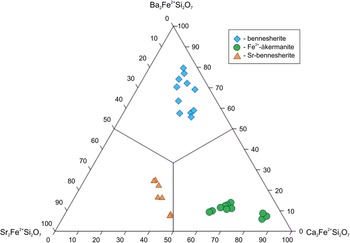
‘Fe2+-åkermanite’, ‘Sr-bennesherite’ (Table 2) and bennesherite (Table 1), are the most ferrous melilites in the samples analysed. The quantity of Fe increases with simultaneous decrease in Al content in the following sequence for melilite-type minerals: alumoåkermanite → ‘Fe2+-åkermanite’ → bennesherite → ‘Sr-bennesherite’ (Table 1, 2). Other investigations have noted a similar observation for some ferrous melilites (Andersen et al. Reference Andersen, Elburg and Erambert2014; Krzątała et al. Reference Krzątała, Krüger, Galuskina, Vapnik and Galuskin2022). This condition may be related to the crystal chemistry, which determines the stabilisation of ferrous iron into the structure of some melilites (Krzątała et al. Reference Krzątała, Krüger, Galuskina, Vapnik and Galuskin2022), or suggests that here is a deficient ferric iron activity in tetrahedral coordination in highly alkaline melts (Andersen et al. Reference Andersen, Elburg and Erambert2014). The distribution of the three dominant cations, Ca, Ba and Sr, at the X site is variable, which manifests in the different apfu content for ferrous melilite end-members in the ternary Ba2Fe2+Si2O7–Ca2Fe2+Si2O7–Sr2Fe2+Si2O7 phase system (Fig. 3). At the T1 site, Fe2+ dominates over the following elements (Ti, Al, Mg, Mn and Zn), which means that more than half of this site is occupied by ferrous ions (Tables 1, 2). Nevertheless, the obtained chemical data for ferrous melilites recognised in xenolith samples shows that ‘Sr-bennesherite’ and ‘Fe2+-åkermanite’ can be distinguished as new members from other melilite-group minerals (Fig. 3).
Ternary phase diagram for ferrous melilite members detected in xenolith samples from Bellerberg volcano, Germany.

Rare accessory Ba minerals
Walstromite
Walstromite, BaCa2Si3O9, a three-membered (Si3O9)6– cyclosilicate, was described for the first time from sanbornite-bearing metamorphic rocks in Rush Creek and Big Creek, Eastern Fresno County, California, USA (Alfors et al., Reference Alfors, Stinson, Matthews and Pabst1965). Subsequently, it has also been recognised in several deposits along the Western Margin of North America (from Baja California Norte in Mexico to Western Canada and Alaska) (Dunning and Cooper, Reference Dunning and Cooper1999; Dunning, Reference Dunning2018; Dunning and Walstrom, Reference Dunning and Walstrom2018). Later, walstromite was reported in paralavas from the pyrometamorphic Hatrurim Complex in Israel (Krzątała et al., Reference Krzątała, Krüger, Galuskina, Vapnik and Galuskin2020) and from the Jakobsberg Mn–Fe deposit, Värmland, Sweden (Holtstam et al., Reference Holtstam, Cámara and Karlsson2021). Together with margarosanite, PbCa2Si3O9 and breyite, Ca3Si3O9, walstromite forms the margarosanite group (Holtstam et al., Reference Holtstam, Cámara and Karlsson2021).
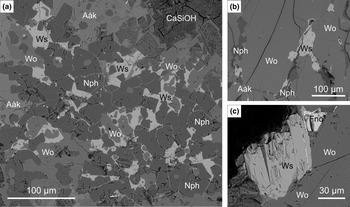
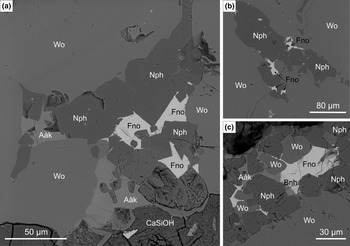
Walstromite, identified for the first time in carbonate–silicate xenoliths from the Bellerberg volcano, forms colourless subhedral and anhedral crystals (Fig. 4), variable in size, though frequently 30–100 μm. Typically, walstromite crystals fill the space between nepheline and wollastonite grains (Fig. 4a) or in cracks in large wollastonite crystals (Fig. 4b,c). Another Ba-bearing mineral, fresnoite, occurs in association with walstromite (Fig. 4c).
(a–c) Walstromite and associated minerals in the xenolith samples from the Bellerberg volcano, BSE images. Aåk – alumoåkermanite; CaSiOH – hydrated Ca-aluminosilicates; Fno – fresnoite; Nph – nepheline; Wo – wollastonite; Ws – walstromite.

Electron-microprobe analyses of walstromite from Caspar quarry, two outcrops of the Hatrurim Complex in Israel (Gurim Anticline and Zuk Tamrur) and Fresno County in the USA (holotype locality) are correlated in Table 3. The calculated empirical formula for the German specimen is as follows (Ba0.90Sr0.11)Σ1.01(Ca1.97Fe0.01)Σ1.98(Si2.99Ti0.01Al0.01)Σ3.01O9. By comparison of these data for walstromite from different localities, we can conclude that this mineral has a stable composition (Table 3).
The representative chemical composition (wt.%) of walstromite from different localities.

Footnotes: S.D. = 1σ standard deviation; n – number of analyses; n.d. – not detected; 1 – present study; 2 – Krzątała et al. (Reference Krzątała, Krüger, Galuskina, Vapnik and Galuskin2020); 3 – Alfors et al. (Reference Alfors, Stinson, Matthews and Pabst1965).
The holotype walstromite composition was measured originally using a direct current arc emission spectrograph and the totals of analyses were normalised to 100% from instrumental totals (Alfors et al., Reference Alfors, Stinson, Matthews and Pabst1965). In this paper, these two analyses were recalculated without this normalisation. The obtained results are very similar to the original one. The slight differences in apfu values of each element were <0.05 (Table 3). The only significant feature noted between the chemical results for walstromite samples presented in Table 3 is the amount of SrO. For German walstromite, this content is equal to ~2.50, for some individual analyses even ~3.00 wt.%, which corresponds to 0.10 apfu in the chemical formula, whereas the Sr content from previous investigations was <0.02 apfu (Alfors et al., Reference Alfors, Stinson, Matthews and Pabst1965; Krzątała et al., Reference Krzątała, Krüger, Galuskina, Vapnik and Galuskin2020). The increased Sr content in German samples corresponds to a decrease in Ba, indicating mutual substitution within the one structural site.
Energy dispersive spectroscopy analysis of walstromite samples from the Jakobsberg Mn–Fe deposit in Sweden found Pb substitution for Ba (Holtstam et al., Reference Holtstam, Cámara and Karlsson2021). Such substitution has not been reported in other mentioned localities (Table 3). This occurrence is related to the mineral association because, in the Jakobsberg deposit, walstromite occurs together with margaro-sanite. As noted by Holtstam et al. (Reference Holtstam, Cámara and Karlsson2021), both minerals contain variable Ba–Pb amounts, indicating a solid-solution series between them
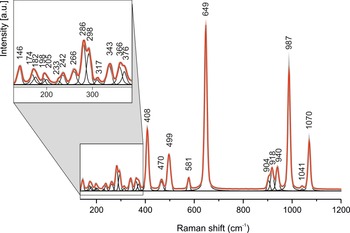
In the Raman spectrum of walstromite from the carbonate–silicate xenolith a sharp and intense band at ~650 cm–1 is observed (Fig. 5). This Raman band is typical for ring silicates (cyclosilicates) and is related to the Si–O–Si symmetric vibrations of the three-membered (Si3O9)6– rings. The next intense band that occurs at 987 cm–1 is assigned to the symmetric Si–O vibrations of the (SiO4)4– group with a non-bridging environment. In other words, this band corresponds to the vibrations between the Si atom and apical oxygen atoms in each tetrahedron. Moreover, three bands with lower intensities at 904, 918 and 940 cm–1 are observed in the walstromite spectrum. Previous publications have no information about these Raman bands (Gaft et al., Reference Gaft, Yeates and Nagli2013; Krzątała et al., Reference Krzątała, Krüger, Galuskina, Vapnik and Galuskin2020). According to the infrared investigations of some (Si3O9)– ring silicates (Sitarz et al., Reference Sitarz, Mozgawa and Handke1997), the assignment of bands in this spectral region might be similar to the Raman band at 987 cm–1. Above 1000 cm–1, two bands with distinct intensity were detected and assigned to asymmetric Si–O stretching vibrations in the (Si3O9)6– rings. The spectral region between 400 cm–1 and 550 cm–1 is related to the three-membered rings Si–O–Si and O–Si–O bending vibrations. Several Raman bands below 400 cm–1, magnified in Fig. 5, correspond to the stretching Ca–O and Ba–O vibrations.
Raman spectrum of walstromite from Caspar quarry, Bellerberg volcano, Germany.

In the current work, the assignment of a low intense Raman band at 581 cm–1 is not considered. This band needs detailed investigation because it could be related to the bending vibrations, as proposed by Krzątała et al. (Reference Krzątała, Krüger, Galuskina, Vapnik and Galuskin2020), or stretching vibrations of the (Si3O9)6– rings by analogy to the pseudowollastonite spectrum, which is one of the dominant bands (Richet et al., Reference Richet, Mysen and Ingrin1998).
The Raman spectrum of walstromite from Caspar quarry and Raman spectra obtained for specimens from Gurim Anticline in Israel (Krzątała et al., Reference Krzątała, Krüger, Galuskina, Vapnik and Galuskin2020) and Fresno County in California (Gaft et al., Reference Gaft, Yeates and Nagli2013) are similar. They exhibit the same band features, e.g. the band frequencies related to the Si–O–Si stretching vibrations of the (Si3O9)6– rings, which are observed at 649 cm–1 (present study), 651 cm–1 (Krzątała et al., Reference Krzątała, Krüger, Galuskina, Vapnik and Galuskin2020) and 650 cm–1 (Gaft et al., Reference Gaft, Yeates and Nagli2013), respectively. Similar correlations are also detected for other types of vibrations and band positions. Moreover, the resemblance between the Raman spectrum of walstromite and two other minerals of the margarosanite group: breyite and margarosanite, is significant. The main difference was noted in the margarosanite spectrum, which reflects the intense band with unclear nature at 1013 cm–1, not presented in the Raman spectra of the other two minerals (Krzątała et al., Reference Krzątała, Krüger, Galuskina, Vapnik and Galuskin2020).
Fresnoite
Similarly to walstromite, fresnoite, Ba2TiO(Si2O7) was discovered in sanbornite metamorphic deposits from Eastern Fresno County, California, USA (Alfors et al., Reference Alfors, Stinson, Matthews and Pabst1965). In contrast to walstromite, this mineral is more common worldwide and has been recognised in different types of rocks in several localities (Solovova et al., Reference Solovova, Girnis, Ryabchikov and Kononkova2009; Andersen et al., Reference Andersen, Elburg and Erambert2014; Peretyazhko et al., Reference Peretyazhko, Savina, Khromova, Karmanov and Ivanov2018; Krzątała et al., Reference Krzątała, Krüger, Galuskina, Vapnik and Galuskin2022). Fresnoite has been mentioned previously in Germany in association with schüllerite from the Löhley basalt quarry at the Eifel Volcanic district (Chukanov et al., Reference Chukanov, Rastsvetaeva, Britvin, Virus, Belakovskiy, Pekov, Aksenov and Ternes2011). Nevertheless, detailed results focusing on this mineral have not been published.
In analysed samples, fresnoite, similar to bennesherite, exhibits a yellow colour in transmitted light. Typically, this mineral forms subhedral and anhedral crystals reaching a size of ~40–50 μm (Fig. 6). They occur in small intergranular areas between rock-forming minerals, mostly wollastonite, nepheline and minerals of the melilite group (Fig. 6a,b). Occasionally, fresnoite–bennesherite intergrowths are observed in xenolith samples (Fig. 6c). The same feature was noted for paralava samples from Israel, where these two phases were associated (Krzątała et al., Reference Krzątała, Krüger, Galuskina, Vapnik and Galuskin2022).
(a–b) Fresnoite and associated minerals in the xenolith samples from the Bellerberg volcano. (c) Intergrowths of fresnoite and bennesherite. BSE images. Aåk – alumoåkermanite; CaSiOH – hydrated Ca-aluminosilicates; Bnh – bennesherite; Fno – fresnoite; Nph – nepheline; Wo – wollastonite.

The results of fresnoite chemical analyses from Caspar quarry, together with the data from the type locality – Fresno County and Gurim Anticline, are compared in Table 4. On the basis of eight oxygens, the empirical formula of German fresnoite was calculated as (Ba1.88Ca0.08Sr0.07)Σ2.03(Ti0.97Fe2+0.03)Σ1.00(Si1.98Al0.03)Σ2.01O8. Generally, the data correlated in Table 4 indicate that fresnoite has a consistent composition with insignificant distinctions. Similarly to walstromite, differences between analyses is related mainly to the Sr content. Fresnoite from Bellerberg volcano, in contrast to the samples from other localities, is enriched with this component, which varies from 1.05 to 2.12 wt.% (Table 4). For one sample from Fresno, the amount of SrO was equal to 0.28 wt.%, equivalent to 0.01 apfu. In other samples, Sr was not detected. One of the recalculated original analyses from Fresno County exhibits a higher TiO2 content with simultaneous lower SiO2 than other samples presented in Table 4. This may be evidence that Ti occupies not only the T1 but also the T2 site in the crystal structure of fresnoite. However, this assumption was not confirmed by the structural investigation in the previous report from Krzątała et al. (Reference Krzątała, Krüger, Galuskina, Vapnik and Galuskin2022).
The representative chemical composition (wt.%) of fresnoite from different localities.

Footnotes: S.D. = 1σ standard deviation; n – number of analyses; n.d. – not detected; 1 – present study; 2 – Krzątała et al. (Reference Krzątała, Krüger, Galuskina, Vapnik and Galuskin2022); 3 – Alfors et al. (Reference Alfors, Stinson, Matthews and Pabst1965).
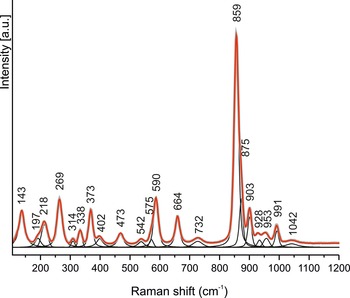
The Raman spectrum of fresnoite from Caspar quarry is presented in Fig. 7. This spectrum is characterised by a sharp and intense Raman band at 859 cm–1 with the lower intensity band on the shoulder at a higher frequency ~875 cm–1. These two bands have a complex nature and were assigned to the symmetric stretching SiO3 vibrations of the disilicate group (Si2O7)6– and symmetric stretching (Ti–O) vibrations in the square pyramid (TiO5)6–. In this case, the (Ti–O) vibrations correspond to the short bond between the Ti and oxygen atom located at the apex of the (TiO5)6– tetragonal pyramid. The assignment of these bands was confirmed previously for synthetic Ba2TiSi2O8, also known as BTS (Gabelica-Robert and Tarte, Reference Gabelica-Robert and Tarte1981; Markgraf et al., Reference Markgraf, Sharma and Bhalla1992), and natural fresnoite (Krzątała et al., Reference Krzątała, Krüger, Galuskina, Vapnik and Galuskin2022). The bands in the range ~900–990 cm–1 have been assigned to the symmetric and asymmetric (SiO3) vibrations, whereas the band at 1042 cm–1 has been assigned to asymmetric stretching modes of the disilicate group. The latter assignment was confirmed by comparison with the Raman spectrum of the mineral rusinovite, Ca10(Si2O7)3Cl2, which contains a (Si2O7)6– group in its structure (Środek et al., Reference Środek, Juroszek, Krüger, Krüger, Galuskina and Gazeev2018). In the Raman spectrum of this mineral, the bands related to the asymmetric stretching vibrations are in the range of 1041–1043 cm–1. The mixing nature of this band, asymmetric bridging Si–O–Si + asymmetric SiO3 vibrations, cannot be excluded according to the IR spectrum of fresnoite (Gabelica-Robert and Tarte, Reference Gabelica-Robert and Tarte1981).
Raman spectrum of fresnoite from Caspar quarry, Bellerberg volcano, Germany.

The bridging symmetric stretching Si–O–Si vibrations of the Si2O7 group correspond to the Raman band at 664 cm–1. The bands observed between ~540 and 590 cm–1 are related to the bending SiO3 vibrations. Nevertheless, the bands at 590 cm–1 may also be connected with TiO4 vibration from the square (TiO5)6– pyramid (Dai et al., Reference Dai, Zhu, Qiu, Ma, Lu, Cao and Yu2007). The range ~270–400 cm–1, with characteristic bands at 269, 338 and 373 cm–1, has been assigned to the translational and symmetric bending vibration of TiO5 and Si2O7. All bands in the Raman spectrum of fresnoite noted below 250 cm–1 are assigned to stretching Ba–O and lattice vibrations. The assignment of two Raman bands at 732 cm–1 and 473 cm–1 is disputable. According to results obtained for oxide glasses, the first one could be related to the deformation vibrations of O–Ti–O or O–(Si,Ti)–O in sheet units (Yadav and Singh, Reference Yadav and Singh2015). In turn, the nature of the second one, which was also detected for fresnoite from the Hatrurim Complex in Israel at 473 cm–1, but not described in detail, is unclear and needs to be investigated further.
The detailed description of the natural fresnoite crystal presented in this work agrees with the spectroscopic result obtained for synthetic counterparts (Gabelica-Robert and Tarte, Reference Gabelica-Robert and Tarte1981; Markgraf et al., Reference Markgraf, Sharma and Bhalla1992; Dai et al., Reference Dai, Zhu, Qiu, Ma, Lu, Cao and Yu2007; Zhu et al., Reference Zhu, Dai, Ma, Zhang, Lin and Qiu2007), and provides additional information not covered by Krzątała et al. (Reference Krzątała, Krüger, Galuskina, Vapnik and Galuskin2022) which focused on only a few characteristic bands.
Celsian
Celsian, Ba(Al2Si2O8), is a Ba-feldspar belonging to the feldspar group with Al:Si ratio equal to 1:1. It was first described from the Mn–Fe deposits at the Jakobsberg ore field, Värmland, Sweden (holotype, Sjögren, Reference Sjögren1895). Since then, celsian has been detected within different types of rocks worldwide (Spencer, Reference Spencer1942; Alfors et al., Reference Alfors, Stinson, Matthews and Pabst1965; Coats et al., Reference Coats, Smith, Fortey, Gallagher, May and McCourt1980; Moro et al., Reference Moro, Cembranos and Fernandez2001; Dunning, Reference Dunning2018; Krzątała et al., Reference Krzątała, Krüger, Galuskina, Vapnik and Galuskin2020).
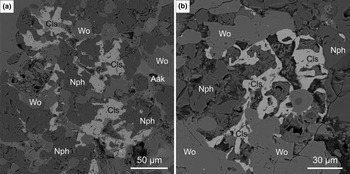
In carbonate–silicate xenoliths, celsian is less abundant than walstromite and fresnoite. Usually, it forms anhedral crystals up to 40 μm in size (Fig. 8). Similarly to other Ba-minerals presented in this work, celsian occurs in non-altered xenolith zones between the larger wollastonite, nepheline and alumoåkermanite crystals (Fig. 8a,b).
(a–b) Celsian and associated rock-forming minerals in the xenolith samples, BSE images. Aåk – alumoåkermanite; Nph – nepheline; Wo – wollastonite.

The electron microprobe analyses of celsian from the Caspar quarry locality are given in Table 5. For comparison, the chemical data of celsian from two additional localities: the baryte deposit of Zamora in Spain (Moro et al., Reference Moro, Cembranos and Fernandez2001) and Aberfeldy in Scotland (Fortey and Beddoe-Stephens, Reference Fortey and Beddoe-Stephens1982), are also included in Table 5. The empirical formula of celsian from Germany, calculated on the basis of eight oxygens, is (Ba0.97Ca0.02Na0.02Sr0.01K0.01)Σ1.03(Al1.96Fe0.06)Σ2.02Si1.98O8. Our result shows that celsian from Caspar quarry is similar to samples from Scotland. The data is similar for the holotype locality, where the main celsian constituents are equal to 32.43 wt.% for SiO2, 26.55 wt.% for Al2O3, and 39.72 wt.% for BaO (Sjögren, Reference Sjögren1895). In comparison, celsian samples from Spain exhibit higher BaO content ~41–42 wt.%, lower Al2O3 content ~25 wt.%, and a negligible TiO2.
Representative compositions (wt.%) of celsian from different localities.

Footnotes: S.D. = 1σ standard deviation; n – number of analyses; n.d. – not detected; 1 – present study; 2 – Moro et al. (Reference Moro, Cembranos and Fernandez2001); 3 – Fortey and Beddoe-Stephens (Reference Fortey and Beddoe-Stephens1982); a-f – sample numbers: a – PB–6I; b – IF–13; c – PB–1; d – PB–6F; e – CRZ3552E (analysis # 1); f – BH2 (analysis # 8).
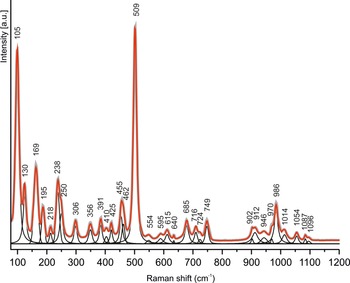
Perhaps due to the similarity to other spectra of feldspar minerals, there is no description or even qualitative characteristics of the celsian Raman spectrum in the literature. Nevertheless, graphic depictions can be found in the spectroscopic database and in some publications (Galuskina et al., Reference Galuskina, Galuskin, Vapnik, Prusik, Stasiak, Dzierżanowski and Murashko2017a). In the present work, we proposed the following band assignment based on a previous publication containing Raman spectra characterization of the feldspar-group minerals (Freeman et al., Reference Freeman, Wang, Kuebler, Jolliff and Haskin2008).
The celsian spectrum from Caspar quarry was divided into a few band groups (Fig. 9). Group I is the spectral range between 450–520 cm–1. Two Raman bands were distinguished, one as a doublet in the range 455–462 and a very strong band at ~509 cm–1, which correspond to the breathing deformation modes of the four-membered rings of the tetrahedron. Group II is the 200–430 cm–1 range and contains a few Raman bands of varying intensity at 218, 238 (strong), 250, 306, 356, 391, 410 and 425 cm–1. This group of bands is assigned to the rotation-translation modes of the four-membered ring. Group III below the 200 cm–1 is characterised by the strong and intense band at 105 cm–1 and a few other bands placed at 130, 169 and 195 cm–1, which are associated with the cage-shear modes. Bands forming group IV are between 590 and 800 cm–1 and are ascribed to the deformation modes of the tetrahedra. In the celsian spectrum, consecutive bands were distinguished at 595, 615, 640, 685, 716, 724 and 749 cm–1. Lastly, group V is 900–1200 cm–1, with nine characteristic bands in the celsian spectrum (Fig. 9). This spectral region is related to the breathing modes of tetrahedra, including T–O stretching vibrations (McKeown, Reference McKeown2005; Freeman et al., Reference Freeman, Wang, Kuebler, Jolliff and Haskin2008). Raman bands above 1200 cm–1 were not detected in the spectrum of celsian from the Caspar quarry locality.
Raman spectrum of celsian from Caspar quarry, Bellerberg volcano, Germany.

The slight differences observed in the band placement in the celsian Raman spectrum compared to the ranges of other feldspar minerals, e.g. albite, orthoclase, or microcline, are related to the chemical composition and the presence of monovalent (K+, Na+) and divalent (Ba2+) ions in the crystal structure of these phases (Freeman et al., Reference Freeman, Wang, Kuebler, Jolliff and Haskin2008). Raman spectroscopic analyses of Ba-rich K-feldspar from the black shale sequence in Anhui Province, South China (Chang et al., Reference Chang, Hu, Fu, Cao, Wang, Wan and Yao2018) proved that the strongest bands in the Ba-rich K-feldspar Raman spectrum are shifted slightly to the higher wavenumbers towards celsian frequencies.
Genetic aspect
The wide variety of minerals in the xenoliths occurring within the volcanic rocks of the Bellerberg area is due to a distinct protolith composition and subsequent metamorphic transformation (Hentschel, Reference Hentschel1987; Mihajlovic et al., Reference Mihajlovic, Lengauer, Ntaflos, Kolitsch and Tillmanns2004; Juroszek et al., Reference Juroszek, Krüger, Galuskina, Krüger, Jeżak, Ternes, Wojdyla, Krzykawski, Pautov and Galuskin2018).
The mineral assemblages detected in the samples studied are primarily products of the high-temperature transformation of argillaceous limestone xenoliths within basalt magma, in a temperature not lower than 1060°С, ${\rm X}_{{\rm C}{\rm O}_3}$ < 0.55 at P total = 1 Kbar (Grapes, Reference Grapes2006; Juroszek et al., Reference Juroszek, Krüger, Galuskina, Krüger, Jeżak, Ternes, Wojdyla, Krzykawski, Pautov and Galuskin2018). High-temperature pyrometamorphic processes of limestone xenolith transformation at the sanidinite facies have predominantly isochemical character and are similar to the cement clinker production process. The initial composition of xenoliths determines the possibility of an insignificant amount of silica melt appearance both on the xenolith surface and inside it (Whitley et al., Reference Whitley, Halama, Gertisser, Preece, Deegan and Troll2020). In natural clinkerisation processes, wollastonite, larnite, gehlenite, magnesioferrite, brownmillerite and minerals of the shulamitite–sharyginite series form. In addition, chlormayenite or fluorapatite may also appear in the presence of volatile components. Analogous crystallisation conditions have been estimated for some clinker-like pyrometamorphic rocks and paralavas with similar mineral assemblages from the Hatrurim Complex in Israel (Vapnik et al., Reference Vapnik, Sharygin, Sokol, Shagam and Stracher2007; Novikov et al., Reference Novikov, Vapnik and Safonova2013; Galuskina et al., Reference Galuskina, Galuskin, Pakhomova, Widmer, Armbruster, Krüger, Grew, Vapnik, Dzierażanowski and Murashko2017b). There is no zonation characteristic for skarns forming with participation of fluids in the studied xenoliths. The heterogeneous distribution of high-temperature mineral association in the altered xenoliths is defined mainly by their primary heterogeneity and mineral crystallisation sequence. During contact of carbonate-rich rock (xenolith) with magma, a significant reduction of mechanical integrity takes place, together with a dynamic element exchange. More common elements, such as Ca, are incorporated into the structures of high-temperature rock-forming minerals, while more incompatible elements that are distributed within the limestone protolith, such as Ba, Sr, or Ti, remain in the melt. Moreover, crystallisation of calcium silicates at the temperature peak of pyrometamorphism determines the Ba and Sr concentration in intergranular spaces filled with a liquid phase, probably, with silicate melt enriched in Na and locally in Al, P and Ti. From this residual melt, xenomorphic crystals of bennesherite, fresnoite, walstromite, celsian and zadovite grains form together with nepheline, usually between large wollastonite crystals. Such an occurrence, and the small size of Ba and Sr-bearing minerals, indicate their later formation at temperatures below 1000°C. Slightly lowering the temperature is related to the increasing alkali components, which are embedded into the structure of nephelines and melilite-group minerals. A similar mechanism of bennesherite, fresnoite, walstromite, celsian, hexacelsian and zadovite formation from the residual melt in rankinite paralava has been described previously in pyrometamorphic rocks of the Hatrurim Complex (Krzątała et al., Reference Krzątała, Krüger, Galuskina, Vapnik and Galuskin2022).
The diversity of accessory minerals identified in xenolith samples from the Bellerberg volcano is reflected in formation conditions such as temperature, transformation during metamorphism, and the availability of suitable components. In samples analysed, both ferric- and ferrous-bearing accessory phases were distinguished. Brownmillerite and minerals belonging to the shulamitite–sharyginite series in which all iron is as Fe3+ indicated crystallisation at a temperature of ~1000°C (Juroszek et al., Reference Juroszek, Krüger, Galuskina, Krüger, Jeżak, Ternes, Wojdyla, Krzykawski, Pautov and Galuskin2018). In turn, ferrous melilites, such as bennesherite, Fe2+-åkermanite, or Sr-bennesherite, as described above, crystallised later from the residual melt and in lower-temperature conditions, below 1000°C. The general decrease in oxygen activity may be related to the mass crystallisation of rock-forming minerals in the xenolith, mainly Ca-silicates and other high-temperature oxide minerals. Small portions of the residual melt in-between earlier crystallised phases were enriched in non-compatible elements, such as Ba and Sr, hence heterovalent iron was probably incorporated into the bennesherite and other melilite structures as Fe2+. Moreover, the crystal chemistry features of such mineral phases determine the stabilisation of ferrous iron, which was also confirmed by the structural analyses of bennesherite detected in rankinite paralava of the Hatruim Complex (Krzątała et al., Reference Krzątała, Krüger, Galuskina, Vapnik and Galuskin2022).
Conclusions
The results obtained in the present work suggest the following conclusions.
Carbonate–silicate xenoliths embedded in alkali basalt from Caspar quarry in the Bellerberg volcano still deserve attention as a source of unique minerals, as evidenced by rare Ba-bearing minerals, including bennesherite, fresnoite, walstromite and celsian being recognised and described for the first time in this locality.
The diversity observed in the chemical composition of various melilite-group minerals and significant substitution at the X and T1 positions indicate the presence of potentially new minerals within this group, such as Sr-bennesherite or ferrous-bearing åkermanite, identified in this work in xenolith samples.
The presence of the P-analogue of gurimite, as a tiny inclusion in bennesherite, has allowed us to confirm the additional occurrence of this new mineral, known already as mazorite, Ba3(PO4)2, and recently approved by the CNMNC IMA (IMA2022–022, Juroszek et al., Reference Juroszek, Galuskina, Krüger, Krüger, Vapnik and Galuskin2022).
Detailed Raman analyses performed for bennesherite confirm the decreasing band frequencies due to the predominance of the Ba atom at the X position. It implies that the Raman spectroscopy method might be used, at least partially, as an effective tool to distinguish various melilite-group members.
A similar mineral association and scheme of crystallisation observed in xenoliths from Caspar quarry and paralava samples from the Hatrurim Complex show the relation between these two stratigraphical distinct geological units. The similarities observed in the micro-scale can be utilised for research in the broader context.
Acknowledgements
We thank Marlina Elburg for sharing the chemical data of bennesherite from Nyiragongo volcano and two anonymous reviewers for their helpful and constructive comments, which allowed us to improve a previous version of the manuscript.
Competing interests
The authors declare none.