1. INTRODUCTION
The concept of design fixation, originally defined as a blind adherence to a set of ideas or concepts limiting the output of conceptual design (Jansson & Smith, Reference Jansson and Smith1991), has for 20 years provided researchers from a variety of backgrounds with a compelling, important, and uniquely cross-disciplinary design phenomenon to study. The research is compelling because design fixation anchors a designer's creative thoughts and actions in the past at the stage of design when creative thinking and actions may have their greatest impact. Design fixation research is also important because innovative products and systems catalyze advances in medicine, art, and science (Youmans, Reference Youmans2010) often leading to large financial rewards (Amabile, Reference Amabile1996). Design fixation is thought to affect the mental processes of a designer at the earliest stages of the design process, a period when the architectures of final designs are established, technologies are chosen, and the bulk of the costs (often upward of 70%) for a product are committed (Pahl & Beitz, Reference Pahl and Beitz1996). In engineering terms, fixation occurs during the conceptual design process, a time during which any given final design outcome is extremely sensitive to the assumptions and chosen methods of the designer. Fixation during conceptual design can prevent a designer from developing feasible design concepts with consequences ranging from minor duplications of technology to the inability of a corporation to change at the same pace as industry, leading to organizational failure (Stempfle, Reference Stempfle2011).
Interest in what design fixation is, why it occurs, and how it can be avoided has created a bloom of cross-disciplinary research activity, but the “boundary-spanning character” (Jansson & Smith, Reference Jansson and Smith1991) of the phenomena has served as something of a double-edged sword. On the one hand, the interdisciplinary nature of the phenomenon has brought together designers, cognitive scientists, engineers, computational modelers, architects, educators, and others around the emerging field of design science, the scientific study of designing (Gero, Reference Gero2000). Design science has revealed important insights into the design fixation phenomena. For example, researchers now speculate that design fixation may occur because of interactions between associative long-term memory systems and working-memory capacity limitations (Youmans, Reference Youmans2011). Researchers also know that some forms of design fixation can be reduced, for example, when designers take short breaks (Smith & Linsey, Reference Smith and Linsey2011), use physical materials to prototype (Youmans, Reference Youmans2010), or incorporate formal design heuristics (Yilmaz et al., Reference Yilmaz, Seifert and Gonzalez2010), and potentially, as they adopt computer-based design tools (Dong & Sarkar, Reference Dong and Sarkar2011).
On the other hand, the interdisciplinary nature of design fixation research has also made it increasingly difficult to determine whether or not researchers are all studying the same behavioral phenomenon. Consider one example of design fixation taken from an empirical psychology study where design and engineering students were recruited to compete in a Puzzle Box Design Contest (Youmans, Reference Youmans2010). The contest gave engineering students 90 min to design two original tools that could be operated by hand to retrieve small objects that had fallen into the bottom of a box. Tool designs were restricted to specific rules that prohibited designers from reaching inside the box with their hands, touching the sides of the puzzle box, and so on, and a large cash prize was offered to whoever could create the most original tool design that did not break these rules. Before beginning their own design efforts, participants completed a practice task where they built duplicates of two preexisting tools that had supposedly been created by previous participants. The preexisting tools were a part of the experiment, and contained 10 fixation features, easily recognizable design characteristics that could be used to objectively detect fixation effects in later designs. Several of the fixation features of the preexisting tools were negative, that is, they were intentionally designed to break the rules of the design competition. The results of the study revealed that many of the subsequent student designs not only demonstrated high levels of fixation but also demonstrated fixation to negative fixation features that broke contest rules, disqualifying them from the contest.
Now consider a second case, that of a structural engineer who is designing a beam under bending. Although structural engineers are trained to consider a variety of structural systems, construction methods, and materials (Arciszewski, Reference Arciszewski1988a, Reference Arciszewski1988b), a common problem for them is their tendency to exploit a single problem-specific body of knowledge to the exclusion of the others they have been trained to employ. This concept, referred to as a vector of psychological inertia by engineers, refers to a phenomenon in inventive engineering whereby a designer or a group of designers fixate on a specific class of design concepts, resulting in a tendency to solve engineering problems in the same way over and over again (Altshuller, Reference Altshuller and Shulyak1994; Clarke, Reference Clarke1997; Arciszewski, Reference Arciszewski1998). An engineer who is designing a beam under bending might be said to be following a vector of psychological inertia if he or she repeatedly designs structures using reinforced concrete beams in spite of the availability of prestressed concrete beams, steel beams, or other potential solutions that do not utilize reinforced concrete beams.
Do both the first and second scenarios represent cases of design fixation? According to many published definitions of the term, the answer is probably yes. In the first empirical study, students blindly adhered to the fixation features of the example designs (even the negative ones), thereby limiting the output of their tool designs. In the second scenario, taken from a real-world example, the structural engineer adhered to one problem-specific body of knowledge (reinforced concrete beams) without consideration of knowledge from other closely related domains of structural engineering, potentially limiting the innovation in his final design solution. In both cases, the designers’ past ideas and concepts limited their creative output.
However, there is a critical distinction that should be made between the Puzzle Box Design contestants who fixated in the first example and the structural engineer who always utilizes reinforced concrete beams in the second: the distinction between whether or not the designers were aware of their own fixation. In the first example, the designers who fixated were almost certainly unaware that the example tools containing negative fixation features were affecting their work. After all, intentionally copying the negative fixation features disqualified them from a chance to win sizable cash prizes. However, in the case of the engineer who chooses to repeatedly design structures using reinforced concrete beams, it becomes much more difficult to determine with certainty whether design fixation is really occurring. If we asked the engineer about the decision to repeatedly use reinforced concrete beams, he or she might react with genuine surprise about his or her own blind tendency to utilize the same beam materials over and over. However, he or she might claim to have recognized that his or her work often incorporated reinforced concrete but blame the repetition on a genuine inability to think of other materials to use. Finally, he or she might say that that the repetition had nothing to do with some insidious tendency to copy past work but rather had to do with the engineer's reliance on his or her own problem-specific body of knowledge on prestressed concrete beams. In this hypothetical scenario, the variety of fixation that the engineer experienced depends largely on awareness.
Discrepancies between the behaviors that researchers describe using the term design fixation are not limited to the examples we have provided in this paper. An April 2010 symposium, titled “Fixation or Inspiration? The Role of Internal and External Sources on Idea Generation,” brought together interdisciplinary researchers in Delft, The Netherlands, with overlapping interests in creative problem solving in design and engineering (Cardoso & Badke-Schaub, Reference Cardoso and Badke-Schaub2011a). Attendees of the conference produced seven journal articles on the topic of design fixation that were published in a special edition of the Journal of Creative Behavior. Although all seven articles were ostensibly on the topic of design fixation, a quick survey of those articles reveals just how different many of the examples of design fixation are in comparison with one another. Of the seven articles, two authors began by referencing examples where fixation was induced seemingly without the designers’ awareness by an example design (Cardoso & Badke-Schaub, Reference Cardoso and Badke-Schaub2011b; Youmans, Reference Youmans2011). Two researchers cited examples where designers were aware that they were unable to come up with new ideas because their thinking was blocked by some initial design idea (Dong & Sarkar, Reference Dong and Sarkar2011). One researcher used an example of design fixation where designers actually gained an advantage by intentionally adopting a preexisting design and then transforming it to fit a new design challenge (Goldschmidt, Reference Goldschmidt2011). Finally, one researcher theorized that many different types of fixation occur in large corporations or other types of organizations at different stages of the creative process (Stempfle, Reference Stempfle2011), and another warned that researchers not become “fixated on our conceptions of what fixation is” (Gero, Reference Gero2011).
Our point in this review of the conference proceedings is not to champion any one use of the term design fixation, but rather to call attention to just how broadly the term is currently being used. In some ways, the popularity of the term is a good thing; its broad use may be a reflection of the importance of the research as well as the increasing cross-disciplinary research efforts investigating design fixation. However, we argue that the relatively imprecise use of the phrase may be doing a disservice to the community by potentially confusing new researchers who are interested in studying design fixation. The failure to operationally define design fixation has hurt efforts to educate designers about fixation effects and complicated efforts to generate a transdisciplinary vocabulary that can be used to describe design fixation behaviors.
To counter recent broadening of the term, we present the following subcategories of design fixation behavior that we recently developed by surveying the current published literature on design fixation and its related behaviors. On the basis of our review, we have identified at least three major forms of design fixation that have been studied, and we recommend that design scientists classify future design fixation research into one of the following categories: studies of unconscious adherence to the influence of prior designs, studies of conscious blocks to change, and studies of intentional resistance to new ideas. We elaborate on the meaning of each category in the following sections of the paper.
2. UNCONSCIOUS ADHERENCE
The idea that a person can be influenced by an encounter with a previous object or system without his or her awareness is not a new idea. The early psychoanalysts of the 19th century assumed that humans were influenced by unconscious internal drives and motivations. In the late 1950s, experimental psychologists who studied attentional processes inferred that unconscious processing of external events in the environment must be taking place in order to explain phenomenon such as the cocktail party effect, the ability for someone to suddenly attend to one's own name when it is spoken across a crowded room by someone in a different circle of conversation (e.g., Cherry, Reference Cherry1953).
Recently, psychologists studying priming effects have demonstrated to a surprising degree how easily conscious thoughts and actions can be influenced by unconscious reactions to the environment. For example, students who share chocolate with their classmates on the same day that their professor is evaluated will irrationally raise their classmates’ ratings of their professor (Youmans & Jee, Reference Youmans and Jee2007), and professors who make corrections to students’ assignments with red ink will irrationally assign those assignments a lower grade than if they had corrected those same assignments using ink that was blue or black (Rutchick et al., Reference Rutchick, Slepian and Ferris2010). Researchers have even shown that creative problem solving can be improved in insight problems when participants are first primed by seeing an illuminated light bulb, an iconic image representing sudden insight (Slepian et al., Reference Slepian, Weisbuch, Rutchick, Newman and Ambady2010).
Biases in the evaluation of professors’ teaching or students’ writing presumably take place without the awareness of either the students or professors even though they are affecting conscious thoughts and actions. However, whether or not these biases are viewed as “unconscious” processes depends heavily on how unconscious processes are defined. Broadly speaking, early psychologists defined unconscious processes as differences in behavior that resulted from the presentation of stimuli that would not be possible for a human to process consciously, a so-called subliminal stimuli (Greenwald et al., Reference Greenwald, Klinger and Schuh1995). In popular culture, people often believe that subliminal stimuli affect behavior, for example, that it can influence consumer behavior (Pratkanis, Reference Pratkanis1992). However, there are at least two reasons to believe that subliminal stimuli are not responsible for design fixation. First, despite popular opinion to the contrary, there is little reliable scientific evidence that subliminal presentations have a strong influence on even basic behavior, let alone higher order cognitive processes (see Weir, Reference Weir1984; Pratkanis, Reference Pratkanis1992; Verwijmeren et al., Reference Verwijmeren, Karremans, Bernritter, Stroebe and Wigboldus2013). Second, in most empirical studies of design fixation, participants are not subjected to subliminal stimuli, but rather have ample opportunities to view a prior design; in some studies, designers even held a physical copy of the design they were told not to copy (e.g., Youmans, Reference Youmans2010). In short, there is no reason to suspect that subliminal forces, per se, are at play in design fixation phenomenon.
However, subliminal processes are not the only way in which humans process information unconsciously. Recent psychological work has defined unconscious processes more broadly as mental behaviors that occur without a person's awareness (Bargh & Morsella, Reference Bargh and Morsella2008), and going by this expanded definition, many researchers in the design fixation community have noticed that designers often seem unaware that they have copied a prior design. In design education, design instructors report that students often commit to the design ideas that they think of first (Purcell & Gero, Reference Purcell and Gero1996). In laboratory experiments, designers are often unaware of their tendency to copy prior examples, leading some researchers to label the effect “unconscious plagiarism” or “cryptomnesia” (Brown & Murphy, Reference Brown and Murphy1989; see also Marsh & Bower, Reference Marsh and Bower1993; Marsh & Landau, Reference Marsh and Landau1995; Marsh et al., Reference Marsh, Ward and Landau1999). Linsey et al. (Reference Linsey, Tseng, Fu, Cagan, Wood and Schunn2010) have argued that the unconscious nature of some types of fixation is one of the very reasons why it is so difficult to overcome.
Some of the strongest evidence for the existence of unconscious design fixation effects may be the frustrating lack of its reduction even when researchers overtly warn participants not to fixate. Jansson and Smith (Reference Jansson and Smith1991) highlighted to participants how previous designs were poor. Other groups of researchers have tried direct warnings to participants to not use features from the examples in their studies (e.g., Smith et al., Reference Smith, Ward and Schumacher1993; Bellows et al., Reference Bellows, Higgins, Smith and Youmans2012; Viswanathan, Esposito, & Linsey, Reference Viswanathan, Esposito and Linsey2012). Youmans (Reference Youmans2010) showed participants examples of designs that were failures, physically demonstrated why they failed, and pointed out that copying some of these failing features could even disqualify participants from winning cash prizes. Although the design study participants in each of these cases definitely perceived the design examples, the warnings not to copy their features did not prevent fixation. These findings are strong evidence that the duplication of design features, in at least some circumstances, must be attributable to some type of unconscious mental processes (Linsey et al., Reference Linsey, Tseng, Fu, Cagan, Wood and Schunn2010).
What cognitive mechanisms explain how fixation unconsciously affects designers? Researchers are currently not sure, but one possible explanation that has been proposed is that humans’ associative memory systems store information via associative networks of interconnected concepts in ways that make recently activated concepts more likely to be retrieved (see Collins & Loftus, Reference Collins and Loftus1975; Youmans, Reference Youmans2010). Because exposure to a prior design has activated associative memory structures for those features, an unconscious “priming” effect may lead to implicit memory biases toward past design ideas. Some preliminary evidence for this position has been established in eye-tracking studies of design fixation, which demonstrated that participants spend much of their time looking at the features of a prior design that they dislike, then fixate on the remaining features that they rarely looked at (see Smith et al., Reference Smith, Youmans, Bellows and Peterson2013). Another possible explanation is that designers who are in the conceptual stage of design make conscious comparisons between products or systems, but because of the heavy load on working memory during a design task (see Bellows et al., Reference Bellows, Higgins, Smith and Youmans2012), knowledge that a feature came from a prior design is not encoded in long-term memory (i.e., the designer forgets about these comparisons). While this new evidence appears to be leading to some answers about how and why designers unconsciously fixate, more research is clearly required before the mechanisms underlying unconscious adherence are fully understood.
3. CONSCIOUS BLOCKING
If design fixation is a blind adherence to a set of ideas or concepts, what happens when a designer becomes aware of his or her fixation? While it may seem logical to assume that designers who recognized that they have introduced undesirable fixation into their work would simply eliminate it, psychological studies have long demonstrated that people have difficulty abandoning old mental strategies. Psychologists have demonstrated that creative thinking (Maier, Reference Maier1931), mathematical reasoning (Luchins, Reference Luchins1942), categorization tasks (Grant & Berg, Reference Grant and Berg1948), and problem solving (Kershaw & Ohlsson, Reference Kershaw and Ohlsson2004) all become more difficult when their solutions run counter to previous experience. In these paradigms, people are often frustratingly aware of their inability to avoid fixated thinking, yet their awareness of their own fixated thinking does little to reduce it.
Designers suffer from these same issues; their experiences create familiar solution paths that solve typical design challenges quickly but that may actually block the generation of new ideas (see Duncker, Reference Duncker1945). In a sense, a designer who is consciously fixated is framing the design problem from a problem-specific body of knowledge, a body of knowledge that may supplant analogies to past experiences that are outside of his or her problem-specific knowledge base (Dahl & Moreau, Reference Dahl and Moreau2002). In engineering, designers gradually expand their experience with practice (i.e., both factual and methodological knowledge regarding their domain increases across time). Methodological knowledge can be understood as the combination of decision rules, strong quasideterministic rules, and very weak rules, often called “heuristics.” All these rules represent together what “works” and what “does not work” to solve a problem creatively.
An important question for researchers has therefore been how to explain how successful designers balance creative thinking with the routines that come with years of experience. From one perspective, experts accumulate an ever growing collection of decision rules that allow them to easily prescreen many design concepts while considering their feasibility, leading to more productivity (see Ohlsson, Reference Ohlsson1992). There is a common folk belief in engineering that approximately 10 years of experience is necessary to become an inventor, a viewpoint shared by some in the psychology community (Erickson et al., Reference Erickson, Krampe and Clemens1993). If a designer does not become an inventor around this critical point, each passing year is often thought to decrease the chance that he or she will ever become an inventor. Framed differently, the so-called curse of experience in engineering predicts that more experience (and the additional decision rules that accompany experience) could lead to a greater likelihood that experienced designers reject alternative or obscure design solutions before giving them their full consideration.
As with unconscious adherence effects, design fixation theories related to conscious blocking are most likely to advance with studies that are designed to distinguish between conscious blocking phenomena and other forms of design fixation. Those studies may show that a certain amount of experience is helpful in inventive design, or in terms of fixation, that a certain amount of knowledge fixation might be a good thing. How to find the appropriate balance is the question, and research in this domain that provides answers about how to balance the design behaviors that come with experience could help us to optimize inventive education.
4. INTENTIONAL RESISTANCE
Design resistance is the concept that, across a great many different practical domains, there is a prevailing attitude that a previously successful solution is preferable to that of a novel solution. Most people have heard some variant on idioms that warn against “fixing what isn't broken” or “reinventing the wheel.” The point of these sayings is that using past ideas that worked well is preferable to the investments and risks associated with attempting something new. Consider the recently developed Chevrolet Volt, an electric car introduced by the General Motors Company that contained a novel battery system. After a number of cars were sold, engineers conducting crash tests discovered that the new design was not safe and required costly upgrades. This case of failed new thinking may underscore why designers are sometimes resistant to risk an unproven new technique when a preexisting design solution is at hand. By adopting an already proven technique, designers may not have a perfect solution, but they have a workable one. In general, engineers are always concerned about the safety of their products, and it is cheaper and more risk averse for designers to deal with the “devil they know” rather than to take a risk on some unproven design.
Idioms aside, design resistance may be most rational when viewed in the short term, but it is clearly not optimal when it comes to the long-term development of innovative new designs or ideas. Historically counterproductive examples include the resistance of Americans to adopt the metric system of measurement, the resistance of professional ice hockey players to adopt safety helmets, and the resistance of sports car manufacturers to adopt automatic transmissions even as their performance became superior to that of manually operated transmissions. Porsche's designers have intentionally kept many of the design features of the Porsche model 911 consistent with the original model introduced in 1963 in spite of the fact that many are not entirely justified in the context of the today's state of the art. Why would someone intentionally choose not to adopt a product or system that is more efficient, safer, or that boosts performance?
One reason might be because a designer genuinely believes that an older system is better. In Western education systems, for example, once educators have developed a teaching method that works in the classroom, they may falsely believe that they have developed a method that works best. Studies show a strong inverse relationship between teaching experience and innovation of teaching (Ghaith & Yaghi, Reference Ghaith and Yaghi1997). Although it is rational for someone who mistakenly believes that a design is optimal to resist changing it, design resistance can even occur when designers recognize that a current design is no longer state of the art. Designers may recognize that aspects of their design are inferior, but they may choose to keep them owing to a feeling of envy or competition. A prideful designer may fear that, by abandoning a suboptimal idea, he or she will validate others’ claims that the design was suboptimal. Further, feelings of nostalgia are common in humans (Sedikides et al., Reference Sedikides, Wildschut, Arndt and Routledge2008), and designers may sometimes prefer time-honored traditional designs regardless of the potential benefits of new systems because of nostalgic feelings.
Is design resistance a true form of design fixation? The answer may hinge on whether it is the design process or the design outcome that is being influenced by outdated beliefs, pride, or nostalgia. Consider what happens when a designer makes the choice to allow design resistance to affect all of his or her work, as may be the case when a designer creates an intentional homage to some other artifact. The goal of the designer would not be to improve upon a design, but rather to mirror as many key elements of it as possible. As such, intentional design efforts to replicate an existing design do not meet the test provided by Jansson and Smith (Reference Jansson and Smith1991), which states that design fixation is a phenomenon that prevents the consideration of all of the relevant knowledge and experience that should be brought to bear on any given problem. On that basis, it would seem wrong to suggest that an automobile enthusiast who has succeeded in designing an automobile that referenced other classic cars has fallen victim to design fixation, because the result is not due to a lack of consideration of other ideas, but rather was intentional.
However, design resistance may very much create the types of blind adherences to past ideas or concepts originally described by Jansson and Smith (Reference Jansson and Smith1991), especially if replicating existing design elements is not the goal of the designer. Schon (Reference Schon1988) has suggested that “in order to formulate a design problem to be solved, the designer must frame a problematic design situation: set its boundaries, select particular things and relations for attention, and impose on the situation a coherence that guides subsequent moves.” Design resistance may therefore affect a final design outcome if mirroring a previous design is not a designer's overall goal, but a past design affects some portion of problem selection, problem framing, designer decision making, or how a designer integrates his or her final design ideas. In this sense, the intentions of a designer seem to matter when it comes to determining whether or not design fixation has occurred. We argue that intentional design resistance whereby a designer makes it his or her goal to intentionally replicate elements of a previous design is a class of behaviors that is outside the scope of design fixation research. However, we also stress that tradition or nostalgia may unintentionally bias designers at any stage of their work, creating scenarios where unconscious adherence is more common.
5. CONCEPTUAL VERSUS KNOWLEDGE-BASED FIXATION
Jansson and Smith (Reference Jansson and Smith1991) framed their investigations into design fixation in the context of a theoretical model where the conceptual design process was described as thinking that moves between two mental domains, a configuration space and a concept space. The researchers described configuration space as a domain that contained mental representations of physical design configurations, including diagrams, sketches, and combinations of physical elements. They described concept space as a mental domain where abstract ideas, relationships, or patterns were considered. Jansson and Smith argued strongly that the conceptual design progress occurred as a designer alternated between thinking in a tangible configuration space and an abstract concept space. Alternating between the two allowed a designer to reveal more about the problem and potential solutions. Barriers to movement between these two ways of thinking would hinder the conceptual design process.
Engineers use a similar framework to that proposed by Jansson and Smith (Reference Jansson and Smith1991) when they talk about the vector of psychological inertia that can lead engineers to suboptimal design solutions. In engineering terms, conceptual fixation occurs when a designer, or an entire design group, considers only a single design concept or a very small number of such concepts in all of his or her designs. For example, a designer who specializes in the design of underground parking structures might base all of his or her designs on the single concept of a rigid reinforced concrete frame. If the company wanted to design and build an underground parking structure at a location where the underground water level was particularly high, the designer might decide to maintain the concept of a rigid reinforced concrete frame by creating a structural system with heavy columns carrying large bending moments and requiring expensive spot foundations, even though a more appropriate design concept would be a system of shear walls.
Continuing with our example of a designer of parking structures, consider what happens to our structural engineer as he or she accumulates a significant experience (a body of knowledge) related to the analysis, design, and optimization of parking structures based on his or her single design concept. In some cases, the available materials and technology, directives from management, or risk aversion could all lead to replications of previous parking structures, but another potential source of fixation comes as more senior designers become less and less inclined to consider alternate knowledge that could lead to a class of entirely different ideas. This case of knowledge-based fixation occurs when a designer, or a team of designers, acquires a substantial body of knowledge in a specific area of engineering and fails to consider knowledge (and the related design concepts) outside of his or her knowledge in this area. Knowledge-based fixation may therefore be thought of as a failure of a designer to consider other tangible physical elements in his or her configuration space.
6. REDUCING FIXATION IN INVENTIVE DESIGN
Given the propensity for designers of all types to systematically approach problems, learn by example, and use their knowledge, all three types of fixation can present serious challenges to creative thinking. How then can designers hope to best facilitate creative thinking? One approach is to modify the design environments to decrease the likelihood that designers become fixated on any one concept or knowledge base (Arciszewski, Reference Arciszewski2009). The sense that one's environment is somehow linked to successful inventive design is likely one reason that so many innovative companies invest in creating rich, interactive workspaces designed to foster creative thinking. Engineering educators believe that an academic environment has an impact on how students learn inventive engineering and how creative they become (Arciszewski, Reference Arciszewski2009; Yuemin, Reference Yuemin2011). Empirical studies support these notions: working in groups, or working in rich, interactive design environments has been shown to lead to more original design outcomes (Youmans, Reference Youmans2010). Designers who work for organizations that allow designer to take breaks, periods of off-task incubation, may also show less design fixation (Smith & Linsey, Reference Smith and Linsey2011).
Another approach is to modify how designers are trained to approach design problems in ways that make them less susceptible to design fixation effects. In case-based design approaches (e.g., Kolodner, Reference Kolodner1993; Maher & Gomez, Reference Maher and Gomez de Silva Garza1997; Ball et al., Reference Ball, Ormerod and Morley2004), designers are instructed to use their previous experience as building blocks to modify or solve problems in new situations. A structural engineer who is working on the design of a steel roof structure may begin by considering his or her “steel structure” design knowledge acquired through past experience. When a designer is using this knowledge exclusively, then he or she might be said to be using first-order knowledge, knowledge from within his or her immediate problem-domain experiences and knowledge structure. However, an inventive designer might not just consider his or her immediate knowledge when faced with a design challenge; he or she might also consider knowledge from mechanical engineering, a second-order knowledge that is closely related to, but separate from, structural engineering knowledge. As the designer continues to think creatively, he or she may consider third-order knowledge that is taken from even more distantly related forms of engineering (e.g., chemical engineering), or even fourth-order knowledge from outside of the engineering profession entirely.
The ability to mentally switch between orders of knowledge likely plays a role in creative thinking, and it may be possible to induce this sort of lateral thinking through training techniques. For example, first-order fixation, an inability to find solutions within the immediate problem domain, may be susceptible to reduction through morphological analysis (Zwicky, Reference Zwicky1969), a method where a problem is broken into subproblems, and solutions to subproblems are independently identified. Next, randomly generated combinations of subproblem solutions form potential solutions to the entire problem. This method may be particularly effective when dealing with well-understood problems when designers have a strong knowledge of the problem domain. Second- or third-order fixations, the inability to consider knowledge structures that are not closely related to the problem, may be reducible using brainstorming (Taylor et al., Reference Taylor, Berry and Block1958) or TRIZ (Altshuller, Reference Altshuller and Shulyak1994; Clarke, Reference Clarke1997; Arciszewski, Reference Arciszewski1998). Finally, when all available knowledge is being used and fixation still occurs, synectics (Lumsdaine & Lumsdaine, Reference Lumsdaine and Lumsdaine1995) provides a knowledge acquisition method called “excursion,” which may be ideal for searching for knowledge within the entire universal knowledge necessary for eliminating fixation. Table 1 provides an overview of these methods as they may relate to reducing different orders of design fixation.
Existing methods to address different orders of design fixation

The authors would like to stress that most real-world cases of design fixation are unlikely to fit neatly into any one of these single categories (Amabile, Reference Amabile1996), and we recognize that few empirical studies have tested the effectiveness of morphological analysis, brainstorming, and other methods toward the reduction of design fixation. However, our point in reviewing these methods is to point out that creative exercises already exist that might be effective with respect to reducing design fixation, and their effectiveness may depend on how well the remedy is tailored to address unconscious adherence, conscious blocking, or intentional resistance. In sum, we are suggesting that designers and design educators differentiate between different forms of design fixation as they consider which interventions are likely to be the most effective in preventing them.
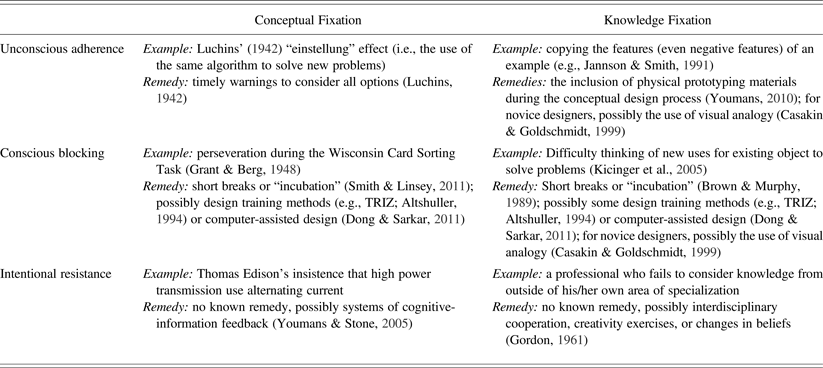
Given the importance of innovation in society, we believe that other interdisciplinary methods for reducing design fixation will be discovered as design science matures and that it may be helpful for both researchers and design educators to consider couching their research efforts in terms of the types of design fixation under investigation. Specifically, we challenge researchers to consider whether the designers in question are displaying an unconscious adherence to the influence of prior designs, are troubled by conscious blocks to change, or are displaying an intentional resistance to new ideas. We provide Table 2 as a general guide to educating designers about the different types of design fixation and as a rough guide to researchers who wish to sharpen the focus of their own research efforts.
Types of design fixation with examples and possible remedies
7. CONCLUSIONS AND FUTURE RESEARCH
The mental processes responsible for creative behavior have been pondered by some of the greatest minds in behavioral science, including Freud, Skinner, and the team of Newell and Simon. With the relatively recent advent of the field of design science, researchers are gaining ground on some very difficult questions about the nature of human creativity. In this paper, we have argued that design fixation should be thought of as limitations in the inventive design process that occur when designers are biased toward, or are consciously or unconsciously influenced by, a set of conceptual ideas or a previous body of knowledge. This definition may not be the one that researchers ultimately come to rely on, but this updated definition better reflects the various fixation behaviors currently being investigated by the interdisciplinary community of design scientists.
Modern approaches to design science research are likely to be influenced by the disciplines of the researchers who study the phenomena, and research questions that are of particular interest to this paper's first and second authors include the potential impact that individual differences in cognitive flexibility may play in designers’ ability to resist fixation (Ohlsson, Reference Ohlsson2011), how large differences in culture, gender roles, and educational systems may affect fixation rates in an increasingly global society (Arciszewski, Reference Arciszewski2009), and how machine learning can be leveraged to reduce fixation effects (Arciszewski & DeJong, Reference Arciszewski, DeJong and Topping2001). However, the authors believe that new breakthroughs regarding design fixation are most likely to be made via interdisciplinary collaborative efforts. The authors are currently engaged in a project to reduce design fixation by developing computational models of inventive engineering that frame design fixation from the perspective of phenomenal consciousness (see Humphrey, Reference Humphrey2011). In this example, conceptual design processes will be chosen by computation models in which fixation is either not included or is controlled by the model. Such a project would not be possible without the transdisciplinary knowledge that cross-disciplinary collaborations afford.
By categorizing design fixation into six areas, we have highlighted areas that are clearly in need of additional research. For example, the theory that fixation may limit a designers’ ability to move between different orders of knowledge, and the possibility that existing creative exercises and methods such as brainstorming or TRIZ may facilitate movement between them, is certainly worth investigating. Many of these techniques are already taught at universities, although we suspect that many students do not really believe that the methods are very effective. Part of the skepticism surrounding creative exercises may stem not only from a lack of empirical research documenting their effectiveness but also from a lack of knowledge on the part of the students (or faculty) about when to use these creative aids and exercises. Design fixation research may be entering a phase of study where such questions can be more accurately addressed.
An updated definition of design fixation is important to ensure that researchers who study fixation or apply research findings to reduce fixation effects do not conflate one area of fixation behavior with another. There is little evidence, for example, that conscious conceptual blocks and unconscious adherence to negative design features are both caused by the same underlying mechanisms, or that the same training methods or interventions would be equally effective in reducing them. The authors hope that categorizing fixation behaviors according to consciousness, intentionality, and the mental design space will lead to less wasted time and effort on the part of design scientists. As design science continues to attract researchers and scholars from a variety of technical fields, we believe that developing stronger operational definitions for design fixation phenomena will be important for supporting interdisciplinary cooperation and communication between researchers and in design education.
ACKNOWLEDGMENTS
This article is a revised and expanded version of a presentation, “Design Fixation: A Cloak of Many Colors,” at the Fifth International Conference on Design Computing and Cognition held at Texas A&M, June 5–9, 2012. The authors acknowledge support for our work from the National Science Foundation's Early-Concept Grants for Exploratory Research program and from the George Mason University Center for Consciousness and Transformation.
Robert J. Youmans is an Assistant Professor of psychology at George Mason University where he directs the Creative Design and User Experience laboratory group. He earned his PhD in cognitive psychology at the University of Illinois at Chicago in 2007 for his work on how physical prototyping and group work facilitate more functional and creative conceptual designs. His current research is dedicated to uncovering the cognitive mechanisms associated with creativity and innovation and the application of those findings to improve design and engineering. Dr. Youmans’ areas of research include design science, individual differences in human creativity, and the design of user-friendly technology.
Thomaz Arciszewski is a Professor of civil, environmental, and infrastructure engineering at George Mason University. He has studied inventive design since the early 1970s, when he was a cofounder of the Heuristics Branch in the Polish Cybernetic Society. He currently teaches undergraduate and graduate classes on inventive engineering at George Mason University, which has led to a realization that integration of transdisciplinary knowledge is the key to improving design science. For the last 3 years, Dr. Arciszewski has been involved in various activities at the recently established George Mason University Center for Consciousness and Transformation, where his studies have included understanding of phenomenal consciousness in the context of inventive design.