Lakoff and Johnson explain the indispensability of metaphor for cognition and thought, based on its key role in conceptualizing abstract concepts.Footnote 1 They maintain that metaphor is employed to conceptualize and construct abstract concepts that cannot otherwise be understood. However, metaphorical capability is not limited to conceptualizing nontangible notions; it may further be used to turn an unknown entity into a known concept.Footnote 2 Consequently, metaphor plays a fundamental role in religious discourses meant to convey inscrutable mysteries that may not be experienced directly via reasoning or the senses. These inscrutabilities, which form the canonical elements of a religious discourse, are conceptualized and depicted using metaphorical models. Metaphor thus shapes the very semantic core of a religious system, serving both to conceptualize transcendence and to communicate those ideas to followers in a convincing way. As metaphor conceptualizes the transcendent in an objective manner and an earthly form, it also represents and evaluates spiritual concepts in accordance with the ideological interests of a religious discourse.Footnote 3
One may argue that metaphor functions simultaneously as a cognitive tool (conceptualizing the transcendent) and an ideological apparatus (constructing a metaphorical representation and evaluation according to some ideological preferences) in religious discourses. This becomes far more complicated when we consider the Yārsān religion, also called Ahl-i Ḥaqq. As a minority religion that obliges its followers to practice absolute secrecy, Yārsān applies various metaphors not only to conceptualize and express its beliefs, but also to conceal them from outsiders.Footnote 4
This secret religion, according to Yārsān texts (Dawra-y Rohtāw, Kalāmə Xazāna), emerged as the result of the ultimate expression of God in Sultan Sahāk in the fourteenth century, a perfect manifestation that had been preceded by other divine revelations, including Bohlul (ninth century), Bābā Sarhang (tenth century), Shāh Xoshin (eleventh century), and Bābā Nāus (twelfth century). It should be noted, however, that these are the epochs of sacred history according to the religious historiography set out in the sect's own texts and cannot necessarily be proven historically.Footnote 5 However, it may be deduced with reasonable historical confidence that Sultan Sahāk merged several heterogeneous heterodox groups into a unified religious community in the fourteenth and fifteenth centuries and established a new religious order.Footnote 6 This newly established order spread mainly to the western regions of Iran and some eastern parts of Iraq, whose inhabitants are predominantly Kurdish. The Yārsān believers in Iran have Kurdish ethnicity, and mainly speak in Kalhori and Sorani dialects. Yārsān followers consider this sect to be the primordial dīn (religion) in history and deny that it developed from any other tradition. Nonetheless, many interconnections between Yārsān and other religions have been identified by scholars.Footnote 7 Therefore, it is mainly regarded as a syncretic religion.
The primary objective of the present study is to analyze the metaphorical models employed to conceptualize the fundamental concepts of transmigration, incarnation, and epiphany in the secretive discourse of Yārsān. To achieve this end, we first explain the epistemological and ideological roles of metaphor in Islamic-Iranian gnosticism. Afterward, applying conceptual and critical metaphor theories, we investigate the metaphors used to depict heretical ideas in the Yārsān sacred texts. In the next section, we will discuss the role of metaphor in Islamic-Iranian gnosticism. In the following two parts, the theoretical framework and the material used for analyzing Yārsān texts will be presented. The following section, the main part of the article, presents an analysis of Yārsān texts to cast new light on the relationship between the sect's heretical notions, its metaphorical models, and its ideology of concealment. Finally, the last part covers conclusions and theoretical implications.
Metaphor in Iranian Gnosticism
Islamic gnosticism (bāṭiniyya), according to Islamic theologians and doxographers such as al-Baghdādī (980–1037) and al-Shahristānī (1086–1153), is characterized by the duality of ẓāhir (lit. external, apparent) and bāṭin (inner, hidden).Footnote 8 These lexemes metaphorically designate exoteric and esoteric knowledge, respectively. The gnostics believed that religious teachings consisted of an esoteric and inner spiritual knowledge, accessible only to gnostic seekers; this has been veiled and disguised by exoteric teachings, which are accessible to laypeople. The relationship between these two kinds of knowledge has been described using a metaphorical device: esoteric knowledge is the kernel of a walnut and the exoteric the walnut's shell. For gnostics who have access to the inner kernel, the validity and usefulness of the shell is nullified.Footnote 9 In other words, when a gnostic discovers the inner transcendent knowledge, the person does not need to follow the sharia and its obligations any longer. As a result, when a spiritual leader belonging to a gnostic sect emerges in a specific era and starts to interpret and reveal the hidden and esoteric teachings of a preceding prophet, the exoteric teachings (especially the sharia laws) of that prophet will be nullified. Gnostics are not obliged to follow the superficial laws and the exoteric precepts of the nullified, outer trappings of religion, since they have attained its inner core. This religious revolution is called qiyāmat (resurrection) in Islamic-Iranian gnosticism because a new order and a new form of transcendence are established by the leader, who has revealed the transcendent kernel enclosed in the shell of sharia. In this way, gnostic sects clearly declare the nullification of other religions.Footnote 10 The following verses taken from two books of Yārsān clearly illustrate this idea:
(1) haqiqat bud maghz ʾeslām pust / čonān maghz ba pust dar ham nekust / čo bādām dar ŝarʾ beŝkaste ŝod / haqiqat ʾaz ʾān maghz wāraste ŝod.
The truth is the nut, and Islam is the shell / Such a nut is fitting only with a shell / When the almond of sharia is broken / Truth becomes manifest from that nut.Footnote 11
(2) rohtāw kam wāča ŝarʾe maghz batāl / pay bāqim nyān tārixə ʾabdāl. (Rohtāw)
You Rohtāw! Speak little of sharia that is a nut without any kernel in it / Hereby I bring for you the history of the sacred people (the science of sacred history of divine manifestations).
In this sect, the decisive spiritual action is to pass from the superficial layer of the religion (exoteric knowledge) to the internal layer, esoteric knowledge. This epistemic passage brings about an ontological transformation for the gnostic believer. In other words, when a gnostic believer acquires the core of the religion, that person ascends to a higher ontological rank.Footnote 12
In Islamic-Iranian philosophy, which forms the basis of the philosophical principles of Iranian gnosticism, the religious or prophetic revelation is brought about by the prophet's spiritual connection to the tenth active intellect.Footnote 13 Before explaining this relationship, we should describe the concepts of intellect and revelation in this philosophy. According to Fārābī and Ibn Sīnā, God first created nine celestial spheres and ten intellects as nonmaterial entities.Footnote 14 The earth and material elements were created afterward by the tenth intellect. In this system, the tenth intellect or the active intellect (ʾaql-i faʿāl) is responsible for transmitting the metaphysical and transcendent truths to human beings (the human intellect) as the only inhabitants of earth who can ascend back to the divine world. As Fārābī and Ibn Sīnā explain, the relationship between the active intellect and the human intellect can be compared to the relationship of the sun to one's eyes. As the eyes fill with light from the sun, so does the human intellect receive philosophical and transcendent truths from the tenth intellect. Therefore, the tenth, active intellect also is metaphorically called the angel of revelation because it is the transcendent messenger who brings the news of the divine world to human beings.
The Islamic-Iranian philosophy presents two kinds of relationships with the active intellect: a philosophical one and a prophetic one. In the first, a philosopher engages in thought and practices logic and the rational sciences, which prepares the mind to receive philosophical concepts from the active intellect. In this relationship, it is the rational faculty of the philosopher that makes the connection to the active intellect possible. Such a relationship requires philosophical teaching and the application of the principles of logic and metaphysics. Accordingly, the human faculty of reason is able to receive divine and metaphysical truths from the active intellect. The second relationship is particular to the spheres of religion and mysticism. More specifically, a prophet or a mystic can link the soul to the active intellect by the faculty of imagination rather than intellect. In fact, Fārābī and Ibn Sīnā clearly state that prophets and mystics do not receive transcendent truths and divine concepts from the active intellect through philosophical thinking, but by connecting their imaginative faculty with the active intellect.Footnote 15 In other words, prophets and mystics access this divine source (the active intellect, the angel of revelation) through their imaginations.
To elucidate Fārābī's theory, it may be argued that because the concepts revealed by the active intellect are too abstract to be grasped by non-philosophers, the imaginative faculty of the spiritual leader employs metaphors to conceptualize and depict these abstract notions (transmitted by the active intellect) in an objective manner. Prophets and mystics use their powerful imaginative capabilities to conceptualize abstract spiritual truths via allegories and metaphors, a particular ability that is described as the transcendent potentiality (quwwi-yi qudsiyya) by Ibn Sīnā.Footnote 16 This process of metaphorizing and symbolizing abstract concepts, carried out by the active intellect with the help of the prophetic imagination, is called prophetic mimesis. However, it should be noted that the figurative devices used in prophetic discourse are used not only to explain the abstract nature of the transcendent but also for preaching, because common people can only understand these divine and metaphysical concepts in a metaphorical fashion.
Therefore, in Islamic-Iranian gnosticism mystical and prophetic discourses are the products of the metaphorical conceptualization of transcendent truths by prophetic mimesis. Accordingly, in gnosticism, any gnostic text is considered to have two semantic layers: a metaphorical and a literal meaning. The second layer refers to the abstract notions as transmitted by the active intellect, and the first refers to those allegories and metaphors used to conceptualize these ideas. A gnostic believer may uncover the abstract, transcendent truths by unraveling and interpreting the superficial figurative devices. This de-codification or spiritual interpretation is called taʾwīl (gnostic interpretation) and is the basic hermeneutical apparatus used in gnosticism to connect the two semantic layers, proceeding from the superficial layer to the inner core of the text. This hermeneutic instrument is applied to render the metaphorical imageries of the religious discourse in their literal equivalents. Taʾwīl is thus the science of making the target domain of the metaphors explicit. Suhravardī (1154–1191) argues that the validity of gnostic texts cannot be denied or confirmed by considering only their external layer; these texts have been codified by ramz (secret[ly]) and must therefore first be interpreted.Footnote 17
Maḥmūd Shabistarī, a great Sufi of the fourteenth century whose book Gulshan-i rāz can be considered a manifesto of Iranian gnosticism, explains gnostic interpretation as follows:
(3) maʿnī čūn kunand īnja tanazzul / żarūrat bāshad ān rā az tamassul.
As meanings come down to us here / The necessity of allegory becomes clear.Footnote 18
Shabistarī believes that when transcendent, abstract truths descend upon the material world, they are necessarily expressed via allegorical devices. His work presents a list of the metaphors applied by gnostics to express transcendent concepts. For example, he says that the ringlet in Sufi texts is a metaphor for the jalālī emergence of God, the manifestation of his glory; that the beautiful face is a metaphor for the jamālī manifestation of God, the manifestation of his beauty; that the conversion of a mystic from Islam to Christianity symbolizes the pious mystic's abandoning of wealth and fame; and that a facial mole is a symbol of the unity of existence. Shabistarī terms the process of rendering allegorical expressions in their literal sense as taʾwīl.
(4) bi nazd-i man xud ʾalfāẓ-i muʾavval / bar ān maʿnī futad az vazʿ-i avval.
To me the (figurative) phrases that are rendered into their meanings / Were first imposed on those meanings.Footnote 19
Therefore, in Iranian-Islamic gnostic discourses, gnostic texts have a figurative discourse composed by prophetic mimesis or the prophetic imagination. If one wants to understand these texts, then one should be aware of their metaphorical nature.
Apart from this expressive function, which denotes the transcendent in imagery, metaphor in gnosticism has another important function: it is used to disguise the heterodox concepts of the sect. Quṭb-al-dīn Shīrāzī (1236–1311) states that figurative devices are used not only to express transcendent notions, but also to conceal these ideas from outsiders.Footnote 20 This function of metaphor is in keeping with the practice of esotericism, which is one of the key characteristics of gnosticism. For example, al-Baghdādī maintains that gnostics always conceal and hide their true beliefs, a practice that also is exercised in the Yārsān religion:Footnote 21
(5) nawā bwāči ʾasrārə yārān / yār ʾāgāw binān na bar tā bāran. (Shāh Xoshin)
You should not express and reveal the secrets of Yārsān community / Friend [God] can see all the things existing between seas and deserts.
This concept of concealment (taqiyya) must be considered in the political and ideological context of the Islamic Middle Ages. Orthodox potentates and scholars often severely persecuted gnostics for their unorthodox beliefs. As a result, gnostics were compelled to hide their ideas and beliefs under the mask of complicated metaphors and similes, so that the uninitiated could not understand it. That is why Ibn Sīnā and Suhravardī composed a large part of their philosophies in the form of allegories and parables.Footnote 22
We can assert that metaphor and similar figurative devices hold two main functions in gnostic discourse: first, a cognitive function, used to conceptualize the spiritual experiences; and second, an ideological function, used to conceal heterodox ideas from outsiders. In other words, the metaphor provides the gnostics with the cognitive capability to conceptualize the abstract transcendent notions in a figurative way, and also can help gnostics transcend the limitations of speech and expression imposed by orthodox groups and escape censorship imposed by the dominant political and religious order.
Theoretical framework
In the field of cognitive linguistics, metaphor is described as the cognitive capability of conceptualizing one domain of experience in terms of another. An abstract concept (the target domain) is understood via an objective notion (the source domain) in a unilateral way. Metaphorical understanding is enabled by ontological and epistemic correspondences between the two different domains.Footnote 23 In other words, the structure and components of the source domain are projected onto the target domain, such that the latter abstract concept is structured and understood in terms of the former. Metaphor is a cognitive faculty that distinguishes the human cognitive system from that of other animals.Footnote 24 Metaphorical mapping between the domains is accomplished at the level of the concept, but it may be realized in terms of different linguistic expressions. As a result, conceptual metaphor should be distinguished from metaphorical linguistic expressions.Footnote 25 For example, the conceptual metaphor argument is war can be realized in terms of different linguistic expressions, as follows:
(6) Your claims are indefensible.
(7) I demolished his arguments.
(8) He attacked every weak point in her argument.Footnote 26
Although metaphor is principally a cognitive ability, it also may play an ideological role in different discourses. This is illustrated by explaining the concept of ideology. Thompson describes ideology as a situation in which meaning is at the service of power and social inequality.Footnote 27 By representing social relations and facts in a specific manner and thus (mis)-using meaning, an ideology tries to maintain these social and political inequalities.Footnote 28 Language, as the most fundamental meaning-producing machine, has a profound relationship with ideology. Indeed, language as a social practice or as a situated interaction is not neutral toward ideological interests and purposes.Footnote 29 Different aspects of language (lexical choices, grammatical structures, cohesion, etc.) are loaded with different ideological meanings.Footnote 30
One linguistic element that is frequently used to serve ideological aims is metaphor. Fairclough proposes that metaphor is used to represent and reproduce social relationships in an ideological manner, and so should be considered in critical discourse analysis.Footnote 31 The conceptual metaphor theory presented by Lakoff and Johnson casts new light on the contribution of metaphor to ideological representation. They argue that a certain experiential situation can be represented in different ways by different metaphors, because each metaphor may highlight some parts of that situation and hide others. They also maintain that the majority of ideological discourses are based on metaphors by means of which parts of an experience are suppressed and parts are selectively highlighted.Footnote 32 Therefore, it can be argued that metaphor not only conceptualizes human experience, but also serves ideological intention.Footnote 33 Additionally, metaphor as an ideological apparatus can make political evaluation possible. It may establish a kind of evaluative system through the extreme emotional effect that metaphor can have on an audience.Footnote 34
Accordingly, Charteris-Black states that metaphor should be regarded critically, since it establishes an ideological evaluation system and plays a significant role in ideological representation.Footnote 35 He also maintains that a critical theory of metaphor must combine cognitive semantics, critical discourse analysis (the role of power and ideology), and pragmatics (individuals’ intentions). According to these fundamental points and following Fairclough, Charteris-Black enumerates three interpretive levels for critical metaphor analysis: metaphor identification, metaphor interpretation, and metaphor explanation.Footnote 36 In the first step, the metaphorical expressions in a text are identified according to certain criteria. When a semantic tension exists between the basic sense of a lexeme and its contextual meaning, it should be marked as metaphorical. Similarly, using the metaphorical identification procedure (MIP), the Pragglejaz Group argue that if contextual meaning is in contrast to basic meaning and the meanings are understood only by comparison, then an expression can be marked as metaphorical.Footnote 37
In the second step, the relationship between metaphorical expressions, conceptual metaphors, and pragmatic intentions is investigated. After identifying the metaphorical expressions, the conceptual metaphors underlying these expressions are extracted. The researcher discovers and explains the coherence of the metaphors in the text. In other words, an attempt to explain the conceptual relationship among these metaphors is made. At this point, we arrive at the conceptual key. Charteris-Black states that different conceptual metaphors may be based on a more general and abstract metaphor.Footnote 38 This basic metaphor, which he terms the conceptual key, forms a semantic coherence among different conceptual metaphors. Different conceptual metaphors are formed, like a cluster, around a shared conceptual key. During the third step, the step of explanation, metaphors are considered against the background of ideology. The researcher attempts to identify the ideological elements that play a role in the production of the metaphorical discourse. The socio-ideological role of metaphor in persuading and interpellating social subjects is examined. In summary, in critical metaphor theory, three layers – linguistic expression, conceptual metaphorical model, and socio-ideological context –are taken into consideration to explain the metaphorical aspects of a text.
The Material
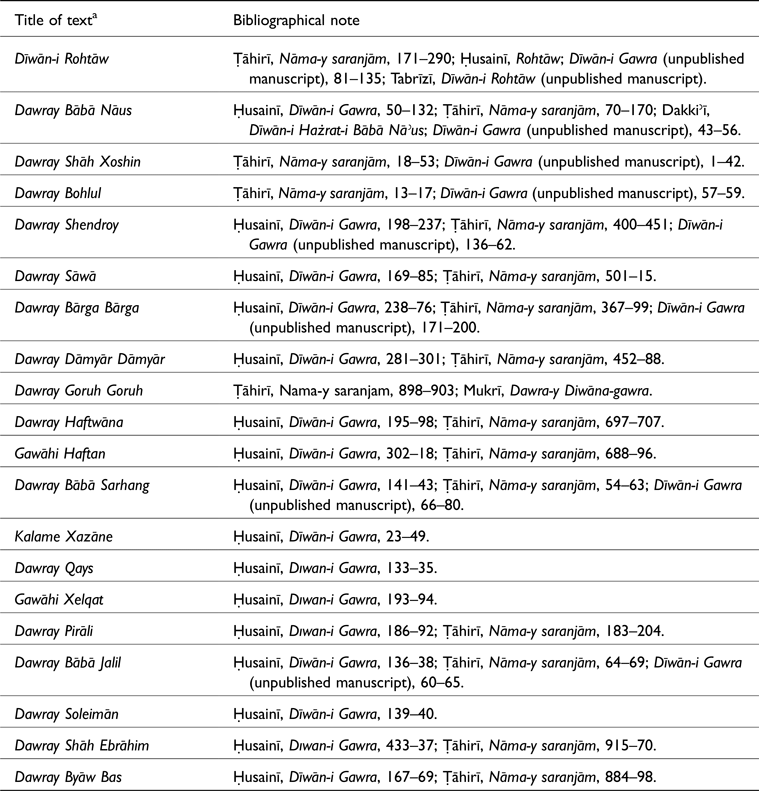
In this article, we investigate some Yārsān texts from the critical cognitive perspective elaborated above. More specifically, we investigate the metaphors used to conceptualize the notion of transmigration and some related concepts in the Yārsān religion, such as body, incarnation, and epiphany. To this end, we identify metaphors in a selected group of Yārsān texts by applying the MIP method. Thereafter, we extract the conceptual metaphors underlying the metaphorical expressions. Finally, by applying critical metaphor theory, we analyze the ideological motivations behind the metaphorical models observed in the sacred texts. The pilot corpus includes twenty Yārsān texts (Table 1). It covers the most important texts of the tradition and all the sacred eras (Bohlul, Bābā Sarhang, Shāh Xoshin, Bābā Nāus, and Sāhak). Accordingly, it can be considered reasonably representative of Yārsān religious discourse as a whole.
Texts of the pilot corpus.

a We refer to these texts with the proper names in their titles.
It should be noted that some texts, like Rohtāw and Bāba Nāus, are very bulky. For instance, the manuscript of Rohtāw (along with its comments and translation) comprises about five hundred pages. In contrast, texts such as Qays, Shāh Ebrāhim, and Bābā Jalil are very short; the manuscript of Qays is only three pages. These manuscripts were collected by the first author during field research in Iran (in Sanandaj, Kermanshah, and Hamedan). The manuscripts were written by many different scribes; accordingly, they lack a unified orthography, and none has a colophon. In addition, Gorani koine, the linguistic variety used in the texts, is a mixed language that has acquired its phonetic, morphological, and grammatical structures from different Kurdish dialects. It also should be noted that no grammar of this dialect has yet been written. Accordingly, our interpretations of the texts are based completely on our experience, intuition, and knowledge of Kurdish dialects.
Heterodox Notions and Their Metaphorical Models in the Discourse of Yārsān
In this section, we discuss the main metaphorical models that are employed to visualize the Yārsān concepts that do not conform to mainstream Islamic theology, such as transmigration, incarnation, and epiphany. Firstly, we will briefly discuss these concepts as they appear in the Yārsān religion; then we will describe and explain their basic metaphorical models from a critical cognitive perspective.
The concepts of divine incarnation (ḥulūl) and transmigration (tanāsukh) are considered the distinctive features of Islamic-Iranian gnosticism. Although he describes some gnostic sects as extremist (ghālī)—Khattabiyya, Numayriyya, Hilmāniyya, Muqanniyya, Razzammiyya, Abūmuslimiyya, Khurramiyya, etc.—al-Baghdādī opines that all these gnostic sects share some common features, such as divine incarnation, transmigration, and nullification of the sharia.Footnote 39 Similarly, in the tenth century, al-Maqdisī, who visited the western regions of Iran, claims that there are many divergent sects of Khurramiyya in this region, and that the principle ideas of transmigration and divine incarnation are shared by all of them.Footnote 40 These sects hold that God incarnates in the bodies of the prophets, imams, and sacred persons in history.Footnote 41
In Yārsān, these ideas also play a fundamental role. However, the notions of incarnation and transmigration are tightly linked to the cosmogony of this religion. In Yārsān cosmogony, when God created the seven archangels, he made a divine pact with them. According to this covenant, the archangels must bear the suffering of time and transmigration. In other words, they have to descend to earth, enter the cycle of time, and then appear in different eras, incarnated in different human forms.Footnote 42 According to the pact, the seven celestial beings must undergo numerous transmigrations in different historical periods until they reach perfection and rejoin God in the heavenly realms. Then God states that he also will undergo incarnation as a human in different historical periods and join the seven archangels on earth. In other words, God also assents to enter the historical cycle of transmigration by incarnating in bodily form.
(9) ʾaz ʾin bāb guyand haq dar baŝar / be dowre zamān miŝawad jelwegar.
Because of this, it is said that God will appear / Among human beings in different temporal periods.Footnote 43
It should be noted that the transmigration and incarnation of God are two sides of the same coin; God's transmigration is nothing more than his continuous incarnation in human form throughout history. In other words, the divine transmigration is the dynamic and continuous incarnation of God across the temporal axis. In fact, the notions of transmigration and incarnation are so closely related in Yārsān that the same terms, doonādoon (a Turkish loan word) and kawākawa (a Kurdish word for changing garments), are used for both of them.
The heterodox ideas of divine incarnation and transmigration occur frequently in Yārsān texts. In addition to the two terms above, the texts employ numerous metaphorical terms or devices to discuss divine and angelic incarnation and transmigration. One exception is the nonmetaphorical term maẓhariyyat (an Arabic loanword), used to designate incarnation; this loanword, however, occurs only seven times in our corpus. Surprisingly, the lexeme badan (body), when it relates directly to God, occurs only three times. The following verses illustrate two cases in which the lexemes maẓhariyyat and badan are used:
(10) weŝ nakaru kaj xolq na tānay be ʾār / mazhar wa mazhar wastan wa kənār. (Bābā Nāus)
He was not upset with the disbelievers who bothered him / In each incarnation (mazhar wa mazhar), he left them and did not tell them anything.
(11) ŝāhtān wa ŝādi mawazu wa hana / xwājā magilo čə sar badana. (Rohtāw)
Your king will come here happily / And the king will enter the body (badan).
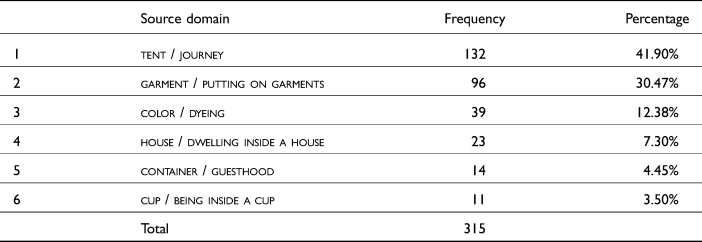
In contrast, metaphorical expressions denoting the concepts of transmigration and incarnation occur frequently. In fact, we identified 315 metaphorical expressions used to convey these concepts in our corpus. This statistical evidence shows clearly that the authors preferred metaphors to literal terms for expression of these concepts. One may argue that because these ideas produced strong reactions among the Islamic orthodox the authors endeavored to disguise these notions through metaphors, expressing them in an indirect way. As described, metaphorical expressions may have been selected because they can bypass limitations imposed by the dominant ideology. A metaphor may conceal a heterodox belief by disguising it with complicated images, allowing the text to express the forbidden in an indirect way. In this way these metaphors challenge the limitations on speech imposed by dominant ideologies. Metaphor as a rhetorical device can resolve a constant linguistic tension in Yārsān discourse: the tension between expressing a heterodox notion and hiding it from outsiders.
In what follows, we investigate those metaphorical models that have been employed to depict the concepts of transmigration and incarnation in the corpus delimited for this research. The results show at least five metaphorical models used to conceptualize the ideas of body, transmigration, and incarnation, and a special model, dyeing, to depict the notion of epiphany (a particular version of incarnation in Yārsān). Table 2 illustrates the models arranged according to their frequency. In each row are two source domains that are closely related. The first one refers to the concept used to metaphorically depict the body that undergoes transmigration or incarnation, and the second is applied to illustrate the process of transmigration or incarnation. It should be noted that any metaphor of transmigration and incarnation is based on a metaphorical conceptualization of body. For instance, if transmigration is conceptualized as putting on a new garment in a specific text, the body has already been depicted as a garment (second model, Table 2).
Metaphorical models for the designation of incarnation and transmigration in the corpus, sorted by frequency.

Tent and journey are the most frequent domains employed to conceptualize the related notions of body and transmigration in Yārsān discourse. Note that the bodies of God and the archangels are visualized as tents in this model. However, the source domain of tent is predominantly verbalized by two different words, yort (a Turkish loanword) and bārga (a Kurdish word), with yort being more frequently used. Moreover, not only does yort appear more frequently than bārga, but most of the occurrences of bārga (fifty-four) are densely located in one book (Bārga Bārga). Hence the Turkish word (yort) is used in most other books in the corpus (Table 3).
Comparison of frequency of use of the two metaphorical lexemes, yort and bārga, in the corpus.

The following verses (12–15) portray the use of the word yort to metaphorically depict the body of holy figures undergoing incarnation. In these examples, the contextual meaning of yort, body, clearly stands in contrast to its basic meaning, a kind of shelter. The Yort's contextual meaning and its basic meaning together convey a containment schema that can host an element, a person or the soul. Example 12 clearly states that Mostafa (the second incarnation) was Fazl (the first incarnation) in the previous epoch. In other words, Fazl's soul is incarnated in the body of Mustafa in the subsequent era. The body of Fazl is here described as a tent. The body of incarnation is similarly described as garment and tent in example 13. This verse refers to a person who was incarnated in an animal body (a goat) and was then rescued from this animal form by God. The animal bodily form is described as the tent of animal. In example 14, the next bodily form, in which Sahar became incarnated during his life in Medina, is depicted as a tent. In example 15, the source domain of tent and its target domain body are clearly mentioned. It should be noted, however, that this is the only case in the text in which the target domain is explicitly mentioned along with its source domain.
(12) yorte mostafā ŝā fazl bi naw dam / nyāŝ maʿrifat pay gərdin ʾālam. (Bābā Nāus)
The tent (yort) of Mostafa was Fazl at that time / He brought gnostic knowledge for the people.
(13) ina dām najāt to ni qabāʾi / . . . na yorte bəzit madi gawāhi. (Bāba Nāus)
Now, I saved you from the garment of a goat (one of the reincarnations of a holy figure in an animal form) / And you declared the truth while you were in the tent of a goat.
(14) nāməm sāhar bi na sarandil dāw / na madyan yortəm hendolay sahāw. (Bāba Nāus)
My name was Sahar in the Sarandil / And in Medina, my tent was Hendola the true follower of the prophet.
(15) kuru badani / har se čanimān ča rāh jahdani / yortu jāmaŝān čə bad badani. (Rohtāw)
They are blind and bad / These three persons are fighting with us / Because their tents and garments are very bad bodies.
It is apparent, then, that in these texts the body is visualized as a tent, and the divine essence is depicted as a person who dwells inside the tent:
-
body is a tent.
-
incarnation is dwelling inside a tent.
However, this is not the whole story of the image of the transcendent tent. There are some other examples that are far more difficult to interpret:
(16) ŝex ʾimāmu ŝā ŝex ʾimāmu ŝā / ŝex ʾimām yortəŝ was habib ŝā. (Rohtāw)
Sheikh Imam and the king, Sheikh Imam and the king / Sheikh Imam put his tent on King Habib.
(17) nāji bǝlafā / ŝex nāji yortǝŝ wastan bǝlafā / . . . ŝex bāqi yortǝŝ sayyed mir Ahmad. (Rohtāw)
Naji is Belaf / Sheikh Naji put his tent on Belaf / . . . And the tent of Sheikh Baqi was Seyyed Mir Ahmad.
(18) dāwudǝ nāzdār / garrāy hazār yorte beŝomār / peŝrawe yārān sargarde čwār. (Shendroy)
You! Beloved Dawud! / You have passed through thousands of tents / You are the leader of my friends, and the leader of four angels.
The expressions yort wastən (to erect a tent) and yort wa yort ʾāmān (going through different tents) are not common expressions either in Kurdish dialects in general or in Gorani koine in particular, and Kurdish speakers cannot interpret them clearly if they are considered in isolation.Footnote 44 The expression yort wastən appears to be a literal rewording of the Kurdish phrase bārga wastən, in which the structure of the Kurdish expression has been preserved, but the lexeme bārga, a specific kind of tent, has been replaced with a Turkish equivalent. In some cases, these two synonyms, yort and bārga, are used in the same verse (example 19). In example 20 the expression bārga wastən appears in the first verse and is repeated with its Turkish equivalent yort wastən in the second. It is probable, therefore, that yort wastən is derived from the original Kurdish expression bārga wastən.
(19) yortə ŝex qodrat yārə mehrətan / ʾā haft lālaw qadim derətan / bārgay čwārəmini koy namirətan. (Kalām-e Xazāne)
The tent of Sheykh Qodrat is your friend, Mehr / He is one of the seven ancient rubies (your old friend) in front of your door house / He is the fourth tent in the land of immortality.
(20) ŝām wast wa bārga pā kaŝti fotuh / beruz da tofan wast wa yortə noh . . . / ŝi wa yorte nuh xwajay sham afruz. (Bārga Bārga)
My king put his tent on the victorious ship / He made a storm and put his tent on Noah / He entered the tent of Noah, the master, who is like a shining candle.
Bārga wastən, which literally means putting up a tent in a given location, refers to the process in which a traveler dismounts from a horse and begins to pitch a tent. It is this cultural model that is applied in the Yārsān texts to the notions of incarnation and transmigration. The Yārsān texts represent God as a traveler in a caravan. The location at which the caravan stops metaphorically depicts a specific temporal era when God manifests himself in a new terrestrial body. For instance, when the text Bārga Bārga mentions the word Mecca as a caravan stop, it refers to the time when God appeared as Ali and established Islam. Alternatively, when it mentions Sirwān, it refers to the temporal epoch in which God manifested himself as Sahāk and established Yārsān. Another example from the same text is the narrative of seventy-two saints talking about the seventy-two locations where God has manifested himself; these spatial locations are in fact seventy-two temporal eras when God has incarnated in bodily forms. Accordingly, we argue that this metaphorical imagery is based on the highly generic metaphor time is space. The process of God's transmigration in different eras is visualized as a journey through different places by caravan. It can be concluded that transmigration is conceptualized as a journey in this model.
Next, consider the question of which source domain is used to conceptualize body in this model. In examples 21–24, the bodies of God and the sacred beings are depicted as tents erected by God and the angels, who are travelers in need of rest. If we consider transmigration to be a continuous process through different eras, one may argue that this idea is depicted as a journey by caravan through different locations. But if we regard incarnation as a static event in which God incarnates in a particular body in a specific era, it can be said that incarnation in a specific era is visualized as dwelling inside a tent in a specific location. The caravan metaphorical model is in this way able to conceptualize both incarnation and transmigration. The fact that a whole text (Bārga Bārga) is based on this model attests to its usefulness for expressing different notions.
Example 21 describes the transmigration of God in different locations, such as Kasnazān and Medina. These local names refer to locations where God has incarnated in human form in different sacred eras. The transmigration of God is conceptualized as a journey through different locations by caravan. The bodies of God are visualized as tents that he has erected in these different locations. In example 22, the incarnation and manifestation of God in Sirwān have been described as erecting a tent on Sirwān by God. In other words, God puts up a tent (body) and dwells inside it, that is, incarnates in Sirwān. Similarly, the manifestation of God in Mecca is described in example 23 as dwelling in a tent in Mecca. In example 24, the body of Mokhtar (a holy figure in Yārsān) is first depicted as a tent, then as a location to which God and his tent descend (incarnate). In this verse, the body of God and that of Mokhtar are simultaneously conceptualized as tents: the verse says that the tent of God descends into the tent of Mokhtar.
(21) ʾaw koy kasnazān ʾaw koy kasnazān / bārgay ŝām wastan ʾw koy kasnazān . . . Bārgay ŝām luwā / wast ʾaw madina / gholāmān ʾāmān ja hazār wena. (Bārga Bārga)
In Kasnazān, on the Kasnazān mountain / The tent of my king was erected on Kasnazan mountain . . . the tent of my king was erected in Medina / And the servants came there with a thousand colors.
(22) ʾaw ŝattǝ sirwān, ʾaw ŝatte sirwān / bārgay ŝām wastan ʾaw ŝattǝ sirwān / ča pardiwardǎ ŝām gǝrtǝn diwān. (Bārga Bārga)
In the Sirwān river, in the Sirwān river / The tent of my king was erected at the shore of the Sirwān river / And he established his courtship in Pardiwar.
(23) ʾaw kābay ʾaʾzam, ʾaw kābay ʾaʾzam / bārgay ŝām wastan ʾaw kābat ʾaʾzam / kābam pardiwar soltānə sarjam. (Bārga Bārga)
In great Mecca, in great Mecca / The tent of my great king was erected in Mecca / But my Mecca was Pardiwar, the lord of all people.
(24) ʾaw yorte moxtār ʾaw yortə moxtār / bārgay ŝām wastan ʾaw yortə moxtār . . . / mirzā zi hādi ča yortə ramzbār. (Bārga Bārga)
The tents of Mokhtar, the tent of Mokhtar / My king's tent was erected unto the tent of Mokhtar / Mirza Hādi was the tent of Ramzbār.
The above examples allow us to infer the following conceptual metaphors:
-
god is a traveler.
-
body is a tent.
-
incarnation in a specific era is dwelling inside a tent.
-
transmigration is a journey.
-
time is space.
Again, yort appears far more frequently than bārga, and most of the occurrences of bārga are in a single book (Bārga Bārga). Interestingly, there is another book, Zolāl Zolāl, the structure and theme of which are highly similar to those of Bārga Bārga. Zolāl Zolāl also narrates different incarnations of God in different temporal periods; in this book, however, yort is exclusively used to conceptualize the notions of body and transmigration.Footnote 45
One may wonder why in these books, written in an ancient Kurdish dialect, a foreign loanword is employed for the important source domain of tent, which in turn conceptualizes the pivotal ideas of body and transmigration. The native Kurdish lexeme bārga can denote the metaphorical meaning far more effectively; indeed, the Turkish phrase can be decoded only by comparing it with its original Kurdish equivalent. Why, then, did the authors opt for the Turkish loanword with an ambiguous meaning? It seems that ideology played a significant role. In the regions where Yārsān was disseminated, the orthodox religious experts knew Persian, Kurdish, and Arabic, but not Turkish to the same degree. It is possible that the authors foreignized and thereby concealed heterodox notions by using foreign loanwords that might not be understood by the orthodox. This use of Turkish loanwords becomes a device of concealment and secrecy. Yārsān discourse not only uses metaphors to disguise the ideas of incarnation and body, but also uses foreign loanwords (yort in the case of tent and doon in the case of garment, used as a metaphor for body) to further obscure these heretical beliefs. It is plausible that the use of Turkish terms for the ideologically contested concepts made their interpretation more difficult. The use of metaphors and foreign loanwords challenges the limitations and censorship imposed by orthodox authority; these linguistic strategies thus serve the rhetoric of concealment in the Yārsān religion.
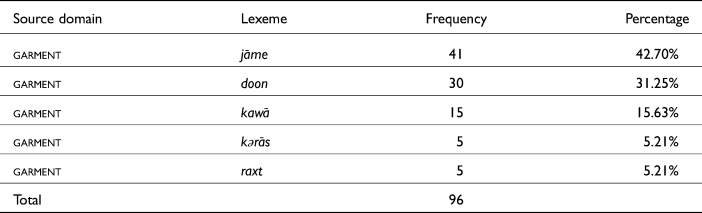
Other domains used to visualize the concept of transmigration in the metaphorical discourse of Yārsān include garment and putting on garments. The domain garment is the second most frequently used domain in the corpus. Garment also is verbalized by many different synonyms, including jāme (a Kurdish and Persian word) and doon (a Turkish word; see Table 4).
Frequency of use of the metaphorical lexemes to render “garment.”

The following verses illustrate the use of different lexemes referring to the source domain of garment, used to depict the concept of body. Transmigration and incarnation also are conceptualized as putting on new garments.
(25) māma jalāla, kākām rangina / doon wa doon ʾāmām čina wa čina. (Shāh Xoshin)
My mother is Jalāla, and my elderly brother is Rangin / I have passed through many garments and come out of many eggshells.
(26) sāzyāym wa haywān aqle moxtasar / hazāru pānsad doonəm kərd gozar. (Bābā Nāus)
We turned into animals with a low intelligence / We passed through fifteen hundred garments.
(27) mar ja pardiwar bwini jam yār / bale jāmay no čogā maw ʾāŝkār. (Bārga Bārga)
We may see God in Pardiwar / There, a new garment will be revealed.
(28) doon wa doon ʾāmām qawā wa qawā / ʾimām hosain biyāni purǝ ŝahanŝā. (Sāwā)
I have passed from one garment to another one, from one robe to another one / I was Imam Husain, the son of the king.
(29) rǝndu qalāŝ bim, nyāŝ asāsā / rǝndǝm qāzyan, qāzim kǝrwāsā / kǝrwāsǝm qāzi jāmǝm qāpi dor. (Bābā Nāus)
I was Rend, and he established that religion / My Rend was Qazi, and he was my garment / My garment was Qazi / And my cup was from the pearl.
(30) ʾaŝqəm wa ʾaŝqi dintān soxti / na ʾazal raxtəm čanitān duxti. (Rohtāw 2)
I burned with love to see you / In eternity, I sewed your garments.
These verses describe successive transmigrations of God and the angels and in doing so use the conceptual metaphor of body as a garment. Example 25 narrates God's transmigrations (accompanied by his angels Mama Jalāla and Rangin) in different bodily forms. Nevertheless, the bodies in which God is incarnated are depicted as garments continuously donned by God. In a similar way, example 26 expresses the incarnation of an angel, who has changed fifteen hundred garments before this time, in an animal form. The verse metaphorically expresses that the person's soul has passed through fifteen hundred bodies historically. In example 27 the body in which God manifests himself in Pardiwar is depicted metaphorically as a garment. Similarly, the contextual meaning of the lexemes denoting garment in other examples refers to the bodies in which God has manifested himself. In these examples, the concept of incarnation in a body is visualized as putting on a new garment. Additionally, the concept of transmigration is depicted as a successive process of changing garments. From these examples, we can infer the following conceptual metaphors:
-
body is a garment.
-
incarnation is putting on a new garment.
-
transmigration is the successive process of changing garments.
According to the above examples, it can be said that at least five different lexemes—jāme, doon, kawā, kərās, and raxt—with approximately similar meanings are used for the source domain of garment. Also, the term doonādoon (a terminus technicus for transmigration) has been derived from the metaphor body is a garment. This term is based on a Turkish root (doon), which literally means garment. However, it has been reduplicated by a productive morphological rule in the Kurdish language to convey the process of changing garments. Some similar terms with the same meaning, such as q(k)awā q(k)awā and mazhar wa mazhar, have been constructed by the same morphological process.
After jāme, a Kurdish and Persian word, the most frequent lexeme used to verbalize the concept of garment is the Turkish word doon, which has a higher frequency than the other Kurdish candidates. As in the previous case, it can be argued that this loanword, which is normally not used at all in Kurdish dialects, replaces available, more semantically transparent Kurdish equivalents. Again, we argue that this lexical substitution serves the ideology and rhetoric of concealment. Like yort in the previous model, this loanword also is used to foreignize the heretical notion of transmigration. Additionally, it can be said that using different words for the same concept—including doon, kawā, and kǝrās (Kurdish words), and jāme—further defamiliarizes the idea. The reader or listener requires further mental effort to process the metaphor. It may even be supposed that using different lexemes decelerates the lexicalization process and precludes outsiders from understanding these metaphors. However, this cannot be verified without access to older resources and manuscripts, and so remains a hypothetical proposal.
The source domain of house, the fourth most frequently occurring domain, also is used to metaphorically depict the concept of body.Footnote 46 Here, the transcendent body is conceptualized as a house, and the holy essence as a person dwelling inside it. The notion of incarnation is conceptualized as dwelling inside the house. The concept of house is verbalized mainly as yāna in most of the verses; however, another phonological realization of this word, xāna, also can be found (example 32). The following verses exemplify this model:
(31) qaf ta qaf jahan wa hangaw bǝri / ča yanay say māma padŝam mačǝri. (Pirāli)
I passed from many mountains in the world / And then I was speaking with God in the Say Māma's house.
(32) pir xānay haqan / . . . merāz daru ʾām gərdin maxluqan. (Rohtāw)
Pir is the house of God / He will realize all the wishes of people.
(33) ŝām ča yānay to kərdən sərkāya / mar to bāwariŝ pay saru wāya. (Rohtāw)
My king manifested himself in the past in your house / It is only you who can again bring back God to this place.
(34) ʾaw yānay huŝang / bārgay ŝām luwā ʾaw yānay huŝang . . . / ŝāh pari yānā nāmiŝ rohyā. (Bārga Bārga)
In the house of Hushang / My king's tent descended unto the house of Hushang / The house of Shah Pari was Rohyā [his next incarnation].
These examples produce the following conceptual metaphors:
-
body is a house.
-
incarnation in a body is dwelling inside a house.
In verse 31, the narrator of the verse describes his previous incarnation (as Say Māma). He says that while he was incarnated in Say Mama's body, he could recognize God's manifestation. In this example, Say Mama's body has been conceptualized as a house. Accordingly, the incarnation of the sacred person has been depicted dwelling inside a house. In example 32, similarly, a sacred person (pīr, spiritual leader) has been described as a house where ḥaqq (God) dwells. The other examples follow the same metaphorical pattern. In example 34, however, a complicated compound metaphor for body occurs. In fact, the metaphors body is a tent and body is a house have been compressed together in the same sentence. As a result, the sentence says that God's tent (his body) descended to the house (body) of Hushang. The metaphorical models of caravan and house have been used simultaneously in this verse.
The next model used for conceptualizing the notion of incarnation, the fifth most frequent one, is based on the concept of guesthood. In this model, the body of a person in which God is incarnated is metaphorically represented as a guesthouse, and God is depicted as a guest dwelling there temporarily. Interestingly, the person whose body hosts God is described as mimāndār (host), and the divine essence incarnated in human form also is called zāt-e mehmān (the essence that is a guest). In this model the idea of incarnation is conceptualized as guesthood; God and the sacred person are conceptualized as guest and host, respectively. The following verses illustrate this model. In these verses, the contextual meaning of the lexemes with the literal meaning guesthood clearly contrast with the basic meaning, namely dwelling inside a building belonging to someone else. The concept of guesthouse, however, functions as the ground against which incarnation is understood in terms of guesthood.
(35) Bale wa zātǝt beŝak hā myān / ča sinaŝ lawhǝt, haq zāte xwājān. (Bābā Nāus)
Yes, your essence is the host of him (you are the host of God as a guest) / And in your chest, there is God the lord of the world.
(36) ča wetan zātu xoŝin penhāna / ləqāʾu xwājām ja to mehmāna. (Bābā Nāus)
The essence of Xoshin is hidden in you / And my God is a guest in you.
(37) mymāntǝn zātǝ xolāsay ʾǎlam / madari mǝrāz panju du tamām. (Bābā Nāus)
That essence that is the ultimate wish of everyone is your guest / You will realize the wish of five and two angels.
(38) gholāmān lisa / bəgirān nizam na joqa lisa / yāzadw haftu čǝl čani yarisa / byām wa mihmān ʾaw lālā qisa. (Qays)
You! The servants, in front of the shining sun / Stand in front of the shining sun / Among all of the eleven, forty, and three archangels / I was the guest in Majnūn.
On the basis of these examples, we can infer the following conceptual metaphors:
-
body is a guesthouse.
-
god is a guest.
-
the sacred person is a host.
-
incarnation is guesthood.
These verses describe the persons in whose bodies God has incarnated. For instance, in example 35 a sacred figure's body is described as a guesthouse in which God dwells as a guest. The notion of incarnation is conceptualized as guesthood, denoted by mymāni, and the person characterized as having a divine essence is depicted as the host. Similarly, in examples 36 and 37 God is metaphorically visualized as a guest dwelling inside a sacred person, who is conceptualized in turn as a guesthouse. Example 38 states that among all the great archangels, God decided to incarnate in the body of Majnūn, and is correspondingly described as the guest of Majnūn. Incarnation, in all of these examples, is visualized as being a guest inside the body of a sacred host.
The source domain of cup appears as the sixth most frequently used domain to depict the transcendent body of incarnation (Table 2). In this model, the body is depicted as a cup containing the divine essence. Although the image of cup is used eleven times for conceptualizing the notion of body in the corpus, it does not necessarily imply the idea of incarnation in all of these instances. The verses for the most part use cup as a source domain to indicate body as the target domain, without using it to conceptualize the notion of incarnation:
(39) haft lālu haft nur gyānə razbār / 14 jāmə pāk gyānə razbār. (Rohtāw)
Seven rubies and seven lights, O dear Razbār / Fourteen clean cups, O dear Razbār.
(40) kənāčay hasan bag ʾaʾlāy zarrin čāk / bāwarim pay to jāmə jamin pāk. (Rohtāw 2)
The girl of Hasan bag is a spotless golden cup / We bring her to you, she is the cup of gold.
In our corpus, the concept of cup appears only twice as a container holding the divine essence:
(41) lāmimān lāmi či pardaw kami / bāzəŝ wastu dām ʾaxzrin jāmi. (Rohtāw)
This child [God] is a child who came from the hidden place / He is like a falcon descended into a golden cup.
(42) dāmu gərdin jām / to məni dalwa dāmu gərdin jām. (Rohtāw)
You are a trap for all the cups / You are like a bucket that will fill all the cups.
These examples are based on the following conceptual metaphors:
-
body is a cup.
-
incarnation in a body is being inside a cup.
In example 41, God is conceptualized as a falcon who descends into the body of a sacred person whose body is depicted as a cup. In a similar way, the bodies of the sacred figure in example 42 are visualized as cups that are filled by the divine essence of God.
As mentioned above, the model of dyeing is used mainly for conceptualizing the concept of epiphany. Tajallī, or epiphany, is another key principle of Iranian gnosticism, and especially of the Yārsān religion.Footnote 47 Although this concept is distinct from incarnation, in the corpus they are closely related and sometimes even used interchangeably. It can even be said that epiphany is a different depiction of incarnation, because epiphany expresses God's presence in the whole world. In the dyeing model, God is conceptualized as a dyer (examples 43 and 44), and his various manifestations and creations are illustrated as different colors revealed and produced by him (examples 45–47). In Yārsān, the archangels are not created ex nihilo, rather they are different manifestations of God. As a result, when the texts describe the creation of the angels, they usually employ the dyeing model (example 47). The following verses illustrate this model:
(43) mawlām rangbāzan ʾaw dāru sad rang / rangəŝ mawaru na zil kinu žang. (Bārga Bārga)
My king is a dyer, he has hundreds of colors / His color cleans the eyes and hearts.
(44) mawlām rang nəmun . . . / dāwud, rangbāzan mawlām, rang nəmun. (kalām-e Xazāne)
My lord showed his colors / Dawud! My lord is a dyer and showed his colors.
(45) ʾaw soltānyān / bārgay ŝām wastan ʾaw soltānyān / rožə ʾazal rož rangəŝ dā niŝān. (Bārga Bārga)
In the form of a lord / My King's tent was erected upon a lord / He revealed his color on the first day of creation.
(46) ham wa pardiwar ʾāmā wa mayān / pādəŝām har waxte range dā niŝān. (Bārga Bārga)
In Pardiwar he reappeared / My king demonstrates in each era a new color.
(47) haftwān wa jawr to kərdi paywast / har haft na ŝeway ŝəklət bin rangraz. (Bābā Nāus)
The heptads have been united together by you / All of them were dyed by you.
These examples allow us to conclude with the following three conceptual metaphors:
-
god is a dyer.
-
epiphany is dyeing.
-
creation of angels is dyeing.
Conclusion
In the last section, five metaphorical models were applied to conceptualize the Yārsān concepts of transmigration and incarnation. Additionally, another model used mainly to represent the concept of epiphany was described. These metaphors express these religious notions efficiently, and as well cover and conceal the heretical ideas within their intricate structures. The metaphorical models have two primary functions. First, metaphor plays a cognitive role, that is, the metaphor is used to conceptualize a religious idea. The second is an ideological function by which the text illustrates ideas that cannot be expressed directly or overtly because of censorship imposed by orthodox authorities. These metaphors comprise an anti-language that challenges the limitations of speech and expression imposed by the dominant discourse. We summarize the metaphorical models as follows:
a) body is a tent. god is a traveler. incarnation is dwelling inside a tent. transmigration is a journey.
b) body is a garment. incarnation is putting on a garment. transmigration is successive changes of garments.
c) body is a house. incarnation is dwelling inside a house.
d) body is a guesthouse. god is a guest. incarnation is guesthood.
e) body is a cup. incarnation is being inside a cup.
f) god is a dyer. epiphany is dyeing.
Although metaphorical models a through e are quite dissimilar, a fundamental schema emerges which produces a kind of semantic coherence: namely, the different imageries of incarnation are all based on a containment schema (Fig. 1). Tent, garment, house, guesthouse, and cup are all envisioned as containers that are filled with the divine essence. This schema forms a common motif that runs through all of these different models; containment may be regarded as the conceptual key that imposes a hidden coherence on these divergent metaphors. The dyeing model, however, is not based on this schema.
Containment schema.

The multiplicity and variety of the metaphorical models applied to conceptualize the heretical ideas of Yārsān serve the notion of secrecy. Using numerous and various metaphors to depict these related ideas defamiliarizes and de-automatizes the interpretation of the metaphorical discourse of Yārsān. The text puzzles the outsider who is not familiar with this pluralistic gnostic poetry; numerous and complicated metaphors may give birth to a puzzling discourse of complex riddles that continuously confuses and perplexes. Both lexical and metaphorical pluralisms in Yārsān discourse seem to serve the purpose of secrecy.
In addition, Yārsān texts rely heavily on foreign loanwords to verbalize the source domains of the most frequent metaphors. These rhetorical devices are used to challenge the censorship and limitations of expression imposed by orthodoxy. In fact, these devices provide Yārsān followers with a linguistic apparatus that enables them to communicate heretical ideas despite orthodox pressure. This is in line with the spiritual poetics of Iranian gnosticism, in which the gnostic imagination (transcendent potentiality or prophetic mimesis) is applied to conceptualize the transcendent and also to disguise it in an acceptable manner. In this way, Yārsān discourse as a prototypical case of Iranian gnosticism is simultaneously influenced by cognitive and ideological motivations.
Acknowledgments
We would like to express sincere thanks to the Alexander von Humboldt Foundation for supporting our research collaboration.
Rahman Veisi Hasar is the assistant professor of Linguistics at the Department of English Language and Linguistics, University of Kurdistan, Sanandaj, Iran. His main areas of interest include semantics, semiotics and (Kurdish) cultural linguistics.
Kianoosh Rezania is Professor for the History of West Asian Religions at the Center for Religious Studies, Ruhr University Bochum and the co-director of the International Research Consortium Käte-Hamburger-Kolleg “Dynamics in the History of Religions between Asia and Europe.” His main research interests cover history of Zoroastrianism, Middle Persian literature, the development of the concepts of time and space in (late) antiquity as well as Digital Humanities.