Introduction
Subjective memory impairment (SMI) is common in the elderly but its significance is often uncertain. According to a number of studies, the prevalence of SMI varies widely, and when subjects with dementia are excluded, between 11 and 50% of the elderly living in urban and industrialized environments have SMI (Jonker et al., Reference Jonker, Launer, Hooijer and Lindeboom1996; Schofield et al., Reference Schofield, Jacobs, Marder, Sano and Stern1997; Wang et al., Reference Wang2000; Stewart et al., Reference Stewart, Russ, Richards, Brayne, Lovestone and Mann2001), while this rate increases to between 22 and 64% when cases with dementia are included (O'Connor et al., Reference O'Connor, Pollitt, Roth, Brook and Reiss1990; Bassett and Folstein, Reference Bassett and Folstein1993; Grut et al., Reference Grut, Jorm, Fratiglioni, Forsell, Viitanen and Winblad1993; Blazer et al., Reference Blazer, Hays, Fillenbaum and Gold1997; Riedel-Heller et al., Reference Riedel-Heller, Matschinger, Schork and Angermeyer1999). Studies on SMI to date have been largely confined to white Caucasian populations, mostly highly educated individuals. In Brazil, Xavier et al. (Reference Xavier, Ferraz, Argimon and Moriguchi2001) reported an SMI rate of 56% among octogenarians in a medium-size town in the south of Brazil using the Memory Assessment Complaints Questionnaire (MACQ), while Almeida et al. (Reference Almeida1998) reported a prevalence of 59% SMI in a sample of elderly within a large metropolis (São Paulo, in south-eastern Brazil). Patients with dementia were not excluded in these two studies.
However, studies in persons with low education, such as the survey by Kim et al. (Reference Kim, Stewart, Shin, Choi and Yonn2003) which investigated SMI in a community study of elders in an urban and rural area of South Korea, found that SMI was associated with depression as well as low scores on the Korean version of the Mini-mental State Examination (MMSE). Moreover, a cross-sectional study of an Afro-Caribbean population in South London found depression and self-rated physical impairment to be associated with SMI (Stewart et al., Reference Stewart, Russ, Richards, Brayne, Lovestone and Mann2001). SMI has often been associated with depression or anxiety (O'Connor et al., Reference O'Connor, Pollitt, Roth, Brook and Reiss1990; Jorm et al., Reference Jorm, Christensen, Korten, Jacomb and Henderson2001; Commissaris et al., Reference Commissaris, Ponds and Jolles1998; Crane et al., Reference Crane, Bogner, Brown and Gallo2007; Dux et al., Reference Dux2008), and also reported as a risk factor for dementia in some studies (Flicker et al., Reference Flicker, Ferris and Reisberg1993), but not all (Schofield et al., Reference Schofield, Jacobs, Marder, Sano and Stern1997).
Several studies have reported that SMI was associated with low performance on memory and cognitive tests (Zelinski et al., Reference Zelinski, Gilewski and Anthony-Bergstone1990; Jonker et al., Reference Jonker, Launer, Hooijer and Lindeboom1996; Clarnette et al., Reference Clarnette, Almeida, Förstl, Paton and Martins2001), although others have found little or no correlation between SMI and objective cognitive performance (O'Connor et al., Reference O'Connor, Pollitt, Roth, Brook and Reiss1990; Jungwirth et al., Reference Jungwirth, Fischer, Weissgram, Kirchmeyr, Bauer and Karl-Heinz2004; Clément et al., Reference Clément, Belleville and Gauthier2008). It is possible that SMI either reflects very mild impairment that cannot be detected by objective tests, or is an expression of cognitive impairment due to depressive states (Christensen et al., Reference Christensen, Griffiths, Mackinnon and Jacomb1997). Chandra et al. (Reference Chandra2001) have hypothesized that in a low demanding society, cognitive impairment may go unnoticed by the subject and proxies. It is almost intuitive that in modern societies of the developed world, where new devices that rely on memory (and also on executive functions) are constantly introduced into daily life, the elderly are confronted with more challenging conditions and may complain and become more aware of memory impairment.
The aim of our survey was to evaluate the prevalence of SMI in individuals with very low levels of education living within communities on the flood plains of the Amazonian region, and to verify the association of SMI with cognitive performance, presence of psychological/somatic symptoms, and self evaluation of state of health.
Methods
Environmental setting and subjects
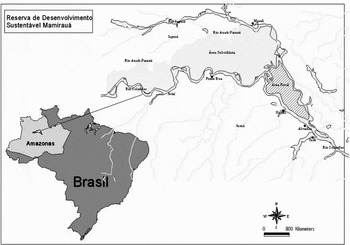
The Mamirauá and Amanã Sustainable Development Reserves (MSDR and ASDR, respectively) are located about 600 km west of Manaus (Amazonas), in the Brazilian Amazonian region (Figure 1). They are contiguous conservation units designed to integrate the preservation of habitats with the sustainable development of local communities. These areas are seasonally flooded, with water levels rising 10 to 12 meters above normal in the rainy season. The people live in small communities along the river banks, each comprising an average of 13 domestic households typically linked by kinship ties, which characterize the communities as being nuclei of small groups of related individuals. The houses are timber-built and raised off the ground to protect them from high water levels. It is essentially a subsistence-based economy, with very low incomes (annual family income of about US$900). Activities are divided among fishing, growing manioc for flour and, in some communities, hunting; these activities are generally practiced throughout the lifetimes of most subjects. Only in the elderly do physical activities decrease. Women tend to work making flour, housekeeping and taking care of children. Almost all communities have schools that provide education for up to four years. The communities also have limited access to radio, but even more restricted access to TV, newspapers and telephones. Electricity, when available, is produced by diesel generators and limited to a few hours per week. The distance of communities to nearest towns varies between 9 and 18 hours by boat. The MSDR has 5,615 inhabitants, 435 of whom are aged 50 or older (7.7%), whereas the ASDR has 1,881 subjects, with 151 (8%) aged 50 or more (data provided by the Mamirauá Institute, 2002 census). There are 62 communities within the MSDR and 23 within the ASDR.
Location of the study area in the Amazon basin.

We made seven expeditions to the area, staying for 12 to 15 days on each visit. The visits to the communities were made by boat, enabling us to interview 43 different communities (23 in MSDR and 20 in ASDR), which were relatively close together (clusters of communities). Each community was visited only once, and all subjects aged 50 years or older who were present at the time of our visit, were given a thorough general examination. We were able to evaluate 69.4% and 45.2% of the Mamirauá and Amanã population aged 50 years or more, respectively. The sample did not differ from the total population aged 50 or more for age (χ2 = 0.043, p = 0.836) or gender (χ2 = 1.53, p = 0.216). We interviewed subjects at their homes or in community centers where clinical, neurological, neuropsychological and anthropometric examinations were carried out, and blood samples collected for glucose and cholesterol level measurements.
Individuals were considered illiterate when they fulfilled all of the following three conditions: they had never attended school or had attended for less than one year; they considered themselves unable to read; and were unable to read the phrase “close your eyes” from the Mini-mental State Examination. We divided the sample by age group: A – adults: 50 to 64 years; and E – elderly: 65 years or older; and by education: group 0 –illiterate; group 1 > than 0 year. None of the subjects was taking medication that influenced the central nervous system.
Subjective memory impairment
In an interview with the subject, the answer to the question: “Do you have problems with your memory?” was used to classify subjects into groups with or without SMI.
Neuropsychological evaluation
The subjects were submitted to a range of tests adapted to the local conditions. Tests of memory, executive functions, temporal estimation, cancellation tasks, and verbal fluency were applied. Several tests were employed for analysis in this study:
• MMSE (Folstein et al., Reference Folstein, Folstein and McHugh1975): a version recommended for use in Brazil (Brucki et al., Reference Brucki, Nitrini, Caramelli, Bertolucci and Okamoto2003). Adaptations were made in evaluating spatial orientation – name of community, nearest community, town and the nearest town.
• Delayed recall: we included the delayed recall of the Brief Cognitive Battery (BCB; (Nitrini et al., Reference Nitrini2004; Reference Nitrini2007), which consists of 10 line-drawings (shoe, house, comb, key, airplane, turtle, book, spoon, tree, and bucket) that were presented three times to the subject, and after about five minutes' delay the subject was asked to recall as many drawings as possible (delayed recall).
Screening mood and mental symptoms
• Happiness Analogical Scale (Myers and Diener, Reference Myers and Diener1996): a sheet of paper with seven line-drawings of circles representing faces showing varying degrees of happiness and sadness, with a fourth representing a neutral face, was presented to the subject. We asked subjects to choose from among faces that best identified their own mood. We scored: 1 – very happy; 2 – happy; 3 – a little happy; 4 – neutral; 5 – a little sad; 6 – sad; 7 – very sad. These tests had good correlation with the Hamilton Depression Scale (Benseñor et al., Reference Benseñor1998) in a Brazilian study. The test is easy to explain to subjects and has few instructions, making it easier to use with illiterate subjects. For the sake of analysis, scores 1 and 2 were taken together as indicative of a self-perception of happiness, while scores 6 and 7 were presumed to mean the opposite.
• Patient Questionnaire (PQ) of the PRIME-MD (Primary Care Evaluation of Mental Disorders; Spitzer et al., Reference Spitzer1994; Benseñor et al., Reference Benseñor1998). This instrument was developed for diagnosing mental disorders by clinicians in primary care and contains simple, easy-to-understand questions. The PQ serves as an initial symptom screen for mental disorders. We opted for the sum of items (ranging from 0 to 26) and read out the questionnaire to all interviewees, so as to minimize the effect of illiteracy. The questionnaire comprises 26 questions covering somatic symptoms (15); depressive symptoms (2); anxiety symptoms (3); eating disorders (1); and alcohol abuse (4) with higher scores indicating pathologic states. On completion, subjects rate their self-perception of health status as: poor, fair, good, very good or excellent (27th item).
Statistical analyses
For statistical analyses, comparisons involving subjects with or without SMI were carried out using the χ2 test for proportions, and the Mann-Whitney test for continuous variables. Multiple logistic regressions were performed to investigate the impact of several variables (gender, MMSE scores, delayed recall scores, PQ of PRIME-MD, self-report of both health status and happiness state) on SMI. The value of significance accepted was 0.05. The software Biostat 4.0 was used for the analyses.
The study was approved by the Ethics Committee of the Hospital das Clínicas of the São Paulo University School of Medicine and of the Mamirauá Institute. All subjects had given written consent for their participation in the study, or relatives had given written consent on behalf of those subjects unable to sign.
Results
Demographic aspects
We evaluated 163 participants with a mean age of 62.3 years (± 9.16), ranging from 50 to 94 years, and a median value of 60 years. The gender distribution was evenly balanced (82 females and 81 males). Three women were excluded because of blindness (1), deafness (1) and aphasia (1). These individuals were in good general health having a very low prevalence of arterial hypertension and vascular risk factors,
This sample was characterized by very low educational levels, with a mean of 0.83 years of schooling (±1.55). The distribution by schooling was: group 0 (illiterates) = 110 subjects (67.5%); group 1 (>0 year) = 53 (32.5%), with only four individuals with more than four years of schooling.
The age groups were distributed as follows: the adult group (50–64 years) had 98 subjects (60.1% of our sample, corresponding to 55.7% of the total population within this age group), with a mean age of 56.1 (±4.1) years, whilst the elderly group (≥65 years) comprised 65 subjects (58% of the total elderly population), with a mean age of 71.8 (±6.2) years.
Subjective memory impairment
Analysis by demographic variables:
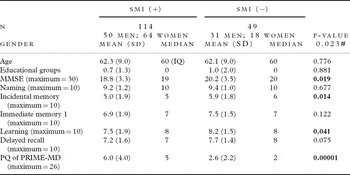
Comparison between subjects with and without SMI yielded no differences regarding age and educational level, but SMI proved more frequent among women. (Table 1)
Demographic data, neuropsychological and mental status scores of subjects with SMI (+) and without SMI (−)

SMI = subjective memory impairment; MMSE = Mini-mental State Examination; PQ = patient questionnaire; PRIME-MD = Primary Care Evaluation of Mental Disorders
p-values: # = χ2; Mann-Whitney Test for the other variables.
Analysis by neuropsychological performance
Our results showed significant differences between subjects with and without SMI in neuropsychological tests (Table 1).
Analysis by mental symptoms and mood
There was a highly significant difference between subjects with and without SMI on the PQ of the PRIME-MD, where this difference persisted for both genders and both age groups. We dichotomized groups into poor/fair and good/very good/excellent state of health for the purposes of statistical analysis. No difference for gender (χ2 = 1.57, p = 0.21), age (χ2 = 1.87, p = 0.17), or education (illiterate and > 0 year) (χ2 = 0.77, p = 0.38) was observed. However, 63.9% of subjects with SMI considered themselves to be in poor/fair state of health, while only 32.5% of those without SMI rated their health as poor/fair (χ2 = 9.71, p = 0.002).
Analysis according to the Happiness Analogical Scale by categorizing into happy or unhappy states (not considering neutral faces) revealed that happiness was reported by 97.0 % of subjects without SMI, and by 77.7% of those with SMI, while for unhappiness these figures were 2.9% and 14.9%, respectively (χ2 = 3.23, p = 0.067). There was no difference in mood status according to gender (p = 0.105) or age group (p = 0.554).
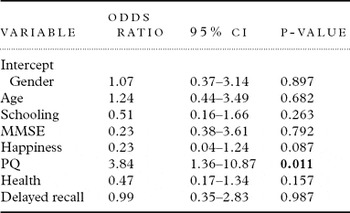
Multiple logistic regression analyses showed that the most important feature associated with the presence of SMI was a high score for mental symptoms on the PQ of PRIME-MD, with a four-fold risk when gender, health status (fair/poor and good/very good/excellent), the Happiness Scale (happy and unhappy), MMSE, and delayed recall were included in the analysis (Table 2).
Results from multiple logistic regression analysis to predict subjective memory impairment using gender, age, MMSE scores, PQ of PRIME-MD, health status, happiness scale, and delayed recall scores

CI = confidence interval; MMSE = Mini-mental State Examination; PQ = Patient Questionnaire; PRIME-MD = Primary Care Evaluation of Mental Disorders
Discussion
The people that form the focus of this study inhabit a region of the Amazon rainforest with limited access to socioeconomic, educational and information resources. In addition, the population is somewhat ethnically homogeneous, with most people being of Amerindian or mixed Amerindian-Caucasian descent, and the same environment influencing all subjects. A very high prevalence of SMI (70%) was observed, even higher than the 22–64% level reported by studies conducted in developed countries that also included patients with dementia (O'Connor et al., Reference O'Connor, Pollitt, Roth, Brook and Reiss1990; Bassett and Folstein, Reference Bassett and Folstein1993; Grut et al., Reference Grut, Jorm, Fratiglioni, Forsell, Viitanen and Winblad1993; Blazer et al., Reference Blazer, Hays, Fillenbaum and Gold1997; Riedel-Heller et al., Reference Riedel-Heller, Matschinger, Schork and Angermeyer1999). The prevalence we observed is also higher than the two other Brazilian studies previously described (Almeida, Reference Almeida1998; Xavier et al., Reference Xavier, Ferraz, Argimon and Moriguchi2001). However, the variance observed in prevalence findings among these studies may stem from the different methods used to assess SMI, which ranged from a simple question to a full questionnaire. Notably, no consensus on a definition for SMI has been reached, and a number of reports used a single question, such as “Do you have trouble with your memory?”, while others used a question with graded responses or a set of questions. This is the probable cause of the differing results (see the review by Abdulrab and Heun, Reference Abdulrab and Heun2008).
The high prevalence of SMI was unexpected, mainly because of the apparent low functional demands on older adults in this apparently “primitive” setting. There are several potential explanations for this. First, the use of a simple question to check for the presence of SMI may have been responsible, as noted above. However, it can be argued that for illiterate individuals or those with low levels of education living in a rather primitive society, a simple and direct question about memory is better than a structured questionnaire requiring an understanding of issues and tasks that are not relevant to this group. A second explanation relates to the high proportion of illiterate individuals and those with low education in this population. According to the cognitive reserve hypothesis, such individuals may have low cognitive reserve and present cognitive decline with a smaller degree of pathological lesions compared to those with higher intellectual abilities. Although this seems a reasonable explanation, it is not supported by the fact that we did not observe a higher proportion of SMI either in the older group of individuals or in the illiterate subjects in our population. In addition, individuals with SMI had lower mean scores on the MMSE, incidental memory, learning, but not the delayed recall test. The hypothesis that SMI is largely related to psychological and psychosomatic symptoms was confirmed by logistic regression. The finding that attention and learning tests scored more poorly than delayed recall in subjects with SMI suggests a frontal-subcortical dysfunction, observable in cerebrovascular diseases or in depressive and anxiety states. The very low prevalence of arterial hypertension and vascular risk factors in this population (data not shown), together with the strong association between the presence of SMI and higher PQ PRIME-MD scores lend credence to the hypothesis that psychopathological conditions were the most important factors for the high prevalence of SMI in this population.
A number of studies have linked memory complaints with depressive or anxiety states (Schofield et al., Reference Schofield, Jacobs, Marder, Sano and Stern1997; Jonker et al., Reference Jonker, Launer, Hooijer and Lindeboom1996; Clarnette et al., Reference Clarnette, Almeida, Förstl, Paton and Martins2001; Stewart et al., Reference Stewart, Russ, Richards, Brayne, Lovestone and Mann2001; Xavier et al., Reference Xavier, Ferraz, Argimon and Moriguchi2001; Antikainen et al., Reference Antikainen2001; Jungwirth et al., Reference Jungwirth, Fischer, Weissgram, Kirchmeyr, Bauer and Karl-Heinz2004; Zandi, Reference Zandi2004), with some exceptions (Lai et al., Reference Lai, Salmon, Ramsdell and Galasko2003; Clément et al., Reference Clément, Belleville and Gauthier2008). In a recent study, Dux et al. (Reference Dux2008) observed that higher levels of negative affect and anxiety sensitivity were associated with increased levels of subjective memory complaints (SMCs), which could distort self-appraisal of memory. Mood improvement has been seen to reduce memory complaints during the follow-up of depressed patients (Antikainen et al., Reference Antikainen2001). When asked to explain their memory complaints, a quarter of subjects could not justify a possible cause although aging was ranked as the primary cause of forgetfulness, followed by emotional problems. Among women, tension and emotional problems were most often cited as a possible cause (Commissaris et al., Reference Commissaris, Ponds and Jolles1998). Another possibility for our high prevalence of SMC is that memory complaints encompass other general cognitive deficits, such as executive functions, that are more likely to be impaired in the presence of depressive and anxiety symptoms.
In a study of a rural elderly population in Taiwan, where 67.4% of the population were illiterate, Wang et al. (Reference Wang2000) reported that 49% had SMI and a poor performance on screening tests together with a high prevalence of depressive symptoms, results which mirror our findings. In a recent study in Brazil, the authors found an association of SMC with depressive symptoms rather than with objective cognitive performance (Minett et al., Reference Minett, Da Silva, Ortiz and Bertolucci2008).
Furthermore, our results have demonstrated that subjects with SMI consider themselves to have a poorer state of health than those without SMI. Previous studies have observed that individuals with physical handicaps were more likely to have memory complaints (Bassett and Folstein, Reference Bassett and Folstein1993; Comijs et al., Reference Comijs, Deeg, Dik, Twisk and Jonker2002). Only one other study (Stewart et al., Reference Stewart, Russ, Richards, Brayne, Lovestone and Mann2001) has established an association between SMI, psychiatric symptoms and self-evaluation of health and neuropsychological testing. However, educational attainment in that study was estimated by the age on leaving school, and we believe that their schooling level was higher than ours.
A limitation of our study includes the use of instruments (PQ, happiness analogical scale) with no normative rules for this population. However, as we compared subjects with and without SMI from the same environment and with a similar educational level, it is unlikely that this limitation had much impact on our results. Furthermore, we used test versions that are recommended for diagnosing cognitive impairment in Brazil, including tests appropriate for illiterate individuals or those with little education (Nitrini et al., Reference Nitrini2004). Our study was cross-sectional in nature, and we are unable to evaluate the significance of these findings over time. In addition, we did not investigate other reports of psychological symptoms in similar cultural backgrounds in Brazil.
With growing attention directed toward aging in developing countries, we need to determine the role that different cultures play in influencing cognitive impairment and performance in formal and informal testing. Transcultural studies that seek to ascertain the extent to which SMI is determined culturally or environmentally should be encouraged, particularly those involving comparisons between areas with high and low access to technological resources. Although our study was conducted in a specific sample of adult and elderly subjects, it revealed the universal presence of SMCs in a heterogeneous culture, making this issue a target of future studies.
Our findings may be important to dispel the myth that isolated places, far removed from modern life-styles and its inherent anxiety and depression, are sanctuaries for their inhabitants, sparing them the common complaints found in other environments. Concerns over self-monitoring are also important factors even in these populations. Depression and anxiety must be further investigated in such remote populations, as well as their consequences and significance, given the inconsistent findings between subjective complaints and objective memory performance.
Conflict of interest
None.
Description of authors' roles
Sonia Brucki and Ricardo Nitrini were responsible for designing the study, and collecting and analyzing the data; Sonia Brucki was responsible for writing the article and Ricardo Nitrini for supervising the writing.
Acknowledgments
The authors thank Maria Mercês Bezerra, Lena VC Peres, Isabel S. Souza and Edila A. Moura for their invaluable help with the work carried out in the Amazonian area, and Andy Davis for improving the English of this paper. Financial support was gratefully received from FAPESP, process no. 01/02921-9; this had no influence on the results of the study.