Do justices retire for political reasons? This question has important policy implications. Supreme Courts comprise a small number of judges who make collective decisions with lasting effects on the life of a nation. If justices can influence who will replace them by timing their retirements strategically, even their decisions to leave the Supreme Court may have a bearing on the direction of the legal system.
Early studies of the US Supreme Court treated decisions to retire as random events (e.g., Wallis Reference Wallis1936), but later works advanced political explanations for judicial retirements (e.g., King Reference King1987; Squire Reference Squire1988; Hagle Reference Hagle1993). The contemporary literature claims that justices prefer to leave the bench when they expect the president to nominate a like-minded replacement. If the president has distant political views, judges will delay their departure hoping that the ruling party will change in the future (Hagle Reference Hagle1993; Ward Reference Ward2003; Calabresi and Lindgren Reference Calabresi2006).
However, the evidence in favor of strategic retirement is contested for the United States (Squire Reference Squire1988; Brenner Reference Brenner1999; Yoon Reference Yoon2006), and comparative studies of high courts in parliamentary systems have found very limited support for similar arguments (Maitra and Smyth Reference Maitra2005; Kerby and Banfield Reference Kerby2014; Massie, Randazzo, and Songer Reference Massie2014).
This article contributes to the debate on strategic retirement in two ways. First, we clarify the empirical implications of the theory by formalizing its basic tenets. Second, we provide a cross-national test of those empirical implications, using the largest available database on Supreme Court biographies in the Western Hemisphere. If strategic retirement is a general pattern of judicial behavior rather than an inductive hypothesis derived from the US case, we should find behavioral similarities in other democracies with comparable nomination systems, even if other historical factors (i.e., confounders) differ. We compare retirement patterns in the United States with five other presidential regimes: those of Argentina, Brazil, Chile, Mexico, and Panama. The Latin American countries were selected because they have presidential constitutions in which the executive plays a central role in the nomination process, a central assumption for strategic retirement theory, yet they provide considerable cross-national variance in other respects, including past experience with democracy and judicial instability.
Our results show consistent behavioral regularities across national cases (including the United States), but the results are surprising. After clarifying the empirical implications of the theory, cross-national evidence in favor of strategic retirement is scant. Combined with evidence from previous studies of judicial retirements under parliamentary systems, the findings suggest that most judges time their departures based on sincere motivations. To the extent that judges ever retire for political reasons, the main motivation seems to be progressive ambition—an incentive that has vanished in the contemporary United States—rather than a systematic attempt to control the profile of their successors.
Strategic Retirement in Supreme Courts
The most controversial hypothesis about vacancies in the US Supreme Court states that justices time their retirement to allow presidents to nominate like-minded successors. Strategic retirements can be crucial in a divided court where a single vote can be decisive.Footnote 1 However, scholars disagree regarding the role of political motivations. Some studies assert that the decision to retire is contingent on the ideological compatibility between judges and the incumbent president (King Reference King1987; Hagle Reference Hagle1993; Ward Reference Ward2003; Calabresi and Lindgren Reference Calabresi2006), while others find no evidence to claim that justices retire for political reasons (e.g., Squire Reference Squire1988; Brenner Reference Brenner1999; Yoon Reference Yoon2006).
Such inconsistent findings may result from two different problems. First, the empirical implications of this argument are not always straightforward, and different authors invoke unique results as evidence in support of the theory. For example, Calabresi and Lindgren (Reference Calabresi2006) find that judges are more likely to retire—rather than die in office—when the incumbent president belongs to the party that nominated the departing judge. Hagle (Reference Hagle1993, 36–37), by contrast, discovers that justices are more likely to retire during the president’s second term in office and are less likely to do so when they are former politicians. Zorn and Van Winkle (Reference Zorn2000) find that justices tend to retire at the beginning of the president’s second term, inferring that justices thus allow the president to fill the position with a like-minded successor. Kerby and Banfield (Reference Kerby2014) find that justices in Canada, Australia, and New Zealand are more likely to retire in electoral years, inferring from this fact that judges expect their parties to lose the general election.
These examples suggest that quite disparate empirical findings are offered as evidence of the theory. In the following pages, we employ a simple model to derive crisp empirical implications from the theory’s core assumptions. We identify the fundamental implication of the theory, plus three secondary corollaries that are often overlooked in the literature.
Second, empirical studies may offer weak or conflicting results because the number of justices serving in the US Supreme Court has restricted the size of the sample available to test models of strategic retirement. Scholars have confronted this challenge by analyzing state supreme courts or lower courts (Nixon and Haskin Reference Nixon2000; Hall Reference Hall2001), but the political issues at stake—and thus the incentives to retire—may be quite different across levels of the judiciary. Other scholars have tested the theory with evidence from parliamentary systems (Maitra and Smyth Reference Maitra2005; Kerby and Banfield Reference Kerby2014; Massie et al. Reference Massie2014). These cross-national studies have found very limited evidence in support of political resignations, but the nomination process tends to be less politicized in most parliamentary regimes.
Besides those two problems, weak findings could also indicate that most judges retire for “sincere” reasons, including bad health and retirement benefits. As Stras (Reference Stras2006, 1444) notes, “Infirmity, both mental and physical, is the single greatest disadvantage associated with life tenure” (Squire Reference Squire1988; Atkinson Reference Atkinson1999; Garrow Reference Garrow2000; Zorn and Van Winkle Reference Zorn2000; Ward Reference Ward2003). Studies have shown that retirement provisions with generous benefits provide strong incentives to retire in the United States (Squire Reference Squire1988; Zorn and Van Winkle Reference Zorn2000; Ward Reference Ward2003; Yoon Reference Yoon2006) and elsewhere (Maitra and Smyth Reference Maitra2005).
The Logic of Strategic Retirements
Although the idea of strategic retirement is straightforward, few studies derive precise behavioral predictions from the theory. As a result, authors invoke disparate findings as confirmatory evidence. To address this problem, we formalize the argument and identify the fundamental empirical implication of the theory, plus a few additional corollaries.
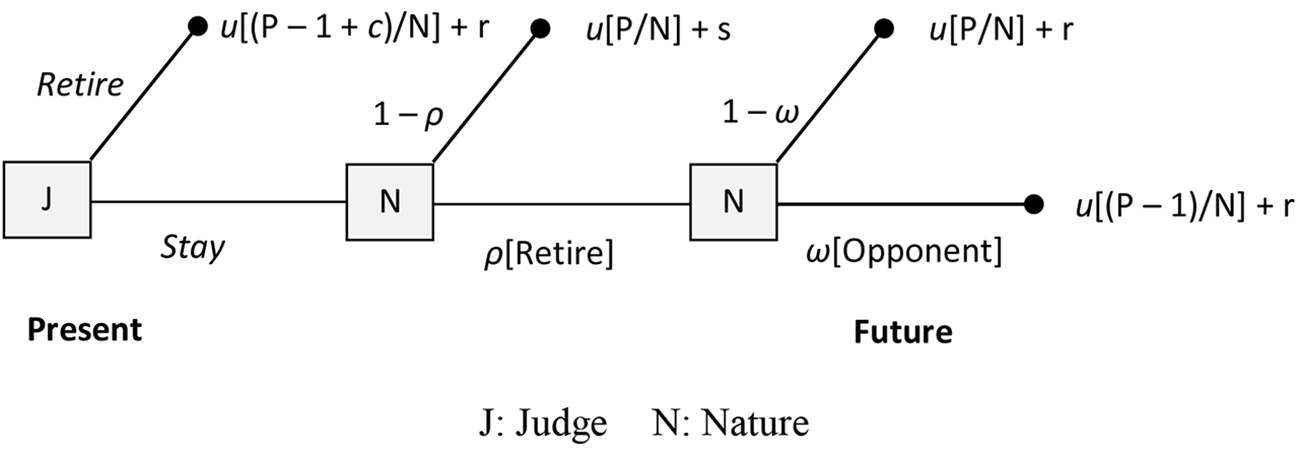
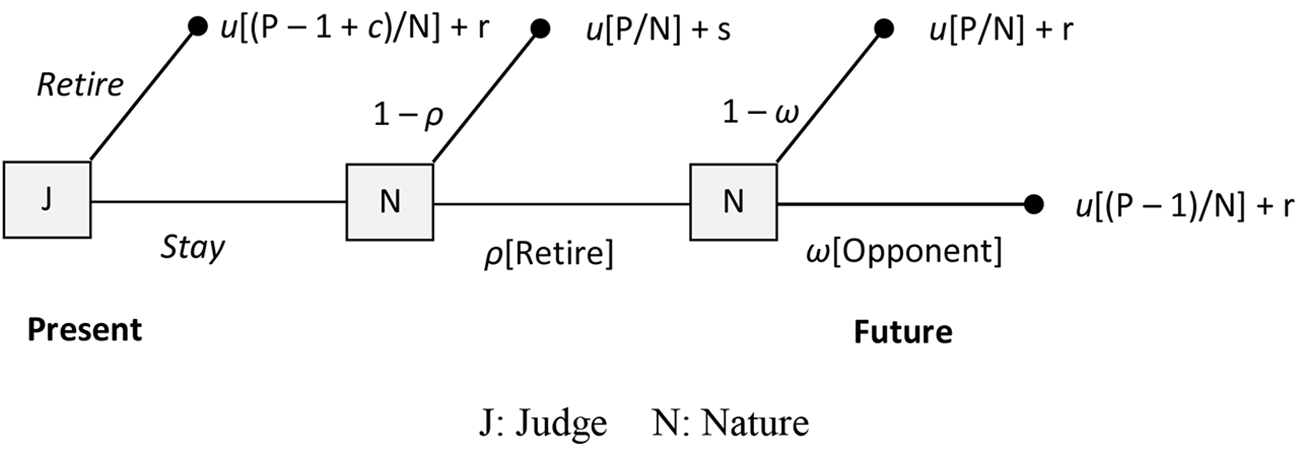
Strategic retirement involves a decision in which a judge compares the utility from giving up her position today against the expected utility of a lottery played if she stays in office.Footnote 2 The theory assumes (at least) two moments, which we can generally call present and future.Footnote 3
If the judge retires today, she relinquishes the benefits of office (call them s), in exchange for retirement benefits, r.Footnote 4 In addition, the judge anticipates that the partisan composition of the court will remain equal to P/N if the president is a co-partisan or it will become
 if the president is not a co-partisan, where P is the number of justices who belong to the judge’s party and N is the size of the court. For notation purposes, we use
 to represent the president’s expected nomination, with
 indicating that the president would nominate an acceptable co-partisan replacement and
 ndicating that he would nominate a distant replacement.Footnote 5 Thus, a retiring judge expects to derive utility
 from the new Court, where u is a monotonically increasingly but possibly nonlinear function.
If, on the other hand, the justice stays in office, there is always the possibility that aging, bad health, or other factors will compel her exit in the future. The judge anticipates the risk of involuntary departure with probability ρ. If the justice completes her second period, she receives payoff s plus whatever utility is derived from the existing court,
 . If instead nature forces the justice to retire, the judge receives r and the president is allowed to nominate a replacement. Because the executive may have changed by the time the judge is compelled to retire, assume that nature will reset the location of the executive by selecting a president from the opposite party with probability ω. The judge thus anticipates a future court P/N with probability
 and
 with probability ρω.
Figure 1 summarizes the structure of the argument. This sequence represents the core assumptions shared by all versions of strategic retirement theory.
A model of strategic retirement
Given this setup, a judge retires when

Retirement is rational when the advantage offered by a co-partisan president
 for the nomination of a successor is greater than the benefits of office (after considering retirement benefits as well as the risk of an involuntary exit in the future). Crucially, the advantage offered by a co-partisan president becomes more relevant as the risks of involuntary exit (ρ) and of party turnover (ω) loom larger in the near future.
Some corollaries of this model simply capture conventional wisdom. For example, justices are unlikely to retire when they are not co-partisans with the president (the left-hand side of eq. [1] becomes negative when
 ), unless considerable retirement benefits are offered. Similarly, judges will retire when they approach an old age (as ρ approximates one, the right-hand side of the equation approaches zero).
More important, however, equation (1) also provides the logical foundation for empirical implications overlooked in the literature. Prior studies have anticipated a greater rate of retirements among judges who have convergent views with the president, without specifying scope conditions for this hypothesis. The model shows that four factors should moderate the effect of partisan convergence on strategic retirements.
(1) If the judge and the president are co-partisans
, the ideological benefits of strategic retirement, represented by
 , are conditional on the risk of involuntary exit, represented by ρ. Age and infirmity are not alternative explanations for retirement; they are part of the motivation for strategic behavior. Judges are unlikely to entertain their departure when they are young, but they are forced to consider the partisan consequences of their choices as they approach retirement age.Footnote 6 This is the fundamental empirical implication of strategic retirement theory:
Hypothesis 1. Partisan convergence between a judge and the incumbent president should produce greater incentives for retirement when the judge is older.
The fundamental empirical implication is usually implied in the literature, but it is rarely formulated with precision and tested appropriately. The model also allows us to derive three additional empirical corollaries:
(2) A similar conditional effect is created by the likelihood of party turnover, represented by ω. A judge would have few incentives to strategize the timing of her retirement in an authoritarian system with no party turnover, because the same incumbents would nominate any replacement. Strategic retirements are driven by a comparison between current political circumstances and future political conditions that become uncertain only in contexts of effective party competition. Therefore:
Hypothesis 2. Partisan convergence between a judge and the incumbent president should increase incentives for retirement in competitive political regimes.
(3) Incentives to retire depend on utility function u. Consider a judge with weak partisan ties, such that
 : her incentives for strategic retirement would be almost null. In contrast, judges involved in politics are more sensitive to partisan outcomes, such that
 . In line with this claim, Hagle (Reference Hagle1993) argued that justices with prior political experience are more inclined to time their retirement for ideological reasons.Footnote 7 It follows that:
Hypothesis 3. Partisan convergence between a judge and the incumbent president should expand incentives for retirement when the judge has a prior partisan career.
(4) It is fair to assume that u is a monotone but nonlinear utility function with respect to (P/N).Footnote 8 If a judge retires from a nine-member body, leaving it with eight co-partisan judges would not present a dilemma, but leaving it with only four co-partisans would alter the balance of power in the Court. For example, in their study of the Canadian Supreme Court, Kerby and Banfield (Reference Kerby2014) noted that Liberal Party–appointed judges often retired when Conservatives were in power. The authors concluded that, given their dominant position, Liberal judges could retire “without dramatically changing the ideological balance of the bench” (350). Thus:
Hypothesis 4. Partisan convergence between a judge and the incumbent president should produce greater incentives for retirement when the court is divided.
The four conditional hypotheses follow from the core model of strategic retirement, without introducing ad hoc assumptions about delays in nominations, the electoral calendar, or other factors. If judicial retirements happen in line with the theory, we should observe the predicted patterns of behavior under a wide range of circumstances. Failure to document such patterns would cast doubts on common assumptions underpinning all strategic retirement arguments.
Case Selection
We test the hypotheses using data for the United States and five Latin American countries. The analysis follows a most-different systems design (Przeworki and Teune Reference Przeworski1970; Berg-Schlosser and De Meur Reference Berg-Schlosser2009). Verification of similar results across disparate historical cases should strengthen the external validity of our findings.
Studies of strategic retirement have focused on the United States and a few industrial democracies with parliamentary systems, such as Australia, Canada, New Zealand, and the United Kingdom (Kerby and Banfield Reference Kerby2014; Massie et al. Reference Massie2014). We complement those studies by comparing the United States with Argentina, Brazil, Chile, Mexico, and Panama. This strategy allows us to focus on presidential systems where the executive plays a central role in the nomination of Supreme Court justices (a crucial fact for the theory), while it maximizes variance in mediating factors and potential confounders.Footnote 9
Three concerns affect the use of Latin American cases to assess strategic retirement theory. The most obvious one is the history of regime instability that plagued the region for most of the 20th century. We leverage this experience with authoritarian rule in favor of our empirical design because variance in party competition is necessary to test hypothesis 2. In authoritarian regimes without an expectation of party turnover, strategic retirement should not take place.
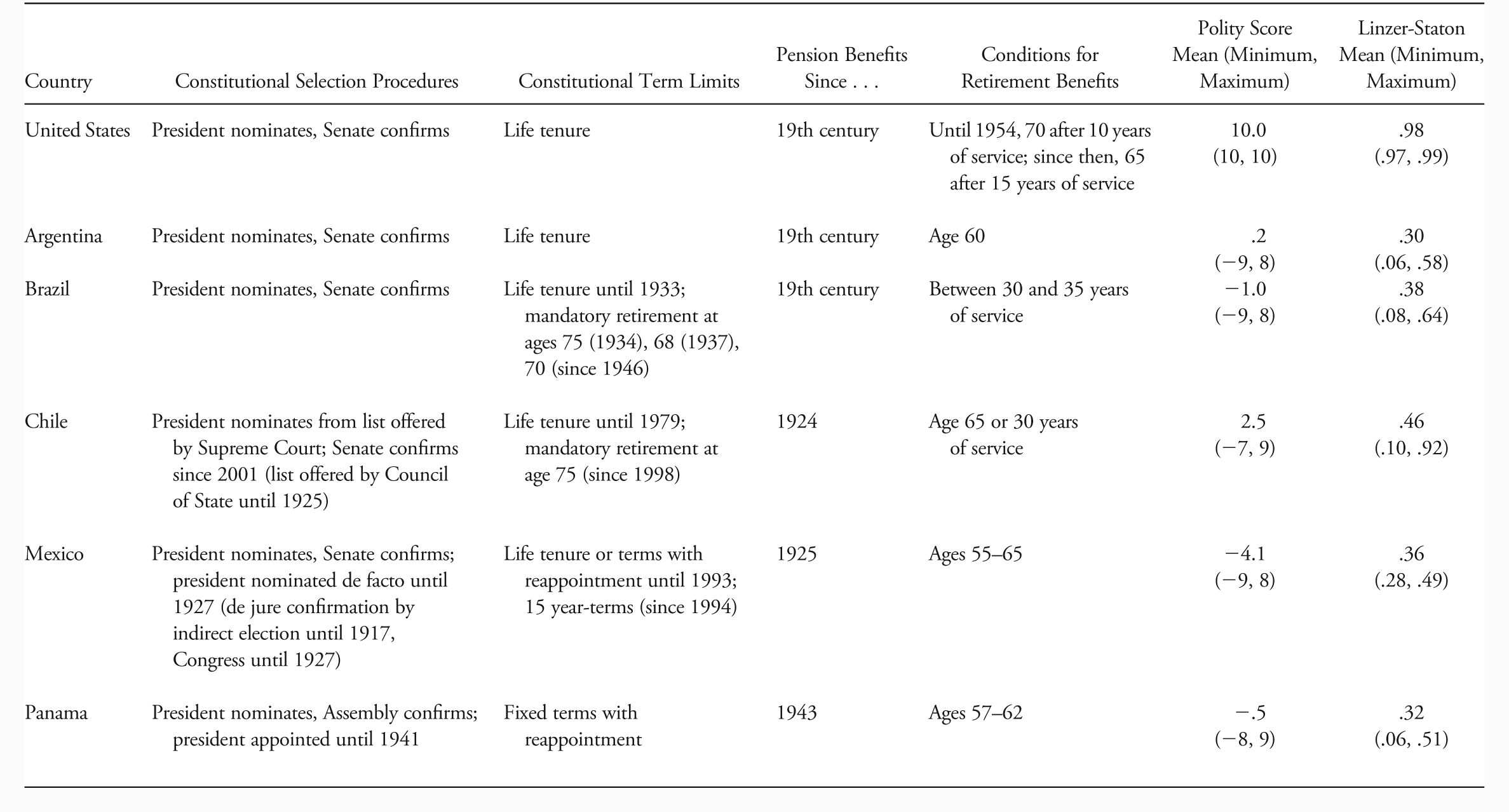
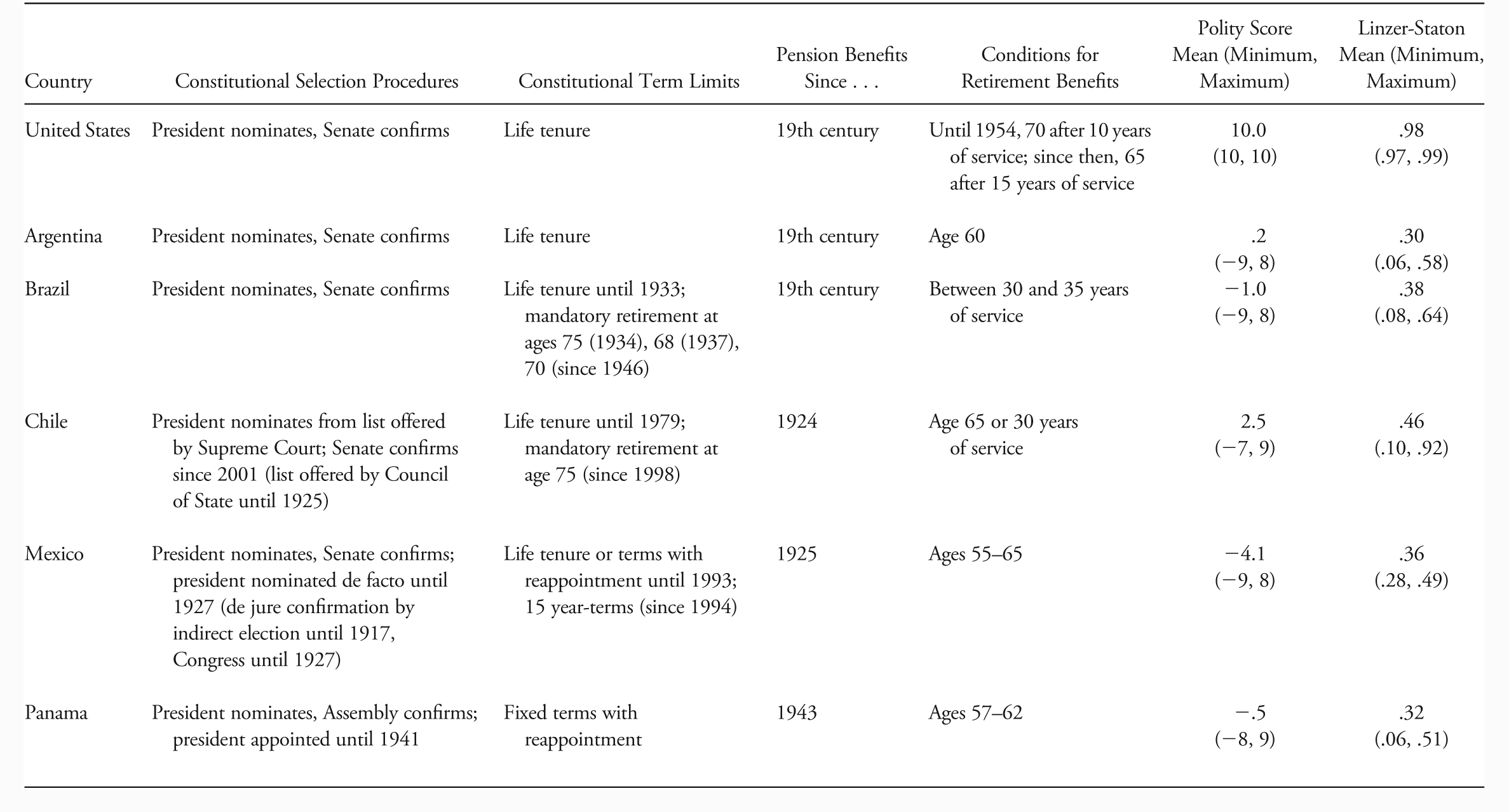
Table 1 shows that our cases differ considerably in their historical experience with democracy and thus in levels of party competition and judicial independence. Between 1900 and 2004, the United States was always coded as a full democracy by the Polity IV index, which ranges from −10 (institutionalized autocracy) to +10 (institutionalized democracy). Other countries in the sample, by contrast, varied considerably during this period. Similarly, the United States ranks above all other cases in Linzer and Staton’s (Reference Linzer2015) measure of judicial independence, available since 1948. To account for those differences, we estimate models for each country, pool all cases while controlling for levels of democracy, and test the hypotheses with a subset of democratic regimes. The results are consistently similar across all tests.
Country Comparison, 1900–2004
A second concern, related to the previous issue, refers to the problem of judicial purges. Several studies have noted that judicial tenures in Latin America are often uncertain, as political leaders force the resignation of hostile justices (Helmke Reference Helmke2005, Reference Helmke2016; Lara Borges, Castagnola, and Pérez-Liñán Reference Lara Borges2012; Pérez-Liñán and Castagnola Reference Pérez-Liñán2016). If judicial turnover in Latin America is essentially the result of unconstitutional mechanisms, high courts in the region may not provide useful information to test theories of voluntary retirement.
Fortunately, the proportion of forced departures in most Latin American cases selected for comparison is relatively small. Only 2% of all judicial exits in Chile (3 of 131), 5% in Brazil (5 of 108), and 6% in Mexico (13 of 204) were identified as forced removals—as opposed to voluntary retirements or deaths in office. In contrast, Panama, with 32% (8 of 25), and Argentina, with 58% (41 of 71), present a more dramatic pattern of judicial ousters. The overall proportion of removals for the Latin American sample is approximately 13%.
To account for this problem, we treat all involuntary retirements as right-censored observations; that is, we assume that judges would have stayed on the job if they had been allowed to. Retirements are coded as involuntary when justices were impeached, removed after a military coup, or forced to resign in the midst of a revolution or a regime transition. Observations are also treated as censored when justices died in office, if they reached a mandatory retirement age, and if they departed after completing a constitutionally fixed term in office. Those individuals contribute to the estimation of the hazard function, but their departures do not alter the likelihood of voluntary retirements.
It is possible that subtle political pressures have induced some exits that appear to be “voluntary” in the historical record (Castagnola Reference Castagnola2012). However, such exits should stand out in the empirical analysis, presenting a stark contrast with the expected pattern for voluntary retirements. Incentives for strategic retirement, as indicated by hypothesis 1, should prevail among judges aligned with the president who are close to retirement age. Pressures for departure, by contrast, should target judges who are not aligned with the president and who are far from retirement, in order to preempt their future influence in the Court. We will analyze such “hidden” involuntary retirements in our discussion of empirical findings below.
The third concern is the dearth of historical sources. Although most Latin American countries have few reliable records about past court members, we have selected five cases that have sufficient biographic data for our study. A list of primary sources is provided in the appendix. We conducted archival work with an international team of research assistants, limiting the analysis to justices in office between 1900 and 2004 because sources are scarcer for earlier periods. Our data set constitutes the most extensive biographic file available for justices in the Western Hemisphere.
Despite these challenges, our comparative strategy presents important advantages. The six countries have presidential constitutions that empower executives to influence high court appointments. Table 1 shows that, in all cases, judges need to consider the preferences of the executive when contemplating retirement. Although the specifics of the nomination process may differ slightly (e.g., the president nominates from a restrictive list offered by the Supreme Court in Chile), nomination procedures employed in these legal systems resemble the US case more than the procedures employed in other countries covered by the literature, such as Australia, Canada, New Zealand, or the United Kingdom.
Legal regulations in all six countries give judges the possibility of retiring voluntarily after many years of service. They grant judges life tenure or impose mandatory retirement only at an elderly age. The only case with fixed terms and no reappointment, Mexico since 1994, provides for very long terms in office (15 years). Most justices in our sample have been entitled to receive pension benefits, and conditions for retirement are similar across cases.
While these similarities in the nomination procedure and judicial terms are key to the scope conditions of the theory, differences across countries allow us to test important empirical implications of the model, verifying if predicted patterns of retirement take place under the conditions advanced by the theory.
Data and Method
Because our dependent variable reflects individual time-to-retirement, and because the main hypothesis (hypothesis 1) refers to individual predictors, we estimate a discrete-time-duration model in which the unit of analysis is the justice-year (Box-Steffensmeier and Jones Reference Box-Steffensmeier2004, chap. 5).Footnote 10 Our complete sample includes 761 justices in office during the period 1900–2004. We have complete biographic information for 669 judges, or a total of 6,678 observations.Footnote 11 The event of interest is captured by a dichotomous indicator that reflects judges’ voluntary retirements.
The independent variables provide measures for our four hypotheses, plus several alternative explanations:
Co-partisanship
As a measure of proximity between the president and each justice, we employ a dichotomous variable (Co-partisan) that takes a value of 1 when the president belongs to the party that nominated the justice.Footnote 12 This indicator follows a conventional operationalization in studies of strategic retirement (e.g., Hagle Reference Hagle1993; Zorn and Van Winkle Reference Zorn2000; Ward Reference Ward2003; Calabresi and Lindgren Reference Calabresi2006).
Age and Infirmity
The literature has relied on different measurements of infirmity. Squire (Reference Squire1988) measured justices’ health by coding major disabilities, but this information is unavailable for our cases. Zorn and Van Winkle (Reference Zorn2000) estimated the justices’ condition based on their productivity, but productivity can respond to different causes (e.g., training or motivation). Stolzenberg and Lindgren (Reference Stolzenberg2010) claim that the number of years left until the justice’s death constitutes the best measure of health. Unfortunately, this measure restricts the analysis to deceased justices.
To assess the risk of involuntary retirement, we include the Age of the Justice. This measure reflects that risks of infirmity and death increase as judges become older, while avoiding the practical limitations of other health indicators (see Squire Reference Squire1988; Zorn and Van Winkle Reference Zorn2000; Stolzenberg and Lindgren Reference Stolzenberg2010). Because our first hypothesis claims that the effect of partisan convergence is conditional on the age of justices, our models include an interaction between Co-partisanship and Age.
Competitive Regimes
Our second hypothesis claims that the effect of partisan convergence is conditional on political competitiveness. Democratic regimes allow for government turnover and thus force judges to anticipate the partisan identity of future presidents. In contrast, authoritarian regimes constrain party competition, minimizing this source of uncertainty. Moreover, authoritarian regimes may force judges who identify with opposition parties to resign (Helmke Reference Helmke2005; Marcilese Reference Marcilese2010; Solomon Reference Solomon2010). Our model includes the Polity IV index. To assess our second hypothesis, we include an interaction between Co-partisanship and the Polity Index and anticipate that the conditional effects of co-partisanship will be stronger in more democratic environments. In some models, discussed below, we represent the full moderating effects of ρω in the decision model by including a triple interaction between co-partisanship, age, and democracy.
Prior Political Career
Following Hagle (Reference Hagle1993), we measure partisan incentives by including a dichotomous variable that identifies judges who had a Prior Political Career before joining the Supreme Court. Judges who were presidents, vice presidents, governors, mayors, senators, representatives, members of constitutional assemblies, cabinet ministers or secretaries, undersecretaries, ambassadors, consuls, subnational legislators, and city councilors were coded as politicians. To assess our third hypothesis, empirical models include an interaction between Co-partisanship and a Prior Political Career.
Divided Court
We measure the composition of the court by capturing the Proportion of Opposition Judges (defined as sitting justices originally nominated by parties other than the president’s) in any given year. According to our fourth hypothesis, incentives for strategic retirement should be greater when the court is divided. The hypothesis suggests that the probability of voluntary exit among judges in the president’s party should follow an inverted-U pattern, with maximum values peaking around 0.5. Therefore, we include a quadratic term for this variable and model the interaction of co-partisanship with the linear and quadratic terms for the proportion of adverse judges.
The literature has identified other variables that we include as potential controls.
Retirement Benefits
Historically, the introduction of retirement benefits has provided strong incentives for earlier retirement (Squire Reference Squire1988; Zorn and Van Winkle Reference Zorn2000; Ward Reference Ward2003; Maitra and Smyth Reference Maitra2005; Yoon Reference Yoon2006). This effect is captured by r in the decision model. The provision of retirement benefits creates a shift in the baseline hazard for each country’s sample over time. Because of this reason, we include an indicator that captures if a justice Qualifies for Retirement Benefits. This variable is coded with a value of 1 if the Supreme Court has a retirement package in place and the individual fulfills its requirements in any given year, 0 otherwise.
Static Careers
The role of parameter s in the model is consistent with claims about the role of salaries in discouraging retirements from US federal courts (Spriggs and Wahlbeck Reference Spriggs1995; Nixon and Haskin Reference Nixon2000; Hansford, Savchak, and Songer Reference Hansford2010). Unfortunately, data on remuneration and workloads are unavailable for other courts over long historical periods, but these are not the only motivations to pursue static careers. Given the varying levels of professionalization across countries and historical eras, we expect that justices recruited among professional judges will see the Supreme Court as the highest point in their careers (see Wood and Marchbanks [Reference Wood2008] for a similar case in the executive branch). As a measure of static career incentives, we employ an indicator taking the value of 1 when the justice has experience on the bench before the Supreme Court and 0 otherwise.
First Year of the Last Term
The literature on the United States has emphasized that judges are more likely to retire early in the president’s second term, once the incumbent confronts term limits but while the administration is still strong. We include a dichotomous variable (First Year of the Last Term) to control for this term-limit effect. It takes the value of 1 for the first year of an administration if the president cannot be reelected. About 21% of the justice-years in the sample fall under this situation.
Progressive Careers
An extensive literature in political science has emphasized the influence of progressive ambition on the decisions of politicians and public officials (e.g., Brace Reference Brace1984; Harrington Reference Harrington2000). Vining, Zorn, and Smelcer (Reference Vining2006) examined the political ambitions of American Supreme Court justices in the period 1790–1868. The authors found that political ambitions constituted the main cause behind justices’ decisions to resign. For some individuals and under some historical circumstances, the prospect of a political career may be more enticing than the Court.Footnote 13 An analysis of progressive ambition provides a sharp test for the influence of post-retirement opportunities: while retirement benefits are constant for all judges above a certain age, prospects of a successful political career vary considerably across individuals. Moreover, political posts may be offered to induce timely retirements from the court.Footnote 14 We employ a dichotomous indicator to identify justices who pursued a Progressive Career after retirement. We coded as progressive careers all instances in which justices occupied a political position after leaving office.Footnote 15 This is an imperfect measure: some judges with progressive ambitions may have failed to achieve a desired position after retirement, and others may have failed to anticipate their political futures at the time they left the court. However, this proxy helps us separate the effects of partisanship (as measured by a political past) from the effects of progressive ambition (as reflected in a political future).
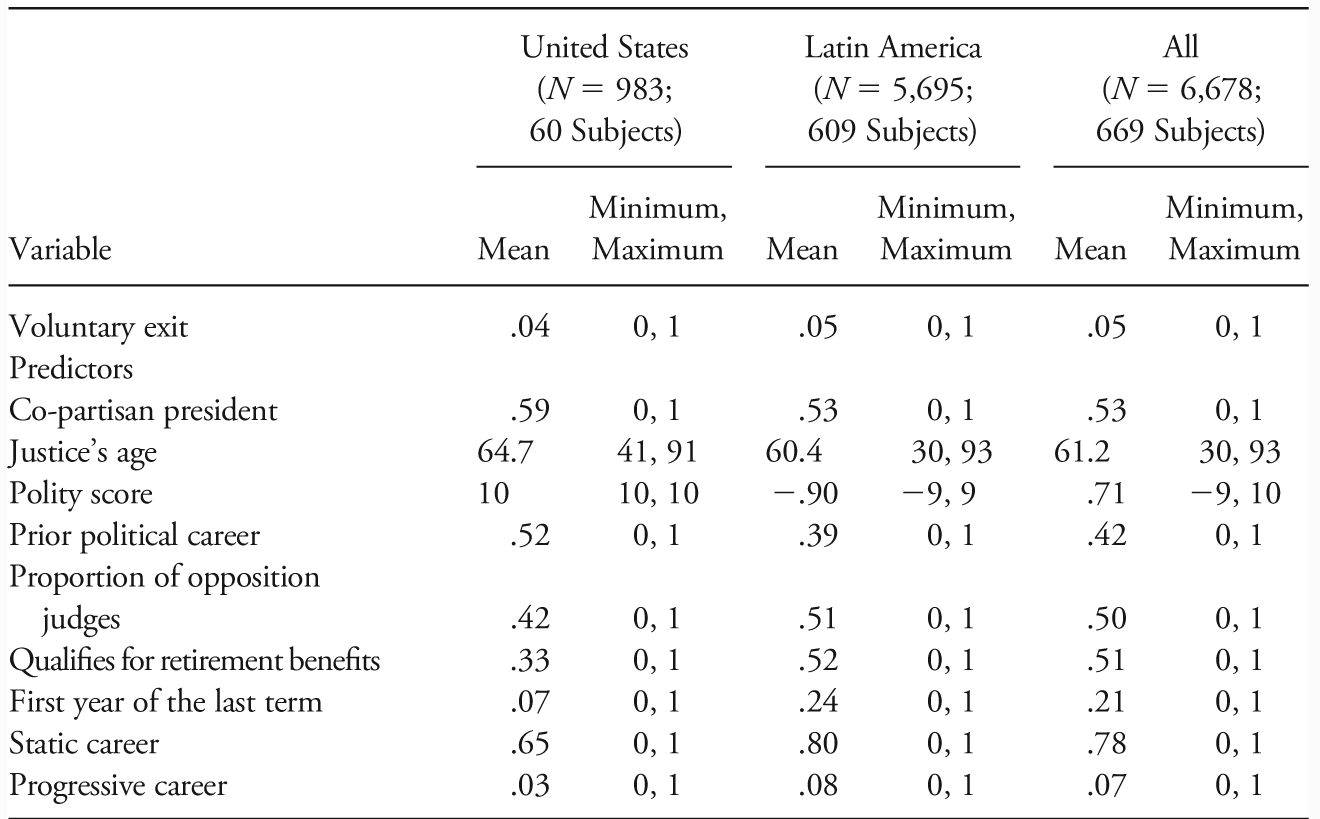
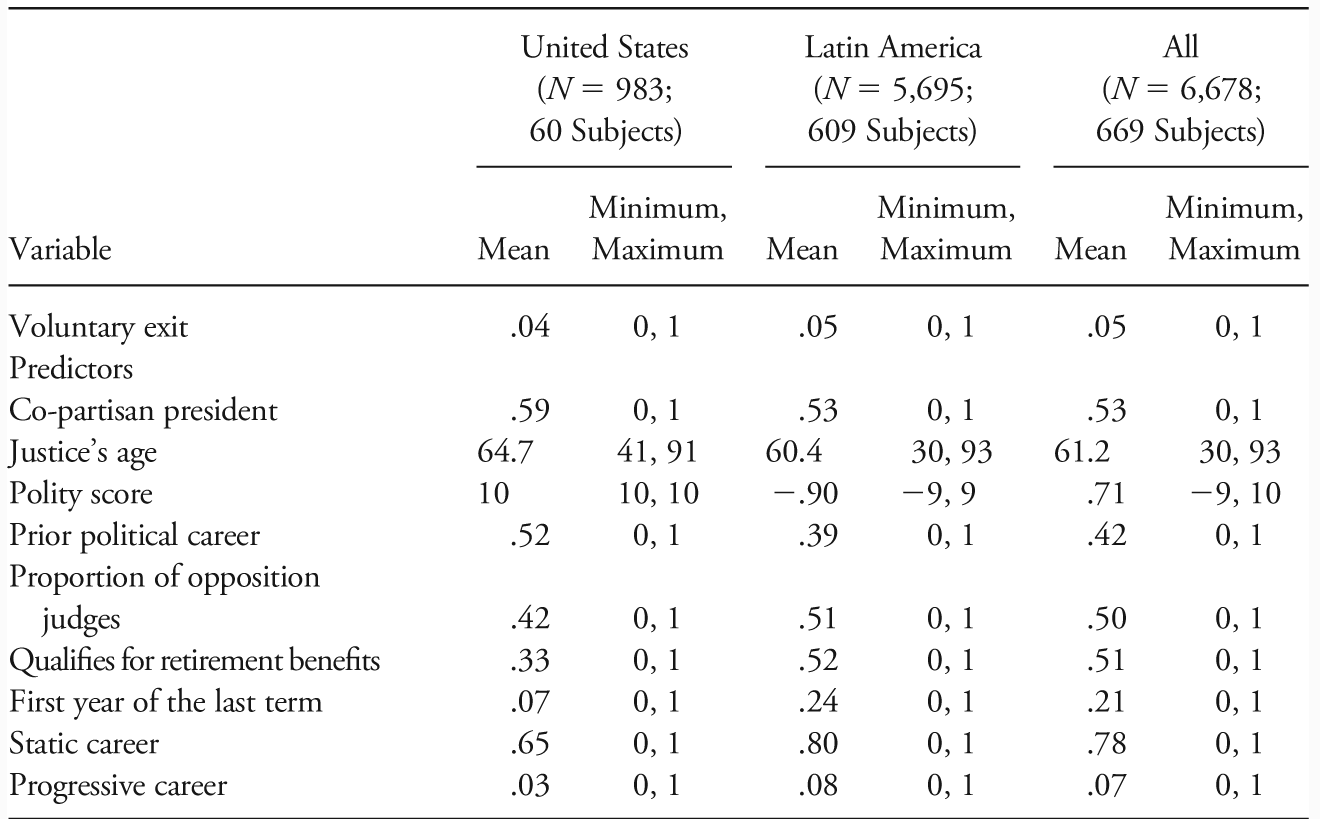
Table 2 offers descriptive statistics for our sample. The table compares the means for the United States and the Latin American cases and provides the observed range for each variable in the whole sample. The probability of voluntary exit for the pooled sample on an average year is .051. Thus, the typical justice will stay on the bench for 19 years before taking up voluntary retirement. The table also indicates that a vast majority of Supreme Court justices were recruited from the judiciary and that the number of judges who were politicians before reaching the Supreme Court is far greater than the number who left the Court to pursue an active political life.
Means for Voluntary Retirement and Independent Variables
Empirical Results
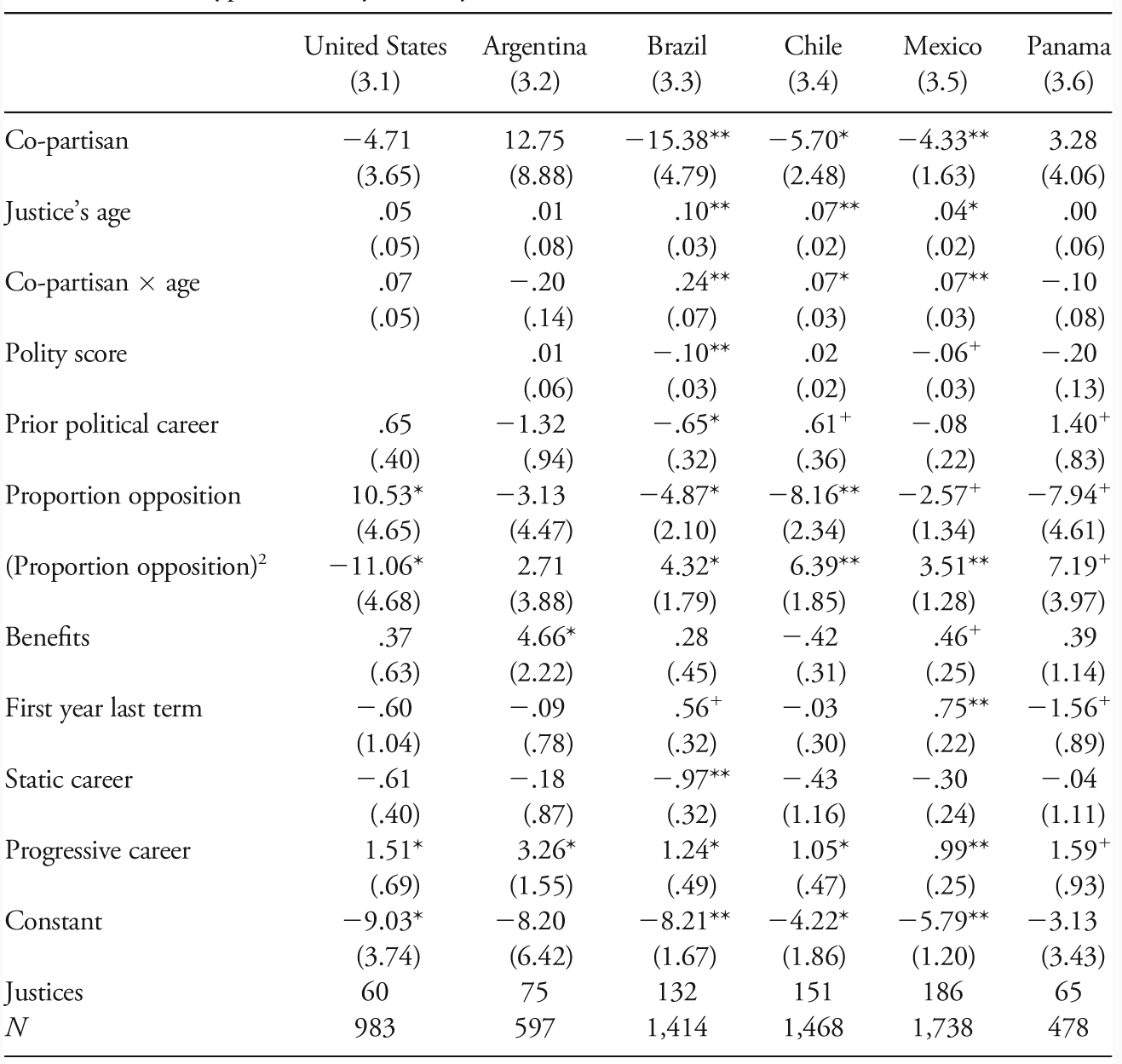
We begin by testing the fundamental empirical implication of the theory (hypothesis 1) for the United States and five other countries in table 3. The table presents discrete-time duration models for voluntary retirements (entries are logistic coefficients). The estimator employs frailties by judge to account for unobserved conditions shaping the baseline hazard at the individual level. In order to capture the conditional effect depicted by hypothesis 1, we model the interaction between co-partisanship and age. The Polity index drops from 3.1 due to lack of variance in levels of democracy in the US case.
Tests of Hypothesis 1, by Country
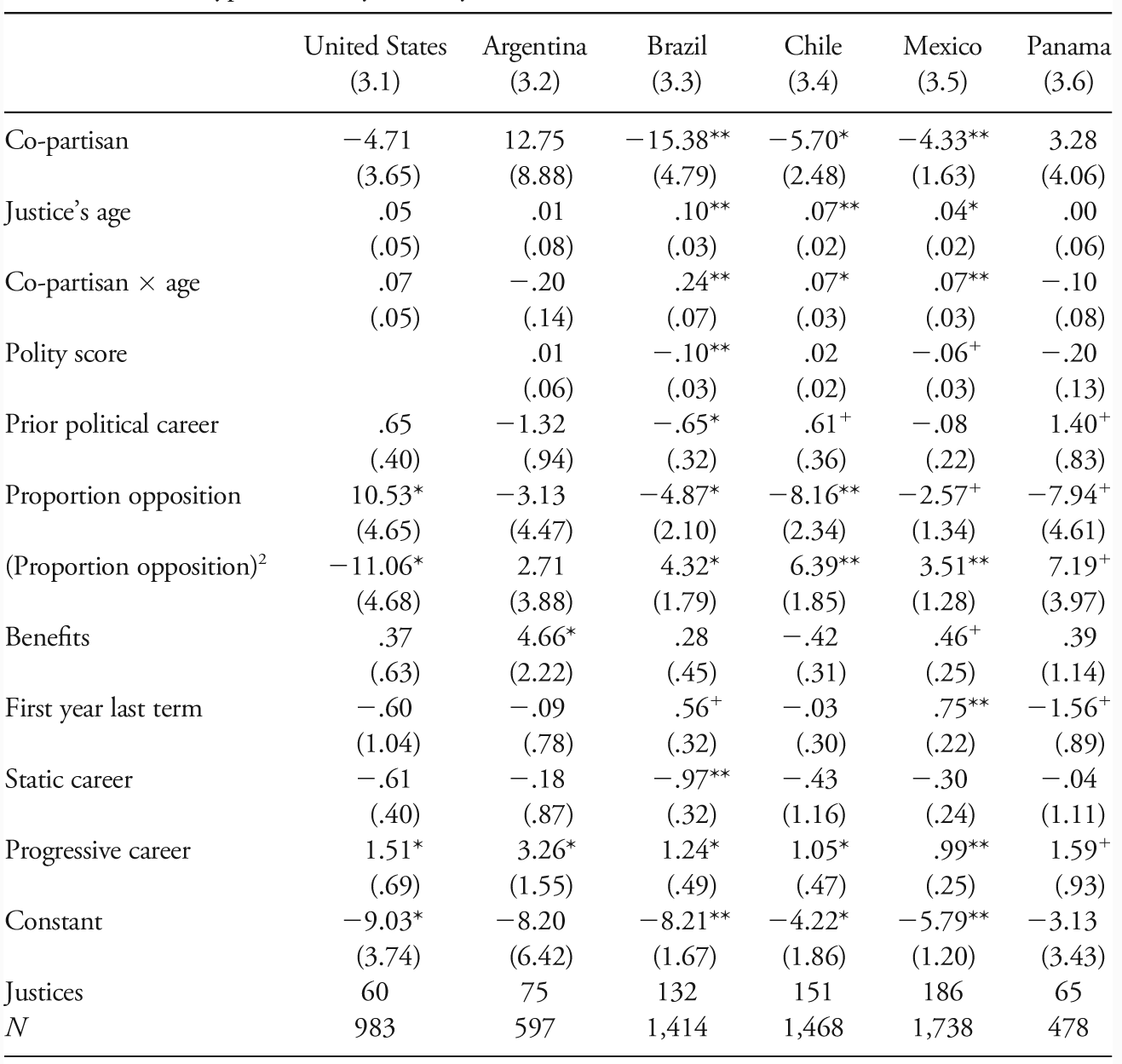
Note.—Dependent variable is voluntary exit. Entries are logistic coefficients. Models include frailties by justice. Standard errors are in parentheses.
+ p < .10.
* p < .05.
** p < .01.
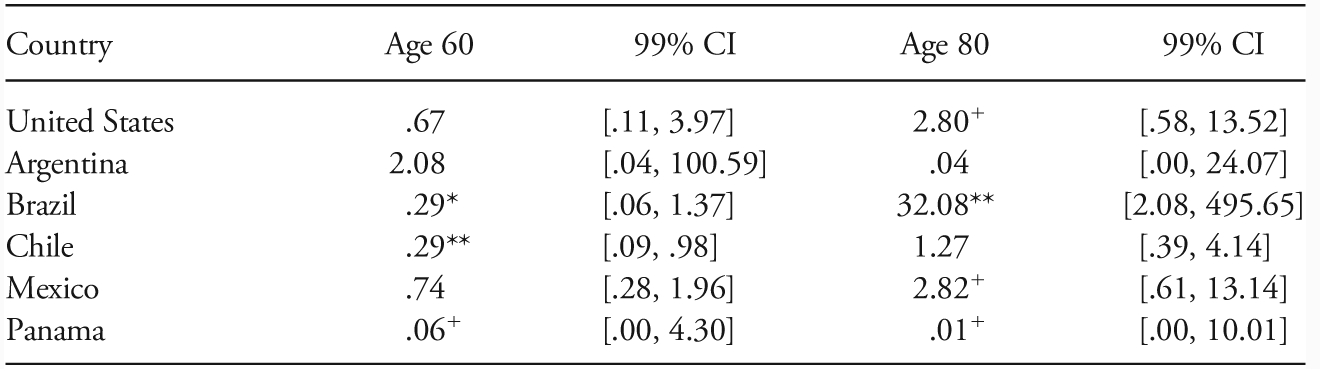
Evidence in favor of strategic retirement at an older age is weak but fairly persistent in three of the six cases (the United States, Brazil, and Mexico). Based on estimates from models 3.1–3.6 of table 3, table 4 compares the marginal effects of co-partisan alignment for judges of ages 60 and 80 in each country. The theory implies that the marginal effect of co-partisanship should be positive and significant for the older judges and feeble for the younger ones. In line with hypothesis 1, a co-partisan judge of age 80 in the United States is 2.8 times more likely to retire than an opposition judge of the same age, but this difference is barely significant at the .10 level. A similar pattern is visible for Mexico (
 ). In Chile, the effect is smaller and statistically insignificant, consistent with the traditional image of an “apolitical” Court (Hilbink Reference Hilbink2007). No evidence in favor of hypothesis 1 is present for Argentina and Panama, where involuntary exits have been more common.
Effects of Co-partisan Alignment at Ages 60 and 80, by Country
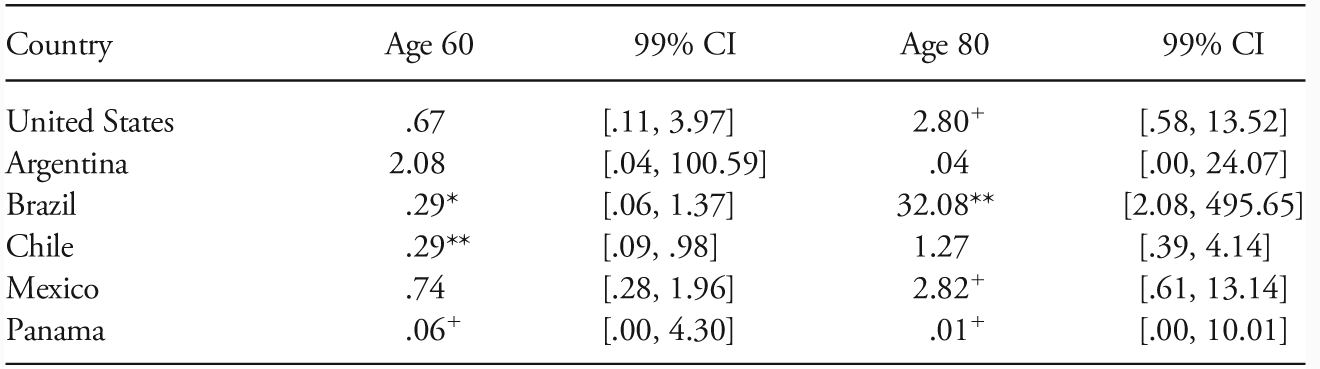
Note. Values are odds ratios for the marginal effect of co-partisanship at ages 60 and 80, based on models 3.1–3.6 of table 3, In brackets are 99% confidence intervals, which are reported to account for random discoveries.
+ p < .10.
* p < .05.
** p < .01.
Only Brazil displays a significant increase in the risk of retirement among older co-partisans. The unrealistic size of the marginal effect (co-partisans are 32 times more likely to retire) and its wide confidence interval are partly explained by the low density of empirical support. Due to mandatory retirement, only six Brazilian judges in our sample remained in office past the age of 75, and only two did so past the age of 80. It is quite possible that some judges in Brazil and the United States have timed their retirements strategically for partisan reasons, but we have little evidence to conclude that this is a general pattern of behavior.
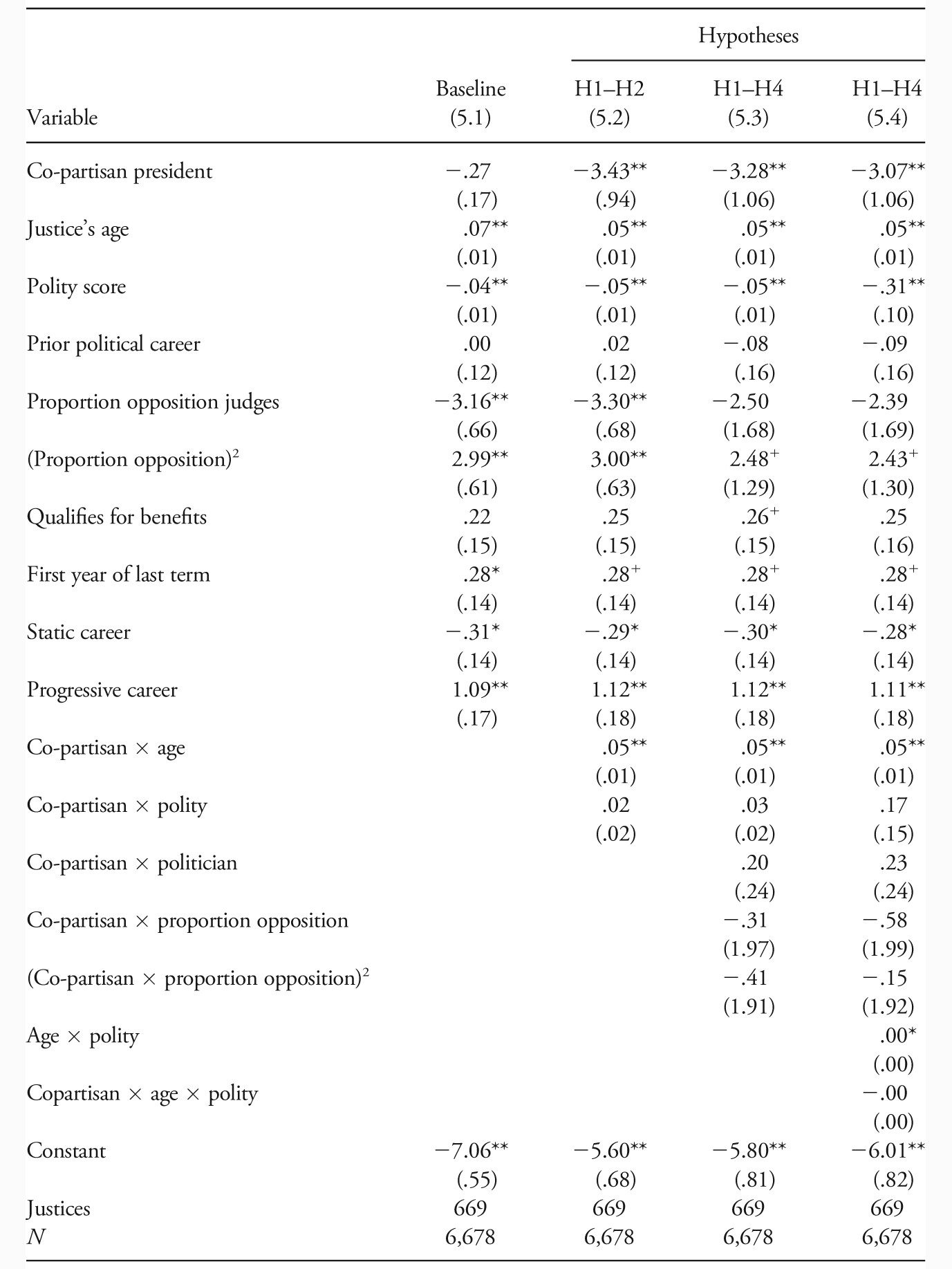
Testing hypothesis 2 requires variance in levels of democratic competition. For this purpose, table 5 pools all countries and employs frailties by judge to account for unobserved conditions shaping the baseline hazard at the individual and country levels. The first model, provided for reference, includes all independent variables but no interactions. Model 5.2 of table 5 incorporates interactions to test hypotheses 1 (about the moderating effects of age) and 2 (democratic competition); model 5.3 adds further interactions to test hypotheses 3 (about the moderating effects of a previous political career) and 4 (court balance); and model 5.4 incorporates a triple interaction among co-partisanship, age, and democracy to provide an unconstrained specification reflecting the effect of ρω in equation (1). In spite of the increasingly complex specifications, the results are consistent across all models, so we present a unified discussion.
Pooled Models of Voluntary Retirement, 1900–2004
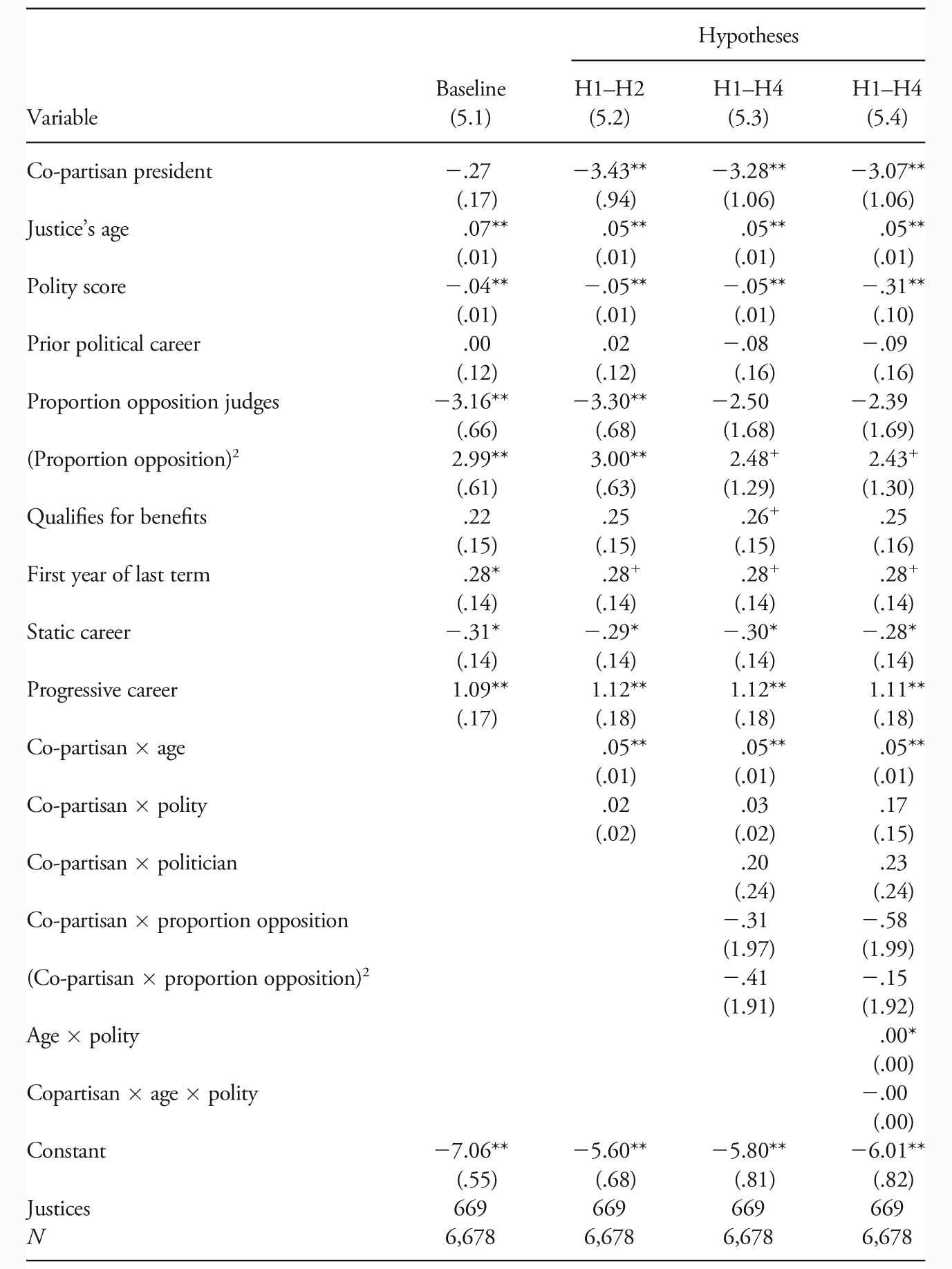
Note. Dependent variable is voluntary exit. Entries are logistic coefficients. Models include frailties by justice. Standard errors are in parentheses.
+ p < .10.
* p < .05.
** p < .01.
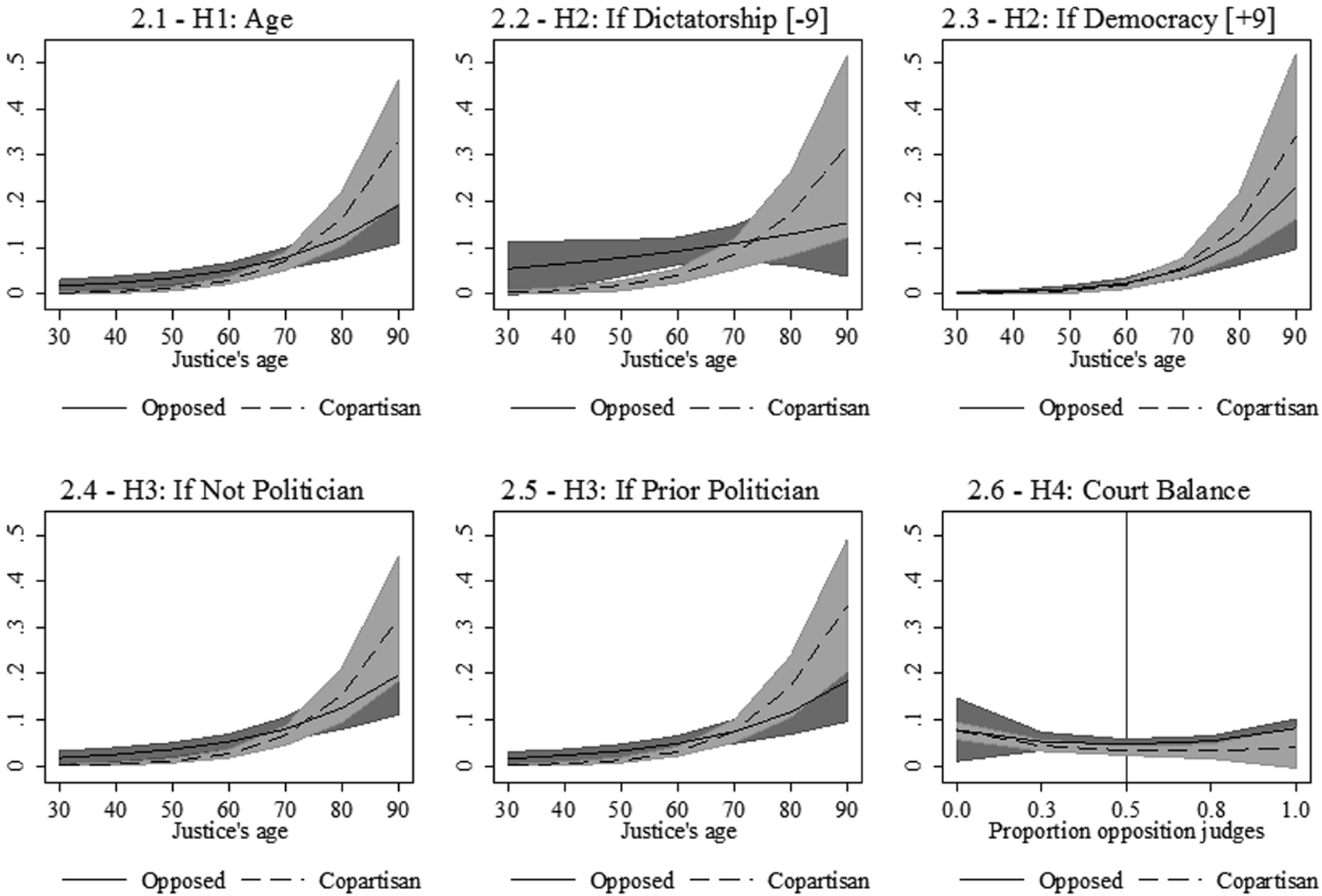
The large number of interactions complicates a straightforward interpretation; we therefore plot the predicted probability of voluntary retirement (based on model 5.4 of table 5) in figure 2. All panels reflect predicted probabilities (and 95% confidence intervals) along the vertical axis, using the observed-value approach (Hanmer and Kalkan Reference Hanmer2013). That is, we fix the levels of the selected variables (and their interactions) for all cases in the sample, and estimate predicted probabilities based on the parameter estimates and the observed values for the remaining predictors. The expected values are then averaged across the sample to produce a point estimate for this counterfactual population.
Expected probability of exit for opposition and co-partisan justices (model 5.4 of table 5)
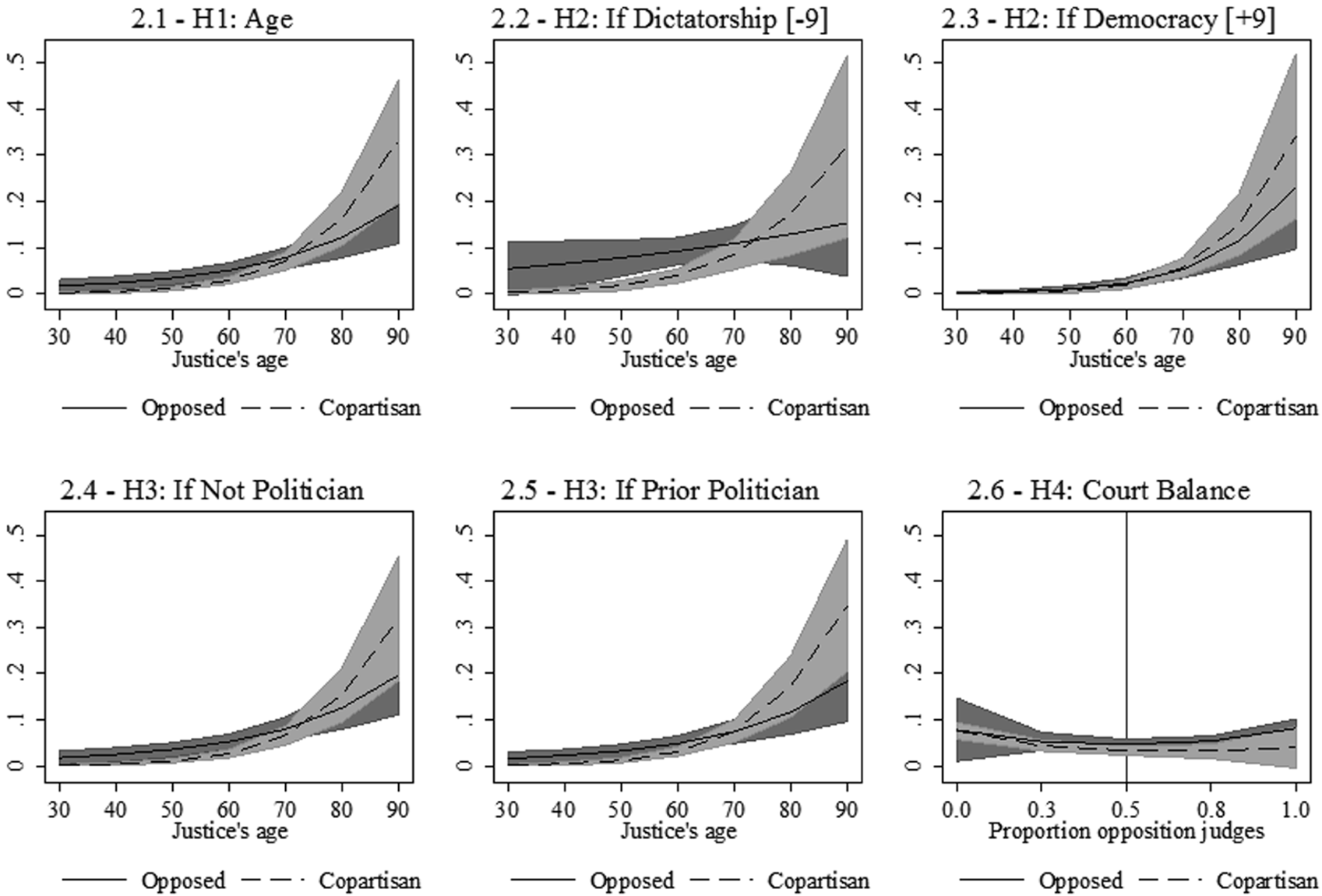
Evidence on hypothesis 1. Figure 2.1 plots the probability of retirement for judges of different ages who are co-partisans with the president or members of an opposition party. Not surprisingly, the propensity to retire increases considerably for judges of age 65 and older. In line with the first hypothesis, older judges appear more likely to retire when the president is a co-partisan. However, the difference for the two partisan groups is not statistically significant in any simulation, reinforcing the findings presented in table 4. Evidence in favor of hypothesis 1, the core empirical implication derived from the theory, is revealing but weak.Footnote 16
Evidence on hypothesis 2. In figure 2.2, the conditional effects of co-partisanship according to age are estimated for a hypothetical sample of judges operating under dictatorship (a Polity score of −9), while in figure 2.3 the same effects are estimated under democracy (a Polity score of +9). This setup allows us to compare the probability of exit for judges of retirement age with different political orientations under different regimes. The overall pattern for older judges is similar in democracies and dictatorships: both figures indicate a relative increase in the retirement of co-partisans vis-à-vis opponents at an older age, but with no statistical differences across groups. To the extent that any differences are observable for older judges across regimes, they challenge theoretical expectations. Although insignificant in both cases, the gap between co-partisan and opposition judges appears to be smaller in democracies, where electoral competition should create greater incentives for strategic behavior.
Evidence on hypothesis 3. Figures 2.4 and 2.5 allow for a test of the third hypothesis: figure 2.4 plots the effects of age and partisan alignments for judges without political experience, and figure 2.5 plots the same effects for judges with a prior political career. Partisan convergence between judges and the president should expand incentives for retirement when a prior political career makes judges sensitive to party needs. The two panels, however, display equivalent patterns for older judges, failing to support hypothesis 3.
Evidence on hypothesis 4. Figure 2.6 compares the probability of voluntary retirement for co-partisan and opposition judges in courts of different compositions. The simulation holds the age of justices constant at 65 years—using observed ages generates equivalent results. Irrespective of age, there is no evidence that judges aligned with the president become more likely to retire when the court is divided or that judges in the opposition are reluctant to retire when they have a pivotal role. Judges of all persuasions are somewhat less likely to leave a divided court, but differences are statistically insignificant.
Together, the results presented in table 4 and figure 2 indicate that there is little empirical evidence in favor of the main hypothesis derived from strategic retirement theory (hypothesis 1) and any of the ancillary empirical implications reflected in hypotheses 2–4.
Induced Retirements
Surprisingly, differences between co-partisan and opposition judges are pronounced for younger judges in figure 2.2. Young judges aligned with the president are less likely to resign than judges in the opposition. This fact suggests that, in weakly institutionalized legal systems, adversarial judges are “induced” by the executive into early retirement (Castagnola Reference Castagnola2012). Even though our estimator treats involuntary exits as censored observations, some exits that appear to be “voluntary” in the historical record may in fact represent ambiguous choices. Strong-handed governments may not invest much effort to induce resignations among older judges precisely because their retirement is expected in the short run.
Presidents are more capable of inducing such resignations in authoritarian contexts. Figures 2.2 and 2.3 illustrate this fact. The pattern for younger judges varies considerably across regimes: co-partisan judges are significantly less likely to resign in authoritarian environments but not in democratic regimes, where trajectories for the two partisan groups are virtually indistinguishable.
Alternative Explanations
Some control variables display effects in line with prior findings in the literature: career judges are likely to stay in office for longer and judges who pursue progressive political careers retire from the court earlier. The effect of progressive ambition is consistent across countries and model specifications. In line with this finding, the literature on judicial politics has shown that court decisions are influenced by judges’ career goals under different institutional environments (Hall Reference Hall2001; Pérez-Liñán, Ames, and Seligson Reference Pérez-Liñán2006; Brace and Boyea Reference Brace2008; Boyea Reference Boyea2010; Grijalva Reference Grijalva2010).
Discussion and Conclusions
The literature on judicial politics has produced controversial results about strategic retirements. Assuming that the theory is correct, such inconclusive findings could result from an imprecise conceptualization of the theory—leading to an imperfect specification of empirical models—or from the sample size imposed by the number of justices in the US Supreme Court. Our analysis shows that those problems are unlikely to explain the inconsistent findings of previous studies. Even if some individual justices retire for political reasons, the theory of strategic retirements does not seem to capture a general pattern of behavior in the United States or elsewhere.
This article has addressed those problems systematically. We developed a formal model of retirement choices and tested its empirical implications with evidence from the Supreme Court in the United States and five other presidential countries between 1900 and 2004. Our empirical analysis finds limited evidence in favor of those hypotheses, suggesting that the empirical foundations of strategic retirement are indeed weak.
The comparative strategy followed a most-different systems design, documenting the general absence of strategic behavior in different political contexts. In Brazil and Mexico, like the United States, some justices may retire for strategic reasons, but the statistical evidence is weak. Indications of strategic retirement are even scarcer in countries that endured judicial purges, like Argentina. These results hold under multiple model specifications, for different historical periods, and for a subsample of democratic cases.Footnote 17 Combined with existing evidence offered by studies of high courts in parliamentary systems, these findings indicate that Supreme Court retirements are mostly driven by sincere motivations worldwide.
The results presented in this article suggest three conclusions. First, scholars seeking to understand judicial retirements should refrain from assuming strategic behavior and investigate sincere motivations. A rich cross-disciplinary literature provides important insights: to explain retirements, economists have focused on money, psychologists have explored the role of perceptions and personalities, human resource management scholars have centered on organizational policies, and physicians have paid attention to health (Adams and Beehr Reference Adams2003).
Prior studies have underscored two sincere motivations driving judicial retirements: wealth and health. Other factors should be taken into account: Johnson and Favreault (Reference Johnson2001) reveal that workers are more likely to retire if spouses have already retired; Henkens and Tazelaar (Reference Henkens1997) find that civil servants in the Netherlands are less likely to retire when social networks in the workplace are important; Cleveland and Shore (Reference Cleveland1992) find that workers who perceive themselves to be more senior than their colleagues report higher levels of job satisfaction. Several disciplines offer alternative hypotheses that could prove valuable to understand retirements from the bench.
Second, the role of progressive ambition in all models hints at important parallels with the study of other democratic institutions. For instance, comparative studies of legislative politics have accounted for differences in legislative behavior where legislators do not pursue reelection (e.g., Jones et al. Reference Jones2002; Guevara Mann Reference Guevara2011). Comparative studies of judicial politics should similarly analyze career paths for judges operating under different legal systems. Justices with progressive ambitions may rule strategically in order to secure nomination for coveted positions in Congress or in the executive branch. In contrast, justices expecting to return to private practice may rule in line with their personal interests (Basabe Reference Basabe2011).
Finally, our results indicate that in weakly institutionalized legal systems, young opposition judges are more likely to resign than judges aligned with the government. This pattern is distinctive of authoritarian regimes, suggesting that strong executives induce “voluntary” retirements among independent judges (Castagnola Reference Castagnola2012). A growing literature has emphasized the role of institutions in authoritarian regimes (Pepinsky Reference Pepinsky2014). Our findings reinforce this perspective, showing that courts remain an important locus of political contention even in less democratic systems (Ginsburg and Moustafa Reference Ginsburg2008; Solomon Reference Solomon2010; Chua and Haynie Reference Chua2016).
Appendix: Historical Sources, by Country
Argentina
Corte Suprema de Justicia de la Nación. 2009. Ministros de la Corte Suprema de Justicia. http://www.csjn.gov.ar/autoridades.html (accessed August 2012).
Molinelli, N. Guillermo, M. Valeria Palanza, and Gisela Sin. 1999. Congreso, presidencia y justicia en Argentina. Buenos Aires: Temas Grupo Editorial.
Kunz, Ana E. 1989. Los magistrados de la Corte Suprema de Justicia de la Nación, 1930–1983. Instituto de Investigaciones Jurídicas y Sociales Ambrosio L. Gioja, Facultad de Derecho y Ciencias Sociales, UBA.
Tanzi, Héctor José. 2006. “Historia ideológica de la Corte Suprema de Justicia de la Nación (1955–1966).” Ius Historia 3. http://p3.usal.edu.ar/index.php/iushistoria/article/viewFile/1618/2051 (accessed August 2012).
Brazil
Rodrigues, Lêda Boechat. 1991a. História do Supremo Tribunal Federal, Vol. II: 1899–1910, Defesa do Federalismo. Rio de Janeiro: Civilização Brasileira.
Rodrigues, Lêda Boechat. 1991b. História do Supremo Tribunal Federal, Vol. III: 1910–1926, Doutrina Brasileira do Habeas Corpus. Rio de Janeiro: Civilização Brasileira.
Rodrigues, Lêda Boechat. 2002. História do Supremo Tribunal Federal, Vol. IV: 1930–1963. Rio de Janeiro: Civilização Brasileira.
Supremo Tribunal Federal do Brasil. 2009. Conheça os Ministros do Supremo Tribunal Federal. http://www.stf.jus.br/portal/ministro/ministro.asp?periodo=stf&tipo=antiguidade (accessed August 2012).
Chile
Alonso Godoy, Pablo, Rodrigo Pizarro Ramírez, and Raúl Stowhas Rodríguez. 2003. Corte Suprema: 179 Años de historia. Facultad de Derecho, Universidad de Chile, Santiago.
Poder Judicial, República de Chile. 2012. Tribunales del País, Corte Suprema. http://www.pjud.cl/corte-suprema (accessed August 2012).
Mexico
Camp, Roderic A. 1991. Mexican Political Biographies, 1884–1935. Austin: University of Texas Press.
Camp, Roderic A. 2011. Mexican Political Biographies, 1935–2009. Austin: University of Texas Press.
Corte Suprema de Justicia de la Nación. 2001. Suprema Corte de Justicia de la Nación (Ministros 1815–1915). México, DF: Corte Suprema de Justicia de la Nación.
Corte Suprema de Justicia de la Nación. 2005a. Suprema Corte de Justicia de la Nación, Ministros 1917–2004 Semblanzas. Vol. I. México, DF: Corte Suprema de Justicia de la Nación.
Corte Suprema de Justicia de la Nación. 2005b. Suprema Corte de Justicia de la Nación, Ministros 1917–2004 Semblanzas. Vol. II. México, DF: Corte Suprema de Justicia de la Nación.
Corte Suprema de Justicia de la Nación. 2012. “Conoce la Corte.” https://www.scjn.gob.mx/conocelacorte/Paginas/ConoceLaCorte.aspx (accessed August 2012).
Pablos, Nicolás Pineda, and Alan Durazo Brassea. 2010. “El presidencialismo y la rotación de los ministros de la Suprema Corte de Justicia de la Nación en México de 1934 a 2010.” Revista legislativa de estudios sociales y de opinión pública 3 (5): 57–96.
Panama
Órgano Judicial de la República de Panamá. 2003. Historia y biografía de la Justicia Panameña en sus primeros cien años. Panamá: Órgano Judicial de la República de Panamá.
Órgano Judicial de la República de Panamá. 2012. “Corte Suprema de Justicia.” http://www.organojudicial.gob.pa/tribunales/corte-suprema-de-justicia (accessed August 2012).
United States
Epstein, Lee, Jeffrey A. Segal, Harold J. Spaeth, and Thomas G. Walker, eds. 2006. Supreme Court Compendium: Data, Decisions, and Developments. 4th ed. Washington, DC: Congressional Quarterly.
Supreme Court of the United States. 2007. “Members of the Supreme Court of the United States.” US Supreme Court.
Supreme Court of the United States. 2012. “About the Supreme Court.” https://www.supremecourt.gov/about/about.aspx (accessed August 2012).
General Sources
Salas, Luis, and José Ma. Rico. 1990. Carrera judicial en América Latina. Centro para la Administración de Justicia.
Suprema Corte de Justicia de México. 2006. Estructura y competencia de las Cortes y Tribunales Supremos de Justicia en Iberoamérica. México: Suprema Corte de Justicia e la Nación.
Mesa-Lago, Carmelo. 1978. Social Security in Latin America: Pressure Groups, Stratification, and Inequality. Pittsburgh: University of Pittsburgh Press.
Mesa-Lago, Carmelo. 2008. Reassembling Social Security: A Survey of Pensions and Health Care Reforms in Latin America. Oxford: Oxford University Press.
US Social Security Administration. 2010. Social Security Programs throughout the World: The Americas. Washington, DC: Social Security Administration.