Introduction
The stresses associated with caring for a family member with an acquired brain injury (ABI) have been well documented (Allen, Linn, Gutierrez, & Willer, Reference Allen, Linn, Gutierrez and Willer1994; Kreutzer, Gervasio, & Camplair, Reference Kreutzer, Gervasio and Camplair1994a; Marsh, Kersel, Havill, & Sleigh, Reference Marsh, Kersel, Havill and Sleigh1998; Peters, Stambrook, Moore, & Esses, Reference Peters, Stambrook, Moore and Esses1990). In addition, researchers have documented the psychological impact on family caregivers (Harris, Godfrey, Partridge, & Knight, Reference Harris, Godfrey, Partridge and Knight2001; Knight, Devereux, & Godfrey, Reference Knight, Devereux and Godfrey1998; Minnes, Graffi, Nolte, Carlson, & Harrick, Reference Minnes, Graffi, Nolte, Carlson and Harrick2000; Ponsford, Olver, Ponsford, & Nelms, Reference Ponsford, Olver, Ponsford and Nelms2003; Sander, High, Hannay, & Sherer, Reference Sander, High, Hannay and Sherer1997). With advances in neurosurgical and neurological techniques, and growing survival rates after ABI, the numbers of older parents caring for an adult with an ABI are increasing, and for many parents, caregiving becomes a lifelong responsibility. The subjective burden of family caregivers has been shown to increase during the first five years post-injury with little reduction after seven years (Brooks, Reference Brooks1991). More recent analyses of these data, however, have highlighted methodological limitations, casting doubt on the levels of ongoing stress or burden (Perlesz, Kinsella, & Crowe, Reference Perlesz, Kinsella and Crowe1999).
A particular challenge for families of individuals with ABI, in general, and particularly for families not living in large urban centres, is reduced contact with and access to organized systems of care after discharge from rehabilitation facilities (Sample & Darragh, Reference Sample and Darragh1998). Although the need for rehabilitation models to include ongoing support has been recognized, research to date has been limited (Boschen, Gargaro, Gan, Gerber, & Brandys, Reference Boschen, Gargaro, Gan, Gerber and Brandys2007). An American study of service needs of individuals with ABI and their families up to five years post-injury (Leith, Phillips, & Sample, Reference Leith, Phillips and Sample2004) highlighted the importance of early, continuous, and comprehensive services, information and education, advocacy, empowerment, and social belonging.
As caregivers age, the physical, social, and emotional burden they bear, coupled with declining health and strength, can take an increasing toll. Caregivers may be less able to carry out domestic or work responsibilities while also assisting with rehabilitation activities (Kreutzer, Serio, & Bergquist, Reference Kreutzer, Serio and Bergquist1994b). In addition, they may feel less able to manage behaviour problems associated with a brain injury and to deal with the ongoing challenges of accessing appropriate services (Willer, Allen, Durnan, & Ferry, Reference Willer, Allen, Durnan and Ferry1990).
The purposes of this study were to document (a) major issues of concern in a sample of older parents caring for a son or daughter with ABI in Ontario; (b) the relative stressfulness of these issues; and (c) service needs and service use of these caregivers. In addition, potential differences according to the caregiver’s age and the residence location of the family member with ABI were investigated.
Method
Research Participants
The sample consisted of 47 parents who were primary caregivers of adults with an acquired brain injury. The parents ranged in age from 50 to 81 years with a mean age of 67.1 years. There were 42 female and 5 male caregivers. The majority (65.9%) of the parents were married while 21.3 per cent were widowed, 10.7 per cent were separated or divorced, and 2.1 per cent were single. None of the participants was married to each other. The largest percentage of parents had completed some post-secondary education (44.5%), while 32 per cent had completed high school, and 24.5 per cent had less than a high school education.
The adults with ABI ranged in age from 25 to 59 years with a mean age of 39.9 years. There were 15 females and 32 males. The level of disability as described by the caregivers ranged from mild (11%) to moderate (38%) and severe (51%). Several causes of ABI were identified, with motor vehicle accident (MVA) being the most common (48.9%), followed by falls (14.9%). A variety of other causes made up the rest of the sample. Time elapsed since injury ranged from 2 to 51 years with a mean of 16.4 years. The majority (51.1%) of offspring with ABI lived with their parents or other family members while another 29.8 per cent lived on their own with support, 12.8 per cent lived in community residences, and 4.3 per cent lived in long-term care settings.
Measures
Demographic information about the respondents was collected including age, gender, education level, marital status, relationship to the person with the brain injury, type and level of disability, and type of accommodation (e.g., at home or residential).
Checklist
In consultation with parents of individuals with ABI and service providers, this Checklist of Support and Service Needs and Use (Woodford, Reference Woodford1998) was adapted from Heller and Factor (Reference Heller and Factor1991) to include services deemed more relevant to persons with brain injuries. Participants were asked if they needed a particular service and if they were currently using the service. The reasons for need and use also were recorded. A total of 12 services and supports were included in this checklist.
Interview
Nachshen, Woodford, and Minnes (Reference Nachshen, Woodford and Minnes2003) first developed the Family Stress and Coping Interview (FSCI) in consultation with parents of children with developmental disabilities (Minnes & Nachshen, Reference Minnes and Nachshen1997) to measure perceived stress related to caregiving issues. The original questionnaire addressed stress as it related to 17 issues of concern to parents: (a) diagnosis, (b) seeking a second opinion about the diagnosis, (c) explaining the disability to others, (d) feelings about the cause of the disability, (e) day-to-day interactions with others, (f) dealing with health professionals, (g) education, (h) participation in activities, (i) integration, (j) accommodation, (k) meeting the needs of other children, (l) meeting personal needs, (m) meeting spouse’s needs, (n) parent’s friendships, (o) sexuality, (p) work placements, and (q) long-term planning.
In consultation with senior parents of adults with developmental disabilities, Woodford (Reference Woodford1998) expanded the FSCI to include issues of concern for older parents. Long-term planning was divided into three issues: (a) long-term planning for accommodation; (b) planning for wills, trusts, and guardianships; and (c) planning for ongoing emotional and social support. Five additional issues were added, dealing with (a) legal professionals, (b) transportation, (c) assistance with care of child, (d) time apart, and (e) finances.
The FSCI was reviewed with a group of six parents of adult children with ABI with a view to the need for possible changes to wording or to the list of issues. However, the parents felt that the issues addressed were all pertinent to persons with ABI and their families.
Each issue was explored with two questions, yielding quantitative data: (a) whether the issue was a concern for the family, and (b) the level of stress associated with this issue. Each issue was rated from 0 (not stressful) to 4 (extremely stressful). The sum of these ratings resulted in an overall caregiving stress score. Additional quantitative data could be gathered regarding the availability and helpfulness of support, and recent and longer-term changes in stress level. Qualitative information was also gathered regarding successes and challenges parents experienced in coping with each issue, coping strategies used, and changes that could make this experience easier. Psychometric properties of the FSCI have been found to be satisfactory in studies with parents of children and adults with developmental disabilities (Minnes & Woodford, Reference Minnes and Woodford2004; Nachshen et al., Reference Nachshen, Woodford and Minnes2003), and in a study of parents of children with ABI (Vilela, Phillips, & Minnes, Reference Vilela, Phillips and Minnes2008). In the current study, internal consistency using Cronbach’s alpha was .86.
Procedure
An introductory letter about the study was sent to potential participants by partner agencies serving adults with ABI and their families in the Ottawa, Toronto, Waterloo, Hamilton, Niagara, Belleville, and Kingston, Ontario, regions. This letter was followed by a phone call to confirm interest in participating. Those who agreed to participate in the study were then contacted by the researcher to arrange an interview time. Before the interview, an information sheet was given to the participants and written consent to participate in the study was obtained. The length of interviews varied from 90 minutes to 2.5 hours. With the permission of participants, all interviews were audiotaped and transcribed.
In addition to quantitative data, qualitative data from the FSCI were gathered. Data falling under each of the FSCI’s 24 predetermined themes were analyzed using NUD*IST (1997), a computer package designed to assist in managing non-numerical and unstructured data for qualitative-analysis purposes. The system helps with data coding and categorization by searching text for patterns, issues, and themes.
Results
Objectives 1 & 2: Issues of Concern and Relative Stressfulness
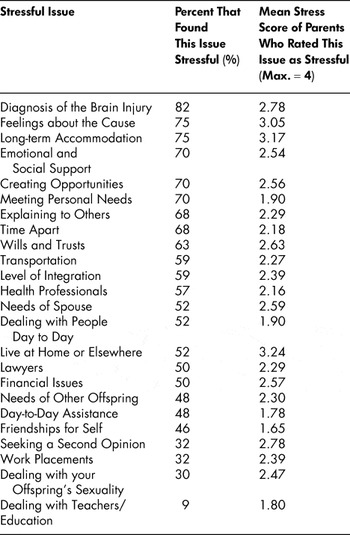
Three issues were identified by at least 75 per cent of parents on the FSCI as being particularly stressful. The most frequently identified issue was the diagnosis of brain injury (82%) followed by feelings about the cause of the ABI (75%) and planning for long-term accommodation (75%). The mean score on the FSCI was 32.05 out of a possible 96 (SD = 16.2) indicating relatively mild stress overall. However, stress levels within issues were somewhat higher. The three most stressful issues for parents were (a) making decisions about whether their son or daughter should live away from home (M = 3.24/4), (b) issues regarding long-term accommodation (M = 3.17/4), and (c) feelings about the cause of the brain injury (M = 3.05/4). These were followed by (d) the diagnosis of brain injury (M = 2.78/4) and (e) issues related to wills and trusts (M = 2.63/4). Mean stress levels for each issue are summarized in Table 1.
Stressful issues for parents on the Family Stress and Coping Interview

Diagnosis of ABI
All of the individuals with ABI in this study had sustained a brain injury at least two years prior to the interview with many having lived with a brain injury for several years. Despite the mean time since injury being 15 years, many of the parents interviewed indicated that the brain injury diagnosis was still a major issue for them. In response to the qualitative questions on the FSCI, parents spoke with considerable emotion about the successes and challenges they had experienced at the time of diagnosis. The major challenge for many was to obtain information, to gain some understanding of what had happened and the implications for the future.
When I was first told about it, my biggest challenge was trying to find out more about brain injury. I didn’t know what brain injury was at that time; I didn’t understand and [know] what to expect. The information didn’t seem to be available; they didn’t tell me anything about it.
Some parents indicated that they had many questions, but doctors and others did not take time to explain about brain injury and the rehabilitation process.
People kept telling me “it’s too soon, it’s too soon”. They didn’t want to tell me and I wanted to know. I’d never been through anything like this before and I wanted to know. I’m sure other parents must have felt the same way.
Cause of the Brain Injury
The second most frequently cited issue for parents was the cause of the brain injury. Some parents felt responsible for accidents that had occurred or for not intervening in activities related to the injury.
The biggest challenge is [that] I feel to blame as his mother. I should have had more wisdom than to let him do such a dangerous sport. He loved it so much, and it was such a joy to his life but I still feel to blame.
Some parents also blamed others for accidents leading to the brain injury.
The thing that still bothers me about the accident is that when I meet the guy who was the driver of the car …. He was responsible, he was negligent. I try not to hold a grudge but my son should have been what he is now. It was his best friend since they were two or three years of age. They had the same ideals and goals and when I see him today, I still find it very hard. He had a very good future ahead of him. He had finished his third year in computer science in university.
Long-term Accommodation
Finding appropriate long-term accommodation for a son or daughter with ABI was the third major concern for many parents. Many struggled to find an adequate solution that would meet the needs of their offspring while also satisfying parents’ own needs and concerns.
The only accommodation available was the psychiatric hospital, and I realized that wasn’t the place for her. When I was so close to death six years ago, what was uppermost in my mind was how long her father [could] cope alone with her, and [that] we may not be able to afford long-term care.
Several parents indicated that appropriate solutions did not exist, and some admitted to having given up looking for answers.
We really don’t know what to do. We have no family here at all, nobody can take over …. The challenge is finding a suitable place for him, a place we feel he would be safe and comfortable.
The part that bothers me is that there just is no place where he could go if anything happened to his mother or myself. I don’t like to see him in a senior citizens’ home. He still is young and he can be happy but there is nothing for him as a young person.
Three additional issues were identified by at least 70 per cent of parents as being of major concern: (a) ensuring ongoing emotional and social support for their family member with a brain injury; (b) creating opportunities for the family member to make friends and be involved in the community; and, finally, (c) meeting personal needs as a caregiver.
Objective 3: Service and Support Needs and Use for Individuals with ABI
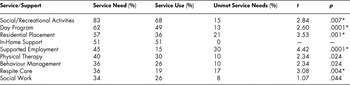
More than 50 per cent of parents reported that four services were needed by their family member with ABI: (a) social and recreational activities (83%), (b) day programs (62%), (c) residential placement (57%), and (d) in-home support (51%). These were also the most frequently used services, particularly social and recreational activities (68%) and in-home support (51%). As indicated in Table 2, the perceived need for services exceeded use for the top three services. Significant differences between services needed and services used were found for supported employment and respite care. When asked about unmet service needs, more than 10 per cent of parents identified six services, with the most frequently unmet needs associated with supported employment and residential placement. The most frequently cited reasons why services were not used were lack of appropriate services and long waiting lists.
Service and support use and need for individual with ABI

* p > .01
Service and Support Needs and Use for Parents
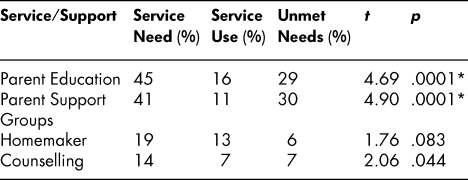
The most frequently reported services needed by parents were Parent Education (45%), and Parent Support Groups (41%). The services most frequently used by parents were Specialty Medical Services (32%). As Table 3 indicates, the need for services frequently exceeded use. Significant differences between services needed and services used were found for Parent Education and Parent Support Groups. The main reasons given for the gaps between service need and use were long waiting lists and a lack of available and appropriate services.
Service and support use and need of parent
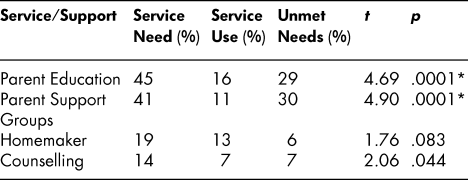
* p < .01
Additional Analyses
One-way analyses of variance were conducted to determine if there were any differences between parents’ overall and individual ratings of stress on the FSCI items according to (a) the parent’s age (less than 65 years; 65 years and over), (b) characteristics of their family member with ABI (i.e., degree of disability: mild, moderate, or severe; time since injury: 1–10 years, 11–20 years, 21–30+ years; and residence location of family member with ABI: at home or other residence), and (c) the parent’s age. Due to multiple comparisons, the significance level was set at a conservative level (p < .01).
• Time since injury. The sample was divided into three groups of parents according to the time since their family member’s brain injury (i.e., 1–10 years, 11–20 years, and 21–30+ years). There were no significant differences in parent stress ratings in these three groups. However, differences approached significance on Item 10 (choosing the best level of integration), with the second group (time since injury: 11–20 years) reporting more stress related to this issue than the other two groups. Similar patterns of response were found for items 13 (meeting your personal needs) and 21 (transportation).
• Degree of disability. The sample was divided into three groups of parents according to their family member’s degree of disability (mild, moderate, or severe). There were no significant differences in parent stress ratings in these three groups. However, differences approached significance on Item 10 (choosing the best level of integration) with the second group (time since injury: 11–20 years) reporting more stress related to this issue than the other two groups.
• Age of parent. Parents were divided into two groups according to their age (less than 65 years and 65 years and over). There were no significant differences in parent stress ratings in the two groups. However, differences approached significance on Item 10 (choosing the best level of integration) with the younger group (less than 65 years) reporting more stress related to this issue than the older parents. Similar differences were found for Item 20 (planning for ongoing emotional and social support for your family member with ABI) with younger parents reporting higher stress.
• Residence location of family member with ABI.
• Twenty of the adults with brain injuries (42.6%) in this study lived at home with their parents, and the rest lived in various types of accommodation with support from staff or family members. There were no significant differences in any of the stress ratings of parents in either group. However, the responses of parents caring for a family member with a brain injury at home differed significantly from those whose family member lived elsewhere on two subscales of the Service and Support Needs and Use questionnaire. The parents of individuals who lived with them reported that they needed (F = 112.67, p < .001) and used (F = 25.78, p < .001) more respite care than the parents of individuals who lived elsewhere. Conversely, the parents of individuals who lived elsewhere reported that they needed (F = 11.295, p < .005) and used (F = 10.844, p < .005) more psychological services than the parents of individuals who lived at home.
Discussion
As the average lifespan of persons surviving severe brain injuries increases, and as the demand for community-based residential options for persons with brain injuries exceeds availability, more parents are caring for their offspring into their seventies, eighties, and beyond. To date, available information concerning the experiences of older caregivers of adults with brain injuries is limited. The results of this study document some of the unique concerns and needs of parents of adults with ABI.
This study focused on the personal, social, and familial stresses experienced by a sample of older family caregivers of adult offspring with ABI living in Ontario. The primary caregivers participating in this study ranged in age from 50 to 89 years with a mean age of 67.1 years. Contrary to expectation, older parents (over age 65) did not perceive caregiving as more stressful than younger parents (between the ages of 50 and 65) did. Previous studies have suggested that this may be due to parents’ ability to adapt to caregiving stress over time (Seltzer & Krauss, Reference Seltzer and Krauss1989; Townsend, Noekler, Diemling, & Bass, Reference Townsend, Noekler, Diemling and Bass1989). It appears that, regardless of age, parents shared many common concerns. This finding would suggest that many issues noted as stressful for parents are chronic stressors.
Stressful Issues for Older Caregivers
The most frequently cited issues of greatest concern were feelings about the diagnosis and about the cause of the acquired brain injury as well as concerns regarding long-term planning for accommodation. Although the diagnosis of a brain injury can occur relatively soon after an accident or traumatic event, the long-term implications of the brain injury might not become apparent to family and friends for some time. These early stages after a brain injury are stressful for many family members; however, feelings about the way in which information was given and feelings about the cause of the injury often continue long after the injury occurred. Parents in this study as in others published previously (Junque, Bruna, & Mararo, Reference Junque, Bruna and Mararo1997; Kreutzer et al., Reference Kreutzer, Gervasio and Camplair1994a, Reference Kreutzer, Serio and Bergquist1994b) expressed a need for more information regarding their family member’s condition and prognosis. In addition, as in previous studies (Gleckman & Brill, Reference Gleckman and Brill1995; McMordie, Rogers, & Barker, Reference McMordie, Rogers and Barker1991), the parents participating in this study felt that they needed more help to understand the brain injury and resulting behavioural and personality changes. They also expressed a need for more information regarding available resources and support services.
Permanency planning has received much attention in research with older parent caregivers of adults with developmental disabilities. Research conducted in the U.S. (Heller & Factor, Reference Heller and Factor1991; Smith, Tobin, & Fullmer, Reference Smith, Tobin and Fullmer1995) and Canada (Minnes & Woodford, Reference Minnes and Woodford2004) in the field of developmental disabilities has indicated that permanency planning is the greatest worry for older parents. To date, information on the concerns of parents of adults with brain injuries has been limited. In this study, long-term planning for accommodation was found to be stressful for 75 per cent of parents of adults with brain injuries.
Service Need and Use
Significant unmet service needs were reported in four areas: (a) social and recreational activities, (b) day programs, (c) residential placement, and (d) home support. The main reasons given for the gaps between service need and use were long waiting lists and a lack of available and appropriate services. The emphasis in the literature on permanency planning as a key issue for older parents would suggest that if adult children with a disability are living at home, parents experience greater caregiving stress. However, this hypothesis generally was not supported. In only two instances were significant differences found between the service needs of parents caring for an adult at home and those whose child lived elsewhere: These differences concerned respite care and psychological services. Regarding the former, it is not surprising that parents caring for their family member at home should express a need for more respite. Regarding the latter, few respondents expressed a need for psychological services, and therefore the difference, although statistically significant, has limited clinical significance. The lack of significant differences in other areas suggests that parents continue to have major concerns for their family member’s welfare even when the individual is no longer under their direct care. Indeed, parents indicated that planning for ongoing emotional and social support for their offspring continued regardless of their family member’s living arrangements.
Limitations and Directions for Future Research
This study provided some initial data on stress, service need, and service use in aging family caregivers in Ontario. Although recruitment was conducted with the assistance of agencies and organizations in seven areas of Ontario, a sample of only 47 parents was obtained. Participation in research can be time-consuming and somewhat intimidating, especially for older individuals. The low participation rate in this sample might also have reflected the limited time and energy of older caregivers who have many responsibilities related to the ongoing care of their brain-injured family member. Consideration should be given to ways of compensating participating caregivers for their time to promote recruitment of larger samples in future research.
Results from this study provide a snapshot of parents’ experiences on only one occasion. Longitudinal research is needed to track the accumulation of caregiving stress over time, the changing patterns of service need and use, and the identification of coping strategies that contribute to successful outcomes.
Implications for Service Delivery
Is there a real need for concern and action regarding the needs of this population? Many parents identified several areas of ongoing stress and a variety of service and support needs for their family member and themselves. During the qualitative interviews, parents described how they “just got on” with their caregiving responsibilities managing as best they could. However, as indicated in the following case example, these circumstances are tenuous at best.
‘A House of Cards’
Mr. and Mrs. J. are in their late 70s. Their daughter, R ., who is in her 40s, lives at home. R. suffered a brain injury 20 years ago and now needs 24-hour supervision. R. also needs help getting dressed and needs assistance with toileting. She has coordination and balance problems, she perseverates in motor movements and often falls. R.’s behaviour can be disinhibited and she will often disrobe.
In recent years, Mrs. J. has not been able to help her daughter with personal care due to her own disabilities including arthritis and a heart condition. Her husband has taken responsibility almost entirely for R.’s care. However, Mr. J.’s health has recently deteriorated and he is currently awaiting surgery for an abdominal aneurysm.
Mr. and Mrs. J. currently receive the maximum home support/respite available from the Access Centre, but this is insufficient given their failing health. They do not have the funds to purchase additional help. Mr. and Mrs. J. are immigrants to Canada and are unable to call upon family for assistance.
Concerns related to uncertain futures continue for older parents caring for a family member with a brain injury. The results of this study suggest that a more pro-active approach in providing service to such families, before a crisis occurs, would be helpful. Parents participating in this study made the following recommendations to improve brain injury services:
• Accommodation. To assist older parents planning for and beginning the transition toward alternative accommodation, parents need more readily available and detailed information about their options, and greater variety and flexibility in those options. For example, parents would like to be able to book respite care with shorter notice and to be able to access both in-home and out-of-home support. Parents also highlighted the need for accommodation specifically for individuals with brain injuries where residents are of similar age and staff have been appropriately trained.
• Information for Families. Parents emphasized the need for more information for family members in the early stages after brain injury. Although definitive answers often cannot be given, opportunities to talk with professionals about possible scenarios and to gain an understanding of what is happening to their family member would be very helpful.
• Public Awareness Campaigns. Parents and family members are often left to educate others about brain injury. More information in the media about brain injury would help to heighten community awareness, and facilitate community involvement and integration.
• Education. Parents strongly recommended that more education, specifically regarding brain injury, be available to health and legal professionals.
• Networking and Partnerships. Parents emphasized the need to create more links between individuals with brain injuries and the community through charitable organizations, volunteer activities, computers and the Internet, and religious or spiritual communities.