In 2010, the performance installation Exhibit A by white South African theatre artist Brett Bailey opened at the Wiener Festwochen (Vienna Festival), an annual music and performing-arts festival. The show was presented in an empty wing of the Vienna Ethnology Museum (since renamed the Vienna World Museum) while the building was undergoing extensive reconstruction and updating. It condensed the history of European colonialism into twelve tableaux vivants, which included live performers in installations that, in the first iteration, focused on German colonialism and the genocide of the Herero and Nama in the German colony of South West Africa (1904). These tableaux were interspersed with displays of contemporary African asylum seekers. Conceptualizing a series that would expand as it travelled, Bailey and his company, Third World Bunfight, added tableaux on Belgian, French and British colonialism in Exhibit B, and envisioned further additions as the series continued.Footnote 2 The performance installation has been shown predominantly at festivals in Europe, as well as in Russia and South Africa.Footnote 3 However, the development of new tableaux has stalled as the show became embroiled in heated controversies in Berlin, London and Paris, cities with large immigrant and post-colonial populations. Although it received merely lukewarm reviews at the Grahamstown Festival (South Africa), the European reception had been largely positive, with critics praising its powerful engagement with colonial history.Footnote 4 However, antiracist activists protested against the show in Berlin (2012), and provoked discussions in the press about the politics of Exhibit B at a time when racism in the theatre was already the subject of debates in Germany. A boycott of the planned London production of the show hosted by the Barbican Centre, which was organized on social media, led to its cancellation in September 2014. Similar protests and demands in Paris shortly afterwards were not successful.
Activists in Berlin, London and Paris charged that the show objectifies black people and, by presenting silent black performers for the enjoyment of white Europeans, essentially reproduces the historic entertainment format popular during the colonial era, which is now referred to as ‘human zoo’. By contrast, the directors and curators of the institutions that hosted Bailey defended Exhibit B as a critique of colonialism and racism. When the Barbican Centre cancelled the show, moreover, its defenders attempted to turn the tables on protesters, by accusing them of censoring artistic expression.Footnote 5 The controversies surrounding Bailey's work, then, initially appeared to pit aggrieved minority communities charging bourgeois public institutions and media with racism against white professionals in the European art world who resist any call to wider public accountability by crying censorship.Footnote 6 Public statements by performers in the Berlin and London productions and subsequent discussions in print media and online blogs, however, begin to break down the stark polarity sketched above, and at the very least call attention to differences between relatively recent arrivals from Africa (many performers recruited by Bailey were asylum seekers) and more established minorities of colour in Germany and the UK. These discussions signal an interest in, and further need for, more differentiated engagements with the ethics of confronting a violent, racist history, the dramaturgy of interracial encounter and the politics of decolonizing cultural institutions. This article seeks to contribute to these debates by taking a closer look at the criticisms of the installation in order to consider its shortcomings as well as its accomplishments.
The figure at the centre of this debate, Brett Bailey (born 1967), has been called ‘one of the most important writer/directors in postapartheid South Africa’ by performance scholar Anton Krueger, who characterizes his work over the past two decades as syncretic (drawing on multiple cultural sources, including Xhosa spiritual practices) and constructivist, calling persisting ideologies of race and ethnicity into question.Footnote 7 Bailey's transgression of cultural lines, especially in his early work during the 1990s, has provoked criticism in South Africa, where, according to actor and director John Matshikiza, ‘to be a white man dabbling in black territory is still taboo – to both sides’.Footnote 8 In the mid-2000s, his work shifted from an investigation of spiritual matters to one more concerned with social and political questions. Most of his work is not shown in traditional theatre spaces, but is carefully selected to support the political meaning and emotional impact of the work.Footnote 9 Bailey's archival research in Amsterdam, where he studied for a postgraduate degree, became the foundation for the Exhibit series.
I begin by unpacking the charge that Exhibit B replicates a ‘human zoo’ that objectifies black bodies. I examine the assumptions underlying the Berlin activists’ accusation that it benefits only the white director, merely repeats racist representations, and fails to empower black Europeans. I argue that the show indeed approaches anti-racist empowerment in ways that clearly diverge from those that currently dominate German plays and performances dramatizing the experiences of the Afro-German minority, but that this divergence should not be too quickly dismissed.Footnote 10 Instead, I propose that Exhibit B addresses spectators as witnesses urged to respond to an emergency. I contend that the need to intervene applies both to the acute racial exclusions evident in the recent militarization of Europe's Mediterranean borders and to the multicultural makeover that so many museums on the Continent – whose display practices are criticized in Exhibit B – are currently undergoing.
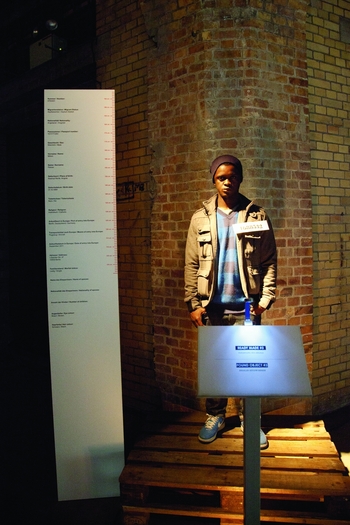
The twelve (now thirteen) tableaux present exhibits in both senses of the word: on the one hand, they present evidence to indict historic crimes against humanity, including the Herero and Nama genocide, and the infamous rubber collection system implemented in the French and Belgian Congo colonies. On the other, many evoke distinct exhibitionary conventions from the history of the museum. These range from the curiosity cabinet to natural-history formats like ethnographic dioramas and the glass cases in which human remains like skulls, bones or skeletons might be displayed. Several exhibits cite art museum formats that isolate, decontextualize and elevate objects through lighting, frames and pedestals. Importantly, the historical tableaux are interspersed with installations that depict contemporary non-citizens in street clothes, who straddle both meanings of ‘exhibit’.Footnote 11 Labelled ‘found objects’, African migrants, asylum seekers and deportees are shown with their arms and legs circled by measuring tapes, and accompanied by biographical information and biometric data charts. The tapes and charts visually link the anthropometric techniques of nineteenth-century racial science with contemporary regimes of migration monitoring and border control. The identities of the respective subjects are changed at each production site, to evoke regional specificities concerning immigration and deportation. In Belgium, for instance, one non-citizen wore a sweatshirt proclaiming ‘Zwarte Piet is racisme!’, a slogan that resonated with local efforts to stop an offensive carnival practice that has since been banned in the Netherlands. Together, the Exhibit stations assemble an introductory and necessarily selective survey of European histories of race. The show's bifocal approach to historical injustices and the imperialist ‘exhibitionary complex’ insists that decolonization hinges on historical remembering and on the critical working-through of the patterns of perception, repertoires of feelings and habits of thinking and knowing that shored up European superiority long after the empires had fallen.Footnote 12 The assumption that truth-telling is the prerequisite for restitution and redress speaks to Bailey's artistic coming of age in post-apartheid South Africa. The measure of such critical efforts, Exhibit B suggests, is the well-being of the African non-citizens that anchor the show. The accusation that the show subjects its African performers to symbolic violence therefore weighs all the more heavily.
Human zoo?
When Exhibit B was shown as part of the performance festival foreign affairs in Berlin, Brett Bailey was surprised to find his work at the centre of public controversy. The organization Buehnenwatch (Stage Watch), an anti-racist watchdog group, protested against the show, engaged with Bailey at a public discussion and called for the boycott of Exhibit B.Footnote 13 Buehnenwatch describes itself as a network comprising black and white activists who oppose racist practices in German theatres.Footnote 14 In a statement posted on their website, they explained their objection by likening the show to displays of foreign peoples in ethnological shows. The display of so-called ‘exotic’ or ‘primitive’ peoples in zoos and theatres, and at circuses, world fairs and colonial exhibitions, was a tremendously popular form of edutainment from the mid-nineteenth century to the mid-twentieth. Troupes ranging from just a few to over a hundred performers toured through large cities and small towns, and, in the age before National Geographic, the Discovery Channel and mass tourism, reached millions of visitors curious about purportedly uncivilized peoples. This genre certainly contained elements of dramatic spectacle, but its staging of ordinary ‘primitive’ life, figured through family pastimes and tribal rituals, was central to its appeal, as historian Eric Ames in particular has argued with regard to the tremendously successful German impresario Carl Hagenbeck.Footnote 15 Respected anthropologists like Rudolf Virchow and Felix von Luschan vouched for the scientific value of shows in exchange for examining and measuring the foreign performers.Footnote 16 The ethnological show is thus a particularly fruitful genre for analysing the interface of anthropological science and popular entertainment. The burgeoning scholarship on human displays during the last two decades has examined its role in buttressing the imperialist imagination, and emphasized that these exhibitions did not, in the vast majority of cases, furnish any overt colonial propaganda even when troupes were recruited from colonies.Footnote 17 Flourishing in step with the newly mass-marketed techniques of advertising and consumption, the ethnological shows instead traded in racial stereotypes and primitive fantasies that transformed foreign bodies and acts into pleasurable objects of scopophilia, and thus honed a way of looking at the bodies of racial Others that have proved more difficult to dismantle than colonial administrations.Footnote 18 The term ‘human zoo’ was popularized by French historian Pascal Blanchard, who selected it as an umbrella term encompassing the respective emphases on universal and colonial exhibitions in France, ethnic displays (Völkerschauen) in Switzerland and Germany, and a hybrid of the two in British culture, but he also included sideshows and freak shows under its purview.Footnote 19 Blanchard not only advanced the comparative study of the human zoo in a transnational context, but brought the topic to international, popular attention by curating a large-scale exhibition at the Musée du Quai Branly in Paris (2011–12).Footnote 20 The exhibition catalogue Human Zoos: The Invention of the Savage maintains that the human zoo constitutes a ‘“global” system,’ an exportable blueprint for visual and theatrical strategies of domination, of ‘constructing a radical alterity . . . often as a prelude to exclusion’ that worked equally well in Hamburg and Chicago, Amsterdam and Osaka.Footnote 21 While the expanded scope of Blanchard's research deserves high praise, his intention to expose the visual grammar of Othering, which shores up white superiority, has come at the expense of attention to the ways in which performers negotiated the constraints of the genre.Footnote 22 The attendant notion of black passivity and powerlessness associated with the term contributed to the outrage provoked by the characterization of Exhibit B as a human zoo.
Exhibit B does not conform to any of the performative conventions of the human zoo. The very stillness of the tableaux contrasts with the staged liveliness of the ethnological show and its pretense at authenticity. While some of the shows would spice up quotidian primitiveness by choreographing indigenous people as dangerous (as in Indians chasing stagecoaches in the Wild West, or Amazon warriors from Dahomey), the horrors of colonial violence, oppression, exploitation and genocide were rigorously excluded from this genre. By contrast, Exhibit B characterizes the culture of coloniality as one marked by cruelty and torture. Exhibit B resembles the human zoo only in a single respect, namely the display of live bodies of performers of colour. By likening Exhibit B to the human zoo, Buehnenwatch charged that ‘Brett Bailey reproduces the idea of Africans as objects’. Although white spectators also become the object of black performers’ looks, activists contended that ‘there is no change in the archetypical constellations white observer–Black observed and white organizer–Black [exhibit]. After all, it is not whites, but Black Africans that are standing motionless for over 45 minutes – some of them almost naked.’Footnote 23Exhibit B replicates hierarchies and exclusions that should be opposed and transformed: ‘you as a white, privileged person are still sitting there and ordering black people around,’ said Afro-German poet Philipp Khabo Koepsell in the public discussion.Footnote 24
Buehnenwatch also questioned the installation's claim to educate visitors about historic or contemporary crimes, and maintained that it merely elicits affects (in this case, shame). In this respect, too, Exhibit B is allegedly like the historic human zoo, which purported to teach Europeans about ‘primitive’ peoples, but merely shored up self-serving feelings (of cultural superiority). Even though shame does not bolster Eurocentric dominance, it is nevertheless self-serving, as it asks little of the subject that feels it: as performance scholar Lisa Skwirblies argues persuasively, it lends itself to expiation and catharsis, rather than to sustained investigation and redress.Footnote 25 Buehnenwatch objected to Exhibit B's emphasis on affect, because ‘there is no analysis of sources and mechanisms of racism, so there is no fostering of a critical discussion’. A rigorous critique, one can infer, would link affect to conscious judgements and deliberate commitments, produce critical knowledge or articulate demands.
Black audience members, Buehnenwatch stressed, would find nothing beyond the mere mirroring of their ‘own everyday experiences of racism’ in Exhibit B. The muteness of performers certifies their lack of agency. Similar accusations were raised when Exhibit B was shown at the Edinburgh Fringe Festival in August 2014. After reading a review that characterized Exhibit B as a human zoo, blogger Sara Myers organized an online protest campaign on change.org that led to its cancellation at the Barbican (London) in September 2014 after receiving almost 23,000 clicks.Footnote 26 Let me take a closer look at the criticisms that this purportedly anti-racist show fails to empower black performers or spectators, provides facile emotional release for white Europeans, and furthers only the career of a white artist.
The Buehnenwatch activists sought to draw connections between Exhibit B and the racist stage practices they had opposed during the preceding year when they protested against the use of blackface at the venerated Deutsches Theater in Berlin in spring 2012.Footnote 27 While these struggles had revolved around the call for more and better (i.e. less stereotypical) roles for black actors, Bailey's show, which used an all-black cast to denounce racist practices, allowed the watchdog group to refine their critique by calling attention to a unequal, racialized distribution of cultural authority, public attention and professional capital. Whereas Bailey gains critical acclaim and professional cachet from his critique of racism, the observations and criticisms of black European activists, artists and academics receive much less attention or funding. Afro-German theatre is often confined to subcultural niches, and receives short-term subsidies from pots reserved for social rather than artistic work. In addition, Bailey's outsider perspective was seen to displace homegrown critiques, and his success on the international festival circuit indicated that he was pandering to the aesthetic sensibilities of theatre-going elites rather than supporting collective struggles against racial oppression.
Moreover, Bailey's work with actors of colour cast in the cities where Exhibit B is staged, which consists of a three-day training session framed as a form of consciousness-raising and political affirmation, contrasts starkly with the long-term efforts of local institutions.Footnote 28 The Ballhaus Naunynstrasse in Berlin, for instance, devotes part of its resources to building creative skills of youth of colour, as do a number of youth empowerment projects that use techniques from director and theorist Augusto Boal's theatre of the oppressed.Footnote 29 These projects also, to varying degrees, articulate the situation of black Germans to other categories of racialized difference, including labour migration, anti-Semitism and post-Cold War migrations, including the arrival of ethnic Germans from the former Eastern bloc. The ‘human zoo’ charge not only castigates the whistle-stop nature of Exhibit B as a lack of commitment and care, but also, as theorists Karel Arnaut and Chokri Ben Chika astutely pointed out, collapses a range of differences into a black–white binarism.Footnote 30
The past three decades have seen a growing scholarly literature by and about Afro-Germans and people of colour in Germany. Many of the recent literary and dramatic works by Afro-Germans wrestle with the difficulties created by the official expunging of the language of race and racism after the Holocaust from discourses of law, policy and science, which did not eradicate racism, but made it more difficult to detect and oppose because of the lack of a critical discourse of race.Footnote 31 To the minds of many white Germans, the very term ‘race’ affirms the biologistic assumptions they associate with Nazism. Most Afro-German cultural productions continue to struggle, in mounting frustration, against a strictly biological understanding of race, and towards one more attentive to cultural perceptions and linguistic subtleties. Poetry, films, literature and plays depicting the lives of black Germans revolve around their experience of Alltagsrassismus (everyday racism). The critique of Alltagsrassismus exposes the linguistic and perceptual traces that perpetuate racialized patterns of exclusion. These patterns are difficult to challenge, because the exoticization and commodification of racial difference are often embraced as evidence of ‘post-racial’ (i.e. non-harmful) relations. While some of the installations in Exhibit B are informed by this research, they lack the nuance and subtlety present in this work.
Bailey often draws straight lines between historic and contemporary practice: the measuring tape around the upper arms of early nineteenth-century Africans in the diorama and contemporary non-citizens, for instance, suggests direct continuities between colonial racism and the modern biopolitical state, across the thresholds of modernity and the debunking of scientific racism. By reducing contemporary racism to the violent treatment of refugees and by anchoring it historically in biological racism, Exhibit B detracts attention from the much more varied and dispersed operations of race today (say, in the cosmopolitan representation of differences in ethnology museums). It confirms contemporary white Europeans’ confinement of racism to the (colonial/Nazi) past, and pays almost no attention to the Afrophilia, differentiated inclusion and paternalism that typify Alltagsrassismus. The activists’ charge that the show facilitates no critical analysis of racism must be seen in this context, where small insights are often very hard-won, and the verbal confirmation of new commitments is pedagogically reinforced through post-show discussions. From the perspective of Alltagsrassismus and the expressive culture it has generated, Bailey's radical rhetoric of transhistorical continuities, and appeal to blockbuster affects, threaten to eclipse the modest scale of family and neighbourhood relations, shred the patience required of both artists and audiences of antiracist work, and drown out the softer, often satirical or humorous, voice cultivated by Afro-German poets and playwrights.Footnote 32 Caricaturing Bailey as an itinerant impresario served to validate these collective struggles, local knowledges and long-term commitments. At the same time, the charge denied that he had done his homework, refused to entertain the ideas that a white artist might have a stake in the critique of racism and that black Germans might also be empowered by the theatrical resignification of injurious forms of representation.
One of the Berlin cast members, Collivan Nso, who had played the part of Sudanese asylum seeker Aamir Ageeb, one of fourteen who died during deportation from Germany between 1991 and 2010, spoke out during the post-show discussion in Berlin. Nso, an immigrant from Cameroon, recalled his own ordeal when in 2006 he was threatened with deportation, which he was able to avert after going on hunger strike.Footnote 33 ‘This is my story,’ Nso said. ‘I hate talking about it. It's so painful. I don't want sympathy; this is how we live every day. There is this silence, but we need to talk about these things.’Footnote 34 In contrast to Koepsell's criticism of the performers’ ‘voicelessness’, Nso's comment underlined the production's ability not only to convey his story, but also to elicit dialogue.Footnote 35 While silent, Nso suggested, the installation nevertheless constitutes a kind of embodied speech. Arguably, Nso's understanding of ‘speech’ and ‘voice’ is not only less literal than that evidenced by Koepsell, who is a spoken-word poet, but also more dialectical. Nso's portrayal of Ageeb, moreover, underscores Bailey's attention to the local and national resonance of individual stories whose significance may be called universal in this age of perilous migrations. None of the ‘found objects’, a label that offended some visitors, were generic non-citizens, but denoted specific individuals whose stories would have been familiar especially to non-citizens and their allies. To Nso at least, presenting their biographies was not demeaning, but a way to honour their ongoing struggles. The careful localization of parts of Exhibit B to some degree qualifies the perception of careless itinerancy.
In sum, I would question some of the criticisms captured by the term ‘human zoo’, namely that the production increases only the director's social capital and carries no benefits for the performers, that performers’ speechlessness signifies passivity, and that audiences of colour are not addressed. The claim that Exhibit B is not attuned to the complexities of nationally or locally specific contemporary racisms or to the way that blackness relates to other categories of difference, by contrast, is irrefutable. Yet I would weigh its blunt reductivism against its ambitious transnational range and historical scope, which attends to national specificities but places them within a larger, European racial imaginary in a way that is unparalleled. I argue that this transnational scope is warranted both by the Europeanization of security policies that affect the treatment of non-citizens, and by the Europeanization of the museum discourses in which the show intervenes. The rhetoric of the ‘human zoo’ ultimately forecloses an understanding of how Exhibit B approaches this goal.
For the most part, Exhibit B inserts live bodies in genres of display that historically did not include humans: a young man, muzzled like a slave in the sugar mills of Surinam, is placed within a Dutch still-life painting. Behind two glass cases containing human skulls, a Herero survivor of the genocide committed by German colonial forces in South West Africa is shown preparing a skull for shipment to a natural-history museum. And an African man and woman in grass skirts are positioned in shipping crates that evoke the habitat dioramas so popular in anthropology museums. In each case, the addition of a live person disrupts familiar viewing expectations and throws into startling relief habits of looking and knowing.
The installation titled ‘The Age of Enlightenment: Angelo Soliman’, near the end of the path, exemplifies Bailey's method. My following analysis is based on my own visit to Exhibit B when it was shown at the Vooruit Arts Center in Ghent, Belgium in September 2013. My fellow spectators and I abided by the same rules as audiences elsewhere: patrons were first welcomed and seated in a room from where we were sent on our way one by one. Taking photographs or making recordings was forbidden, and we were asked to look at the exhibits, but refrain from speaking. Since Bailey adapts the work to each carefully selected site and casts local performers, I did not see the same production as the ones that provoked protests in Berlin and London, yet I choose to base my analysis on first-hand observation.
Angelo Soliman, the subject of ‘The Age of Enlightenment’, is a figure with whom Austrian audiences in particular might have been familiar, as he was a resident of Vienna in the eighteenth century, and the subject of several exhibitions and artworks in the decade prior to the opening of Exhibit A. His first biographer, Karoline Pichler (1807), framed his colourful life story as one of spectacular upward mobility and transcendence of racial barriers.Footnote 36 Born in what is today Nigeria in 1721, and sold in the Mediterranean port of Marseille as a slave, he served several European aristocrats as a Hofmohr (court moor), and was eventually baptized, renamed and freed. A highly educated man, he spent a large part of his life working as a royal tutor in Vienna. Soliman, a celebrity in his day, became head of a prestigious Freemason lodge in Vienna, and befriended several of the city's leading artists and intellectuals. He married and had a daughter, and owned the house in which he lived with his family. Pichler's biography, however, left out important details about this prominent public figure's posthumous life. After his death in 1796, Soliman was skinned by a taxidermist, stuffed and displayed in a glass case in the imperial natural-history cabinet. Much in contrast to the elegant attire in which Soliman usually appeared in public, the mummy was outfitted in the grass skirt, beaded necklace, and headdress of a stereotypical savage, and moreover placed in a cabinet furnished with native American flora and fauna. His daughter Josefine sued in vain for the return of her father's remains so the family could bury him. In 1848, the remains were destroyed in a building fire. In the 1990s, in the aftermath of mass refugee flows, xenophobic backlash and neo-Nazi resurgence, Soliman was rediscovered. The death of Marcus Omofume, a Nigerian asylum seeker who in 1999 was suffocated by Austrian police during deportation, kindled mass protests and a broad coalition of migrant and leftist anti-racist organizations, a coalition that has eroded since then.Footnote 37 Soliman's memory became a way to contextualize and orient both the bonds and the rifts emerging in Austrian society. He has been the subject of new biographies, several exhibitions, two plays and one dance theatre piece authored by critically minded white Austrians who seized on Soliman for a project of anti-fascist and anti-racist reckoning. These works accord his posthumous desecration a great deal of attention, and read his life largely through the lens of this degradation to an object of racist display. This shift towards a critical perspective evidences a much-needed attention to the violent operations of racial objectification, but it also risks locking Soliman, and black Europeans more generally, into the position of quintessential victim.
In 2006, the newly formed Research Group on Black Austrian History and Presence turned to the Soliman family to define its own identity and mission: ‘How would we tell/write Angelo Soliman's story?’ the group asked:
How can the protest of his daughter Josefine Soliman who fought against the inhuman display of her father in the Imperial Cabinet of Natural Curiosities be grasped from a Black position given that she was an 18th century Black Austrian woman? Although publications about these two people already exist they usually depict the position of the white majority. For us, however, it was important to research and work [through] Black history collectively.Footnote 38
The group translated Josefine's lawsuit for her father's remains into a series of public happenings, such as a proposed renaming of a street in Vienna, and a song titled ‘Let It Be Known’ that was part of the Mozart year of 2006.Footnote 39 These public interventions gave expression to a collective, black Austrian subject and object of knowledge that bridged past and present, and emphasized Josefine's agency.Footnote 40 Filiation with Soliman's daughter brought into being an oppositional subject empowered to both mourn the victims of violence and protest against injustice.
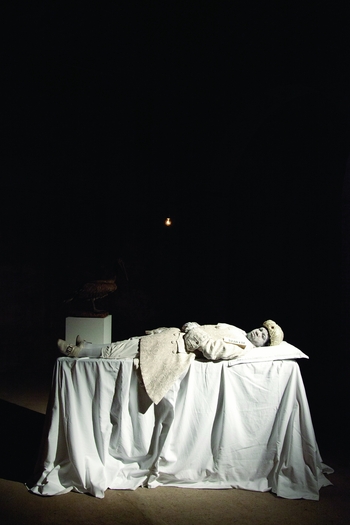
At Exhibit B, I encounter Angelo Soliman's body placed on a table in a dank basement room with a low ceiling (Fig. 1). The actor impersonating him wears a cream-coloured, embroidered brocade coat from which spills a fine lace jabot, white gloves, silk stockings, silver-buckled shoes and an Ottoman turban, fineries similar to those in which Soliman had himself portrayed by the painter Johann Nepomuk Steiner. A stuffed white pelican is propped up behind him, and reminds spectators what lies in store for the body in front of them. The stuffed bird makes this mouldy-smelling cellar more clearly legible as a taxidermist's workshop. As a stand-in for the animals that historically surrounded Soliman's stuffed corpse in the curiosities cabinet, the pelican also signals their shared status as ‘curiosities’ in the cabinets of wealthy collectors. The performer's dark skin is painted white, making his dark eyes stand out. As I take in his body, note the pelican and read the information placard, I become aware of choral music emanating from the next room.
‘The Age of Enlightenment: Angelo Soliman’, Exhibit B, Berlin, 2012. Reproduced with permission by Anke Schuettler.

Bailey's choice to apply white paint to the actor's face serves to distance the historic figure, to underscore his status as representation. It could be read as a protective layer that interposes a screen between viewer and actor, interrupting the disappearance of contemporary performer into the role and the impression of an unbroken continuity of racial discourse. But it is a highly ambiguous choice: it could be seen as underscoring the symbolic violence perpetrated by biographers’ attempts to ‘whitewash’ his story, but also, more negatively, as denouncing his cultural identification with those who, in the end, regarded him as a savage, painting him as a victim of his own false consciousness and misplaced trust, an Uncle Tom. At the same time, it evokes some regional traditions of covering the face and body with white paint in Africa, for instance in coming-of-age rites used by Xhosa boys on the eastern Cape, suggesting a liminal state of becoming. What might read as classically deconstructive ethnic drag thus introduces the possibility of multiple reference systems in which Soliman signifies.
By displaying Soliman in his courtly vestments, the exhibit pointedly honours the living man, described as a philosopher, scientist, royal confidant and prominent Freemason on the placard, rather than re-enacting the scandal of his post-mortem display. Like his early Austrian biographers, it underscores his embeddedness in multi-ethnic Austrian society and friendship circles. In contrast to their whitewashing efforts, the horror of his story, and the display of human remains in European museums more generally, are central to this installation. The mournful hymn wafting over from the adjacent room, composed by Marcellinus Swartbooi to commemorate the Herero and Nama genocide and presented by four Nama choristers, recalls the Black Austrian Research group's choice of an aural, rather than visual, form of commemoration and protest. The song hints that Soliman's story is part of a larger diasporic project of repatriation and symbolic reclamation.Footnote 41
The still, recumbent figure admittedly provides few clues about the protests of Josefine, who has become a figure of inspiration and identification for contemporary black Austrian activists. But neither is he portrayed as a passive victim, which made his portrayal problematic in their eyes of black Austrians. The look directed at me from that whitened face is not the pleading, tearful look often depicted in abolitionist imagery, such as Samuel Wedgwood's famous medal; it neither invites a problematic victim-identification, nor is it content with my recognition of suffering. The way in which I feel myself observed and held in the performer's steady, alert gaze makes it difficult to perceive him as passive or objectified. The defamiliarizing facepaint, moreover, signals that the performer communicates not as Angelo Soliman, but about him. Many of Bailey's critics have objected to the racist visual pleasure they suspect attends any meeting between a white spectator and black bodies (especially when they are partially nude). I suggest, however, that the bodies on display in Exhibit B elicit not the one hegemonic gaze of the white supremacist, but at least two distinct looks. First, they reconstitute the humanity whose brutal elision underwrote the fantasy of European innocence. Second, they raise the possibility of looking at the scene of violation as witness.
The witness has become a key figure in contemporary human rights discourse, as the provider of first-hand testimony and the one whose voice grounds the experience of victims and survivors in historic truth. The receiving of testimony through attentive and empathetic listening as well has been described as witnessing. Such witnessing allows for the recognition of survivors’ experience within new ethical and juridical frames. The giving and receiving of testimony at the Adolf Eichmann trial in Jerusalem (1961) and at the Auschwitz trial in Frankfurt (1965); in front of the truth commissions established in former South American dictatorships in the 1980s and 1990s; and at the public, mass-mediated hearings staged by the Truth and Reconciliation Commissions from 1996 to 1998 in South Africa, for instance, brought the values and commitments of newly democratic states into being. Although the truth commissions sought to recognize the injuries inflicted by the perpetrators, and break the repressive silence shrouding their crimes, however, they were often criticized for failing to obtain justice by punishing perpetrators, making reparations to victims and ensuring the civil rights of the young democracies’ denizens equally.Footnote 42 While the state of Israel was successful in demanding reparations for Jewish victims of the Nazi Holocaust from the West German state, the injuries of other victim groups of Nazi racism – including Roma, homosexual men, and Eastern European slave labourers, among others – received only very belated recognition and have not been adequately acknowledged or repaired. Victims and survivors of colonial genocide have not been compensated. Too often, witnessing gross human rights offences has remained circumscribed by negotiations between nations, or is mediated by national governments, thereby abandoning those whose civil rights are either ignored or actively injured by these governments.
This is becoming increasingly alarming in the European Union, where non-citizen populations are governed, without having a say in how they are governed, by a confusing array of governmental and non-governmental agencies. These agencies interpret their mandate as the protection of the rights, property and security of privileged groups of citizens against non-citizens who are denied protection or rights. They solicit consent to their violent procedures from the privileged group on whose behalf exclusionary measures are enacted, by drawing on the historic institutions and cultural practices that made citizenship rights contingent on national belonging, which is in turn circumscribed by race and gender. However, the unbundling of sovereignty from the nation state in the course of the European Union's political restructuring has also presented opportunities for comparative critiques of colonialism and its ongoing racist legacies. Exhibit B interrupts the solicitation of consent and the limitation of citizenship to the category of the national. In contrast to press reports, which frame the sinking of refugee ships crossing the Mediterranean as sensational and exceptional accidents, Exhibit B situates Europe's violent treatment of non-citizens as part of larger patterns that have rendered injury claims unremarkable. The performance installation allows violations to become visible as emergencies requiring intervention and redress. These interventions are not anticipated to be literal, as in some performance-art pieces. Nor should they remain only at the emotional level, as several critics have suggested when they interpreted the installation's address to be a call for shame.Footnote 43 The juxtaposition of tableaux condensing the racial history and politics of the exhibitionary complex with displays of non-citizens continually reminds spectators of the immediate stakes of exhibiting difference, and the urgency of decolonizing culture.
Found Object #3, Exhibit B, Berlin 2012. Reproduced with permission by Anke Schuettler.

The present reorganization of the exhibitionary complex presents the potential for rehearsing what we might call a ‘civil contract of performance’, analogous to the ‘civil contract of photography’ that visual-culture scholar Ariella Azoulay has theorized.Footnote 44 In this space, citizenship is freed from coalescing around nationality, and enacted as the making of emergency claims. It is a ‘civil contract’, because claims are no longer mediated by the state, but can be brought against the (transnational) state for distinguishing between EU nationals and non-citizens dwelling in Europe. Spatial proximity, the separation of informational and affective contents, the emphasis on one-on-one encounters, the ban on photographing or speaking, and the stipulation of eye contact all intensify the sensorial receptivity of the spectator and prepare her for the task of witnessing. The inclusion of ‘spectator’ in the evidence list provided by each informational plaque points to her ambiguous positioning as part of that which is indicted and must be changed, and as the addressee of grievances who must take responsibility for that change, who will no longer tolerate others’ violation on her behalf. Azoulay warns against framing criticism in terms of intellectual-property claims that have historically accrued to authorship. The ‘author’ (Bailey) is only one among several potential ‘addressers’ of grievances, a position that (in Azoulay's understanding) also includes the so-called ‘objects’ of representation (the performers) as well as the institution that produces it.
The published statements of performers in the cancelled London production of Exhibit B in particular reveal that they did regard themselves as addressers of important claims, rather than mere objects within an artwork created and owned by Bailey. They insisted not only on their creative expertise, but also on being participants in a historic process of antiracist enunciation that they understood as unprecedented and as carrying important political and social implications. To cite just a few:
Exhibit B was not made to make anyone feel guilty but to teach them. People are familiar with slavery in America and the Holocaust but Exhibit B tells the stories of those who are not recognised for what they went through. Exhibit B has changed my life! Not only has it educated me, but it also gave me the chance to educate others. (Rania Modi)
I invited a friend, a black African and a scholar in African studies, to the show. I knew he could deconstruct this piece every which way and I wanted his opinion. Afterwards he said: ‘Everything I am trying to do in my work was presented in this exhibition.’ I have never felt prouder. (Anne Moraa)
I feel blessed to have been in a position where I was able to tell a story of the injustice of past and present so that the future doesn't have to be the same. (Anna Modi)Footnote 45
‘We are actors and performers who believe that art should be meaningful. Challenging. Provoking. Not only for us, as participating collaborators in the work, but also for the audience who witness the work’, they wrote in their open letter. Their bodies do much of the work of testifying, enacting torture by wearing a facial muzzle, exposing their nude torsos in ethnographic dioramas and wearing shackles and head restraints while squeezed into an airplane seat. As in performance art, the actor's physical and psychological discomfort is the primary medium and content of communication. None of the installations merely re-enacts historic violence, but rather presents it in the mode of testimony. Sometimes the distance between the performer as witness and referent of historic violence is stressed by defamiliarizing techniques such as anachronistic costuming, or through body paint, as in ‘The Age of Enlightenment’; other times it is conveyed mainly through blocking and posture. The performers, in their role of presenting grievances on behalf of people who could not make emergency claims, or whose claims were not recognized, are mediating figures between racism's referents and spectators. They address themselves to spectators after themselves being addressed and become receptive to claims of injury, or infusing their presentation with their own sense of injury as racialized (impaired or non-)citizens. The installation's focus on performers’ eyes, and the active look they fasten onto the spectator, not only mark them as witnesses, but underscore witnessing as a horizontal, intersubjective, civil process that has barely begun to grasp historic injustices, much less figured out how to repair them.
In Exhibit B, testimony arises not from the witness's voice, but from the clash between bodies, artefacts, and text. The compact, detailed arrangement of material and bodies in each tableau testifies very precisely to the visual and spatial conditions of exploitation and dehumanization. In fact, the performers’ alert, intense gazing without verbally articulating an unequivocal or unified take-away message can be perceived as a command to carry the performance forward by putting into speech what has remained unsaid, and thereby turn the addressee into an addresser. The civil contract of performance, then, inaugurates a dialectic of receiving evidence and transforming that evidence into new ethical imperatives that guide individual behaviour and social transformation.
Conclusion
The accusation that Exhibit B duplicates the discredited colonial entertainment format of the human zoo, while misleading from a scholarly perspective, furnished protesters in Berlin with a critical shorthand that reinforced the antiracist community's critique of the unjust, racialized distribution of economic resources in the cultural sector, which serves to exclude Afro-German voices from mainstream cultural institutions and confines Afro-German theatre to social niches. The cancellation of the London installation eventually shifted the debate beyond the stall that a number of controversies since the 2005 Muhammad cartoon scandal have rehearsed. I have tried to show how performers, who were not members of the Afro-German community but refugees, reframed the problematic relationship among author (a position tethered to notions of ownership and profit), objectified performer and voyeuristic viewer as a dialectic of addresser and addressee. It hinges on the deconstruction of the Eurocentric gaze historically forged in humanist art museums and antihumanist science museums.
Instead Exhibit B elicits the attentive watching demanded by witnessing. Bailey uses cultural and economic resources to dismantle the white, European subject that cultural institutions have historically shored up. Although the show directs itself to the educated middle class that makes up the majority of high-culture consumers, it does not therefore accommodate itself to liberal or neo-liberal discourses of race. While it differs from the way community theatre nurtures its ethnically diverse audiences, Exhibit B does exactly what Greek feminist Angela Dimitrakaki, a theorist and historian of contemporary art, advocated in a recent keynote on the future of the museum in an age of migrations, namely to transform European cultural institutions into sites for exposing and dismantling racial privilege.Footnote 46 She insists on a more confrontational approach to colonial history, and demands a more principled break with past representational practices. Warning that European museums – like other cultural institutions – have already been targeted by violent forms of protest, Dimitrakaki urges them not to resort to a facile notion of cultural harmony but to explore more agonistic forms of representation.Footnote 47Exhibit B, I suggest, models such an agonistic approach.
Black performers play a key role in this endeavour. Rather than re-enacting historic injuries, the performers reframe the specific forms of racial Othering so they become intelligible as emergency claims in the present. This reframing requires a more physical, less language-centred form of expertise than that enacted in the expressive culture of Alltagsrassismus, which tends to make empowerment contingent on performers’ careful dissection of language, and on their ability to command empathetic listening and elicit verbal commitments to new communicative protocols. Exhibit B directs attention to the contradictions within installations, as well as to continuities between historically and geographically distant events, which are brought to bear on the urgent problem of racist exclusion. This agonistic and open-ended approach, which poses questions rather than providing solutions, is riskier than the inclusionary multiculturalism championed by European museums. But it arguably contributes to a more forthright discussion about racialized social injustices and economic disparities.
There are few architectural metaphors more evocative of the troubling conjunction of an elitist multiculturalism with historical revisionism than the much-touted Humboldt Forum in central Berlin. The building, a reconstructed Hohenzollern castle built on the site of the razed socialist-era parliament building, will house the collections of the Berlin Ethnology Museum and function as a ‘forum’ for intercultural dialogue named after the aristocratic brothers Wilhelm and Alexander von Humboldt, one the founder of the humanist university of Berlin, the other an explorer and scientist. Built with public and private monies, it will certainly add to the tourist appeal of Berlin's museum quarter. While a broad coalition of activists, artists and academics mounted protests against the Humboldt Forum in summer 2012, a caravan of refugees and supporters had arrived after long marches from southern Germany and set up a tent city in the ethnically mixed neighbourhood of Kreuzberg, not far from the future Humboldt Forum. They protested against the German asylum law, which limits their mobility, houses them in camps under often inhumane conditions, prevents them from supporting themselves and forces them into prolonged dependency on government agencies while limiting the provision of education and health services. The encampment was dispersed in November 2012. Despite the best efforts of activists to draw public attention to the violent effects of German and European security policies on refugees, neither the Kreuzberg encampment, nor allied campaigns in other cities, effected any of the legislative changes they had called for, even as the situation of non-citizens in Germany and in Europe at large has deteriorated and the death rate of those attempting to cross the Mediterranean has risen steeply.
Exhibit B speaks to this cultural–political conjunction by forcing questions of cultural representation into contiguity with the situation of non-citizens, and frames both as an emergency caused by national and transnational governing agencies, which requires civil intervention. It is certainly not the only production that has done so; theatres in Berlin (both the Ballhaus Naunynstrasse and the Maxim Gorki Theater) and in Hamburg (Thalia Theater), for instance, have followed suit. The allied yet distinct paths and methods chosen by activists and artists underline the urgency of remaining open to the variety of ways in which the task of enacting the civil contract of performance to decolonize culture may be pursued.