


Why do citizens support the welfare state? The answer remains as elusive as the question is fundamental. We know that patterns of public support vary greatly across nations and domains of social policy. We also know that these differences are associated with variations in levels of spending and program generosity (Brooks and Manza Reference Brooks and Manza2006a; Reference Brooks and Manza2006b; Reference Brooks and Manza2007; Kang and Powell Reference Kang and Powell2010; Svallfors Reference Svallfors1997; 2004). Yet there has only been limited effort to explain why patterns of public support vary; that is, why aggregate public support, polarization of opinion, and the breadth of opposition to the welfare state differ across societies and social policy areas.
In this article, we develop such a proposition, distinguish it from other leading claims, and show that it finds strong confirmation not only in cross-national analysis but also when examining popular support for different social policies within the United States. The proposition is that the structure of support for the welfare state varies with the joint distribution of economic disadvantage (low income) and economic insecurity (high risk). More specifically, we argue that social policies will be more contested when income and risk within a country or policy area are more correlated. To the extent that citizens lower on the economic ladder are also most likely to experience the risks that the welfare state buffers, social policies will be characterized by (1) greater and more intense opposition, (2) greater opinion polarization, and (3) lower average support (with one qualification, discussed shortly).
To be sure, the joint distribution of risk and income is not the only influence on popular support for the welfare state. Nor, of course, is that joint distribution independent of the welfare state itself: The relationship between risk and income shapes citizens’ views of social policies, but social policies also shape the relationship between risk and income. Nonetheless, by designing our analyses to isolate the effect of the income-risk distribution and addressing the issue of reverse causality, we show that the correlation of disadvantage and insecurity provides a strong starting point for explaining the structure of popular opinion regarding government's role in providing economic security.
We lay out and test our propositions in the following sections. The first elaborates the basic argument, its relationship to the existing literature, our method, and our evidence, which includes both cross-national opinion data and a new survey we designed to assess perceptions of economic insecurity and support for social policies within the United States.
The second and third sections test the argument. In the second, we present a cross-national analysis of variation in support for unemployment benefits—a social program central to competing welfare-state theories. In the third, we examine variation in support across key policy areas within the United States using our new dataset. Because this “cross-domain” analysis inherently holds constant broad features of national culture and economic structure, it provides particularly powerful evidence. In addition, because our survey asks about prospective policies that are often qualitatively distinct from past government involvement, we can test our central claim in ways that are much less subject to reverse-causality concerns than are most opinion analyses. Although citizens may well understand prospective policies in the context of existing programs, these policies cannot directly affect the joint distribution of income and risk for the simple reason that they do not yet exist.
The final section brings these findings together and outlines their implications. A weaker association between risk and income does not just mean higher aggregate support for the welfare state. Crucially, it also implies that this support extends beyond the least advantaged, who are typically the least politically engaged and efficacious segment of the citizenry. Economic inequality may have the harshest effects when the least affluent are also the least secure. Yet support for the welfare state will be widest and most difficult to ignore when disadvantage and risk affect different groups.
INCOME, RISK, AND SUPPORT FOR THE WELFARE STATE
Explaining the structure of popular support for the welfare state is a pressing research agenda—and not merely because opinion cleavages over social policy are intrinsically worth understanding. Growing evidence suggests that public support for the welfare state is closely related to the size and generosity of social programs (Brooks and Manza Reference Brooks and Manza2007; for dissent, see Kenworthy Reference Kenworthy2009). Whether this relationship elucidates the welfare state's origins or mainly the maintenance of programs once established (Gingrich and Ansell n.d.), there seems little question that welfare states cannot long swim in a sea of public hostility, that widespread support is a necessary, if not sufficient, condition for their sustenance.
Most analysts of support for the welfare state fix their attention at the individual level. This is an important and productive research agenda in its own right. Yet at least as crucial is understanding the overall structure of public support. In democratic societies, policies with greater overall support should be expected to have a greater likelihood of adoption and continuation. It makes a substantial difference, in other words, whether individual-level opinion adds up to broad majorities or narrow minorities in support of the welfare state. Nor is the aggregate level of support the only feature of opinion worth understanding. Political and policy dynamics are also shaped by the scope of strong opposition and the polarization of opinion. As Robert Dahl (Reference Dahl1956) argued more than 50 years ago, democracies are often characterized by “minorities rule,” in which small intense groups—such as committed opponents of the welfare state—tend to hold sway. When intense groups exist on both sides of an issue, the resulting opinion polarization may foster legislative stalemate, especially when high levels of elite agreement are required for policy change (McCarty, Poole, and Rosenthal Reference McCarty, Poole and Rosenthal2006). Thus distribution of opposition to or polarization regarding social policies may well be as pivotal as overall public support in explaining policy outcomes.
Given how crucial this research agenda is, it is notable that neither of the two leading schools of welfare-state research—the power-resources school, which focuses on political cleavages based on class, and the insurance or “revisionist” school, which focuses on political cleavages based on risk exposure—offers a satisfactory explanation for variations in the structure of public support. In both cases, we argue, the oversight is the same: Focused on a favored factor, each has failed to examine the interrelationship between class and risk and how it conditions popular support.
Existing Literature
For the power-resources school (Esping-Andersen Reference Esping-Andersen1990; Huber and Stephens Reference Huber and Stephens2001; Korpi Reference Korpi1983), the fundamental basis for the welfare state is the relative power of the working class. Less affluent citizens, dependent on wage labor for their income and lacking substantial capital, seek a generous welfare state to protect themselves against poverty and economic dislocation. Although class and income are not synonymous in these arguments, the power-resources perspective implies that lower income citizens will most strongly support the welfare state. A similar (though more basic) proposition has been expressed formally in the well-known Meltzer-Richard model (Meltzer and Richard Reference Meltzer and Richard1981), which predicts that the median voter will be more supportive of redistribution to the extent that inequality is greater. In these formulations, the main foundation of support for the welfare state is the demand of less affluent voters for redistribution through government taxes and transfers.
The second school, which we have termed “revisionist,” takes a very different view: The fundamental basis for the welfare state, revisionists argue, is not redistribution, but demand for insurance that cuts across class lines (Baldwin Reference Baldwin1990; Cusack, Iversen, and Rehm Reference Cusack, Iversen and Rehm2006; Iversen and Soskice Reference Iversen and Soskice2001; Mares Reference Mares2003; Moene and Wallerstein Reference Moene and Wallerstein2001; Swenson Reference Swenson2002). These scholars note that the largest welfare state programs represent social insurance that protects people from major economic risks: health insurance, unemployment benefits, retirement pensions, and other risk-buffering initiatives. Although social insurance is redistributive—because lower income households tend to face greater risk, have limited private buffers against economic shocks, and pay less in taxes and mandatory insurance contributions—its core goal is to protect people from major economic dislocations induced by interruptions to income or unpredictable nondiscretionary expenditures.
In the revisionist view, then, social insurance programs are attractive not just to those with low incomes but also to those facing higher risks. This creates the basis for cross-class coalitions in support of social protection. In one of the most influential formulations of the revisionist approach, Iversen and Soskice (Reference Iversen and Soskice2001) argue that workers will demand welfare state programs when they rely on highly specific skills—that is, skills whose returns hinge on their employment in particular sectors of the economy, industries, or job types. Because social programs can provide protection against the ravages of “skill displacement” when specialized labor markets are hit with economic shocks, workers with highly specific skills will back the welfare state. Other scholars have argued that social insurance is particularly important for workers or sectors buffeted by economic openness (Cameron Reference Cameron1978; Katzenstein Reference Katzenstein1985; Rodrik Reference Rodrik1998; Scheve and Slaughter Reference Scheve and Slaughter2004) or who are especially vulnerable to medical or demographic risks (Taylor-Gooby et al. Reference Taylor-Gooby, Dean, Munro and Parker1999). In all these arguments, risk lies at the heart of support for the welfare state (Baldwin Reference Baldwin1990; Iversen Reference Iversen2005; Mares Reference Mares2003).
As the label “revisionist” implies, this scholarship is usually cast as an alternative to traditional arguments emphasizing the primacy of class position. As a result, neither the power-resources school nor revisionist research has dwelled much on the territory that lies at the intersection of these two traditions. In a pioneering historical analysis in the revisionist vein, for example, Baldwin (Reference Baldwin1990, 20, 28) observes that “risk and fortune have bound some groups together, split others apart” and that “risk and class are only partially correlated.” Yet he provides only limited historical evidence regarding how the two are interrelated. A more recent revisionist analysis acknowledges that “[w]hether risk exposure and income are reinforcing or cross-cutting cleavages is, of course, an empirical question” (Cusack, Iversen, and Rehm Reference Cusack, Iversen and Rehm2006), but then proceeds to sidestep this “empirical question” and focuses on risk exposure.
Similarly, power-resources theorists have frequently noted the crucial role of middle-class support for the welfare state in allowing working-class power to be translated into policy (Esping-Andersen Reference Esping-Andersen1990). At the same time, however, they have evinced considerable hostility to the revisionist assertion that more affluent citizens exposed to economic risks might be crucial supporters of the welfare state, even going so far as to assert that there is no “empirical evidence that risk categories have been the basis for social identification and mobilization” (Huber and Stephens Reference Huber and Stephens2001, 369).
We believe that a more compelling argument would cast redistribution and insurance as two overlapping motivational foundations of the welfare state, not competing variables waging a head-to-head contest. In this perspective, it is the interrelationship of risk and income that shapes public opinion and political cleavages. More specifically, we argue that the breadth of popular support for social programs depends crucially on whether those programs unite lower income citizens (who support them primarily because of their redistributive impact) and more affluent citizens (who support them primarily because of their insurance function). In turn, the possibilities for such coalitions depend on how closely risk and income are related to each other within a society or area of public policy. Thus a fundamental determinant of popular support for the welfare state—one neglected by both power-resources theorists and their revisionist critics—is the overlap between those experiencing material disadvantage and those facing heightened economic risk.
Income-Risk Correlations and the Structure of Public Support
The overlap between disadvantage and risk is a macro-level relationship. However, its implications for public support for the welfare state are grounded in two simple and theoretically explicable relationships at the individual level: first, that support for the welfare state decreases with income, and, second, that support for the welfare state increases with risk exposure.Footnote 1 That is, lower income individuals and those more exposed to economic risks are more supportive of social programs. These individual-level relationships have been amply documented (Anderson and Pontusson Reference Anderson and Pontusson2007; Cusack, Iversen, and Rehm Reference Cusack, Iversen and Rehm2006; Mughan Reference Mughan2007; Rehm Reference Rehm2009; 2011a; 2001b; Rueda Reference Rueda2005; Reference Rueda2007). How they interact to shape aggregate support for the welfares state has not.
After all, these relationships imply ceteris paribus clauses—income decreases support, all else equal; risk increases support, all else equal. In the real world of welfare states, however, all else is rarely equal. Instead, risk and income are systematically related in ways that differ across nations and policy areas, with profound implications for the breadth and character of support for the welfare state.
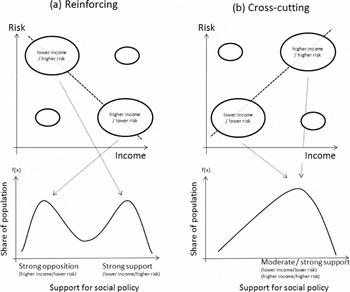
A simple way of picturing these implications is displayed in Figure 1. The two panels of the figure show two stylized distributions of the population across our crucial variables of risk and income. In panel (a), disadvantage and insecurity are reinforcing traits (i.e., income and risk are strongly negatively correlated). Lower income households are the most insecure, higher income households the least. In panel (b), by contrast, disadvantage and insecurity are cross-cutting traits (i.e., income and risk are strongly positively correlated): Lower income people are the most secure, whereas those higher up the income distribution face greater risk.
How the Relationship between Risk and Income Shapes Popular Cleavages

Looking first at panel (a), where insecurity and disadvantage are reinforcing, we see two large groups: insecure disadvantaged citizens and secure advantaged citizens. Given the individual-level relationships just discussed, the first group (insecure, disadvantaged) is likely to be highly supportive of the welfare state. They are the “doubly deprived”—citizens who benefit from both the redistributive and insurance effects of social programs. In contrast, the second group (secure, advantaged) is likely to be strongly opposed. They are the “doubly advantaged.” Neither economically disadvantaged nor insecure, they have relatively little to gain from supporting social programs and much to lose from the taxes necessary to finance them.
The two groups lying off the diagonal are the “cross-pressured”—the insecure advantaged and secure disadvantaged. These citizens have cause to support the welfare state, but also cause to worry that they will pay more in taxes (the main concern of economically advantaged citizens) or receive less in benefits (the main concern of economically secure citizens). In both groups, however, risk exposure or limited income provides powerful motivation to support social programs. Decades of research have shown that people are highly sensitive to drops in economic standing; they are “loss averse” (Fellner and Sutter Reference Fellner and Sutter2009; Kahneman, Knetsch, and Thaler Reference Kahneman, Knetsch and Thaler1991). For this reason, high-risk citizens are likely to endorse social insurance that covers risks affecting them even when they have higher incomes and will bear much of the tax price for financing those programs. This is particularly true for risks that cannot be easily buffered through private insurance markets, such as unemployment and long-term disability. Even if private insurance markets are robust (a big if), these private policies will generally be costlier than public social insurance—and thus less attractive—for higher risk citizens.
By contrast, support from secure but disadvantaged citizens rests on a combination of loss aversion and the low price of public insurance. With little wealth or slack in family budgets, even relatively modest levels of uncertainty may induce insecurity. At the same time, because of progressive financing for social programs, the tax burden on this group is relatively small. Thus, low-income citizens have strong reason to support the welfare state even when not at heightened risk—which helps explain why surveys consistently show the economically disadvantaged to be the welfare state's most reliable backers (Page and Jacobs Reference Page and Jacobs2009).
In panel (a), the cross-pressured groups are small, reflecting the strong negative correlation of risk and income. The result is a highly polarized opinion distribution, as shown in the lower half of the figure. On one side of the distribution, the doubly deprived strongly support social protections. On the other side, the doubly advantaged strongly oppose them. The small cross-pressured groups do little to fill out the middle.
Panel (b) shows a diametrically opposed relationship between income and risk. Here, disadvantage and insecurity are cross-cutting, creating two large groups of cross-pressured citizens. The distribution in the lower half of the panel is accordingly quite different. With most citizens in the middle, there is much less polarization and much weaker opposition.
In practice, risk and income are negatively correlated: Across all the countries and domains of economic risk that we examine, we find none in which economically advantaged citizens face greater risk of loss on average. This is a powerful reminder that the risk-buffering aspects of the welfare state tend to be reliably egalitarian, even when not explicitly defended on those terms. Yet, as we document shortly, the strength of this negative correlation varies greatly across countries and domains of social policy. It is this variance that gives us leverage for explaining differing patterns of support across nations and domains.
The transition from panel (a) to panel (b) shows how the opinion distribution should change as disadvantage and insecurity shift from reinforcing to cross-cutting; that is, as the share of citizens who are cross-pressured increases. First, extreme opposition to social policies will be more limited, because there will be a smaller group of doubly advantaged citizens. Second, opinion regarding those policies will be less polarized as the relative size of the cross-pressured groups increases. These are the two clearest implications: When low income and high risk are less correlated, opposition to social policies will be more limited (Hypothesis 1) and opinion regarding those policies will be less polarized (Hypothesis 2).
What are the implications for average support? Here the conclusion is more ambiguous, because lower polarization or weaker opposition could theoretically occur without an increase in the average level of support. (For example, the lack of intense opposition could be outweighed by the lack of intense supporters.) However, we hypothesize that when low income and high risk are less correlated, the average level of support for social programs will in fact be higher (Hypothesis 3). First, there is a simple ceiling effect: Responses to social policy questions inevitably cluster at the high end of the scale, so the only way to polarize attitudes is to increase opposition. Moreover, this ceiling effect is not a survey artifact. As we have suggested, because of loss aversion and the progressive financing of social insurance, cross-pressured citizens do indeed generally support the welfare state quite strongly. With their opinions skewed toward support, most of the variation in average support is driven by what happens on the opposition side of the spectrum. As a consequence, we expect (and find) a very close correlation among average support, polarization, and the scope of intense opposition.
In sum, we are able to test our argument on three related but distinct outcomes: (1) the share of citizens in intense opposition to social policies (larger when low income and high risk are more correlated), (2) the polarization of opinion (greater when low income and high risk are more correlated), and (3) the average level of support (lower when low income and high risk are more correlated). Because all these measures track each other so closely, the choice of measure makes little difference for our findings. Nonetheless, it should be kept in mind that the first two measures—opposition and polarization—are most closely related to our argument. The third—overall support—requires the additional qualification we have offered.
The linchpin of our argument is that advantaged citizens who face greater insecurity are more supportive of the welfare state. Does this claim make sense? Do higher income citizens actually face threatening economic risks they cannot easily insure against? Do they actually support social insurance when they face such risks? The first question can be answered simply. Despite the typically negative correlation of risk and income, advantaged but insecure citizens can be found in all nations and policy domains. They include, for example, workers in better paying jobs with relatively high unemployment risk,Footnote 2 well-paid employees with highly specialized skills (Iversen and Soskice Reference Iversen and Soskice2001), and affluent people with high-cost illnesses where health insurance does not comprehensively protect against medical expenses (Collins et al. Reference Collins, Kriss, Doty and Rustgi2008). The crucial question for our argument is how closely income and risk track each other across society, because this correlation determines the size of the cross-pressured groups and how strong their incentives are to support social policies. But in no case is the correlation so high that advantaged citizens are wholly exempt from the economy's risks.
The second question—whether private substitutes can be purchased—is mostly orthogonal to our argument. Higher income citizens may well prefer private alternatives, but once a social policy is in place, they will be more or less enthusiastic about it depending on their risk. It would be a mistake to assume, however, that private markets offer a complete substitute for public social insurance even for high-income groups. In areas of risk routinely covered by social insurance, private insurance markets are often incomplete or nonexistent. In addition, because social insurance, by design, does not charge proportionately higher premiums to higher risk groups, it should be attractive to high-risk citizens even in the presence of private insurance.Footnote 3
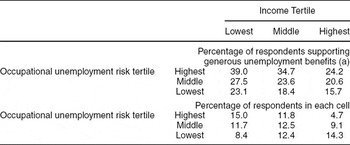
The third question—do more advantaged citizens who face higher risks actually support risk-buffering social policies?—requires an empirical response. In the rest of this article, we test our claims by examining the relationship between the income-risk correlation and aggregate public support. Before moving to these analyses, however, let us demonstrate that expressed individual support for social welfare policies varies in precisely the expected manner across income and risk groups. Table 1 presents an illustration, drawn from individual attitudes toward the generosity of benefits for the unemployed across the 13 nations on which we focus our cross-national analysis.Footnote 4 In this table, we divide respondents into three levels of income and three levels of unemployment risk. The results show remarkable symmetry in the effect of income and risk, with insecure advantaged citizens almost exactly as supportive of unemployment insurance as secure disadvantaged groups. Equally important, respondents’ positions are clearly associated with both their level of income and their level of risk. Across nations or policy domains, we predict that opposition to, polarization regarding, and support for the welfare state depend on how large and how supportive are these cross-pressured strata of citizens.Footnote 5
Individual-level Support for Unemployment Benefit Generosity

Notes: (a) Percentages of respondents in a given category who think it “definitely should be” the government's responsibility to provide a decent standard of living for the unemployed, based on ISSP 2006 data. The following countries are included in the sample (number of observations in parentheses): AUS (2,188), CHE (704), DEU (1,049), DNK (1,193), ESP (1,669), FIN (849), GBR (719), IRL (727), NOR (1,140), NLD (824), PRT (1,039), SWE (948), and the USA (1,221). Family income tertiles are calculated by country. Occupational unemployment rates are at the ISCO88–2d level (AUS is at ISCO88–1d level), and tertiles are calculated across all countries. Average unemployment rates at each tertile are about 2.5% (lowest), 5.1% (middle), and 10.5% (highest).
Analytic Strategy
We test our hypotheses through two investigations. First, we look at variation across nations in support for unemployment insurance. An innovative aspect of this analysis is that we rely on an approach that recovers a citizenry's support for unemployment insurance from a latent opinion distribution. This approach not only addresses some methodological concerns involving categorical variables but also allows us to account for a wide range of potentially important individual-level determinants of preferences, such as union membership, religiosity, general spending preferences, and skill specificity.
Second, we look at variation in the structure of support for specific social policies within the United States, investigating how the correlation of risk and income across different domains of economic risk shapes the distribution of opinion about major facets of the welfare state in a single nation. For this analysis, we designed a new survey on economic security that was incorporated into the American National Election Studies (ANES) 2008–9 panel (DeBell, Krosnick, and Lupia Reference DeBell, Krosnick and Lupia2010). The survey asked respondents to assess major economic risks (both their level of worry about them and the expected probability they would experience them). We also probed their attitudes about spending on existing programs, the role of government relative to the private sector in providing economic security, and hypothetical social programs that could be created to deal with major economic risks.
These two sets of analyses produce highly consistent results, strengthening our conclusions. In tandem, they also tackle the two major methodological hurdles we face: endogeneity (social policies induce the income-risk correlation) and confounders (omitted variables that influence both the income-risk correlation and support). The most daunting challenge is endogeneity. We know that public support shapes social policies and that social policies shape the correlation of income and risk. How do we ensure that, in analyzing the effect of the income-risk correlation on public support, we are not merely capturing the reciprocal effect of social programs on the income-risk distribution?
We tackle this issue in the cross-national and cross-domain tests using different but complementary strategies. First, in the cross-national analyses, we rely on measures of income-risk distributions that are based on pre-government income—income before taxes and transfers. A standard procedure in political economy, this approach reduces the chance that income and risk measures are induced by policy. Second, we ensure that our cross-national tests are not contaminated by differences in the extent of market income inequality across nations by basing our measures of the income-risk correlation on relative market income, rather than absolute market income. In other words, we look at the correlation between risk and one's position in the income distribution, rather than the correlation between risk and one's absolute income. As a result, countries with greater dispersion in market incomes do not automatically have higher income-risk correlations. What matters is the correlation between relative income position—say, being at the 90th percentile in the distribution—and risk. (Because the extent of market inequality might in itself predict support for the welfare state, we also include country-level inequality as an independent variable in our cross-national regressions.)
Third, we focus our cross-national analysis on unemployment insurance, an area of policy where the threat of reverse causality is weaker than in other domains. Although some scholars argue that unemployment benefit generosity affects levels of unemployment (Blondal and Pearson Reference Blondal and Pearson1995)—a potential confounder we control for in our analyses—we are unaware of evidence that the distribution of unemployment is driven primarily by unemployment insurance. The risk of unemployment varies in ways that appear largely independent of the generosity of unemployment benefits (on cross-national variation, see Howell and M. Rehm Reference Howell and Rehm2009).
Finally, our cross-domain tests—looking at variations in the structure of public support across areas of U.S. social policy—are particularly suited to dealing with endogeneity. This is because any legacies of past policies that commonly affect citizens across social policy domains are, in essence, held constant. So long as these legacies have the same impact in every domain, they cannot cause variation in support. Of course, some policies may only affect the income-risk distribution and policy attitudes within a single domain. For this reason, and to strengthen our findings more generally, we designed the U.S. survey to include questions not only about existing policies but also about prospective policies that were distinct from existing ones. Because these policies do not yet exist, citizens’ attitudes toward them cannot be induced by their effects on experienced risks or income.Footnote 6
The second major methodological challenge we face is distinguishing the effect of the income-risk correlation from potential confounders. Here again, it is the combination of cross-national and cross-domain tests that gives us confidence. In the cross-national tests, we rely on an underutilized approach to measuring a country's average social policy support—the recovery of a latent opinion distribution from ordinal response categories. We adopt this approach mostly because of the limits of the cross-national opinion data. Nonetheless, it allows us to control for a wide range of potentially important individual-level determinants of preferences even though we are using cross-national regressions to test our argument. In the cross-national regressions, we also account for a wide range of other alternative explanations by including national-level controls.
The most important way in which we deal with potential confounders, however, is to conduct our cross-domain comparison. By looking at variation across policy domains within a single nation, we inherently hold constant a large number of factors that are argued to cause cross-national divergence—from the distributions of skills to popular attitudes to the structure of welfare regimes. Thus, testing our argument across countries (within the same domain) and across policy domains (within the same country) strengthens our findings in the face of potential endogeneity and confounders and allows us to evaluate our account alongside an additional set of alternative explanations. The next section outlines these tests, starting with the cross-national analysis.
CROSS-NATIONAL ANALYSIS
For most people of working age, labor income—whether their own or that of a family member—provides the lion's share of disposable income. At all but the highest reaches of the income ladder, therefore, involuntary unemployment is among the most serious threats to citizens’ economic well-being and one of the most salient risks affecting public perceptions of economic security (Dominitz and Manski Reference Dominitz and Manski1997).Footnote 7 Furthermore, unemployment insurance is a policy arena well suited for sorting out the competing claims of leading welfare state theories. For power-resources theorists, replacement income while out of work is a core source of “decommodification,” reducing workers’ dependence on wage labor and giving them additional bargaining power in the labor market. For revisionist scholars, unemployment is a key risk that encourages those with more specific skills or in occupations with highly variable employment to support the welfare state.
Dependent Variable: Recovering Latent Support for Unemployment Insurance
To examine public support for unemployment insurance, we use the Role of Government IV (RoG) module of the International Social Survey Program (ISSP Research Group 2006), fielded around 2006.Footnote 8 We match it with estimates of occupational unemployment risks for 13 affluent nations for which we have usable economic data. The RoG survey contains the following item: “On the whole, do you think it should be or should not be the government's responsibility to provide a decent standard of living for the unemployed?” (1: “definitely should not be”; 2: “probably should not be”; 3: “probably should be”; 4: “definitely should be”).Footnote 9
As discussed, we are interested in three aspects of the structure of public support: the share of respondents who are strong opponents of unemployment insurance, the polarization of responses, and the average level of support for insurance. For reasons already discussed, all three are highly correlated, and so the measure chosen has little consequence for our findings. We first present preliminary results (in the form of scatterplots) for each measure of the distribution of support. We then focus our multivariate analyses on average support. Although least self-evidently linked to the correlation of risk and inequality, average support is the outcome of primary interest for cross-national research on public opinion regarding the welfare state. There is reason to think that polarization is at least as consequential (McCarty, Poole, and Rosenthal Reference McCarty, Poole and Rosenthal2006), but this outcome is less commonly examined, in part because agreed-on measures of polarization remain somewhat elusive. In addition, unlike the share of respondents in the extreme answer category, measures of average support use the full opinion distribution. Again, however, our findings are substantively identical (other than a reversed sign) if we use opposition or polarization as the dependent variable rather than average support.
Despite its close link to our hypothesis, the ISSP survey item poses one major drawback: It has categorical answer categories that force respondents to choose from a small number of options. Clearly, not all respondents’ attitudes exactly fit into these categories. For example, two respondents who chose the “probably should be” answer could have very different underlying attitudes. When the number of ordinal categories is plentiful, this is not a serious problem (and, indeed, is frequently ignored). With only four categories, however, simply treating the ordinal categories as cardinal measures leaves much to be desired.
Our solution is to estimate a latent level of support that is continuous rather than categorical, taking into account individual attributes other than income and unemployment risk that influence public support for the welfare state (Goodrich and Rehm Reference Goodrich and Rehm2008). This approach allows us simultaneously to convert ordinal variables with ill-defined means into continuous variables with well-defined means and to control for individual-level factors that may shape attitudes toward unemployment insurance. In predicting each respondent's probability of falling into the various answer categories, we include the usual suspects of demographic controls (Iversen and Soskice Reference Iversen and Soskice2001, 884) and country and year-of-fieldwork dummies. We also include church attendance (a measure of religiosity), because scholars have argued that religious citizens are less demanding of social insurance (Scheve and Stasavage Reference Scheve and Stasavage2006); skill specificity, because those with greater dependence on specific types of jobs should be more supportive of unemployment protections (Iversen Reference Iversen2005; Iversen and Soskice Reference Iversen and Soskice2001); and general spending preferences (excluding attitudes toward social spending), so that we are focusing specifically on support for unemployment insurance rather than general support for government spending.Footnote 10
To be clear, although this approach allows us to incorporate individual-level factors, it does not amount to “smuggling in” competing accounts. Rather, we are adjusting the national means for individual-level factors whose distribution differs across nations, such as age and education. In essence, these factors are controls, allowing us to isolate at the macro level the effect of the income-risk distribution. To allay any concern, however, we should stress that removing any of the independent variables from our individual-level regressions—including skill specificity and spending attitudes—has no tangible effect on our findings.
In estimating the latent opinion distribution, model parsimony is not a concern because the individual first-stage coefficients are not of interest and the sample sizes are quite large. Thus instead of conventional ordered logit models, we use more flexible generalized ordered logit models, which can be written asFootnote 11

where X is our set of right-hand variables; namely, gender, age, education degree, employment status (employed, unemployed), union membership, church attendance, skill specificity, and general spending attitudes, as well as country and year-of-fieldwork dummies. We include neither household income nor our measure of risk (to be introduced shortly), because these are the variables of key interest at the macro level. Note the subscript j for the βs, which indicates that the estimated impact of the explanatory variables can be different for each category. Essentially, this model estimates logistic regressions for each of the four categories separately; the other three categories become the reference category. We then assign each respondent the predicted probability of falling into his or her chosen answer category.
Key Independent Variable: Correlation of Income and Unemployment Risk
Our key independent variable is the correlation of household income and the risk of unemployment within a nation: The more correlated the two are, the more contested unemployment insurance will be.Footnote 12 Testing this hypothesis calls for measuring this correlation with some precision. Income and unemployment data in opinion surveys are often of poor quality, and the ISSP data are no exception.Footnote 13 The relatively small sample sizes are another worry, especially because we wish to measure unemployment risk at a fine-grained level of occupational classification. We therefore turn to other sources of economic data to reliably estimate the correlation between income and risk within nations.Footnote 14
To capture risk, we use labor force surveys to calculate occupational unemployment rates at the International Standard of Classification (ISCO) subgroup level. Occupational unemployment rates are defined like national unemployment rates, but for occupational strata (at the ISCO88–2d level).Footnote 15 Our measure of income is “equivalized market income” for those aged 22–60.Footnote 16 We use household income (as opposed to person-level income) because income is typically pooled at the household level and unemployment risk is buffered at the household level by the labor force participation of other members of the household (Schoeni Reference Schoeni2002).Footnote 17 We equivalize incomes by dividing household income by the square root of the number of household members to take into account economies of scale. We restrict the sample to those aged 22–60 because the risk of unemployment is most directly relevant for active workers and because the concept of market income makes little sense for most college students or those who are retired.
Finally, we convert the income variables into 99 percentiles. Doing so resolves some thorny issues that arise when comparing incomes across countries (such as different top-coding and bottom-coding rules, the treatment of negative incomes, and different currencies). As already mentioned, it also allows us to avoid confusing market income inequality and the income-risk distribution—which makes our dependent variable more plausibly exogenous from government policy. In our analyses, differences in the correlation of income and risk are due to differences in the distribution of risk across the income scale, not differences in how spread out that scale is in any given country.
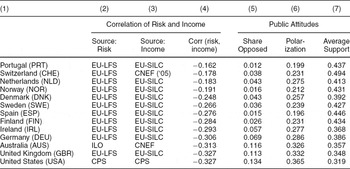
The correlation coefficient between household income and risk of unemployment for 2006 is displayed in Table 2. As previously noted, income and risk are negatively correlated in all 13 nations: Higher income occupations tend to confer a lower risk of unemployment. Yet the degree to which income and risk are negatively correlated varies substantially—from a high of −0.33 in the United Kingdom and United States to a low of −0.16 in Portugal. In other words, some nations come much closer to a cross-cutting distribution than do others.
Income-Risk Correlations and Unemployment Insurance Attitudes for 13 Nations

Notes: Risk = occupational unemployment rates at ISCO88–2d (AUS is at ISCO88-1d), 2006 (Dutch data are from 2008); Income = HH market income/sqrt (HH size), age 22–60; CPS = “Current Population Survey;” EU-SILC = “Statistics on Income and Living Conditions,” cross-national files; CNEF = “Cross-National Equivalence File,” Cornell University; ILO = LABORSTA database; EU-LFS = labor force surveys from the EU; “Share opposed” = Share of respondents who think it “definitely should not be” the government's responsibility to provide a decent standard of living for the unemployed, based on ISSP 2006 data; “Polarization” = Coefficient of variation of survey item; “Average Support” = Latent mean answer to survey item (see text).
Results and Robustness Checks
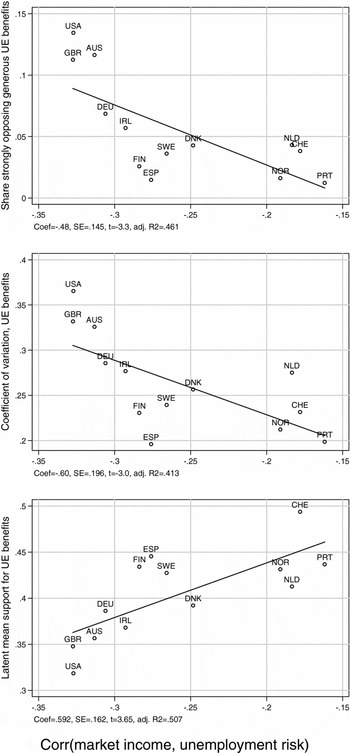
Do these differences affect the structure of support for unemployment insurance as expected? The answer is yes. Recall that we have three closely related dependent variables: (1) the share of citizens in intense opposition to social policies, (2) the polarization of opinion, and (3) the average level of support. As a first simple exploration, Figure 2 displays scatterplots of the relationship between the income-risk correlation, on the one hand, and each of these variables, on the other.
Income-Risk Correlations and Opposition, Polarization, and Average Support

The first scatterplot examines the share of respondents in the least supportive answer category—which Hypothesis 1 indicates will be higher when income and risk are strongly correlated, reflecting a large proportion of workers in the doubly advantaged category. As the figure shows, this is indeed the case: Greater correlation yields more intense opposition. The second scatterplot looks at polarization, which we measure as the coefficient of variation of responses.Footnote 18 Once again, our hypothesis is borne out: Greater correlation leads to greater polarization. The final scatterplot examines the relationship between the income-risk correlation and average public support for unemployment insurance, based on the latent distributions. This is the hypothesis closest to the core concerns of existing research, and we therefore focus on it in what follows. As predicted, there is a clear, significant positive correlation between the income-risk correlation and support for unemployment insurance.
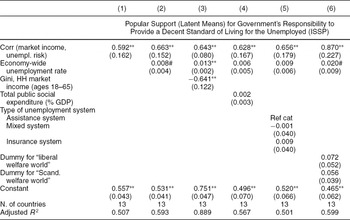
This last estimated relationship already accounts for cross-national differences in the distribution of religiosity, demographic characteristics of the workforce, and general attitudes toward government, all of which were included in the first-stage regression models. How does this relationship fare when we include other plausible macro-social determinants of support for unemployment benefits? Our fuller models, described in Table 3, incorporate a number of lagged country-level controls:
• Economy-wide unemployment rates. Our argument is about the distribution of risk, not its level. Although a higher level of risk raises the value of social insurance to some citizens, it also raises the average cost. The net effect is therefore ambiguous. Despite this ambiguity, however, controlling for levels of risk makes sense, and Models 2–6 in Table 3 all include economy-wide unemployment as a control. As Model 2 shows, the correlation between risk levels and public support is positive (Blekesaune and Quadagno Reference Blekesaune and Quadagno2003). Yet this does not undermine the argument about risk distribution and public support: In fact, taking into account the societal level of unemployment makes the association between the income-risk correlation and support for government responsibility even stronger.
• Economic inequality. By standardizing the income variables into 99 percentiles before we calculate the correlation between income and risk, we make the income-risk distribution independent of the absolute dispersion of income within nations. In Model 3, however, we control directly for income inequality by including the Gini coefficient of equivalized household market income for those aged 18–65. The results indicate that inequality significantly decreases policy support.Footnote 19 More important for our current purposes, it has little impact on our key coefficient.
• Government social expenditure. Countries differ markedly in their welfare state spending, which may affect citizens’ attitudes toward social policies.Footnote 20 To take this possibility into account, we control for total public social expenditure as a share of GDP in Model 4. Overall welfare state effort is indeed positively correlated with the popularity of unemployment benefits, but the effects are small and insignificant and do not materially affect our central finding.
• Form of unemployment insurance. The design of welfare states could matter for aggregate support (Korpi and Palme Reference Korpi and Palme1998; Rothstein Reference Rothstein1998). Scholars distinguish between unemployment systems that offer assistance only; systems that offer insurance only; and systems that are mixed (Vroman Reference Vroman2007). We take into account these different provisions—which may affect public support—with dummy variables in Model 5. These variables turn out to be statistically insignificant and, again, irrelevant for our main finding.
• Welfare-state regime type. Esping-Andersen's (1990) three types of welfare regimes—liberal, corporatist, and social-democratic—are often singled out as a possible determinants of varying support for social policies (Arts and Gelissen Reference Arts and Gelissen2001; Bean and Papadakis Reference Bean and Papadakis1998; Gelissen Reference Gelissen2002; Jaeger Reference Jaeger2009). They could also be associated with different distributions of income and risk. Therefore, Model 6 includes regime-type dummies. Although the coefficients are insignificant, accounting for regime type increases the estimated coefficient for our key variable.Footnote 21
Predicting Support for Unemployment Benefits (Cross-national)

Notes: OLS regressions, coefficients above standard errors in parentheses. #p < 0.1, *p < 0.05, **p < 0.01. The ISSP surveys were administered at different times, but generally in late 2006. Thus our time-varying controls are for 2006 or earlier: The joint-distributions are for 2006, with modest exceptions due to data availability; unemployment rates refer to 2006; Gini coefficients are for the mid-2000s. The unemployment rate (Key Economic Indicators), Gini coefficients (Income Distribution and Poverty Database), and social expenditure data (Social Expenditure Database) are taken from the OECD.
The effect of the income-risk correlation on public support is not only statistically significant but substantial as well. According to the models, a two-standard deviation change (0.12) shifts average support for unemployment benefits by about 0.08 (Model 2 in Table 3), or roughly from the American level of average support to the Danish level.
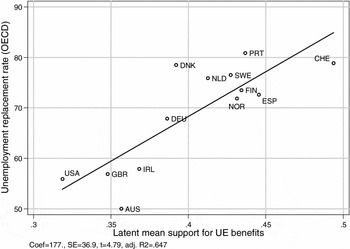
One way to judge the size of this effect is to consider how it might influence the generosity of the welfare state. This question takes us well beyond the analytic scope of the article. For illustrative purposes, however, Figure 3 shows the simple correlation between average public support and unemployment replacement rates (the share of pre-unemployment income replaced by public benefits, net of taxes). We do not want to suggest that demand for social policy is automatically translated into supply; our argument concerns underlying public cleavages, not how they are activated. Nevertheless, the results from Figure 3 are striking: the 0.08-point change just discussed implies a 14-point change in unemployment replacement rates—in the ballpark of the difference between the unemployment replacement rate in the United States (56%) and Norway (71%). Crude as this demonstration is, it suggests that the differences in the income-risk correlation have potentially very large effects.
Correlation between Average Support and Unemployment Replacement Rates

In sum, the cross-national evidence strongly supports our argument that the distribution of risk across the income scale is an important determinant of the structure of popular support for social insurance. Countries in which the risk of unemployment is more concentrated among lower income citizens also have greater opposition to and polarization over unemployment insurance and lower average support for unemployment benefits. Does this argument also hold within the same country across different risks and policy domains? We explore this question next and show it does.
CROSS-DOMAIN ANALYSIS
An important feature of our account is that it should apply not only to cross-national variation in the structure of popular support but also to cross-domain variation. That is, if the correlation of household income and the specific risk targeted by social policies differs across domains of social policy within a nation, we should expect the same basic relationship across domains that we find across nations. In domains of social policy where low income and high risk are correlated more strongly, public opposition and polarization should be greater and average support lower.
No existing survey provides the full range of information required to run such a test. In particular, no extant survey contains suitably fine-grained measures of both economic risk and popular attitudes toward existing and prospective social policies. We therefore designed a battery of questions about economic risk and social policies that was asked of a representative sample in March and September 2009 as part of the ANES panel survey. A key advantage of designing our own survey was that we could ask directly about a wide range of anticipated economic risks. Thus unlike in the cross-national analysis, where we constructed a proxy measure of employment risk based on occupation-specific unemployment rates, our measure of economic uncertainty for the cross-domain analysis involves respondents’ own perception of the risk in question (Manski Reference Manski2004).
The United States might seem a challenging case for our argument, because it is frequently assumed in the comparative welfare-state literature that anti-government ideology trumps all other considerations. In fact, American public support for social programs is high in many domains. Even in the United States, some social policies attract strong support from citizens across the economic ladder, whereas others are characterized by much more polarized and class-stratified backing, with pockets of intense opposition and lower overall support. As we see, this variation closely tracks the joint distribution of risk and income within these policy domains.
Dependent Variables: Opposition, Polarization, and Average Support
Our survey asked about attitudes regarding social policies in varied domains using three sets of questions. The first set asked respondents about their preferred allocation of responsibility for various social policies between the government and the individual or market in five areas (health insurance, guaranteeing good employment, long-term health care, retirement security, and general economic security).Footnote 22 The second set of questions asked respondents whether funding should be altered for existing social policy programs in seven areas: Social Security, aid to the poor, support for the disabled, unemployment benefits, health insurance for working-age adults, health insurance for children, and public schools. Spending questions are hazardous in the cross-national setting, because they ask people about priorities relative to very different national baselines. This is less of a concern when looking across domains within a single country.Footnote 23
Finally, the survey asked about prospective policies. We designed the descriptions of these new initiatives to be distinct from existing policies, so as to make them plausibly exogenous from the influence of extant social programs on the income-risk distribution. The survey asked about seven new policies: (1) offering tax breaks to people who support or care for family members not living with them, such as an elder parent; (2) providing short-term financial support for people who experience large, unexpected income declines; (3) providing short-term financial support for people whose incomes drop substantially following a divorce or other family dissolution; (4) allowing all Americans to buy coverage from Medicare at a premium based on their age; (5) protecting homeowners against practices or circumstances that might threaten their credit or cause them to lose their homes; (6) providing up to two years of job retraining or support for higher education for people who have been laid off from work; and (7) providing free access to a trained patient advocate who can help navigate the health care system and assist in disputes with health insurers. In each case, the question included the same explicit price tag of $50 in additional taxes per year—a value that previous research suggests is sufficient to force respondents to consider the costs of new policies alongside their benefits (Barry et al. Reference Barry, Brescoll, Brownell and Schlesinger2009).Footnote 24
Key Independent Variable: Correlation of Income and Worry or Estimated Risk
The survey assessed domain-specific risk perceptions in two ways. First, people were asked how worried they were about different risks.Footnote 25 Previous research has shown that such worry measures are effective in tapping into people's assessment of the combined likelihood and seriousness of economic concerns (Miron-Shatz Reference Miron-Shatz2009; Rivers and Arvai Reference Rivers and Arvai2007). Second, for a subset of risks, people were also asked to estimate the precise probability of a bad event affecting “people like you.”Footnote 26 Because the ANES panel survey was web-based, we were able to visually represent this risk probability in a way that pretesting showed respondents could easily grasp—presenting a box with 100 people and allowing them to move a marker along a line segment ranging from “no one” to “everyone” to highlight the share of the 100 affected. This innovative elicitation technique eliminated the common problem of reported subjective probabilities “clumping” at cognitively accessible percentages (e.g., 25%, 50%, or 75%).
These subjective risk measures have several advantages for our cross-domain analysis. Unlike the risk of unemployment, which is relatively easy to estimate using economic data, many social policy domains involve risks that are difficult to quantify using existing sources. Asking about specific risks allows us to closely match policies in a wide range of domains and the relevant risk. For example, respondents’ level of worry about “having enough money to retire on” is linked to attitudes toward government's role in securing retirement income.
Beyond the methodological advantages in this particular context, there is a theoretical argument for subjective risk assessments as well: Individuals’ estimates of whether risk-protecting policies will benefit them should reflect their perceived chance of needing assistance, regardless of whether this perception is accurate. A drawback of subjective assessments, however, is that they could reflect underlying support for social programs. For example, people might express worry or estimate a high probability of experiencing a risk in domains where they believe government should act. Therefore it is reassuring that our multivariate results (presented next) are not weakened when we control for the average level of worry or the average expected probability of experiencing a risk within a given policy domain.
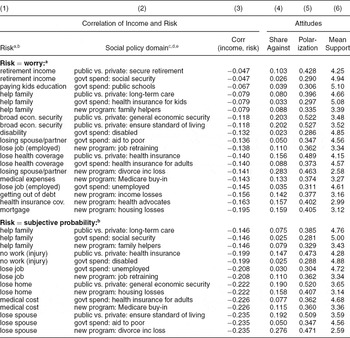
Table 4 shows the correlation of perceived risk and family income across the domains that we examine, as well as our three key attitudinal variables: opposition (the share in the least supportive category), polarization (as before, the coefficient of variation), and average support.Footnote 27 The first two columns show which worry or probability (column 1) we map onto public attitudes in which domain (column 2). The remaining columns show the correlation between income and worry/probability (column 3) and the levels of public opposition (column 4), polarization (column 5), and average support (column 6). As the table shows, the correlation between income and worry ranges widely, from a low of −0.047 (retirement income) to a high of −0.195 (mortgages). The correlation between probabilities and income also varies considerably.
Income-Risk Correlations and Attitudes (Cross-domain)

Notes:
a Risk = worry: “Are you very worried, fairly worried, slightly worried, or not worried at all about . . .?”
b Risk = subjective probability: “We'd like you to indicate how likely each of the following risks might be, in terms of the chance that they'll affect the lives of people like you over the next year. Out of 100 people like you, how many will . . . during the next year?”
c public vs. private: “Now we're going to ask about your assessment of and support for various roles for government in American society. On some issues people have two very different viewpoints. Some people agree entirely with the first position, others entirely with the second position. And, of course, some other people have opinions somewhere in between”
d govt spend: “Consider a list of existing federal programs. If you had a say in making up the federal budget this year, should federal spending be increased or decreased for . . .”
e new program: “How much would you support or oppose each of the following new ways of having government address social issues? This would increase your taxes by $50 per year.”
Results and Robustness Checks
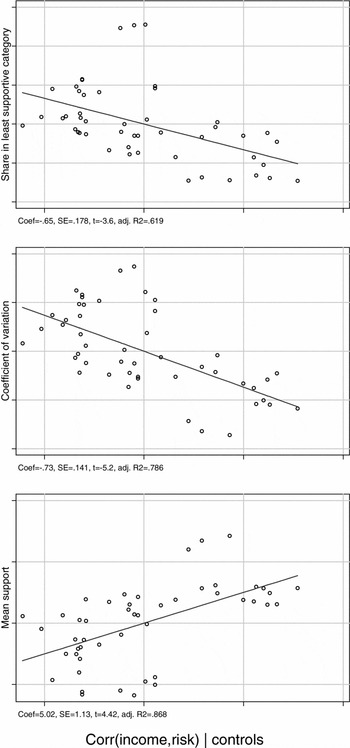
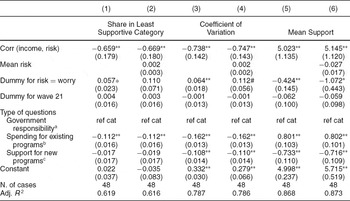
We start with scatterplots as before. Because we are mixing different measures of risk (worries, probabilities) and different types of attitudinal questions (public vs. private, spending, support for new programs), we control for the measure of risk and type of question. Because we are pooling questions across two survey waves, we also include a dummy for the wave (our results are comparable if we look at each separately). Thus the scatterplots in Figure 4 relate the income risk-correlation, on the one hand, and our three key attitudinal variables, on the other, taking into account the aforementioned controls. They bear out each of our three hypotheses: When the income-risk correlation is greater, opposition (the share of respondents in the least supportive answer category) and polarization (the coefficient of variation of responses) are higher, while average support is lower.
Income-Risk Correlations and Opposition, Polarization, and Average Support

In Table 5, we present the results of regressions for each measure of the support for social policy. Because our analysis is now restricted to the same sample, we inherently hold constant a wide range of possibly important nation-specific variables, such as ideology and market structure. Thus our only control unrelated to survey instrumentation (measure of risk, type of question, and wave) is the level of average worry about or average estimated probability of the relevant risk. The rationale here is identical to the reason we include the unemployment rate in our cross-national regressions: We wish to focus on the effect of the distribution, not the level, of risk. As already mentioned, controlling for the level of risk also addresses the concern that the public might estimate higher average risks in areas where government action is viewed as more appropriate.
Predicting Support for U.S. Social Polices (Cross-domain)

Notes: Standard errors in parentheses. # p < 0.1, * p < 0.05, ** p < 0.01.
As Table 5 shows, the correlation of income and risk significantly predicts popular support for social policies for all three measures of public attitudes. As with our cross-national regressions, accounting for the level of risk has no material effect on our main coefficient and, in fact, slightly strengthens the relationship between the income-risk correlation and the various measures of public support. Additional tests show that the expected relationships also hold if we analyze the three types of social policy questions separately. In particular, income-risk correlations shape attitudes toward prospective social policies (where endogeneity is least worrisome) as well as existing policies.
To give a sense of the magnitude of substantive effects, imagine for a moment that the correlation between income and worries about losing one's health insurance is similar to the correlation between income and worries about a secure retirement (−0.047 instead of −0.14). This would decrease the share of respondents in the least supportive category by more than 6 percentage points (a reduction of about 70 percent), and increase overall support for public provision of health insurance substantially.
Given the challenges of assessing perceptions of risk and mapping those perceptions onto specific domains of social policy, we find these results strongly corroborative of our cross-national analyses. Just as support for unemployment benefits is weaker and more polarized in countries in which the income-risk correlation is stronger, support for U.S. social policies is weaker and more polarized in policy domains in which low-income people perceive themselves to be most likely to experience the covered economic risks. We are especially reassured by the robustness of our finding to different measures of risk and different types of questions tapping into popular support. That our hypotheses hold for questions about hypothetical policies, in particular, makes us considerably more confident that we are not simply picking up the influence of existing policies on the income-risk distribution.
CONCLUSION
The welfare state has two natural constituencies: the disadvantaged and the insecure. Yet these two groups are not inherently distinct. In some nations and policy domains, the disadvantaged and the insecure are more or less the same individuals. In other nations and domains, the two overlap much less—the fate of those lower on the income ladder is linked to those higher up by the shared experience of risk. Between these alternative scenarios, we contend, lie very different possibilities for broad coalitions supporting the welfare state. When economic disadvantage and economic risk go hand in hand, wide public support for the welfare state is elusive.
Our argument offers a distinctive common ground between the two leading schools of contemporary welfare-state scholarship: the power-resources view and what we have called “revisionist” theories. In contrast to both schools, we argue that what is crucial is not the relative role of income and risk, but rather the overlap of the two. The power of less affluent citizens and the exposure of broad sections of the workforce to insecurity do not shape the welfare state in isolation from each other. Rather, it is the degree to which disadvantage and insecurity are cross-cutting (or reinforcing) that fosters (or undermines) the foundation for encompassing coalitions in support of the welfare state.
This argument finds solid empirical backing. In nations where disadvantage and insecurity are correlated more closely, strong opposition to welfare-state programs (in this case, unemployment insurance) is more common, opinion is more polarized, and overall public support is lower. The same is true across various domains of social policy within the United States. In domains where the distribution of the relevant economic risk closely correlates with household income (high risk, low income), the base of popular support for social provision is also generally narrower. And in both the cross-national and cross-domain tests, our key findings are robust to the inclusion of additional controls and alternative construction of the key variables. Although certainly not the only influence on public support, the joint distribution of income and risk goes a long way toward explaining the extent to which public opinion is characterized by strong opposition, high polarization, and anemic support, or the opposite.
In explicating the role of the income-risk correlation, we have sought to explain the structure of popular support for the welfare state, not the scope of the welfare state itself. Nonetheless, support and scope appear to be closely related: Countries in which citizens are lukewarm or divided or in which strong opposition exists generally have smaller welfare states than do those in which citizens are more broadly enthusiastic. This makes it vital to examine with greater clarity the key influences on support.
Perhaps the most difficult methodological challenge for this work will be endogeneity—that is, the degree to which generous social programs create, rather than simply reflect, strong support. The politics of the welfare state plays out in an environment in which major social policies are both a consequence and a cause of popular sentiments. In our analyses, we have tried to reduce the potential bias in a variety of ways—most important, through our cross-domain analysis within the United States, which not only controls (by design) for common policy legacies across domains but also includes questions about hypothetical policies alongside questions about policies that already exist.
Our cross-domain analysis embodies a broader methodological prescription as well: look within as well as across countries. Most analyses of variation in support for the welfare state are pitched at the cross-national level. Yet most existing theories imply differences across policy domains as well as across nations. According to our argument, social programs that operate in domains where risk and income are more distinct should also be characterized by smaller opposition, less polarization, and greater support. This might be thought of as a more precise form of the familiar argument that universal programs feature broader support than selective programs dealing with concentrated risks (Coughlin Reference Coughlin1980; Skocpol Reference Skocpol, Jencks and Peterson1991). In our version of this claim, what makes programs more universal is not just the scope of the risks that they cover but also the degree to which those risks affect a broad cross-section of citizens, not just the economically disadvantaged.
In focusing on the correlation of income and risk, we have emphasized that the solidarity that undergirds the welfare state is based in part on “generalized and reciprocal self-interest” (Baldwin Reference Baldwin1990). This is not to deny the importance of value-based attitudes (Lynch and Gollust Reference Lynch and Gollust2010) nor to overstate the degree to which immediate self-interest dictates support.Footnote 28 Our view is that self-interest is grounded in relatively enduring features of personal circumstances, such as occupation and long-term economic position. Attitudes toward social programs are likely to gel over a long period and persist absent enduring changes in economic circumstances. In our analyses, we have used both objective measures of the income-risk correlation (based on income and unemployment data) and subjective measures (based on survey data). The robustness of our findings across these two data sources suggests that individuals can place at least basic probabilities on the likelihood of adverse events. Yet this conclusion still leaves plenty of room for subjective assessments to be mediated by basic beliefs about how the economy works, whether its processes are predictable or fair, what role government should play, and so on—which in turn surely reflect both social context and media exposure. How people evaluate and estimate the likelihood of economic risks is an area ripe for continued investigation.
Although attitudes toward social protection are likely to be fairly enduring, they should nonetheless be responsive to large changes in risk exposure or economic standing. Indeed, a clear implication of our argument is that economic events that alter the perception of risk among advantaged citizens are likely to reduce opposition to and polarization concerning social policies and raise average support. This provides a simple basis for the anecdotal observation that economic crises provide a popular basis for welfare-state expansion. It also provides a unique qualifier: Economic shocks whose effects are felt mostly by the less advantaged are unlikely to shift the structure of public opinion in a direction conducive to greater welfare-state generosity. To create cross-class coalitions, risks have to broaden in reach, not just deepen in impact on the already disadvantaged.
The degree to which coalitions in support of the welfare state include advantaged citizens seems even more relevant when we consider the effects of economic disparities on political influence. Because our argument is about the character of support rather than the generosity of the welfare state, we have implicitly treated all citizens as equal in their influence. Yet there is good reason to think that higher income citizens have greater sway in political debates (Bartels Reference Bartels2008; Gilens Reference Gilens2005; Hacker and Pierson Reference Hacker and Pierson2010). To the extent that political participation—including the donation of money—is more frequent and efficacious for the advantaged, we would expect the opinions of advantaged citizens to carry disproportionate weight. If they do, cross-class support for the welfare state becomes even more important, because it implies greater support for social programs among more influential citizens.
Given that the joint distribution of income and risk is such a basic source of variation in popular support for the welfare state, it is natural to ask why income-risk distributions vary across countries and domains of social policy. Although we have argued that they are not simply the result of social policies, future research will need to look much more systematically at how and why labor-market structures and other fundamental features of economies and societies differ and what role the welfare state plays in creating these differences. In these investigations, a deep historical perspective will need to be coupled with greater emphasis on the accurate measurement of risk. We think it is likely that income-risk distributions are rooted in the most basic structures of a nation's economy and society and the very long-term evolution of public and private responses to risk. Yet it seems probable as well that these deeper features have their effects in tandem with characteristics of labor markets that are more easily affected by contemporary public policy, such as the scope of public-sector employment and the density of unions. All these are likely to play an important role in determining whether the coincidence of insecurity and disadvantage can unite those on the bottom of the economic ladder with those higher on its rungs.




Comments
No Comments have been published for this article.