




No CrossRef data available.
Article contents
Neuropsychological deficits in patients with chronic fatigue syndrome
Published online by Cambridge University Press: 01 March 2004
Abstract
The degree of neuropsychological dysfunction across multiple domains was examined in individuals suffering from chronic fatigue syndrome (CFS). In this descriptive study, a similar series of neuropsychological tests was administered to a group of CFS patients and healthy participants. More specifically, CFS patients (n = 141) who met the 1994 Case Definition criteria were compared to 76 healthy control participants on tests of memory, attention (concentration), speed of information processing, motor speed, and executive functioning. On the 18 measures administered, CFS patients scored 1 standard deviation below the healthy mean on nine measures and scored 2 standard deviations below the healthy mean on four of the measures. Moreover, results indicated that CFS patients were more likely than healthy controls to fail (1.6 SD below the healthy mean) at least one test in each of the following domains: attention, speed of information processing, and motor speed, but not on measures of memory and executive functioning. Finally, CFS patients demonstrated a greater total number of tests failed across domains. (JINS, 2004, 10, 278–285.)
Information
- Type
- Research Article
- Information
- Journal of the International Neuropsychological Society , Volume 10 , Issue 2 , March 2004 , pp. 278 - 285
- Copyright
- © 2004 The International Neuropsychological Society
INTRODUCTION
Chronic fatigue syndrome (CFS) is an unexplained fatiguing illness in which neuropsychological complaints and objective cognitive deficits are common (Tiersky et al., 1997). Recent studies have consistently shown group differences between CFS and healthy participants in mean level of performance across numerous cognitive domains. For instance, CFS patients have consistently performed below the level of healthy controls on measures of attention, concentration, speed of information processing, and motor functioning (DeLuca et al., 1993; Marshall et al., 1997; Michiels et al., 1996, 1998; Smith et al., 1993; Volmer-Conna et al., 1997; Wearden & Appleby, 1997).
Although there is some inconsistency in the literature, individuals with CFS have also been found to exhibit deficits in memory when group differences are examined (DeLuca et al., 1994; Estes et al., 1984; Johnson et al., 1998; Joyce et al., 1996; Marcel et al., 1996; Michiels et al., 1996; Sandman et al., 1993). The memory deficit in CFS seems to be a consequence of difficulties in the acquisition of information. DeLuca et al. (1994) reported, “impaired memory may be secondary to deficient information processing and encoding of material rather than impaired storage and/or retrieval.” This finding is consistent with the results found by Lawrie et al. (2000), in which CFS patients displayed more difficulty on “harder” tasks involving information-processing capacity.
Deficits on specific measures of executive functioning in CFS have been documented in the literature (Marcel et al., 1996; Marshall et al., 1997; McDonald et al., 1993; Ray et al., 1993; Smith et al., 1993). A variety of measures have been used to assess different aspects of executive functioning such as set shifting and conceptualization [Stroop Interference (Stroop, 1935); Proverb Interpretation (Gorham, 1956), respectively], figure copying [figures from the Wechsler Memory Scale (Wechsler, 1945)], along with processing reading passages [Salthouse Reading Span Task (Salthouse, 1994)]. Indeed, there has been variability in the measures used to assess executive functioning across studies, and therefore estimates of executive dysfunction in CFS have differed (Dobbs et al., 2001; Moss-Morris et al., 1996; Tiersky et al., 1997). Most recently, Dobbs et al. (2001) found that CFS patients performed more poorly on complex tasks that involve rapid information processing as compared to healthy controls. In the study by Dobbs et al. (2001), the tasks required processing routine information while filtering out distractions, and shifting conceptual sets within a limited time frame (Dobbs et al., 2001). Although earlier studies evaluating other executive domains, which did not include a significant timed component, such as abstract reasoning, set shifting and concept formation have consistently reported no significant differences between CFS patients and healthy controls (Tiersky et al., 1997; Moss-Morris et al., 1996). In the present investigation, the nature of executive deficits in CFS will be further investigated using a variety of measures.
Clearly many studies have documented neuropsychological decline in CFS. Yet, as discussed previously, most studies identified cognitive deficits by a “mean difference” (DeLuca et al., 1993; Marshall et al., 1997; Michiels et al., 1996, 1998; Smith et al., 1993; Volmer-Conna et al., 1997; Wearden & Appleby, 1997). Using mean comparisons to healthy data makes it difficult to determine the extent of a specific deficit for CFS patients unless standard scores are computed in reference to healthy norms. Indeed, the use of standard scores is pragmatic when evaluating and comparing neuropsychological, psychological, and functional data (Lezak, 1995). Scores converted to standard deviation units provide a basis for performance comparison when different tests with different metrics are being utilized to measure the same cognitive domain. Equating performance in terms of standard deviation units also is useful when evaluating performance across cognitive domains. In fact, Drebing and colleagues (1994) used standard scores to classify “high, moderate, or low probability” of cognitive deficits in the elderly population.
Vercoulen et al. (1998) attempted to standardize his method in determining the extent of neuropsychological dysfunction by creating a failure score (a score below the 5th percentile of the healthy group mean). By computing the number of failures in the CFS and healthy groups, these researchers then examined the degree of dysfunction in their CFS sample and found a limited degree. Given that these authors only used a single criterion for identifying neuropsychological deficits, limited conclusions can be drawn from their study, as the extent of cognitive dysfunction across domains cannot be determined. A goal of the current investigation is to use several different criteria to describe and determine the degree of neuropsychological dysfunction across multiple domains in CFS.
It is important to document the extent of cognitive dysfunction across domains in CFS, as deficits in neuropsychological functioning have been found to affect functional capabilities in this population (Christodoulou et al., 1998). By identifying neuropsychological performances that are 1, 1.6 (5th percentile) or 2 standard deviations below a normative mean, clinicians may be more readily able to identify the individuals who demonstrate functional decline. Indeed, authors have been able to predict ability to perform activities of daily living using cutoff scores based on standard deviation units in the elderly population (Richardson et al., 1995).
Thus, to help determine the degree of neuropsychological dysfunction across domains in CFS, the following comparisons were made in the present investigation: (1) the percentage of CFS patients performing 1 and 2 standard deviations below the healthy mean to the percentage of healthy participants demonstrating similar performance, (2) the percentage of CFS versus healthy participants failing (5th percentile) at least one neuropsychological measure (using the methods of Vercoulen et al., 1998), and (3) the total number of tests failed overall by CFS patients versus the total number failed by healthy participants.
METHOD
Research Participants
One hundred forty-one patients suffering from CFS participated in the research study. CFS patients were required to meet the 1994 CFS case definition criteria (Fukuda et al., 1994). In addition, patients were excluded at intake if they met any of the following criteria: (1) were diagnosed with any Axis 1 psychiatric disorder within 5 years prior to the initial evaluation; (2) had a diagnosis of schizophrenia, mania, substance abuse/dependence, or an eating disorder at any time; (3) had an onset of CFS greater than 15 years prior to intake; or (4) experienced a loss of consciousness greater than 5 min.
As a comparison group, 76 healthy participants were recruited into the study. Healthy controls were excluded at intake if they demonstrated any psychiatric history or any history of a chronic medical illness as determined by a physician's assistant trained in the diagnosis of CFS, and supervised by an expert in CFS (Benjamin Natelson, MD).
Procedure
As part of the initial screening process, all participants completed a paper and pencil screen form to determine if they met the criteria for CFS. Those who met the paper and pencil criteria were invited to participate in the psychiatric aspect of the intake process to determine further eligibility. Participants were then administered the Diagnostic Interview Schedule Third Edition (DIS–III–R) (Marcus et al., 1990) via telephone by a trained research assistant. At this time, participants were screened for prior (within 5 years of intake) or concurrent psychiatric illnesses, as defined as exclusionary criteria by Fukuda et al. (1994) (schizophrenia, mania, eating disorders, substance abuse). Participants who met the initial inclusion criteria were then scheduled to visit the Chronic Fatigue Center for comprehensive neuropsychological testing and a history and physical examination. A physician's assistant, trained in the diagnosis of CFS and supervised by Benjamin Natelson, MD, conducted all history and physical examinations and took blood work from all participants in order to rule out other possible causes of fatigue. Control participants also completed a psychiatric interview, a history and physical evaluation, as well as neuropsychological testing.
A trained research assistant administered the neuropsychological battery. The standardized neuropsychological battery included: The California Verbal Learning Test (CVLT) (Delis et al., 1987); the Paced Auditory Serial Addition Task (PASAT) (Gronwall, 1977); the Rey-Osterreith Complex Figure Test (Corwin & Bylsma, 1993); The Continuous Performance Test (CPT) and The Simple Reaction Time Task (SRT) (Neurobehavioral Systems, Inc., 1994); The Category Test, Computer version (Defilippis, 1991); the Grooved Pegboard (Klove, 1963); Trails Making Test A & B (Reitan & Davidson, 1974); the Wechsler Adult Intelligence Scale–Revised (WAIS–R) Digit Span and the Digit Symbol subtests (Wechsler, 1981); and the Test of Memory Malingering (TOMM) (Tombaugh, 1996). In addition, the Beck Depression Inventory (BDI) was utilized to measure depression (Beck et al., 1961).
Thirty-four CFS patients were administered the TOMM to determine if they were putting forth full effort. No participant's performance was indicative of a lack of effort (scores > 45 on trial 2 and retention trial) (Tombaugh, 1996). The TOMM was administered to only 34 CFS patients as it was inserted into the protocol late into the study.
Categorization of neuropsychological tests
In this study, neuropsychological measures were categorized into specific cognitive domains. Each domain included measures that evaluated similar cognitive skills. Below is a listing on the domains, the measures included in each one, and the rationale for their inclusion.
Memory
In the domain of memory, the CVLT (words recalled, short delay free recall, and long delay free recall), the Rey-Osterreith Complex Figure Test (immediate and delayed recall), and Digit Span forward subtest of the WAIS–R were included. All of these measures are known to evaluate different aspects of memory ability (Lezak, 1995).
Attention/concentration
The attentional domain was comprised of the Digit Span subtest (total score) along with the Digit Symbol subtest from the WAIS–R. The Digit Symbol subtest was included in this attentional category as it evaluates visual attention and concentration (Farr et al., 1986). The Digit Span total was included as an index of attention, due to its sensitivity in detecting overall inattention to the string of presented numbers.
Speed of information processing
The speed of information processing (SIP) domain consisted of the total PASAT score, which is a complex task of attention and information-processing ability (Gronwall & Wrightson, 1981; Lezak, 1995). Other SIP measures included the CPT and Trails Making Test A. The CPT is designed to measure a participant's ability to attend and process information quickly. The Trails Making Test A also includes a speeded information-processing component.
Motor speed
The Grooved Pegboard (preferred and nonpreferred hand) task and the Simple Reaction Time task (SRT) were included in the domain evaluating motor speed. The Grooved Pegboard is known to evaluate speeded motor performance (Lewis & Rennick, 1979; Mathews & Haaland, 1979). Likewise, the SRT evaluates basic motor speed.
Executive functioning
Diverse executive measures were included in this domain to reflect a range of higher-order cognitive skills. The Digit Span backwards subtest of the WAIS–R, the Trails Making Test B, Rey-Osterreith Complex Figure—copy, and the Category Test comprised this domain. The Digit Span backwards subtest was included to evaluate the executive component of working memory, while the Trails Making Test B was included as a measure of rapid set shifting. The Rey-Osterreith Complex Figure—copy was included to evaluate executive planning and organization. Finally, the Category Test was included to measure abstract concept formation.
Analyses
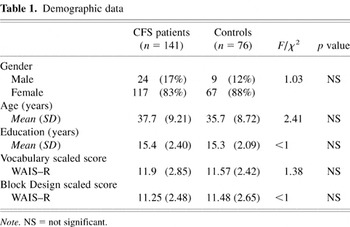
A multivariate analysis of variance (MANOVA) was utilized in order to examine group comparisons on demographic variables such age, education, along with the scores on the vocabulary and block design subtests of the WAIS–R, used as estimates of intellectual functioning. In addition, a chi-square test of significance was utilized to determine significance of gender difference in both groups (see Table 1).
Demographic data

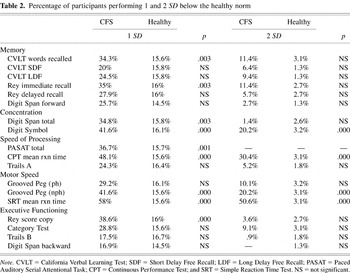
To examine the extent of neuropsychological dysfunction in CFS across domains, the following three analyses were completed. First, a chi-square comparison was used to determine the percentage of CFS patients versus healthy controls who performed 1 or 2 standard deviations below the healthy group's mean performance (see Table 2). To control for type 1 error, a Bonferroni correction procedure for inequality was utilized (Stevens, 1986). We used a more stringent alpha level of .003, correcting for the 18 comparisons. Second, a chi-square test of significance was utilized to determine if CFS patients were more likely than healthy participants to fail one or more neuropsychological measures in each specific cognitive domain. See below for an explanation of how failure was determined. To control for type 1 error, we set the p value at .01, correcting for five comparisons (Bonferroni correction for inequality). Finally, by using an analysis of variance (ANOVA), the total number of tests failed by the CFS versus healthy groups was compared. Standardized residual scores were utilized in all of the above analyses (see section on neuropsychological dysfunction for a further discussion of the use of residual scores).
Percentage of participants performing 1 and 2 SD below the healthy norm

Finally, it has been reported that 50–70% of CFS patients have concomitant depressive symptomatology, which can affect cognitive performance (David, 1991; Lawrie et al., 2000). Thus, to determine if depression needed to be controlled for, we utilized the Pearson correlation to examine the relationship between depression (BDI score) and neuropsychological functioning.
Neuropsychological dysfunction (failure)
In the present investigation, the method utilized by Vercoulen et al. (1998) was used to determine failure on the cognitive measures. Specifically, participants' scores on each of the neuropsychological tests were converted to standardized residual scores using multiple-regression procedures. Similar to Vercoulen et al. (1998), age, gender, and education were used as covariates in the regression analyses. Then, these scores were compared to the mean of the healthy group, which served as a reference point. The researcher then dichotomized the score as a failure if the score fell below the 5th percentile or the 1.6 standard deviation cutoff on a given measure (by definition, 5% of healthy participants have cognitive deficits).
RESULTS
Demographic Variables
As displayed on Table 1, the CFS and healthy groups did not differ in age, education, and gender composition. In addition, there were no significant differences between the CFS and healthy groups on the Vocabulary (CFS mean = 11.9, SD = 2.85 and healthy mean = 11.56, SD = 2.42) and Block Design (CFS mean = 11.25, SD = 2.48 and healthy mean = 11.48, SD = 2.65) subtests of the WAIS–R.
Correlations between Neuropsychological Measures and the Index of Depression
In the present investigation, there was not a significant correlation between total cognitive failures and the total BDI score (r = .104, p = .085)
Memory
The percentage of CFS and healthy participants performing at 1 and 2 standard deviations below the healthy group mean is presented in Table 2. Two out of the six tests reached significance, while one other tests (Digit Span forward) approached significance at the 1 standard deviation cutoff. Specifically, a significantly greater percentage of CFS patients performed 1 standard deviation below the healthy group mean on the CVLT than did healthy control participants (# words recalled) (34.3% vs. 15.6%, respectively, p = .003), and on the Rey-immediate recall (35% vs. 16%, respectively, p = .003). No significant differences were found at 2 standard deviations when using the adjusted alpha of .003.
Attention/Concentration
Results of the CFS and healthy group contrasts on neuropsychological tests measuring concentration and attention are presented in Table 2. The CFS patients demonstrated significantly more dysfunction than healthy participants in this domain in both of the tests at the 1 standard deviation cutoff and one out of two for the 2 standard deviation cutoff. Specifically, 34.8% of CFS patients performed 1 standard deviation below the healthy group mean as compared to only 15.8% of the healthy participants on the Digit Span total task (p = .003). On the Digit Symbol subtest, 41.6% of CFS patients performed 1 standard deviation below the healthy mean where as only 16.1% of healthy participants demonstrated similar performance (p = .000). Moreover, more CFS patients performed 2 standard deviations below the healthy group mean than did healthy participants on the Digit Symbol subtest of the WAIS–R (20.2% vs. 3.2%, respectively) (p = .000), but these differences did not reach significance on the Digit Span total (1.4% vs. 2.6%) between the healthy and CFS groups, respectively.
Speed of Information Processing
Table 2 illustrates differences between CFS patients and healthy controls on measures of speed of information processing (SIP). CFS patients demonstrated significantly more dysfunction than healthy participants on two out of the three tests for the 1 standard deviation cutoff and one out of the three tests for the 2 standard deviation cutoff in this domain. Specifically, 36.7% of CFS patients performed 1 standard deviation below the healthy group mean as compared to 15.7% of the healthy participants on the PASAT (p = .001), along with 48.1% versus 15.6% on the CPT (p = .000). Moreover, more CFS patients performed 2 standard deviations below the healthy mean than did healthy participants on the CPT (30.4% vs. 3.1%, respectively) (p = .000). However, there were no significant differences between the groups on Trails Making Test A (1 SD and 2 SD), and there were no participants scoring 2 standard deviations below the healthy mean on the PASAT.
Motor Speed
As is presented in Table 2, CFS patients were more impaired than healthy participants on two out of the three tests for both the 1 and 2 standard deviation cutoffs on measures of motor speed (p < .003). On the Grooved Pegboard (nonpreferred hand), a greater percentage of CFS patients as compared to healthy participants performed at 1 standard deviation below the healthy group mean (41.6% vs. 15.6%, respectively) (p = .000). On the SRT, 58% of CFS patients performed 1 standard deviation below the healthy group mean as compared to 15.6% of healthy participants (p = .000). With respect to 2 standard deviations below the healthy mean, 20.2% of CFS patients as compared to 3.1% of healthy participants demonstrated such performance on the Grooved Pegboard nonpreferred hand (p = .000). On the SRT, 50.6% of the CFS patients performed 2 standard deviations below the healthy group mean as compared to only 3.1% of healthy participants (p = .000)
Executive Functioning
As shown in Table 2, CFS patients also demonstrated more significant dysfunction than healthy participants on one out of four tests on measures of executive functioning (p < .003). More CFS patients performed 1 standard deviation below the healthy group mean than did healthy participants on the Rey-copy (38.6% vs. 16.0%, respectively) (p = .000). No significant differences were found on the Category Test, the Digit Span backwards subtest and Trails Making Test B at the 1 standard deviation cutoff (p > .003). Finally, no significant differences were found between the two groups at the 2 standard deviation cutoff on any measure.
Failure Scores
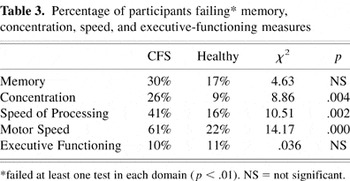
As presented in Table 3, significantly more CFS patients than healthy participants failed (1.6 standard deviations below the healthy mean) at least one task in the following domains: attention/concentration (p = .004), SIP (p = .002), and motor speed (p = .000). Specifically, on measures of memory functioning, 30% of CFS patients failed a task, while only 17% of healthy participated demonstrated failing performances, yet this result did not reach significance using the adjusted alpha (p = .035). Overall, 26% of the CFS patients and 9% of the healthy participants failed at least one task designed to test concentration. More specifically, CFS patients failed the Digit Symbol subtest. Forty-one percent of the CFS patients failed at least one neuropsychological test measuring SIP as compared to 16% of the control group, and 61% percent of CFS patients performed significantly slower on at least one motor task in comparison to 22% of the healthy cohort. More specifically, CFS patients failed the CPT mean reaction time task and/or the PASAT in the SIP domain, and the SRT and/or the Grooved Pegboard (nph) in the domain measuring motor speed. However, CFS and healthy groups did not differ in regard to the percentage of participants failing at least one neuropsychological test in the domain of executive functioning (10% vs. 11%, respectively).
Percentage of participants failing* memory, concentration, speed, and executive-functioning measures

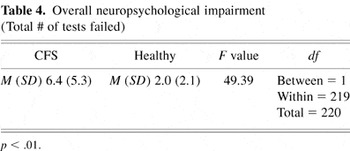
As noted in Table 4, CFS patients failed more neuropsychological measures overall than healthy controls (p < .01).
Overall neuropsychological impairment (Total # of tests failed)

DISCUSSION
The results of the present study indicate that a significant number of individuals suffering from CFS exhibit deficits on a variety of neuropsychological tasks across multiple domains. These descriptive findings were based on a series of neuropsychological tests administered to CFS and healthy participants and appear consistent with the subjective cognitive complaints of attention, concentration, and memory, which are common among individuals with CFS. Also, these findings parallel the literature that has documented differences in mean neuropsychological performance levels between CFS and healthy participants (DeLuca et al., 1994; Marshall et al., 1997; Michiels et al., 1998; Smith et al., 1993; Volmer-Conna et al., 1997; Wearden & Appleby, 1997). Overall, the CFS group was more likely than the healthy group to perform 1 standard deviation below the healthy reference mean on nine out of the 18 tests, and 2 standard deviations below the healthy norm on four out of the 18 tests. In addition, the CFS group was also more likely than the healthy cohort to fail at least one test (defined as scoring below the 5th percentile of the healthy mean) in the domains of attention, processing speed, and motor speed, but not in the domains of memory and executive processing. Individuals with CFS also demonstrated a higher total failure rate across domains.
The lack of significant findings at the 1.6 and 2 standard deviation cutoffs in the memory domain lends further support to the findings of DeLuca et al. (1994) and Lawrie et al. (2000), who note that memory deficits in CFS might actually be due to difficulty with information processing as compared to retrieval. The subtle deficit found in the memory domain (only two out of the six tests of memory reached the 1 standard deviation cutoff) may be explained by the information-processing deficiency. Indeed, in our study, we found that CFS patients failed (1.6 standard deviation cutoff) on two out of the three tests on information-processing tasks (PASAT, CPT) and reached the 2 standard deviation cutoff on the CPT task.
In addition, another interesting trend in the data is that the CFS patients failed (reached the 2 standard deviation cutoff) tests of information processing requiring a motoric response such as the Digit Symbol subtest, CPT, and the SRT test. In fact, the CFS patients also did poorly (2 standard deviation cutoff) on the Grooved Pegboard (nph), which requires a patient to concentrate using their nondominant hand and sustain motoric activity throughout the task. Overall, it appears that CFS patients are having most difficulty concentrating and processing information when required to respond motorically. Our research lab has examined information-processing efficiency in CFS, and have found that CFS patients do worse on tasks require simultaneous processing (DeLuca et al., 1994), and more specifically on auditory processing tasks (Johnson et al., 1996). The findings in the present investigation further suggest that CFS patients have difficulty when completing a complex information-processing task.
In the domain of executive functioning, the CFS patients did not fail any tests at the 1.6 and 2 standard deviation cutoffs. In the present investigation, we administered both un-timed measures of nonverbal abstract reasoning and planning, along with measures of rapid processing and timed set shifting. CFS patients performed similar to the healthy participants on a rapid processing and manipulation task (Digit Span backwards) and on a timed test of set shifting (Trails Making Test B). This finding is consistent with that of Dobbs et al. (2001) and other authors who did not find significant differences between CFS and healthy participants on the Digit Span backwards subtest or the Trails Making Test B (Dobbs et al., 2001). However, CFS patients did perform more poorly than healthy participants on the Rey-copy measure (1 standard deviation), which suggests some difficulty with planning and organization. The nature of this finding requires further investigation.
The goal of the present investigation was to describe and determine the extent of neuropsychological dysfunction across domains in patients with CFS, using several different criteria. Indeed, CFS patients demonstrate poor performance on a variety of cognitive tasks. Lezak (1995) explains that educational and employment opportunities, along with functional abilities, relate to compromised cognitive abilities, yet the etiology of cognitive dysfunction in CFS is still unknown and may come from a wide spectrum of neuropsychiatric, medical, and/or functional factors. Thus, future studies should be done to identify specific factors contributing to cognitive deficits in CFS. In fact, Christodoulou and colleagues (1998) found a relationship between cognitive dysfunction and functional disability in patients with CFS. More specifically, irrespective of psychiatric factors, CFS patients who had a higher number of failing test scores reported more general days of inactivity. Future research should further investigate the relationship between the degree of neuropsychological dysfunction in CFS and functional disability.
Further research should examine if the degree of neuropsychological dysfunction predict physical and psychological decline in CFS using several different criteria. This proposed examination should include overall neuropsychological dysfunction along with deficits in specific cognitive domains. Understanding the role of neuropsychological deficits in maintaining disability in this illness could also lead to targeted treatment recommendations.
ACKNOWLEDGMENTS
This research was supported by grant U01AI32247 from the NIH. Portions of the paper have been previously presented at the Twenty-Ninth Annual International Neuropsychological Society Conference, February 14–17, 2001, Chicago, Illinois. The reference for the previously presented abstract is as follows: Kim Busichio, Lana Tiersky, John DeLuca, & Benjamin Natelson. (2001). Neuropsychological Impairment in Patients with Chronic Fatigue Syndrome. Journal of the International Neuropsychological Society, 7, 172.
References
REFERENCES
Beck, A.T.,
Ward, C.H.,
Mendelson, M.,
Mock, J., &
Erbaugh, J.
(1961).
An inventory for measuring depression.
Archives of General Psychiatry,
4,
565–571.Google Scholar
Christodoulou, C.,
DeLuca, J.,
Lange, G.,
Johnson, S.K.,
Sisto, S.A.,
Korn, L., &
Natelson, B.H.
(1998).
Relation between neuropsychological impairment and functional
disability in patients with chronic fatigue syndrome.
Journal of Neurology, Neurosurgery, and Psychiatry,
64,
431–434.CrossRefGoogle Scholar
Corwin, J. &
Bylsma, F.W.
(1993).
Translations of excerpts from Andre Rey's Psychological
examination of traumatic encephalopathy and P.A. Osterreith's The
Complex Figure Copy Test.
The Clinical Neuropsychologist,
7,
3–15.Google Scholar
David, A.S.
(1991).
Postviral fatigue syndrome and psychiatry.
British Medical Bulletin,
46,
966–988.Google Scholar
Defilippis, N.A.
(1991).
The Category Test, Computerized Version.
Odessa, Florida:
Psychological Assessment Resources, Inc.
Delis, D.C.,
Dramer, J.H.,
Kaplan, E., &
Ober, B.A.
(1987).
California Verbal Learning Test: Adult Version.
San Antonio, Texas:
The Psychological Corporation.
DeLuca, J.,
Johnson, S.K., &
Natelson, B.H.
(1993).
Information processing efficiency in chronic fatigue syndrome and
multiple sclerosis.
Archives of Neurology,
50,
301–304.CrossRefGoogle Scholar
DeLuca, J.,
Johnson, S.K., &
Natelson, B.H.
(1994).
Neuropsychiatric status of patients with chronic fatigue syndrome:
An overview.
Toxicology and Industrial Health,
10,
513–522.Google Scholar
Dobbs, B.M.,
Dobbs, A.R., &
Kiss, I.
(2001).
Working memory deficits associated with chronic fatigue syndrome.
Journal of International Neuropsychological Society,
7,
285–293.CrossRefGoogle Scholar
Drebing, C.E.,
Van Gorp, W.G.,
Stuck, A.E.,
Mitrushina, M., &
Beck, J.
(1994).
Early detection of cognitive decline in higher cognitively
functioning older adults sensitivity and specificity of a
neuropsychological screening battery.
Neuropsychology,
8,
31–37.CrossRefGoogle Scholar
Farr, S.P.,
Greene, R.L., &
Fisher-White, S.
(1986).
Disease process, onset, and course and their relationship to
neuropsychological performance. In
S.B. Filskov &
T.J. Boll (Eds.),
Handbook of clinical neuropsychology,
Vol. 2 (pp.
213–253).
New York:
John Wiley & Sons.
Fukuda, K.,
Straus, S.E.,
Hickie, I.,
Sharpe, M.C.,
Dobbins, J.G., &
Komaroff, A.
(1994).
The Chronic fatigue syndrome: A comprehensive approach to its
definition and study.
Annals of Internal Medicine,
121,
953–959.CrossRefGoogle Scholar
Gorham, D.R.
(1956).
A proverbs test for clinical and experimental use.
Psychological Reports,
1,
1–12.Google Scholar
Gronwall, D.
(1977).
Paced auditory serial addition task: A measure of recovery from
concussion.
Perceptual Motor Skills,
44,
367–373.Google Scholar
Gronwall, D. &
Wrightson, P.
(1981).
Memory and information processing capacity after closed head injury.
Journal of Neurology, Neurosurgery, and Psychiatry,
44,
889–895.CrossRefGoogle Scholar
Johnson, S.K.,
DeLuca, J.,
Diamond, B.J., &
Natelson, B.H.
(1996).
Selective impairment of auditory processing in chronic fatigue syndrome:
A comparison with multiple sclerosis and healthy controls.
Perceptual Motor Skills (United States),
83,
51–62.CrossRefGoogle Scholar
Johnson, S.K.,
DeLuca, J.,
Diamond, B.J., &
Natelson, B.H.
(1998).
Memory dysfunction in fatiguing illness: Examining interference and
distraction in short-term memory.
Cognitive Neuropsychiatry,
3,
269–285.CrossRefGoogle Scholar
Joyce, E.,
Blumenthal, S., &
Wessely, S.
(1996).
Memory, attention, and executive functioning in chronic fatigue
syndrome.
Journal of Neurosurgery and Psychiatry,
60,
495–503.Google Scholar
Klove, H.
(1963).
Clinical neuropsychology. In
F.M. Forster (Ed.),
The medical clinics of North America,
Vol. 47 (pp.
1647–1658).
New York:
Saunders.
Lawrie, S.M.,
MacHale, S.M.,
Cavanagh, J.T.,
Carroll, R.E., &
Goodwin, G.M.
(2000).
The difference in patterns of motor and cognitive function in
chronic fatigue syndrome and severe depressive illnesses.
Psychological Medicine,
30,
433–442.Google Scholar
Lewis, R.F. &
Rennick, P.M.
(1979).
Manual for the Repeatable Cognitive-Perceptual-Motor Battery.
Clinton Township. Michigan:
Ronald F. Lewis.
Lezak, M.D.
(1995).
Neuropsychological assessment
(3rd ed., pp.
107–109; 154–169; 357–358;
445–448).
New York:
Oxford University Press.
Marcel, B.,
Komaroff, A.L.,
Fagioli, L.R.,
Dornish, J., II, &
Albert, M.S.
(1996).
Cognitive deficits in patients with chronic fatigue syndrome.
Biological Psychiatry,
40,
535–541.Google Scholar
Marcus, S.,
Robins, L.N., &
Bucholz, K.
(1990).
Quick Diagnostic Interview Schedule III–R, Version 1.
St. Louis, Missouri:
Washington University School of Medicine.
Marshall, P.S.,
Forstot, M.,
Callies, A.,
Peterson, P.K., &
Schenck, C.H.
(1997).
Cognitive slowing and working memory difficulties in chronic
fatigue syndrome.
Psychosomatic Medicine,
59,
58–66.CrossRefGoogle Scholar
Mathews, C.G. &
Haaland, K.Y.
(1979).
The effect of symptoms duration on cognitive and motor performance
in Parkinsonism.
Neurology,
29,
951–956.CrossRefGoogle Scholar
McDonald, E.,
Cope, H., &
David, A.
(1993).
Cognitive impairment in patients with chronic fatigue syndrome: A
preliminary study.
Journal of Neurology, Neurosurgery, and Psychiatry,
56,
812–815.Google Scholar
Michiels, V.,
Cluydts, R.,
Fischler, B.,
Hoffman, G.,
Le Bon, O., &
De Meirleir, K.
(1996).
Cognitive functioning in patients with chronic fatigue syndrome.
Journal of Clinical and Experimental Neuropsychology,
18,
666–677.CrossRefGoogle Scholar
Michiels, V.,
Cluydts, R., &
Fischler, B.
(1998).
Attention and verbal learning in patients with chronic fatigue
syndrome.
Journal of International Neuropsychological Society,
4,
456–466.Google Scholar
Moss-Morris, R.,
Petrie, K.J.,
Large, R.G., &
Kydd, R.R.
(1996).
Neuropsychological deficits in chronic fatigue syndrome: Artifact
or reality?
Journal of Neurology, Neurosurgery, and Psychiatry,
60,
474–477.Google Scholar
Neurobehavioral Systems, Inc.
(1994).
Simple reaction time task.
16 Park Ave., Winchester, Massachusetts.
Ray, C.,
Phillips, L., &
Weir, R.C.
(1993).
Quality of attention in chronic fatigue syndrome. Subjective
reports of everyday attention and cognitive difficulty, and performance
on tasks of focused attention.
British Journal of Clinical Psychology,
32,
357–364.Google Scholar
Reitan, R.M. &
Davidson, L.A.
(1974).
Clinical neuropsychology: Current status and applications.
Washington, DC:
Winston.
Richardson, E.D.,
Nadler, J.D., &
Malloy, P.F.
(1995).
Neuropsychologic prediction of performance measures of daily living
skills in geriatric patients.
Neuropsychology,
9,
565–572.CrossRefGoogle Scholar
Salthouse, T.A.
(1994).
The aging of working memory.
Neuropsychology,
8,
535–543.CrossRefGoogle Scholar
Sandman, C.A.,
Barron, J.L.,
Nachoul, K.,
Goldstein, J., &
Fidler, F.
(1993).
Memory deficits associated with chronic immune dysfunction syndrome.
Biological Psychiatry,
33,
618–623.CrossRefGoogle Scholar
Smith, A.P.,
Behan, P.O.,
Bell, W.,
Millar, K., &
Bakheit, M.
(1993).
Behavioural problems associated with chronic fatigue syndrome.
British Journal of Psychology,
84,
411–423.Google Scholar
Stevens, J.
(1986).
Applied multivariate statistics for the social sciences.
Hillsdale, New Jersey:
Erlbaum.
Stroop, J.R.
(1935).
Studies of interference in serial verbal reactions.
Journal of Experimental Psychology,
18,
643–662.Google Scholar
Tiersky, L.A.,
Johnson, S.K.,
Lange, G.,
Natelson, B.H., &
DeLuca, J.
(1997).
Neuropsychology of chronic fatigue syndrome: A critical review.
Journal of Clinical and Experimental Neuropsychology,
19,
560–586.Google Scholar
Tombaugh, T.
(1996).
Test of memory malingering.
U.S.A., Canada:
Multi-Health Systems, Inc.
Vercoulen, J.H.M.M.,
Bazelmans, E.,
Swanink, C.M.A.,
Galama, J.M.D.,
Fennis, J.F.M.,
Van der Meer, J.W.M., &
Gleijenberg, G.
(1998).
Evaluating neuropsychological impairment in chronic fatigue
syndrome.
Journal of Clinical and Experimental Neuropsychology,
20,
144–156.Google Scholar
Volmer-Conna, U.T.E.,
Wakefield, D.,
Lloyd, A.,
Hickie, I.,
Lemon, J.,
Bird, K.D., &
Westbrook, R.F.
(1997).
Cognitive deficits in patients suffering from chronic fatigue
syndrome, acute infective illness or depression.
British Journal of Psychiatry,
171,
377–381.CrossRefGoogle Scholar
Wearden, A. &
Appleby, L.
(1997).
Cognitive performance and complaints of cognitive impairment in
chronic fatigue syndrome (CFS).
Psychological Medicine,
27,
81–90.Google Scholar
Wechsler, D.
(1945).
A standardized memory scale for clinical use.
Journal of Psychology,
45,
409–419.Google Scholar
Wechsler, D.
(1981).
Wechsler Adult Intelligence Scale–Revised, Manual.
New York:
Psychological Corporation.
Demographic data
Percentage of participants performing 1 and 2 SD below the healthy norm
Percentage of participants failing* memory, concentration, speed, and executive-functioning measures
Overall neuropsychological impairment (Total # of tests failed)
 You have
Access
- 39
- Cited by