

In the northern French village of Jumièges from the late Middle Ages to the middle of the nineteenth century, a peculiar fraternal ritual took place. Each year on the evening of the twenty-third of June, the Brotherhood of the Green Wolf chose its new chief. Arrayed in a brimless green hat in the shape of a cone, the elected master led the men to a priest and choir; together the group processed to church for mass, chanting the hymn of St John the Baptist (Ut queant laxis). After mass and a dinner, they danced and lit a bonfire as music ensued: following the ringing of handbells, the men sang the Te Deum and vernacular parodies of Ut queant laxis. Just before midnight, the brotherhood surrounded their elected Green Wolf leader and pretended to throw him into the fire. After the stroke of twelve, the ceremony devolved into chaos as voices bellowed and fiddles played through the night around the fire. The next day, the raucous gaiety continued. To the sound of musketry, the brothers paraded through streets with a gigantic loaf of bread adorned with greenery and ribbons.Footnote 1
These curious annual practices of unknown origin took place as a celebration of Midsummer, a day long observed as the summer solstice and later designated as the Christian feast of the Nativity of St John the Baptist. Nineteenth-century folklorists have no doubt fancifully embellished the exercises in Jumièges, but the Green Wolf tradition has nevertheless been documented from the later fourteenth century and probably existed earlier than this date.Footnote 2 More importantly, music-making was inevitably part of the fraternal ritual from the start. No matter the precise date of origin for these Midsummer practices, this description makes a fitting entrée to this study on the convergence of sacred, secular, political and ritualistic realms in music surrounding a major festival day of the calendar year.
The fraternity sang two hymns to adorn their celebration: the Te Deum, the popular multi-purpose hymn commonly used outside the church confines in processions, and Ut queant laxis, a hymn liturgically proper to the feast of John the Baptist, though better known to musicologists as the basis for a sight-singing heuristic introduced by Guido of Arezzo in the early eleventh century.Footnote 3 Contrafacta and instrumental music further accompanied the festival events well into the night. Music was no doubt included when the fraternity attended mass, likely in honour of St John the Baptist. But the vernacular parody of the hymn Ut queant laxis demonstrates a surprising reversal of the Christian influence, as the melody became subject to a playful rendering. The Green Wolf ceremony, in short, had significant and obvious interaction with the annual commemoration of John the Baptist. While the incorporation of sacred music served to remind participants of the Christian backdrop to their fraternal rite, the bonfire and mock political charade are more difficult to reconcile with the Christian feast. Moreover, some of these activities were not localised traditions, but rather remnants of widespread pre-Christian customs that formed the basis for such ceremonies across the Continent.
This study aims to chart the vestiges of well-known rituals of Midsummer that are adumbrated in music associated with a thirteenth-century motet family based on two related tenors for the nativity feast of John the Baptist (24 June). Through this lens, we will see that the motet is, to a greater degree than has heretofore been recognised, a popularising genre that exemplifies the inextricable link between sacred and secular aspects of medieval Christian celebrations. Woven into the standard subgenres of the motet (from rhymed Latin texts to courtly and pastoral vernacular texts) are words and phrases which, upon examination, can be seen to stand apart from the basic literary stereotypes. The filter that helps us identify these key references is the tenor of the motet, which not only points to a liturgical celebration but also cues a wider set of popular traditions associated with that feast. By focusing on a large family of motets united by two tenors, the study will demonstrate that these conspicuous words and phrases in the discursive upper voices serve as markers for the popular rituals that preceded Christian feasts and continued to be embedded in their fabric. Several of these motets merit rereading and reinterpretation in the light of these Midsummer suggestions. With a rich contextual understanding of the Midsummer social practices involving nature (sun, fire and foliage), as well as those repudiating authority, we will be able to witness more clearly some basic pre-Christian observances from Midsummer Day that surface in the family of thirteenth-century motets for the saint.Footnote 4 The subtle references to these varied traditions in the context of music for a saint's feast expose more broadly the false dichotomy between sacred and profane worlds, encouraging us to consider new ways of thinking about how popular culture may infuse artefacts of the lettered in late medieval society.
POPULAR RELIGION AND THE MIDSUMMER FESTIVAL
The case of the Green Wolf ritual not only reveals some unexpected popular uses for well-known sacred music but also demonstrates what has long been understood as the apparent intermingling of distinct ‘religions’ – one known from the Christian church, the other derived from antiquated pagan customs and sometimes associated with magic.Footnote 5 These two ‘religions’ and the ostensible triumph of the former over the latter underlay much Enlightenment historiography. Beginning with Gibbon's account of the early history of Christianity, these tidy notions led to a bifurcated conception of medieval culture that was expressed in several ways (e.g., official vs. unofficial, lettered vs. unlettered, sophisticated vs. crude, dominant vs. subordinate).Footnote 6 Such artificial boundaries have further impacted twentieth-century studies on popular religion, most pointedly in Keith Thomas's magisterial tome Religion and the Decline of Magic.Footnote 7
With increasing studies on the role of popular practices in the face of Christian values, medieval historians have begun to unravel and modify the imagined polarity between dual cultures, as it were.Footnote 8 Jacques Le Goff and Peter Burke have each made valuable contributions towards understanding the interaction of elite and popular traditions.Footnote 9 In each of these proposed theoretical models, however, the influence is still uncomfortably uni-directional: the two social ‘classes’ apparently collide, but the official Christian culture ultimately prevails in its suppression of wayward pagan customs.Footnote 10 The musical evidence involving the motets for John the Baptist and the celebration of the summer solstice suggests something different; namely, that the cultural lines of influence worked in both directions. The all-important liturgical tenors governing this family of motets at once delicately Christianised the commentary of the upper voices, while also licensing a space for allusions to popular practices associated with this special day of wide-ranging traditions.Footnote 11
The present study is not the first to focus on the commingling of sacred music of the late Middle Ages with traditional or popular practices. Musicologists studying this period have increasingly recognised the influence of popular rituals in shaping our understanding of some of the most venerable ‘high’ register music that has come down to us.Footnote 12 Christopher Page has devoted the most substantial discussion to the popularising elements that may lie amidst some of the ‘high’ music of the period. By taking steps to contextualise music of the late Middle Ages in his study of the origins and function of the early motet, Page criticised the view of motets as belonging to the cultural elite in France, arguing instead that the genre had little of the esteemed heritage and audience that scholars have artificially imagined for their use. His proposed alternative considers the thirteenth-century motet as both a miniature and a light parody, well suited to dances known as caroles or festivals of a decidedly secular bent. In his rereading of the treatise of Johannes de Grocheio (fl. 1300), Page further demonstrated that many late thirteenth-century motets were not just the creation of clerics, but were likely sung at festivals of the laity just as other lighter musical genres.Footnote 13 His evidence points to a medieval culture in northern France that showed little demarcation between literary and popular realms, despite the social position of the clergy.Footnote 14
Who or what could effectively mediate the perceived gap between the sacred and the profane? In many ways, this role fell on the saints, who routinely served mundane causes, despite their characteristically elite status.Footnote 15 The development of the Western liturgical calendar exemplifies this premise in the case of John the Baptist. With Christianising intentions, the Church Fathers organised the annual slate of celebrations and commemorations with an astute eye towards the existing practices of ancient Rome. It is well known that the conception of Christ on 25 March (Annunciation) was associated with the spring equinox in the Roman calendar (a.d. VIII Kalendas Apriles), which in turn situates Christmas (25 December, or a.d. VIII Kalendas Ianuarias) around the time of the winter solstice. The feasts of John the Baptist's conception and birth complete the connections to the four so-called ‘quarter days’ – the summer and winter solstices and the vernal and autumnal equinoxes.Footnote 16 These four critical times of year no doubt won popular acceptance because they were in fact solar phenomena, physically observable and demonstrative of the cyclical nature of the heliological year.Footnote 17 The calendrical equilibrium also established a special connection between John the Baptist and Jesus, whose complementary nativities are all but lost on Christians today.
Symmetrically dividing the solar year and the Christian liturgical year, the nativities of Christ and John the Baptist immediately became associated with the solstices to which they were assigned. The symbolism that connects the Jesus's nativity with the shortest day of the astronomical year was especially potent, particularly when one considers that one of Christ's titles was ‘sun of righteousness’ (sol iustitiae), an appellation which will return in music for John the Baptist. On 25 December, both the sun and Christ were thought to be born anew. Jesus's nativity is further regarded as a deliberate Christianisation of a Roman festival on the winter solstice called the Birth of the Invincible Sun (Dies Natalis solis invicti), set on 25 December in the Julian calendar.Footnote 18
A stronger solar parallel in fact occurs in the case of John the Baptist and the celebration at Midsummer. John the Baptist's nativity on 24 June occurred on Midsummer Day – a day of solar crisis – when the length of sunlight and its power was thought to be at its greatest in the year. Just as the increasing daylight from the depths of darkness at Midwinter became associated with the Christ, so too was there a realisation among early and medieval Christians of the necessary decreases in daylight that would follow after the feast of the Baptist. This ‘decreasing’ effect beginning at the summer solstice became symbolic of John's ministry, which was said to diminish once Christ's ministry ascended to prominence. John's ‘opposing’ nativity to that of Christ even seems to have concretised the theology contained in the final witness of John the Baptist, who proclaimed, according to the gospel of John (3:30), that his ministry must eventually cede to Christ's: ‘He [Christ] must increase; I must decrease.’Footnote 19 The parallel between the seasonal rhythms and Christian theology resonated throughout the Middle Ages, in commentary from Augustine to the thirteenth-century Bishop of Mende, Guillelmus Durandus.Footnote 20
There is no first-hand evidence that suggests that the placement of the Baptist's nativity was a deliberate attempt by the earliest defenders of the faith to Christianise a pagan sun festival. Yet the confluence of John's feast day with the perceived solstice allowed several widespread rituals to perpetuate the solar analogy. The twelfth-century Parisian theologian Johannes Beleth testified to the dual nature of John's feast on Midsummer Day in 1162, writing that it was ‘celebrated by both Christians and pagans because it holds allegorical and ritualistic significance’.Footnote 21 The Christian veneer on the Midsummer celebration took an astonishingly long time to mask the vestiges of peculiar solstitial customs, several of which survived into the late Middle Ages – a few, like the Green Wolf Ceremony, enduring into modern times. The popular Midsummer practices of lighting bonfires, rolling fiery wheels down mountainsides, criticising public authority and other seasonal customs were all Midsummer staples maintained as defensible rituals under the auspices of John the Baptist.Footnote 22 Historical anthropologists who address Midsummer traditions have noted traces of these pre-Christian practices throughout the Christian era, with the contribution of musical artefacts understandably left out of the scholarly conversation.Footnote 23 An array of evidence within a large family of thirteenth-century motets based on two tenors, IOHANNE and MULIERUM, alludes to the survival of these proliferous Midsummer rituals, shedding new light on the subtlety of the genre and demonstrating the permeability between elite and popular culture in the late Middle Ages.
THE JOHANNINE FAMILY OF MOTETS
As Christopher Page has suggested, it is likely that some thirteenth-century motets belong to a festival atmosphere and are less inclined to be enjoyed by an ill-defined cultural elite. If we accept that certain clerical creations were destined for popular outdoor-type occasions, then we can more easily understand the syncretism of sacred and secular worlds found in the early motet. The family of motets on tenors for John the Baptist is especially aptfor this type of hybrid interpretation, because it was the locus par excellence for intimations of solstitial practices, which were evidently ingrained even in the lettered of late medieval society. An overview of the tenor foundations and large motet families in which several of these Midsummer citations occur will set the stage for revealing these heretofore unnoticed references.
In the Ars antiqua sources of the thirteenth century, there are two distinct tenors derived from a single Alleluia for the feast of the Nativity of John the Baptist (Alleluia. Inter natos mulierum) that form the basis for the thirteenth-century motets for this saint.Footnote 24 The melismas on the words ‘mulierum’ and ‘Iohanne’ are the two longest melismas in the verse of this Alleluia and were selected to serve as the governing voice of more than two dozen motets. The words ‘mulierum’ and ‘Iohanne’ (literally, ‘[of] women’ and ‘John’) were well deserving of melismatic treatment, having been spoken by Christ and recorded in the Gospel of Matthew (11: 11): ‘Among those born of women, none has arisen greater than John the Baptist’ (‘Inter natos mulierum, non surrexit maior Iohanne baptista’). It comes as no surprise that this lone gospel verse inspired a large family of musical works: the words were broadly emblematic of John himself and often depicted in late medieval illustrations of the Precursor saint, particularly in the suffrages (i.e. short prayers to saints) in books of hours.Footnote 25
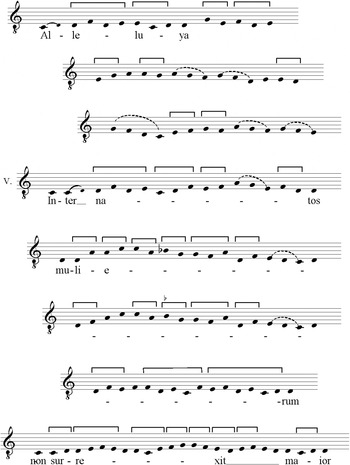
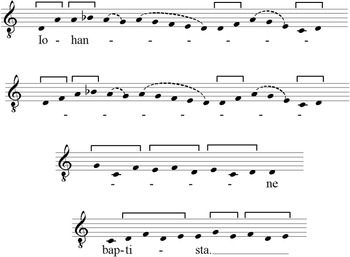
The Alleluia verse from which these tenors derive is given in full in Example 1.Footnote 26 The ‘mulierum’ extract would have been an attractive motet tenor for two reasons. Not only is this particular melisma a self-contained first-mode melody, a popular mode for the thirteenth-century motet repertory,Footnote 27 but the internal similarity between the first and second line of music above also suggests a kind of built-in repetition, akin to two statements of a cursus.Footnote 28 Some important similarities bind the gesture on ‘mulierum’ to that of ‘Iohanne’, the penultimate word of the Alleluia verse. Both melismas have strikingly comparable length (fifty-one discrete pitches for ‘mulierum’, forty-six for ‘Iohanne’), while also maintaining an unambiguous D-mode profile amidst the E-mode Alleluia verse. The ‘Iohanne’ melody has three cadences on D, like its counterpart, as well as internal repetition (aligned in the transcription), which again could have been an appealing feature for a tenor cursus. Given the parallels between these melodic segments, the two melismas begin to approach a level of interchangeability. As a consequence, the analogous profiles of these two tenor melodies allow the possibility for the individual motet families founded on these melismatic extracts to be considered as a single, John-based (hereafter, ‘Johannine’) collection for further analysis.
Alleluia. Inter natos mulierum. Transcription after Le Magnus liber organi de Notre-Dame de Paris, ed. Roesner, iii, p. 232


In the last two decades, medieval musicologists have sufficiently demonstrated that the texts of the upper voices in the motet repertory often expound the tenors on which they were constructed.Footnote 29 But only recently has attention been drawn to the benefits of examining the families of motet texts based on single tenors.Footnote 30 Various texts associated with the IOHANNE and MULIERUM tenors are expected foremost to build on the tenor scaffolding by engaging in poetic and musical ‘exegesis’ on the figure of John the Baptist in the later Middle Ages. Conversely, tenors may also cleverly summarise or reinforce the substance of the motet texts. Aside from the Latin texts that describe the Baptist or events in his life, the Johannine motets also deliver specific images related to the secular rituals surrounding his feast, such as the lighting of bonfires, the criticism of authority, the wearing of floral garlands and dancing. However, before examining these upper-voice texts and their attendant rituals more closely, we must briefly take stock of the complete family of motets that these tenors bequeathed.
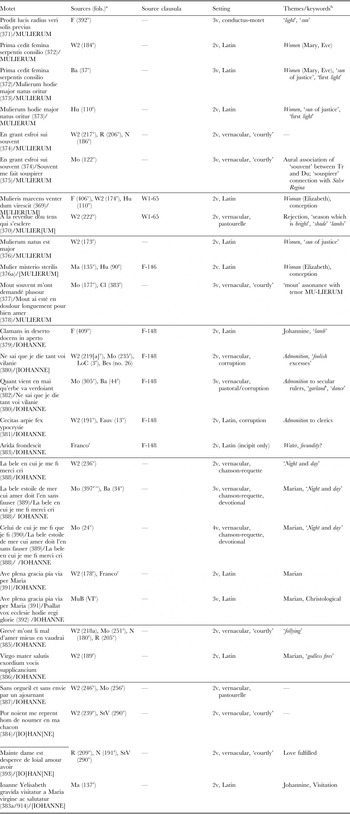
A family of twenty-seven motets has survived on the Johannine tenors MULIERUM and IOHANNE, which is significant, since only four out of some two hundred tenors from the extant Notre Dame repertory inspired more motets.Footnote 31 Appendix 2 indicates the motets constructed above these respective tenors and highlights some internal groupings of motets within the individual tenor families, along with the types of settings and any key Midsummer ideas that will occupy the remainder of the study. The full set of motets on MULIERUM and IOHANNE unveils a wide array of genres not uncommon for a large thirteenth-century motet family. Although there are no bilingual motets, the collection includes Latin and vernacular examples ranging from two to four voices, along with a three-voice conductus-motet (Prodit lucis radius veri solis previus/MULIERUM).Footnote 32 The scope of thematic material in these motets is naturally wide as well, as indicated in the column marked ‘Themes/Keywords’. In addition to images strictly referring to John's conception, his preaching, or his presence (in utero) at the scene of the Visitation, the subjects raised in the upper voices include Marian supplications and amorous pursuits of both courtly and pastourelle registers, all typical for the motet as a host genre.Footnote 33 We must also add the subject category of corruption to the list, since this topic – comparatively infrequent in the thirteenth-century motet repertory – appears twice in the subgroup of motets based on IOHANNE clausula F-148 and will engender fuller discussion later.
While Appendix 2 in many ways fulfils the generic expectations of a motet family of this size (such as having a Marian emphasisFootnote 34), there is an unexpected uniformity of certain ideas across these motets, with up to two-thirds of the family alluding to pre-Christian solstitial rituals. Most readily apparent in this collection of motets is the general emphasis on women, no doubt inspired by the use of the tenor MULIERUM (‘of women’). Among its many meanings, the season of Midsummer held promise for love and procreation – to say nothing of lewd behaviour. Anca Vlasopolos has compellingly explained the resolution of human sexual discord that historically takes place on Midsummer's Eve, noting that lovers seek to enter into harmony with one another, just as individuals become attuned to the natural elements at this critical time in the solar year.Footnote 35 Perhaps the raw suggestiveness ‘of women’ in the tenor was enough to justify copious commentary on female characters from the Virgin Mary to the shepherdess Marion and all amorous things in between.Footnote 36 So fascinated were these poet-composers with the evocative word ‘mulierum’ that the first word of four of the Latin upper-voice texts and two vernacular texts in Appendix 2 creates deliberate assonance with the tenor rubric (Mulier misterio sterilis, Mulierum natus est major, Mulieris marcens venter dum virescit, Mulierum hodie major natus oritur, Mout souvent m'ont demandé and Mout ai esté en doulour).Footnote 37 Despite the appeal of the word ‘mulierum’, the four Latin motet texts on MULIERUM each revert to the subject of John the Baptist. Thus, the aural emphasis on ‘mulier-’ at the outset is quickly supplanted by deeper theological reflections on the Precursor saint in the upper voice, expounding John's status as the greatest man born to a woman.Footnote 38 These cases demonstrate in miniature the dual nature of motets as both an outlet for commentary and a playful combination of disparate (and occasionally convergent) sounds.
It is true that tales of women and love may broadly concord with the Easter season and May Day as much as Midsummertide, but more evidence surfaces that will cause us to associate these motet texts specifically with the pre-Christian solstitial rituals of Midsummer. The core of this study will introduce several solstitial practices and chart oblique references to more specific Midsummer cues in thirteenth-century motet. With a firm understanding of some basic themes surrounding the summer solstice and their revelation in properly Johannine music, we may continue to chip away at the supposed elite qualities of some of the accepted ‘sacred’ music of the period by witnessing the infusion of popular elements into some of our most hallowed musical artefacts of the period. The sheer appearance of these rituals confirms the slippery nature of elite and popular culture as analytical categories, hinted at by Johannes Beleth in his description of the Midsummer festival in Paris. The allusions further complicate our search for a context for the medieval motet. Given the centrality of the solstitial connection to John's nativity feast, any study of John the Baptist must first address the fundamental solar analogy.
SOLAR SENSITIVITY
It was natural for any religious tradition of the ancient world, let alone many cultures today, to draw upon the movements of the sun and other seasonal rhythms in designing sacred observances throughout the year. The sun's longest day of the year at Midsummer was an especially palpable occurrence, well before John's nativity was assigned to 24 June. But the placement of the saint's nativity on this day automatically generated associations between the Precursor and the sun (or light, more generally). One need not look further than the New Testament for additional support, where upon hearing of the Baptist's death, Jesus responds: ‘He was a burning and shining lamp, and for a while you rejoiced in his light.’Footnote 39 Durandus even referred to John the Baptist as lucifer (‘light-bearer’).Footnote 40 Analogies involving John the Baptist and the sun, however, could risk entanglement with Christ, who is considered the true light of the world and whose nativity feast near the dark winter solstice intensified the moment at which the light was received.Footnote 41 The three-voice conductus-motet Prodit lucis radius veri solis previus/MULIERUM (from the manuscript F) addresses these central themes of light surrounding John and Jesus.Footnote 42 As a conductus-motet, the same poetry is given to both triplum and motetus, and the usual questions of intelligibility from the double motet evaporate. The piece does not name the Baptist as its subject; instead, the motet produces a series of descriptions, emphasising John's predecessory nature and reinforcing the well-known relationship to the ‘true sun’. The poet carefully portrays John as a ‘ray of light’, portending the full radiance of Christ's light to come:
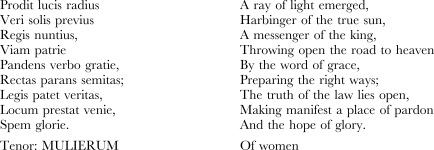
Despite its symbolic engagement of light and the sun, this motet text does not directly steer us towards the festival of Midsummer. Instead, Prodit lucis radius veri solis previus/MULIERUM avoids mixing literary registers in any obvious way. But the powerful light-sun metaphor does reappear in other motets, raising awareness for the peculiarities of the season of Midsummer. The two-voice vernacular motet A la revenue dou tens qui s'esclere/MULIERUM provides closer connection to the season of Midsummer now within the context of a pastourelle. The bucolic encounter described in the upper-voice text begins as one might expect, with an exordium hailing the season and the male protagonist's discovery of a young maiden in a natural setting.

In this duplum text, the typical sexual tension abounds as the protagonist makes an unsolicited advance on the maiden, but is rejected by her.Footnote 44 Although of contrasting register, the pastoral narrative harmonises quite well with the Johannine tenor from the Baptist's nativity feast. In both the musical and textual climax of the motet, the maiden's rebuff of the male may obliquely parallel John's rejection of Herod the Tetrarch.Footnote 45 But her admonishment may also signal a broader popular tradition of repudiating authority on the feast of St John, a subject to be addressed more fully in the discussion of corruption texts.
Further connecting to the tenor and the season of Midsummer is the innocent-sounding first poetic line of the duplum, as it emphasises the time of year – tens qui s'esceler (‘time which is bright [with sun]’).Footnote 46 While this seasonal description may simply take the guise of a stock début printanier (evocation of springtime), its vagueness could transport the encounter to late spring or early summer, namely around the time of the solstice, when a shepherdess would seek shade to protect herself (s'ambroie) from the sun's intensity. The underpinning of the MULIERUM tenor assists in linking the ‘time which is bright’ to the solstitial moment. Typically, pastourelle texts involve an escapade in the month of May (as days are getting longer and brighter). But the imprecise temporal reference and focus on solar intensity permit a reading of this tale as being closer to the summer, or even at the solstice.Footnote 47
A final passing image from A la revenue dou tens qui s'esclere/MULIERUM strongly connects to the Johannine domain. The presence of the shepherdess in the motet text is wholly typical of the pastourelle genre, but nevertheless may allegorise the narrative in the light of the suggestive tenor. Though she is very much a standard figure in vernacular motet texts, references to her flock are surprisingly scarce and thus warrant attention.Footnote 48 As students of the motet have become accustomed to recognising the maiden as a parodic rendering of the Virgin Mary, so too may the rare mention of lambs, or more broadly sheep, parodically intersect with topoi related to John the Baptist. Christ is the ‘Lamb of God’, but it was a title proclaimed by John who pointed out the Messiah, saying: ‘Ecce Agnus Dei qui tollit peccatum mundi.’Footnote 49 Saints have long served quotidian applications for Christians; in the case of John, his association with the Lamb was reflected in daily life. It was John, in fact, who was considered the patron saint of shepherds, sheep and the wool industry, among his many speciality areas of intercession.Footnote 50 The annual ‘labour’ of sheep-shearing was assigned to the month of June, and depictions in the visual arts further conjoin the seemingly secular nature of shepherding with John the Baptist's nativity feast day.Footnote 51 In sum, the maiden's rejection, the début printanier and the reference to lambs are much in keeping with the general characteristics of the pastourelle. But when these elements are combined in a motet above a Johannine tenor and when the bright days of springtime are turned into hot summer afternoons through the mention of the maiden's need for shade, the interpretative power of the host genre looms large, exposing the subtlety of the allusions in the upper voice.
Christological and Johannine images collide again as we return to themes of light and the sun, where, in fact, two of the four MULIERUM motet texts beginning with ‘mulier-’ reveal the descriptor ‘sun of justice’ (sol iustitie). This appellation was traditionally reserved for the Messiah and resonated with the seasonal importance of his nativity on the darkest day of the year.Footnote 52 The ‘sun of justice’ designation appears once in the Old Testament in the Book of the prophet Malachi, but was long interpreted as a metaphor for coming of the Saviour.Footnote 53 Numerous medieval commentary traditions further strengthen the Christological interpretation of the title ‘sun of justice’.Footnote 54 The motet text Mulierum natus est maior from the Johannine family, with all of its luminescent imagery, is particularly unequivocal with respect to the ‘sun of justice’ – it can only be Christ (or God), not John, in this context.Footnote 55

However, another motet on the MULIERUM tenor, Mulierum hodie maior natus oritur, makes us wonder if Christ is the only one to whom the phrase sol iustitie might refer.Footnote 56 From a grammatical perspective, the Baptist (not Christ) is understood as the ‘sun of justice’, as the poet places the phrase sol iustitie in the middle of a short list of descriptions of John. The upper voice hails the Precursor as both the prima lux ecclesie (‘first light of the church’) and sydus syderum (‘star of stars’), the latter appellation found in the previous motet. These titles could easily be used to describe Christ; nonetheless, in the context of gloss on Matthew 11: 11, they must refer to John. The imagery of radiance is as appropriate for Christ's forerunner as it is for the season of Midsummer.

Taken together, these two motets exemplify the unusual parity between the Baptist and Christ. The parallel in the waxing and waning of night and day at the solstices seems to allow for the free transferral of titles from the Christological to the Johannine domain.Footnote 57 It was impossible to escape the connection between the figure of John the Baptist and light, ideas which were rooted not only in Scripture but also in cultural practice. Especially during the annual solar apogee, these common Johannine associations with light lead us from sunlight to a peculiar pre-Christian ritual regarding firelight. This practice involves the lighting of bonfires, of which much has been chronicled as the foremost tradition of the Midsummer feast.
THE FIRE FESTIVAL
The act of kindling bonfires at certain times of the year was a common activity in all of medieval Europe, one filled with multivalent meaning. As part of what David Cressy called the ‘vocabulary of celebration’, bonfires have historically marked special events such as an anniversary or were used in thanksgiving for a bumper crop.Footnote 58 The sprawling flames at once inspired fear and awe in those who gathered, but they also were thought to have regenerative and cleansing effects.Footnote 59 Bonfires were lit mainly in spring and summer, although there were occasions throughout the year, such as the eve of All Saints (Halloween), Christmas and the eve of the twelfth day after Christmas (Epiphany), when the public celebrated with large fires. But the best-known bonfire of the entire year was the one ignited in the summer on Midsummer's Eve. This particular bonfire tradition had the longest life of all Midsummer rituals, surviving even into the early part of the twentieth century.Footnote 60 Widespread accounts indicate that, on the night of 23 June, citizens would convene, bringing combustible items to burn in a large blaze, which over time acquired the name ‘St John's fire’. From the Christian perspective, these fires could symbolise renewal and purification, which would have been compatible with the baptising ministry of John the Baptist.Footnote 61 But this Christian metaphor was not top of mind for Johannes Beleth, who shockingly explained that the purpose of the St John's fires, as he understood it, was to banish ‘dragons that fly in the air, swim in the waters and walk the earth’.Footnote 62 Evidently, a line separating official and popular conceptions of ritual had not been drawn even in twelfth-century Paris, which was not only the most important seat of theology north of the Alps in the later Middle Ages but also the breeding ground of the medieval motet. Citing Beleth in his well-circulated Golden Legend, Jacobus de Voragine likewise confirmed this understanding of the fires in the thirteenth century.Footnote 63
The most storied activities that accompanied the lighting of St John's bonfires were (1) the act of leaping over the large flames and (2) the rolling of a fiery wheel of straw down a hillside. With regard to the former ritual, some jumped over the flames to bring about protection from both evil spirits and various ailments during the year ahead.Footnote 64 Other traditions included couples vaulting over the flames together either as a public sign of betrothal or in the hopes of bearing children in the coming months.Footnote 65 Music must have been a staple of these various ritual acts. Indeed, the seventh-century bishop Eligius of Noyon condemned both the practice of hurdling the large flames and the ‘devilish songs’ (cantica diabolica) that were sung on the feast.Footnote 66 Beyond the leaping activities around the bonfire, far more attention has been paid to the curious ritual of setting a large straw wheel aflame and rolling it down a hill or mountainside, often towards the public fire itself. While the bonfire pastime is generic in some sense, this peculiar wheel-rolling practice was special only to the fire festivities on the eve of St John's Day. The wheel-rolling tradition slowly negotiated a delicate relationship with the saint's nativity feast. Naturally, Christian theological interpretations of the practice accrued, again notably by Johannes Beleth, who saw the practice as a reflection of the setting sun and in connection with the Baptist's waning ministry:
John was a burning light who prepared the way of the Lord. But as the wheel [down the hill] is turned thus, [the people] think it is like the sun in its orbit, which will descend when it can progress no further, so that little by little it will descend. In the same way common belief has it that the blessed John came before Christ and arrived at the summit, for he was thought the Christ; and afterwards he descended and was diminished, as his own words say: ‘I will decrease; but he will become great.’Footnote 67
Apart from this theological understanding of the practice, some have viewed the wheel-rolling ritual as an invocation of Lady Fortune, whose capricious wheel turned human fate, a point to be discussed later.Footnote 68
The general image of fire appears in the motet Virgo mater salutis exordium vocis supplicancium/IOHANNE, found only in W2. The duplum features an unequivocal Marian supplication, as common to the motet repertory as amour courtois texts. In the light of the extensive fire rituals known to be associated with the feast of St John's Day, the isolated and conspicuous allusion to a ‘conflagration’ might give us pause to consider a connection to the seemingly distant IOHANNE tenor and the implications of the festival day.

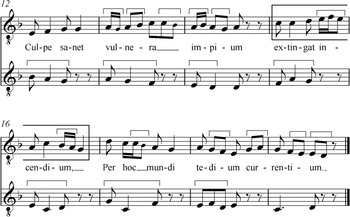
The mention of the fire alone is in fact quite rare in the Latin and vernacular texts of the thirteenth century, with none of them precisely repeating the phrase ‘godless conflagration’.Footnote 69 The formulation impium … incendium does, however, appear in Ovid's Metamorphorses, befitting its pagan origin.Footnote 70 The phrase ‘godless conflagration’ is striking in itself, but might easily go unnoticed over any number of tenors in the large thirteenth-century motet repertory. When set against the tenor IOHANNE, however, the connection of an impious blaze to the activities associated with the feast of St John cannot be missed. The motetus declares that Christ will put out this ‘godless conflagration of those struggling through the weariness of this world’. While Christ remained the one who was supposed to drive out the impurity of humankind, the fact remains that the most famous pagan or ‘godless’ fires in the medieval world were those bonfires kindled at Midsummer. Though the mention of fire may be understood metaphorically in this context, it is no surprise that the idea arose in connection with the IOHANNE tenor from the Baptist's Midsummer feast day, which coincided with the ubiquitous act of lighting bonfires. The music for this motet is marked for importance when mention of the ‘conflagration’ occurs: at the very moment that the upper voice sings extingat incendium (‘put out the [godless] conflagration’), the composer breaks the established confines of the D–d compass in the upper voice, allowing it to ornament the first syllable of the word incendium with clarity, due to the absence of the tenor sounding beneath this upper voice (boxed in Example 2).
The motet Virgo mater salutis exordium vocis supplicancium/IOHANNE from W2, fol. 189r

How are we to understand the charge to extinguish the ‘godless conflagration’ in Virgo mater salutis against the IOHANNE tenor heard on Midsummer Day? We know, for instance, that clergy did not universally condemn bonfire rituals; some probably participated in them, again blurring the lines between elite, official practices and popular lay customs.Footnote 71 The testimony of churchmen like Johannes Beleth and Jacobus de Voragine suggests that church officials were well aware of bonfire rituals and later evidence points beyond mere acknowledgement of the practices and towards the actual participation of clergymen in the Midsummer fire-kindling festivities. The church's involvement over time apparently sought to corral an otherwise non-Christian practice into the Johannine milieu, but learned and popular culture ultimately remained inseparable. In tracing vestigial Gallican practices, Alexandre Bertrand noted that bonfires were kindled near parish churches following the office of Vespers on the eve of the feast. While citizens brought fuel for the fire such as bundles of sticks, it was a priest who ignited the bonfire. After the fire was kindled, prayers were recited and even sacred hymns sung, including the hymn tune Ut queant laxis for John the Baptist.Footnote 72 In the light of Christopher Page's compelling arguments concerning the festival atmosphere that gave rise to some of the thirteenth-century motets, the composer of Virgo mater salutis exordium vocis supplicancium/IOHANNE might have been doing more than just using the timely metaphor of a ‘godless conflagration’. Perhaps under the guise of a stock Marian plea to Christ, he was subtly admonishing his fellow clergymen who engaged in Midsummer rituals, the rules of which continued to be negotiated in the face of the Christian feast of the Baptist's Nativity.
A well-circulated contrafactum of Virgo mater salutis exordium vocis supplicancium is the motet Grevé m'ont li mal d'amer mieus en vaudrai/IOHANNE, found in no fewer than four sources (see Appendix 2). Here too, subtle glimpses into the festival atmosphere of St John's Day surface. The traditional celebration of the solstice, even with its temporal connection to the Johannine nativity feast, sanctioned a temporary suspension of social order and created an inversion of the medieval world-view, a subject to be explored shortly. In Jumièges, the election of a Green Wolf and the mock deposal of this fraternal leader illustrate this urge to change the course of human behaviour on St John's Day. Acceptable conduct could even yield to socially improper displays, specifically between the sexes. An allusion to this break with the status quo may be seen in this contrafactum.Footnote 73 Cast in a high literary register, the account tells of a male lover who makes known his noble intentions in his search for love. In the final verses of the motet text, the poet increases his overall restraint by vowing to steer away from distracting acts of folly (foloier).Footnote 74

When heard against the IOHANNE tenor, the poet's past foolish behaviour in the name of love accords well with general sexual licence that accompanied the Midsummer feast. Loose sexual behaviour and frivolous escapades in the spirit of Carnival were typical for this celebration of suspended social order.Footnote 75 St John's Day was also a day to discover a lifelong mate, one with whom a partner could vault over the Midsummer fire. The nobleman from this motetus might have been imagining such a scenario; at the very least, he testifies to the conflicting traditions (promiscuity vs. commitment) surrounding love at Midsummer.
FESTIVAL FOLIAGE
Understanding popular culture in part demands grasping the mindset of a rural society that was overwhelmingly dominated by agricultural concerns.Footnote 76 The fate of agrarian societies often turned on the capriciousness of the natural elements. But some things were for certain, such as the length of daylight at Midsummer. As the sun swelled to its highest intensity of the year, the Midsummer bonfire did its part to elevate the temperature. The heat of the season brought flowers, foliage and grasses near their peak and were cause for celebration, as plants were set to bear fruit in the late spring and be harvested later in the summer.
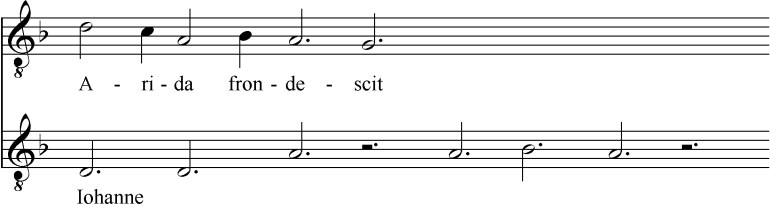
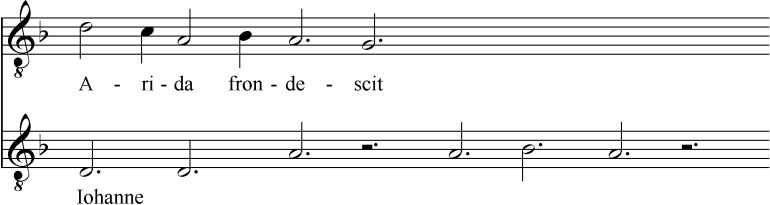
A short musical incipit from a motet in Franco of Cologne's treatise Ars cantus mensurabilis hints at the vibrancy of natural life on this day. As Franco has received due attention for his innovations in rhythmic interpretation, it is easy to ignore the morsels of music that he used to register his new system.Footnote 77 Two of Franco's passing polyphonic examples in his discussion of discant and its species are set to the IOHANNE tenor, not surprising given the wide circulation of this popular melisma. Both fragments feature the opening gesture of a two-voice motet (i.e., with a tenor and texted upper voice). One of the fragments (Ave plena gratia/IOHANNE) concords with a motet from W2,Footnote 78 but another snippet on the same tenor, Arida frondescit/IOHANNE (Example 3), is only known from Franco's treatise. The latter motet is recognisably a texted version of the two-voice clausula F-148, the only clausula connected with motets on the tenor IOHANNE.Footnote 79 In the case of Arida frondescit, Franco merely aimed to provide an example of a piece of discant that began at the octave.Footnote 80 Even in its extreme brevity for reasons of pedagogy, the text of the upper voice seems to accord with themes of fecundity that surrounded the Midsummer feast day. Despite a lack of context for this brief utterance in the upper voice and in the absence of a concordance for the entire motet, we can still gather that the formerly ‘dry [parched] land’ effectively ‘shoots forth leaves’ and flourishes, an idea advanced by the underlying tenor melody from the feast of St John. From this slightest of musical fragments, one witnesses a transformation in the natural world from dry foliage to green leafy plants – an image as fundamental to the summer celebration as the sun.
Arida frondescit/IOHANNE, from Franco of Cologne, Ars cantus mensurabilis. Transcription after Strunk (ed.), Source Readings in Music History, rev. edn (New York, 1998), p. 240
A product of the season's fruitfulness, blooming floral arrangements adorned many spring and summer feasts both within and outside churches. While May Day was best known as a celebration of seasonal flowers,Footnote 81 the feast of Midsummer likewise featured lavish displays of flowers and particular herbs in full bloom, especially in and around the home.Footnote 82 In the storied Green Wolf ritual from Jumièges, citizens made a large loaf of bread bedecked with foliage in addition to ribbons. Midsummer Day was also the day to harvest the famous herb known as St John's wort (also called vervain).Footnote 83 In some ritual practices, bonfire participants held violets as well as other flowers and herbs, which they apparently cast into the blaze – a custom that was said to relieve eye ailments.Footnote 84
The mention of flowers in the thirteenth-century motet repertory, particularly in pastourelle texts, was so common that it has become second nature within the genre. The lengthy triplum of the French double motet Quant vient en mai qu'erbe va verdoiant/Ne sai que je die tant voi vilanie/IOHANNE mentions a floral garland (coroie) and dancing (baler), which would seem to be unassuming references in the context of this pastoral encounter between a passerby and a maiden, who is eager to win back her love Robin. In its two sources (Mo and Ba), the triplum joins in polytextual declamation with the motetus Ne sai que je die tant voi vilanie, a text to be explored later with special connections to Midsummer through its subject of corruption:

The exordium hails the month of May, which might seem to derail any link with the Baptist's principal feast in June. Moreover, this triplum has no obvious literary connection to the corruption text with which it is paired in both sources. And yet, the tale of the shepherdess's longing for love broadly concords with the search for a mate at Midsummer. As we shall see, this text resonates further with the spirit and rituals from the Midsummer festival, in the light of the female protagonist's references to a garland of flowers and dancing.Footnote 86
In pastourelle narratives of the thirteenth-century repertory, one occasionally finds references to a garland or chaplet, as the protagonist often discovers the maiden producing such a floral decoration. But when mention of a garland is made above the tenor IOHANNE, a connection to themes of fertility and fecundity of Midsummer Day emerges that is not afforded by similar references in conjunction with other tenors.Footnote 87 Additionally, the garland is not being made nor is it worn by the shepherdess, as is typically the case in pastourelles. Instead, she explains to the protagonist that she will lure another man (Robin) with several items, one of which is a garland.Footnote 88 In fact, the wearing of garlands and the display of wreaths with seasonal flowers are very often mentioned in accounts of Midsummer festivities.Footnote 89 Loosened from its usual context, the garland from Quant vient en mai text may be reconciled more strongly with themes surrounding the solstice, an idea prompted by the tenor IOHANNE.
While mention of garlands occurs sporadically in pastourelle texts, the added allusion to dancing (baler) in the final line of the upper-voice text Quant vient en mai provides an even stronger thematic nexus with the tenor from the Baptist's nativity. The concluding pseudo-refrain of the pastourelle text seems innocent enough at first: ‘Se de s’amour puis avoir son otroi, / Je voudrai baler' (‘If I can have the gift of his love, I shall want to dance’).Footnote 90 One might think that the notion of dancing fits well into the playful pastourelle prototype, but it turns out that the subject is seldom found in the texts of thirteenth-century motets.Footnote 91 Dancing, however, is an activity associated both with the festivities of the nativity feast of the Baptist and, more importantly, his notorious Beheading.Footnote 92
The Midsummer allegory indeed takes an ironic turn when one considers that John the Baptist's death was brought about by a dance.Footnote 93 The infamous dance associated with John the Baptist is the dance of Salome, the daughter of Herodias and stepdaughter of Herod the Tetrarch. As told in the synoptic Gospels (most vividly in Matthew), Salome's evidently seductive dancing at Herod's birthday banquet pleased the King so much that he granted the young woman any wish. Prompted by her mother, Salome called for the beheading of John the Baptist, an event that the church commemorates with a feast day on 29 August.Footnote 94 As a symbol of the Baptist's martyrdom containing all of the elements of an intriguing drama (a femme fatale, incest and murder), the story of Salome's dance and John's beheading at the banquet of Herod Antipas was a popular subject in the visual arts in the Middle Ages and well into the modern era.Footnote 95
The foregoing evidence gives further testimony that pastourelle texts should continue to be pursued in relation to their accompanying tenors. The temporal convergence of springtime narratives with the Midsummer feast helps unite the popular pastourelle genre with the musical foundation upon which it was constructed. Moreover, the use of uncommon turns of phrase involving garlands and dancing may be subtle clues to the hybrid nature of motet texts, even pastourelles, as they reveal commentaries on the sometimes overlooked tenor rubrics that undergird the thirteenth-century motets.
VERBAL VITRIOL
With their agriculturally oriented lives dependent on the weather, people in the Middle Ages were no doubt sensitive both to seasonal changes and to the cyclical course of the sun across the meteorological year. But they did more than simply internalise the change of heliological and theological course at the solstices: they understood the image of power connected with the sun and acted out the implications of its new waning path. Among the rituals at the winter solstice and the days to follow was a mock inversion of the world, which licensed the opportunity to alter social norms and typical behaviours, akin to Carnival celebrations in preparation for Lent.Footnote 96 Medieval musicologists are familiar with temporary inversions of social order from the case of the Feast of Fools (festa stultorum) on 1 January, where a role reversal in the clerical hierarchy at the Cathedral of Notre Dame of Paris around the turn of the thirteenth century produced some of the richest descriptions of early polyphonic practices in the history of Western music.Footnote 97
The festival at the summer solstice was an analogous time of the year for such role reversals, which extended well outside the confines of the church.Footnote 98 On Midsummer Day, citizens used the occasion as a steam valve to inveigh against temporal authorities, sometimes burning effigies. They rejoiced in the symbolic ‘Fall from Fortune’, which was performed with the downward rolling of the flaming wheel mentioned earlier. Just as the straw wheel was set ablaze and flung down a hill, so too were kings and nobles ultimately subject to imminent downfall.Footnote 99 The wheel-rolling practice conceptually activated the four ‘figures’ who typically surrounded Dame Fortune in medieval art – ‘Regno, Regnavi, Sum sine regno, Regnabo’ (‘I reign, I have reigned, I am without a kingdom, I will reign’).Footnote 100 In the period of palpable heliological crisis at Midsummer, earthly rulers were to have their authority questioned. They were reminded of their vulnerability by the public, who on this day could openly rebuke sovereigns without fear of castigation.Footnote 101 In some French locales, a different political demonstration took place at Midsummer, involving the election of a temporary lord or ruler, who effectively became a whipping post and symbol of the power of popular rebellion (most notably, the Green Wolf ceremony in Jumièges).Footnote 102 Various role reversals, mock elections and condemnation rituals were fundamentally legitimated by the solar turning point.
As with the other Midsummer practices, the criticism of earthly authority – so bound up with the pre-Christian concept of Fortune – persisted in a syncretic way under the sponsorship of John the Baptist. The survival of such a ritual at first appears irreconcilable with the meaning behind the Precursor saint and his nativity feast. And while some have suggested that the church must have resisted a connection between the Baptist and the criticism of authority, it is easy to forget that one particular episode in the life of the Baptist was a literal enactment of the reprimanding of a ruler.Footnote 103 In the narratives of three evangelists, John the Baptist spoke out against the unlawfulness of Herod's illicit relationship with Herodias.Footnote 104 Out of fear of John's moral righteousness and under the evident influence of his sister-in-law and her daughter Salome, Herod would have the Baptist decapitated for his bold dissent of the King's actions. In this sense, the act of publicly rebuking authority fits better with the feast of the Baptist's decollation on 29 August than it does with the nativity commemoration on 24 June. Recognising this similarity between the castigation rituals of Midsummer and the narrative of the Decollation, Sandra Billington has even suggested that a broad summertime ‘window’ for the populace to speak out against authority might have lasted from Midsummer until the Decollation at the end of August.Footnote 105 The criticism rituals in any case have a connection to the Baptist, but the Johannine sheen around the summer feast did not fully stamp out the ancient traditions. As we will see in two motets on the tenor IOHANNE, attacks on the powerful and the privileged co-existed with, or even overshadowed, the musical model rooted in the feast of John the Baptist.
The opportunity to vilify authority publicly on St John's Day could not have gone to waste, given the ecclesiastical corruption and fraud brewing in thirteenth- and fourteenth-century France. The clerical offences of simony and the trafficking of indulgences were beginning to spiral out of control, prompting nascent voices of reform to gather.Footnote 106 The city of Paris, now established as seat of a central government in France, was not immune to criticism, with several popular uprisings in the early fourteenth century in protest of royal fiscal policy, specifically regarding taxation and the devaluation of the coinage.Footnote 107 Cultural products registered these verbal assaults on these abuses of authority, including some Parisian music from the time in question. The works of Philip the Chancellor spring to mind, especially because of the poet's connection to the repertory that blossomed in Paris in the early thirteenth century. Philip's fierce opposition to the election of William of Auvergne as Bishop of Paris (1227–8) and his outrage at the pluralism of benefices held by clerics undoubtedly fuelled some of the stinging rhetoric seen in his output.Footnote 108 Some of Philip's texts even survived in the major musical source of corruption criticism from the late Middle Ages – the fourteenth-century Roman de Fauvel manuscript (Paris, Bibliothèque nationale de France, MS fr. 146), a satire with musical interpolations probably serving as a document of admonition to King Philip V of France, implicitly alerting him to the dangers of malevolent counsellors and providing advice for ruling wisely as a monarch.Footnote 109 It is into this political context that two corruption texts explicitly on the tenor IOHANNE must be received.
It might be expected that echoes of the Midsummer tradition of fulmination towards authorities would scarcely survive as cultural artefacts, given that these attacks appear to be oral traditions emanating from popular circles, not those clerical or courtly ones that accounted for manuscript production.Footnote 110 Yet again, however, it turns out that those who created ‘high art’ digested popular traditions and weaved them seamlessly into the tapestry of their music. The Johannine tenor and attendant polyphonic clausulae apparently inspired clerical poet-composers to generate parodies of the feast, which must have included warnings to those in power, perhaps those within close reach.
Thirteenth-century Parisian motets speaking out against corruption do in fact survive, but they are few and far between.Footnote 111 Philip the Chancellor's Latin texts that were set to music evidently have little to do with the liturgical tenors that are set beneath them, if they were set to tenors at all.Footnote 112 Other Ars antiqua motets do not detail corruption so much as admonish the people addressed in the text.Footnote 113 Therefore, the occurrence of two corruption texts on the tenor IOHANNE appears all the more conspicuous. We have already seen two motet texts based on the two-voice clausula F-148 (Appendix 2). The motet fragment Arida frondescit vaguely suggested themes of greenery and fertility, while the triplum pastourelle text Quant vient en mai revealed subtle references to the Midsummer celebration in its mention of garlands and dancing. The motet text Ne sai que je die tant voi vilanie and its contrafactum Cecitas arpie fex ypocrysie are likewise based on the popular clausula F-148, but in this case they constitute an important connection to the general criticism rituals associated with the Midsummer feast.
Ne sai que je die appears with the tenor IOHANNE in five different manuscripts (listed in Appendix 2), making it the single most employed text in the entire Johannine family. It is found twice in the Montpellier Codex, first in a two-voice motet and later expanded to a three-voice setting with addition of the triplum Quant vient en mai.Footnote 114 The vernacular duplum Ne sai que je die speaks very generally to the age of corruption, but the explicit mention of the disappearance of courtoisie in those with the ‘highest repute’ points to misconduct among nobles or the king, not an unlikely charge for the later thirteenth century. The appearance of this corruption text above the tenor IOHANNE is no contradiction, but a clue to the compatibility of the tradition of public criticism with the feast of St John. As the poet reproaches those in power, he notes that the virtues of joy and good company have been dismissed as ‘foolish’ excesses. A form of the word folie was seen earlier in the motet Grevé m'ont li mal d'amer/IOHANNE, again revealing a clue to the pervasive spirit of misbehaviour recognised on the day when the sun changes its course.

The IOHANNE tenor inspired a considerable range of upper-voice material, encompassing both theological and practical applications of the seasonal commemorations. In the two manuscripts where Quant vient en mai was layered above Ne sai que je die (Mo and Ba), the effect of the simultaneous declamation of texts delicately hints at a rich array of Midsummer traditions, from the joyous celebration of nature and dancing to the deep criticism of authority sanctioned on the feast. The tradition of Midsummer rebuke is carried one step further when the references become couched in an important musico-historical artefact that vigorously mocks and questions authority – the Roman de Fauvel.
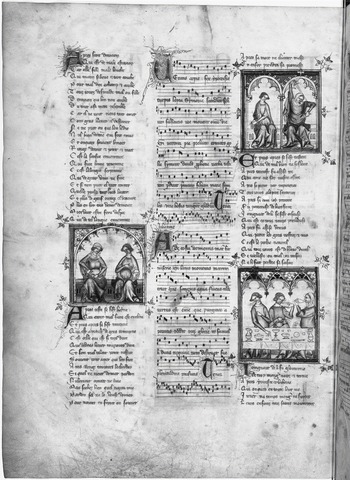
The Latin contrafactum Cecitas arpie fex ypocrysie features a more admonitory tone than Ne sai que je die. Both motets are found in the W2 manuscript, possibly conceived as Latin and vernacular correlates.Footnote 116 More importantly, some two generations after the compilation of W2, the Latin motet with a variant first syllable (Veritas arpie fex ypocrysie/IOHANNE) would be included in the Roman de Fauvel, the early fourteenth-century satire detailing the imagined effects of complete political and ecclesiastical upheaval in France. The authors of Fauvel, intimately familiar with the political ramifications of the Midsummer feast, knew exactly where to look for criticism material. Both corruption motets in fact are not just superficially critical of secular and sacred authority through the direct references in their upper voices, but they are ‘hard-wired’ to serve this purpose through the association with the Baptist's feast at the summer solstice. The compilers of the Roman deftly positioned Veritas arpie fex ypocrysie/IOHANNE within in the ‘roll call’ section of the manuscript (fols. 12v–15v), where forty-nine allegorical Vices (including Carnality, Envy, Sloth, etc.) are named as courtiers of Fauvel (see Figure 1). This section of the manuscript directly precedes Fauvel's encounter with Dame Fortune, who will ensure the downfall of the donkey-ruler. The Latin poetry of this contrafactum maintains an important aural connection to the vernacular Ne sai que je die with the preponderance of the terminal [i][e] vowel sounds at the ends of lines:

The motet Veritas arpie fex ypocrisie/IOHANNE. Paris, Bibliothèque nationale de France, fr. 146, fol. 13v (middle column, top half)

Reminiscent of some of the texts by Philip the Chancellor, Cecitas/Veritas arpie fex ypocrysie is notable for its critical stance, drawing on Old Testament references to remind the nameless perpetrators that their reward in heaven will be lost should they continue their errant behaviour in church office. The separate allusions to both Goliath and Uriah suggest the imminent downfall of the corrupt ones rebuked in the upper-voice text. The comparison with the warrior Goliath is familiar. As the famous story from 1 Samuel goes, the confident Goliath, emerging from the camp of the Philistines, did battle with a young David, who fought on behalf of Saul and the Israelites. Goliath of course was mortally struck down by a slingshot from the undersized David.Footnote 117 The implication in the upper-voice text of this motet, then, is that the Philistines – a symbol for the enemies of the Church – will meet their demise for their arrogance.
The final utterance of the Latin motet (‘Simile Urie / Hostis tingunt gladium’) likewise engages an Old Testament analogy, as it compares the corrupt individuals to the lesser-known figure Uriah the Hittite. Uriah himself was neither evil nor corrupt, but naive, manipulated and abused by the same King David. Similar to the hypocrites in power being admonished in the motet text, Uriah did not foresee his own downfall. After King David committed his infamous act of adultery with Uriah's beautiful wife Bathsheba, he sought to eliminate Uriah by placing him unprepared in the front lines of his army, where he was quickly killed by the enemy.Footnote 118 The Latin ‘Simile Urie / Hostis tingunt gladium’ confirms the notion that death is imminent.
Beyond the pure admonishment reminiscent of the Midsummer tradition, it should also be remembered that John the Baptist himself met a swift death by the sword as well, making the text resonate further with the John-inspired tenor. But there is yet more to the analogy between the Precursor and the Hittite: both were witnesses to corrupt rulers, specifically rulers who had each committed the act of adultery.Footnote 119 From this perspective, we can see how these scenes from the book of Samuel fit seamlessly into the solstitial ritual of criticising authority, not to mention the narrative of John the Baptist, especially when cued by the IOHANNE tenor.
Because of the mention of simony – the ecclesiastical crime of paying for offices in the Church's institutional hierarchy – the corrupt individuals who are censured in the upper voices of Cecitas/Veritas arpie fex ypocrysie appear to be clerics (and not temporal rulers). In the IOHANNE motet family, this Latin contrafactum serves as a complement to the targeting of temporal rulers in the text Ne sai que je die. Billington has explained that the Western Christian Church used the tradition of speaking out on the nativity feast of John the Baptist as a reminder of the ephemerality of worldly power and success, emphasising that the only permanent authority of this world belongs to Christ.Footnote 120 However, she does not broach the subject of those speaking out against corruption within the Church itself, as we witness in Cecitas arpie. This motet text, in short, suggests that clerical abuses should be included in the possibilities of St John's Day criticisms aimed at those invested with the power of ecclesiastical office.Footnote 121
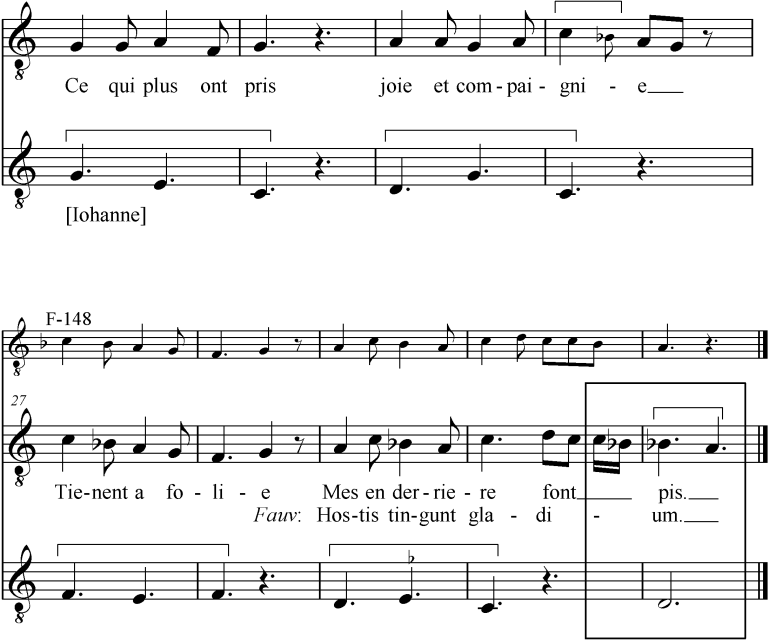
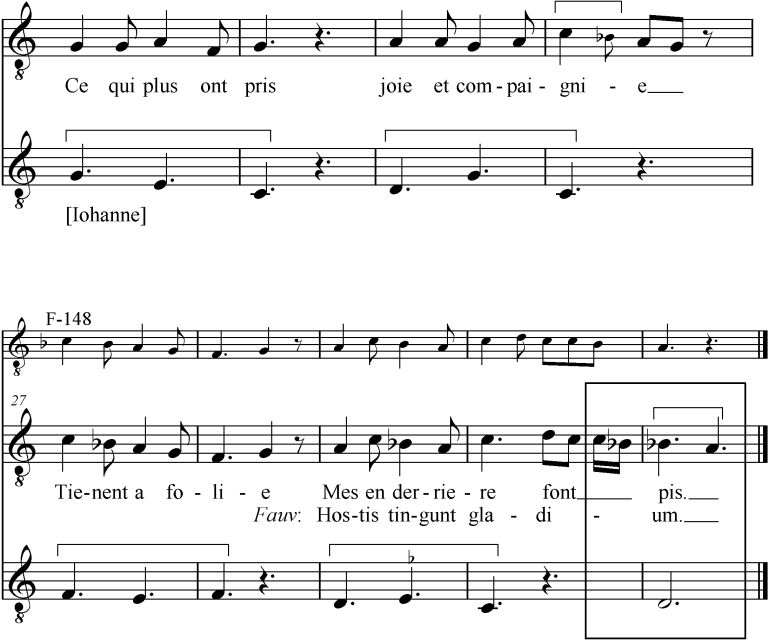
The stern warning to authorities, issued in both Ne sai que je die/IOHANNE and its Latin contrafactum, is registered at the musical surface. In two versions of this motet, the final gesture is modified from the clausula source and recast with an unexpectedly suspended fa–mi resolution in the upper voice for the final two notes over the tenor's final pitch D (Example 4). While this compositional turn represents a slight departure from other examples of this well-travelled motet, the conclusion deepens the emotion in this short work, and modern performances have tended to emphasise the ending's threatening quality quite profitably for its pathos.Footnote 122 The conclusion in the vernacular ‘Mes en derriere font pis’ (‘ultimately they will do worse’) from the Montpellier Codex and the corresponding Latin ‘Hostis tingunt gladium’ (‘They whet the sword of the enemy’) from the Fauvel manuscript are ominous suggestions on their own. But together with this striking musical gesture and the looming Johannine tenor, these foreboding texts sound a menacing warning to those in power.
End of Ne sai que je die/IOHANNE (Mo, fol. 235r), following the transcription by Rokseth, Polyphonies du XIIIe siècle, iii, p. 9. Corresponding text in Fauv, fol. 13r included for comparison
That the Latin and vernacular motets on the IOHANNE tenor censure ecclesiastical and royal authorities respectively lends credence to the idea that there was still political significance tied to the feast of John the Baptist, as the Christian overlay to Midsummer Day.Footnote 123 Indeed, the coincidence of John's nativity feast with Midsummer rituals involving the admonishment of the powerful casts a political hue on the saint's reception. John's ministry itself can, in some ways, be considered a moral reprimand to his followers in preparation for the coming of Christ,Footnote 124 while the details surrounding John's beheading are a fitting example of his questioning of moral authority. However, the general nature of the Latin and vernacular corruption texts transports the idea of moral chastisement to a broader sphere, well beyond the usual exegetical territory associated with the Precursor saint.
The evidence for the repudiation of authorities is scarcely reported in the sources that have come down to us, probably due to the fact that these practices were performed by the powerless, who would have lacked the means to record and preserve these events for posterity. Still, traces of mock elections, the burning of effigies and other scattered pre-modern testimony intensify our picture of the political vitriol emanating from the populace in many locales and across several historical periods. The condemnation of the haughty was not surprising given the pre-Christian heritage of the ‘Fall of Fortune’ around the Midsummer festivities, where citizens reflected on the ephemeral nature of those in high office, even to the point of demonstrating their hot-headedness towards the powerful. The underlying presence of John the Baptist in the tenor of in Ne sai que je die and Cecitas arpie hardly lessens the admonishments in the upper voices. Instead, the polysemic potential of the Johannine tenor melody effectively opens up a discursive space for the cautionary sentiments of the upper voices and even draws our attention to the time of year when it might have been performed.
CONCLUSION
The ancient Romans were no strangers to the great ambivalence of the summer solstice: it was at once a day of celebration and one of great crisis. Pliny considered the festival of Midsummer a moment of great interest to the whole earth, serving as an important turning point in the year (magnus hic anni cardo).Footnote 125 As people rejoiced in the blossoming plant life and the plentiful daylight during this critical time, they experienced the emotional ‘high’ of the season; at the same time, they were reminded of the ‘low’ to come in the colder and darker months ahead. The analogy with the waning sun in the cycle of the calendar year was echoed in a pessimistic view of earthly power. The earliest Christians' appropriation of Midsummertide as the nativity feast for St John established clear symmetry with Christ's nativity around the time of Midwinter, creating what James George Frazer has termed the ‘golden hinges’ of the calendar year.Footnote 126 But more importantly, the Forerunner's nativity feast accommodated the wide-ranging, pre-Christian imagery and practices that surrounded the Midsummer celebration. The Christian overlay on pagan observances was not overpowering, as demonstrated both in the Green Wolf ritual and in the admonitions of theologians, bishops and clerics.
One may think of this process in musical terms and apply it to this large family of thirteenth-century motets built on the tenors IOHANNE and MULIERUM. Mainly drawn from recognised liturgical plainchant, these all-important tenors are the authoritative voice of the Church. At the same time, the tenors are wordless and fragmented, and the control they exert on the upper voices varies widely, from texts that theoretically could be sung on a given liturgical feast to seemingly distant descriptions of ribald, pastoral encounters. The tenor implicitly reconciles and sanctions the thematic direction of these unpredictably layered voices, whether pious or profane in nature. This symbolic musical extraction does not stifle that which is discordant in the upper voices – it embraces the new poetry. Just as a sermon could potentially draw on well-known images and use capricious rhetoric to illustrate as little as a single evangelical verse, so have composer-poets used motet texts to explicate their tenors, sometimes in unexpected and ironic ways.
In the present case of the solstitial references, these images were evidently embedded, perhaps almost from birth, in the minds of composers. The special markers of Midsummer (women, sun, fire, hot-headedness, flowers and general folly) are hardly conspicuous when viewed individually. But when they all appear in a single large family of motets, governed by the tenors associated with the nativity feast of John the Baptist, their repetition becomes meaningful and indicative of the mindset of the composers. The creators of these works instinctively incorporated wide-ranging seasonal associations in motets, a genre in which a tradition of commentary prevailed. Through analysis of entire motet families, these references can be distilled from what is otherwise the generic poetry of the pastourelles and courtly love songs of the late Middle Ages.
This study suggests that more connections remain between the venerable tenors and their expounding upper voices in these clerical ditties, many of which were probably created for a festival-type milieu. The ripest areas for further enquiry involve those tenors associated with saints' feasts, since these days generally include a melange of traditions, as we have seen with the nativity feast of John the Baptist.Footnote 127 Pursuing the cultural meaning and seasonal implications of these pithy tenors, we will continue to unearth references to popular culture embedded in other tenor families and other genres of late medieval music.Footnote 128 In doing so, we can witness an assimilation – or dissolution – of perceived sacred and secular poles, at the same time conceptualising a new kind of ‘learned’ musical product of the Middle Ages, one that admits popular allusions into some of our most revered polyphonic works of this period.
APPENDIX 1
The Green Wolf Ceremony
Source: J. G. Frazer, The Golden Bough: A Study in Magic and Religion, 3rd edn, 12 vols. (New York, 1935), x, pp. 183–4.
Every year, on the twenty-third of June, the Eve of St. John, the Brotherhood of the Green Wolf chose a new chief or master, who had always to be taken from the hamlet of Conihout. On being elected, the new head of the brotherhood assumed the title of the Green Wolf and donned a peculiar costume consisting of a long green mantle and a very tall green hat of a conical shape and without a brim. Thus arrayed he stalked solemnly at the head of the brothers, chanting the hymn of St. John, the crucifix and holy banner leading the way, to a place called Chouquet. Here the procession was met by the priest, precentors, and choir, who conducted the brotherhood to the parish church. After hearing mass, the company adjourned to the house of the Green Wolf, where a simple repast, such as is required by the church on fast-days, was served up to them. Then they danced before the door till it was time to light the bonfire. Night being come, the fire was kindled to the sound of hand-bells by a young man and a young woman, both decked with flowers. As the flames rose, the Te Deum was sung, and a villager thundered out a parody in the Norman dialect of the hymn Ut queant laxis. Meantime the Green Wolf and his brothers, with their hoods down on their shoulders and holding each other by the hand, ran round the fire after the man who had been chosen to be the Green Wolf of the following year. Though only the first and the last man of the chain had a hand free, their business was to surround and seize thrice the future Green Wolf, who in his efforts to escape belaboured the brothers with a long wand which he carried. When at last they succeeded in catching him, they carried him to the burning pile and made as if they would throw him on it. This ceremony over, they returned to the house of the Green Wolf, where a supper, still of the most meager fare, was set before them. Up till midnight a sort of religious solemnity prevailed. No unbecoming word might fall from the lips of any of the company, and a censor, armed with a hand-bell, was appointed to mark and punish instantly any infraction of the rule. But at the stroke of twelve all this was changed. Constraint gave way to license; pious hymns were replaced by Bacchanalian ditties, and the shrill quavering notes of the village fiddle hardly rose above the roar of voices that went up from the merry brotherhood of the Green Wolf. Next day, the twenty-fourth of June or Midsummer Day, was celebrated by the same personages with the same noisy gaiety. One of the ceremonies consisted in parading, to the sound of musketry, an enormous loaf of consecrated bread, which, rising in tiers,was surmounted by a pyramid of verdure adorned with ribbons. After that the holy hand-bells, deposited on the step of the altar, were entrusted as insignia of office to the man who was to be the Green Wolf next year.
APPENDIX 2
Motets on MULIERUM and IOHANNE

a Subgroups boxed in boldface share the same music, whether or not the source clausula is known. Manuscript sigla, clausula numeration and updated catalogue numbers for the motets are taken from Hendrik van der Werf, Integrated Directory of Organa, Clausulae and Motets of the Thirteenth Century (Rochester, 1989).
b Italic words indicate a keyword specific to Midsummer images or rituals.
c From Franco of Cologne's theoretical treatise Ars cantus mensurabilis.