Newspapers have become central to studying the history of colonialism. To historians facing limited and biased archives, they promise to recover the voices of the colonized. Read in this way, newspapers have yielded insights on the development of new conceptions of selfhood, grassroots social movements, and the emergence of modern prose.Footnote 1 Benedict Anderson famously argued that the adoption of vernacular print languages inspired ‘imagined communities’ that geared modern nationalism towards the ideal of the nation state.Footnote 2 In contrast, scholars of Asian and African print cultures have shown that vernacular newspapers could imagine far more heterogenous communities.Footnote 3 The case of German East Africa contributes to these debates about newspapers, subaltern voices, and nationalism. Between 1904 and 1916, the colonial government published a Swahili newspaper called Kiongozi (The Guide or The Leader). Although German teachers retained editorial control, Africans wrote the bulk of the newspaper's content. Under German rule, Swahili was made the sole language of administration. Scholars have surmised that the resulting spread of the language contributed to the emergence of supra-tribal identities, which benefitted the success of anticolonial nationalism after 1945.Footnote 4 But while African nationalists gradually adopted Swahili in the interwar period, speaking the language had little to do with the idea of a nation before the First World War.Footnote 5 Anderson himself noted that reading back the origins of postcolonial nationalism risks treating ‘languages in the way that certain nationalist ideologues treat them – as emblems of nation-ness’. What is more important is how languages may have fostered ‘particular solidarities’.Footnote 6
This article explores whether Kiongozi encouraged such solidarities and how they might have shaped subsequent Tanzanian history. Kiongozi played an ambivalent role that reflected the contradictions of colonialism writ large. On the one hand, the newspaper convened a community of educated Africans by promoting the shift from Swahili written in Arabic script, called ajami, to Latinized Swahili. The paper's African authors and readers were teachers, administrators, and soldiers trained at government schools such as Tanga, where Kiongozi was published. After completing their education, graduates entered government service and were spread thinly across the vast territory. By offering this small diaspora a forum, the paper fostered a culture of literacy that — as British officials recognized — prepared the ground for Tanganyika's interwar press.Footnote 7 Kiongozi formed part of a rare effort to cultivate a vernacular language of colonial government.Footnote 8 In the German colonies, no other government newspaper was published in the vernacular.Footnote 9 German rule in East Africa has rightly been viewed as an oppressive regime that provoked widespread resistance and upended local cultural life.Footnote 10 But German rule also accelerated the inland expansion of coastal Swahili culture through its ‘mutual assimilation’ with European and African elements.Footnote 11 By reading and writing Latinized Swahili, the paper's waletaji wa habari — its bearers of news — became trailblazers of this process. Indeed, early colonial newspapers such as Kiongozi illuminate a pivotal chapter in East Africa's social and cultural history.
On the other hand, Kiongozi served the power of the colonial state. Max Weber defined power as ‘every chance within a social relationship to impose one's own will even against resistance, regardless of what this chance is based on’.Footnote 12 In this sense, German colonialists based their power primarily on military force and corporal punishment.Footnote 13 The bearers of news exercised some of this violence. Kiongozi aided them in fulfilling their duties. Teachers employed the newspaper as study material, administrators followed the latest decrees published in it, and African soldiers (askari) used its wanted posters to identify deserters. When the peoples of the south of the colony attempted to shake off German rule during the Maji Maji war of 1905–7, the bearers of news justified the execution of rebels and the famine caused by a German scorched-earth campaign. However, this dependence on force reflected the inherent weakness — not the omnipotence — of the colonial state. Drawing on Pierre Bourdieu's notion of ‘symbolic power’, Michael Pesek has highlighted that German rule remained fragile and tried to compensate for its inability to maintain control with symbolic practices such as shauri (public councils) and military pageantry.Footnote 14 Bourdieu understood language as a symbolic system of communication structured by unequal power relationships.Footnote 15 In this view, symbolic power consists in the ‘invisible’ means that achieve the acquiescence of subjects in their own domination. Key to acquiescence are ‘instruments of knowledge and communication’ that enable members of one social group to control another.Footnote 16 By promoting Latinized Swahili, Kiongozi became an instrument of knowledge and communication that asserted the symbolic power of the colonial state.Footnote 17 Externally, it did so by touting the superiority of European knowledge over that of subject societies. The waletaji wa habari directed their audience to embrace compulsory education, colonial medicine, and German rule. Writing in Swahili lent a vernacular hue to the civilizing mission and identified its enemies as the washenzi, the illiterate barbarians of the interior. Internally, Kiongozi mediated between German colonizers and their African subordinates. While the former could construct and control the voices of their interlocutors through censorship, the latter could demonstrate their allegiance to the colonial project. In the wake of Maji Maji — when defections had cast doubt on the loyalty of African intermediaries — the paper thereby helped to stabilize a precarious colonial state.
Yet Kiongozi's assertion of colonial power neither went unchallenged nor did it necessarily reflect a genuine commitment to German rule. Bourdieu emphasized that the effectiveness of symbolic power depends on the mutual recognition of symbols by rulers and ruled. Such a homology of symbolic practices was never attained in German East Africa.Footnote 18 Counternarratives continued to challenge the authority of German colonizers — whether in the form of students flunking school, patients trusting traditional healers, or followers of the Maji medicine taking up arms. Beyond cooptation, Kiongozi exposes the warped nature of African voices in the colonial archive. The only extended study of the paper claimed that the waletaji wa habari's support for colonialism reflected the success of German cultural colonization.Footnote 19 In contrast, Emma Hunter and Harri Englund have warned against reducing government-owned colonial newspapers to artefacts of subaltern mimicry.Footnote 20 Recent scholarship has illustrated that colonial intermediaries not only abided by orders, but also pursued their own agendas.Footnote 21 Similarly, Kiongozi allowed the bearers of news to demonstrate their loyalty through literacy, mirroring other arrangements of cooptation across colonial Africa.Footnote 22 Scholars such as Walter Ong have suggested that literacy makes its bearers more rational, empathetic, and modern. Critics of this ‘great divide’ thesis contend that reading and writing carry no intrinsic cognitive qualities and have to be understood as culturally variant practices.Footnote 23 Africanist historians have bolstered this view, emphasizing that literate cultures draw on oral ones and vice versa.Footnote 24 Whereas advocates of a ‘great divide’ overestimate literacy's capacity to shape consciousness, their critics often ignore how a rhetoric of rationality may legitimize relations of power founded on literacy.Footnote 25 Reading Kiongozi did not make its audience more rational. Rather, the teaching of Latinized Swahili formed part of an ideology that discounted the rationality of interior African societies. Kiongozi's appeals against washenzi ‘nonsense’ were epistemic attacks against subaltern challenges to the introduction of ‘rational’ education, medicine, and government. In this respect, the newspaper helped to inaugurate a secular rhetoric of authority that persisted under British rule and after independence in conflicts between supposedly enlightened, literate bureaucrats and recalcitrant, illiterate peasants.Footnote 26 Consequently, claims that colonial newspapers engendered new forms of selfhood and community should consider authors’ subaltern position as much as how literacy perpetuated existing, or created new, social hierarchies.Footnote 27 Studying Kiongozi enriches our understanding of the history of print in largely illiterate societies, the role of colonial intermediaries, and the relationship between vernacular languages, colonial rule, and nationalism. To illuminate these relationships, the article first examines Kiongozi's origins and role in promoting Latinized Swahili. Second, it analyzes the paper's authors, structure, and readership. Finally, it considers how the newspaper contributed to the assertion of colonial power in the wake of Maji Maji.
LANGUAGE AND PRINT
Three factors shaped the creation of Kiongozi: its affiliation with the government secondary school at Tanga, a shift in the colony's language policy, and the desire to better control the state's African intermediaries. Paul Blank, the headmaster of Tanga school, founded Kiongozi in 1904.Footnote 28 The school was the colony's highest institution of learning for Africans. Its aim was to train the clerks, teachers, and translators necessary to consolidate colonial rule. Founded in 1892, the school was the brainchild of German East Africa's first governor Julius von Soden and the German Colonial Society. Von Soden believed that the colony required a government school that could train African clerks independent of religious schools, whose graduates often remained tied to the missions.Footnote 29 Subjects at Tanga ranged from Swahili and German to math, geography, science, and singing. The avowed aim of this instruction was to train students in administration and to ‘educate’ them to work. Beyond this narrow mandate, teachers considered ‘the research, enrichment, and perfection of the linguistic treasure of the natives . . . their primary purpose’.Footnote 30 Early instruction relied on Swahili teaching materials by the British Universities Mission to Central Africa (UMCA), but successive headmasters developed their own curriculum with African assistant teachers.Footnote 31 Despite reservations about its ‘slightly unappealing English-Swahili’, the school followed the orthography of UMCA missionary Edward Steere, which was based on the Kiunguja dialect of Zanzibar.Footnote 32 In 1904, Blank and other teachers rejected calls by some district officers to align Swahili spelling with that of German.Footnote 33 Tanga was unique among government schools in the German colonies to cultivate a vernacular in this way.Footnote 34 Kiongozi formed part of these efforts by offering texts that could be used in teaching and a written forum of exchange for the school's graduates.
The creation of Kiongozi also cemented a shift from ajami towards Latinized Swahili. At the beginning of German rule, the language was already widespread as a result of the nineteenth-century caravan trade and had been written in Arabic script for centuries.Footnote 35 Colonial officials in Berlin initially aimed to make German the language of administration. In contrast, administrators on the ground pragmatically embraced ajami.Footnote 36 Some missionaries and officials objected to using Arabic script because they feared it would spread Islam.Footnote 37 The shift away from ajami began in 1899, when Governor von Liebert decreed that official correspondence had to be written in Latinized Swahili. In 1906, government schools restricted the teaching of German to higher grades in favor of Swahili. Governor Rechenberg justified this step by arguing that mastering the language constituted a necessary precondition to learning German.Footnote 38 The government's move relied on previous efforts of the Church Missionary Society (CMS) and the UMCA. Since the 1840s, their European missionaries and African adherents had developed Swahili orthographies in Latin script.Footnote 39 But the government's pivot also aimed to deny the colonized potential leverage against their rulers. German Protestant missions — which only embraced Swahili after 1908 due to concerns over its association with Islam — criticized what they considered ‘a superficial make-belief education’ in German that would breed ‘a vain, demanding, and easily dissatisfied race’.Footnote 40
Kiongozi was meant to prevent the emergence of such a ‘dissatisfied race’. After the Abushiri rebellion of 1888–9, when coastal Muslim elites resisted German encroachment on the slave and ivory trade, the administration coopted its former adversaries by employing them based on the administrative system of the Busaidi Sultanate. While aristocratic maliwali (governors) oversaw towns, maakida (magistrates) acted as intermediaries between subsidiary majumbe (village headmen) and superior German district officials. Under Zanzibari rule, maakida had been community leaders who maintained order and organized public events.Footnote 41 The Germans professionalized the office of akida, making it part of a civil service career that began with serving as a government teacher and ended with becoming a liwali.Footnote 42 Maakida usually had no allegiance to their area of posting and became effective albeit feared tax collectors. Resentment against their efficiency contributed to the outbreak of Maji Maji. But because some maakida and majumbe had cooperated with the rebels, the loyalty of African intermediaries was called into question.Footnote 43 Consequently, the government sought to increase control over African officials and improve their rapport with German superiors. Thus, Headmaster Blank explained that Kiongozi ‘offered the possibility to become more and more familiarized with the intellectual features, the mindset, and the character of the natives’.Footnote 44 For German colonialists, the newspaper became an instrument to study and control African intermediaries when their loyalty had seemingly been compromised. In this way, the newspaper contributed to the consolidation of German rule after Maji Maji.
A SCHOOL NEWSPAPER
By 1904, Tanga had become the training center for the colony's administrative elite. Two of Kiongozi's most prolific authors illustrate the close relationship between school and newspaper. Alfred Juma was a Mbondei from Usambara who had been educated by the UMCA at Magila and at Kiungani College on British-controlled Zanzibar.Footnote 45 After teaching at different mission schools, Juma transferred to Tanga in 1898, becoming Headmaster Blank's assistant and, ultimately, the colony's longest-serving African government teacher. Meanwhile, the Muslim poet Mwabondo Mwinyi Matano was a scion of the Shambaa dynasty of Kilindi and hailed from Mnyanjani. After attending primary school for six years as an adult, he was trained by Blank and became an assistant teacher in 1904. In 1908, he was promoted to government teacher. Four years later, he was assigned school supervisor, a position he held until 1916.Footnote 46
Juma, Matano, and the other waletaji wa habari produced a fully-fledged newspaper. From the beginning, they offered advice on a wide array of subjects, ranging from agriculture and home construction to European timekeeping.Footnote 47 This didactic streak was reflected in Kiongozi's name, which meant ‘guide on a road, director’ and ‘leader of a caravan’.Footnote 48 In December 1909, Kiongozi adopted a full newspaper format of 44 x 32 cm with an average of four to six pages.Footnote 49 Over the years, the paper's structure remained largely unchanged. Issues opened with announcements and ordinances. Then followed editorials written under the pseudonym ‘Kiongozi’ or by individual authors. Turning the page, readers could study the didactic column of ‘Shauri njema’ (good advice), enjoy the fiction and poetry of ‘Baraza’ (place of public audience or reception), or catch up on ‘Habari za dunia’ and ‘Habari za nchi’ (world and local news). The subsequent entertainment section offered riddles and games.Footnote 50 In the ‘Majibu kwa’ (answers to) section, which was renamed ‘Mfuko wa barua’ (postbag) in 1910, the editors communicated with correspondents, prospective and current subscribers, and readers interested in purchasing books published by Tanga's printing press.Footnote 51 Issues closed with advertisements for German and African businesses and job offers.Footnote 52 Africans were central to every aspect of producing the newspaper. Between April and October 1906, Juma served as sole ‘responsible editor’. While permanent staff at Tanga wrote major articles and helped edit the paper, the majority of contributions were sent via mail by unpaid correspondents. In its first year, Kiongozi received submissions from 47 contributors in thirty locales. By the end of 1909, more than 300 contributors who hailed from over 160 towns and villages had published in the paper, although 82 locations had only submitted material once.Footnote 53 In October 1910, the 55 most-frequent correspondents were awarded a copy of the book Askari wa kidachi as ‘their little present’.Footnote 54 Coordinating this collective endeavor was not easy. Correspondents faced harsh rejection: ‘Amiri Saidi, Ruvu. The news you brought were put into Kiongozi, but your story did not fit the paper. The trash can was hungry, it swallowed your story.’Footnote 55 The editor repeatedly exhorted authors to adhere to grammar rules and to send dues only via secure money order. He requested that ‘all of you . . . send news that are useful to everyone, and not news of nonsense.’Footnote 56 Once submissions were accepted, typesetters of Tanga's press cast authors’ words onto paper. By 1908, the shop employed fifty African students, who produced 2,000 copies of Kiongozi per issue.Footnote 57 Finished issues were mailed to subscribers’ nearest government office and distributed by local teachers and officials. Despite the paper's expansion over the years, the number of German staff fell from five to three. Those who remained were overworked and often sick in bed.Footnote 58
German teachers used the newspaper to depict Germany as a benevolent empire. Each January and November, they celebrated the birthdays of Emperor Wilhelm II and his wife Auguste Viktoria. In one of these elegies, ‘the German’ (‘dt.’, or datchi) argued that Germans did not ‘honor the Kaiser by order of their masters’ but that they were grateful to the dynasty for having brought ‘blessings and peace to all people’ in the form of taxes and a strong military. He then asked:
And we in the country here do we also have a reason to thank him? — Yes, we do! In Germany the bad times were more than 500 years ago; but here in our country that evil did not end long ago. Ask your fathers and grandfathers if they knew that evil! They will tell you that they could not travel by day without being kidnapped or killed. The big men of the past mistreated the poor badly. The powerful approached the weak, beat them and plundered their wealth or enslaved them. They will also tell you that often thousands and thousands of people died of hunger, the plague or disease . . . Now our Kaiser has finished removing all this evil, and this is why we want to thank him today.Footnote 59
African authors echoed this propaganda. Amiri Saidi claimed that
[w]hen we remember the things of the past, we talk about them, many of us thank our Kaiser who built us good things now. Some of the old people are thankful to receive this rule. Those who are not content are those who were oppressors and plunderers, because they are not happy under this rule. Those that are thankful are those who were treated badly. In the past people were by themselves selling each other. Anyone who was walking on the road, small or large, would be caught, slaughtered, or sold into slavery. But now all things are abolished by the deed of Kaiser Wilhelm II.Footnote 60
According to Amiri, those who resisted paying taxes were ‘fools’ because they did not realize that their money was used ‘for the construction of useful things, such as bridges over rivers, or good streets in towns and in the bush, so that we can travel with ease’.Footnote 61 Hilde Lemke asserts that German teachers could barely edit these contributions for fear of alienating African colleagues.Footnote 62 But censorship was commonplace. German teachers limited the use of Arabic loanwords prevalent in coastal dialects because they feared their use would spread Islam.Footnote 63 Tanga's late Headmaster Sendtke admitted in retrospect that the paper received so many submissions that he could not compile a manuscript archive. Instead, he made a big bonfire of them every month.Footnote 64 German censorship probably resembled that under British rule, when submissions to the government newspaper Mambo Leo (Current Affairs) were ‘invariably the subject of strict scrutiny, and not infrequently . . . rejected, while others are submitted to correction and excision before publication’.Footnote 65 Kiongozi therefore allowed German officials to construct African voices that echoed their own propaganda. In this view, colonialism had ended slave raiding, famines, and epidemics and brought peace and infrastructure instead. In fact, German rule proved much more contradictory and disruptive. Officials ended slave raiding but tolerated slavery's persistence to bolster the colony's labor supply. Famines — some of which were caused or exacerbated by the large number of ‘punitive expeditions’ — continued to exact large tolls. And although the colony's persistent labor shortage created leverage for workers, infrastructure projects often relied on forced labor.Footnote 66
But the Tanga newspaper offered more than sycophancy. The waletaji wa habari touched on some of the social effects of colonialism, such as elders’ loss of authority. According to Matano:
These days you see a wickedness among modern children of not fearing their fathers, they play with them very much. When the child is subdued by his father, he rebels; when his father becomes angry and punishes him, eventually [the child] tells him: ‘I have insulted you on purpose, and if you hit me I will go tell the master (bwana).’ So, when the father is told this, he becomes scared. These things not only concern school children, but even children who work for other masters. Accordingly, all elders are very angry about the arrogance of their children, they are anguished, they do not have any power due to the Europeans (wazungu).Footnote 67
Matano conceded that ‘not every child is supposed to be polite and respectful’, but since children were a gift from God and were raised by their parents, they had to honor their elders.Footnote 68 Meanwhile, younger men such as Eustice thought elders themselves were to blame. He complained that:
You ask why the old customs have been abandoned? You answer: European culture (Uzungu) has come and has changed things. Is that true? The Europeans have changed our customs, which were good? No. The Europeans very much like to keep our old customs, which were good. Moreover, the Europeans help us raise our children. Yes, children should be sent to school, learning about the good progress of men and manners . . . When a child emerges from circumcision, you will see that he does not fear people due to pride. And this pride is the downfall of children.Footnote 69
To Eustice, elders jeopardized children's future by letting them undergo circumcision rites rather than sending them to school. Given that many waletaji wa habari had been taught by or were teaching in government schools, Eustice's praise of their alleged disciplining power is perhaps unsurprising. But government education and literacy in Latinized Swahili also became constitutive of the bearers of news’ status. Sendtke remembered the satisfaction of contributors seeing their name in print.Footnote 70 When Alfred Juma reflected on his life in the pages of Mambo Leo, he stressed how ‘very honored’ he was by Blank, his fellow teachers, and all students.Footnote 71 This pride illustrates that in largely illiterate societies literacy became what Derek Peterson has called ‘a socially creative activity’ that constituted new forms of community and status.Footnote 72 Literacy was no novelty on the Swahili coast. But on the eve of German rule, books remained so rare that they were thought to hold magical powers.Footnote 73 The bearers of news’ command of Latin script allowed them to access a privileged universe of knowledge. The socialization in government schools cast a long shadow. In the 1940s, the remaining German-educated teachers at Tanga still formed a group apart.Footnote 74 The longevity of this community partly resulted from having been connected through Kiongozi's audience.
READERS AND LISTENERS
Kiongozi's readership consisted of the colony's African elite, European officials, and missionaries, as well as Indian and Arab merchants. In the Mfuko wa barua column, editors confirmed the receipt of subscribers’ two-rupee annual dues, admonished them for their failure to pay, or reminded them when subscriptions were about to expire. Two such announcements in May 1910 and October 1913 read:
Ombasha Salim, Tabora; Akida Musa Mursal, Mkalama; Timoteo Tebajang, Mwanza; Balosi Ali, Sekenke: Your Rupees have arrived, you will receive ‘Kiongozi’ for one year.Footnote 75
Ahmadi Salehe, Lindi; Soli Ali Doka, Mwanza; Shehk [sic] Auman Mohamed, Malindi Zanzibar, Mwalimu Arthur Mbezi, Korogwe; C.S. Bandali Ladaki, Arusha (Umbulu); Chizi bin Chizi, Langoni-Sigi (Muheza) Hamisi 3 Askari [sic], Neu-Moshi; Hakum Mganga, Mwera (Pangani); Jiwanji Ibrahimu, Pongwe; San.-Sergeant Knaak, Ujiji; Michael, Schule Bukoba; Mohamed Ibrahim, Pangani; Nusurupia, Muheza; Rehema bin Musa, Neumoshi; Shaush Songoro, Arusha — I am informing you that your period of receiving Kiongozi has ended, if you want to read more news of Kiongozi, send money again.Footnote 76
Because the paper served as government gazette, officials such as Akida Musa Mursal — who faced off Maji Maji fighters during the war — were ordered to follow the ordinances published in it and consult its advice columns.Footnote 77 Teachers such as Arthur Mbezi of the UMCA in Korogwe followed the advice of Headmaster Blank.Footnote 78 Students of government schools such as Michael and askari such as Shaush (Sergeant) Songoro received Kiongozi as study material.Footnote 79 German readers such as Medical Sergeant Knaak received the paper as a supplement to the settler newspaper Usambara-Post or through a separate subscription. To help with little known words, issues included a vocabulary section.Footnote 80 Other notable subscribers included Archdeacon H. W. Woodward of the UMCA in Zanzibar, the Catholic mission at Kurasini, merchants such as Jaffer Piran in Chole, Mohamed Jaffer Premji in Lindi, oil factory owner Ismail Bachu in Tanga, three readers in Nairobi, and a potential subscriber in Entebbe, Uganda.Footnote 81 This widespread audience explains why, according to parliamentary reports, Kiongozi was popular enough to cover its production costs.Footnote 82 However, the city of Tanga had ‘no interest’ in continuing the paper unless it received government subsidies, which it did in the form of official subscriptions.Footnote 83 In 1910, 96 government offices, military units, and metropolitan institutions accounted for sales of 470 copies. Among these, the highest number of issues went to the District Offices Tanga (110), Lindi (75), Dar es Salaam (28), Morogoro (25), Pangani (25), Ujiji (17), Wilhelmstal (15), Bukoba (10), and Neulangenburg (8).Footnote 84
Martin Sturmer has claimed that the paper reached a peak circulation of 2,500 copies but has not offered any evidence for this claim.Footnote 85 Available figures indicate that circulation ranged between 1,200 and 2,000 copies, which appears realistic given the potential size of Kiongozi's literate audience.Footnote 86 On the eve of the First World War, 99 government schools employed at least 159 African teachers who served 6,100 students. Army and police askari, a minority of whom acquired proficiency in Latin script, numbered 4,512.Footnote 87 By 1911, over one hundred maakida administered ten districts along the coast and in its hinterland.Footnote 88 Makarani, clerks educated at government schools, also read Kiongozi. Between 1905 and 1913, at least 646 graduates took up such posts.Footnote 89 Finally, 4,611 European men and women lived in German East Africa around this time, over 700 of whom were colonial officials.Footnote 90 These numbers suggest that Kiongozi's core readership consisted of roughly 1,000 African officials, askari, and mission members as well as local Europeans. A typical correspondent-cum-reader was ‘Mr. Barnabas’, whom the ethnologist Karl Weule encountered in 1906. Originally a Makua from the interior, he had completed his education at the government school in Lindi and worked as a clerk in the town's post office.Footnote 91
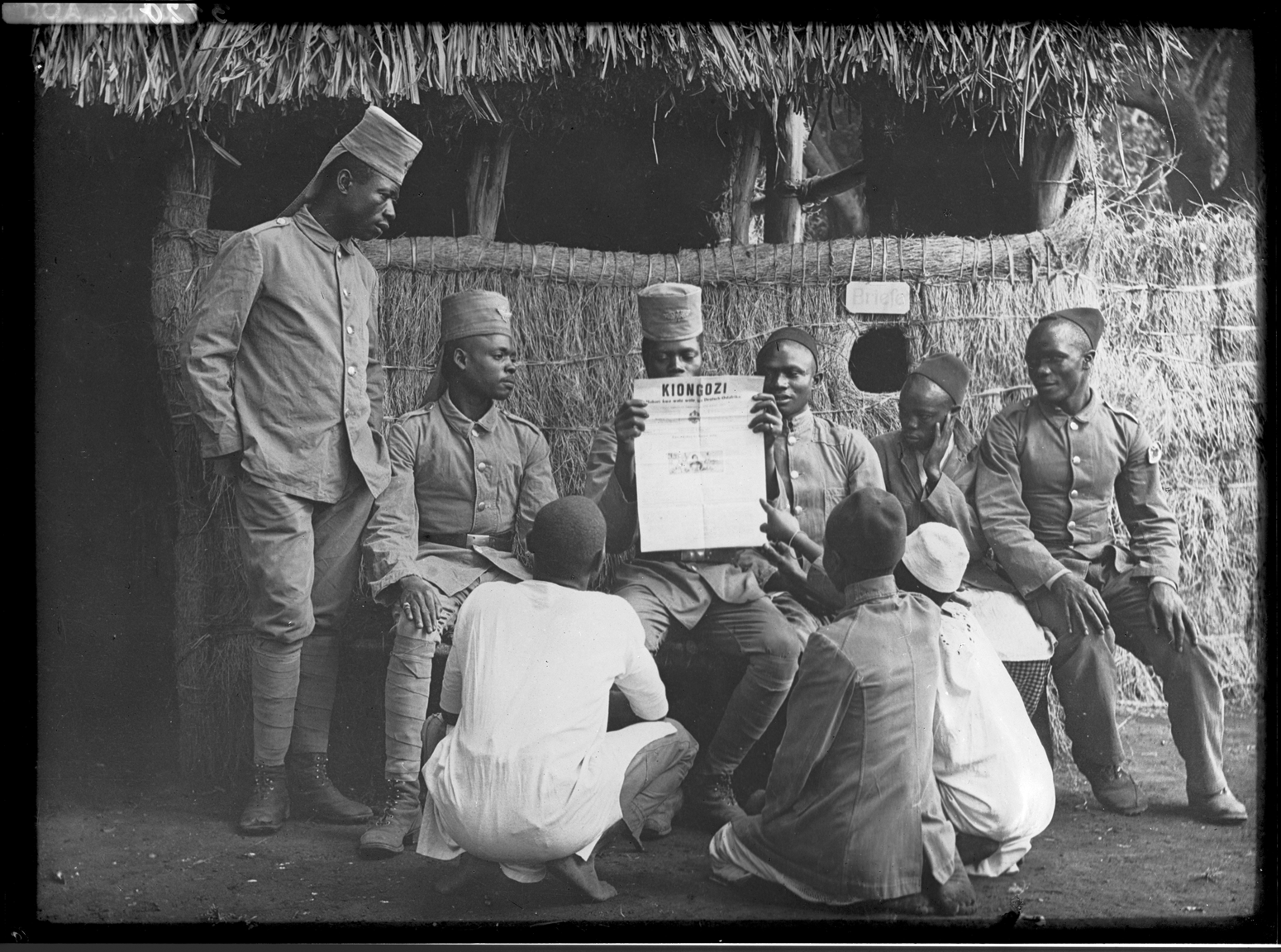
The photograph in Fig. 1, which was taken by Walther Dobbertin, a young photographer who emigrated to East Africa in 1903, reflects how the newspaper shaped this audience while aiding the execution of colonial power.Footnote 92 Taken during the First World War, it captures a seated askari of the Schutztruppe (protection force) reading from Kiongozi to five fellow soldiers and porters. With its choreographed composition, the photograph could be dismissed as mere propaganda. The reader is arranged at the center, surrounded by attentive listeners. In this way, the viewer's eye is drawn to the newspaper's title head. After the loss of Germany's colonies, the photograph served revisionist mythmaking. General Paul von Lettow-Vorbeck, the last commander of the East African troops, reproduced it in his account of the war as a symbol of askari loyalty.Footnote 93 However, the photograph also demonstrates that the paper became integral to the socialization of African intermediaries. Askari not only read the newspaper, but also wrote for it, although less frequently than other correspondents.Footnote 94 Kiongozi tailored advice columns on drilling and shooting exercises to the askari.Footnote 95 The Schutztruppe used the newspaper as teaching material in askari schools.Footnote 96 At the same time, the paper's supplement helped African soldiers and policemen to enforce the colonial order by providing them with information on runaway slaves, servants, workers, and soldiers.Footnote 97 For its audience, Kiongozi thus formed part of what Michelle Moyd has called ‘an interactive sociocultural process between Africans and Germans’.Footnote 98
‘Porters being read to from a newspaper' (Träger lassen sich aus einer Zeitung vorlesen). Photograph by Walther Dobbertin, ca. 1914. Reproduced by permission from the German Federal Archives, Koblenz, Bild 105-DOA3120.

Kiongozi's audience also reflected the shifting nature of German power. At first, readers were centered around the city of Tanga and its hinterland. The paper's initial subtitle offered ‘News for all people of the country of Tanga’. As German rule moved inland through successive pacification campaigns, more correspondents contributed from the interior. In November 1906, the paper's subtitle was changed to ‘News for all people of German East Africa’. Two years later, the staff surgeon at Tanga government hospital reported that Kiongozi was read ‘on all government stations and by all sultans of the interior, at the coast in hundreds of towns, and even in Zanzibar and British East Africa’.Footnote 99 However, many correspondents were coastal transplants and had been sent inland as clerks and teachers.Footnote 100 Frequent contributors such as Matano and Juma were always based on the Mrima. Consequently, Kiongozi remained a newspaper rooted in coastal culture. This was underlined when the newspaper's print shop moved to Dar es Salaam in 1913.
Kiongozi formed part of an emerging Swahili print sphere. German East Africa experienced the fastest growth of a vernacular press among all East African colonies.Footnote 101 From 1896–88, and again from 1904–5, the UMCA published East Africa's first Swahili-language newspaper, Msimulizi (The Reporter), in Zanzibar. By tying together mission stations on the island with those on the mainland, Msimulizi became an important vehicle in fostering Christian identities among former slaves and in coining what would become standard Swahili.Footnote 102 Habari za Mwezi (News of the Month), which was published by the UMCA at Magila, followed in 1895.Footnote 103 Apart from its focus on mission development, Habari served as the government's first vernacular gazette. The UMCA newspapers probably inspired Headmaster Blank to found Kiongozi. Like Msimulizi, Kiongozi referred to itself and readers in a direct, colloquial way. Blank expanded Habari's local news and entertainment sections, which probably contributed to driving the paper out of business in 1907.Footnote 104 When the Kiungani graduate Samwil Sehoza republished it one year later, Habari contained more news, poetry, and signed contributions by Africans.Footnote 105 Faced with the nondenominational Kiongozi and a British monopoly on Christian newspapers, German missionaries followed suit in 1910. The Protestant Pwani na Bara (Coast and Inland) and the Catholic Rafiki Yangu (My Friend) focused on religious content, but also included ethnographic articles, entertainment, and educational tracts.Footnote 106 At first glance, this budding print sphere appears fragmented. Each paper was rooted in a relatively small community. Estimated circulation ranged from about 350 in the case of Msimulizi to between 2,000 and 5,000 for Pwani na Bara and Rafiki Yangu.Footnote 107 Each of these communities also formulated its own vision of belonging. In Msimulizi, authors imagined themselves as part of a transcontinental mission community united by Swahili.Footnote 108 Meanwhile, German Protestant missions boycotted Kiongozi because of its alleged role in spreading Islam and catching runaway slaves.Footnote 109 Religious newspapers potentially reached the much larger audience of mission school students, who numbered over 100,000 by 1913.Footnote 110 All colonial newspapers had to contend with literate and oral counter-publics that rejected the premise of the civilizing mission, as in the case of the Muslim poet Hemedi Abdallah al-Buhriy.Footnote 111 But fragmentation did not preclude exchange. Msimulizi and Habari za Mwezi provided a model for Kiongozi, which in turn inspired Pwani na Bara and Rafiki Yangu. Some authors, such as Alfred Juma, wrote for multiple newspapers.Footnote 112 Despite being associated with Christian colonizers and missionaries, Kiongozi, Pwani na Bara, and Habari za Mwezi were reportedly read by the region's growing Muslim population. In 1913, for instance, the pan-Islamic Al-Najah, which was published in Zanzibar, engaged in a dispute with Pwani na Bara and Kiongozi over the history of slavery.Footnote 113 And all five publications drew a similar boundary between their own literate community and the mass of washenzi.Footnote 114 In this way, they spread Swahili inland and transformed its association with Islam and ajami to encompass secular and Christian forms of authority based on literacy in Latin script.
Karin Barber has argued that newspapers create publics through specific genres of text, which address readers in novel ways.Footnote 115 A public, in Barber's view, ‘is an audience whose members are not known to the speaker/composer of the text, and not necessarily present, but still addressed simultaneously, and imagined as a collectivity’.Footnote 116 The bearers of news cultivated the diverse habari genre, whose texts were concerned with conveying the knowledge of ‘facts’ and preserving information for their audience.Footnote 117 They also reached beyond the confines of print. Authors referred to German East Africa as nchi yetu (‘our country’), suggesting a collective of German colonizers and their supposedly obedient subjects. After the suppression of Maji Maji, Matano asserted that ‘[s]ince our country is owned by the Germans peace has come. All people have submitted to the government and respect it.’ While reading Kiongozi, the audience heard the waletaji wa habari's outcries at washenzi ignorance — ‘Ala!’ — and their calls for undivided attention — ‘Sikilizeni!’Footnote 118 As Fig. 1 suggests, Kiongozi's audience also included an unknown number of listeners. The Dar es Salaam government school instructed students to read the paper aloud to relatives, and reading circles probably existed in German East Africa. In interwar Tanganyika, such groups often attracted more than a hundred listeners.Footnote 119 In contrast to Anderson, Barber highlighted that early colonial print publics were ‘either far larger than a linguistically-defined nation state, or far smaller’.Footnote 120 But in convening publics, newspapers also defined others as enemies and established social hierarchies.Footnote 121 Kiongozi imagined the inhabitants of German East Africa as obedient subjects. Whoever resisted the colonizers’ purported uplift was labelled a mshenzi and would have to suffer the consequences. Based on the administrative structure of the colonial state, the newspaper created a far-flung audience. But beyond the pages of Kiongozi, competing registers continued to challenge the authority of German colonizers and their African intermediaries.
WORLDLY MINDS, HEALTHY BODIES
In labeling the majority of the colonized washenzi, the bearers of news recalled a central dichotomy of nineteenth-century Swahili culture, that between Muslim, civilized waungwana of the coast and the purported barbarians of inland societies.Footnote 122 By framing German propaganda in the coastal language of status, the men of Kiongozi helped to define colonialism's opponents. At the same time, Kiongozi allowed the bearers of news to distinguish themselves from the washenzi by demonstrating their support for the civilizing mission. Their assertion of symbolic power illustrates that German control depended not least on the appropriation of indigenous registers.Footnote 123 In the first place, asserting symbolic power meant touting the superiority of Western learning. Mansuri Zuberi, a former government school student, confided to readers:
In old times I was very ignorant. But then I went inside of a school, with the objective of not being a fool. My father did not like me going to school, because he does not know how a school gives children intelligence. In school the teacher taught me good manners and the customs of school. I was very happy to receive these teachings. Elders, you must not keep children at home to prevent them from going to school. Don't you know this is ignorance? Look! Is the knowledge of today the same as of old? Maybe you like your children to live in ignorance their whole life. Don't you want them to get the knowledge of the world?Footnote 124
Apart from imparting ‘good manners’, worldly knowledge also prepared children for life in the colonial economy. Reporting on school inspections around Tanga in October 1906, Juma described how teachers Braune and Matano had tried to convince ‘the majumbe and elders of the country to make an agreement with them that they must send their children to school’. He then appealed to his readers:
We hope this intention will convince our brothers who still live in darkness to go to school [where] they will wake up and follow this good advice. The elders will not fool around by taking their children back. And their children will not fool around not going to school, they will go on a bad path. You youngsters, keep it up! The Europeans have come to give out Heller [cents] in our country, bow down and pick them up! But how will you gather them if you don't bow down?Footnote 125
The purported beneficiaries of worldly knowledge had their own ideas about ‘bowing down’ for small change. In Tanga, children joked that they did not attend school because they were ‘not yet caught’. Juma did not tolerate such taunts of compulsory schooling, which had been introduced to the district seven years earlier. He explained that only runaway slaves, thieves, and prisoners of war were captured. Schools taught children ‘all the ways of behaving according to norms. Because people have not yet known their tradition of sending children to school since old times, the children are admitted to school by order.’Footnote 126 He also appealed to his readers’ sense of status: ‘Wherever we are when we use our education, it will benefit us [more] at once than sitting around and behaving like washenzi. Let us remember and hold on to these words: “The one who has knowledge stands above the fool.”’Footnote 127 Juma's report exposes that the introduction of compulsory schooling involved both negotiation and force. When children attended class, they expected to receive a stipend for ‘doing the work of school’.Footnote 128 If monetary incentives and worldly knowledge proved insufficient, other means were employed. In 1902, three students who complained about being held against their will were put in chains for a week.Footnote 129 Both students and teachers were punished with canes and hippopotamus hide whips.Footnote 130 Corporal punishment was central to government education but failed to save German colonizers and their African intermediaries from subaltern mockery. It also failed to keep children in school: the three students who were put in chains were punished in part because of previous absences. Government school students were predominantly the sons of local maakida and majumbe. The bearers of news’ appeal to their — and their own — sense of status illustrates how Kiongozi sought to reframe Swahili culture in the government's image: in place of the authority of madrassa-schooled walimu (scholars, teachers) should stand that of government-trained officials.Footnote 131
In no area did this epistemic challenge become clearer than in Kiongozi's advocacy of colonial medicine. The bearers of news called on their audience to avoid uganga (indigenous medicine) and to reject widespread belief in uchawi (witchcraft) as a cause of disease. First, they contended that indigenous healers only exploited patients for material gain. Matano complained that
[many people who are sick] only use medicine of possession to drive out spirits. These things are complete nonsense. Because you see that many people who have spirits driven out do not get better, except that they are cheated out of their money by impostors.Footnote 132
Second, the men of Kiongozi contrasted what they considered the private and potentially harmful knowledge of indigenous waganga with the public and benevolent nature of the European doctor, the bwana mganga. Matano conceded that ‘[a]mong the black people of this country there are those who know disease . . . It is true they know disease by using traditional medicine of plants and this medicine has many uses.’Footnote 133 However, waganga kept their expertise secret and transmitted it exclusively within their families. In contrast, Matano hailed the government for providing free healthcare:
Out of its kindness, the government has spread doctors to every place in our country intending to treat the sick. It also built houses of the sick to tend for them and on top of this they give them nourishment. The doctors are ordered by the government to treat all patients that arrive at the hospital. This medical treatment benefits them and they themselves like to treat us very much.Footnote 134
Finally, the waletaji wa habari again appealed to their audience's pride. Matano claimed that choosing European doctors separated the fool from the wise man: ‘Like the Waswahili say, “He who follows the imbecile is an imbecile.”’Footnote 135 But this was easier said than done. According to the poet and teacher Ramazan Saidi, even the waletaji wa habari were at risk of falling for the ‘pure ignorance’ of waganga divinations. He explained that
people always say: Witchcraft is [caused by] the bones of people that have been ground. And if the witchdoctor wants to bewitch [someone] he just orders it. And he also always utters the name of that person that he wants to kill. And once he finds him, he kills him. Ee, my colleagues, readers and even waletaji who hear this news, can you believe this? That poison that kills like cyclones or lightning, and these are not ordered in this way; that it is bone meal? Come on, try [and] see that this is great nonsense.Footnote 136
Although framed within colonial propaganda, Kiongozi's objections to indigenous medicine echoed concerns of African societies. Under German rule, witchcraft eradication movements, which rejected received healing technologies in response to the upheavals of the 1890s, emerged across the territory.Footnote 137 Another concern was proper adherence to Islam. At the turn of the century, the medical practice of Swahili walimu combined Islamic and African influences. Under Zanzibari rule, a new generation of religious scholars emerged that contested what they considered the walimu's contamination of Islam.Footnote 138 Similarly, Saidi criticized diviners’ acceptance of bembe, little presents for performing rituals that supposedly improved the harvest or cured illness. Although a man who believed in the power of a local mganga informed him that this custom had existed ‘since the arrival of the Arabs’ and was also common in Zanzibar, Saidi still considered it a washenzi practice. After confronting a mganga and being chased away, he appealed to his readers: ‘My God, learn the customs of Europe [and] you will be trusted and become very rich.’Footnote 139
Those who refused to embrace colonial medicine had to be compelled to do so. Reporting on the government's vaccination campaign against sleeping sickness, Aniseti Musoga informed readers that
a man by the name of Uiswa, who suffered from sleeping sickness, ran away to go to his home in Muhuru. The doctor sent an askari to go bring him back. When the askari arrived there, he told him: ‘We're going back.’ This patient refused, he said: ‘Since I went to Utegi, I have not yet returned to our home to cultivate for my mother, and I have recovered from the sickness.’ The askari wanted to force him to return. That patient took the patient slip (kipande cha wagonjwa) and threw it at the askari. When the askari saw the great folly of that patient, he did not want him to get well, he only wanted bad luck for him, he returned to report. Here we see many people die because they refuse medicine. Let us hasten these imbeciles, even by force, to accept medicine, they must regain their health rather than die like animals without medicine.Footnote 140
Musoga's call for the capture of ‘imbeciles’ illuminates the nature of colonial power in German East Africa. Uiswa's home Muhuru was located near the epicenter of the sleeping sickness epidemic that swept the Great Lakes region in the early twentieth century. Utegi was one of ten isolation camps in the colony where military doctors searched for a vaccine. Dr. Scherschmidt, the local camp doctor, experimentally administered the drug Arsenophenyltoxyl, which not only proved ineffective but even increased patients’ mortality. Unsurprisingly, Uiswa was not the only patient who eloped from Utegi.Footnote 141 His reasons for leaving — to help his mother cultivate fields and because he felt he had convalesced — underline that African patients engaged pragmatically with colonial medicine. Treatment was sought as long as it proved feasible or effective. Colonial medicine could be invasive and violent, but the state simply lacked the resources to compel patients to comply.Footnote 142 In this context, the bearers of news reminded themselves and other colonial intermediaries of their duty to uphold the flailing colonial order as best as they could.
PRINT AND POWER
According to the men of Kiongozi, worldly minds and healthy bodies would enable the colonized to prosper and distinguish themselves from the washenzi. But resistance threatened this purported uplift. This threat became most apparent during the Maji Maji war.Footnote 143 While many colonial intermediaries became targets of insurgents, some joined their ranks. At this precarious juncture, Kiongozi offered the bearers of news a space to condemn the washenzi and reaffirm their support to the government. By providing news from the war zone, correspondents aided German efforts to reassert control over information in the colony. James Giblin and Jamie Monson have emphasized the importance of information flows for the rise and spread of Maji Maji.Footnote 144 Missing issues make it difficult to assess how frequently reports on the war were published in Kiongozi. That the newspaper was an important medium of information can be gleaned from the fact that Liwali Mzee bin Ramazani of Songea published his ‘News on the trouble of Maji Maji in the country of Songea’ in the Tanga newspaper.Footnote 145 Indeed, colonial officials and observers appreciated that Kiongozi could counter ‘misinformation’.Footnote 146
The waletaji wa habari argued that the war was a misguided insurrection (fitina) by ignorant washenzi. Bin Ramazani explained that the maji was brought to Songea by a Mngindo convert called Omari Waziri Kinjara:
And after reaching Ungoni, he called a group of great ones of the washenzi and told them: ‘I bring water that comes from God. If you drink this water, you will be able to fight the Europeans and their weapons will turn into water. And we will defeat the Europeans, we will drive them from our country.’ And the washenzi, who are people who have no intelligence, neither reflection nor thought, then agreed to follow the words of Omari Waziri Kinjara.Footnote 147
Echoing Kiongozi's concern with proper adherence to Islam, the liwali was dismayed that ‘this insurrection of Maji Maji consisted not only of washenzi, but also of Muslims who had followed their advice’.Footnote 148 Meanwhile, some rebels had joined the war to contest the interference of coastal people such as bin Ramazani in their affairs.Footnote 149 Literacy in Latinized Swahili played an important part in this conflict. Bin Ramazani noted that
every person in their right mind knows very well the sufferings that people received when they drank the maji of the mahongo in order to become the enemies of the government. And they have received their punishment by the government. Every man who can read should read, should understand, should know that the government has much power! And he who knows how to read should read, should explain [this] to people who cannot read! Footnote 150
While illiteracy allegedly provided a fertile ground for insurrection, literacy enabled its bearers to appreciate the war's hopelessness in the face of superior colonial power. Bin Ramazani's demand that the literate instruct the ignorant about the dangers of resistance illustrates how Latinized Swahili was employed as an instrument of symbolic power meant to achieve the acquiescence of the colonized in their own domination. Kiongozi provided the news for this information campaign. In late 1906, for instance, Zuberi Mwinyipembe quoted parts of a speech by Rufiji district officer Karl Graß to all African officials and dignitaries in Mohoro near the Matumbi Hills, one of the epicenters of the rebellion.Footnote 151 Graß declared that
I think now you see the benefits of war, many washenzi are dying like leaves. They die in war, and they die because of hunger. Near Kitschi and Matumbi, I have seen many people, men and women, elders and children, die without sickness, only due to the misery of hunger. All this is only because of the war. If they had not started the war first, a man could get food from cultivating; except because of the war they don't stay together, only hide in the bush, and many people die.Footnote 152
Beyond the collective punishment of famine, government retribution was justified because the rebels had attacked representatives of the state. Thus, M. Muhamadi from Dar es Salaam explained that ‘Jumbe Kibasira, Mahawa and Mdose’ were sentenced to death by hanging ‘because they started the insurrection’ and had ‘killed the interpreter Asmani’. In contrast, supporters of German rule were awarded medals and promised the colonizers’ patronage.Footnote 153
Newspaper reports of government retribution frequently stood next to accounts of daily life, creating a surreal effect of intense violence amid normalcy. In March 1906, a man called Liindikemune was hanged in Mohoro ‘because he killed Jumbe Balakasi during the war’. At the same time, the town was busy preparing for the annual floods. In early 1907, Akida Abdallah Maftaha shot himself at Kilwa Mtandura and Jumbe Muhamadi Kaparo was hanged because both had allegedly been involved in the rebellion. Meanwhile, an Indian wedding took place. On 20 April that year, nine people were hanged in Mahenge for drinking the Maji medicine, while a German officer caught and shot a leopard.Footnote 154 Kiongozi shaped a curated public sphere, in which the variables and participants of discussion were ultimately beyond the walteaji wa habari's control. That the men of Kiongozi did not voice opposition to the violence of colonialism does not mean that they assented to it. The newspaper was not a space for dissent. But their dismissal of resistance provided an unsettling background to the symbolic power they exerted through print. Attacks by insurgents, belief in divination, and taunts by school children illustrated that this power was neither stable nor uncontested. At heart, Kiongozi was thus characterized by the tension between preserving the voices of its African authors and discounting those of the majority of the colonized. When Kiongozi's printing press finally stopped running in 1916, Tanga school had already been closed for two years.Footnote 155 Matano became a Quranic teacher and focused on writing poetry. During the First World War, Juma appears to have acted as a German spy and sought the arrest of anyone who opposed them.Footnote 156 Despite their association with German rule, both published their work in Mambo Leo.Footnote 157 Such continuities illustrate that we still know little about the afterlives of German rule under mandates and trusteeship, and, ultimately, independence.Footnote 158 British officials recognized that Kiongozi had strengthened colonial power and a vernacular print culture. In 1917, the head of the Intelligence Department of the British expeditionary forces in East Africa noted that Kiongozi and ‘Khabari ya Pwani’ (he probably meant Pwani na Bara or Habari za Mwezi)
had a wide circulation among all classes of literate natives and were a great assistance to the Administration. They were much appreciated by the natives and much regretted when our Administration refused to carry them on. The renewal of these papers would be a valuable measure . . . since the educated native conveys the ideas contained to his illiterate friends who are as eager as the Athenians to tell or hear some new thing.Footnote 159
In 1922, Governor Byatt noted that several Africans had asked to revive Kiongozi, ‘to which they had for long been accustomed’. One year later, the administration published the first issue of Mambo Leo.Footnote 160 The editorial proclaimed that the new paper was the ‘heir’ of ‘my friend Kiongozi’.Footnote 161
CONCLUSION
In a Weberian sense, Kiongozi served colonial power by increasing German colonizers’ chances to impose their will against resistance. When the waletaji wa habari lauded compulsory education, European medicine, and foreign rule, they outlined the conditions of subjugation to colonial authority. The paper assisted them in enacting these conditions in their capacity as teachers, officials, and soldiers. Moreover, Kiongozi offered the bearers of news a space to demonstrate their allegiance to the colonial state when that allegiance had been called into question. As an ‘instrument of knowledge and communication’, the newspaper thereby mediated between German colonizers and their indigenous subordinates. The paper's promotion of Latinized Swahili underlines that German rule depended on both coercive and symbolic means. By dismissing washenzi ignorance, the bearers of news not only harnessed the coastal language of status, but also shaped a new secular register of authority that persisted under British rule and after independence. But increasing the colonial state's chances of exercising power was not tantamount to realizing its will. As much as the newspaper touted the potential scope of colonial domination, it also exposed its limits. After all, Kiongozi's audience constituted only one public among many that struggled to define the meaning of the colonial encounter.
At the same time, Kiongozi's partisanship formed the basis for its linguistic and cultural contribution to Swahili. The paper connected the literate diaspora of government school graduates across a vast territory. In translating the civilizing mission, the waletaji wa habari changed what it meant to speak and write Swahili through a different script and new genres of text. Their amalgamation of Swahili culture with Western and African elements calls for comparisons with other literate diasporas of empire connected by language and print. However, this amalgamation did not make Kiongozi a cauldron of supratribal identities. Rather, the paper reflected how German colonizers and their African subordinates tied the prestige of coastal culture to new means of social advancement in government schools and the colonial bureaucracy. The bearers of news thereby fashioned a culture of literacy that led to the flourishing of Swahili print in the interwar period and beyond. Kiongozi's rich trove of news, poetry, and fiction awaits further reading.