Introduction
Interatrial stenting has emerged as a transformative technique in the management of CHDs, offering critical benefits in cases where interatrial communication is essential for maintaining adequate systemic and pulmonary blood flow.Reference Leonard, Justino and Carlson1 This procedure involves the placement of a stent within the atrial septum to either create or enlarge an atrial septal defect, thereby enabling effective blood mixing and optimising haemodynamic stability. It provides relief of a restrictive interatrial septum in conditions where effective atrial level mixing is critical, such as hypoplastic left heart syndrome, transposition of the great arteries, total anomalous pulmonary venous drainage, and borderline left ventricle, and to optimise Fontan circulation in selected patients.Reference Yalçın, Zeybek and Önsel2 Initially developed to address haemodynamic challenges in CHDs, interatrial stenting has since broadened its application to include other conditions, such as heart failure and pulmonary hypertension.Reference Lehner, Schulze-Neick and Fischer3
Significant advancements in procedural techniques and device design have facilitated its use in both paediatric and adult populations.Reference Awasthy4 However, the procedure is not without challenges, including risks of stent occlusion and restenosis, which underscore the need for ongoing innovation and long-term evaluation. The present study aims to evaluate procedural success, haemodynamic improvement, and mid-term clinical outcomes of interatrial stenting in a single-centre cohort of paediatric patients with various congenital and acquired cardiac conditions requiring sustained interatrial communication.
Materials and methods
This retrospective study analysed the clinical and procedural data of patients with CHD who underwent interatrial stenting at our institution between 2018 and 2024. The study protocol was approved by the institutional ethics committee (Approval No: 2023.10-98), and written informed consent was obtained from all patients or their legal guardians.
Patient selection
Patients included in the study presented with CHDs, left ventricular dysfunction or pulmonary hypertension, necessitating the creation or maintenance of an interatrial communication to optimise haemodynamics. Indications for interatrial stenting included conditions with restrictive interatrial septal communication, and those requiring improved oxygenation or reduced atrial pressure gradients. Multidisciplinary evaluation by paediatric cardiologists, interventional cardiologists, and cardiac surgeons ensured appropriate patient selection. Patients were divided into two groups according to age (≤12 months and >12 months) for comparative analysis.
Procedural details
All procedures were performed under general anesthesia in a dedicated paediatric catheterisation laboratory equipped with fluoroscopic and transthoracic or transesophageal echocardiographic guidance. Femoral venous access was obtained in all patients.
In patients without a pre-existing interatrial communication (atrial septal defect or patent foramen ovale), transseptal puncture was required to access the left atrium. Septal perforation was achieved using either a standard Brockenbrough needle or radiofrequency energy. In several patients, controlled electrocautery energy was delivered through the Brockenbrough needle tip to facilitate safe and effective atrial septal crossing, after which an appropriate transseptal sheath was advanced into the left atrium.
Stent type, diameter, and length were selected according to septal anatomy and haemodynamic objectives. Balloon-expandable pre-mounted stents were deployed under continuous fluoroscopic and echocardiographic monitoring to ensure precise positioning and creation of a non-restrictive interatrial communication. Haemodynamic improvement was confirmed by pressure measurements and Doppler evaluation immediately after implantation.
Data collection
Data extracted included demographic characteristics, CHD anatomy, procedural details, and pre- and post-procedure clinical parameters. Short-term outcomes were evaluated during hospitalisation and included changes in oxygen saturation and atrial pressure gradients, along with procedural complications. Mid-term outcomes assessed during follow-up included stent patency, clinical status, and the need for reintervention.
Due to the retrospective nature of the study and variation in clinical indications, paired pre- and post-procedural haemodynamic data were not available for all patients. Systemic oxygen saturation (SpO2) measurements were recorded in patients undergoing interatrial stenting for atrial mixing, while atrial pressure and left atrial–right atrial gradient measurements were recorded in patients undergoing stenting for left atrial decompression. In some cases, paired measurements were unavailable due to clinical instability, emergent procedures, early termination of the intervention, or lack of invasive haemodynamic assessment.
Follow-up
Patients were followed at regular intervals, with clinical assessments, echocardiography, and, where necessary, catheterisation studies. The follow-up period ranged from 6 months to 5 years, facilitating the evaluation of both immediate and sustained procedural outcomes.
Statistical analysis
Continuous variables were presented as median and interquartile range, while categorical variables were expressed as numbers and percentages. The normality of data distribution was assessed using the Shapiro–Wilk test. Comparisons between two independent groups were performed using the Mann–Whitney U test, and categorical variables were analysed using the Chi-square or Fisher’s exact test, as appropriate. Spearman rank correlation analysis was used to evaluate associations between continuous variables, including stent diameter, radiation exposure, patient age, and body weight. Subgroup analyses were performed according to body weight (≤5 kg vs >5 kg) to compare procedural parameters and clinical outcomes. Correlation coefficients were reported as Spearman’s rho (rs). A p-value < 0.05 was considered statistically significant.
All analyses were performed using IBM SPSS Statistics, Version 26.0 (IBM Corp., Armonk, NY, USA).
Results
Baseline characteristics
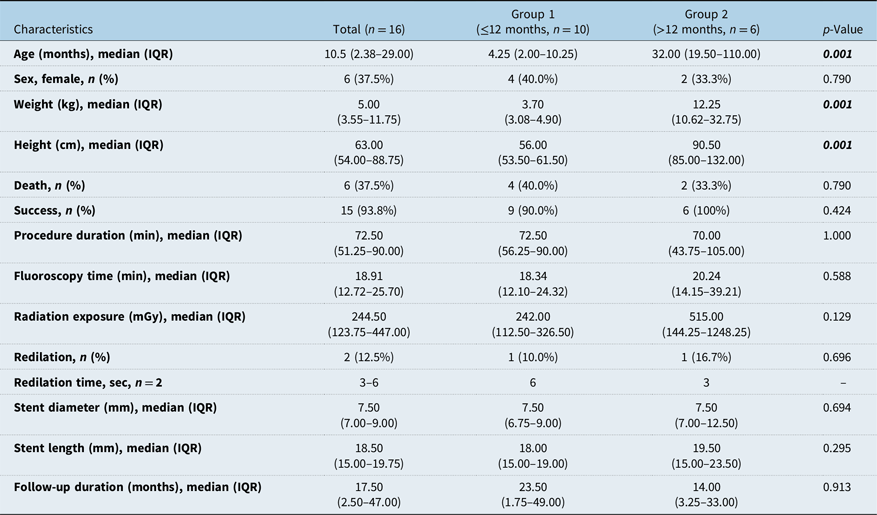
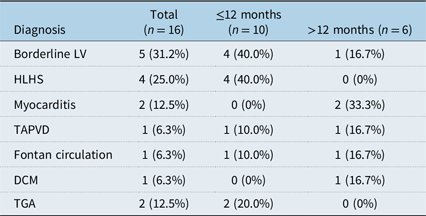
A total of 16 patients were included in the study, with a median age of 10.5 months (interquartile range 2.4–29.0), median body weight of 5.0 kg (interquartile range 3.6–11.8), and median height of 63.0 cm (interquartile range 54.0–88.8) (Table 1). Of these, 10 were male and 6 were female. Borderline left ventricle was the most frequent diagnosis (37.5%), followed by hypoplastic left heart syndrome (25.0%) and myocarditis (12.5%) (Table 2).
Demographic, clinical, and diagnostic characteristics of patients

SpO2 = peripheral oxygen saturation; IQR = interquartile range; mGy = milligray; mmHg = millimetres of mercury.
Diagnosis distribution by age group

HLHS = hypoplastic left heart syndrome; LV = left ventricle; TAPVD = total anomalous pulmonary venous drainage; DCM = dilated cardiomyopathy; TGA = transposition of the great arteries.
The median procedural duration was 72.5 minutes (interquartile range: 51.25–90.00). Median fluoroscopy time was 18.9 minutes (interquartile range: 12.7–25.7), while median radiation exposure was 244.5 mGy (interquartile range: 123.75–447.00). Access through the interatrial septum was achieved using radiofrequency catheters in two patients, the Brockenbrough needle in four, and existing septal openings with catheters in the remaining 10.
A total of 15 stents were implanted during the study period. All devices used were bare-metal, balloon-expandable stents; no covered stents or coronary stents were employed. The implanted devices consisted of peripheral artery stents with diameters ranging from 6 to 10 mm and lengths ranging from 14 to 27 mm, as well as renal artery stents with diameters of 6–7 mm and lengths of 15–20 mm.
Patients were divided into two groups according to age: Group 1 (≤12 months, n = 10) and Group 2 (>12 months, n = 6). Age, weight, and height differed significantly between the two groups (p = 0.001 for all comparisons). No significant differences were observed between groups regarding sex distribution (p = 0.790), procedural duration (p = 1.000), fluoroscopy time (p = 0.588), radiation exposure (p = 0.129), procedural success (p = 0.424), or need for redilation (p = 0.696).
The median follow-up duration was 17.5 months (interquartile range 2.5–47.0), with no significant difference between the two groups (p = 0.913). Overall, six patients (37.5%) died during follow-up, including four in Group 1 (40.0%) and two in Group 2 (33.3%) (p = 0.790).
Group 1 (infants)
Most of the cohort (10 patients, 62.5%) consisted of infants. Among these, four were diagnosed with hypoplastic left heart syndrome and four with borderline left ventricle physiology, and two with transposition of the great arteries. Two neonates had previously undergone atrial septostomy, and one patient underwent a surgical septectomy. In one borderline patient, a surgically reduced atrial septal defect required subsequent stenting, while another patient underwent simultaneous patent ductus arteriosus stenting and interatrial stent placement.
In six infants with available data, post-procedural SpO2 increased significantly compared with pre-procedural values (p = 0.027) (Supplementary Table S1). Stents implanted in this group had a median diameter of 7.50 mm (interquartile range 6.75–9.00) and a median length of 18.00 mm (interquartile range 15.00–19.00). The median procedure duration was 72.50 minutes (interquartile range 56.25–90.00), with a fluoroscopy time of 18.34 minutes (interquartile range 12.10–24.32) and radiation exposure of 242.00 mGy (interquartile range 112.50–326.50).
During a median follow-up period of 23.50 months (interquartile range 1.75–49.00), one patient required stent redilation after 2.5 months, and four patients subsequently underwent surgical intervention. Four deaths occurred in this group. One patient with hypoplastic left heart syndrome died on postoperative day 1 despite technically successful stent implantation. One patient with hypoplastic left heart syndrome died two months after the procedure following prolonged ICU stay and inability to be weaned from mechanical ventilation due to advanced underlying cardiac disease. One patient underwent Glenn surgery after interatrial stenting and died one year later from post-infectious respiratory failure while receiving pulmonary arterial hypertension therapy. One patient with borderline left ventricle died one month after the procedure following prolonged ICU stay and respiratory failure. Two patients are currently awaiting surgery.
Group 2
The remaining six patients comprised Group 2, with a median age of 32.00 months (interquartile range 19.50–110.00) and a median weight of 12.25 kg (interquartile range 10.62–32.75). This group included three patients with left ventricular dysfunction (due to myocarditis or noncompaction-related dilated cardiomyopathy), two with postcapillary pulmonary hypertension (one associated with total anomalous pulmonary venous drainage and one with borderline left ventricle), and one with Fontan failure following classic Fontan surgery. One case involved acute myocarditis requiring extracorporeal membrane oxygenation support. Individual pre- and post-procedural haemodynamic data for Group 2 patients are presented in Supplementary Table S2.
Stents deployed in this group had a median diameter of 7.50 mm (interquartile range 7.00–12.50) and a median length of 19.50 mm (interquartile range 15.00–23.50). The median procedural duration was 70.00 minutes (interquartile range 43.75–105.00), with a fluoroscopy time of 20.24 minutes (interquartile range 14.15–39.21) and radiation exposure of 515.00 mGy (interquartile range 144.25–1248.25).
The median follow-up period was 14.00 months (interquartile range 3.25–33.00). Among these patients, two with left ventricular dysfunction underwent pulmonary artery banding after stenting. Two deaths occurred during follow-up. One patient with acute myocarditis requiring extracorporeal membrane oxygenation support experienced procedural failure and died on postoperative day 1. The second patient, who had pulmonary hypertension secondary to borderline left ventricle, died from sepsis four months after the procedure. One patient with postcapillary pulmonary hypertension remained asymptomatic throughout a five-year follow-up period, while the Fontan failure patient, who underwent simultaneous stenting and antegrade closure, remained asymptomatic for one year. Additionally, one patient with interatrial stent placement required reintervention nine months after the procedure.
Correlation and subgroup analysis
Stent diameter
No significant correlations were observed between stent diameter and patient weight (rs = 0.078, p = 0.775) or age (rs = 0.020, p = 0.942). When analysed by diagnosis, mean stent diameter ranks were highest in myocarditis (14.25) and transposition of the great arteries (12.50), and lowest in borderline left ventricle (6.00) and Fontan or dilated cardiomyopathy cases (5.50).
Radiation exposure
In the overall cohort (n = 16), radiation exposure showed a significant positive correlation with patient weight (rs = 0.596, p = 0.015). No significant correlations were found between radiation exposure and age (p = 0.066), fluoroscopy time (p = 0.131), or procedure duration (p = 0.103).
Weight-based subgroup analysis
When analysed according to body weight, eight patients (50%) weighed ≤5 kg and eight weighed >5 kg. No significant differences were found between weight groups regarding procedural parameters, ΔGradient values, or mortality (p > 0.05 for all comparisons).
Complications
Venous thrombosis was observed in two patients but resolved with intravenous heparin therapy and did not require reintervention. Venous obstruction was the most common complication, while no cases of stent thrombosis were reported. Two patients required balloon dilation to address elevated gradients (22 mmHg peak, 14 mmHg mean).
All patients received post-procedural antithrombotic therapy with aspirin at a dose of 3–5 mg/kg/day. Aspirin was initiated immediately after stent implantation and continued during follow-up as standard institutional protocol to maintain stent patency. No additional anticoagulation or dual antiplatelet therapy was used.
Procedural success
Procedural success was achieved in most cases, although complications were observed. One patient with an unstable general condition (Group 1) died immediately after the procedure. In the extracorporeal membrane oxygenation-supported case, a 34-mm Cheatham-Platinum stent protruded into the right atrium and was parked in the inferior vena cava, representing the only procedural failure (6.2%). All other procedures were performed using pre-mounted stents, none of which resulted in acute failure. Overall procedural success was achieved in 15 patients (93.8%), including 9 of 10 patients (90.0%) in Group 1 and all 6 patients (100%) in Group 2 (p = 0.424).
Discussion
Many patients with CHD benefit from the presence of appropriate interatrial communication. However, achieving or maintaining this communication after the neonatal period with balloon septostomy is often challenging. Atrial septal stenting has emerged as a critical intervention in managing CHD, particularly for patients with obstructive lesions or complex physiologies that require stable interatrial communication. This technique has demonstrated the ability to rapidly improve systemic oxygenation and reduce atrial pressure gradients, solidifying its role in contemporary paediatric cardiology. Studies by Chowdhury et al. and Awasthy have highlighted its life-saving potential and long-term durability, while Corno et al. emphasised its tailored application to optimise interatrial shunting for individual patients, especially in complex congenital anomalies.Reference Awasthy4–Reference Corno, Adebo and LaPar6
The success of atrial septal stenting relies on meticulous procedural planning and execution. In our study, a procedural success rate of 93.5% was achieved, with only one failure due to stent embolisation. Similar success rates have been reported in other studies; for example, Mainzer et al. documented a 93% success rate (27 out of 29 cases), while Prakoso et al. reported achieving non-restrictive atrial flow in 90.9% of cases, even under high-risk conditions.Reference Prakoso, Kurniawati and Siagian7,Reference Mainzer, Goreczny and Morgan8 In our cohort, pre-mounted stents, preferred for their ability to reduce the risk of embolisation, were utilised in most procedures. However, one case involving a 34 mm Cheatham-Platinum stent mounted on a 20 mm balloon resulted in stent displacement into the right atrium. This experience underscores the importance of using pre-mounted stents to enhance procedural success and minimise complications.
Stent size selection is a critical factor for both procedural success and long-term outcomes. For temporary improvement in cyanosis and intracardiac mixing, smaller stents (4–6 mm) are often adequate.Reference Sivakumar9 However, larger stents are required for sustained decompression of left atrial pressure. Radityo Prakoso et al. reported an average stent diameter of 8.5 mm, with the size varying based on the patient’s anatomy and specific clinical objectives.Reference Prakoso, Kurniawati and Siagian7 In our study, stents with a median diameter of 7.5 mm were used in both age groups, and no significant correlations were observed between stent diameter and patient weight or age. Currently, there is no consensus on the optimal stent size for different scenarios, making the interventionist’s expertise crucial in determining the most appropriate size. Larger multicentre studies are necessary to establish standardised, evidence-based guidelines for stent sizing.
In paediatric populations, expandable stents offer the significant advantage of accommodating growth through subsequent adjustments. This was demonstrated in our cohort, where two patients underwent stent dilation during follow-up to account for growth-related changes. Previous studies, such as those by Quandt et al., highlight the importance of this flexibility for effective long-term management.Reference Quandt, Ramchandani and Bhole10 However, determining the optimal timing for redilation can often be challenging. In our practice, we used echocardiographic measurements, specifically gradients of 22 mmHg peak and 14 mmHg mean, combined with the patient’s clinical status to guide the decision for redilation. Similarly, Mainzer et al. identified gradients exceeding 20 mmHg as a clear indicator for redilation, while Sivakumar recommended maintaining interatrial pressure gradients within the range of 5–10 mmHg after stenting to ensure optimal outcomes.Reference Mainzer, Goreczny and Morgan8,Reference Sivakumar9
The choice of tools for septal puncture also impacts procedural success. In our cohort, we used Brockenbrough needles and radiofrequency guidewires in four and two cases, respectively, ensuring precise puncture and stent placement. Sivakumar emphasised the utility of Brockenbrough needles for thickened atrial septum or hypoplastic left heart syndrome. Mainzer et al. and others reported radiofrequency guidewires as beneficial in difficult anatomies.Reference Mainzer, Goreczny and Morgan8 These findings underscore the importance of a versatile toolkit to address varied anatomical challenges effectively.
Clinical outcomes in our cohort suggested a trend towards improved oxygenation and relief of atrial level obstruction after interatrial stenting. In a small subgroup of patients undergoing stenting for atrial level mixing, increases in systemic oxygen saturation were observed at the individual patient level. Previous studies have reported similar findings; for instance, Danon et al. reported an average oxygen saturation increase of 11.3% in patients with transposition physiology following stenting.Reference Danon, Levi and Alejos11 Similarly, Mainzer et al. observed oxygen saturation levels rising above 70% in critically ill patients, indicating substantial clinical improvement.Reference Mainzer, Goreczny and Morgan8 Consistent with these findings, patients in our cohort requiring enhanced atrial mixing exhibited notable increases in oxygen saturation, confirming the procedure’s efficacy in alleviating hypoxaemia in complex congenital settings. However, these results should be interpreted cautiously due to the limited number of patients with complete paired measurements.
Patients with elevated left atrial pressures due to left ventricular dysfunction showed significant symptom resolution, and pulmonary hypertension was successfully prevented in several cases. Radityo Prakoso et al. emphasised that reducing left atrial pressure not only improved cardiac output but also rapidly stabilised haemodynamics.Reference Prakoso, Kurniawati and Siagian7 Similarly, Mainzer et al. reported that atrial septal stenting effectively mitigated pulmonary hypertension, thereby reducing the risk of long-term cardiac and pulmonary complications.Reference Mainzer, Goreczny and Morgan8 In our cohort, patients with left ventricular dysfunction demonstrated a noticeable decrease in inotropic support requirements and hospital admission rates, underscoring the procedure’s clinical benefits in this population.
Our cohort represents a highly heterogeneous population including patients with hypoplastic left heart syndrome, borderline left ventricle, transposition physiology, myocarditis-related left ventricular dysfunction, pulmonary hypertension, and Fontan failure. These conditions differ fundamentally in pathophysiology, haemodynamic targets, and prognosis. Accordingly, the clinical objective of atrial septal stenting varies substantially across subgroups: improving intracardiac mixing and systemic oxygenation in transposition physiology, decompressing the left atrium and pulmonary venous system in left-sided dysfunction and pulmonary hypertension, and serving as a rescue strategy to augment cardiac output and relieve systemic venous congestion in Fontan failure. Similar diagnosis-specific physiological benefits were reported by Danon et al., who demonstrated a mean increase in systemic oxygen saturation of 11.3% in transposition physiology and a mean reduction of 7.4 mmHg in left atrial pressure in patients with left-sided obstructive lesions.Reference Danon, Levi and Alejos11 Contemporary real-world experience further confirms that atrial septal stenting is most often performed in critically ill, high-risk patients, with outcomes predominantly driven by the severity of the underlying disease rather than procedural factors alone. In the largest paediatric series to date, Mainzer et al. reported a procedural success rate of 93% but substantial early mortality in the sickest infants, particularly those weighing ≤3 kg, underscoring the palliative and bridging nature of this intervention.Reference Mainzer, Goreczny and Morgan8 Qureshi has similarly emphasised that atrial septal stenting should be regarded as a high-risk palliative strategy rather than a definitive therapy.Reference Qureshi and Sivasankaran12 Therefore, although pooling such distinct pathophysiological entities limits direct outcome comparisons, our cohort accurately reflects contemporary clinical practice, in which atrial septal stenting is employed as a stabilising or life-saving intervention across a wide spectrum of complex congenital and acquired heart diseases.
Interatrial septal stenting is typically performed in critically ill patients with advanced haemodynamic compromise and is therefore associated with substantial mortality that is largely driven by the severity of the underlying cardiac disease rather than by procedural factors alone. In previously published series, mortality has consistently been reported as a combination of early post-procedural deaths and late deaths related to disease progression.
Mainzer et al. reported an early mortality rate of 14% in a high-risk paediatric cohort, with deaths predominantly occurring within the first 24 hours in patients with severe clinical instability.Reference Mainzer, Goreczny and Morgan8 Importantly, the authors emphasised that most deaths were attributable to the critical pre-procedural condition rather than to traumatic procedural complications. Mortality was particularly high among infants weighing ≤3 kg, reflecting the extreme vulnerability of this subgroup. Danon et al. similarly reported two deaths in a cohort of 13 patients, including a neonate with hypoplastic left heart syndrome and intact atrial septum who died three days after technically successful stent implantation, and a patient with failed Fontan physiology who died following transplantation.Reference Danon, Levi and Alejos11 In both cases, stent patency was preserved and mortality was attributed to the underlying disease rather than to the intervention itself. Qureshi has likewise characterised interatrial stenting as a high-risk palliative intervention reserved for patients with failing Fontan circulation or severe pulmonary hypertension, in whom long-term survival is primarily determined by disease trajectory.Reference Qureshi and Sivasankaran12
In our cohort, the overall mortality rate was 37.5%, reflecting the advanced clinical status of the patient population. Deaths were classified according to their temporal relationship with the procedure and underlying cause. Two deaths occurred in the early post-procedural period. One patient with hypoplastic left heart syndrome died on postoperative day 1 despite technically successful stent implantation. A second patient with acute myocarditis requiring extracorporeal membrane oxygenation experienced procedural failure and died on postoperative day one in a salvage setting.
The remaining deaths occurred during follow-up and were related to progression of underlying cardiac disease or non-cardiac complications. One patient with hypoplastic left heart syndrome died two months after the procedure following prolonged ICU stay and inability to be weaned from mechanical ventilation due to advanced cardiac dysfunction. One patient underwent Glenn surgery after interatrial stenting and died one year later from post-infectious respiratory failure while receiving pulmonary arterial hypertension therapy. One patient with borderline left ventricle died one month after the procedure following prolonged ICU stay complicated by respiratory failure. One patient with pulmonary hypertension secondary to borderline left ventricle died from sepsis four months after the procedure.
Consistent with previous reports, early mortality in our cohort occurred in the setting of extreme clinical instability and salvage intervention, whereas late mortality reflected the burden of advanced cardiopulmonary disease and critical illness. No late deaths were directly attributable to procedural complications, and interatrial septal stenting served primarily as a stabilising or bridging intervention in a population with limited therapeutic options.
In long-term follow-up, the majority of our patients successfully transitioned to planned surgical interventions. Mainzer et al. reported an average stent patency duration of 302 days, which was generally adequate to bridge patients to surgery.Reference Mainzer, Goreczny and Morgan8 However, some cases required balloon redilation, occurring between 58 and 201 days post-procedure. Similarly, in our study, two patients underwent redilation at 2.5 and 9 months, respectively, during follow-up. Radityo Prakoso et al. reported a 90.9% long-term patency rate, which is consistent with our findings of sustained stent functionality in most patients.Reference Prakoso, Kurniawati and Siagian7 The durability of stents was further exemplified by a patient in our cohort with postcapillary pulmonary hypertension who remained asymptomatic for five years post-stenting, demonstrating the procedure’s effectiveness over extended periods.
Nevertheless, complications such as stent thrombosis and venous obstruction, though rare, necessitate careful post-procedural monitoring and anticoagulation. Aspirin therapy was used in all patients in our cohort, effectively preventing stent thrombosis during follow-up.
Limitations
This study has several limitations. First, the retrospective design introduces potential biases, including incomplete data and variability in procedural techniques. Second, the small sample size limits the generalizability of findings to broader populations. In addition, haemodynamic assessments were available only in small patient subgroups, which further limits the strength and interpretability of haemodynamic outcome analyses. Third, the relatively short follow-up period for some patients may not fully capture long-term outcomes such as stent durability or the need for reinterventions. Lastly, the single-centre nature of this study limits its applicability to other settings. Larger multicentre studies with longer follow-up periods are required to validate these findings and refine interatrial stenting strategies.
Conclusion
Atrial septal stenting is a feasible and clinically useful intervention for CHD, offering immediate haemodynamic stabilisation and potential symptomatic benefit. Its adaptability supports its use in carefully selected patients requiring enhanced interatrial communication. Advances in stent technology and procedural techniques may further optimise outcomes and broaden its applicability in paediatric and adult populations.
Supplementary material
The supplementary material for this article can be found at https://doi.org/10.1017/S1047951126111652.
Competing interests
None.