Attention deficit/hyperactivity disorder is the most common neurobehavioural disorder of children, with a prevalence in the United States of 4%–12% in school-aged children. Reference Batra, Alexander and Silka1 Multiple studies have demonstrated an increased prevalence of attention deficit/hyperactivity disorder in children with CHD. For children with CHD, there is at least a twofold increase in the odds of developing attention deficit/hyperactivity disorder in comparison to those without CHD, Reference Razzaghi, Oster and Reefhuis2–Reference Shillingford, Glanzman, Ittenbach, Clancy, Gaynor and Wernovsky4 which varies based on their underlying defect and repair. One- to two-thirds of patients with single-ventricle morphology Reference Mahle, Clancy, Moss, Gerdes, Jobes and Wernovsky5,Reference DeMaso, Calderon and Taylor6 and about one-third of those following total anomalous pulmonary venous return or tetralogy of Fallot repair Reference Kirshbom, Flynn and Clancy7–Reference Hovels-Gurich, Konrad, Skorzenski, Herpertz-Dahlmann, Messmer and Seghaye9 have symptoms of inattention and/or hyperactivity.
Standard treatment for attention deficit/hyperactivity disorder typically involves the use of stimulant medications such as amphetamines or methylphenidate. There have been some reported cases of sudden cardiac death or other serious events in children treated with these medications over the last two decades Reference Batra, Alexander and Silka1,Reference Cooper, Habel and Sox10,Reference Vetter, Elia and Erickson11 that have led to concerns regarding the use of medical therapy in children with pre-existing cardiac disease. Multiple large studies have demonstrated no increased risk of sudden cardiac death in children on stimulant medications. Reference Cooper, Habel and Sox10,Reference Winterstein, Gerhard and Kubilis12,Reference Berger13 Typical cardiovascular changes associated with stimulant use are a mild increase in heart rate and/or blood pressure which are rarely haemodynamically significant. Reference Findling, Short and Manos14,Reference Torres-Acosta, O’Keefe, O’Keefe and Lavie15
There remains controversy regarding the safety of stimulant use in children with CHD and attention deficit/hyperactivity disorder. A 2008 American Heart Association statement raised questions regarding the use of routine screening methods necessary to detect underlying CHD in children prior to initiation of stimulant medications. Reference Vetter, Elia and Erickson11 Additionally, the latest statement from the Food and Drug Administration, “Stimulant products and atomoxetine should generally not be used in patients with serious heart problems”, 16 lies in direct contrast to opinions from experts in the field. In a survey of largely North American-based paediatric electrophysiologists, the vast majority supported medical therapy even in those with severe, life-limiting, single-ventricle CHD. Reference Batra, Alexander and Silka1 The objective of our study was to evaluate the safety of stimulant medication use for attention deficit/hyperactivity disorder in our CHD population. We hypothesised that medical therapy for patients with CHD and attention deficit/hyperactivity disorder is safe.
Materials and method
We performed a retrospective cohort study of patients who had been seen in the Sibley Heart Center Cardiology/Children’s Healthcare of Atlanta system from 7/1/2013 to 7/1/2018 with a diagnosis of attention deficit/hyperactivity disorder. Patients who were seen at Sibley Heart Center were queried for ICD-9/10 codes for CHD and cross-referenced for attention deficit/hyperactivity disorder medications (atomoxetine, amphetamine, methylphenidate, and their respective brand names). Institutional Board Review approval was obtained through Children’s Healthcare of Atlanta.
Patient demographics including sex, age at visit, date of birth, and anthropometrics were identified. Information was obtained through manual chart review of the electronic medical record in regard to CHD diagnosis, prior cardiac surgery, stimulant medication, other cardiac medication, serial electrocardiograms, adverse events (arrhythmias, syncope, sudden cardiac arrest or death), and length of follow-up. Patients were excluded if they were not on a stimulant medication or if they had trivial or resolved CHD such as a patent ductus arteriosus/atrial septal defect/muscular ventricular septal defect with spontaneous resolution, patent foramen ovale, or trivial peripheral pulmonary artery stenosis.
Descriptive statistics were calculated for all variables of interest and include means and standard deviations, medians and ranges, or counts and percentages, as appropriate. Prevalence rates with 95% confidence intervals were calculated. A sensitivity analysis limiting the eligible population to those with follow-up visits in our clinics was conducted to determine incidence per 1000 person-years.
Statistical analysis was undertaken using standard t-tests to compare the prevalence of arrhythmias to the incidence of supraventricular tachycardia in the general population of 2.25/1000 person-years. Reference Orejarena, Vidaillet and DeStefano17 Significance was assessed at the 0.05 level and analyses were conducted using SAS v. 9.4 (Cary, NC).
Results
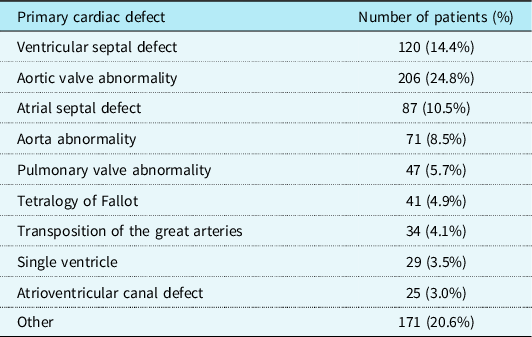
Of the 945 patients identified with our database search criteria, 114 patients were excluded, largely on the basis of resolved or trivial CHD, resulting in a total patient population of 831. Mean age of all patients included was 12.9 years (range 4–22 years). Male gender accounted for 68.2% (567 total) patients (Table 1). Breakdown of form of CHD is shown in Table 2. The most common defects included ventricular septal defect, atrial septal defect, and aortic valve abnormalities, with the majority being bicuspid aortic valve. Aortic arch abnormalities were also prevalent, most commonly coarctation of the aorta. Roughly half of the patients (49.5%) had undergone prior cardiac surgery. At the time of data collection, 53.1% of patients were on an amphetamine, 41.6% were on a methylphenidate, and 5.3% were on atomoxetine. During the study period, a total of 26 patients received medical therapy that could have potential anti-arrhythmic effects (3.1% of the study population). Six patients received digoxin and 20 patients received beta-blocker therapy. The primary indication for medical therapy in these patients was related to rhythm control in five patients. In all of these patients, this medical therapy was present prior to the initiation of attention deficit/hyperactivity disorder therapy. The other 21 patients received medical therapy for the treatment of hypertension or ventricular dysfunction.
Patient demographics

Breakdown of CHDs in our patient population

Only 1 patient out of the 831 patients in our study was found to have a significant arrhythmia during the study period representing a prevalence rate of 0.12% (95% CI = 0.02%, 0.68%). This one patient had right aortic arch but no other structural heart disease and a prior diagnosis of supraventricular tachycardia that became more significant and frequent while on stimulant therapy. The stimulant was discontinued and the patient had no further episodes of supraventricular tachycardia during follow-up. No other patients had a diagnosis of supraventricular tachycardia during the study period.
In the sensitivity analysis, there were 472 patients with adequate follow-up information. Among this group, median follow-up was 686 days (interquartile range 441–994 days) for a total follow-up duration of 366,257 person-days (or 1002.8 person-years of follow-up). The prevalence rate of significant arrhythmia using sensitivity analysis was 0.21% (95% CI 0.037%, 1.19%), which represents 1 event per 1000 person-years. In comparison with the prevalence of supraventricular tachycardia in the general population by Orejarena et al of 2.25/1000 person-years, Reference Orejarena, Vidaillet and DeStefano17 our prevalence of a significant arrhythmia in children with CHD on attention deficit/hyperactivity disorder therapy was not significantly different (p = 0.5).
Discussion
In this study, the largest study to date focusing on significant adverse events in the population of children with CHD and attention deficit/hyperactivity disorder who have received medical therapy, there was an incidence of serious cardiac events while on attention deficit/hyperactivity disorder medication of 0.21%. This is similar to that of serious cardiac arrhythmias in the general public. These findings suggest that attention deficit/hyperactivity disorder medications are safe in children with CHD.
In children with CHD, there is hesitancy to starting medical therapy for the treatment of attention deficit/hyperactivity disorder. The International Consensus Statement on attention deficit/hyperactivity disorder addresses the significant detrimental effects of untreated attention deficit/hyperactivity disorder in children, including increased rates of dropping out of high school, not completing college, having fewer friends, underperforming at work, teen pregnancy, sexually transmitted infections, depression, and other personality disorders. Reference Barkley18 Many children with CHD are already at increased risk for decreased school performance and social isolation. Reference Batra, Alexander and Silka1,Reference Mahle, Clancy, Moss, Gerdes, Jobes and Wernovsky5–Reference Holland, Cassidy and Stopp8 Shillingford et al examined children who had undergone newborn cardiac surgery through parent surveys. Nearly, half of the respondents were already receiving remedial services in school, and 18% had to repeat at least one school grade. Almost one-third of the students surveyed were identified to be at high risk for inattentive behaviours. Reference Shillingford, Glanzman, Ittenbach, Clancy, Gaynor and Wernovsky4 Hovels-Gurich et al used attention network tests to demonstrate that patients with neonatal hypoxia had decreased scores in the realm of attention at a mean age of 7.4 years. Reference Hovels-Gurich, Konrad, Skorzenski, Herpertz-Dahlmann, Messmer and Seghaye9
An American Heart Association Consensus Statement on neurodevelopmental outcomes in children with CHD emphasised the importance of early identification and treatment of attention deficit/hyperactivity disorder in these patients. Reference Marino, Lipkin and Newburger19 Many studies demonstrate how large of an issue attention deficit/hyperactivity disorder is for children with CHD and how destructive untreated attention deficit/hyperactivity disorder can be. Actively choosing to not treat their underlying medical condition on the basis of potential rare adverse reactions can place a population that we know is already at risk for delayed social and intellectual development in further jeopardy. Furthermore, up to 60% of children continue to manifest symptoms into adulthood potentially compounding the detrimental effects of non-treatment. Reference Posner, Polanczyk and Sonuga-Barke20 Further population-based studies aiming to identify rare events in this group of patients would help to solidify the observations made in our single-centre study.
Many arrythmias in association with CHD occur in the neonatal period surrounding neonatal surgeries. Having neonatal cardiac surgery can increase the risk of arrhythmia later in life. Reference Tripathi, Black, Park and Jerrell21 Almost half of our patients had undergone prior cardiac surgery, indicating that our patient population had significant CHD at baseline and are at higher risk for arrhythmias. Patients with a prior history of a significant arrhythmia or repair with resultant arrhythmogenic substrate may have been less likely to be prescribed a stimulant medication, so they would not have been included in our study population.
One potential confounder regarding the identification of rhythm complications would be if a significant percentage of our patient population was receiving concurrent medical therapy with antiarrhythmic capabilities. In reviewing our dataset, 26 patients were receiving either a beta-blocker or digoxin, with only 5 of the 26 having a primary indication for medical therapy of rhythm control. Given the low overall percentage of patients receiving these medications, we do not think that this had a significant impact on our results. A limitation to our study design is that we assume that if a patient had an adverse cardiovascular event related to medical therapy that this would have been captured in either a clinic follow-up visit or a hospital visit within our medical system. This is a reasonable assumption as we represent the main provider for paediatric cardiology in our region and the single paediatric hospital facility during this time period. It would not, however, account for patients who moved during the study period, a limitation present in most studies of this type. With our sensitivity analysis, we excluded patients with no follow-up in our system and the average follow-up duration was almost 2 years, representing about 1000 person-years of follow-up. In addition, our study was not powered to specifically assess incidence of sudden cardiac arrest, which occurs in 1–2:100,000 in the general population.
In the current study consisting of 831 patients with CHD and attention deficit/hyperactivity disorder who received medical therapy, we identified no increased risk for severe cardiovascular adverse events. While further population-based studies would be of significant benefit to detect rare events, we hope that this single-centre study can aid in the decision-making process regarding medical therapy for this growing patient population.
Acknowledgements
None.
Financial support
This research received no specific grant from any funding agency, commercial or not-for-profit sectors.
Conflicts of interest
None.
Ethical standards
The authors assert that all procedures contributing to this work comply with the ethical standards of the relevant national guidelines on human experimentation and with the Helsinki Declaration of 1975, as revised in 2008, and have been approved by the institutional committees (Institutional Review Board at the Children’s Healthcare of Atlanta).