Introduction
Anxiety disorders are frequent in elderly adults with 12-month prevalence ranging from 1.2% to 15% in community samples (Bryant et al., Reference Bryant, Jackson and Ames2009; Wolitzky-Taylor et al., Reference Wolitzky-Taylor, Castriotta, Lenze, Stanley and Craske2010), and from 1% to 28% in clinical samples (Bryant et al., Reference Bryant, Jackson and Ames2009), being more common than depression. The prevalence of anxiety symptoms, which do not meet criteria for an anxiety disorder, is even higher, ranging from 15% to 52.3% in community samples and from 5% to 56% in clinical samples (Bryant et al., Reference Bryant, Jackson and Ames2009). They are often under diagnosed, and many times only their somatic symptoms are treated; in addition, they are costly for the healthcare system (Wolitzky-Taylor et al., Reference Wolitzky-Taylor, Castriotta, Lenze, Stanley and Craske2010). The detection and diagnosis of anxiety are complicated by clinical comorbidities, cognitive impairment, age-related changes in daily life such as lack of mobility, retirement, and worries about health and death that are not usual to happening in younger population (Wolitzky-Taylor et al., Reference Wolitzky-Taylor, Castriotta, Lenze, Stanley and Craske2010).
Most anxiety scales were originally created for younger adults and were applied in older samples later on. The Beck Anxiety Inventory (BAI) has provided a mean score for community-dwelling elderly subjects (Beck et al., Reference Beck, Epstein, Brown and Steer1988; Morin et al., Reference Morin, Landreville, Colecchi, McDonald, Stone and Ling1999) and the Adult Manifest Anxiety Scale – Elderly Version was adapted for older individuals (Lowe and Reynolds, Reference Lowe and Reynolds2000). Likewise, the Penn State Worry Questionnaire (Meyer et al., Reference Meyer, Miller, Metzger and Borkovec1990), the Depression Anxiety Stress Scale (Gloster et al., Reference Gloster2008), and the State-Trait Anxiety Inventory (STAI) (Spielberger et al., Reference Spielberger, Gorsuch and Lushene1970) were also originally developed for the adult population and only later used for evaluating anxiety in old-aged samples.
The Short Anxiety Screening Test – SAST (Sinoff et al., Reference Sinoff, Ore, Zlotogorsky and Tamir1999), the Geriatric Anxiety Scale – GAS (Segal et al., Reference Segal, June, Payne, Coolidge and Yochim2010), and the Geriatric Anxiety Inventory (GAI) (Pachana et al., Reference Pachana, Byrne, Siddle, Koloski, Harley and Arnold2007) are among the few instruments specifically created to evaluate elderly people anxiety symptoms.
The GAI (Pachana et al., Reference Pachana, Byrne, Siddle, Koloski, Harley and Arnold2007) has some advantages, since it is a brief scale, with yes/no answers and easily applied in situations of fatigue, lower educational level, or mild cognitive impairment. It contains 20 items that can be self-answered or administered by an interviewer. Furthermore, it has few items that target symptoms that could be due to other frequent clinical conditions in old age. The psychometric properties of the original scale have already been demonstrated with high internal consistency (α = 0.91 among normal elderly people and 0.93 in the psychogeriatric sample), high test–retest reliability (ρ = 0.91), and concurrent validity with BAI (r = 0.63) (Pachana et al., Reference Pachana, Byrne, Siddle, Koloski, Harley and Arnold2007). It was also significantly correlated with the STAI-S in Australian community-residing older women (ρ = 0.58) (Byrne et al., Reference Byrne, Pachana, Goncalves, Arnold, King and Khoo2010). A GAI cut-off point of 10/11 was able to identify the Generalized Anxiety Disorder (GAD) diagnosis in older patients with a sensitivity of 75% and specificity of 84% (Pachana et al., Reference Pachana, Byrne, Siddle, Koloski, Harley and Arnold2007). The GAI has been translated into over two dozen languages spread across five continents and the standard translation approach of a translation and independent back-translation checked for accuracy in the original language has been employed with all translations (Pachana and Byrne, Reference Pachana and Byrne2012). Psychometric properties of the GAI in older adult populations have been investigated in a variety of clinical settings in an attempt to both confirm the properties and functionality of the GAI while also contributing to empirical data about anxiety in later life (Pachana et al., Reference Pachana, Byrne, Siddle, Koloski, Harley and Arnold2007). Some of those translations are the already validated Portuguese (Ribeiro et al., Reference Ribeiro, Paúl, Simões and Firmino2011) and Spanish (Márquez-González et al., Reference Márquez-González, Losada, Fernández-Fernández and Pachana2012) GAI versions. The GAI Portuguese version (Ribeiro et al., Reference Ribeiro, Paúl, Simões and Firmino2011) showed high internal consistency with a Cronbach's α of 0.95, high test–retest reliability (ρ = 0.99), and good concurrent validity with STAI-S (ρ = 0.63). It was also able to detect severe anxiety with 80% specificity and 88% sensitivity (area under the ROC curve: 0.93), using the 8/9 cut-off point. The Spanish version (Márquez-González et al., Reference Márquez-González, Losada, Fernández-Fernández and Pachana2012) also found a high internal consistency (α = 0.91), however, its test–retest reliability, concurrent validity, and diagnostic property to detect anxiety disorders were not assessed. GAI was also translated and adapted to Brazilian Portuguese by Martiny et al. (Reference Martiny, Silva, Nardi and Pachana2011). However, the Brazilian Portuguese version remains to be validated. Additionally, no other scale specifically developed to identify anxiety disorders in elderly individuals has been validated in Brazil, despite the growing rates of aged people in this country (Brazilian Institute of Geography and Statistics, 2010).
The aim of this study is to validate the Brazilian Portuguese version of the GAI (GAI-BR). We aim to estimate the internal consistency of the GAI-BR, to evaluate its test–retest reliability, to assess its concurrent validity, and to evaluate the GAI-BR diagnostic power in detecting GAD. Our hypothesis is that the GAI-BR will present psychometric properties similar to those showed by the original scale.
Material and methods
It was a cross-sectional study. A mixed convenience sample of outpatients recruited from Psychogeriatric Clinics of two Brazilian Universities (UFCSPA and UFRJ) and of healthy elderly community-dwelling subjects recruited from a community center for elderly people located at Porto Alegre city was selected for the study. In this community center, the elderly individuals have social and cultural activities, such as handcraft works, games, singing, and dancing. All the participants and their proxies consented to participate in the study and signed the informed consent form. The Mini-Mental State Examination (MMSE) (Folstein et al., Reference Folstein, Folstein and McHugh1975) was initially applied to evaluate the cognitive performance and those subjects who presented positive in this screening for cognitive impairment were excluded. The MMSE cut-off points for positive screening and subsequent exclusion were 24 for individuals with high educational level (>8 years) and 18 for those subjects with ≤8 years of education (Bertolucci et al., Reference Bertolucci, Brucki, Campacci and Juliano1994). The remaining sample completed the entire research protocol.
In addition to the GAI Brazilian Portuguese version (Martiny et al., Reference Martiny, Silva, Nardi and Pachana2011), the whole research protocol included: a sociodemographic data questionnaire; a questionnaire for assessment of clinical diseases based on reports of previous medical diagnosis of some clinically significant diseases; the BAI (Beck et al., Reference Beck, Epstein, Brown and Steer1988; Cunha, Reference Cunha2001); the STAI (Spielberger et al., Reference Spielberger, Gorsuch and Lushene1970; Gorenstein and Andrade, Reference Gorenstein and Andrade1996); the Geriatric Depression Scale (GDS)-15 (Yesavage, Reference Yesavage1983; Almeida and Almeida, Reference Almeida and Almeida1999), and the Mini International Neuropsychiatric Interview (MINI) (Sheehan, Reference Sheehan1998; Amorim, Reference Amorim2000). The BAI and the STAI were administered to assess GAI-BR concurrent validity. The Geriatric Depression Scale (GDS)-15 was also used in order to verify the GAI-BR concurrent validity, since anxiety and mood disorders have a high rate of comorbidity (Byers et al., Reference Byers, Yaffe, Covisnky, Friedman and Bruce2010). The MINI interview was used to establish psychiatric diagnoses allowing to evaluate the GAI-BR diagnostic power in detecting GAD. All these instruments had already been adapted and translated to Brazilian Portuguese language and are briefly described below:
-
(a) Questionnaire with sociodemographic data: gender, age, education (measured in years of schooling), and family income (measured by index of family purchasing power) from the Brazilian Association of Research Companies Socioeconomic Survey (2010) that includes: the presence and number of family goods such as radio, television, DVD, washing machine, and cars; the number of bathrooms in the house; the presence and number of housemaid in the family, and the educational level of the family chief. The total score generates categories and each category represents a range of family income;
-
(b) Questionnaire for assessment of clinical diseases based on reports of previous medical diagnosis of some clinically significant diseases;
-
(c) BAI (Beck et al., Reference Beck, Epstein, Brown and Steer1988; Cunha, Reference Cunha2001): self-report instrument consisting of 21 items that evaluates the most common anxiety symptoms seen in clinical practice. Each item is scored from 0 (absent) to 3 (severe) and total score ranges from 0 to 63;
-
(d) STAI (Spielberger et al., Reference Spielberger, Gorsuch and Lushene1970; Gorenstein and Andrade, Reference Gorenstein and Andrade1996): a self-report instrument consisting of 40 statements describing personal feelings, measuring two separate components. Part I evaluates the state of anxiety, which refers to a transient state characterized by subjective feelings of tension that can vary in intensity over time. The subject must answer how he feels at the time, on a scale of 1 (not at all) to 4 (extremely). Part II evaluates the trait anxiety, which refers to a relatively stable disposition to respond to stress and anxiety with a tendency to perceive a wide range of situations as threatening. The items range from 1 (almost never) to 4 (almost always). The total score ranges from 40 to 160 points, so that higher values indicate higher levels of anxiety;
-
(e) GDS-15 (Yesavage, 1982–83; Almeida and Almeida Reference Almeida and Almeida1999): this scale contains 15 items with a yes/no response format, and was developed to measure symptoms of depression in older subjects;
-
(f) MINI (Sheehan, Reference Sheehan1998; Amorim, Reference Amorim2000): a semi-structured interview for DSM-IV and ICD-10 criteria, lasting approximately 15–30 minutes.
Twenty-two percent of the complete sample was interviewed again 1 week later, to evaluate the GAI-BR test–retest reliability. The 1-week interval between the two applications was considered by the authors as a time neither so long as to allow a real change in the individual state, nor so short as to the memory of the first interview influences the response on the second administration.
Eight previously trained researchers conducted the data collection in the three participating centers. One psychiatrist and one psychologist from the research team rated the MINI interview. They were previously trained to apply this interview in order to establish a good inter-rater reliability. Two senior research psychiatrists, who had many years of clinical psychiatry research experience, provided the training. The MINI rating sheets were reviewed by these senior researcher psychiatrists to solve any diagnostic doubts by consensus. Five medical graduate students and one psychology graduate student applied the other scales. The ethics committees of UFCSPA, the HMIPV, the Municipality of Porto Alegre, and UFRJ approved the project.
Statistical analyses
Descriptive analyses were performed first. The Kolmogorov-Smirnov test was used in order to assess the normality of data. Parametric or nonparametric statistics were carried out according to the variables distribution. For statistical analysis of internal consistency, we applied the Cronbach's α test. The Spearman correlation test was used in order to evaluate the test–retest GAI-BR reliability and to assess its bivariate correlation with each anxiety scale (BAI and STAI), and with the GDS. It was also used in order to evaluate the correlation of the GAI-BR with education level and age. The Mann–Whitney U test was used to compare the GAI-BR, BAI, STAI, and GDS scores between individuals with or without GAD.
The receiver operating characteristic (ROC) curve was used in order to assess the GAI-BR performance as a diagnostic test for GAD. This curve is a graphic representation of the relation between the sensibility (on y-axis) and specificity (1-specificity on x-axis) for all possible test values cut-off points. For a continuous test, the optimal cut-off point to correctly pick up a disease and nondiseased cases is the point where sum of specificity and sensitivity is maximum, when equal weight is given to both (Kumar and Indrayan, Reference Kumar and Indrayan2011). Sensitivity (conditional probability of correctly identifying the diseased subjects by test) and specificity (conditional probability of correctly identifying the nondiseased subjects by test) of GAI-BR were calculated. The area under the ROC curve (AUC), an index of overall inherent validity of test was also calculated.
The SPSS 17.0 software was used for statistical analysis.
Results
Descriptive analyses
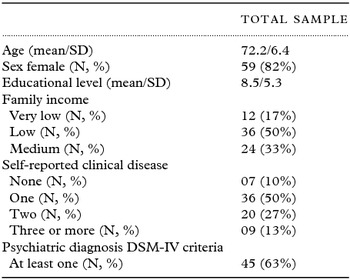
The final sample comprised 72 elderly individuals (age ≥ 60 years). Sociodemographic and clinical data are described in Table 1. Women and individuals with low family income made up the majority of the sample. Sixty-five percent of the sample demonstrated at least one psychiatric diagnosis according to MINI (DSM-IV). The most frequent diagnosis was depressive episode (48%) followed by GAD (25%), agoraphobia (8%), dysthymia (6%), hypomania (6%), panic disorder (4%), and obsessive compulsive disorder (1%).
Sociodemographic and clinical data (N = 72)

The mean/SD GAI-BR score was 8.77, ranging from 7.39 to 10.16, the median was 8.00. As the distribution of scores in the GAI-BR was nonparametric (p = 0.04, the Kolmogorov-Smirnov test with Liliefors Significance Correction), nonparametric analyses were carried out.
The GAI-BR total score was significantly higher in subjects with lower family income (N = 13, GAI BR mean score/SD = 11.54/4.70) than in those individuals who had higher family income (N = 58, GAI-BR mean score/SD = 8.17/5.90) (Mann–Whitney U = 333, z = –2.69, p < 0.007), did not differ between elderly subjects with none or one or more self-related clinical illnesses (Mann–Whitney U = 187, z = −1.67, p < 0.096), and did not differ by gender (Mann–Whitney U = 322, z = −0.89, p = 0.37). The GAI-BR was inversely correlated with education (Spearman ρ = −0.47, p < 0.001) and it was not correlated with age.
The internal consistency of the GAI-BR, measured by Cronbach's α, was 0.91. A strong and significant test–retest reliability (ρ = 0.85, p < 0.001) was found between the two applications of the scale, with a week interval, in a subsample of 16 individuals.
The GAI-BR correlated significantly with other measures of anxiety and depression used in the study. Table 2 shows the Spearman correlation analysis between these instruments in the total sample (N = 72).
Spearman correlation coefficient between the Brazilian Portuguese GAI version and other measures of anxiety and depression (Spearman correlation)

*p < 0.001; ** p < 0.019; GAI = Geriatric Anxiety Inventory; BAI = Beck Anxiety Inventory; STAI = State-Trait Anxiety Inventory; STAI-T = State-Trait Anxiety Inventory-subscale trace; STAI-S = State-Trait Anxiety Inventory-subscale state; GDS = Geriatric Depression Scale.
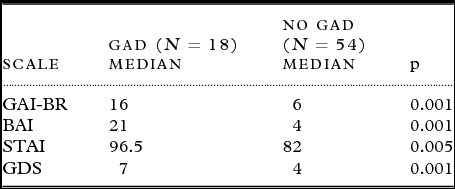
Comparisons of GAI-BR, IAB, IDATE, STAI, and GDS scores between the groups with and without GAD (DSM-IV) are shown in Table 3. Brazilian Portuguese GAI, STAI, BAI, and GDS scores were significantly higher in the individuals with GAD (DSM-IV).
Comparison of GAI-BR, BAI, STAI, and GDS scores between individuals with and without GAD diagnose (Mann–Whitney U test)
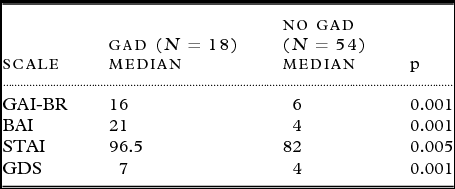
GAD = Generalized Anxiety Disorder; GAI = Geriatric Anxiety Inventory; BAI = Beck Anxiety Inventory; STAI = State-trait Anxiety inventory; GDS = Geriatric Depression Scale.
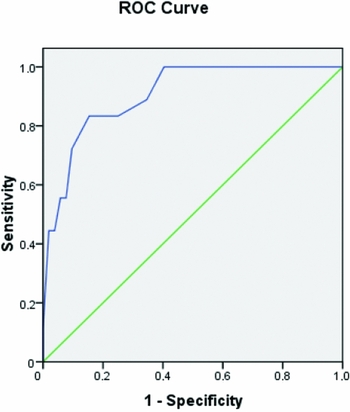
Using the diagnosis of GAD by DSM-IV as gold standard, the GAI-BR showed good diagnostic power to detect this condition, indicating an area under the curve of 0.90, obtained by ROC curve analysis (Figure 1).
ROC curve analysis.

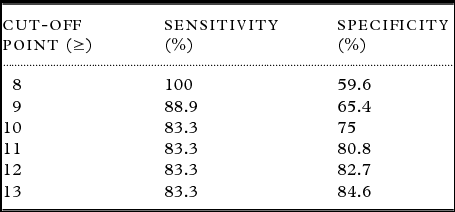
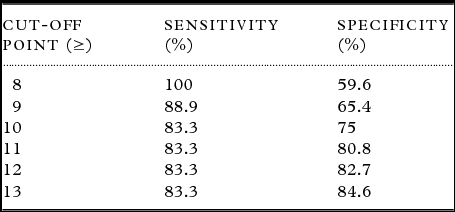
Table 4 shows the Brazilian Portuguese GAI cut-off points with their respective sensitivity and specificity for the detection of GAD. The cut-off point of 13 demonstrated a sensitivity of 83.3% and a specificity of 84.6%, indicating that this GAI version was able to discriminate individuals with GAD from those without GAD.
GAI-BR cut-off points derived from ROC curve and their sensitivity and specificity values to diagnose TAG by DSM-IV TR
Discussion
The present study aimed to evaluate the psychometric properties of the GAI-BR version. We found strong internal consistency among the 20 inventory items (α = 0.91) and strong and significant test–retest correlation (ρ = 0.85), proving the GAI-BR as a reliable scale in this regard. Internal consistency was similar to those values reported in other studies carried out with this instrument. In the original study, Pachana et al. (Reference Pachana, Byrne, Siddle, Koloski, Harley and Arnold2007) found high GAI internal consistency (α = 0.91 in the community sample; α = 0.93 in the psycho-geriatric sample). In another study conducted in Australia, Byrne et al. (Reference Byrne, Pachana, Goncalves, Arnold, King and Khoo2010) found a value of α = 0.92. In the GAI validation study carried out in Portugal (Ribeiro et al., Reference Ribeiro, Paúl, Simões and Firmino2011), the authors found α = 0.95, while the Spanish version showed α = 0.91. The test–retest reliability was also similar to that demonstrated in the original validation study of the English language version (ρ = 0.91) (Pachana et al., Reference Pachana, Byrne, Siddle, Koloski, Harley and Arnold2007) and in the Portuguese version in Portugal (ρ = 0.99) (Ribeiro et al., Reference Ribeiro, Paúl, Simões and Firmino2011). This result suggests that cross-cultural adaptation does not change the performance characteristics of this instrument.
Additionally, the GAI-BR correlated significantly with the other instruments that measure anxiety, reflecting its concurrent validation. The correlation was significant and moderate with the BAI and the STAI (ρ = 0.68 and 0.61, respectively). The correlation with BAI was similar to those found in the GAI's original validation study (r = 0.63, p < 0.001). The Brazilian Portuguese version also correlated significantly with STAI subscales, although this correlation was weaker. The weak correlation with the STAI-state (ρ = 0.28, p < 0.019) may have been influenced by the statement contained in the version used in this study, which emphasizes that the subject should respond to the items according to how he/she feels when being interviewed. This may have generated a bias and may not reflect the state of anxiety that the patient has presented over most days during the previous week, for example.
It is well known that the comorbidity between anxiety and depression symptoms is very common (Byers et al., Reference Byers, Yaffe, Covisnky, Friedman and Bruce2010). Thus, the significant and moderate correlation (ρ = 0.70, p < 0.001) between GAI-BR and GDS found in the present study was expected and also reflects this association.
Educational level was inversely correlated with the GAI-BR total score, and this finding should be further investigated. A suitable explanation would be that the lower income, the higher frequency of anxiety complaints. In addition, lower education was associated, as expected, to lower income. Similarly, as the GAI-BR score was significantly higher in people of lower family income, this finding can be explained by the same two hypotheses mentioned above.
The GAI scale was designed to measure common anxiety symptoms in elderly population (Pachana et al., Reference Pachana, Byrne, Siddle, Koloski, Harley and Arnold2007; Byrne et al., Reference Byrne, Pachana, Goncalves, Arnold, King and Khoo2010; Pachana and Byrne, Reference Pachana and Byrne2012). The GAI-BR cut-off point of 9 demonstrated high sensitivity (88.9%) to identify GAD and the use of this cut-off value could be recommended for screening purposes. However, with this cut-off value the specificity was low (65%) impairing the overall scale performance. High values of sensitivity (83.3%) and specificity (84.6%) were found with the cut-off point of 13, with a very good diagnostic power of this version to detect GAD. This cut-off point was the optimal value to correctly identify GAD and non-GAD cases, attaining the maximum sum of specificity and sensitivity, producing the best counterbalance between sensitivity and specificity, and generating the high area under the ROC curve (AUC = 0.90). It was two points higher than those observed for the original version (10/11) (Pachana et al., Reference Pachana, Byrne, Siddle, Koloski, Harley and Arnold2007). We can attribute our result to the female preponderance (82%) in the total sample as it is well described in the literature that women have higher scores of depressive and anxiety symptoms in rating scales, without conforming to any diagnosis (Camozzato et al., Reference Camozzato, Hidalgo, Souza and Chaves2007). Also, we can hypothesize that in Brazil some cultural characteristics may have contributed to our cut-off scores, such as a greater “permissiveness” for anxiety complains. Furthermore, social differences may impact anxiety levels, particularly among individuals with low-income situation and social vulnerability, which have many stressors like urban violence and lack of access of health services. As our sample consisted mostly of individuals with lower income and schooling, these aspects may have influenced the cut-off scores. It is also possible that, in general, our population are “more complaining” and therefore, the cut-off point to establish psychiatric diagnosis is higher.
Moreover, the sample size did not allow us to analyze the data from those individuals who only presented with GAD (without any psychiatric comorbidity), which may have influenced the cut-off point. Validation studies in larger samples that are more representative of the population should be carried out to clarify this issue. In any case, GAD pure cases are not frequent, and comorbidities (especially with depression) are very frequent.
The current results indicate that the GAI-BR can be an useful and reliable instrument to measure anxiety in Brazilian elderly people, as well as a good instrument to perform transcultural studies from now on using Brazilian elderly samples.
Conflicts of interest
None of the authors have conflicts of interest.
Description of authors’ roles
P. Massena collected the interviews, analyzed the data, conducted the writing, and reviewed the paper. N. Araújo participated as interviewer and reviewed the paper. N. Pachana is the author of inventory in validation and reviewed the paper. J. Laks and A. Camozatto de Pádua participate in the writing and supervised the final reviewing of the paper.