1. INTRODUCTION
The integration of GPS and INS has been extensively investigated and increasingly applied for high precision position and attitude determination in different kinds of applications such as airborne geo-referencing and land vehicle navigation. Current GPS/INS integrated systems are typically based on the integration of double differenced code and phase measurements from two GPS receivers and inertial data. The differencing operation on GPS data is necessary in order to eliminate or significantly reduce GPS satellite orbit and clock errors, atmospheric errors and GPS receiver errors (Petovello et al., Reference Petovello, Cannon and Lachapelle2004; Scherzinger, Reference Scherzinger2000; Zhang and Gao, Reference Zhang and Gao2004 and Reference Zhang and Gao2005). There are two disadvantages to such differential GPS/INS systems. First, they increase the system cost and complexity since a base GPS receiver station must be deployed at a control site whose position should be precisely known. Second, the separation distance between the base and rover GPS receiver stations must be short, in the range of several tens of kilometres, to ensure high correlation between the measurement errors at base and rover stations. The above has been a limitation factor for many applications where GPS base stations are difficult to deploy. Airborne geo-referencing is a typical example for mapping operations over large areas with limited ground access.
With the advent of precise orbit and clock products, a new positioning methodology known as Precise Point Positioning (PPP) has been developed and increasingly applied for high precision GPS position determination (Kouba and Héroux, Reference Kouba and Heroux2000; Gao et al., Reference Gao and Shen2002). Different from double different GPS positioning method, PPP processes GPS data from a single GPS receiver and is able to provide cm to dm accurate position solutions using widely available precise GPS products from International GNSS Service (IGS) to mitigate GPS orbit and clock errors (Gao et al., Reference Gao and Shen2002). Such precise GPS product is also currently available in real-time from Jet Propulsion Laboratory (JPL) and has been applied to commercial applications (Navcom; Gao, et al., Reference Gao and Chen2005). The success with PPP for precise position determination is opening a new way for GPS/INS integration system development. It is expected a GPS/INS system that employs only a single GPS receiver will not only reduce the system cost and complexity but also increase the system's flexibility to field operations since a base station is no longer a requirement.
This paper describes the development of a GPS/INS system based on the integration of un-differenced GPS code and phase observations from a single GPS rover receiver station and inertial data for precise position and attitude determination. The mathematical models for both un-differenced GPS measurements and INS will first be introduced. The methods for the mitigation of errors in un-differenced GPS measurements will then be presented. A tightly coupled integration strategy has been developed and will be described in detail. Results from a field test are analyzed to demonstrate the system performance.
2. INERTIAL NAVIGATION SYSTEM MODEL
The mechanization of an inertial navigation system given in a Local Level frame (L-frame) can be described by the following equations (Schwarz and Wei, Reference Schwarz and Wei2000):




where γ is the vehicle's position, V1 is the vehicle's velocity given in L-frame, M is the relationship matrix between position rate and the velocity in L-frame, Rb1 is the transformation matrix from the Body frame (B-frame) to L-frame, ωie1 is the angular rate of the Earth relative to the Inertial frame (I-frame) shown in L-frame, ωe11 is the angular rate of L-frame relative to the Earth frame (E-frame) shown in L-frame, g1 is the gravity shown in L-frame,  is the specific force measured by the accelerometers, Ωibb is the skew-symmetric matrix of
 , the body angular rate measured by the gyroscopes.
Considering only bias errors in the inertial sensors and modelling them as Gauss-Markov processes, we are able to have the following simplified perturbation error model (Scherzinger, Reference Scherzinger2004; Schwarz and Wei, Reference Schwarz and Wei2000):
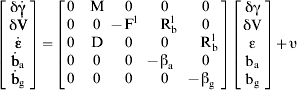
where δγ is the vector of position errors, δV is the vector of velocity errors, ε is the vector of misalignment angles, ba is the vector of biases of the accelerometers, bg is the vector of biases of the gyroscopes, D is the relationship matrix between the misalignment angles and the velocities in L-frame, Fl is the skew-symmetric matrix for the specific force given in the L-frame, βa and βg are reciprocal to the correlation time of the accelerometer biases and gyro biases' Gauss-Markov processes respectively, υ is system noise vector.
3. UN-DIFERENCED GPS OBSERVATION MODEL
The observation model for un-differenced GPS code and phase measurements can be described by the following equations (Gao et al., Reference Gao and Shen2002):


where P is the measured pseudorange (m), Φ is the measured carrier phase (m), ρ is the true geometric range (m), c is the speed of light (m/s), dT is the receiver clock error (s), dt is the satellite clock error (s), dorb is the satellite orbit error (m), dtrop is the tropospheric delay (m), dion is the ionospheric delay (m), λ is the wavelength (m), N is the phase ambiguity (cycle) and v(⋅) is the measurement noise (m).
Equations (6) and (7) show that un-differenced GPS measurements include satellite orbit and clock errors, troposphere and ionosphere errors, receiver clock errors, multipath and measurement noise. Applying precise GPS products to mitigate the satellite orbit and clock errors reduces the observation model in equation (6) and (7) to:


The ionospheric delay effect can be eliminated by a linear combination of observations from GPS L1 and L2 frequencies. The resultant ionosphere-free observation equations from equations (8) and (9) become:


The remaining error source in equations (10) and (11) now includes only the tropospheric delay effect. The slant tropospheric delay dtrop, which is different for observations from different GPS satellites, contains two major components, namely hydrostatic and wet delays, and each can be represented by a zenith delay and a mapping function as described below (Schuler, Reference Schuler2001):

where m(⋅) is the mapping function, e is the elevation angle, the subscripts h and w represent the hydrostatic and wet part of tropospheric delay, respectively.
As stated by Bevis (Bevis et al., Reference Bevis, Businger, Herring, Rocken, Anthes and Ware1992), the hydrostatic delay dh, which contains 90% of the total tropospheric delay, can be modelled with accuracy up to a few millimetres. As a result, equations (10) and (11) can be modified to the following form:


The unknown parameters to be estimated in equations (13) and (14) now include the position coordinates, receiver clock offset and the tropospheric wet delay effect. If the phase rate measurements and Doppler shift measurements, are available, their ionosphere-free combination has the following form:

As the satellite orbit and clock change rates can be extracted from the precise GPS products, the change of the tropospheric delay is very slow, equation (15) can be simplified as:

4. INTEGRATION OF UN-DIFFERENCED GPS AND INS DATA
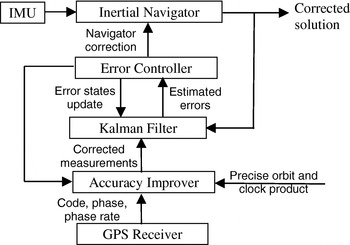
The core part for any integrated navigation systems is the data fusion strategy through which accurate navigation parameters can be derived. Different GPS/INS data fusion methods have been developed and used in different applications including uncoupled integration, loosely coupled integration, tightly coupled integration and deeply coupled integration. They differ in the extent of information being shared and provide navigation solutions of different performance and complexity. In this paper, the tightly coupled integration strategy, which has been increasingly adopted for the development of high precision GPS/INS systems, is used. Illustrated in Figure 1 is the architecture of a tightly coupled un-differenced GPS/INS system. As shown in Figure 1, the integrated system consists of two major components, namely, an inertial component including an IMU and an Inertial Navigator, and a GPS part comprising an accuracy improver and precise orbit and clock products and a data fusion part, the Kalman filter. Since the inertial component is the same as conventional differential GPS/INS systems and the GPS component uses the error mitigation approaches of PPP methodology, the main task of the integration of un-differenced GPS and INS measurements is the design of the Kalman filter which will be introduced herein.
Architecture of un-differenced GPS/INS.

Unlike a differential GPS/INS system, the system error state vector of the new un-differenced GPS/INS system includes not only the INS errors but also the errors remaining in the un-differenced GPS measurements. Adopting the commonly used 15 states error model for INS as described in equation (5) and considering the GPS measurement errors presented in equations (13), (14) and (16), a system dynamics model has been developed as follows (Zhang and Gao, Reference Zhang and Gao2004 and Reference Zhang and Gao2005):
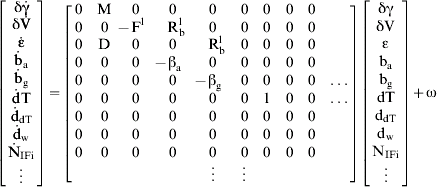
where δγ, δV, ε, ba and bg are errors in INS measurements, dT, ddT (receiver clock error rate) and dw are errors in GPS measurements, NIFi (i=1, 2, … n where i is the total number of phase observations) is the ambiguity parameter to a satellite and ω are the vectors of system noise.
With ionosphere-free pseudorange, carrier phase and phase rate as the measurement input data for the GPS/INS system, the design matrix for the Kalman filter can be developed as follows (Zhang and Gao, Reference Zhang and Gao2004 and Reference Zhang and Gao2005):
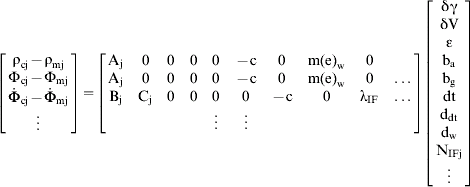
where ρcj−ρmj is the difference between the measured and calculated ionosphere pseudorange from the GPS receiver to the j-th satellite, Φcj−Φmj is the difference between the measured and calculated carrier phase from the GPS receiver to the j-th satellite, Φcj−Φmj is the difference between the measured and calculated phase rate from the GPS receiver to the j-th satellite,  ,
 and
 are the partial derivatives of the range, phase and range rate with respect to the receiver position and velocity.
5. FIELD TEST RESULTS AND ANALYSIS
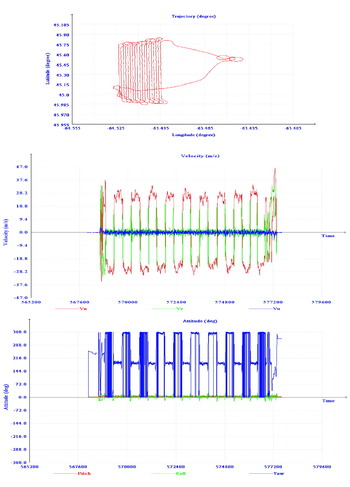
An airborne test has been conducted to verify the performance of the integration of un-differenced GPS data from a single GPS receiver and INS measurements in a tightly coupled approach for position and attitude determination. The data was sampled by a BDS system from NovAtel. During this test, the BDS system was mounted in a test airplane and the lever-arm between the IMU and GPS antenna was −1·22 m in X-axis, 7·08 m in Y-axis and 2·32 m in Z-axis. The test airplane had a speed about 100 km/hr during the flight. Figure 2 illustrates the trajectory, velocity and attitude of the airplane, which indicate that during the flight, both the velocity and attitude of the airplane experienced rapid variations where the airplane made turns, which can also be interpreted as high dynamics of the airplane.
Trajectory (top), velocity (centre) and altitude (bottom) of the airplane.

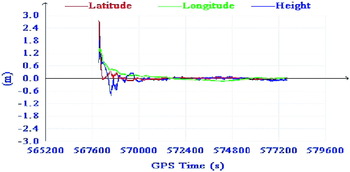
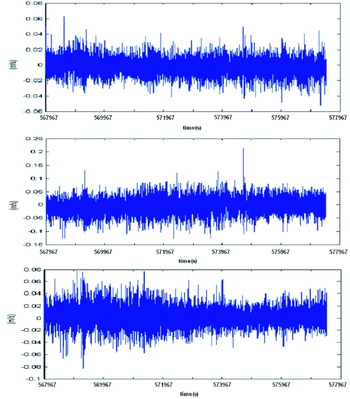
The position and velocity accuracy of the un-differenced GPS/INS system was evaluated by comparing the system's solution to a reference obtained by differential GPS/INS processing with a ground base receiver using a commercial software system. The reference solution accuracy is at the level of several centimetres for position and millimetre to centimetre per second for velocity estimates. The differences between the differenced and un-differenced solutions are given in Figure 3 for position and in Figure 4 for velocity. The summary accuracy statistics are provided in Table 1.
Position accuracy.

Velocity accuracies: Eastward (top), northward (centre), upward (bottom).

Position and velocity accuracy.

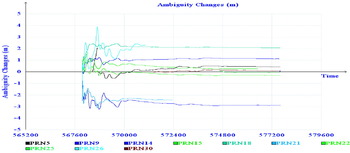
The greater position difference at the beginning of the processing as shown in Figure 3 is due to the less accurate position solutions from the un-differenced GPS and INS integration. This is because the position solution in PPP requires a time period before it can converge to centimetre accurate level due to the fact that the ionosphere-free ambiguity terms are estimated as float numbers and they require a time period to converge to their true values. Figure 5 illustrates the convergence of the ambiguity terms during the data processing. This is not the case for the integration of double difference GPS data and INS data which estimates double difference ambiguity terms that are integers and can be quickly fixed by ambiguity resolution techniques. From Figure 4 however, it can be found that there is no convergence time for velocity estimation because the velocity estimate mainly depends on the phase rate measurements. The test results obtained indicate that even in the high dynamic environment experienced by the test flight, un-differenced GPS/INS integration can provide high quality position and velocity solutions with accuracy at centimetre to decimetre level for position and at centimetre per second for velocity.
Float phase ambiguity convergence.

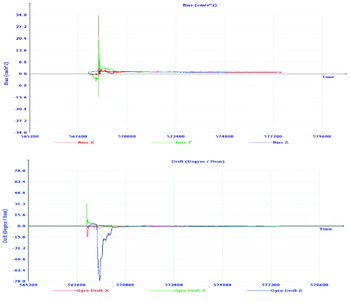
Figure 6 shows the solution for the accelerometer biases and gyro drifts. Although there is no reference for these states, the results demonstrate that the estimates of the accelerometer biases and gyro drifts are stable after the convergence time period as required for the determination of the precise position parameters, which agrees with the physical property of these errors. The test results indicate that for tightly coupled integration of un-differenced GPS and INS data, all system error states can be precisely estimated.
Estimates for accelerometer bias (top) and Gyro drift (bottom).

6. CONCLUSIONS
The observation models have been presented in this paper to facilitate the integration of un-differenced GPS and INS observations for precise position and attitude determination using a single GPS receiver. A tightly coupled un-differenced GPS/INS system has been developed and described in detail. A field test has been conducted to verify the performance of the solutions from the un-differenced GPS and INS integration. The test results indicate that the un-differenced GPS/INS system is able to provide position and attitude solutions with accuracy comparable to current differential GPS/INS systems. With advantages of being more flexible to field operations and more simplified operational logistics, the developed un-differenced GPS/INS system using a single GPS receiver is expected find wide applications in the future especially to those applications where base GPS receiver stations are difficult to set up. The required convergence time, typically about 20 minutes, is a limiting factor. For post-mission applications, it can be overcome by the use of a backward processing strategy that has been widely applied in GPS data processing. In order for the system to support real-time applications, fast ambiguity convergence techniques should be investigated and the research work is currently underway.
ACKNOWLEDGMENTS
Financial supports from NSERC and GEOIDE, and the test data provided by Terrapoint Canada Inc. are greatly acknowledged.