Loneliness is a universal phenomenon mostly accompanied by other negative feelings such as anxiety, anger, hopelessness, sadness, and depression, which visits every human soul in every culture at different times of life cycle. Hence, over the past decades the research and publications on resources and consequences of loneliness have increased rapidly and researchers have become increasingly interested in examining the relationship between attachment dimensions (Bernardon, Babb, Hakim-Larson, & Gragg, Reference Bernardon, Babb, Hakim-Larson and Gragg2011; Feeney, Reference Feeney2006), family and loneliness (Junttila & Vauras, Reference Junttila and Vauras2009; Solomon, Reference Solomon2000; Terrell, Terrell, & Von Drashek, Reference Terrell, Terrell and Von Drashek2000).
Loneliness has been described in various ways throughout the literature. Broadly, loneliness is defined as an unpleasant experience that occur when a person's social relationship network is significantly deficient qualitatively or quantitatively (Peplau & Perlman, Reference Peplau, Perlman, Peplau and Goldston1984). Lonely people were found to perceive themselves in a negative and self-depreciating manner, believing that they were inferior, worthless, unattractive, unlovable, and socially incompetent individuals. Moreover, lonely people have negative perceptions not only about themselves but also about others. Compared to non-lonely people, lonely people perceive others as less trustworthy. Terrell et al. (Reference Terrell, Terrell and Von Drashek2000) found that females who had been taught to distrust strangers in most cultures experience more loneliness than males. Similarly, a study from Jakobsson and Hallberg (Reference Jakobsson and Hallberg2005) showed that women more frequently reported both loneliness and fear than men did. On the other hand, many of the studies have revealed that males are lonelier than females (e.g., Dykstra & de JongGierveld, Reference Dykstra and de Jong Gierveld2004). Similarly, Jackson, Ervin, Gardner, and Schimitt (Reference Jackson, Ervin, Gardner and Schmitt2001) stated that women are more depressed, but men are lonelier. Toivonen, Salmela-Aro, and Eronen (Reference Toivonen, Salmela-Aro and Eronen1997) investigated the strength of the association of loneliness with cognitive and attribution strategies people adopt in social situations. It was found that a pessimistic avoidance strategy was associated with subsequent feelings of loneliness, even after the level of self-esteem was controlled. Both optimistic planning strategy and self-serving attribution bias were negatively associated with feelings of loneliness among men but not among women.
Despite the differences between authors about correlation of gender with loneliness there is common agreement between various authors (e.g., Deniz, Hamarta, & Arı, Reference Deniz, Hamarta and Arı2005; Fraley, Waller, & Brennan, Reference Fraley, Waller and Brennan2000; Hecht & Baum, Reference Hecht and Baum1984; Landman-Peeters, Ormel, van Sonderen, den Boer, Minderaa, & Hartman, Reference Landman-Peeters, Ormel, van Sonderen, Boer, Minderaa and Hartman2008) who have suggested that adolescent and adulthood loneliness may have some of their origins in the historical attachment relationship between the lonely person and his/her caregivers. According to the findings of Hojat (Reference Hojat1982) and Weiss (Reference Weiss1987), one of the key determinants of the patterns of relationships leading to loneliness is the type of relationship developed in early childhood. Weiss (Reference Weiss1987) has suggested that just as in newborns, during adolescence and adulthood there is an internal mechanism designed to find and form an attachment with an individual. The loneliness that an adult or an adolescent experiences, therefore, is a result of this missing attachment figure; parents are relinquished as attachment figures and a search ensues to find an attachment figure and romantic partner. The secure attachment developed in early childhood can be expected to make the individual capable of having more comfort and confidence in close relationships in adult attachments (Collins, Welsh, & Furman, Reference Collins, Welsh and Furman2009; Kafetsios & Sideridis, Reference Kafetsios and Sideridis2006; Herzberg & Hammen, Reference Herzberg and Hammen1999).
Attachment patterns are developed in the first years of life and transferred to adolescence and adulthood (Ainsworth, Reference Ainsworth1989; Bowlby, Reference Bowlby1977). The quality of adult attachment also has some influence on social functioning. Greater attachment, social integration and reassurance of worth are found to be associated with lower levels of loneliness (Kraus, Davis, Bazzini, Church, & Kirchman, Reference Kraus, Davis, Bazzini, Church and Kirchman1993). Similarly to Kobak and Sceery (Reference Kobak and Sceery1988), Bernardon et al. (Reference Bernardon, Babb, Hakim-Larson and Gragg2011) stated that insecurely attached late adolescents had significantly higher hostility scores and reported more loneliness, anxiety and depression. It was also found that the fearful group was the loneliest, followed by the preoccupied and dismissing groups. The secure group was the least lonely (DiTommaso, McNulthy, Ross, & Burgess, Reference DiTommaso, McNulthy, Ross and Burgess2003). In short, researches show that loneliness is correlated positively with insecure attachment dimension (Feeney & Noller, Reference Feeney and Noller1990; Fraley et al., Reference Fraley, Waller and Brennan2000), and negatively with secure attachment dimension (Bogaerts, Vanheule, & Desmet, Reference Bogaerts, Vanheule and Desmet2006; DiTommaso, Brannen, & Burges, Reference DiTommaso, Brannen and Burgess2005; DiTommaso et al., Reference DiTommaso, McNulthy, Ross and Burgess2003; Deniz et al., Reference Deniz, Hamarta and Arı2005; Hecht & Baum, Reference Hecht and Baum1984).
In addition to the researches examining the relation between attachment and loneliness, a number of studies have investigated the relationships among different aspects of family and loneliness (e.g., Feeney, Reference Feeney2006; Terell et al., Reference Terrell, Terrell and Von Drashek2000; Uruk & Demir, Reference Uruk and Demir2003). Family environment, which can briefly described as interactions within a family, has a great impact on the development of individuals’ attachment patterns (Brussoni, Jong, Livesley, & MacBeth, Reference Brussoni, Jong, Livesley and MacBeth2000; Junttila, Vauras, & Laakkonen, Reference Junttila, Vauras and Laakkonen2007; Vasta, Miller, & Ellis, Reference Vasta, Miller and Ellis2004), as well as an influence on one's psychological and socio-emotional functioning (Laible, Reference Laible2007), which includes secure attachment cognitions and their close relationships with others apart from the family members, such as friendships or romantic relationships (Feeney & Noller, Reference Feeney and Noller1990).
Cohesion, which can be defined as the emotional, intellectual and physical closeness among family members, is one of the basic functions of the family. Families teach individuals how to relate to and treat to each another (Barnes & Olson, Reference Barnes and Olson1985; Gülerce, Reference Gülerce1996). Furthermore, it is expected that families provide an appropriate setting for nurturing, growth and education. The family environment is a school for children in whom they acquire social and emotional skills and form their first attachment bonds (Murray & Murray, Reference Murray and Murray2010). In a similar way, Brage, Meredith and Woodward (Reference Brage, Meredith and Woodward1994) found that family strengths and parent–adolescent communication affected the loneliness of adolescents. Johnson, LaVoie, and Mahoney (Reference Johnson, LaVoie and Mahoney2001) suggested that perception of interpersonal conflict and low family cohesion were positively related with feelings of loneliness in both males and females.
Despite the fact that family environment and attachment dimensions are important factors in predicting loneliness (DiTommaso et al., Reference DiTommaso, McNulthy, Ross and Burgess2003), they are both also culturally bonded issues. Hence, a review of childhood experiences in different cultures indicates some significant differences in those experiences. Preliminary findings have indicated that secure, anxious-ambivalent and avoidant attachment classifications occurred in somewhat different proportions in other countries and cultures compared to US culture (Van Ijzendoorn & Kroonberg, Reference Van Ijzendoorn and Kroonberg1988) even though most of the reported research has been conducted in industrialised nations (Bhogle, Reference Bhogle1991). Rook (Reference Rook1988) stated that childhood experiences, which are intertwined with cultural customs and expectations, would affect the subjective experience of loneliness. On the other hand, some studies have demonstrated that higher levels of loneliness are associated with western cultural orientations, which emphasise more individualism (e.g., Schneider, Reference Schneider1998; Sermat, Reference Sermat, Hartoz, Andy and Cohen1980; Cushman, Reference Cushman1995). In other words, the loneliness among more collectivist or transient cultures versus westerners is not known. In her study examining the cultural background on the causes of loneliness, for example, Rokach (Reference Rokach2007) found that causes of loneliness of Canadian participants differed significantly from those of Czech participants.
The cultural dimension plays a prominent role in experiencing loneliness, based on cultural elements, which set standards of perceiving, evaluating, communicating, and behaving among people who share a language, a history and a geographic location (Le Roux, Reference Le Roux2009; Jordaan, Reference Jordaan2004; Sadler, Reference Sadler, Hartog, Audy and Cohen1980). Therefore, loneliness can be linked to individual factors as well as cultural factors (Le Roux, Reference Le Roux2009; Seepersad, Choi, & Shin, Reference Seepersad, Choi and Shin2008). Medora, Woodward, and Larson (Reference Medora, Woodward and Larson1987) stated that the culture and family in which an individual develops are among the important factors affecting the individual's experience of loneliness.
Similarly, Turkish culture plays a dominant role in how loneliness develops and is experienced. Traditionally, Turkish people focus on highly close, interpersonal relationships. Moreover, family relations have great importance in the Turkish culture. Turkish society is rapidly transforming from a rural, traditional society to a modern, urban and industrial one. However, even though there have been rapid economic changes, interpersonal relations and family dynamics are still highly influenced by traditional cultural values. Within the traditional cultural context, family still plays the primary role in shaping interpersonal relations (Çelik, Reference Çelik2007; Gürsoy & Bıçakçı, Reference Gürsoy and Bıçakcı2007; İmamoğlu, Reference İmamoğlu2003; Kağıtçıbaşı, Reference Kağıtçıbaşı2005, Reference Kağıtçıbaşı2010). The educated urban family also encourages emotional intimacy, closeness and sensitivity to the needs of others, and the importance of the family over the individual is emphasised. While there are important areas of continuity between traditional and more westernised families (Sunar, Reference Sunar, Ozdalga and Liljestrom2002), there is a greater encouragement of independence in the child and the child's individual success in westernised families compared to traditional families. For both urban and traditional families, of utmost importance is that the child is a good person, followed by success at school; while popularity, obedience to one's parents and independence are also desired (Ataca, Kağıtçıbaşı, & Diri, Reference Ataca, Kağıtçıbaşı, Diri, Trommsdorff and Nauck2005).
The differences between the Turkish culture and its western counterparts and the impact of these differences on loneliness are an under-researched area. Some research was done on the predictive effect of family environment on attachment styles (e.g., Gezer, Reference Gezer2001) and on the predictive value of family cohesion and loneliness (e.g., Uruk & Demir, Reference Uruk and Demir2003). However, they fall short in explaining the joint relation between family cohesion and attachment dimension and loneliness. Many studies have been developed to investigate the relation of family and attachment dimensions with loneliness in European and American cultures. Although the context of Turkish culture and family system is different from western culture and families, only a limited number of studies have been carried out in Turkish culture.
The purpose of this study was to investigate the relative contribution of attachment dimensions, family environment and gender in explaining the degree of loneliness among university students in the Turkish culture. It was hypothesised that the individuals with coherent families and secure attachment dimension would be more capable of developing healthy relationships and thus feel less lonely, while those with low-coherent families and insecure dimensions would be less capable of developing healthy relationships due to their mistrust towards themselves and their environment.
Method
Participants
Four hundred and seventy-three students (281 females, 192 males) at Ankara University volunteered to participate in the study. The mean age of the participants was 21.1 (SD = 2.46) years. One hundred and nine (23%) students were freshmen, 123 (26%) students were sophomores, 102 (21.6%) students were juniors, and 138 (29.2%) students were seniors. Regarding the faculties in which they are enrolled, 166 (35%) of participants were in Faculty of Educational Science, 132 (27%) in the Faculty of Law, 123 (26%) of participants were in the Faculty of Media, and 52 (29%) participants were in the Faculty of Political Science. All the selected faculties are in the same downtown campus area and provide social science education.
Instruments
Demographic information sheet:
Information about gender, age, faculty, and grade of the participants was gathered using a demographic information sheet prepared by the researchers.
University of California Los Angeles (UCLA) Loneliness Scale:
The UCLA Loneliness Scale was developed by Russell, Peplau, and Cutrona (Reference Russell, Peplau and Cutrona1980). The scale has 20 items with responses on a 4-point Likert scale ranging from never to Often. It consists of 10 positively worded and 10 negatively worded statements reflecting satisfaction with social relationships. Higher scores indicate greater loneliness. In the present study, the Turkish version of the UCLA Loneliness Scale (Demir, Reference Demir1989) was used. The test–retest reliability was .94 and the alpha coefficient was .96. Concurrent validity was demonstrated in that the scale discriminated lonely versus nonlonely people. Correlation between the UCLA Loneliness Scale and the Beck Depression Inventory was found to be .77, while the correlation with the Social Introversion Subscale of the Multiscore Depression Inventory was .82 (Demir, Reference Demir1989).
Family Environment Assessment Scale (FEAS):
The Family Environment Assessment Scale was developed by Gülerce (Reference Gülerce1996) to assess the coherence and functioning patterns within the family environment of Turkish families. The FEAS is a 36-item instrument with a 10-point Likert-type scale ranging from 1 (strongly agree) to 10 (strongly disagree). Communication, marital/family unity, management/organisational control, family competency, and emotional context are the subscales of FEAS that measure different aspects of a family's psychological functioning (Gülerce, Reference Gülerce1996). In order to obtain a total score of FEAS, scores of each participant were calculated by summing the item scores. A cut-off point was accepted as M = 125.62, based on the norm score given by Gülerce (Reference Gülerce1996) for family environment. A score above the norm mean score was accepted as an indicator of high family coherence, while a score below the mean score was accepted as an indicator of low family coherence. The criterion-related validity was obtained by correlating the scores of the instrument with those of the Beavers-Timberlawn Family Assessment Scale. The result revealed a correlation coefficient of .78. The scale significantly discriminated families with clinical symptoms from normal families with no clinical symptoms. The scale also had a satisfactory level of internal consistency (α = .70), stability (r = .79) and split-half reliability (.83) (Gülerce, Reference Gülerce1996).
Experiences in Close Relationships — Revised (ECR-R):
The Experiences in Close Relationships Questionnaire, developed by Fraley et al., (Reference Fraley, Waller and Brennan2000), is a 36-item, 7-point Likert-type self-report measure of adult attachment. More specifically, it measures adult attachment within the context of romantic relationships. It has two subscales, each having 18 items, which measure anxiety and avoidance dimensions. The higher scores are obtained for avoidance or anxiety attachment dimensions. Scores that point out security of attachment are placed at lower levels of these two dimensions. Selçuk, Günaydın, Sümer, and Uysal (Reference Selçuk, Günaydın, Sümer and Uysal2005) adapted the ECR-R into Turkish. In this study, the items are loaded in two factors as they were in the original study. The internal consistencies of attachment avoidance and anxiety subscales were found to be satisfactory (.90 and .86, respectively).
Procedure
The instruments were administered to volunteer students in classrooms by the researchers during the regular class hours. All students were provided with both verbal and written standard instructions. Specifically, students were asked to be honest while responding to the instrument items and were informed about the confidentiality of their responses. Students completed all the measures in approximately 20 minutes.
Results
A hierarchical regression analysis was conducted to examine the extent to which independent variables, namely gender and attachment dimensions, measured as anxiety and avoidance, and family environment predicted loneliness. Hierarchical regression was chosen since it is typically used to evaluate the relationship between a set of independent variables and the dependent variable, controlling for or taking into account the impact of a different set of independent variables on the dependent variable. The hierarchical model calls for a determination of R 2 and the partial coefficients of each variable at the point at which it is added to the equation. In hierarchical regression, the independent variables are entered into the analysis in a sequence of blocks, or groups that may contain one or more variables (Tabachnick & Fidell, Reference Tabachnick and Fidel2007). Hierarchical analysis of the variables typically adds to the researcher's understanding of the phenomena being studied, as it requires thoughtful input by the researcher in determining the order of entry of independent variables, and yields successive tests of the validity of the hypotheses which determine that order (Tabachnick & Fidell, Reference Tabachnick and Fidel2007).
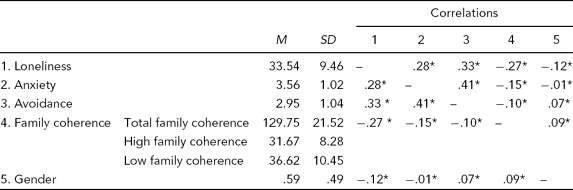
Hierarchical regression is a statistical method of exploring the relationships among, and testing hypotheses about, a dependent variable and several independent variables. Linear regression requires a numeric dependent variable. The independent variables may be numeric or categorical. Gender, which is a categorical variable, was entered as a dummy variable to the regression analysis. Before conducting the analysis, major assumptions of the multiple regression analysis were tested. In order to test normality, descriptive statistics, including mean, standard deviation, skewness, kurtosis and histograms were conducted. Results of these statistics demonstrated that normality was not violated. Descriptive statistics of variables and coefficient correlations were computed and are given in Table 1. In addition, multicollinearity was tested and found no intercorrelation above .70. Additionally, tolerance and VIF values were used for indicators of multicollinearity, and Durbin-Watson was used to test the autocorrelation of variables. As a result, considered the acceptable values (Tabachnick & Fidell, Reference Tabachnick and Fidel2007) multicollinearity and autocorrelations of independent variables were not detected in the present data.
Means and Standard Deviations and Correlations of Loneliness, Gender, Attachment Dimensions, and Family Environment

As seen in Table 1, avoidance and anxiety subscales were correlated significantly positively with each other (r = .41, p < .001). Loneliness was correlated positively with anxiety (r = .28, p <.001) and with avoidance dimensions (r = .33, p < .001) of the attachment scale. There was a negative correlation between loneliness and family coherence (r = −.27, p < .001). In addition, anxiety (r = −.15, p < .001) and avoidance (r = −.10, p < .005) were negatively correlated with family cohesion. Lastly, gender correlated negatively with loneliness (r = −.12, p < .001) and anxiety (r = −.01, p < .001), and positively with avoidance (r = .07, p < .001) and family coherence (r = .09, p < .001).
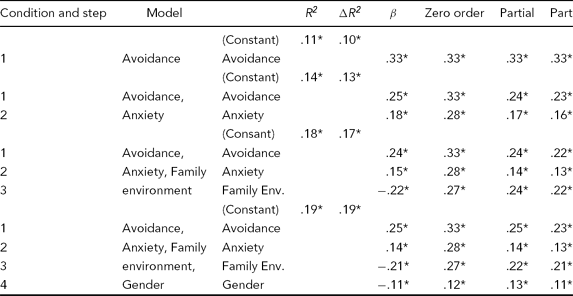
Standardised regression coefficients (β), t values, partial correlation coefficients, zero-order correlation coefficients, and part correlation coefficients of the models are presented in Table 2.
Model Summary of Hierarchical Multiple Regression Analysis and the Bivariate and Partial Correlations and the Significance Levels of β
Note: * p < .05.
In the overall model, avoidance, anxiety, family cohesion, and gender significantly predicted loneliness with beta values of β = .25, p<.001; β = 14, p < .001; β = −.21, \p < .001; and β = −.11, p < .001, respectively. The avoidance attachment dimension significantly predicted loneliness, R 2 = .11 adjusted R 2 = .10, F (1, 471) = 56.37, p = .00. The regression equation with both the avoidance and anxiety dimensions was also significant, R 2 = .14, adjusted R 2 = .13, F (1, 470) = 13.94, p = .001. In addition, the regression equation of family environment and attachment dimensions was significant, R 2 = . 18, adjusted R 2 = .17, F (1, 469) = 27.22, p = .001.
Finally, the regression equation of avoidance and anxiety dimensions of attachment was significant, R 2 = .19, adjusted R 2 = .19, F (1, 468) = 7.5, p = .00, for family environment and gender, indicating that 19% of the variance in loneliness is explained by all factors operating jointly.
To understand the unique contribution of each variable to the prediction of loneliness, partial and zero-order bivariate correlations were reported for each of the individual variables in attachment dimensions, family environment and gender. Of these variables, avoidance and anxiety dimensions were the strongest predictors of loneliness. Partialling out the effects of other predictors, all variables, namely avoidance dimension, anxiety dimension, family environment, and gender, were significantly correlated with loneliness; and among them, the avoidance dimension was the most strongly correlated variable. Strength of the partial correlation between avoidance and loneliness was .33 (p = .001) and between anxiety, avoidance and loneliness was .23 (p = .001).
Discussion
In the present study, predictor values of gender, attachment dimensions and family environment on loneliness were investigated. In general, males, insecure attachment dimensions, and low-coherent families were found to lead to higher loneliness. More specifically, results showed that loneliness was positively correlated with both anxiety and avoidance dimensions of attachment. Moreover, results showed that the avoidance attachment dimension had the strongest correlation with loneliness. The main difference with western counterparts determined in this study was that the avoidant attached males with low-coherent families reported the highest degree of loneliness, whereas in western societies, individuals with fearful attachment type were found to be lonelier (Bernardon et al., Reference Bernardon, Babb, Hakim-Larson and Gragg2011; Hecht & Baum, Reference Hecht and Baum1984; Kobak & Sceery, Reference Kobak and Sceery1988).
Family environment was found to be the second predictor of loneliness. Students who reported their family environment to be high coherent reported lower loneliness. Earlier studies also revealed the importance of a coherent family environment in the development of loneliness (Brage et al., Reference Brage, Meredith and Woodward1994; Girgin, Reference Girgin2009; Uruk & Demir, Reference Uruk and Demir2003). This result is consistent with the findings of Hojat (Reference Hojat1982), who found that adolescents who have problems with their parents were more likely to experience loneliness. Moreover, Johnson et al. (Reference Johnson, LaVoie and Mahoney2001) reported that adolescents’ perceptions of their family were associated with their reports of loneliness, social anxiety, and social avoidance. They proposed that interpersonal conflict and family cohesion were positively correlated with adolescents’ feeling of loneliness. Also, Terrell et al. (Reference Terrell, Terrell and Von Drashek2000) informed that low family cohesion and interparental conflict were related with reported loneliness of individuals.
Although gender, which is the third predictor, was the weakest predictor of loneliness, findings also revealed that males were lonelier than females. These findings of the study are consistent with several other studies (Chen & Chung, Reference Chen and Chung2007; Brage et al., Reference Brage, Meredith and Woodward1994; Demir, Reference Demir1990; Girgin, Reference Girgin2009; Norman & DeWayne, Reference Norman and DeWayne1986; Wiseman & Guttfreund, Reference Wiseman and Guttfreund1995). On the other hand, in their studies, Terrell et al. (Reference Terrell, Terrell and Von Drashek2000) and Woodward and Frank (Reference Woodward and Frank1988) reported that females are lonelier. The present study demonstrated that avoidant attached males with low-coherent families reported the highest degree of loneliness. These can be related to the impact of gender roles in the Turkish culture on developing relationships. As was determined by Gülerce (Reference Gülerce1996), the Turkish culture gives women more opportunity than men do to develop close relationships. This difference can also be taken as a determining factor on the differences in the loneliness levels observed between genders in Turkey.
The findings of the present study are consistent with other Turkish studies examining the loneliness level of the subjects (Uruk & Demir, Reference Uruk and Demir2003). As Güngör (Reference Güngör1996) stated, the similarity between the degrees of loneliness can be due to the fact that these studies were performed with university students. The present study was undertaken at a large university in a big city, Ankara. On the other hand, German, Czech, Canadian, and Chinese participants who were living in the United States, and American students scored significantly higher than Turkish students of a similar age (Adams, Sadors, & Auth, Reference Adams, Sadors and Auth2004; Hsu, Hailey, & Range, Reference Hsu, Hailey and Range2001; Levin & Stokes, Reference Levin and Stokes1986; Rokach & Bauer, Reference Rokach and Bauer2004). Bhogle (Reference Bhogle1991) asserted that being independent and self-reliant in cultures with typical collectivistic and familial values and with large, close-knit families is much less valued than in the North American culture.
As discussed before, in Turkish society, family influence on the regulation of social conduct and the development of identity is greater than in western cultures (Altun, Reference Altun2001; İmamoğlu, Günaydın, & Selçuk, Reference İmamoğlu2011). As the present study is one of the first attempts to investigate the predictive value of attachment dimensions and family environment on loneliness, conducted among a university population in Turkey, the results are clearly preliminary. Further research with larger and more demographically diverse populations will strengthen the findings of this study. Furthermore, other family variables such as socio-economic status, cultural and educational backgrounds of the parents, and several other social and relational variables such as peer relations, social support mechanisms, were not controlled in this study. Especially, cultural and emotional background may be influential (Jong-Gierveld, Reference Jong-Gierveld1987) on adolescents’ attachment experiences and should be included in future studies. Finally, personality characteristics, such as coping mechanisms, social skills, shyness, assertiveness are also needed to be investigated (Peplau & Perlman, Reference Peplau, Perlman, Peplau and Goldston1984) to determine the reasons and consequences of loneliness.
Although it is preliminary, the results of the present study indicate that counsellors, school staff, and families should seriously consider attachment dimensions, family environment, and gender difference when developing prevention and intervention programs for eliminating loneliness in individuals.
In order to help parents dealing with such problems, counsellors should be knowledgeable about these problems, as well as about attachment dimensions, the development of attachment, and the effects of family environment and gender differences on feelings of loneliness.
Awareness of loneliness has significant implications for counsellors in educational settings. School counsellors should be educated in order to prevent loneliness turning into more serious problems such as depression, suicide and drug abuse. Counsellors may also be more helpful and supportive if they understand the importance of family environment on the development of loneliness. Counsellors in school settings can guide parents toward establishing coherent family environment.
Being informed about individuals’ attachment styles is an advantage for counsellors. It will enable the counsellor to determine appropriate counselling strategies for sessions, and to develop functional programs. For example, cognitive–behavioural intervention programs may be effective in changing the working models about themselves and others (Gezer, Reference Gezer2001).
Another point is the effect of gender difference in feelings of loneliness. Research has revealed that males are lonelier than females. Thus, counsellors should pay attention to gender difference while determining an individual's loneliness level.