Introduction
Biodiversity is under threat because of the loss, modification and fragmentation of habitats caused by land development and climate change (Northrup et al. Reference Northrup, Rivers, Yang and Betts2019, Power & Jetz Reference Power and Jetz2019). Land development for human use has induced high rates of extinction and decreased biodiversity as native vegetation that serves as habitat is often removed during urbanization, which is one of the main reasons for land development (Chemini & Rizzoli Reference Chemini and Rizzoli2014). For example, the diversity of native bird species in urban areas is largely dependent on the amount of native vegetation present (Dale Reference Dale2018). The expansion of land development causes changes in habitat configuration and connectivity and thus has serious ramifications for biodiversity (Bai et al. Reference Bai, Xiu, Feng and Liu2019). Anthropogenic climate change is another major threat to biodiversity. Many species have shifted their geographical ranges towards higher latitudes and elevations in the Northern Hemisphere as a result of global warming (Chen et al. Reference Chen, Lupi, Viña, He and Liu2010). The geographical ranges of species of conservation concern are projected to be further affected by climate change in the future (Moritz & Agudo Reference Moritz and Agudo2013). A meta-analysis of 133 studies covering 120 threatened terrestrial mammal species and 569 threatened bird species across four continents concluded that 47% of the mammals and 23% of the birds had been negatively affected by climate change in at least part of their distribution (Pacifici et al. Reference Pacifici, Visconti, Butchart, Watson, Cassola and Rondinini2017).
In response to the threats that land development and climate change pose to biodiversity, considerable interest has focused on allocating conservation investments towards habitat protection in order to mitigate the loss of biodiversity (Scroggie et al. Reference Scroggie, Preece, Nicholson, McCarthy, Parris and Heard2019). For example, payments for ecosystem services to private landowners as compensation for supporting biodiversity conservation have gained popularity (Salzman et al. Reference Salzman, Bennett, Carroll, Goldstein and Jenkins2018). Conservation investment in habitat protection to promote biodiversity typically focuses on identifying either species or sites to protect (Cuesta et al. Reference Cuesta, Peralvo, Merino-Viteri, Bustamante, Baquero and Freile2017, Boland & Burwell Reference Boland and Burwell2020). Regardless of its aim, habitat protection tends to be controversial, mainly because of uncertainties about the costs and benefits associated with it. Land development is a critical source of uncertainty, as it depends on real-estate market fluctuations that influence the costs of conservation investment (Cho et al. Reference Cho, Lee, Roberts, Yu and Armsworth2018). Climate uncertainty is also important for conservation investment decisions, as climate change poses an increasingly imminent threat to biodiversity benefits at multiple scales (Urban Reference Urban2015).
Modern portfolio theory (MPT) has received much attention as a risk-diversification strategy for constructing efficient portfolios of species (Koellner & Schmitz Reference Koellner and Schmitz2006, Sanchirico et al. Reference Sanchirico, Smith and Lipton2008, Moore et al. Reference Moore, McClure, Rogers and Schindler2010, Schindler et al. Reference Schindler, Hilborn, Chasco, Boatright, Quinn, Rogers and Webster2010, Anderson et al. Reference Anderson, Clark and Sheldon2014) or of sites (Ando & Mallory Reference Ando and Mallory2012, Mallory & Ando Reference Mallory and Ando2014, Shah et al. Reference Shah, Mallory, Ando and Guntenspergen2017, Beyer et al. Reference Beyer, Kennedy, Beger, Chen, Cinner and Darling2018, Eaton et al. Reference Eaton, Yurek, Haider, Martin, Johnson and Udell2019, Vinent et al. Reference Vinent, Johnston, Kirwan, Leroux and Martin2019). The tool is commonly used to integrate market fluctuations related to conservation costs, climate uncertainties related to conservation benefits or both (Ando et al. Reference Ando, Fraterrigo, Guntenspergen, Howlader, Mallory, Olker and Stickley2018). For example, Koellner and Schmitz (Reference Koellner and Schmitz2006) illustrate how to handle biodiversity portfolios in ways that manage performance risk by highlighting how the diversity of temperate grassland species has a substantial positive impact on another important ecosystem service: the risk-adjusted yield of biomass. Beyer et al. (Reference Beyer, Kennedy, Beger, Chen, Cinner and Darling2018) apply MPT to identify a global portfolio of habitats for guiding conservation action and strategic investment for coral reefs under rapid climate change. Sharma and Cho (Reference Sharma and Cho2020) adopt MPT to identify a cost-efficient budget distribution for forest protection focused on carbon storage in eight states in the central and southern Appalachian region.
The separate branches of the literature on efficient portfolio analysis for species or sites are helpful for developing conservation investment programmes that focus on protecting either species or sites under uncertainty. Despite the merits of MPT, its applications to conservation investment decisions to date have had a major downside: they have only dealt with a single-dimension optimal solution, seeking either to protect species or to protect sites but not both. However, conservation organizations often want to identify not just what species to protect but also where to protect them as a risk-diversification strategy. For example, conservation organizations often evaluate which species are most in need of conservation as well as which sites can be protected most effectively. Even given these practical needs, studies that deal with both dimensions of conservation decision-making under uncertainty are absent from the literature.
The objective of this research is to identify optimal conservation investment allocations for target regions and species within those regions under uncertain conditions. We develop a two-step approach using MPT to estimate an investment portfolio represented by percentages of conservation investment allocated to counties and taxonomic groups (referred to as ‘portfolio weights’) in the central and southern Appalachian region (see Supplementary Fig. S1, available online) under climate and market uncertainties. In the first step, optimal target counties are identified and corresponding portfolio weights for biodiversity protection are estimated at four portfolio risk-tolerance levels represented by the standard deviation of expected return on investment (ROI). The four sets of portfolio weights indicate optimal percentages of budget allocation at the county level for the protection of overall biodiversity at four different risk-tolerance levels. In the second step, taxonomic group portfolio weights are estimated for each individual target county chosen at each risk-tolerance level in the first step. The taxonomic group portfolio weights indicate optimal percentages of budget allocation that benefit the biodiversity of four particular taxonomic groups for each individual target county.
The sequence of the two steps is determined based on the assumption that the first step finds the risk diversification strategy that focuses on spatial targeting (referred to as ‘spatial diversification’) for overall biodiversity protection and the second step determines the risk diversification strategy (referred to as ‘taxonomic diversification’) that optimally distributes county-level investment shares from the first step among specific taxonomic groups. The two-step MPT approach as a whole is critical because spatial diversification in the first step does not isolate specific amounts of conservation investment tailored to specific taxonomic groups, while the second step lacks the spatial diversification component.
Methods
In the first step of the MPT approach, we used the expected county-level ROIs of biodiversity conservation for protecting 258 forest-dependent vertebrates that are of policy concern at the county level. In the second-step, we used the expected ROIs of four taxonomic groups (i.e., amphibians, birds, mammals and reptiles) in each of the first step’s optimally selected counties. We chose 2050 as a future timeframe for the modelling because it is far enough into the future to allow climate and market uncertainties to influence benefits and costs. The species benefits for the expected ROIs of biodiversity and of taxonomic groups were calculated by estimating future species distributions using species distribution models (see Section S1 for details of how future species distributions were predicted).
The conservation costs for the expected ROIs were specified by urban return minus forestland return (referred to as ‘relative opportunity cost’) under the assumption that urban development is the dominant competing land use for forestland. The relative opportunity cost considers the cost of avoiding the conversion of unprotected forestland to urban land. The assumption is made based on evidence that urbanization and land fragmentation predominantly change the spatial structure of forest landscapes in the study region (Wear & Greis Reference Wear and Greis2013, Keyser et al. Reference Keyser, Malone, Cotton and Lewis2014). For example, urbanization-driven forest loss centres on the Cumberland Plateau region (Keyser et al. Reference Keyser, Malone, Cotton and Lewis2014). To predict the forest landowners’ relative opportunity costs, we needed forecasts of annualized forest and urban returns (see Section S2 for details of how relative opportunity costs were predicted).
Our cost estimate represented by relative opportunity cost reflects the cost of avoiding forestland conversion and does not consider the costs of ongoing management associated with maintaining conservation benefits. Consequently, we do not differentiate among the costs of protecting different taxonomic groups, which could vary among the groups, and thus the costs are different across counties, but within a county they are the same for the four groups. Nevertheless, Gordon et al. (Reference Gordon, Butt, Rosner-Katz, Binley and Bennett2020) found no statistically significant differences in total (or mean) species recovery costs among vertebrate taxonomic groups. Thus, these costs are likely to have small differences among vertebrate taxonomic groups, leading us to focus on the costs of avoiding conversion, which also is the most straightforward to generalize to a taxonomic group.
We estimated the expected ROIs for individual species for each county in 2050 by using their future benefit measures and relative opportunity costs (see Section S3 for details of how expected ROIs were estimated). We aggregated the expected ROIs of 258 forest-dependent vertebrates into one expected ROI for overall biodiversity conservation at the county level for 193 of 246 total counties in the study region. The 193 counties remained after filtering out consolidated city-counties and counties that do not face urban development pressures (see Fig. S1). Then, we specified the 193 counties as potential conservation targets in the first step, where portfolio weights were determined representing optimal percentages of conservation investment for overall biodiversity across counties at four risk-tolerance levels. In the second step, we selected counties with positive portfolio weights assigned in the first step at four risk-tolerance levels and determined portfolio weights for the protection of four taxonomic groups for each individual county selected. By focusing on counties with positive portfolio weights in the first step to determine portfolio weights for taxonomic groups in the second step, we implicitly assume that counties with non-positive weights in the first step are excluded from spatial and taxonomic diversification strategies because they are of no consequence for those.
The following subsection provides a description of how we used the scenario-specific expected ROIs (see Section S4 for details of scenario design) to derive efficient portfolios for each step of our MPT approach (see Fig. S2 for a schematic diagram of the empirical framework and their related scenarios).
MPT framework
For simplicity, we offer a single MPT framework below because the same MPT framework was applied in both steps of the two-step approach. Under climate and market uncertainties, the MPT framework determines the optimal portfolio weight
 ${w_i}$
for an asset
 $i$
by minimizing the portfolio’s variance
 $\sigma _P^2$
for a particular portfolio
 $P$
of assets, conditional on the weights that achieve a target level of the portfolio’s expected ROI,
 ${\overline \mu _P}$
, as follows:
 $$Mi{n_w}:\;\sigma _p^2 = {w^T}\Omega w$$
subject to
 $${w^T}\mu = {\overline \mu _P}$$
 $${w^T}1 = 1$$
where
 $w$
is an
 ${\rm{n}} \times 1$
vector of optimal portfolio weights
 ${w_i}$
,
 ${w^T}$
is a
 $1 \times {\rm{n}}$
vector transpose of
 $w$
,
 $\Omega $
is an
 ${\rm{n}} \times {\rm{n}}$
variance–covariance matrix and
 $\sigma _P^2$
is the portfolio’s variance, which is the variance of the weighted sum of the expected ROIs of assets (i.e., counties in the first step and taxonomic groups in the second step). The variance of an asset
 $i$
is calculated as
 $\sigma _i^2 = \mathop \sum \nolimits_{s \in S}^{} {\left( {{r_{is}} - {\mu _i}} \right)^2}{p_s}\;\forall i \in n$
, in which
 ${\mu _i}\;$
is the expected ROI of asset
 $i$
under all climate and market scenarios and is equal to
 $\mathop \sum \nolimits_{s \in S}^{} {r_{is}}{p_s}\;\forall i \in n$
,
 ${r_{is}}$
is the ROI of asset
 $i$
in scenario
 $s$
and
 ${p_s}$
is the probability of scenario
 $s\;$
occurring.
The optimal solutions from the second step of the two-step approach may yield zero or extremely small portfolio weights for any of the four taxonomic groups within a selected county indicating zero or an extremely small percentage of the budget being allocated to the target taxonomic group. This possibility is concerning since it implies that taxonomic groups are completely fungible, which would inevitably lead to poor ecological outcomes if an entire taxonomic group of a selected county were lost following such recommendations. Thus, we ran an alternative second step that constrains the portfolio weights required for each taxonomic group within each selected county to a minimum of 10%. Although we mainly discuss the portfolio weights of the second step without the 10% constraint in the ‘Results’ and ‘Discussion’ sections, we briefly comment on the alternative outcome as a sensitivity analysis in the Supplementary Material. We note that changes in the portfolio weights triggered by the constraint can be mostly explained by the covariance structure among taxonomic groups (see Section S6 and Table S3 for detailed outcomes).
Consistent with a uniform prior on climate and market uncertainty, we assumed an equal probability of each scenario by setting
 ${p_s}$
to be the inverse of the number of the scenarios. Optimal portfolio weights
 $w$
were obtained by solving minimization problems for both steps. We derived an efficient portfolio frontier by connecting the coordinates between aggregated expected ROIs and their standard deviations at 100 different points. While an infinite number of points could be chosen, the 100 points were arbitrarily selected for a given portfolio frontier with equal intervals between the points (i.e., a single portfolio frontier for targeting overall biodiversity and different numbers of portfolio frontiers for targeting specific taxonomic groups for the selected counties at the different risk levels). The optimal portfolio frontiers were converted to maps and pie charts that illustrate how conservation organizations with various risk tolerances can optimally distribute the portfolio weights of each target county for overall biodiversity and the portfolio weights for each taxonomic group given the optimally selected counties.
For illustrative purposes, we assumed risk tolerances of conservation organizations to be represented by four standard deviations: 5 percentage points above the minimum standard deviation (referred to as ‘5% risk tolerance’); 15 percentage points above the minimum standard deviation (referred to as ‘15% risk tolerance’); 25 percentage points above the minimum standard deviation (referred to as ‘25% risk tolerance’); and maximum standard deviation (referred to as ‘maximum risk tolerance’). We focused on the portfolios with various risk options as MPT is commonly used to identify diverse portfolios that reduce risk by different amounts (Schuster et al. Reference Schuster, Hanson, Strimas-Mackey and Bennett2020). We assumed that the risk tolerances of conservation organizations are consistent across both steps. For example, a conservation organization evaluating spatial diversification in the first step at maximum risk tolerance would use the same risk tolerance in evaluating taxonomic diversification in the second step.
The product of the portfolio weights from the two steps offers the optimal portfolio weight of a taxonomic group in a selected county for a given risk tolerance. Using these weights and a hypothetical total budget of US$1 million, we calculated how much of the investment budget to optimally distribute to each county for the biodiversity of the particular taxonomic group for each risk tolerance.
Results
Figures 1 and S3, respectively, show the mean standard deviation relationships for the portfolio frontier from the first step (spatial diversification of biodiversity) and 12 portfolio frontiers (i.e., five counties at 5% risk tolerance, three counties at 15% risk tolerance, three counties at 25% risk tolerance and one county at maximum risk tolerance) from the second step (taxonomic diversification), given the selected counties from the first step at these risk tolerances. As Clay County (AL), Wolfe County (AL), Preston County (WV) and Coosa County (AL) were selected at more than a single risk tolerance in the first step, 8 of the 12 portfolio frontiers in the second step are unique. All portfolio frontiers consistently show a concave relationship between the expected ROI and its standard deviation (risk), reflecting an increase in the risk–return trade-off (i.e., the potential sacrifice in the expected ROI for a given decrease in its standard deviation towards the origin) affected by the covariance structure across counties and taxonomic groups. The relevant meanings and implications of the rates of changes in the slopes of the efficient frontiers are provided in Section S5.
Mean standard deviation relationships for the portfolio frontier from the first step of our modern portfolio theory approach (spatial diversification of overall biodiversity). ROI = return on investment.

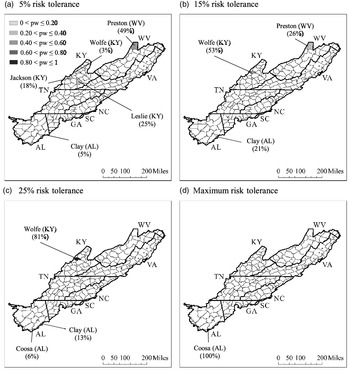
Table 1 and Fig. 2a–d show the optimal portfolio weights under the four risk tolerances for the portfolio frontier from the first step shown in Fig. 1. The portfolio weights generally indicate that the lower the risk tolerance, the greater the number of counties assigned portfolio weights, which is consistent with a risk-diversification pattern. The findings suggest that the target counties are conditional on risk tolerance. For example, the counties with the two highest portfolio weights are: (1) Preston County (WV) and Leslie County (KY) at 5% risk tolerance; (2) Wolfe County (KY) and Preston County (WV) at 15% risk tolerance; and (3) Wolfe County (KY) and Clay County (AL) at 25% risk tolerance. The county with the highest portfolio weight is Coosa County (AL) at maximum risk tolerance. The portfolio weights at lower risk tolerances versus higher risk tolerances are dictated by the differences in expected ROIs among selected counties, their standard deviations and the covariances across the ROIs under different future climate and market scenarios.
Portfolio weights for the counties selected in the first step of our modern portfolio theory approach (referred to as ‘Portfolio weights 1’), portfolio weights for the four taxonomic groups in the second step of our modern portfolio theory approach (referred to as ‘Portfolio weights 2’) and the portion of total budget optimally distributed to the counties for the conservation investments that benefit the biodiversity of particular taxonomic groups under four risk tolerances using a hypothetical total budget of US$1 million (referred to as ‘Optimal budget distribution of US$1 million’).

The optimal portfolio weights (pw) for the counties selected in the first step of our modern portfolio theory approach at 5%, 15%, 25% and maximum risk tolerances represented by the four vertical lines in Fig. 1.

Specifically, the expected ROIs and their standard deviations for the counties selected in the first step to be consistently lower at lower risk tolerances. For example, the five counties selected at 5% risk tolerance had a 76% lower average expected ROI and an 87% lower average standard deviation than the single county selected at maximum risk tolerance (see Table S1 for the averages and standard deviations for target counties under different risk tolerances). In addition, selected counties for portfolios at lower risk tolerances tend to have lower covariances across the ROIs under different climate and market scenarios. For example, the average pairwise covariance among the selected counties for the portfolio at 5% risk tolerance (i.e., Clay County (AL), Jackson County (KY), Leslie County (KY), Wolfe County (KY) and Preston County (WV)) was 0.000078, while the average covariance among the selected counties for the portfolio at 25% risk tolerance (i.e., Clay County (AL), Coosa County (AL) and Wolfe County (KY)) was 0.0015561, which was 181% greater than the value for 5% risk tolerance.
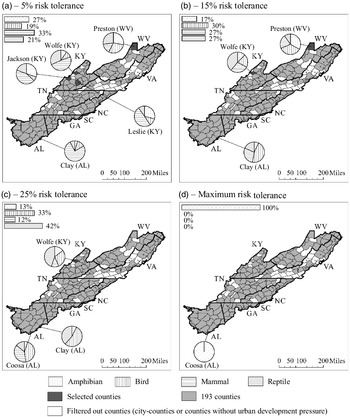
The optimal portfolio weights for the four taxonomic groups from the second step, given a specific risk tolerance and the selected counties from the first step (Table 1 & Fig. 3a–d), indicate that the target taxonomic groups are conditional on the selected counties as well as the risk tolerance. The portfolio weights for the four taxonomic groups varied considerably across the counties for the same risk tolerance. For example, at 5% risk tolerance, more than 40% of portfolio weights were assigned to the mammal group in Leslie County (KY) and Wolfe County (KY), whereas only 15% of portfolio weights were assigned to the mammal group in Preston County (WV) (see Fig. 3a for the maps and pie charts of the portfolio weights and the locations of the counties). The difference is triggered by differences in the expected ROIs and standard deviations for the same taxonomic group across the counties. For example, at 5% risk tolerance, the mammal group had the lowest expected ROIs and standard deviations in Leslie County (KY) and Wolfe County (KY), while the same mammal group had the highest expected ROI and standard deviation in Preston County (WV). These findings suggest that conservation organizations may take different conservation strategies for taxonomic diversification in different counties even for a given decrease in risk tolerance, depending on the counties’ expected ROIs and standard deviations.
Portfolio weights for the four taxonomic groups identified in the second step of our modern portfolio theory approach in the counties selected in the first step of our modern portfolio theory approach at 5%, 15%, 25% and maximum risk tolerances. Bar graphs in the top-left corner of each map show the overall portfolio weights for each taxonomic group at each risk tolerance.

Likewise, the portfolio weights for the four taxonomic groups varied considerably across risk tolerances for a given county. For example, at 5% risk tolerance in Clay County (AL), portfolio weights of 4%, 12%, 76% and 8% were assigned to amphibian, bird, mammal and reptile groups, respectively, while at 25% risk tolerance, portfolio weights of 7%, 54%, 0% and 38% were assigned to those taxonomic groups, respectively (see Fig. 3b–d for the maps and pie charts of the portfolio weights and the locations of the counties). These findings suggest that conservation organizations can adjust conservation investments that benefit the biodiversity of the four taxonomic groups in a particular county to accommodate the level of risk that they can endure based on the taxonomic groups’ expected ROIs and standard deviations in that county. For example, since the mammal group had the lowest expected ROI and standard deviation in Clay County (AL), at 5% risk tolerance most portfolio weight was assigned to the mammal group in that county, while at 25% risk-tolerance most portfolio weight was assigned to the taxonomic groups with the second-lowest and third-lowest expected ROIs: bird and reptile groups (see Table S1 for the expected ROIs and standard deviations for the four taxonomic groups in selected counties under the four risk tolerances). Moreover, the overall allocation of the conservation budget among the taxonomic groups varied across risk tolerances. For example, at 5% risk tolerance, portfolio weights of 33%, 27%, 21% and 19% were assigned to amphibian, bird, mammal and reptile groups, respectively, while at maximum risk tolerance, portfolio weights of 100%, 0%, 0% and 0% were assigned to the respective taxonomic groups (see Fig. 3a & d for the bar graphs for the overall portfolio weights for each taxonomic group). These findings suggest that conservation organizations’ investments for each taxonomic group can be modified to fit their risk tolerances.
Table 1 also summarizes the amounts of the total budget optimally distributed to the counties for conservation investments that benefit the biodiversity of particular taxonomic groups using the product of the portfolio weights from the two steps and a hypothetical total budget of US$1 million. At 5% risk tolerance in Preston County (WV), the largest percentage of the budget (29% of the total budget allocated to that county) targeted US$144 630 to benefit the biodiversity of the bird group, whereas at 25% risk tolerance in Wolfe County (KY), the largest percentage of the budget (44%) targeted US$361 582 to benefit the biodiversity of the reptile group. These findings and overall numbers suggest that increases in risk tolerance expand the optimal budget for conservation investment to protect a particular taxonomic group in a selected county or vice versa.
Allocating funds to a particular taxonomic group in a given county would increase the expected number of species in the county. We report the subsequent increases in expected numbers of species in Table 2 corresponding to the optimal budget distribution in Table 1. The values are estimated by multiplying the average ROI for each taxonomic group reported in Table S1 with the budget allocated to the corresponding taxonomic group reported in Table 1. The values in the table show the average increases in the numbers of species when the optimal budget amount is invested in a specified county. These average benefit estimates reflect an overall baseline assumption in which each scenario associated with climate, market and economic growth rate is given uniform (or equal) probability. Therefore, this finding implies that the projected value is not directly linked to any specific scenario, any specialized conservation action or any ongoing management associated with maintaining conservation benefits. Instead, it is simply the average of the change in the number of species conserved as the consequence of reversing urban growth resulting from land protection investments based on the future species’ distributions and future conservation costs. Hence, the budget allocations from the second step are assumed to be the amounts of the total budget optimally distributed to the counties for conservation investments benefitting the biodiversity of particular taxonomic groups for each county.
Subsequent increases in expected numbers of species corresponding to the optimal budget distribution in Table 1. The values show the average increases in the numbers of species persisting when the optimal budget amount is invested in a specified county.

Because of the considerable differences in the expected ROIs across species and counties (Table S1), the amount of optimal budget allocated to a county does not linearly increase the expected number of species (see Table 2 for increases in expected numbers of species by county). For example, the 65% of the total budget for the reptile taxonomic group (i.e., US$134 492 out of US$207 212) optimally allocated to Preston County (WV) at 5% risk tolerance yields 37% of the total increase in expected number of species for the reptile taxonomic group. By contrast, only 5% of total budget for the reptile taxonomic group (i.e., US$10 696 out of US$207 212) optimally allocated to Wolfe County (KY) at 5% risk tolerance yields 17% of the total increase in expected number of species for the reptile taxonomic group. This comparison suggests that the conservation investment for the reptile group is more cost efficient in Wolfe County (KY) than in Preston County (WV). These findings imply that conservation organizations may target Wolfe County (KY) over Preston County (WV) if they want to focus on improving the biodiversity of the reptile group.
Discussion
We developed a two-step approach using MPT that estimates portfolio weights for counties and taxonomic groups based on the central and southern Appalachian region under climate and market uncertainties. The portfolio weights across the counties and taxonomic groups from the two steps entail a combined spatial and taxonomic diversification strategies.
Our three main results of spatial, taxonomic and combined spatial and taxonomic diversification strategies each have their own unique implications for conservation organizations with differing goals and conditions. For example, a species threat abatement and restoration (STAR) metric developed by the International Union for Conservation of Nature (IUCN) Species Survival Commission quantifies the contributions of specific conservation and restoration actions in specific locations for terrestrial amphibians, birds and mammals (IUCN 2021a). The STAR metric supports conservation organizations and agencies in identifying geographical targets for the protection of overall biodiversity by summing STAR metrics among taxonomic groups. By applying the STAR metric instead of the expected ROI to the first step, portfolios of target sites for biodiversity can be created to help improve spatial diversification.
Conservation organizations also often develop lists of species in different threat categories for protective measures in a priority site. For example, the IUCN (2021b) reports the Mediterranean Red List of Species that informs on the threat status of species in the Mediterranean Basin, which is the second largest biodiversity hotspot globally. The probability of extinction is one of the main attributes that determines to which of the nine different threat categories a species is assigned (IUCN 2012). Accounting for the impact of climate change on population decline by developing models of bioclimatic habitat or population dynamics is encouraged in assessing species for the IUCN Red Lists (IUCN Standards and Petitions Committee 2019). While the effects of climate change on species are analysed using various model outputs under different future climate scenarios, the scenario-specific models cannot help with the identification of portfolios of threatened species that can diversify climate and other types of risk. Thus, the application of our second step to the Mediterranean Red List to develop diversified conservation investments that benefit the biodiversity of particular taxonomic groups is critically needed.
Conservation organizations also often want to identify both target sites and species under conditions of uncertainty. For example, Global Conservation Fund (GCF 2021), which helps design and support sustainable financing mechanisms, is intended to protect the natural areas that are most essential to human well-being without predisposition towards protecting either specific sites or species. Because of this flexibility, the GCF is a suitable candidate for the application of the two-step MPT approach, which can suggest spatial portfolios that are also tailored for diversifying conservation investments that benefit the biodiversity of particular species or taxonomic groups.
Despite our study’s contribution, we offer several caveats. Our empirical model is framed at the county and taxonomic group levels, whereas conservation decision-making is often made at finer individual parcel and species levels. We are capable of creating binary suitability layers for individual species at the 1-km2 pixel level; however, establishing cost data at this scale for a large study area is challenging because of the difficulty of obtaining consistent cost data that are composed of returns from both urban and forestland at such a fine scale. With those data available, future research could explore the two-step MPT approach at the individual parcel or site level and/or the individual species level to provide more refined policy implications. This kind of framework would require switching from optimally solving for continuous portfolio weights for budget allocations across counties and taxonomic groups to binary decisions for specific parcel sites for conservation investment targeting individual species’ biodiversity. In addition, such a revised framework would need to include considerations that are relevant at the parcel or site scale, such as species connectivity and adjacency to other protected sites.
The use of county-level relative opportunity costs to proxy conservation costs for the four taxonomic groups within a county in the second step of the MPT approach is another limitation of our study if such costs are similar across counties. The reason for this is that this approach does not incorporate differences in cost associated with conservation actions or any ongoing management associated with maintaining the conservation benefits for each taxonomic group. Such differences in cost are important to consider in a taxonomic diversification strategy for cases where the relative opportunity cost is similar across counties because some taxonomic groups are more expensive to conserve, especially if they require intensive actions. For example, nest boxes may be needed to conserve some bird groups, while predator exclusion fencing may be necessary for the effective protection of some mammal groups, and such costs are drastically different and become a significantly different component of total cost if the relative opportunity cost is similar. In short, an analysis that considers the costs of ongoing management associated with maintaining conservation benefits or of conservation activities would probably need to be done on a species-by-species or taxonomic group-by-taxonomic group basis for cases where the relative opportunity cost is similar across counties.
Conclusion
The optimal portfolio weights for the counties and taxonomic groups from our two-step approach offer risk-diversification information to help conservation organizations determine which taxonomic groups to protect in which counties and the shares of the total investment budget to allocate for given market and climate risk levels. Furthermore, our two-step MPT approach can identify different optimal target counties and taxonomic groups along a continuum of assumed risk levels. These optimal risk diversification strategies can be presented to conservation organizations, who can then choose a strategy that matches their risk tolerances. The outcomes from each step of this approach have vital implications in their own rights. For example, conservation decisions that allow for selecting sites for risk diversification fit the purpose of the first step of our MPT approach. Likewise, conservation investments that benefit the biodiversity of particular species for a selected site are made based on the relative importance among species of diversifying risk in that site, fitting the purpose of the second step of our MPT approach. The two-step MPT approach as a whole allows the greatest flexibility regarding where and what to protect for conservation investment under uncertainty and thus would be applicable for the distribution of general conservation funds without prior motivation to protect either specific sites or species.
Supplementary material
To view supplementary material for this article, please visit https://doi.org/10.1017/S0376892922000194.
Acknowledgements
We gratefully acknowledge B Wilson, J Menard, L Lambert, T Kim, S Kwon, J Mingie, S Moon, PR Armsworth, M Soh, OF Bostick, JG Welch, M Papes, G Zhu, Y Lee, BP Sharma and X Giam for helpful discussions and data support.
Financial support
We gratefully acknowledge the Agriculture and Food Research Initiative Competitive Grant No. TEN2021-10861 and No. 111216290 from the USDA National Institute of Food and Agriculture through the project ‘Dynamic portfolios of spatial and temporal forest-based biodiversity conservation’ and ‘Optimal spatial targeting of payments for forest-based ecosystem services under climate and market risks’, respectively.
Competing interests
The authors declare none.
Ethical standards
None.